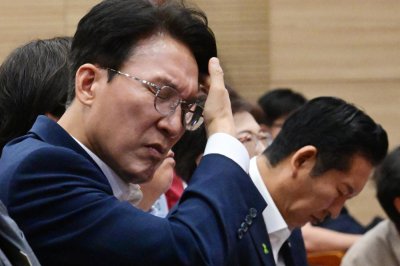

Democratic Party leadership candidates Kim Min-seok, left, and Jung Chung-rae attend a youth and labor policy forum at the National Assembly in Seoul on Wednesday. Photo by Asia Today
July 22 (Asia Today) — South Korea’s ruling Democratic Party leadership race has descended into an increasingly bitter dispute over allegations that members of a controversial religious group may be attempting to influence the party’s Aug. 17 national convention.
The dispute began after former Prime Minister Kim Min-seok, a candidate for party leader, raised the possibility that the Shincheonji Church of Jesus was intervening in the election.
Shincheonji is a South Korean religious movement whose alleged political activities have become the subject of a national investigation. The church has denied allegations that it directed members to join political parties or interfere in elections.
Kim’s claims have revived questions about why proposed legislation authorizing a special counsel investigation into Shincheonji was abandoned while rival candidate Jung Chung-rae was serving as Democratic Party leader.
The controversy has escalated beyond the original allegations. Jung has denied wrongdoing and threatened legal action, while his allies have demanded that Kim produce evidence, apologize or withdraw from the race.
Party members have warned that the dispute could deepen factional divisions and make it difficult to reunify the party after the convention.
The conflict is increasingly being viewed as a proxy battle between supporters of President Lee Jae Myung and those aligned with Jung.
Kim is generally associated with the party faction loyal to Lee. Jung, a former party leader, has developed his own base among rank-and-file members, and several senior party figures have publicly rallied behind him.
“The essence of this convention is to defeat an alliance of anti-Lee forces, divisive elements and Shincheonji,” Kim said Tuesday. “We must also examine, one by one, why the Shincheonji special counsel investigation did not proceed.”
Kim did not identify Jung by name. His remarks, however, were widely interpreted as criticism of Jung because proposed special counsel investigations into Shincheonji and the Family Federation for World Peace and Unification were abandoned during Jung’s tenure as party leader.
Rep. Lee Geon-tae, an ally of President Lee, reinforced Kim’s allegation in a social media post.
“It appears difficult to dismiss Shincheonji’s alleged intervention in the party convention as mere speculation,” Lee said. “We need to determine why the special counsel legislation was halted.”
Jung denied the allegations and said he would take legal action against the dissemination of false information.
Rep. Moon Jeong-bok, a Supreme Council member aligned with Jung, challenged Kim during a party leadership meeting Wednesday.
“What evidence supports the claim of a secret alliance with Shincheonji, and why is this allegation being used to place the party in danger?” Moon said. “He said he has evidence, so he must disclose it and accept responsibility.”
Reps. Choi Min-hee, Lee Sung-yoon and Han Min-soo, who are running for seats on the party’s Supreme Council and are considered Jung allies, issued a similar demand at a news conference.
They said Kim should apologize and withdraw his candidacy if he could not substantiate the allegation.
“He is portraying the Democratic Party as though it were violating the constitutional separation of religion and politics to gain an advantage in the election,” they said.
Some party officials said Kim’s accusation could backfire because Jung’s supporters may interpret it as an attempt to associate all of them with Shincheonji.
“It could be understood as linking every party member who supports Jung to Shincheonji,” a Democratic Party official said. “That could provoke voters and create even greater barriers between groups of supporters.”
Party members said the larger concern was that the fight could undermine unity long after the leadership election ends.
The repeated allegations, threats of lawsuits and demands for candidates to withdraw have pushed debate over party policies and future priorities into the background, they said.
“A certain level of conflict was expected before the convention, but the candidates are now crossing lines that should not be crossed,” another Democratic Party official said.
“The candidates and party leadership must prevent further division so these wounds do not remain after the primary is over.”
— Reported by Asia Today; translated by UPI
© Asia Today. Unauthorized reproduction or redistribution prohibited.
Original Korean report: https://www.asiatoday.co.kr/kn/view.php?key=20260723010008191