Russia is developing a new balloon-borne system that could provide battlefield access to high-speed data communications at a time when its forces are desperate to keep connected. The testing of the Barrage-1 balloon comes as Ukrainian troops are taking advantage of Russia’s loss of access to the SpaceX Starlink satellite constellation network. Both sides have become dependent on the SpaceX system for daily wartime operations, but the restrictions on Russia’s use of Starlink are allowing Kyiv’s forces to fend off attacks in some areas while advancing in others. You can read more about Russia’s Starlink troubles in our initial story here.
As we previously noted, the introduction of Starlink to the battlefield in Ukraine revolutionized how war is waged, giving users high bandwidth, relatively secure communications basically anywhere, all in a small, off-the-shelf package. Though Elon Musk’s SpaceX company provided them to Ukraine, Russians soon came to rely on them as well. However, earlier this month, the company created a list of verified users, cutting Russia off from the system and throwing its troops into disarray. We will talk more about that later in this story.
The Barrage-1 balloon recently underwent its first test flight, according to Russia’s Foundation for Advanced Studies (FFAS), which is developing the system. It “is designed to carry up to 100 kilograms (about 220 pounds) of payload at an altitude of up to 20 kilometers (about 12 miles),” FFAS recently announced on Telegram. One of the payloads being considered is “a promising 5G NTN terrestrial communication equipment, the testing of which is planned for the near future,” the organization claimed.
While not reaching anywhere near the low earth orbit (LEO) altitudes as the Starlink constellation – between 341 miles to 298 miles – Barrage-1 could still serve as an alternative access point for high-speed data transfer for troops on ground below.
Regardless of FFAS intentions, however, even if it is perfected, the Barrage-1 system will not provide the same level of coverage as Starlink, which is made up of thousands of laser datalink-connected satellites covering the globe. In contrast, Barrage-1 will be guided by “a pneumatic ballast system, which allows changing the flight altitude to utilize wind currents and move in the desired direction.”
“Due to this, the platform can maneuver and stay in a specified area or move along the trajectory required for the payload,” FFAS claimed, despite being in the very earliest stages of testing.
You can read all about how high-altitude balloons can stay on station even in the presence of prevailing winds in this past story of ours.
Even though it wouldn’t be a direct match to Starlink, at 12 miles high, it could provide wide-area connectivity similar to that offered by Starlink, albeit over a much more limited area. A mini ‘constellation’ of these systems spread over a region and mesh-networked together, could help solve the line of sight limitations of a single balloon.
Ukrainian Defense Ministry (MoD) advisor on defense technology and drone and electronic warfare (EW) expert Serhiy “Flash” Beskrestnov sees potential in this system.
“The platform is seen as an accessible and efficient alternative to expensive satellite constellations in LEO,” Beskrestnov explained on Telegram. “One of the priority tasks for ‘Barrage’ will be to test 5G NTN communication. Placing transmitters at an altitude of 20 km will allow providing high-speed internet and communication to vast territories where the construction of ground towers is impossible.”
“In theory and in practice, by controlling the altitude of an aerostat, it can be steered, not precisely, but enough to stay over any territory,” he added.
However, the Barrage-1’s comparatively low altitudes could make them targets for Ukrainian air defense systems and other countermeasures.
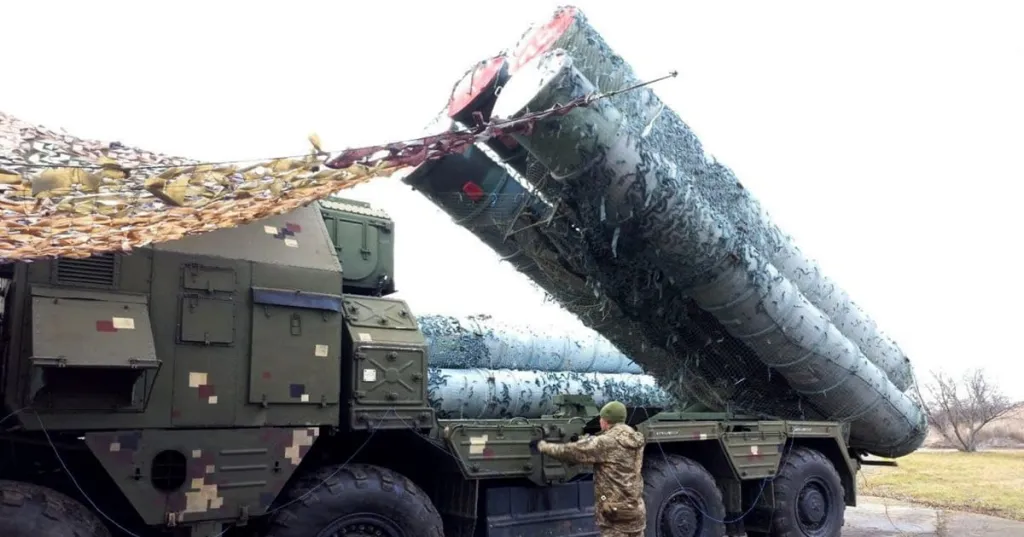
“And what’s most important for us? To have the means that can detect such objects over our territory,” Beskrestnov suggested. “And to have the ability to shoot down such targets if they pose a threat. As far as I remember, the S-300 [surface to air missile system] can engage targets at an altitude of 20-30 km (about 12 to 19 miles).”
Still, successfully targeting and engaging a balloon with a small radar signature using SAMs are two different things. Russia worked on this exact problem extensively during the Cold War, which you can read about here.

The balloons could also fall victim to other forms of attack. It isn’t hard to imagine Ukraine producing a drone to specifically hunt for these systems at longer ranges. Their emissions would make them hard to hide. Also, the electronic warfare aspect is worth noting for the same reasons.
The concept of using balloons as communications nodes is far from new. It has been around for many years. The U.S. military continues to eye using balloons to lug communications relays and gateways aloft as well. As we previously noted, the U.S. once even considered sending balloons over Cuba with equipment that would allow citizens to have access after the government cut it off. For homeland applications, high altitude balloons have been eyed to replace cellular towers, especially after natural disasters have wiped-out ground-based communications.

The SpaceX restrictions have impacted everything from Russia’s high-level command and control, to basic communications and data exchange between troops across the entire battlespace. It has also affected Russia’s drone warfare, including interfering with long-range aerial weapons and uncrewed ground vehicles (UGV). The Kyiv Post article claims that some Russian UGVs have relied on Starlink to operate.
“The loss of Starlink has now forced Russian military logistics troops to return to the use of manned trucks, cars, motorcycles or quad-cycle vehicles,” noted Mick Ryan, a retired Australian major general now serving as a military analyst. “These have proven to be more vulnerable to drone strikes.”
Losing Starlink has slowed down Russian offensive actions and increased their casualties while opening up opportunities for Ukraine to advance, Ukrainian military officials have claimed.
“For three to four days after the shutdown, they really reduced the assault operations,” Lt. Denis Yaroslavsky, who commands a special reconnaissance unit for the Ukraine Armed Forces, told the New York Post.
“The disruption comes as Russia suffers its worst death rate since the start of the four-year-old war,” U.S. and Ukrainian intelligence officials told the publication.
Russian sources concurred that restrictions on Starlink use are having major negative effects on the frontlines.
“As a result” of the SpaceX action, “instead of a planned strike against the enemy, where their (meaning ours) communications are instantly cut off while theirs remains operational, we have a hellish mess,” Andrey Medvedev, Deputy Chairman of the Moscow City Duma and Deputy Director General for Radio Broadcasting of the VGTRK television and radio company, stated on Telegram.
Compounding problems created for Russia by the restrictions on Starlink, the launch of its own satellite constellation system has reportedly been delayed by about a year.
“The Russian aerospace company Bureau 1440 announced the postponement of its initial deployment of 16 high-speed internet satellites,” the SatNews media outlet recently reported. “Originally scheduled for late 2025, the launch of the first batch for the ‘Rassvet’ (Dawn) Low Earth Orbit (LEO) constellation has been rescheduled for 2026.”
Seen as a domestic alternative to Starlink, the program has been plagued by manufacturing shortfalls.
“While Roscosmos Chief Dmitry Bakanov stated in September 2025 that deployment of the first 300 satellites would begin by the end of that year, industry sources now indicate that the production line has failed to meet the necessary volume,” SatNews noted. “Despite the delay, Deputy Minister of Digital Development Dmitry Ugnivenko had claimed as recently as December 2025 that all 16 initial satellites were complete. Bureau 1440 currently has only six experimental satellites in orbit, launched during the Rassvet-1 and Rassvet-2 missions to test laser inter-satellite links and 5G signal compatibility.”
Even if it is launched, the Rassvet satellite constellation, which will take years to become operational, is very unlikely to have the same capabilities as Starlink.
Amid all these issues, Russia is struggling to find more immediate ways to overcome the Starlink restrictions.
“There are no alternatives [to Starlink] right now – at least not at the level of today,” the Russian Colonelcassad Telegram channel explained. It added that Russia is looking for workarounds, but nothing appears to be imminent.
The Russian Gazprom Space Systems satellite array is not a viable alternative at the moment, Colonelcassad rightfully noted.
“There is Gazprom’s dish, it works, but, to put it mildly, it lags behind in connection speed and needs development or refinement,” he stated. “Of course, it is technically possible to provide high-speed internet in the fields by other methods, which many are currently working on.”
The long-term effect of the SpaceX decision on Starlink remains to be seen. This war has shown that both sides advance quickly when it comes to battlefield technology and Russia will have to find some kind of a workaround. However, for Moscow, the timing of the Starlink restrictions is not good, considering that the latest round of peace talks are currently underway in Switzerland. Russian President Vladimir Putin is sticking to his stance that Ukraine turn over territory in the eastern part of the country it still holds, something Ukrainian President Volodymyr Zelensky told Axios that the public won’t allow. Losing ground on the battlefield takes away an important bargaining chip for Russia.
Contact the author: howard@thewarzone.com