


First Look At Hypersonic Boost-Glide Vehicle Just Tested By South Korea
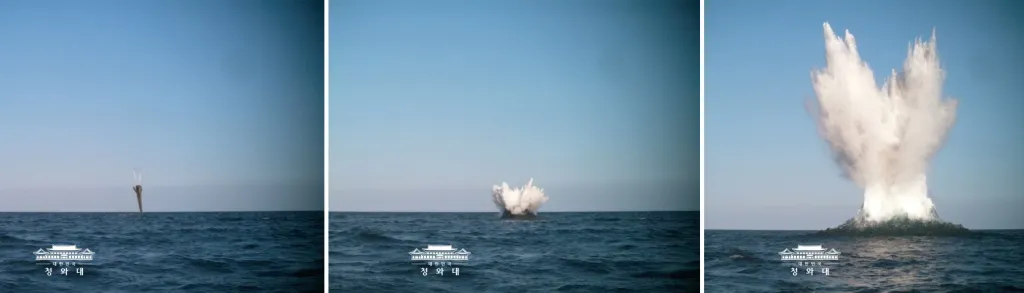
The South Korean government has released images from its first successful test of a domestically developed hypersonic boost-glide vehicle. This includes shots of the vehicle impacting the water at the end of its flight. A weapon of this kind would give South Korea a significant new way to hold targets in North Korea at risk amid an ever-deepening arms race on the Peninsula.
South Korea’s Presidential Office, more commonly referred to as the Cheong Wa Dae or the Blue House, announced the test in a Korean-language press release yesterday. The Blue House initially released a video of President Lee Jae Myung and others observing the test from a conference room at the Anheung Proving Ground, which is located in South Chungcheong Province on the country’s western coast. South Korea’s Agency for Defense Development (ADD) manages testing at Anheung. A series of still images from the test itself was subsequently posted on the Blue House’s website.


Included in the still image gallery are shots showing the launch of the missile, a formal name for which has not yet been disclosed, from a wheeled transport-erector-launcher on a platform sitting just off the coast. The low resolution of the pictures makes it hard to tell whether the missile and/or the TEL are of an existing South Korean design or are based on one. We will come back to this later on.


As mentioned, there are also pictures of the hypersonic boost-glide vehicle hitting the water. At first glance, the vehicle looks to have a broadly conical design with stabilizing fins at the base. However, at least one of the fins looks to be truncated. Closer inspection of the available images shows further indicators that might point to it actually having a more wedge-shaped design with a distinct top and bottom, though it is still not definitely clear given the low resolution. Conical boost-glide vehicles are generally understood to be easier to design, relatively speaking, than wedge-shaped ones. Historically, hypersonic boost-glide vehicles of any kind have proven to be technically complex and challenging to turn into viable operational weapons, even by countries with extensive past experience with their development.

“This test launch was conducted to verify, for the first time, the vehicle’s core technologies in a hypersonic flight environment: the performance of ultra-high-temperature heat-resistant materials, guidance and control capabilities, and the ability to perform irregular flight maneuvers at low altitudes,” the Blue House said in its release yesterday, per a machine translation of the Korean text. “The HGV [hypersonic boost-glide vehicle] successfully separated after ascending to the target altitude and executed its planned flight path within the hypersonic environment without any issues.”
With all this in mind, the fact that the vehicle just remained intact through to impact is noteworthy. At the time of writing, South Korean authorities do not appear to have disclosed more specific details about the test, including how far the boost-glide vehicle traveled before hitting the water or what peak speed it reached. Important questions also remain about how the vehicle is guided during the mid-course and terminal phases of flight, challenges that do not appear to have been addressed by this particular test.
In general, unpowered hypersonic boost-glide vehicles need to be brought first to an optimal altitude and speed. This is typically achieved using a sufficiently sized rocket booster, with existing ballistic missile designs often serving as a starting point.
Once released from the booster, a boost-glide vehicle flies along a relatively shallow flight path within the Earth’s atmosphere. The vehicle is able to maneuver along the way, sometimes erratically, while traveling at hypersonic speeds, generally defined as anything about Mach 5.

All of this sets hypersonic weapons of this kind apart from traditional ballistic missiles, even ones with advanced maneuverability capabilities, which all follow a broadly arcing trajectory to their targets. The combination of speed, flight trajectory, and maneuverability offered by hypersonic boost-glide vehicles creates distinct challenges for opponents. They are hard to spot and track, let alone attempt to intercept, and there is less time for defenders to react overall. This ability to penetrate enemy air defenses and cover ground rapidly makes these weapons particularly attractive for strikes on very high-value and time-sensitive targets.
“The HGV [hypersonic boost-glide vehicle] is a ‘key strategic asset capable of changing the game on the battlefield,’ as its unpredictable flight trajectory and overwhelming speed allow it to launch surprise strikes against key strategic targets during contingencies,” the Blue House’s release explicitly noted, again according to a machine translation.
With all this in mind, South Korea does have an entire family of domestically-produced ground-launched ballistic missiles that could be suitable starting places for launching an unpowered hypersonic boost-glide vehicle. President Lee was notably shown a TEL for the country’s newest Hyunmoo-5 ballistic missile at Anheung yesterday, though no explicit connection has been drawn between that weapon and the hypersonic test. The Hyunmoo-5 is itself still a relatively new development, having only entered service around the end of last year.

When it comes to new South Korean arms developments, the Hyunmoo-5, which entered service around the end of last year, has been and continues to be a major point of discussion by itself. It is officially categorized as a short-range design, despite how big it is (35 tons gross weight), which is said to be due largely to the equally substantial size of its warhead (17,000 pounds). Past reports have raised the possibility that it could be capable of flying out to intermediate ranges if the warhead weight were reduced. Short-range ballistic missiles are defined as ones with ranges between 190 and 620 miles (300 and 1,000 kilometers), while intermediate-range ballistic missiles can hit targets out to between 1,864 and 3,418 miles (3,000 to 5,500 kilometers). Medium-range ballistic missiles (MRBM) fall in between these two categories.

With its massive unitary warhead, the Hyunmoo-5 already gives South Korea an important new way to hold deeply buried and otherwise hardened targets in North Korea at risk. This fits in directly with the country’s broader Korea Massive Punishment and Retaliation (KMPR) policy, as TWZ has previously written:
“While the Hyunmoo-5 has been widely reported as a future pillar of the KMPR, its specific ability to penetrate deeply buried bunkers, such as those used by the North Korean leadership, the same functions mean that it can also fulfill elements of the ‘kill chain.’ In this way, it could be used as part of a pre-emptive strike, to try and knock out North Korea’s launch capability by targeting its hardened command-and-control facilities and missile storage areas.“
By virtue of the very high speeds they reach in the terminal phase of flight, hypersonic boost-glide vehicles also offer bunker-busting benefits on top of the other aforementioned advantages they bring to the table.
In addition, the hypersonic boost-glide vehicle test reflects a broader arms race that has been expanding in scale and scope for years now. South Korea is also developing an air-breathing hypersonic cruise missile, seen in the composite image below, as well as new air- and sea-launched ballistic missiles, the latter of which will be loaded on new surface warships and submarines.

Though there are always questions about the actual maturity and viability of the designs, North Korea continues to churn out its own new missile developments. This includes two separate test launches of purported new hypersonic designs just in recent weeks. Tit-for-tat missile launches are not entirely uncommon on the peninsula, but there are limits to how quickly a test like the one South Korea conducted yesterday involving an emerging technology can reasonably be staged.

Friction between the North and South has been at a particular high point, in general, following an incident on September 21, in which three South Korean troops were injured along the Demilitarized Zone (DMZ). South Korea’s Joint Chiefs of Staff (JCS), as well as the United Nations Command (UNC) on the Peninsula, have said a North Korean landmine placed in violation of the Armistice Agreement was to blame. South Korean authorities have demanded an apology and raised the prospect of some form of action in response, though President Lee has more recently sought to downplay the situation. The government in North Korea has denied the accusations and threatened an “immediate and powerful counteraction” should South Korea seek to retaliate.
An operational hypersonic boost-glide vehicle capability would also expand South Korea’s capacity to challenge opponents regionally beyond North Korea. Though the regime in Pyongyang represents the most proximate national security threat to the country, China and Russia have also been growing points of concern for South Korean authorities in recent years.
“We must secure our national security through our own strength,” President Lee said after yesterday’s hypersonic test, per the Blue House’s release. “The government must not rest on today’s success but must further advance the technology so that the hypersonic glide vehicle can establish itself as a robust strategic asset safeguarding our future security.”

South Korea’s very public test of its new hypersonic boost-glide vehicle underscores the country’s still-expanding efforts to broaden its options for striking even the best-defended targets in North Korea, as well as projecting power elsewhere regionally. At the same time, it remains to be seen when the South Koreans may field a real operational capability in this regard.
Contact the author: joe@twz.com

Alexandra Burke shares true feelings about X Factor ‘return’
EXCLUSIVE: Alexandra Burke gives her verdict on an X Factor comeback, life at home and why she’s more vigilant than ever about her health these days

15:19, 06 Oct 2026Updated 07:25, 10 Oct 2026

The X Factor winner gives her verdict on the show’s reported return(Image: Getty Images)
Eight years after The X Factor disappeared from our screens, it’s rumoured to be making a comeback with a whole new look and a fresh judging panel.
And one of the biggest stars to have come out of the prime-time talent show, Alexandra Burke, admits she’s “very excited” at the prospect of seeing it back on television.
Alexandra, who shot to fame in 2008 as the show’s fifth winner, says, “The X Factor gave me a career. I don’t know what format it’s going to come back in, what it’s going to look like, but we all know that Simon Cowell is a genius at what he does. So all I can do is sit here and wish him the best with it.”
The show hit pause in 2018 due to declining viewing figures, but although it has been criticised by some former contestants, Alexandra – who duetted with Beyoncé during her unforgettable final – has nothing but glowing memories.
“I’ve only ever had good things to say because I had a great experience,” she says. “It gave me a massive career and I’m still here working, 18 years later.”
As for whether she’s still in touch with Simon, she says, “I saw him in April at Britain’s Got Talent when I performed with the cast of The Chaka Khan Musical. It was lovely to see him, Amanda [Holden], Alesha [Dixon] and KSI. It was wonderful to catch up with everyone.”
She previously admitted that Cheryl [Tweedy], her mentor during her time on the show, didn’t reply to texts following her win, but there are clearly no hard feelings. “We met at a birthday party a couple of years ago and she was on great form,” Alexandra says. “She’s always really lovely when I see her, always so kind.”
So what advice would Alexandra give to any future contestants? “Stay true to who you are, because on these shows it’s easy to get wrapped up in it all,” she says. “And work hard – nothing’s ever handed to you. The hard work starts when the show ends.”
Alexandra’s own career has flourished since her time on the show. She took part in Strictly Come Dancing in 2017, finishing in joint second place with her professional dance partner Gorka Márquez, and has gone on to become one of the West End’s most prolific leading ladies, with starring roles in The Bodyguard and Chicago.
Right now, she’s catching a breath after finishing an epic run of I’m Every Woman – The Chaka Khan Musical in London, playing the iconic singer herself. But laughing, the star – who has two young sons with her Irish fiancé, former professional footballer Darren Randolph – admits her home life alone is enough to keep her on her toes.
“It’s chaos, but it’s a house full of love,” she says. “We have six dogs as well, by the way. My boys are amazing. They’re two very different personalities, and full of energy.”
Stunned by how fast time is whizzing by, she tells us she’s trying her best to live in the moment. “Time just goes so quickly. I remember when my first son was born – now he’s four and in reception, I don’t know where those four years have gone,” she says. “I know that I’ve tried my best to juggle both kids, bringing them to work, and it’s the hardest thing I’ve ever done. But I wouldn’t have it any other way.”
Alexandra says she and Darren make a brilliant team. She has a soft spot for the Irish and dubs them “the friendliest people on the planet”. And if work didn’t keep her in London, she’d be tempted to move to the Emerald Isle.
“I love it there,” she says. “Darren goes back weekly. My boys have only been twice, but we’re planning more trips now they’re older.”
The fitness-loving couple, who have already ticked off two London Marathons together, are set to begin training for their third – and fitness clearly runs in the family as Alexandra’s eldest, at just four years old, comes to the gym with her, lifting his own little weights.
She says having children has reminded her that life is for living. “I look at them and think, ‘Gosh, I need to relax a bit sometimes.’ They have such a zest for life.”
Sadly, she lost her own mum, Melissa Bell, who was the lead singer of London band Soul II Soul, in 2017 from kidney failure, caused by complications from diabetes. “It’s such a hard thing to go through, but I have a brilliant network around me,” she says. “And Mum’s always there, you know. I feel her around me all the time.”
Alexandra has no doubt Melissa would have been a doting grandma. “Oh, 100%. She’d have taken the kids from me daily, and said, ‘Just go to work.’ She did that with my nieces and nephews.”
Almost 10 years on, she says the grief still comes in waves, but she has learned to live with it. “It’s the price we pay for love, isn’t it?” she says softly.
Looking to the future, Alexandra has plenty to be thankful for. As well as her family, she’s back in the studio recording new music, which she hopes to release next year. And she’s just landed an exciting film role – for now, a top secret.
She won Best Supporting Actress in a TV Series at the National Film Awards last year, for playing teacher Helen Jones in the Paramount+ crime series Curfew, but while she wants to get stuck into more TV work, music will always be her “first love”.
The star recently appeared on a special edition of Katherine Ryan’s podcast What’s My Age Again?, in conjunction with tombola and Breast Cancer Now, to get women talking about their breasts more. Despite the topic, she had a hoot with the comedian.
“She’s a gem; she’s so funny,” says Alexandra. “The conversation was really warm. It was actually comfortable for me to have, simply because it just meant a lot.”
Alexandra, who lost her beloved aunt Jean to breast cancer in 2009 and had her own scare some years back, is keen to help change the narrative. As tombola’s research reveals, 66% of women have never asked a friend if she’s checked her breasts, though 58% know someone who’s been diagnosed with breast cancer.
“That hit home for me. I asked myself, ‘When was the last time I asked my girlfriends, my sister or my aunties if they have checked their breasts?’ Why don’t we do that? It needs to become a normal thing, not a taboo question. Who knows, just a quick call asking your friend to check themselves could save their lives.”
Staying healthy has never been more important for Alexandra, now she has two adorable little boys to think of. “I was mindful of it when I lost my mum, but even more so since becoming a mum myself,” she says. “You’re nothing without your health.”
For guidance on how to check your breastsand understand what’s normal for you, visit tombola.co.uk/breast-cancer-now
Like this story? For more of the latest showbiz news and gossip, follow Mirror Celebs on TikTok , Snapchat , Instagram , Twitter , Facebook , YouTube and Threads .

How the top 25 football teams in the Southland fared this week
A look at how the top 25 high school football teams in the Southland fared this week:
Rk. School (record) result; Next game
1. SANTA MARGARITA (7-0) def. Servite, 27-3; at St. John Bosco, Friday
2. ST. JOHN BOSCO (6-1) def. Orange Lutheran, 28-14; vs. Santa Margarita, Friday
3. SIERRA CANYON (7-0) def. Gardena Serra, 58-0; at Chaminade, Friday
4. CORONA CENTENNIAL (4-3) def. Murrieta Valley, 42-20; vs. Norco, Thursday
5. MATER DEI (5-2) def. JSerra, 41-7; at Servite, Thursday
6. MISSION VIEJO (6-1) def. Yorba Linda, 27-26; at San Clemente, Friday
7. ORANGE LUTHERAN (4-3) lost to St. John Bosco, 28-24; vs. JSerra, Friday
8. SAN CLEMENTE (7-0) def. Los Alamitos, 40-0; vs. Mission Viejo, Friday
9. PALOS VERDES (6-1) lost to Inglewood, 26-23; at Mira Costa, Thursday
10. JSERRA (4-3) lost to Mater Dei, 41-7; at Orange Lutheran, Friday
11. SERVITE (3-4) lost to Santa Margarita, 27-3; vs. Mater Dei, Thursday
12. CORONA DEL MAR (7-0) def. Tustin, 28-14; at Capistrano Valley, Friday
13. BISHOP AMAT (6-1) def. Chaminade, 28-7; at Sherman Oaks Notre Dame, Friday
14. LA SERNA (6-1) def. La Mirada, 56-19; vs. Cerritos, Friday
15. CREAN LUTHERAN (5-2) def. Capistrano Valley, 30-22; vs. La Habra, Friday
16. CARSON (6-1) def. Banning, 41-3; at Narbonne, Friday
17. OXNARD PACIFICA (5-2) lost to Newbury Park, 21-16; at Bishop Diego, Friday
18. CHAMINADE (5-2) lost to Bishop Amat, 21-0; vs. Sierra Canyon, Friday
19. GARDENA SERRA (3-4) lost to Sierra Canyon, 58-0; at Loyola, Friday
20. HUNTINGTON BEACH (709) def Dana Hills, 21-16; at Western, Thursday
21. SAN JACINTO (7-0) def. Tahquitz, 48-7; at Elsinore, Thursday
22. ORANGE (7-0) def. Segerstrom, 53-7; at Beckman, Friday
23. SHERMAN OAKS NOTRE DAME (7-0) def Loyola, 49-21; vs. Bishop Amat, Friday
24. CAPISTRANO VALLEY (6-1) lost to Crean Lutheran, 30-22; vs. Corona del Mar, Friday
25. YORBA LINDA (0-7) lost to Mission Viejo, 27-26; vs. San Juan Hills, Thursday
India protest live: ‘Cockroach’ leaders detained; New Delhi in lockdown | Elections News
Live updatesLive updates,
Cockroach Janta Party founder Abhijeet Dipke and other leaders detained before protest to demand election chief’s resignation.

Published On 10 Oct 2026

Spa bliss in the Alps: hot springs and hiking in the shadow of Mont Blanc | Spa breaks
Mont Blanc is hiding behind the clouds, but the Aiguille du Midi spears the sky above a mountainside ablaze with russet, gold and tawny tones. The maples flare red; rowan trees are dusted with crimson berries.
Our little group has trundled up to Mont Lachat station (altitude: 2,115 metres) on the Tramway du Mont Blanc, the century-old cog railway that climbs improbably steep slopes from the French alpine town of Saint-Gervais-les-Bains. Operational since 1909, the railway was once intended to reach the 4,809-metre summit of Mont Blanc, but war, glacial terrain and waning funds put an end to that ambition. But even from Mont Lachat, the view is a showstopper. On one side, the Bionnassay Glacier slips scenically down the slope, a buzzard soaring over the milky-green glacial lake at its base, while on the other the Chamonix valley basks in soft autumnal sunshine.
Autumn is golden season in the Alps, when you can find quieter hiking trails, lower prices and air crisp enough to stir the senses without nipping your fingers. Once focused purely on winter sports, the region’s resorts have spent years building up their summer credentials to offer hiking and biking through flower-strewn meadows. Now they’re marketing their shoulder season, too, to meet a growing demand for off-peak escapes.
The little spa town of Saint-Gervais-les-Bains, 50 minutes from Geneva and sandwiched between its glitzier neighbours Chamonix and Megève, is perfectly placed to take advantage of this trend. Unlike many resorts, the town of 5,800 doesn’t fall silent once the snow (or summer crowds) melts away, in large part thanks to its thermal waters, which were discovered at the beginning of the 19th century.
A year-round gondola called Le Valléen now links the train station in the village of Le Fayet, farther down the slope where the thermal spa is located, to Saint-Gervais proper. Opened in late 2024, it means you can arrive by rail from London via Paris and reach the heart of the resort without needing a car. “If you go to Megève in the shoulder season there’s no one there,” says long-serving mayor Jean-Marc Peillex. “That’s not the case here. The secret is that instead of thinking about tourists, you think about the people who live here. Then the tourists will be happy too.”
Saint-Gervais (850 metres) may lack Megève’s polish but it has its own quiet charm: a medieval fortified house, a 17th-century church with geometric stained glass windows, elegant belle époque buildings near the spa and a thriving market every Thursday. Several excellent restaurants stay open year round, and our hotel, the chocolate-box Coeur des Neiges, offers rooms at less than half the summer or winter rate, making it an ideal base for autumnal exploring.
From here we take the Mont Blanc tramway one stop to Motivon, at 1,400 metres, then hike for an hour without seeing another soul; the only sound is the gentle clanging of cowbells. Our destination is the Distillerie Saint-Gervais Mont Blanc, one of Europe’s highest microdistilleries at 1,365m. It’s actually set in a converted donkey shed with windows framing pine forests and plunging valleys, shelves fashioned from old skis and two gleaming copper distillation stills.
This is where Scotsman James Abbott, kilt and all, produces some 450 bottles a year of single malt whisky (in a Speyside style), along with vodka, the traditional herbal liqueur génépi and a superb mountain gin infused with ingredients such as blueberries and wild herbs from the nearby slopes.
“The locals noticed that when I went to parties, I took whisky, not wine,” James laughs. “They said: ‘Why don’t you make your own – you drink enough of it.’” It turns out he does it rather well: the whisky sells for €95, the gin for €50, and both go down beautifully after a day in the mountain air before we hop back on the tramway.
Although the tramway stops running from the end of September, there’s no shortage of scenic hiking trails fanning straight out from town which are accessible later in the year, plus a free, year-round bus service linking the villages that make up the commune of St-Gervais. We’re due to take it the next morning for a walk from Saint-Nicolas-de-Véroce, whose baroque church is resplendent with blue-and-gold interiors and frescoed ceilings, but a heavy rainstorm postpones our plans.
after newsletter promotion
That’s not a problem when just down the road (or a free cog lift ride down the mountainside) are Les Thermes de Saint-Gervais, which have been soothing weary bodies since 1806, when notary Joseph-Marie Gontard discovered the springs. The mineral-rich waters, packed with sulphur, magnesium, calcium and zinc, bubble up from underground at 39C, feeding a three‑hour wellness circuit.
We drift between pools of different temperatures, move lazily from sauna to steam room, enjoy the rainforest spa and wallow outdoors as jets of water pummel our backs while the gondola glides silently overhead. Who cares about the rain?
By the time we emerge, the storm has cleared, so we continue to Saint-Nicolas. From here, a steep two‑hour trail winds up to the Refuge du Mont-Joly, a century-old wooden inn that smells of woodsmoke and melting cheese. Normally there are sweeping views of Mont Blanc from the terrace, but today the peaks are shrouded in cloud.
We might not be able to see the mountains but we can taste their produce, notably in the enormous portion of blueberry tart that follows a tartiflette big enough to satisfy a sumo wrestler. As I tuck in, snow begins to fall. By morning it will be gone, melted by the late-summer sun. But now it lies thick and soft outside, turning the world white, as if the Ice Queen from Narnia might step through the door at any moment. That’s autumn in the Alps for you.
The trip was provided by the Saint-Gervais Mont Blanc tourist board. Doubles at the Coeur des Neiges from €108 room-only, or from €76 room-only at Plan B at Le Fayet. The Refuge du Mont-Joly is closed from the end of March to late May, and from November to mid-December.
The Tramway du Mont Blanc now stops at the Nid d’Aigle lookout (2,380 metres), after the line was extended in July

Bunker Talk: Let’s Talk About All The Things We Did And Didn’t Cover This Week

Welcome to Bunker Talk. This is a weekend open discussion post for the best commenting crew on the net, in which we can chat about all the stuff that went on this week that we didn’t cover. We can also talk about the stuff we did or whatever else grabs your interest. In other words, it’s an off-topic thread.
This week’s caption reads:
Illustration shows a visit to the Commandobunker of Kemmel, in Heuvelland, Friday 18 March 2022. After World War II, in the middle of the cold war, several countries including Belgium, France and Great-Britain, decide to build a bunker to coordinate west Europe aerian defence. BELGA PHOTO KURT DESPLENTER (Photo by KURT DESPLENTER / BELGA MAG / Belga via AFP) (Photo by KURT DESPLENTER/BELGA MAG/AFP via Getty Images)
PRIME DIRECTIVES:
- If you want to talk politics, do so respectfully and know that there’s always somebody that isn’t going to agree with you.
- If you have political differences, hash it out respectfully, stick to the facts, and no childish name-calling or personal attacks of any kind. If you can’t handle yourself in that manner, then please, discuss virtually anything else.
- No drive-by garbage political memes. No conspiracy theory rants. Links to crackpot sites will be axed, too. Trolling and shitposting will not be tolerated. No obsessive behavior about other users. Just don’t interact with folks you don’t like.
- Do not be a sucker and feed trolls! That’s as much on you as on them. Use the mute button if you don’t like what you see.
- So unless you have something of quality to say, know how to treat people with respect, understand that everyone isn’t going to subscribe to your exact same worldview, and have come to terms with the reality that there is no perfect solution when it comes to moderation of a community like this, it’s probably best to just move on.
- Finally, as always, report offenders, please. This doesn’t mean reporting people who don’t share your political views, but we really need your help in this regard.

Céline Dion falls during her Paris residency, but she gets back up
Céline Dion will go on — even after taking a little tumble onstage.
The 58-year-old singer slipped in front of a live audience while performing “Dans un Autre monde” during her Paris residency on Oct. 7. But the French Canadian singer quickly got back up and signaled to fans that she was A-OK by flashing a thumbs-up, in footage obtained by People.
Despite the slight stumble, it has been a triumphant comeback to the live stage after a six-year hiatus for the “All By Myself” singer, who has shows scheduled for this fall and next spring at the Paris Plenitude Arena (formerly Paris La Défense Arena).
In 2022, Dion was diagnosed with stiff-person syndrome (SPS), an autoimmune neurological disorder that affects about one in a million people and has no cure. The illness is characterized by muscle rigidity in the torso, arms and legs. Sensitivity to noise, touch and emotional distress can set off muscle spasms, according to the National Institute of Neurological Disorders and Stroke.
Following the diagnosis, Dion canceled her North American Courage World Tour in May 2023 (which originally began in 2019 but was interrupted by COVID-19 pandemic) as she continued to deal with severe muscle spasms and was having difficulty controlling her voice.
“I’m so sorry to disappoint all of you once again. I’m working really hard to build back my strength, but touring can be very difficult even when you’re 100%,” she said in a public statement on her website in May 2023. “It’s not fair to you to keep postponing the shows, and even though it breaks my heart, it’s best that we cancel everything now until I’m really ready to be back on stage again.”
Her early symptoms began in 2008 during her Taking Chances World Tour, when she experienced difficulty controlling her voice despite doctors saying her vocal cords appeared normal, she shared with Vogue in 2024.
Additional details about her struggles with SPS came to light in a 2024 Prime Video documentary titled “I Am: Celine Dion,” directed by Academy Award nominee Irene Taylor, which follows the singer as she navigates the drastic changes to her health.
The “It’s All Coming Back to Me Now” singer has experienced broken ribs because of the spasms, she told Hoda Kotb on “Today” in 2024 while promoting the documentary. Her journey back to the spotlight has entailed intense physical therapy, vocal rehabilitation and medication, she said.
“I’m going to go back onstage, even if I have to crawl, even if I have to talk with my hands, I will,” Dion shared. “Not just because I have to, or because I need to, but because I want to. And I miss it.”

Sampdoria, Bordeaux, Real Zaragoza: Ranking European football’s biggest sleeping giants
Deportivo, Parma, Hamburg. Not just a football hipster’s holiday hit-list, but a sample of erstwhile headline acts who have returned to their respective top flights in recent years.
You can throw Leeds United, Nottingham Forest, Schalke and Malaga into the mix too.
But with such footballing royalty back in the big time, where can you find Europe’s current sleeping giants? Which one-mighty sides are still snoozing?
We first need to establish some criteria – history, heritage, fanbase, stadium. Clubs with huge potential who currently exist outside the top flight.
Calling a big city home helps, but it is not a deal-maker – sorry to fans of Bristol City and second-tier Russian outfit FC Ufa, where the local population tops one million.
Likewise, some clubs with good-sized stadiums have not made the cut. Bari, whose Stadio San Nicola is the third-largest in Italy and was built for Italia ’90, stands out, though some of their calcio colleagues outside Serie A also have grounds of more than 30,000 – Hellas Verona, Messina and Palermo among them.
There’s a plethora of ex-Premier League teams with top-flight worthy arenas and storied pasts, while Germany is stacked full of historic clubs with huge homes who arguably deserve a spot – Fortuna Dusseldorf, Wolfsburg, Hannover 96 – but we can’t include them all.
A sleeping giant must have experienced some element of former glory and Pro Vercelli are the obvious candidate there, winning seven Italian titles by 1922. But, despite being under new ownership, the third-tier side boast neither the ground nor local population to awaken that historic status any time soon.
The other nuance is, that success cannot have come too recently. West Ham, for example, won a European competition three years ago, Wolves are recent top-flight regulars; likewise Stade de Reims, twice European Cup runners-up, and eight-time French champions Nantes.
Leaving out Steaua Bucharest was another big call. European Cup winners 40 years ago and Romania’s most dominant club, they now play in Liga II. But, following a deeply divisive split, many of the traditional fanbase follow top-flight FCSB. So who really owns that legacy?
And there was a case for Boavista, title winners in 2001 but whose existence now hangs by a thread. Facing financial ruin, despite fans’ best efforts, they have been ejected from Portugal’s professional leagues.
Anyway, let’s get on with this. Piped through the matrix above, here are my top 10 European sleeping giants – you can have your say in the comments, too.
Taiwan president says defence spending boost aims to ‘deter war’ | Conflict News
President Lai emphasises peace and freedom, vows not to tolerate aggression in Taiwan Strait.
Published On 10 Oct 2026
Taiwan’s President Lai Ching-te has said the island “cherishes peace” and will “not give up our freedom” in a National Day speech outside the Presidential Office in Taipei.
Lai made the remarks on Saturday before thousands of people, including foreign diplomats.
Recommended Stories
list of 3 itemsend of list
“We are open to exchanges, but will not accept subordination,” he said. “Our aim by increasing investment in national defence is not to provoke; rather, it is to deter war.”
Taiwanese fighter jets and two Chinook helicopters carrying giant Taiwan flags flew over the capital ahead of the speech.
The holiday marks the 115th anniversary of a 1911 uprising that toppled China’s last imperial dynasty and led to the founding of the Republic of China.
Pressure from China
Taiwan’s 23 million people live under the constant threat of an attack by China, which insists the island is part of its territory, has never renounced the use of force to take it, and calls Lai a “separatist”.
Beijing has rebuffed his offers of talks.
Lai said China continued to “apply pressure through military and grey-zone activities in an attempt to alter the status quo across the Taiwan Strait”.
Grey-zone tactics are actions that stop short of open war. “Peace cannot rely solely on wishes, and tolerance cannot become a pretext for aggressors to encroach ever further,” he added.
Lai’s government has set aside a record 1.1 trillion New Taiwan dollars ($34.5bn) for defence in 2027, more than 3 percent of gross domestic product.
China held war games around the island shortly after Lai’s first National Day speech in 2024, but not last year. Its last drills near Taiwan were in late December, after news of an $11bn arms deal with Washington, the largest ever US weapons package for the island.
Lai said he welcomed talks between the United States and China, but insisted “there must be respect for the right of the people of Taiwan to exist”.
He urged democracies in the Indo-Pacific to join forces to preserve peace and stability in the region.
The US switched official diplomatic relations from Taipei to Beijing nearly 50 years ago but remains Taiwan’s most important security backer.
Officials in Washington and Taipei have repeatedly said US policy on Taiwan has not changed under President Donald Trump.
In May, after meeting Chinese President Xi Jinping in Beijing, Trump suggested arms sales to Taiwan could be a bargaining chip with China, which set off alarm across the world.
Taiwan is now waiting for Trump to sign off on $14bn worth of weapons, including the US-made Patriot air defence system.
The dispute dates back to China’s civil war, when the nationalist forces of Chiang Kai-shek retreated to Taiwan in 1949 after defeat by Mao Zedong’s communists.
The Republic of China remains the island’s formal name.

CCTV footage shows ICE shooting in New York | Donald Trump
New footage shows the moment ICE agents opened fire on a man as he drove his car with his child in the backseat. The shooting in New York has sparked outrage and protests with more demands for immigration authorities to leave the city.
Published On 10 Oct 2026

Netflix plans substantial layoffs, sources say
Netflix plans a substantial round of layoffs as the streaming giant faces rising competition and pressure to retain its subscribers, according to people familiar with the job cuts.
The cuts are expected to affect 5% of the company‘s workforce, which could be 800 employees, according to one of the sources who was not authorized to comment. The job losses will affect the creative team including those working on features, the source said.
Netflix declined to comment. The planned cuts are believed to be the biggest at the Los Gatos company since 2022. The news was first reported by news outlet Puck.
Netflix has been under scrutiny from investors over how much time its subscribers spend on the streaming service. View hours rose only about 2% in the first half of 2026 compared with a year earlier, even as content spending climbed.
“Overall we’re not growing as fast as I want us to, and we’re working on making that move faster,” said Netflix co-Chief Executive Ted Sarandos at the Bloomberg Screentime event last week.
Netflix has noted how engagement can be measured in different ways. For example, its investment in live programming helps spur significant subscription sign-ups, even though it represents a small percentage of watch time on the streaming service, the company has said.
But some investors remain skeptical about the company’s future growth. Rival YouTube remains the leader in streaming viewing hours in the U.S. on TVs, representing 14.2% versus Netflix’s 7.8% in July, according to Nielsen. Netflix stock has also declined 43% compared to a year ago. On Friday, the stock closed at $70.30, down about 2%.
Netflix last conducted major layoffs in 2022 after the streamer reported subscriber losses for the first time in more than a decade. In May that year, the company laid off 150 workers and dozens of contractors and part-time workers in areas including its social media teams. The following month, it laid off 300 people or roughly 3% of its staff.
Recently, Netflix made changes to its games division. In August, the company closed its Hollywood-based gaming studio Night School and said it was in the process of closing its Helsinki-based gaming studio Moonloot.

Valkyries defeat Aces in overtime, will face Dream in the WNBA Finals
LAS VEGAS — Kayla Thornton scored 18 points and the second-year Golden State Valkyries became the quickest expansion team to reach the WNBA Finals, sweeping the defending champion Las Vegas Aces 87-77 in overtime Friday night in Game 3.
The second-seeded Valkyries will have home-court advantage and will host No. 4 Atlanta beginning Oct. 17. The Dream swept New York earlier on Friday, and now teams are 22-0 in playoff history when leading a series 2-0.
Las Vegas, which was seeded third, had won three of the past four championships.
Gabby Williams added 16 points for the Valkyries, including eight in overtime. Former Aces Kiah Stokes and Tiffany Hayes each had 11 points, and Stokes also grabbed 10 rebounds.
A’ja Wilson, honored before night’s game for winning an unprecedented fifth MVP, scored 21 points, but on six-for-19 shooting for the Aces. She also had 10 rebounds, joining DeWanna Bonner as the only players with 1,300 points and 600 rebounds in the postseason.
Jackie Young added 18 points and Chelsea Gray 17.
A 17-point run bolted Golden State past the Aces for a 53-47. Las Vegas closed within a point by the end of the quarter, giving the Aces only seven points in the period.
The Aces led by six points late in the game before the Valkyries evened the score when Gabby Williams stole the ball from Wilson and Thornton finished with a transition layup to make it 69-69 with 1:50 left.
Golden State then took the lead Veronica Burton’s 9-foot floater with 1:12 remaining. The Aces tied the score on Gray’s inbound pass to Young with 27 seconds left and ultimately force overtime.
The extra period belonged completely to the Valkyries, who outscored the Aces 16-6.
India deploys police and restricts transport ahead of mass protest in Delhi | Civil Rights News
The Cockroach Janta Party wants Chief Election Commissioner Gyanesh Kumar to quit over changes to voter lists.
Published On 10 Oct 2026
India has deployed thousands of police and paramilitary personnel in central Delhi and restricted transport in and around the capital ahead of a youth-led protest demanding the resignation of Gyanesh Kumar, the country’s chief election commissioner.
Saturday’s rally, called by the Cockroach Janta Party (CJP), a youth-based political movement, is expected to be the biggest yet in a wave of near-daily protests over a revision of voter lists that critics say favours Prime Minister Narendra Modi’s ruling Bharatiya Janata Party (BJP).
Recommended Stories
list of 3 itemsend of list
Organisers have billed it as a protest to “Save Democracy”.
Shutdown of central Delhi
Police have not authorised a rally at Jantar Mantar in central Delhi, which authorities usually designate for protests, because they said the request was not made on time and that the CJP had violated undertakings given during earlier protests.
Police have also warned that protesters will face a forceful law enforcement response if they violate the ban.
Roads to the site are blocked with multiple layers of metal barricades, as authorities shut 57 metro stations from Friday night, cancelled several long-distance trains and suspended mobile internet within 4km (2.5 miles) of the protest area until Saturday night, the Indian news agency ANI reported.
India’s Supreme Court said on Friday that some trains must still run and that blanket closure of metro stations is unlikely.
“The dictator would rather shut down the entire national capital and inconvenience millions of citizens than allow a peaceful protest at a designated protest site,” CJP chief Abhijeet Dipke said on X.
The CJP says at least 10,000 people, including protesters travelling to Delhi by train, have been detained across the country.
“You can detain the people, you cannot detain the movement,” said Neha Bora, national president of the All India Students’ Association, who has emerged as a leading face of the protests.
What kicked off the protests
Protesters want Chief Election Commissioner Gyanesh Kumar to quit over a voter list revision that has removed more than 130 million names.
The Election Commission says the exercise removes duplicate and ineligible voters and aims to prevent “foreign illegal immigrants” from voting.
Critics say it has disproportionately affected marginalised and minority communities.
The protests escalated after the Indian Express reported that Kumar’s two deputies had formally raised concerns at least 14 times in the past 10 months over the revisions.
The Election Commission and the BJP have denied the allegations. The BJP says the opposition is misleading the country because it cannot win elections.
The CJP began online as political satire in May after Chief Justice Surya Kant called unemployed youth “cockroaches”, sparking nationwide outrage. Since then, the CJP has garnered a large following among India’s youth.
The July protests led Modi’s education minister to resign over exam paper leaks. The latest demonstrations come months before a series of state elections in early 2027, including in Uttar Pradesh, India’s most populous state, which the BJP governs.

Manchester United vs Tottenham: Premier League – teams, prediction, lineups | Football
Who: Manchester United vs Tottenham Hotspur
What: English Premier League Matchweek 6
Where: Old Trafford, Manchester, United Kingdom
When: Saturday, October 9, at 5:30pm (16:30 GMT)
How to follow: Al Jazeera Sport will bring you all the build-up from 13:30 GMT.
Manchester United and Tottenham are accustomed to battling it out at the top end of the Premier League, albeit for UEFA Champions League rankings as opposed the domestic crown in recent years for the former in particular.
Recommended Stories
list of 4 itemsend of list
Recent seasons have seen both slide to dramatic lows by their standards and a concerned Old Trafford welcomes a Spurs side, whose immediate concerns are far greater than those of the hosts.
Roberto De Zerbi’s struggling North Londoners are bottom of the table with only two points to their name after five games. United’s have one only once in that time and a Spurs win will see the sides level on points.
Al Jazeera Sport takes a closer look at a match that, although early in the season, could well shape the months ahead for both sides and the immediate futures of their managers in a game that has been labelled: “El Sackicko”.
Carrick casts an eye across Manchester to eye City’s woes
United head coach Michael Carrick has plenty of problems of his own, but has called for a swift resolution to Manchester City’s financial charges case, saying the long-running process had raised many questions and affected him personally.
Last month, an independent commission found City guilty of all charges relating to breaches of the Premier League’s financial rules over nine seasons, between the 2009-10 and 2017-18 campaigns, as well as three of four charges concerning their failure to cooperate with the investigation.
City, who currently top the Premier league table as the only side with a perfect record after five matches, have denied wrongdoing and lodged an appeal.
Carrick spent 12 years at United from 2006 to 2018, winning five Premier League titles and the Champions League among numerous honours, before taking charge in January following Ruben Amorim’s departure.
During his playing career, the 45-year-old former midfielder lost out in two title races won by City, including the 2011-12 campaign when United fell short on goal difference after Sergio Aguero’s dramatic title-clinching goal on the final day.
“It’s thrown up a lot of questions. As it’s still ongoing, and we don’t know how long it’s going to go,” Carrick told a press conference when asked about the City charges.
“It’s affected me personally in different ways over a period of time.”
Would medals make up for lost titles for Man United?
Asked if he wants the titles United missed out on, Carrick said he would reserve judgement until the process was complete.
“I think regardless of anything, a medal anyway, in any sport in history, I think later on you get the medal and it’s proven at different times,” the Englishman added.
“It’s the moment that you strive for to win and achieve in that moment, so the medal here or there, not getting blase about it, but that doesn’t bring the feeling of when you initially win or you don’t win. That’s essentially what we’re all in it for.”
De Zerbi calls on struggling Spurs to react in Man Utd clash
Roberto De Zerbi has urged bottom-of-the-table Tottenham to “react” to the pressure of their crunch clash with fellow strugglers United.
Spurs have been waiting for the chance to erase the bitter taste of a 3-2 home defeat against Aston Villa in their last match before the international break.
And, with scrutiny mounting on the Italian, the Spurs manager demanded his players rise to the challenge against United.
“I’ve been waiting for this game from three weeks. After the defeat at home against Villa, personally I wanted to play the day after,” he told reporters on Friday.
“It was difficult, it was very tough, especially the first week. But it is football. It is part of the situation in this moment. We have to react, to work in this moment.”
Misfiring Tottenham must improve their aim
Tottenham failed to score in their first four league games before finally finding the net twice against Villa.
De Zerbi conceded his team have to improve in attack if they are climb out of the bottom three.
“We created chances to score many other goals in these seven games but we didn’t. We are working to improve in the last third, the assists and the finishing,” he said.
“We are fourth in the table for the team who brings the ball into the opponents’ area the most times.
“It is nothing but it shows we can arrive in the area. We are not good enough to score goals so far when we have clear chances.”
Can Carrick or De Zerbi survive ‘El Sackicko’?
With Carrick also under pressure following their poor start, Tottenham’s trip to Manchester has been dubbed ‘El Sackicko’.
De Zerbi saved Tottenham from relegation after arriving late last season, but that final-day survival feat is unlikely to save him from the axe if results don’t improve soon.
“We are Tottenham. United and Tottenham are still big clubs in the Premier League,” he said.
“We have to deserve to work in this club, playing better and making different results.”
What happened the last time Man United played Tottenham
The sides last met in February in a Premier League encounter at Old Trafford with the home side winning 2-0.
Cristian Romero was shown red on the half-hour mark for Spurs before Bryan Mbeumo and Bruno Fernandes netted the United goals.
When did Tottenham last beat Manchester United?
Spurs famously beat United 1-0 in the UEFA Europa League final in May 2025, thanks to Brennan Johnson’s first-half strike.
The match marked Ange Postecoglou’s last game in charge of the club before being sacked for their lowly league finish.
Ruben Amorim paid the same heavy price the following season.
When did Tottenham last win a match at Manchester United?
Spurs piled the pressure on Amorim early in the 2024-2025 season with a 3-0 Premier League win at Old Trafford.
Johnson gave the away team a third-minute lead, before United had Bruno Fernandes sent off on the stroke of half-time.
Dejan Kulusevski and Dominic Solanke completed the scoring in the second half.
Head-to-head – Manchester United vs Tottenham
This will be the 205th meeting between the clubs with United winning 96 matches compared to Tottenham’s 56 victories.
Prediction – Manchester United vs Tottenham
The Opta supercomputer has given United a 54 percent chance of winning, while offering Spurs only a 22 percent chance of emerging victorious.
Manchester United team news
“It’s a bit mixed really through the internationals,” Carrick said. “(Wing back) Patrick Dorgu came off and it looks like he’ll be out probably for a number of weeks.
“(Defender) Noussair Mazraoui came off and took a knock. He’s not quite right yet, we’ll have to see how he is.”
He added that Carlos Baleba was improving, while fellow midfielder Kobbie Mainoo, winger Amad Diallo and forward Marcus Rashford had resumed limited training. Striker Benjamin Sesko remains further away from a return.
Predicted Manchester United starting lineup
Lammens; Dalot, Maguire, Martinez, Shaw; Mainoo, Tielemans; Mbeumo, Fernandes, Rashford; Cunha
Tottenham team news
Kulusevski, Xavi Simons, Wilson Odobert and Mykhaylo Mudryk all remain sidelined due to injury.
Jan Paul van Hecke has overcome a foot injury, but may miss out after his wife gave birth to twins – the club has said emotional needs will be taken into consideration.
Predicted Tottenham Hotspur starting lineup
Kinsky; Gray, Senesi, Van de Ven, Robertson; Gallagher, Tonali, Fernandes; Savio, Solanke, Marmoush

Donna Air warning as ‘new pal’ embroiled in Hollywood’s ‘most toxic’ divorce

DONNA Air was all smiles as she enjoyed a night out with former Tottenham Hotspur vice-chairman and property tycoon multi-millionaire Paul Kemsley last month.
The former Byker Grove actress, 47, was recently spotted leaving the Chateau Marmont in Los Angeles with the multi-millionaire Brit, 59.
Onlookers claimed the pair “seemed really cosy” while he was heard telling a fan not to interrupt as he was “on a f***ing date.”
After moving to the States last year to pursue new film and TV roles, Donna will no doubt by impressed by Paul’s impressive network of contacts and ability to open doors.
But The Sun can reveal that she may be in for a shock – as he is at the centre of one of Hollywood’s most toxic divorce battles ever.
Sources told how the property magnate’s split from Real Housewives of Beverly Hills star Dorit, who filed for divorce last April, has become “so brutal it makes the War of the Roses script look tame”.
And one warned: “I hope Donna knows what she’s getting into, because this divorce will be explosive. Dorit wants to destroy Paul and she will use every tool in her Gucci handbag to get what she wants.
“If I was Donna, I wouldn’t want to get caught up in it.”
Entrepreneur Paul – who is known as PK – and glamorous ex-wife Dorit have been locked in a poisonous battle since May 2024 when they decided to separate, and he moved out of their $6m mansion in Encino, California into a five star luxury hotel.
And the set of Real Housewives, which both have appeared on since 2016 as cast members, became the fighting ring in which the pair slugged it out, trading a series of vicious blows.
In perhaps the nastiest, in November 2024, Dorit branded her husband “a full-blown alcoholic” and told cameras he had “always” been a drinker.
She added: “Over the years, it’s gotten progressively worse, and little fights will turn into blow-ups. We would be in the gutter after a fight, screaming at one another. I don’t want that toxic energy around small children.”
Months after the episodes aired, in November, PK was pictured kissing Shana Wall outside Cipriani restaurant in Los Angeles and seemingly sounded the death knell for his nine-year marriage.
One day later, Dorit filed for divorce citing irreconcilable differences and requested sole legal and physical custody of their two children, son Jagger, 12, and daughter Phoenix, nine. PK countered with a request for shared custody.
And the fight was to grow even nastier as time went on.
Just two months ago, Dorit claimed in court that her ex-husband was trying to force their kids into homelessness by refusing to maintain an informal agreement to pay the mortgage on their marital home in LA.
Court documents stated they were $6m behind on the payments – despite him earning “at least $2,000,000 a year”. It was also noted that he “has other income streams outside of the United States.”
PK then hit back that his ex-wife had blown $995,270 on “wardrobe related expenses” during a 14-month span between December 2024 and March 2026 – as the family faced the potential foreclosure of their home.
The filing included $69,000 in charges from Louis Vuitton, $69,000 from Chanel, $38,000 from Hermes, and $22,000 from Saint Honore that she racked up between October 30 last year and Jan 6.
The source continued: “Dorit’s shopping is out of control. Fame doesn’t suit some people and she became a bit of a diva after she joined the show. But it wasn’t that which caused her and Paul to break-up.
“The trouble started when they had a burglary, which she found very traumatic, and she was upset with him being away when it happened. She accused him of being absent when she needed him the most.”
In the terrifying ordeal, in 2021, three masked intruders broke to the couple’s home while she was sleeping and held her at gunpoint, threatening her life while her two young children were asleep in their own rooms.
She later recalled hearing them say: “Just kill her” as she prayed for her kids to stay asleep. The crooks ran off with over $1million in luxury handbags, watches, and jewelry.
The source continued: “She was badly traumatised, and they started drifting apart and being very mean to each other. She thought he was having affairs because he would often go missing, not answering his phone.
“He was spending a lot of time in London and she was thinking about hiring a private investigator, that’s for sure.
“Meanwhile for him, one of the worst blows came when she told the world he was an alcoholic after they had separated. That had an awful effect on him. To do that felt unforgivable.
“Now, she is demanding huge maintenance payments from PK, but he will argue that she earns more than him now and so she basically owes him. It’s definitely going to be explosive.”
Against such a poisonous backdrop, the source also warned that PK’s friendship with Donna, who has dated James Middleton and has daughter Freya with Damien Aspinall, will not go down well.
They went on: “Paul might not look like Robert Redford, but he is very generous – he showers women with gifts and fun nights. And he’s very charismatic and has a great sense of humour.
“He and Donna have been friends for ages and have become much closer of late.
“She always says she loves a man with a sense of humour and she finds Paul hilarious.
“He always says he put all his energy into turning Dorit into a TV star – he completely changed her style and the way she looked. If you look at the before and after pictures of her, there’s huge difference.
“To get Dorit the job on Housewives, he set up a dinner party with the show’s bosses, invited his most exciting friends and entrepreneurs, brought in a chef and spent thousands entertaining them all to land her the gig – and it worked.
“Paul saw the potential in her and he turned her into the star she is today.
“Over the years he has lost a lot of money and made a lot of money, but he’s always on the up. He always finds a way to get the deal done. He’s like a cat with nine lives – he always falls on his feet.
“But Dorit is out for revenge and his night out with Donna will only make her angrier and more bitter.
“Recently she has been saying: ‘I will show the world the real Paul Kemsley’ and she is certainly angry enough to really attack him. “This could be the most toxic divorce in Hollywood history.
“So far it’s making the War of the Roses script look tame.”
A spokesman for Donna last night said the couple were not dating and claimed Paul’s comment about a date was made “in jest”.

Northern Ireland 0-4 Portugal: NI World Cup hopes gone from ‘improbable to impossible’
Missing a number of experienced players, including captain Simone Magill, Laura Rafferty and Nadene Caldwell, McArdle handed a debut to defender Jane McMaster and first caps to Kess Elmore and Charlotte Havern off the bench.
McMaster responded well after giving away the early penalty for Encarnacao’s opener, while Kelmore was lively in the second half and, at 16, it was a big moment for Cliftonville’s Havern to be introduced with 10 minutes remaining.
“It’s fundamental, especially for our younger players, to get this exposure,” McArdle added.
“It’s a risk and it’s brave, but it’s one that will definitely 100% stand strong with us in the long term.
“It will give us that sustainable opportunity to qualify for tournaments in the longer run because we need our younger players to get this exposure, but also for a lot of our senior players as well.”
After impressing in the second half before Pinto’s goal took the wind out of their sails, McArdle said his players will “hurt for the next 24 hours or so” but regroup for the second leg.
Northern Ireland will be without Chambers, who was sent off in the closing stages for grabbing the hair of Carolina Correia.
“There’s the travel over to Portugal thrown in to allow us to relax a wee bit afterwards.
“But once we get there, we’ll look forward to Tuesday again.
“We’re trying to qualify, but there is a longer process as well that we’ll use Tuesday night for.”

Elon Musk lashes out at Indian ‘Prime Minister’ Mukesh Ambani in Starlink | Elon Musk
Elon Musk has accused Indian billionaire Mukesh Ambani of being India’s ‘real boss’ in a row over delays to Starlink’s entry into India. Ambani’s Reliance Jio has over 500M subscribers in India, and Musk claims Ambani is using political interference to sabotage his business interests.
Published On 10 Oct 2026
Two Renoir paintings recovered after France museum heist, mayor says | Arts and Culture News
The recovered Renoir paintings, valued at millions, were stolen in a daring heist at Cagnes-sur-Mer last month.
Published On 10 Oct 2026
Two paintings by the French Impressionist artist Pierre-Auguste Renoir that were stolen from a museum in southern France a month ago have been recovered, the town’s mayor said.
“These two paintings are not simply works of art. They are part of our city’s history,” Bryan Masson, the mayor of Cagnes-sur-Mer, near Nice, said on Friday. “Knowing they have been recovered is an immense relief.”
Recommended Stories
list of 3 itemsend of list
Six people have been arrested in connection with the theft, local authorities said. Masson did not say where the paintings were found or in what condition.
How the theft unfolded
Two thieves broke into the Renoir Museum a little before 6am on September 8, cutting through a fence to enter the grounds, smashing a window and using an electric saw to cut the clips securing the frames, Masson said at the time.
He described them as “well equipped” and “well informed”.
The museum alarm sounded at 5:48am, and municipal police arrived five minutes later, forcing the thieves to flee.
They had taken four paintings, valued by the mayor at about nine million euros ($10.5m).
Two of the stolen works – Renoir’s “Portrait of Madame Pichon” and “Coco Reading” – were later found dropped in the museum garden, the prosecutor’s office said at the time.
The two works that remained missing were “Portrait of Madame Colonna Romano” and “Young Woman at the Well”, the office said.
Police said last month that the thieves were not first-time offenders and had scoped out the premises.
The Marseille prosecutor opened a theft investigation into an organised gang, and the national office for trafficking in cultural goods joined the probe.
A string of museum heists
The museum, opened in 1960, is in the painter’s last home, where he died in 1919.
“This incident should serve as a warning about the protection of our museums,” Masson said after the robbery.
The theft came less than a year after jewels worth about $100m were stolen from the Louvre in Paris in a daylight robbery.
The four suspected robbers have been arrested, but the jewels have not been found.
In August, Italian police said they had recovered paintings by Renoir, Cezanne and Matisse worth more than $10.4m that were stolen from a museum in March.

Adéla brings ‘Nicole Kidman’ and Chappell Roan to the Fonda Theatre
It was only Adéla’s second headlining show in Los Angeles — and she was only about 20 minutes into it — but the ascendant pop star already had an apology she needed to get off her chest.
“The next song that I’m gonna sing is a little bit awkward,” she said Thursday night at the Fonda Theatre. “So I’m gonna need y’all to bear with me as I explain why I made a song called ‘The Baddest Bitches Ain’t in L.A.,’ OK?”
Added Adéla: “Please don’t boo.”
To be precise, the song in question is titled “Ain’t in L.A.” — a woozy banger from the 22-year-old’s buzzy debut album, “Prima.” But you took her point: Here she was in front of a hyped-up crowd that included Chappell Roan and members of the girl group Katseye, and what she was about to tell us is that true coolness lies elsewhere.
Based on her assertion that the Hollywood dream machine is “all a lie,” “Ain’t in L.A.” looks back with scorn at Adéla’s experience as a first-round flameout on “Dream Academy,” the build-a-band reality series that documented Katseye’s creation under the watchful eye of the K-pop kingpin Bang Si-hyuk. At the Fonda, Adéla recounted moving here from her native Slovakia and working alongside the show’s other contestants to “try to become pop stars together,” she said.
“And guess what? That didn’t work out for me. But it did for them.” She peered up at the venue’s balcony. “Shout out to y’all,” she said.
Except now it’s working out for Adéla too: Thursday’s show was the first of two at the Fonda behind last month’s release of “Prima,” whose title nods to the singer’s background as a ballet dancer; in addition to “Ain’t in L.A.,” which has more than 190 million streams on Spotify, the album has spun off a second hit in “Nicole Kidman,” which reached No. 1 on that platform’s U.S. singles chart thanks in part to the enthusiastic embrace of the Hollywood meme queen herself.
This week, Kidman appeared in a viral TikTok video showing her, Kristen Wiig, Pedro Pascal and Dua Lipa lip syncing to “Nicole Kidman” at a Chanel fashion show in Paris.
Adéla’s breakthrough comes amid a broader surge by a generation of young pop singers — think of Slayyyter and think of Tinashe — finding success with music that plays up rather than sands down its rough edges; each is working in the wake of Charli XCX’s influential “Brat,” which offered new ways to think about how pop balances polish and filth, swagger and confession.
Adéla made “Prima” with the producers Dylan Brady (of the duo 100 gecs) and Blake Slatkin (who’s scored hits with Lizzo and Justin Bieber); together the three get an appealingly scuzzy sound that puts chirpy vocal hooks over serrated club beats à la “Blackout”-era Britney Spears. What I’m saying, basically, is that the indie-sleaze revival is real.
At the Fonda, Adéla brought her songs to life on a stage that was bare except for a ballet barre, which she and a small crew of dancers used to execute choreography that grew raunchier and more elaborate as the show progressed. Both she and a guy danced en pointe; Adéla never went long without whipping her long pink hair, which was one style choice widely replicated throughout the room.
Before she closed with “Nicole Kidman,” the singer sat down at the front of the stage with her journal and told the crowd she wanted to “take a second and manifest a little bit.” She asked the universe to give her a long career, and she asked that her fans, after having gotten home safe, remember this night forever. She also asked — again — that L.A. not be mad at her for writing “Ain’t in L.A.”
“I really do feel bad,” she said, and not a boo could be heard.
Mikel Arteta: Arsenal boss has clear conscience over Man City charges
Mikel Arteta says his conscience is clear over Manchester City’s Premier League rule breaches during a period when he was assistant manager at the club.
The Arsenal boss worked under Pep Guardiola between 2016 and 2019, which overlapped with the nine seasons during which City have been found to have broken rules and disguised secret funding of more than £830m.
In his first news conference since the ruling – which the club has appealed – Arteta attempted to bat away questions, saying he wanted to “respect” the ongoing process.
However, towards the end of more than half an hour of questioning, he was asked: “You were at City for three and a half years, is your conscience clear? You had a senior position there, is your conscience clear?”
Arteta answered: “Yes”.
His answer was one word, but it was arguably the most revealing part of the whole interaction.
It was the only occasion where the Spaniard did not in some way revert to his messaging about not giving opinions on the case until such a time as there is a resolution.
Arteta was at no point combative, but it was clear he arrived at Arsenal‘s training ground with a response he was determined to stick to.
Asked if he had spoken to Guardiola, he added: “I prefer not to answer those questions.”
Arteta was asked for his reaction to the damning report from the independent commission, which found City had arranged “sham contracts” with a number of commercial partners to disguise earnings.
He said: “I fully understand the question, but obviously I think it’s very important that we respect the process, the timelines, and it’s still an ongoing process that is not resolved because it’s been appealed.
“My position, and I think the club’s position, is not to make any further comments until this is fully resolved.”
When asked if he thought, that to preserve the integrity of the Premier League, the appeal and sanction needed to be resolved this season, he replied: “The people are responsible to manage this process and to come to the right conclusions and I’m sure it will be done and it will be resolved in the right way. We have to trust that.”
Arteta also added he “100%” believed the Premier League remains the best in the world.
Arsenal, who sit three points behind league leaders City, face fifth-placed Leeds on Saturday at Emirates Stadium.

Putin tells Trump peace talks are unlikely, cites Ukraine drone attacks | Russia-Ukraine war News
Negotiators aim to present a proposal to Russia in the coming weeks, meanwhile Putin says resumption of talks unlikely.
Published On 10 Oct 2026
Russian President Vladimir Putin has said an immediate resumption of peace talks with Ukraine is unlikely, citing drone attacks on Moscow during parliamentary elections last month.
In a phone call with US President Donald Trump on Friday, Putin said Moscow was ready to resume negotiations with Kyiv after the parliamentary elections. However, the drone attacks on the capital made the resumption of trilateral peace talks between Russia, Ukraine and the US unlikely.
Recommended Stories
list of 3 itemsend of list
“By launching a large-scale drone attack on Moscow, other cities and polling stations on the most important day of the elections, and by targeting some people involved in organising the elections, the Kyiv regime has, in reality, interrupted the possibility of an immediate resumption of the negotiation process,” said Kremlin foreign policy aide Yuri Ushakov about the call with Trump.
“As the president said, we will now assess when these negotiations can resume,” he added regarding the trilateral talks.
US Secretary of State Marco Rubio said on Thursday that Russia’s war in Ukraine is at a dangerous stalemate and the United States will keep working towards a deal to end the war.
Ukrainian President Volodymyr Zelenskyy said earlier this week that the country was ready to hold trilateral talks with the United States and Russia this month.
US-Russia diesel deal
Earlier on Friday, Donald Trump announced after the call with Putin that Russia agreed to deliver more than 300,000 tonnes of diesel to American and global markets.
The deal was criticised by US lawmakers, Zelenskyy and European allies.
Zelenskyy called the agreement a “gift to Putin”.
“All that money goes toward the war against people, against Ukraine, against all of us. I believe our team is simply being used as a smokescreen. And that is certainly not fair,” he said in a statement.
In response to the US-Russia diesel deal, a government spokesperson said the United Kingdom would continue to “maintain pressure on Russia through the toughest sanctions regime ever imposed by the UK.”
Iran war live: Kremlin says Trump welcomed Russia’s effort in Iran deal | Houthis News
Live updatesLive updates,
Iran’s IRGC says it struck a “giant LPG gas carrier named NV Sunshine” that was “attempting to pass through the illegal route” south of the Strait of Hormuz.


Published On 10 Oct 2026