



‘Four simple car checks could have saved our hols’

‘Four simple car checks could have saved our hols’
Source link

Lille clinches bid to host EU Customs Authority
Published on
Lille will host the European Custom Authority, a new decentralised agency tasked with supporting and coordinating national customs administrations across the bloc.

ADVERTISEMENT
ADVERTISEMENT
The decision was made on Wednesday in Brussels, after EU lawmakers from the European Parliament and the Council of the EU voted on the matter in three rounds.
“France is one of Europe’s leading customs nations, [considering] one in three parcels entering the EU passes through French territory,” Dutch MEP Dirk Gotink, rapporteur on the customs reform, said in a press statement.
“Lille’s strategic location at the crossroads of Europe makes it the natural hub for this authority,” the EU lawmaker continued.
Italy, with Rome as its candidate, was the runner-up in the voting rounds.
Other contenders included Belgium with Liège, Croatia with Zagreb, the Netherlands with The Hague, Poland with Warsaw, Portugal with Porto, Romania with Bucharest, and Spain with Málaga.
Customs management and trade have taken on renewed urgency after former US President Donald Trump imposed sweeping tariffs shortly after taking office.
Amid growing global trade uncertainty, the EU has stepped up engagement with international partners. This week, it signed a new agreement with Australia, while the EU–Mercosur deal is set to apply provisionally from 1 April.
The establishment of the new authority is part of the overall reform of the EU customs framework, with key negotiations expected to take place on Thursday.
The reform also aims to tackle the rising pressure from increased trade flows, fragmented national systems and the rapid rise of e-commerce.
The agency is expected to be set up in 2026 and could become operational in 2028 according to a draft schedule which is still be subject to significant changes.

Cotswolds ‘Golden Triangle’ has some of the UK’s prettiest towns
IF you’re planning a trip to the Cotswolds, one of the most popular areas is the ‘Golden Triangle’.
Not to be confused with the Indian Golden Triangle (covering New Delhi, Agra and Jaipur) the Golden Triangle of the Cotswolds covers three of the most popular towns.
In between these towns are the famous fancy attractions such as Soho Farmhouse and Daylesford organic farm shop.
The first town is Chipping Norton, which is where a number of famous celebs live.
Nicknamed the Chipping Norton set, this includes the Beckhams, Jeremy Clarkson and Kate Moss.
This is also where you will find Clarkson’s farm Diddly Squat although pop into The Chequers pub and you might pop into David Beckham.
Otherwise the town has the Chipping Norton lido, with two heated outdoor pools, as well as the National Trust owned Chastleton house.
The second location in the Cotswolds Golden Triangle is Stow-on-the-Wold.
Not only is it said to be one of the UK’s prettiest towns but it also claims to have the most photographed door.
A door of St Edward’s Church is rumoured to have inspired Lord of The Rings author J.R.R Tolkien’s book Doors Of Durin.
Stow-on-the-Wold is also home to The Porch House, one of the oldest inns in the country.
Dating back to 947AD, it is now a five star hotel.
And finally, the third place that makes up the Golden Triangle is Burford.
The small town’s main shops are found on one long hill, and they’re mainly independent sellers.
Try the Burford Sweet Shop for some sweet treats or Huffkins for some afternoon tea.
Otherwise the other celeb-heavy spot is Burford Garden Centre, often said to be one of the fancies garden centres in the UK.
Beyonce and Jay Z were rumoured to have been spotted there before.
While not in the Golden Triangle, the nearby town of Witney is home to one of the world’s best hotels called Estelle Manor.
Here’s another place called the “capital of the Cotswolds”.
And we spoke to a Cotswolds expert to get her top tips on how to visit on a budget.

TSA officers share how they’re scraping by without pay
A woman in Indiana who put off dental surgery because she doesn’t know if she can afford the copay. A Florida couple with young children who are depleting their savings. A grandmother in Idaho who plans to sell her car to pay the rent.
They are among about 50,000 Transportation Security Administration officers expecting to receive another $0 paycheck this week. A dispute in Congress over funding the Department of Homeland Security has held up their salaries since mid-February. With monthly bills coming due, many of these federal employees, who screen passengers and luggage at airports across the U.S., are making difficult choices about how to make ends meet.
High absentee rates at some major airports have produced long lines and frustrated passengers at understaffed security checkpoints. Union leaders and federal officials say empty gas tanks, child care expenses and the threat of eviction keep more screeners from showing up the longer the shutdown continues. At last count, more than 455 had quit instead of weathering the ongoing uncertainty, according to DHS.
“Stop asking me about the long lines. Ask me if somebody’s gonna eat today,” Hydrick Thomas, president of the national American Federation of Government Employees union council that represents TSA employees, told reporters Tuesday.
Indiana TSA agent turns to food pantry for groceries
Before starting her shift at Indianapolis International Airport on Monday, Taylor Desert stopped at a food bank for meat, eggs, vegetables and dairy products.
“I never thought I would be in a position where, working for the federal government, I would need to go to a food bank to supplement my groceries,” she said as she loaded bags into her car.
Desert, who has been a TSA officer for seven years, said her last full paycheck came on Feb. 14, the day the shutdown started.
She had some savings to draw on despite a record 43-day shutdown last fall but put some personal plans on pause.
For example, Desert needs to get her wisdom teeth removed but says the TSA isn’t approving time off during the shutdown. She also worries about costs from the surgery not covered by insurance.
Wednesday was the 39th day of the DHS funding lapse. If it goes another 21 days, Desert said she would seek another job.
“I don’t want to have to spend my entire savings just to afford to keep living,” she said.
Florida TSA couple worry about their young children
Oksana Kelly, 38, and her husband, Deron, 37, both work as TSA agents at Orlando International Airport. They have two young children and don’t know how they will keep supporting their family without any income coming in.
Kelly said they’re dipping into savings for now, but it’s running dry. If the shutdown persists, they will ask relatives for help or take out a loan, which she worries would put them deeper in debt.
Her husband has worked as a DoorDash delivery driver in his spare time since the shutdown in October and November. He’s considered resigning from the TSA to put the couple on more stable financial footing.
“It’s very mentally exhausting,” said Kelly, who is an organizer for the labor union representing TSA workers across central and northern Florida. “How do we even decide between being able to feed our kids or come to work?”
Kelly said strangers might criticize the couple for “putting all eggs in one basket” since both choose to work for the TSA for the past decade.
“All we want is to pay our bills and get the pay we deserve,” she said.
A veteran officer in Idaho fears homelessness
Rebecca Wolf cries every day. She tries to hide it from her grandchildren, ages 11 and 6.
“They don’t understand why grandma’s crying,” Wolf said. “I try not to cry in front of them, but sometimes it’s just too much.”
The 53-year-old TSA officer and union leader in Boise, Idaho, joined the agency soon after its creation in the wake of the Sept. 11 attacks. She was homeless at the time but turned her situation around with steady work and the benefits of federal employment.
Now, Wolf can’t help but dwell on where she was 24 years ago. “I don’t want to be in that position again,” she said.
Her Feb. 28 paycheck amounted to $13.53, sending her “into a spiral right away.”
With no savings to fall back on, she is preparing to sell her car to cover her rent due in a week. She calls nonprofits daily seeking rental assistance, but hasn’t had any luck.
Supporting six family members — four children and two grandchildren — has always been challenging, but the repeated shutdowns have made it nearly unsustainable.
Wolf, who serves as president of AFGE TSA Local 1127, is hesitant to walk away from both the job that turned her life around and her role advocating for fellow officers.
“I worked hard to get to where I am now, and the thought I might lose it all scares me,” she said, her voice breaking as she tried to stifle the sound of weeping.
Massachusetts agent digs into savings to get by
Mike Gayzagian, a TSA officer at Boston’s Logan International Airport, says long stretches without pay have become enough of a “new normal” that he’s prepared for them.
The 56-year-old says he has a financial cushion of about six months to tap but that his situation is “an exception to the rule.”
“The majority live paycheck to paycheck and don’t have those kinds of reserves available,” said Gayzagian, who is president of his local TSA union chapter.
It shouldn’t be this way for federal workers, he said.
“The financial situation adds an additional burden to what is already a stressful job,” Gayzagian said. “I didn’t go into public service to make a lot of money. I went into public service because it has a certain stability and reliability and predictability that other jobs don’t have.”
A father in Utah leaves TSA
Robert Echeverria quit his job as a TSA agent at Utah’s Salt Lake City International Airport about two weeks into the current shutdown.
The 45-year-old, who has a wife and three children, counted five government shutdowns in the nine years he worked for the agency. The toughest was last year’s record shutdown that ended in mid-November around the start of the holiday season.
Echeverria said his family skipped Christmas and took months to recover financially. He began looking for a new job in February when it became clear Congress was headed for another budget battle.
“Emotionally I was already distraught,” Echeverria said last week. “We were barely recovering from the last shutdown.”
He now works for the department that manages the airports in Utah’s capital. Leaving federal service “was a hard decision for me,” Echeverria said.
“I really believed in the mission of the TSA,” he said. “We took an oath, and it was a way for me to give back to the country that gave me so much.”
He’s still based at Salt Lake City International, where his 20-year-old daughter works as a TSA agent, and says that seeing his former colleagues struggling is difficult.
“They all feel betrayed by their government because they’re showing up to work,” Echeverria said. “They’re there, but they feel that the government doesn’t care for them,” he said.
Marcelo, Lamy and Yamat write for the Associated Press. Marcelo reported from New York, Lamy reported from Indianapolis and Yamat reported from Las Vegas.
A great city needs a walking path to Dodger Stadium. Do it, Frank McCourt
Dodgers fans generally hiss at the mention of Frank McCourt — the former owner took the team into bankruptcy, after all — but today is about tipping our cap to him.
Without him, fans would have no option to take public transit directly to Dodger Stadium. On his watch, the Dodgers helped secure government funding for the shuttle buses that provide free rides between Union Station and Dodger Stadium.
Sixteen years later, beyond the addition of a sister shuttle from the South Bay, that’s it.
The Dodgers boast the best team in the world. Shohei Ohtani is a tourist attraction. So is their historic ballpark. The Dodgers sold a record 4 million tickets last year.
In 1990, the last year Fernando Valenzuela pitched for the Dodgers, Los Angeles County unveiled a report that suggested ways to improve access to Dodger Stadium “for those who cannot or do not wish to drive.”
The options: a monorail, people mover, or light rail extension from the Chinatown Metro station; the shuttle buses that McCourt and Metro launched 20 years later; the gondola that McCourt first pitched in 2018 and continues to pursue; and a walking path.

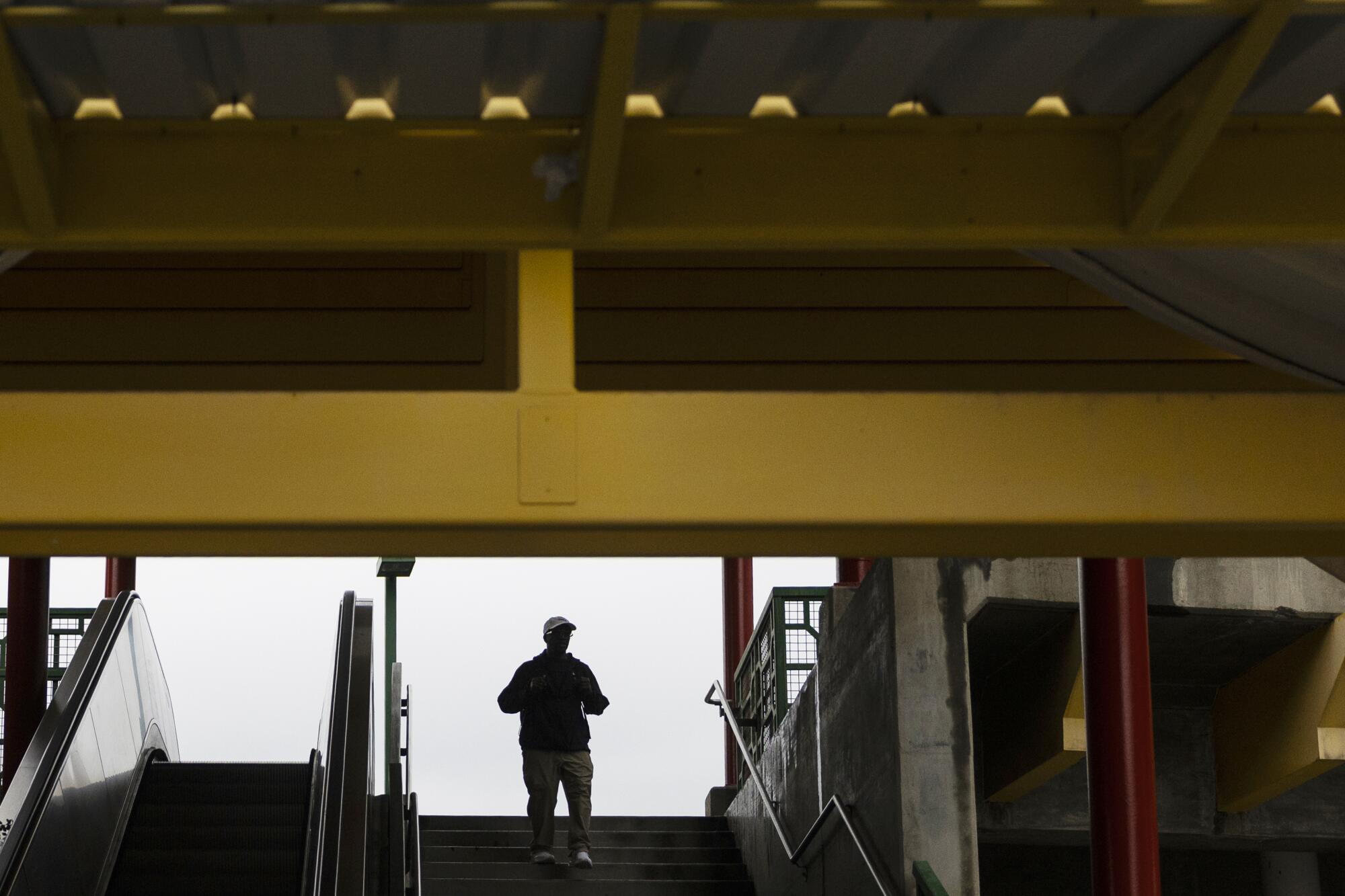
A passenger exits the Chinatown Metro station in January.
(Etienne Laurent/For The Times)
L.A. is all about the car. You will most likely drive to Dodger Stadium, and so will your children.
For decades, the Dodgers have promised to ease traffic by adding amenities that encourage fans to come early and stick around after the game. That has not materialized, and notorious congestion within and around the stadium is as much a tradition as Dodger Dogs.
What if you could walk, for real? What if you could head into the stadium along a beautifully landscaped and wide Dodgers-themed path, a blue ribbon of fans coalescing into a community, with decorations and food carts, shade and lighting, and chants of “Let’s Go Dodgers!” along the way?
You can walk now, sort of. It’s about a mile.

There’s a map at the Chinatown Metro station displaying the pedestrian path toward Dodger Stadium.
(Etienne Laurent/For The Times)
At one end of the Chinatown station, there is a map with a pedestrian route, in a glass case that faces away from Dodger Stadium. If you walk out of the station at the other end, or if you just start heading in the direction of Dodger Stadium, good luck finding the map.
There are Metro signs leading you back to the station from Dodger Stadium, but none leading you along the route there.
The Dodgers actually would prefer you did not take that route, or at least the last part of it. I walked it with Alissa Walker, whose Torched newsletter is the go-to place to learn how major sporting events impact the everyday lives of Angelenos.
We entered the Dodger Stadium property at an intersection with no crosswalks, where cars enter and exit the 110 freeway. We stood atop a dirt patch next to a crumbling curb.
“To go a very short distance safely with a feeling that you’re not going to die,” Walker said, “is very difficult.”
With Game 3 of the World Series underway at Dodger Stadium last October, a few folks scurried across a pedestrian bridge with LED lights and blue glow sticks.
The bridge connects Chinatown with Dodger Stadium, traversing the 110. Without this bridge, there is no walking path to Dodger Stadium.
At night, the bridge offers magnificent views of downtown lights. But it had no lights of its own, so the volunteers used the LED lights and glow sticks to attach homemade Dodgers-themed signage to the fence that encloses the bridge.
“Our goal was, just by adding some lights, to make the really dark path at the top of the bridge at night a little bit brighter, so that it felt a little less scary,” transit advocate Jeremy Stutes said, “and to add a little bit of fun and whimsy.”

Glow sticks forming the “LA” logo of the Dodgers were placed on a pedestrian bridge over the 110 Freeway connecting Chinatown to the area where Dodger Stadium is located during the World Series and for several months after. As of last week, the glow sticks were no longer there.
(Etienne Laurent/For The Times)
From the Chinatown Metro station, the bridge is three blocks up College Street and one block down Yale Street. It’s an easy walk, and for now you pass an elementary school, a church, a row of Chinese restaurants, a dirt lot where a hospital once stood, parking lots, and an auto repair facility with a Dodgers flag hung on a wall.
When I did the walk last week, the trash at the foot of the bridge included a plastic cup, socks, a piece of rotting fruit, a half-full bottle of tequila, and half of a turkey sandwich, peeking out from torn plastic wrapping that indicated the sandwich had gone bad three days earlier. On the bridge: shopping bags, a pair of flip-flops, stray clothes scattered at one end, and graffiti everywhere.

A sign painted on the sidewalk indicates the direction toward the Chinatown Metro station.
(Etienne Laurent/For The Times)
That was the point those volunteers made last October: Clean up the bridge and light up the bridge — as they did for three days — and fans will walk there.
“It’s not that it’s not used,” Stutes said. “It’s not designed to be a safe space to use as an alternative to driving.”
When you cross the bridge, you can turn right or left along Stadium Way to get to a stadium entrance.
Turn right, as the map tells you to do, and you’ll encounter decaying sidewalks, with cracked and buckled concrete that turns a modest uphill walk into an obstacle course. Once you get onto the stadium grounds, the paint is fading along the pedestrian path, which offers you no protection from passing cars.
Turn left, and you’ll have to walk part of the way in the street, on an unprotected bike lane. You also could walk along the road behind the Fire Department training center, a path with no sidewalks and passing fire trucks. Either route takes longer than the one on the map, but you would enter Dodger Stadium through a pair of protected and brightly painted pedestrian paths. (That entrance, along Vin Scully Avenue, is a quarter-mile from Sunset Boulevard, where two Metro bus routes stop.)
If the primary choices for getting out of Dodger Stadium after a game are car congestion or Dodger Stadium Express shuttle bus congestion, a downhill walk to Chinatown Metro station — 12 minutes, Metro says — would be a nice option. That’s why those folks lit up the bridge over the freeway during the World Series.
“The lights were just a fun way,” transit advocate Kevin Dedicatoria said, “to show, ‘Hey, here’s a bridge so you don’t have to play, ‘Dude, where’s my car?’ or have to worry about waiting for the bus.’”
McCourt hails from Boston, where the local subway drops Red Sox fans a few short blocks from Fenway Park. When McCourt owned the Dodgers, I asked him if he could envision a subway or light rail extension to Dodger Stadium.
He’d love it, he said then, but the Dodgers were a private business, and government should pay for public transit.

Homes line a street in Eylsian Park, where Dodger Stadium is located.
(ETIENNE LAURENT/For The Times)
It was a fair point. The Dodgers pay taxes. In an era where teams regularly demand stadium and arena deals that exempt them from property tax, the Dodgers have paid $12.8 million in property taxes over the past three years, according to Los Angeles County tax collection records.
Would demand for public transit amid a car culture justify the investment? The Dodger Stadium Express indicates it could: Ridership has just about quadrupled since its inaugural season, from 122,273 in 2010 to 463,147 last year, according to Metro.
Even along the poorly maintained, poorly lit and poorly advertised pedestrian path, Metro said more than 700 riders returned to the Chinatown station on each of the three nights of World Series home games last year.
“As seen in social media videos during the 2025 postseason, the walking path continues to explode in popularity,” Metro spokesman Jose Ubaldo said.
Next steps?
“It’s astonishing to me that the Dodgers have not taken it upon themselves, as this great community partner, to fix this problem,” Walker said. “It is the city’s responsibility, but the Dodgers should be doing this, as part of what they want to represent to this community.”
The walking path includes segments along city streets, a Caltrans bridge, and Dodger Stadium property. Just who is the responsible party?
A Caltrans spokesman said the city is responsible for maintaining the bridge. A spokesman for the city’s department of street services did not provide an answer. A spokesman for the Dodgers declined to comment.
You could almost hear the sigh from city councilwoman Eunisses Hernandez, whose district includes Dodger Stadium.
“That’s what my job is: to bring people and agencies and organizations together to accomplish a goal,” Hernandez said. “We’re already in conversation with all these entities.
“We’re looking at some of the things we can enhance to make this a more walkable and accessible option for people.”

City Council member Eunisses Hernandez, center, talks with Circle outreach workers in Los Angeles.
(Allen J. Schaben/Los Angeles Times)
How much might those enhancements cost?
Without a look at a city-commissioned Dodger Stadium traffic mitigation study, expected to be completed this fall, Hernandez said she could not put a price tag on it.
“What I can tell you,” she said, “is that it will be less than half a billion dollars, for sure.”
By year’s end, the Los Angeles City Council is expected to vote on McCourt’s gondola project, estimated to cost $500 million and proposed as privately financed. Last November, the council voted 12-1 to urge Metro to kill the project.
Metro granted its approval, but with conditions that included a requirement to explore supplementing the gondola with other Dodger Stadium transit options, including more buses along Sunset Boulevard and a designated walkway from there to the stadium.
The walking path proposed in that 1990 study would have avoided Sunset Boulevard and the current Stadium Way routes — the ones with crumbling sidewalks, or no sidewalks at all — by using escalators and walkways to get fans up and down the hill between Lookout Drive, just off Stadium Way, and Dodger Stadium.
“Pedestrians could be directed through Chinatown,” the study read, “where numerous restaurants, shops and pedestrian amenities are provided.”
It’s hard to sell Chinatown businesses on the benefits of the gondola when fans would ride between Union Station and Dodger Stadium, soaring over Chinatown. It would be easier if a walking path led at least some of those fans through Chinatown, even if only on the way back from the game.
Even if the gondola system really can accomplish what its proponents say it can — loading 35 people into a cabin every 23 seconds — thousands of riders leaving when the game ends could mean a long line to board.

One of the entrances to Dodger Stadium on Stadium Way, the easiest access when walking from Chinatown Metro station.
(Etienne Laurent/For The Times)
“Also,” the 1990 study said, “passenger waiting following a game is psychologically perceived as being three to four times longer than actual waiting time.”
From this perspective, McCourt might win a few council votes by funding a first-class walking path. The cost, I’m told, would depend on what the enhancements include: signs, lights, trees, shade canopies, sidewalk repairs, escalators, and so on. For something close to $5 million — one one-hundredth of the projected cost of gondola construction — McCourt likely could do an exceptional job.
Is there any sign of progress here? Happily, yes.
In an internal report last December, Metro said Zero Emissions Transit (ZET) — the nonprofit organization now shepherding the gondola project — is pursuing ways to link pedestrians and bicyclists to the transit system and to Dodger Stadium. Those potential improvements include sidewalk repairs and a revitalized pedestrian pathway from the Chinatown Metro station to the bridge across the 110 and then across Stadium Way, to Lookout Drive and the hill above.
“Dodger Walk is envisioned as a series of switchbacks,” the report said, “inspired by the original walking path up Lookout Mountain that existed prior to the construction of Dodger Stadium.”
Whether such switchbacks would make the walk to the stadium longer or shorter than the current path remains to be determined.
In a statement, ZET said: “We embrace and include active transit solutions to increase pedestrian and bike access throughout the project area.” In particular, ZET said, it was “supportive” of a walking path to Dodger Stadium.
The Metro report cautioned the concepts “are in the early planning stage,” so L.A. might get an extravagant walking path, a utilitarian one, or none at all.
Here’s hoping McCourt gives us a path of some kind — whether the city approves the gondola or not — because a pretty walk generations can enjoy would be a prettier civic legacy than driving a team into bankruptcy.

Dutch scientist wins World Food Prize for fighting foodborne illness
March 25 (UPI) — Dutch scientist Huub Lilieveld has been named the recipient of the 2026 World Food Prize Wednesday for leading a food safety movement across 113 countries.
For six decades, Lilieveld has researched and advocated for food safety, using scientific evidence to inform regulations and legislation across the globe. His work has culminated in establishing modern global food safety, security, trade and aid standards.
The World Food Prize Foundation is recognizing Lilieveld’s contributions with a $500,000 award.
“Lilieveld lives by his conviction that access to safe food is a universal right — a philosophy shared by the late Dr. Norman Borlaug,” Mashal Husain, president of the World Food Prize Foundation, said in a statement. “Through his lifelong commitment to harmonizing regulations, he has lowered trade barriers, prevented the unnecessary destruction of safe food, promoted innovative food safety technologies worldwide and reduced the risk of foodborne illness outbreaks.”
Foodborne illnesses kill 420,000 people annually. There are about 600 million cases of foodborne illnesses per year.
Lelieveld established the Global Harmonization Initiative in 2004, to connect volunteers and food safety experts around the world to combat safe food insecurity and improve the distribution of safe foods.
“Companies large and small, as well as all consumers are negatively affected by unjustified differences in regulations,” Lelieveld said in a statement. “The Global Harmonization Initiative, therefore, strives not only to reach scientific consensus but also to ensure that findings are accessible to everyone, requiring simplification without compromising scientific accuracy and translation into local languages.”

Founder of the Women’s Tennis Association and tennis great Billie Jean King (C) smiles with representatives after speaking during an annual Women’s History Month event in celebration of the 50th anniversary of Title IX in Statuary Hall at the U.S .Capitol in Washington on March 9, 2022. Women’s History Month is celebrated every March. Photo by Bonnie Cash/UPI | License Photo

Missiles overhead, silence below: Israel’s home front holds firm | US-Israel war on Iran News
As the United States-Israeli war on Iran rages on, schools across Israel have been closed, cultural venues shuttered and large gatherings cancelled under police orders.
Dissent against the war, if there is much at all, has little chance of being aired.
Recommended Stories
list of 4 itemsend of list
A few demonstrations against the war, such as those staged by the Israeli-Arab activist group Zazim, still flicker through central cities, but they do so under heavy supervision, with officers warning crowds to disperse when sirens sound or when assemblies grow beyond what commanders deem safe.
The effect is a public sphere constrained less by decree than by the constant threat hanging overhead.
“Kids aren’t going to school, while employers are insisting their parents go to work,” Zazim’s co-founder and executive director, Raluca Ganea, says. Everyone is too overwhelmed by the daily grind to voice any dissatisfaction, she adds.
“We’re enduring multiple missile attacks daily, which means people aren’t sleeping. It’s like a manual for tyrants. It’s how you suppress protest or opposition and it’s working so far,” she added.
“We’ve attempted a couple of protests, but people are just too tired to engage,” Ganea says of Zazim’s efforts to resist the war. “It’s not so much that people are telling you that you can’t so much as protesting becomes impossible when a missile attack could happen at any time.”
Support for the war on Iran has remained strong in Israel, a fact borne out by polls. But as exhaustion grows and resentment builds over having their fates decided by often distant leaders such as Israeli Prime Minister Benjamin Netanyahu and US President Donald Trump, who have shown little investment in their welfare, the societal fractures that came to define the war on Gaza are almost inevitable, she warns.
“It’s depressing,” she says. “The only response people have is to feel helpless when their fate is in the hands of people like Trump and Netanyahu, who really don’t care about them.”
Those who have put their heads above the parapet to object openly to the war are shunned anyway, as 19-year-old Itamar Greenberg knows only too well. People spit at him in the street.
“It comes in waves,” he says of the criticism he faces for his opposition to the war on Iran on the streets of his hometown, near Tel Aviv. “Sometimes they follow me, shouting ‘traitor’ or ‘terrorist’.”
Itamar is clear enough that he isn’t a terrorist, though he seems ready to accept the label of traitor if it means halting the war on Iran.
“At my university, everywhere, they say my opposition to the war on Iran is somehow crossing a red line. For instance, because of the [danger to the Israeli] hostages, some people could understand opposition to the genocide on Gaza, but opposing the war on Iran, the great evil, is somehow too much,” he says.

Rising censorship
Across Israel, journalists and activists like Itamar describe a pervasive atmosphere of self-policing and censorship that, they say, has left people less informed about the consequences of the war than the citizens in Iran, whom many in their media encourage them to pity.
In a country largely unified against a threat that, for generations, politicians have told them is existential, criticism, dissent or opposition is, for the majority, beyond the pale.
This way of thinking is baked into Israeli society. The systems employed by the country’s military censor today to curtail media reporting predate the establishment of Israel in 1948.
Furthermore, new wartime restrictions on what can and cannot be broadcast of the Iranian missile barrages targeting Israel, where they land and what damage they have done – introduced on March 5 – mean these largely go entirely unreported, Israeli journalists say.
Reporting on the new media restrictions in mid-March, the Israeli magazine +972 documented one instance when journalists were permitted to report on debris that had hit an educational facility, but did not mention the actual strike by an Iranian missile, which had successfully hit its intended target nearby. Nor were they allowed to examine the site.
In another case reported by +972, journalists photographing damage to a residential block said they were approached by a man they believed to be linked to a security agency. He asked police to stop reporters from recording the real target of the attack, which was located behind them. The police officer replied that the journalists would not have noticed that site at all had it not been pointed out, since the visible destruction was concentrated on the civilian building.
The censorship, which had been growing more relaxed in recent years, had been tightened once more during the current war, Meron Rapoport, an editor at +972’s sister paper, Hebrew language Local Call, told Al Jazeera, “We don’t really know what is being or with what explosives,” he said, “The IDF [Israeli army] announcements always refer to strikes being on ‘uninhabited areas,’ which is peculiar, because there aren’t that many uninhabited areas in Tel Aviv. It’s a very compact city.”
Indeed, Iran has launched multiple missiles at Tel Aviv, some of which have resulted in damage and injuries – either by the missiles themselves or by debris falling following interception. Most recently, on Tuesday, missiles triggered air raid sirens in the city, where gaping holes were ripped through a multistorey apartment building.
Israel’s Magen David Adom emergency medical service said: “Six people were lightly injured at four different sites.”
“It’s curious,” Rapoport says. “Israeli commentators are always saying how the Iranian public has no real idea how badly they’re being hit. The irony is that they probably have a better idea of how hard Israel is being hit than most Israelis.”

Netflix fans ‘can’t wait’ after update on ‘best show in the world’
Netflix has confirmed the third season of one of their most popular shows is now in production

Netflix fans ‘can’t wait’ after update on ‘best show in the world’
Netflix has announced the third series of popular rom-com Nobody Wants This is presently in production.
Featuring Adam Brody as rabbi Noah and Kristen Bell as agnostic podcast presenter Joanne, the programme chronicles the duo as they begin an unexpected romance.
The second series wrapped up with Joanne choosing to convert to Judaism while Noah comes to terms with wanting to be with her regardless.
Series three is consequently expected to commence with their relationship more solid than ever, though there will inevitably be additional drama to unfold with Joanne’s sister, Morgan (portrayed by Justine Lupe) and Noah’s brother, Sasha (Timothy Simons), and sister-in-law, Esther (Jackie Tohn).
Showrunners Jenni Konner and Bruce Eric Kaplan informed Netflix: “We are so grateful to Netflix and 20th for giving us another season of Nobody Wants This”, reports the Express.
They continued: “This job is criminally fun. Working with the uniquely gifted Erin Foster [creator], this unbelievable cast of talented, hilarious pros, amazing writers, and incredible crew has been a truly great experience.”
Foster shared with the streamer when the third series was originally announced: “I couldn’t be more excited to head into a third season of this show.”
She added: “It is a privilege to be able to write about my favourite couple on a scale like this. As long as it doesn’t take too much time away from me watching reality TV at night, I’ll do it for as long as they want me to!”
The second season of Nobody Wants This demonstrated even greater triumph than the first, accumulating 18 million views within its initial 11 days and securing a position in Netflix’s Top 10 chart across 82 countries.
Netflix and lead actress Bell ignited excitement amongst devotees with a collection of behind-the-scenes photographs as production commences in Los Angeles, California.
“Can’t wait to see them be silly and cute on my screen again,” responded one user beneath Bell’s Instagram post.
Someone else declared: “Hurry!!! We can’t wait for season 3.” Another stated: “Best series in the world ever.”
Get Netflix free with Sky for Bridgerton Season 4
This article contains affiliate links, we will receive a commission on any sales we generate from it. Learn more
‘Dearest gentle reader’, as the fourth season of Bridgerton follows second son Benedict love story, there’s a way to watch this fairytale-like season for less.
Sky is giving away a free Netflix subscription with its new Sky Stream TV bundles, including the £15 Essential TV plan. This lets customers watch live and on-demand TV content without a satellite dish or aerial and includes the new season of Bridgerton.
And a final fan enthused: “Finallyyyyyy!!! We have been waiting for this!!”
Season two featured numerous thrilling guest stars, including Seth Rogen, Kate Berlant, and Leighton Meester, so devotees are anticipating further major names could participate in the entertainment for season three.
A launch date for the third season remains unconfirmed, but as the previous instalment commenced filming in March 2025 and was released later that same year, viewers could anticipate the series to return in October or November 2026.
Nobody Wants This is available to stream on Netflix.

British expat in Tenerife says ‘things will change’ in April following Storm Therese chaos
Storm Therese has wreaked havoc across the Canary Islands, but a British expat is urging holidaymakers not to cancel as he claims big changes are coming at the start of April

Holiday paradise Tenerife was recently hit by severe weather in Storm Therese (stock image)(Image: Getty Images)
Weather chaos has been wreaking havoc across Spain recently as Storm Therese sweeps through the Canary Islands, particularly Tenerife and La Palma – prompting numerous holidaymakers to abandon their plans after anticipating days basking in the sunshine.
The storm is currently bringing an unusual mix of torrential rain, 100 km/h (62 mph) winds, and significant snowfall at higher elevations. Authorities have issued a full-scale emergency in Tenerife, calling it one of the most serious storms to strike the archipelago in more than a decade. Despite this, it appears locals are beginning to see light at the end of the tunnel, as they’re encouraging people to maintain their holiday plans.
Taking to TikTok, one British expat named Mattie Barnett posted on the Tenerife First Excursions account, where he works, to reveal that a major shift is anticipated to arrive in Tenerife in April.
“Bollocks to the rain in Tenerife,” Mattie declared at the opening of the video, before briefly outlining that they’d been forced to endure days of rainfall in the Spanish holiday hotspot. But now, the sunshine had finally returned.
Gesturing towards the popular Playa del Camisón beach, he remarked: “There were people queuing at eight this morning to get the sun beds after half a day of rain.”
Mattie, who hails from Lincolnshire, went on to predict that the weather will likely remain sunny with pleasant temperatures of around 24 degrees through to the weekend. While early April may bring some overcast conditions, Mattie expressed optimism that the warm summery weather would return shortly afterwards.
It appears holidaymakers are placing their trust in Mattie’s forecast, as numerous people confirmed they’re pressing ahead with their travel plans.
“Coming next Wednesday. Need to be seeing blue skies, palm trees and everything in between,” one person commented. Another user stated: “I come on the 28th hopefully still good weather.”
Spain’s meteorological agency, AEMET, is forecasting that the rainfall will cease by Friday, 27 March, when sunshine will return, with temperatures hovering around 21 degrees for the remainder of the week and throughout Easter weekend, which is typical for this period.
Meanwhile, weather maps from WXCharts suggest that portions of the UK could be battered by heavy snowfall and temperatures plummeting to -9C between April 3 and April 5 – Easter weekend.
Weather charts indicate the snow zone stretching approximately 480 miles from the Scottish Highlands across northern England and the Midlands down towards areas of southern England.
At least 12 major cities could find themselves in the trajectory of the wintry conditions, which may trigger worries about travel chaos, school closures and hazardous driving conditions.
Exact date flying from UK is set to get more expensive
Air Passenger Duty (APD) is set to increase, with the tax usually passed on to passengers

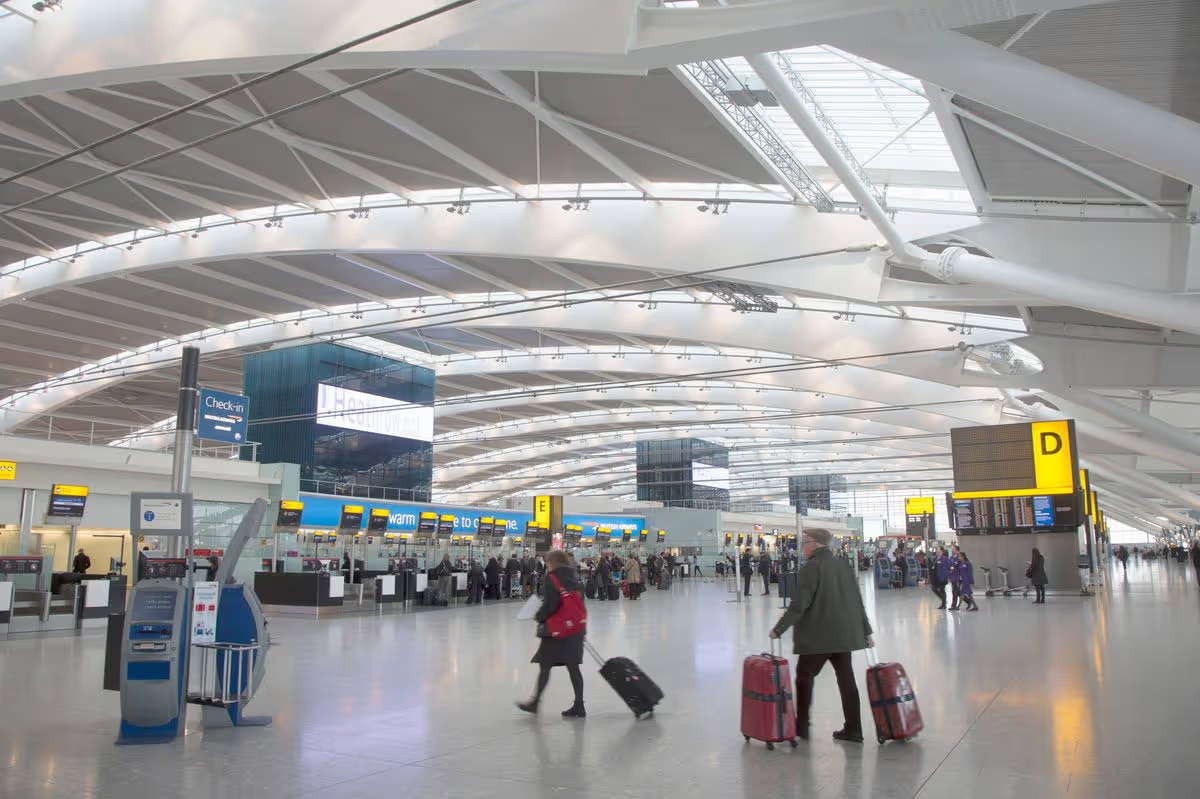
Airlines will have to pay more tax, and this is usually passed on to customers(Image: Grant Faint via Getty Images)
British holidaymakers are being warned that flight prices are soon very likely to rise.
Among many other price hikes Brits are likely to encounter this April, Air Passenger Duty (APD) is poised to rise on flights departing from most parts of the UK from April 1. While APD is levied on airlines and aircraft operators, the costs are typically transferred to passengers at the point of booking. Charges vary depending on the distance travelled, with categories for domestic journeys as well as distances spanning 0 to 2,000 miles, 2,001 to 5,500 miles, and beyond 5,500 miles.
From April onwards, passengers taking an economy domestic flight within the UK will fork out an additional £1, bringing the cost to £8 per leg. Travellers will pay £2 extra for economy short-haul flights, with the rate climbing from £13 to £15. The levy on an economy medium-haul flight – covering 2,001 to 5,500 miles – will jump by £12 to £102, and by £12 – from £94 to £106 – on a long-haul journey.
The surcharge is considerably steeper for those travelling in premium class, escalating to £32 for short-haul, £244 for medium-haul, and £253 for long-haul. And for those opting for private jets, the hike will see APD rocket from £673 to £1,141.
The aforementioned rates exclude Northern Ireland and the Scottish Highlands and Islands. HM Revenue and Customs (HMRC) clarifies that passengers on flights departing from airports in the Scottish Highlands and Islands region are exempt. This region encompasses:
- the Highland Region, Western Isles Islands Area, Orkney Islands Area, Shetland Islands Area, Argyll and Bute District, Arran, Great Cumbrae and Little Cumbrae.
- in the Moray District, it includes the parishes of Aberlour, Cabrach, Dallas, Dyke, Edinkillie, Forres, Inveravon, Kinloss, Kirkmichael, Knockando, Mortlach, Rafford and Rothes.
Passengers on flights from other parts of the UK to airports in this area are not exempt.
Direct long-haul flights leaving from Northern Ireland airports are exempt from APD. However, for domestic and short-haul flights departing Northern Ireland, the standard rates apply.
American airline launches new ‘couches’ in economy that let you turn an entire row of seats into a bed
AN American airline’s plan for new couches in economy has been hailed as a “game changer.”
It means a far more comfortable flight for travelers seeking additional space to sleep.
United Airlines has announced a “relaxed row” to allow travelers to stretch out and have a better rest in economy class.
It involves transforming economy seats into a couch between two rows of seats.
The initiative will provide more comfortable international travel, the airline said yesterday.
“Customers will get a custom-fitted mattress pad, specially sized blankets, extra pillows and a stuffed plush for children to help create a cozy, tranquil environment,” the carrier explained.

“Sounds like heaven to me,” said one thrilled customer.
United‘s relax row option is expected to be available from 2027.
Prices for the perk haven’t been released as yet.
“Customers traveling in United economy on long-haul flights deserve an option for more space and comfort, and this is one way we can deliver that for them,” said Andrew Nocella, executive VP.
Once available, United will be “the first North American airline to offer this kind of seating option and holds North American exclusivity on the design,” the carrier said.
The lie-down couch-style seating will eventually be rolled out across some 1,000 United planes by 2030.
More on United Airlines’ ‘relaxed row’ economy seats that transform into a couch

The option will be available for United customers traveling in the economy cabin on long-haul flights from 2027
A new, dedicated row of three seats will be outfitted with individually adjustable leg rests that fold up at a 90-degree angle.
The formation of the couch will create more room to sleep, stretch out or watch a movie.
Customers traveling in United relax row will receive additional amenities for their international flight.
This includes a custom-fitted mattress pad, a specially sized plush blanket, two additional pillows, as well as a plush toy and children’s travel kit for families.
The airline plans to offer it on more than 200 Boeing 787 and 777 widebody aircraft by 2030.
The seats will be located between United economy and premium plus, with up to 12 relax row sections on each plane.
They aren’t just available for families, as single travelers can also purchase the row, added United.
Source: United Airlines YouTube
Around nine to 12 couches will be available per aircraft.
The seats will have individually adjustable, flip-up leg rests.
These can then be angled to create more room to sleep, stretch out or watch a movie.
Their provision follows a similar option offered by Air New Zealand, which already offers a row of economy seats that convert into a lie-flat couch after takeoff.
Travelers commenting on United’s version have said that it will be worth the extra money.
“I’ve used the sky couch a bunch, and for traveling with young kids on long haul flights it’s an absolute game changer, worth every penny,” raved one flyer on Reddit yesterday.
“I love the skycouch on Air New Zealand and have used it multiple times between the US and Auckland,” wrote another traveler.
“Obviously you don’t get the bells and whistles of a first class seat, but the lie flat feature is the only thing that allows me to sleep on airplanes so for me it’s perfect.”
“Family and I use the Air NZ sky couch every time we travel between NZ/US,” shared one parent.
“It’s a game changer and we always choose Air NZ for that reason. Will start looking seriously at UAL now for our travels.”
Stay in 10 of the world’s best cities from £6 a night
FROM rooftop bars in South Africa to swimming pools in Marrakech and sundrenched terraces in Madrid – Sun Travel has found of the most affordable spots in the world’s best cities.
These 10 stays are the perfect places to rest your head while travelling around the world and they start from just £6 per night.
Cape Town, South Africa
Cape Town is the sixth best city in the world according to Time Out.
It has beautiful beaches and buzzy neighbourhoods, all set against the backdrop of the enormous Table Mountain.
When it comes to affordable places to stay check out Never@Home Green Point near Cape Town Stadium.
Along with private rooms and shared ones (including female-only), the hostel has a rooftop swimming pool, bar and chill-out lounge.


A stay at Never@Home Green Point starts from £20 per night.
Amsterdam, The Netherlands
Amsterdam sits at number 34 in the list of the world’s best cities with pretty canals and gabled buildings.
There are plenty of attractions to explore as well as lots of busy bars and cafes to explore.
Anyone heading to the city should take a look at Generator Amsterdam which is inside a former university building overlooking Oosterpark.
One of its most impressive rooms is the bar inside a former lecture theatre.
A bed in one of the dorm rooms starts from £15 per night.
Edinburgh, United Kingdom
With its enormous hilltop castle, winding Royal Mile lined with plenty of shops and of course, pubs – Edinburgh has been announced as the third best city in the world.
It’s easy to walk about on foot and those brave enough should hike up to Arthur’s Seat.
When it comes to where to stay, consider the Castle Rock Hostel which is right next to Edinburgh Castle with easy access to the Old Town.
It has plenty of communal spaces and is a perfect budget stay for Edinburgh explorers – a night in one of the dorms at the Castle Rock Hostel starts from £15 per night.
Osaka, Japan
Travelling to Japan is on the rise, and while flights there are likely to be expensive, staying there doesn’t have to be.
Time Out, which named Osaka as the 39th best city in the world, also said it’s the “undisputed street food capital of Japan“.
When looking for a base to explore and fill your stomach with delicious takoyaki and yakitori, check out Hotel Toyo Hostel.
It’s basic but offers private rooms and is in the heart of the city with stays from £10 per night.
Kraków, Poland
Nicknamed the ‘jewel of the Baltics’, Kraków is said to be ‘fairytale-like’ with its colourful buildings and grand squares.
The pretty city is filled with pretty gardens, parks, and for beer fans, you can get a pint for as little as £1.50.
Any guest that checks into Greg & Tom Beer House Hostel gets free breakfast, dinner and there’s even free beer hour starting from 9pm.
The hostel is three-minutes from the Main Square and rooms start from £10 per night.
Marrakech, Morocco
The 24th world’s best city is Morocco’s vibrant Marrakech where you can haggle in busy souks, take in history at the medinas and stop in traditional tearooms.
To get into the spirit of Marrakech, all the while saving pennies, check into the Equity Point Marrakech.
It’s a unique spa hostel with a swimming pool and even offers hammam and massages to guests.
It also has a relaxing courtyard area and a rooftop bar with views across the city.
One visitor wrote in their review: “The Pool, rooftop terrace, and rooms are amazing. I wish we stayed longer and i would definitely recommend it to anyone who is visiting Marrakesh.”
A stay here starts from £8 per night.
Dublin, Ireland
Closer to home is vibrant Dublin a city known for its charm, old boozers, and friendly locals.
It’s said to be the city for some of the ‘best nights out in Europe‘ so if you want to see it for yourself, head to Generator Dublin.
The hostel that has a mix of private rooms and shared dorms is near the Jameson Distillery and the famous Temple Bar.
Rooms start from £25 per night.
Lisbon, Portugal
Lisbon is hard to beat with the best of both worlds; coast and city.
Some of the most famous attractions include the Jerónimos Monastery, Belém Tower and with it being so hilly, taking the tram is a popular transport choice.
There are plenty of tascas too where you can dig into bacalhau (salted cod) and sip on sangria.
Goodmorning Solo Traveller Hostel is minutes from the city centre with plenty of communal spaces – some rooms even have balconies.
A stay here starts from £20 per night (a two-night minimum stay is required).
Buenos Aires, Argentina
There’s so much to do in the capital of Argentina from eating its world-class food to exploring the city’s vibrant culture.
Stewart Jackson, the Sun’s UK Digital Editor, who visited the city described it as a “brag-to-your-friends city break that is achingly cool and, once you’re there, incredibly cheap.”
Cocktails can be picked up from £4 and a 30-minute taxi journey can be as little as £3.
Affordability doesn’t stop with places to stay either – First Stop Buenos Aires Hostel is a budget-friendly hostel in the heart of the city.
The hostel offers a variation of rooms – some are private with adjoining ensuites.
A one night stay starts from £20 per night.
Madrid, Spain
Food, nightlife, culture – and just over two hours from the UK, Madrid should be top of your list for a city break.
Deputy Travel Editor Kara Godfrey even called it her “new favourite Spanish city.”
She said: “It feels more livable than other more tourist destinations, with an amazing food and drink scene.
“I mingled with the locals at Pez, where the only thing on the menu is huge sloppy pieces of tortilla chased with a cana (small beer) or tinto de verano for €2.50 (£2.16).”
Generator Madrid is just off of Gran Vía known as ‘Spanish Broadway’ and is a top pick thanks to its rooftop terrace with a bar, sunloungers and hot tubs.
The hostel holds social events too like yoga and DJ sessions and a night in one of the dorms starts from £6 per night.
For more on hotels – here are the very affordable hotels that are better than a five-star – by a holiday expert who’s visited more than 200.
Plus, the top travel mum influencer reveals her best cheap, family-friendly hotels.
The Network of Fake News Sites Amplifying Delcy
Behind a network of fake YouTube newscasts spreading propaganda in favor of Venezuela’s acting president, Delcy Rodríguez, lies a hidden digital structure made up of dozens of websites and social media accounts. It is a much larger and still-active operation than initially believed, designed to distribute content as if it came from independent regional outlets.
In two previous reports, Cazadores de Fake News named this influence operation “Hispan Online.” The first revealed part of the network of YouTube channels whose videos appeared as ads on Venezuelan screens, pushing narratives favorable to the Rodríguez administration. The second report confirmed that the “anchors” were not journalists, but more than 20 actors living in Argentina who were hired through an intermediary agency. The videos racked up millions of views.
The channels mimic Spanish-language news outlets, presenting their content as if it were multiple spontaneous local coverages. So far, Cazadores has identified: Hispan Online (the most prolific producer and the network’s central amplification node), Nación Argentina, Colombia Actual, Panorama Colombiano, La Perspectiva Global, México en Datos, Informe Mexicano, United Data News, Continental Report, Nación Digital MX, Chile en Datos, Argentina en Perspectiva, EC En Análisis, and El Informe Europeo. All of them are part of the network identified so far as the YouTube arm of the operation.

But Venezuelans exposed to those videos are largely unaware that the operation extends far beyond YouTube. At least 30 websites were created as part of it, publishing more than 11,000 articles in just one month. Each site links to Instagram, Facebook, and YouTube accounts bearing the same names as the fake newscasts.
Domain records for some of these websites identify QSocial, an Argentine political communications firm, as the registrant of several of them. A separate investigation by La Nación points in the same direction.
YouTube channels as the tip of the iceberg
The propaganda videos promoted through YouTube ads amassed millions of views, but the 14 channels that initially hosted them hardly resembled real news outlets. Most displayed little more than a logo, and their videos were often not publicly listed.
Some channels, however, included short descriptions and, in some cases, a website address—such as colombiaactual.co for “Colombia Actual” and nacionargentina.info for “Nación Argentina.”
Ongoing monitoring of F. G. Medios S.A. (the company that paid for the YouTube ads) through Google’s Ads Transparency Center led to the identification of 30 distinct YouTube channels. Together, they published at least 90 videos and amassed more than 47.5 million views. Following the pattern of the web addresses, additional associated sites were expected: Manual searches confirmed 30 corresponding websites.
At least five of these sites embedded YouTube playlists or windows featuring the same fake “journalists” seen in the ads.

All 30 domains with known registration dates were created within just nine days, between February 17 and 25, 2026. Fourteen were registered on February 20 alone. This pattern mirrors the creation of the YouTube channels, which appeared between February 18 and early March. The clustering of dates is one of several technical indicators of coordination in this influence operation.
The sites also share a common technical architecture. All run on WordPress, use Cloudflare servers, were registered via Dattatec or DonWeb, use themes developed by Ansar, and have the same Jetpack plugin installed. Articles across all sites are published by the same three WordPress users: “administrador,” “periodista 1,” and “periodista 2.”
This is not a network of independently built websites. It is a single model replicated 30 times and operated by the same group. In total, the network includes more than 90 social media accounts: 30 YouTube channels, 32 Instagram accounts, and 29 Facebook pages. As of publication, most have minimal activity and almost no followers—but the infrastructure is in place and regularly updated.
Venezuela content stands out
With 30 active websites identified, the next step was to analyze their content. Reviewing each article manually was not feasible at that scale.
To do so, Cazadores de Fake News developed a tool—with assistance from generative AI—capable of automatically downloading all articles published across the 30 sites, including full text and images. The result was a database of 11,391 articles produced in just one month.
While most articles are not about Venezuela, it is the most frequently referenced country. With 1,912 pieces, Venezuela accounts for 16.79% of all content, ahead of Brazil (14.30%), Colombia (8.83%), Mexico (8.79%), and Argentina (8.12%). The rest covers other countries, helping each site appear as a regional outlet with its own editorial agenda.
Much of the Venezuela-related content mirrors the narratives promoted in the YouTube ads: favorable coverage of Delcy Rodríguez and her brother Jorge Rodríguez (who presides the Venezuelan parliament), reporting on the new amnesty and hydrocarbons laws, and stories highlighting positive economic projections and the oil sector.

The analysis also revealed another pattern: the same article often appeared across multiple sites with different headlines and slight rewrites tailored to each country, but with nearly identical core narratives. It is a form of serial production, where one base story is rewritten and redistributed to simulate independent local coverage.
One example is coverage of joint ventures between PDVSA and US oil companies. Articles published on March 16–17 across republicahoy.do, pulsonacional.mx, and panoramabrasil.info repeat identical figures (250,000 barrels per day, 22% of national output) while adapting their framing. The Dominican version adds references to Caribbean fuel prices. The Mexican version mentions the Dos Bocas refinery and the Energy Ministry. The Brazilian version refers to the Palácio do Planalto and investment opportunities for Brazil.
The texts share repeated transitional phrases—“in this context,” “on the other hand,” “diante deste cenário”—and identical section structures. The Brazilian version also contains errors suggesting automated translation, such as “empresas americana” instead of “americanas” and leaving “barriles” untranslated.
Although headlines and wording vary, these articles share one constant: they use exactly the same featured images. By comparing images across all 11,391 articles, the tool identified hundreds of such clusters. Contents largely consist of one base story, adapted and republished across multiple sites with the same photo.

This is the first time Cazadores de Fake News has documented evidence suggesting the use of automation or generative AI to sustain an influence operation of this scale targeting Venezuelan audiences. Producing more than 11,000 articles in one month, localized by country and language, would have been unfeasible for a small team of human writers.
The websites have so far attracted little traffic. But the infrastructure is active, content continues to be published, and the material already looks credible enough to be mistaken for real journalism.
The trail leads to QSocial
Despite the scale of the operation (30 websites, three social media platforms, and thousands of articles) those who registered the domains left traces. At least five domains lacked privacy protection, exposing registrant names and emails.
Three “.com” domains—brasilemdados24.com, ecuadorenanalisis.com, and panamaestrategico.com—list “QSN Big Data” as the registrant, linked to the email [email protected].
Two Dominican domains—diariocaribedigital.do and republicahoy.do—were registered on February 20 at the exact same second. Their records list “QSocial” as the registrant. These are different names pointing to the same corporate ecosystem.

QSN Big Data and QSocial are names used by the same Argentine political communications firm, which has also operated as QSocialNow. According to a March 23 investigation by La Nación, the company—led by former Chubut governor Martín Buzzi—produced the fake newscast videos. The outlet reported that the videos were recorded at the company’s offices in Buenos Aires, where actors were recruited through a casting process.
The firm also has a documented history within Venezuela’s propaganda ecosystem. After the July 2024 presidential election, it produced a poll under the name QSocialNow backing a decision from Venezuela’s Supreme Tribunal to declare Nicolás Maduro the winner, despite widespread independent evidence of electoral fraud.
All domains in the network were registered through the same Argentine provider, within the same time frame, and using the same servers. However, this investigation could not determine whether QSocial itself entered the domain registration data or whether it was done by a third party.
Cazadores de Fake News and Argentine fact-checking outlet Chequeado contacted QSocial for comment. The company had not responded at the time of publication (March 24).
An unprecedented operation in Venezuela
Although QSocial director Martín Buzzi denied involvement to La Nación, the technical records documented in this investigation and the newspaper’s sources point to the same company. Who commissioned the operation and how it was financed remain unanswered questions.
It is also unclear whether the thousands of articles about Argentina, Mexico, Brazil, and other countries are merely camouflage for the pro-Rodríguez campaign or part of parallel influence operations using the same infrastructure.
There is no recent precedent in Venezuela for an influence operation of this scale deployed in such a short period.
Before Google, Meta, or the operators themselves took down most of the YouTube channels and 15 Instagram accounts, the propaganda videos had already surpassed 47.5 million views. At the time of publication, all Facebook accounts and the 30 websites remain active.

Man who racially abused England defender Carter sentenced
Nigel Dewale, 60, admitted sending abusive messages over social media during the 2025 Women’s Euros.
Source link

Are Middle East attacks pushing Asia towards an energy crisis? | US-Israel war on Iran
Energy facilities in the Middle East are under attack, including Qatar’s LNG, pushing prices higher.
In a sharp escalation in the Middle East conflict, energy production itself is now in the firing line.
Iran targeted facilities across the Gulf – including the world’s largest liquefied natural gas hub in Qatar.
It was retaliation for an Israeli strike on an Iranian gasfield hours earlier.
Energy prices are soaring, and countries from Asia to Europe are scrambling for alternative supplies.
But, for Asia – the world’s largest LNG buyer – this is a severe energy shock.
The region depends on Gulf supplies to keep its lights on, its factories running, and its people fed.
Published On 25 Mar 2026

Israel talks up Iranian threats to European cities to justify war | US-Israel war on Iran
Israel has been trying to make the case for its war on Iran by portraying the country as a threat to European cities, warning Iranian missiles could reach capitals like London and Paris.
Published On 25 Mar 2026

Tom Hardy’s absence from Peaky Blinders movie explained
Need to know
Peaky Blinders creator Steven Knight has disclosed he almost brought back Tom Hardy’s Alfie Solomons for The Immortal Man

Peaky Blinders film almost brought back Tom Hardy for massive twist(Image: BBC)
Everything you need to know about Tom Hardy’s absence from Peaky Blinders: The Immortal Man.
- Peaky Blinders creator Steven Knight has revealed he scrapped a massive twist that would have brought back Tom Hardy’s iconic character Alfie Solomons as a ghost.
- The show’s writer originally considered revealing that Alfie had actually died from his gunshot wound on Margate beach. Knight briefly toyed with the idea that all of Alfie’s appearances since season four were just apparitions in Tommy Shelby’s mind.
- “I thought, maybe [Alfie] appears, and we realise he’s been dead all that time,” Knight told the Hollywood Reporter. “Now, I nearly did that, and I didn’t do it, but that was a thought.”
- The twist would have mirrored Tommy’s other ghostly visions, including his deceased first wife Grace. Knight noted that since the beach shooting, viewers have only ever seen Tommy and Alfie together alone, adding fuel to the theory.
- Hardy’s busy filming schedule for Paramount+ crime drama MobLand may have also influenced the decision not to pursue this storyline.
- Fans still have hope of seeing Alfie return as the series continues with at least two more instalments on Netflix and the BBC. Knight confirmed Duke Shelby will appear in the upcoming post-WWII Birmingham follow-up.
- The creator teased: “Some of the characters that are in [The Immortal Man] will appear in that. But I’m under strict instructions not to talk about it except to say that it’s happening.”
READ THE FULL STORY: Peaky Blinders boss almost brought back Tom Hardy for huge Immortal Man twist

Wednesday 25 March Greek Independence Day around the world
This article details the historical significance of Greek Independence Day, which commemorates the 1821 uprising against nearly four centuries of Ottoman occupation. The author explains how the rebellion began in the Peloponnese region and notes that the holiday coincides with the religious Feast of the Annunciation. Following the conflict, the Hellenic State emerged as the first modern Greek nation under the leadership of John Kapodistrias. Kapodistrias is remembered for his vital contributions to national education and the economy, and he is still honored on the country’s currency today. Overall, the text serves as a historical overview of Greece’s journey toward sovereignty and its enduring

World-first Bluey rollercoaster is opening in the UK this week
THE first ever Bluey rollercoaster in the world is coming to the UK this week.
The new ride will be part of CBeebies Land at Alton Towers.
Called “Bluey the Ride: Here Come the Grannies!”, the ride will let both adults and kids hop in a carriage behind Bluey and Bingo.
It’s based on the episode where they dress up a grannies Janet and Rita to cause trouble.
The ride is made for younger riders, specifically for preschoolers.
Meet and greets with all the characters is also possible at the park, which includes Chilli, Bandit, Bluey and Bingo.


Future plans include more Bluey-themed hotel rooms too, with one already at the CBeebies Land Hotel.
Howard Ebison, Vice President of Alton Towers Resort said: “It’s exciting to be able to give eager fans and families an official first-look at our newest attraction Bluey the Ride: Here Come the Grannies! this spring at Alton Towers Resort.
“This first glimpse of the ride shows what promises to be an exciting experience for the whole family – from little ones to grandparents – which bring the limitless energy of Bluey to life.”
The new rollercoaster opens on March 28.
Sun writer, Hannah Ferrett, recently stayed in one of the Bluey rooms that are already open at Alton Towers.
She said: “The kids slept in Bluey and Bingo’s room, complete with bunk beds, the recognisable watermelon rug and the cartoon dogs’ pretty Himalayan rock salt night light — a nice touch for little ones.
“My partner Dan and I were in Bandit and Chilli’s room, which had a king size bed, TV and lots of pictures of Bluey and Bingo as puppies, much to the delight of our kids.”
“Even the bathroom had pictures of Bluey and her sister plastered across the walls.”
Also new at the park are the world-first Hey Duggee themed hotel rooms.
And here are some other new lands and rides coming to theme parks this year.
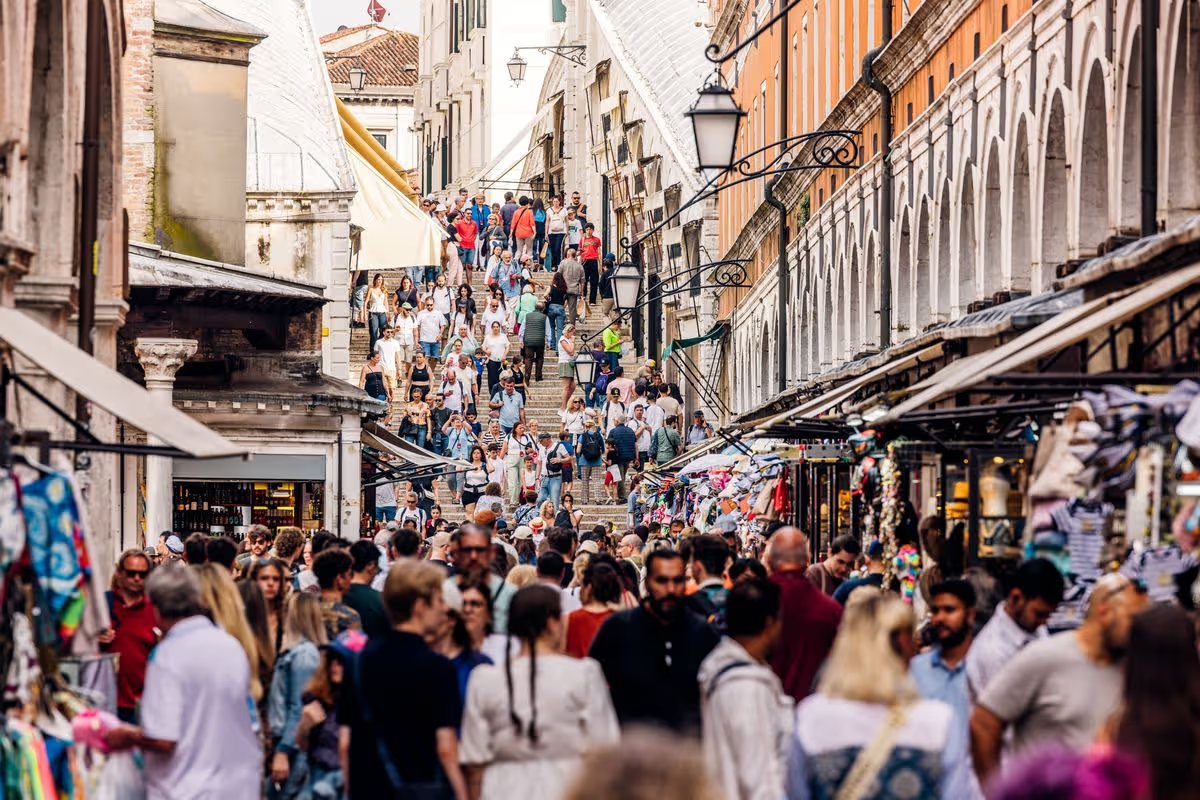
Europe’s most touristy city has 16,250 visitors for every 100 locals — full list
A new ranking compares international tourist numbers to locals in European cities – and one tops the list with a staggering 16,250 visitors for every 100 residents

These destinations are the most crowded in Europe(Image: Alexander Spatari via Getty Images)
Summer is on the horizon, and folks are starting to map out their holiday plans. Being based in the UK, we’re fortunate to have some of the world’s most stunning destinations within easy reach, with iconic cities just a short flight away.
However, many of these sought-after spots are now swamped with tourists – in fact, some now host more visitors than locals. DiscoverCars.com has compiled a new ranking that contrasts the number of international tourists with the local population in European cities. Five of the top holiday hotspots now boast more tourists than residents.
Topping the list is Dubrovnik in Croatia. This breathtaking historical city gained even more fame after serving as the backdrop for King’s Landing in the HBO series Game of Thrones.
Last year, this fortified city welcomed 6.5 million tourists – an astounding figure compared to its 40,000 inhabitants. That equates to 16,250 tourists for every 100 locals.
Taking second place is Reykjavik in Iceland, reports the Express. This Arctic city attracted even more tourists than Dubrovnik, with 7.4 million visitors compared to its 140,000 residents, resulting in 5,286 tourists per every 100 locals.
The city is renowned for its Blue Lagoon thermal baths and, of course, the opportunity to witness the Northern Lights illuminating the sky.
Securing third place is the floating city of Venice in Italy. Arguably one of the most famous cities globally, Venice played host to 10.6 million tourists last year.
Compared to its population of 250,000, that’s a whopping 4,240 international visitors per 100 residents. The city is a hit with tourists for its stunning architecture and the opportunity to glide along its canal streets by gondola.
Switzerland’s Geneva secured fourth place on the list, welcoming 7.8 million tourists in 2025. With a local population of 200,000, this equates to 3,900 visitors per 100 residents.
Renowned for its breathtaking views of the Alps, Geneva serves as an excellent base for day trips into the mountains and exploring the picturesque villages scattered throughout them.
Porto in Portugal claimed fifth place. The city attracted seven million international tourists in 2025, against its population of 250,000.
With 2,800 tourists for every 100 residents, it’s a highly sought-after destination. The narrow streets are adorned with beautiful architecture and striking Portuguese tiles, providing a perfect backdrop for photos.
With the river slicing through the city, you can discover both sides of the city in a day – just remember to bring your walking shoes.
The most tourist-dense cities worldwide
- Dubrovnik, Croatia
- Reykjavík, Iceland
- Venice, Italy
- Geneva, Switzerland
- Porto, Portugal
- Phuket, Thailand
- Florence, Italy
- Lisbon, Portugal
- Edinburgh, United Kingdom
- Athens, Greece

Shohei Ohtani has solid final spring start as season opener nears for Dodgers
Shohei looks sharp
From Maddie Lee: Shohei Ohtani’s three straight strikeouts in the fourth inning of his final spring start Tuesday featured a different putaway pitch for each.
He got Angels slugger Jorge Soler to whiff on a sweeper. Jeimer Candelario went down on a curveball. And Jo Adell struck out on a fastball.
“Just shows the confidence he has and different ways he had to attack guys, to get ahead and also put guys away,” manager Dave Roberts said after the Dodgers’ 3-0 loss to the Angels in the Freeway Series finale. “And today the feel was really good, even better than the first outing.”
Pretty much everything was clicking for Ohtani heading into the regular season, even though it was only his second spring training start on the mound. Ohtani recorded 11 strikeouts in four-plus innings. He held the Angels to four hits, three of which were consecutive singles in the fifth, and was charged with three runs, all scored in the fifth.
For the first time in three years, Ohtani is set to begin the season as a fully healthy pitcher. And it will be the Dodgers’ first time managing his two-way schedule all year. Limited the last two seasons by his recovery and build-up from elbow surgery, Ohtani last made 20-plus starts in 2023 with the Angels.
“The desire is high,” Roberts said when asked about Ohtani’s aim to pitch wall to wall. “I think it’s realistic. Then the bigger question is, how are we going to manage that and navigate it?”
Can Kurt Suzuki lead Angels to success?
From Steve Galluzzo: Anxious may be the best word to describe the vibe in Anaheim before the Angels fly to Houston ahead of Thursday afternoon’s season opener versus the Astros.
New manager Kurt Suzuki has infused enthusiasm into a club that has not finished above .500 since 2015 and has missed the playoffs for an MLB-worst 11 straight seasons. The Angels went 72-90 and finished last in the American League West, though they were nine games better than 2024 — when they set a franchise record for losses with 99. Time will tell if the Halos have enough talent to contend in a division the Seattle Mariners are heavily favored to win.
A special assistant for the Angels the last three seasons, Suzuki signed a one-year contract last October and is the team’s fifth full-time manager since Mike Scioscia stepped down in 2018 after compiling a franchise-record 1,650 victories over 19 seasons. Suzuki spent 16 seasons as a major league catcher, retiring in 2022.
“It’s been fun,” Suzuki said prior to Sunday’s Freeway Series game, a 13-5 loss to the Dodgers at Angel Stadium. “Obviously I’ve never managed before but just being out of the game just as recently as a few years ago I understand the situations of the game, the speed of the game and those type of things. I’m not saying it’s going to be easy by any means. It’s a lot of work, but I’m having a great time, we’re surrounded by great people and the guys have been awesome so it’s been all good.”
As a former player, Suzuki will trust his instincts.
“For me, it’s attention to detail, it’s fundamentals, it’s just really being a baseball player,” he said. “Sometimes in this day and age of analytics and all that stuff you can kind of get lost in that sometimes. Not to say forget about it, but I think the more you can just play baseball how it’s supposed to be played, move guys over, situational hitting, things you grew up doing, if we can kind of keep that style and play hard and all that, I like our chances.”
Drop Los Angeles from the Angels?
From Bill Shaikin: Two decades after owner Arte Moreno decided the Angels should play under the Los Angeles name, elected officials representing Anaheim are pursuing two paths toward getting their hometown back into the team name.
Assemblyman Avelino Valencia, whose district includes Angel Stadium, has introduced state legislation that could require any sale or new lease of the stadium property be conditioned upon the team reverting to the Anaheim Angels name.
Meanwhile, Anaheim Mayor Ashleigh Aitken has asked the city attorney to explore whether the Angels have violated their current lease by dropping the Anaheim name from legal documents.
Why UCLA women might not win it all
From Mirjam Swanson: Absolutely, this is the best team in UCLA women’s basketball history.
Not the best team in the country this year, but truly a testament to teamwork and hard work and talent retention.
Whether UCLA wins it all this season or not, the Bruins are the envy of teams everywhere, including Oklahoma State, whose season they ended with an 87-68 second-round victory Monday. Afterward, UCLA’s six seniors joined their teammates in one last victory lap around the court, waving to fans, soaking in the adoration, on their way to the Sweet 16 for the fourth consecutive season.
“Seeing a team who gets to host, a team who has stayed together, for the most part, they get to experience all the things that all of us want, and that is so incredibly rare and hard and special,” Oklahoma State coach Jacie Hoyt said.
But how much further those things will take these Bruins in the NCAA tournament after they fought off Oklahoma State?
Maybe all the way, but maybe not.
Kings lose to Flames
Yegor Sharangovich scored in the fourth round of the shootout to lead the Calgary Flames to a 3-2 victory over the Kings on Tuesday night.
Olli Maatta and Zayne Parekh, each with their first goals of the season, scored in regulation time for the Flames, who have won four games in a row for the first time this season. Dustin Wolf stopped 23 shots.
Quinton Byfield scored both goals and Darcy Kuemper made 21 saves for the Kings, who have points in seven of their last nine but just three victories. They have dropped four straight.
First-place Ducks beat Canucks
Mikael Granlund scored twice, Alex Killorn had a goal and an assist, and the Ducks beat the Vancouver Canucks 5-3 on Tuesday night.
Mason McTavish and Troy Terry also scored for the Ducks, while John Carlson had three assists and Lukas Dostal stopped 27 shots.
The Ducks grabbed a 2-1 lead in the second period, only to see Vancouver rally and tie the score twice before McTavish scored the winner at the 5:45 mark of the third.
This day in sports history
1934 — Horton Smith wins the first Masters golf tournament by one stroke over Craig Wood.
1947 — Holy Cross, led by George Kaftan, beats Oklahoma 58-47 in the NCAA basketball championship.
1958 — Sugar Ray Robinson regains the middleweight title for a record fifth time with a 15-round decision over Carmen Basilio.
1961 — Cincinnati ends Ohio State’s 32-game winning streak with a 70-65 win in the NCAA basketball championship. In the third-place game, St. Joseph’s beats Utah 127-120 in quadruple-overtime.
1967 — UCLA, led by sophomore Lew Alcindor’s 20 points, beats Dayton 79-64 for the NCAA basketball championship.
1972 — Bill Walton scores 24 points to lead UCLA to an 81-76 victory over Florida State and the NCAA basketball title.
1972 — Maryland beats Niagara 100-69 in the NIT championship, becoming the first team to score 100 points in the finals of the tournament.
1973 — The Philadelphia 76ers post the worst mark in NBA history at 9-73 under coaches Roy Rubin (4-47) and Kevin Loughery (5-26).
1982 — Wayne Gretzky becomes the first NHL player to score 200 points in a season.
1995 — Scotty Bowman gets his 900th regular-season coaching victory as the Detroit Red Wings beat the Canucks 2-1 in Vancouver.
2006 — Following the tradition of teenage American women pulling off big upsets, 16-year-old Kimmie Meissner uses the performance of her life to soar to the World Figure Skating Championships title.
2008 — Tennessee gives coach Pat Summitt her 100th NCAA tournament win, a 78-52 rout of host Purdue. The win sends the Lady Vols to the NCAA regional semifinals.
2011 — The Southwest regional is the first in NCAA men’s basketball history with three double-digit seeded teams in the semifinals. Virginia Commonwealth, an 11th seed beats 10th seed Florida State 72-71 in overtime and the top-seeded Kansas Jayhawks beat No. 12 seed Richmond 77-57 in the region’s other semifinal.
2012 — In the NBA’s first quadruple-overtime game since 1997, Joe Johnson scores 37 points and Josh Smith adds 22 as the Atlanta Hawks beat Utah 139-133. The four overtimes tie for the third-longest game in NBA history.
2016 — Klay Thompson scores 40 points and Stephen Curry adds 33 to help the Golden State Warriors become the second team to post back-to-back 65-win seasons with a 128-120 victory over the Dallas Mavericks. The Warriors improve their record to 65-7 following a 67-win season a year ago. The only other team to win at least 65 games in consecutive seasons was Chicago in 1995-96 and 1996-97.
2017 — Arrogate shows his class again in the $10 million Dubai World Cup as he comes from last place to win by an impressive 2 1/4 lengths.
Compiled by the Associated Press
Until next time…
That concludes today’s newsletter. If you have any feedback, ideas for improvement or things you’d like to see, email me at houston.mitchell@latimes.com. To get this newsletter in your inbox, click here.

Childbirths grow at fastest pace in 7 yrs in Jan. on increased marriages

The number of babies born in South Korea rose at the fastest pace in seven years in January, government data showed Wednesday. In this file photo, a nurse cares for a newborn at a hospital in Goyang on Dec. 26, 2025. File Photo by Yonhap
The number of babies born rose at the fastest pace in seven years in January, driven largely by an increase in marriages, government data showed Wednesday.
A total of 26,916 babies were born in January, up 11.7 percent from the same period a year earlier, according to the data from the Ministry of Data and Statistics.
The January figure was the highest for the month since 2019, when 30,271 babies were born, the ministry said, noting that births are gradually recovering to pre-pandemic levels.
The number of newborns has been on an upward trend since July 2024.
The country’s total fertility rate, the average number of children a woman is expected to have in her lifetime, rose 0.1 from a year earlier to 0.99 in January.
It marked the highest rate since January 2024, when such data began being compiled on a monthly basis.
On an annual basis, the last time the fertility rate exceeded 1 was in 2017, when it stood at 1.052.
The rate then fell to a record low of 0.721 in 2023 before beginning to rebound in 2024.
However, the rate still remains well below the 2.1 births per woman needed to maintain a stable population without immigration.
The ministry said the recent rise in births appears to have been influenced by a continued increase in marriages, government policies supporting childbirth and the growth in the population of women in their early 30s.
In South Korea, where childbirth outside of marriage remains rare, an increase in marriages tends to precede a rise in births.
The number of marriages in January jumped 12.4 percent on-year to 22,640, marking the 22nd consecutive month of growth.
The figure is the highest for the month of January since 2018, when 24,370 marriages were recorded.
The number of divorces also went up 4.2 percent on-year to 7,280 in the cited month, the data showed.
Meanwhile, the number of deaths went down 17.6 percent from a year earlier to 32,454, resulting in a natural population decline of 5,539.
Copyright (c) Yonhap News Agency prohibits its content from being redistributed or reprinted without consent, and forbids the content from being learned and used by artificial intelligence systems.