


Luka Doncic’s 60-point game thrusts Lakers star into MVP debate
MIAMI — The chants started in a purple-and-gold-clad cluster in the upper deck at Kaseya Center. As Luka Doncic’s scoring total crept up with each step-back three, free throw or fadeaway shot, the cheers grew louder, coming from every corner by fans dressed in every color.
“M-V-P! M-V-P!”
“That’s what I think every player wants to hear,” Doncic said.
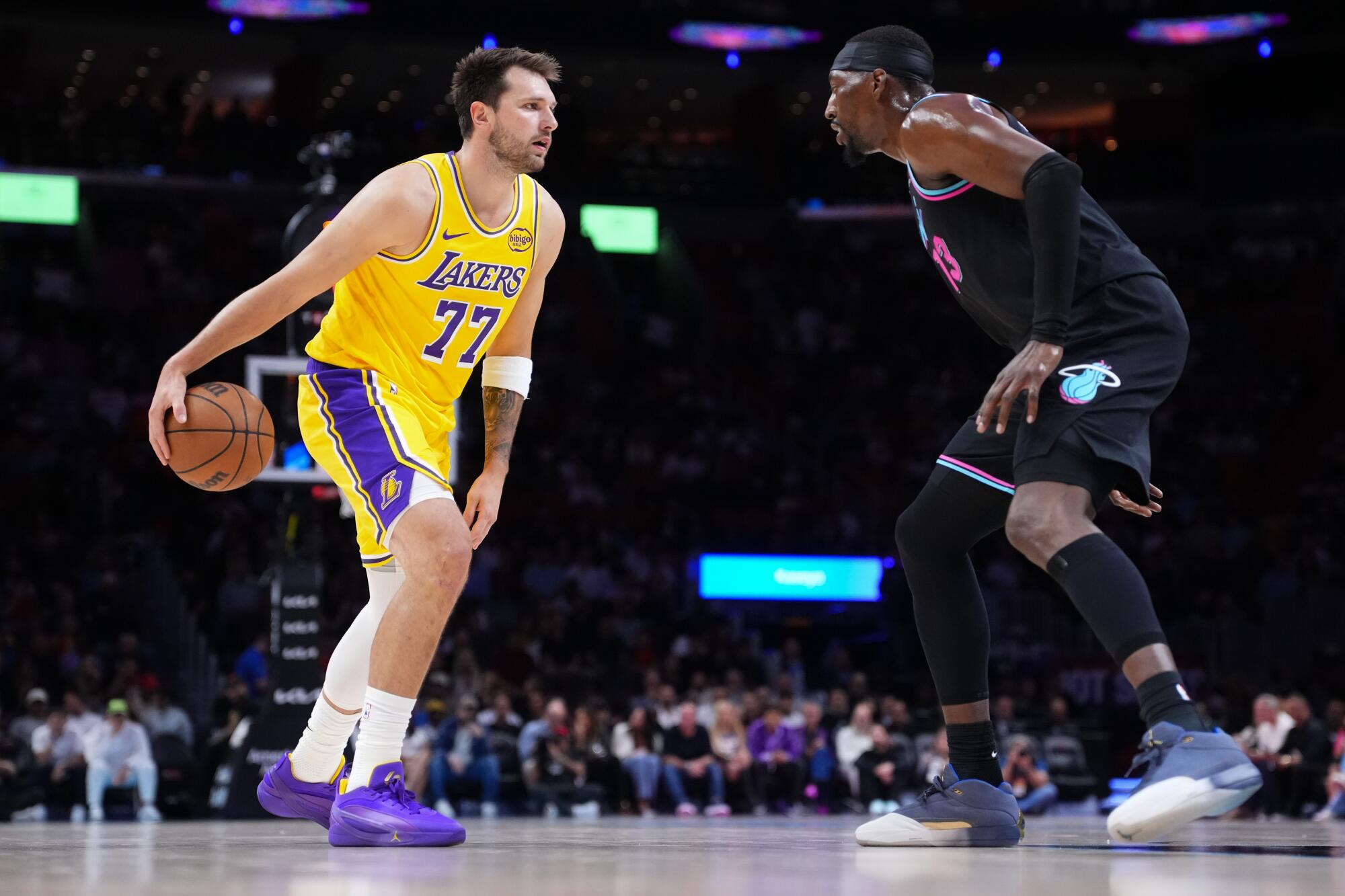
Doncic’s season-high 60 points — the first 60-point game for a Lakers player since Kobe Bryant’s swan song in 2016 — led the Lakers to a 134-126 win over the Miami Heat on Thursday. It was another exceptional feat in Doncic’s late-season campaign for the NBA’s most valuable player.
The NBA’s leading scorer poured in 100 points in less than 24 hours, helping the Lakers extend their winning streak to eight games. Doncic is averaging 40.9 points per game over the streak, shooting 42.2% from three-point range. He became just the seventh Laker to record a 60-point game, joining franchise legends Bryant, Elgin Baylor, Wilt Chamberlain, George Mikan, Jerry West and Shaquille O’Neal.
“It was a superhero performance,” Lakers coach JJ Redick said.
Doncic’s dominance has rescued the Lakers, propelling them to a season-best winning streak. The team’s previous best winning streak was built by taking down bottom-feeding teams including New Orleans, Utah and Dallas. This streak is against some of the league’s best: Six wins are against teams with a .500 record or better and five were against .600 teams. The Lakers have climbed from sixth to third in the Western Conference in two weeks, netting critical tiebreakers against rivals Minnesota, Denver and Houston.

Lakers star Luka Doncic, left, controls the ball in front of Miami’s Bam Adebayo during the first quarter Thursday.
(Rich Storry / Getty Images)
Doncic, in his first full season with the Lakers, began the season as one of the betting favorites to win MVP. But the Lakers went through December doldrums, losing four out of five. He missed two games while traveling to Slovenia to be present for the birth of his second daughter, Olivia. When he returned, Doncic shot 24.5% from three over the next five games.
Doncic’s defense was criticized, along with his consistent complaining to referees. Reigning MVP Shai Gilgeous-Alexander, who leads the Western Conference-leading Oklahoma City Thunder with 31.5 points, 4.5 rebounds and 6.6 assists, figures to still be the favorite in the MVP race, especially with the Thunder on a conference-best 10-game winning streak.
Doncic’s production never dipped — he has maintained the league’s top scoring average for most of the season — but his play still lacked the same zip that made him a must-watch star in Dallas.

Lakers star Luka Doncic reacts after making a three-pointer in the third quarter Thursday against the Miami Heat.
(Rich Storry / Getty Images)
The Lakers embodied some of their star’s struggles. The team was sorting through injuries while trying to integrate new pieces. The chemistry “wasn’t there,” guard Marcus Smart said.
Finally, it all clicked, starting with Doncic.
“Just trusting my game,” Doncic said of how he’s reached this level at this stage of the season. “I know some games I won’t have it. … I’ve been there, so you just got to trust in yourself. I got all the support from my teammates, which helps me a lot.”
Teammates cheered, jumped and raised their fists from the Lakers bench when Doncic made his final free throw to finish off his 60-point night. On a night when LeBron James tied the NBA’s regular-season games played record, appearing in his 1,611th game and notching a 19-point, 15-rebound, 10-assist night, it was Doncic’s final points that seemed to make James smile the widest.
Doncic, who said the crowd’s chants gave him goosebumps, added it “makes my heart happy” seeing the reaction from all of his teammates.

Lakers star LeBron James reacts to a free throw by teammate Luka Doncic in the fourth quarter against the Miami Heat on Thursday.
(Rich Storry / Getty Images)
“We all know the talent that Luka is,” Smart said. “And when he gets in those modes, man, it’s definitely a sight to see, and you don’t want to miss it.”
Before the game, Redick sarcastically wouldn’t even utter the name of the award Doncic has positioned himself for, only saying he believed Doncic should be in the “M-word conversation.”
If it’s not the cheers from the crowd, Doncic doesn’t care about the chatter either.
“It’s you guys, the media,” Doncic said. “I ain’t got nothing to do with it.”


Pezeshkian says Iran not seeking war with Muslim neighbours | US-Israel war on Iran
Iran’s President Masoud Pezeshkian says his country is not seeking war with its neighbours, blaming the US and Israel for creating problems. Iran has justified its attacks on Gulf states as they host US military bases.
Published On 20 Mar 2026
US judge sides with New York Times against Pentagon journalism policies | Donald Trump News
Published On 20 Mar 2026
A federal judge in the United States has agreed to block the administration of President Donald Trump from enforcing a policy limiting news reporters’ access to the Pentagon.
Friday’s ruling sides with The New York Times in its argument that key portions of the new rules are unlawful.
Recommended Stories
list of 3 itemsend of list
US District Judge Paul Friedman in Washington, DC, ruled that the Pentagon policy illegally restricts the press credentials of reporters who walked out of the building rather than agree to the new rules.
The Times sued the Pentagon and Defense Secretary Pete Hegseth in December, claiming the credentialing policy violates the journalists’ constitutional rights to free speech and due process.
The current Pentagon press corps is comprised mostly of conservative outlets that agreed to the policy. Reporters from outlets that refused to consent to the new rules, including those from The Associated Press, have continued reporting on the military.
Friedman, who was nominated to the bench by Democratic President Bill Clinton, said the policy “fails to provide fair notice of what routine, lawful journalistic practices will result in the denial, suspension, or revocation” of Pentagon press credentials.
He ruled that the Pentagon policy ultimately violates the First and Fifth Amendment rights to free speech and due process.
“Those who drafted the First Amendment believed that the nation’s security requires a free press and an informed people and that such security is endangered by governmental suppression of political speech. That principle has preserved the nation’s security for almost 250 years. It must not be abandoned now,” the judge wrote.
Times lauds ruling
New York Times spokesperson Charlie Stadtlander said the newspaper believes the ruling “enforces the constitutionally protected rights for the free press in this country”.
“Americans deserve visibility into how their government is being run, and the actions the military is taking in their name and with their tax dollars,” Stadtlander said in a statement. “Today’s ruling reaffirms the right of The Times and other independent media to continue to ask questions on the public’s behalf.”
Theodore Boutrous, a lawyer who represented the Times at a hearing earlier this month, said in a statement that the court ruling is “a powerful rejection of the Pentagon’s effort to impede freedom of the press and the reporting of vital information to the American people during a time of war”.
The Pentagon did not immediately respond to a request for comment on the ruling.
It has argued that the policy imposes “common sense” rules that protect the military from the disclosure of national security information.
“The goal of that process is to prevent those who pose a security risk from having broad access to American military headquarters,” government lawyers wrote.
The Times’ legal team, meanwhile, claimed the policy is designed to silence unfavourable press coverage of President Trump’s administration.
“The First Amendment flatly prohibits the government from granting itself the unbridled power to restrict speech because the mere existence of such arbitrary authority can lead to self-censorship,” they wrote.
Weeding out ‘disfavoured’ journalists
The judge said he recognises that “national security must be protected, the security of our troops must be protected, and war plans must be protected”.
“But especially in light of the country’s recent incursion into Venezuela and its ongoing war with Iran, it is more important than ever that the public have access to information from a variety of perspectives about what its government is doing,” Friedman wrote.
Friedman said the “undisputed evidence” shows that the policy is designed to weed out “disfavored journalists” and replace them with those who are “on board and willing to serve” the government, a clear instance of illegal viewpoint discrimination.
“In sum, the Policy on its face makes any newsgathering and reporting not blessed by the Department a potential basis for the denial, suspension, or revocation of a journalist’s [credentials],” he wrote. “It provides no way for journalists to know how they may do their jobs without losing their credentials.”
The Pentagon had asked the judge to suspend his ruling for a week for an appeal. Friedman refused.
The judge ordered the Pentagon to reinstate the press credentials of seven Times journalists. But he said his decision to vacate the challenged policy terms applies to “all regulated parties”.
Friedman gave the Pentagon a week to file a written report on its compliance with the order.
The Times argued that the Pentagon has applied its own rules inconsistently. The newspaper noted that Trump ally Laura Loomer, a right-wing personality who agreed to the Pentagon policy, appeared to violate the Pentagon’s prohibition on soliciting unauthorised information by promoting her “tip line”.
The government didn’t object to Loomer’s tip line but concluded that a Washington Post tip line does violate its policy because it purportedly “targets” military personnel and department employees.
The judge said he does not see any meaningful difference between the two tip lines.
“But the problem is that nothing in the Policy explicitly prevents the Department from treating these two nearly identical tip lines differently,” Friedman added.

Gogglebox star says ‘that’s got me’ as he breaks down in tears
The channel 4 hit show made a return to our TV screens for a brand new episode

Pete Sandiford couldn’t hide his emotions(Image: Channel 4)
Gogglebox’s Pete Sandiford couldn’t hide his emotions tonight as he broke down in tears during an emotional moment on Friday night’s show.
The television personality initially joined the Channel 4 hit programme back in 2017 during its tenth series alongside sister Sophie. Since then the duo, from Blackpool, quickly became fan favourites as viewers fell in love with their sharp wit, memorable quips and hilarious reactions to the week’s top TV shows and films.
However during Friday’s (March 20) episode of the hit show, things took an emotional turn for Peter as they tuned in to watch Netflix new film, I Swear.
But it was one scene that let Peter in tears as they watched the character John Davidson (played by Robert Aramayo) get interviewed for a job by a school caretaker named Tommy Trotter (played by Peter Mullan).
Throughout the interview, John struggled with her tics and verbal outbursts and he even spat in Tommy’s tea. Despite John’s symptoms being severe, Tommy made John feel accepted and he decided to give him the job.
The moment left the Gogglebox cast feeling emotional, especially Peter who burst into tears. Sister Sophie reached out and offered her support as she rubbed his arm. Pete tearfully said: “That’s got me that.”
I Swear follows the story of real-life Tourette’s activist John Davidson who fights for awareness and understanding about the condition which causes involuntary tics, which can include whistling, clicking, and expletives.
Following his diagnosis aged 15, the inspirational film directed by Kirk Jones follows John’s difficult teenage years in the 1980s when Tourette’s was barely recognised. It continues into the present day, where he is now one of the most prominent campaigners raising awareness for the condition.
The film has been a huge hit as it landed several BAFTA nominations, including for Outstanding British Film, with Aramayo taking home the trophy for Best Actor in a Leading Role. The Guardian called it an “absorbing, compassionate film”, while Mark Kermode said he “absolutely loved it”.
Audiences have also given the film rave reviews, with one IMDb user who saw I Swear at the Toronto Film Festival highlighting the “amazing performances”.
“The performances are so natural that you often forget you are watching a dramatic depiction,” they went on. “Tells the story with a minimum of gloss.
“It had a good chunk of the audience in tears at various points, both for the painful and joyful moments.”
Gogglebox airs Friday night’s from 9pm on Channel 4 and I Swear is available to stream on Netflix
Judge sides with New York Times in challenge to policy limiting reporters’ access to Pentagon
WASHINGTON — A federal judge agreed Friday to block the Trump administration from enforcing a policy limiting news reporters’ access to the Pentagon, agreeing with The New York Times that key portions of the new rules are unlawful.
U.S. District Judge Paul Friedman in Washington sided with the newspaper and ruled that the Pentagon policy illegally restricts the press credentials of reporters who walked out of the building rather than agree to the new rules.
The Times sued the Pentagon and Defense Secretary Pete Hegseth in December, claiming the credentialing policy violates the journalists’ constitutional rights to free speech and due process.
The current Pentagon press corps is comprised mostly of conservative outlets that agreed to the policy. Reporters from outlets that refused to consent to the new rules, including from the Associated Press, have continued reporting on the military.
Friedman, who was nominated to the bench by Democratic President Bill Clinton, said the policy “fails to provide fair notice of what routine, lawful journalistic practices will result in the denial, suspension, or revocation” of Pentagon press credentials. He ruled that it violates the First and Fifth amendment rights to free speech and due process.
“In sum, the Policy on its face makes any newsgathering and reporting not blessed by the Department a potential basis for the denial, suspension, or revocation of a journalist’s (credential),” he wrote. “It provides no way for journalists to know how they may do their jobs without losing their credentials.”
The Pentagon did not immediately respond to a request for comment on the ruling.
It has argued that the policy imposes “common sense” rules that protect the military from the disclosure of national security information.
“The goal of that process is to prevent those who pose a security risk from having broad access to American military headquarters,” government attorneys wrote.
Times attorneys claim the policy is designed to silence unfavorable press coverage of President Trump’s administration.
“The First Amendment flatly prohibits the government from granting itself the unbridled power to restrict speech because the mere existence of such arbitrary authority can lead to self-censorship,” they wrote.
Kunzelman writes for the Associated Press. AP writer Konstantin Toropin contributed to this report.

The Prem: Bath 62-15 Saracens – nine-try Bath dismantle Saracens with statement win
Bath: De Glanville; Arundell, Lawrence, Ojomoh, Muir; Russell, Spencer (capt); Obano, Dunn, Griffin; Roux, Ewels; Bayliss, Reid, Barbeary.
Replacements: Tuipulotu, Van Wyk, Du Toit, Hill, Pepper, Van der Linde, Carreras, Underhill.
Saracens: Daly; Elliott, Cinti, Tompkins, Segun; Farrell, Van Zyl (capt); Mawi, Dan, Street; Isiekwe, Tizard; McFarland, Gonzalez, Willis.
Replacements: Hadfield, O’Driscoll, Riccioni, Onyeama-Christie, Earl, Simpson, Burke, Malins.
Sin bin: Dan (61)
Referee: Matthew Carley
Military movements indicate Trump is considering Iran ground operation | US-Israel war on Iran
The US is moving military assets to the Middle East that are key to providing support for ground troop operations. Al Jazeera’s Kimberly Halkett says it’s the clearest sign yet of potential US boots on the ground in Iran to secure the Strait of Hormuz.
Published On 20 Mar 2026

USS Boxer The Second Amphibious Assault Ship Now Heading To Middle East (Updated)

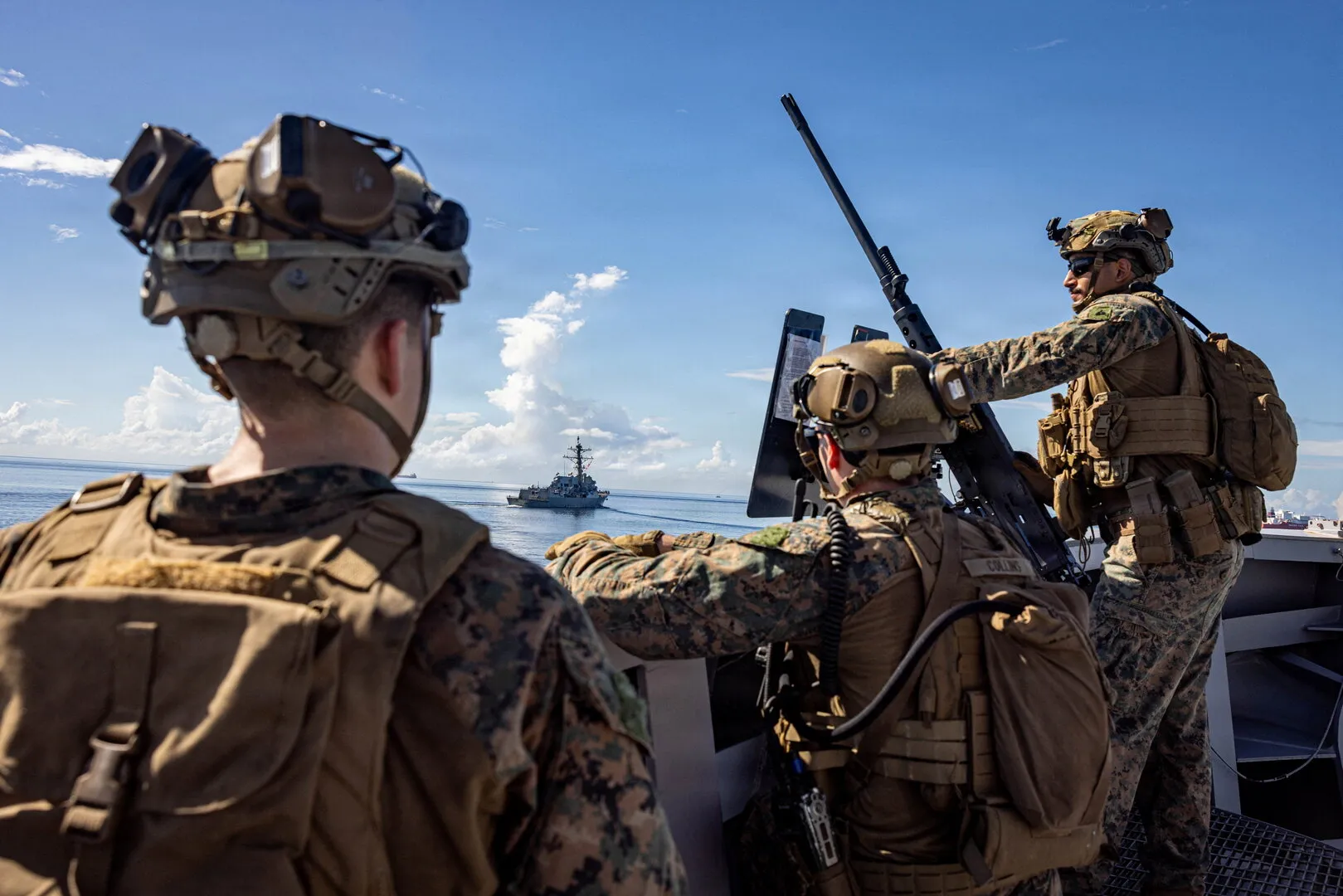
The Pentagon is reportedly sending the Wasp class amphibious assault ship USS Boxer and the rest of its Amphibious Ready Group (ARG), loaded with elements of the 11th Marine Expeditionary Unit (MEU). This comes as the Trump administration is reported to be increasingly considering seizing or blockading Iran’s highly strategic Kharg Island in the Persian Gulf as part of a new phase of Operation Epic Fury.
It has now been widely reported that what is described as an “accelerated” deployment of the Boxer Amphibious Ready Group and the 11th MEU from the West Coast will be in support of Operation Epic Fury.
The Boxer Amphibious Ready Group also includes two other amphibious warfare ships, the San Antonio class USS Portland and the Whidbey Island class USS Comstock. The 11th MEU has roughly 2,500 personnel, in total, and includes air and ground components.
This follows reports last week that the America class amphibious assault ship USS Tripoli and its ARG, carrying elements of the 31st MEU, had also begun moving from the Pacific toward the Middle to support ongoing operations against Iran.
Axios reported today that the Trump administration could be leaning toward establishing a blockade around Iran’s Kharg Island, through which it exports much of its oil, or occupying it, citing unnamed officials. The central goal of doing this would be to step up pressure on the regime in Tehran to, in turn, force it to reopen the Strait of Hormuz. Traffic through that waterway has come to a virtual halt, which is causing massive reverberations across global energy markets.
“[Trump] wants Hormuz open. If he has to take Kharg Island to make it happen, that’s going to happen. If he decides to have a coastal invasion, that’s going to happen,” one official said, according to Axios. “But that decision hasn’t been made.”
The U.S. military carried out extensive strikes on Kharg Island this past weekend. A deployment of U.S. ground troops there would be a major escalation that could have significant ramifications, including domestically.
“We’ve always had boots on the ground in conflicts under every president, including Trump. I know this is a fixation in the media, and I get the politics, but the president is going to do what’s right,” a second official, who also said no decision has yet been made, said, per Axios.
Just yesterday, TWZ spoke with Joseph Votel, the former commander of U.S. Central Command, with a particular focus on the tumultuous Strait of Hormuz, through which around 20 percent of the world’s oil passes. You can read that interview here.
In the meantime, publicly available flight-tracking data indicates that the U.S. Navy is using MQ-4C Triton intelligence, surveillance, and reconnaissance drones to monitor Kharg Island as part of their patrols of the northern Persian Gulf.
Trump has warned that he might consider targeting oil facilities on the island if Iran or other countries “do anything to interfere” with the safe passage of ships through the strait.
Destroying or damaging oil infrastructure on Kharg could have unintended side effects, however. On the one hand, it would further push up global oil prices. The complex nature of infrastructure might take years to repair, which would compound this. In the long term, there is also the question of whether oil infrastructure here should be preserved for the benefit of a potential new Iranian government.
Any successor to the current regime would lose out on vital oil income, potentially driving further internal strife.
There is also the possibility that seizing the island and cutting off the current Iranian government from its most vital source of revenue could be used as a catalyst to bring about its fall.
Then there is the huge question about the kind of military effort that would be required to seize Kharg. This would require a large-scale, sustained operation and would be brought with risk. The island is only 20 miles from the Iranian mainland, putting whatever U.S. force is there at extreme risk of bombardment of multiple types. Getting amphibious assault ships through the Strait and into the Gulf would be an issue, as well, and those ships would be heavily targeted during transit and especially once inside the Gulf. With this in mind, a longer-range aviation assault would be most likely.
A naval blockade of the island might be easier to achieve in the short term, but it would run the risk of Iranian attacks, likely involving uncrewed surface vessels (USVs), drones, and other asymmetric options, as well as anti-ship cruise missiles, the use of which has been limited up to this point, as you can read about here.
As already noted, additional U.S. forces are headed to the region in the form of the Tripoli ARG and the 31st Marine Expeditionary Unit (MEU). While the deployment of the big-deck amphibious assault ship USS Tripoli had already been reported, we now know it is being supported by the amphibious transport docks USS San Diego (LPD-22) and USS New Orleans (LPD-18), thanks to publicly available ship-tracking data.
What exactly the next phase of Operation Epic Fury will look like could be clearer as the Navy amphibious warfare ships and the thousands of Marines they are carrying get closer to the Middle East.
UPDATES
UPDATE: 6:16 PM EST –
There are some mixed messages coming out of Washington about the future of Epic Fury.
President Donald Trump said he is considering “winding down” the war on Iran. His comments, delivered on his Truth Social account, come even though two Marine Expeditionary Units (MEUs) are steaming toward the Middle East and the Pentagon has reportedly drawn up plans to put American troops into Iran with the president’s approval.
Trump added that the U.S. could end the war effort even with the Iranians still closing the Strait of Hormuz.
“We are getting very close to meeting our objectives as we consider winding down our great Military efforts in the Middle East with respect to the Terrorist Regime of Iran,” Trump proclaimed.
He stated that the U.S. has: “(1) Completely degrading Iranian Missile Capability, Launchers, and everything else pertaining to them. (2) Destroying Iran’s Defense Industrial Base. (3) Eliminating their Navy and Air Force, including Anti Aircraft Weaponry. (4) Never allowing Iran to get even close to Nuclear Capability, and always being in a position where the U.S.A. can quickly and powerfully react to such a situation, should it take place. (5) Protecting, at the highest level, our Middle Eastern Allies, including Israel, Saudi Arabia, Qatar, the United Arab Emirates, Bahrain, Kuwait, and others.”
The Strait, Trump added, “will have to be guarded and policed, as necessary, by other Nations who use it — The United States does not! If asked, we will help these Countries in their Hormuz efforts, but it shouldn’t be necessary once Iran’s threat is eradicated. Importantly, it will be an easy Military Operation for them.”
Our coverage has ended for the day. Stay tuned for more.
UPDATE: 5:15 PM EST –
Retired Marine Gen. James Mattis, who served as Defense Secretary and CENTCOM commander, weighed in on the war, saying he doesn’t believe regime change is likely.
Iranian state media warns Iran will target the UAE’s industrial port city of Ras Al-Khaimah if Iranian islands are again attacked from that nation, Arab News reported.
UPDATE: 4:20 PM EST –
Trump ruled out any ceasefire with Iran.
He suggested that re-opening the Strait is “a simple military maneuver.”
The president also declined to say if he will order troops into Iran.
CBS News is reporting that Pentagon officials have made detailed preparations for deploying U.S. ground forces into Iran. The network cited multiple sources briefed on the plans..
“Senior military commanders have submitted specific requests aimed at preparing for such an option as President Trump weighs moves in the U.S.-Israel-led conflict with Iran, the sources said,” according to CBS. The news outlet’s sources do not specify how those troops would be used. Meanwhile, the Trump administration hasn’t committed to any such plan to put boots on the ground, which would greatly escalate the war.
CENTCOM provided us an update of the number of troops wounded so far in Epic Fury. To date there have been 232 wounded, up from about 200 on Monday. Of those troops, 207 returned to duty. The number of seriously wounded has held steady at 10. The Associated Press was the first to report these details.
The command also shared video of what it says was an attack on The Esfahan Khomeynishahr Drone Production Plant that produced Shahed one-way attack drones.
New video shows another Iranian cluster munition exploding over Israel. There were no reports of injuries from the attack, which was the ninth so far this evening, according to Times of Israel military correspondent Emanuel “Mannie” Fabian in a post on X.
NATO provided us a statement about pulling its forces out of Iraq as Iranian-backed militias have carried out several attacks there:
“‘I would like to thank the Republic of Iraq and all the Allies who assisted in the safe relocation of NATO personnel from Iraq,’ said Gen. Alexus Grynkewich, Supreme Allied Commander Europe. “‘ would also like to thank the dedicated men and women of NATO Mission Iraq, who continued their mission throughout this period. They are true professionals.’
The last NATO Mission Iraq personnel departed the country on March 20.
NATO Mission Iraq will continue from Joint Force Command Naples. NMI is a non-combat advisory and capability-building mission to assist Iraq in building more sustainable, transparent, inclusive and effective security institutions and forces, so that they themselves are able to stabilise their country, fight terrorism, and prevent the return of ISIS/Daesh.”
Iraq declared a ”force majeure” on all oilfields developed by foreign oil companies, as attacks in the region have disrupted navigation through the Strait of Hormuz,” Al Arabiya reported on X. This is ”preventing most of the country’s crude exports from moving,” oil ministry sources told the outlet.
A force majeure is a contractual clause freeing parties from liability due to extraordinary, unavoidable events, like the war.
The U.K. Defense Ministry offered its latest update on the war.
The Iranian space program, one of the most advanced in the Middle East, has suffered extensive damage from US and Israeli airstrikes, Bloomberg News reported. The attacks are “potentially driving Tehran to deepen cooperation with China and Russia,” the outlet posited.
UPDATE: 2:12 PM EST –
Earlier in our story, we noted that the USS Boxer (ARG) was deploying to the Middle East. Images emerged on line of the Boxer, the Portland and the Comstock departing San Diego.
Ukrainian President Volodymyr Zelensky is once again touting a deal to provide drones to the U.S., an arrangement Trump has so far dismissed.
“I am very interested in signing this agreement with our close partner – the United States of America,” Zelensky stated on X. “So when President Trump is ready, I will definitely be ready. Our negotiating team will discuss this issue at the meeting in the United States.”
Jerusalem’s Old City, home to some of the most sacred sites in Christianity, Islam and Judaism, was reportedly hit by missile shrapnel that fell near the Al-Aqsa Mosque compound. The official Turkish Anadolu news outlet reported that missile fragments also fell in the Jewish Quarter near Jerusalem’s Old City, amid heightened tension and a security alert in the area.
Shrapnel landed in several locations across Jerusalem, with no immediate details available on the extent of the damage, Anadolu added, citing Israeli media.
Shipping giant Hapag-Lloyd provided us with a statement on the current state of their maritime commerce.
“We are monitoring the situation very closely, but the situation in the Middle East remains very fluid. Based on our current risk assessment, we have suspended all transits through the Strait of Hormuz and the Suez Canal as well as bookings from and to the Upper Gulf region. As a result, schedules and port calls may change at short notice, and some services will be adjusted. We have contingency plans in place, and the safety of our people on ground and ocean remains our top priority. Our teams are working closely together to find the best possible solutions for our customers’ shipments.”
A Greek-owned medium-sized cargo vessel, also known as a panamax, became the first bulk carrier to transit the Strait of Hormuz with its Automatic Identification System on since March 2, according to Lloyd’s List.
Moscow proposed a quid pro quo to the U.S. under which the Kremlin would stop sharing intelligence information with Iran, such as the precise coordinates of U.S. military assets in the Middle East, if Washington ceased supplying Ukraine with intel about Russia, according to a report from Politico. The outlet cited two people familiar with the negotiations.
UPDATE: 1:00 PM EST –
The Israel Defense Forces (IDF) and Iranian media have both reported the death of Iran’s Islamic Revolutionary Guard Corps (IRGC) spokesperson, Ali Mohammad Naeini. The Israeli military said in a post on X that he was killed in an overnight airstrike.
Just before his death, Naeini issued a statement insisting Iran was still able to produce missiles despite the attacks from Israel and the United States.
Naeini made the comment in response to a claim by Israeli Prime Minister Benjamin Netanyahu that Iran could no longer build missiles. Referencing how Iranian schools consider a 20 as a perfect score, Naeini said: “Our missile industry score is 20 and there is no concern in this regard because we are producing missiles even during war conditions, which is amazing, and there is no particular problem in stockpiling.”
Naeini joins a growing list of high-profile Iranian regume figures who have been killed so far in the conflict, others including the former supreme leader Ali Khamenei, the security chief Ali Larijani, head of the paramilitary Basij force, Gholamreza Soleimani, and the intelligence minister, Esmail Khatib.
Tehran has accused the United Kingdom of “participation in aggression,” reflecting the fact that the country has permitted the U.S. Air Force to use its airbases as a launchpad for bombing missions over Iran.
Iranian Foreign Minister Abbas Araghchi warned his British counterpart, Yvette Cooper, and insisted on his country’s right to self-defence. “These actions will definitely be considered as participation in aggression and will be recorded in the history of relations between the two countries. At the same time, we reserve our inherent right to defend the country’s sovereignty and independence,” Araghchi said on his official Telegram channel.
U.S. Central Command says that it has destroyed an Iranian ballistic missile plant in Karaj, to the west of Tehran. The plant was used to “assemble ballistic missiles that threatened Americans, neighboring countries, and commercial shipping,” CENTCOM said.
Satellite imagery from Bandar Abbas suggests that airstrikes have targeted the naval base and port facilities once again. The imagery below shows fires burning at several different structures, although the level of overall damage is not entirely clear.
Other recent targets of U.S. airstrikes appear to include Qeshm Island in the Strait of Hormuz. Satellite imagery shows cratering, but it unclear if the attacks collapsed the IRGC’s tunnel complex that is understood to be on the island. The underground complex is reportedly used to store small boats, missiles, and drones.
Israel conducted airstrikes on Tehran today, as Iranians marked Nowruz, the Persian New Year. In a statement on X, the Israel Defense Forces said: “The IDF has now begun a wave of strikes targeting infrastructure of the Iranian terror regime in the heart of Tehran.”
Meanwhile, there are growing questions about the degree to which Israel and the United States are on the same page as regards the war against Iran.
Israeli Prime Minister Benjamin Netanyahu has said that Israel acted alone in the bombing of Iran’s South Pars gas field, one of the largest in the world. He also confirmed that Trump had asked Israel to stop any further such attacks. “President Trump asked us to hold off on future attacks, and we’re holding out,” Netanyahu explained.
Iran is being “decimated” and no longer had the capacity to enrich uranium or make ballistic missiles, but a revolution in the country would require a “ground component,” Netanyahu added.
When asked whether he had dragged Trump into the conflict, Netanyahu responded: “Does anyone really think that someone can tell President Trump what to do?” Netanyahu told reporters, at a press conference. “He didn’t need any convincing,” he added. “I don’t think any two leaders have been as coordinated as President Trump and I. He’s the leader. I’m, you know, his ally.”
Israel, Kuwait, and the United Arab Emirates today all announced that their air defenses were responding to Iranian missile attacks. Elsewhere in the region, Bahrain’s interior ministry announced an air raid alert, while Saudi Arabia’s defence ministry said it had intercepted a drone in the country’s east.
Kuwait’s state oil firm KPC reported that its Mina Al-Ahmadi refinery was hit by multiple drone attacks early on Friday, causing a fire in some units. No initial casualties were reported, according to the state news agency.
Iranian attacks on energy infrastructure have taken a toll on Qatar, too. Ras Laffan Industrial City in Qatar has been forced to reduce the country’s liquefied natural gas (LNG) export capacity by 17 percent, according to QatarEnergy, the state-run energy giant. The “extensive damage” could reportedly reduce its annual revenues by $20 billion and take “up to five years” to repair.
Iran has also launched strikes against energy infrastructure in Israel.
According to Israel’s energy ministry, an Iranian missile attack — reportedly using cluster warheads — hit oil refineries in the northern port city of Haifa but did not cause “significant damage.” Energy Minister Eli Cohen added that power was disrupted, but electricity was soon restored to most of those who were affected.
The video below purports to show debris from an intercepted Iranian ballistic missile landing on a car in central Israel.
According to the Fars news agency, the Iranian military has reportedly threatened American and Israeli military personnel and officials. In a post on Telegram, the agency quoted a senior spokesperson for Iran’s armed forces as saying: “We are keeping an eye on your cowardly officials and commanders, your wicked pilots and soldiers… From now on, based on the information we have from you, the world’s tourist attractions, resorts, and entertainment centers will not be safe for you either,” the spokesperson reportedly said.
Contact the author: thomas@thewarzone.com

‘Mormon Wives’: Jessi Draper’s husband files for divorce
In a week rife with drama involving “The Secret Lives of Mormon Wives” cast, two stars of the hit reality series appear to be going their separate ways officially.
Jessi Draper and Jordan Ngatikaura’s marriage is coming to an end after five years, with the latter filing for divorce in Utah, according to TMZ, which cited court documents. The estranged pair married in October 2020 and share two children. Ngatikaura is also the father to a teenage daughter from a previous relationship.
A representative for Draper did not immediately respond to a request for comment Friday. Ngatikaura, who also did not respond to The Times’ request for comment, issued a statement about his filing to TMZ and People.
He told the outlets his decision to divorce Draper “comes with a heavy heart” and said he is grateful for their time together. Ngatikaura plans to prioritize his children, “ensuring they feel loved, supported, and protected through this transition,” according to People. He said in his statement that he is seeking privacy for his family.
Before Ngatikaura’s divorce filing, the pair’s marital struggles had become public. In November, Draper broke her silence on allegations she had cheated on Ngatikaura and admitted to having an “emotional affair” with “Vanderpump Villa” star Marciano Brunette. At the time, Draper spoke to People about the “emotional abuse” she said she faced from her husband — he took “full accountability for the pain I caused Jessi” — and said, “We both made mistakes for sure.”
The spouses had agreed to a 90-day separation and to work things out together in therapy, People reported last year.
News of the “Secret Lives of Mormon Wives” divorce comes as the franchise reckons with star Taylor Frankie Paul, who faces new allegations of domestic abuse against her on-again, off-again partner Dakota Mortensen. Paul, who was arrested and charged in 2023 for a separate dispute involving Mortensen, was tapped to lead the latest season of “The Bachelorette” set to premiere Sunday, but that all came to a screeching halt earlier this week.
As Utah’s Draper City Police Department confirmed it was investigating alleged incidents of domestic violence involving Paul and Mortensen, TMZ published video Thursday of Paul kicking and throwing chairs at Mortensen in a 2023 dispute while one of her children was in the same room. ABC, home network of “The Bachelor” and “The Bachelorette,” acted swiftly and pulled the plug on Paul’s upcoming season.
“In light of the newly released video just surfaced today, we have made the decision to not move forward with the new season of ‘The Bachelorette’ at this time, and our focus is on supporting the family,” Disney said in a statement Thursday.
“Taylor is very grateful for ABC’s support as she prioritizes her family’s safety and security,” read a portion of a statement provided by a representative for Paul. The statement went on to say Paul had suffered “extensive mental and physical abuse as well as threats of retaliation.”
Amid the fresh allegations, Paul has seen brand deals fall to the wayside and production on “Mormon Wives” pause pending a decision on her status as a cast member, according to a person briefed on the situation.
Times staff writer Yvonne Villarreal contributed to this report.

Paramount deal for CNN and Warner Bros. draws concerns about news independence
Should Paramount Skydance prevail in its $111-billion takeover of Warner Bros. Discovery, the Larry Ellison family would control two historic Hollywood film studios, dozens of cable channels, HBO and two legendary newsrooms, CBS News and CNN.
Concerns about the potential loss of more Hollywood jobs, and questions about newsroom independence dominated a hearing Friday to address Los Angeles’ crisis of shrinking film and TV production jobs.
Paramount wants to wrap up its Warner merger by September — a rapid timetable. The takeover deal, which was struck last month after Netflix bowed out, would put HBO and CNN under the control of Larry Ellison and his son David, the chairman of Paramount, which includes CBS.
Both Ellisons maintain friendly relations with President Trump. Those bonds, along with challenges to legacy media and changes at CBS News in recent months, sparked handwringing during the hearing called by Sen. Adam Schiff (D-Burbank) and Rep. Laura Friedman (D-Glendale).
“The questions surrounding this merger go beyond jobs, contracts and consumers,” Schiff said. “They also go to editorial independence of two of America’s most significant news organizations, CNN and CBS News.”
Trump has long agitated for changes at CNN, and members of his cabinet, including War Secretary Pete Hegseth, have openly cheered for an Ellison takeover of CNN.
To pave the way for the Ellisons’ purchase of Paramount, the company paid $16 million to Trump last summer to settle his lawsuit over edits to a “60 Minutes” interview with Kamala Harris in October 2024. Most 1st Amendment experts had deemed Trump’s suit “frivolous.”
Since the Ellisons took the helm, there has been a change in direction at CBS News and a reduction in its size and scope. Staff members at CNN are bracing for similar changes, including to the tone of its newscasts.
In addition to the long-term health of Los Angeles’ film economy, the merger’s fate could determine “whether we have state sponsored media … or whether we have journalists who can truly follow the story,” Friedman said.
A Paramount spokesperson declined to comment.
The deal is currently before regulators in the U.S. and abroad.
Paramount Chairman David Ellison has vowed to “build a stronger Hollywood,” by increasing the creative output of the two legendary movie studios — Paramount and Warner Bros. — to 30 theatrical releases a year. Warner Bros., which owns such prominent franchises as “The Matrix,” Batman, Harry Potter, “The Big Bang Theory,” and “Friends,” has long been one of Hollywood’s most prolific studios.
But Paramount has suffered from years of under-investment and Ellison and his team have been working to boost the film pipeline.
Ellison has also pledged to keep both studio lots and preserve HBO.
“HBO will continue to operate independently under our ownership, enabling it to create more of the world-class content it is renowened for,” Ellison wrote in the Feb. 28 letter to Schiff and Friedman, responding to their concerns about consolidation.
During Friday’s hearing, the lawmakers turned to former CNN anchor Jim Acosta, who famously jousted with Trump during his first term, for his reflections. He was asked whether any “guardrails” could protect against potential merger harms.
“If this merger goes through, the guard-rails are gone,” Acosta said bluntly. “If we continue to go down this road it will be lights-out for the news industry… We need media options that are not controlled by the wealthiest and most powerful people in the country.”
The hearing occurred the same day that CBS News imposed another sweeping round of layoffs and disbanded its CBS News radio network. It also came the same week as Trump’s Federal Communications Commission approved a massive television station merger, which will allow Texas-based Nexstar Media Group to control more than 250 stations, despite a legal challenge from state attorneys general.
The proposed Paramount-Warner merger would prompt at least $6 billion in cost savings, according to Paramount. Industry veterans warn that billions more in cuts may be necessary to make the deal math work.
A combined Paramount-Warner would carry nearly $80 billion in debt, a legacy of the proposed leveraged buyout and the mergers that came before it.
The hearing at Burbank City Hall —“Lights, Camera, Competition”: Promoting American Film Production,” — was wide-ranging. Award-winning actor Noah Wyle, the star and a producer of Warner Bros.’ “The Pitt,” discussed the need to bring more productions back to Los Angeles where thousands of out-of-work film professionals have been suffering. “The Pitt” is filmed in Burbank.
“Over the last six years, the aggregate effect of projects leaving the state in search of tax credits, the pandemic and last year’s fires has been a near cratering of our once thriving industry,” Wyle said. “We lost 42,000 film and TV jobs between 2022 and 2024.”
The hearing unfolded down the road from the massive Warner Bros. studio complex, and was held to explore ways to boost the Hollywood economy, including the potential for a national tax credit under consideration in Congress. The campaign is intended to keep film jobs in the U.S. amid an increased migration to Britain, where Warner Bros. maintains an expansive studio complex in London, and other countries that offer generous subsidies.
“Work in the entertainment industry is precarious,” said Matthew D. Loeb, International President of the International Alliance of Theatrical Stage Employees (IATSE). “Past studio mergers have meant fewer jobs.”

How Kiki Rice became the UCLA Bruins’ top WNBA draft prospect
The WNBA will likely get an injection of UCLA talent. One of the players most equipped to make an impact right away, it turns out, might be Kiki Rice.
Some mock drafts have the senior guard as high as being picked No. 5 overall after concerns she might fall out of the first round entirely before this season.
After a career-best season, though, Rice is one of the top prospects in a loaded class. That wasn’t a given after taking a step back in all statistics other than shooting last season.
The No. 1 seed Bruins are hoping to ride that to a national title, with the next step coming Saturday against No. 16 seed California Baptist in the first round of the NCAA tournament. Tipoff is at 7 p.m. at Pauley Pavilion.

UCLA guard Kiki Rice shoots over Ohio State guard Jaloni Cambridge during the semifinals of the Big Ten tournament on March 7 in Indianapolis.
(Michael Conroy / Associated Press)
WNBA scouts are hoping Rice proves she can be one of the best early first-round investments in the league.
“The work she did on her mentality, film study, with leadership, using her voice, working on her handles, I just think it’s her commitment to the details,” UCLA coach Cori Close said. “I’m not surprised that she’s playing this way because of the intentional work that she puts in.”
A Big Ten All-Defensive Team and unanimous All-Big Ten First Team selection this season, Rice is averaging career highs in points (15.3), rebounds (6.0) and shooting percentage (50.4%). Her assist numbers have dropped since the addition of Charlisse Leger-Walker, but that’s allowed Rice to create her own offense.
“I think one of the things that Kiki’s been able to do is have different kinds of scoring catches this year because of Charlisse’s presence on our team,” Close said. “But I do think the biggest thing has probably been her passing, her facilitation, as well as her ability to shoot.”
WNBA scouts have taken notice, too. One evaluator said her ability to play with a “group of weapons” has set herself up to be taken seriously for a larger role even as a rookie. For a long time, among those scouting in the league, she was viewed as a potential backup point guard, but her shooting ability and defensive consistency has made her a more complete prospect.
Her 2.2 defensive win shares are third in the Big Ten and her 83.0 defensive rating is seventh.
“I worked a ton of [defense] in the offseason and really stepped up to the challenge of guarding the other team’s best perimeter player,” Rice said. “I think me being challenged in that way, it’s been a really great area of growth, and that’s probably the area that I’m most proud of.”
Rice’s improvement from the three-point line is a big one for WNBA scouts. She improved her deep shot from 21.7% to 38.1% across four seasons.

UCLA guard Kiki Rice steals the ball from Washington guard Chloe Briggs at Pauley Pavilion on Feb. 19.
(Gina Ferazzi/Los Angeles Times)
That, plus her defensive prowess and ability to play point guard and more of a loose guard role, have helped her WNBA stock rise tremendously.
“Defensively has been probably the most impactful growth thing that she’s had,” Close said. “But Kiki — people don’t realize she was out for six months. She had surgery on April 15th last year and was out for six months.”
Rice was injured at the start of last season and then underwent right shoulder surgery right after the Final Four. Despite the injury, she played in 34 games last season, averaging 12.8 points and 5.0 assists per game.
Rice won the Big Ten tournament’s most outstanding player award after UCLA thrashed Iowa by 51 points in the championship. She averaged 16.6 points and 5.3 assists during three Big Ten tournament games.
Her numbers might be even better if she were the team’s top offensive option, like Hannah Hidalgo with Notre Dame. Instead, she is sharing time with other top WNBA prospects such as Lauren Betts, Gianna Kneepkens and Leger-Walker.
“What I love most is she’s one of the most selfless people I’ve ever played with,” Betts said of Rice. “She really could [not] care less about all of the attention. She just wants to win games. She’s always there for her teammates. I’m so grateful I get to be her teammate and her friend. She’s amazing.”
In addition to her three-point shot improvement, around 60% of her points still come in the paint from driving to the basket, making her a threat all over the floor.
“There were lots of times in previous years where Kiki could get downhill, but we didn’t have the court spacing because we didn’t have the quality of shooting that allowed those driving lanes to take place,” Close said.

UCLA guard Kiki Rice shoots over USC guard Malia Samuels at Pauley Pavilion on Jan. 3.
(Eric Thayer/Los Angeles Times)
The biggest question with Rice is whether her three-point shooting can scale to a higher volume in the WNBA, where guards are more likely to shoot from deep than be relied on in the post. She has never taken more than 2.7 attempts per game.
Part of that is because there are so many options from three-point range that Rice doesn’t have to be the primary shooter. Kneepkens is making 44.2% of her three-pointers and Gabriela Jaquez has hit 41.1% while Leger-Walker is shooting 36.4% from range.
That hasn’t affected Rice’s efficiency, though.
“I think this year the way that we moved the ball and everyone gets touches is so important for everyone and allows me to be successful,” Rice said.

UCLA guard Kiki Rice celebrates with teammates as she’s handed the Big Ten tournament most outstanding player trophy on March 8 in Indianapolis.
(Michael Conroy / Associated Press)
With the way the draft order falls, Rice is likely to end up with either an expansion team or a team that struggled last season, such as Washington or Chicago. That might mean she’ll need to step in and produce in her first season as a pro.
That is why her stock has risen so much this season — she’s shown she has the versatility to do what is needed.
“Kiki has been playing the best basketball of her career,” Close said. “I think she has put in the work. She knows what she’s earned, and she’s sort of ‘that girl’ for us.”
Supreme Court sides with street preacher free speech lawsuit
March 20 (UPI) — The U.S. Supreme Court on Friday ruled in favor of allowing a so-called street preacher in Mississippi to challenge a law prohibiting where he can protest.
The high court said Gabriel Olivier can file a civil suit in response to a law in Brandon, Miss., that prevents public protests outside of designated areas. He said the law violates the 1st Amendment’s free speech protection.
Police in Brandon, Miss., arrested Olivier in 2021 as he and a group of protesters shouted slurs and insults at concertgoers as they entered an amphitheater. Some members of the group also held up graphic signs showing aborted fetuses.
He was convicted of violating the city’s laws banning protesters from coming within about 265 feet away of the amphitheater and from using loudspeakers that can be heard from more than 100 feet away, CNN reported.
Olivier pleaded no contest to the charges and was ordered to pay a fine and serve a year of unsupervised probation. Following his sentence, he sued the city, saying its law violated his free speech rights.
A 1994 Supreme Court ruling — Heck v. Humphrey — though says that a defendant convicted of a crime can’t then sue over the legality of their conviction. Otherwise, he and other defendants could be cleared of their convictions outside of the normal criminal appeals process, The Washington Post reported.
Olivier’s lawyers said his case should be allowed to proceed because success wouldn’t affect the result of his conviction, for which he wasn’t imprisoned. The Supreme Court agreed with a unanimous vote.
The ruling did not pass judgment on the constitutionality of the city of Brandon’s laws, only that Olivier is allowed to challenge them.

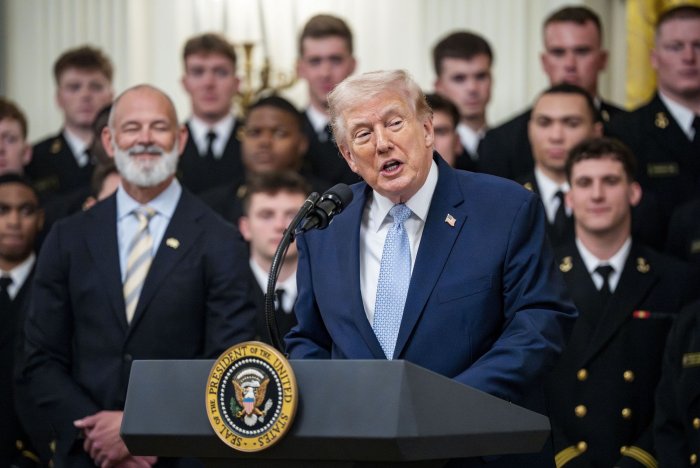
President Donald Trump presents the Commander in Chief’s Trophy to the Navy Midshipmen football team during a ceremony in the East Room of the White House on Friday. The award is presented annually to the winner of the football competition between the Navy, Air Force and Army. Navy has won the trophy back to back years and 13 times over the last 23 years. Photo by Bonnie Cash/UPI | License Photo
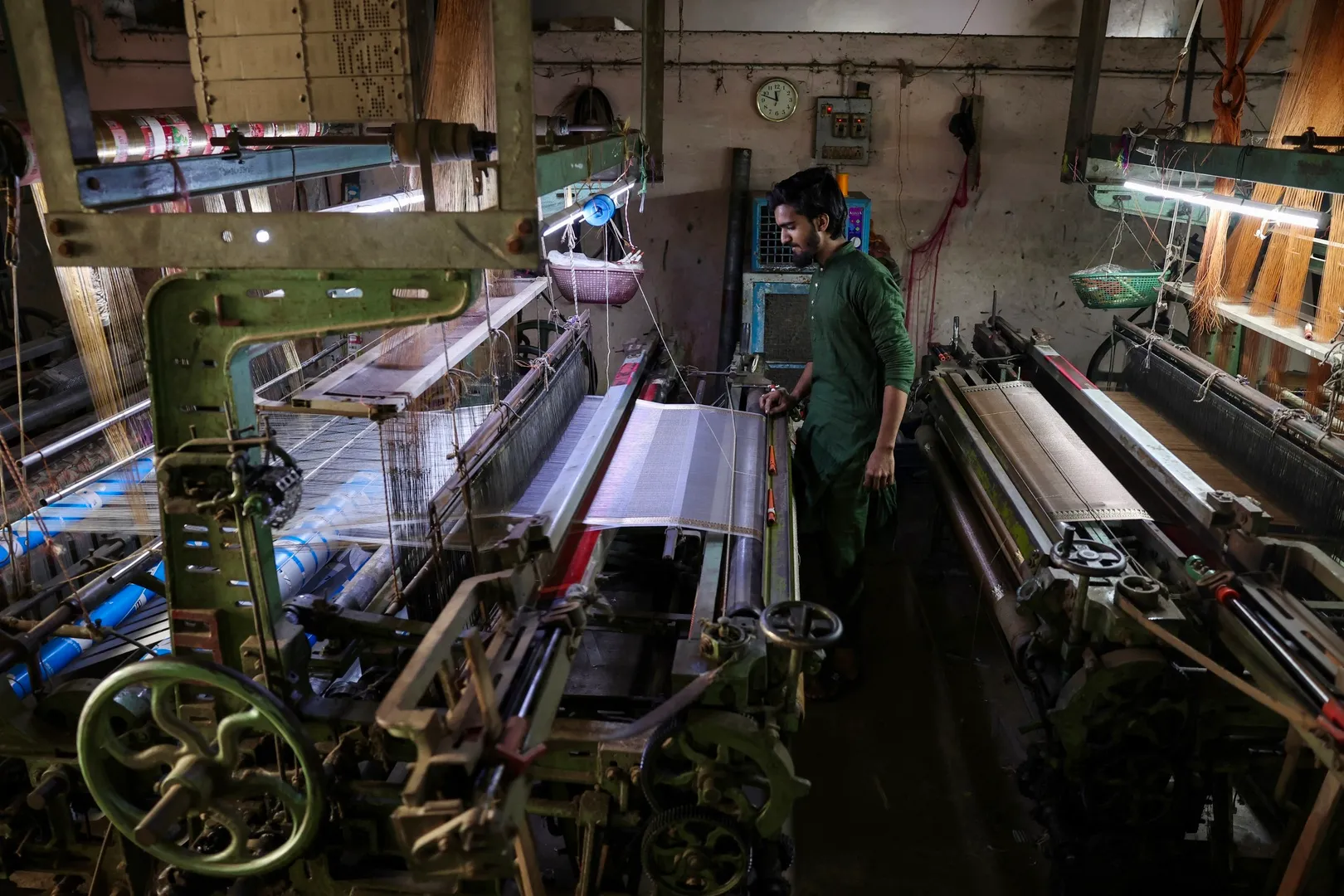
India cooking gas crisis forces exodus of textile workers | Oil and Gas
Workers in India’s textile hub Surat are returning home after days without cooking gas, as an LPG crisis linked to Iran war disruptions halts supplies. Industries face shutdowns, while authorities invoke emergency measures to prioritise households.
Published On 20 Mar 2026

How Shaun Ryder smoked 50 rocks of crack a day, escaped a gun battle & faced down orangutan before becoming ‘normal’ dad
HE may be a 63-year-old “normal” dad these days, but Shaun Ryder has not lost the ability to shock.
When the Happy Mondays frontman spoke to host Jack Whitehall at the Brit Awards last month, his tale of nearly being busted for drugs had to be edited out.
But, then again, putting the potty-mouthed and straight-talking singer on live telly is always a risk.
In an exclusive interview with The Sun, the Mancunian reveals that ITV did not appreciate his story of a drugs raid that happened when he was up for a Brit award in 1996.
Back then, Shaun’s other band, Black Grape, had been nominated for British Breakthrough Act.
Shaun says: “I told him I went to score and the gaff where I went to score got raided by the police as I’m scoring and the cops cottoned on who I was.


“And I’m saying, ‘Oh, I’m getting a Brit Award here’ and they let me go.
“They busted a heroin house and they let me go because I was up for a Brit Award.”
You might think that Shaun, who has already published two autobiographies, has no fresh stories.
But the singer, who has a new memoir out now and who is writing material for Happy Mondays’ first album in 20 years, always has plenty of tales to tell.
In his latest book, 24 Hour Party Person, he recalls facing down what he believes was a killer orangutan, escaping a gun battle and being held hostage by an armed robber.
There are also numerous car crashes from which he somehow escaped alive.
Shaun, who quit drugs aged 40 after 20 years of substance abuse, admits: “I have used up more than nine lives.”
It could all have ended shortly after Happy Mondays’ first album, Squirrel And G-Man Twenty Four Hour Party People Plastic Face Carnt Smile (White Out), came out in 1987.
Shaun, who was not famous at that point, went to Amsterdam to live for a short while.
He remembers: “Some nutcase we knew from Manchester, who was doing armed robberies and was then in Amsterdam, hijacked a load of people, put them in the canal and shot them and then turned up at the gaff where we were staying and held us hostage for a day or two.”
Luckily, Shaun managed to talk the robber into letting them go.
But there was no way of having a nice discussion with a great ape that appeared in front of Shaun on a Barbados beach when he was recording Happy Mondays’ fourth album in 1992.
At the time there were stories in the local Press about a dangerous orangutan, nicknamed Jack the Ripper, on the loose.
Shaun claims: “This thing just dropped out of the trees right in front of me. It was a f***ing big orangutan.”
Telling himself “don’t show any fear”, the musician stood tall and shouted, “Grrr, arrrgh, f*** off, just f*** right off”, at the animal.
Remarkably, the orangutan did as it was told.
Orangutans are not native to the Caribbean, so there is a good chance it was indeed Jack the Ripper.
And Shaun, who was “smoking up to 50 rocks of crack cocaine a day” in Barbados, insists it was not a hallucination.
The album, Yes, Please!, failed to generate enough sales to justify the £150,000 spent making it and the following year the Happy Mondays broke up.
Shaun formed Black Grape in 1993 with his dancer mate Bez and rapper pal Paul “Kermit” Leveridge.
But it did not help keep him out of trouble.
During one trip to Jamaica, he and Kermit found themselves in the middle of a gun battle while trying to buy drugs.
He recalls: “I was going scoring and someone got shot, shot in the head. We just ran for it. If you’re a junkie going scoring, that’s the sort of s**t you come across.”
It was getting together with third wife Joanne which finally helped Shaun give up drugs and stop boozing.
They had dated briefly before Happy Mondays had hits, but he says: “She blew me out.”
Joanne, who now manages the TV part of his career — which has included two appearances on I’m A Celebrity . . . Get Me Out Of Here! — remained in the same circle as him.
The couple got together more than 20 years ago and married in 2010.
They have two daughters, Pearl, 17, and Lulu, 18.
Shaun, who also has four other children with previous partners, says: “She reeled me in and it’s a good job. “She didn’t let me get away with half of the stuff.
“If she hadn’t I’d have just carried on with crashing, but once I hit 40, I was determined to give up drugs anyway.”
His older children had to deal with his absences and spells in rehab.
But the youngest two have grown up in a more stable environment.
Shaun, who is also stepdad to Joanne’s son Oliver, explains: “I’ve still got two kids at home, so for the last 18 years, I’m just Dad.
“They’ve grown up coming and watching us at music festivals, and they’ve seen me in the jungle, but they’ve never seen that Shaun Ryder who’s off his nut.
“I pick them up from college and all that sort of thing, and drop them off. I’m the f***ing taxi service.
“In this house, you know, we don’t even have booze or anything, so, we’ve just been like a normal f***ing mad family for the past 18 years or whatever.”
Shaun says he did not see much of his older children and admits he was not a good dad to them.
But he says: “I’ve had really no trouble off my kids, I’ve been very lucky with the kids.”
This year is going to be an important one for Shaun.
Apart from the book and new album out next year, he is doing a Q&A tour and is on the road with Happy Mondays.
The return to the studio is due to former Creation Records label boss Alan McGee.
Shaun reveals: “I’m writing it now. Alan McGee wanted a new Mondays album, so Alan usually gets what he wants.”
When it comes out, it will be 40 years since the Manchester group’s first release in 1987.
These days various health problems, including a recent bout of pneumonia, means performing is harder than ever for Shaun.
One legal substance that has helped keep him on the road is the fat jab Ozempic.
Shaun says: “You just raid the medicine cabinet, don’t you, and get on with it, so the show must go on.
“I have an overactive thyroid, so even if I ate f***ing lettuce and tomatoes, I would be big.
“Since I started on the injections my thyroid started to get better.”
If Shaun has his way he will keep performing until the Grim Reaper finally catches up with him.
And the singer would settle for dying on stage, like the comedian Tommy Cooper.
He says: “In this game, you’re doing some Tommy Cooper style, you know what I mean?
“As long as you enjoy it, do what you do, f***ing do it and I still do.
“I’ll still make music and go play music out there until I f***ing drop dead on stage.
“It’s a good place to go, innit? To drop dead on stage, singing Kinky Afro.”
- Shaun’s new book 24 Hour Party Person is available from awaywithmedia.com.
California lawmakers aim to apply a film and TV tax credit federally
California’s economy might see a boost from the state’s expanded film tax credits, but local lawmakers say it’s not enough.
Despite Gov. Gavin Newsom authorizing a $750-million film and TV tax credit program last summer, the impending merger between Paramount and Warner Bros., and the projected budget cuts that are expected to follow, has reignited fears about Hollywood jobs and U.S.-based productions.
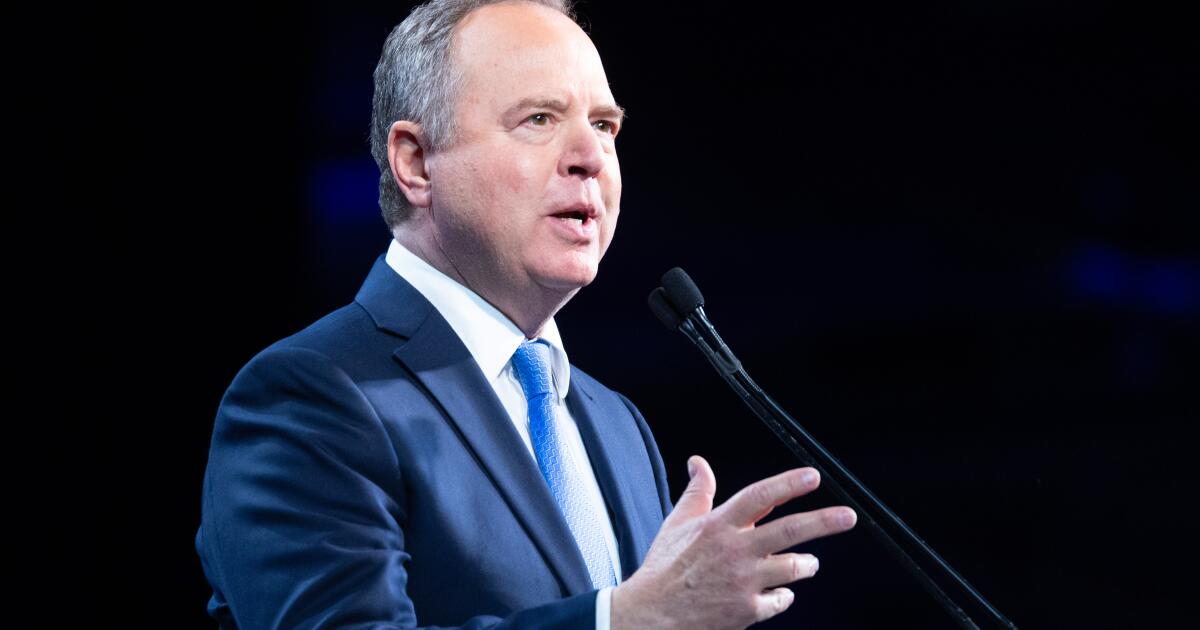
“State programs cannot simply substitute for the kind of global, federal and competitive tax incentives that are needed to bring production back to American soil and stop its offshoring,” U.S. Sen. Adam Schiff (D-Calif.) said during a news conference Friday morning.
“We must act, and the urgency could not be greater,” he said. He revealed he is working on a bipartisan federal film incentive proposal that would be competitive with what other countries are offering for film productions.
He said the program isn’t about Hollywood’s stars; it’s about the jobs that productions create, including roles for set designers, carpenters and lighting crews.
“These are the people who make that magic happen. We want to keep those jobs here, and many of us are deeply concerned about what this potential merger will do to those jobs,” Schiff said.
Earlier this week, the California Film Commission revealed that 16 shows had recently received tax credits for filming in the state. The projects represent $871 million in qualified in-state spending and are expected to generate $1.3 billion in economic activity in California. Schiff said the state tax credit has generated more than $29.1 billion in motion picture production wages and supported more than 220,000 jobs.
Even as shows start to see gains in Southern California, Los Angeles film activity was still down 13.2% from July through September when compared with the same period in 2024. The downward trend extends the loss of 42,000 jobs in L.A. between 2022 and 2024, the continued suffering of local sound stages and the offshoring of productions internationally.
“Federal policymakers must act to level the playing field and make the U.S. film and television industry more competitive on the global stage,” said Matthew Loeb, the president of the International Alliance of Theatrical Stage Employees. “A globally competitive labor-based and tax incentive is. For us, production that supplements state incentives is essential to return and maintain film and television jobs in America.”
HBO Max’s medical drama “The Pitt” is filmed at one of Warner Bros. soundstages in Burbank and it’s one of the shows benefiting from California’s tax incentive.
Noah Wyle, the star and executive producer of the show, said during the news conference that “it’s really hard to shoot a TV show in Los Angeles, and it’s really expensive, prohibitively” — so adopting an economic model that allows productions to take full advantage of the California tax incentive was essential to “The Pitt” filming in L.A.
“As an Angeleno with generational roots to this city and as a seasoned member of its creative community, advocacy for Los Angeles-based production is something that is very close to my heart,” Wyle said.
“‘The Pitt’ has blessedly become proof of that speculative concept. I’m happy to report we’ll commence shooting season three this summer, and that a rising tide has indeed lifted all boats in season one under the 3.0 tax program,” he added.
The show received a 20% tax rebate on many above-the-line costs. The budget for one episode was approximately $6.6 million, so the show received a rebate of about $760,000 per episode. By the end of season one, the production was able to save over $11 million. Wyle estimated that the first season of “The Pitt” contributed around $125 million toward California’s gross domestic product.
Rep. Laura Friedman (D-Glendale), who is working with Schiff on production tax incentives, said that because California is already seeing benefits from the current program, there’s no reason it wouldn’t work nationally. Friedman added that tax incentives are a common practice among many industries in the U.S.
“Hollywood is not asking for special treatment. Whether it is computer chips, the energy sector or pharmaceuticals, this is something that is standard in the United States,” said Friedman. “In terms of our nation, Hollywood and its ability to tell the story of America, it is something worth saving.”

Andrew Friedman on looming labor battle and ‘noise’ around the Dodgers
PHOENIX — Dodgers president of baseball operations Andrew Friedman went into the offseason expecting outfielder Kyle Tucker to sign elsewhere.
Sure, Friedman was confident in what the Dodgers could provide on and off the field to the 29-year-old four-time All-Star. And Tucker was a rare hitter who could actually elevate an already star-powered Dodgers lineup. But with the team unwilling to offer a super long-term deal, their chances at landing the best free-agent hitter available this past offseason felt “incredibly low.”
“I can’t remember a time where a player has taken a shorter-term, higher-AAV deal when they’ve had an actual long-term contract on the table,” Friedman said Wednesday.
The Dodgers, however, had already pulled off a bigger surprise when closer Edwin Díaz chose them over returning to the Mets this past December.
The team’s pitch, which included a conversation with the Dodgers’ director of family programs Patricia Romero, discussions about preparation and player resources, and a championship track record, helped land both top-tier free agents.
Of course it didn’t hurt that though Tucker’s contract was only four years, it was worth $240 million. Taking deferrals into account, the net-present day value set an MLB record at about $57 million per year.
The Dodgers’ aggressive offseason, coming off consecutive World Series titles, once again makes them the favorite entering the 2026 season.
They wrap up their Cactus League schedule this week, as World Baseball Classic participants trickle back into camp, and baseball operations leadership make final opening day roster decisions.
Before Friedman headed back to Los Angeles, he spoke with The Times on a range of topics. Here’s part of that conversion, edited for length and clarity.
Q: When it comes to the WBC, there’s variance on how supportive teams are. You have Shohei Ohtani participating as a position player, Yoshinobu Yamamoto pitching after an extra-short offseason, Kiké Hernández supporting Puerto Rico in person while rehabbing. How have you landed in being highly flexible?
Friedman: Obviously everything is case by case. But in a vacuum, we are incredibly supportive of the World Baseball Classic and what it does for our game worldwide. We saw it in ‘23, we saw it this past year, with just how important this is to the players, the staff, the fans — and just how exciting it is for baseball.
So that part’s easy. Now you layer on our situation, us trying to win a World Series. For position players, it’s easier to justify. For pitchers, it’s way harder. Throwing at that intensity in March is really, really challenging. And so we feel like our role is to work with each of our players and have conversations and share our thoughts, listen to their thoughts, and then answers kind of fall out of that.
Q: It’s such a cliche to say you can never have too much pitching, but with this group, are you close?
Friedman: I’ve learned my lesson to never say that we have enough pitching. But I do feel like we are breaking camp with the most talented one through 20 arms — which gets at, obviously, who we’ll break with, and then depth behind it — that we’ve ever had.
Q: Between Díaz, who’s part of that equation, and Tucker, you signed two players this offseason who you didn’t necessarily expect to land. What does that say about this organization and what you’ve done the last few years?
Friedman: Our biggest, most overarching goal is to be a destination spot, where our own players don’t want to leave, where players on other teams are looking longingly, because we feel like championships fall out of that. By having the right environment, having the right culture, that helps your star players want to stay, it helps in the recruitment of others. So we’re way better at it today than we were five years ago. But it’s like a living organism that we have to continue to foster and nurture and develop. And we hope we’re way better at it five years from now.
Q: On that note, the Dodgers are very much caught in the middle of CBA posturing with the current agreement expiring this year. You hear a lot of players saying the Dodgers are doing it the right way and other teams could be doing something similar. On the other hand, the league appears to be floating a salary cap, and plenty of fans are accusing the Dodgers of “ruining baseball.” What’s it been like to see those conflicting narratives?
Friedman: Obviously see it, come across it, hear it quite a bit. But we’re just not that focused on it. We’re a really healthy organization, and the partnership we have with our fans is our guiding light. And we’re doing everything we can to put a team out there that our fans really connect with, and that they feel that partnership with all that they pour into us, and don’t really think about it in any other terms.
And so obviously, there’s a lot of narratives that get extrapolated from that. But our sole focus is on ourselves and the partnership we have with our fans and the rest of it to us, it’s kind of just noise.
Q: You guys raised the bar years ago to, “We’re going to be in the postseason every year.” But there were clear frustrations from the fan base when that wasn’t consistently leading to championships. Is it fair to say that this continued push is almost a response to that frustration?
Friedman: Each year we’ve poured everything we have into winning. And in October, you need a really talented roster, and you need some good fortune. And there’s years where we haven’t been as talented as we wanted to be, whether it’s injuries or lack of performance. There’s years we’ve had really bad fortune, there’s years we’ve had good fortune. And a lot of that is the game, and it’s what I both love and hate about it.
I wouldn’t say our mindset is all that different. But obviously, when you’re in a moment in time with an incredibly talented roster, I think the mindset is, ‘Don’t sit back on your heels, be aggressive, and don’t be nonchalant about the opportunity that we have in front of us.’ And so it’s more the idea of pressing an advantage and being aggressive on that front.
Q: I’m sure when you were pursuing Ohtani, you looked into the revenue ramifications of signing him. Has this been about what you expected? Has it exceeded your expectations?
Friedman: Oh, it’s far exceeded. I don’t think the human brain could have comprehended it correctly. It’s been a perfect storm on a lot of levels, and something that has definitely far exceeded our expectations.”
Q: A three-peat seems to be the goal. Is there such a thing as a successful season without winning a championship, or has this team gotten to a point where you really have to win a World Series in order to claim success?
Friedman: Everything for us, all of our energy and focus, is on doing everything we can to win a championship this year. And our first goal is to win the division and be in position to have a bye. Last year, we added to the degree of difficulty [by winning the division but having to play in the wild-card round] in a way that I’d like to avoid this year.
So that’s the first goal. And then obviously that puts you in the best position to accomplish our ultimate goal, which is winning a World Series. So that’s what all of our energy and focus is on.
And, obviously, if we win the World Series this year, it will be a three-peat. But it’s not how my brain processes it. We’ve won back-to-back, and those are in the bank. And now it’s, do everything we can to win this year, and it’s its own unique, disparate year.

Will Europe be pulled into the Iran war? | News
Europe is under pressure as Trump pushes allies to support the Iran war. How are they responding?
As US President Donald Trump pushes deeper into war with Iran, Europe is keeping its distance, calling it “not our war”. But as strikes on Gulf energy facilities send oil and gas prices soaring, that distance is being tested. In a rare joint move, leaders from across Europe and Japan have pledged to help stabilize energy markets and ensure safe passage through the Strait of Hormuz. Can Europe stay out of the fighting while being pulled in by its economic consequences?
In this episode:
- Sven Kühn von Burgsdorff, Former EU Diplomat
Episode credits:
This episode was produced by David Enders and Chloe K. Li, with Spencer Cline, Sonia Baghat, Tuleen Barakat, Catherine Nouhan and our host, Malika Bilal. It was edited by Sarí el-Khalili.
Our sound designer is Alex Roldan. Our video editors are Hisham Abu Salah and Mohannad al-Melhem. Alexandra Locke is The Take’s executive producer.
Connect with us:
Published On 20 Mar 2026
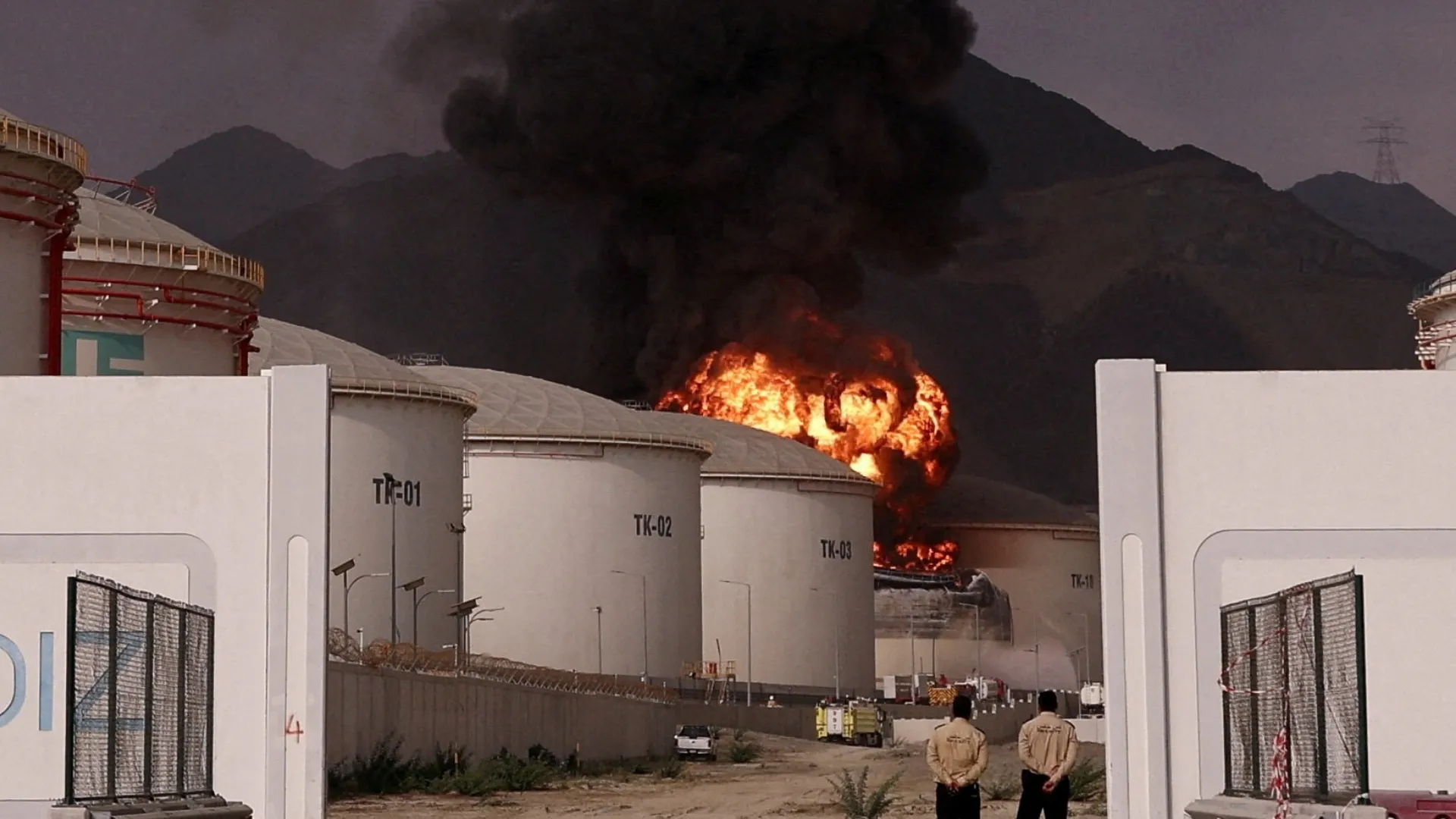
What are the risks of turning energy sites into battlefields? | US-Israel war on Iran News
Oil and gas facilities in the Gulf have been attacked since early in the war on Iran.
The war in the Middle East took a serious turn when Israel bombed Iran’s energy facilities, pushing Iran to step up attacks on its Gulf neighbours.
The damage has been significant and will take years to repair. It also has long-term consequences, with Qatar already warning of a reduction in exports.
Recommended Stories
list of 3 itemsend of list
The escalation is dangerous, experts say, as energy exports from the Gulf region account for a fifth of global output.
So, what are the risks of turning energy facilities into battlefields?
Presenter: Imran Khan
Guests:
Mohsen Baharvand – Former Iranian ambassador to the United Kingdom
Jim Walsh – Research associate in MIT’s security studies programme
John Sfakianakis – Chief economist at the Gulf Research Center
Published On 20 Mar 2026

BBC Comic Relief host says ‘don’t do it’ as Davina McCall issues stern warning
Davina McCall and Joel Dommett hosted BBC Comic Relief’s Red Nose Day special, with the TV presenter forced to caution viewers

Davina was forced to issue a warning to viewers(Image: BBC)
BBC Comic Relief’s Davina McCall found herself compelled to issue a warning to viewers just moments into the programme.
The charity fundraiser made its annual return to our telly screens on Friday (March 20) evening, as the Red Nose Day squad tackled the biggest night in comedy and entertainment.
TV favourite Davina took on presenting responsibilities, joined by co-host and close mate Joel Dommett for the entire evening’s entertainment.
They were joined by comedic luminaries such as Katherine Ryan, Nick Mohammed and Catherine Tate (reprising her role as Nan from The Catherine Tate Show).
This year’s live broadcast once again brought more energy and enthusiasm than ever before. The three-hour extravaganza kicked off with a special message from Sir Lenny Henry, who retired from his hosting duties back in 2024, and a musical number from Catherine Tate, reports Wales Online.
However, early into the proceedings, Davina found herself obliged to issue a warning to viewers when the cast of The Play that Goes Wrong provided a step-by-step guide on how to donate to Comic Relief during the show.
The programme switched to a clip of the cast performing a skit involving some perilous stunts. Following the clip, Davina began by saying: “Thank you so much to the cast of the Play that Goes Wrong. Smashing… literally.
“The actors used specially designed fake props and are all professionally trained in the art of tomfoolery.”
She cautioned: “Please do not try anything that you saw at home, especially taking a swig from the bottle marked with a warning and skull and cross bones label.” Joel chimed in: “Don’t do that.”
The charity event, held at Salford’s MediaCity, showcased sketches from Amandaland, the Bank Job featuring the dynamic This Morning pair Dermot O’Leary and Alison Hammond, and The Traitors: The Movie – The Sequel.
Communities, workplaces, schools and families have contributed to raising more than £1.6 billion over the past 41 years, benefiting over 100 million people, according to Comic Relief.
The charity has been instrumental in supporting communities by offering food, healthcare and shelter to those most in need. Meanwhile, Greg James participated in a colossal Comic Relief challenge, which saw him raise over £4million.
He embarked on his journey from Weymouth on Friday 13 March. The star endured eight gruelling days of pushing himself to the extreme, cycling through England and Wales before crossing the finish line in Edinburgh on Friday 20 March.
Comic Relief: Funny For Money is available to watch on BBC iPlayer.
Pentagon orders 2,500 troops, 3 warships from California to the Middle East
WASHINGTON — The Pentagon is reportedly sending three California-based warships and roughly 2,500 Marines to the Middle East, the second significant deployment in a week.
The three warships are part of the San Diego-based USS Boxer amphibious ready group. The Marines are from the 11th Marine Expeditionary Unit, based at Camp Pendleton. The deployments were reported Friday by the Associated Press, citing Pentagon sources.
A 2,500-strong Marine unit accompanied by the USS Tripoli warship launched from Japan on Saturday.
The major reinforcement comes as the war’s economic shock waves are felt throughout the globe, as Washington seeks to secure vital shipping lanes and deter further attacks on energy infrastructure around the Persian Gulf.

Secretary of Defense Pete Hegseth, front, and Chairman of the Joint Chiefs of Staff General Dan Caine arrive for a news conference at the Pentagon in Washington on Thursday.
(Mandel Ngan / AFP via Getty Images)
President Trump has continued pressing allies to join his proposed coalition to patrol the Iranian-controlled Strait of Hormuz, a vital shipping lane through which about 20% of the world’s oil supply passes. So far, Europe, Japan, China and Australia have refused to heed the call.
Trump on Thursday said Iran “is close to demolished,” but that securing the Strait of Hormuz remained a struggle. He suggested the U.S. was working to secure the strait not for its own oil needs, but “just to be nice” to other countries that rely on oil from the region to a much larger degree than the U.S.

Marines perform a demonstration with helicopters and the amphibious assault ship USS Boxer Oct. 18, 2025, on Marine Corps Base Camp Pendleton.
(Gregory Bull / Associated Press)
“They complain about the high oil prices they are forced to pay, but don’t want to help open the Strait of Hormuz, a simple military maneuver that is the single reason for the high oil prices. So easy for them to do, with so little risk. COWARDS, and we will REMEMBER!” Trump wrote Friday on Truth Social.
Iran continued sweeping attacks on Mideast energy facilities, a retaliation to Israeli strikes on its Iran’s South Pars field, the world’s largest natural gas field Wednesday. The fallout has dragged the gulf states into the war amid the largest energy supply disruption in history.
Iranian Shahed drones hammered Kuwait’s largest oil refinery Friday. Similar attacks triggered fires at Ras Laffan Industrial City in Qatar, bringing energy product screaming to a halt at the largest natural gas hub in the globe. Repairs are expected to take years.
Meanwhile, United Arab Emirates’ air defense systems were countering Iranian missiles overnight, and Saudi Arabia said it might respond with force if Iran continues to attack facilities in the kingdom.

An Israeli self-propelled howitzer artillery gun fires rounds toward southern Lebanon from a position in the upper Galilee in northern Israel near the border on Friday.
(Jalaa Marey / AFP via Getty Images)
Israel said Friday it had killed Esmail Ahmadi, a senior intelligence official in Iran’s Basij and deputy to its commander, in an airstrike. Officials described Ahmadi as “one of the most important pillars” of the Basij volunteer paramilitary force.
Even as Israel carries out daily decapitation airstrikes in Tehran and the U.S. deploys renewed forces to its front door, the Islamic Republic has not faltered.
Abolfazl Shekarchi, a senior spokesperson for Iran’s armed forces, said American and Israeli officials could be targeted worldwide.
“From now on, based on the information we have, even recreational and tourist locations around the world will not be safe for you,” Shekarchi said.
Oil prices have surged past $100 a barrel and found a volatile new floor amid the chaos.
Financial markets have reacted with sustained losses. Wall Street has now posted its fourth consecutive week of declines, with investors increasingly pricing in the risk that higher energy costs could slow economic growth while reigniting inflation. Analysts warn that persistently elevated crude prices are likely to squeeze corporate margins and weigh on consumer spending in the United States and beyond.
The International Monetary Fund has cautioned that the conflict could push inflation higher, too. The Federal Reserve is now facing renewed uncertainty as they weigh whether to hold interest rates higher for longer in response to rising energy costs.
At a White House event on Friday, Trump maintained that the United States’ military operation is “going extremely well in Iran.”
“The difference between them and us is they had a navy two weeks ago and they have no navy anymore. It’s all at the bottom of the sea,” Trump said. “Fifty-eight ships were knocked down in two days and we have the greatest navy in the world. It is not even close.”
The president did not take questions from reporters in the room. But in unprompted remarks, he said the United States and Iran are not engaging in talks because their leaders “are all gone,” adding to the uncertainty about the war’s exit strategy.
“We are having a hard time, we want to talk to them and there is nobody to talk to,” he said. “We have nobody to talk to and you know what? We like it that way.”

Chaminade softball team become surprise team in Mission League
Perhaps Chaminade’s softball team should no longer be considered a surprise for its 7-0 start overall and 1-0 mark in the Mission League.
Its 7-6 win over defending Mission League champion Sherman Oaks Notre Dame on Thursday featured a five-run seventh inning that should get everyone’s attention. Notre Dame went 8-0 in league play last season. Casey Glantz hit a two-run go-ahead home run.
Chaminade has featured sophomore pitcher Finley Suppan, the daughter of former major leaguer Jeff Supan. She’s 6-0 with a 1.15 ERA. She had a strikeout to end the game. The Eagles are flourishing under coach Cory Skinner.
Garden Grove Pacifica 4, Anaheim Canyon 1: Shay Kletke hit a home run and also pitched four innings.
Thousand Oaks 9, Granada Hills 4: Zoe Justman had three hits for Granada Hills.
Los Alamitos 6, Huntington Beach 5: A home run by Erin Denny on a 3-and-2 count in the top of the ninth inning broke a 5-5 tie and lifted the Griffins to victory.
Baseball
Sun Valley Poly 11, Sylmar 9: The Parrots improved to 3-0 in the Valley Mission League with a huge win over preseason favorite Sylmar.
Etiwanda 2, Foothill 0: Four Etiwanda pitchers combined on a three-hit shutout. Foothill had recorded shutout wins in four of its last five games. James Milam had two doubles.
La Mirada 7, Aliso Niguel 1: Blake Barberena had two hits and two RBIs.
Santa Monica 8, Calabasas 4: Jaxson Ehlers went four for four to lead Santa Monica.

Iran: From Khamenei to Khamenei | US-Israel war on Iran
How Iran’s power structure was built, and how it survives its architect.
After a US-Israeli strike killed Iran’s Ali Khamenei, the war on Iran escalates, and the Islamic Republic faces a critical moment. Mojtaba Khamenei has been elected supreme leader, marking a rare and controversial succession. This explainer breaks down how Iran’s power structure was built after the 1979 Islamic revolution led by Ayatollah Ruhollah Khomeini, and how Ali Khamenei transformed that revolution into a complex political and security structure.
We examine how the supreme leader sits above all institutions in Iran, shaping decisions across government, the military, and the Islamic Revolutionary Guard Corps, and how this system is designed to endure beyond any single leader. As Mojtaba Khamenei takes power, questions grow over how Iran will be governed, how the IRGC will influence decision-making, and whether the system Ali Khamenei built can withstand both internal pressure and external conflict.
From Ali Khamenei to Mojtaba Khamenei, this is the story of Iran’s supreme leader, the system behind power in Iran, and what comes next.
Published On 20 Mar 2026