



Rescue teams brave fire in suspected attack on Gaza City residential area | Gaza
A blast occurred in an apartment above a restaurant in Gaza City, causing a blaze. Rescue teams headed to the site to put off the fires. The cause of the blast is suspected to be an Israeli drone attack, several people had died in the blast.
Published On 23 Mar 2026

IEA chief warns of ‘very severe’ global energy crisis | Newsfeed
IEA may release more oil as the Iran war hits supply, with chief Fatih Birol warning of a severe global energy crisis.
Published On 23 Mar 2026
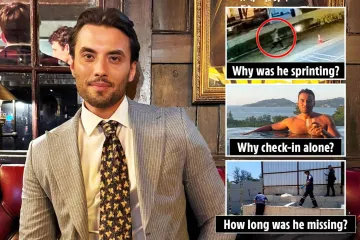
Supernatural actress Carrie Anne Fleming dies aged 51 after breast cancer battle as devastated co-star pays tribute
A BELOVED actress has been remembered as a “powerhouse of vitality and goodwill” after tragically dying following a battle with breast cancer.
Carrie Anne Fleming, 51, passed away in Sidney, British Columbia, and was best known for her role in the fantasy drama Supernatural.
She is survived by her daughter Madalyn Rose.
Fleming was confirmed dead by her co-star and friend Jim Beaver in a statement to Variety.
The star died on February 26, from complications after battling the deadly illness.
Later, in a lengthy heartfelt tribute posted to Facebook, 75-year-old Beaver called Fleming his “soulmate”.
“To find a soul mate once in life is something of a miracle. To find one twice is almost unimaginable,” he said.
“To love and be loved is a pearl above price, but such pearls do come more than once or twice to the lucky.”
Beaver said loving her had been devastating, after losing Cecily – the mother of his child – to the same disease.
“I lost Cecily to cancer in 2004,” he said.
“Thursday, I lost Carrie to the same disease. I never thought my heart could break so badly more than once.
“But it has. But, oh, the two torches I carry – what bright, bright light they shed.”
He continued, recounting the first time they met on the set of the popular television series.
“Carrie Anne Fleming was cast as my wife on Supernatural in my fifth season on the show,” he said.
Beaver revealed he had “fallen for her hard” just seconds after meeting her for the first time.
He said he had been “shocked” to find she felt the same way.
“To find oneself paired with someone who not only loves and is loved, but who seems by magic or the grace of the gods to understand you, to want what you are, to want you to be what you are, who GETS you and never feels the need to have you defend who you are, and about whom you feel the same – how many of us can say that spark of divinity has alighted on us once, much less twice? I can,” he said in the heartbreaking tribute.
The pair bonded over both having daughters named Madeline Rose, with Beaver saying the discovery had been “the beginning of a beautiful friendship”.
“We ran lines of dialogue together in my trailer and talked for hours that first day, and the electricity between us was practically visible,” he wrote.
Beaver said the actress had “an amazingly good nature … a rapturous laugh and an utterly adorable personality that didn’t seem to have an off switch”.
“I was so in love I think my eyes turned silver,” he said.
“She seemed to think I was worth hanging around with, too.”
Fleming also starred in other popular shows including iZombie, Smallville, Good Luck Chuck, The L Word, Married Life and Supergirl.
Born on August 16, 1974, in Digby, Nova Scotia, Fleming studied at Mount Douglas Senior Secondary in Victoria, British Columbia, and later attended the Kaleidoscope Theatre as well as the Kidco Theatre Dance Company for drama.
She broke into the industry through an uncredited appearance in Adam Sandler’s Happy Gilmore, and later in a role in Viper.
In 2005 she was cast in Dario Argento’s show Masters of Horror, starring as a disfigured woman with cannibalistic urges.
She went on to appear and star in other horror shows, including Bloodsuckers and The Tooth Fairy.
More recently Fleming played Candy Baker on five seasons of the CW’s iZombie.
She also appeared in the 2015 TV film The Unauthorized Full House Story, exploring the behind-the-scenes making of the hit sitcom.
Fleming played the mother of Full House star Candace Cameron Bure, who portrayed D.J. Tanner on the show.
Fleming also performed in a number of British Columbia stage productions, including Steel Magnolias, Noises Off, and Romeo and Juliet.

Troy Terry’s overtime goal lifts Ducks past Sabres
Troy Terry scored on a breakaway 1:29 into overtime for his second goal of the game after Mikael Granlund tied it late in regulation and the Ducks rallied to defeat the Buffalo Sabres 6-5 on Sunday night.
Anaheim ended Buffalo’s seven-game road winning streak when Tage Thompson couldn’t keep in the puck in the Ducks’ zone and Terry held on a 2-on-0 break to score on a backhander.
Granlund tied the score at 5 with 1:44 remaining in the third period on a power play with Ville Husso pulled for an extra attacker.
Chris Kreider and Jackson LaCombe had power-play goals in the first period, Beckett Sennecke also scored, Husso made 24 saves and the Ducks have won consecutive games as part of a four-game points streak.
Alex Lyon had his 10-game road winning streak — tied for the third-longest by a goaltender in NHL history — snapped after giving up six goals on 33 shots. That included giving up goals to Sennecke and Terry on two of the Ducks’ four shots in the second period.
Alex Tuch, Josh Doan, Jack Quinn, Owen Power and Zach Benson scored for the Sabres, who extended their franchise-record road points streak to 14 games. It was their second loss in the last 14 games overall.
Lyon hadn’t lost a road start since Dec. 8, when Buffalo was last in the Eastern Conference with a 2-9-2 record outside of upstate New York. The Sabres had since won 20 of 24 road games as part of an astonishing turnaround that has them set to end the longest playoff drought in the NHL and on track to claim a first division title since 2009-10.
A victory for Lyon would have tied San Jose’s Evgeni Nabokov in 2009-10 and Minnesota’s Devan Dubnyk in 2014-15 for the longest undefeated road run in league history.

White House border czar Tom Homan confirms ICE deployment to airports Monday

March 23 (UPI) — President Donald Trump‘s border czar Tom Homan has confirmed that Immigration and Customs Enforcement agents will be deployed to U.S. airports starting Monday, despite strong opposition from unions and Democrats.
Homan told CNN’s State of the Union on Sunday that he was working on the plan’s execution with acting ICE Director Todd Lyons and Transportation Security Administration Administrator Ha Nguyen McNeill.
“So, we’ll put together a plan today and we’ll execute it tomorrow,” he said.
On Sunday, Trump threatened to send ICE agents to U.S. airports over a protracted fight with Democrats over Department of Homeland Security funding.
Funding for DHS lapsed Jan. 31 after Congress failed to pass legislation to keep the department open, with Democrats are demanding reforms in response to federal immigration agents deploying aggressive tactics during the Trump administration’s immigration crackdown.
The partial shutdown is affecting the TSA, which is under the DHS. Airports are reporting long lines and congestion due to a shortage in TSA staff, who haven’t been paid since DHS funding ran out.
Trump threatened on his Truth Social platform that ICE will perform security at airports where they will arrest undocumented migrants, raising questions about whether the agents are being sent only to relieve pressure on TSA or to carry out immigration enforcement at major travel hubs.
Homan on Sunday sought to frame the move as a way to alleviate congestion and move long lines of travelers though security.
Asked if ICE had the specialized training to inspect bags and passengers, Homan said he doesn’t expect the immigration agents to be ‘looking at an X-ray machine, because we’re not trained in that.”
“But there are certain parts of security that TSA is doing that we can move them from those jobs, and put them in the specialized jobs to help those lines,” he said, adding that discussions with the TSA concerning what security roles ICE agents would perform were ongoing.
“We will have a plan by the end of today … what airports we’re staring with and where we’re sending them,” he said, suggesting that the worst affected airport will be given priority.
“So it’s a work in progress, but we will be at airports tomorrow helping TSA move those lines along.”
He also confirmed that ICE agents will perform immigration enforcement at the airport, underscoring that their deployment is mainly to aid TSA.
Republicans have attempted to characterize the shutdown as Democrats prioritizing undocumented immigrants over airport security, while the Democrats have blamed Republicans for blocking more than half a dozen attempts to pass legislation to fund the TSA, including on Saturday. The GOP lawmakers say they want to fund the entirety of the DHS.
“Instead of sending ICE agents to harass travelers at airports, why don’t Republicans get their act together and agree to pay TSA workers like we’ve asked them to SEVEN TIMES now?” Senate Minority Leader Chuck Schumer, D-N.Y., said in a statement on X on Sunday.
Vice President JD Vance accused Schumer of continuing “to hold TSA funding hostage.”
“Thankfully, ICE will bring sanity to our airports starting tomorrow, but it’s far past time for Democrats to fund DHS,” he said.
Following Homan’s interview, Rep. Dan Goldman, D-N.Y., accused the Trump administration of using ICE “to strike fear and terror on our airports.”
“Mr. President, it’s pretty simple: if you want TSA agents to get paid (as they should), then pass the Democrats’ bill to fund TSA,” he said on X. “No need for your out-of-control paramilitary to do yet another thing they aren’t trained to do.”
Hartsfield-Jackson Atlanta International Airport has been informed it is among those where ICE agents will be deployed Monday, Atlanta Mayor Andre Dickens said in a statement.
The agents will report to the TSA and will be assigned to line management and crowd control within domestic terminals, he said, adding that federal officials have indicated that they are not intended to conduct immigration enforcement activities.
“Our administration remains hopeful the Federal Government can soon find a way to fully fund TSA and pay their employees to resume standard operations at Hartsfield-Jackson Atlanta International Airport — and all airpots we connect to,” he said.
The deployment of ICE agents is also being lambasted by the American Federation of Government Employees, the largest government worker union in the United States.
It accused the Trump administration of sending ICE agents to do the jobs of the more than 50,000 TSA employees who have worked without pay for more than five weeks.
It also expressed worry that the ICE agents will be undertrained for what they may be required to do, arguing that stationing them at security checkpoints will create security risks.
“Our members at TSA have been showing up every day, without a paycheck, because they believe in the mission of keeping the flying public safe,” AFGE National President Everett Kelley said in a statement.
“They deserve to be paid, not replaced by untrained, armed agents who have shown how dangerous they can be.”
The leaders of several flight attendant unions also criticized the Trump administration on Sunday for using the TSA and frontline security officers “as pawns in this dangerous game,” stating that the DHS can use its billions of dollars in discretionary funding to pay them.
“This latest threat of ICE invasion at the airports is another distraction from solutions that protect Americans,” the Association of Flight Attendants-CWA, the Association of Professional Flight Attendants, International Brotherhood of Teamsters Local 135 and the International Association of Machinists and Aerospace Workers said in a joint statement.

Lionel Messi scores as Inter Miami rally past NYCFC in MLS | Football News
The Argentinian star forward records his 901st career goal as Inter Miami beat New York City FC at Yankee Stadium.
Published On 23 Mar 2026
Micael dos Santos Silva’s go-ahead goal in the 74th minute lifted Inter Miami to a 3-2 comeback victory over hosts New York City FC on Sunday.
Dos Santos headed home a beautiful ball from fellow defender Noah Allen, which found its way past NYCFC keeper Matt Freese and gave Inter Miami (3-1-1, 10 points) their first Major League Soccer (MLS) win since March 7.
Recommended Stories
list of 3 itemsend of list
Lionel Messi scored his 901st career goal, and Gonzalo Lujan scored his first career MLS goal for Inter Miami, which bounced back after being eliminated from the CONCACAF Champions Cup on Wednesday following a pair of draws against Nashville, with that side advancing on the away goals tiebreaker.
NYCFC (3-1-1, 10 points) suffered their first defeat of the season and snapped a three-game winning streak despite goals from Nicolas Fernandez Mercau and Agustin Ojeda.

Maxi Moralez delivered a stellar assist to Ojeda in the 59th minute to put NYCFC briefly ahead 2-1.
Moralez sent a great ball through traffic down the middle of the field to Ojeda, who was uncontested, and flipped the ball past Inter Miami goalkeeper Dayne St Clair.
But two minutes later, Inter Miami earned a free kick, and Messi delivered. His shot deflected off NYCFC’s Hannes Wolf and redirected past Freese (five saves) to tie the game at 2.
Messi nearly had a multi-goal match as he came close on several chances. He hit the post in the 31st minute and the crossbar in the 42nd minute. He also had a late opportunity to pad Miami’s lead but missed wide.
German Berterame appeared to extend Miami’s lead in the 79th minute, but what would have been his first goal with his new club was nullified after he was ruled offside.
After Lujan scored in the fourth minute, NYCFC levelled the match with a fantastic free kick goal by Fernandez Mercau, who lifted a high shot that bounced just under the crossbar and in, freezing St Clair in place in the 17th minute.
NYCFC used Moralez as a decoy, having him approach as if he would take the shot, and then Fernandez Mercau ran up and booted it.
St Clair (three saves) made a huge save late in stoppage time to preserve Inter Miami’s win.

Monty Don shares retirement plans after recovering from ‘painful’ surgery
Monty Don has gone under the knife and admits he will need to do it again in 2027 as he opens up about his future with Gardeners’ World and retirement plans

Monty Don has been speaking to Saga magazine(Image: PA)
Monty Don has spoken of his “painful” recovery from a knee replacement in October that briefly slowed the Gardeners’ World host. The broadcaster and horticulturist went under the knife shortly after he turned 70 last Summer.
Looking back he says: “I was finding by the end of a day’s filming I could barely walk upstairs and I certainly couldn’t take the dogs for a walk. It was severely limiting what I was doing. I did it so I could keep on working because it was getting to the point where filming was cutting round me limping.
“However you do it, a knee replacement is horribly painful. But three months on I’m gardening again and haven’t walked with a stick for a month. Sarah says I’ve been doing far too much stuff, but it’s fine and going to plan – though it can be inexplicably painful one day and then not at all another. At some point, I’m going to have to do the other one – but only when I can fit it in, probably late 2027.”
**Ensure our latest headlines always appear at the top of your Google Search by making us a Preferred Source. **Click here to activate** or add us as your Preferred Source in your Google search settings.**
As well as planning his next new knee, the good news for his fans is Monty is also in discussions to continue hosting on screen Gardeners’ World until at least 2028.
Although speaking to Saga Magazine, he admits he may be closer to the end of his run than the beginning now, having been on the show since 2003, with a break between 2008 and 2011.
“I hope I’m continuing, but as I come up to the end of every contract, I seriously consider how it fits the rest of my life.” He ponders. “And each time, it’s come down fairly and squarely that I’d like to continue. But there will come a time when either they’ll say, ‘No, thanks’ or I’ll say, ‘It’s time for a change’. But neither of us, as far as I know, has reached that point yet.”
Almost all of his TV filming is done at his Herefordshire home Longmeadow, which the father-of-three shares with his wife Sarah and their two dogs; golden retriever Ned and Yorkshire terrier Patti.
“Longmeadow has a dual personality,’ admits Monty. “The compatibility between a private domestic garden for all the family and one that works for television is at best a fine line and at worst an impossible line to tread. Everything we do is heavily influenced by filming. I’m often working on the programme seven days a week and when we’re filming, it’s a place of work at every level.”
So whilst that level of work maybe ok for now, it seems there will come a time when he wants to do a bit less. Retirement completely is not on the cards though.
“I genuinely don’t know what retirement would look like. I don’t play golf or tennis, and I can’t see myself doing the crossword all day. Whenever I say to Sarah, ‘Well, thank God, I have no addictions’, she rolls her eyes and says, ‘You are completely addicted to work!’.”
Monty is also well known for being a dog lover with his faithful hounds on screen. He has lost three of his dogs in recent years – Nigel then Nellie who died in 2020 and 2023 – then Peggy who died on 24 January but thinks he is ‘good for one more at least’.
He said: “She[Peggy] was 16, very old, so while it was sad, somehow it was the right thing. She was completely deaf, 90% blind, and walking round and round in circles. So we’re down to just two dogs, Ned and Patti, the lowest number for a long time. Although I’m sure it will go up again, as there’s talk of more. I think I’m good for one more dog, at least.
“I’ve always said the deal with dogs is one of you is going to die, and with ageing it’s more likely to be you. But of course, the dog won’t care particularly, I think we completely romanticise that. They’re absolutely callous.”
* The full interview with Monty Don is in April’s Saga Magazine.
Like this story? For more of the latest showbiz news and gossip, follow Mirror Celebs on TikTok, Snapchat, Instagram, Twitter, Facebook, YouTube and Threads.

‘You’d be pushed to find a more soul-stirring landscape in Scotland’: walking in Beinn Eighe | Highlands holidays
The waymarked quartzite path glimmers in the sun, flanked by amber-gold grassland. Beyond, one of Scotland’s finest landscapes opens up before me, a woodland of ancient Caledonian pines leading my eye to the metallic glint of Loch Maree. On the other side of the water, a winding river separates the steep, stacked rocks of Beinn a’Mhùinidh from Slioch, one of the great mountains of Wester Ross, rising to a knuckle ridge of Torridonian sandstone.
I’m walking the four-mile mountain trail looping through Beinn Eighe national nature reserve (NNR), Britain’s first NNR, which celebrates its 75th anniversary this year. In a crowded list, you’d be hard pushed to find a more soul-stirring landscape in all of Scotland.
“The mountain path gives you a real flavour for Beinn Eighe,” the reserve manager, Doug Bartholomew, told me earlier. “It takes you right through the heart of the ancient Caledonian pinewood, then you climb steeply up to this rocky upland with views of Beinn Eighe mountain itself.”
When I reach the high point, at about 550m (1,805ft), I’m awed by the views across a lonely valley to the jagged ridgeline of mountain, which surges and falls like Atlantic waves locked in stone.
Beinn Eighe NNR stretches 48 sq km from Loch Maree to the eponymous mountain summit. When it was created in 1951, a key mission of the NNR was to protect Coille na Glas Leitir (the Wood of the Grey Slope), which is the largest remaining fragment of ancient Caledonian pinewood in north-west Scotland. The woodland was felled by some of Scotland’s earliest ironworks in the 1600s, and forestry and farming took its toll over the generations, but it is believed to have been here for the last 8,000 years.
After the Highland clearances, the lower slopes of Beinn Eighe were increasingly used for grazing. Deer-stalking, grouse-shooting and muirburn (when old growth is burnt off to encourage new growth for grazing) followed. The final exploitation happened during the second world war, when lumberjacks were brought in from Newfoundland and British Honduras to fell the trees for ammunition boxes. But thanks to pioneering landscape restoration work, namely deer management and tree planting, woodland cover has increased by more than 40% in the 75 years since the reserve was created.
Today, it’s a rare Scottish landscape where you can walk beneath twisted and gnarled pine branches hundreds of years old, but also alongside younger, conical trees.
“In the past, we had a tree nursery; so we collected seeds from the reserve, grew them in our nursery and planted them,” said Bartholomew. “We’ve now got continuous woodland linked from Glas Leitir all the way through to Coulin Estate, where you’ve got other remnants of ancient woodland, and we’re moving more to natural processes – conditions that will allow the woodland to regenerate and expand naturally.”
I soon descend into Coille na Glas Leitir on the mountain trail, passing a mosaic of birch and pines, draped in lichen. This path was a public access landmark when it opened in the early 70s, encouraging visitors to explore the mountain, and it’s still perfectly marked (though snowfall can obscure it in winter). Stags roar from the other side of Loch Maree as I walk. Tougher to pick out are the crossbills, with crossed mandibles to prise open pine cones. In warmer months, dragonflies with magical names – northern emerald, azure hawker – nose around rare mosses.
While steep, the mountain trail isn’t technical. Along with the easier woodland path, which showcases the ancient forest, and short loops from the excellent visitor centre, the beauty of this reserve really is accessible. Local providers such as Shieldaig Outdoor Adventures also offer days out exploring the islands of Loch Maree by canoe or kayak in warmer months.
I’m staying in Torridon youth hostel, at the head of Upper Loch Torridon, south-west of the Beinn Eighe massif. It’s a 20-minute drive from Coille na Glas Leitir via the village Kinlochewe, passing beneath the bulky mass of Beinn Eighe before Liathach, an icon of Glen Torridon, is revealed. The hostel is tucked beneath this mighty mountain, not in the nature reserve itself, but in an ideal place to explore it and the Torridon hills beyond.
“When we mention that we live in Torridon, people get misty eyes,” jokes Debbie Maskill, manager of the youth hostel. “For us, it’s the best part of Scotland. A real jewel.” It’s true that few place names roll so sweetly off the tongue of a hillwalker as Torridon. This is a place of grandeur – of immense, intimidating mountains set on some of the oldest rocks in Britain; of shifting light and uncompromising ferocity – with a beauty verging on myth.
The hostel – which itself turned 50 last year – is a pilgrimage site for hikers; it’s in close reach of some of Scotland’s finest scrambles, as well as the family-friendly nature reserve. Walkers and climbers trade stories and photographs in the communal kitchen and dining area. Floor-to-ceiling windows in the cosy lounge allow you to watch the weather roll over the Wester Ross peaks.
I stay in a comfy private room, and regret my early bedtime when a French guest shows me the photographs he took of the aurora shimmering above Loch Torridon the next morning. “Winter really captures the far north essence here, but by February, it’s getting lighter,” says Paul Thompson, duty supervisor at the hostel. “In the middle of winter, we don’t see the sun here, but in February it’s above the hills for quite some time. Then you get to May, a stunning time of year, when everything is fresh and you’ve got almost endless daylight. I love it all.”
On a six-mile loop of Loch Clair and Loch Coulin, just outside the reserve, I stroll beneath more tall pines, looking on to the Torridon beasts. The grey, dotted ridge of Beinn Eighe looks like it has a snow leopard’s coat draped over it, and the pyramidal mass of Liathach reflects back off the water.
I plan to walk to the Triple Buttress of Coire Mhic Fhearchair on my final day (three glacial rock towers in a corrie of Beinn Eighe), but heavy rain arrives. It’s all the excuse I need for a venison lunch at Bo & Muc, a field-to-fork restaurant at the swanky five-star The Torridon hotel.
I leave Torridon via the road to Achnasheen, stopping at the Glen Docherty viewpoint for one last look over the road to Kinlochewe, the lapping mountains and Loch Maree.
After centuries of deterioration, it’s heartwarming to see the fragments of ancient pinewood reconnecting here, in this immediately spellbinding landscape. In another 75 years, the young pines of Beinn Eighe will stand taller and, if all goes to plan, those who pass by them will be walking through a fully regenerative forest.
Accommodation was provided by Hostelling Scotland. Torridon youth hostel has private rooms for two from £52 a night, dorm beds from £20.50. The Beinn Eighe NNR trails are open year-round and are free to visit. The Beinn Eighe NNR visitor centre (with info on the reserve) is open April to October, 10am to 5pm
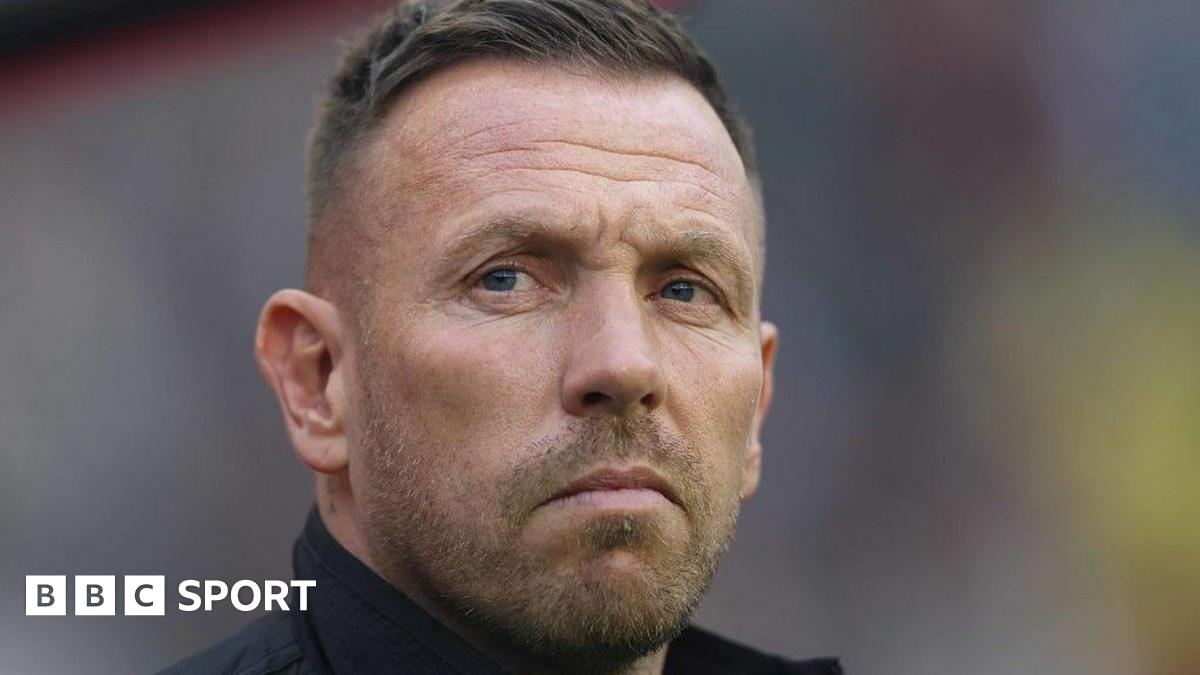
Craig Bellamy: Inside the complex mind of Wales’ head coach
There was a spiritual pull for Bellamy returning to Wales.
Born in Cardiff, he spent most of his playing career outside of his homeland, representing the likes of Liverpool and Newcastle.
As a coach, Bellamy followed Vincent Kompany to Anderlecht and Burnley, describing his time with the now Bayern Munich boss as an “education”.
The former Manchester City team-mates remain good friends and speak frequently, but Bellamy felt it was time to become a head coach in his own right when his country came calling.
Despite only being an assistant to Kompany at Burnley, Bellamy took a substantial pay cut to take charge of Wales.
This, however, was a job like no other. As well as the obvious emotional ties, Bellamy had unfinished business.
He never got the chance to play at a major international tournament but, as head coach, he aims to put that right by qualifying for this summer’s World Cup.
“You always have that buzz of chasing something, like I want qualification, I want to be at major tournaments,” Bellamy says.
“But how do we do it? I’ve got loads of flaws, but the team needs to play with intensity, play with balls.
“As long as you have belief, that’s the motivation. That’s why you do so much work, why you look at opposition.
“As a footballer for Wales, I didn’t really feel belief, I just felt hope. Italy [when Wales won 2-1 in 2002 in a European Championship qualifier] was different because we took the game to them. We were brilliant but there weren’t many nights like that.”
Bellamy scored the winning goal when Wales last faced Italy in Cardiff, a momentous occasion at a sold-out Millennium Stadium.
The teams will meet again if they win their respective World Cup play-off semi-finals on Thursday, with the final to be played at Cardiff City Stadium the following Tuesday.
Much like Bellamy himself, Welsh football is unrecognisable from that memorable night 24 years ago.
Having been absent from major tournaments since the 1958 World Cup, Wales not only qualified for Euro 2016 but reached the semi-finals in France, three years after Bellamy retired.
They followed that by getting to the knockout stages at Euro 2020 and then qualifying for the 2022 World Cup.
Bellamy wants to build on that success – and take his country to new heights.
“Euro 2016, that moment was like, ‘We are here’. That gave belief and I want to carry that on,” he says.
“We do punch well above our weight but that’s where we want to be. We need to do it continuously. I like expectations.
“This is what it takes to be a Wales player. To wear this shirt, these are the qualities you have to have. I believe we have a chance to consistently be at major tournaments.”
With that, Bellamy turns back to his laptop. The cursor hovers over files labelled ‘Italy’ and ‘Northern Ireland’ – Wales’ potential play-off final opponents – and then back to ‘Bosnia’.
Whether or not Wales get to the World Cup this summer, it will not be down to a lack of preparation.
Air Canada jet collides with ground vehicle at New York airport | News
LaGuardia shut down after Air Canada Express plane hits ground vehicle upon landing from Montreal.
Published On 23 Mar 2026
An Air Canada Express regional jet coming from Montreal struck a ground vehicle on Sunday evening while landing at New York’s LaGuardia Airport, leading to the airport’s closure.
The New York Fire Department in a statement said on Sunday that it was responding to a reported incident involving a plane and a vehicle on the runway at LaGuardia airport, but did not provide further details.
Recommended Stories
list of 3 itemsend of list
The CRJ-900 plane struck the vehicle at a speed of about 24 miles per hour (39 kph), flight tracking website Flightradar24 said. The jet was operated by Jazz Aviation, Air Canada’s regional partner.
The Federal Aviation Administration issued a ground stop for all departures to LaGuardia due to the aircraft emergency, with the airport closure in effect until 0530GMT. The probability of an extension was listed as high.
The FAA notice showed that the reason for the halt at the airport was an emergency and there was a high probability of an extension, without specifying any details.
Unverified footage on social media showed damage to the nose of the plane, as it tilted upward. Reuters could not immediately verify the footage.
LaGuardia’s website showed arriving planes had been diverted to other airports or returned to their point of origin.
In a separate notice to airmen, the FAA said that the airport could be shut until 1800 GMT.

Brothers search rubble for missing sibling under Tehran rubble after strike | US-Israel war on Iran
Five days after a strike destroyed a building in Tehran, Mahdi Mirzahosseini’s brothers are still searching through rubble for signs of their youngest sibling. They are holding onto hope of finding their brother who had gone to work insisting on serving customers for the Persian New Year.
Published On 23 Mar 2026

8 great movies about getting lost in space, from ‘2001’ to ‘Gravity’
p]:text-cms-story-body-color-text clearfix”>
Space isn’t a forgiving place to be stuck. There’s no air, no pulling over for directions and no margin for error. When something goes wrong, you’re left with whatever you have on hand for however long you can make it last.
That fear drives the new sci-fi epic “Project Hail Mary,” opening in theaters Friday, with Ryan Gosling as Ryland Grace, a middle school science teacher who wakes up alone on a spacecraft light-years from Earth with no memory of how he got there. Gradually he realizes he’s been sent on a mission to figure out why the sun is dimming and how to stop it. What begins in isolation turns into something closer to a buddy movie, as Grace ends up working with an alien he names Rocky, another traveler trying to solve the same problem.
The film, directed by Phil Lord and Christopher Miller, comes from sci-fi author Andy Weir, whose earlier, similarly survival-themed breakthrough novel “The Martian” was adapted by director Ridley Scott in 2015. That movie put Matt Damon alone on Mars and made the act of thinking through one life-or-death problem after another the engine of the story. The result was a critical and commercial hit that earned seven Oscar nominations, including best picture.
Put someone out in space long enough and the story can go in many directions. Sometimes it’s about survival. Sometimes it turns inward. Sometimes it gets more horrific or even darkly comic. Here are eight of our favorite movies about people lost or stranded in space. Watch them somewhere with plenty of oxygen.

Lost village lies beneath beautiful reservoir after it was drowned in the war
The Peak District village was systematically demolished and submerged in the 1940s to provide water for the industrial industries during the second world war – but it’s ruins remain

Passers-by have no idea what lies beneath (Image: Steve_Bramall via Getty Images)
It lies beneath a beloved hiking destination in Derbyshire, but this was once a thriving community before it was deliberately flooded and lost forever.
During the 1940s, the picturesque village of Derwent was methodically demolished and submerged beneath what is today known as Ladybower Reservoir.
The expansive, stunning expanse of water frequently serves as a stopping point for visitors admiring the scenery whilst exploring the Peak District, yet few realise what rests beneath its surface.
The reason for its submersion was to supply water to the booming industrial centres throughout the East Midlands during World War Two.
Locals were relocated, and by 1945 the valley had been flooded, with remnants of the former settlement now resting underwater.
Best Derbyshire holiday cottage deals
This article contains affiliate links, we will receive a commission on any sales we generate from it. Learn more
Derbyshire is known for its dramatic Peak District landscapes, historic market towns and stately country houses. Sykes Cottages has hundreds of places to stay, with prices from £32 per night.
Derwent before it drowned
Prior to the outbreak of war across Britain, Derwent had seemed like a permanent fixture in the moorlands, characterised by its century-old structures and tight-knit community.
Two initial dams were constructed after the water board selected a remote section of the valley. This decision impacted numerous residents. Those who owned farms or smallholdings were relocated to safer areas including Derwent and the neighbouring village of Ashopton.
What they couldn’t have anticipated was that this stretch of the valley, and their cherished village which they’d made their home, would shortly vanish entirely.
The village church conducted its final service for parishioners on March 17, 1943, before being submerged beneath the reservoir. Remnants of the church can be found scattered throughout Derby, with the bell now rehung at St Philip’s Church in Chaddesden.
Whilst nearly the entire area was deliberately flooded, a small number of homes survive above the waterline. Reports indicate that five properties from the original village endure, including several farms and the former village hall.
Mabel, a former Bamford resident who was 92 at the time of her interview, spoke to BBC Travel about growing up nearby and her memories of Derwent.
She revealed: “I may be the last person who remembers Ashopton and Derwent,” explaining that her school was located in Derwent, which she attended whilst the reservoir was being built.
The village emerged
During periods of extreme heat or reduced water levels, the reservoir has receded, and hauntingly, remnants of the village have surfaced. This phenomenon has been documented on several occasions, with the first instance occurring in 1976, leaving locals astounded.
The most recent, and consequently most significant, reappearance of the village occurred in 2018, when reservoir levels dropped dramatically and visitors flocked from across the region to witness the extraordinary spectacle.
An enormous crowd assembled, and the attention drawn to the old structures – which are largely piles of rubble and bricks – resulted in various complications.
On 3 November that year, a man found himself in a sticky situation, requiring mountain rescue assistance after becoming severely stuck in the dense mud surrounding the ruins of Derwent.
In a similar vein, due to the influx of visitors, the remnants were defaced with graffiti, prompting park rangers to discourage further visits as additional items were also taken from the site.

Kings rally in third period before falling to Mammoth in overtime
SALT LAKE CITY — Nick Schmaltz scored his second goal of the game at 1:46 of overtime to give the Utah Mammoth a 4-3 victory over the Kings on Sunday night.
Schmaltz carried the puck in on a two-on-one rush with defenseman Mikhail Sergachev on his left and fired a snap shot between goalie Darcy Kuemper‘s legs.
After the Kings controlled play in the three-on-three overtime and nearly ended it on Alex Laferriere’s shot that went off the right post, Kevin Stenlund won a faceoff against Quinton Byfield to set up Schmaltz’s seventh winning goal of the season.
Artemi Panarin tied it for the Kings with 3:30 left in regulation with his 25th goal of the season. His shot from deep on the far right side eluded goalie Karel Vejmelka.
Schmaltz pushed his career-high goals total to 26 and reached 63 points to match his career high set in 2024-25. Lawson Crouse scored twice in the first period and added an assist, and Vejmelka made 33 saves to help Utah end a four-game home losing streak. The Mammoth hold the first wild card in the Western Conference, five points ahead of Nashville.
Byfield had a goal and an assist, and Laferriere also scored for the Kings. Kuemper stopped 30 shots.
The Kings are two points behind Nashville for the final wild-card spot.


Oh Se-hoon calls for centrist-focused campaign team in Seoul race

Oh Se-hoon, right, sits with other prospective candidates during a Seoul mayoral nomination interview at the People Power Party headquarters in Seoul on Sunday. Photo by Asia Today
March 22 (Asia Today) — Seoul Mayor Oh Se-hoon on Sunday renewed his call for the formation of a campaign committee aimed at broadening the party’s appeal to centrist voters, as he completed an interview for the ruling party’s Seoul mayoral nomination.
Oh, who entered the People Power Party primary late, urged party leaders to quickly launch what he described as an “innovation campaign committee” led by figures capable of attracting moderate voters.
Speaking to reporters after the interview at the party’s headquarters in Yeouido, Oh said recent opinion polls show a significant gap in party approval ratings, underscoring the need for a strategy that resonates with centrist voters in the Seoul metropolitan area.
“Without a campaign structure that can expand toward the center, winning the election will be difficult,” he said.
Oh dismissed suggestions that his proposal amounts to sidelining the party leadership under Jang Dong-hyuk, saying his goal is to balance the party’s confrontational stance against the opposition with broader electoral appeal.
“At this point, it would not make sense to ask the leadership to weaken its political stance,” he said.
He also pushed back against media reports portraying his proposal as an attempt to take control of the party or position himself for the next party convention, calling such interpretations “unintended.”
Tensions between Oh and the party leadership are expected to continue. Jang has previously rejected calls for an early launch of the campaign committee, saying it should be formed after the nomination process is completed.
While both sides agree on the need for a campaign body with wider appeal, they remain divided over the timing of its formation.
The interview marked the confirmation of a six-way race for the party’s Seoul mayoral nomination. Other candidates include Rep. Park Soo-min, former Gangdong District Mayor Kim Chung-hwan, former lawmaker Yoon Hee-sook, party official Lee Sang-kyu and business executive Lee Seung-hyun.
— Reported by Asia Today; translated by UPI
© Asia Today. Unauthorized reproduction or redistribution prohibited.
Original Korean report: https://www.asiatoday.co.kr/kn/view.php?key=20260323010006563
Trump sends US immigration agents to airports as shutdown chaos deepens | Migration News
Shutdown standoff forces US President Trump’s hand as airport queues spiral and security staff go unpaid.

Published On 22 Mar 2026
Immigration enforcement agents will be deployed across major United States airports from Monday, President Donald Trump has announced, in an extraordinary move to ease a security crisis triggered by a prolonged political standoff in Washington.
Trump confirmed the plan in a social media post on Sunday, with his senior border official Tom Homan named to lead the effort.
Recommended Stories
list of 2 itemsend of list
This came after weeks of mounting chaos at airport security checkpoints and a day after Trump threatened the move unless Democrats backed down on a funding battle.
The crisis stems from Congress’s failure to renew funding for the Department of Homeland Security (DHS), the federal agency that oversees airport security.
Since February 14, tens of thousands of workers, including Transportation Security Administration (TSA) screeners responsible for passenger checks, have continued working without receiving paycheques.
More than 366 have since resigned, according to DHS, and unscheduled absences have more than doubled, leaving major airports struggling to cope.
“This loss significantly decreases TSA’s ability to meet passenger demand and leaves critical gaps in staffing, as each new recruit requires 4-6 MONTHS of training,” it said last week in a post on X.
Queues at Atlanta’s Hartsfield-Jackson and New York’s JFK airports stretched for hours at the weekend, with New Orleans advising passengers to arrive at least three hours before departure.
Union officials say some officers have taken on second jobs, while several airports have begun collecting food and gift cards for staff who can no longer make ends meet.
Homan said agents from US Immigration and Customs Enforcement (ICE), trained in law enforcement and immigration, not airport security, would take on supporting roles, such as monitoring exit lanes and checking identification, freeing TSA officers to focus on screening lines.
“I don’t see an ICE agent looking at an X-ray machine,” he acknowledged on Sunday, adding that a detailed plan for which airports and how many agents would be finalised by the end of the day.
Transportation Secretary Sean Duffy warned the situation was “going to get much worse” before it improves.
At the heart of the standoff is a bitter dispute over immigration enforcement.
Democrats have refused to pass a full DHS funding bill unless the administration agrees to reforms of ICE. Their demands hardened after federal agents fatally shot two US citizens, Alex Pretti and Renee Good, during immigration raids in Minneapolis in January.
Democrat Senator Dick Durbin said his party had attempted nine times to pass emergency funding for DHS entities including the TSA, the US Federal Emergency Management Agency (FEMA), and the Coast Guard. Republicans have blocked each attempt, insisting on a single comprehensive funding package for the entire department.
House Democratic leader Hakeem Jeffries warned bluntly that deploying “untrained ICE agents” at airports risked repeating the conduct that had already cost lives.
In an unusual intervention, billionaire and Trump ally Elon Musk said he would “offer to pay” the salaries of TSA workers.
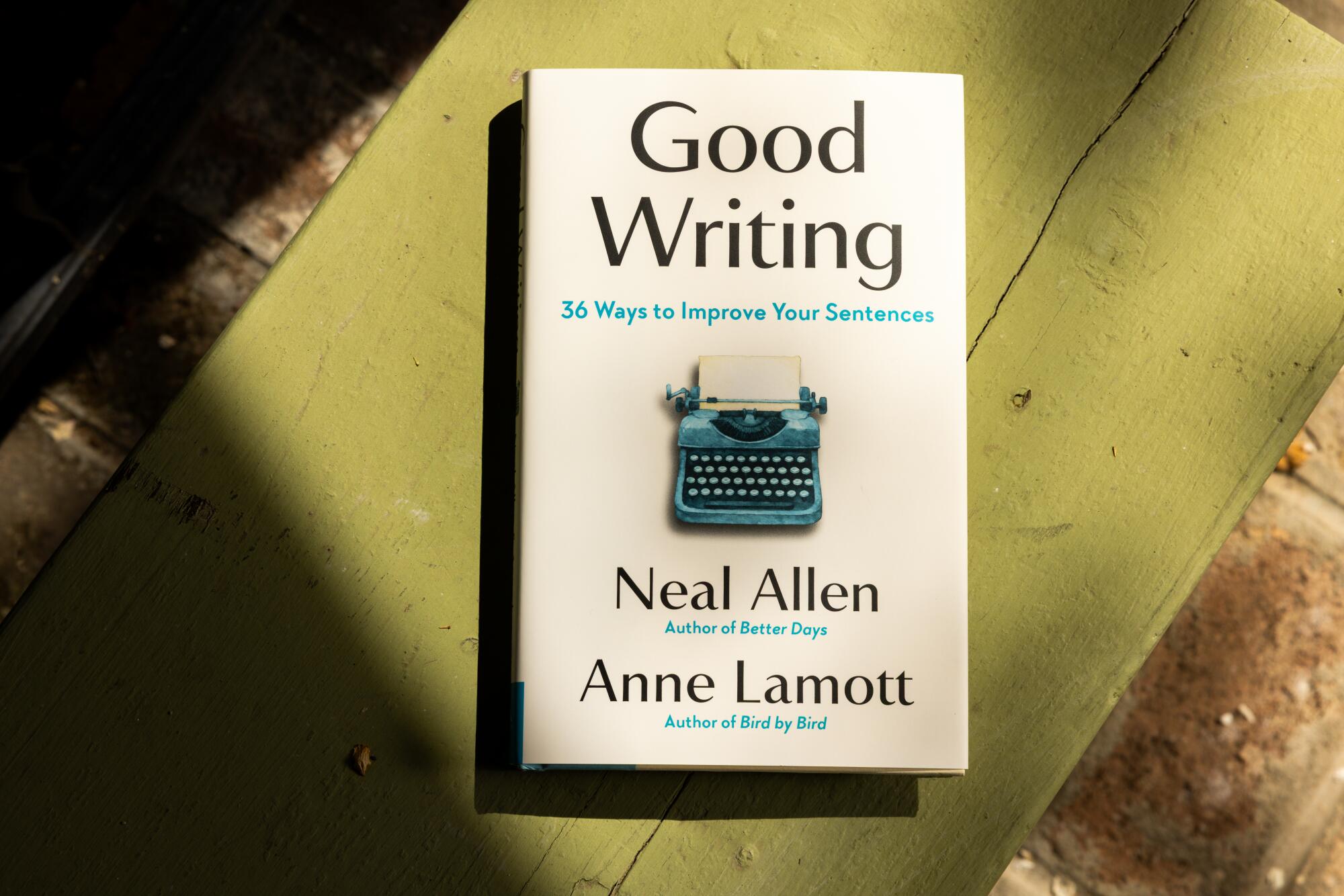
Anne Lamott and Neal Allen share ’36 Ways to Improve Your Sentences’
On the Shelf
Good Writing: 36 Ways to Improve Your Sentences
By Neal Allen and Anne Lamott
Avery: 208 pages, $27
If you buy books linked on our site, The Times may earn a commission from Bookshop.org, whose fees support independent bookstores.
They’re so darn cute together, these two. Neal Allen, father of four, newspaper reporter turned corporate executive turned spiritual coach turned author of two spiritual guidebooks, stands a full head of hair taller than his dread-headed wife, who calls him her “current husband.” He calls her his “remarkable and beautiful partner” and himself “Mr. Anne Lamott.”
And no wonder. Author Anne Lamott has published 21 books, with worldwide sales in the millions. “Bird by Bird,” her 1994 writing handbook, which has sold more than 1 million copies and continues to sell approximately 40,000 copies each year, became a meme before there were memes. Thirty-two years later, the titular phrase has made appearances everywhere from “Ted Lasso” (Coach Beard: “I hate losing.” Coach Lasso: “Bird by bird, Coach.”) to a Gloria Steinem interview in Cosmopolitan (“Every writer, truth-seeker, parent, and activist I know is in love with one or more books by Anne Lamott”).
Ask a famous writer how they do what they do, and “Bird by Bird” will likely get honorable mention. Harlan Coben, whose 35 novels have sold roughly 90 million copies, calls “Bird by Bird” his “favorite writing manual.” “I use it like a coach’s halftime speech to get me fired up to write.”
In a 2007 interview, “Eat Pray Love” author Elizabeth Gilbert called herself Lamott’s “literary offspring.” Paula McLain, who wrote the 2011 blockbuster “The Paris Wife,” told me: “I return to ‘Bird by Bird’ again and again because Anne Lamott tells the truth about how hard this work is — and then somehow makes you laugh about it.”
I reached out to best-selling memoirist and novelist Dani Shapiro to ask if she had her own experience with the book. “A writer is always a beginner,” she said. “And there is no better companion than ‘Bird by Bird.’”

Lamott and Allen partnered to write “Good Writing.”
(Christie Hemm Klok / For The Times)
Lamott, 71, and Allen, 69, met in 2016 on the 50-plus dating site OurTime.com. Nine months later, they bought a woodsy Marin County home with room for Lamott’s son and grandson. Sam, when he was 1 year old, was the subject of his mom’s first bestseller, the 1993 memoir “Operating Instructions.” His son Jax was the subject, at age 1, of his grandmother’s 2012 memoir, “Some Assembly Required.”
“We were watching U.S. Open tennis one night and Neal said, ‘Can I ask you something?’” Lamott told me via email. “I barely looked away from the TV, and he asked me to marry him. I said, ‘Yes, if we can get a cat.’”
After a decade of marriage, Lamott and Allen have undertaken a professional collaboration whose outcome, like their union, is greater than the sum of its parts. “Good Writing: 36 Ways to Improve Your Sentences” is as sharply specific as “Bird by Bird” is wanderingly wonderful: as winning a companion piece as two winning companions could create. The table of contents is itself a mini-manual of writerly tips: “Use Strong Verbs.” “Sound Natural.” “Keep it Active.” “Stick with Said.” “Don’t Show Off.”

Lamott and Allen.
(Christie Hemm Klok / For The Times)
I spoke to the late-life lovebirds about their process of marital manuscript-making: the good, the not so good and the blackmailing.
Meredith Maran: How did writing “Bird by Bird” compare to co-authoring “Good Writing”?
Anne Lamott: “Bird by Bird” was literally everything I knew about writing, everything I had been teaching my students for years. It was definitely my book. “Good Writing” was definitely Neal’s book. I just foisted my attention on him and threatened to undermine the marriage if he did not let me contribute.
MM: Neal, what on earth convinced you that you could add something to one of the world’s most popular writing books —written by your wife, no less?
Neal Allen: Oh, I’m not adding anything to “Bird by Bird,” which is a complete classic. It’s everything you need to know about becoming a writer. “Good Writing” is about what comes next: a second draft. And while it’s not fair to call “Bird by Bird” a craft book — it’s much more — it’s fine to define “Good Writing” that way.

“Helping each other with our work is one of the richest aspects of our life as a married couple,” Lamott said.
(Christie Hemm Klok / For The Times)
MM: In producing this joint project, how did you two negotiate the differences between your writing styles and personalities?
AL: We didn’t need to negotiate. Neal somehow manages to be both elegant and welcoming, whereas I think I am more like the class den mother, with a plate of cupcakes, exhorting people not to give up, trying to convince them that they can only share their truth in their own voice, that their voice is plenty good, and that when they get stuck, as we all do, I know some tricks that will help them get back to work.
NA: I once asked AI to describe the difference between my writing and Annie’s. AI answered that I explain things to readers; Annie helps readers reach catharsis. I think that’s absolutely right.
MM: How did you come up with the book’s fab format, whereby each of you writes your own introduction, and then each chapter starts with Neal’s thoughts about one of the 36 rules and ends with Annie’s?
NA: Annie first asked if she could annotate what I had written. That scared the bejesus out of me. When she started writing her own essays in her own voice, I was quite relieved. One of the format’s surprising strengths is that Annie always gets the last word. I explain the rule; then she helps the reader find their way and resolve their issues with the rule. There’s a downside: I don’t get to respond when she tells the reader to ignore me.

“I’m not adding anything to ‘Bird by Bird,’” Allen said. “It’s everything you need to know about becoming a writer. ‘Good Writing’ is about what comes next: a second draft.”
(Christie Hemm Klok / For The Times)
MM: In your intro, Anne, you recall Neal telling you he was working on a writing book. “Well. Hmmmph,” you replied. “I had written a book on writing once …” How did professional jealousy, competitiveness, possessiveness, or, on the brighter side, tenderness, collaborative spirit and generosity play out as you wrote a writing book together?
AL: We have no competitiveness or jealousy when it comes to each other’s writing. We just want the other person to write the most beautiful work they can. We are each other’s first reader, and editor, and while of course I feel attacked if Neal suggests even the tiniest change to my deathless prose, I have come to understand that his suggested cuts and additions save me from myself. Helping each other with our work is one of the richest aspects of our life as a married couple.
NA: There’s no way around “Bird by Bird,” and I just have to deal with that. My worry was whether Annie really wanted to be associated with my little book. I’m envious of Annie’s brilliance, of course, but we speak the same writing language and we love it equally.
MM: What are each of you proudest of, “Good Writing”-wise?
AL: We just recorded the audio version, and I was surprised by how much practical help the book offers. Also, I love the tone, which is so conversational and sometimes, I hope, pretty funny.
NA: I had the opposite reaction to recording the audio version. I saw all the opportunities for readers to mock me. In the 18 months between writing a final draft and the book showing up in stores, we’ve both flipped from believing it reflects well on us to thinking it’s a disaster. Luckily, both of us haven’t ever thought it sucks at the same time.
MM: That is fortunate. Also, Neal, I’m not sure you answered my question.
NA: What am I proudest of? That the book exists. I carried around these rules for improving sentences for years. I think a lot of writers do a book because they notice it’s not out there, and why isn’t it? And then they shrug, ‘Well, I guess it’s up to me.’ That’s how I came into all three of my books.
AL: May I just add that I’m proud to introduce my seriously charming and breathtakingly wise husband to a wider audience.
Festival of Books
“Written by Hand: Lexicons, Storytelling, and Protecting Human Language in an Age of Artificial Everything” (featuring Anne Lamott and Neal Allen)
The Los Angeles Times Festival of Books, USC Town and Gown, Sunday, April 19, 10:30 – 11:30 a.m.
Admission is free. Ticket required.

Bush Family’s Feud Heats Up With Clinton
PHILADELPHIA — George W. Bush and his campaign have enjoyed remarkable success synchronizing the message from everyone at the Republican National Convention this week.
Except his parents.
After maintaining a low profile all year, former President Bush and former First Lady Barbara Bush have been drawn into a pointed war of words with President Clinton–the man who ousted the elder Bush from the White House in 1992.
The confrontation, which escalated when Barbara Bush criticized Vice President Al Gore on Wednesday, worries many Republicans, who fear it will both distract from the convention’s velvet-glove feel and reinforce questions about whether the younger Bush would be this close to the presidency if his name was Smith.
“It plays into [the Democrats’] hands,” complained one Bush campaign insider about the feud. “It’s what they want: a distraction from a perfect convention.”
Indeed, Democrats have welcomed the controversy. “It reminds everybody . . . that Bush thinks the presidency is an office you can inherit,” said Democratic National Committee Chairman Joe Andrew on Wednesday.
Karl Rove, Bush’s chief strategist, rejected the notion that the Bush family-Clinton tiff was interfering with the convention’s carefully scripted message of moderation and civility. “I think what’s more important . . . is that the vice president is such a weak candidate that he’s forced to rely upon a constant barrage of attacks launched by President Clinton,” Rove said. “I think people see it as inappropriate and it paints a picture of Al Gore as a weak candidate and a weak leader.”
She’s Skeptical Gore Can Restore Respect
Barbara Bush added fuel to the flap when, with her husband Wednesday on ABC-TV’s “Good Morning America,” she first inferred that Clinton had brought disrespect to the presidency, then said she was skeptical Gore could return respect to the office. “It would be very difficult, I think, with some of the things he’s done,” she said.
She did not elaborate.
The multi-generational battle–which before Barbara Bush’s comments had seen Clinton criticize the younger Bush and both the younger and elder Bush criticize Clinton–underscores the unique circumstance of this campaign. Only once before in American history has a president’s son also won the office. And that man, John Quincy Adams, ran 24 years after the term of his father, John Adams, had ended, long enough for the passions of his presidency to cool.
In contrast, the younger Bush is running at a time when the wounds of his father’s defeat are still open, especially among Republican activists who viewed Clinton as morally unfit for the office even before the Monica S. Lewinsky scandal.
But in both public and private, George W. Bush has always emphatically rejected suggestions that he has sought the White House to avenge his father’s defeat. And for most of the campaign, the younger Bush has been extremely sensitive to avoid the impression his presidency would amount to a restoration of his father’s.
Bush, for instance, hasn’t campaigned with his father since the former president referred to him at a New Hampshire rally as “this boy . . . of ours.”
Media Stir Debate on Father’s Influence
That arms-length relationship began to break down last week, when Bush selected Dick Cheney as his running mate. As Defense secretary, Cheney had been an architect of the Persian Gulf War that marked the greatest triumph of the elder Bush’s presidency. And President Bush’s apparent backstage support for Cheney inspired a new wave of media discussion about his influence on his son’s campaign.
Clinton stirred the pot Friday at a Democratic fund-raiser in Rhode Island, where he suggested that Bush was running for president on minimal qualifications. Speaking as if he were Bush, Clinton said derisively, “I mean, how bad could I be? I’ve been governor of Texas; my daddy was president; I own a baseball team.”
Democratic insiders say Clinton may have turned on Bush in response to Bush’s own barbed comments that day on his inaugural campaign swing with Cheney. Bush described his running mate as “a solid man . . . a man who understands what the definition of ‘is’ is.” That was a reference to an often-ridiculed answer from Clinton during his 1998 grand jury testimony in the Lewinsky scandal.
Whatever the cause, Clinton’s comments drew sharp retorts from both the younger and elder Bush. The former president told NBC earlier this week: “I’ll tell you what I’m going to do. I’m going to wait a month. And then, you give a call. . . . And if he continues that, then I’m going to tell the nation what I think about him as a human being and a person.”
Since then, the elder Bush has studiously avoided further comments; he told Fox News on Wednesday that his son “probably wished I kept my mouth shut, but I haven’t heard from him yet.”
Some Bush campaign officials say the former president’s high personal popularity–recent polls found about two-thirds of Americans now have a favorable opinion of him–means there’s little risk in his increased visibility over the last few weeks. In any case, one senior Bush aide said that after this week, the parents will quickly recede into the background again.

March Madness: UCLA’s Sweet 16 ambitions thwarted in loss to UConn
PHILADELPHIA — On the night reigning NCAA champion Florida was eliminated by Iowa, UCLA tried to follow the Hawkeyes’ lead against Connecticut, the team that had worn the crown the previous two years.
And for the second straight game they were hoping to win without leading scorer Tyler Bilodeau, whose sprained knee still hadn’t healed enough for coach Mick Cronin to risk putting him on the floor.
Seventh-seeded UCLA battled, managing to take a brief lead in the second half. But in the end, No. 2 Connecticut’s size and power were too much for the Bruins to overcome in a 73-57 loss in the second round of the NCAA tournament Sunday.
Four players scored in double figures for UCLA. Xavier Booker finished with 13 points, Eric Dailey Jr. had 12 points and Donovan Dent and Skyy Clark each finished with 11. But the Bruins couldn’t contain Connecticut forward Alex Karaban, who erupted for 27 points, as the Huskies advanced to the Sweet 16 to play No. 3 Michigan State in Washington, D.C., on Friday.
The Bruins got off to a good start, building an 18-12 lead before the Huskies caught fire, hitting seven straight shots at one point to seize a 38-33 halftime lead.

Connecticut’s Tarris Reed Jr., center, tries to work past (from left) UCLA’s Trent Perry, Donovan Dent and Eric Dailey Jr. during the first half Sunday.
(Matt Rourke / Associated Press)
UCLA (24-12) started the second half on a 6-0 run, regaining a 39-38 edge on a corner jumper by Clark.
Connecticut (31-5) didn’t wait long to retake control, going on a 14-0 run over the next five minutes, with Karaban scoring 10 points over that span.
UCLA answered with an 8-0 run, with Dailey’s three-point play cutting Connecticut’s lead to 56-52 and reigniting the Bruins’ hope of an upset. Connecticut, however, responded with a decisive 9-0 run, taking a 67-54 lead with 4:24 left.

UCLA struggled with its shooting most of the night, going 19 for 49 (39%) in comparison to Connecticut’s 23 for 49 (47%). Both teams had the same number of free-throw attempts (21), but the Bruins made just 67% of their shots and the Huskies made 90%.

Immense damage seen in Iran’s streets after air strikes | US-Israel war on Iran
Videos show the aftermath of strikes in Iran, as search teams recover bodies from rubble. Residents are using torches to look for loved ones, as air raids appear to have knocked out power in some parts. Iran’s health ministry says more than 1,500 people have been killed during the US and Israel’s war.
Published On 23 Mar 2026

Apology for poor care over Wolverhampton boy’s bleed death
The couple’s solicitor, Catherine Lee, from legal firm Irwin Mitchell, added: “Whilst the trust has recognised the severity of the failings Aarav suffered and the need for improvements, it’s now vital that staff are supported to uphold the highest standard of care at all times.”

Chappell Roan reacts to Jorginho claim that she left girl in tears
A soccer star has accused a pop star of making the daughter of a movie star cry.
Chappell Roan — who, in recent years, called out fans’ “creepy behavior” and said she “pumped the brakes” on fame to protect her own privacy — was accused over the weekend by soccer star Jorginho of rough treatment of his family.
Roan (letting up on the brakes?) headlined Lollapalooza Brazil over the weekend, and Jorginho was in attendance along with his wife and child. While there, as outlined by People, the footballer said the 11-year-old was thrilled to see the singer while they were dining at their São Paulo hotel. The girl walked by the 28-year-old “Pink Pony Club” singer’s table “to confirm it was her, smiled, and went back to sit with her mum. She didn’t say anything, didn’t ask for anything,” he wrote.
Although he didn’t name the girl, his wife, Catherine Harding, shares an 11-year-old with Jude Law. Harding, aka Cat Cavelli, is a singer-songwriter and native of Ireland.

Jorginho of Brazil’s Flamengo celebrates after scoring his side’s second goal, from the penalty spot, during the Recopa Sudamericana second leg final soccer match against Argentina’s Lanus in Rio de Janeiro, Thursday, Feb. 26, 2026.
(Bruna Prado/AP)
Jorginho alleged that, after the girl sat down, a “large security guard” came over and interrupted their breakfast to generally make their lives miserable. The guard allegedly told the girl’s mother “she shouldn’t allow [her] daughter to ‘disrespect’ or ‘harass’ other people.”
The girl was “extremely shaken and cried a lot,” said Jorginho, a player for the Brazilian club Flamengo whose legal name is Jorge Luiz Frello Filho.
Jorginho knows what it’s like to be famous and have fans. (Jude Law also has a little experience in that department.)
Jorginho told his nearly 5 million Instagram followers that he knew what it was like when fans didn’t respect boundaries, and “[w]hat happened there was not that.”
On Sunday, Roan responded on Instagram. She said the guard was not her personal security and that no one — including a starry-eyed 11-year-old girl — had bothered her.
“I did not ask the security guard to go up and talk to this mother and child. … They did not come up to me. They weren’t doing anything.”
“I do not hate people who are fans of my music. I do not hate children.”
She expressed her regrets to the girl and her mom. A representative for the artist did not immediately respond to The Times’ request for further comment.
Roan has shown that she’s not afraid to speak out when she does feel a fan has overstepped. This incident comes after an episode this month in Paris when the singer filmed herself in selfie mode as a swarm of people shouted behind her.
“I’m just trying to go to dinner,” she tells the camera in a video captured by an onlooker, “and I’ve asked these people several times to get away from me.”
Even as she calmly reprimands them, one man continues to ask for her autograph.