



Cuba’s Raul Castro makes first public appearance since US charges | Newsfeed
Former Cuban president Raul Castro made his first public appearance in Havana since being indicted by the United States on murder charges linked to the 1996 downing of two civilian aircraft. He was cheered at an event commemorating the Interior Ministry, attended by military officials and Cuba’s Olympic wrestling champion.
Published On 6 Jun 2026
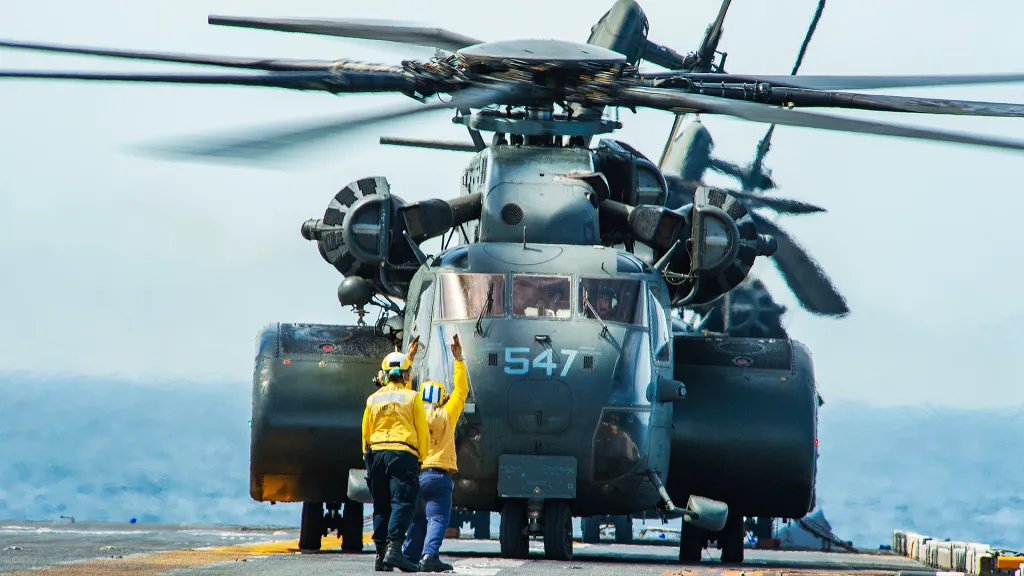
Confessions Of A Navy MH-53E Sea Dragon Minehunter Pilot
For decades, the massive MH-53E Sea Dragon helicopter has served as the Navy’s primary airborne mine countermeasure platform, dragging massive mine hunting sleds through waters all around the globe. However, the Sea Dragon’s days are now numbered, with the last 11 aircraft scheduled to sunset sometime next year. With the MH-53E’s demise on the horizon, we reached out to one of its former pilots, Steve Jones — a man who came to know this monster intimately during the Global War On Terror. He had plenty of stories to tell and provided us with a new understanding of the often misunderstood counter-mine mission.
The MH-53E’s mission is also, of course, extremely topical right now thanks to ongoing tensions with Iran. Secretary of State Marco Rubio recently told senators that the Islamic Republic mined “large segments” of the Strait of Hormuz, endangering shipping in the region.
As it currently stands, the mighty Sea Dragons, which are considered one of the military’s most dangerous to fly due to numerous fatal mishaps, are being phased out in favor of the smaller MH-60S Seahawk paired with a suite of new aerial mine countermeasures systems, as well as other new technologies, like uncrewed underwater and surface vessels. The Navy’s overall mine hunting force is going through a transition that is controversial, to say the least, with many questioning if the Pentagon is investing enough resources in this critical missions set.

With all these issues in play, in an exclusive, wide-ranging, two-hour interview, Steve Jones offered in-depth insights about the Navy’s airborne counter-mine mission, the Sea Dragon’s capabilities and dangers, current mine sweeping operations, as well as everything from what it was like to narrowly avoid getting entangled with a surfacing sub to his experiences ferrying celebrities like Robin Williams and Tom Jones around a war zone.
So, with the stage being set, let’s get into this incredible exchange.
Some of the questions and answers have been lightly edited for clarity.

Q: How did you end up becoming an MH-53 Sea Dragon pilot?
A: During the time that I selected, you could choose SH-60 Seahawks, you could choose CH-46E Sea Knights and the MH-53 Echo. You could choose SH-3 Sea Kings, but they were kind of winding down the H-3s, which is the same as the presidential helicopter Marine One that they fly now, but they were flying out of Norfolk and Puerto Rico, primarily for VIP transport.
So, I looked at the 53 for a lot of reasons. One, I liked the instructors that came from that community in the advanced helicopter training. And two, I just thought the helicopter just really looked awesome, and it was big, and so that’s why I chose it, and I just thought it would be a good personality fit, work fit for me, and it ended up being that way.

Q: What are the main differences between the Navy’s MH-53E and the Marines’ CH-53E Super Stallion?
A: It’s primarily the same aircraft. Except our aircraft has larger fuel sponsons, so we could carry more gas. The reason for that is ideally we’d want to be able to fly an hour to where the mission objective was, be able to stay on station for about an hour, and be able to fly back. That requires at least three and a half, four hours of gas and extra fuel in those side sponsors. And that allowed us to do that. So instead of a small sponson with two tanks, we had one big sponson with four fuel tanks that were inside each of the sponsons on either side of the aircraft.
Q: So how much gas would that larger sponson hold?
A: About 22,000 pounds of gas.

Q: Talk about the training and some of the biggest challenges of flying that huge aircraft.
A: Typical Navy training is two years of flight school, and then after flight school, we went to our Replacement Air Group, which we call the RAG, that was in Norfolk, Virginia. You spend about a year, or up to 10 months, in Norfolk, Virginia, learning primarily how to fly the helicopter, how to land the helicopter, and we do that in the combination with the Airborne Mine Countermeasure Squadron. We used aircraft from Helicopter Mine Countermeasures Squadron (HM) 14 to learn how to fly the different mission sets and learn aircraft familiarization. And then from there you either get assigned to HM-14, which was in Norfolk, Virginia, or HM-15, which was in Corpus Christi, Texas. HM-15 has now moved to Norfolk, Virginia. [Editor’s note: HM-14 sunsetted in 2022.]

The training takes about 10 months. Mine was a little bit longer because when I actually joined that community, the aircraft were down because of a crash off the coast of Corpus Christi, Texas. There was a problem called ‘thermal runaway,’ where the bearings in the main rotor head would fail, and they would seize together and get hot, and we lost a few sailors from HM-15. And until they figured out why and how to prevent it, it took about a year for those aircraft to come back up, so I was in Norfolk for maybe about a year and a half, almost two years, before I got to Corpus because of that bearing issue.
Q: What was it like when you finally got out there and learned how to fly while pulling a mine countermeasure sled?
A: There’s different types of equipment that you use and it takes a special kind of person to be able to maintain the situational awareness – both flying the aircraft and what’s happening in the back – because there’s dangers in the back. You have a very confined area, lots of equipment, and under lots of tension, and so the very first couple of times, the instructor is kind of handling everything, and you’re just kind of riding along.

Then eventually you start to do more tasks, physical tasks, in terms of flying and maintaining a stable platform for the men and women that are working in the back, and then over time those skills translate into a larger situational awareness, where you’re now a mission commander – where you’re flying the aircraft, but also, conducting the mission in the back is your primary responsibility. The positions are second pilot or co-pilot, and then you become a Helicopter Aircraft Commander (HAC), which is like the captain, and then you become an Airborne Mine Countermeasures Mission Commander (AMCM MC), meaning you’re flying the aircraft, you’re the commander of the aircraft, but you’re also commanding the mission.

Q: Did you become a mission commander?
A: I did. So I was fully qualified in the MH-53 Echo in my squadron, so I was a mission commander. I worked the maintenance side, so I was the maintenance check pilot and functional check pilot. It takes a lot of maintenance, and then post maintenance, and you have to do post maintenance flights to be able to make sure the aircraft is safe for anyone else to fly. So I spend most of my time in those areas in that squadron.

Q: What are the MH-53’s unique quirks and advantages?
A: One of the advantages was pure brute strength. You had three GE engines, so you could handle lots of torque, and the way that we hunted and swept for mines was pulling sleds in the water, which causes thousands and thousands of pounds of stress, so it’s really like a forceful instrument in the water. The operation requires the coordination of not only meteorologists and Operations Specialists, which are like intel specialists in mine warfare, but then you have the maintainer, you had two pilots and a crew chief, plus it could be up to four people in the back, depending on the type of gear you’re stowing in the back, so it really takes coordination from the front.

The disadvantage is that it’s a very expensive aircraft to operate. Every hour of flight, required 24 hours of maintenance, and if a squadron had 10 helicopters, which we did at one point in time, you’re looking at the largest deployable squadrons in the Navy, like 600-plus people to operate these aircraft.
With everybody working together, we advertise that we could be anywhere in the world in 72 hours, where there’s a mine threat. We could break down the helicopters, put them in a C-5 and then reassemble them anywhere in the world in 72 hours. After 9/11, for Operation Iraqi Freedom, we did deploy by C-5. We took half the helicopters to Sicily and the other half went to Bahrain and took 11 C-5s in order to move a squadron that size into those two locations, so big footprints, lots of money, lots of parts.

Q: How fast could the Sea Dragons fly?
A: The 53 is a fast helicopter. One of the fastest out there. We were limited to 150 knots for airframe preservation. Under towing conditions, we typically flew between 18 and 25 knots, depending on the device in the water. Each vehicle had different performance parameters to properly deploy the device. Under rapidly changing conditions we always had to maintain proper speed and altitude control.
Q: The Sea Dragon has experienced a notoriously high rate of mishaps. Did that ever concern you? What do you think contributed to this record?
A: It did. If you’ve ever seen one or been on one, been close to one, or heard one, you’ve got 100-foot long machine with millions of moving parts, right?
Our maintenance crews were very good, I always felt safe flying. I think you have to if you choose to fly that particular weapon system, but there were a lot of accidents. And I knew folks that were killed in MH-53 accidents who I went to flight school with, and buddies.

Maintaining MH-53E’s
It’s a very complicated machine that did a very important mission, and accidents do happen, both mechanically, but also because of pilot error. In combination, you end up losing a lot of airframes. Besides the United States, there is only one other nation that flew that airframe, and that was the Japanese for their mine sweeping operation. It’s a very complicated, expensive machine, and that’s why not very many people flew it.

Q: Did the danger concern you?
A: You know, you’re in your 20s, right? So you feel a little bit invincible. I’ll tell you a story. When I switched from 53s and started flying C-130s, after the Haitian earthquake, I flew into Guantanamo Bay, and my old squadron was there on the same ramp as we were. So I walked over to see who I still knew there, and they had a 53 turning on the deck there, and I was just going, ‘wow, I couldn’t believe I used to do that,’ and not thinking about how many things have to go right in order to have a good day. And I just kind of said to myself, ‘it’s really a young person’s game,’ because you gotta kind of hit the ‘I believe’ button on a lot of things, because there’s just a lot of opportunity for negativity to come in. Weather, environment, and then the mechanics of things.

Q: What were the biggest factors contributing to the Sea Dragon mishaps?
A: With any aircraft system, the largest factor that contributes to any accident is the human factor. Yes, engines will fail, components will fail, but a lot of times it was human error that caused the ultimate catastrophe because when an emergency happens, you have three criteria in order to gauge when you should land.
The two critical ones are ‘land immediately,’ meaning if you do not ditch in the water or put the aircraft down, it is going to come apart in flight. The other critical criteria is ‘land as soon as possible,’ meaning as soon as you have a safe place to land, then you land as soon as possible. Then you have another condition where you can continue to fly, but flying is not recommended. And so that decision factor between land immediately and land as soon as possible, it’s a bit of a gray area, right? You have a set of skills you can fly, but you can never time when the aircraft is going to come apart.

Navy ‘Sea Dragon’ Helicopter Unsafe For Flight | NBC Nightly News
For example, in the Corpus Christi crash, they knew that they had a problem. I’m not second-guessing the pilot, but it was in that gray area between land immediately and land as soon as possible.
The aircraft commander chose to try to bring the aircraft closer to the beach, so you could survive a ditch, because putting a helicopter in the water – nothing is guaranteed, right? Then you have no control. However, bring it closer to the beach means you’re flying that much longer. So land immediately, there could have been more survivors.
Not to ‘Monday morning quarterback’ anything. I probably would have made the same call. And then with the new equipment that was put on the aircraft, there are lights now placed in a monitoring system that kind of took the gray area out of those decisions when it came to thermal runaway with the main rotor head. So now the decision is clear. Land immediately if certain indications happen, and land as soon as possible if certain indications happen. Prior to 2000, we didn’t have that.
Q: The Sea Dragon community has been well-documented for being neglected by the Navy. What was your experience when you were flying it? Why do you think that was?
A: It’s a unique mission set. It kind of came online during the Vietnam War and Haiphong Harbor, and clearing those mines, and then again in Desert Storm, when the USS Tripoli was hit by a mine.

Mining sea straits is a very cheap way to stop a huge navy, such as the one that we have in the United States. However, the Navy, in my opinion, didn’t necessarily see the value in that mission. There are very limited resources. There’s only so much money to go around, and large strike groups and ships just took priority. We were always probably a little bit underfunded, in my opinion, for a mission that’s important, which you can see today with the Strait of Hormuz. But it was definitely a huge problem that many people did not talk about during the first two Gulf Wars.

Q: Why was it a huge problem?
A: Well, when you try to move a carrier strike group into a small area like the Persian Gulf, by putting mines in the water, you create doubt in a captain’s head. The captain is responsible for thousands and thousands of lives, and the battle group commander is responsible for thousands and thousands of more lives, plus the strategic reason of why they’re there. If a mine is discovered, then everything has to pause. You can’t land Marines on the beach, you can’t move the strike group closer to the shore. The ability for you to project power ashore, all that kind of comes to an end.
Q: How does the MH-53E go about this unique mission set? Can you walk us through what a mission would look like from start to finish?
A: Depending on the intel, you’ll have a threat and the threat could be you suspect that there’s mines in the water, or that you know that there’s mines in the water. So, typically it’s ‘you suspect,’ right? And we used the AN/AQS-14, or “Q-14.” There’s about three different versions of the Q-14. It’s a side-looking sonar, which you drag in the water – we call it the fish. We would fly the fish at certain depths based on the terrain and what was in the water. That was called mine hunting.

So initially you would always kind of begin with a hunting mission, where we could, or the OS operator, or the console operator would mark what they view as a mine-like contact. You’re really kind of looking at the sonar and distinguishing between man-made objects and natural objects. If you believe it’s a man-made object, and then you would mark a tape. You could also, real time, send that image back to the ship, but that capability came a little bit later.
We also had devices that allow you to sweep. A mine can be triggered by different mechanisms. Sometimes they’re triggered by contact.

Some mines are acoustically triggered, meaning you can set that mine to blow up for a certain type of ship acoustics. For instance, a destroyer has a different set of acoustics from an amphibious ship, from an aircraft carrier. If you want to let 1,000 destroyers pass you or a submarine and then wait for the aircraft carrier, you can tune it to that way. So we had devices that could mimic the sound signatures of different ships, and you could tow that in the water, you could tow it really fast. One of the reasons why we were successful is that we could do large areas of the ocean relatively quickly.

The last piece for sweeping is the magnetic variation. Each ship is a metal hull, and as a ship is moving through the water, it has a magnetic signature, and then we have gear, which you could tune to mimic certain types of ships in the water, in order to have them explode behind the gear that we’re towing in the water.
So you hunt, that means you’re searching, and then you sweep, and then that means you’re clearing. Sometimes you can clear using other technology, such as sometimes the Avenger class ships would go in and sweep, and not us. Sometimes you would use dolphins to work with EOD teams in order to sweep mines. It just depends upon the threat, on what the second tool is used after you hunt.

Navy Dolphins Practice In Key West How To Find Mines In The Ocean
The most time that I spent was in the hunting phase of the mission set. In Bahrain, every week, a couple days a week, we would hunt. We would do the Strait of Hormuz. We would do the approaches into Saudi Arabia for the tankers. We would do the approaches into the Suez Canal, just to be sure that there are still no mines in that area.
That is for what we call change detection, meaning you map the ocean floor, and then over time, because of consistency, you’ll be able to tell if something changed. If something changed, then you went in to investigate further. It’s constant because the ocean floor is constantly moving, and then somebody could easily place a very cheap object that could be devastating.

Q: Walk me through how a mission would take place.
A: The intel can be good sometimes, sometimes the intel is lacking. The weather has to be at a certain sea state in order for it to be successful, and you can’t do it at night, right? You have to do it during a daytime in littoral situation, so you’re pretty close to shore and you are susceptible to threats that are on the beach. That is the mission set and if you don’t know where the mines are, that’s why you begin with hunting. The Q-14 is a relatively quick device to deploy. You can pull it in the water relatively fast. Then you can real-time send images back, or you can collect tapes to study for that change detection.
When you’re going out for a mission, you’ll have your standard aircraft brief, where the crews get together and talk about the state of the aircraft, the conditions, the environmental conditions of today. And then you’ll get into the mission brief on where the ship is, or where the shore is, and where actually the square, or the box, or the rectangle is, where we’re going to conduct a mission. We talk about the distances from that point that we’re going to deploy the gear, because it takes time to be able to do that, and then we’ll enter what we suspect is a minefield or an area of interest from which we want to be able to tow in.

Minesweeper Exercise
Then we fly what we call tracks. It’s almost like rows on a field, like cornrows, and we go up, down, up, down, and you have to stay within track by feet, okay? If you, if you stray as little as 20 feet off track, then you have to redo that track, because you want to have a continuous picture of the ground. And so it may take two or three sorties to cover an entire minefield.
And then times where the device may have strayed off track. It takes time, but we can do it quicker than a ship doing it on its own, like the Avenger class ship, and so between the aircraft brief and the mission brief, and executing, it’s like a six, seven hour day in the heat or in the cold, depending on where you are.

This is the Navy’s Largest Helicopter | MH-53 Sea Dragon
There’s no air condition on that helicopter. So everybody’s working in those conditions based on the information that we bring back. Then the tactics folks that are supplied to us by COMINEWARCOM (Commander, Mine Warfare Command), which was our bosses, those intel folks will say what needs to happen next, meaning there’s nothing that needs to happen now, or we need to investigate this further. And then they pick the next tool for us to be able to deploy, or they go with the EOD and dive teams to go take a closer look.

Q: How fast are you flying, and how high are you flying? How deep do the sleds go?
A: The helicopters are anywhere between 25 and 75 feet over the water, depending on the gear, because the speed in which we pull through the water is extremely important. You could go as fast as 25 knots in some cases, which is about the top speed, or you’d have to go as slow as 12 knots.

Mine Countermeasures Unit Drops a Slocum Glider from a MH-53E Sea Dragon
Q: How deep do the sleds go?
A: The depth of some of the gear is classified, or at least it was at my time. I’m not sure now, but you could go relatively deep. It’s under lots and lots and lots of tension, and the reason why you had to go very deep is that some gear has to be able to get to the sea floor at certain distances, because there’s also the subsurface fleet that is operating down there, and mines will affect them as well.
Q: What’s the tension like when you’re dragging a sled?
A: You’re looking at around 15,000 to 20,000 pounds of tension. The aircraft will kind of buckle. You look at the side of a 53, it has a crease from the tension that goes on it.
If there is a swell in the sea state, sometimes the Doppler radar – which would kind of track how fast you’re going forward, backwards, or sideways – it’ll go from forward to negative, meaning we’re actually getting pulled backwards by the sea state. And the engines would automatically just start – the torque would come in as the blade did a bigger bite out of the air. And the aircraft will kind of turn, because of the torque. It’ll kind of turn and whine, and you’re just flying an out of balance flight, nose down.

Q: Did you ever have the sled get tangled up behind you?
A: Yes. It can get caught on things in the water, and the tension will spike. If the tension spikes too high, or the gear gets fouled in something, you always have the option to guillotine or cut the gear.
Q: Did the aircraft have other devices that helped in the mine hunting mission?
A: Yes. In addition to the Q-14, we had the Mk 104 acoustic device, mine chain cutting devices and the Mk 105, a huge gas generator, which produces electrical charges in the water for those magnetic-seeking mines that change the magnetic variation.

HM-15 Sailors Recover Mk 104
There’s at least six devices that I know of that are used for hunting mines, including something as simple as what we call a MOP, which is stands for Magnetic Orange Pipe, which is what they used in Vietnam.
Essentially you have this pipe, it looks like a telephone pole, which is about the size of a telephone pole or larger, and it’s orange. It has a positive charge on one end and negative on the other end. It’s just a magnetic pipe that we would tow in the water. It’s probably the easiest thing that you can tow, and the simplest, but it’s looking for those magnetic variations. The problem with the magnetic orange pipe is you can’t change it, so it’s set for a certain amount of tactics. You can see how that could become obsolete in today’s environment.

Q: How does the Sea Dragon integrate with other mine hunting capabilities, like the Avenger class ships or other assets?
A: We worked as a team, but obviously we’re a tool in that larger mine warfare strategy. We were the speed aspect of that, meaning we could have left holes, but if you’re trying to move at the speed of war, then sometimes we were the tool that was required. And if you have 72 hours to be somewhere, speed is required. We could do that to be sure that the fleet can continue to do what it needs to do, but if you’ve got time, then you could sail a ship or move one of those slower small boats into that environment, that makes sense.
Q: Did you ever work together with Avenger class ships?
A: Maybe in the same AOR, but other than an exercise where you would see an Avenger class ship working the tow area, and then we will be working our tow area. It was under controlled condition. When I was doing change detection, and during work conditions, we were operating concentrated on our mission set, they’re probably concentrating on their mission set, and between the two pictures, they came together in the operation center to have a very clear picture.

Q: When was the Sea Dragon actually used for this mission operationally? How did it perform?
A: It was used throughout Iraqi Freedom, from Shock and Awe to the pull-out to the drawdown. If not every day, every week there was change detection in mine operations, because it’s always a threat. It’s a very cheap weapon that non-state actors can get off the black market. One mistake or one mishap causes devastating consequences for the individuals on that ship, but also the mission, so it’s a constant threat, and still is a threat.
During my time, actively hunting for mines to be sure that those straits and those approaches remain clear, dominated my entire career in the community. From the time I started and then I towed to my last days in the squadron, which was in 2005.

Q: How did the Sea Dragon perform?
A: I would say, since there was not a mishap, it performed as designed. It doesn’t mean that the mines were not there. During Iraqi Freedom, mines were put in the water, but we didn’t have the mishaps like we had before that I can recall. So I would say it was a success.

Q: Any close calls during any of your sled-towing flights?
A: I got disoriented one time with vertigo. Like I mentioned earlier, you’re on an out-of-balanced flight, so your ears are doing one thing, your eyes are doing another thing, and sometimes there’s low fog over the water early in the morning. Under tow there was a time where I got vertigo and put the aircraft in an undesired state, but there’s two pilots. I recognized it and told the aircraft commander ‘I’ve got vertigo.’ He took the control and saved it. Being that close to the ground, getting vertigo could have devastating effects, right? We just ended up releasing the gear that day.
Q: How do the big rearview mirrors help with towing?
A: Mirrors are super important for situational awareness when lowering the equipment into the water and for ensuring the tow cable is staying on track. The co-pilot is crucial while under tow because they are responsible for making sure the aircraft remains clear of obstacles and threats. The pilot flying will be head-down monitoring performance of the helicopter and the gear deployed. The pilot flying will maintain navigation in the minefield and overall safety. When flying, looking out of the windows was a brief luxury.
Q: Tell me about the time you encountered a surfacing sub while dragging your sled.
A: It was sometime in 2003 or 2004. We were flying over the Strait of Hormuz, towing a side-looking sonar to do bottom mapping. I’ve got a very loud helicopter in the air and a sonar that’s pinging on the bottom, so it probably was not a surprise where we were to the submarine, but their location was a surprise to us.
It’s a bright sunny day. The water looked beautiful, and we’re just doing a random tow. And all of a sudden, this big black submarine surfaced right in front of us. Just popped out of the water, and right in line with our track.
I think I was maybe 50 feet over the water and the gear is behind me. Now I have to turn like a semi truck, having to turn myself and the gear all at the same time to maneuver around the submarine. I said something like ‘holy shit’ and I remember I banked to the right because I think it was the easiest thing to do. There’s more space.
We ended up able to clear the sub, but it had a startling effect. So either they were in the wrong spot or we were in the wrong spot, I couldn’t tell you. But no one came and knocked on the door, saying that I did something wrong. So I’m gonna leave it as if they were in the wrong spot.

Q: What was it like aerial refueling such a monstrous helicopter and did you use it operationally often?
A: Very intimidating at first. However, it is all about training. Yes, you are very close to the other airplane, but that is not your focus. Your focus is on check points. Align your check points and the aircraft will plug. Once you connect and position the aircraft above the wing and propeller wash, the ride is smooth. When I switched over the flying C-130s, it would have been nice to go full circle, but never got the chance to give fuel.
We almost did aerial refueling during a possible mission scenario, but the plan was scaled back and we ended ship hopping. I only used the boom in training. I’m sure it happened, but didn’t know anyone who did it. They were there for a reason, and we trained for it.

Q: What’s the operational situation regarding Iran at the time you were flying?
A: Annoying. They have a lot of islands that are in the Persian Gulf that are their territory, and sometimes during operations, when you’re either delivering cargo or going to field a tow, it puts you in close proximity with those islands. At the same time, if it’s necessary, you could have your own boat team in the water as well. It was post-Cole [a reference to the October 12, 2000 attack on the USS Cole just a few years earlier by explosive-laden suicide boats at the port of Aden in Yemen. The blast ripped a 40-foot-wide hole near the destroyer’s waterline, killing 17 U.S. sailors and injuring nearly 40 other crew members.]

A Suicide Boat Attack Leaves the USS Cole Reeling from the Damage | Combat Ships | Smithsonian
So you have fishing boats in the water, and you don’t know who’s on that boat that is getting close to your ship. But when you got close to Iranian territory, they will speak up on the radio, and tell you to turn around, that you’re approaching their territory,. Even though you know exactly where you are, and you know exactly where this island is, they’re still going tell you are in violation of their airspace.
Then it’s always a constant threat, right? So, if I were to have to ditch a helicopter or airplane in the water, they’ve got boats in the water. You wouldn’t want to get captured by them, where they could say you are in violation of their sovereign territory by mistake, and then it becomes an issue.
We were flying helicopters without GPS, so you’re using visual navigation maps and whatnot. I’m sure there’s a GPS on those birds now, but at the time, I had a handheld GPS from Academy Sport, where I marked the islands myself, so I knew exactly where I was, or at least the best that I could manage with the equipment, to be sure that was in the right position.
Q: Did they ever directly threaten you while you were on those missions?
A: No. They talked about violating their airspace, but they never intercepted or anything like that. I think that would be a huge mistake. It would not be a good day for them.
Q: Tell us about other locales where Sea Dragons operated.
A: We had detachments in South Korea for the North Korean threat from underwater mines. We did exercises in the Pacific. We did exercises with Japan because there’s a threat of mine in those straits, like the Strait of Malacca.
There’s obviously a threat in the Pacific theater. But because of the situation with Operations Enduring Freedom and Iraqi Freedom, I spent most of my time in the Middle East.

Q: Were there any difference between operating in the Persian Gulf area and the Pacific, or Europe?
A: A lot of the effectiveness of what we do is dependent upon water. The salinity of the water, the sea state, the amount of garbage and trash that’s in the water. So those environmental threats change the tactics. That’s why you need to practice out there.
In terms of the purpose of the mission, that does not change, but how you go about it does change. If you’re closer to a near-peer actor, it’s going to require better intelligence, different types of equipment in order to counteract the threat. I would say the Iraqi Navy was not near-peer in terms of mine tactics, but the Chinese could probably be very different in terms of mine tactics. They would be a more sophisticated enemy in this case, which would heighten everything.

Q: Did the Iraqi Navy or the Iraqis present a threat to your aircraft? Did they harass you, fire at you?
A: No, not during my time. I think maybe possibly during the first Gulf War. The threat was that there, it was always a threat when you’re operating close. So yes, something could have happened. They’ve got boats, they’ve got men in the water.
Q: What are your thoughts about the current MCM missions taking place now in the Middle East? Just how hard is it to clear an area of mines like the Strait of Hormuz?
A: I would say that it is difficult. All mine clearing operations are difficult because you’re talking about the needle in the haystack. Like literally, and you know they’re deploying something that can be hoisted by one person and thrown overboard into the water or by a machine, and you can deploy a lot of mines in a very short time in a concentrated, tactical way, or randomly. It really doesn’t matter, it’s still a threat.
I would say it is difficult because people talk about how narrow and small the Strait of Hormuz is, but you have to remember the earth is large, and there is just a sheer volume of water, and square miles or square kilometers on which something can happen.
It is a very daunting task, and so having more MH-53E helicopters probably wasn’t the solution for the future.
From reading, and then from hearing from my peers that are still in, the tactics are different, but also the equipment that they use to detect this threat is also different. It is faster. It is unmanned. You can deploy more assets quicker because you’re not relying upon one machine or two machines at one time being deployed.

What kind of sea mines is Iran using in Strait of Hormuz?
Q: What equipment are they using now? What are the differences?
A: I retired in 2017 and it has changed dramatically. For one, it is more integrated into the fleet, so you’ll have multi-mission capabilities, meaning an MH-60Ss can be used for different sets of missions, from delivering cargo, to deploying different sensor arrays. You have AI for detection assistance. You have side-looking sonar, which instead of being towed are now on underwater unmanned vehicles. So I think more of what you’re looking at now is a mission package of sensors that can be deployed.
When you have sensor sets, it’s integrated into the larger Navy strategic picture better. I think that that was lacking in the past in a way, because you have to cover such a large volume of area, you need more sensors and eyes to be able to do that, and I think that’s the strategy today.

Q: Do you talk to any of the current pilots/crews of the last squadron flying them? What do they say about the current status of the fleet? Are they involved in the mine clearing operation in the Strait?
A: So I talked with folks, there’s still some folks that are still active duty. Some of them have transitioned out of the 53 pilot-wise and have transitioned into the MH-60S community and so they are deploying those tactics and new systems.
I would say it is probably still a neglected community in their opinion. Everybody’s fighting for resources, but I think when you’re talking about the current situation with Iran in the straight, there’s always a time where mine countermeasures become a very hot topic, because people do forget about it.
Q: Are the MH-53Es still performing airborne counter-mine missions?
A: I’m not sure.
Q: What other missions does the MH-53 community perform? Can you talk about your experience with those and what they entail?
A: When you have that much capability, you move a lot of things. And so we did a lot of moving cargo. I could move an F-14 Tomcat engine with the afterburner completely attached. I could move it at 150 knots from shore to ship internally, so I didn’t have to sling it underneath the aircraft in a pod. I can have the engine assembled together and be able to move it. So we moved things that the C-2 Greyhound couldn’t.
The primary mission was mines, the secondary cargo and people. We would do people movement, if a better ride wasn’t available to move an admiral or someone for an important meeting, then we would do so. Obviously, you know, it’s a very dirty ride.

Q: What admirals did you move?
A: I can’t remember the admirals, because they kind of all blend together, but we did move fun people. We did Tiger Woods for all the USO engagements. Blink 182. We did Tom Jones, Robin Williams, a number of NASCAR folks and other celebrities. We did a lot of that.
Q: What was Robin Williams like?
A: Funny. He was on from the time that we picked him up in Bahrain, and then giving him the brief. He liked talking with sailors and making jokes. Tom Jones was memorable because he’s got the hair right, and he didn’t want to wear a cranial or helmet on his head to mess up his hair before he did the show, and so that became a thing. But you know, the hair won out. The hair was not going to get covered by the helmet.

Q: What will the Navy miss when that last squadron is finally retired next year and there are no more Sea Dragons flying? Can the MH-60S handle the job?
A: With the Greyhounds going away, I think even with the CMV-22, which is a very capable aircraft, a very fast aircraft, but in terms of lift capacity internally, there’s something to that. If it’s outsized or weirdly shaped or is on wheels, the MH-53E is your catch-all aircraft. The Navy will miss that and the large numbers of people that we can move.
During the start Operation Iraqi Freedom, when I was in Sigonella we spent four days offloading the Marine Corps battalion landing team from the Iwo Jima on to Souda Bay for them to be flown into the northern part of Iraq. With those two helicopters and in one helicopter with Helicopter Detachment 4, we moved hundreds and hundreds of Marines from a ship to the shore for them to be staged in order to be moved into Iraq in a matter of days. I don’t think that same amount of capability in terms of volume of moving at that speed can be done with what’s available today. So I think they’re going to miss the kind of the ad hoc nature of having a big aircraft to move odd things. It’s good to be a generalist sometimes.

Q: What about the mine countermeasures mission? Is there anything that the Navy will miss from the capabilities of the 53 from that standpoint?
A: I can’t speak on it with the new equipment, because I’ve never operated it, but I think what the Navy won’t miss is the price tag, and maybe the lack of full mission capability. We operated a lot of times in that partial mission capability, because of the complexity of the equipment and the machine, and then you have to get the equipment and the machine to work together, the machine being the helicopter. I don’t think the Navy will miss that part of it.
Q: Can the MH-60 do the job?
A: They can do the job, but they don’t conduct it the same way we did. They can’t pull big sleds like we did for underwater sonars because of power and tension. And you can’t send as many crew members in the back in order to make that mission successful. But the 60 is a very capable platform in order to conduct the mission the way they do it now.

Q: What’s the difference between what they do and what you did?
A: They’re deploying sensor arrays and underwater vehicles from the thing, so they have standoff distance. They’re capable of not putting the helicopter in the same proximity to danger. They can’t put a Mk 105 in the water, but they don’t need to, because they have other types of technology to do it.

Q: What was your most fear-inducing flight in the Sea Dragon?
A: For me, I was on the sea wall in Corpus Christi, Texas, about to do a towing training mission off the coast of Texas. In the 53 you have three engines, and then you have an auxiliary power unit – another gas turbine that’s above the cockpit.
The purpose of the auxiliary power unit is to run the hydraulics and various components and accessories when the engines and the rotor head aren’t turning. The idea is, once you get the engines going and the main rotor is turning, there is a shaft that goes from the main gear box into that auxiliary power unit, where all your generators and hydraulic systems are run. So we had the engines running, we were on the sea wall – we had a hanger, and then we had an apron, and right there was the Corpus Christi Bay.

I was taxiing out to take off from the helipad, and you’re over the water as soon as you take off from the sea wall. Well, that shaft sheared while I was taxiing up. I have to push the cyclic (the stick) forward in order to tip the rotor head forward to pull me along the ground. If you lose hydraulics in a 53 there is no amount of strength that you or the other copilot has to help to change the path of that helicopter.
When the shaft broke, it meant whatever condition that rotor head was in, it was not going to move, and that rotor head was in position for me to be able to take off, but I did not have enough power in order for me to lift off. Even if I lifted off, I probably would have just careened into the water.
So we were going in a situation where I heard it pop, and then all of a sudden the controls froze, and I told the co-pilot, Ty Jurica, that I was so concentrated at that point because I could not control the aircraft. I said ‘I don’t have control, I cannot move the controls.’ But Ty’s quick thinking noted that he could get the hydraulic power unit started again, which it takes time to spool up, but he was able to hit the start on the APU, and we managed to spool up to get hydraulics back, and as soon as the pressure came on at 3000 psi, I was able to move the controls again.
We stopped the aircraft where we were, and we shut it down at that particular time, but in a few seconds, maybe, we probably just would have taxiied off over the sea wall, and into a very bad situation.

Q: What was your best memory of a mission you flew, or a moment during one of your missions in your time in the Sea Dragons? Put us in your shoes of what that was like.
A: Oh man, my best day there? There were a lot of good days. A lot of times, we would fly in formation – two ships going out to whether it was an aircraft carrier or whatever – and we would take off before sunrise. When you’re flying in formation low over the water, and the sun is coming up over the Persian Gulf, those are those are great days. Because everything is working. You have two planes actually going to conduct the mission and not training. I don’t care who you are, it’s always a lot of fun.
You’re going relatively fast. I mean, we’re not Hornets or whatever, but we were low and fast at that time for us, and we thought we were pretty cool.
You couldn’t touch us on those days.

Author’s note: we added three additional sets of questions and answers to this story. We asked Jones about how fast the Sea Dragons could fly, how helpful the big rearview mirrors were when pulling a sled and what it was like conducting aerial refueling in the giant helicopter.
Contact the author: howard@twz.com
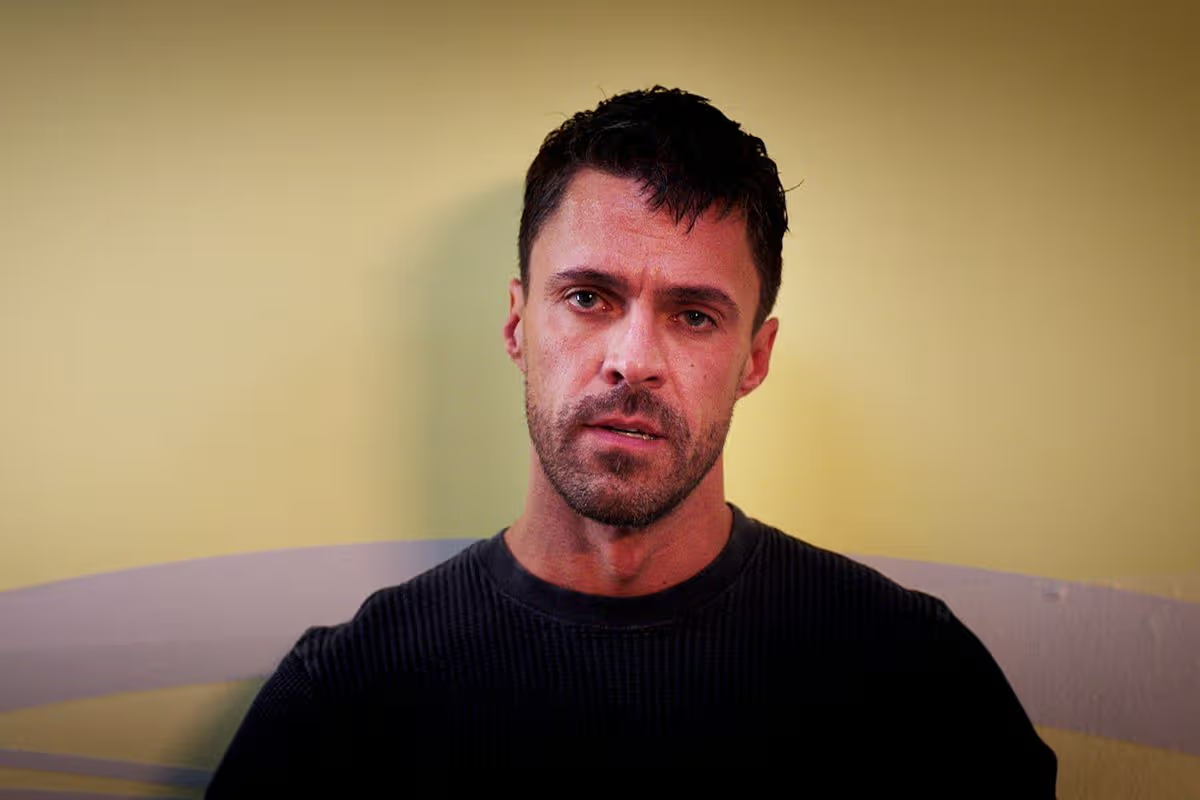
BBC Casualty fans left ‘screaming’ and say ‘I will simply never recover’
Flynn Byron finally found out what solider Rory Dickson was hiding during the latest episode of BBC’s Casualty as his romance with Stevie Nash left fans gobsmacked

Casualty’s Flynn Byron became concerned for the welfare of solider Rory Dickson(Image: BBC)
The ending of the latest episode of Casualty has left BBC viewers all saying the same thing.
Saturday’s (June 6) instalment of the medical drama finally revealed the deadly secret from Flynn Byron’s (Olly Rix) past, which explains his mysterious and fractured relationship with his former military trainer, Colonel Jack Bard (Mark Womack)
In the current boxset titled Lethal Legacy, the clinical lead has become concerned about the welfare of one of Bard’s soldiers, Rory Dickson (Gwïon Morris Jones).
After noticing several injuries on the young man, Flynn has reached out to Rory several times, but has been silenced by Bard each time raising suspicions.
In the latest episode, Flynn rushed to hospital in the middle of the night to see Rory, who was brought in after being found drunk on a busy road. Rory received a mental health assessment before being released but Flynn was convinced that he was at risk of harming himself.
Flynn asked Rory to stick around so he can patch him up in his office and Rory later admitted that he’s being bullied by Bard, disclosing various horrific incidents that he has experienced at the barracks.
However, after Flynn secured Rory a place at a recuperation facility, the soldier vanished. A packet of drugs also went missing and Flynn headed out fearing the worst. Thankfully, Stevie found the medication in the hospital.
Flynn then got a call to say that Rory was in a critical condition after being hit by a car. Flynn rushed back to the ED to find Rory in cardiac arrest, but against all odds, managed to restart his heart.
Deeply affected by the events of the day, Flynn went out for a drink with Stevie Nash (Elinor Lawless) on the canal and the pair had an honest chat about her current struggles and they headed to a bar to shelter from the rain.
Flynn told Stevie that he started basic military training at the age of 17 with a boy called Adam, whose name was mentioned earlier in the boxset. Adam was also bullied by Bard and his ordeal led him to take his own life.
He signed a statement out of fear saying that Bard had nothing to do with Adam’s death but in an emotional moment, he explained that his fight to get justice for Rory is partly to make up for his past regrets.
Stevie sent Matty Linklaker (Aron Julius) a text to end their secret fling and she continued to drink with Flynn. He initially decided against sharing a taxi with Stevie but as he started walking in the rain and released that he wants to be with her.
He rushed back to the bar and was gutted to realise that he was too late as Stevie had already left in a taxi, leaving fans begging for next week’s episode already.
Taking to X, formerly known as Twitter, one fan penned: “I am SCREAMING at today’s #Casualty I will simply never recover.” Another added: “Those final scenes between Flynn & Stevie in tonight’s #Casualty were [flame emoji].”
A third person said: “That end montage with Stevie and Flynn? It’s all probably going to go pear shaped though when he finds out about Matty.”
A fourth person said: “That ending had me literally jumping up and down, next week needs to hurry up already.” Someone else agreed: “Today’s episode was intense and full of emotion.” Could a love story be on the horizon or have Flynn and Stevie missed their chance?
Casualty airs on Saturday nights on BBC One and now streams first on BBC iPlayer at 6am on the day of transmission
For emotional support, you can call the Samaritans 24-hour helpline on 116 123, email jo@samaritans.org, visit a Samaritans branch in person or go to the Samaritans website

Judge halts Trump plan to link USDA SNAP funds to gender, immigration
A federal judge sided with California and other Democratic states on Friday in a preliminary injunction that blocked the Trump administration’s attempt to condition food benefits on compliance with the president’s policies on gender and immigration.
Twenty states and the District of Columbia filed a lawsuit in March against the Trump administration in U.S. District Court in Massachusetts, arguing that the “unlawful” and “unconstitutional” funding requirements are vague and designed to force policies on states.
Billions in federal funding are ultimately at stake, including money for school lunch programs that provide meals to 30 million children nationwide and food stamps that support about 40 million Americans living in low-income households.
“As the Trump Administration tries to use essential programs and billions in funding as leverage to advance their hateful, discriminatory agenda, California continues to fight to uphold the law and ensure that our communities can continue to access the funding they need to thrive,” said California Atty. Gen. Rob Bonta in a statement.
The policy shift from the United States Department of Agriculture marks another effort by the president to force left-leaning states to submit to his positions on hot-button political and cultural issues to receive government funding. California’s current budget relies on $174.5 billion in federal dollars, or roughly one-third of the overall state budget funds.
Last year, the Trump administration canceled a sexual education grant to California after the state declined to remove gender identity from sexual education curriculum. The administration is also restricting federal funds in an attempt to force states to ban transgender athletes from competing in women’s sports.
The funding conditions from the USDA relate to gender ideology, women and girls’ sports and immigration, according to the lawsuit.
States argue that the conditions do not explain what activities are prohibited for entities that receive grants. The USDA did not cite any law allowing the organization to impose anti-discrimination policies that go beyond federal law, the suit states.
The states that joined the lawsuit contend that they are left with the “unlawful” choice of adhering to the conditions or risk losing up to $74 billion in collective federal assistance from the USDA.
U.S. District Judge Myong Joun approved a preliminary injunction Friday and is expected to issue a memorandum later explaining the decision, according to the Associated Press.

How to watch the World Cup on the BBC and ITV
All the TV and radio details for each of the 2026 World Cup group games.
Source link

Video shows Israeli soldier and settlers assaulting two Palestinians | Occupied West Bank
A surveillance camera caught a brutal assault by an Israeli soldier and settlers on two young Palestinians in the occupied West Bank. Video shows them slamming the victims onto the ground and repeatedly beating them, including with a plank of wood, leaving them motionless on the ground.
Published On 6 Jun 2026

Pope begins Spain visit with praise for country's opposition to war and support for migrants
On the first day of his official seven-day tour of Spain, the Pope praises the country’s “active commitment to peace and solidarity among peoples”.
Source link

Dua Lipa and Callum Turner say ‘I Do’ at lavish £1.5m Italian nuptials as Elton John serenades newlyweds with hit song
DUA Lipa has tied the knot for a second time to actor Callum Turner in a picture perfect Palermo-based ceremony.
The popstar and her new husband, who made it official last week with a London town hall wedding, exchanged vows in front of family and famous friends as part of their £1.5m wedding extravaganza in the Italian holiday hotspot.
Dua, 30, and Callum, 36, said ‘I Do’ to one another in an outdoor ceremony adorned with high trees at the magnificent 18th century Villa Valguarnera with A-list pals Charli XCX, Mark Ronson and Tame Impala in attendance.
The Sun can exclusively reveal that bride Dua, 30, walked down the aisle with a bridal bouquet made up of lily-of-the-valley, peonies and hyacinths from a local florist.
Amid the vow renewal, music legend Elton John serenaded the couple with a rendition of his smash hit ‘Your Song’ in an incredibly emotional and touching moment.
The special performance prompted tears all round as the 79-year-old belted out the classic love song for his beloved pal and her new husband.


Elton, 79, and the Be The One singer have a firm friendship with the two previously collaborating on single Cold Heart back in 2021, a remix of his iconic song Rocket Man (1972).
The ceremony kicked off at 5pm and lasted for around an hour with guests arriving from 3:30pm in a whopping 60 minivans.
The bride and groom turned up in a luxury Mercedes Maybach Class V at 3pm prompt to greet their guests ahead of the nuptials.
Post-ceremony, a posh dinner is expected to be laid on by a two Michelin star chef from Rome, and speeches, before the celebrities dance the night away with a party set to go well into the early hours.
The evening is split into three moments: ceremony in the courtyard, a dinner, followed by an outdoor DJ set by four prominent names on the international music scene.
A huge amp system has been set up in anticipation, with diffusers positioned towards the estate and the villa park to limit sound waves travelling into the Bagheria town
Dua’s wedding dress – a well-kept secret – is rumoured to have been designed by Donatella Versace, who attended a pre-wedding drinks reception last night as she and Callum kicked off their celebrations.
They shut down two city centre squares in Palermo as famous music pals gathered to celebrate the couple.
Dua stunned in a white, backless Bottega Veneta dress and also had a £2580 Bottega Anidamo leather clutch bag and Bulgari jewels – including a classic £185,000 Manchette watch.
She was seen dancing to Le Freak and Kylie Minogue’s Spinning Around.
Waiters later bought out Margarita pizza for guests on silver trays.
A ring of steel was put around the Piazza Sant’Anna and Piazza Croce dei Vespri with police and private security blocking off access to the public.
The Sun revealed that Dua paid £5,000 to residents who live around the Piaza Croce dei Vespri, where the party was held, to thank them.
But she faced a battle against some protestors who stuck up posters in nearby streets accusing the singer of making their public space a “living room for the rich”, insisting: “Palermo is not for rent.”
Dua and Callum are staying in a £6,000 a night suite at the five-star Villa Igiea.
Their Donna Franca suite has stunning views of the Mediterranean Sea and is described as the hotel’s crowning jewel.

Route 66 still beckons at 100 as a caravan takes off from Santa Monica
Around 7 a.m. Saturday, in a lot beside the shuttered Santa Monica Civic Auditorium, a strange set of cars and trucks began to gather. Three Model A’s. A couple of ’60 convertibles. A 1964 Chevrolet Impala station wagon. Also, a big bull on trailer wheels.
“Am I in the right place?” asked a man in one of the Model A’s.
“Going to Chicago?” asked a guy in a white Denali.
“I wish I could do the whole thing,” said Joe Hernandez of Pasadena, wistfully standing by.

-
Share via
This was the starting line for roughly 70 drivers who gathered to celebrate the centennial of Route 66 with a 2,448-mile, 20-day caravan to Chicago. Most had come from outside California to share an adventure with fellow “roadies” and boost awareness of the classic scenery and independent businesses along the eight-state route.
But soaring gas prices and hesitant international travelers have added uncertainty to a trip that was always going to be a logistical challenge. Day 1 alone might terrify an L.A. commuter: From the Pacific to Pasadena by surface streets, including miles on Santa Monica and Colorado boulevards.
“I don’t know how it’s all going to happen,” said Gary Daggett, president of the Old Route 66 Assn. of Texas. But he and his wife, Stephanie, have more than a little Route 66 experience to draw upon.

Mike and Lisa Visket of Prescott, Ariz., pose in Santa Monica at the pier in their Route 66 clothing on June 6, 2026.
“This is our 30th trip over 20 years,” Daggett said. “You can’t see everything. There’s so much…. You start meeting the people, you get hooked on the people.”
Shortly before their 8:30 departure time, organizer Rhys Martin called drivers together.
“Leaving here is going to be a little complicated,” he said.
Martin, who is part of the Route 66 Road Ahead Partnership, is president of the Oklahoma Route 66 Assn., and serves as manager of the National Trust for Historic Preservation’s Preserve Route 66 initiative. For the journey, he is driving a ’64 Chevy Impala station wagon with a GPS unit inside so that armchair travelers can follow his journey on the web.
“It’s going to be impossible to keep everybody together,” he said during preparations. “We’re encouraging people to spread out and support independent businesses rather than all going to one place and demolishing the kitchen.”

William Cooke of Pinon Hills participates in a caravan from Santa Monica Pier to Chicago, celebrating the centennial of Route 66.
In song and literature, the route is celebrated as an east-to-west journey. This caravan, running in the opposite direction, will travel from California through Arizona, New Mexico, Texas, Oklahoma, Kansas and Missouri to Illinois.
From Santa Monica, the Day 1 schedule took drivers to Beverly Hills City Hall, Grand Central Market downtown for lunch, the Chicken Boy statue and Galco’s Soda Pop Stop in Highland Park, then an overnight in Pasadena.
Day 2 takes the group from Pasadena to Barstow. Day 3, from Barstow to Needles. On June 25, the caravan is due to arrive in downtown Chicago.
The loose procession was led by a core group of 15 cars, including representatives of all eight states on the route. Since anyone can join or leave the caravan at any time, the number of vehicles will vary by the hour.
Through the decades, the road has grown from an American artifact into a global symbol of small-town Americana. Many merchants, restaurateurs and hoteliers along 66 now say that their summer customers are mostly travelers from abroad, especially Europe. One of the caravan’s drivers, in a rented pickup truck, was Dries Bessels, co-founder of the Dutch Route 66 Assn.

Brady Wilson of Amarillo, Texas, displays an assortment of Route 66 pins on his cowboy hat. Wilson is part of a caravan of Route 66 enthusiasts who set out from Santa Monica Pier on June 6, 2026, for Chicago.
Though the Model A’s will surely raise eyebrows on the road, the caravan’s most startling element is the fiberglass bull representing the Amarillo-based Big Texan Steak Ranch restaurant, one of the event’s sponsors.
“It’s the same one my dad brought home in ’71. His name is Big Moo,” said Danny Lee, who co-owns the restaurant with his brother, Bobby Lee. “He’s 12 and a half feet high. About 500 pounds. It’s all fiberglass.”
In 21 cities along the drive, the Big Texan team aims to stage nightly steak-eating contests, giving free dinners to anyone who can eat 72 ounces of steak, a baked potato, three shrimp, a side salad and a roll in 60 minutes.
The caravan’s first challenge came at the Santa Monica Pier, where there was no room for the cars due to a construction project, World Cup preparations and a Children’s Hospital fundraiser. Instead, the caravan gathered by the Santa Monica Civic Auditorium. Drivers strolled over the pier for a photo op, then returned to their cars.
“Herding cats,” said George Kulakowski of Huntington Beach, at the wheel of a 1931 Ford Model A Panel Delivery truck.

Participants in a Route 66 centennial caravan pose for a photo before they depart from Santa Monica Pier on June 2, 2026, for Chicago along the historic highway.
Another challenge awaited in West Hollywood, where Santa Monica Boulevard (aka Route 66) was busy with crowds for the city’s WeHo Pride Street Fair. By plans laid ahead of time, most caravan vehicles detoured around the party while select caravan cars followed a police escort through the action.
This way, Martin said, “another community along Route 66 gets to share its identity with the community at large.”

Allison Lehn of Boston participates in a caravan from Santa Monica Pier to Chicago, celebrating the centennial of Route 66.
By 11:15 a.m., Martin’s car had reached Sunset Boulevard in Silver Lake. Meanwhile, assorted other parades and caravans are traveling Route 66 in other states this year; most of them concentrate on short segments.
By 12:45 p.m., caravaners had met the mayor of Beverly Hills and rolled through West Hollywood’s Pride festivities, arriving at Grand Central Market, running slightly ahead of time.
On May 30, an estimated 3,596 classic cars joined a “Capital Cruise” on Route 66 in Tulsa, Okla., becoming a Guinness Book of World Records holder for the largest parade of classic cars, drawing an estimated 100,000 spectators and overwhelming local traffic.
In Arizona, the Williams Historic Route 66 Car Show was set for Friday and Saturday. In Texas, the Amarillo-based Texas Route 66 Festival is running Thursday through June 13.

William Cooke of Pinon Hills, left, and Sarah Jane Woodall of Tecopa, Calif., drive along Wilshire Boulevard in a 1960 Edsel Ranger Convertible as part of a Route 66 centennial caravan.
In those states and beyond, the caravan from Santa Monica will find hotels and motels in every kind of condition, vintage neon, road food, blue states, red states and purple states.
As a package of Times stories described in May, some landmarks date to the highway’s days as a scene of Depression desperation in the 1930s, others to its giddy postwar years in the late 1940s and ‘50s.
Route 66 was created in 1926 as a highway stitching together hundreds of local roads. Nicknamed “the Main Street of America” by its boosters and “the Mother Road” by John Steinbeck in “The Grapes of Wrath,” the highway inspired Bobby Troup’s song “(Get Your Kicks on) Route 66” in 1946.
But economic life along Route 66 has been precarious since the late 1960s, when interstate highways and chain hotels began stealing traffic away from the older, slower road. After Route 66 was decommissioned as a highway in 1985, about 85% of the old route remained in use, often as small-town thoroughfares, country highways and frontage roads alongside Interstate 40.
Efforts to save and rebuild the route as a historic resource began in the late 1980s and gained ground after the 2006 release of the Pixar/Disney animated features “Cars,” which tells the story of the highway’s rise and fall. In small towns such as Tucumcari, N.M., and Seligman, Ariz., the highway remains central to local identity and economy.

A vehicle in the Route 66 caravan is photographed June 6, 2026.
This year’s centennial improvements along the route “are things that are going to go into the future,” Martin said. “The real impact is going to be next year and the years after.”
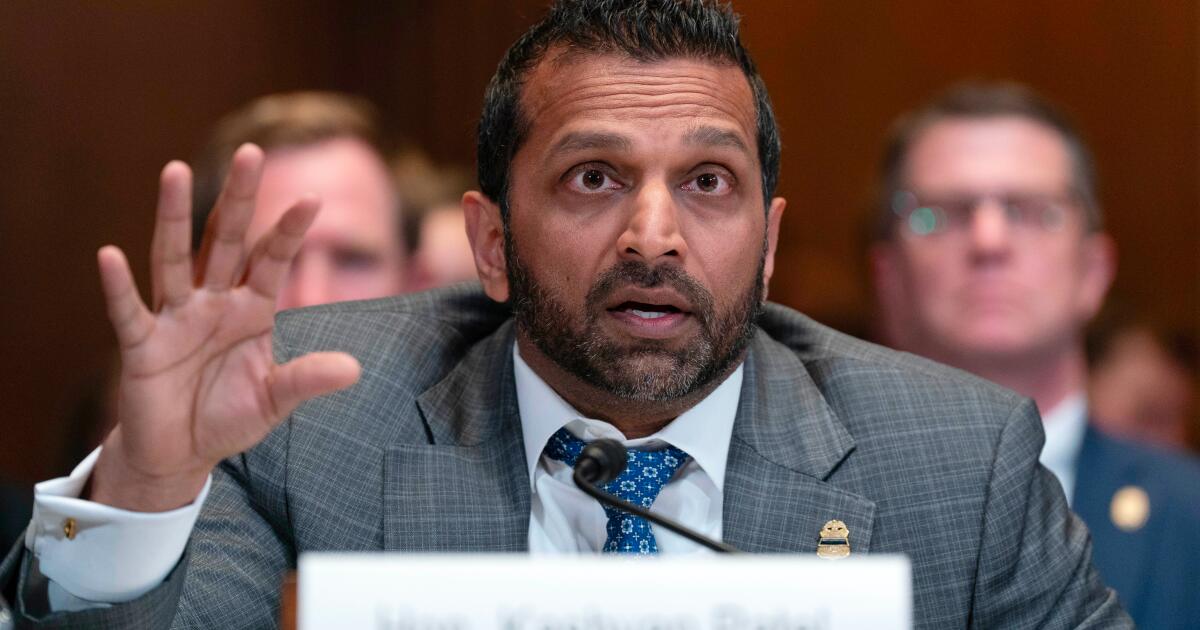
FBI fires several analysts tied to disputed ‘Catholic ideology’ memo
WASHINGTON — Several FBI analysts tied to the creation of a 2023 memo warning of a potential threat from Catholic “violent extremists” were fired Friday, according to their lawyer, the latest wave of terminations under Director Kash Patel.
The fired employees included four intelligence analysts and a supervisory analyst. The FBI declined to comment.
“This action is manifestly unjust, completely unsupported by the facts, and subverts standard FBI policy and procedure,” their lawyer, David Laufman, said in a statement. “These individuals deserved far better for the exceptional and faithful public service they rendered to protect our country.”
The January 2023 intelligence product produced by analysts in the FBI’s Richmond, Va., field office emerged as a political focal point after it was issued, with Republicans in Congress citing it as part of their broader claim that the FBI during the Biden administration was targeting conservatives.
Then-FBI Director Chris Wray denied that allegation and the agency has said the document was quickly retracted and an internal review was launched. Merrick Garland, the attorney general under President Biden, has said he was “appalled” by the memo.
Earlier Justice Department investigations into the memo challenged the analytical tradecraft but did not find intentional misconduct by the analysts involved.
The firings are part of a broader personnel purge under Patel, a President Trump loyalist who over the last year has pushed out dozens of employees who either contributed to investigations of the president or who were perceived as not in alignment with the administration’s agenda. The Justice Department has engaged in similarly sweeping firings of prosecutors since Trump took office last year.
In February, for instance, the FBI fired a group of counterintelligence agents who participated in the investigation into Trump over his retention of classified documents at his Mar-a-Lago estate in Palm Beach, Fla.
Critics including former federal officials say the purge has transformed federal law enforcement agencies into politically motivated extensions of the Trump White House. The classified documents investigation resulted in a federal indictment against Trump, but the case was dismissed after his 2024 election.
The Richmond memo, which emerged from a domestic terrorism investigation, sought to examine a potential link between what it called “Radical Traditionalist Catholic” ideology and racially and ethnically motivated extremists. It warned of the potential for violence and also highlighted what the authors described as “new avenues for tripwire and source development.” FBI leadership quickly condemned those findings once the document became public.
An internal FBI review described in a 2023 letter to Congress and based on interviews with 26 people “found that all individuals involved in the creation, review and approval of the product failed to adhere to analytic tradecraft standards and failed to recognize that the product, as drafted, equated the subjects’ interest in their self-described form of religion with racially or ethnically motivated violent extremist (RMVE) ideology without sufficient evidence or articulable support.”
The failure to adhere to standards, including on proper domestic terrorism terminology, “created the appearance that the FBI conducts investigative activity based on religious affiliation,” the letter said. “One of the FBI’s most fundamental principles is that investigative activity may not be based solely on the exercise of rights guaranteed by the First Amendment.”
A Justice Department inspector general report in 2024 summarized the earlier FBI review by saying that though there were departures from proper analytic tradecraft, “no evidence of a malicious intent or an improper purpose” were found.
MS NOW earlier reported the firings.
Tucker and Richer write for the Associated Press and reported from Los Angeles and Washington, respectively.

French Open 2026 results: Maja Chwalinska reflects on ‘unforgettable three weeks’ at Roland Garros
Maja Chwalinska’s French Open ended almost three weeks after it started – but her journey to the brink of a first Grand Slam title began long before that.
A former Australian Open junior doubles finalist alongside fellow Pole Iga Swiatek, Chwalinska has spoken openly about the depression that led her to take a break from tennis early in her professional career.
In the build-up to Roland Garros, she was playing events on the second tier of the women’s tour across Europe.
Her French Open campaign began in the first round of qualifying on Monday, 18 May. Nine wins later, only teenager Mirra Andreeva stood in the way of Chwalinska becoming just the second qualifier to win a Grand Slam singles title in the Open era.
It was not to be for Chwalinska, who fell 6-3 6-2 to Andreeva on Saturday, but finishing runner-up will have a profound effect on her life and career.
She will climb from 114th in the world to a new high of 21st on Monday, while her Roland Garros prize money of 1.4m euros (£1.21m) is almost double what she had previously earned in her entire career.
“It’s been 18 years of hard work, patience and perseverance,” said 24-year-old Chwalinska, who took up tennis as a young girl.
“I had to go through so much to be in this position. Life is weird sometimes and you’ve just got to do your thing and believe it will click someday, and I’m happy that it did.
“It is definitely an unforgettable three weeks for me. I’ll never forget it.”

Ukraine hits St. Petersburg in overnight strikes
Saturday is the last day of Russian President Vladimir Putin’s St. Petersburt International Economic Forum. Ukraine struck military targets near the city overnight Friday. Photo by Anatoly Maltsev/EPA
June 6 (UPI) — A drone attack launched by Ukraine hit St. Petersburg, Russia, overnight as Russian President Vladimir Putin wraps up an economic forum there.
Ukrainian President Volodymyr Zelinsky had asked Putin to meet face to face and discuss peace talks, but Putin responded that there was no point.
“It is time to end this war. But Russia’s ruler wants to keep fighting,” Zelensky wrote on X early Saturday. “That is why Ukrainian sanctions against this aggression are working. Last night, our drones covered a distance of about 1,000 kilometers to the St. Petersburg region — to the enemy navy’s arsenals and a base in Kronstadt. Our long-range sanctions also reached about 500 kilometers into the Krasnodar region — and hit an oil depot.”
Kronstadt is home to a naval academy and is the main base, repair and supply hub for the Russian navy in the Eastern Baltic.
Leningrad Governor Aleksandr Drozdenko said more than 140 drones were shot down in his region. St. Petersburg Governor Alexander Beglov told residents to stay indoors, CNN reported. He also said three people were injured.
Drozdenko said more than 600 people were evacuated from Bolshaya Izhora, a village on the Gulf of Finland near St. Petersburg, as efforts continued to put out a fire. The area is also home to a Russian naval arsenal, CNN reported.
St. Petersburg is Russia’s second-largest city, behind Moscow.
The New York Times reported that St. Petersburg’s main airport, Pulkovo, suspended operations for almost five hours, according to Rosaviatsia, the Russian aviation authority. Residents reported smoke in the sky and roaring noises and bangs, according to Fontanka, a local news website.
Ukrainian Foreign Minister Andrii Sybiha said on X Saturday that “Things will only get worse for Russia. Battlefield losses will continue to grow. Failures will get more humiliating. … “The international pressure will not ease. It will only get stronger. Including the use of frozen assets, travel bans and inevitable accountability for crimes,” Sybiha said.
Zelensky is scheduled to meet with leaders of France, Germany and Great Britain in London Sunday to discuss support for Ukraine and peace talks, Politico reported.

President Donald Trump discusses renovations to the Lincoln Reflecting Pool and makes an announcement on coal in the Oval Office at the White House on Thursday. Photo by Samuel Corum/UPI | License Photo

Yadda Uwa Ta Yi Jiran Labarin Garkuwa Da Yayanta

Saurara a: Apple Podcast | Spotify | RSS
Lokacin Ramadan ne, kuma Bintu Suleiman, wata uwa kuma ‘yar kasuwa mai shekaru 55 daga Ngoshe a Jihar Borno, Arewa maso Gabashin Najeriya, tana shirin buɗe baki tare da iyalanta.
Sai harbe-harbe ya fara, kuma cikin awa guda gidanta ya kama da wuta. Yayin da ‘yan ta’adda ke tattara mutane, ta samu damar tserewa tare da wasu daga cikin ‘ya’yanta da jikokinta zuwa cikin daji. Daga baya, ta gane cewa mutum huɗu daga cikinsu ba su tsere tare da ita ba. Suna wani wuri a cikin duwatsu.
A wannan shirin na #BIRBISHINRIKICI, mun ga yadda bayan harin, Bintu, wadda yanzu ta rasa matsuguninta, ke samun mafaka a wata makarantar firamare ta gwamnati a Pulka, yayin da har yanzu ba ta san halin da ‘ya’yanta da jikokinta suke ciki ba.
Mai Gabatarwa: Rukayya Saeed
Marubuciya: Sabiqah Bello
Muryoyin Shiri: Sabiqah Bello
Fassara: Rukayya Saeed
Edita: Aliyu Dahiru
Furodusa: Mu’azu Muhammad
Babban Furodusa: Anthony Asemota
Babban Mashiryi: Ahmad Salkida

Maura Higgins ‘in advanced talks’ to host reboot of iconic show ‘the perfect choice’
Love Island’s Maura Higgins is reportedly in talks to host the new Blind Date reboot on Disney+

Maura Higgins is reportedly in the running to host the reboot of Blind Date(Image: Getty)
Maura Higgins could be poised to transition from seeking romance on television to assisting other singletons in finding “the one”.
The former Love Island contestant is said to be in advanced discussions to become the face of the reboot of Blind Date with streaming behemoth Disney+ reportedly preparing to commence filming later this year.
Maura, 35, initially rose to prominence on Love Island in 2019 before establishing an impressive television career on both sides of the Atlantic.
Since departing the villa, she has featured on programmes including Love Island USA, The Traitors US, Dancing On Ice and I’m A Celebrity… Get Me Out Of Here!.
Now sources suggest producers are convinced she represents the ideal candidate to follow in the footsteps of legendary presenter Cilla Black.
A TV insider told The Sun: “Discussions are at an advanced stage, with the show’s producers convinced Maura’s the perfect choice for the job.”, reports the Daily Star.
“Not only did she shoot to fame on a TV dating contest, she is now an internationally famous face which is what a global service like Disney need for one of their shows.
“Maura also has an unquestionable glamour combined with cheeky charm which has echoes of Blind Date’s most famous host.” Daily Mirror has reached out to Disney and Maura’s representative for a comment.
The original Blind Date became one of Britain’s most successful television programmes after launching in 1985, with Cilla Black at the helm. At its height, the show drew audiences of up to 17 million viewers before ultimately being axed by ITV in 2003.
A subsequent Channel 5 revival presented by Cilla’s dear friend Paul O’Grady aired between 2017 and 2019 but struggled to capture the original’s sparkle.
Reports of a fresh comeback initially surfaced last year, with executives said to be determined to secure a female presenter who could deliver a contemporary twist while maintaining its sentimental appeal.
It is understood the iconic wall dividing contestants from their prospective dates will be retained, though other aspects of the format may be modernised for today’s audience.
The development would represent another significant career achievement for Maura, whose public profile has continued to rise since her reality television debut.
The Irish star has established herself as one of the most prominent figures to emerge from Love Island and remains a consistent presence on television, red carpets and high-profile entertainment occasions.
Disney+ is anticipated to premiere the reboot at some point next year, with an official confirmation still to be announced.

Trump pardons Republican ex-congressman convicted of insider trading
WASHINGTON — President Trump has issued a pardon to Stephen Buyer, a Republican former congressman from Indiana who served nearly two years in prison for making illegal stock trades based on inside information after he left office.
Buyer was sentenced to 22 months in prison in 2023 for trades made while working as a consultant and lobbyist. He was ordered to forfeit more than $350,000, representing the amount of the illegal gains, and pay a $10,000 fine. He was released in 2025.
The Supreme Court in May rejected Buyer’s appeal without comment or noted dissent.
In granting “a full, complete, and unconditional pardon,” Trump cited Buyer’s career as a judge advocate general in the Army and in the House that was “distinguished and highly productive.” The pardon was dated Thursday and released by the White House late Friday.
Buyer asserted that the pardon “corrects a politically motivated prosecution” and that it was “horrific to be imprisoned for a crime that I did not commit.”
Trump used his social media platform May 31 to share a pair of letters requesting a presidential pardon for Buyer, a lawyer and Persian Gulf War veteran who left office in 2011. He was a House prosecutor at President Clinton’s 1999 impeachment trial and in 2016 he served on Trump’s transition team focusing on veterans issues.
A letter signed by more than 40 Republican former members of Congress said Buyer was “targeted by the deep state” because of his involvement in Clinton’s trial a generation ago.
A second letter, from five current House Republicans, including Ken Calvert of Corona, said pardoning Buyer would bring justice to his case. The June 2025 letter was also signed by Tom Cole of Oklahoma, Marlin Stutzman of Indiana, Jack Bergman of Michigan and Pete Sessions of Texas.
Buyer, 67, was convicted in connection with insider trading involving the $26.5-billion merger of T-Mobile and Sprint, announced in April 2018, and illegal trades in the management consulting company Navigant when his client Guidehouse was set to acquire it in a deal publicly disclosed weeks later.
The Constitution gives a president broad power to grant pardons for federal crimes. The pardons do not erase a recipient’s criminal record but can be seen as an act of mercy or justice.

Women’s Giro d’Italia 2026: Demi Vollering wins shortened queen stage on day eight
Demi Vollering claimed victory on a shortened queen stage of the women’s Giro d’Italia on Saturday but admitted it was the “weirdest finish line of my life”.
A summit finish in Sestriere had been scheduled for the eighth and penultimate stage, but organisers reduced the route by 28 kilometres as an unstable slab of ice was threatening to fall on to the route.
Ice had already been cleared from an avalanche shortly before the riders passed through the Italian Alps.
Instead the line was hastily moved to one kilometre below the Colle delle Finestre, where Vollering, of FDJ United–Suez, prevailed in a four-way sprint finish.
The pre-race favourite edged out Isabella Holmgren, Antonia Niedermaier and fellow Dutch rider Anna van der Breggen to claim her second stage win of this year’s race.
“It was strange because the Finestre was suddenly the final climb,” said the 29-year-old Vollering. “It was the weirdest finish line of my life, but I’m very happy to take the win.”
Team SD Worx–Protime rider Van der Breggen retains the pink jersey for the final stage, over 145km around Saluzzo at the foot of the Alps, with Vollering having cut the four-time winner’s lead slightly to 49 seconds.
“We hoped that we could get closer to the maglia rosa today,” said Vollering. “Tomorrow’s stage is not as hard as today’s, but we will make a plan and think about how to try to win the Giro.”

South Korea election chief to resign over ballot shortage

Heo Cheol-hoon, secretary general of the National Election Commission, issues a public apology after a shortage of ballot papers prompted the temporary suspension of voting in the local elections at some polling stations in southern Seoul, South Korea, 03 June 2026. South Koreans voted on 03 June to elect mayors, governors, local council members and regional education chiefs in nationwide local elections. Photo by YONHAP / EPA
June 5 (Asia Today) — South Korea’s election chief said Friday he will resign to take responsibility for ballot shortages that disrupted voting during the June 3 local elections.
Roh Tae-ak, chairman of the National Election Commission, made the announcement during a public apology at the commission’s headquarters in Gwacheon, Gyeonggi Province. NEC Secretary-General Huh Chul-hoon also offered to resign.
“The high public interest in local autonomy and the active expression of the people’s will through voting were damaged by the ballot shortage,” Roh said. “As chairman of the National Election Commission, I feel devastated and bear unlimited responsibility for the situation, which has damaged public trust in election management and led to distrust in the election process.”
The commission said ballot shortages occurred at 50 polling stations nationwide, including 14 in Seoul’s Songpa district. Voting was temporarily halted at 22 polling stations, the commission said. Outside reports also said the shortages caused delays and protests in parts of Seoul.
The commission said the shortages were linked to a decision to print ballots for at least 50% of eligible voters in some areas, reflecting internal discussions about reducing unused ballots as early voting rates have risen in recent elections.
Yoon Jae-soo, head of the commission’s election policy office, said the minimum number of ballots was set at 50% of eligible voters but could be adjusted depending on local conditions.
“In Songpa district, when the early voting rate of 23.3% was included, ballots equal to 73.3% of eligible voters were secured,” Yoon said. “But shortages occurred because there were differences among individual polling stations.”
The commission said it will create a fact-finding committee made up of outside experts to examine the cause of the shortages, identify problems in the response and prepare measures to prevent a recurrence.
Roh said the commission will cooperate fully with any process to determine responsibility, including a possible National Assembly investigation.
“We will sincerely take part in all procedures to confirm the commission’s responsibility for this incident and will not avoid responsibility depending on the results,” Roh said.
On Wednesday, voters at some polling stations in Seoul’s Gangnam, Gwangjin and Songpa districts had to wait because of ballot shortages. The disruption has drawn criticism from political parties, civic groups and universities over the commission’s election management.
Oh Min-seok, chairman of the Seoul Election Commission, also issued a public apology Friday.
“This was the commission’s fault, with no excuse,” Oh said. “We deeply feel responsibility for damaging public trust through poor election management that ran counter to common sense.”
— Reported by Asia Today; translated by UPI
© Asia Today. Unauthorized reproduction or redistribution prohibited.
Original Korean report: https://www.asiatoday.co.kr/kn/view.php?key=20260605010001883
7-month-old baby killed, parents wounded after Israeli forces open fire on vehicle in West Bank
Israeli forces reportedly killed a seven-month-old Palestinian baby, Sam Fahd Abu Haikal, and injured his parents in the Tel Rumeida area near Hebron on Friday evening, according to the Palestinian health ministry. The baby’s grandmother described how the family stopped their car after seeing Israeli military vehicles when shots were fired at them. She recounted that a bullet hit the baby in the face and lodged in his mother’s cheek, while also grazing the father’s finger. The parents were treated for their gunshot wounds.
The Israeli military stated that during operations in Hebron, soldiers fired shots at a vehicle they thought was approaching them quickly. They acknowledged that three Palestinians, later determined to be “uninvolved civilians,” were injured, and the incident is under investigation. Tel Rumeida has a history of violence as Israeli settlers live with military protection among the Palestinian community. Recent EU data indicates over 700,000 settlers reside in East Jerusalem and the West Bank while more than 3 million Palestinians live there.
With information from Reuters

New weekend Netflix recommendations including sci-fi hit with 15 million views
Netflix have updated their viewing figures and it makes for a compelling list of what you should binge next
The Boroughs official Netflix trailer
If you’re looking for the next binge watch to see you through the weekend, Netflix already has you covered.
The streamer has updated its latest viewing figures and it pretty much reads as the new list of recommendations you need. So rather than scrolling through for hours on end, you can make your way through at least one of these titles and it will most likely only take you one sitting.
Not only that but there is something for everyone, including a sci-fi hit, a tense crime thriller and also a heart warming laugh out loud comedy.
The Boroughs
Website Collider call the series a ‘sci-fi masterpiece’ and compare it to a Steven Spielberg movie. They also report that the title managed to accumulate 15 million views in its first 10 days of being available.
It is the most watched Netflix series globally over the last couple of weeks and remains in the UK top 10 at the time of writing. It is set in the sun-drenched expanse of the New Mexico desert and a picturesque retirement community which promises its residents the time of their lives.
But for new arrival Sam Cooper, paradise feels more like a prison. Everything changes when a terrifying night time encounter reveals that something monstrous is stalking the manicured cul-de-sacs.
One review said it is “Stranger Things Meets Thursday Murder Club”. Meanwhile many viewers say they watch it in one sitting. A fan added it “has everything that your next binge-watch needs.”
Nemesis
Coming from the creator of Power, the eight-part series follows two rivals from opposite sides of the law who are at each other’s throats when a daring heist in Los Angeles opens up old wounds. What follows is an exhilarating game of cat-and-mouse as an LAPD cop desperately tries to hunt down a criminal mastermind behind a string of robberies.
One viewer claimed: “Kept me engaged and not sure whose side I was on. Binge watched twice. I need season 2.” Another said: ““Binged in one sitting- very authentic catchy story line. I hope there is a season two.”
While someone else contributed: “This was a masterpiece! The rollercoaster, amount of cliffhangers, and overall writing was top notch!” It has spent three weeks in the global top 10 charts also claiming more than 15 million views on the streamer.
The Four Seasons
One of the more recent additions, the series has just returned for its second season. Co-created by 30 Rock’s Tina Fey and based on the 1980s movie of the same name.
A group of married couples who regularly vacation together throughout the year reunite once again after one of the most difficult times in their relationships. They have new members of the group to contend with as well as some old problems.
It has immediately become the third most watched series across the world among Netflix users. Many fans admit to becoming ‘obsessed’ with it.
One person simply shared on social media: “The Four Seasons” is a must-watch series on Netflix.” Someone else added: “I binged it the day it came out with my man. We’re obsessed!” Another admitted: “I literally started it last night and I’m already on season two. I love it.”
The Witness
This is Netflix’s latest true crime thriller. While the platform have yet to release the official viewing figures, it has immediately surged to the number one spot among UK subscribers.
As a result, it’s expected to compete with the numbers of all the titles already mentioned. Consisting of only three episodes and based on a gripping but horrifying true story, it is bound to keep viewers captivated and watching all the way through in one go.
It follows the experiences of Alex and André Hanscombe as they deal with the devastating impact of a brutal act of violence. When Rachel Nickell was killed on Wimbledon Common in 1992, André became a single parent overnight. Putting his own grief to one side, he made his son Alex – the only eyewitness to the attack – the centre of his world.
This is the story of how a father and son moved through the aftermath of unimaginable tragedy, from darkness into light. Fans sharing their thoughts on the series include one who posted: “15 mins into The Witness on Netflix and I’m already broken.” Someone else said: “The Witness on Netflix will give you the chills.”
FIFA World Cup: Climate change could create ‘dangerous’ situations
A few hours after Lionel Messi and the Argentine World Cup team checked into their training base in Kansas City, a series of thunderstorms pounded the area, knocking out power, felling trees and bringing flood and tornado warnings.
Hardly ideal conditions for the world’s biggest soccer tournament. Yet that’s likely just the opening salvo of a disruptive weather system that could affect the 38-day competition, which kicks off next week with games in Mexico, Canada and the U.S.
“It’s pretty safe to say climate change is going to have a mark on this World Cup,” said Kaitlyn Trudeau, a senior research associate of climate science for Sacramento-based Climate Central. “With climate change we know it’s not just going to be hotter, but it’s also going to increase the humidity as well.”
And that could make this summer’s World Cup one of the last of its kind. Tournament soccer in June and July has been a tradition dating to the first World Cup in 1930, but since then global temperatures in June have warmed by 1.89 degrees, according to the U.S. National Oceanic and Atmospheric Administration. That may not sound like a lot, but it takes many days and nights of extreme heat to move the needle that much.
“It can be a very dangerous situation,” Trudeau said.
As a result, FIFA President Gianni Infantino has already begun discussions on moving the start of the tournament from June to March or October after 2030. In the meantime, early kickoffs, cooling breaks, air-conditioned stadiums and regular weather-related delays will necessarily become common features of the tournament, according to “Pitches in Peril,” a detailed report on the impact of climate change on global soccer, released in the run-up to the World Cup.
“Football’s all of a sudden starting to reckon with the new climate realities,” said Elliot Arthur-Worsop, founding director of Football For Future, a pioneering U.K. nonprofit and co-publisher of “Pitches in Peril.”
“Extreme weather events are becoming more unpredictable,” he said. “The players, the spectators and the officials, they’re all at risk here, especially when it comes to extreme heat. How can we future-proof the game?
“Adaptation looks like moving the entire tournament to another time of year to deal with the extreme weather. Short term it could be moving the kickoff times, it could be introducing more drink breaks, having more heat protocols and safety regulations.”
Some climatologists fear summer events like the World Cup and Olympic Games are just one heatwave away from a major weather-related tragedy. In fact, Arthur-Worsop said his group’s study found that this men’s World Cup, the first held in North America in 32 years, will likely be the last played here.
“By the time the cycle of awarding the hosting rights would possibly come back, our climate projections show that the tournament in its current form would be unplayable due to extreme weather events,” he said. “Not only heat, but other compounding threats such as extreme wind and flooding and wildfires.”
Trudeau worries that whatever adaptations are eventually adopted won’t keep pace with a rapidly warming planet.
“We are basically pushing ourselves to a limit,” she said. “I’m not saying we’re going to absolutely lose the World Cup. But we are making it so much harder to find time to safely enjoy these kinds of events.
“This is not a safe environment and we should not be putting people’s lives at risk just to watch a game.”
FIFA did move the 2022 World Cup, pushing the start of the tournament in Qatar from June to November. Even then the games had to be played in air-conditioned stadiums, though. Three of the 16 venues to be used this summer — in Atlanta, Houston and Arlington, Texas — are domed and climate-controlled.
But the next World Cup, to be held in 2030, will be played mostly in Spain, Portugal and Morocco, where June and July temperatures frequently top 95 degrees. And just one of the likely venues is climate-controlled.
As for this summer’s tournament, a 2025 study published in the International Journal of Biometeorology found that conditions in 14 of the 16 World Cup host cities are likely to exceed the extreme Wet Bulb Globe Temperature (WBGT) threshold, an advanced index used to measure how the human body experiences heat stress.

A weather delay interrupts a Club World Cup match between Auckland City FC and Boca Juniors in Nashville in June 2025.
(Alex Grimm / Getty Images)
But you don’t have to do complicated math to know it’s hot because there’s also the “feels like” index, which registers how your body feels the heat. That can be vastly different from the reading on a thermometer. In Miami, for example, where seven World Cup games will be played, humidity will make an air temperature of 90 degrees “feel like” 109 degrees.
Under those conditions, it becomes more difficult for the body to cool itself.
“We talk about temperatures all the time, but that is only one part of the equation. It’s not including the amount of heat that you might feel from humidity,” Trudeau said. “It’s so important because once it gets too humid, then our body’s main cooling mechanism, sweating, is no longer possible.
“These are the kinds of situations where you have to be really careful. Not just players, but also people who maybe work at the stadiums, people who are watching the matches. It can be a very dangerous situation.”
Playing games in the cooler evening hours could alleviate that but FIFA, in a nod to TV viewers in Europe, scheduled 40 of the tournament’s 104 games, including the majority of games in the knockout rounds, to kick off at 3 p.m. or earlier local time. And though mandatory three-minute hydration breaks midway through each half have been added, Trudeau questions their impact.
“That’s kind of silly to be like, ‘Oh, we’re going to give an extra water break. But we’re going to be doing it at the hottest time of the day,’” she said. “It kind of sends mixed messages, right? What is the main priority of FIFA here? Is it to get the most views and the most revenue and the most whatever? Or is it to actually protect these players?
“We should not be having these in the hottest parts of the world at the hottest times of day,” she continued. “It’s just common sense.”

Chelsea’s Benoit Badiashile puts water on his face before a Club World Cup match against Esperance de Tunis in Philadelphia in June 2025.
(Francois Nel / Getty Images)
FIFA defended the schedule, saying in a statement that climate-related risks are assessed as part of overall tournament planning and managed in close coordination with the host cities, stadium authorities and national agencies.
“Building on experience from recent tournaments, a tiered heat-mitigation model will apply,” the statement continued. “When forecasts indicate elevated temperatures, venues will activate additional cooling capacity, including shaded areas, misting systems, cooling buses and expanded water distribution. Work-rest cycles for staff and volunteers are adapted accordingly, and first-aid readiness is reinforced with clear triage and escalation pathways for suspected heat illness. These measures scale dynamically based on real-time conditions before and during each event.”
Last summer’s FIFA Club World Cup, a 63-game tournament played in the U.S. as a kind of dress rehearsal for this year’s event, gives an indication of the problems ahead. That tournament was plagued not just by high heat and humidity, but also by thunderstorms and lightning that paused or delayed a half-dozen matches in Orlando, Fla.; Nashville; Cincinnati; Charlotte, N.C.; and East Rutherford, N.J.
“The heat is incredible,” said Argentine midfielder Enzo Fernandez, who played in last summer’s tournament with Chelsea. “I got a bit dizzy during a play. I had to lie down on the ground because I was really dizzy.
“Playing in this temperature is very dangerous.”
But if health risks are the primary concern of summer sporting events on a warming planet, they aren’t the only ones. The weather also affects the quality of play, said Norwegian defender Julian Ryerson, who played for Borussia Dortmund in last summer’s club tournament.
“Football is different when you play in this humidity and heat,” he said. “It is really tough. You take some precautions. That’s the only way to go about it.”
As the planet continues to bake, there are also increasingly fewer ways of going about staging a World Cup. You can play it nontraditional times and in nontraditional places. You can play it indoors in air-conditioned stadiums.
Or you can not play it at all.
“We’re running out of options,” Trudeau said. “We have to understand that unless we are going to address human-caused climate change, you’re going to start losing these things that are culturally important to us or economically important.
“We cannot keep doing these things at the rate we’re doing them and the times that we’re doing them in the ways that we’re doing them while we also continue to warm the planet.”

Iran attacks Bahrain, Kuwait after U.S. hits surveillance radar sites

June 6 (UPI) — The United States said it intercepted several Iranian ballistic missiles and drones shot toward the Strait of Hormuz, the Persian Gulf, Bahrain and Kuwait Friday night.
The U.S. Central Command said seven missiles were fired toward Kuwait and Bahrain Friday after it shot down four Iranian drones headed toward the strait. It said six of the missiles were intercepted and one didn’t reach its target.
Bahrain and Kuwait said there were no injuries, but Kuwait said there was some “material damage.”
The Kuwaiti Army, attributed to the official spokesperson for its defense ministry Brigadier General Saud Abdulaziz Al-Otaibi, posted on X: “The armed forces detected and responded at dawn today to 7 hostile ballistic missiles within Kuwaiti airspace, which were intercepted over several residential areas, resulting in the fall of some debris.
“The Iranian criminal aggression caused material damage with no human casualties.”
CENTCOM also said there were no American casualties.
“There are currently no reports of harm to U.S. personnel, and Iranian claims of damaging U.S. 5th fleet headquarters in Bahrain are false,” CENTCOM said in a press release.
Kuwait and Bahrain called the strikes a violation of their sovereignty and a threat to regional security. Egypt, Jordan and Qatar also condemned the strikes Saturday.
Iran said it launched the strikes against U.S. military bases in the region after the United States struck Iran. CENTCOM said it hit coastal surveillance radar sites in Goruk and Queshm Island “to defend against further maritime attacks.”
Iran called the U.S. attacks a “flagrant” violation of the cease-fire, which has been in place since April. It said the American side “not only lacks the will to reduce tensions,” but “seriously endangers the security of the region.”
“These facilities are tasked with safeguarding the country’s border security and ensuring the security of navigation in international waterways,” the Iranian Foreign Ministry said in a statement. “The attack constitutes a clear violation of the April 8 ceasefire and an act of military aggression against the national sovereignty and territorial integrity of the Islamic Republic of Iran.”
Iran said the U.S. strikes violate international law.
“This action, which comes as a continuation of the hostile and provocative conduct of the U.S. regime against the Islamic Republic of Iran, demonstrates the complete disregard of the U.S. ruling establishment for the fundamental principles of international law and the Charter of the United Nations,” the foreign ministry said.
Tehran also said the U.S. is responsible for “all the effects and consequences of these illegal actions, as well as any possible escalation of tension.”
Iran’s Revolutionary Guard claimed the clash started when the U.S. military tried to “illegally” escort oil tankers through the waterway, which Iran has largely closed off during the war.
The Gulf Cooperation Council condemned the Iranian missile attacks Saturday.
“These treacherous Iranian terrorist acts represent a dangerous and irresponsible escalation, a blatant violation of all international laws and norms, and a direct threat to regional stability,” Jasem Mohamed Albudaiwi, secretary general of the Gulf Cooperation Council, said in a statement.
The Gulf Cooperation Council, formed in the 1980s, is an economic pact that includes Bahrain, Kuwait, Oman, Qatar, Saudi Arabia and the United Arab Emirates.
“The Council countries stand in a united and steadfast position alongside the Kingdom of Bahrain and the State of Kuwait, fully supporting all measures and steps they undertake to protect their security, safeguard their sovereignty and territorial integrity, as well as ensure the safety of their peoples,” Albudaiwi said.

World Cup 2026: Can sub-Saharan Africa outdo noisy neighbours from north? | Football News
Africa’s performance at World Cups peaked at Qatar 2022 when Morocco became the first side from the continent to reach the semifinal stage.
Even their quarterfinal appearance was noteworthy – the Atlas Lions were only the fourth African nation to get there.
Recommended Stories
list of 4 itemsend of list
Although Cameroon, Senegal and Ghana are the three other African teams to reach the quarterfinals, North Africa has dominated the continent’s success overall at the World Cup and at the Africa Cup of Nations.
Egypt are the record seven-time winners of AFCON, while three of the top five African qualifiers for World Cup finals are Morocco, Tunisia and Algeria.
Al Jazeera breaks down the chances of the sub-Saharan nations looking to outshine their neighbours from the north at the tournament which kicks off on June 11:
SENEGAL
World Cup Appearances: Four – 2002, 2018, 2022 and 2026
Best finish: Quarterfinals
Overall record: P12 W5 D3 L4 F16 A17
FIFA ranking: 14
Prediction: Eliminated at quarterfinal stage
Senegal head to World Cup 2026 with a burning sense of injustice firing their campaign. The Lions of Teranga were stripped of the Africa Cup of Nations (AFCON) title by the Confederation of African Football (CAF), which decided the mid-game walk-off by the Senegalese players and staff voided January’s final – which was later awarded to Morocco, along with the trophy, as a 3-0 win.
In 2002, Senegal upset the odds and reached the quarter-finals in their World Cup debut at the tournament co-hosted by Japan and South Korea.
More than two decades later, expectations are running high – perhaps carrying the greatest expectation on all African teams, including Morocco.
The depth of the 26-man squad is seen as their greatest strength over continental neighbours, but their star power is also envied by rivals.
Sadio Mane remains the country’s greatest export. Although midfield kingpin Pape Gueye, goalkeeper Edouard Mendy and captain Kalidou Koulibaly would grace almost any side at the tournament.
All three are French-born and another shot at the two-time winners of the competition is in their sights.
A 1-0 win against then defending champions France at the 2002 edition announced Senegal as a rising footballing powerhouse. Their first Group I encounter this time around is against Didier Deschamps side in New York on June 16.
“It’s always a pleasure to play against France. It’s a country we know well,” said Senegal coach Pape Bouna Thiaw, who moved to France aged 17.
“If I lose even a second of my belief that I can win the World Cup with Senegal, I will step down,” he added.
Senegal’s group is completed by Iraq and Norway.

GHANA
World Cup Appearances: Five – 2006, 2010, 2014, 2022 and 2026
Best finish: Quarterfinals
Overall record: P15 W5 D3 L7 F18 A23
FIFA ranking: 74
Prediction: Eliminated at quarterfinal stage
Ghana have only missed one World Cup since their 2006 debut.
Four years after their global bow they became the third African side to reach the quarterfinal stage at Germany 2010.
Their run-up to this tournament has not been smooth, with a late change of coach as veteran Portuguese Carlos Queiroz replaced Otto Addo following a run of poor results.
The German-born former Ghana international led his nation at Qatar 2022, but the failure to qualify for the last AFCON and comprehensive losses in their four high-profile games in November and March saw him fired in early April.
It will be a fifth successive World Cup for the 73-year-old Queiroz, whose past African experience has been with South Africa and Egypt, and who managed Real Madrid, and was Alex Ferguson’s right-hand man at Manchester United.
Group L, against Panama, England and Croatia, appears to be the ‘group of death’ in the opening stage of the competition, but with Manchester City’s Antoine Semenyo leading a strong attack, Ghana will fully expect to progress.
“I think that this country has a huge, enormous potential. This is a country of footballers,” Queiroz said.
The Black Stars will, however, be without the injured Tottenham forward Mohammed Kudus, who has become the team’s talisman and key factor in their last two successful qualifying campaigns.

IVORY COAST
World Cup Appearances: Four – 2006, 2010, 2014 and 2026
Best finish: Group Stage
Overall record: P9 W3 D1 L5 F13 A14
FIFA ranking: 34
Prediction: Eliminated at quarterfinal stage
The Ivory Coast return to the global stage after a 12-year absence – one that was hard-felt following the retirement of some of their greatest players in Yaya Toure and Didier Drogba.
It has been a long rebuild for the Ivorians, but they have won two AFCON titles since their last World Cup appearance.
Their youthful attack led by teenager attacker Yan Diomande, alongside Simon Adingra and Amad Diallo of Manchester United, will be key to their chances.
When hosting AFCON two years ago, Ivory Coast were nearly eliminated in the group stage, but they promoted Emerse Fae from assistant manager for their final game of the opening phase and went on to win the title.
“I believe Ivory Coast has the potential to achieve something exceptional – why not aim for the final?” Fae said ahead of the tournament, that will begin with matches against Curacao, Ecuador and former world champions Germany.

CAPE VERDE
World Cup Appearances: One – 2026
Best finish: NA
Overall record: NA
FIFA ranking: 69
Prediction: Eliminated at group stage
One of the debutants, Cape Verde – with a population of about 600,000 – is the third smallest nation to qualify in the tournament’s long history.
They only debuted at AFCON in 2013, but did go on to reach the quarterfinals – a feat repeated in 2023.
The task before them now – which will be led by their diaspora of players in the main – is daunting, with Uruguay, Saudi Arabia and European champions Spain, lying in wait in the group stage.
“We’ve always been aware of our talent but we haven’t always believed that it could take us much further than we had achieved up to that point,” said manager Bubista, named African Coach of the Year in 2025.
“Therefore, it took courage to face any opponent. The first step in our success was truly believing in our potential. In other words, we changed the players’ mindset.”

SOUTH AFRICA
World Cup Appearances: Four – 1998, 2002, 2010 and 2026
Best finish: Group stage
Overall record: P9 W2 D4 L3 F11 A16
FIFA ranking: 60
Prediction: Eliminated at round of 32 stage
After a burgeoning beginning to their return to the international fold, with qualification for the 1998 World Cup, South Africa’s fortunes have taken a downtown in the last 16 years.
A first appearance in the finals since 2010 feels long overdue for a nation hoping to reap the rewards of strong domestic growth as they head to North America.
South African club Mamelodi Sundowns are the newly crowned African Champions League winners and eight of their players are in Bafana Bafana’s squad. There are also eight players from Orlando Pirates – the domestic league champions, who pipped Sundowns to the title by a point.
“We can say that we have players of the best teams of the season. Those guys have much experience at a high level,” South Africa’s Belgian-born coach Hugo Broos said of his 26-man selection.
“I’m certainly happy that Sundowns won the Champions League, because I was afraid that if they should lose, I would get players who would be very disappointed. So now they all have that boost of confidence, and that helps a lot.”
South Africa are in the other so-called ‘group of death’ as they take on Czech Republic, South Korea and co-hosts Mexico, who they face in the opening game of the tournament

DR CONGO
World Cup Appearances: Two – 1974 and 2026
Best finish: Group stage
Overall record: P3 W0 D0 L3 F0 A14
FIFA ranking: 46
Prediction: Eliminated at quarterfinal stage
DRC’s only previous appearance was when it was still known as Zaire, competing at the 1974 finals in West Germany – the first African side from south of the Sahara to go to the World Cup.
As reigning continental champions, their 9-0 thumping by Yugoslavia did little to raise the flag for Africa at the time.
Much has changed since then for the continent and in its second-largest country. The Congolese players will arrive in North America with a FIFA ranking that outstrips three of the other five sub-Saharan qualifiers.
It did take two playoffs to reach this edition – the African legs saw the Congolese eliminate Cameroon and Nigeria, before edging Jamaica in extra time in their intercontinental playoff
Most of the squad are European-born, either in Belgium, France or Switzerland, plus the London-born Aaron Wan-Bissaka, previously called up by England but who missed out on a cap through injury.
“We are extremely proud because a whole generation hasn’t been able to see its national team in the World Cup but now they will see them there,” said their French coach, Sebastien Desabre.
