



South Korea says nuclear sub plan still calls for local build

The South Korean flag flies over Cheong Wa Dae in Seoul. Photo by Asia Today
June 5 (Asia Today) — South Korea’s presidential office said Friday there has been no major change in the plan to build nuclear-powered submarines in South Korea as Seoul and Washington resume talks on nuclear cooperation and wartime operational control.
A senior Cheong Wa Dae official told reporters that recent security talks between South Korea and the United States were “very productive and useful.”
“There has been no major change in the position that nuclear-powered submarines will be built in South Korea,” the official said.
The official said the two sides discussed uranium enrichment, spent fuel reprocessing and nuclear-powered submarines. The talks also included what the official described as an “umbrella” consultation framework.
“We have not set a target deadline, but we will move quickly and try to produce concrete results by the end of the year,” the official said.
South Korea and the United States held formal talks in Seoul this week on follow-up discussions related to Seoul’s push for nuclear-powered submarines and expanded rights for uranium enrichment and spent fuel reprocessing. The talks followed earlier bilateral agreements on nuclear cooperation and submarine development.
On enrichment and reprocessing, the senior official said Seoul and Washington need “several new frameworks of agreement.”
“We intend to make progress, including by revising what needs to be revised,” the official said.
The official said talks on enrichment and reprocessing are now moving into a full-fledged phase.
“These discussions are based on trust in South Korea’s denuclearization, so there are no additional denuclearization conditions,” the official said.
Asked about coordination between Seoul and Washington on the timing of South Korea’s recovery of wartime operational control, the official said the two allies do not have a significant difference of opinion.
“Efforts to meet the conditions have continued for more than 10 years, and several years ago there was even an assessment that the conditions had been more than 90% met,” the official said. “Because there is little difference in views on the conditions, we can coordinate and align them.”
The official said the two sides also do not differ sharply on the timing of the transfer.
“There is a gap of a little over a year, about one year-plus,” the official said. “We do not see that gap as something that cannot be adjusted.”
— Reported by Asia Today; translated by UPI
© Asia Today. Unauthorized reproduction or redistribution prohibited.
Original Korean report: https://www.asiatoday.co.kr/kn/view.php?key=20260605010001877
The pro-Israel lobby goes for broke – Middle East Monitor
Ever since leading pro-Israel lobby financier Sheldon Adelson intervened in the 2016 election heavily in favour of Donald Trump, the now-president’s Middle East policies (if you can even call them that) have become more and more openly in favour of the Zionist state.
To call casino tycoon Adelson an “Israel first” financier is misleading, as it implies that he has second, third and fourth priorities. With a net worth of almost $34 billion at his disposal, though, his one and only cause is Israel, so “Israel only” financier would be a more accurate description.
Adelson has ploughed hundreds of millions of dollars into funding anti-Palestinian groups. He has, for example, donated a reported $410 million to Birthright Israel, a pro-Israel propaganda organisation which takes young Jews on brainwashing tours to occupied Palestine, inculcating in them the idea that the country forms part of their “birthright”.
Although nobody should delude themselves that such a huge amount of money does not have the intended effect on many impressionable young people, money isn’t everything and, thankfully, largely left-wing and liberal Jews are increasingly rejecting Israel. Last year, media outlets reported a number of walk-outs from Birthright tours, with participants reacting against the heavy-handed propaganda that always forms the basis of such trips.
READ: US comedian Roseanne, shunned since racist tweet, visits Israel
Left-wing and anti-Zionist Jews have for many years now been organising against Birthright, even putting on a “Birthwrong” tour celebrating diasporic Jewish life in ancestral Jewish homelands, such as Spain, France, Brazil, Germany, the USA and Britain.
Such efforts are now paying off. Birthright walk-outs are part of a broader trend in which Israel is haemorrhaging support from the base of the Democratic Party in the US. Once upon a time, Sheldon Adelson funded the Democrats. However, in a 2012 op-ed for the Wall Street Journal (the in-house organ of America’s billionaire business class), Adelson explained: “I didn’t leave the Democrats. They left me.” In that article it emerged that the main, if not the only, reason he switched his substantial financial support from the Democrats to the Republicans was that the Democrats’ base is now largely hostile to Israeli war crimes and apartheid.
Since then, Adelson has apparently made it his mission in life to fund the worst of the worst right-wing Republicans. As the late, lamented website Gawker reported, “In 2012 he spent $20 million supporting Newt Gingrich, nearly derailing [Mitt] Romney’s primary run.”

President Donald Trump answers questions during a meeting with military leaders in the Cabinet Room on 23 October, 2018 in Washington [Win McNamee/Getty Images]
During the course of the race for the 2016 White House, every Republican candidate did their best to net Adelson’s support and, of course, his money. Marco Rubio was reportedly calling Adelson every other week at one stage, and “when Jeb Bush hired a foreign policy advisor who was critical of Israel’s diplomatic actions, Adelson forced Bush to issue an apology.”
With President Donald Trump now leading the most anti-Palestinian White House of all time, it’s easy to forget that at one stage, his non-interventionist instincts in matters of foreign policy seemed, for a brief moment, to extend even to Palestine. That’s when Adelson started to plough cash onto the Trump bandwagon and ended up being Trump’s number-one backer. The White House is now more pro-Israel than ever, with each new advisor seemingly more fanatically Zionist than the last.
READ: Media hypocrisy puts pressure on Arabs but not Israeli activists
The Trump-appointed US Ambassador to Israel not only tolerates illegal Israeli settlements in the West Bank, for example, but also actively funds them out of his own money. Trump has also followed through on a promise to Adelson to move the US Embassy from Tel Aviv to Jerusalem in the face of international law, which still considers the latter to be an occupied city, the annexation of which by Israel is illegal.
While the pro-Israel lobby seems to have the White House sewn up for now, its propagandists look at the new crop of progressive and left-wing Democrats in Congress with some trepidation, for Israel no longer has the universal, bipartisan support in the House and Senate that it once had. This week, news emerged that its lobby has even had to establish a new group, aiming to shore up its floundering support among Democrats.
“Democratic Majority for Israel” is supposedly set to make the “progressive case for Israel”. The fact that such a move has had to be made now is a serious indication of how much US support for Israel has slipped. Indeed, in the secretly filmed words of Eric Gallagher, a leading “liberal” pro-Israel lobbyist when he referred to the lobby’s flagship organisation, the American Israel Public Affairs Committee: “The foundation that AIPAC sat on is rotting… There used to be actual widespread public support for Israel in the United States. So I don’t think that AIPAC is going to remain as influential as it is.”
READ: How AIPAC-Israel agenda became US priority
One establishment policy wonk conceded this week that the passage of a bill through the Senate targeting the Boycott, Divestment and Sanctions (BDS) campaign, while seemingly a victory for Israel, was “actually a pretty significant loss. Because only one serious presidential candidate voted for it.”
Kamala Harris and Cory Booker, two corporate Democrats who have thrown their hats into the presidential ring for 2020, both failed to show up for the vote, despite speaking at previous AIPAC policy conferences. Even they don’t want to enrage their support base, much of which is likely to opt for Bernie Sanders should he decide to run again.
With the situation in Congress changing rapidly, the pro-Israel lobby is going for broke to take advantage of its position in the White House while it lasts.
The views expressed in this article belong to the author and do not necessarily reflect the editorial policy of Middle East Monitor.

‘Love Story’ stars see the show as a ‘lens’ on the ‘intensity’ of fame
In this week’s episode of The Envelope podcast, “Love Story” stars Paul Anthony Kelly and Sarah Pidgeon open up about inhabiting John F. Kennedy Jr. and Carolyn Bessette — and creating a cultural moment of their own.
Kelvin Washington: Welcome to the next episode of The Envelope, Kelvin Washington alongside Yvonne Villarreal; we got Mark Olsen as usual. And so you, my friend, had a chance to speak with stars of “Love Story” — Ryan Murphy, of course, tackling love with this. So it got me thinking, give me some real-life love stories that you’d like to see portrayed, maybe next season. Some love stories you always found interesting.
Villarreal: This one doesn’t have a tragic ending, and that’s why I want it. And that is Ina and Jeffrey Garten. “Barefoot Contessa”!
Olsen: I didn’t know that there was a great romance in her life.
Villarreal: Mark. You’ve never heard of Jeffrey? You don’t know Ina and Jeffrey. OK, this is why we need it. That man adores Ina and anything that she makes. Chicken, anything. This is a love story I need to see get the full display. I’ve read it in her book, but I need —
Olsen: So like “Julie & Julia.” Julia Child and her husband.
Villarreal: But cuter, sweeter, more adoring.
Washington: Loving the food theme here.
Villarreal: She’ll make anything and he thinks it’s delicious, and she laughs at everything he says, and I just want more of it, and I’m very curious what a Ryan Murphy take on Ina and Jeffrey would be.
Olsen: But see, that’s the thing. A Ryan Murphy take on that would ruin it for you.
Washington: That would be dramatic and spicy. Salacious.
Villarreal: Nothing could ruin it for me.
Washington: You got one?
Villarreal: Yeah, what’s yours?
Olsen: Well, I have two. One is because the sort of the ’90s vibes of “Love Story.” So you would obviously do Kurt Cobain and Courtney Love. And that one would be very exciting and dramatic and very ’90s-ish. But I think for more of a torn-from-the-headlines [version], Taylor Swift and Travis Kelce.
Villarreal: It’s too current.
Olsen: That’s why though.
Villarreal: How about you?
Washington: So I’m gonna stay with your ’90s. Instead of the pop grunge. I’m going to go R&B pop. I’m going to go Bobby and Whitney.
Olsen: I mean, that’s gold right there.
Washington: I’m just saying. You got love, you got fame, you got tragedy. You’ve got stuff that we didn’t know about behind the scenes.
Villarreal: Maybe he could hire us as head writers for each of these seasons and we can all have our say.
Washington: We can all have our own season. So as I mentioned, Yvonne, you had a chance to sit down with Paul Anthony Kelly and Sarah Pidgeon of “Love Story.” How’d that chat go?
Villarreal: They play John F. Kennedy Jr. and Carolyn Bessette, respectively, and it sort of looks at this seven-year tumultuous relationship and what they both endured navigating the spotlight and what that did to them, how they each felt about it. So it was interesting to get the take from Paul and Sarah about how they’re also navigating the spotlight, because I feel like social media fame is quite different than what John and Carolyn were navigating back then. And I was curious to see what it was like for them. So yeah, it was an interesting conversation.
Washington: All right, let’s get into that conversation now.

Sarah Pidgeon and Paul Anthony Kelly, the breakout stars of FX’s “Love Story.”
(Jason Armond / Los Angeles Times)
Villarreal: I imagine doing this series has been a sort of singular experience. What do you want to remember about this moment that you’re in?
Kelly: All of it’s so fun, it’s exciting. It’s definitely, for me, a new muscle that I’m learning to use and explore and stretch and flex. And I get to hang out with her a little bit more. It was wonderful.
Pidgeon: I think it’s just really hard to contextualize what this [is] — [to Kelly] I don’t know if you feel this way too — because there hasn’t been a ton of space from even the show having all the episodes come out. I don’t think I totally understand how this fits into the story of my life. I recognize that we’re experiencing something very exciting. And I think I speak for both of us that we feel really grateful and so honored to have taken on these roles and that it’s resonated and has excited people. But being out and about in New York and someone stops you and says, like, “Are you that girl from that show?” … When you’re making something, it can feel so insular. I remember when I started, I had a freak out sort of midway through like, “Oh, this is actually going to come out. It’s not just about the making of it. People will see it.” I had a huge heat rash. [To Kelly] Remember when we were in Hyannis Port? I just haven’t totally had that perspective. It’s just been very full-on in the most exciting, lovely, happy way.
Kelly: It’s all unfolded in succession. There’s been no period of time to really process. I can’t believe I did it, still. It’s out and it’s exactly the same thing … people are like, “Hey, you’re the guy in that thing, right?” I’m like, “Yeah.”
Villarreal: Has it happened in an awkward way?
Kelly: No, no, it’s all been overwhelmingly positive. I guess that’s best-case scenario, but I still try to walk around with a mustache and glasses and a hat and they’re still like, “Hey …!”
Villarreal: You didn’t try to go to the [JFK Jr.] look-alike contest in New York?
Kelly: Oh, my gosh, no.
Pidgeon: He would have won. That wouldn’t have been fair.
Kelly: It’s too many people. I got the show, so I think I already won.
Villarreal: A big theme of the series is exploring the heavy ramifications of fame on privacy. And aside from the great opportunities that come with doing the press or other things that come along with this, what has it been like adjusting your life to this experience?
Pidgeon: That idea was on both of our minds when we were filming. And we were filming in New York, so apart from the scenes and subject material we were exploring, we actually experienced it in real life as well. You have even more characters in a scene when you’re shooting on the streets of Tribeca and people stop and watch. And there was a lot of interest from the public while we were filming. I’ve been marinating on that idea. Maybe not marinating, but meditating. [Or] a little bit of both. Through our characterization of Carolyn and John, I think we felt those extremes. I haven’t felt anywhere close to that. But I don’t know about you [Kelly], but I feel like I’ve been quite busy going different places, coming on podcasts and things like that where my downtime hasn’t really been spent walking the streets so much. It’s been kind of going home and taking a shower and going to sleep.
Kelly: Same. I haven’t really had much time to go out and just be in the public, which I think has been kind of a gift. I recently had a child, so I have no time between the show and being dad. It’s been really great to live within that little privacy bubble I have at the moment. I’m going to New York for the first time in a little while tomorrow.
Villarreal: Has living in their story made you more conscious of what types of boundaries you do want to set?
Kelly: Absolutely. That was a really great gift of the show. And exploring the exponential setting of what privacy means to people, certainly those two individuals. But now I’ve adopted that within my own life, and it’s like, “OK, yeah, I like to be a private person.”
Villarreal: What about you, Sarah?
Pidgeon: So much, at least for Carolyn, was she was constantly battling this sense of how she was being perceived. And I really admire her ability, whether or not she felt the pressure [to do so] — she never spoke on the record and never had to correct the record despite, in my mind, a lot of those allegations being false in the stories about her. That sense of sort of self-possession is quite admirable and, again, this is so new for the both of us. Being able to embody her, that approach and attitude towards it, is something that’s quite interesting to me. And I mean, it definitely has a lot of self-restraint attached to it, so who knows if I possess that as well.
Villarreal: The love story between John and Carolyn, as well as their fateful flight, generated a lot of media attention. And I know you, Sarah, were a toddler, at the time of their deaths; and you, Paul, were a young boy — and you’re a Canadian. What was your image of them in terms of the lore that surrounded them before making the series?
Kelly: Growing up in Canada, I was familiar with who he was. I became even more familiar with them after living in the States for a while. I was a model before, and I had been told I looked like him, so after being told that, you kind of do a little bit of research. Who is this guy? And I was like, “I don’t look anything like JFK.” But then I realized [they meant] JFK Jr. “OK, maybe; yeah, I do look like him a little bit.” So I became more aware of them after that. But growing up, it definitely wasn’t in my cultural zeitgeist, whatever you want to call it.
Pidgeon: I knew that Carolyn worked at Calvin Klein. I knew they were married. I knew their story. I was such a young child when they passed, but they remained so in the cultural conversation because, especially in 1999, they represented such hope in politics. And they’re such a modern couple, sort of breaking the rules of what those norms are, especially coming from such a storied family that has such legacy in the States.
Villarreal: There’s an overwhelming amount of source material from the Kennedy side, but less so on Carolyn. What proved to be most useful to you? What were the things that you turned to to study or figure out who she was?
Pidgeon: That was such a mystery. [I was] taking these still photographs, mainly paparazzi images — and now that I’ve had a few photos taken of myself, you hold yourself differently when you know someone’s taking a photo of you that you also don’t know. That plus videos of her, very few in which she was speaking. And some of the candid photos, mainly from when she was younger. I sort of laid those on top of each other and then used as many books that I could find and interviews that people would give who knew her. But there’s scarcity in terms of that information. That at times felt arresting, but at other times … there’s a lot of freedom in that. And I think that’s what was so interesting about playing this character that is so well known and yet very enigmatic. Finding her walk and thinking about how that changes over the course of nine episodes and six-and-a-half, seven years. How this woman with so much freedom and anonymity — 26 years old, living in New York City, barreling down these streets in the East Village — then changes when she’s the most photographed woman in America. How that perception changes you physically.
Villarreal: Her walk was very striking for me, because I’m like, I can’t move that way.
Pidgeon: Yes you can. You can get a pair of Manolos.
Villarreal: It won’t look as elegant as you, Sarah, but talk to me about finding that walk because, like you said, it shifts from when the onslaught happens. Did you work with a movement coach? Was that all you?
Pidgeon: Julia Crockett is so incredible. There’s not enough hours in the day to sing her praises. We started with a lot of what I just mentioned, the quotes that people said of how she moved. She spoke with her hands. She could be a fast walker — most people who live in New York are. If there was a video of what I was doing in these hotel rooms, they’d think I was absolutely crazy. Rolling around on the floor, isolating different parts of my body, making it as dramatic as possible, and working it into a circle of attention that felt real. And understanding we were both 5-10, which helps. I think tall women carry themselves in a certain way. But understanding that my body is still my body, and our production I don’t think was particularly interested in doing huge physical transformations in terms of prosthetics or things like that. But getting the shoes, walking around in my spare time in New York in heels, which Carolyn does in the show and Sarah Pidgeon does not. That really changes you and it changes how you feel. And just always having that through line of, “What were the touchstones of Carolyn as a young woman, and where did I want her to end up physically?” You can see it through so many different versions in these different photographs — her hair changes, how she dresses changes, the red lip. I [was] always remembering that there was a journey that I was going on: “How can the world close in on her? What does that feel like?” Also, not only putting it into my body first, but feeling it in my body, imagining that. And what are the images that come up? We thought about [her as a] mossy ball; very tactile, just rolling down these hallways in the Roosevelt Hotel in Hollywood.
Villarreal: Paul, you had about three weeks from when you got cast and when production started. And there’s ample stuff to sift through. How did you figure your way out through the noise? What was the thing that really helped you lock in to who he was?
Kelly: He narrates his father’s book, “Profiles in Courage,” and that for me was a great asset. I had to learn how to use my tongue in a different way than I’ve ever spoken before. His speech patterns are different. I worked with a dialect coach. I would listen to that all day, every day — amongst ’90s alt music, some Nine Inch Nails and stuff because that’s what John would do.
Villarreal: Was that what he was into?
Kelly: I think so. One of my favorite photos of him is a candid photo, and he’s wearing a Nine Inch Nails shirt. I’m like, “My guy! Here we go. I can relate.” I watched a lot of his interviews just to see how he kept his cool and composure. He was a very relaxed individual under extreme stress situations. The Larry King interview was a great one; I relied on [it] a lot. I also looked at a lot of images and saw how he moved through the world. I was a model before so I’m pretty good at understanding how my body moves and how to move it; I also worked with Julia pretty briefly, but she gave me some really great tips and I took those throughout the entire duration of filming and just ran with it.
Villarreal: Are you someone that takes bike as your transportation often?
Kelly: Oh yeah. Four wheels moves the body, two wheels moves the soul.
Villarreal: How is it doing it with the suit on?
Kelly: It’s hot.
Pidgeon: Yeah, you did a lot of that in July during a heat wave.
Kelly: Oh, my gosh, when we started filming, the first scene where John is introduced on the bicycle, we shot that on a Sunday and it was like 103 degrees outside and I’m in a ’90s wool suit. It was great … And a hat. And a backpack. There’s a photo where there’s several hands coming at me with fans and spritzer.
Villarreal: How about finding John and Carolyn together? What did that look like for the two of you, figuring out who they were as a couple?
Kelly: I feel like it happened organically. We had like this unspoken bond and trust with each other from the moment we met and it was just like, “OK, we both understand the assignment.” Then we get to step into these shoes and we understand what that was like, I guess, but just going through it together [helped]. It’s also so well written and it is easy to fall into that. It’s very easy to fall in love with this one every day and then fight.
Pidgeon: Oh, you flatter me.
Villarreal: Because you both were so young at the time that they were a couple, were there modern-day couples of your generation that you looked to in terms of how they dealt with the spotlight? Was there someone you were looking to, to help you understand it?
Pidgeon: I think they were pretty singular, especially considering so much of how we view them as a couple was the time in which they existed. I don’t think I can really point to a couple … obviously there’s a comparison with [Princess] Diana, but I can’t really I put my finger on a couple that had the same essence of John and Carolyn, or the same challenges and obstacles of being a couple in public life. [To Kelly] Can you think of anyone?
Kelly: Not really, no.
Pidgeon: It was also that we were coming in on this advent of paparazzi. Obviously coming from such an important family, there was — and I want to speak for you [Kelly] in terms of how you felt about your characterization of JFK Jr. — but there was so much investment in them as a couple because America, and really the world, had watched him grow up. So of course there is this heightened interest in who America’s son marries. And again, that hope that they were this modern couple, one that we’ve never seen before, and what will they become in this new millennium? In terms of finding them together, what was so wonderful about the writing of the show was they were — granted, it happened in about three or four episodes [for the show’s purposes] — but as we were getting to know each other, so were Carolyn and John. They were falling in love with each other and figuring out what that dynamic was and having those misfirings and miscommunications and moments of intensity and questioning. The amount of times I’ve used the word “meta” while talking about the experience of making this show, that sort of mirrored life in a way. I was able to just absolutely give over to Paul and trust him and be excited working with him every single day and be so curious about who John and Carolyn were that day on set. No one better than Paul Anthony Kelly.
Kelly: Oh, you flatter me.
Villarreal: There are a lot of scenes that are stuff that we’ll never know whether they actually happened. But then there are the moments that were played out in tabloids — one of them is the Bryant Park episode. What can you tell me about what that was like shooting on the streets of New York? What do you remember about that experience?
Kelly: What was it, the Nextdoor app called?
Pidgeon: Citizen.
Kelly: The Citizen app. They called it [a] “domestic dispute” … so we were obviously doing our job correctly. It was interesting. Shooting in New York is a very interesting experience because you have all these outliers just watching and gawking. Everyone’s got phones and cameras and what have you. And we’re so in it and doing it and then to have like this blowup argument over and over and again, take after take, angle after angle.
Pidgeon: I wonder if someone reported us just to be like, “Make it stop!”
Kelly: Yeah, exactly. Nobody tried to save you in the moment. Maybe that was them trying to save you [by posting it in the app].
Pidgeon: That was always something to contend with or accept, really, at a certain point. This is an expectation of working in the city. And what I really liked about that scene was that — considering there was such little videography of her, especially because that was a private moment that was unfortunately caught on tape — they both had less inhibitions. I found it [to be] a really amazing exercise as an actor to finally be able to really take something and mimic it exactly and find how the words that Connor [Hines] had written [aligned with it]; it felt like such a great sign when it felt the writing really matched what I physically knew to be true. Because our interest in the story is what happens behind closed doors, as you said. But in those few moments that we did re-create, the real-life [moments], it felt very reassuring as an actor to feel like the words that we were speaking matched the physical footage. I just found it such an exciting way to go about it, to have it really be this outside-in approach. You take this physicality and vocal pattern that I had developed as Carolyn, but then really have some proof for that to be the jumping-off point. I love that we had that scene; we had when they take their first photo after their wedding; we had, in Episode 9, the [Newman’s Own/George Awards] event. Remember that clip that we watched? We’re in the exact same outfits, and I think it’s the Newman’s Own event. I always appreciated those moments. It felt like a different way in to a character that I had really started to get to know at that point.
Villarreal: Whenever I watch something based on a true story or people that were like historical figures, I can’t help but Google to see if something really happened. Is there something you Googled in the process of making the show where you were like, “Did this really happen?”
Pidgeon: There’s a bit of speculation as to how they met. There’s a couple of different stories. Considering this couple was so well known, the fact that there’s still a mystery into how they even met for the first time I think is quite interesting.
Villarreal: I Googled — and I will say I clearly am not the only one that thought this because there was a whole story of it — “Did they really eat KFC chicken?”
Pidgeon: They did.
Kelly: Fine dining.
Pidgeon: You didn’t eat any chicken.
Kelly: Noooo. I got secondhand chicken. That chicken, oh my gosh.
Pidgeon: They did warm it up a bit, but it was pretty cold, you know.
Villarreal: We can’t talk about this show without talking about the wardrobe, the costumes. It’s such a key piece to the storytelling here. Tell me about that collaboration and what the clothes said to you about who Carolyn is and then who John is.
Pidgeon: Yes, clothes are incredibly important to the story and to how most of the public knows and remembers Carolyn. Working with Rudy Mance was so incredible. What he was able to source, while we’re not necessarily sure if they were pieces that Carolyn herself wore, they were the exact pieces of the exact same collection. The very few pieces we weren’t able to source, they were impeccably re-created. Just the attention to detail, I had never really experienced something like that. It was just really watching a master at work, and the rest of our crew as well; not a detail was ever overlooked. The mystery that we really tried to solve in the beginning was: Wow, there’s so many photos of her [from] ’95, ’96 and beyond; there are far fewer photos of what she looked like when she was working at Calvin Klein. And we’re in that space and that time for quite a while. From the photos that we do have of her living in this time in her life, and then how we know she will dress, what are the through lines? What are the pieces she repeats? I don’t think I wore much Prada in the first two, three episodes, which makes sense, because she was just starting out at Calvin Klein. We [had her wear] a lot of Calvin pieces. What was so insightful to playing her was her sartorial choices and her understanding of how, especially since she never spoke on the record, [and] what she can communicate through fashion and how in those initial fittings, even before I really spoke the words of those episodes, how it immediately changed how I held myself as Carolyn was growing and getting older. I keep referencing this quote about Yohji Yamamoto, a designer whom she wore frequently. He liked making the association with his clothing to armor. I just thought that was such a great way into her sort of mental state and how she approached clothing. It was very her, she wore the clothes. That was something that I had to remember, that if I was going to try and embody her, I had [to] feel like I was wearing the clothes because that’s what really stuck out. You always saw her first, despite her wearing some incredibly beautiful clothing. Carolyn was No. 1.
Kelly: John had such great style. Sometimes it was pretty kooky. I also loved that too because it just is such a sense of him. Working with Rudy was a dream. He and his team were incredible. They were able to source so many things. And if they couldn’t find it, it was a direct re-creation, like exact copy of what it was. I remember even just like those shorts with the Knicks logo that he wears playing football. I remember seeing a comment, “John would never wear those.” [Sighs.] “OK, sure.” There’s something about getting into those outfits that it just was this whole other transporting layer of becoming. You hold yourself differently in these things and it just made it feel more real and you’re like, “OK, cool,” and you just live in it and it feels good and you get slouchy and whatever. It was really nice.
Villarreal: How does your style compare? Did they influence your style now?
Kelly: Honestly, it’s a little different, but it’s not that far off. I feel pretty good in a suit. I like to wear suits a lot. I’m the suited heavy metal guy.
Pidgeon: You also have that cool factor about you too. I think there’s something in that with John. He looked great in a suit, he looked great in a tux, but then there was a bit of an edge to him. There was bit of a realness, I think, that you guys share.
Villarreal: Everyone’s trying to emulate it. So many TikToks of people trying to re-create it. Sarah, do you feel like you can never go back to brunette now? Like this is your thing now? You have to stick with it?
Pidgeon: The blond seems to be working. I like being a different hair color. I don’t think I’ll be blond forever. Simply too much time [involved]. It’s so much work. My colorist is amazing — Kari Hill. Cannot sing her praises enough. And Alex Pardoe, who does extensions. It’s been really interesting to find how I [am as a blond] — so much of my time being blond was embodying Carolyn. [Paul and I] would both sleep on the weekends. We wouldn’t do anything while we were shooting. So I didn’t really get a chance to take a walk in this new hair. And when I started dressing again, to go out, I would put on my favorite clothes from when I was brunette. It’s like, “Oh, it just doesn’t hit.” It’s been cool to see how I present and how color theory is crazy. But we’ll see, I guess it depends on how much time I have on my hands.
Villarreal: The series really grapples with the media invasion that swirled around them. What do you say to the critics that feel that a show like this either reignites that craze or contributes to it? What do you want the takeaway of a show like this to be?
Pidgeon: Thinking about one of the first questions you asked — how are we now dealing with with being potentially recognized — I think the intensity of interest in famous people, famous couples, celebrity, actors, musicians, you name it, artists, it’s changed shape, but it has never gone away. Our intention in making this show was, again, what we know about their lived reality, but what can we infer might have happened behind those closed doors. To the general public, [they were] sort of two-dimensional … I knew very little about Carolyn, but I ingested so many photos of her far before this project was ever on my radar. While I recognize this may have contributed to reigniting interest in them, I hope that that interest feels like there’s a more intimate understanding of these people; that they weren’t just figures, that they were people with very full lives, feelings, a profound sense of privacy, intense relation to each other, very, very human. I guess that would be my answer to that. I hope that this is also a bit of a lens or a mirror that, again, if that intensity hasn’t changed, how might we [change it] in the future?
Female Navy officers say they fear a career cap
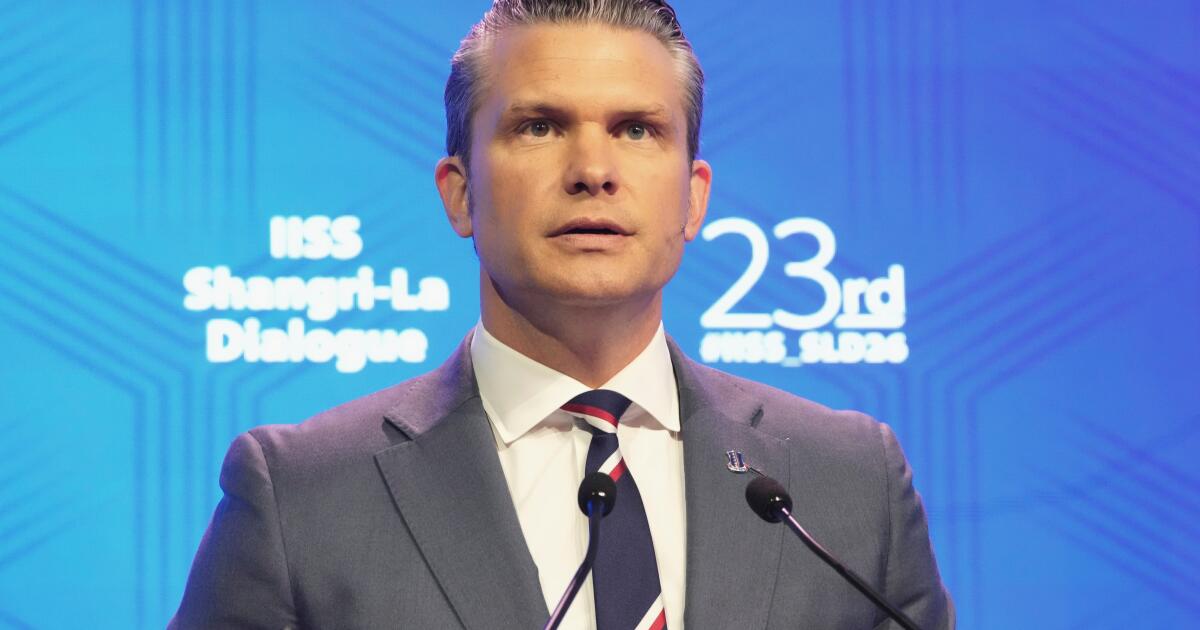
WASHINGTON — After Defense Secretary Pete Hegseth cut nine Navy officers, including all the women, from a promotion list, several female officers say they see the unusual intervention as a sign that their careers now have a ceiling and worry for the future generation of female military leaders.
The Navy had selected 31 sailors to promote from the rank of captain to one-star admiral, but Hegseth recently intervened to strike nine people from the list, including three women and two Black men, according to a Defense official who spoke on condition of anonymity to discuss information not permitted to be released publicly.
As a result, the Navy is not promoting a single woman to the one-star admiral rank this year even though women make up about one-quarter of all Navy officers and nearly one-third of the sea service’s midgrade ranks, according to military data from 2024.
The Associated Press spoke with eight female Navy officers of varying ranks and time in service after Hegseth’s cuts, which were reported earlier by the New York Times, became public. They spoke on condition of anonymity out of fear of retribution from their superiors.
The more junior officers said they saw the development as a sign that their careers would become politicized if they rose too far in the ranks, and some said they felt they now had a limit on how far they could be promoted. Some said it made them feel less valued within the military and wondered whether that wasn’t part of the intent.
The Pentagon has not offered any rationale on why the women, or any of the other six people, were removed from the promotion list.
Sean Parnell, the Pentagon’s top spokesman, said on social media last week that “military promotions are given to those who have earned them” and that the Pentagon “will never consider the color of a service member’s skin or their gender as a factor in promotions.” The Pentagon did not immediately respond to a request seeking further comment.
The Navy’s process for choosing which officers to promote to the one-star rank has been relatively constant and transparent over the years. The service convenes a group of officers, called a promotion board, that examines the records of eligible officers and chooses those deemed to be the most qualified.
The board that selected the initial slate of 31 officers for promotion was directed by then-Navy Secretary John Phelan, an appointee of President Trump, to “recommend for promotion the best qualified officers within their respective competitive category.”
The order from Phelan, who abruptly departed his post in April, said the board should consider an officer’s performance, competence and character, among other traits, as part of those qualifications.
It also said that given China’s prominence in the Trump administration’s National Defense Strategy, “special consideration shall be given to officers who have excelled in their knowledge of the political military affairs and U.S. strategic interests in the Indo-Pacific region, and operational contingency planning for Indo-Pacific war plans.”
Hegseth has long argued, without offering evidence, that women in the military benefit from preferential treatment and are not suited for combat roles.
“For too long, we’ve promoted too many uniformed leaders for the wrong reasons based on their race, based on gender quotas, based on historic so-called firsts,” Hegseth told hundreds of military leaders in September.
The approach, he asserted, made the Pentagon “less capable and less lethal.”
‘A break from tradition’
Phelan’s order said the Navy cannot discriminate based on criteria such as race and sex, and it specifically noted that “this guidance shall not be interpreted as requiring or permitting preferential treatment of any officer or group of officers on the grounds of race, religion, color, sex.”
The full list of 31 people to be promoted was approved by Phelan, other Navy leaders and the chairman of the Joint Chiefs of Staff, Gen. Dan Caine, before it reached Hegseth, who chose to make the changes, the Defense official said.
While Hegseth is within his rights to intervene in the list, “it’s just not the norm” and is “a break from tradition,” said Katherine Kuzminski, a researcher specializing in military recruiting and retention at the Center for New American Security think tank. She said that promotions historically have been seen as “the services’ business.”
Kuzminski noted that “this is a decision that’s not being made by the Navy — it’s being made by the secretary of Defense,” and she said Hegseth’s growing interference in operational aspects of the military services such as promotions is creating “tension” about what “normal” will look like going forward.
Some of the more senior Navy officers who spoke with the AP expressed concerns about the message it sends to the next generation of young sailors.
In addition to pulling the recent promotions of three women to admiral, Hegseth shortly after he took office fired Adm. Lisa Franchetti, the service’s top officer and the first woman to hold the job. He never explained his rationale.
Since then, he also has fired two other female three-star admirals without explanation.
Some of the officers who spoke to the AP said that while they were encouraging female sailors to stick with the Navy, they acknowledged that message is coming at a difficult time.
Kuzminski said the rhetoric and actions surrounding women in the military “affects individual service member decision-making and it also affects family unit decision-making,” including whether people make a career of the military.
Kuzminski said that following the months-long hold on military promotions by Sen. Tommy Tuberville (R-Ala.) during the Biden administration, surveys showed that partisan politics spilling into the day-to-day lives of troops affected their decision-making.
One officer said this impact was not confined to women.
In conversations with other sailors in her unit, she said that male sailors were hesitant to deal with what appears to be a growing politicization of simply following the orders of previous administrations.
Toropin writes for the Associated Press.

World Cup 2026: Lionel Messi not used in Argentina beat Honduras as Brazil and Germany also win warm-up games
Germany earned a 2-1 victory against World Cup co-hosts United States in the final warm-up game for both teams.
Kai Havertz had an early goal for Germany cancelled out by Antonee Robinson’s stunning volley before Leroy Sane’s winner for Julian Nagelsmann’s side.
“I’m happy with the performance of everyone,” said US coach Mauricio Pochettino, who believed his side were “unlucky” to lose.
“We played one of the most important teams in the world. I think we need to be happy with that.”
The US will start their World Cup campaign against Paraguay on 12 June, while Germany, who have won nine games in a row, begin with a game against Curacao on 14 June.
Germany coach Julian Nagelsmann said his side’s win against the US had been a “perfect test for us, both in terms of the weather and the opponent”.
Brazil beat Egypt 2-1 in the final warm-up game for both countries, with Newcastle United midfielder Bruno Guimaraes scoring early on for the winners.
Mostafa Zico equalised for Egypt but Raphinha set up Endrick to win it for the South American side, who had to take defender Wesley off after 17 minutes.
Egypt forward Mohamed Salah, who recovered from a “minor muscle injury” to play for Liverpool towards the end of the season, came on for the second half against Brazil.
“Salah underwent a rehabilitation program with Liverpool and then with the national team, and he is now ready for matches,” said Egypt coach Hossam Hassan.
Egypt’s opening game of the World Cup on Monday, 15 June will be against Belgium, who thrashed Tunisia 5-0.
Leandro Trossard, Charles de Ketelaere, Kevin de Bruyne, Dodi Lukebakio and Nicolas Raskin each scored against a Tunisia side reduced to 10 men following the dismissal of Ismael Gharbi after 62 minutes.
Belgium boss Rudi Garcia brought Romelu Lukaku on after 66 minutes as he manages the striker’s return to action.
“It is a good preparation for the World Cup, we know this team can do great things,” said Garcia, whose side were beaten 2-0 by Croatia in their previous game.

Pope Leo hopes to bridge Spain’s political divide on papal visit
1 of 2 | Pope Leo XIV blesses infants on his visit to the Caritas Charity Centrer in the Lucero neighborhood of Madrid Saturday. The pontiff is visiting Spain from from June 6 through June 12, with stops in Madrid, Barcelona and the Canary Islands. Photo by Ciro Fusco/EPA
June 6 (UPI) — Pope Leo XIV landed in Madrid Saturday to begin his one-week papal visit to the country, the first in 15 years.
Leo was greeted at the airport by King Felipe VI and his wife Queen Letizia, then addressed them at the Royal Palace along with politicians and diplomats.
He acknowledged political polarization and called for an end to it in Spain and elsewhere in the West.
“I come among you to affirm, encourage and instill a renewed fidelity to the Gospel among believers, as well as a deeper reconciliation and collaboration among the various elements of this nation,” the first American pope said.
“In reality, the message of peace, which at present unfortunately strikes some as naive and others as confrontational, is welcomed by those who do not shut themselves off in preconceived ideologies, but are rather open to the truth,” Leo said.
Spanish Deputy Prime Minister Yolanda Díaz told the Washington Post that the left in Spain embraces the pope.
“The [left’s] alignment with Pope Francis was immediate: He defended Spain’s labor reform and the Episcopal Conference also supported it, something that would have seemed unthinkable 20 years ago,” she said. “With Leo XIV, that alignment deepens.”
The Spanish far-right are battling the Church, which they believed an ally. They are particularly upset over the church’s advocacy for migrants, The Washington Post reported. The left once saw the Church as complicit in the Franco dictatorship.
“The far right in Spain wants to copy the far right in the United States,” Bishop José Mazuelos Pérez, who heads a Canary Islands diocese providing shelter, food, blankets and medical care for arriving migrants, told The Post. “To go to war with the bishops over the issue of migration.”
On Monday, Leo will address the Spanish parliament, which is gridlocked. He’s expected to discuss that type of polarization, and his other visits around the country highlight differing segments of the Church.
He will have a prayer vigil with young people Saturday, then march Sunday in a traditional Spanish street procession.
On Thursday, Leo plans to visit the Canary Islands, a landing for Latin American migrants and for those arriving by sea from the African coast. He is planning to visit Lampedusa on July 4, an Italian island where migrants from Africa and beyond land.
On his flight to Spain, Leo acknowledged that he would be competing popular with Puerto Rican singer Bad Bunny, who played the Super Bowl halftime show this year, for Spanish attention. Bad Bunny is scheduled to perform in Madrid Saturday night.
Leo said that more young people are turning to the Church, looking for something more.
“If they are confronted with the question: do they want to see Bad Bunny or do they want to see the pope, I think many will see Bad Bunny,” Leo said. “But I think there will also be a few here to see the pope. And that says something.”
On Sunday, the pope will celebrate mass on the feast of Corpus Christi in the Plaza de Cibeles. There will be a Corpus Christi procession, the Vatican said. He will also meet privately with members of the Order of St. Augustine to which he belongs.
Later, he will go to a gathering of representatives of culture, arts, business and sports at Madrid’s Movistar Arena.
The Vatican spokesperson Matteo Bruni said, “Leo XIV’s trip to Spain is a sign that, despite the secularization of society, the pope still has something to say in many areas, in Spain and in Europe, where he can play a constructive role in public debate,” Euro News reported.

Russian Mirra Andreeva plays against Ukrainian Marta Kostyuk in their semi-final match during the 2026 French Open in Paris on June 4, 2026. Andreeva won 6-1, 6-3. Photo by Maya Vidon-White/UPI | License Photo

Manhunt for suspects after 12 people shot near festival in Ohio
Police in the Toledo city say it appears that two people fired weapons and they were “probably shooting at each other”.
Source link

Emmy voters, ‘The Pitt’ Season 2 is just as good as Season 1
What was the moment from the season finale of “The Pitt” that finally broke you?
Was it the shot of the day-shift staff watching the Fourth of July fireworks from the hospital roof, the sound of “America the Beautiful” playing in the distance? Maybe it was Dr. Al-Hashimi (Sepideh Moafi) crying in her car, realizing she can’t work around the seizure disorder that makes her a liability in the ER. Or perhaps it came when Noah Wyle’s Dr. Robinavitch (a.k.a. Dr. Robby) swaddled Baby Jane Doe, telling her that “everything’s gonna be just fine,” because she has “so many wonderful things to see and so many people to love.”
But what opened the floodgates for me, after the last half-hour of the episode left me completely dazed and dumbfounded, was Drs. Santos (Isa Briones) and King (Taylor Dearden) exorcising the day’s demons by belting out Alanis Morissette’s “You Oughta Know” at a karaoke bar and demonstrating that primal scream therapy is alive and well three decades into the 21st century.
Which is all to say: “The Pitt” is the only television show I’ve watched that gives me the same feeling I have when I read a great, immersive novel. When the end is near, I’m bereft. I’m Al-Hashimi in her car, wanting to pound the dashboard. I do not want to let these characters go. They’ve given me 15 hours and I still crave more. I would devour a series of short films about odd couple Santos and Whitaker (Gerran Howell) sharing an apartment or a summer spinoff showing Dr. Abbot (Shawn Hatosy) working off-hours as a SWAT medic. Anything to fill the long, “Pitt”-less weeks between seasons.
Instead, I’ll just have to content myself with scrolling through social media, watching fan-made videos of Dr. King self-soothing her way through the day, (this one, set to Vince Guaraldi’s score from “A Charlie Brown Christmas,” is the absolute best) and taking in the compilation of the show’s cast asking, “What’s the status on Baby Jane Doe?” in their best Katherine LaNasa Pittsburgh accent.
“The Pitt” won five Emmys from 13 nominations, including best drama series, for its celebrated first season, a 15-episode run that began with Dr. Robby up on the hospital roof talking down Dr. Abbot after an intense shift. The season ended with Dr. Abbot returning the favor after Robby and his staff ground their way through a day that included a mass shooting, a child drowning and a patient assaulting LaNasa’s no-nonsense charge nurse.
How do you follow that?
For a few episodes this new season, it looked like “The Pitt” wasn’t up to the task. We watched the ER staff dealing with a series of bloody, messy (the disimpaction!) medical maladies, an avert-your-eyes spectacle that felt like the writers were trying to one-up themselves and find the worst possible affliction to make viewers double over. Worse, the thrill of discovery that kept us invested throughout the first season, the slow drip of information about the characters, wasn’t quite there. Something was missing, and it wasn’t just Dr. Robby’s motorcycle helmet.
But the luxury of having 15 episodes is that the writers can take their time laying the groundwork for the story they want to tell.
And what a story it was.
Over the course of the season, we watched Dr. Robby disintegrate, his mental health more precarious than ever because he has done nothing to address his apparent PTSD. “You need help,” Dr. Langdon (Patrick Ball) tells Robby, confronting him in the finale. “Be honest with yourself.”
Robby isn’t the only one struggling, as Dr. Abbot puts it, to “dance through the darkness.” Langdon is back, managing his sobriety. Dr. Mohan (Supriya Ganesh) is having panic attacks. Santos is still dealing with self-harm. Dana remains haunted by that Season 1 patient assault and now carries a syringe containing a heavy sedative just in case somebody emerging from that overcrowded waiting room crosses the line again.
“I’ve seen so many people die that I feel like it’s leaching something from my soul,” Robby says. “I’m tired of feeling like I’m drowning every day.”
And there you have it, the subject of Season 2 of “The Pitt.” Medical professionals are gasping for air, and the American healthcare system, with its focus on profit above all else, is failing them and the patients they treat.
Remember Orlando, the patient with severe diabetic ketoacidosis who arrives at the ER after fainting? Orlando had to ration his insulin because he lacked insurance and felt he had to cut corners. He ends up leaving the hospital early, fearing the cost of treatment. Later he returns, having fallen (jumped) from a catwalk at his construction job, fracturing his skull. But good news: He now qualifies for Medicare and Medicaid due to long-term disability.
It’s a tragedy, one of many reasons the season finale shot of the ER staff holding back tears as they watched the Fourth of July fireworks felt like a body blow. “America the Beautiful”? How can that be true when the current administration is seeking $1.5 trillion for defense spending — nearly 50% more than this year — while cutting healthcare and social safety nets? How can that be true when an act known as the “Big, Beautiful Bill” removed funding from an already frayed healthcare system and exacerbated the shortage of care in rural areas of the country?
That one scene, the culmination of hours of careful, patient storytelling, said more about the disconnect between American ideals and America’s reality than anything else I’ve read or watched this year.
Give “The Pitt” all the Emmys. It has more than earned them.

‘I live in Benidorm and there’s 3 places you should avoid at night’
A British man living in Benidorm has issued a stark message to those jetting out to the popular Spanish resort this summer – saying there’s certain places you want to avoid at night

Stay safe while in Benidorm (stock)(Image: JOSE JORDAN/AFP via Getty Images)
A British expat living in Benidorm has issued a warning to holidaymakers heading to the popular Spanish resort this summer – revealing the three places he would avoid after dark. Benidorm remains one of the UK’s favourite holiday destinations, attracting millions of tourists every year with its beaches, bars and nightlife.
But according to one resident, there are a handful of spots visitors should think twice about walking through late at night. Sharing his advice on social media, the expat said: “This is a warning for anyone coming out to Benidorm. “This is the top three areas I would definitely avoid if coming to Benidorm in 2025 and the reasons why.”
Coming in at number three was a public pathway known locally as the “Yellow Brick Road”, which runs behind several hotels and leads towards the Rio Park area.
He explained: “Now it has been known for a few things, mainly small thefts like pickpocketing, that sort of thing.
“Now generally during the day it’s absolutely fine. I’d recommend avoiding it at night.”
Next on his list was Pueblo Alley, which he claimed can attract unwanted attention after dark.
He said: “And in at number two has got to be Pueblo Alley.
“And this is one I definitely recommend avoiding, especially late at night, as you do get the pickpockets hanging around this area and you also get the odd lady of the night.
“So I definitely consider avoiding it. There’s plenty of other ways around.”
Topping his list was a location known as “Mugger’s Alley”, which has long gained a reputation among some tourists and locals.
He said: “Straight in at number one, it’s Mugger’s Alley.
“It is the most notorious. It is the one we all know, known for pickpocketing, ladies of the night.
“It’s just an area that I would avoid.”
The expat also warned visitors to be cautious of scams, claiming he had recently seen reports of people being targeted.
He added: “Cross the road, it’s not necessary. I mean, they’re even doing these new taxi scams. I’ve seen videos online about it.
“It’s crazy. So save yourself the hassle and cross the road.”
Commenting on his post, one travel fan said: “Don’t agree with you, stayed in Rio Pak about 20 times and never had a problem.”
Another user added: “Anywhere people are shouting.”
It comes after the UK Government issues a warning about a police officer scam in Spain, saying: “Thieves posing as police officers may ask to see your wallet, claiming they need to see it for identification.
“Genuine police officers will ask to see ID but will not ask for wallets or purses. All police officers, including those in plain clothes, carry official ID.”
The Visit Benidorm Tourist Board has been contacted for comment.

Craig Bellamy: Belief but work to do – Wales’ two years under Bellamy
Bellamy has regularly been keen to stress the need for Wales to increase and improve their player pool.
The 46-year-old has used 37 different players during his tenure to date.
He has also handed seven players – Karl Darlow, Dylan Lawlor, Ronan Kpakio, Kai Andrews, Joel Colwill, Isaak Davies and Cameron Congreve – their senior Wales debuts.
Qualifying for Euro 2028 remains the long-term aim for Wales and Bellamy, and blooding young talent has been viewed as a necessity to strengthen the nation’s long-term prospects.
Now halfway through his four-year contract with the Football Association of Wales, there are clearly signs of evolution, although there is work still to be done.
Assessing his two years in the hotseat after the loss to Romania, Bellamy said: “We’re definitely very different, two years older.
“It’s been really enjoyable, there’s a lot of stuff I really like that we’ve been able to do.
“But also it’s so, so clear, I feel that if we want to improve, these are the areas we need to improve on.”
Bellamy, who has been linked with several clubs in recent months, has clearly not lost his appetite for the Wales job.
“That excites me as well because I do like the team, I like how we play, but we need to be better in certain areas,” he added.
“That’s going to allow us to be able to compete with the top, top teams on a regular basis – because that’s where we want to be and we’re going to be tested now on that in Nations League A.
“It’s going to test everything about us. That’s where we want to be and that’s where we want to stay, so a lot of work to do.”

Secrets of BA’s history from paper dresses and grouse for dinner to contraband
EXCLUSIVE: A new book charts the extraordinary history of British Airways, inclduing its unusual first passenger flight, its unique link to Marmite, royal fans, and some questionable fashion

The Boeing 707 was a symbol of the iconic 60s and shrunk the world overnight(Image: Supplied)
British Airways has been flying for 107 years, connecting Britain to the world across more than a century of aviation history.
From a single biplane lifting off from a grass field in west London to a fleet serving destinations across the globe, the story of the world’s favourite airline is told in a new history by Captain Al Bridger – taking the story of BA in 100 objects, which encompass everything from Neville Chamberlain to Marmite.
British Airways traces its roots to 1919, when Aircraft Transport and Travel (AT&T) launched the world’s first international scheduled passenger service from Hounslow Heath to Paris.
This pioneering line later fed into Imperial Airways, which became BOAC in 1939 for long-haul routes, while BEA was formed in 1946 for European services; the two finally merged in 1974 to create modern British Airways.
But it began on August 25 1919 when a modest biplane was prepared on the grass at Hounslow Heath, a few miles from what is now Heathrow Airport. Captain Al said: “The world’s first international scheduled passenger was piloted by Lieutenant Bill Lawford.
“It carried one passenger, some newspapers, fresh grouse bound for the British Ambassador to France and Devonshire clotted cream. In challenging weather, Lawford skilfully completed the trip in 2 hours and 30 minutes.”
Five years later, in March 1924, the British government formed Imperial Airways, at the futuristic Croydon Airport. The art deco structure had a first-class restaurant, canteen for staff and a viewing gallery. The network expanded and flights could reach Delhi in seven-and-a-half days.
The Argosy aircraft, which first flew a passenger service on July 16 1926, gave early travellers a taste of luxury that would define the airline’s ambitions for decades to come. Captain Al said: “A white-coated steward served twenty passengers incredible four-course meals with drinks, providing true luxury for those lucky enough to afford it.
“The aircraft were also used for very popular weekend ‘Tea Flights’, offering afternoon tea while enjoying fabulous views over the capital.”
Among the collection’s most striking objects is a signed photograph of Prime Minister Neville Chamberlain, stepping from a British Airways Lockheed 10A after his famous Munich meetings and the declaration of “peace in our time”.
The 1950s brought a fresh start. “The Jet Age was officially launched with the introduction of the Comet in 1952, placing the UK at the very forefront of aviation,” said Captain Al, “The Rolls-Royce-powered Boeing 707 was a truly iconic symbol of the 1960s, and Sydney in Australia was now within reach in just 33 hours with four stops on the way. A true symbol of the iconic 1960s, the Boeing 707 was a triumph, shrinking the world overnight.”
The collection’s menu cards speak to a more glamorous age of flying. A BEA Silver Wing menu signed by Sir Winston Churchill on 26 April 1955 sits alongside one signed by Muhammad Ali on 10 May 1979
The 1960s brought experimentation of a more flamboyant kind. BOAC introduced cabin crew uniforms that became one of aviation’s most memorable fashion footnotes.
“While famously described as paper dresses, they were in fact sensibly made of a fireproof fabric that resembled paper and could be cut to the required length,” said Captain Al. “Incredibly, they were discarded after each flight.” They lasted a year.
The airline was also reaching out to its youngest passengers. On 26 March 1957, BOAC launched the Junior Jet Club, and Captain Al said: “The club was a huge success and had over 2 million members in its twenty-seven years of existence. Cabin crew would hand young travellers an envelope containing a registration form, a logbook and a Junior Jet Club badge.”
No history of British Airways would be complete without Concorde. The aircraft first flew on 2 March 1969 and entered service with British Airways on 21 January 1976. Captain Al said: “Concorde was to become the flagship of the fleet, bringing supersonic travel to everyone for the first time. Able to carry 100 customers in total luxury at speeds in excess of Mach 2 (more than 1,300 mph) the aircraft could cross the Atlantic in under 3 hours, with the record set on 7 February 1996 at 2 hours and 52 minutes.” The aircraft operated its last service on 24 October 2003.
While Concorde was redefining long-haul travel, the airline was also transforming life on board for ordinary passengers. A BOAC packing checklist pamphlet from the 1960s shows the formality of travel at the time. “For gentlemen, the list mentions the necessity of a dinner jacket, shirt collars and hair tonic,” said Captain Al. “For ladies, a bed jacket, hat and stole were essentials when travelling abroad.”
A photograph of the Beatles from the same era shows the Fab Four carrying BEA travel bags. Captain Al said: “Note how the Beatles are carrying BEA(TLES) travel bags, much like the more common BOAC bags. Clearly the band were travelling light.”
The 1980s brought fresh challenges and fresh ambition. In 1995, as part of a £500 million investment, the airline introduced the world’s first fully flat bed seat in First Class. Captain Al said: “Scientifically proven to give a much better night of sleep, it represented a huge leap forward in airline comfort.”
The airline’s inflight magazine, High Life, had been charting the journey since 1973. Captain Al said: “It truly is BA’s wingman. Through the years there have been some amazing contributors, from Jilly Cooper to Morecambe and Wise.”
Smoking had been part of airline life since the very beginning, but by March 1998 it was over. “When BEA was formed in 1946 over half of the British public smoked, with two-thirds of adult males recorded as smokers,” said Captain Al. “It wasn’t until 1998 that British Airways introduced a complete smoking ban on all flights.”
The modern era brought its own landmark moments. On 18 May 2012, a gold-liveried Airbus A319 named Firefly carried the Olympic flame into Culdrose Naval Airbase in Cornwall. Captain Al said: “Safely contained in four miner’s lamps, the flame was taken from the aircraft by Anne, the Princess Royal, accompanied by Lord Coe, the chairman of the London Olympics Organising Committee and football superstar David Beckham.”
The airline’s centenary in 2019 produced one of the collection’s most unlikely objects. “To celebrate the airline’s centenary, British Airways and Marmite teamed up and created a limited-edition jar that could be purchased on board,” said Captain Al.
“Apparently Marmite is the most confiscated brand at airport security, so the centenary jar was made to be just 70 grams, conveniently sized to fit within the liquid allowance to get it safely through airport security.”
Few objects in the collection carry more weight than the Royal Flights book, its pages bearing the signatures of those who have trusted the airline across the decades. The first entry dates from November 1983.
Captain Al said: “The book was beautifully inscribed with superb calligraphy and the signatures of Her Late Majesty Queen Elizabeth II and His Late Royal Highness The Duke of Edinburgh. Fittingly, the final signature is again that of Her Late Majesty after her visit to the British Airways Headquarters on 23 May 2019 to celebrate the airline’s centenary year.”
From a grass field in Hounslow to the signature of a queen, British Airways has carried the nation and the world for 107 years.
As Captain Al writes of the airline he has served and loves: “It has seen great highs and led the world through some very challenging times, and I know it will continue to give the best it can in the coming years, generating many more wonderful objects along the way.”
British Airways in 100 Objects by Al Bridger is published by Amberley, £17.99
BA in numbers
46.3 million passengers carried in 2025.
Fleet of 254 aircraft serving 215 destinations across six continents.
40,000 employees worldwide.
Revenue of £14.6 billion in 2024.
I went on the mystery Wizz Air holiday where you only find out where you’re going when landing

SIR Ranulph Fiennes and Bear Grylls most likely pop into your head when you think of adventurers. But now, you can add Wizz Air customers to that list.
And me. Last month, I was invited to join some competition winners on a flight to . . . who knows where?
As part of the Hungarian airline’s Let’s Get Lost promotion, 22 lucky travellers and their plus-ones were going on an all-expenses-paid trip, to a secret destination.
We were given five possible locations for our three-night adventure — Moldova, Bosnia & Herzegovina, Lithuania, Armenia and Albania.
Even after boarding the plane we were still none the wiser, all we had was a pre-provided packing list and a rough idea of the climate.
It was only once the flight had exceeded three and a half hours that we could guess it was Armenia. A tannoy announcement confirmed it, prompting a round of applause.


I’ll be honest, Armenia was never on my radar as a holiday destination, but that’s exactly what made this trip so special.
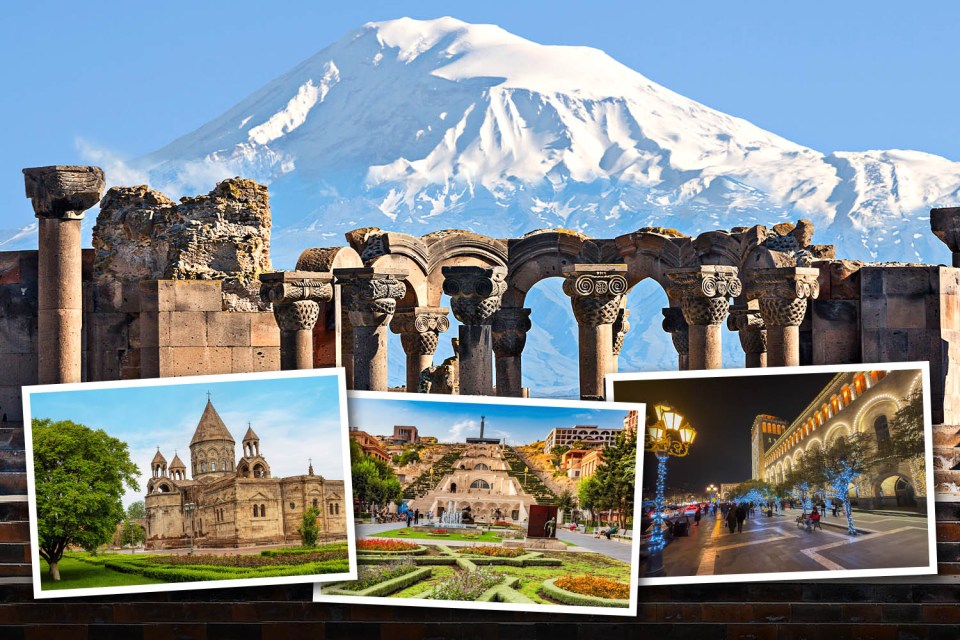
Arriving in Republic Square, the heart of the capital city Yerevan, the Saturday evening atmosphere was electric with hordes of people enjoying live music alfresco.
We stayed in the DoubleTree by Hilton Hotel, perfectly located in the city centre of Yerevan.
A walking tour was the best way to get our bearings. We wandered the main streets past buildings made from pink volcanic stone, before reaching the Cascade Yerevan.
Made up of 572 steps (we took the interior escalator), this mighty landmark is a must-visit. From its peak, we had stunning views of the snow-capped Mount Ararat, now in modern-day Turkey.
A 30-minute drive away is Charents’ Arch, a monument dedicated to a much-loved poet in this region. The curved brick structure provides the perfect natural frame for the landscape and is a great photo spot.
The architectural highlight for me was the Mother See of Holy Etchmiadzin — the Mother Cathedral of the Armenian Church.
Remnants of it date back to the 4th century (Armenia was the first nation to adopt Christianity in 301AD), and it is the most ornate church I’ve ever seen.
The ruins of the 7th-century Zvartnots Cathedral are also worth a visit.
The whole place has an otherwordly feel, and with the hot sun beating down on us, it felt spiritual.
In just two days, we ticked off key landmarks, including Garni Temple and the Geghard Monastery, with lunches and dinners in between, accompanied by Armenian wine, which I would highly recommend.
With such a short time on the ground, this trip didn’t allow for loafing, but that’s the brilliance of a Wizz Air mystery getaway — cramming in all the best bits.
Our final evening was spent at Tavern Yerevan Riverside. The setting, grub and entertainment were truly amazing. Armenian wine was flowing while we tucked into khorovats, traditional Armenian barbecued meats scorched over an open flame.
While we had a curated itinerary, Yerevan can be navigated independently and you can tailor-make a cultural and/or foodie break.
After attempting, and failing, to say ‘shnorhakalutyun’ — Armenian for ‘thank you’ — throughout, I was advised that the French equivalent would also be appreciated.
So, merci Armenia — a destination I’d never planned to visit, but am so glad I did.
GO: ARMENIA
GETTING THERE: Starting tomorrow, Wizz Air flies twice a week from Luton to Yerevan with one-way fares from £45.99.
See wizzair.com.
STAYING THERE: Double rooms at the DoubleTree by Hilton Yerevan City Centre cost from £101 per night, hilton.com.
MORE INFO: For Let’s Get Lost trips, keep your eyes peeled on the Wizz Air website and social media channels for competition announcements.

Second New World Screwworm case confirmed in Texas cattle
June 6 (UPI) — A second case of New World screwworm was confirmed in Texas this week in a one-month old calf nearly six miles from where the first case was detected.
The U.S. Department of Agriculture announced the second confirmed case on Friday, which was detected in Zavala County, Texas, but 5.6 miles away from the first one.
The second case was confirmed just 24 hours after the first, which had been detected in a three-week old calf, and has spurred the USDA to step up surveillance, as well as take other actions to prevent the infestation from spreading.
New World screwworm is spread by flies that lay their eggs in the exposed flesh of living animals — livestock, pets, wildlife and humans are all susceptible — and when the fly larvae, or maggots, emerge from the eggs they burrow through muscle as they grow.
Although screwworm was eradicated from the United States in the 1960s, severe infestations in recent years in Central America slowly moved toward the southern border and was detected here in 2025, according to the USDA.
“With our partners in Texas, we are responding with speed and strength,” the USDA said in a statement about the second case that was posted on X.
“We have defeated this pest before, and we will do it again,” the agency said. “America’s livestock producers have USDA’s FULL support.”
The primary way of controlling the spread of New World screwworm is a combination of trapping flies for testing, implementing detection and quarantine zones where it confirmed, and releasing sterile flies into the area it has been detected to prevent infected insects from reproducing, the agency said.
The USDA has encouraged people in the area of the two cases to check their pets and livestock for draining or enlarging wounds, if not maggots or eggs around bodily opening such as the nose, ears or genitals, or around the navel of newborn animals.
Although screwworm infection in humans is relatively rare, the infestations can happen in ways similar to animals and require immediate medical attention.

President Donald Trump discusses renovations to the Lincoln Reflecting Pool and makes an announcement on coal in the Oval Office at the White House on Thursday. Photo by Samuel Corum/UPI | License Photo

Lebanon army chief in Pakistan, funeral plans for soldiers killed by Israel | Israel attacks Lebanon News
Funerals will be held for Lebanese officers killed in an Israeli attack in southern Lebanon, as Beirut’s army chief headed to Pakistan on a surprise visit amid ongoing mediation efforts in the wider United States-Israel war on Iran.
The Lebanese soldiers will be laid to rest on Sunday, a day after the brigadier general, captain and soldier were killed in an Israeli strike on a military vehicle on the Khardali-Nabatieh road, in an incident the Israeli army said it was investigating.
Recommended Stories
list of 4 itemsend of list
A ceasefire agreed on April 17 was meant to halt the fighting between Israel and Hezbollah, but Israel has continued to carry out near-daily attacks, prompting retaliatory ones from the Lebanese group. The violence has taken a disproportionate toll on civilians in Lebanon, where more than 3,500 people have been killed since hostilities resumed on March 2.
A further conditional ceasefire was announced by Lebanese and Israeli envoys last week in Washington, but was rejected by Hezbollah as it did not include the group or provide for Israel’s withdrawal from southern Lebanon.
Lebanese army chief Rodolphe Haykal left on Saturday for Pakistan, which has emerged as a central mediator between the US and Iran.
The visit is notable given the insistence by Washington – and by Lebanese leaders, including the president – that ceasefire talks for Lebanon remain separate from the US-Iran negotiations mediated by Pakistan.
Fighting continues in southern Lebanon
Meanwhile, Israeli attacks hit several towns across southern Lebanon and the western Bekaa overnight, while Hezbollah said it launched rockets, artillery fire, and drone attacks against Israeli forces, including near the Beaufort Castle in Yohmor al-Shaqif.
Lebanon’s Ministry of Public Health said on Sunday that an Israeli raid on the town of Saksakiyeh a day earlier killed at least two people. The ministry added that 22 people were wounded in the attack, including three children and a woman.
Two others were wounded following an Israeli drone attack on the town of Shahabiyeh, Lebanon’s National News Agency (NNA) reported.
Israeli air attacks also hit the town of Qalawiya at dawn, and the towns of al-Qatrani, Byblos and Rihan in the Jezzine district overnight. The town of Deir Kifa in the Tyre district was also bombed, while Barashit and Chaqra in the same district were subjected to intermittent artillery shelling overnight.
NNA also reported artillery shelling in the towns of al-Mansouri and Bayt al-Sayyad in the Tyre district.
Israeli warplanes launched an attack on the town of Srifa. Local media also reported that Israeli fighter jets attacked Dweir, near Nabatieh, north of the Litani River.
Paramedics, meanwhile, continue to look for survivors under the rubble following Israeli attacks.
“The pattern is part of what is being called the Gazafication of Lebanon, or Israel using actions normalised by the Gaza genocide,” said Al Jazeera’s Nour Odeh, reporting from Ramallah in the occupied West Bank.
“The targeting of schools in southern Lebanon, just like Gaza. Bombing Lebanese hospitals and clinics, also like Gaza. And the murder of journalists. Then there’s these so-called double-tap attacks against paramedics and rescue workers. Hundreds of Palestinian and Lebanese paramedics have been killed with this unlawful practice.”
Gazafication extends to the ceasefire, too, she added.
“The ‘Yellow Line’, first introduced in Gaza, has now swallowed 60 percent of the territory. In Lebanon, the ‘Yellow Line’ now includes nearly a fifth of the country. Both invisible lines keep expanding,” said Odeh.
No choice but negotiations, says Lebanese lawmaker
Najat Aoun Saliba, an independent member of Lebanon’s parliament, meanwhile, condemned Israel’s killing of the Lebanese soldiers and said President Joseph Aoun has no choice but to enter into negotiations with Israel.
“If we don’t have negotiations, what is the alternative? Is the alternative going to war? The war is not going to give us peace,” she told Al Jazeera.
Saliba said dialogue was the only viable path given the imbalance of power between Israel and Lebanon’s armies.
“The balance of power between the armies is not to be compared. Israel has a very strong army backed up by the United States. The Lebanese Armed Forces have been sidelined by a political will for 30 years, because they wanted to strengthen the presence of Hezbollah,” she said.
The lawmaker added that Hezbollah has not been able to stop Israeli aggression.
“Hezbollah is not able to stop any of these war crimes, and it’s not able to stop any of the invasions that Israel is doing. I think with … all these massacres and destruction, I don’t think we have a choice.”
The killing of Brigadier General Wissam Sabra, Captain Elie Khoury and soldier Hussein Ghozal came at a tense moment amid broader efforts to strike a deal between the US, Iran, Hezbollah, the Lebanese government and Israel.
Lebanese President Joseph Aoun said the attack was “aimed at thwarting all efforts to reach a solution”, while Prime Minister Nawaf Salam described it as “a heinous crime and an attack on Lebanon and all Lebanese people”.
Lebanon was drawn into the Middle East war when Iran-backed Hezbollah attacked Israel on March 2, following joint US-Israeli attacks on Iran.
Tehran has made a ceasefire in Lebanon between Israel and Hezbollah a condition for any peace deal with Washington.

Death Cab’s Ben Gibbard on enduring divorce and going indie again
Ben Gibbard remembers late 2023 as a time of competing realities.
Onstage, the frontman of Death Cab for Cutie and the Postal Service was thriving as his two bands toured together to mark the 20th anniversaries of Death Cab’s “Transatlanticism” and the Postal Service’s “Give Up.”
Behind the scenes, Gibbard’s personal life was in shambles.
“I was getting off phone calls — very difficult phone calls — 20 minutes before going on in an arena,” he says. The singer and his wife, photographer Rachel Demy, were in the middle of an agonizing breakup that would eventually lead to divorce. Yet audiences in the thousands were turning up nightly to see Gibbard reanimate the peak-millennial classics that made him one of indie rock’s defining stars.
“I’d just tell myself, You’re a professional — you’re gonna go out there and do it, and no one’s gonna know,” he recalls. “It was all waiting for me when I got offstage, of course. But for two hours I was able to disconnect and be a performer, which was incredibly …” Gibbard, 49, trails off into a laugh.
“I don’t know if it was healthy,” he says. “But it was helpful.”

Two and a half years later, that split-screen experience — “this idea of how we compartmentalize our pain or our grief or our trauma,” as Gibbard puts it now — forms a through line of Death Cab’s ruminative new album, “I Built You a Tower.” Due Friday from Anti Records, where the group landed after leaving its longtime home of Atlantic amid a corporate shake-up, the LP sets thoughts of broken fences and never-ending storms against tuneful arrangements that can churn, shimmer or chime.
“I pledge myself to your misery / I kneel at its throne,” Gibbard sings in his still-boyish tenor over the sleek new wave groove of “Trap Door,” “Respecting your proclivity / To languish on your own.” In the fuzzed-out “Envy the Birds,” the frontman recounts an argument between two lovers “spraying bullets of grievances”; the driving “Riptides” is narrated by a guy “too tired to end the war.”
“This record is definitely the result of a divorce,” Gibbard says plainly during a recent visit to Los Angeles from his home in Seattle. “But I didn’t want to make a score-settling record or an angry record. This wasn’t an opportunity to defame someone or make this about how I’d been wronged. People drift apart — relationships don’t work. And I think how that’s affected me at almost 50 is a very different mindset than I found myself in when I was 33 or whatever the last time it happened.”
Gibbard means his first divorce, in 2012, from the actor and singer Zooey Deschanel — a split that inspired Death Cab’s 2015 album “Kintsugi,” on which one song asks, “Was I in your way when the cameras turned to face you?” and another chides an unnamed celebrity: “You’ll never have to hear the word ‘no’ if you keep all your friends on the payroll.”
“There’s some gnarly stuff on that record,” says Gibbard, who’d moved to L.A. to be with Deschanel then promptly left as soon as their marriage collapsed. “It’s not exactly a kind album.”
Bassist Nick Harmer, who formed Death Cab with Gibbard in the late ’90s after the two met as students at Western Washington University, agrees that “I Built You a Tower” represents a shift in perspective. “There’s so much more self-examination — and so much more self-indictment,” he says. (Death Cab’s other members are drummer Jason McGerr, guitarist Dave Depper and keyboardist Zac Rae.)
Which isn’t to say that Gibbard entirely resists placing blame. In “Trap Door” he sings about “a trap door in your heart and a button on your desk well-worn from being pressed.”
The frontman says that in recent years he’d “tried to get away from using the word ‘heart’ because that had been a touchstone for so many of our early records.” Yet this line seemed worth holding onto when it came to him.
“I Googled it to see: Did I already write this?” he says, laughing. “Or is there a very popular song called ‘There’s a Trap Door in Your Heart,’ and now I’m just rewriting it? We’ve made a lot of songs at this point — you gotta check your work.”
Indeed, “I Built You a Tower” is Death Cab’s 11th studio LP. After the band’s previous album, 2022’s “Asphalt Meadows,” fulfilled its deal with Atlantic, Death Cab reupped with the major label for one more record, Gibbard says, based on its strong relationship with the company’s then-CEO, Julie Greenwald.
“Julie was our shepherd and our protector the whole time we were there,” the singer says of Death Cab’s nearly two-decade run at Atlantic, which began with 2005’s Grammy-nominated “Plans.” Yet just days after they reached an agreement for “Tower,” Greenwald was fired and replaced by a new leader, Elliot Grainge, about whom the band felt less than optimistic.

Ben Gibbard
(Cielito Mercado Vivas / For The Times)
“We weren’t given the impression that Elliot had spent a lot of time with ‘Transatlanticism’ in college,” Gibbard says of the 32-year-old exec, who made his name signing rappers like Ice Spice and Trippie Redd. With Greenwald’s help, Gibbard says, Death Cab negotiated an exit from Atlantic with ownership of the new album.
Did Grainge try to persuade the band to stay?
“Never heard a word,” Gibbard says.
In an email, Grainge (whose father is Universal Music Group Chairman and Chief Executive Lucian Grange) said that Death Cab’s music “has meant a great deal” to him.
“Working together may not have been in the cards for us; however, that does not lessen my enthusiasm for the band,” he wrote. “They have delivered an impressive body of work over their decades-long career, and I am looking forward to their new music.”
Death Cab’s Harmer says he and his bandmates “talked for half a beat” about putting out “Tower” on their own before thinking better of the idea.
“We’re not businesspeople,” Gibbard says. “Music is the only thing we know how to do.”
At a friend’s wedding in 2024, the frontman had been seated next to the musician Allison Crutchfield, who was then heading up Anti’s A&R department; early this year, Death Cab announced that it had signed to the indie label, whose other acts include Fleet Foxes and Madi Diaz.
This summer, the band will tour behind “I Built You a Tower,” including two shows in August at L.A.’s Greek Theatre. After the “Transatlanticism”/”Give Up” anniversary outing — not to mention a subsequent tour on which the group looked back at “Plans” — Gibbard is “very ready to play some new material,” he says.
Doing the hits was fun. “But at a certain point,” he adds, “it’s really about moving ahead.”
World Cup: Scotland’s Steve Clarke has ‘decisions to make’ for Haiti opener
To think that four-goal first-half performance didn’t even involve John McGinn.
A traditional 4-4-2 brought the best out of Scott McTominay, if that’s even more possible. Although we all know the Napoli star’s position was never in any doubt.
Bologna’s Lewis Ferguson, who captain Robertson said “turned into a man” , externalduring the qualification campaign, again showed his maturity and ability to dictate play in the middle of the park. Cultured, some might say.
But, in truth, the first half was dominated by the work done down the wings by Bournemouth pair Ben Gannon-Doak and Ryan Christie.
Long before he was even in the squad, Gannon-Doak excited supporters. He was the Billy Gilmour of the Euro 2024 team, picking up an injury before the squad jetted off to Germany.
Since then, he’s reminded everyone what they missed with his absence. The epitome of a Duracell Bunny, the 20-year-old dazzled on Saturday.
At times, his end-product has been his downfall, but it wasn’t of concern stateside.
“Ben did himself the power of good today,” Clarke acknowledged. “We know what he can give us.”
Clarke also knows what Christie can provide. In many positions. He was lively down the left, with an instinct to cut in and create.
Many were crying out for Findlay Curtis to start, given his first international goal last weekend, but its hard to make a case for Christie not starting somewhere on Sunday.
It’s perhaps the biggest head-scratcher of them all for Clarke, but what a problem to have.

The unlikely county becoming more popular for holidays with cider farms and Cotswolds-like villages
STAYCATIONS are on the rise, according to the experts – and there is a county that is booming in demand.
In its latest Summer Travel Report, Airbnb revealed that not only are staycations up 11 per cent year on year, but an unlikely trending rural destination is Herefordshire where searches have increased by 76 per cent.

The county bordered by Gloucestershire, Shropshire and Worcestershire is known for its cider and pretty villages that look similar to those found in the nearby Cotswolds.
Earlier this year, Herefordshire was called the ‘quiet corner of England’ by The Independent – but hoped it would be thrust into the spotlight after the release of Hamnet.
Some of the county’s small villages were used for filming and doubled as Shakespeare’s Stratford.
One of the villages is Weobley which is nicknamed a ‘black and white’ village thanks to its half-timbered houses.


Alongside its pubs, fans of Hamnet should head into The Wobbly Badger Cafe which took centre stage for the exterior of Shakespeare’s family home in the film.
It’s not just Weobley – there are lots of other villages like this one and some are part of that are part of Herefordshire’s ‘black and white villages’ trail which is a 40-minute driving route.
Other villages include Pembridge, or Eardisland, which sits on the banks of the River Arrow (and looks similar to Bourton-on-the-Water).
Even smaller villages include Eardisley, Dilswyn, Leominster and Kingsland.
window.itgHolidayConnectHolidayDealsFrames =
window.itgHolidayConnectHolidayDealsFrames || [];
window.itgHolidayConnectHolidayDealsFrames.push({
cid: “5827a302”,
pid: “8925dc20-49c7-4663-9c7c-547ad29879e4”,
config: {
“poweredBy”:”icelolly”,”intro”:”Best deals “,”title”:”Sun Travel all-inclusive deals under £500pp”,”boardBasis”:”AI”,”duration”:”7″,”maxPrice”:”50000″,”utm_campaign”:”sun travel all-inclusive deals (generic 1) “,”layout”:”carousel”,”container”:”false”
},
});
https://holidayconnect-app.icetravelgroup.com/supersonic-assets/scripts/holiday-deals/init.js
Herefordshire gets around six million visitors each year compared to the Cotswolds’ 25million – so for visitors it will make for a much quieter staycation.
For fans of cider, Herefordshire has around 15,000 orchards growing apples and pears, some of which is used to produce the drink.
There are even dedicated cider circuits with cycling routes.
Stops on the South Circuit include Little Pomona Cider & Perry, Gregg’s Pit Cider & Perry, Oliver’s Cider & Perry, Ross on Wye Cider & Perry.
Another famous spot that TV fans will recognise in Herefordshire is Symonds Yat.
The spot on the River Wye is known for its enormous limestone gorge.
It even appeared in the Netflix series of Sex Education – one of the most recognisable places is the red and white chalet that sits high above the valley, which was the exterior of Jean and Otis’ house.
The River Wye within the valley is the fifth longest river in the country.
It’s surrounded by walking paths and tourists are also welcome to take to the water on a kayak, canoe or paddleboard.
Of course, Herefordshire’s centre is the city of Hereford which is home to a large cathedral.
This houses a famous treasure called Mappa Mundi which is a medieval map of the world from 1300.
It also has the unusual 17th century Chained Library – a collection of over 1,500 rare books and manuscripts that are secured to their shelves by iron chains, rods, and locks.
Entry into Hereford Cathedral is free, but to see Mappa Mundi, Chained Library or a Tower Tour there are additional fees.
Another popular spot is the Eastnor Castle which while it looks like one isn’t a medieval fortress, instead, it’s a 19th-century mock castle.
Found in Ledbury, the castle was once home to the Hervey-Bathurst Family who lived at there for over 200 years.
It’s open throughout the year holding events like family fun days, bird of prey and supercar displays,
The grounds are popular for hiking and to entertain the kids, there’s a playground, tree top walkway, maze and mini zip wire.

Outrage over Palestinian ‘dog rape’ joke at Tribeca Film Festival | Israel-Palestine conflict
A US influencer and actor have caused outrage after mocking Palestinians subject to rape and beastiality in Israeli prisons. Elon Gold and Lizzy Savetsky made the comments at the Tribeca Film Festival as they promoted a new film made in Israel.
Published On 7 Jun 2026

Teenager Antonelli snatches Monaco pole with ‘magic lap’ for Mercedes | Motorsports
Published On 7 Jun 2026
Formula One racing sensation Kimi Antonelli made a mockery of suggestions that the Monaco Grand Prix would stall his incredible start to the season by producing a stunning qualifying lap to stick his Mercedes on pole position.
The qualifying battle lived up to expectations, with provisional pole changing hands several times before the 19-year-old championship leader snatched it with his final lap on Saturday.
Recommended Stories
list of 4 itemsend of list
He edged out Red Bull’s Max Verstappen by 0.043 seconds to become the first Italian since Jarno Trulli in 2004 to take pole position in the principality.
“It was one of those laps that we call a magic lap. I was able to put it all together. It was such a close qualifying with Max,” Antonelli, who clocked 1:12.051 (1 minute and 12.051 seconds) to claim his fourth pole in six races this season, said.
“I knew the last lap was good; I was just hoping that it would be enough, but it was very close.”
Antonelli is the youngest driver to lead the championship, having won the last four races, but the unique nature of Monaco’s twisting circuit, full of slow corners, was supposed to take away the Mercedes power advantage.
Ferrari pair on second row
Ferrari have been strongly tipped as race favourites but had to be content with the second row on Sunday’s grid, with Lewis Hamilton third quickest, 0.228 seconds slower, and local favourite Charles Leclerc, winner of the race in 2024, fourth.
Leclerc had been on provisional pole with time running out in Q3 – the third and final session of qualifying – but clipped the wall on his final lap as he tried to wrestle it back, stopping his car at Rascasse.
Ferrari dominated Friday’s two practice sessions, with Hamilton and Leclerc first and second in both, although Antonelli was quickest in Saturday’s final practice.
“Congrats to Kimi. Mega, mega job. Having your first pole here is so special,” three-time Monaco champion Hamilton, who is yet to win a race for Ferrari, said.
“It was tough for us. We were looking so strong in practice, and we barely changed anything, but the car was drastically different once we got to qualifying for some reason.”
Isack Hadjar, in the second Oracle Red Bull, bounced back from a nasty crash in Friday practice to qualify fifth, with Antonelli’s teammate George Russell, who trails him by 43 points in the standings, a disappointing sixth.
Reigning world champion and last year’s Monaco winner Lando Norris will be on the fourth row alongside fellow McLaren driver Oscar Piastri, with the team’s hopes of victory in their 1,000th Grand Prix now looking slender.

‘The walls start coming closer’
Antonelli finished 18th and last at the Monaco Grand Prix 12 months ago, and he was expected to feel the pressure of leading the standings on his return.
But he now has a golden chance to continue his dream start to the season by emulating Trulli, who converted his pole into a victory in his Renault in 2004.
“I think this is one of the most intensive, if not the most intense, qualifying sessions of the year, and it takes a massive effort,” he said. “When it is about finding the last two tenths, it is not easy because the walls start coming closer.
“But I felt great this morning, and I am happy that we could finish the job today.”
Of the last 22 Monaco Grands Prix, only six have been won by a driver who did not start on pole, such is the extreme difficulty of overtaking on the narrow, twisty circuit that snakes round the stunning Mediterranean playground.
The last three editions have all been won by the top driver in qualifying, but Hamilton did win from third on the grid in 2016, and with Verstappen showing great speed here this year, Antonelli will be taking nothing for granted.
“If you would have told me yesterday I would be on the front row, I would have taken it,” Verstappen said.
‘Spellbinding’ BBC drama fans are rewatching after Anthony Head’s death
Audiences have been streaming their “favourite role” of Anthony Head’s, following the sad news of his death.

Fans are rewatching Merlin in tribute to Anthony Head (Image: Shine TV)
BBC viewers have spent this weekend rewatching a ‘spellbinding’ and ‘phenomenal’ drama.
Following the devastating news of Anthony Head’s death, fans have been paying tribute and watching one of his best roles.
The news of the Buffy the Vampire Slayer star’s death was announced days ago, with his daughters sharing the news that he had died aged 72.
“He passed away peacefully of complications due to pneumonia, surrounded by his family,” his daughters Emily and Daisy said.
Their statement went on: “It has been, and forever will be, an honour and a privilege to be his daughters, and to have witnessed firsthand the impact both he and his work have had on so many.”
Fans have now taken to social media to share they’ve been watching some of his works, including Persuasion, Ted Lasso and Vanity Fair.
“It’s a lovely tribute to remember artists for their work,” one fan wrote on Reddit.
Another replied: “My favourite was him in Merlin,” to which another said: “He was incredible as Uther! So intimidating!” “Right he was so good as Uther,” a fan agreed.
The beloved actor starred as Uther Pendragon, King of Camelot in the BBC fantasy series, alongside Colin Morgan as Merlin, Bradley James as Prince Arthur and Richard Wilson as Gaius.
Merlin aired for five seasons between 2008 and 2012, and followed a reimagining of the legend, in which the young warlock was sent to live with Gaius in Camelot after his mother feared for his life because of his gift of magic.
Working in court, he becomes Arthur’s manservant and spends his talent trying to protect him from evil forces.
Over years, the pair become trusted friends, despite Merlin keeping his magic a secret from all those around him, as he works to help Arthur become the King he was destined to be.
Fans have hailed Merlin as “spellbinding” and “one of the best,” with one writing: “The ending is heartbreaking and may leave you in an eternal sadness but it’s worth it.”
Another said: “I love Merlin, from the 1st episode I knew this would be an excellent show.”
“One of the best TV series of BBC,” another echoed, as one called it “perfection”.
Someone else called it “phenomenal”, as another fan called it “an epic masterpiece”.
Anthony Head previously spoke about how much he enjoyed playing his role in Merlin.
“He has so many levels, and that makes him fascinating,” he said in a 2010 interview.
“We established early on that he wasn’t just a two-dimensional baddie, and now his past transgressions have manifested themselves, which is great fun to play.”
He joked: “I also get to wear the cloak and sword, which reminds me of dressing up as a knight when I was a child.”
Merlin is available to watch on BBC iPlayer.
Europe’s highest outdoor lift cost £470,000 to build and is used by 200 people a day
The incredible lift ascends 153 metres (502 feet) in under a minute

Europe’s highest outdoor lift is used by 40,000 people a year
Some of the world’s most jaw-dropping lifts can be found in luxury hotels, including the highest outdoor lift in Europe, nestled in Lucerne, Switzerland. The Bürgenstock Resort is home to the remarkable Hammetschwand lift, offering stunning views of Lake Lucerne.
The Hammetschwand lift was built between 1900 and 1905 by pioneering hotelier Franz Josef Bucher, at a cost of 500,000 Swiss francs (around £470,000). It remains the quickest route up to the viewpoint, climbing 153 metres (502 feet) in under a minute.
Those planning a visit should bear in mind that to reach the foot of the lift, you’ll need to walk the breathtaking Felsenweg cliff path.
It is estimated that over 40,000 people use the Hammetschwand lift annually, and around 200 to 250 riders per day.
On Tripadvisor, one visitor advised choosing “the perfect sunny day to enjoy the view.” They went on to say: “This is a fantastic view, the elevator is just too quick, but still worth a visit.”
Another said: “You do the Burgenstock track to the lift and it is already by itself stunning!!! Nobody talks about it. It’s a hidden gem in Switzerland!
“Then you arrive at that special spit where the lakes of the four cantons connect, and it’s breathtaking. A bit ahead, there’s the lift and the adventure to one of the most beautiful views ever. It’s easy, it’s accessible, it’s unbelievably beautiful. I will do it again.”
Among other remarkable examples is the Hotel Santa Caterina’s lift in Amalfi, Italy, which boasts breathtaking views. Carved into the rugged cliffside, the glass-fronted elevator takes guests down to the exclusive Beach Club and the hotel’s Italian seafood restaurant.
In Greece, the Corfu Holiday Palace features a stunning lift that transports guests down the cliffside to the beach in just moments, treating them to gorgeous views across the bay while providing far easier access to the white sands below.
The Luxor Hotel in Las Vegas, United States, is home to one of the most iconic lifts on the planet. Given the hotel’s striking pyramid shape, the lifts travel between floors at a diagonal 39-degree angle, treating guests to a spectacular outlook over the atrium as they make their way to one of the hotel’s 4,407 rooms.

Vegas’ Brayden McNabb takes a puck to the face in Stanley Cup Game 2
Vegas Golden Knights defenseman Brayden McNabb was forced to leave Game 2 of the Stanley Cup Final on Thursday after taking a puck to his face on a slap shot midway through the first period.
The 14-year veteran, who played for the Kings from 2014-2017, did not return to the game. ESPN is reporting that McNabb was taken from Lenovo Center in Raleigh, N.C., to a hospital for evaluation.
Vegas coach John Tortorella did not have an update on McNabb’s status after his team’s 4-3 overtime loss to the Carolina Huricanes, and the Golden Knights had not provided one as of early Friday morning.
McNabb was defending in front of the net with 9:08 remaining in the first period when a blistering shot by Carolina winger Nikolaj Ehlers hit him in the facial area. Slow-motion replays show the puck may have struck the protective visor on McNabb’s helmet near his eyes.
After crumpling to the ice, McNabb immediately climbed to his feet, skated off the playing area and headed down the tunnel while holding a hand over his nose and mouth.
“It’s a scary play,” Vegas forward Brett Howden said after the game. ”You never want to see that. Just hope he’s doing all right. We haven’t seen him yet but hope he’s doing OK.”
Knights defenseman Noah Hanifin said: “Any time you see that happen to a teammate, especially to a guy like Nabber who is a huge part of this team, a leader, it’s tough. It’s hard to see that happen to any guy on the ice. We’re just hoping for the best for him.”
Born in Davidson, Canada, McNabb was selected by the Buffalo Sabres in the third round of the 2009 entry draft. He played in 37 games for the Sabres and was acquired by the Kings on March 5, 2014. Los Angeles also received Jonathan Parker and a pair of draft picks in exchange for Hudson Fasching and Nic Deslauriers.
McNabb had six goals and 36 assists in three seasons with the Kings before being selected by Vegas in the 2017 expansion draft. This is his third Stanley Cup Final with the Golden Knights, who won the championship in 2023.
In Vegas’ 5-4 Game 1 victory against Carolina on Tuesday, McNabb had three assists for the first time in his career. Ben Hutton and Kaedan Korczak are possible options to take McNabb’s spot if he can’t play in Saturday’s Game 3 in Las Vegas.
The Associated Press contributed to this report.