





How investors stand to profit from L.A. County sex abuse settlements
Walking out of a Skid Row market, Harold Cook, 42, decides to play a game.
How long after opening YouTube will it take for him to see an ad asking him to join the latest wave of sex abuse litigation against Los Angeles County?
“I can literally turn my phone on right now, something’s going to pop up,” said Cook, opening the app.
Within a few seconds, a message blares: “They thought you’d never speak up. They figured you was too young, too scared, too Black, too brown, too alone. … L.A. County already had to cough up $4 billion to settle these cases. So why not you?”
Since the historic April payout to resolve thousands of claims of sex abuse in county-run facilities, law firms have saturated L.A.’s airwaves and social media with campaigns seeking new clients. For months, government officials have quietly questioned who is financing the wall-to-wall marketing blitz.
The ad Cook heard was from Sheldon Law Group, one of several law firms active in sex abuse litigation in California that receive backing from private investors, according to loan notices and SEC filings. The investors, which often operate through Delaware companies, expect to profit from the payouts to resolve the cases.
Sheldon, based in Washington, D.C., has been one of the most prolific L.A. advertisers. The firm has already gathered roughly 2,500 potential clients, according to a list submitted to the county. The lawsuits started being filed this summer, raising the prospect of another costly settlement squeezed out of a government on the brink of a fiscal crisis.
“We act in the best interests of our clients, who are victims in every sense of the word and have suffered real and quite dreadful injuries,” a spokesperson for Sheldon Law Group said in a statement. “Without financial and legal support, these victims would be unable to hold the responsible parties, powerful corporate or governmental defendants, accountable.”
The financing deals have raised alarms among lawmakers, who say they want to know what portion of the billions poised to be diverted from government services to victims of horrific sex abuse will go to opaque private investors.

Kathryn Barger, a member of the L.A. County Board of Supervisors, said she was contacted by a litigation investor who sought to gauge whether sex abuse litigation could be a smart venture. “This is so predatory,” Barger told The Times.
(Juliana Yamada/Los Angeles Times)
“I’m getting calls from the East Coast asking me if people should invest in bankrupting L.A. County,” Supervisor Kathryn Barger said. “I understand people want to make money, but I feel like this is so predatory.”
Barger said an old college friend who invests in lawsuits reached out this spring attempting to gauge whether L.A. County sex abuse litigation could be a smart venture. Barger said the caller referred to the lawsuits as an “evergreen” investment.
“That means it keeps on giving,” she said. “There’s no end to it.”
The county has spent nearly $5 billion this year on sex abuse litigation, with the bulk of that total coming from the $4-billion deal this spring — the largest sex abuse settlement in U.S. history.
The April settlement is under investigation by the L.A. County district attorney office following Times reporting that found plaintiffs who said they were paid by recruiters to join the litigation, including some who said they filed fraudulent claims. All were represented by Downtown LA Law Group, which handled roughly 2,700 plaintiffs.
Downtown LA Law Group has denied all wrongdoing and said it “only wants justice for real victims.” The firm took out a bank loan in summer 2024, according to a financing statement, but a spokesperson said they had no investor financing.
Lawyers who take the private financing say it’s a win-win. Investors make money on high-interest rate loans while smaller law firms have the capital they need to take on deep-pocketed corporations and governments. If people were victimized by predators on the county’s payroll, they deserve to have a law firm that can afford to work for free until the case settles. Money for investors, they emphasize, comes out of their cut — not the clients’.
But critics say the flow of outside money incentivizes law firms to amass as many plaintiffs as possible for the wrong reasons — not to spread access to justice, but rather ensure hefty profit for themselves and their financial backers.
“The amount of money being generated by private equity in these situations — that’s absurd,” said former state lawmaker Lorena Gonzalez, who wrote the 2019 bill that opened the floodgate for older sex abuse claims to be filed. “Nobody should be getting wealthy off taxpayer dollars.”
For residents of L.A.’s poorest neighborhood, ads touting life-changing payouts have started to feel inescapable.
Waiting in line at a Skid Row food shelter, William Alexander, 27, said his YouTube streaming is punctuated by commercials featuring a robotic man he suspects is AI calling on him to sue the county over sex abuse.
Across the street, Shane Honey, 56, said nearly every commercial break on the news seems to feature someone asking if he was neglected at a juvenile hall.
In many of the ads, the same name pops up: Sheldon Law Group.

Austin Trapp, a case worker in Skid Row, was among several people in the neighborhood who said ads seeking people to join sex abuse litigation against L.A. County have become increasingly common.
(Gina Ferazzi/Los Angeles Times)
Sheldon’s website lists no attorneys, but claims the firm is the “architect” behind “some of the largest litigations on Earth.” They list their headquarters online at a D.C. virtual office space, though the owners on their most recent business filing list their own addresses in New York. The firm’s name appears on websites hunting for people suffering from video game addiction, exposure to toxins from 9/11, and toe implant failure.
Sheldon Law Group was started by the founder of Legal Recovery Associates, a New York litigation funding company that uses money from investors including hedge funds to recruit large numbers of plaintiffs for “mass torts,” cases where many people are suing over the same problem, according to interviews with former advisers, court records and business filings.
Those clients are gathered for one of their affiliated law firms, including Sheldon Law Group, according to two people involved in past transactions.
Ron Lasorsa, a former Wall Street investment banker who said he advised Legal Recovery Associates on setting up the affiliate law firms, told The Times it was built to make investors “obscenely rich.”
“It’s extremely profitable for people who know what the hell they’re doing,” Lasorsa said.
The idea, he says, emerged from a pool cabana at a Las Vegas legal conference called Mass Torts Made Perfect in fall 2015.

A man visiting friends on Skid Row holds up his phone showing an ad recruiting clients for sex abuse case in Los Angeles County on December 11, 2025 in Los Angeles, California.
(Gina Ferazzi/Los Angeles Times)
Lasorsa had just amassed 14,000 clients for personal injury lawsuits in one year using methods that, he now says, were legally dubious. A favorite at the time: using call centers in India that had access to Americans’ hospital records and phoning the patients to see if they were feeling litigious.
Near the pool at a Vegas hotel, Lasorsa said Howard Berger, a former hedge fund manager barred by the SEC from working as a broker, asked if he could turbocharge the caseload of Legal Recovery Associates, where he worked as a consultant.
Lasorsa said he soon teamed up with the founders of LRA — Gary Podell, a real estate developer, and Greg Goldberg, a former investment manager — to create “shell” law firms based in Washington. The nation’s capital is one of the few places where non-lawyers can own a law firm, profiting directly from case proceeds.
Goldberg, who is not licensed to practice law in D.C., would become a partner in at least six D.C. law firms including Sheldon Law Group by 2017, according to a contract between Legal Recovery Associates and a hedge fund that financed the firms’ cases.
Sheldon, which said it was responding on behalf of Podell, said in a statement that all their partners are lawyers, though declined to name them. Goldberg did not respond to a repeated request for comment.
The Sheldon spokesperson said Legal Recovery Associates is a separate entity that engages in its “own business and legal activities.”
Investors typically make money on litigation by providing law firms with loans, which experts say carry interest rates as high as 30%, representing the risk involved. If the case goes south, investors get nothing. If it settles, they make it all back — and then some.
Lasorsa said he helped the company gather 20,000 claims using the same Indian call centers before a bitter 2019 split. He later accused the owners of unethical behavior, which led to a half-million dollar settlement and a non-disparagement agreement that he said he decided to breach, leading to a roughly $600,000 penalty he has yet to pay, according to a court judgment.
Lasorsa was also ordered to delete any disparaging statements he’d made, according to the judgment.
D.C. law firms with non-lawyers as partners must have the “sole purpose” of providing “legal services,” according to the district’s bar. Some attorneys have argued no such service was provided by the firms associated with Legal Recovery Associates.
Troy Brenes, an Orange County attorney who co-counseled with one of the firms over flawed medical devices, accused the company of operating a “sham law firm” as part of a 2022 court battle over fees.
“The sole purpose … appears to have been to allow non-lawyers to market for product liability cases and then refer those cases to legitimate law firms in exchange for a portion of the attorney fees without making any effort to comply with the D.C. ethics rules,” Brenes wrote.
A spokesperson for Sheldon and LRA noted in a statement that “no court or arbitration panel has ever concluded” that its business structure violates the law.
In the medical device cases, the affiliate firm, which was responsible for funding the marketing campaign, took 55% of recoverable attorney fees, according to an agreement between the two firms. The profit divide mirrors the 55/45 breakdown between Sheldon Law Group and James Harris Law, a two-person Seattle firm they have partnered with on the L.A. County sex abuse cases, according to a retainer agreement reviewed by The Times.

A person on Skid Row in downtown L.A. shows an ad on their phone seeking plaintiffs to joint a lawsuit over sexual abuse in juvenile halls.
(Gina Ferazzi/Los Angeles Times)
This summer, ads linking to a webpage with the name of James Harris appeared online, telling potential clients they could qualify in 30 seconds for up to $1 million. When a Times reporter entered a cell-phone number on one of the ads, a representative who said they worked for the firm’s intake department called dozens of times.
After The Times described these marketing efforts in a story, Harris emphasized in an email that he did not know about the ads or the persistent calls and said they were done by his “referring firm.” The landing page the ads led to was replaced with the name of Sheldon Law Group.
Harris said his firm and Sheldon, which he described as “functioning as a genuine and independent co counsel law firm,” have “been highly selective and have only prosecuted cases that we believe are legally and factually meritorious.”
“I continue to believe that lawyer advertising, when conducted ethically and without misleading claims, serves as a vital tool for raising public awareness about legal rights and available recourse, particularly for survivors of abuse seeking justice,” he said.
Over the last five years, experts say, the practice of funding big mass tort cases has boomed in the U.S.
Of the five main firms in L.A. County’s initial $4-billion sex abuse settlement, two took money from outside investors shortly before they began suing the county, according to public loan filings.
The loans to both Herman Law, a Florida-based firm that specializes in sex abuse cases, and Slater Slater Schuman, a New York-based personal injury firm, came from Delaware-registered companies. Deer Finance, a New York City litigation funding firm that connects investors with lawyers, is listed on business records for both companies.
The loan documents do not specify which of the firms’ cases were funded, but show each deal was finalized within months of the firms starting to sue L.A. County for sex abuse. Neither firm responded to questions about how the outside funding was used.
Slater, which received the loan in spring 2022, represents more L.A. County plaintiffs than any other firm, by far.
Slater’s caseload surged after the county signaled its plan to settle for $4 billion in October 2024. Several of the main attorneys on the case told The Times they stopped advertising at that point, reasoning that any new plaintiffs would now mean less money for the existing ones.
The next month, Slater Slater Schulman ran more than 700 radio ads in Los Angeles seeking juvenile detention abuse claims, according to X Ante, a company that tracks mass tort advertisements.
By this summer, the number of claims jumped from roughly 2,100 to 3,700, according to court records, catapulting Slater far beyond the caseload of any other firm.

This fall, another Delaware-registered company took out a lien on all of Slater’s attorney fees from the county cases, according to an Oct. 6 loan record. The law firm assisting with the transaction declined to comment.
“These are extraordinarily complex cases and litigating these cases effectively requires resources,” said an outside attorney representing Slater in a statement, responding to questions from The Times.
The firm, which also represents roughly 14,000 victims in the Boy Scouts sex abuse cases, was singled out by the judge overseeing the litigation this fall for “procedural and factual problems” among its plaintiffs. The firm was one of several called out by insurers in the litigation for using hedge fund money to “run up the claim number.”
The firm has said they’re working “tirelessly” to address the issues and justice for survivors is its top priority.
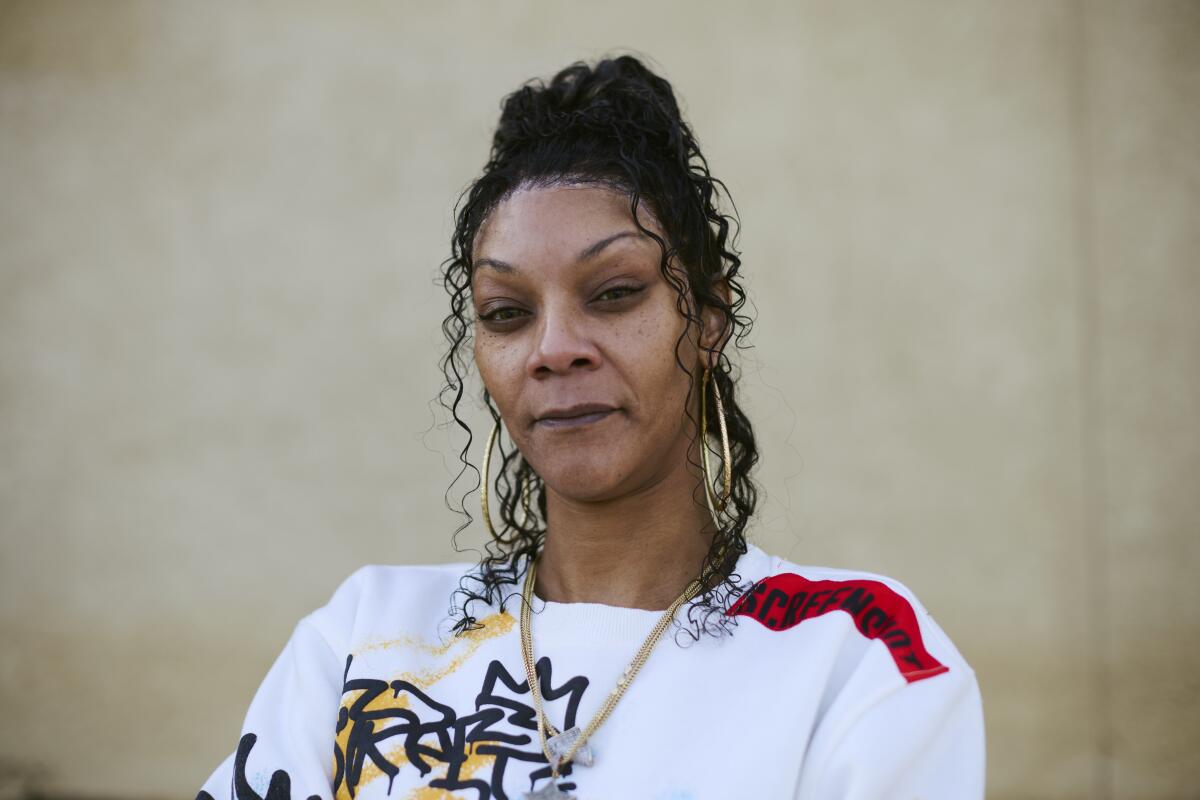
April Mannani, who says she was assaulted in the 1990s by an officer while she was housed at MacLaren Children’s Center, said she feels lawyers on the sex abuse cases are putting profits ahead of the best interests of clients.
(Jimena Peck/For The Times)
Many plaintiffs told The Times they were discouraged to see how much money stood to be made for others off their trauma.
April Mannani, 51, sued L.A. County after she said she was raped repeatedly as a teenager at MacLaren Children’s Center, a shelter now notorious for abuse. Mannani accepts that her lawyers are entitled to a cut for their work on the case, but said she was disheartened watching the numbers of cases suddenly skyrocket this year. With the district attorney investigating, a pall has been cast over the entire settlement.
“We’ve been made fools of and we were used for financial gain,” she said. “They all just see it as a money grab.”
That firm that represents her, Herman Law, has filed roughly 800 cases against L.A. County. Herman Law took out a loan in 2021 from a Delaware-registered company affiliated with Deer Finance, according to a loan notice. The firm said they use traditional bank loans for “overall operations.”

Herman Law is the most prolific filer of county sex abuse cases outside of L.A. County since the state changed the statute of limitations.
Herman Law has filed about half of these roughly 800 sex abuse lawsuits that have been brought outside of L.A. County, according to data reviewed by The Times.
Herman Law has sued several tiny counties, where public officials say they’ve been inundated with advertisements on social media and TV looking for plaintiffs. Some counties say they threw out relevant records long ago and have no way to tell if the alleged victim was ever in local custody.
A judge fined Herman Law about $9,500 last month for failing to dismiss Kings County from a lawsuit despite presenting no evidence the county ever had custody of the victim, calling the claim “factually frivolous” and “objectively unreasonable.” An attorney for Herman Law said in a court filing the client believed she’d been in a foster home there, and the lack of records didn’t conclusively establish anything.
“There are not records. There’s nothing that exists,” said Jason Britt, the county administrative officer for Tulare County, which has been sued at least eight times by Herman Law. “Counties at some point are not gonna be able to operate because you’re essentially going to bankrupt them.”
The firm said its clients are always its top priority.
“No lender or financial relationship has ever influenced, directed or played any role in legal strategy, client decisions or case outcomes, including any matters involving the Los Angeles County,” the firm said. “Herman Law’s work is driven solely by our mission to advocate for survivors in their pursuit of justice and healing.”
Joseph Nicchitta, L.A. County’s acting chief executive officer, said he believed the region’s social safety net was now “an investment opportunity.” In an October letter to the State Bar, he called out the “explosive growth” of claims, arguing a handful of firms were “competing to bring as many cases as possible” to the detriment of their existing clients.
He estimated that attorney fees in the lawsuit would amount to more than $1 billion. “It begs reform,” he wrote.

The Times’ football back of the year: Luke Fahey of Mission Viejo
The fact quarterback Luke Fahey of Mission Viejo High signed with Ohio State is impressive enough. Then look at his 2025 statistics and you begin to realize he’s going to be next in line to continue Southern California’s success in developing top quarterbacks.
Over 11 games, he only had three passes intercepted while completing 71% of his passes. He threw for 3,199 yards and 25 touchdowns. He ran for six touchdowns. He had a school-record 569 yards passing against Los Alamitos. He made a clutch touchdown pass in the second half to beat eventual Southern Section Division 1 champion Santa Margarita 7-6 in the season opener.
He clearly performed at his best when the pressure was on and Mission Viejo needed him to lift up his teammates.
“He’s the best leader I’ve had in 25 years of coaching. He’s the total package,” coach Chad Johnson said.
Fahey has been selected The Times’ back of the year.
Before this season, he was sharing time at quarterback, showing incredible unselfishness while putting his trust in the process that everything would work out when it was his time to be the full-time starter. And it did.
“He’s always been real good,” Johnson said. “He was sharing reps and didn’t allow everyone to see his greatness and what he could be. Ohio State saw it. It’s going to be crazy what he can do at the next level.”
There’s one memory Johnson won’t soon forget. It was in the visiting locker room after a game at St. Paul. Fahey stayed behind as the last person to pick up trash to leave the locker room clean. Then he headed to the bus. Only the head coach saw it. The best player on the team doing work others ignored.
“Remarkable,” Johnson said.

Organized crime drove political shift in Latin America in 2025
Members of the Rio de Janeiro Police carry out an operation in Rio de Janeiro in October. The police launched a major operation in two favelas aimed at arresting the leaders of the Red Command, the largest criminal gang in the city, and to halt its territorial expansion. File Photo by Antonio Lacerda/EPA
SANTIAGO, Chile, Dec. 19 (UPI) — After nearly two decades of relative stability, the advance of organized crime has reshaped security across Latin America.
The expansion of illicit economies, armed disputes over territorial control and rising violence triggered new migration flows and partly explain the region’s political shift toward right-wing governments in 2025.
According to a report by the Global Initiative Against Transnational Organized Crime, 39 organized crime groups are operating across Latin America.
The report said these groups have become more interconnected and sophisticated, “coordinating operations not only at the local level but also across borders and even continents.”
One of the main factors behind the expansion of criminal structures is business diversification, said organized crime specialist Hugo Contreras, who holds a doctorate in social complexity sciences and is a researcher at the School of Government at Universidad del Desarrollo.
“Organized groups stopped being just traffickers and adopted a portfolio of activities such as extortion, contract killings, smuggling, arms trafficking and human trafficking,” Contreras told UPI. “That has multiplied and diversified their sources of illicit income, as well as their territorial control and disputes.”
He said the trend has been compounded by institutional weakness, including collapsed prison systems that have turned into logistical hubs for criminal groups and judicial systems ill-prepared to confront the phenomenon.
“There has been an emergence of more aggressive and sophisticated transnational criminal gangs, with international networks, greater financial capacity and increased firepower,” Contreras said.
He added that the situation has been reinforced by “massive migration flows from different conflict regions, which these groups have exploited to conceal their members, recruit new people and expand their criminal activities into other countries.”
Pablo Carvacho, director of research and development at the Center for Justice and Society at the Pontifical Catholic University of Chile, shared that assessment, noting that organized crime is especially dynamic and adaptable.
“Migratory processes created space for the development of transnational illicit activities such as human trafficking and sexual or labor exploitation, particularly affecting a highly vulnerable group like migrants,” Carvacho told UPI.
“These flows served as an entry point for countries such as Chile, where criminal activity was not as developed as what we are seeing today,” he said.
The new scenario has deeply transformed internal security dynamics across the region, turning local problems into international threats that are more violent and more damaging to social and political stability, Contreras said.
Criminal organizations manage and contest territory, impose their own rules, control prisons and challenge state authority.
“This forces governments to move beyond traditional crime-control strategies and adopt comprehensive responses that combine financial intelligence, border security, international cooperation and prison reform,” he said.
Contreras said the impact varies widely across the region depending on how deeply organized crime has taken root in each country.
In 2025, Mexico, Ecuador, Brazil and Haiti ranked among the world’s 10 most dangerous countries based on indicators such as mortality, risk to civilians, geographic spread of conflict and the number of armed groups, according to a conflict index published by the Armed Conflict Location and Event Data Project, a nongovernmental organization known as ACLED.
The report said rising violence has been a common trend across Latin America this year. However, the sharpest deterioration was recorded in those four countries.
In Mexico, the organization linked the surge in violence to factors including an internal war within the Sinaloa cartel following the July 2024 arrest in the United States of Ismael “El Mayo” Zambada, one of the group’s historic leaders.
In Ecuador, ACLED warned that violence levels are on track to reach record highs in 2025. It said the homicide rate could be the highest in Latin America for a third consecutive year and that gang-related violence has caused more than 3,600 deaths.
In Haiti, gangs have taken advantage of the political instability the country has faced since 2021, expanding their operations from the capital, Port-au-Prince, to other areas.
In a different political context, criminal gangs in Brazil have also fueled major clashes as they fought for territorial control in cities such as Rio de Janeiro. A large-scale police operation in that city targeting the Comando Vermelho, one of the country’s main criminal groups, left 121 people dead.
The rise in violence and organized crime has contributed to at least 10 countries in the region electing right-wing governments in the 2024-2025 period.
Carvacho said more conservative platforms “place greater emphasis on public order and the intensive use of coercive tools, with strategies based on police force, military deployment, harsher criminal penalties and territorial control.”
He said these approaches often rely on emergency measures under states of exception, with rapid executive decisions and reforms, as well as a greater willingness to strengthen ties with foreign intelligence agencies, including those of the United States.
In Carvacho’s view, containing transnational organized crime requires coordination among countries because “emergency policies alone will not stop its advance.”
He said what can truly weaken these organizations is targeting their financial assets and reducing the pool of people, including children and adolescents, vulnerable to recruitment.
“Everything else is treating the symptoms of a disease,” Carvacho said. “It is arriving late to a problem that is not about criminal law but about vulnerability and the lack of opportunities in communities excluded from society. That is where the state must act.”

Top airline will make overweight passengers pay for two plane seats from next year
PLUS-SIZED passengers will have to pay for two seats when flying with a one of the world’s largest low-cost airlines, from January.
A new rule will come into play in next month requiring customers who cannot fit within the armrests of their seat to buy an extra ticket in advance.
Southwest Airlines flies across the US to 100 destinations in 42 states.
And from January 27, 2026, travellers will need to be aware of its seat changes.
It will require larger passengers who ‘encroach upon the neighbouring seat’ to buy an additional ticket for their journey.
Currently, Southwest Airlines offers plus-size passengers the chance to pay for an extra seat up front and then request a refund on the ticket later, or they can request a free extra seat at the airport.

But that policy is now changing, with passengers who need two seats required to pay for both of them when booking, with less chance of a refund.
The only situation when the second seat might be approved for a refund is if the flight departs with at least one seat still available, and if both seats have been purchased in the same fare class.
If a passenger in need of an extra seat does not buy one before the flight, they will be required to do so at the airport.
If their flight is already full when they are at the airport, the airline will book them onto a new flight.
Southwest Airlines: “To ensure space, we are communicating to Customers who have previously used the extra seat policy that they should purchase it at booking.”
“Customers who encroach upon the neighboring seat(s) should proactively purchase the needed number of seats prior to travel to ensure the additional, adjacent seat is available.
“The armrest is considered to be the definitive boundary between seats; you may review information about the width of Passenger seats.”
These aren’t the only changes coming on January 27 as on this date, the airline will begin its policy of assigning seats.
Previously, the open seating meant passengers could pick any available seat after boarding.
It worked on a first-come, first-served basis to speed up turnarounds, lower costs, and simplify travel with one cabin class.
Southwest Airlines also recently revealed its new cabin interior with seats that have been made extra comfy.
The airline showed images of its new design in October stating it has listened to travellers and improved facilities like adding USB chargers and entertainment holders.
Now, it has revealed the new design onboard its Boeing 737 MAX 8 – the airline even took passenger feedback into account when creating the new cabin.
‘Southwest’s move to charge for two seats makes perfect sense’
By LISA MINOT, Head of Travel
IT may have been the only airline to make allowances for plus-size passengers but American airline Southwest’s move to charge for two seats makes perfect sense to me.
Allowing larger travellers to book an extra seat for free may have been popular with those who struggled to fit in an airline seat, but it was hardly fair on the rest of us.
Taller passengers who want to enjoy a comfortable flight have always been forced to splash out on extra-legroom seats.
Why should those who – for whatever reason – are unable to fit in a single seat be afforded the privilege of extra space without paying?
It has covered “employee perceptions of color, comfort, and aspirations for the overall onboard experience, and it’s meant to create a cabin environment that feels modern, welcoming, and uniquely Southwest.”
The airline added that its seats “are intuitively designed for ultimate comfort, while maximizing seat width and overall support”.
For more on airlines, Jet2 has made a major change on flights and it’s great news for families.
And new EU rules that could soon make your long-haul flight more expensive.

Buh-bye 2025! 25 ways to banish this no good, very bad year

It has been a year. And for many of us, not a great one. Fires, political chaos, rising unemployment, the loss of beloved cultural icons — it’s understandable if you want to toss 2025 in the trash heap where it belongs.
And you should, at least symbolically. Ending a collective or personal era with a closing ritual can be therapeutic and allow you to make room for something new. The goal is not to work abracadabra-type magic, but to “enact a symbolic shift,” as University of British Columbia anthropologist Sabina Magliocco puts it.
“When you do a New Year’s ritual, you are symbolically shifting to a new beginning,” she said. “That might involve rituals to usher in good luck or health, more prosperity, more creativity, or just out with the old, in with the new.”
Humanity has been enacting rituals to transition from one year to the next for millennia, and they are part of our lives today — drinking sparkling beverages, watching the ball drop in Times Square, cheering as the clock strikes midnight — these are all ways of celebrating the completion of one cycle and welcoming the start of the next one with joy and the hope that this time may be better.
We’ve collected and created 25 practices to help you say goodbye to 2025. Some of our rituals are serious, others more lighthearted, yet all should be done with intention for maximum effect. We’ve included some places around L.A. that would be ideal for these activities — for instance, Downtown’s Rage Ground where you can (safely) smash a car, or San Pedro’s Cabrillo Beach, where you can plunge into water that’s freezing by L.A. standards (it’s about 59 degrees).
So sweat it out, sweep it out, dance it out or melt it away. Whichever way you choose to say good riddance, we hope it brings you a bit of peace and helps you slide purposely into the new year (which surely, hopefully, God-willing has to be better than the one we just finished, right?).
— Deborah Netburn

1. Scream into the void
“Scream therapy,” or “primal scream therapy,” dates back to the early ‘70s and is an underrated — and free — way to release bottled-up tension and anger (or a relentlessly stressful year). Find an open expanse with a dramatic view — check out our guide to shout-worthy spots in L.A. — take a few deep breaths, engage your core and let out an unbridled scream. Not ready to howl in a place where other people may be in the vicinity? A primal scream into a pillow at home can offer a similar sense of release. — Deborah Vankin
2. Sweat 2025 out of your system
Koreatown’s Wi Spa, open 24/7, has five progressively hot saunas in a coed community space. But its single hottest sauna — one of the toastiest in all of L.A. — is the Bulgama sauna. It looks like an igloo from the outside, though the interior is made mostly of oak wood. The sauna is set at an intense 231-degrees (by contrast, my gym’s dry sauna is 160-180 degrees). There are no benches to sit on; guests lie on the floor or sit upright against the wall, their faces flushing scarlet and sweat dripping down their cheeks and limbs. Tough it out for as long as you possibly can, perhaps while meditating on all you want to let go of, and sweat out every bit of this difficult year. Just be sure to hydrate afterward. — D.V.
3. Roll down a hill
If the heaviness of 2025 has you feeling stuck, shake up your perspective by making like a 5-year-old and rolling down a grassy hill. Luckily, L.A. is filled with hills perfect for rolling, including the popular Hancock Park near the La Brea Tar Pits and Museum. I guarantee that you’ll feel different at the end of your roll than you did at the start. (And if I’m wrong, try climbing the hill and rolling down again!) — Deborah Netburn

4. Jump into the ocean
The “polar bear plunge” is a popular tradition in many places, including San Pedro’s Cabrillo Beach, where people have been jumping into the water on New Year’s Day for at least 73 years. The Cabrillo Beach Polar Bears name a king and queen and hand out polar bear certificates — in fact, so many people joined in last year that the club ran out of certificates. The water in San Pedro is typically about 59 degrees. But this tradition persists in places much colder — for instance, Scheveningen, the Netherlands. There, as many as 10,000 brave bathers show up each New Year’s Eve to dip into the North Sea, which is usually between 37 and 48 degrees Fahrenheit. — Christopher Reynolds
5. Rage … and smash a car!
When I’m angry — like fuming, stomping, raging mad (which is a lot, lately, considering the state of, well, everything) — I often think of Swiss artist Pipilotti Rist’s video, “Ever Is Over All.” In it, Rist saunters down an urban sidewalk in a light blue sundress smashing car windows as she goes. The crinkly, cacophonous sound of shattering glass is amplified each time she bashes a car. Sounds awesome, right? You can do the same at L.A. Rage Rooms such as Rage Ground and Break Room Los Angeles. Visitors don protective gear while wrecking an entire automobile — windows, doors, headlights and all — to the angry playlist of their choice. Unleashing rage can be cathartic and healing — not a bad way to put 2025 behind you for f— good! — D.V.
6. Burn some incense — or join a safe, fire department-sanctioned communal blaze
Maybe you’ll spark some sage, as people do when hoping to rid a room of bad vibes. You could also burn a little incense, cedar, yerba santa, palo santo, rosemary, mugwort, juniper or sandalwood. Or, if you crave a bigger blaze, you could head up to Solvang, where on Friday, Jan. 9, the Santa Barbara County Fire Department will supervise a community Christmas Tree Burn. Local authorities bill the event as “a powerful safety demonstration” in the empty lot next to the Mission Santa Ines (1760 Mission Drive). But you’ll know that it’s really about purging the vile remnants of the last year. — C.R.
7. Walk a labyrinth
Labyrinths can be a great tool for release. To make a labyrinth walk extra meaningful, find a trinket or stone that represents 2025 to you and then walk slowly toward the labyrinth’s center, infusing the stone with whatever you want to leave behind in 2025. When you get to the center of the labyrinth, drop the stone, and breathe out the year. As you leave the center, imagine filling yourself up with your hopes for the new year. Looking for a labyrinth to walk? Check out our list of great labyrinths in the L.A. area, including the one at Peace Awareness that uses the same pattern design as the labyrinth at the Chartres Cathedral in France — D.N.
8. Travel through time
If you visit the Time Travel Mart in Echo Park or Mar Vista, you’ll come to understand that its true mission is to promote literacy and writing skills among kids. But the goofball retail goods in both shops — alleged supplies for chrononauts — are a comfort to anyone seeking maximum distance from 2025. Buy candles honoring patron saints of time travel (including theoretical physicists Stephen Hawking, Albert Einstein and Ronald Mallett). Pick up some robot milk or canned mammoth. Or, perhaps best of all, grab a copy of “The Time Traveler’s Almanac,” a 2013 collection of 72 literary “journeys through time” by writers including Douglas Adams, Isaac Asimov, Ursula K. Le Guin, George R.R. Martin and H.G. Wells. As the largest collection of time-travel stories ever assembled, it won’t just take you to 2026, but far beyond. — C.R.

9. Dance it out
Shake your booty, swing your limbs, wriggle your hips. Literally shake off the year while working up a sweat at any number of dance events. I do it at Zumba class; others at nightclubs and dance parties. LA Dance Project offers weekly, community dance classes for all levels; Wiggle Room holds improvisational movement workshops; Pony Sweat, a “fiercely noncompetitive dance aerobics celebration,” holds $10 classes on Monday nights; and Ecstatic Dance LA is a “substance-free, all ages community celebration” of dance. Even the Los Angeles Public Library holds free ‘80s-era dance classes. Or travel to another part of the world for the night at ¡BAILE!, a recurring world music dance party — one of many in L.A. You’ll forget all about 2025, if just momentarily. — D.V.
10. Challenge yourself with one of L.A.’s hardest hikes
You made it through a hard year. Celebrate by making it through a hard hike. For a serious challenge, try the Vital Link Trail at Wildwood Canyon Park in Burbank where you’ll do an elevation gain of 1,700 feet in just two miles. Because the trail is sandy and has some erosion, it’s best to navigate it with trekking poles. Also, remember that “challenging” is a relative term. If Vital Link Trail is not for you, check out other options on our list of local hikes for all skill levels. — D.N.
11. Write a year-end letter
This could be a pep talk, a condemnation of the last 12 months, a breakup letter to your past self or a hopeful letter to your future self. Or take control of your life by starting a diary, as the main character does in the Helen Fielding novel and subsequent Renée Zellweger movie “Bridget Jones’s Diary.” Maybe with less smoking, drinking and mixing it up with Hugh Grant. — C.R.

12. Visit a cemetery to reflect on the past
L.A.’s legendary Hollywood Forever Cemetery just held an end-of-year event with a cord-cutting meditation meant to help participants “dispel the shadows” of their lives and let go of what no longer serves them. You could create a similar ritual. Visit one of the city’s many cemeteries and as you stroll through the space, think about laying to rest what’s been weighing on you most this past year. — Michelle Woo
13. Be your own Death Bear
More than a decade ago, New York performance artist Nate Hill created a Death Bear character. He would appear at people’s homes in a strange black PVC costume, then remove items that triggered bad memories and take them away forever to his Death Bear Cave, location unspecified. Hill seems to have retired Death Bear, but you could always create your character to vanquish bad memories. — C.R.
14. Bury the year
You could throw 2025 in the trash, but consider composting it instead. Write down “2025” on a small scrap of paper along with an few aspects of the year you would like to leave behind. Bury the paper in a garden or a flower pot along with some seeds of your choice. Over the next few weeks, watch with satisfaction as a budding seedling transmutes 2025 into something beautiful and fresh. — D.N.
15. Shed 2025 along with your dead skin with an intense body scrub
Vigorous, bracing, borderline painful, there is nothing like a no-frills full-body scrub at one of L.A.’s many Korean spas. For as little as $50 you will feel like you’ve removed the hard crust of the bygone year from your body, emerging shiny, soft and new. Let the shedding begin! — D.N.
16. Cut your hair
Or change it. Various cultures have ideas about this and exactly when you should do it. I say the sooner we turn the page, the better. Along with shedding skin, getting a trim is one of the most literal ways you can change your body to signal a new era. — C.R.
17. Purge your closet — and donate
This summer, the fluff and fold I bring my laundry to burned down — with three enormous bags of my clothing and linens inside. At first I was upset: beyond its practical function, our clothing is an extension of our identity and often beloved items house emotional memories from the places they’ve traveled to. It felt like a loss, not to mention a financial burden. But surprisingly quickly, silver linings surfaced. My closet was roomier and more navigable — it was easier to put outfits together. Friends and family offered blankets, sheets and sweaters, and I felt supported. I somehow also felt lighter? A purposeful, DIY closet purging can feel cathartic at the end of year. And in hauling off a bag or two of your clothing to Goodwill or the Salvation Army, you’ll not only be releasing a little bit of 2025, but helping others, who need your recycled goods, in the process. — D.V.

18. Cry in the shower
I get my best creative ideas in the shower. And I indulge my fiercest sobbing sessions there as well. The act of crying — anywhere — lowers stress hormones such as cortisol and releases feel-good hormones like oxytocin. But there’s something about being in a cozy, private space, ensconced by rushing water and plumes of steam, that allows me to fully release and opens the floodgates. Try it. Bonus: no tear-stained face afterward. — D.V.
19. Rearrange your house
Switch up the energy in your home by switching up the placement of your furniture. It will help you see your space, and perhaps your life, in a fresh light. The bed in that corner? That was so 2025. The dresser on that wall? Last year’s news! Try working with the items you have before going out to buy something new. — D.N.
20. Sweep the worst of 2025 out the door
Deep cleaning followed by ritually sweeping misfortune and bad energy out of your home before the start of the Lunar New Year is a tradition in Chinese culture. I’ve also seen ritual sweeping practiced by modern witches and other spiritual questers. The ritual itself is simple but deeply symbolic: For a fresh start to the new year, fully clean your house top to bottom and then finish by holding a broom just a bit off the floor and use a sweeping motion to push the bad energy out of your house. — D.N.
21. Make a physical threshold and cross it
New Year’s Eve party idea: Just before midnight create a physical threshold on the ground using a stick, a piece of string, or draw an actual line in the sand if you happen to be at the beach (this is L.A. after all). As the clock strikes midnight, invite guests to cross the threshold one by one and cheer as you step into 2026 and leave 2025 behind. — D.N.
22. Watch 2025 melt away
Find a small candle and carve “2025” onto the side of it using a small knife. Light the candle and let it burn until 2025 has melted away. — D.N.
23. Watch the sunset
Is there a more symbolic way to say farewell to 2025 than watching the sun literally dip below the horizon for the final time on this god-awful year? Consider this nature’s ball drop. — D.N.
24. Toss 2025 into the waves
Tashlich is a Jewish new year ritual of symbolically releasing your sins by throwing them into a natural body of water. When I was a kid, my family used bread crumbs to represent our sins. Now I use small stones or torn-up bits of leaves to keep from polluting the environment. Whatever you use, hold it in your hand and imagine what it is that you want to release. Then toss it into the water and imagine yourself letting it go. The Jewish new year holiday, Rosh Hashanah, is celebrated in early fall, but there’s no reason you can’t give this ritual a whirl on the Gregorian calendar’s new year too. — D.N.
25. Take a final photo
2025 may not have looked like how you hoped it would look, but now you are in control. As the year draws to a close, set yourself a task of taking one final photo of the year that is meaningful to you. Sad or hopeful, lush or desolate: you decide. Perhaps it is someone or something you love. Or a representation of the loss you experienced. We take photos all the time without thinking. Choose to make this one count. — D.N.


‘I used to dread Christmas Day with my abusive ex’

 PA Media
TV weather presenter Ruth Dodsworth has revealed that she used to “dread” Christmas Day with her abusive ex-husband.
The 50-year-old described the festive season as serving to amplify the problems of people living with domestic violence, especially those whose partner’s behaviour is triggered by alcohol.
Her former husband Jonathan Wignall, 54, was jailed in 2021 after a nine-year campaign of harassment and stalking during their marriage.
Ms Dodsworth added that the highlight of each 25 December would be when Wignall “passed out drunk”, affording her “an hour or two of relief” with her children.
Warning: This story contains distressing content and discussion of domestic abuse
“I never knew who I was going to come home to, Jekyll or Hyde,” said Ms Dodsworth, who met Wignall in 2001, a year after she started her job as a weather presenter for ITV Wales.
“When you live with someone like that, Christmas just makes everything worse on so many levels.
“There’s more pressure on people to have a wonderful time, with more parties and more alcohol.
“And, because drink was a key part of my ex-husband’s behavioural changes, it would just make for an awful time – as it can for too many other people.”
Ms Dodsworth and Wignall married in 2002, while his controlling behaviour began about eight years later when the couple moved from Swansea to Cowbridge in the Vale of Glamorgan.
At that time she had become the family’s main breadwinner, his nightclub business having begun to fail.
“It was a volatile, frightening relationship that several times nearly cost me my life,” she told BBC Radio Wales.
“I never knew when the violence was going to happen or when it would finish.
“And I grew to dread Christmas Day because he’d start drinking in the morning.”
Ms Dodsworth added that her family “would be on eggshells” around Wignall whenever they came over, “because they were frightened of him too”.
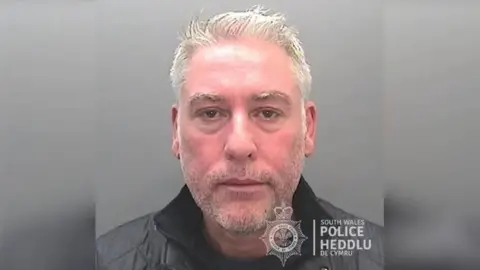 South Wales Police
“And, after they’d gone, I would be left with him – so it was a highlight when he’d pass out,” she said.
“It meant an hour or two of relief when I wasn’t frightened and could just be with my kids.”
She described feeling a lot of “mum guilt” that she “didn’t get them out of that situation sooner”.
“But, I didn’t want to admit to the outside world that there was something wrong with my marriage,” said Ms Dodsworth, adding that eventually leaving had been the best decision she ever made.
She added: “My life was saved because I got out – I asked for help and set those wheels in motion.
“It wasn’t easy, but I did it.”
‘Huge spike’ in calls for support
Stephanie Grimshaw, head of public affairs and communications at Welsh Women’s Aid, told BBC Radio Wales Breakfast one in four women experience domestic abuse in England and Wales, adding “it doesn’t change just because it’s Christmas”.
She said: “Christmas Day and the days surrounding are actually our quietest time for our helpline, but then we have a huge spike in January and the days following Christmas when survivors tell us they were not able to reach out.
“That’s really dangerous if they feel they’re not able to reach out for support.
“It’s so important those family and loved ones who are supporting survivors make them a safe space.”
If you are affected by any of the issues raised in this story, support and advice is available via the BBC Action Line.
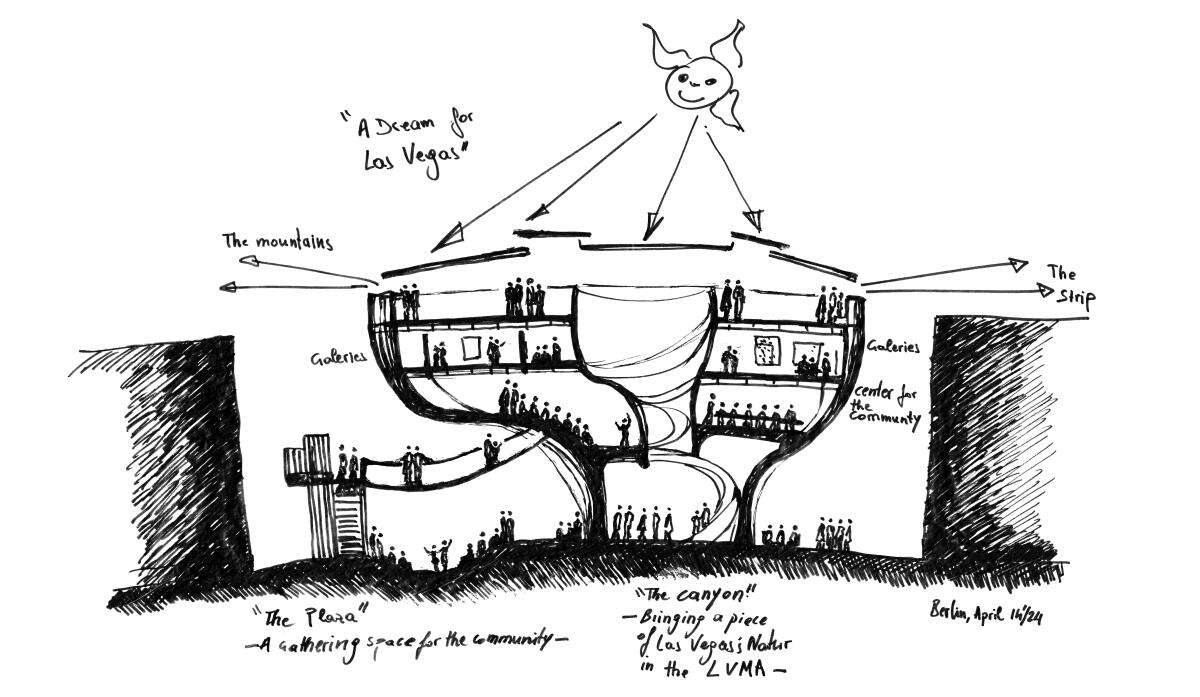
Las Vegas Museum of Art’s design by Diébédo Francis Kéré revealed
The Las Vegas Museum of Art has revealed new key details of Pritzker Prize-winning architect Diébédo Francis Kéré’s design for the city’s first freestanding museum, which is expected to break ground in 2027.
The earthy red structure will feature a facade of locally sourced stone, and was inspired by the canyons and red rock landscape that stretches beyond the brash, man-made playground of Sin City, Kéré said in an interview alongside the museum’s executive director, Heather Harmon.
“How can I use what is surrounding Las Vegas to create something open and welcoming?” he said. “We started to think about the subtle beauty of the nature, and to bring it into the core of the museum.”
Renderings of the structure, which is situated in Symphony Park, show a cubed modernist building with a large awning that stretches over a bustling entry plaza to provide shade. A curved grand entrance staircase spirals through the center of the museum and is visible from the building’s floor-to-ceiling windows. Cloistered second-floor galleries are meant to provide a peaceful sanctuary for taking in the art.
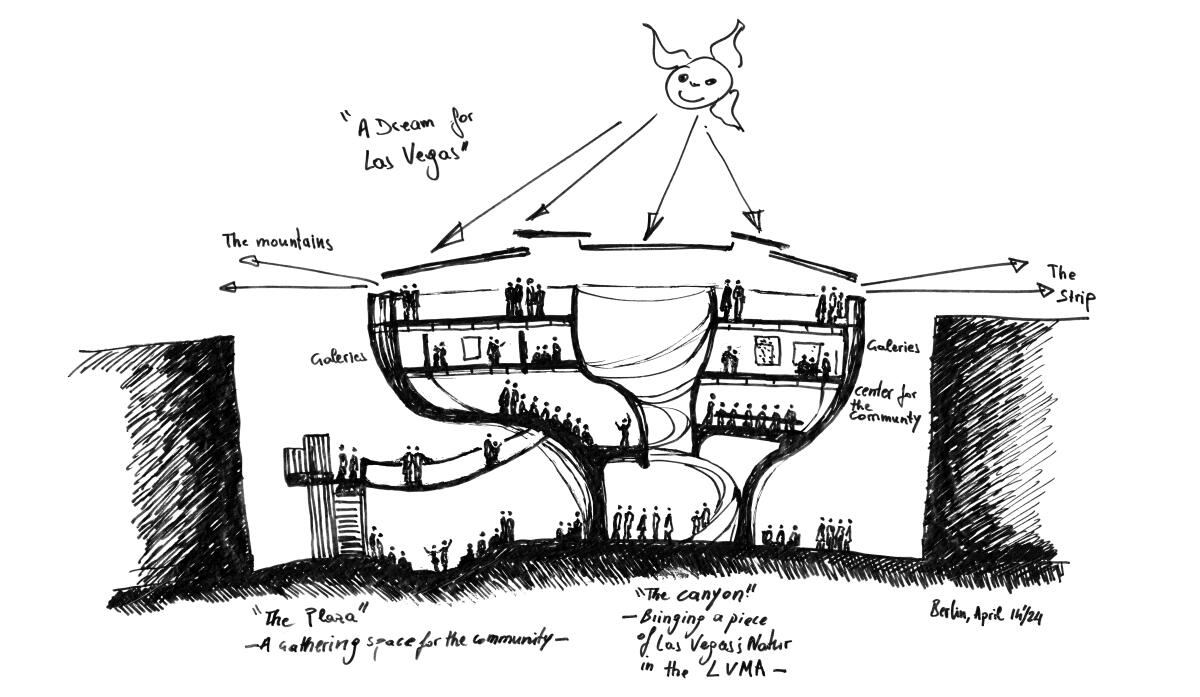
A concept sketch for the Las Vegas Museum of Art by architect Diébédo Francis Kéré.
(Diébédo Francis Kéré / Las Vegas Museum of Art)
Architect Paul R. Williams’ Guardian Angel Cathedral, which opened in the city in 1963, is cited as a design influence, as are the singular stocky trunk baobab trees of the African savanna. Kéré was born in the village of Gando in the West African country of Burkina Faso, and noted that although the natural environment of his home country is quite different from that of Las Vegas, he was able to find many design parallels for inspiration.
Kéré, who is also a professor at Yale in New Haven, Conn., has made many trips to Las Vegas over the last few years, and received personalized tours of the city and its natural surroundings from Harmon and Elaine Wynn, a museum board member and philanthropist who died in April.
They went to the Valley of Fire State Park, which features fantastical sandstone formations the same color as the museum’s renderings. They also saw various quarries as well as the Hoover Dam. In the city, they visited the west side, which is rooted in the city’s rich African American history, as well as Ward 3 on the east side, which is home to a large Latino population.
“We looked at community spaces, we looked at people in community spaces,” said Harmon. “And we really wanted to have that feeling of understanding as we approached the project — just knowing firsthand who we were building the museum for.”
The 60,000-square-foot building is expected to welcome more than 2.4 million year-round Las Vegas residents, as well as millions of global tourists. The museum is expected to cost about $200 million, including its endowment. The target opening date is in 2029.
Last year, the Los Angeles County Museum of Art announced it would share its collection with the Vegas museum, which does not have plans to become a collecting institution. LACMA director and LVMA founding trustee Michael Govan told The Times that the sharing arrangement is part of a paradigm shift for LACMA, allowing it to expand access to its collection without increasing the physical footprint of its home base. (Critics, including former Times art critic Christopher Knight, disagreed with the move.)
“I think that’s a very 20th century idea — to keep adding wings until you’re a million square feet on Fifth Avenue,” Govan said in an interview at the time.

Manchester City: Pep Guardiola says players will be weighed before Nottingham Forest game
Guardiola is known as a strict coach when it comes to player fitness levels and in 2016 exiled some of his squad from first-team training until they met certain weight targets.
Former City full-back Gael Clichy said Guardiola had told his players to avoid pizza, some juice and certain “heavy food”.
Guardiola previously apologised to Kalvin Phillips after saying the City midfielder was “overweight” on his return from the 2022 Qatar World Cup.
City are two points behind Premier League leaders Arsenal, who beat Everton 1-0 on Saturday, and face Forest before an away fixture at Sunderland on New Year’s Day.
Guardiola said he had no problem with his squad’s fitness or running, but they simply “have to play better”.
“The players asked me to have tomorrow’s [Sunday’s] training session off and I said no, because they didn’t play well enough,” Guardiola said.
“So Sunday recovery, train the guys that didn’t play, and after three days off they have two days to prepare for Nottingham Forest.”
Guardiola added that it was important for his players to spend time with their families over the Christmas period.
“I’ve learned from England, since I arrived, as much days [where you can] have a day off, you give them,” he added.
“The schedule is so tight and the players have to forget. The moment of the game they will be fresh in the legs.”

Russian general killed in car bombing in Moscow | Newsfeed
A Russian general was killed in Moscow on Monday when an explosive device detonated underneath his car. Authorities say they are investigating whether Ukrainian special services were involved.
Published On 22 Dec 2025

The best family attractions in Scotland whatever the weather, from castles to magical bluebell woods and adventure parks
If you’re heading to Scotland on a £9.50 Holiday with your family, you’ll want some ideas up your sleeve to keep the kids entertained.
Of course, there are swimming pools, playgrounds and free entertainment at your holiday park – but if you want to step outside and explore the local area, there’s plenty on offer.
We’ve asked local experts for their top recommendations on what to do with your family in Scotland, with suggestions that are never too far from our £9.50 Holiday parks.
From child-friendly aquariums to free-to-enter country parks that have brilliant playgrounds, here’s where you should take the kids first.
Adventure park thrills
For families with kids needing to burn off some energy, a day trip to an adventure park could be a good bet.
Nairn has the fabulous Landmark Forest Adventure Park around 40 minutes away.
Children will enjoy coming face-to-face with more than 22 prehistoric giants in Dinosaur Kingdom and embracing nature on a fun treetop trail (keep eyes peeled for red squirrels).
If you’re staying closer to Perth, you could instead head for Active Kids Adventure Park.
Recommended by Christopher Hill, Administration Manager at Tummel Valley Holiday Park, it has an indoor soft play and little ones will love feeding the animals.
Christopher added: “We also have magical bluebell woods at Kinclaven and seasonal fruit picking at Gloagburn Farm, which has a play park.”
Swings and steam engines
The Scottish Sun Travel Editor Heather Lowrie says: “Sundrum castle is just outside Ayr – you could go into the town and go to Ayr beach for its attractions, big swing park, and Pirate Pete’s adventure play areas for kids.
“Or turn the other way towards Galloway Forest Dark Sky Park and the Doon Valley Railway, which has steam trains and a museum with kids’ stuff.”
If trains are what your brood is into, Strathspey Steam Railway is another great idea for a family day out.
See the magnificent Cairngorm mountains from the comfort of a plush carriage, or stop off at Boat of Garten to spot ospreys at the nearby RSPB reserve.
The railway is located near Aviemore, around an hour’s drive from Tummel Valley Holiday Park.
Free family activities
In Ayrshire, near holiday parks such as Sandylands, Eglinton Country Park is ideal for a family day out without spending a penny.
As well as having 400 acres for your kids to run around in, it has a big swing park and marked routes including a STEM (Science, Technology, Engineering and Maths) trail.
Morvyn Cattanach, General Manager at Sandylands Holiday Park says: “It’s a good option for families on a budget because it’s free to enter and there are lots of picnic areas and barbecue stations.”
Other top-rated free things to do in Scotland include hiking up Arthur’s Seat and visiting the National Museum of Scotland, both in Edinburgh, and Kelvingrove Art Gallery and Museum in Glasgow.
Leaps of faith
Older kids – and parents – can test their mettle with a bungee jump.
Highland Fling is just a short drive from Tummel Valley Holiday Park and offers heart-pounding activities such as bungee jumping, bridge swings and zip lining through the valley of Killiecrankie.
Meanwhile, around 20 miles south of Ayr on the west coast, Adventure Carrick offers a range of water-based thrills, including three-hour coasteering sessions (from £55pp).
Suitable from age eight, the high-energy sessions will see you climb cliffs and leap into swirling seas near Ballantrae.
For budding scientists
If your kids are scientists in the making, expand their little minds at a family-friendly museum like Glasgow Science Centre.
Its super-engaging exhibits include a Planetarium that transports you through the solar system and a “Perception” room with mind-bending visual illusions.
Other fantastic kids’ exhibits can be found at Dynamic Earth in Edinburgh and the Dundee Science Centre.
Wildlife wonders
Wildlife lovers big and small can find their favourite species from all over the globe in Scotland.
You could head to Highland Wildlife Park near Aviemore – home to everything from polar bears and snow leopards to rare Scottish wildcats.
Or how about letting your kids be a zookeeper for the day at Camperdown Wildlife Park in Dundee?
For an aquatic adventure, SEA LIFE Loch Lomond contains a magical underwater world, and you can join turtle tea time and watch the tropical sharks being fed.

#HumAngle2025RoundUp: HumAngle’s Top 10 Atypical Stories in 2025

1. The Making and Unmaking of Abubakar Shekau
Abubakar Shekau, a founding leader of the Boko Haram terror group, killed himself with a suicide vest four years ago at his base in Sambisa, during an attack by ISWAP, an offshoot of his group. Through archived materials and interviews with over ten individuals, including former associates, friends, bodyguards, and captives of Shekau, HumAngle’s Editor-in-Chief, Ahmad Salkida, penned what is arguably the most in-depth exposé into the life of the terror leader.
Following its publication in November, our website suffered a cyber attack that took us offline for a while, but it didn’t hinder a widespread reception of the story, which sparked a national discourse on the history of the insurgency that has gripped Nigeria for over a decade, and how the terror that Shekau ignited has outlived him.
2. Maitatsine: The Preacher of Fire (1927 – 1980)
Maitatsine is a Cameroonian and Kano-based Islamic preacher whose teachings and activities turned violent, birthing several cult-like movements in Nigeria’s North that radicalised and also influenced young people. In December 1980, his ideology culminated in one of the deadliest urban uprisings in Nigerian history. This ideology, the rejection of modernity, would later influence terror leaders like Muhammad Yusuf and Abubakar Shekau.
The exposé carefully examined the unhealed wound that Maitatsine created. It is yet another archival documentation that seeks to contribute to the understanding of Nigeria’s contemporary security challenges and how they emerged from unassuming places.
3. The Boys Lured into Boko Haram’s Enclave with Food Rations
When terror groups are referred to in the media, the description is often ‘armed men’, but that’s not always the case, as we’ve reported on women terrorists and this time, young boys. For this investigation, we spent time with Hassan Audu, a 16-year-old who, alongside his brother, was captured by Boko Haram terrorists, who in turn used food to keep him within their ranks.
The story offers insight into the terror group’s recruitment strategy for child soldiers and what the governance structure is like in their enclaves in North Central Nigeria, including in the group’s logistics department, where Audu worked.
4. A Robbery Incident Killed His Wife and Unravelled His Whole Life
We spent eight months tracking the effects of one tragedy on the life of one man and then represented the story in an interactive story that blends photos, videos, illustrations, and animations. Modu Bakura, a 30-year-old resident of Bama, northeastern Nigeria, was robbed three years ago. He lost his wife in the attack and also suffered several injuries that took months to recover from.
We penned a tender narrative of this incident, and the years that have followed, and how he continues to survive amidst debt and emotional hurt.
5. What Life Could Have Been for Leah Sharibu at 22
In May, Leah Sharibu turned 22. It was also her seventh year in captivity after Islamic State West Africa Province (ISWAP) abducted her alongside 104 other schoolgirls from their dormitory in Dapchi, northeastern Nigeria. She’s the only one among the girls who remains in captivity, and has since become a global face of schoolchildren abducted in Nigeria during the reign of the insurgency in the country.
To commemorate her birthday, we sat with her only sibling to understand who she was before captivity and what she imagined her life would be like in seven years. That conversation gave birth to a speculative non-fiction narrative where we constructed what would have been, while also reflecting on her current reality, and how his family has continued to grieve her absence.
6. The Disappearing ₦aira
Two years ago, we interviewed everyday Nigerians to highlight the cost-of-living crisis that is faced in the country and how it has impacted their lives. This time around, we looked at the root of the crisis, not just the fruits. Through a data-driven interactive storytelling approach, we showed how the smaller denominations of the Nigerian Naira are disappearing
7. From Elephants to Warthogs: The Shadow Wildlife Trade Financing Boko Haram in Nigeria
Terrorism financing is one issue that comes up every time there’s a discussion about insurgency in Nigeria, and even across the world.
In this investigation, we uncovered how terror groups like Boko Haram are using wildlife to fund their activities in the country. Not only is this causing harm to communities, but animals like Elephants have also vanished in conflict-affected areas in the North East, prompting poachers and terrorists to turn to Warthogs, an overlooked species with tusks just as valuable.
8. Boko Haram is Tracking and Assassinating Defectors in Nigeria’s North East. Here’s How
Since the Nigerian government started the deradicalisation of terrorist deserters, we have extensively covered the struggle of reintegration that they face. But this report is different, it explores a challenge that is not often spoken about: the assassination of terrorists deserters by the groups they were once loyal to. Boko Haram, for instance, has created a spy network that tracks its defectors and assassinates them or forces them to return to their enclaves.
Through interviews with some deserters, we revealed how this approach has increased issues of recidivism and its impact on the Operation Safe Corridor programme.
9. The Intersection Between Healthcare and Loyalty to Terror Groups in Nigeria
In last year’s Atypical List, we featured the story of Mariam, who we used to represent women as willing participants in terror. We spoke to her again recently, and she is on the brink of recidivism. The recent USAID funding cut is making it difficult for her to access the anti-retroviral medications that were the very reason why she defected.
10. To Those We Miss
When we report on missing persons, we often tell you how they went missing and how their families are faring. So, we thought, how about we give the families of these missing persons the mic and allow them to bare their minds unfiltered? This gave birth to this heartwarming video, where families sent words to their loved ones who have gone missing, some for decades.
The provided articles delve into various socio-political issues afflicting Nigeria, highlighting key aspects of terrorism, personal tragedies, and socio-economic challenges. One article investigates Abubakar Shekau’s life and the terror he perpetuated through Boko Haram, which persisted even after his death during an ISWAP attack. Another piece explores Maitatsine, a preacher whose violent ideology influenced radical groups, affecting Nigeria’s socio-political landscape.
Further, the role of young boys being recruited into Boko Haram with promises of food, and the impact of terrorism on individuals such as Modu Bakura who lost his wife to robbery, are examined. Leah Sharibu’s continued captivity serves as a poignant reminder of unresolved insurgency impacts. Economic analysis discloses the disappearance of smaller Naira denominations amid a cost-of-living crisis. Additionally, investigations reveal Boko Haram’s reliance on illegal wildlife trade for funding and their spy networks targeting defectors. Healthcare access issues for former terrorists highlight the complex interplay between resources and loyalty. Lastly, a video gives a voice to families of long-missing persons, shedding light on their enduring hopes and struggles.

Thomas Skinner admits ‘struggle’ as he issues new statement on Strictly voting
Thomas Skinner was said to be ‘suing’ the BBC over his early exit from Strictly and has claimed that the BBC ‘rigged’ the votes to orchestrate his elimination from the dance competition
Thomas Skinner has hit back at press attention of his rumoured feud with the BBC in furious statement made on Good Morning Britain. Ahead of the Strictly Come Dancing live final on 20 December, it was reported that Skinner was ‘suing’ the BBC as he believed they had ‘rigged’ the votes to ensure he would be eliminated first, which the BBC strongly denied. The broadcaster made clear that they had not received any legal paperwork and Skinner did not confirm that he was suing.
However, after refusing to appear in the live final, Skinner posted a statement to X where he said he “received an anonymous email claiming to be from a BBC exec with stats, saying I’d received far more votes than it appeared and it wasn’t right”. Following the statement, The Mirror exclusively revealed that Skinner’s voting figures may not be as high as he believes.
READ MORE: Thomas Skinner ‘dropped by agent’ after threatening to sue BBC over Strictly axeREAD MORE: Thomas Skinner’s true Strictly voting figures revealed leaving BBC fight in tatters
A source pointed to an independent exit poll of 125,000 viewers as “clear evidence of his unpopularity.” It showed how Skinner attracted just 1805 votes, which was the lowest of any contestant on the BBC programme. The source claimed: “The poll – which is larger than an exit poll for a general election – comprehensively shows that Skinner was the least popular contestant by a long way. There is no conspiracy. These are the cold, hard facts.”
Hitting back at the article in a statement shared on Good Morning Britain, Skinner said he was “struggling to understand” why his words on X were getting so much attention. He said: “I don’t hate the BBC – they gave me my big break on The Apprentice. I had discussions with my representatives on Wednesday evening which I believed to be private and confidential and I spoke openly with them in confidence.
“I was obviously gutted when I received the email on the evening I left the show, and at first I didn’t believe it was true. When I raised this in conversation, I was advised by the BBC to seek legal advice. I’ve had a difficult year with the press attention I didn’t seek, and I’m honestly struggling to understand why this continues to escalate. “
Similarly, when approached by The Mirror, Skinner said he did not believe the low voting figures were accurate but refused to reveal how he was able to verify the “anonymous email” his information came from.
He said: “Regarding the anonymous email and verification process, I don’t wish to comment further at this time or release anything publicly. As for the voting figures, I know for a fact that the information you have is not accurate. That said, it doesn’t materially matter to me now, and I’m not looking to contest this publicly.”
Despite “not looking to contest this publicly”, Skinner made a lengthy public statement on X where he insisted his elimination was “unfair” and that a BBC exec had told him that the broadcaster was angry over his friendship with JD Vance.
He wrote: “On the night I left the show, I received an anonymous email claiming to be from a BBC exec with stats, saying I’d received far more votes than it appeared and it wasn’t right. I’ve since had the email independently verified.”
“That same email mentioned the BBC was very angry an nervous simply because I had met JD Vance (USA VICE PRESIDENT). Let me be clear, I’m not a political bloke. Never have been. I just love my country and am patriotic. I’ve been made out by the press to be this political figure. If anyone was to get an opportunity like what I did, they would have taken it. I still think it is mad that a man like me who sells mattresses out of a van can call someone that senior in the world ’s politics a friend now.”
“I have asked to see the official voting figures to back up the ones I was sent in the email but was told they couldn’t be shown to me. And have never been shown in the history of the show. I have spoke about the email I had received to senior people and the BBC welfare team, who btw I genuinely respect. And they was the ones who advised me to get legal advice because of how unfair it all was. (This was not my idea).”
However, a BBC spokesperson said Skinner never shared the email he referenced. They told the Mirror: “”In response to Tom’s latest statement, the BBC said: “Strictly Come Dancing’s public vote is independently overseen and verified to ensure complete accuracy every week. Any claims to the contrary are entirely without foundation. Unfortunately, despite requests for it, Mr Skinner is yet to share the email he references with anyone from the BBC so we are unable to comment on it.”
Like this story? For more of the latest showbiz news and gossip, follow Mirror Celebs on TikTok , Snapchat , Instagram , Twitter , Facebook , YouTube and Threads .

Shea Serrano’s book headlines great year for Latino sports books
When Fernando Mendoza won the Heisman Trophy this weekend with another Latino finalist looking on from the crowd, the Cuban-American quarterback did more than just become the first Indiana Hoosier to win college football’s top prize, and only the third Latino to do so. He also subtly offered a radical statement: Latinos don’t just belong in this country, they’re essential.
At a time when questions swirl around this country‘s largest minority group that cast us in a demeaning, tokenized light — how could so many of us vote for Trump in 2024? Why don’t we assimilate faster? Why does Supreme Court justice Brett Kavanaugh think it’s OK for immigration agents to racially profile us? — the fact that two of the best college football players in the country this year were Latino quarterbacks didn’t draw the headlines they would’ve a generation ago. That’s because we now live in an era where Latinos are part of the fabric of sports in the United States like never before.
That’s the untold thesis of four great books I read this year. Each is anchored in Latino pride but treat their subjects not just as sport curios and pioneers but great athletes who were and are fundamental not just to their professions and community but society at large.

Shea Serrano writing about anything is like a really great big burrito — you know it’s going to be great and it exceeds your expectations when you finally bite into it, you swear you’re not going to gorge the thing all at once but don’t regret anything when you inevitably do. He could write about concrete and this would be true, but his latest New York Times bestseller (four in total, which probably makes him the only Mexican American author with that distinction) thankfully is instead about his favorite sport.
“Expensive Basketball” finds Serrano at his best, a mix of humblebrag, rambles and hilarity (of Rasheed Wallace, the lifelong San Antonio Spurs fan wrote the all-star forward “would collect technical fouls with the same enthusiasm and determination little kids collect Pokémon cards with.”) The proud Tejano’s mix of styles — straight essays, listicles, repeated phrases or words trotted out like incantations, copious footnotes — ensures he always keeps the reader guessing.
But his genius is in noting things no one else possibly can. Who else would’ve crowned journeyman power forward Gordon Hayward the fall guy in Kobe Bryant’s final game, the one where he scored 60 points and led the Lakers to a thrilling fourth-quarter comeback? Tied a Carlos Williams poem that a friend mistakenly texted to him to WNBA Hall of Famer Sue Bird? Reminded us that the hapless Charlotte Hornets — who haven’t made it into the playoffs in nearly a decade — were once considered so cool that two of their stars were featured in the original “Space Jam?” “Essential Basketball” is so good that you’ll swear you’ll only read a couple of Serrano’s essays and not regret the afternoon that will pass as quickly as a Nikola Jokic assist.
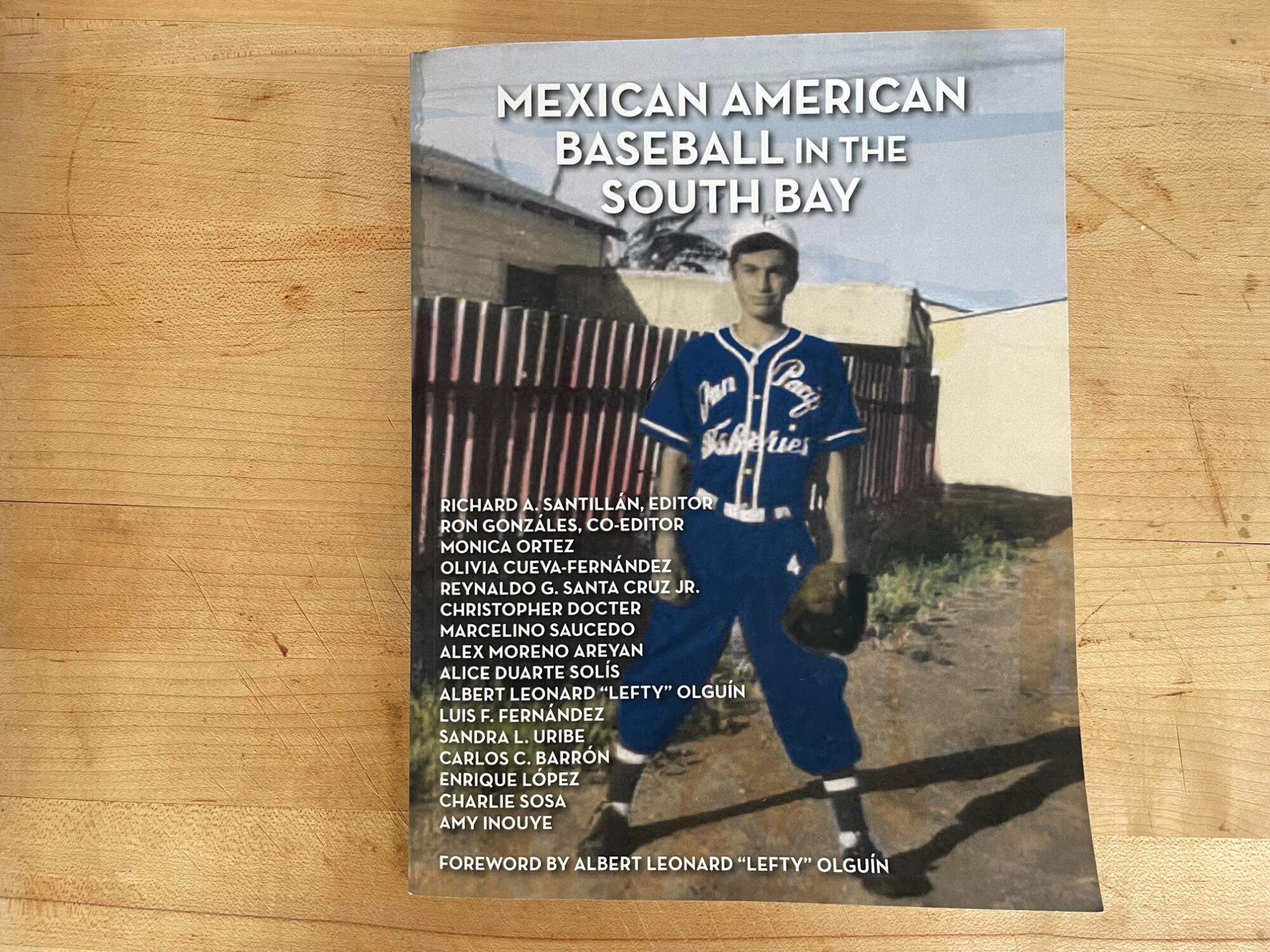
“Mexican American Baseball in the South Bay”
(Gustavo Arellano/Los Angeles Times)
I recommended “Mexican American Baseball in the South Bay” in my regular columna three years ago, so why am I plugging its second edition? For one, the audacity of its existence — how on earth can anyone justify turning a 450-page book on an unheralded section of Southern California into an 800-page one? But in an age when telling your story because no one else will or will do a terrible job at it is more important than ever, the contributors to this tome prove how true that is.
“Mexican American Baseball in the South Bay” is part of a long-running series about the history of Mexican American baseball in Southern California Latino communities. What’s so brilliant about this one is that it boldly asserts the history and stories of a community that too often get overlooked in Southern California Latino literature in favor of the Eastsides and Santa Anas of the region.
As series editor Richard A. Santillan noted, the reaction to the original South Bay book was so overwhelmingly positive that he and others in the Latino History Baseball Project decided to expand it. Well-written essays introduce each chapter; long captions for family and team photos function as yearbook entries. Especially valuable are newspaper clippings from La Opinión that showed the vibrancy of Southern Californians that never made it into the pages of the English-language press.
Maybe only people with ties to the South Bay will read this book cover to cover, and that’s understandable. But it’s also a challenge to all other Latino communities: if folks from Wilmington to Hermosa Beach to Compton can cover their sports history so thoroughly, why can’t the rest of us?

(University of Colorado Press)
One of the most surprising books I read this year was Jorge Iber’s “The Sanchez Family: Mexican American High School and Collegiate Wrestlers from Cheyenne, Wyoming,” a short read that addresses two topics rarely written about: Mexican American freestyle wrestlers and Mexican Americans in the Equality State. Despite its novelty, it’s the most imperfect of my four recommendations. Since it’s ostensibly an academic book, Iber loads the pages with citations and references to other academics to the point where it sometimes reads like a bibliography and one wonders why the author doesn’t focus more on his own work. And in one chapter, Iber refers to his own work in the first person — profe, you’re cool but you’re not Rickey Henderson.
“The Sanchez Family” overcomes these limitations by the force of its subject, whose protagonists descend from Guanajuato-born ancestors that arrived to Wyoming a century ago and established a multi-generational wrestling dynasty worthy of the far-more famous Guerrero clan. Iber documents how the success of multiple Sanchez men on the wrestling mat led to success in civic life and urges other scholars to examine how prep sports have long served as a springboard for Latinos to enter mainstream society — because nothing creates acceptance like winning.
“In our family, we have educators, engineers and other professions,” Iber quotes Gil Sanchez Sr. a member of the first generation of grapplers. “All because a 15-year-old boy [him]…decided to become a wrestler.”
Heard that boxing is a dying sport? The editors of “Rings of Dissent: Boxing and Performances of Rebellion” won’t have it. Rudy Mondragón, Gaye Theresa Johnson and David J. Leonard not only refuse to entertain that idea, they call such critiques “rooted in racist and classist mythology.”
(University of Illinois Press)
They then go on to offer an electric, eclectic collection of essays on the sweet science that showcases the sport as a metaphor for the struggles and triumphs of those that have practiced it for over 150 years in the United States. Unsurprisingly, California Latinos earn a starring role. Cal State Channel Islands professor José M. Alamillo digs up the case of two Mexican boxers denied entry in the United States during the 1930s, because of the racism of the times, digging up a letter to the Department of Labor that reads like a Stephen Miller rant: “California right now has a surplus of cheap boxers from Mexico, and something should be done to prevent the entry of others.”
Roberto José Andrade Franco retells the saga of Oscar De La Hoya versus Julio Cesar Chávez, landing less on the side of the former than pointing out the assimilationist façade of the Golden Boy. Mondragón talks about the political activism of Central Valley light welterweight José Carlos Ramírez both inside and outside the ring. Despite the verve and love each “Rings of Dissent” contributors have in their essays, they don’t romanticize it. No one is more clear-eyed about its beauty and sadness than Mondragón’s fellow Loyola Marymount Latino studies profe, Priscilla Leiva. She examines the role of boxing gyms in Los Angeles, focusing on three — Broadway Boxing Gym and City of Angels Boxing in South L.A, and the since-shuttered Barrio Boxing in El Sereno.
“Efforts to envision a different future for oneself, for one’s community, and for the city are not guaranteed unequivocal success,” she writes. “Rather, like the sport of boxing, dissent requires struggle.”
If those aren’t the wisest words for Latinos to embrace for the coming year, I’m not sure what is.
Nearly half of Korean exporters cite China’s low-price competition as top challenge
Results of the Korea Federation of SMEs’ “2026 SME Export Outlook Survey.” Graphic by Asia Today and translated by UPI
Dec. 21 (Asia Today) — Nearly half of South Korea’s small and medium-sized exporters expect their overseas shipments to decline next year, with many citing intensifying low-price competition from China as their biggest challenge, a survey released Sunday found.
The Korea Federation of SMEs said its “2026 SME Export Outlook Survey” polled 1,300 exporting SMEs from Dec. 1-12.
In the survey, 68.6% of respondents said they expect exports to increase in 2026 compared with this year, while 31.4% forecast a decrease, the federation said.
Among firms expecting export growth, cosmetics exporters (86.4%) and medical and biotech exporters (86.1%) were the most optimistic, the federation said. The most common reason for expecting export growth, in multiple responses, was improved product competitiveness through new product launches and quality improvements (47.1%), followed by diversification of export markets (29.8%) and improved price competitiveness due to exchange rate appreciation (21.6%).
Among SMEs forecasting weaker exports, 49.3% cited intensifying low-price competition from China as their main export challenge, followed by greater exchange rate volatility (44.6%), sharp increases in raw material prices (37.0%) and uncertainty over U.S. and European Union tariff policies (35.0%), the federation said.
Planned responses to weaker export performance included diversifying export markets (28.2%), improving quality or launching new products (23.0%) and reducing production costs such as labor and raw materials (21.8%), according to the survey.
Despite tariff concerns, the United States ranked first among markets SMEs most want to enter or expand into, at 21.0% when combining first-, second- and third-priority choices, the federation said. Europe followed at 15.2%, with Japan and China tied at 10.6%.
For government priorities to strengthen export competitiveness, respondents most frequently called for expanding support for an export voucher program (53.5%), followed by building a system to counter China’s low-cost offensive (35.8%) and strengthening diplomacy to respond to U.S. and EU tariffs (35.1%), the federation said. Other priorities included expanding support for participation in overseas exhibitions, including in emerging markets (31.5%) and supporting overseas certification and regulatory compliance (27.2%).
Chu Moon-gap, head of the federation’s economic policy division, said it was significant that SMEs are projecting export growth by improving competitiveness despite external headwinds such as tighter export regulations by various countries. He added that companies’ ability to reduce total costs, including production and logistics costs, tariffs and lead times, will be key to export competitiveness and said the government should prepare cost-reduction support measures to help SMEs respond to China’s low-cost competition.
– Reported by Asia Today; translated by UPI
© Asia Today. Unauthorized reproduction or redistribution prohibited.

Understanding Honduras’ Post-Election Crisis
Honduras’ presidential election occurred on November 30, but nearly three weeks later, there is still no clear winner. The elections have faced issues with the vote counting process, allegations of fraud, and U. S. involvement. Conservative candidate Nasry Asfura of the National Party leads center-right candidate Salvador Nasralla of the Liberal Party by about 43,000 […]
The post Understanding Honduras’ Post-Election Crisis appeared first on Modern Diplomacy.

Helen Flanagan sets pulses racing in sexy Christmas lingerie after fresh swipe at ex Scott Sinclair
HELEN Flanagan looked sensational as she stripped to Santa-themed lingerie for a sexy social media post.
The actress’ sizzling snaps, which saw her posing in a plunging lace bodysuit with white fur trim as well as a red camisole with matching thong, came as she teased “Meet the new Santa Clause”.
The Coronation Street alum’s latest Instagram upload comes after her feud with her ex Scott Sinclair escalated.
Recently, she branded her ex a “piece of s**t” as he lived it up in Abu Dhabi, rather than attending their son’s nativity play.
Yet appearing to put their bad blood to one side, she struck a series of looks while donning her racy Ann Summers clobber.
Helen, 35, was seen perched on her bed as she played around with a bow on her semi-sheer top before writing her own list to Father Christmas himself.

She then hopped over to wrap some presents under her tree in a fir-trim one piece.
The screen star, best-known for playing Corrie’s Rosie Webster, then held two jugs of milk while donning her Christmassy bodysuit before pouring one into a mug emblazoned with the words “Santa’s little helper”.
She finished off the clip by teasingly untying her one-piece and flashing a cheeky smile to the camera.
In her caption, Helen wrote: “Meet the new Santa Clause.”
A fan wrote: “You look stunning.”
Another put: “Well hello gorgeous.”
A third put: “Wow Helen your so beautiful merry Christmas.”
HUGE CLASH
Helen split from her ex-fiancé in 2022 after 13 years together and they share three children Matilda, 10, Delilah, seven, and Charlie, four.
She recently took to her social media pages to praise her mum for her support in raising their brood.
Soap characters who’ve been recast
Soap operas are staple viewing for many people, but even some of the most famous characters have been played by different actors. Here are some examples from over the years.
- Tracy Barlow: Kate Ford took on the role of Corrie legend Tracy Barlow in 2002. Before Kate, three other actresses had played Tracy – most notably Dawn Acton from 1988 to 1999.
- Nick Tilsley: Ben Price has been playing Gail’s oldest child in 2009, but the former Footballers’ Wives star is the third actor to take on the part.
- Sarah Platt: Although Tina O’Brien debuted as Sarah Platt in 1999, she is the third actress who has played the iconic role of Sarah Platt.
- David Platt: Completing the line-up of Gail’s children, David was initially played by Thomas Ormson for a decade before Jack P. Shepherd took over.
- Daniel Osbourne: For almost a decade, the role of Ken Barlow’s son Daniel has been portrayed by actor Rob Mallard. Before Rob joined, two other actors had previously played Daniel.
- Bethany Platt: Fans know Lucy Fallon as Bethany nowadays but before her, three other actresses had stepped into the character’s shoes.
- Kirk Sutherland: Before Andy Whyment took on the role of Kirk, he played by an uncredited actor in his very first appearance.
- Todd Grimshaw: Gareth Pierce stepped into the role of Todd back in 2020, becoming the second performer to play this part.
- Summer Spellman: Harriet Bibby became the second actress to play Summer, taking over the role from Matilda Freeman in 2020.
- Ryan Connor: Ryan Prescott currently plays the long-running character, but Ben Thompson and Sol Heras had earlier portrayed the role.
- Martin Fowler: Although Martin was the first baby born on-screen in EastEnders, he hasn’t always been played by the same person. His current portrayer, James Bye, is the third actor to star as the character.
- Peter Beale: Seven actors have portrayed Ian Beale’s elder son, with the current actor, Thomas Law, in his second stint as the character.
- Ben Mitchell: Ben has been played by a total of six actors – with Max Bowden bowing out of the role in March 2024.
- Bobby Beale: Before Clay Milner Russell, Ian’s younger son had been played by four other actors.
- Freddie Slater: Bobby’s best mate, Freddie Slater, had been previously played by twins Alex and Tom Kilby before Bobby Brazier took over in 2022.
- Chelsea Fox: Former Coronation Street actress Zaraah Abrahams took over the role of Chelsea in 2020. The character had been first played by Tiana Benjamin from 2006 to 2010.
- Lauren Branning: Jacqueline Jossa took on the role of Lauren in 2010, succeeding Madeline Duggan who’d played her from 2006 to 2010.
- Johnny Carter: Johnny has been played by three actors since debuting in 2013 – most recently, Charlie Suff has taken on the role.
She is currently starring as The Wicked Queen in a production of Snow White in Liverpool and said her mum, Julia, has practically raised her kids while she treads the boards.
Yet this came after she lashed out at her Bristol Rovers footballer ex Scott after he missed their son Charlie’s nativity play to party at the Formula One.
“You really are a piece of s***,” Helen raged, as she shared Scott’s Instagram post.
“How dare you not turn up to Charlie’s nativity.”
Scott, 36, had posted snaps from his weekend in the United Arab Emirates where he watched Lando Norris secure his maiden Drivers’ Championship title.
“What a weekend-Abu Dhabi F1,” Scott wrote.
He added: “Happy Days, blurry nights..”
Meanwhile Helen posted a snap of her cuddling their son, writing: “Loved Charlie’s nativity. My star, my heartbeat.”
She recently hinted at trouble “co-parenting” with Scott, telling The Sun: “He lives like Somerset and I live in Lancashire. So we live so far away from each other, which is really difficult when you’ve got three young children.
“I hate calling it co-parenting because I don’t really feel like a co-parent to be honest with you anyway.”

Fikayo Tomori on AC Milan, Thomas Tuchel and World Cup dreams
At AC Milan’s Milanello training base images of club legends adorn the walls. After all, it was Paolo Maldini who rang Tomori on Zoom before he joined and was instrumental in him moving.
“It’s mad. You walk in every day and you see pictures of players like Maldini, (Franco) Baresi, Kaka, Zlatan (Ibrahimovic) and (Alessandro) Nesta,” says Tomori.
“So you definitely feel the expectation knowing those players were in the same building.
“And it comes from the fans you meet in the city. You realise how much weight the shirt holds.
“I love that they’re so proud of the club and there’s an expectation for us to deliver and do what those before did.”
Tomori has fond memories of the summer after winning Serie A in 2022, and there is of course an eye on the summer ahead. Winning the Scudetto would surely enhance his chances of going to the World Cup with England.
“Of course, I want that for myself and I know that winning the league will help,” he says.
Tomori was born in Canada and played for their Under-19s, and revealed recently that he was never asked to consider Nigeria, where his parents are from.
He made his England debut in 2019 and won five caps under Gareth Southgate but, even though it has been two and a half years since his most recent international call-up, current England manager Thomas Tuchel remains in touch.
When Tomori left Chelsea for Milan on loan initially in 2021, Tuchel became Chelsea boss four days later.
“I spoke to him after the last international break in November. We’ve spoken a few times and the message is to keep doing what I’m doing,” Tomori says.
“The World Cup is six months away and there’s a lot of football to be played.
“I know he’s watching and keeping an eye because he called up (team-mate) Ruben Loftus-Cheek. That gives me the confidence I can make it.
“He came to Milan last season and I know he gets our data and sees our clips regularly too.
“The way he’s spoken about it is that it’s difficult because there’s so many players in that position, and I get it because you have players like John Stones, Marc Guehi, Dan Burn and Ezri Konsa.
“But the World Cup is still a dream and I’m working towards that.”
Achieve that dream and the likelihood is that his neighbour will be waiting in Dallas when England face Croatia in their first game at the World Cup.
Luka Modric, who joined AC Milan in the summer, lives in the same apartment complex as Tomori.
“I guess it’s not too shabby of a building then,” jokes Tomori.
Does he ever pick the brain of the former Ballon d’Or winner?
“Yes, but it’s more about listening when he speaks and seeing the way he carries himself and trains. You just know the levels and, because it’s Modric, whenever he speaks you just listen.”
All that listening will certainly come in handy for both Tomori and England if he does make the cut for the World Cup.

Is the US making a great gamble to reshape Iraq? | Donald Trump
United States President Donald Trump’s second administration has introduced a bold and unconventional strategy for the Middle East. The administration intends to recalibrate US influence in a region historically scarred by conflict, prioritising regional stability through economic strength and military consolidation by asserting a stronger, business-minded US presence.
At the centre of Trump’s ambitious goal is what the new US envoy to Iraq, Mark Savaya, described as his goal to “make Iraq great again”. This approach moves away from traditional endless war tactics towards a transactional, results-oriented diplomacy that aims to restore Iraqi sovereignty and economic vitality. It could be the “great gamble” for Trump, who seeks an Iraq that serves as a stable, sovereign regional hub rather than a battleground for foreign interests.
Trump’s primary plans and wishes for Iraq involve a twofold mission: consolidating all armed forces under the command of the legitimate state and drastically reducing the influence of malign foreign players, most notably Iran. The administration seeks to open Iraqi markets to international investment, upgrade the country’s infrastructure, and secure the independence of its energy sector. Hence, the plan is to ground a genuine partnership that respects Iraq’s unity while ensuring that it is no longer a central node for militia activity or external interference.
Militias and political gridlock
This assertive US strategy lands directly in a highly contested and fractured political environment in Iraq, which is less a single state than a patchwork of competing powers. The heart of the problem lies not just in parliament, but also in the persistent shadow influence of armed factions and militias that often operate outside the formal chain of state command. Those groups were among the biggest winners in the November 2025 elections.
Now the ongoing government negotiations have thrown a stark light on these non-state actors.
Their power raises crucial concerns for the future: How can Iraq enforce the law and, crucially, attract the foreign investment needed for revival if armed groups challenge state authority? The consolidation of the country’s armed forces under complete state control is an urgent necessity, underscored by rising regional tensions and security threats.
Moreover, the path to achieving genuine stability is severely obstructed by entrenched political interests.
For Iraq to achieve stability, it must urgently strengthen its institutional frameworks and clearly establish a separation of powers. Yet, many political parties seem more focused on maintaining control over lucrative state resources than on implementing the meaningful reforms the country desperately needs. The result is a governance model struggling to stand firm amid the crosscurrents of competing loyalties and power grabs.
Washington’s play
To achieve these high-stakes goals, Trump has bypassed traditional diplomatic channels by appointing Mark Savaya as the US special envoy to Iraq on October 19. Such an appointment signals a shift towards “deal-making” diplomacy. Savaya’s mission is to navigate the complex political turmoil following Iraq’s parliamentary elections to steer the country towards a stable transition. His job is to bridge the gap between institutional support and massive financial investment, acting as a direct representative of Trump’s business-centric foreign policy.
Savaya is an Iraqi-born, Detroit-based businessman lacking the traditional diplomatic background; his experience is rooted in the private sector in the cannabis industry, but he gained political prominence as an active supporter of Trump’s campaign in Michigan.
He played a key role in the delicate negotiations that secured the release of Elizabeth Tsurkov, the Israeli-Russian academic and Princeton University student who had been kidnapped by an Iraqi militia for more than two years.
Savaya’s communal and ethnic ties have given him significant access to Iraqi power centres that traditional diplomats often lack.
The Iran factor
Iraq’s position in a geopolitical tug-of-war is compounding the internal struggles, forced to balance its critical relationships with two giants: the US and Iran. On the one hand, Washington’s objective is clear: it wants to bolster Iraq’s sovereignty while simultaneously pushing back against the dominance of powerful, often Iran-backed, militias. The US believes that allowing these armed groups too much sway could leave the nation isolated and wreck its fragile economic stability.
But Iranian influence remains a formidable and enduring force. Tehran views Iraq not just as a neighbour but also as a crucial strategic ally for projecting its power across the entire region. The Islamic Revolutionary Guard Corps (IRGC) has been actively working to maintain unity among key Shia factions in Baghdad. This move clearly signals Iran’s deep and enduring interest in shaping Iraq’s political alignment and its future path. Iraq must therefore navigate this high-stakes balancing act to survive.
Savaya’s mission unfolds at a time when Iran’s regional “axis of resistance” is under unprecedented pressure. Having already lost their primary foothold in Syria after the fall of the Assad regime in late 2024, and seeing Hezbollah’s political and military standing in Lebanon severely decimated by the 2025 conflict with Israel, Iranian proxies now face the very real prospect of losing their grip on Iraq too.
In Lebanon, a new government is committed to regaining the state’s monopoly on the use of force, leaving Hezbollah increasingly isolated. This regional retreat means that for Tehran, maintaining influence in Baghdad is a final, desperate stand to remain a relevant regional power.
Other regional actors
The success of Trump’s gamble also depends on the roles of other regional players. Turkiye has recently recalibrated its strategy to integrate Iraq into ad hoc regional trade and security frameworks, effectively diluting Iran’s centrality. Simultaneously, Gulf monarchies such as Saudi Arabia and the United Arab Emirates are emerging as key economic and security partners for Baghdad, offering an alternative to reliance on Iran.
However, these regional actors also bring their own agendas — such as Turkiye’s focus on containing Kurdish movements — which may conflict with US objectives. If Savaya can successfully align these diverse regional interests with Trump’s plan, he may fundamentally rewrite Iraq’s turbulent future.
A realist pragmatism
The “Make Iraq Great Again” strategy reflects a pragmatic reassertion of US interests within the anarchic international system, prioritising Washington’s security and economic power over idealistic goals.
By appointing Savaya — an unconventional, business-oriented envoy — the Trump administration is employing “transactional realism”, utilising economic diplomacy and personal ties as strategic tools to pull Iraq away from Iran’s orbit. This approach views the US-Iran rivalry as a zero-sum game of power politics, where integrating Iraq’s armed forces under centralised state control is fundamental to restoring a state-centric order and sidelining non-state militias that currently feed Tehran’s regional influence.
The new US envoy to Iraq has made clear that “there is no place for armed groups in a fully sovereign Iraq”. His calls resonated with Iraqi officials and militia leaders alike – now at least three militias close to Iran have publicly agreed to disarm. However, other groups have yet to do the same, while rejecting the call from the outset.
However, this high-stakes attempt to shift the regional balance of power faces a significant “security dilemma”, as aggressive moves to diminish Iranian influence may trigger a violent defensive response from Tehran to protect its remaining strategic assets. While the strategy seeks to exploit a regional shift – leveraging the weakened state of Iranian proxies in Syria and Lebanon – it must contend with the “hybrid” power of Iraqi militias and the narrow self-interests of neighbouring players like Turkiye and the Gulf states.
The success of this gamble depends on whether the US can dismantle the shadow economies that facilitate foreign interference and establish a stable, autonomous Iraqi state capable of navigating the intense geopolitical tug-of-war between Washington and Tehran.
The stakes for Iraq’s future
Ultimately, the appointment of Savaya serves as the definitive stress test for Iraqi sovereignty, marking a high-stakes transition towards a transactional “America First” strategy aimed at “Making Iraq Great Again”. By attempting to consolidate military command under the state and dismantle the shadow economies fuelling Iranian influence, Savaya’s mission seeks to exploit the current regional weakening of Tehran’s proxies to transform Iraq into a stable, autonomous hub.
However, the success of this “Great Gamble” hinges on Savaya’s ability to overcome entrenched political opposition and reconcile the presence of US forces with the demand for national unity. If this unconventional diplomatic push can bridge internal divides — particularly between Baghdad and the semi-autonomous Kurdish region in the north — Iraq may finally secure a path towards economic independence; otherwise, the nation risks remaining a perpetual battleground caught in the geopolitical crossfire between Washington and Tehran.
The views expressed in this article are the author’s own and do not necessarily reflect Al Jazeera’s editorial stance.

Sudanese bloc declares Nairobi roadmap, but is it a civilian breakthrough? | Sudan war News
On December 16, Sudanese political parties, armed movements, civil society organisations, and prominent political figures signed a nine-point political roadmap in Nairobi, presenting it as a civilian-led initiative aimed at ending Sudan’s war and restoring a democratic transition.
Framed as an antiwar, pro-peace platform, it seeks to position civilians as a “third pole” against the two military actors in Sudan’s conflict: the Sudanese Armed Forces (SAF) and the paramilitary Rapid Support Forces (RSF).
Its authors say it represents an attempt to reclaim political agency for civilians after months of marginalisation by armed actors and foreign mediators, even though the declaration does not outline any concrete steps towards military reform.
The roadmap reignited longstanding debates within Sudanese political and civic circles about representation, legitimacy, and the persistent dominance of elite-driven civilian politics.
The roadmap
The Nairobi declaration emerged after a statement released by the Quad – Egypt, Saudi Arabia, the United Arab Emirates (UAE), and the United States – in September.
The Quad statement called for an immediate three-month truce to lead to a permanent ceasefire, humanitarian access to help civilians, and the creation of a political process for a civilian transition.
It also emphasised excluding remnants of former President Omar al-Bashir’s regime and reforming Sudan’s security forces under civilian oversight, all points that the Nairobi declaration echoed.
The Nairobi signatories included the National Umma Party, the Sudanese Congress Party, civil society organisations – including the Darfur Lawyers Association and the Coordination of Internally Displaced Persons and Refugees – and the Sudan Liberation Movement (SLM-AW) led by Abdelwahid al-Nur.
Former Prime Minister Abdalla Hamdok, who led Sudan’s transitional civilian government from al-Bashir’s overthrow in 2019 until the October 2021 military coup by the SAF and the RSF working in concert, also signed the declaration.
It was likewise endorsed by al-Nur, longtime leader of the SLM-AW armed group that controls Jebel Marra in Darfur and has historically rejected what he describes as “elite-driven” political settlements.
Falling short
Sudanese researcher Hamid Khalafallah told Al Jazeera that despite the intent to present a civilian leadership, the declaration falls short of reflecting Sudan’s broader civic movement.
The Nairobi coalition, he argued, mirrors earlier civilian formations that failed to connect with Sudanese citizens, particularly those most affected by the war.
“It’s in many ways a reproduction of former groups that have … struggled to represent the Sudanese people,” he said. “It’s still very much an elite group that does politics in the same way they always have.”
Although resistance committees – neighbourhood groups that emerged from Sudan’s protest movement and helped topple al-Bashir in 2019 – were referenced in the declaration, no committees formally endorsed or signed it.

Drafts were reportedly shared with some grassroots groups, but the process advanced without waiting for collective deliberation – reinforcing concerns that civilians on the ground remain politically instrumentalised rather than empowered.
While al-Nur’s participation was hailed by some as a breakthrough, Khalafallah questioned the underlying motivation, arguing that his inclusion was intended to counterbalance rival military-aligned forces rather than transform civilian politics.
Before the Nairobi declaration, there were three main civilian coalitions in Sudan, each aligned with a warring party or accused of such an alliance.
Tasis is the coalition of political parties and armed movements that was founded in February 2025, before forming the RSF’s parallel government in July 2025, while the Democratic Bloc is a grouping of parties and armed groups aligned with the SAF.
Finally comes Hamdok’s Sumoud, comprising political parties and civil society organisations and accused by SAF of supporting the RSF.
Europe’s one-track civilian strategy
European officials have distanced themselves from the Nairobi initiative.
A senior European Union diplomat, speaking on condition of anonymity, told Al Jazeera that Brussels does not see the Nairobi roadmap as the foundation for a unified civilian process.
“We would like to see only one civilian process, that’s why we are helping the African Union [AU],” the source said. “Everything else is a distraction, like this Nairobi one.”
According to the EU official, the priority is not multiplying civilian platforms but consolidating them under a single credible framework, led by the AU and broadly accepted by Sudanese society.
“Our aim is to create a credible third pole – versus RSF and SAF,” the source said. “An inclusive one, supported by most Sudanese citizens.”
The EU plans to build a broad coalition that can take the lead after the Quad’s humanitarian truce and ceasefire proposals are accepted by the SAF and the RSF, including reforms placing security forces under civilian-led oversight.
The EU’s language reflects growing frustration among international actors with Sudan’s fragmented civilian landscape, while insisting that abandoning it would legitimise military rule by default.
“Of course, we are not naive that civilians will take over tomorrow,” the source said. “But we have to stand for our values.”
The EU official was blunt in assessing the conduct of Sudan’s warring parties, rejecting narratives that frame either side as a governing authority.
“I would not call what RSF does in Darfur ‘governing’, SAF is a bit better – but not much,” the source said.
“Look at the oil deal they did,” the official added. “Money is important; people are not.”
They referred to the latest agreement between the SAF and the RSF – under South Sudanese mediation – that both would withdraw from the Heglig oil facility, with South Sudanese troops deployed to secure the refinery following SAF’s pullout and the RSF’s capture of the site.
Warring parties as spoilers?
US-Africa policy expert Cameron Hudson told Al Jazeera that the Nairobi declaration appears to mimic the Quad’s recent statement, effectively presenting to the international community a roadmap that aligns with pre-existing objectives to gain Quad support.
“My sense is that the Nairobi declaration reverse engineers what the Quad has said,” Hudson said, suggesting that the initiative is designed more to attract international endorsement than to build genuine domestic consensus.
Hudson warned that this approach mishandles the sequencing of Sudan’s political transition, “prematurely” linking ceasefire efforts with reforms of the army or other political changes, arguing that these should remain on separate tracks until violence subsides.
“If what the Quad wants is an unconditional ceasefire, then it needs to pursue that, not create opportunities to trade a ceasefire for political assurances during a transition,” he said.
“For that reason, it is premature to be talking about reforming the army or other political reforms. These should remain in separate tracks for now.”
The tension is stark. The Quad and the European Union increasingly state that neither the SAF nor the RSF should have a political future and that remnants of the Bashir regime must be excluded entirely.
Yet both armed forces remain indispensable to any cessation of hostilities, creating an unresolved contradiction at the heart of international strategy.

Imax just had a $1-billion year. 2026 looks to be bigger
Imax is having a moment. More than 50 years after debuting at the 1970 Osaka world’s fair with the 17-minute experimental film “Tiger Child,” the format has become the ascendant king of spectacle. Today, Imax counts 1,829 screens in 89 countries — just 1% of theaters — yet makes up an increasingly vital part of the theatrical box office, with 50% market share growth since 2018 and an estimated $1.2-billion take in 2025. And the company shows no signs of slowing down.
“As long as there are filmmakers who are fans as well as studios who are fans, we’re going to make a difference,” says Chief Executive Richard Gelfond, who acquired the company in 1994 with business partner Bradley Wechsler.
Breaking into mainstream Hollywood didn’t come easy. For decades Imax films were largely documentaries, often about space exploration, nature or discoveries, with systems installed in museums and science centers. The flash point came in 2008 with Christopher Nolan’s “The Dark Knight,” which featured 28 minutes filmed with Imax 70mm cameras. Film buff and industry content creator Lizzy Gonzalez vividly remembers when the Joker (Heath Ledger) unmasks himself during the chaotic bank heist. “It was my earliest Imax experience, and my jaw dropped in awe,” she says. Ever since, she’s been hooked, admitting the premium format is “the only legit movie experience that immerses you in the story.”
Directors are now leaning in, with the “Filmed for Imax” (FFI) lineup expanding to 14 titles in 2025 — doubling last year’s total. The program lets filmmakers shoot with Imax cameras or other approved cameras and provides additional production support, such as a longer window with the equipment and more publicity during release. “In previous years, Imax used to do about 10% of the box office in North America, but [with] FFI movies we’ve averaged about 15%. It means more dollars to whoever makes them and more profit to the studio,” says Gelfond.

Regina Hall in “One Battle After Another.”
(Warner Bros. Pictures)
Not all movies exhibited in Imax formats are shot under the FFI banner — indeed, from James Cameron’s original “Avatar” to Paul Thomas Anderson’s “One Battle After Another,” the majority of Imax releases are instead enhanced using digital media remastering. But movies that take advantage of FFI, including “Sinners,” “Superman” and “F1,” are seeing box-office benefits and a palpable moviegoing experience.
“Today’s audiences are searching for an emotional connection; they want to feel something, to step inside the filmmaker’s vision. That’s exactly what we wanted to give them by shooting in 65mm Imax,” says “Sinners” cinematographer Autumn Durald Arkapaw, who was the first woman to shoot in the format. “When you sit in a dark theater and take in a full 1.43:1, 15-perf Imax image, it fills your field of view, and you finally understand what cinema can be.”
Claudio Miranda, the cinematographer behind Joseph Kosinski’s “Top Gun: Maverick” and “F1,” agrees. “For me, Imax is all about immersion. It brings audiences more into the movie than any other format, surrounding them from the north, south, east and west with the film, which is needed for a story of the size and scope of ‘F1.’ Joe and I operate under the shared understanding that audiences react more viscerally to a film that’s been shot authentically, and they can feel it in their bones if it’s not. So we gravitate towards telling immersive, human stories.”
Imax is improving technical capabilities too, including a new Imax 70mm film camera system nicknamed “The Keighley” in honor of late Chief Quality Officer David Keighley, who oversaw hundreds of Imax projects. Its most significant improvement is reduced noise. The previous model was bulky, heavy and notoriously loud. Thanks to the quieter design, Nolan’s “The Odyssey” will become the first theatrical movie shot entirely on Imax film cameras, something he couldn’t achieve on “Oppenheimer” due to sound issues.

“Brad Pitt” in “F1.”
(Warner Bros. Pictures)
Nolan’s adaptation of Homer’s epic has already caused a stir, as most Imax tickets sold out a year before its release next July. Imax superfan Shane Short, who saw “Oppenheimer” 132 times and once sat next to Arkapaw during a screening of “Sinners,” says it’s a good thing. “What really pulls me into movies is the emotional aspect when connecting with something. For me, it’s hard to get that in a normal theater. Imax is truly the ultimate immersive experience that draws me in.”
Of course, Imax is not the only big-screen game in town. There’s AMC Prime, Cinemark XD, Regal RPX, Dolby Cinema, Real3D and 4DX, to name a few. All share one thing in common: an extra premium for a ticket. “The upcharges for a lot of people are worth it,” says Comscore senior media analyst Paul Dergarabedian. “When you go into Imax or other premium formats, it’s really about the sound and vision coming together. And for the right movie, the right screen, fans who don’t go to the movies every day are going to splurge.”
How much that will cost audiences going forward is left up to theaters. “By way of our agreement, it’s not our place to get involved,” says Gelfond about pricing. “We believe there could be more elasticity if it’s a big release, but again, it’s up to the exhibitor.” Any indication of a price squeeze on consumers will likely surface in the next two years with the forthcoming “Project Hail Mary,” “Supergirl,” “The Batman: Part Two” and “Dune: Part Three,” for which director Denis Villeneuve shot scenes using the new Imax 70mm cameras.
Our guess? Start saving now.

James Madison fights, but Group of Five teams still struggle in CFP
EUGENE, Ore. — Perhaps it was James Madison going for it twice on fourth down on its first drive of the game.
Or, maybe it was coach Bob Chesney calling for a wide receiver pass on the Dukes’ second series of the evening. Even 12th-ranked James Madison successfully pulling off a fake punt could have adequately explained what the scoreboard failed to convey.
It was clear that the fifth-ranked Oregon Ducks were in a different class than their visitors in a 51-34 win in a College Football Playoff first round matchup Saturday at Autzen Stadium. Oregon led 48-13 midway through the third quarter before the Dukes added three late touchdowns to make the final score appear closer than the game really was.
“I think the scoreboard itself, every time we got down there we kind of shot ourselves in the foot,” said Chesney, who takes over as UCLA’s head coach after the JMU loss. “If we did not do that, if we did not end with 13 penalties, is this a little bit of a different game? Maybe. But at the same point in time, that’s a tough offense to stop, and I think it’s tough for a lot of teams in the entire country to stop.”
With James Madison’s loss, Group of Five teams fell to 0-4 all-time in CFP games. No. 17 Tulane fell 41-10 to No. 6 Mississippi on Saturday, too, while Penn State beat Boise State 31-14 in last year’s Fiesta Bowl. Alabama topped Cincinnati 27-6 in a 2022 CFP semifinal at the Cotton Bowl.
Following their loss to Ole Miss, Green Wave head coach Jon Sumrall brushed aside any notion of his team not belonging among the last 12 standing.
“We’re our conference champion and the rules are what they were, and I think there should be access for at least one G5 team moving forward,” Sumrall said. “I do. I think you should have given the American champion an opportunity before the ACC champion this year because we beat the ACC champion. So Duke won the ACC Championship; we beat them.”
To Sumrall’s point, Tulane beat a pair of Power Four teams in Northwestern and Duke, but those schools combined to go 14-11 in 2025.
James Madison, meanwhile, lost to its only Power Four opponent this season, with Louisville beating it 28-14 in a game in which the Dukes mustered just 263 yards of total offense. Most of the season, James Madison ran with the ball with ease against its opponents, rushing for over 300 yards in a game five times and over 200 yards in a game nine times.
But on Saturday, the Dukes mostly abandoned the run after quickly falling behind, and instead often turned to Sun Belt player of the year and quarterback Alonza Barnett III, who attempted a career-high 48 passes in the contest. Even so, Barnett was confident his team belonged in the CFP over other Power Four schools.
“I believe people saw that we were meant to be on this level. When you look at the Power Four teams and whatever, the destiny is really — the ball is in your court. You control your own destiny,” Barnett said. “Most of those teams that didn’t make it, they controlled their own destiny, and we handled what we could handle and we didn’t give into outside noise.”
Among Group of Five schools, James Madison did fare the best of any of them on offense in the CFP. The other three programs scored a combined 30 points in their respective playoff games, a total James Madison eclipsed against the nation’s eighth-ranked scoring defense.
But where the Dukes fell flat was slowing down the Ducks’ ninth-ranked scoring offense. Oregon ran the ball with ease, averaging more than 7.7 yards per attempt against James Madison’s run defense that entered the contest allowing the second-fewest yards per game in the country.
As has often been the case in matchups between Power Four and Group of Five teams, the greatest discrepancies existed in the trenches. To a man, James Madison could not adequately match up with Oregon, just as Tulane couldn’t with Ole Miss and many other Group of Five programs before them both failed to do.
“I think there were moments today where I feel like we could play with them,” Chesney said. “ And I think that today, the complimentary football, and us playing in the way we needed to just did not exist.”
Destin writes for the Associated Press.
Swiss court to hear Indonesian islanders’ climate case against cement giant | Climate Crisis News
Four residents of Pari, a low-lying Indonesian island, filed the complaint in January 2023.

Published On 22 Dec 2025
A Swiss court has agreed to hear a legal complaint against cement giant Holcim, accusing the company of failing to do enough to cut carbon emissions.
NGO Swiss Church Aid (HEKS/EPER), which is supporting the complainants, said on Monday that the court had decided to admit the legal complaint. Holcim confirmed the decision and said it plans to appeal.
Recommended Stories
list of 4 itemsend of list
The complaint was filed in January 2023 by four residents of Pari, a low-lying Indonesian island that has suffered repeated flooding as rising global temperatures drive up sea levels. The case was submitted to a court in Zug, Switzerland, where Holcim has its headquarters.
According to HEKS, this is the first time a Swiss court has admitted climate litigation brought against a big corporation.
If successful, it would also be the first case seeking to hold a Swiss company legally responsible for its contribution to global warming, the group has previously said.
The lawsuit is also among the first climate cases brought by people in the Global South directly affected by climate change and forms part of a growing push for compensation for “loss and damage”, campaigners backing the case said.
The nongovernmental organisation supporting the plaintiffs said Holcim was selected because it is one of the world’s largest carbon dioxide emitters and the biggest so-called “carbon major” based in Switzerland.
A study commissioned by HEKS and conducted by the United States-based Climate Accountability Institute found that Holcim emitted more than 7 billion tonnes of carbon dioxide between 1950 and 2021 – about 0.42 percent of total global industrial emissions over the period.
Holcim has said it is committed to reaching net-zero emissions by 2050 and is following a science-based pathway to meet that goal. The company says it has cut direct CO2 emissions from its operations by more than 50 percent since 2015.
The plaintiffs are seeking compensation for climate-related damage, financial contributions to flood protection measures on Pari Island, and a rapid reduction in Holcim’s carbon emissions.
Cement production accounts for about 7 percent of global carbon dioxide emissions, according to the Global Cement and Concrete Association.