The incident is the third of its kind in recent weeks in which Tajik border guards and civilians have been killed.
Published On 25 Dec 202525 Dec 2025
Share
Five people have been killed in a firefight between border guards and intruders on Tajikistan‘s border with Afghanistan, the Tajik border protection agency says.
Heavily armed raiders from Afghanistan crossed into Tajikistan at the village of Kavo in the Shamsiddin Shokhin district on Tuesday and were located on Wednesday, according to a statement by the border agency published by Tajik news agency Khovar.
Recommended Stories
list of 3 itemsend of list
The border agency said the men attacked a guard post, killing two border guards, and three of the intruders died in the ensuing gun battle.
The agency said the incident was the third of its kind in recent weeks in which Tajik border guards and civilians were killed.
The border guards secured the weapons and ammunition used by the intruders, including grenades, three M-16 rifles, a Kalashnikov assault rifle, three foreign-made pistols with silencers, 10 hand grenades, a night-vision scope, explosives and other ammunition at the scene, the agency said.
“The terrorists refused to obey orders from Tajik border guards to surrender and offered armed resistance. They intended to carry out an armed attack on one of the border posts of the Border Troops of the State Committee for National Security of the Republic of Tajikistan,” the statement said.
Chinese citizens working for a mining company in the region have also been among those killed.
The latest incident demonstrated “the Taliban government’s failure to fulfil their international obligations and repeated commitments to ensuring security and stability along the state border with the Republic of Tajikistan and to combating members of terrorist organisations, reflecting serious and recurring irresponsibility”, the statement added.
It agency said that it expected an apology from the Afghan leadership.
Tajikistan will defend its territorial integrity against “terrorists and smugglers” by all means, it added.
Afghanistan has not yet commented on the incident.
Drugs from Afghanistan are smuggled into Central Asia across the largely unsecured 1,340km (830-mile) border. Russian forces are stationed in Tajikistan and have in the past participated in joint exercises with Tajik forces to help secure the border.
The 2025 celebrity festive special of Gladiators aired on Christmas day – with two winners crowed after a batch of stars took on the professional athletes – and the daunting travelator
16:35, 25 Dec 2025Updated 17:06, 25 Dec 2025
The 2025 celebrity Gladiators champions have been crowned(Image: PA)
Two celebrities have been crowned winners of the 2025 Christmas special of Gladiators. The festive edition of the revived sports entertainment TV show saw a number of stars take on the titular athletes and race through obstacle courses.
But in the end, only two stars could be crowned the winners of the latest episode of the show. Fitness coach Joe Wicks – who arguably had an advantage when it came to taking on the challenges due to his sporty background – was one winner.
While TV presenter and podcaster Vogue Williams proved her worth in the arena and was also found to be a champion. The pair succeeded after facing off against other celebrities, Made in Chelsea star Sam Thompson and boxing champ Nicola Adams.
After winning, Joe, 40, explained that he was truly challenged by the physicality of the special. He said: “Even though I had a bit of a breather, I still found that travelator hard. It’s much harder doing it in real life than watching it on TV. I’m really chuffed that I won but I have to say Sam has been an amazing partner.”
In defeat, Sam remained gracious and laughed about the self appointed Gladiators name he had awarded himself. He told the Utilita Arena in Sheffield: “El Cockroacho, baby – you can’t stamp him out!”
Meanwhile, Vogue, who won after only being two-hundredths of a second ahead of her opponent Nicola, gushed: “I honestly cannot believe it, I’ve had the best day ever. The crowd when I was doing so badly were so nice to me so thank you.”
And the Olympic gold medallist said in defeat: “I came down on the zipline and landed funny on my ankle and I just couldn’t get it going again. This is the first silver medal I’ve had!”
Nicola was the first woman to win Olympic gold in her sport when she took the flyweight title at London 2012, and successfully defended her crown in Rio four years later. Another four years later, she appeared on Strictly Come Dancing – making Strictly history as the first same-sex couple to perform after she was partnered with professional dancer Katya Jones.
Vogue’s time on Gladiators comes soon after her stint in the Australian jungle as a contestant on the 2025 season of I’m A Celebrity… Get Me Out Of Here! The mum-of-three – who has been married to former Made In Chelsea star Spencer Matthews. Fans of the couple were concerned when Spencer failed to fly to meet his wife after she was ditched from the series.
Vogue was greeted by her manager – leaving some fans to fear for her marriage, which has been notoriously rock solid since they swapped vows in 2018. However, the reality star later took to social media to applaud his wife – even though they were far apart from each other.
Sharing a snap of themselves on holiday, he captioned his upload: “Disappointed to hear that my gorgeous Vogue is out of I’m A Celeb but I’m so proud of the brave stint she did in there. She showed heart, courage and fearlessness in challenges and, as always, was such a positive and pragmatic figure in camp! I would have loved nothing more than to have been there for her when she came out and am sending so much love from Antarctica.
“On the positive side, we can now all FaceTime – I know she will have missed the kids like mad and I can’t wait to hear her voice and for us to all be reunited next week.” His message came after Vogue had previously told fans that her husband was off on a wild adventure of his own.
Before her stint in the jungle, she wrote on social media: “Spence has landed in Antarctica – as I knew he would. This will be the most gruelling part of the whole challenge, but if anyone can push through it, it’s him.”
SACRAMENTO — Assembly Speaker Karen Bass, widely known as a nice person, flexed some muscle Monday: She punished the sole Assembly Democrat who refused to vote Sunday evening for a state spending plan drafted by fellow Democrats.
Bass (D-Los Angeles) ordered Assemblywoman Nicole Parra of Hanford out of her fifth-floor Capitol office and into an office building across the street where legislative staffers work.
“They wanted us to have everything packed up by 4 p.m.,” said Parra’s chief of staff, Derek Chernow, as he ripped packing tape to seal a box of office supplies.
Parra, who is in her last few months in the Assembly, said she didn’t vote for the budget because it was not paired with a water bond to pay for dams to ease water supply troubles in her agricultural district. She said she warned Assembly leaders weeks ago that she wouldn’t vote for a budget unless it also improved water delivery.
“I knew I would be punished,” she said in the hallway outside the Assembly chamber. “I don’t regret it. I would do it again. I’m still hopeful that we can get a vote on a water bond and therefore we can get a budget resolved. But it was a drill yesterday. We didn’t even have the votes.”
The vote on the Democratic spending plan was 45 to 30, but 54 votes — a two-thirds majority — were needed to advance it to the Senate. Budget talks continue today among legislative leaders and Gov. Arnold Schwarzenegger.
Bass referred reporters to a couple of Parra’s colleagues, who expressed outrage at her refusal to vote.
“Every Democrat in our caucus is expected to put a vote up on the budget, and to hold the budget hostage . . . to me is intolerable,” said Assemblywoman Patty Berg (D-Eureka). She added that fellow Democrats have spent millions of dollars helping Parra win election in her conservative district.
It probably didn’t help that Parra has offered more enthusiastic support of the Republican running to replace her now that she’s termed out — Danny Gilmore — than the Democrat, Fran Florez, the mother of state Sen. Dean Florez (D-Shafter), with whom Parra has openly feuded for years.
“I’m probably not a favorite of the speaker,” Parra said.
In other Assembly business Monday, two measures to restrict the use of chemicals in food containers and wrapping, among the most heavily lobbied of the year and previously passed by the Senate, were defeated.
The first, SB 1713 by Sen. Carole Migden (D-San Francisco), would ban a chemical called bisphenol A from use in bottles or cups designed for children 3 and younger. Starting in 2012, the measure would also ban bisphenol A from use in cans or jars that hold food for babies and toddlers.
The chemical is used mostly in the production of hard plastics and the epoxy resins that coat metal cans and bottle tops, and it can migrate into food, scientists have found.
Several Democratic legislators criticized as disingenuous the chemical-industry campaign against the bill, which included full-page newspaper ads showing an empty shopping cart on a parched lake bed.
“They don’t have empty grocery carts in Japan, where they have banned bisphenol A in a manner even more broad than what this bill proposes,” said Assemblyman Jared Huffman (D-San Rafael).
Republicans opposed the bill and many Democrats abstained. It was defeated 27 to 31. Migden could bring it up for another vote before the Legislature adjourns later this month.
Tim Shestek, director of state affairs for the American Chemistry Council, a trade group for chemical manufacturers, said the federal Food and Drug Administration recently concluded that the public’s current contact with bisphenol A is safe.
“When the Legislature finally took a look at it,” Shestek said, “they came down in agreement.”
The second chemical measure, SB 1313 by Sen. Ellen Corbett (D-San Leandro), would restrict perfluorinated compounds from use in food packaging starting in 2010. The chemicals help keep water, oil and grease from leaking.
Perfluorinated compounds have been linked to a wide range of maladies including prostate cancer. The chemical industry argues that the science is not conclusive.
Corbett’s bill was defeated 36 to 33 but may also be subject to another vote.
Also on Monday, the Senate passed measures that would:
* Allow Riverside County to build and operate four carpool lanes as toll lanes on Interstate 15. The measure, AB 1954 by Assemblyman Kevin Jeffries (R-Lake Elsinore), goes back to the Assembly for final approval.
* Make it easier for farm workers to unionize with a two-part ballot they can fill out privately. AB 2386 by Assembly Speaker Emeritus Fabian Nunez (D-Los Angeles) passed on a 23-15 vote and goes back to the Assembly for final action.
PHOENIX — It’s not the lineups, the injuries or necessarily the system. The cause of the Lakers’ defensive demise is a thousand little decisions gone wrong.
“It comes down to just making the choice,” coach JJ Redick said after the Lakers gave up 132 points in a blowout loss to the Phoenix Suns on Tuesday. “It’s making the choice. There’s shortcuts you can take or you can do the hard thing and you can make the second effort or you can sprint back or you can’t. It’s just a choice and there’s a million choices in a game, and you’re very likely not gonna make every choice correctly. But can you make the vast majority of ‘em correctly? It gives you a chance to win.”
Coming off back-to-back losses for the first time this season, the Lakers (19-9) are ranked 28th in defensive rating in the last 14 games entering a Christmas Day showcase against the Houston Rockets at 5 p.m. PST at Crypto.com Arena.
The Lakers, without any individual shutdown defenders, need a perfectly executed team defense to compete. But 15 different starting lineups in 28 games has delayed some of the team’s ability to build continuity. The Lakers have had their full complement of 14 standard contract players for two games.
Forward Rui Hachimura (groin) and Luka Doncic (leg) could return Thursday. Guard Gabe Vincent, one of the team’s top defensive options on the perimeter, will miss his fourth game with lower-back soreness. Center Jaxson Hayes tweaked his left ankle in the second quarter of Tuesday’s loss and didn’t return.
The Rockets (17-10) limp into the Christmas Day blockbuster with their own struggles. The team thought to be one of the few who could challenge Oklahoma City in the West has lost five of its last seven games. Three of the losses were in overtime and four came against teams currently out of the play-in picture, including Tuesday’s loss to the Clippers.
Led by Kevin Durant’s 25.2 points, the Rockets are a statistical anomaly in the sped up, possession-maximizing modern NBA. They have the third-ranked offense in the league despite being one of the slowest. They shoot the fewest three-pointers per game, but make them at a 40% clip that ranks second, and dominate the glass with NBA-leading 48.7 rebounds and 16.1 offensive rebounds per game.
Houston’s physicality and expertise on the boards could be especially worrisome for a team that still has to consciously choose defense on a possession-by-possession basis instead of consistently living up to a standard of playing hard.
“There’s really no defense, no scheme we can do when we’re giving up offensive rebounds in crucial moments like we are, our [opponents] are getting wherever they want on the court,” guard Marcus Smart said after Tuesday’s loss. “And there’s no help, there’s no resistance, there’s no urgency. … It’s on us.”
The Suns grabbed 12 offensive rebounds against the Lakers on 35 missed shots, an offensive rebounding rate of 34.3%. After the Suns scored a three-pointer by twice grabbing offensive rebounds off tipped balls, Lakers players had an animated discussion in a timeout with Smart was gesturing toward center Deandre Ayton about tipping rebounds. Ayton, who finished with 10 rebounds and 12 points, and Smart ended the timeout with a high-five.
“[I need to] just continue to talk to guys, even though sometimes they might not want to hear it,” said Smart, a free-agent addition the Lakers coveted for his leadership and tenacity on defense. “Especially when we losing, nobody wants to hear it, myself included, but also understand that it’s integral for us to hear those things, to see and to be able to talk to one another and figure it out as players on the court, because we’re the ones out there.”
Redick intentionally built in moments for players to connect and communicate during every timeout this season before coaches speak. The strategy was meant to encourage players to take a larger leadership role. “Championship communication” was one of the team’s three pillars.
Lakers center Jaxson Hayes, left, foulds Clippers guard James Harden on a layup during their game Saturday.
(Gina Ferazzi / Los Angeles Times)
Along with “championship shape,” Redick also asked his team to build “championship habits.” Living up to the mantras is easier said than done.
“It’s not the easy choice,” Redick said. “It’s human nature. … We do it on a daily basis. We make easy choices cause it’s comfortable. Comfortable doesn’t win.”
Celebrated director of ‘Jenin, Jenin’ documentary leaves behind legacy of artistic resistance.
Published On 25 Dec 202525 Dec 2025
Share
Acclaimed Palestinian actor and filmmaker Mohammad Bakri has died in northern Israel, ending a five-decade career that established him as one of the most influential voices in Palestinian cinema.
Bakri died on Wednesday at Galilee Medical Centre in Nahariya after suffering from heart and lung problems, hospital officials said.
Recommended Stories
list of 2 itemsend of list
His passing removes a towering figure whose work directly challenged Israeli narratives and whose decades-long legal battles over censorship became a defining chapter in Palestinian cultural resistance.
The 72-year-old was best known for his 2002 documentary, Jenin, Jenin, which captured testimonies from Palestinian residents following a devastating Israeli military operation in the refugee camp that killed 52 Palestinians.
The film ignited years of controversy in Israel but elevated Bakri’s status as a creative and would overshadow the remainder of his life.
Israeli authorities banned the documentary from screening in 2021, with the Supreme Court upholding the prohibition in 2022, deeming it defamatory.
“I intend to appeal the verdict because it is unfair, it is neutering my truth,” Bakri told the Walla News website at the time.
Five soldiers sued Bakri, and courts eventually fined him hundreds of thousands of shekels while ordering all copies seized and online links removed.
In an interview with the British Film Institute earlier this year, Bakri said, “I don’t see Israel as my enemy … but they consider me their enemy. They see me as a traitor … for making a movie.”
Born in 1953 in the Galilee village of Bi’ina, Bakri was a Palestinian citizen of Israel who studied Arabic literature and theatre at Tel Aviv University. He made his striking film debut at age 30 in Costa-Gavras’s Hanna K, playing a Palestinian refugee attempting to reclaim his family’s home.
His role as a Palestinian prisoner in the 1984 Israeli film Beyond the Walls earned international acclaim and an Academy Award nomination for the production.
But it was Bakri’s commitment to telling Palestinian stories that defined his career. He appeared in more than 40 films and directed several documentaries examining the experiences of Palestinians living under occupation and within Israel.
His solo theatrical performance of The Pessoptimist, based on Emile Habibi’s novel about Palestinian identity, was performed more than 1,500 times worldwide and cemented his status as a cultural icon.
Bakri is survived by his wife Leila and six children, including actors Saleh, Ziad and Adam, who have followed him into cinema. His funeral was held the same day in Bi’ina.
Pope Leo has urged Ukraine and Russia to find the “courage” to hold direct talks to end the war during his first Christmas remarks to crowds in St Peter’s square.
He called for an end to conflicts around the world during his Urbi et Orbi address, which is traditionally delivered by the pontiff on Christmas Day to worshippers gathered in Vatican City.
Speaking about Ukraine, the Pope said: “May the clamour of weapons cease, and may the parties involved, with the support and commitment of the international community, find the courage to engage in sincere, direct and respectful dialogue.”
His plea comes as US-led negotiations on a deal to end the fighting continues.
The US has sought to put together an agreement acceptable to both sides, but direct talks between Russian and Ukraine have not taken place during this latest round of diplomatic efforts.
Pope Leo also decried turmoil and conflict plaguing other parts of the world, including Thailand and Cambodia where deadly border clashes have flared up despite a ceasefire in July.
He asked that the South East Asian nations’ “ancient friendship” be restored and “to work towards reconciliation and peace”.
During an earlier Christmas Day sermon in St Peter’s Basilica, Pope Leo lamented conditions for homeless people the world over, and the damage caused by conflicts.
“Fragile is the flesh of defenceless populations, tried by so many wars, ongoing or concluded, leaving behind rubble and open wounds,” he said.
He said the story of the birth of Jesus showed that God had “pitched his fragile tent” among the people of the world. “How, then,” he asked, turning his attention to the conditions of Palestinians, “can we not think of the tents in Gaza, exposed for weeks to rain, wind and cold?”
Gaza has been devastated by Israeli bombardment in a two-year war, triggered by Hamas’s attack on Israel on 7 October 2023.
Winter storms have compounded the plight of the territory’s 2.1m population, nearly all of whom have been displaced and their homes damaged or destroyed.
Aid agencies have called for Israel to allow more tents and urgently needed supplies into Gaza.
Cogat, the Israeli military body which controls Gaza’s border crossings, has dismissed claims of deliberate aid restrictions, saying almost 310,000 tents and tarpaulins had been delivered since the start of the ceasefire in October.
TRISHA Goddard danced with joy as she celebrated reaching 68 years old amid her terminal cancer diagnosis.
The TV legend shared a deeply personal and positive message for fans as she marked the milestone while living with cancer.
Sign up for the Showbiz newsletter
Thank you!
Trisha Goddard danced around her living room as she celebrated reaching 68 years oldCredit: InstagramTrisha has taken followers on her cancer journey through social mediaTV legend Trisha pictured on Good Morning Britain earlier this yearCredit: Rex
The veteran broadcaster appeared overjoyed in the video, which she captioned: “If dem ask me how me feel turning 68 today & living with metastatic breast cancer.”
The Celebrity Big Brother star has secondary breast cancer, also referred to as metastatic or stage 4 breast cancer.
She is also living with Raynaud’s syndrome, a condition that restricts blood flow to the fingers and toes.
Raynaud’s can develop as a side effect of certain cancer treatments, including chemotherapy, and may cause skin colour changes along with sensations such as numbness or burning.
Karl Rove, the canny and controversial presidential advisor who will be leaving the White House at the end of the week, may have more enemies than anybody in Washington. He also may have more nicknames. George Bush calls him “boy genius.” Critics of the administration have often described him as “Bush’s brain.”
But the name that has really stuck with Rove over the years is “the architect.” In January 2000, before Bush had competed in a presidential primary, he was asked about Rove’s role in shaping his campaign strategy.
“Karl gets credit for being the architect of it,” he said, “and he should.” He famously repeated the term at a news conference after his 2004 victory over John Kerry. Wayne Slater and James Moore titled their second book on Rove, published last year, “The Architect: Karl Rove and the Master Plan for Absolute Power.”
What is it about architecture that makes it so attractive as a metaphorical job description? There’s Bill Walsh, the NFL coach who after he died last month was widely remembered as “the architect of the West Coast offense.” And Khalid Shaikh Mohammed, Osama bin Laden’s Rove, often is called the architect of 9/11. Don’t forget James Madison, architect of the Constitution, or Alfred Hitchcock, labeled by one of his biographers “the architect of anxiety.” The computer industry is full of information and software “architects” who do their building with zeros and ones.
And, of course, there’s God: architect of the universe.
The architect label suggests precision, strategic savvy and the ability to consider a project from a certain analytical remove — to see the whole chessboard at a glance. It describes the person who sketches out a complex plan but never the one who executes it.
As a metaphor, it’s a step up from “engineer,” which used to be as common a rhetorical title as architect is now. Somebody in Rove’s position a few decades ago would have been said to have “engineered” an electoral victory; those architects at Intel and Microsoft were once called software engineers.
But engineering, a profession that tends to be more esteemed in quickly growing industrial societies than in postindustrial ones like ours, has none of the Machiavellian undertones required to capture the scope of Rove’s role. It implies pure expertise — all science and no art.
In his canonical “Ten Books on Architecture,” written in the 1st century BC, Roman architect Vitruvius argued that successful buildings had three qualities in common: firmness, commodity and delight. In other words, to qualify as a piece of architecture, a structure had to be not only stable and useful but beautiful.
That distinction helps explain why certain public figures become candidates for architect status. There usually has to be a sense, even among rivals, that what you are producing is the result of creativity along with hard work or brute force. It has to be impressive in form as well as function, in operation as well as plan. Like architecture, it has to have one foot in the practical world and one foot in the aesthetic.
And it helps if there is a noticeable gap between a typical approach to your job and the way you perform it. Walsh’s reserved, professorial style on the sidelines and the quick grace of his best San Francisco 49ers offered a sharp contrast to football’s inherent violence and plodding, three-yards-and-a-cloud-of-dust conservatism. Hitchcock too seemed all the more urbane because he was creating artworks for a mass audience, cinematic choreography to be enjoyed with popcorn.
A similar dynamic was at work from the start between Bush and Rove. As a presidential candidate, Bush had the popcorn part down from the beginning: Despite his gilded political pedigree as the son of a president and the grandson of a senator, and his years at Andover, Yale and Harvard, he has always been comfortable cloaking himself in down-home rhetoric. He needed a way to turn that raw material — of connections and a certain kind of charm — into votes on a national level.
And we, the public, needed a way to reconcile the seeming contradiction between the aw-shucks, tongue-tied Bush persona and the nimble strategic thinking that got him elected president — twice — by outfoxing the Democrats in nearly every battleground state. (Bush might have won Georgia or Texas by himself, but it took an architect to win Ohio.) Self-taught and widely curious, Rove is a true mirror image of Bush — and the perfect vehicle for that reconciliation. If he hadn’t existed, the pundits would have had to invent him.
The odd twist to this story is that architects are increasingly chafing at what they see as the political limitations of their profession. At ground zero in New York, in post-Katrina New Orleans and in traffic-choked Los Angeles, they are realizing that however much celebrity they may enjoy, it hasn’t helped them become real players in shaping the future of cities.
Leading architects, including Thom Mayne and Rem Koolhaas, have been outspoken in recent months about trying to change that. They want to leverage their fame into clout and, by operating more strategically, move closer to the centers of power. They want to be metaphorical architects — of disaster recovery, of urban rebirth — and not just the real thing.
Robertson had played for Scotland at schoolboy and youth level before joining Forest as a teenager in 1970. He had failed to make an impact until Clough’s appointment, but the great manager saw something he could nurture.
In his autobiography Clough wrote: “Rarely could there have been a more unlikely looking professional athlete… scruffy, unfit, uninterested waste of time… but something told me he was worth persevering with and he became one of the finest deliverers of a football I have ever seen.”
He also wrote: “If one day, I felt a bit off colour, I would sit next to him. I was bloody Errol Flynn in comparison. But give him a ball and a yard of grass, and he was an artist, the Picasso of our game.”
Clough was idolised by Robertson, who said: “I knew he liked me but I loved him. I wouldn’t have had a career without him.”
Robertson played in 243 consecutive games between December 1976 and December 1980, and despite the big-name buys such as England goalkeeper Peter Shilton and Francis, Britain’s first £1m footballer, he was the player who made Forest tick.
For all the talent elsewhere, Robertson was Forest’s fulcrum.
In Forest’s first season back in the top flight under Clough in 1977-78, Robertson not only played a vital role in winning the title, but also scored the winner from the penalty spot against Liverpool in their League Cup final replay at Old Trafford.
It was not just Clough who recognised Robertson’s significance, with former team-mate Martin O’Neill saying: “He was the most influential player in Europe for maybe three-and-a-half to four years.”
And Forest’s captain under Clough, John McGovern, stated: “He was like Ryan Giggs but with two good feet.”
All this despite Robertson’s own admission that he had no pace and could not tackle.
Clough, however, was not bothered about what Robertson could not do, preferring to give him licence to concentrate on what he could do. It was the perfect footballing marriage of manager and player. Two maverick characters working in harmony.
In a famous interview before the 1980 European Cup final against Hamburg, who had England captain Kevin Keegan in their side, Clough was asked about the prospect of their great Germany right-back Manfred Kaltz keeping Robertson quiet.
“We’ve got a little fat guy who will turn him inside out,” said Clough. “A very talented, highly skilled, unbelievable outside-left.”
BP announced Wednesday that it’s selling its majority ownership of Castrol to pay debts. File Photo by Neil Hall/EPA
Dec. 24 (UPI) — BP is selling its majority stake in Castrol to U.S. investment company Stonepeak in an effort to pay down its debt.
The company is selling its $10 billion, 65% ownership in the lubricants business to the investment firm. It will keep a 35% stake in the business through a joint venture.
The deal is expected to close at the end of 2026, the company said.
BP will use the $6 billion in proceeds to pay down some of its $26 billion in debt, the company said.
“We concluded a thorough strategic review of Castrol that generated extensive interest and resulted in the sale of a majority interest to Stonepeak,” said Interim CEO Carol Howle in a statement. “And with this, we have now completed or announced over half of our targeted $20 billion divestment program, with proceeds to significantly strengthen BP’s balance sheet. The sale marks an important milestone in the ongoing delivery of our reset strategy. We are reducing complexity, focusing the downstream on our leading integrated businesses and accelerating delivery of our plan. And we are doing so with increasing intensity – with a continued focus on growing cash flow and returns, and delivering value for our shareholders”
BP announced last week that Meg O’Neill would become CEO of BP in April. Murray Auchincloss stepped down as CEO and board director. Howle is interim CEO until O’Neill takes over.
O’Neill, an American raised in Boulder, Colo., is CEO of Woodside Energy.
Maurizio Carulli, analyst at the investment company Quilter Cheviot, called the Castrol deal “a positive step forward for BP, reinforcing its ongoing strategy reset and the aim to reduce its net debt and refocus its downstream business,” The Guardian reported.
As the United States reasserts its hemispheric priorities in its recent National Security Strategy document, Latin America and the Caribbean are once again cast as a zone of interest, with Venezuela squarely in Washington’s sights. Puerto Rico—still a US colony more than a century after the 1898 invasion—plays a central role in this imperial architecture, serving as both a military platform and a living example of colonial rule in the region.
Cira Pascual Marquina spoke with Puerto Rican geographer, author, and longtime activist Déborah Berman Santana about the continuity of US imperialism, the island’s strategic function in projecting imperialist military power in the region, and why Venezuela’s insistence on sovereignty represents such a profound threat to US interests.
Drawing on decades of grassroots struggle against militarization, including the successful campaign to halt US Navy bombings in Vieques, Berman Santana situates today’s escalation against Venezuela within a broader history of colonial control, neocolonial coercion, and popular resistance in the continent.
The US has just issued a new National Security Strategy document that shifts its focus to the Western Hemisphere. From your perspective in Puerto Rico, what does this reveal about Washington’s imperial ambitions, and how does it impact the Caribbean and specifically Venezuela?
From Puerto Rico, and with the history of US-Latin American relations in mind, what is being presented as a “new” security strategy is really the old one. Even before the Monroe Doctrine, Thomas Jefferson was already worried that Spain’s colonies might become independent before the United States was strong enough to take control of them. Hemispheric domination has always been central to US policy.
What this document makes clear is that Washington wants absolute control over the Western Hemisphere, regardless of what happens elsewhere in the world or how competition with China or Russia evolves. When US officials say “America for the Americans,” they mean the entire hemisphere for the United States: its peoples and its resources, all under US imperialist control.
The Caribbean is still referred to as the US “backyard,” even by sectors of the US left. Venezuela’s oil—the largest proven reserves on the planet—is treated as US oil. Bolivia’s lithium is viewed as US lithium. The strategy simply reasserts the United States as the dominant power, the plantation owner of the hemisphere.
There is nothing new in this policy paper except how openly it is stated. I don’t believe the substance would be radically different under a Democratic administration; it would simply be expressed in more polite language.
Puerto Rico is identified as a US “territory,” but in reality, it’s an occupied colony. How does that colonial status enable the buildup of US bases and military deployments, and why is Puerto Rico so central to projecting imperialist power in the Caribbean, especially toward Venezuela?
In the US Constitution, “territory” essentially means property. The US Supreme Court has defined Puerto Rico as an unincorporated territory belonging to, but not part of, the United States. “Unincorporated” means there is no obligation to ever make Puerto Rico a state.
The simplest analogy is a pair of shoes: they belong to you, but they are not part of you, and you can dispose of them at will. That is how Puerto Rico is legally understood. We don’t even have the limited sovereignty administratively allowed for Native peoples in the US. This is not my opinion; it is established by Supreme Court rulings.
This colonial condition makes militarization extremely easy. For roughly twenty years there was a visible reduction in US military presence, but that period is clearly over. The US does not need to negotiate with us. If it chooses to offer compensation, it may, but it is under no obligation.
There are six US military bases in Puerto Rico. Four were never meaningfully demilitarized. Two—Ramey in Aguadilla and Roosevelt Roads in Ceiba—were supposedly closed and slated for civilian redevelopment. In practice, that process has been partial at best.
I live near Ceiba, and since the summer, there has been a dramatic increase in military air traffic. The airstrip, which had been used for regional civilian flights since 2004, is now filled with F-35s, Hercules aircraft, and Ospreys. No permission was requested. The military simply took it over.
If the US decides to deploy additional warships or aircraft carrier groups—as it recently did with the USS Gerald R. Ford—it can do so without even consulting us. Whether this is intended as a prelude to an actual attack on Venezuela or primarily as pressure, it clearly sends a message.
It is the logic of a bully: “I am here, and I am ready to hurt you unless you comply.” Even without an invasion, the buildup is meant to force concessions, deepen internal divisions, or provoke instability in Venezuela. I doubt this will succeed, given Venezuela’s strong commitment to sovereignty, but it clearly reflects the US’ strategic thinking.
Venezuela faces escalating economic, political, and military pressure. Why is the Bolivarian Revolution perceived as such a threat to US imperialist interests?
The United States seeks to remain the dominant global power, but when that dominance is challenged—especially by China—it insists on absolute control of this hemisphere. In this worldview, Latin America and the Caribbean are US turf: their resources belong to Washington, and their peoples are treated, implicitly, as subjects.
What the US will not accept is a country that insists on real sovereignty, a country that engages with Washington as an equal. Venezuela’s decision to control its own resources and choose its own trading partners is intolerable to US policymakers.
That is why Cuba has faced a blockade for more than sixty years, why Nicaragua is targeted, and why Venezuela is now under such intense pressure. A Russian ship making a courtesy visit to Venezuela or expanded ties with China are treated not as sovereign decisions, but as provocations.
The real threat to Washington is not Venezuela in isolation, but the precedent it sets. The Bolivarian process represents a living challenge and a model that could inspire others across the region. That is why US policy aims either to overthrow the government or to force it to abandon its sovereign course.
And it would not stop with Venezuela: Cuba would be next, and Nicaragua would follow. Donald Trump has openly warned Colombia’s President Gustavo Petro that they could also “be next.” This military buildup sends a message to all of Latin America and the Caribbean—Mexico included—about the limits Washington seeks to impose on sovereignty.
As one billionaire ally of Trump [Elon Musk] once crudely said about Bolivia’s lithium: “We coup whoever we want.” It may sound blunt, but it reflects a long-standing reality. When US interests are challenged, it resorts to coups—soft or hard. It prefers banks over tanks, but ultimately it will do whatever is necessary to maintain imperialist control.
While Puerto Rico is under direct colonial rule, much of Latin America faces neocolonial domination. How do these models operate together today?
Puerto Rico is a colony with no sovereignty, now effectively governed by a fiscal control board imposed by the US Congress. Appointed under Obama and maintained by subsequent administrations, this unelected body can veto budgets and policies. Its priority is not social well-being, but debt repayment—most of it owed to Wall Street hedge funds.
This structure enforces privatization: electricity, education, and public services. Environmental protections are also under attack. But colonialism works by degrees. A country can be formally independent and still be coerced through debt, IMF pressure, financial blackmail, economic war, etc.
Chile’s water privatization after the Pinochet coup is one example. Haiti is another—it is formally independent, yet occupied and burdened with illegitimate debt. Elsewhere, intervention comes through NGOs, the National Endowment for Democracy, election interference, or direct coups, as in Honduras in 2009.
In Venezuela, when the right wing loses elections, the US cries fraud. When it wins, there is silence. This selective logic serves as justification for sanctions, isolation, and ultimately military threats.
The US justifies its military buildup in the Caribbean using anti-drug rhetoric. What does this narrative conceal?
Historically, Washington claimed to be fighting communism. Later, it was terrorism. Now the target is supposedly drugs. Yet it is widely known that drug demand is driven by the United States itself, and that many of its closest allies have been deeply involved in drug trafficking. It’s allowed as long as they remain politically obedient.
Meanwhile, fisherfolk across the Caribbean are targeted and killed under the pretext of drug interdiction, without evidence and without inspections. This is not about drugs. It is about control.
Most people understand this, even within the United States. The real objective is hemispheric domination and control over strategic resources—above all, Venezuelan oil.
Puerto Rico has a long history of resistance to militarization. How do those struggles connect today with Venezuela and the broader region?
Puerto Rico has consistently resisted US militarism. The struggle against US Navy bombings in Vieques was long and difficult, but it ended in a victory: the base was shut down. Although the land has yet to be fully cleaned up or returned to the community, the pueblo won that battle.
The same anti-militarist, independentista, and socialist forces that fought in Vieques continue to resist today, grounded in the understanding that Puerto Rico is part of the Caribbean and Latin America. Simón Bolívar himself insisted that his liberation project would remain incomplete without Cuba and Puerto Rico.This struggle is far from over. It will not be complete until Puerto Rico is free and can stand alongside Venezuela, Cuba, and other pueblos of the region in a hemisphere that truly belongs to its people—free, just, and sovereign.
KIM Kardashian and her sisters got all decked out for the family’s annual Christmas Eve party, and showed off their lavish looks on social media for fans to take in.
Kim Kardashian wore a vintage Mugler gownCredit: Instagram/kimkardashianKendall Jenner channeled Mrs. Clause for her vintage Mugler lookCredit: Instagram/kendalljennerKylie Jenner wore GallianoCredit: Instagram/kyliejennerKhloe Kardashian wore a diamond necklace and earrings with her white gownCredit: Instagram/khloekardashian
Kim, 44, took a sexy selfie video of her skintight silver gown with sparkly black accents that looked like festive garland.
She wore dangly diamond earrings and matching diamond cuff bracelets to accessorize the look.
She topped off her outfit with a high half ponytail.
The breathtaking dress was a 1986 vintage Thierry Mugler.
Hostess Kendall chose an all-white vintage Mugler look with matching fur trim.
She showed off her long legs in a very, very short skirt.
In a sexy selfie, she held a glass of red wine.
In a white satin dress and diamond accessories, Khloe, 41, shared some pics of her kids, Tatum and True.
Most read in Entertainment
Kylie, 28, chose a strapless black Galliano gown, and wore her hair in a braided updo.
‘INTIMATE’ BASH
Oldest sister Kourtney, 46, mentioned she attended the party, but didn’t share any photos of her fashion choice.
Momager Kris also kept fans in suspense and kept her looks off camera as of Christmas morning.
However, this year the family decided to keep the party more intimate, claiming Kris’ recent 70th birthday bash took all their energy.
‘We are not doing a big Christmas Eve party this year, because we just had my mom’s huge 70th and we just wanted something more intimate, so we’re doing just family, but of course, we have to still be so dressed up, because that’s what we love to do,” Khloe said.
“And so we are just celebrating the holiday very glam and fab.”
Kendall’s skirt was very, very shortCredit: Instagram/kendalljennerKim looked bustier than ever in her gownCredit: Instagram/kimkardashianKim shared a selfie video from her closetCredit: Instagram/kimkardashianKylie showed off her braided updoCredit: Instagram/kyliejenner
Reporting from Cleveland — A top police union official asked Ohio’s governor to temporarily ban guns outside the Republican National Convention in downtown Cleveland after the shooting of several police officers in Louisiana renewed fears about the safety of this week’s political gathering.
But a spokeswoman for Gov. John Kasich, a Republican, said Sunday that he did not have the power to suspend the state’s open-carry laws.
The city has banned a wide variety of potential weapons from the protest zone near the convention — including tennis balls, water pistols and bicycle locks — but cannot limit firearms.
The dispute over the open-carry law, which is similar to statutes in most other states, came as protesters from a long list of organizations began to gather here for demonstrations that are expected to last at least until Donald Trump accepts the Republican presidential nomination on Thursday.
Sunday afternoon, a man with an AR-15 semiautomatic rifle, a handgun and ammunition stood in downtown’s Public Square saying he was there to exercise his rights and make a point.
“What are you going to do, ban everything that kills people?” Steve Thacker, a 57-year-old information technology engineer from Westlake, Ohio, asked when someone criticized his decision to walk through Cleveland with the rifle. “The point is to protect yourself. This world is not the world I grew up in.”
A local resident, Steve Roberts, 61, who was riding his bike through the square, stopped to acknowledge that Thacker was within his rights, but asked him to leave.
“You’ve shown it. Why don’t you take it back?” Roberts, who was wearing a “Stand for Love” T-shirt, told Thacker. “I find it offensive.”
The miniature drama between the men could be one of many that will play out as viewpoints collide in Cleveland this week — not just left versus right, but sometimes far left versus far right.
In preparation, metal security fencing stands around the convention site, which is protected by the U.S. Secret Service. The rest is the responsibility of a police force including thousands of officers from agencies from California to Florida who have been sworn in with arrest powers in the city. Police officers with dogs have begun patrolling the streets.
“It’s game time,” Cleveland Police Chief Calvin Williams said Sunday morning, “and we’re ready for it.”
Black nationalists drew an escort of bicycle officers in helmets and shorts as they marched through the city Saturday. Planes towing banners opposing abortion and supporting the imprisonment of Hillary Clinton circled the city Sunday while hundreds of activists marched through the streets to protest Trump and killings by police.
The names of Tamir Rice and Eric Garner, who were killed by police, were invoked as a small but raucous crowd began to chant outside the Cleveland Masonic and Performance Arts Center.
“No Trump. No KKK. No fascist USA,” the crowd chanted, with many holding signs that read “Stop Trump” or “Black Lives Matter.”
On Monday, one group of anti-Trump activists plan to hold an illegal march to the Quicken Loans Arena, the site of the convention, to have a “clash of ideas” with Trump supporters.
The city granted the activists use of a public park but denied them a permit for the route they desired, said organizer Tom Burke, who said they wanted to get “as close as they possibly can” to the Republican delegates shielded behind the metal fencing.
“We hope that they’ll hear us inside the convention,” Burke said. “We don’t expect any trouble.”
Chelsea Byers, 26, of Los Angeles was dressed in a pink Statue of Liberty costume and said she traveled to Cleveland to protest the Trump and Clinton candidacies. A member of the antiwar group Code Pink, she thought it was important to rail against “war hawks.”
“We felt like it was important to stand in solidarity to stop the hate,” she said.
Cleveland natives said they were more worried about how out-of-town demonstrators might act as the week goes on.
“It’s always a concern because it’s not their city. Whatever they do, they don’t care,” said David Allen, a biker and longtime city resident. “I’m just gonna try and stay away from downtown.”
Mike Deighan, a 28-year-old restaurant employee in the downtown area, seemed to be enjoying the fanfare near the Quicken Loans Arena as he purchased a hat from one of several pop-up stands that were selling shirts disparaging Trump and Clinton.
But his mood soured when the topic turned to the likely demonstrations later in the week.
“I’m not really excited about it at all,” he said. The only people who are going to destroy this city are the people who aren’t from here.”
Along East 55th Street, Brian Lange waved a 2nd Amendment flag proudly as he stood near a vendor hawking pro-Trump paraphernalia. Lange, who is affiliated with the right-wing Oath Keepers group, said he had traveled from Lima, Ohio, to report for his radio show.
Although he’d been in Cleveland for less than an hour, he said, someone had already driven by and hurled profanities at him for supporting Trump. Lange, an Air Force veteran, said he just smiled back.
“They got the freedom to say whatever they want, as long as they don’t trample on my rights,” Lange said. “I just consider them ill-informed.”
Steve Loomis, president of the Cleveland Police Patrolmen’s Assn., who called for the ban on guns outside the convention, said he was not “against the 2nd Amendment.”
But recent killings of police in Texas and Louisiana, combined with volatile confrontations that could occur outside the convention, will create situations that are too risky for city police, he said.
City officials canceled a security briefing for reporters Sunday night and issued a statement that extended condolences for the deaths of the three officers killed in Baton Rouge, La., but said nothing about whether the shooting would change the security plan.
Jeff Larson, chief executive of the Republican National Convention, told reporters in a briefing that “I feel good about the security plan.”
Cleveland police have had “a number of big events that have taken place with open carry without any issues,” Larson said.
He added: “It is the constitution in Ohio. The governor can’t simply say, I’m going to relax it for a day or tighten it up for a five-day period of time.”
Times staff writer Michael Finnegan contributed to this report.
Martin O’Neill, Nottingham Forest team-mate and manager at Celtic
He was a beautiful footballer who could play with both feet, terrific ability.
I keep getting back to this word, fulcrum. He very seldom missed football matches and we needed John to play every single one of those games. He’s played his part in footballing history, I think.
When you consider the things he’s won in the game, he’s an iconic figure, absolutely.
John coming back to Scotland to see his family was a really big thing for him. Very seldom would he have got home and he hears this opportunity to come home as an assistant manager [at Celtic].
John really enjoyed his role. He was a special partner, no question about that.
People, for want of a better phrase, bought into John, they really did. There was something about him.
The players had enormous respect for John as a player and anyone who was playing in his position would come and ask John for advice. I’ve heard of players now, top quality players in the Premier League, that have said that John was influential in his advice to him.
Dec. 24 (UPI) — High winds, torrential rains and localized river flooding could make the Christmas holiday particularly challenging across much of Southern California.
A storm system is forecast to bring between 4 and 7 inches of rainfall to valleys and coastal areas located south of Santa Barbara County’s Point Conception on Thursday and Friday before dissipating on Saturday, KTLA reported.
Further east in San Bernardino County, heavy rainfall caused flash flooding and debris fields early Wednesday.
The potential for heavy rainfall and localized flooding caused the National Weather Service in Los Angeles-Oxnard to issue a flash flood warning for Santa Barbara and Ventura Counties from 4:02 a.m. to noon PST on Wednesday.
“Turn around, don’t drown when encountering flooded roads. Most flood deaths occur in vehicles,” NWS forecasters said. “Be especially cautious at night when it is harder to recognize the dangers of flooding.”
NWS forecasters also advise holiday travelers and others to be aware of their surroundings and to avoid driving on flooded roads.
“In hilly terrain, there are hundreds of low water crossings, which are potentially dangerous in heavy rain. Do not attempt to cross flooded roads. Find an alternate route,” NWS forecasters advised.
Small creeks and streams, urban areas, highways, streets and underpasses are particularly vulnerable to flash flooding, according to the NWS. So are low-lying areas and others with poor drainage.
“Some locations that will experience flash flooding include: Santa Barbara, Lompoc, Santa Ynez, Montecito, Point Conception, Carpinteria, Solvang, Isla Vista, El Capitan State Beach, Refugio State Beach, Highway 101 through Gaviota State Park, Summerland, Rincon Point, La Conchita, Goleta, Buellton, Lake Cachuma, Highway 154 over San Marcos Pass, Santa Barbara Airport and Hope Ranch,” NWS forecasters warned.
Areas north of Point Conception are expected to get between 2 and 4 inches of rainfall in coastal and valley areas and between 4 and 7 inches in foothills and mountains through Friday.
Those south of Point Conception are expected to see heavier rainfall amounts of between 4 and 7 inches in coastal and valley areas and between 6 and 14 inches in foothills and mountains through Friday.
Heavy rainfall would become especially dangerous and destructive in local burn areas, where flooding and debris flows are more likely.
The rainfall could be accompanied by strong and gusty southeast and south winds on Wednesday and Thursday, with gusts of between 60 and 80 mph predicted across Santa Barbara and San Luis Obispo Counties, in the Ventura and Los Angeles mountains and Antelope Valley.
Winds gusting to between 35 and 55 mph are predicted in other areas, and high wind warnings and wind advisories remain in effect until the storm system passes on Saturday.
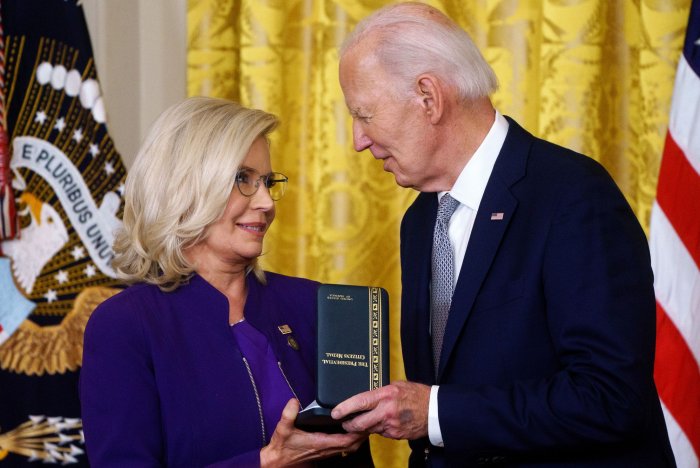
Former President Joe Biden presents the Presidential Citizens Medal to Liz Cheney during a ceremony in the East Room of the White House in Washington, on January 2, 2025. The Presidential Citizens Medal is bestowed to individuals who have performed exemplary deeds or services. Photo by Will Oliver/UPI | License Photo
WE’VE taken a look at how to spend a family day out for FREE across multiple locations in the UK.
We’ve pinpointed three UK counties brimming with free activities for all ages, ensuring everyone stays entertained without spending a single penny.
Sign up for the Travel newsletter
Thank you!
Whether it’s getting outdoors or enjoying indoor soft play, there’s plenty of free things to doCredit: Getty
And with activities covered for all ages, you can be sure there’ll be no getting bored.
Sussex: Beach days, railways and pirate festival
Across Sussex there are plenty of free things to do, meaning that you can take the kids out for an action-packed day of activities without breaking the bank.
If you’re visiting when the sun’s out, head to one of the many beautiful beaches in the county.
Camber Sands is perfect for families with its sprawling stretches of golden sands, perfect for bucket and spade days and paddling in the water.
It’s a top choice due to its nearby facilities including parking, cafes and loos – perfect for parents of young children.
A sunny day is also the perfect time to go for a family bike ride.
The South Coast East route will take you along the coast, past stunning cliffs and landscapes.
And if the children (or Dad) are into steam trains, there’s multiple ways to enjoy them in Sussex – without booking a pricey ticket.
Most read in Best of British
The Bluebell Railway is a great spot to visit, with its interactive “SteamWorks” exhibition at Sheffield Park station, and its own outdoor playground at Kingscote station.
There is no charge for platform entry on non-service days, and the gifts and models shop often remains open on these days too – just check their website ahead of time.
Spotting steam trains is great for railway enthusiasts – and some platforms even have free entryCredit: AlamyCamber Sands is the perfect beach in Sussex for families with its amenities and vast spaceCredit: Alamy
You can also head to Hotham Park, a short walk from Bognor Regis town centre, where there’s a popular miniature railway.
The park is free to enter if you’re wanting to stroll and have a look around.
But there’s loads to see and do for an optional small fee, such as crazy golf, a boating lake and kids’ adventure play area.
And if you do visit with some change in your pocket, the Hotham Park Railway is only £2.50 for adults and £2 for kids (under 2s go free).
Sun reader Nora Hinds, 69, from Hounslow, recommends Hastings in Sussex for its annual Pirate Festival.
She said: “Hastings is brilliant for live music, with lots of events on the seafront like the pirate festival.
The Guinness World Record for the largest gathering of pirates was won in Hastings: 14,231Credit: GettyDon’t skip out on the Shipwreck Museum in Hastings, East SussexCredit: Alamy
It’s a pirate-themed weekend with free things to do including a treasure hunt, craft workshops and kids pirate tattoos.
Lastly, Sussex is home to some fantastic free museums.
The Shipwreck Museum is free to enter, and is full of fascinating maritime artifacts.
Sue Mercer, 62, from Pagham recommends The Novium Museum in Chichester for families.
It also has free entry, and kids can learn about history covering the Stone Ages to the Saxons.
Lincoln: Horse sanctuary, lakeside picnics and history museums
There’s loads of free and cheap things to do for families in Lincolnshire.
So much so, that there’s a Facebook group with more than 15,000 members sharing free things to do with the kids “in and around Lincoln”.
If you’ve got any mini history buffs in the family, they’ll enjoy a visit to the Museum of Lincolnshire Life.
The museum takes a deep dive into life in the county, from 1750 to the present day.
There’s an authentic WWI tank, interactive exhibitions and group quiz sessions.
Similarly, The Lincoln Museum is another indoor attraction well-worth the visit.
Aside from the fascinating exhibitions, it offers “Play at The Lincoln Museum” – a free activity centre packed with activities for younger children and a play zone for babies.
For older kids, there’s lots of interactive games and trails too.
Lincoln is a pretty city with plenty to do, instantly recognisable by its massive CathedralCredit: GettyHubbard’s Hills is a great spot for outdoors-y familiesCredit: Alamy
Alternatively, just 20 minutes from Lincoln you’ll find Bransby Horses.
The charity owns a 600-acre site which is home to over 300 horses, ponies, donkeys and mules.
Visitors can walk through to admire the animals and set up for lunch at the designated picnic area.
Entry is free, although donations are recommended upon visiting to support the charity.
Sun reader Sarah Al-Aidi recommends Hubbard’s Hills – a vast green space near Louth with plenty of trees and a water valley.
“It’s a real beauty spot with great picnic areas, dog walking trails and nature walks” she says.
In the park you’ll find a play area and plenty of scenic picnic spots by the river – and it’s a great place to bring the dog, too.
The sanctuary is home to over 300 animals including cute poniesCredit: Alamy
Devon: Free soft play, giant animal models and discovery trails
Whilst Devon is known for it’s family-friendly beaches, there’s more to it than building sandcastles and wasting away your change at the arcades.
One of the best ways to explore the county is by undertaking one of its many outdoor discovery trails.
Haldon Forest near Exeter has a popular family activity trail which often has new themes depending on the time of year.
It’s a beautiful winding trail which ends at a picnic spot, home to an impressive Gruffalo sculpture.
And for kids of all ages, geo-caching can make for an exciting and energy-burning day out – and can get your kids away from their screens.
Geo-caching in Dartmoor or Exmoor National Parks is a fantastic way to get the kids to explore the outdoors.
Hidden around the parks you’ll find stashes of hidden items known as caches.
Kids can meet the Gruffalo in Haldon ForestCredit: Alamy
They’ll often have quirky items in to trade, as well as a log book to record your win finding the geo-cache.
In fact geo-caching happens all over the UK, and all the rules are on the geo-caching website.
Plus, theRoyal William Yard Geo Trail in Plymouth is a fascinating look back in timeto 380 million years ago.
And whilst you’re visiting Plymouth, dads can make the most of free soft play.
“On Thursdays, Barnardo’s runs a Dads and Dinkies session, which is free soft play for dads and the children” says Gem Krupa, Holiday Home Sales Manager at Challaborough Bay holiday park.
“Mums can have a rest while Dads take the kids down to the YMCA for a play.”
The free soft play sessions take place every Thursday at 1.30pm. Just make sure to prebook first!
Lastly, on the outskirts of Dartmoor in Bovey Tracey you can’t skip out on The Jolly Roger.
Here you’ll find incredible showrooms displaying giant animal and dinosaur models – and the best part is, it’s free to visit.
There’s also models of race cars, fairies, and at Christmas time the showroom even gets decked out with Santas and sleighs.
There’s even a free soft play group called “Dads and Dinkies”Credit: GettyThe Jolly Roger has giant animal modelsCredit: Facebook/@The Jolly Roger- Life Size ModelsThere’s no need to spend a lot of money on a day out for the familyCredit: Getty
Weekly insights and analysis on the latest developments in military technology, strategy, and foreign policy.
The U.S. Air Force has formally designated Northrop Grumman’s Project Talon drone as the YFQ-48A and described it as a “strong contender” to be part of its future Collaborative Combat Aircraft (CCA) fleets. This follows news that the service has handed contracts to nine companies to refine a wide array of designs under Increment 2 of its CCA program. Northrop Grumman, together with its subsidiary Scaled Composites, only lifted the lid on Project Talon earlier this month, as you can read more about in our initial report here.
YFQ-48A is the third ‘fighter drone’ designation the U.S. military has now applied to a CCA-type design. The service announced in March that the drones General Atomics and Anduril have been developing under Increment 1 of the CCA program had received the designations YFQ-42A and YFQ-44A, respectively. However, the Project Talon design is not part of Increment 1, as we will come back to later on.
“The MDS designation highlights the ongoing partnership between the Air Force and Northrop Grumman and acknowledges the continued progress of the YFQ-48A as a strong contender in the CCA program,” according to an official Air Force release.
A top-down look at the Project Talon drone. Northrop Grumman
“We are encouraged by Northrop Grumman’s continued investment in developing advanced semi-autonomous capabilities,” Air Force Brig. Gen. Jason Voorheis, the service’s Program Executive Officer for Fighters and Advanced Aircraft, said in a statement. “Their approach aligns with our strategy to foster competition, drive industry innovation, and deliver cutting-edge technology at speed and scale.”
“Northrop Grumman’s commitment to innovation, low-cost manufacturing, and calculated risk-taking aligns perfectly with the CCA acquisition strategy and the Secretary of War’s Acquisition Transformation Strategy,” Air Force Col. Timothy Helfrich, Director of the Agile Development Office, also said. “Project Talon is a testament to their ability to push boundaries and experiment with new technologies, ultimately advancing solutions that could enhance the future of airpower.”
While details about the Project Talon drone itself remain limited, Northrop Grumman has made clear that it is based on lessons learned from its losing entry in the Increment 1 competition. The company has said that its Increment 1 design was at the higher end of the performance and capability spectrum, and had a price to match. Talon, by extension, has been described as “cheaper and better” and “significantly different” from the Increment 1 offering, and a first flight is now targeted for late next year. You can learn more about what TWZ has been able to glean so far here.
Project Talon is here. This next-gen autonomous aircraft is made to adapt fast.
“Northrop Grumman remains in a vendor pool that can compete for future efforts, including the Increment 1 production contract and subsequent increments,” an Air Force spokesperson told TWZ when asked about the current relationship of Northrop Grumman and Project Talon to the CCA program.
“As the Air Force continues to advance the CCA program, the ongoing collaboration with Northrop Grumman and the defense and aerospace industry will ensure that the Air Force remains at the forefront of airpower innovation,” the Air Force’s release today also noted. “These types of partnerships will help the Air Force meet the challenges of an increasingly complex and competitive global security environment while maintaining the technological superiority necessary to prevail in future conflicts. “
General Atomics’ YFQ-42A, one of the two designs now in development under Increment 1 of the Air Force’s CCA program, seen during a test flight. GA-ASIAnduril’s YFQ-44A, also known as Fury, the other design now being developed under the CCA program’s Increment 1. Anduril Courtesy Photo via USAF
TWZ has also reached out to Northrop Grumman. Northrop Grumman and Scaled Composites have also previously said that Project Talon, which has been described so far as a demonstrator effort, is not explicitly aimed at a particular contract opportunity, such as the Air Force CCA program’s Increment 2.
As mentioned, the Air Force has separately confirmed that nine companies have now received initial concept refinement contracts under the CCA program’s Increment 2, which were all awarded earlier this month. The service is presently declining to name any of those companies, one of which could be Northrop Grumman. An Air Force spokesperson told TWZ that the vendor details are currently “protected by enhanced security measures.”
“These designs [being refined under Increment 2 now] represent a broad spectrum, ranging from more affordable, attritable concepts to higher-end, more exquisite designs,” that same spokesperson also told TWZ. “This variety ensures that the program explores different approaches, optimizing for cost-effectiveness while maintaining the flexibility and capabilities necessary to enhance operational effectiveness.”
That the Air Force is again considering a mix of lower and higher-end designs for Increment 2 is a notable development. The service had indicated previously that it would focus heavily on less exquisite and cheaper designs for the second tranche of CCA drones based on its experience with Increment 1. It’s also worth remembering here that Increment 2 has also long been expected to include foreign participation, which would have impacts on the requirements. In October, the Netherlands announced it had formally joined the Air Force’s CCA program.
The U.S. Marine Corps and U.S. Navy also have their own CCA programs, which are formally intertwined with the Air Force’s effort, including in the development of common command and control and autonomy architectures. However, the Marines and Navy have been pursuing specific airframe designs to meet their respective needs independently. The Marine Corps is moving to field an operational version of Kratos’ XQ-58A Valkyrie drone following extensive testing with that design. The Navy has four companies under contract now for conceptual aircraft carrier-based CCA designs.
A US Marine Corps XQ-58A Valkyrie, one of a number of these drones the service has been using for test and evaluation purposes. USAF Master Sgt. John McRell
“The next competitive contract award will occur after the Concept Refinement Phase, as the Air Force evaluates the technical and operational merits of the submitted designs for prototyping,” the Air Force spokesperson added. “Increment 2 will be structured similarly to Increment 1, where more than one awardee may be selected for prototyping. This approach allows for competitive development and ensures that the Air Force can evaluate various solutions before selecting the final designs to move into production.”
“For CCA Increment 2, following concept refinement, the Air Force will proceed with prototyping, with plans for a future competitive award leading to production awards,” they continued. “The specific timeline for these milestones will depend on the results from Concept Refinement and the vendor’s performance during testing.”
Many questions remain about the Air Force’s CCA plans, including exactly how many drones the service is set to acquire under Increment 1, and whether that initial fleet will be all YFQ-42As or YFQ-44As, or a mix of both. The Air Force, Marine Corps, and Navy are all still very much refining their core concepts of operations for future CCA fleets, including deployed, launched, recovered, supported, and otherwise operated on a day-to-day peacetime basis, let alone employing them tactically.
In the meantime, the Air Force is clearly pushing with the development of additional CCA types, including Northrop Grumman’s and Scaled Composites’ Project Talon design. With Increment 2 now underway, more insights into the new field of CCA competitors may begin to emerge.
It takes a lot for sweet-tempered 28-year-old Nick Darnell to transform himself into Christmas’ most sought-after sourpuss.
There’s colored contacts and facial prosthetics, a protruding belly and at least an hour of makeup. But for the devout Christian and preternaturally cheerful young actor, the real metamorphosis is psychological.
“People today love to connect with the villain,” said the viral Grinch impersonator. “The world is just a darker world now.”
Darnell called the chartreuse baddie he portrays “the modern-day Santa.”
Dr. Seuss’ holiday parable “How the Grinch Stole Christmas!” has been a seasonal favorite since it was published in 1957, ranking among the most popular and profitable of the author’s iconic rhyming picture books.
The story’s sassy, brassy antihero has likewise adorned Christmas trees and school library shelves for generations. His hornlike fur forelocks and pathological refusal to assimilate have led some critics to call the Grinch ambiguouslyantisemitic, but those concerns have largely been glossed over by years of nostalgia.
Experts say 2025 heralds the Grinch’s ascent from Yuletide bit player to Christmas A-lister. He now crowds out Kris Kringle in store displays, social media feeds and holiday meet-and-greets.
Unlike Santa, who ho-ho-hos his way through the holiday season, Grinches twerk and pout and scream in kids’ faces. Compilations of their antics on YouTube and TikTok routinely rack up millions of views.
“I do the things that people think,” Darnell said of the role. “I’m not restrained.”
Despite the Grinch’s anti-consumerist zeal, the market for his visage has exploded in recent years.
Target touts its “Grinchmas,” while Walmart has “WhoKnewVille.” McDonald’s sells Grinch fries, Starbucks features a “secret menu” frappuccino. Hanna Andersson, a popular purveyor of holiday pajamas, boasts roughly a dozen different Grinch patterns, compared to three Hanukkah options and just one Santa design in two colorways.
“I’m not restrained,” Grinch impersonator Nick Darnell, 28, says of his role.
(Christina House/Los Angeles Times)
Ownership of the Grinch’s likeness is guarded as jealously as the villain protects his lair: Dr. Seuss Enterprises holds the rights to the children’s book, Warner Bros. Discovery the 1966 animated TV special, and Universal Studios the 2000 live-action Jim Carrey film, which ranks among the highest-grossing Christmas movies of all time.
But impersonators, academics and even working Santas agree: Americans’ embrace of the Grinch in 2025 goes far beyond consumerism.
“It’s definitely more popular,” said ‘Santa’ Ed Taylor, the famed Los Angeles Santa behind the Worldwide Santa Claus Network, a training camp for the art of Christmas cheer. “It’s a little yin and yang. Maybe we need a little bit of both.”
Costume companies across Los Angeles say they’ve seen a deluge of demand for the Grinch this year. At Etoile Costume & Party Center in Tarzana, nearly half of Christmas costume rentals are now furry green villains.
“It’s about equal to Santa,” one employee said. “Maybe 40% Grinch and the rest Santa.”
Ryan Ortiz, dressed in a Grinch costume, stands next to his 1969 Volkswagen Bus in San Diego on Dec. 21.
(K.C. Alfred / The San Diego Union-Tribune via Getty Images)
Fans of the hirsute sourpuss seek him out for his in-your-face edge — the opposite of Santa’s remote joviality. Santa enforces his regime of goodness through lists and surveillance. The Grinch will get in your face and yell at you to shut up.
“[Santa]’s supposed to be mysterious and unknown,” said Darnell’s fiancee JadaPaige. “He’s supposed to just come in the night and you’re never supposed to see him.”
“I grew up obsessed with Santa Claus — I did not grow up obsessed with the Grinch,” Darnell said. “I was the kid waiting up in the middle of the night, peeking, wondering if Santa’s down there. A lot of modern day kids aren’t having that journey.”
Instead, many Gen Alpha youths look to the Grinch for his views on “corruption or poverty or the oversaturation of commercialism,” Darnell said.
“Santa is looked at more like a godly figure, while the Grinch is a more everyday man,” the actor explained. “The world is so sinister and negative. [The Grinch] tells you how it is, rather than telling you everything is going to be fine.”
TikTok turbocharged that trend, with the infamous green meanie matching or beating his red rival in holiday clout.
Grinch impersonator Nick Darnell said the character he plays has become popular because, “He has aura.”
(Christina House/Los Angeles Times)
Today’s professional Santas are often retirees with a bit of a belly and some time on their hands. Grinches, by contrast, are more likely to be working actors like Darnell, who look reverently to Carrey’s performance as a blueprint for the character’s slapstick antics and snarky reads.
Still, experts say the Grinch’s 2025 glow-up likely owes as much to holiday exhaustion and broad consumer pessimism as it does vertical video virility.
“The Grinch is the opposite side of Christmas,” said Oscar Tellez, who owns Magic Dream Costumes and Party Rentals in East Los Angeles and says he’s seen a spike in Grinch requests even as overall holiday rentals have sagged.
“Especially with the Latino community, I don’t think they feel the enthusiasm to celebrate,” Tellez said. “They are more worried about what’s gonna happen next.”
Pop culture experts agreed.
“The economy is in big trouble, our political situation is chaotic, there’s a lot of hate — it’s no wonder that we would seek to express that through the embodiment of a monster like the Grinch,” said Michael M. Chemers, director of the Center for Monster Studies at UC Santa Cruz.
“You’ve seen these nativity displays popping up all over the country that have the Jesus figures removed and it says ‘ICE was here,’ ” he added. “I think there’s just a lot of Grinchy feeling right now in the world.”
Chemers and other scholars say the emergence of the Grinch as a foil to Santa is less a departure than a return to form: the Grinch is a “PG version” of the mythical Krampus, a shaggy, fork-tongued Germanic goat man who beats and even abducts naughty children, working as an enforcer for Father Christmas.
An “organillero,” or traditional street musician, dressed as the anti-Christmas character known as the Grinch plays on a central street in Mexico City on Dec. 9.
(Yuri Cortez/AFP via Getty Images)
“He’s been called the Christmas devil,” said Jeff Belanger, author of “The Fright Before Christmas,” a compendium of so-called “Yuletide monsters.”
“[Krampus] represented the consequence of bad behavior, while St. Nick rewards good behavior,” he said.
Krampus likely evolved from older, pre-Christian deities, just as Christmas absorbed solstice and midwinter customs, the author explained. The Christmas most Americans grew up with only emerged as a national holiday in the wake of the Civil War, he said, about a decade after the formal introduction of Thanksgiving in 1863. It was around this time that Christmas trees became popular in the United States.
“In 1867, Charles Dickens came over to Boston and that’s when he read his ‘Christmas Carol’ for the first time in America,” spurring President Ulysses S. Grant to declare Christmas a federal holiday, Belanger said. “It was truly on the back of that story.”
The holiday’s corpulent, white-bearded dandy arrived even later, his schmaltzy persona skimmed from bony St. Nicholas between Reconstruction and 1931, when Coca-Cola debuted its iconic, brandy-flushed Santa Claus.
“That’s when Christmas turned purely commercial, and there was no room for consequences anymore,” Belanger said.
Seuss’ Grinch sits somewhere in the middle — cuddlier than Krampus and pricklier than Santa — making him the perfect avatar for a moody, uncertain age.
Workers check Grinch inflatables ready for export at a factory in Suixi County in central China’s Anhui Province on March 19.
(Wan SC/Future Publishing via Getty Images)
Grinch boosters point out that the villain repents and reforms at the end of the story, shedding his pathological hatred of Christmas.
“I always tell people, ‘Don’t you just love how his heart grew three sizes?’ ” Taylor, the famous Santa, said of his increasingly popular crossover events.
Others note that it’s never the repentant Grinch who marauds through schools and holiday parades or blows up on social media.
“Once he’s rehabilitated, he’s no fun anymore,” Chemers said.
That makes it hard for the holiday villain to visit sick kids in the hospital, as legions of Santas do every year, or comfort children who confide in him about bullying.
“The message is one of encouragement and positivity and acknowledgment of accomplishments and encouragement to strive harder,” Taylor said. “It’s these beautiful personal development messages that Santa gets to be the conduit for.”
The Grinch, by contrast, can affirm where you are, without ever asking you to be better.
“He can hear you and know what you’re thinking, because he has the same thoughts,” Darnell said of his beloved version of the character. “People want to know his heart and his mind, and that’s something they wouldn’t be able to ask Santa.”
Last February, I climbed into a Jeep and rumbled up a rocky shelf road that took me high above a breathtaking corner of the Mojave National Preserve. At the top was an old gold mine where an Australian company had recently restarted activities, looking for rare earth minerals.
The National Park Service had been embroiled in a years-long dispute with the company, Dateline Resources Ltd., alleging that it was operating the Colosseum Mine without authorization and had damaged the surrounding landscape with heavy equipment. Dateline said it had the right to work the mine under a plan its prior operators had submitted to the Bureau of Land Management decades before.
President Trump had taken office just weeks before my visit. Environmentalists told me the conflict posed an early test of how his administration would handle the corporate exploitation of public lands.
You’re reading Boiling Point
The L.A. Times climate team gets you up to speed on climate change, energy and the environment. Sign up to get it in your inbox every week.
At the time, observers weren’t sure how things would shake out. Conserving public lands is one of the rare issues that’s popular on both sides of the political aisle, they pointed out.
Almost a year later, it’s clear that the Trump administration has sided with the corporations.
Trump directed the Department of Interior to inventory mineral deposits on federal lands and prioritize mining as the primary use of those lands. He instructed officials to dramatically fast-track permitting and environmental reviews for certain types of energy and critical minerals projects — and designated metallurgical coal a critical mineral, enabling companies that mine it to qualify for a lucrative tax credit.
His budget bill lowered the royalty rates companies must pay the government to extract coal, oil or gas from public lands and provided other financial incentives for such projects while reducing the authority of federal land managers to deny them.
Under the president’s direction, the DOI has opened up millions of acres of federal land to new coal leasing and moved to rescind both the 2021 Roadless Rule, which protects swaths of national forest lands from extractive activities by barring most new road construction, and the 2024 Public Lands Rule, which puts conservation and restoration on par with other uses of BLM land like mining, drilling and grazing.
Altogether, the Trump administration and its legislative allies have taken steps to reduce or eliminate protections for nearly 90 million acres of public land, according to the Center for American Progress, a progressive think tank. That figure rises to more than 175 million acres if you include the habitat protections diminished by the administration’s moves to weaken the Endangered Species Act, the organization notes.
“All of these things represent in some ways the largest attack on our public lands and giveaway to large multinational mining corporations that we’ve seen probably since the 19th century,” said U.S. Rep. Melanie Stansbury of New Mexico, who likened the level of resource exploitation to “something like what happened during the robber baron era when there was no regulation or protection for our communities or the environment.”
Stansbury has introduced legislation that would increase the fees mining companies must pay to sit on speculative claims on federal lands and require those funds be used for conservation. She told me it’s just a tiny contribution to a larger effort to push back against the administration’s approach to initiate extraction on public lands, which she described as so frequent and pervasive that “it’s a bit like whack-a-mole.”
“So much damage has been done, both administratively and legislatively, over the last 11 months since Trump took office,” she said.
As for the Colosseum Mine, the DOI sided with its operators back in the spring, saying Dateline Resources did not have to seek authorization from the Park Service to keep mining. The announcement was followed by public endorsements from Trump and Interior Secretary Doug Burgum. The company’s stock value soared, and by September, it had kicked off a major drilling blitz.
The company has already uncovered high-grade gold deposits. It’s taking a break for Christmas, but is expected to resume drilling in the new year.
More recent land news
The Pacific Forest Trust returned nearly 900 acres of land near Yosemite National Park to the Southern Sierra Miwuk Nation in a transfer partially financed by the state,reports Kurtis Alexander of the San Francisco Chronicle. Members of the Indigenous group were forced off their ancestral lands during the California Gold Rush, when state-sponsored militias undertook efforts to exterminate them. Some now hope the new property will bolster their decades-long push for federal recognition.
California State Parks is violating the Endangered Species Act by allowing offroaders to drive over dunes that are home to western snowy plovers, a judge recently ruled in a long-running legal case over the use of Oceano Dunes State Recreation Area along the Central Coast. Edvard Pettersson of the Courthouse News Service reports that State Parks will need a federal “take” permit to continue to allow offroading at the popular beachside spot.
California lawmakers introduced legislation to conserve more than 1.7 million acres of public lands across the state, in part by expanding the Los Padres National Forest and the Carrizo Plain National Monument, according to Stephanie Zappelli of the San Luis Obispo Tribune.
President Trump’s media company is merging with a nuclear fusion energy firm in a $6-billion deal that some analysts have described as a major conflict of interest, my colleague Caroline Petrow-Cohen reports.
House Republicans pushed through a bill that would overhaul the federal environmental review process in a way that critics say could speed up the approval process for oil and gas projects while stymieing clean energy, report Aidan Hughes and Carl David Goette-Luciak of Inside Climate News.
The iconic chasing-arrows recycling symbol is likely to be removed from California milk cartons, my colleague Susanne Rust reports. The decision exposes how used beverage packaging has been illegally exported to East Asia as “recycled” mixed paper, violating international environmental law.
Wind energy is again under attack from the Trump administration, which this week ordered all major wind construction projects to halt. As The Times’ Hayley Smith notes, the White House has been consistent in slowing down clean energy development in 2025, but offshore wind has been a particular bête noire for the President.
We’ve published a comprehensive collection of stories looking back on thewildfires that burned though Altadena and Pacific Palisades last January and all that’s happened since, which columnist Steve Lopez calls “one of the most apocalyptic years in Southern California history.” Check out After the Fires here.
This is the latest edition of Boiling Point, a newsletter about climate change and the environment in the American West. Sign up here to get it in your inbox. And listen to our Boiling Point podcast here.
People place bets at Santa Anita Park, where purses have declined along with the number of horses racing and lack of money coming from off-site betting.
(Getty Images)
Figuring out the purse for 34 of the 35 graded stakes races at Santa Anita is, for horsemen anyway, maddeningly simple: Just look up the minimum purse required in North America.
For a Grade 1 race, that’s $300,000. It drops to $200,000 for Grade 2 races and $100,000 for Grade 3s.
Even the one local exception, the Santa Anita Derby, pays “only” $500,000 after offering $750,000 from 2021-24. The current amount is half the purse on offer for the top 3-year-old races at Gulfstream Park (Florida Derby) and Fair Grounds (Louisiana Derby), and just one-third what Oaklawn Park pays for the Arkansas Derby.
Last year the Santa Anita Derby attracted only five entries, which reduced the number of Kentucky Derby qualifying points available in the race. That almost kept Baeza, who finished second to Journalism in the Arcadia race, from qualifying for the Derby (he made it in the field only after another horse was scratched and wound up placing third).
It’s the same story for older horses, where Gulfstream offers the $3-million Pegasus World Cup next month plus turf races for $1 million and $500,000. Oaklawn Park has a half-dozen races worth at least $500,000 (two at $1.25 million), and Fair Grounds has three between $250,000 and $500,000. No Grade 3 race at any of those tracks offers less than $150,000.
All of that makes it harder for Santa Anita to attract top horses from those states, which increase purses with money from slot machines or casinos, something not available to California tracks. Santa Anita, however, has hiked its purses this meeting for maiden and allowance races.
Dec. 24 (UPI) — The United States is witnessing an unprecedented decline in murders with 2025 projected to mark the largest one-year drop on record, an analysis of crime data indicates.
Crime analyst Jeff Asher, using data from the Real Time Crime Index, said murders have fallen nearly 20% nationwide between 2024 and 2025 following a 13% decline the previous year.
Several major cities hardest hit by gun violence were reporting sharp decreases.
Baltimore has been down 31%, Atlanta 26%, Albuquerque 32% and Birmingham at nearly 49%.
Nationally, robberies, property crime and aggravated assaults have also fallen by 18%, 12% and 7%, respectively.
The Hill attributed the decline to post-pandemic stabilization and heightened anti-violence initiatives at the local and federal level.
In Memphis alone, murders dropped by almost 20% while Chicago recorded a 28% decrease.
Asher estimates roughly 12,000 fewer homicides occurred in 2024-2025 than during the pandemic peak though final FBI data is still pending.
Clouds turn shades of red and orange when the sun sets behind One World Trade Center and the Manhattan skyline in New York City on November 5, 2025. Photo by John Angelillo/UPI | License Photo
Weekly insights and analysis on the latest developments in military technology, strategy, and foreign policy.
One of the U.S. Air Force’s last remaining EC-130H Compass Call electronic warfare planes is now in Puerto Rico, video emerging on social media shows. The arrival marks the latest in an increasing buildup of military assets in the region to pressure Venezuelan dictator Nicolas Maduro and for what seems increasingly likely to be a contingency for a sustained kinetic operation over Venezuela.
You can catch up with our latest coverage on Operation Southern Spear in the Caribbean here.
The Compass Call landed 10 p.m. on Saturday at the Luis Muñoz Marin International Airport in Puerto Rico, the videographer, an aircraft spotter who uses the Instagram handle Pinchito.Avgeek, told us. Other aircraft spotters told The War Zone that this is the first confirmed Compass Call to be seen in Puerto Rico as of late. The airport is also home to the Puerto Rico Air National Guard’s 156th Wing and has seen C-17 Globemaster III and other military aircraft operating there for Southern Spear.
A video posted to social media yesterday (20 Dec) shows the arrival of a USAF EC-130H at Luis Muñoz Marin International Airport (SJU/TJSJ) in Puerto Rico.
There are only a few EC-130Hs left in USAF inventory.
While there are a number of C-130 Hercules variants in Puerto Rico, a screencap of that video shows that antennas under the tail and on top of the aircraft behind the cockpit conclusively show this is an EC-130H Compass Call.
EC-130H. (Screencap via Pinchito.Avgee Instagram account.)
Though the Air Force is phasing these aircraft out in favor of EA-37B Compass Call jets, the EC-130H brings capabilities that would be called upon for an attack on Venezuela should one be ordered. The heavily modified C-130 Hercules cargo planes carry a suite of electronic attack gear that can find and track “emitters” like radios and radars and then scramble their signals. This equipment can also jam cell phones.
A U.S. Air Force EC-130H Compass Call aircraft taxis on the flightline at Davis-Monthan Air Force Base, Ariz., July 18, 2024. The EC-130H allowed the Air Force to jam communications, navigation systems, early warning and acquisition radars during tactical air, ground and maritime operations. (U.S. Air Force photo by Airman 1st Class Jasmyne Bridgers-Matos) Senior Airman Jasmyne Bridgers-Matos
The equipment aboard the Compass Call would help to blind Venezuelan air defenses, communications and command and control, making it harder to respond to attacks by combat aircraft and cruise missiles. The four-engine aircraft can fly for many hours without refueling and much longer with tanker support, giving U.S. Southern Command a long-loitering airborne EW platform.
As we noted in an earlier story: “Previous iterations of the EC-130H-based Compass Call system have proven their value in combat zones on multiple occasions in the past two decades. A contingent of these aircraft was continuously forward-deployed in the Middle East, from where they also supported operations in Afghanistan, between 2001 and 2021. EC-130Hs supported the raid that led to the death of Al Qaeda founder Osama Bin Laden in Pakistan in 2011 and prevented the detonation of an improvised explosive device that might have killed then-Maj. Gen. James Mattis, who later rose to the rank of General and also served as Secretary of Defense under Trump, in Iraq in 2003, among many other exploits, according to a recent story from Air Force Times.”
Maintenance troops and aircrew members prepare a U.S. Air Force EC-130H aircraft for its final departure from an undisclosed air base on Aug. 29, 2010. (U.S. Air Force photo by Maj. Dale Greer) Maintenance troops and aircrew members prepare a U.S. Air Force EC-130H aircraft for its final departure from an undisclosed air base on Aug. 29, 2010. Credit: U.S. Air Force photo by Maj. Dale Greer
The current status and location of the Compass Call are not publicly known. The videographer told us he only saw it land. A U.S. official we spoke with could not comment on the arrival of the EC-130H but told us that there have been no new military orders for Southern Spear.
The EC-130H joins a squadron of E/A-18G Growler electronic attack jets, deployed on the aircraft carrier USS Gerald R. Ford, as well as another squadron on land, as airborne electronic warfare assets now operating in the Caribbean. While Compass Calls offer some overlapping capabilities and some significantly different ones than the Growlers, the arrival of the EC-130J is another indication that electronic warfare is clearly taking a lopsided focus compared to the size of the rest of the fighting force deployed in the region.
A stock picture of a US Navy EA-18G Growler. USAF/Staff Sgt. Gerald Willis
While it is unclear if the Compass Call has performed any of its offensive operations yet, both the U.S. and Venezuela are using defensive jamming to protect assets. This has become an increasing problem for the region as tensions rise.
“At least some of the U.S. warships that have deployed to the Caribbean in recent months have been jamming GPS signals in their vicinity,” The New York Times reported, citing an analysis of data provided by Stanford University and a U.S. official who spoke on the condition of anonymity to discuss operational matters.
In an effort to protect important resources, “the armed forces of President Nicolás Maduro of Venezuela have jammed the GPS signals around the country’s critical infrastructure, including military bases, oil refineries and power plants,” the publication noted, citing an analysis by Spire Global, a satellite data firm.
Combined, the jamming is raising concerns for aviation.
“Whether jamming is due to the U.S. or Venezuelan forces, it really doesn’t matter: You don’t want an aircraft going in there,” Gen. Willie Shelton, the former head of the U.S. Air Force’s Space Command, told The Times.
The US has issued a flight warning for Venezuela, but it has been mostly silent about the impact of its warships’ GPS jammers on tourism-dependent Caribbean islands. “We just lost our GPS,” a Copa pilot reported over Trinidad on Dec. 10. w/ @riley_mellenhttps://t.co/Sd8KkvgzwH
As for the EC-130Hs, the aircraft is being retired from the Air Force inventory.
“Currently, the U.S. Air Force is operating and maintaining eight EC-130H aircraft,” Capt. Ridge Miller, a spokesperson for Air Combat Command (ACC) told The War Zone Monday afternoon. “A total of 10 EA-37B aircraft are on track to be delivered while simultaneously retiring the EC-130H fleet in a phased approach. Both platforms currently operate out of the 55th Electronic Combat Group at Davis Monthan AFB in Arizona.”
The EA-37B is based on a heavily modified version of the Gulfstream G550 airframe.
An EA-37B Compass Call jet. (L3Harris) L3Harris
In addition to the Compass Call, other C-130 variants are operating out of Puerto Rico. One of which is the Marine Corps’ KC-130J Hercules tanker/transport aircraft. The KC-130Js uses the probe-and-drogue method for Navy and Marine Corps aircraft, and is used to refuel fixed-wing fighter aircraft and helicopters.
Plane spotter @LatAmMilMovements told us that at least one of these aircraft, and sometimes two, have had a steady presence ever since Marine F-35B Lightnings arrived in Puerto Rico in September. This matches the imagery and satellite photos we have seen of the installation for months now. AV-8B Harriers, MV-22 Ospreys, and CH-53 Sea Stallions, all from the USS Iwo Jima and its flotilla, are also using the base regularly and they can all refuel from the KC-130J.
These types are just part of a growing fleet of aerial refuelers in the region. The Air Force has also deployed KC-135 Stratotankers and KC-46 Pegasus tankers to the Dominican Republic and U.S. Virgin Islands.
A U.S. Marine Corps KC-130J aircraft taxis before takeoff past parked U.S. Marine Corps F-35B and U.S. Air Force F-35A fighter jets on the apron at the former Roosevelt Roads naval base in Ceiba, Puerto Rico, December 21, 2025. REUTERS/Ricardo Arduengo pic.twitter.com/MhQqrCrK0j
As more tanker aircraft arrive in Puerto Rico, they are also building up at MacDill Air Force Base in Tampa, Florida. Aerial images show at least 28 KC-135s at the base. The image also shows at least two E-3 Sentry Airborne Warning and Control System (AWACS) aircraft are operating from MacDill, located about 1,400 miles northwest of Venezuela. As we pointed out last week, at least one Sentry was recently tracked on FlightRadar24 flying close to the Venezuelan coast.
Flying over MacDill this morning, seeing a significantly lot more aircraft than last month: 1 C-32 1 C-17 Globemaster 2 E-3 Sentry’s 8 UHi60 Blackhawk’s 28 KC-135 Stratotanker’s pic.twitter.com/g7zi9AnraA
While E-3s may have been present but not trackable over the Caribbean in recent days, this one being trackable was not a mistake. U.S. military aircraft executing easily trackable sorties very near Venezuelan airspace have been a key component of the pressure campaign placed on Maduro.
In addition to the growing military pressure on the Venezuelan leader, the U.S. is also raising the stakes economically. Since President Donald Trump declared a blockade against sanctioned oil tankers, U.S. authorities have seized two tankers. On Sunday, the Coast Guard was in “active pursuit” of the massive tanker Bella 1 after it refused to submit to U.S. seizure efforts. The status of that effort was unclear as of Monday afternoon. We have reached out to the Coast Guard for more details.
??????? BREAKING: The oil tanker Bella 1 was not seized by United States forces and has continued its voyage from Iran to Venezuela. The vessel remains en route, signaling a completed avoidance of interdiction during its transit. pic.twitter.com/denLoaDhRR
Though the military and economic pressure are building on Maduro, Trump’s exact intentions remain an open question, although they appear to be becoming clearer by the day. During his announcement of the new Trump class battleships Monday afternoon, the president again said that the U.S. would soon be going after drug cartels on land; however, he explained that would not just be focused on Venezuela.