



NCAA to expand March Madness fields to 76 teams
The NCAA announced Thursday that it will expand its two March Madness tournaments by eight teams each next season, a long-expected move that will drop more games into the first week of the highly popular and lucrative showcase without substantially changing its overall form.
The new, 76-team brackets will jam eight extra games — for a total of 12 involving 24 teams — into the front half of the first week of the men’s and the women’s tournaments. It will turn what’s now known as the First Four into a bigger affair that will now be called the “March Madness Opening Round.”
The 12 winners will move into the main 64-team bracket that will begin, as usual, on Thursday for the men and Friday for the women.
It is the first expansion of the tournaments in 15 years, when they were bumped to 68 teams each.
The NCAA said it will distribute more than $131 million in new revenue to schools that make the tournament. That money will come via expanded TV advertising opportunities for alcohol, the likes of which were previously restricted. It said the value of the rights agreement will increase $50 million each year on average over the course of the six years.
Most of the eight new slots are expected to go to teams from the power conferences that were already commanding the lion’s share of entries in the bracket. Two years ago, the Southeastern Conference placed a record 14 teams in the men’s bracket. Last season, the Big Ten had nine.
Keith Gill, the chairman of the Division I men’s basketball committee, called the expansion “a nice way to create some access but make sure we have the bracket we all love when we start Thursday at noon.”
The move is a product of the times, which includes massive expansion — the Atlantic Coast Conference, for instance, has grown from nine to 17 teams since 1996 — and the reality that mid-major schools with top-notch players will often see them plucked away by programs with bigger budgets and the ability to pay them through revenue sharing.
Cinderella? There will still be room for those stirring runs in the tournaments, though not a single mid-major advanced past the first weekend of either tournament the last two seasons.
This is hardly a concern of the decision-makers anymore, who will point to TV ratings that traditionally spell out fans’ preference for the likes of Duke and North Carolina over St. Peter’s and San Diego State, especially once the Sweet 16 starts.
What matters more to the biggest schools is that their teams have a chance to compete in what remains the best postseason in college sports and that they aren’t iced out by lower conference champions who earn automatic bids.
“You’ve got some really, really good teams who are going to end up in that 9, 10, 11 [seed] category that I think should be moved into the” 64-team bracket, SEC commissioner Greg Sankey said last year in discussing how he favored expansion.
Also, the money. The new beer and wine money will add to what the NCAA can distribute in “units” that are earned for placing teams in the bracket and then for every round those teams advance. Last year, that amounted to about $350,000 per unit for the men’s tournament. The Big Ten made nearly $70 million from both tournaments, won by conference members Michigan [men] and UCLA [women].
Leaders in the SEC, Big Ten, Big 12 and ACC have all acknowledged that smaller programs help make March Madness what it is, all the while steadily expanding their own power in NCAA decision-making. That brings with it the tacit threat of fracturing the single thing the NCAA does best — the basketball tournament.
This move might forestall that. What it isn’t expected to do is drastically change the TV deal beyond the advertising.
The current deal for the men’s tournament is worth $8.8 billion and runs through 2032. Adding a few extra games between mid-level Power Four teams on Tuesday and Wednesday won’t change that much.
One reason this took as long as it did was the NCAA negotiations with CBS and TNT, which themselves have been in negotiations over their own ownership.
The more drastic option of expanding the tournament to 96 teams or beyond would involve adding an extra week to a tournament that has thrived in part because of the symmetry of a six-round bracket that gets whittled down over three weeks.
That basic shell began in 1985, with only slight tweaks, the latest of which came in 2011 when it was upped to 68.

Japan to launch prime minister-led National Intelligence Bureau

Prime Minister of Japan Sanae Takaichi speaks during a joint press statement with Australian Prime Minister Anthony Albanese (not pictured) at Parliament in Canberra, Australia, 04 May 2026. Prime Minister of Japan Sanae Takaichi is on a three-day visit to Australia. Photo by LUKAS COCH / EPA
May 7 (Asia Today) — Japan plans to launch a new National Intelligence Bureau as early as July to centralize intelligence gathering and analysis under the prime minister’s office, a move expected to affect trilateral security cooperation among South Korea, the United States and Japan.
The new organization will upgrade the existing Cabinet Intelligence and Research Office into a roughly 700-member agency, with plans to gradually expand staffing by recruiting specialized intelligence personnel and private-sector experts.
According to the Yomiuri Shimbun, the Japanese government has finalized plans to establish the National Intelligence Bureau this summer with an initial workforce similar in size to the current intelligence office.
Legislation creating the National Intelligence Council, which will serve as the legal basis for the new bureau, was submitted to parliament on March 13 and passed the lower house in April. Deliberations in the upper house are scheduled to begin Thursday.
The new bureau will operate under the prime minister’s office and support the National Intelligence Council, chaired by Prime Minister Sanae Takaichi.
The restructuring marks a major shift from the current system, in which the Cabinet Intelligence and Research Office is largely staffed by officials dispatched from agencies such as the National Police Agency and the Foreign Ministry.
Beginning next year, Japan plans to recruit its own career-track intelligence officers through the national civil service examination system.
The government also intends to expand midcareer hiring from the private sector to secure experts with foreign language skills, cybersecurity expertise and advanced internet technologies.
Officials are additionally considering hiring engineers capable of using artificial intelligence to process large volumes of intelligence data more efficiently.
The new agency is expected to oversee intelligence exchanges with foreign services, analysis of overseas developments and responses to disinformation and misinformation on social media platforms.
Japan’s opposition parties have raised concerns about the expansion of surveillance powers and the political neutrality of the organization.
Critics argue the legislation does not clearly define the operational scope of intelligence activities and could lead to infringements on privacy rights and freedom of thought.
Some lawmakers have also warned the new system could pave the way for future legislation on anti-spying measures or the establishment of a full-fledged foreign intelligence service.
For South Korea, the reorganization means Japan’s intelligence-sharing channel within trilateral security cooperation with Washington could become more centralized and influential.
Key security issues already shared among the three countries include North Korea’s nuclear and missile programs, Chinese military activities in the East and South China seas, Russian military movements in the Far East, cyberattacks and disinformation campaigns.
Analysts said Japan’s strengthened intelligence structure could accelerate the speed of Japanese threat assessments and crisis responses during regional emergencies.
At the same time, South Korea is expected to closely monitor how Japan integrates the new agency into trilateral intelligence-sharing frameworks and whether the reform strengthens Japan’s independent security decision-making role.
The launch of the National Intelligence Bureau could improve coordination on North Korean missile threats while also marking a broader expansion of Japan’s security and intelligence capabilities.
— Reported by Asia Today; translated by UPI
© Asia Today. Unauthorized reproduction or redistribution prohibited.
Original Korean report: https://www.asiatoday.co.kr/kn/view.php?key=20260507010001415

U.S. Just Struck Iranian Targets Around The Strait Of Hormuz (Updated)

Iranian media outlets are reporting that a port on Iran’s largest island in the Strait of Hormuz came under attack. However, details are scant at the moment and no images have emerged to support the claims. We have reached out to U.S. Central Command for more information. The reports come as negotiations between the U.S. and Iran to end the war have been ongoing during a fragile ceasefire that would be further imperiled by a new round of fighting.
This story has been updated with new information from CENTCOM that it attacked Iranian targets in response to U.S. Navy destroyers being fired on by Iran.
“FARS investigations in Bandar Abbas show that during the exchange of fire between the Iranian armed forces and the enemy, parts of the commercial area of Bahman Qeshm pier were targeted,” the official Iranian FARS news outlet reported on Telegram.
The outlet did not say who had launched the attack. In a previous report, the Far said that “sounds of several explosions were heard near Bandar Abbas. A few minutes ago, people in Bandar Abbas heard several sounds resembling explosions near the city.”
Bandar Abbas is the epicenter of Iranian naval operations around the Strait of Hormuz and was attacked repeatedly during Operation Epic Fury. It is located about 15 miles from Qeshm Island.
The IRGC-affiliated Tasnim News reports signs indicating a “UAE hostile action at Bahman Port in Qeshm,” while the explosions in Bandar Abbas were related to “defense activity in response to two small aircraft, ” Israel’s I24 News reporter Ariel Oseran reported on X. “If this issue is confirmed, the UAE will pay the cost of its hostile action.”
Though it is unclear what is taking place, online flight trackers show at least five U.S. KC-135 Stratotanker aerial refueling jets got airborne from the UAE at the same time. We don’t yet know if this is related.
The reported attack comes amid heightened tensions in the Strait and two days after U.S. President Donald Trump announced the abrupt pause of Project Freedom, an effort to protect commercial shipping in the Persian Gulf. Though Trump claimed he did so to foster further negotiations with Iran, NBC News later reported that the president ended Project Freedom after one day because Saudi officials, surprised by the operation, withdrew access to its bases and airspace.
It also comes after Iran attacked the UAE and Oman in response to the U.S. moving to evacuate ships from the Persian Gulf under the now stalled Project Freedom. It’s possible this could be a direct retaliation for those actions from one of those countries. At the same time, there have been past reports of Iran activating its air defenses, possibly due to operations to probe the country’s air defenses in order to determine their status. This could be another one of those instances or a result of confusion entirely.
Iran’s islands in the Strait of Hormuz are strategic strongholds from which it can project its forces and surveil the region. The complex littorals that make up this waterway make it an ideal area for employing small boat swarming tactics. Iran retains much of its small boat capacity even after Epic Fury and has trained to employ it for decades. These islands are also a host to anti-ship missile and one-way attack drone systems. These can turn the Strait and the surrounding bodies of water into very dangerous places for ships to operate. This arsenal remains partially intact.
This is a developing story. We will update this post when we know more.
UPDATE: 5:01 PM
Fox News Chief National Security Correspondent Jennifer Griffin is now reporting on X that the U.S. attacked Qeshm Port and Bandar Abbas. Citing a senior U.S. official, she said she was told “but this is NOT a restarting of the war.
We have reached out to the Pentagon, CENTCOM and the White House for more details.
UPDATE: 5:14 PM EDT –
FARS is now claiming that the U.S. “violated the ceasefire by targeting an Iranian oil tanker ship moving from Iranian coastal waters in the Jask area towards the Strait of Hormuz, as well as another ship entering the Strait of Hormuz opposite the port of Fujairah, UAE. At the same time, they carried out air assaults on civilian areas in cooperation with some regional countries on the coasts of Bandar Khamir, Sirik, and Qeshm Island.”
We cannot independently verify that and have reached out to CENTCOM for further details.
UPDATE: 5:29 PM EDT –
As we noted earlier in this story, the reported attacks on Iran came amid further discussion between the U.S. and Iran over peace negotiations.
Washington and Tehran “are discussing a one-page plan for both sides to reopen the Strait of Hormuz and end hostilities for 30 days while they try to reach a comprehensive deal,” The New York Times reported hours before the strikes took place.
UPDATE: 5:36 PM EDT –
The U.S. military also just struck Iran’s Bandar Kargan naval checkpoint in Minab, Griffin reported, citing a senior U.S. official. That’s located about 50 miles due east of Bandar Abbas.
CENTCOM provided new details on X.
“U.S. forces intercepted unprovoked Iranian attacks and responded with self-defense strikes as U.S. Navy guided-missile destroyers transited the Strait of Hormuz to the Gulf of Oman, May 7,” the command wrote.
“Iranian forces launched multiple missiles, drones and small boats as USS Truxtun (DDG 103), USS Rafael Peralta (DDG 115), and USS Mason (DDG 87) transited the international sea passage. No U.S. assets were struck.”
CENTCOM “eliminated inbound threats and targeted Iranian military facilities responsible for attacking U.S. forces including missile and drone launch sites; command and control locations; and intelligence, surveillance and reconnaissance nodes,” the command added. “CENTCOM does not seek escalation but remains positioned and ready to protect American forces.”
Contact the author: howard@twz.com
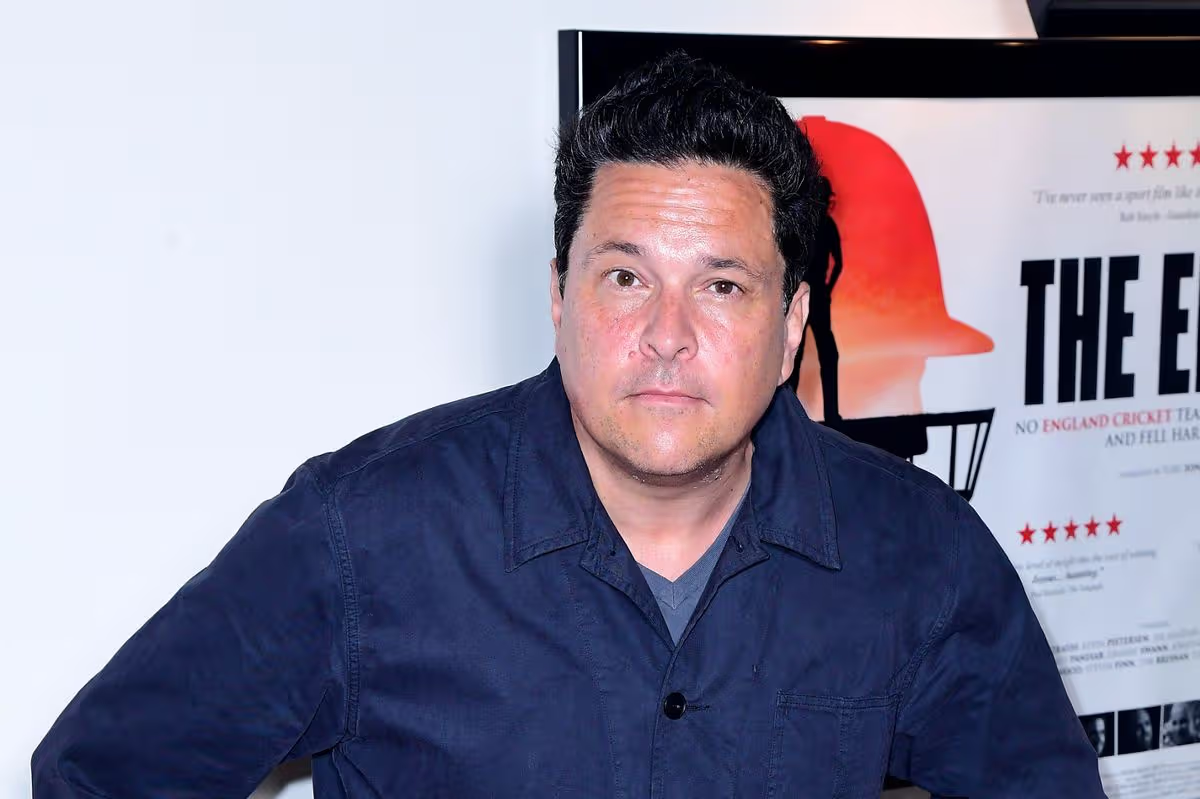
TV legend Dom Joly reveals why so many people refused to join him on camera
A noughties TV legend and star of I’m A Celebrity…Get Me Out Of Here! has explained just why so many people refused to appear with him on television at the height of his career

Dom Joly has admitted that he struggled to get some people to appear with him on Trigger Happy TV(Image: PA)
Dom Joly has revealed that several people refused to appear alongside him on TV – all for the same reason. The comedian, 58, shot to fame when he began fronting Trigger Happy TV in 2000, and the format saw him going out in public to intentionally put himself in embarrassing situation, all to get a reaction.
When the programme first started, viewers and participants alike assumed the chaos, which was being caught on hidden cameras, was genuine and it became an overnight success. But as the series progressed and became more popular, members of the public became wise to when Dom was out and about filming.
The show came to an end in 2003, and now Dom, who went on to appear on I’m A Celebrity…Get Me Out Of Here! alongside This Morning star Alison Hammond and eventual winner Stacey Solomon, has revealed that a considerable amount of people refused to be seen on camera because they were being unfaithful to their partners at the time, and couldn’t risk having that broadcast to the nation.
READ MORE: I’m A Celebrity legend lands huge radio role and raves new gig is ‘perfect’ for themREAD MORE: Dom Joly now from Trigger Happy breakdown to BBC regrets and rarely-seen wife
Speaking on the Remember Me? podcast, he told host Maisie Adam: “We got away with quite a lot but the main reason people didn’t sign consent forms – it’s not that they didn’t want to be on telly, it’s because they were having affairs.
“I can not tell you the amount of people we did, and when the second series went out, the guy would go ‘Oh my god, it’s Dom Joly! Am I being filmed? Oh! That’s not my wife.’ That was just the people we talked to!”
Dom’s most famous bit is, ironically, his least favourite – that enormous phone. Just days after the first episode aired in January 2000, he was on a train when he heard that now-familiar Nokia ring tone.
He said: “Three people stood up and shouted, ‘HELLO?! YEAH I’M ON THE TRAIN – IT’S RUBBISH!’ I was like, ‘f***. What is happening?’” It’s a catchphrase that has haunted him for 25 years.
“I swear there’s not a day where it doesn’t happen. Even on the way here, a bloke spotted me and shouted, ‘HELLO?!’ And 25 years later I still don’t have a good response to it! Like, ‘Yes, hello!’”
“So many scenes went wrong, but the worst we did was with Sarah Ferguson,. We were walking past the Duke of York barracks on King’s Road and there’s a party going on, so we go in and blag some free drinks. Suddenly we spot Fergie sitting in the corner on her own, so we say, ‘let’s do it’.
“We go right up to her, she looks panicky and I stick my microphone in her face and say, ‘Good morning Your Majesty, you are live on Good Morning Mexico – do you have anything to say to the people of Mexico?’
“She starts blabbering on into this tiny camera, and after a while I ask her to pause because we’ve gone to a commercial break, and could she absolutely freeze?
“And for three minutes, me, Sam and the Duchess of York are frozen in the middle of this drinks party. And then we leg it. By the time we get back to our office there’s a fax from her lawyers and sadly we could never show the footage.”
Follow Mirror Celebs and TV on TikTok , Snapchat , Instagram , Twitter , Facebook , YouTube and Threads

California’s single-use plastic law is angering all sides
Within days of California’s long-anticipated single-use plastic law going into effect, environmentalists, anti-waste activists and the packaging industry reacted with anger and frustration.
Anti-plastic activists say Gov. Gavin Newsom’s administration and CalRecycle inserted exemptions favoring the plastic industry into the law’s regulations that weaken it and undermine legislative intent.
“These new rules create huge loopholes for plastic packaging that violate the law,” said Avinash Kar, senior director of the toxics program at the Natural Resources Defense Council.
On the other side, the packaging industry has sued over similar laws in other states. “Our members have real concerns about cost, compliance, and constitutionality,” said Matt Clarke, spokesman for the National Assn. of Wholesaler-Distributors, which sued Oregon earlier this year over a similar waste law.
CalRecycle, the state’s waste agency, did not respond in time for publication. The final regulations putting the law into effect were released May 1 and posted for review Tuesday.
The environmental organizations say the law’s new final regulations open the door to what is known as “chemical recycling,” which produces large amounts of hazardous waste. The law also contains problematic exemptions for certain categories of plastic foodware, they say.
The language of the law forbids any kind of recycling that would produce significant amounts of hazardous waste. The new regulations allow for these recycling methods if the facilities are properly permitted.
The new regulations also exempt certain products if they are already covered by federal law. For instance, a packaging company, retailer or distributor can claim that they have such a preemption, Kar said, and CalRecycle might not immediately review that claim. “And as long as they don’t review it, they’ll get the exemption for as long as CalRecycle doesn’t review it,” creating a potential “forever loophole.”
“Californians were promised a system where producers take real responsibility for the waste they create,” said Nick Lapis, advocacy director for Californians Against Waste. “When regulations introduce broad exemptions and redefine key terms, that promise starts to erode. The details matter here, and right now they don’t line up with the intent of the law.”
Senate Bill 54, the Plastic Pollution Prevention and Packaging Producer Responsibility Act, was signed by Newsom in 2022. It was considered landmark legislation because it addressed the scourge of single-use plastics, requiring plastic and packaging companies to use less of them and ensuring that by 2032, all food packaging is either recyclable or compostable.
Accumulating plastic waste is overwhelming waterways and oceans, sickening marine life and threatening human health.
The law’s intent was not only to reduce it, but also to put the onus and cost of dealing with it on packaging producers and manufacturers, not consumers and local governments. It was supposed to incentivize companies to consider the fate of their products and spur innovation in material redesign.
According to one state analysis, 2.9 million tons of single-use plastic and 171.4 billion single-use plastic components were sold, offered for sale, or distributed during 2023 in California.
Similar laws have been passed in Maine, Oregon, Colorado, Minnesota, Maryland and Washington. Oregon’s law, however, is on hold while a lawsuit by the National Assn. of Wholesaler-Distributors works its way through the courts.
“We see a lot of the same problems in California that we flagged in Oregon,” said Clarke, the trade group spokesman. “Given California’s scale, the cost implications are going to be even larger. Our legal counsel has noted that California’s proposed fees are already higher than what other states have put forward.”
Jan Dell of Last Beach Cleanup, an anti-plastic waste group based in Laguna Beach, doesn’t believe the law will work — irrespective of the final regulations — and said the “exorbitant” cost of its implementation will either spur producers to sue, or they’ll end up passing the higher costs onto consumers.
She referred to a report from the Circular Action Alliance, the state-sanctioned group established to represent and oversee the implementation of the law on behalf of the plastic and packaging industry. It finds the law will increase the cost of disposal between six and 14 times for common products, such as Windex bottles, made of polyethylene terephthalate.
“If the producers don’t successfully sue to stop the fees, this will certainly add to product inflation for CA consumers,” she said in an email. “Californians already have to pay exorbitantly high curbside collection fees for trash, recycling, and organics … so, starting in 2027, our groceries will cost a LOT more but we won’t see a reduction in our waste bills.”
Christopher “Smitty” Smith, a partner at law firm Saul Ewing in Los Angeles, who councils companies and interest groups on SB 54 and other Extended Producer Liability laws, said that although he could see areas of the law that “could be sharper and avoid the legal challenges … you can’t stop people from suing.” Environmentalists and anti-waste activists say they are preparing a lawsuit.
Smith said the law already has sparked changes in how companies think and respond to concerns about waste.
One of his national fast-food chain clients has realized that if its brand name is on plastic packaging, it’s that company’s responsibility, he said, so “they’ve spent the past year mapping out their franchise agreements, their supply chain agreements, their producer agreements, to figure out” what it needs to do to comply.
He said in the past, companies have paid little attention to these details and just let their franchisees figure this kind of thing out. Now, they’re spending a lot of time and money “to wrap their arms around what their supply chain looks like and like, what post consumer use of their plastic products looks like and what their regulatory obligations are.”
It’s bringing a new dialogue within companies. And that, Smith said, is what could make this law so powerful.
Times staff writer Meg Tanaka contributed to this report.

Wetherspoons boss Tim Martin hits back at Ryanair after Michael O’Leary’s alcohol attack
Tim Martin has spoken out after Ryanair boss Michael O’Leary claimed drinking booze at UK airports, such as London Heathrow, should be banned before a certain time

Tim Martin, the Wetherspoons boss, has argued against a early-morning ban of booze at airports(Image: PA)
The boss of JD Wetherspoons has hit back at the Ryanair CEO’s claims alcohol shouldn’t be served at UK airports in the early hours of the morning.
Tim Martin, who founded his pub chain in 1979, said Michael O’Leary’s suggestion would require passengers being breathalysed at airports. He described the plan as “an overreaction”.
But Mr O’Leary, boss of the budget airline, had claimed an average of nearly one flight every day is diverted due to disruptive passengers fuelled by booze. The 65-year-old businessman said these tourists often drink in bars at airports for hours before they board their planes, and called on a ban on serving booze at airport bars in the early hours of the morning and a two-drink limit thereafter.
Mr Martin, though, has said: “A two-drink limit would be extraordinarily difficult to implement, short of breathalysing passengers, and would, in our opinion, be an overreaction — especially since many of the problems stem from incoming flights. It is in everyone’s interests to have good behaviour at airports and on flights.”
READ MORE: Mum raves about ‘family friendly’ Wetherspoons nestled around stunning bluebell forestREAD MORE: Seaside town with UK’s shortest pier and arcades ‘paying out big’
Mr Martin, 71, also told The Times it had “never been suggested” its customers cause disruption on flights. JD Wetherspoon told the newspaper that pubs in airports were “highly supervised” with strict policies preventing excessive alcohol consumption.
Airside bars in the UK are not required to follow restrictions on opening hours which apply to other venues selling alcohol. Being drunk on a plane is a criminal offence in the UK and can be punished by a fine of up to £5,000 and two years’ imprisonment.
But alcohol can be served on flights, including those of Ryanair, and there have been no calls on this practice. This, coupled with alcohol consumption at airports, has led to a number of incidents of disruption recently.
A man was, for instance, jailed for becoming abusive, causing widespread alarm throughout the Ryanair aircraft on which he was travelling from Poland to Bristol.
And, on Thursday, Ryanair welcomed the decision by a court in France which it said found two passengers guilty of causing disruption onboard a flight from Stansted to Ibiza that was diverted to Toulouse in May last year. The pair received a combined penalty of more than 10,000 euros (£8,640) and received suspended prison sentences of up to 10 months, according to the airline.
Speaking earlier this week, Mr O’Leary shared his plans. The father of four had said: “I fail to understand why anybody in airport bars is serving people at five or six o’clock in the morning. Who needs to be drinking beer at that time? There should be no alcohol served at airports outside [those] licensing hours.”

Football gossip: Vinicius Jr, Gordon, Barcola, Alvarez, Palhinha, Vlahovic, Gvardiol
Manchester City are keen on Real Madrid winger Vinicius Jr, Bayern Munich make contact with Newcastle United over Anthony Gordon, and France forward Bradley Barcola could leave PSG in the summer.
Manchester City are contenders to sign Real Madrid and Brazil forward Vinicius Jr, with just over a year left on the 25-year-old’s contract at the Bernebau. (Teamtalk), external
Bayern Munich have made contact with Newcastle United over a move for England winger Anthony Gordon, 25, but there is a £20m gap in valuations between the clubs. (Mail – subscription required), external
France forward Bradley Barcola could leave Paris St-Germain in the summer, with Arsenal, Liverpool and Barcelona interested in the 23-year-old. (Sky Sports Germany) , external
Tottenham boss Roberto de Zerbi wants to trigger the option Spurs have to turn 30-year-old Portugal midfielder Joao Palhinha’s loan move from Bayern Munich into a permanent switch for £27m. (Mail – subscription required) , external
Barcelona have a limit of about 100m euros (£86.5m) to sign Argentina striker Julian Alvarez from Atletico Madrid but are waiting to see if the 26-year-old pushes for a move before attempting any transfer. (Mundo Deportivo – in Spanish), external
Serbia striker Dusan Vlahovic, 26, will be out of contract at Juventus this summer and is waiting for Barcelona or Bayern Munich to try to sign him. (Sportmediaset, via Football Italia), external
Manchester City are in talks with 24-year-old Croatia defender Josko Gvardiol about extending his contract with the club. (Sky Sports) , external
Brighton, Leeds United and West Ham could try to scupper Brentford‘s move for 19-year-old RB Salzburg’s Austrian defender Jannik Schuster. (Teamtalk), external
Everton will have to step up their efforts to sign Burnley defender Maxime Esteve as Bayer Leverkusen are keen on the 23-year-old Frenchman. (Football Insider), external
German club Eintracht Frankfurt are considering parting ways with manager Albert Riera, with the former Liverpool and Spain winger only appointed in January. (Sky Sports Germany), external

Palestinian boy mourns father killed in Israeli strike on security post | Gaza
A Palestinian boy mourns his father, one of three people killed in an Israeli strike on a security post in Gaza. The attack is part of ongoing Israeli violence, despite a fragile ceasefire, which has killed at least 846 Palestinians, according to Gaza’s Health Ministry.
Published On 7 May 2026

B-1B “Apocalypse II” Out Of The Boneyard And Back In Service
The U.S. Air Force may once have eyed the B-1B Lancer for retirement, but the swing-wing bomber is now set to remain in service longer, and the fleet is even regaining a jet it had previously retired. The B-1B in question was once parked in the “boneyard” in the Arizona desert, but is now back in service after an intensive regeneration and depot maintenance effort.
The Air Force announced today that the B-1B, serial 86-0115, formerly named Rage, had departed Tinker Air Force Base, Oklahoma, after nearly two years of depot maintenance work to return it to operational status. Work was led by the Oklahoma City Air Logistics Complex, and the bomber left Tinker on April 22 of this year.


The Lancer was returned to combat-capable status after spending time in Type 2000 storage at the 309th Aerospace Maintenance and Regeneration Group (AMARG) at Davis-Monthan Air Force Base, Arizona. The jet originally arrived at the boneyard in 2021, as one of 17 B-1Bs retired in 2021 that were sent there to consolidate the fleet from 62 to 45 aircraft to help improve overall readiness rates and help redirect funds toward the type’s replacement, the B-21 Raider.
In 2024, we reported on the aircraft’s return to flight at Davis-Monthan.


As you can read about here, Type 2000 involves the aircraft being maintained in a way that makes it easier to return it to service should that be necessary, especially to fill in for any potential future combat losses or accidents. 86-0115 was one of four B-1Bs placed into this (reclaimable) storage.
According to the Air Force, the work involved more than 200 airmen and civilians from the 567th Aircraft Maintenance Squadron, who worked extended shifts. More than 500 components were replaced on the jet as part of system overhauls and structural repairs.


Prior to being returned to active duty, pilots from Tinker’s 10th Flight Test Squadron flew the aircraft in a stripped, bare-metal configuration over Oklahoma, as seen in the photo at the top of this story. These functional check flights were used to validate systems and performance, after which the B-1B was declared fully mission capable and was then repainted, a process that was underway as of mid-April this year.
The B-1B is now at Dyess Air Force Base, Texas, where it has rejoined the 7th Bomb Wing with a new name — Apocalypse II — and nose art marking its restoration. The jet is also the flagship for the wing, so it bears the markings of its 9th and 28th Bomb Squadrons.

The arrival of the reactivated bomber means the Air Force once again meets strict legal requirements set by Congress for the service to maintain a fleet of 45 B-1Bs. The service told TWZ that 86-0115 was regenerated to replace aircraft 86-0126, which was undergoing heavy structures repair development with Boeing at Palmdale, California.
“Analysis determined regenerating an aircraft in AMARG storage could be accomplished faster, at lower cost and risk, than continuing the Boeing repair project,” the Air Force said at the time.


In 2024, a B-1B nicknamed Lancelot — also previously retired in Type 2000 storage — was flown to Tinker Air Force Base to undergo final regeneration work before rejoining the operational fleet. This replaced another aircraft that was written off following a catastrophic engine fire during routine maintenance at Dyess Air Force Base two years earlier.
Other bombers have also been pulled from the boneyard and returned to active duty. In 2019, the B-52 Wise Guy touched down at Barksdale Air Force Base in Louisiana to take the place of a bomber that had crashed and burned at Andersen Air Force Base in Guam three years earlier. Prior to that, the B-52 Ghost Rider was brought back into service at Minot Air Force Base in North Dakota in 2015, replacing a B-52 that had been written off after an electrical fire during routine maintenance in 2014.

The return to service of 86-0115 is especially relevant now that the B-1B is officially slated to serve for another decade. Although earlier plans called for retiring the Lancer by 2030, its unmatched capacity to haul especially large payloads has helped secure an extended service life now projected to run to at least 2037.


At the same time, the relevance of the bomber continues to grow, including adding more new weapons. Earlier this week, we looked at the first imagery of the a B-1B carrying an AGM-183 Air-launched Rapid Response Weapon hypersonic missile, or ARRW.

The Air Force now also wants to develop an improved version of the ARRW, as well as a separate air-launched ballistic missile (ALBM). Once again, the B-1B is likely to be closely involved with these efforts.


Fiscal Year 2027 budget documents show the Air Force intends to invest $342 million to upgrade its remaining 44 B-1Bs between 2027 and 2031. “This request provides the necessary funding to modernize the platform, ensuring its lethality and relevance through 2037,” the document states.
With the B-1B now set to fly beyond its once-expected sunset, demand for the bomber shows no sign of easing, including recent heavy tasking for Operation Epic Fury. With that in mind, bringing the refurbished Apocalypse II back into the fleet will help keep it ready for the missions yet to come.
Contact the author: thomas@thewarzone.com

MAFS Australia experts left stunned over ‘unhinged’ dinner party
Married At First Sight Australia fans were left in disbelief as the final dinner party descended into chaos and tears

The final dinner party was completely chaotic (Image: Channel 4)
Viewers confessed they found themselves shouting at their television screens during the final Married At First Sight Australia dinner party.
Fans branded it ‘unhinged’ as proceedings spiralled into mayhem and waterworks. Just a handful of episodes remain of the current reality series from Down Under, with Final Vows anticipated to broadcast next week.
While Australian audiences have already seen it through to the end, UK-based fans are almost completely up to speed. Once again, more than a dozen strangers exchanged vows upon meeting for the very first time as part of an unconventional social dating experiment.
Throughout recent weeks, audiences have been captivated by numerous dramatic developments and its climax is scheduled to reach British screens this week. One couple even chose to call it quits just days ahead of the finale.
Recent days have witnessed the surviving couples undertake a final challenge devised by the experts. This was succeeded by a catastrophic breakdown as multiple participants fled from the cameras, threatening to abandon the programme, reports OK!.
This evening’s episode (May 7) resumes just in time for the final dinner party. Scott, still shaken after his bride abandoned him, reveals that he suspects Gia has travelled back home. He says: “Gia sent me a voicemail. She’s upset and her daughter’s crying. She sent me pictures. I think she’s trying to make me feel bad?” Despite Gia’s earlier insistence that she’d quit the experiment and jetted off, Filip drops a bombshell – he’d actually spotted her in their apartment block. Unsurprisingly, she’s not about to miss out on Dinner Party drama.
Elsewhere, Alissa and David are battling to repair their relationship following their explosive row over the final challenge. David confronted Alissa about her conduct, which saw him storm off and Alissa hurl her wedding ring in his direction.
David offers an apology for removing his ring and expresses his desire to listen to Alissa’s perspective. However, Alissa refuses to say sorry for her antics during the lunch with the alternate matches, insisting she was simply enjoying herself. In a dramatic gesture, David drops to one knee and tries to slip the ring back onto her finger.
He declares: “I love you” and Alissa pauses before responding: “Thank you.”
The experts observe the exchange, with Mel Schilling appearing distinctly unimpressed by Alissa’s reply. She remarks: “That shows absolutely lack of flexibility and saying this is who I am, take me or leave me. She’s giving him nothing.” Alessandra adds: “I can’t believe that was her response to saying he loves her.”
Shortly after Gia makes her entrance, Bec wastes no time exposing her fabrications. Gia’s knee-jerk reaction is, predictably, to announce she wants out. Once more, Bec appears oblivious to the presence of cameras and microphones as her covert scheme unfolds before the audience. She instructs Gia: “They all know you weren’t in Melbourne. You know what you need to do.” Gia responds: “Out victim him. So, what am I saying?”
Bec advises: “I’m looking at this strategically. It’s not just about your relationship, it’s about all of Australia. This is your moment. And if you can cry, that would be great.”
During the confrontation, Gia delivers a rehearsed statement as directed by Bec. She declares: “Dear Scott (cue tears), this hurts in a way I didn’t think it could.”
Upon completion, Stella disapprovingly shakes her head, while Bec applauds in isolation and gestures for Gia to cease the waterworks. Scott then presents his own statement, which resonates far more with the majority of the group, including the words: “You are not the one for me. We are a different calibre of people.”
Gia attempts one final manoeuvre, suddenly levelling accusations at Scott, who has already departed, of pressuring her into a ‘showmance’. She further alleges he never paid her compliments, criticised her drinking habits and exploited her physically. Claims that devoted viewers have never witnessed on screen.
Audiences at home were swift to voice their reactions. One viewer questioned: “Is this more dramatic than the I’m A Celeb reunion?” Another remarked: “Gia for once was put in her place. So whatever else she says now will be met with pure disgust. No less than she deserves..” One person asked: “How many of us are arguing out loud with our TVs?” Another confessed: “‘To bare my soul, not for the cameras but for you’ – the worst performance I’ve ever seen, Gia. And loving this letter show down.”
Others remarked on David and Alissa’s predicament, with one stating: “So, David taking off his ring was unforgivable, but it was absolutely fine for Alissa to lob hers at him.”
And another: “Alissa pretending she didn’t do or say anything wrong at that dinner is unbelievable. And David is just being FAR too graceful. Bless his heart.”
Married At First Sight Australia continues Monday at 7.30PM on E4 and streaming on Channel 4.

Suntera’s Von Bevern on the ‘Speed’ Advantage of Private Credit

Michael Von Bevern of Suntera breaks down how private credit lenders are faster and act more like business partners than banks in a tightening global market.
As traditional banks continue to retreat from risk, private credit is stepping in to provide the speed and execution that entrepreneurs desire. Global Finance spoke with Michael Von Bevern, Global Head of Funds at Suntera Global, about why this “unregulated” sector has become a permanent fixture in the funding landscape.
Global Finance: What are the benefits of being a private credit borrower?
Michael Von Bevern: The big benefit is speed. It can be relatively simplistic, depending on what type of borrowing you’re going for. In a direct-lending situation, like a senior term loan, it is usually simple because your risk profile is clear. For anything less senior, such as mezzanine or subordinated debt, the advantage is that it provides capital without diluting ownership. That’s important for entrepreneurs. They just need cash flow to grow and don’t necessarily want to give up equity. And they don’t want to be taken to the cleaners for raising equity. In those cases, mezzanine or subordinated debt can be a really effective solution.
In our business, we see a lot of NAV (Net Asset Value) lending, where a fund’s assets serve as collateral. This helps borrowers boost returns and navigate tricky markets, especially when raising equity is difficult. I also see a lot of action in specialty finance, or the asset-based lending space. The borrower is unlocking liquidity at usually more favorable rates than going to banks.
GF: Are banks really that cumbersome?
Von Bevern: Well, they don’t take risks. That’s not what they do. They bet on sure things, whereas in our industry, we fill the gap for high-growth companies seeking custom, quick solutions. We have a lender at Suntera — Carlyle Group. They’re extremely helpful. It’s like having a business partner.
GF: You wouldn’t get extra assistance with, say, JPMorgan Chase or Morgan Stanley?
Von Bevern: We bank with JPMorgan here in the U.S. Don’t get me wrong — I love JPMorgan. But, they’re not the risk-takers. If you need speed, if you need execution quickly, banks aren’t known for that. Specialty lenders — whether focused on a particular sector or type of credit — can move much faster than a bank. That speed can make the difference in whether a deal gets done. There’s a lot of competition out there, especially with the IPO market drying up. Finding ways to create liquidity and still grow your company is critical. At the end of the day, banks are regulated. These lenders aren’t, so they just view credit differently than your average fund lender.
GF: Is the unregulated party going to end soon?
Von Bevern: I don’t think so.
GF: Why not?
Von Bevern: I’ve been doing this for 20 years, and people have been talking about regulating private credit the whole time. I just don’t see it happening. If you did regulate it, you’d basically be regulating private equity and venture capital, too. What makes it work is that there are highly skilled, disciplined people in this industry who can lend responsibly while helping companies achieve their goals — whether it’s M&A, expansion, or growth. I can’t see regulation coming in and dampening that.
GF: How do you pay back a private credit lender like Ares, Blackstone, KKR, or Carlyle?
Von Bevern: I can’t speak to the Carlyle loan specifically, but in general, we see lots of different loan agreements as a fund admin and loan agent. The key thing is flexibility—these agreements are designed for repayment, but they give you options: payment-in-kind (PIK) interest option, rollovers, and adjustable-to-fixed contracts. They’re structured to support your growth while giving you room to navigate the business.
GF: So, with Suntera and Carlyle, is there someone on the ground at Suntera who can offer expertise or perspective, given how sector-specific it is?
Von Bevern: I can’t speak to Suntera and Carlyle, but large private credit lenders work across multiple industries and verticals. That means when you’re in a specific sector and need liquidity, they bring a wealth of experience from similar companies. They can act almost like a business partner — advising on how you use the proceeds, what your expected returns might be, and even on covenants in loan agreements.
Over the years, I’ve seen lenders in areas like recycling, renewables, and reusability not only provide capital but also offer extensive guidance about the business itself. It’s similar to what private equity would provide — but without the dilution.
GF: Wouldn’t these companies get money from a traditional bank if they could? And are these companies already a credit risk?
Von Bevern: There’s some risk in every loan. The less risky borrowers are usually the ones banks handle. Banks set strict guardrails and count on repayment. Private credit, on the other hand, often funds the next level down or borrowers that need speed of execution that banks can’t offer. The risk depends on the loan structure — whether it’s collateralized or uncollateralized, senior or mezzanine — and is managed through interest rates, covenants, and other terms.
Looking ahead, we’re approaching a refinancing cycle that will make the embedded risk in today’s market clearer — probably by the end of 2027. Even so, defaults remain rare, and most borrowers are likely to refinance without issue. Of course, there will always be cases, like Blue Owl, that attract attention, but those don’t indicate a broad crisis.
GF: U.S. small business insolvency filings jumped 67% year over year. Many point to inflation, geopolitical instability, and tightening credit as key factors.
Von Bevern: A few years ago, when interest rates were historically low, it was easier to match lenders with portfolio companies in a way that worked for both sides. Today, with interest rates much higher, we’re entering a cyclical period that naturally creates stress for these businesses. Your stat isn’t surprising, but structurally, the market remains sound. It’s also hard to know how many of these insolvencies were directly due to loans or credit constraints.
GF: The European Central Bank’s fourth-quarter data shows euro-area banks are tightening credit standards. Are you seeing private credit growth globally as a result?
Von Bevern: The expansion of private credit is definitely a global trend. We operate in the U.K., the Channel Islands, the U.S., Singapore, Hong Kong, the Bahamas, and other markets, and the trends are similar across regions — interest rates have risen everywhere. Even with higher rates, defaults haven’t spiked as some might have expected. Lending today is often collateralized, not just unsecured, and large funds, like BlackRock’s $20 billion credit fund, are expanding the pool of borrowers, which naturally introduces a wider spectrum of risk — but that’s manageable. Competition among private lenders has increased significantly, thanks to abundant dry powder and a mature, experienced market. Looking ahead, the refinancing cycle over the next year or two will be interesting to watch, but I don’t see it as a systemic problem.
GF: Should ETFs, retirement accounts, and pension funds incorporate private credit companies?
Von Bevern: They already are. Private credit exchange-traded funds (ETFs) are definitely among the fastest-growing segments of the business. And they can be either directly with the lender or the stock of a company that does a lot of private credit lending. So it’s a sort of direct and indirect way to get into the ETF part of it.
GF: So you’re clearly bullish about private credit. Is there anything you’re bearish about?
Von Bevern: Going into 2026, I expected it to be a strong fundraising year. There’s a lot of dry powder, and many managers still have to fully invest the funds they raised in prior years before starting new ones. Overall, that made me bullish.
What concerns me is emerging managers. With so much dry powder flowing to established names, it’s harder for new managers to raise funds. It’s going to the sort of household names. Intense selectivity and abundant opportunities are making it harder for emerging managers in our space to gain attention. It’s not that they can’t be successful; there just won’t be that many of them. I’ve worked with hundreds of emerging managers over my career, and many struggle to get off the ground even with strong pedigrees.
Emerging managers often provide more specialized attention to portfolio companies, which can translate into better returns. If this segment struggles, it could constrain that part of the alternatives market. But hopefully this too will pass.
Editor’s note: This interview has been edited for length and clarity.

More abortion restrictions loom, even in California
In the ancient days of 2022, when the Supreme Court sledgehammered abortion rights with the Dobbs decision, the (Republican) party line was that the issue had returned to where it belonged: the states.
Fast forward to 2026 and it would now seem that the antiabortion crowd, faced with the aggressive pro-choice response of states such as California and lethargy on the part of the Trump administration to do more toward implementing a national ban, is no longer satisfied with that outcome.
They are now out to stomp on California, and a handful of other reproductive health sanctuaries, to ensure that what happens inside our borders fits their ideology.
“It’s strategic, it’s targeted,” Mini Timmaraju, president and chief executive of Reproductive Freedom for All, told me. “Even if you’re in a ‘blue state,’ you’re not safe.”
The U.S. Supreme Court will decide next week whether to take up the abortion issue again, in a case that could end medication-only procedures as we know them.
That would force women into a less-safe regimen with a lower success rate that would almost certainly lead to more complications — and therefore more controversy. Even in California, which would not be spared by what the court could do, and whose policies are central to the case.
Let’s break it down.

Union members, immigrant rights supporters and anti-Israel demonstrators participate in a May Day rally and march in Washington, D.C., on Friday.
(Robyn Stevens Brody / Sipa USA via Associated Press)
Rogue California
After the Dobbs decision, 11 states passed near-total bans on abortions.
Six other states put early time limits on the procedures, and others passed bans in the second trimester, leaving women in much of the South and the Great Plains with no access to in-person care for hundreds or even thousands of miles.
In many of those places, those bans include making it illegal to receive abortion-inducing medications in the mail from states such as California. But that’s a hard law to enforce unless you go around opening lady-mail.
In recent years, the number of U.S. abortions arranged through telehealth and mailed medication has skyrocketed to more than a quarter of all procedures, though the often illegal nature of this route probably means the number is higher but underreported.
To protect the doctors and providers who are prescribing and sending these medications, California and other states have passed numerous laws to make it easier and safer — from allowing the prescriber to remain anonymous to shield laws that ensure those providers can’t be penalized or extradited to other states for prosecution, though some states are trying.
Earlier this year, Louisiana (a state with a full ban) tried to extradite a California doctor with no luck. Gov. Gavin Newsom gleefully denied that request, promising to “never be complicit with Trump’s war on women.”

U.S. House Speaker Mike Johnson, a Republican from Louisiana, speaks during the annual March For Life at the National Mall in Washington, D.C., on Jan. 23.
(Graeme Sloan / Bloomberg via Getty Images)
Rogue Louisiana
In the Supreme Court case, Louisiana is thinking bigger — and expressing antiabortionists’ frustration with the Trump administration. The state is suing Trump’s Food and Drug Administration because it allows mifepristone, one of two medications used in abortions, to be prescribed via telehealth.
“Patients and these states with bans and extreme restrictions have relied on providers in blue states, abortion access states, to really help provide care,” Timmaraju said. “And this is a way to stop that.”
Antiabortion groups had hoped (and pushed) Trump to simply have the FDA remove its approvals of mifepristone, but Trump ain’t that dumb. Despite all his promises on the campaign trail, the administration would prefer to kick the can instead of the hornet’s nest on this one, especially before the midterms — since most Americans support abortion rights. So the FDA has said it’s “studying” mifepristone, which could take awhile.
Louisiana is claiming it had to spend $90,000 in taxpayer money to help two women who sought medical treatment after medication abortions (though it has not said they received the medication in the mail).
That’s a real harm, it argues, and gives them standing to sue the FDA to stop mifepristone from being prescribed by telehealth at all, claiming the FDA hasn’t done its due diligence to ensure that’s safe and it makes them really sad that they can’t stop women from ordering it.
The FDA has remained “completely silent on this point because the Trump administration doesn’t want to get involved,” said Mary Ziegler, a UC Davis law professor and expert on reproductive law.
“It’s totally one of the signs that the antiabortion movement is in an open rebellion, and is using the federal courts to express that because the political branches have been pretty non-responsive,” she said.

The Contemplation of Justice statue is seen outside the U.S. Supreme Court building on Monday in Washington.
(Andrew Harnik / Getty Images)
The Supreme Court lifted a stay Monday imposed by the 5th Circuit that stopped mifepristone from being tele-prescribed. So it’s available until at least May 11.
After that, who knows. It’s up to a court that has proven it’s no friend to reproductive rights.
It’s an issue with real consequence for Trump. If the court takes the case, the midterms must contend with abortion. If they don’t, the pressure on Trump to do so sometime intensifies. But its also an issue with real consequence for Californians.
Consequences in California
In California, there are 22 counties without an abortion clinic, Ziegler points out. In the far north of the state, women without access to telehealth abortions would be little better off than those in Louisiana if mifepristone by mail is stopped.
Instead, women would probably be forced to use the second medication, misoprostol, alone. This single-drug regimen has a lower effectiveness rate than the combined drugs, meaning more women will have to seek out secondary care — often in places where even in-person care is hard to come by. That could lead to more real harm, and therefore more high-profile cases of botched abortions to fuel a further ban on misoprostol.

Steve Hilton takes an interview after the California gubernatorial debate at Skirball Cultural Center on Wednesday.
(Jason Armond / Los Angeles Times)
And then there’s the fact that Newsom won’t be governor for much longer, and it will be up to the next chief executive to protect in-state providers from extradition. The top Republican contender, Steve Hilton, has previously said he would allow Louisiana to grab our California doctor if he were in charge.
Those kinds of threats have a chilling effect, both Ziegler and Timmaraju said. If enough providers are scared of the consequences of providing telehealth — or any — abortions, a ban becomes self-imposed.
Even in California.
What else you should be reading
The must-read: Immigration crackdown souring Orange County’s view of Trump, poll finds
The deep dive: ‘How the Fight Over Israel Is Playing Out Inside MAGA
The L.A. Times Special: Who won the California governor debate on CNN? Here’s what our columnists say
Stay Golden,
Anita Chabria
Was this newsletter forwarded to you? Sign up here to get it in your inbox.

Cocodona 250 ultramarathon: Rachel Entrekin smashes record fuelled by mashed potato and little sleep
The key to breaking a course record for a 250-mile ultramarathon?
Mashed potato, and 19 minutes’ worth of sleep on the ground.
That is what fuelled Rachel Entrekin in her historic run at the Cocodona 250 in Arizona as the American won the overall race – men included – in a record-breaking time of 56 hours, nine minutes and 48 seconds.
“Somewhere around mile 200, I slept for five minutes at an aid station,” said the 34-year-old, speaking to BBC Sport the morning after her success.
“Then around 230 miles, I took two seven-minute naps on the floor. And food, it’s impossible to say how much I ate but as far as real food goes, I had a lot of mashed potatoes.
“Mashed potatoes are the best. You get tired of chewing and you don’t want to expend any extra energy doing that.”
Entrekin also fuelled with lots of energy gels, sweets, rice and broth along the way, and even had the capacity to put in a sprint finish at the end.
The morning after the race, after sleeping from 11pm until 6.30am, was spent refuelling and cheering other runners over the finish line.
She was supported along the course by a six-person team which included her parents, and this was her third consecutive win, having triumphed in the women’s races in 2024 and 2025.
“Men and women obviously have very different skillsets but in an event like this, it comes down to so much more than just fitness,” said Entrekin.
“Your attitude and your ability to combat stress is so important, they are at least as important as how physically fit you are, so I think the field is just so much more levelled at something like this.”

U.S. Secretary of State Rubio, Pope Leo XIV meet at the Vatican

1 of 3 | Pope Leo XIV (L) talks with Secretary of State Marco Rubio during a private audience in Vatican City on Thursday. Photo courtesy Vatican Media/EPA
May 7 (UPI) — U.S. Secretary of State Marco Rubio met Thursday with Pope Leo XIV at the Vatican, a moment of diplomacy in the wake of President Donald Trump‘s repeated attacks on the Catholic leader.
Rubio and the pope talked about “the situation in the Middle East and topics of mutual interest in the Western Hemisphere,” State Department spokesman Tommy Pigott said, The Washington Post reported.
“The meeting underscored the strong relationship between the United States and the Holy See and their shared commitment to promoting peace and human dignity,” Pigott said.
The meeting, which was a little more than 2 hours long, was not open to the press. There has been tension between the White House and the Vatican in recent months, with Trump directing insults at the pope and the pontiff (who is the first U.S.-born pope) criticizing the United States’ actions in the Middle East.
Rubio also met with Vatican Secretary of State Cardinal Pietro Parolin. Pigott said Rubio and Parolin talked about “mutual cooperation and pressing international issues” and efforts “to achieve a durable peace inthe Middle East,” CBS News reported.
The meeting comes after Trump said in an interview Monday that the pope’s views on the U.S. attacks on Iran “are endangering Catholics and a lot of people” and that the Catholic leader “thinks its just fine for Iran to have a nuclear weapon.” In recent months, the president has also criticized Pope Leo on social media, saying the pontiff is “WEAK on crime” and “terrible for Foreign Policy.”
For his part, Pope Leo has said that he “has no fear of the Trump administration.”
“Should anyone want to criticize me for proclaiming the Gospel, they should do so with the truth,” the pope said in response to Trump’s comments Monday. “For years the Church has spoken out about all nuclear weapons, so there’s no doubt about it, there. So I simply hope to be listened to for the value of God’s word.”

Former Florida Congressman Convicted Over Undisclosed Venezuela Lobbying
Rivera could face a lengthy prison sentence. (Reuters)
Mérida, May 7, 2026 (venezuelanalysis.com) – A federal jury in Miami found former US Congressman David Rivera guilty on charges related to an undisclosed lobbying campaign on behalf of the Venezuelan government of Nicolás Maduro.
The guilty verdict was issued on Friday, May 1. Rivera was convicted of acting as an unregistered agent of a foreign government, conspiracy to commit money laundering, and tax evasion. The final decision concluded a six-week trial that featured testimony from Secretary of State Marco Rubio, a former roommate and close friend of the defendant.
Rivera, a Republican who represented Florida’s 25th district in the US House of Representatives from 2011 to 2013, was accused by the Justice Department of securing a $50 million contract to secretly lobby senior US officials to improve relations and ease sanctions on Caracas during the first Trump administration.
The indictment, unsealed in 2022, alleged that the former congressman and an associate, political consultant Esther Nuhfer, manipulated political connections to advance the interests of the Maduro government at a time when Washington was ramping up regime-change efforts against the Caribbean nation.
“The ultimate goal of these efforts was to garner political support in the United States for a normalization of relations,” prosecutors argued, detailing how Rivera allegedly tried to arrange meetings for then-Foreign Minister Delcy Rodríguez, now Venezuela’s acting president, with White House officials and members of Congress.
The conviction rested on a series of meetings and communications in 2017. The lobbying efforts proved unsuccessful as the Trump administration introduced its “maximum pressure” sanctions campaign beginning in August 2017.
One of the main highlights of the trial was the testimony of Secretary of State Marco Rubio. In an unusual move for a sitting cabinet member, Rubio took the stand in a Miami federal courthouse on March 24 to detail his interactions with Rivera.
According to reports, Rubio testified that Rivera approached him in July 2017 with an urgent plan. Rivera claimed to be working with Venezuelan media magnate Raúl Gorrín on an alleged scheme to convince Maduro to voluntarily resign and step down as president in exchange for guarantees for himself and his inner circle.
“He provided me with insight into some of the key phrases that regime insiders would have wanted to hear to know this was serious,” Rubio told the jury, referencing talking points he later used in a Senate floor speech about non-retribution. “No vengeance, no retribution.”
However, Rubio, who was serving as a Florida Senator at the time, insisted he was unaware that Rivera had been hired by the Maduro government to lobby. He claimed to have been “skeptical” of the plan, which he eventually labeled a “total waste of my time” after Gorrín failed to produce a promised letter from Maduro to Trump. Had he known Rivera was working directly for Caracas, Rubio stated, he never would have agreed to deliver a rare televised address to Venezuela on Gorrín’s Globovisión network.
The back-channel talks reportedly collapsed as the Trump administration escalated unilateral coercive measures and regime-change efforts.
Rivera’s defense team, led by attorney Ed Shohat, claimed that their client had not acted as a foreign agent but rather as a “promoter of democracy.” They contended the contract focused on commercial work, specifically luring Exxon Mobil back to Venezuela, which they argued is generally exempt from the Foreign Agents Registration Act (FARA).
Furthermore, Rivera latched onto Rubio’s testimony to argue that his actions were aimed at ousting Maduro. “Marco Rubio made it abundantly clear today that everything we worked on together in 2017 was meant to remove Maduro from power in Venezuela,” Rivera said in a statement following Rubio’s testimony.
The former congressman was taken into custody immediately after the verdict and faces a potentially lengthy prison sentence. He also faces additional federal charges in Washington, D.C., related to a separate foreign lobbying case.
Rivera’s trial came amid a fast-tracked rapprochement between Washington and Caracas. Diplomatic relations, which had been severed in 2019 after Trump recognized self-proclaimed “Interim President” Juan Guaidó as Venezuela’s legitimate leader, were reestablished in March.
The White House also recognized Rodríguez as Venezuela’s “sole leader” and lifted personal sanctions against her. Rodríguez took over the Venezuelan presidency after US special forces kidnapped Maduro on January 3.
The Trump administration has also seized control over the South American country’s oil revenues and has sought to force the return of Western corporations into Venezuela’s energy and mining sectors under privileged conditions.
Venezuelan authorities have not commented on Rivera’s trial and conviction. A government social media account labeled a report from investigative portal La Tabla on the alleged Maduro resignation plan as “fake,” but officials offered no further explanations.
Edited by Ricardo Vaz in Caracas.

Strictly fans say two major TV stars just ‘let slip’ they’re new hosts with tell-tale sign
Some fans are convinced that two TV stars have hinted that they are to take over as Strictly Come Dancing hosts after Tess Daly and Claudia Winkleman stepped down

Tess Daly and Claudia Winkleman left Strictly Come Dancing last year(Image: PA)
Two major TV stars have seemingly let slip that they’re about to become the new Strictly Come Dancing hosts.
The BBC have now announced all the returning professional dancers after a massive number of exits. It has also been confirmed that all four judges are making their return to the BBC show.
The hosts have yet to be announced after Tess Daly and Claudia Winkleman stepped down and there has been much talk about who might replace them, with names including Rylan Clark and Bradley Walsh being rumoured.
Fans now are convinced they know who will be presenting the show – after spotting a telling clue. Referencing the official post to announce the returning professional dancers and judges, one fan noted: “I noticed that they are the only ones from the rumoured 10 to be commenting on the post. Correct me if I am wrong. My dream duo.”
READ MORE: Bonnie Tyler, 74, ‘in an induced coma after condition deteriorated following surgery’READ MORE: Strictly’s Nikita Kuzmin breaks silence on Nadiya Bychkova’s sacking
They are referring to the fact Zoe Ball and Angela Scanlon were the only two stars to comment on the post from the rumoured 10. Zoe – who previously presented the spin-off show – and former contestant Angela are hot favourites to replace Tess and Claudia.
One fan penned in response: “Would be two good choices as hosts. Zoe could fill the more serious role (although I still think Emma Willis would’ve been perfect for that but won’t complain about Zoe) and Angela would fill the Claudia role very well.
“The only thing I would say is Angela might have to balance her humour with seriousness a bit more than she has had to do in other presenting roles. But much much better than the other rumoured hosts like Rylan and Bradley Walsh.”
Another added: “I would absolutely not be mad if these were our hosts. Fit the bill for me, and they both know strictly well and how it works,” as a third penned: “Would be absolutely fine with this.”
Tess and Claudia announced back in September that they were quitting the show after the end of this series.
“We have loved working as a duo and hosting Strictly has been an absolute dream. We were always going to leave together and now feels like the right time. We will have the greatest rest of this amazing series and we just want to say an enormous thank you to the BBC and to every single person who works on the show,” they said.
“They’re the most brilliant team and we’ll miss them every day. We will cry when we say the last “keep dancing” but we will continue to say it to each other. Just possibly in tracksuit bottoms at home while holding some pizza.”
Like this story? For more of the latest showbiz news and gossip, follow Mirror Celebs on TikTok, Snapchat, Instagram, Twitter, Facebook, YouTube and Threads.

Clarence Thomas becomes the second-longest-serving justice in Supreme Court history
WASHINGTON — The first baby boomer on the Supreme Court hit a milestone on Thursday, becoming the second-longest-serving justice in history at a time when his influence has never seemed greater.
Once an outlier on the nation’s highest court, Justice Clarence Thomas has become a towering figure in the conservative legal movement over the last decade as he helped secure landmark rulings on abortion, voting and Second Amendment rights.
The only justice with a longer tenure is liberal William O. Douglas. Thomas would overtake Douglas in 2028 if he remains on the court — and there’s no sign he plans to retire anytime soon.
“I think he’s more energized and excited now than when I first met him,” said John Yoo, a law professor at the University of California, Berkeley, who served in Republican President George W. Bush’s administration after his time as a Thomas clerk three decades ago.
Thomas was confirmed in 1991 after contentious hearings that included sexual harassment allegations. More recently, his acceptance of luxury trips has raised a storm of ethics questions. He’s nevertheless gone from near-silence at oral arguments to asking the first questions and penning a landmark ruling expanding Second Amendment rights.
Following the appointment of three conservative justices by Republican President Trump, Thomas is now the most senior member of a supermajority that’s also overturned abortion as a constitutional right, ended affirmative action in college admissions and sharply limited the Voting Rights Act.
“The court has radically moved in his direction over the course of his time on the court,” said Stanford University law professor Pamela Karlan. Thomas’ seniority means he can decide who writes an opinion if he’s part of a majority that doesn’t include Chief Justice John Roberts, a factor that can nudge other votes behind closed doors, Karlan said.
Off the bench, Thomas’ sphere of influence also includes his large, close-knit network of former clerks, who have served in the Trump administration and are increasingly filling out the ranks of federal judges.
“That is an important legacy that he will leave,” said Sarah Konsky, director of the Supreme Court and Appellate Clinic at the University of Chicago Law School. “Even as justices’ own time on the court winds down, significant influence lives on through their clerks.”
That’s not to say Thomas’ time on the court is up. In a recent speech, Thomas tied the nation’s highest ideals to a conservative vision of limited government — and launched a broadside on progressivism seen by critics as unfair and inappropriate. In the room at the University of Texas, though, it earned a standing ovation.
Thomas, who became the second Black member of the court, now has a tenure that tops 34 years, putting him ahead of Justice Stephen J. Field, who was appointed by Lincoln before the end of the Civil War and served as the only 10th justice until 1897.
For Thomas, 77, it’s a long way from the hearings at which his nomination by Republican President George H.W. Bush was nearly derailed by allegations that he had sexually harassed Anita Hill, a charge he forcefully denied.
Thomas has more recently come under scrutiny for lavish, undisclosed trips from a GOP megadonor and the conservative political activism of his wife, who backed false claims that the 2020 election was stolen from Trump. The justice has said he wasn’t required to disclose the trips he took with friends and ignored calls to recuse himself from cases related to the election.
On the court, though, recent years have also brought perhaps the most significant work of his career, especially a 2022 opinion he wrote that found people generally have the right to carry a gun in public. The justice did not respond to a request for comment on his tenure.
His own jurisprudence has changed little over the years, said Scott Gerber, author of “First Principles: The Jurisprudence of Clarence Thomas.” Even as the majority moves his way, he’s continued to write dissents that get noticed.
“He’s incredibly consistent,” Gerber said. Once known for solo dissents, “now he writes majority opinions.”
Whitehurst writes for the Associated Press.

Fifa and Panini to end sticker book partnership after 2030 World Cup
Panini will no longer provide its World Cup sticker albums after the 2030 tournament, ending a partnership of 60 years with Fifa.
The publisher has produced the books and stickers since the 1970 World Cup in Mexico.
Football’s world governing body has signed a new deal with Fanatics, owner of collectibles brand Topps, which will produce the stickers and trading cards for Fifa tournaments and events from 2031 onwards.
The same company already produces collectables for Uefa, having replaced Panini in 2024.
Fifa president Gianni Infantino described the deal as “a new, meaningful way for fans to engage with their favourite teams and with their favourite players”.
“This provides another important commercial revenue stream that we channel back, as always, into the game, into football,” Infantino added.
Panini sticker books will still be available for this summer’s tournament, next year’s Women’s World Cup and the 2030 World Cup.

Mexico’s Sheinbaum rejects Trump’s criticism about drug cartels

Mexican President Claudia Sheinbaum, in her morning press conference Thursday, rejected criticism from the President Donald Trump over her government’s anti-drug efforts after Trump suggested the United States could take unilateral action against drug cartels operating in Mexican territory. Photo by Isaac Esquivel/EPA
May 7 (UPI) — Mexican President Claudia Sheinbaum rejected criticism from the U.S. President Donald Trump over her government’s anti-drug efforts after Trump suggested the United States could take unilateral action against drug cartels operating in Mexican territory.
“President Trump has said this several times before, but we are acting,” Sheinbaum said Thursday during her daily morning press conference.
During a White House event Wednesday, Trump said his administration already had reduced maritime drug trafficking by 97% and would now begin a “land phase” against drug smuggling operations.
“If they are not going to do the job, we will,” Trump said.
Sheinbaum defended her administration’s security strategy and said Mexico has achieved a nearly 50% reduction in homicides, dismantled 2,500 clandestine laboratories used to manufacture synthetic drugs and reduced fentanyl trafficking from Mexico into the United States.
The Mexican president also urged Washington to recognize the severity of the U.S. drug consumption crisis and strengthen efforts to stop the illegal flow of firearms into Mexico.
She said the trafficking of weapons strengthens the operational capacity of criminal organizations and fuels violence across several regions of the country.
During the press conference, Sheinbaum said the 2026 U.S. National Drug Control Strategy, presented Tuesday, marked the first time the Trump administration formally acknowledged the seriousness of domestic drug consumption in the United States.
According to Sheinbaum, the report recognizes that the United States faces “a serious drug consumption problem” by proposing prevention measures, public awareness campaigns and public health programs to combat addiction.
Asked about comments made Wednesday by U.S. Deputy Attorney General Todd Blanche to U.S. network NewsNation regarding possible new investigations into Mexican officials allegedly linked to drug trafficking, Sheinbaum again demanded evidence from U.S. authorities.
“Evidence, send evidence, because extradition treaties and mutual trust agreements require proof,” she said.
The Mexican president reiterated that drug trafficking and drug consumption must be addressed as a shared responsibility between both nations.
She said her government remains willing to cooperate with the Trump administration on security, migration and anti-drug policies, but stressed that any collaboration must respect Mexico’s sovereignty.
The 2026 U.S. National Drug Control Strategy identifies Mexico as the center of Washington’s anti-drug campaign, reaffirming the designation of Mexican cartels as terrorist organizations and classifying fentanyl as a weapon of mass destruction.
The document conditions future security cooperation on measurable results in extraditions and the dismantling of drug laboratories, warning that the United States will use “all available capabilities” against criminal networks.

Major rail disruption expected in southern England until end of day
A radio fault has been resolved but passengers could continue to face long delays, warns National Rail.
Source link

Eurovision 2026 favourite unmasked as topless Baywatch beauty as she battles to win the competition for Finland
THE hot contender to win Eurovision has a steamy past, having posed topless for Playboy and appeared on Baywatch.
Glamorous violinist Linda Lampenius is the bookies’ favourite to win next week’s contest with singer Peter Parkkonen, representing Finland with their song Liekinheitin.
But she is no stranger to fame, as she has an illustrious career as one of the nation’s sexiest musicians.
Linda, now 56, posed on the cover of US magazine Playboy in 1998 and appeared topless while holding her instrument in photos inside the mag.
She was compared to Pamela Anderson because of her stunning figure and blonde hair, which led to an appearance on Baywatch.
Linda, who has also used the name Linda Brava, appeared in an episode playing a violinist named Ariana, but she later claimed to have refused to shoot certain scenes with David Hasselhoff, who played lifeguard Mitch Buchannon.


She said the script included the pair giving each other massages before they “find themselves in a steam room sharing a hot kiss.”
But Linda recalled: “I said that I refused to do the scene and that Hasselhoff was also ‘too old’ for me.”
She also appeared on an episode of the British late-night show Eurotrash in the Nineties, where she was referred to as a “supermodel” and “the hottest thing to come out of Finland since the sauna.”
Reflecting on the TV show appearance and her previous work in 2018, Linda said it was a small part of her life which she still laughs about.
She wrote on Instagram: “These fashion shows and photo shoots were something I did for less than 20 days of my life!! (I’m just laughing about the fact that they called me ‘supermodel’).
“If you get stuck in a box and never dare to do anything funny and different, life will become boring. Eurotrash was a humorous TV show, like a comedy show.
“I come from a theatre family and all quirky stuff is normal. It doesn’t make me less of a classical violinist/artist.”
Linda and Pete will compete in the first Eurovision semi-final at 8pm on Tuesday on BBC One, with hopes of progressing to the 70th annual grand final on Saturday May 16.
The latest odds from William Hill give Finland odds of 5/4 to win the entire contest, just in front of Denmark and Greece which are both at 11/2.
If Linda does win, she will be the oldest person to ever do so.
Estonia’s Dave Benton currently holds the record after winning aged 50 for Estonia in 2001.
Meanwhile, the UK act Look Mum No Computer is 17th in the betting with odds of 80/1 to win with his song Eins, Zwei, Drei.
Republican Sen. Susan Collins discloses her longtime tremor after scrutiny in Maine’s Senate race
PORTLAND, Maine — Republican U.S. Sen. Susan Collins says she has a benign essential tremor, disclosing the longtime health condition for the first time in her decades-long political career as she seeks reelection in one of this year’s toughest Senate races.
Collins first confirmed the tremor to WCSH-TV in Maine on Wednesday after facing questions about her health from appearances in recent videos, including her campaign announcement video.
The condition causes trembling in Collins’ hands, head and voice, and she said she has had it for the entirety of her nearly three-decade Senate career. It affects millions of Americans over the age of 40 and “does not interfere” with work, Collins said in a Thursday statement to the Associated Press. She said it is not a neurodegenerative condition.
“The tremor is occasionally inconvenient, and sometimes the subject of cruel comments online, but it does not hinder my ability to work and, as I said, is something that I have lived with for decades,” the statement said.
Health issues and candidates’ ages have drawn increased scrutiny in high-profile elections following Democratic President Joe Biden’s decision not to seek reelection in 2024 at age 81. Those questions have only lingered with Republican President Trump, who’s 79 and in recent months has been seen with bruising on the back of his hand, sometimes concealed with makeup. The White House acknowledged last year that Trump was diagnosed with chronic venous insufficiency.
Collins is up for reelection in a seat Democrats need to flip to have a chance to take back the Senate. Her likely opponent is Democrat Graham Platner, an oyster farmer and combat veteran, after Democratic Gov. Janet Mills suspended her campaign last week. Age has been an issue in the contest, with Collins, 73, and Mills, 78, more than three decades older than Platner, 41.
Platner acknowledged early in his campaign his own health problems. He has spoken openly about chronic pain in his shoulder and knees stemming from combat service, and he has said he was diagnosed with post-traumatic stress disorder after serving at war. Platner has said he has a 100% disability rating from the U.S. Department of Veterans Affairs but continues to work as an oyster farmer.
“There are a lot of disabled combat veterans, or just disabled vets, at 100%, who still work,” Platner told WCSH last year. “It’s a very normal thing.”
Collins was first elected to the Senate in 1996 and said in her statement that she has had the condition for all of that time. Over the years, the condition has been noticeable in Collins’ debates and frequent public appearances.
As chair of the Senate Appropriations Committee, Collins has been at the forefront of the chamber’s many spending disputes this Congress, often leading the floor debate and providing the GOP’s closing arguments. She frequently engages with reporters in the hallways. Her streak of never missing a Senate vote is up to 9,966 and stands as the second-longest consecutive voting streak in the chamber’s history.
Tremors happen when nerves aren’t properly communicating with certain muscles. Essential tremor, sometimes called benign essential tremor, is one of the most common movement disorders, according to the National Institutes of Health.
The risk of developing it increases as people get older, but at least half of cases are inherited, meaning the tremor runs in the family, and those tend to begin at younger ages. It almost always involves shaky or trembling hands but also can affect the head, voice or lower limbs.
Whittle and Kruesi write for the Associated Press. Kruesi reported from Providence, R.I. AP writers Kevin Freking and Lauran Neergaard in Washington contributed to this report.