



Trinity League football transfers become eligible on Monday
As if the six-team Trinity League wasn’t good enough in the first five weeks of the high school football season, here come the sit-out period players who become eligible on Monday after using their one-time transfer without moving.
St. John Bosco is the big winner. Offensive tackle Elisha Mueller, a transfer from Servite and one of the top prospects from the class of 2028, will make an immediate impact, helping both the passing and running games. Also becoming eligible for the Braves is sophomore defensive back Kingston Fatu, a transfer from Tustin who should be beneficial for a secondary that has given up big plays this season.
Santa Margarita will be adding 6-foot-3, 285-pound sophomore transfer Karras Vandermade, a defensive lineman. Servite has six players who could compete for major roles, with four on defense that will add much needed depth. Orange Lutheran gains 6-5 tight end Hudson Ploog and linebacker Jamaal Fay, who started for two years at Leuzinger.
JSerra adds 6-7, 315-pound offensive lineman Wyatt Martin and tight end/defensive end Blake Dunn.
The sit-out players have been practicing with teams. They just haven’t been allowed to play in a real game, so coaches know what they are capable of adding to the team.
They become eligible as teams begin Trinity League play next Friday. Five of the six teams are off this week, with only Servite playing Damien in a nonleague game.
The opening league games next week have Santa Margarita playing Mater Dei at Saddleback College, St. John Bosco hosting JSerra and Servite playing Orange Lutheran at Orange Coast College.
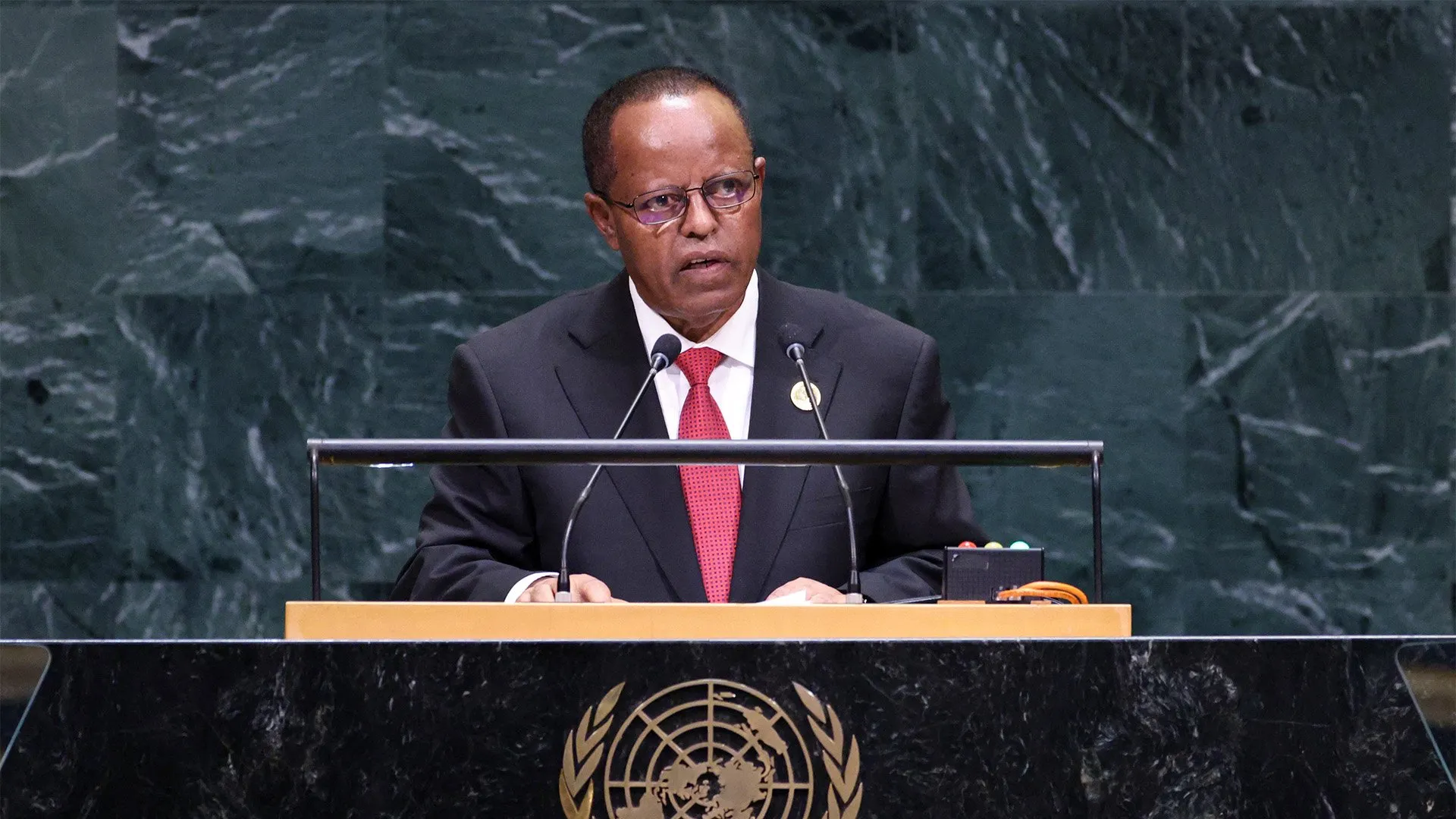
Ethiopia warns of ‘destruction’ as Tigray rebels launch offensive | Abiy Ahmed
Ethiopian President Taye Atske Selassie warned the UN General Assembly of “forces of destruction and mayhem” as Tigray rebels joined other rebel groups to seize airports and target government positions in northern Ethiopia, triggering fears of a renewed civil war.
Published On 23 Sep 2026
FBI says investigating breach of ‘very sensitive’ data by hackers | Donald Trump News
Hacker group ShinyHunters claims to have detailed data on thousands of FBI employees.

Published On 23 Sep 2026
The United States Federal Bureau of Investigation says it is investigating a breach of its jobs website by a hacking group that claims to have obtained sensitive data on thousands of employees.
“The FBI is aware of a cybercriminal enterprise group claiming a compromise of the fbijobs.gov portal and alleged impact to FBI employee personally identifiable information,” the agency said in a statement on Wednesday.
Recommended Stories
list of 3 itemsend of list
“While the point of breach is still undetermined — whether a third -party or the FBI’s enterprise — we are actively and aggressively investigating this matter and working closely with those third-party providers that support fbijobs.gov to mitigate any and all risk.”
Several news outlets, including Reuters news agency, reported they had seen parts of the data, claimed to be part of a larger trove between two and three terabytes by ShinyHunters, a hacking group claiming responsibility for the breach. According to Reuters, the data includes granular detail about scores of bureau officials’s job assignments, including sensitive work against Chinese spies, Russian intelligence, drug cartels and more.
ShinyHunters said on Tuesday that it had breached the FBI and stolen data on a huge number of current and former FBI employees. It said it is holding the data hostage until the bureau rescinds an unflattering statement about the group issued in May. On Wednesday, the group said it was trying to keep the personnel information from circulating widely in the meantime.
An FBI statement in May characterised ShinyHunters as “threat actors” who often harass or threaten victims, using “their real or exaggerated claims of access to sensitive or personal information to prompt payment from victims”.
The group “may falsely claim to have sensitive or compromising information, including embarrassing photographs or videos of victims, which frequently do not exist,” the FBI said.
The FBI has been a common hacking target.
In March, the FBI disclosed that it was investigating “suspicious activities” on an internal system that contains sensitive information related to surveillance operations and investigations. Also that month, a pro-Iranian hacking group claimed to have hacked an account of FBI Director Kash Patel and posted online what appear to be years-old photographs of him, along with a work resume and other personal documents dating back more than a decade.
The jobs portal was still offline Wednesday afternoon.

Central Cee shares cryptic response after it’s revealed he bought Love Island’s Yasmin £7k Chanel bag
CENTRAL Cee has shared a cryptic response after buying Love Island’s Yasmin Hadlow a £7k Chanel handbag.
It was revealed on Tuesday that he splashed the cash on the designer purchase as he continues to woo her.
The Sun’s Bizarre revealed the news of Cench’s date with Yasmin at 77 London on Friday night and then told of a Harrods trip before.
Now the 28-year-old has taken to his Instagram stories to share a mysterious picture.
In the snap, his pals Ruby Lyn and Lily Chee are seen covering their faces with designer handbags as they sit in a luxury store.
The two girls are pictured surrounded by the different coloured bags as Cench played up to the rumours about him and Yasmin, 23.


The pair enjoyed a cosy date on Friday night at 77 London.
Before their evening out, the musician treated the reality star to the Chanel bag as well as some designer heels.
A source said that the Doja htimaker – real name Oakley Caesar-Su, told Yasmin to “buy whatever she wanted”.
Central Cee first revealed his crush on Yasmin last month during an interview.
While speaking on 60 Seconds with Missy, he expressed: “I do have one, I’ve got one I’m sure. Yasmin from Love Island.”
When asked about Cee at the National Television Awards, Yasmin replied coyly: “No comment… Watch this space.”
Fans were recently left confused about his equation with Yasmin after he was previously rumoured to be dating Ruby.
She even posted a video of him on her social media of him walking Burberry’s catwalk on Monday night.
However, those rumours have been debunked.
A source said: “Cench and Ruby are just friends. No one knows where this comes from. He’s very much single and free to date Yasmin.”
She split from Tommy Stagg just weeks after coming out of the villa.
The pair were at the centre of plenty of speculation after they weren’t spotted together and didn’t post each other on social media.

Newsom vetoes bill that would have remade state demonstration forests
Gov. Gavin Newsom has vetoed a bill aimed at deprioritizing commercial logging in a unique state forest system, arguing the measure would jeopardize the ability to test best management practices.
At issue are the state’s 14 demonstration forests — managed by the California Department of Forestry and Fire Protection, or Cal Fire — which are billed as “living laboratories” for forest management practices. Under existing law, they’re directed to produce as much timber as can be sustained over time, while considering factors like recreation and wildlife.
Assembly Bill 2494 would have eliminated what’s often characterized as a logging mandate in favor of prioritizing values such as carbon storage, wildfire resilience and biodiversity conservation. It also would have directed state officials to seek agreements with Native American tribes to integrate their traditional knowledge into managing the land.
In Newsom’s veto message, he said the forests “produce cutting-edge strategies that inform forest management on public and private lands across California,” which is key for fighting climate change and improving wildfire resilience.
“By narrowing the management of these forests to a limited set of public benefits, this bill risks the state’s ability to fully demonstrate the best science-based practices,” he wrote Friday. “At a time when California is racing to keep pace with a rapidly changing climate, we cannot afford to lose the flexibility needed to safeguard our forests for future generations.”
The move deals a blow to a grassroots coalition that included tribes, environmentalists and mountain bikers, some of whom have fought for decades to rein in logging at Jackson Demonstration State Forest in Mendocino County. In recent years, activists have staged protests and tree sits, harkening back to the “timber wars” of the 1980s and ‘90s.
The bill grew in part out of discussions with constituents who wanted to see the forest run differently, according to its author, Assemblymember Chris Rogers (D-Santa Rosa).
Rogers, who represents the North Coast, called Newsom’s veto message “nonsensical” and said it didn’t reflect the language of the bill.
“Current law says that the guiding principle for the management of the forests is maximum sustained production of high-quality wood products,” he told The Times. “That’s much more narrow as a directive on how to manage those lands than by expanding it to include biodiversity, carbon sequestration, research, recreation.”
Polly Girvin, who pushed for changes at Jackson along with her late partner and tribal leader Priscilla Hunter, said the fight will continue under California’s next governor. She wants to see Native Americans take an even stronger leadership role going forward, pointing to rights afforded to them by state law.
“Our local tribal voice is not pro-logging; it’s really to keep the world in balance, to honor the cries of the ancestors, to try to save the trees from commercial logging,” said Girvin, a retired attorney focused on Native American law.
Leaders in Mendocino and Humboldt counties backed the measure. Humboldt County Supervisor Steve Madrone saw it as codifying practices that could help rebuild trust in the community, which he said Cal Fire had lost.
“It was not going to restrict it from being able to do all kinds of things,” he said. “Frankly, it was going to be better than just letting them kind of focus on board feet.”
Cal Fire’s Kevin Conway, who oversees the state’s demonstration forests, said he could not comment on the measure.
The bill was opposed by the Rural County Representatives of California, an advocacy group representing 40 counties, along with many in the timber and agriculture industries.
Staci Heaton, senior policy advocate for RCRC, echoed Newsom’s concerns that the legislation would have limited what could be done in the forests to achieve resilience, such as the ability to harvest trees of different sizes and types. She said they also had concerns about the funding structure and what she described as vague definitions in the bill, which could invite litigation.
“We appreciate the governor signaling that we’re going to continue to use sound forest management in California,” Heaton said.
Asked about the disagreement among some counties, she said there tends to be “more of a split in what people think good forest management looks like” when it comes to coastal redwood forests.
“We maintain that a lot of our forests really aren’t healthy in their current condition, and there’s too many straws in the ground, and there does need to be, in some areas, more aggressive management,” she said.

FBI case widens against fake NFL player who allegedly defrauded women
Love is the name. Fraud allegedly was his game. And the list of his victims — several of whom said they became romantically involved with him — continues to grow.
Daejon Labrayae Love, 35, and his accomplice Taylor Jamie Chan, 18, remain in federal custody after their arrest Aug. 24 in Boise, Idaho, on wire fraud and conspiracy to commit wire fraud charges. The FBI charged the two men with scamming at least 26 women in four states out of at least $1.3 million.
Since then many more women have come forward to say they were victims of Love’s schemes, which often involved him impersonating a San Francisco 49ers player. The FBI said it has identified 35 additional women who say they were defrauded, ratcheting up the number of alleged victims to more than 60.
The latest development is especially troubling. A woman told ESPN on Tuesday that she submitted a complaint about Love on the 49ers website eight months ago on Dec. 20, 2025, yet the team apparently did little with the information.
Gwen Herndon submitted a complaint/concern form, writing “there is a federal investigation surrounding a man pretending to be a 49ers player.” She named Love, saying he stole money from women.
“I wanted you to be aware of the situation and are hopefully proactive in denouncing his involvement on your team,” she wrote in the message, which was reviewed by ESPN.
Herndon said the only response she received from the 49ers came from a Levi’s Stadium guest services account a week after her report, encouraging her to contact law enforcement agencies with the information.
“We take reports of individuals misrepresenting themselves as members of the San Francisco 49ers very seriously,” the 49ers response said. “For safety and legal reasons, the team cannot comment on ongoing investigations or specific individuals…. Our internal team will also monitor any instances of impersonation and take action as appropriate to protect fans and the team’s reputation.”
A 49ers spokesperson declined to confirm that Herndon’s email was viewed by team officials, citing the ongoing FBI investigation.
Federal investigators, meanwhile, are working to verify that the 35 women who have come forward in recent days are in fact victims of Love and Chan, Portland FBI Special Agent in Charge Doug Olson said in a news conference.
“We were surprised how many people were victimized in such a short period of time and then to have that many more come forward,” Olson said. “It’s a large volume for just a couple of subjects. Our concern is that this fraud could be replicated by other individuals that are out there victimizing other people in similar schemes.”
The FBI alleges that from February 2022 until they were arrested, Love and Chan fraudulently solicited money from women in California, Oregon, Washington and Idaho.
Love portrayed himself on Instagram as a 49ers wide receiver who went undrafted but worked his way onto the roster. He met many of the women through dating apps and developed romantic relationships with several, according to the FBI. Chan falsely posed as Love’s financial adviser.
In an Instagram Story titled “NFL Journey,” Love held a 49ers helmet while driving and said, “I’m on my way to get my mom. I know I get a lot of fans who want to know how football works or how I got involved in the league…. If you know me and see me in person I’ll explain.”
Experts on interpersonal relationships say that a person can instantly assume someone is trustworthy who exudes warmth and confidence as a first impression — especially if they find the person attractive.
“When we meet someone for the first time, our brains are quietly trying to answer two big questions: Can I trust this person, and do they seem capable and confident?,” said Tammi Pickle, an executive at the personalized matchmaking agency Elite Connections. “Someone who comes across as confident might suddenly seem smarter, kinder, more successful and even more trustworthy simply because of the way they carry themselves.
“When we are attracted to someone, our brains have a tendency to fill in the blanks with positive assumptions. The catch? Those assumptions aren’t always accurate.”
Love quickly gained the trust of dozens of women, allegedly convincing them to give him large sums of money. The FBI said Love instructed several women who did not have cash to invest to take out personal loans, assuring them they would quickly be repaid.
“The scheme relied on Love’s creation of fictitious personas and display of a lavish lifestyle which Love presented to victims both in person and on social media websites,” federal authorities said in a press release.
“Chan and Love also hosted three-way FaceTime calls in which they showed victims falsified investment gains and encouraged victims to part with their money. Victims sent Love and Chan money due to their belief that their money would be invested in legitimate investment vehicles on the victims’ behalf.”
One women who didn’t fall for Love’s scheme told KPTV in Oregon that she went on a 2024 date with him in 2024 after meeting on a dating app. He told her his name was John Prince and claimed he was a Swiss real estate developer.
Anderson said his behavior during their first date raised suspicion.
“He said, ‘I’m very intentional and efficient when it comes to dating, and if I pursue you, you will be the only one I pursue. I need someone who has been around money, who understands that, you know, these things aren’t luxuries to me. This is just my normal life.’
“Within five minutes, I decided I wasn’t gonna see him again.”
Love also manipulated AI. Search engines and AI rely on web scraping and frequency of mentions, and the sheer volume of his fake posts caused AI to mistakenly identify him as an NFL wide receiver. He showed screenshots of erroneous AI search summaries to alleged victims, convincing them he was worthy of their trust.
On an Instagram story, he posted a one screenshot of a webpage AI Overview that says “Daejon Love is a wide receiver for the San Francisco 49ers and information about his position, contract and teammate texting habits is available online. He is also associated with the team in various social media content and articles.”
Love then turns the camera on himself and says, “That’s Google. That’s not me, that’s Google.”
He goes on to explain why he isn’t currently playing, lifting a crooked finger to the camera and saying he is injured. He concludes the story by again saying he wants “full transparency” because “people ask, what do I do? How can I afford a $500,000 car? How can I afford a $300,000 [Lamborghini] Urus? “
He says that he is driving to pick up his mother, then concludes by inviting those watching to reach out to him in person.
In the month before his arrest, Love traveled to New Mexico, California, Oregon, Nevada, Utah and Idaho to meet with women, according to investigators. He allegedly used several fictitious names, including Jon Love, Avril Lyto Love and Jordan Love.
The romp abruptly ended at the Boise airport when Love and Chan were removed from a white sports car by federal agents, according to a video obtained by TMZ. Love appears to be wearing red Niners gear as he is handcuffed.
“Victims were encouraged to take out personal loans and make life-altering financial decisions based on the belief they were building a future with someone they cared about,” said Olson, the FBI special agent. “Once the money was taken, the victims were cut off, left without answers, without funds, and often without closure. Many lost not only their savings, but their sense of security and confidence.”

US aviation sanctions disrupt Iran flights, push travellers overland | US-Israel war on Iran News
Tehran, Iran – Travel is becoming increasingly difficult for Iranian civilians as United States sanctions shut domestic airlines out of much of the world’s airspace and international carriers continue to avoid the country.
The US Department of the Treasury designated 27 airlines on September 8, covering the remaining Iranian carriers that had not previously been sanctioned by Washington. Major names like Iran Air and Mahan are among those already heavily sanctioned, but have continued limited operations.
Recommended Stories
list of 3 itemsend of list
Recent designations have also targeted individuals and entities linked to aviation support and procurement in the United Arab Emirates, Turkiye, China, India, the United Kingdom, Malaysia and elsewhere.
Airports and companies that provide Iranian-operated aeroplanes with fuel, landing services, or ticket sales risk secondary US sanctions that could cut them off from the US financial system, Treasury Secretary Scott Bessent said on Monday. It is the latest attempt to squeeze Iran and force it to make concessions amid the US-Israel war on Iran.
Wednesday marked the expiry of a short wind-down period allowing countries to stop servicing Iranian carriers, leading to the cancellation of all but a handful of Iranian flights to Turkiye, UAE and China.
Aviation authorities in several neighbouring countries that had continued to allow Iranian airlines to use their airspace and airport services would no longer be providing them, including Oman, Azerbaijan, and Georgia. In Iraq, Baghdad Airport was declared off-limits to Iranian carriers, but flights to Najaf Airport were still operating on Wednesday.
Many flights between Iran and major transit hubs in Turkiye and the UAE had already been suspended because of the war and sanctions. International airlines have also largely stopped flying to Iran, with Turkish Airlines suspending flights until at least March 2027, and Qatar Airways, Emirates, and Lufthansa’s operations also suspended.
‘A new level’ of sanctions
Iran-based aviation and transit expert Mohammadreza Ebrahimpour said years of US sanctions had already forced Iranian airlines to rely on third countries and work with smaller firms to get fuel or services. Obtaining spare parts needed to keep Iran’s ageing aircraft flying has also become increasingly difficult.
But the decision by aviation authorities in neighbouring countries to formally refuse services to Iranian airlines constituted “a new level of sanctions in action” that could have longer-lasting consequences, he told Al Jazeera.
Ebrahimpour said the US had also effectively prohibited international airlines from flying through Iranian airspace by suspending authorisations for some US-origin aircraft to fly to Iran and limiting US-linked overflight payments.
“This is a big blow because payments for overflights were one of the most lucrative parts of [Iran’s] aviation industry, which could act as a support for developing infrastructure and the overall industry,” Ebrahimpour said, adding that Iran earned more than $300m a year from this.
Beyond the effect on civilian passengers and the import of some goods, the measures could put tens of thousands of jobs at risk across the aviation sector and related industries, including tourism and hospitality.
Ebrahimpour pointed out that the International Civil Aviation Agency and other organisations have failed to offer any tangible protection to Iran’s aviation industry during years of sanctions. Iranian authorities, he said, would likely consider China and Russia among the few countries potentially able to provide assistance.
The two countries have rejected US sanctions against Iran, although some of their more globally connected financial networks and companies have, at times, distanced themselves from Iran to avoid secondary sanctions.
Under pressure from all fronts
The flight cancellations have pushed thousands of travellers towards land crossings, particularly those with Turkiye and Armenia, where onward international flights remain available for Iranians. Heavy congestion has been reported in recent days at the Bazargan and Razi border crossings with Turkiye and along land routes to the Armenian capital Yerevan.
But everyday passenger travel overland into Azerbaijan remains restricted, with Azerbaijan’s government citing internal security and COVID-19 restrictions. As a result, Iranians cannot cross overland into Azerbaijan to catch a flight there.
The Shalamcheh and Chazabeh border crossings with Iraq were also temporarily closed earlier this month, leaving travellers stranded, before reopening to passengers on September 13.
For thousands of Iranians attempting to travel, the flight suspensions mean significantly longer journeys. Some members of the Iranian diaspora have expressed concern online that the lingering effects of war and sanctions could potentially prevent them from visiting parents and other family members in Iran.
Bus tickets from Iran to Turkiye have reportedly sold for quadruple their normal price on the black market amid surging demand.
Some of the people making the journey are young Iranians who are attempting to take international language tests that are not allowed to be administered inside Iran due to sanctions. The tests are often a prerequisite for anyone planning to study, work, or settle abroad.
Iranian academics have also expressed concern about growing isolation from the international academic community. Numerous universities across the globe, including in Norway, Australia, Singapore, Estonia and elsewhere, have in recent weeks rejected postgraduate and research applications from Iranians as a result of US education sanctions.
At the same time, many of Iran’s roughly 90 million people are currently unable to afford international travel – or even domestic flights – as the country’s economic conditions worsen.
The Trump administration has portrayed the war and sanctions as measures directed at the Iranian authorities.
The US Treasury has said its aviation restrictions are intended to disrupt the use of Iranian commercial aviation for weapons procurement and transportation, including activities linked to the Islamic Revolutionary Guard Corps (IRGC). But the designation of entire airlines under “Operation Economic Outcast”, after nearly seven months of war, has also had sweeping consequences for affected civilians.
Iran’s international aviation network was already badly damaged prior to the latest package of sanctions. Aviation analytics company Cirium reported that international capacity in August 2026 was 49 percent lower than in August 2025, despite a modest recovery from July.
The latest flight cancellations are also expected to further disrupt imports by air at a time when the US naval blockade of Iran’s southern ports in the Strait of Hormuz has constrained maritime trade routes, while war and sanctions have caused disruptions and delays to road and rail cargo routes.
Some of Iran’s medical imports enter the country by air, raising concerns that the latest aviation restrictions could place more pressure on an already struggling healthcare sector. A domestic pharmaceutical company executive told Al Jazeera earlier this month that the cost of some imported supplies, some of which arrived by air, had risen as much as 10-fold as a result of sanctions, wider economic pressure, and war damage.
Addressing the United Nations General Assembly in New York on Wednesday, Iranian President Masoud Pezeshkian accused the Trump administration of “bullying”.
“They have tested Iran’s resilience, and now they know full well that Iran cannot be forced to surrender through war,” Pezeshkian said.
Trump administration invites Putin to attend G20 summit in Miami | Vladimir Putin News
US Secretary of State Marco Rubio says summit would be opportunity for Russian president to engage with global leaders.
Published On 23 Sep 2026
United States President Donald Trump has invited his Russian counterpart Vladimir Putin to the upcoming G20 summit in Miami, Florida, the latest step meant to build ties between the two countries amid Russia’s ongoing invasion of Ukraine.
US Secretary of State Marco Rubio told reporters on Wednesday that Putin had been invited to travel to the summit in December, saying that he hopes the Russian leader will take the opportunity to meet with global leaders.
Recommended Stories
list of 3 itemsend of list
“In order to solve problems, you have to meet with the people that you disagree with or the people that you might have some issues with,” Rubio said. “So we’ve invited President Putin to the G20.”
“We think it’s an opportunity for him to engage not just with the president, but with other world leaders. We hope that’s an invitation he’ll accept,” Rubio said.
Rubio’s remarks followed a meeting with Russian Foreign Minister Sergey Lavrov on the sidelines of the United Nations General Assembly (UNGA), currently convening in New York City.
During a speech to the UNGA on Wednesday, Ukrainian President Volodymyr Zelenskyy called on the world to place more financial pressure on Russia.
“When someone gives Russia more money through trade, they give this war more time. And that is exactly why we insist on limiting trade with the aggressor, and why we are burning Russia’s revenues ourselves,” he said, adding that he is sceptical that Russia is sincerely interested in taking steps that could end the war.
Trump has searched in vain for an agreement between Russia and Ukraine to end the war sparked by Russia’s full-scale invasion in 2022.
Ukrainian officials have called for a pause on strikes targeting energy infrastructure and for steps to facilitate shipping for the Black Sea. Russia has given little sign that it is interested in such an arrangement.
“We are not going to have a pause in our special military operation,” Lavrov told the UN Security Council on Wednesday, accusing Europe of wanting to pause the fighting in order to “pump the Kyiv regime with weapons”.
Rubio, however, continued to express optimism about the possibility of a temporary ceasefire.
“I think both sides have expressed an interest in some limited ceasefire that involves grain and energy,” he said. “Obviously, you know, that won’t be easy, either.”
Zelenskyy told reporters that Kyiv remains open to a maritime truce in the Black Sea.
“We are waiting for Russia’s response,” he said, adding that his country is ready “to ensure safe shipping and food security in the Black Sea if Russia is ready to take real steps towards de-escalation, too”.
“We have to start somewhere,” he added.
The International Criminal Court (ICC) issued an arrest warrant for Putin in 2023 for the alleged war crime of deportation of Ukrainian children to Russian territory. The arrest warrant obliges member states to arrest Putin if he travels to their countries, but the court has no enforcement mechanism for this. The US is not a member of the ICC.

BBC The Repair Shop guest in tears over son’s incredibly rare health condition
A guest on The Repair Shop opened up about how the precious item meant so much to her family.

A guest on The Repair Shop broke down in tears (Image: BBC)
A guest on The Repair Shop broke down in tears as she opened up about her son’s health.
The BBC programme returned to screens on Wednesday, September 23, with spin-off Beyond the Barn. The series follows experts restoring precious items from guests across the country, while also discovering what happened after the special items were restored.
Wednesday’s programme saw a treasured trophy revived, as well as a coronation scrapbook brought back to life. At the start of the show, Ruth Dalton from Rochester arrived with a gardening tool.
She sought The Repair Shop team’s help, including expert Jonathan Reid, in reviving her grandfather’s gardening tool, a pair of secateurs, so her son could use them.
She explained: “I have my late grandfather’s gardening scissors. He used them all the time, and I kind of wanted to keep them as a reminder of him and his gardening.”
She continued: “His name was Stan. He was a real, real green-fingered guy. He had a massive garden. I used to love spending time with my grandad. As children, we were always up there, helping him in the garden.
“There were little steps that went up to a big lawn and different archways. He used to tell us what plants you could touch and what they did. You know, ‘Don’t touch the roses, you might get pricked by the roses,’ and that sort of thing.
“He was very encouraging and did teach us a lot, gardening was his life.” Ruth went on to reveal that she herself loved gardening, though her own garden wasn’t “at its best”.
Ruth explained how she wanted the secateurs fixed so she could tend to her own garden, which was built for her son. She said: “His name is Samuel, he’s got a condition called Bainbridge-Ropers syndrome.
“He was only the 12th person in the UK to be diagnosed, and there’s about 300 worldwide. He’s coming up to 26 years old. He can’t walk, he can’t talk, he doesn’t really understand much but he loves being outside. His demeanour changes completely when he’s out in the fresh air.”
She added: “He can’t do things on his own but he really loves doing things like when we’re weeding and stuff. If he can reach them, he’ll pull the weeds out himself. So I thought these would be perfect because they’re just about the right size for Samuel to hold.”
She went on to point out some “dreadful” issues with the scissors, including how rusty they were and how stiff they were to use, as well as the old paintwork that was flaking off.
When asked how it would feel for her son to be able to use the same pruners that her grandfather once used, Ruth broke down in tears. She said: “My grandad’s always there, and his guiding hand on Samuel’s… I do things hand-on-hand with him, I almost feel that if he could use those, it would be my grandad’s hand helping him and to get him out there doing something purposeful gives him that little bit of independence. It would be special, he’s a special boy, he deserves it.”
The Repair Shop: Beyond the Barn is available to watch on BBC iPlayer

Airbnb broadens use of OpenAI models across engineering teams (ABNB:NASDAQ)

GoodLifeStudio/iStock Unreleased via Getty Images
Airbnb (ABNB) is expanding access to OpenAI’s (OPENAI) frontier models, including GPT-6 Astra, for its engineering and product development teams under a new agreement, the companies said on Wednesday.
The expansion builds on Airbnb’s use of OpenAI’s (OPENAI) Codex

U.S. charges Utah postal worker with dumping mail ballots in trash
SALT LAKE CITY — A U.S. Postal Service letter carrier in Utah threw out more than 300 mail ballots that were being sent to voters for the state’s June primary, the Justice Department said Tuesday.
Acting Deputy Atty. Gen. Trent McCotter said during a news conference that Damon Matai Seei was arrested Tuesday and appeared in federal court in Salt Lake City to be arraigned.
The 34-year-old from Payson, Utah, pleaded not guilty to a felony charge of destruction or delay of mail. If convicted, he could face up to five years in federal prison. A message seeking comment was sent to his attorney.
Seei was delivering mail in Eagle Mountain, a conservative suburb of Provo, when he threw the ballots and other mail into a dumpster in a church parking lot not long after his shift started, McCotter said.
Melissa Holyoak, the U.S. attorney for Utah, said Seei indicated to authorities that he had no political agenda and did not intend to discard the ballots. He told investigators in an interview that he acted out of “laziness,” throwing away mail to “lighten his workload,” according to court documents.
In a written statement quoted in court filings, Seei said he felt overwhelmed that day by the quantity of mail, and he decided to toss out advertisements so he could focus on other deliveries.
He told law enforcement he had set aside the ballots at the beginning of his shift, prosecutors said, arguing it was implausible that Seei didn’t know they were in the discard pile.
Most voters in Utah cast ballots by mail or deposit them in drop boxes. Nationwide, nearly a third of voters use mail-in ballots.
All active registered voters in Utah are automatically sent ballots by mail, though that system is set to end in 2029 under a new state law requiring voters to opt in.
Several Eagle Mountain residents complained to Utah County Clerk Aaron Davidson that they never received their ballots, leading him to investigate. He determined that the rate of voter participation in the community was unusually low and learned through outreach that the number of voters who did not receive ballots was in the hundreds, according to court documents.
Seei is no longer employed by the Postal Service. The investigation remains ongoing, officials said.
Earlier this month, the U.S. Supreme Court rejected President Trump’s attempts to impose new Postal Service rules that would have restricted mail voting for the midterm elections.
Catalini and Schoenbaum write for the Associated Press.
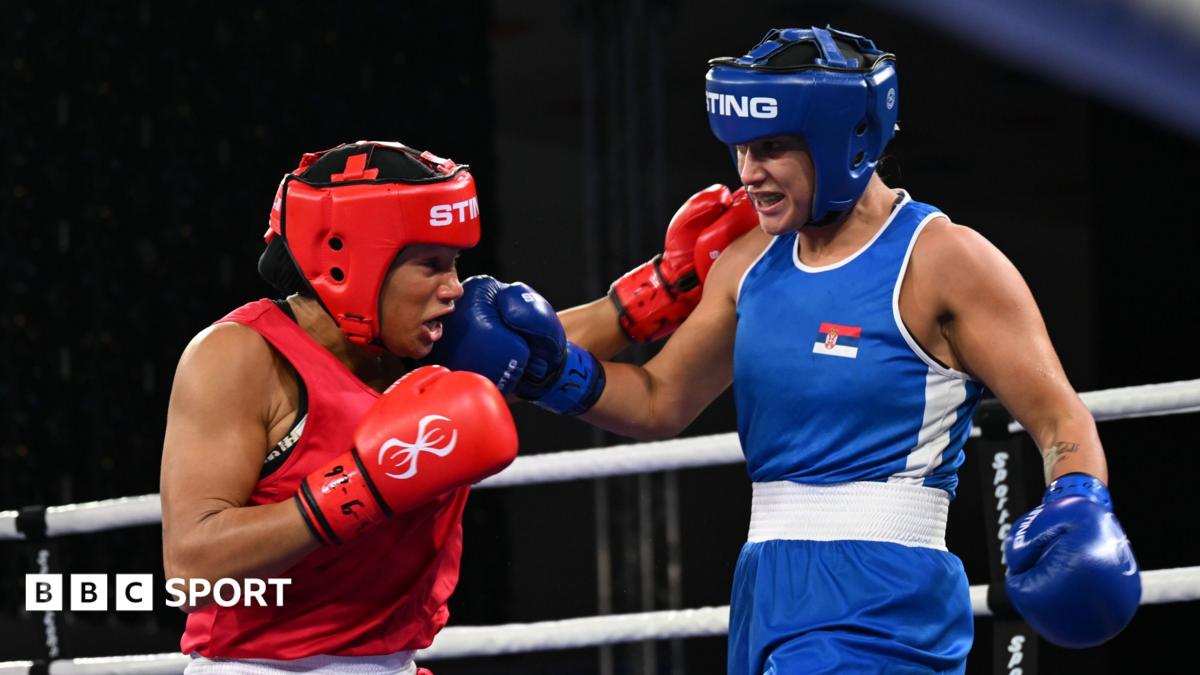
European Boxing Championships: Great Britain’s Chantelle Reid and Damar Thomas reach finals
Great Britain’s Chantelle Reid and Damar Thomas will fight for gold at the European Boxing Championships after semi-final victories on Wednesday.
Reid defeated Serbia’s Milena Matovic 3-2 in her light-middleweight semi-final, while Thomas triumphed 5-0 over Azerbaijan’s Mahammad Abdullayev in the men’s super-heavyweight competition.
Team-mates Callum Makin and Dimeji Shittu are also guaranteed medals in the men’s middleweight and light-heavyweight divisions respectively after victories in their quarter-finals.
Reid, the Commonwealth Games silver medallist, was behind after the first round against Matovic, but she was the unanimous winner of the second and did enough in the third to seal victory at Asics Arena Sports Hall in Sofia, Bulgaria.
“It was a really good bout. She’s a really good girl and I hope we get to share the ring again one day,” said Reid.
“On to the next. Each bout’s gone better, each opponent’s gotten better and I’ll be boxing the best out of the weight category in two days’ time.”
The 28-year-old will face Busenaz Surmeneli in the final on Friday, after the Turkish boxer defeated Russia’s Nadezhda Golubeva 3-2.
Thomas, the 21-year-old Commonwealth gold medal winner, will face Russia’s David Surov in Friday’s final after the Russian also completed a 5-0 victory over Austria’s Ahmed Hagag.
Shittu, who had to settle for Commonwealth Games silver in August after a controversial defeat by India’s Ankush Panghal, made sure of a European medal with a 5-0 win against Austria’s Lucky Aimufua.
The 24-year-old will fight Russia’s Cheerav Ashalaev on Thursday for a place in the final.
“My first performance wasn’t the best, but that’s what I’m like, I go back to the drawing board and showed what I’m really capable of,” said Shittu.
“Credit to my opponent. He was game, he was strong, but ultimately skills paid the bills, booked me a place in the semi-finals and a guaranteed medal.
“Last time I brawled, now I want to show that I can box. And the end of the day it’s hit or not get hit. So I went out there, put on a show. Got the medal, let’s go change that colour.”
Makin, a bronze medallist at last year’s World Boxing Championships, won 3-2 against Armenia’s Marat Mikaelyan.
The 22-year-old will face Azerbaijan’s Saidjamshid Jafarov in Thursday’s semi-final.
The remainder of Great Britain’s fighters experienced defeat on Wednesday, with Lauren Mackie and Amy Broadhurst both losing in the quarter-finals.
Commonwealth Games bronze medallist Mackie lost 5-0 to Lenka Bernadova of the Czech Republic in the women’s bantamweight division, while Broadhurst was beaten 4-1 by France’s Sthelyne Grosy in the women’s lightweight.
Abdul Burton also represents Britain on Thursday, facing Turkey’s Semih Gumus in the men’s super-bantamweight semi-finals.
He and Shittu compete in the session starting at 11:30 BST, while Makin’s bout with Jafarov is among the fights scheduled from 16:00.
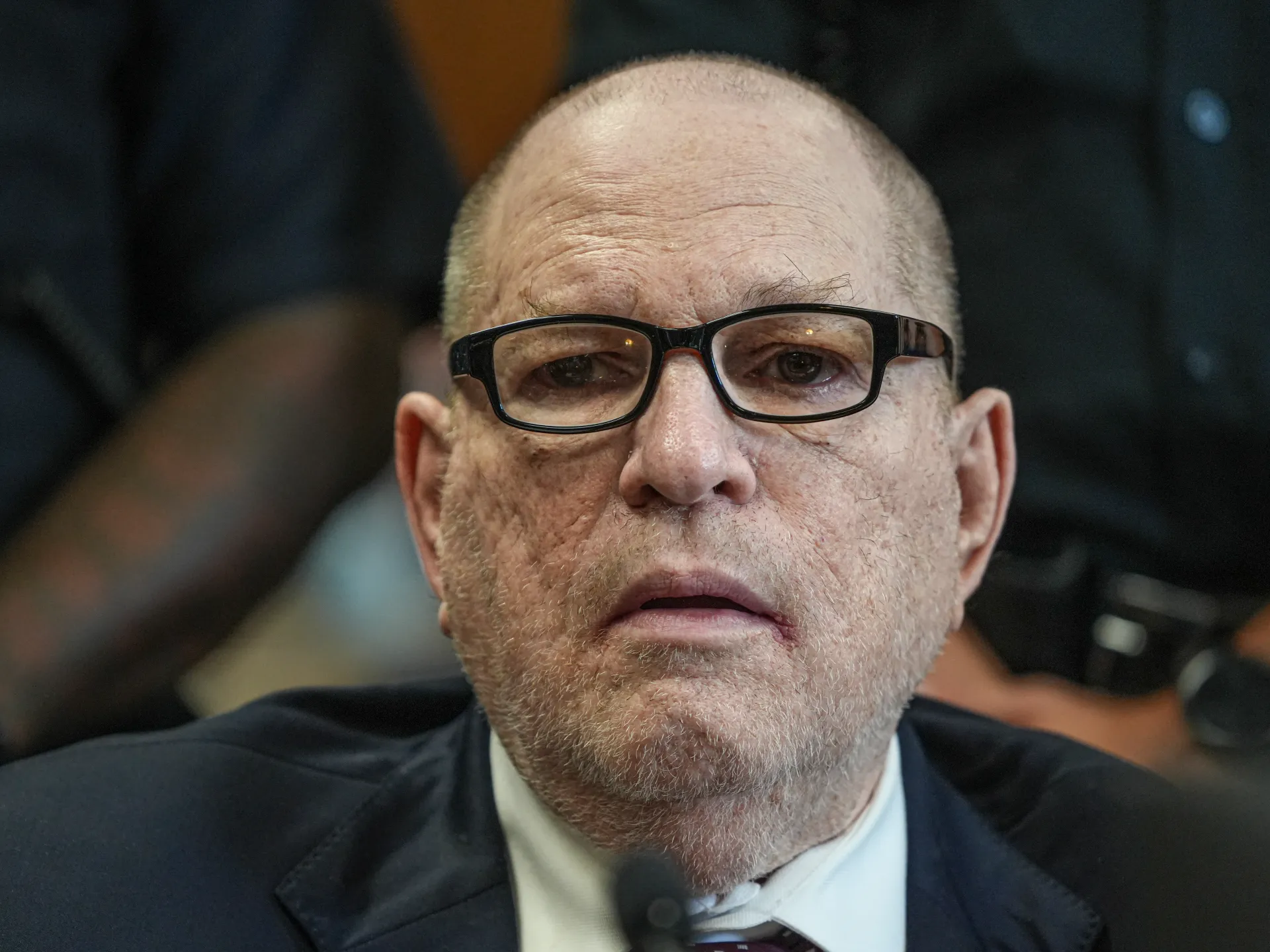
Harvey Weinstein sentenced to 15 years in sexual assault retrial | News
The ruling seals six years of legal battles after Weinstein’s initial conviction for sexually assaulting TV assistant.
Published On 23 Sep 2026
Harvey Weinstein, the disgraced movie mogul, has been sentenced in Manhattan to 15 years in prison for a felony sex crime in another #MeToo reckoning.
Weinstein’s sentencing on Wednesday for sexually assaulting one-time TV production assistant Miriam Haley followed a legal odyssey spanning more than six years, when New York’s highest court overturned his 2020 conviction. A second jury found Weinstein guilty again at a retrial last year.
Once among the most powerful figures in the entertainment industry, Weinstein was an Oscar-winning producer whose hits included “Shakespeare in Love,” “Pulp Fiction” and “Chocolat.” But his downfall came quickly after sexual assault allegations in 2017 set off the #MeToo movement.
Weinstein, 74, is expected to appeal and maintains that he never raped or sexually assaulted anyone. He is now likely to remain behind bars well into his 80s. Seated in a wheelchair, he was quickly moved out of the courtroom after the sentencing, while some of his accusers hugged and brushed away tears.
Haley, 49, appeared in court on Wednesday morning and delivered a victim impact statement in which she talked about enduring seven years of public smear campaigns and humiliation orchestrated by Weinstein, his legal team and allegedly paid podcasters aiming to sour her image.
Haley added that her experience following the assault had “already been a life sentence” for her, and implored the judge to take all of this into consideration.
Owing to a cycle of retrials, appeals and judicial proceedings, Weinstein has remained incarcerated since his 2018 arrest and is now serving time in a prison medical ward.
Weinstein, first publicly accused of wrongdoing in 2017, was detained a year later. In 2024, New York’s highest court overturned the original 2020 conviction that had sentenced the former Hollywood producer to 23 years in prison, ruling that the inclusion of extraneous, non-indicted testimony had compromised the equity of the trial.
Prosecutors attempted to retry the case last June, but it ended in a split verdict after the jury foreperson refused to return to deliberate amid a jury room feud. Weinstein was convicted of a first-degree criminal sex act on a separate count at the time, again.
Weinstein is also awaiting resentencing in a separate rape case in Los Angeles.

Ivory Coast vs Ghana: AFCON 2027 qualifier, kick-off time, lineups, teams | Africa Cup of Nations
Who: Ivory Coast vs Ghana
What: CAF Africa Cup of Nations qualifier
Where: Stade de Bouake, in Bouake, Ivory Coast
When: Thursday, September 24, at 7pm (19:00 GMT)
How to follow: Al Jazeera Sport will have live build-up from 16:00 GMT before our text commentary stream.
The qualification process for the 2027 Africa Cup of Nations kicks off with a match befitting the final itself as Ivory Coast play Ghana.
Recommended Stories
list of 4 itemsend of list
Both nations are packed with high-profile players and are led by names that have managed at the highest levels of the game.
Al Jazeera takes a look at the mouth-watering opener on the path to the finals in Kenya, Uganda, and Tanzania.
Who else is in Ivory Coast and Ghana’s AFCON qualifying group?
The Gambia and Somalia complete Group C of the Africa Cup of Nations qualifiers.
In the next round of matches in the group, Ghana will entertain The Gambia on Tuesday, while Ivory Coast will travel to Somalia.
What are the expectations on Ivory Coast’s AFCON campaign?
Despite their round-of-32 exit in the FIFA World Cup 2026 at the hands of Norway, Ivory Coast’s task ahead is quite clear: win AFCON 2027.
The Elephants are led by Herve Renard, who is taking charge of the West African giants for the second time and replaced Emerse Fae following the World Cup.
The Frenchman previously managed Ivory Coast from 2014 to 2015, leading them to the AFCON title before joining French Ligue 1 club Lille immediately after the final.
Renard is a two-time AFCON winner, having also led Zambia to their historic win in 2012. The 57-year-old has also managed Morocco, Tunisia – in a last-minute call-up at World Cup 2026 – and Saudi Arabia, who he famously led to victory against Argentina in their group-stage match at Qatar 2022.
Who are the star names in the Ivory Coast side?
Although not blessed with the superstar-level talents like Didier Drogba from their 2015 victory, Ivory Coast are still a force to be reckoned with.
Yan Diomande is the shining light of African football following his $161m move to Spanish giants Real Madrid from RB Leipzig in Germany.
Former Barcelona midfielder, now with Atalanta in Italy’s Serie A, Franck Kessie is arguably the next biggest name in the current side.
Former Arsenal forward, Nicolas Pepe is resurrecting his career at Villarreal in Spain after a failed $92m transfer to the Gunners from French club Lille.
Ibrahim Sangare has been a standout performer in the English Premier League with Nottingham Forest, while Amad Diallo of Manchester United is the starlet of Ivory Coast football.
What is Ivory Coast’s AFCON record?
The Elephants are three-time AFCON winners and beat Ghana on penalties in the 1992 final for their first continental crown.
Renard’s 2015 victory also saw Ghana defeated, and once again it was by penalties.
Their most recent win came at the 2023 edition when they defeated Nigeria 2-1 on home soil.
What are the expectations on Ghana’s AFCON campaign?
Ghana, like Ivory Coast, were also eliminated at the round of 32 at the World Cup 2026 as they lost 1-0 to Colombia.
The Black Stars also lost their final group stage match to Croatia, but achieved a respectable 0-0 draw with eventual semifinalists England, while beating Panama to secure their progress to the knockouts.
Led by former Real Madrid manager Carlos Queiroz, Ghana will also have their sights set on the final of AFCON 2027.
Queiroz, who rose to prominence as assistant to Alex Ferguson at Manchester United, has the record of Iran’s longest-serving manager with a run between 2011 and 2019. The Portuguese also returned to manage the side at Qatar 2022.
Alongside his two-year stint as Real manager, the 73-year-old has also managed South Africa, Egypt, Colombia, Qatar and his native Portugal.
With his wealth of experience, the West Africans will hope to rise from a nation that failed to reach the last AFCON – finishing bottom of their qualifying group – to winners of the 2027 edition.
Who are the star names in the Ghana side?
Where Ivory Coast have more strength across the board, Ghana have a longer list of star attractions.
Manchester City forward Antoine Semenyo is undoubtedly Ghana’s key player, but is ably assisted in attack by Mohammed Kudus, who made his name in the English Premier League with West Ham before a big-money move to Tottenham.
Jordan Ayew is a long-established spearhead of attacks in European football, as well as for Ghana, for whom he remains the national team captain.
Former Arsenal midfielder Thomas Partey is still a pivotal player for his new club Villarreal, while Athletic Bilbao’s Inaki Williams remains one of the hottest talents in La Liga, with a host of top clubs across Europe vying for his signature.
What is Ghana’s AFCON record?
Ghana are four-time winners of AFCON, but have not lifted the trophy since 1982.
Alongside their 1992 and 2015 defeats by Ivory Coast, they lost the 2010 edition to Egypt.
What happened the last time Ivory Coast played Ghana?
The last meeting between the sides came in a friendly in 2021 and, much like the 2015 AFCON final, it ended in a 0-0 draw.
The previous competitive meeting between the sides saw Ivory Coast win 3-1 in their round-of-16 match at AFCON 2010.
Head-to-head
This will be the 38th meeting between the border-sharing nations, with Ghana winning 15 of the encounters and Ivory Coast winning 10.
Ivory Coast team news
Diallo is the prominent absentee from the match for Ivory Coast as the forward recovers from injury.
Evann Guessand and Omar Diakite are notable omissions from Renard’s 25-man squad selection.
Ivory Coast predicted starting lineup
Fofana; Doue, Koussounou, O Diomande, Konan; Kessie, Sangare, Inao; Pepe, Bonny, Y Diomande
Ghana team news
Injuries have stripped the Ghana squad of a number of their leading names, including their captain Ayew.
The losses of Semenyo and Kudus are even greater blows, the latter having missed the 2026 World Cup with a hamstring injury.
Ghana predicted starting lineup
Asare; Oppong, Adjetey, Opoku, Mensah; Yirenkyi, Sibo, Donkor; Issahaku, Thomas-Asante, Nuamah

First impressions of the Lucas Museum on opening day
After more than two decades of planning and years of building, the Lucas Museum of Narrative Art opened to the general public Tuesday, and a vast campus that had been nearly empty for weeks of press previews filled to capacity with eager fans, including some who traveled across oceans to see what all the hype is about.
Actor D’Arcy Carden stopped by early, beating the cadre of guests crowding the main plaza beneath the now-famous oculus of the 300,000-square-foot Ma Yansong-designed building. A Stormtrooper drove by on a flatbed truck, shortly before R2-D2 greeted visitors in the courtyard, wearing an official staff badge. (The line for a selfie with the droll droid stretched as far as the eye could see.) Museum leaders have long said that “Star Wars” artifacts account for about 7% of the 100,000 square feet of gallery space, but one worker quipped 90% of opening-day attendees likely had a vested interest in the franchise.
This proved true, for the most part: Many visitors clearly knew and loved “Star Wars,” and Princess Leia buns and Yoda ears abounded. (Two Padmé Amidalas ran into each other, and according to a restaurant worker, one brave soul showed up in “Star Trek” gear.)

Still, the museum, as its famous co-founder George Lucas has repeatedly said, is about more than just one story, however beloved. That sentiment cropped up repeatedly in interviews, too: Early guests seemed to believe the museum’s brochure, which notes that the galleries are about the “narrative art” of illustrating stories.
Co-founders Lucas and businesswoman Mellody Hobson (also Lucas’ wife) gave remarks early Tuesday to the first 100 visitors, consisting of students from USC, Los Angeles Technology Center, Otis College of Art and Design and Los Angeles City College, who were all handed free tickets.

A yellow Naboo N-1 Starfighter hangs above the education lobby, across from the main plaza, guarding the research library.
(Carlin Stiehl / For The Times)
“I’ve spent more than 50 years collecting the work of artists who don’t always get their due — illustrators, cartoonists, muralists, painters — because I believe their images are as vital as any other art form,” Lucas said. “They deserve to be in a museum.”
“This is a museum of the ‘people’s art’ — the images are illustrations of the beliefs we live with every day,” said Hobson, “and for that reason, this art belongs to everyone.”
Later that day, The Times asked visitors to share their impressions of a museum that, until now, has lived largely in the imaginations of fans and in abundant social media posts online. The museum has drawn loads of applause but also plenty of criticism, mostly for its lack of context via wall text, and for displaying art that not everyone agrees should be elevated.
Do the people love the “people’s art”?
Responses have been edited for length and clarity.

Alden Chang and his wife flew 6,800 miles from Taiwan to thank George Lucas for creating the “Star Wars” films and franchise. Chang told The Times that he also wrote an academic paper examining “Star Wars” fan culture in Taiwan.
(Carlin Stiehl / For The Times)
Alden Chang, 32, green product engineer from Taiwan
You flew all the way from Taiwan, just for this?
Chang: Yeah, halfway across the world to meet George Lucas and Miss [Mellody] Hobson.
Did you get to meet them?
Chang: Yeah, I just shook hands with them this morning. It’s like a dream come true.
How long ago did you and your wife get here, and how long are you staying?
Chang: For eight days. We came here on Sept. 18.
Is this the highlight of the trip?
Chang: Sure. [Laughs.] It’s my main mission and my main goal.
(Later, in an email, Chang told The Times that he also wrote an academic paper examining “Star Wars” fan culture in Taiwan.)

Friends Robert Meier, left, and Marc Downing used to work as ushers at the Music Center together. Growing up, Marc rode his bike where the Lucas Museum now stands.
(Carlin Stiehl / For The Times)
Marc Downing, 71, retired, from Exposition Park and Robert Meier, 70, educator, from Highland Park
Downing: I go to all the museums. This was the newest museum, so I had to come and see this.
How does this compare to the other L.A. museums?
Downing: This is ultra modern, ultra space-future. I’m glad the museum is here; highly recommend it. And I’m proud that it’s in my city, and I’m glad that it’s in the neighborhood that I grew up with.
What made you want to be a member of the museum, Robert?
Meier: It’s giving to the neighborhood. I’ve admired George Lucas — I used to have a relative in Marin County, and growing up, we’d go to lunch, and I’d see George Lucas and his family. We’d be at the same restaurant together.
Downing: Well, speaking of this neighborhood: This used to be a parking lot. I remember it very well. And I used to come here and ride my bike in this neighborhood as a kid.

C.S. Lee sits on a bench at the south viewpoint of the museum, gazing out onto the sculpture garden below. “This is why you live in Southern California. This is why you live in L.A.: for days like these.”
(Carlin Stiehl / For The Times)
C.S. Lee, 54, actor, from Koreatown
Lee: “Star Wars” was the very first movie I ever saw in my life as a 4-year-old when I immigrated here from Korea. We landed in Hawaii, in Waikiki Beach. Our family friends took us to a drive-in movie cinema place, and they said, “You want to come see a movie?” And it was “Star Wars” and “King Kong,” double billing. And my mom said when I saw the screen, my eyes popped out of my head because I’d never seen a movie before.
How do you think “Star Wars” impacted how you saw narrative and story?
Lee: I think I carried that all through my life: the story of “Star Wars.” I was like, “Oh, the good guys won!” And it was such an uplifting thing for me to hold on [to] all these years.
What did you think about the rest of the museum?
Lee: It’s so beautifully done: all the curves, all the light. You got the wind coming through the trees that they planted. I mean, honestly, I was just looking out, thinking to myself, “Wow, this is why you live in Southern California. This is why you live in L.A.: for days like these.”

The view of the sculpture garden and grounds beyond that C.S. Lee was contemplating from the south viewpoint.
(Carlin Stiehl / For The Times)
What about the building itself?
Lee: We rarely get to see architecture like this. But I think it’s good for people to see the artistry and the imagination of what people can build.
Janet Jacobs, 62, architect and Hanjin Jacobs, 25, audio equipment manufacturer technician, mother and son on a family trip from Portland (pictured at the top of the story)
I see you’re wearing a “Star Wars” T-shirt.
Janet: Yes, I am — actually from 1977.
Wow, really?
Janet: Yeah, I’ve had it for that long [laughs].
What was your overall takeaway from the museum?
Janet: I know George Lucas wanted to create this museum in a different way, like he didn’t have a sequence of events or a roadmap, he just wanted people to experience it the way they wanted to, so that’s all great. We do wish some of the things were explained a little more. Like, I know who Ralph McQuarrie is; [my kids] do not. So that would’ve been nice. Like in a typical museum, you do have a little blurb.
[My son] brought up a really good point: how ironic it is that it’s about storytelling, but yet there seems to be no storyline.

Andrew Liu, left, and Matthew Haak hang loose in front of a KAWS sculpture. They actually didn’t know it was opening day, but were happy to be there anyway.
(Carlin Stiehl / For The Times)
Matthew Haak, 26, architectural designer, and Andrew Liu, 26, behavioral therapy assistant, both from University Park
Haak: We are not “Star Wars” fans. I haven’t watched a single “Star Wars” movie. I’ve somehow evaded them my entire life.
So, if not for “Star Wars,” why did you come out today?
Haak: I’ve been watching this building being constructed for the past two years. I’m just geeking out over the organic curvilinear forms. Not a single hallway has been straight. And they even have real expensive details, like light coves on the base [of the wall]. All of these things really stand out to me. Also, curved walls like this are so expensive; architects never get a budget to do stuff like that.
I was just surprised: It’s not just “Star Wars” stuff. There’s so much art; it’s so cool.

Nicole Garcia — dressed as Padmé Amidala in her lakeside gown — poses in front of a statue of Princess Leia.
(Carlin Stiehl / For The Times)
Nicole Garcia, 24, cosplayer/costumer from Corona and Veronica Antonucci, 40, administrative assistant from Orange County
So, this might be an obvious question [given their fun outfits], but what brought you guys out today?
Antonucci: This little thing called “Star Wars”!
Garcia: Growing up with “Star Wars,” I always loved all the pieces, knowing that, for example, there’s miniature pieces that look just huge on-screen, and seeing them in-person is just, like, I want to shrink myself down and just be there.
Antonucci: It’s also amazing that it’s not just “Star Wars,” and it’s also so much more that everyone should come out and see.
Is there anything else you were particularly excited to see?
Garcia: I was shocked to see “Fritz the Cat.”
Antonucci: I was really excited to see the Frida [Kahlo]. I didn’t know she was gonna be here, so I think when I saw her, I gasped.
Is there anything else you’d like to add?
Garcia: I just hope the future generations of kids come back to see this, growing up with museums more often, and just learning how to make art — like, physically make art — and be inspired.
Antonucci: Actually, we talked about feeling jealous of all the kids who are going to be here on their school field trips, because we didn’t get to experience this.

Nikki Foster, left, loves a good field trip. She texted her group chat to visit the museum, and her bestie, Shalonda Dean, responded, so they both cleared their calendars for the visit.
(Carlin Stiehl/For The Times)
Shalonda Dean, 47, consulting business founder and president, and Nikki Foster, 45, live event production executive, both from Beverly Hills
You both gravitated toward Norman Rockwell’s “The Problem We All Live With” — why did it stand out to you?
Dean: Being a Black woman, I can identify with this little Black girl. Even in 2026, I think this painting depicts a lot of what Black women are going through today, whether it be in the workplace, navigating motherhood, navigating life. And I think this is an example of the barriers that we’re constantly breaking through every day, even today.
Foster: I’ve never seen it in person until now. So when we saw it, we were like, “It’s here, it’s here!” Just to be able to lay our eyes on it, and not have to go to another country, another state — here in Los Angeles. This is divine. It’s a divine day.

“I love meeting people,” Vincent Zabierowski said. “People are my main inspiration. I’m very lucky I get to be in a place where people want to be, and people want to soak up all that creative energy and just experience art.”
(Carlin Stiehl / For The Times)
Vincent Zabierowski, 23, host at the Skywalker Grill and freelance illustrator, lives near Downtown L.A.
As an artist yourself, what are your favorite pieces in the museum?
Zabierowski: I love a lot of the things that are in the graphic novel collection, like the Jack Kirby, the Garfields. My favorite is the Art Nouveau artist Alphonse Mucha. The Diego Rivera mural, that one was really amazing — and just the history here, having it be in L.A.
How does your work as an illustrator inform how you see these pieces?
Zabierowski: When I was going through it with some of my co-workers, I would [ask] “Do you know why they use a blue pencil?” And it’s because, when you take a photograph or a scan, that blue pencil disappears. So it was just really cool to see the behind-the-scenes and understand.
So seeing those blue pencil marks tells you that a piece is real?
Zabierowski: A person made it! I feel like a lot of people see artwork in textbooks, or they see artwork on their phones, or they see artworks on posters, and it takes a lot of skill and intelligence and training to be able to do those pieces of artwork.

U.S. IPOs raised $137B in first half of 2026, up almost 400% Y/Y, SEC says (IPO:NYSEARCA)

Donny DBM
In the first half of 2026, issuers raised $137.9B through 208 initial public offerings on U.S. markets, boosting capital raised by 398% from the year-ago period, according to data released by the U.S. Securities and Exchange Commission on Wednesday.
The

Trump says his ballroom will house a drone port. The Secret Service already has one next door
WASHINGTON — President Trump’s AI-fueled vision for a drone port he intends to install atop the new White House ballroom includes missile-bearing unmanned aerial vehicles and gun-toting troops, ostensibly to protect the 18-acre complex and the nation’s capital.
A few hundred feet away, a drone port, run by the U.S. Secret Service and not the military, is already quietly operational. Equipped with cameras and sensors to scope out potential threats from a bird’s-eye view, the small UAVs stand on alert in four gray weatherproof boxes until deployed at officers’ commands.
The agency is using a model known as “drone as first responder,” deploying speedy unarmed drones from outdoor stations to serve as flying cameras. That model has been adopted by hundreds of police agencies across the U.S., often powered by AI software to help dodge obstacles or track targets.
The existence of the surveillance drones on a Treasury Department building adjacent to the White House complex has not been previously reported, and could undercut Trump’s legal claims that the ballroom construction is necessary “to protect the White House and surrounding region from aerial attacks.” The need for the drone port underpinned Trump’s national security defense for the construction project — a justification he is now citing for the construction of a massive arch outside the gates of Arlington National Cemetery.
The installation is thus far markedly less imposing than the vision outlined by Trump, with its rows of futuristic attack drones, apparently modeled after those used in U.S. military strikes, that drone experts describe as outlandish.
“To be honest, if a drone was so close to the White House that it needed interdiction, it’s already gotten too far,” said Matt Sloane, co-founder of SkyfireAI, which makes software for drones used by public safety agencies.
It would be more realistic for the White House to build something akin to what the Secret Service is using next door, Sloane said: “The drone takes off and does some type of perimeter sweep or whatever, and then puts itself back in the box.”
The White House did not comment for the story. The Secret Service declined to comment on the specifics of its drone operations but said the new docks are separate from Trump’s ballroom drone port.
The details of Trump’s ballroom drone port remain murky
Security of the president and the White House complex is generally the domain of the Secret Service, which works in close concert with the White House Military Office and other military elements when needed.
Trump has said the drone port came at the request of U.S. military officials. Speaking to reporters in May, he said the building’s plans were expanded to meet the request: “They wanted more drone capacity,” he said. On social media, he boasted that the drone port might end up being the “most sophisticated” in the world.
What Trump is ultimately aiming to build, and how far it goes beyond what has already been installed, remains unclear. Beyond Trump’s AI images, some of which he filed in his appeal to the U.S. Supreme Court to lift lower courts’ blocks on the construction, the White House has not disclosed what kinds of drones will be used or for what tactical purpose.
The Secret Service is using smaller surveillance drones that are a fraction of the size of the attack drones depicted in Trump’s AI images. The U.S. Air Force bought similar drones from Skydio in April to protect bases across the Middle East. The company also supplied drones to help protect World Cup matches this year.
The Secret Service has been building out its drone- and counter-drone programs for years. But work has accelerated since the 2024 attempted assassination of Trump at a campaign rally in Butler, Pa., when the agency failed both to take action against a drone used by the shooter to scout out the attack and to fly one of its own to provide overwatch of the event.
In the weeks that followed, tethered and untethered surveillance drones became commonplace at campaign rallies and large events at the White House complex.
In an online video released by the agency highlighting their deployment, the Secret Service said the Skydio drones are used to provide “real-time situational awareness” and “aerial overwatch.”
“It allows you to see the threat before it becomes an issue, and to task assets accordingly,” Dustin Talbott, of the Secret Service’s Aviation and Airspace Security Division, said in the video. “We no longer wait for the threat to reveal itself. We find it first.”
Skydio did not provide comment for this story.
Trump’s drone port vision would face logistical hurdles
Trump has made it a priority to build a stronger drone presence around the White House, responding to an increase in political violence and the evolution of drone warfare.
Paul Eckloff, a former supervisor of the Secret Service’s presidential protection division, said the Russia-Ukraine war has highlighted the risks posed by drones, even off-the-shelf models that can cause massive damage. Drones now represent one of the largest emerging threats the White House must defend against, he said.
During Trump’s first term, conversations about drones often centered on their use in places like Iraq and Syria, said Javed Ali, who served on the National Security Council during at that time and now teaches national security at the University of Michigan. Since then, it has become a matter of domestic security, he said.
Yet there would be major logistical hurdles involved in putting a busy drone port on top of the White House, he said. “There’s a whole host of questions, like who is responsible for overseeing it, and how would there be any de-confliction with commercial airspace?” he said.
Complexities around federal oversight were laid bare this year when the U.S. military used a laser to shoot down a drone near El Paso, Texas, only to find it belonged to Customs and Border Protection. The mishap briefly led the FAA to close nearby airspace.
A drone hub at the White House would navigate crowded and complex airspace around Washington, not far from Reagan Washington National Airport and flight paths shared by other military aircraft.
Opponents say the White House is becoming a fortress
Trump started talking about the drone port in May, weeks after a federal judge halted ballroom construction but allowed work on security components to continue. Trump later went on to refer to the ballroom as a “military complex,” leaning on that security role as a legal justification.
The Supreme Court in August cleared Trump to continue construction as the legal challenge moves ahead.
Opponents say the president is going too far in his hardening of the White House, turning it into something closer to a fortress. Edward Lengel, a former chief historian for the White House Historical Assn., said Trump has militarized the White House at a scale that’s at odds with its legacy as “the people’s house.”
“It turns it into a big giant porcupine that has its spines pointing out against the people and against the world,” Lengel said.
Trump has argued that the White House was in “very bad condition” when he returned to office, saying it had become vulnerable to modern threats.
At times, he has expressed concerns about his own safety and the risks posed by drones and other air threats. Speaking at a Rose Garden dinner for law enforcement officials in May, Trump quickly glanced up from the lectern as a low bird flew overhead.
“I thought that was a drone,” Trump said, bringing laughs from the crowd. “They make them in all different sizes nowadays — they can be very destructive, as you’ve probably heard.”
Binkley writes for the Associated Press.
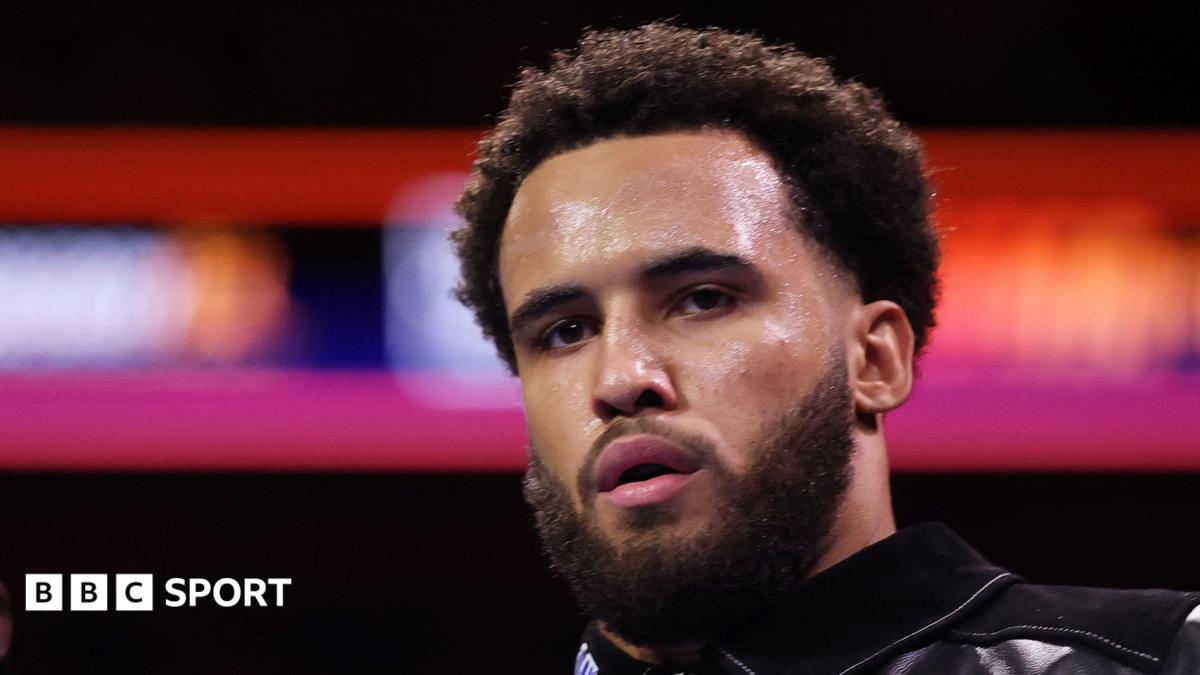
Moses Itauma: Briton ‘humiliated’, but may never lose again – Filip Hrgovic
Moses Itauma may never lose again if he can get over the “humiliation” of his IBF heavyweight title defeat, says Filip Hrgovic, who stunned the Briton in August.
The Croatian, 34, stopped Itauma, who had been the strong pre-fight favourite, in the ninth round of their meeting at the O2 Arena.
The early signs suggested Itauma had the measure of his opponent, with Hrgovic touching the canvas in the second round and conceding that he was “outboxed” early on.
Hrgovic took advantage when Itauma tired but stressed the 21-year-old southpaw is so skilful that he could go on to have a hugely succesful career if he learns from his loss.
“He’s really good. He’s special. Very fast, very talented and he countered whatever I tried with his speed and timing,” said Hrgovic.
“I never was in the ring before with such a talented kid, with such a fast guy. You have some fast guys but they’re small heavyweights. You can handle them with your power but this kid is fast and big. He’s got great IQ and great talent.
“I’m still kind of angry because he outboxed me. In my whole career, in 20 years of boxing, I was never outboxed in any sparring or any fight.”
While Hrgovic, who wants to unify the division, praised Itauma’s boxing abilities, he suggested doubts remain over his mentality.
“It was big shock for him, big humiliation, so maybe it’s end of his career if he’s not mentally tough. If he recovers from this loss, mentally, it will be hard for anyone to ever beat him again,” Hrgovic added.
“A lot of people after that kind of loss, they never come back. So, it will be a hard journey for him to come back.
“You have to go through a ruthless, hard training camp. You need to go through hell to be mentally ready for this. I think he was physically ready but it’s the mental part.”
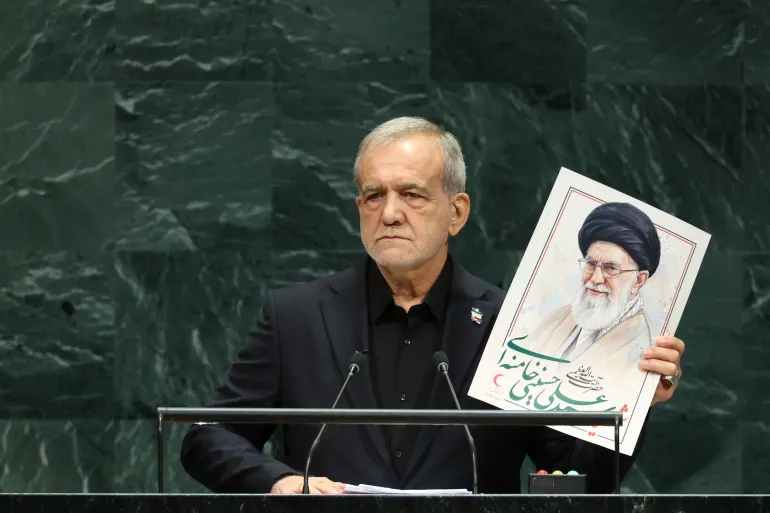
Iran’s Pezeshkian slams ‘terrorist’ US but extols diplomacy in UN speech | US-Israel war on Iran News
In a defiant speech at the United Nations General Assembly, Iran’s President Masoud Pezeshkian has delivered a sharp rebuke to a threat by US President Donald Trump from the same rostrum the previous day to annihilate the country, but left the door open for diplomacy to end nearly seven months of war.
“The US president called us terrorists but we are the victims of terrorists,” Pezeshkian said on Wednesday.
During his speech, Pezeshkian held up a picture of former Supreme Leader Ayatollah Ali Khamenei – assassinated in a joint US-Israeli strike at the start of the war in February – as well as photos of schoolgirls killed in an alleged US air attack on their school in the southern city of Minab.
“They hit us, but we did not bow our heads or bend the knee,” Pezeshkian added.
As the Iranian president began his speech, an official from the US delegation walked out of the vast hall. The Israeli delegation also boycotted the address.
“[Trump] must know that the resistance of the Iranian people will only grow in the face of sanctions and increased pressure and bullying,” Pezeshkian said.

But Pezeshkian, a relative centrist in the Iranian ruling system, also left the door open for negotiations, saying, “Iran extends its hands towards the world.”
“We invite the world and call to it, not out of weakness, but out of a deep belief in our own power and steadfastness to cooperate and collaborate out of a deep understanding that no one in this region will have security alone,” he said.
‘Very good meeting’
On Tuesday, Trump said his son-in-law Jared Kushner and Steve Witkoff, who are both leading negotiations with Tehran, had held a three-hour meeting with Iranian officials.
“They had a very good meeting, a very productive meeting,” Trump told reporters at the UN, adding that he believed there was “a lot of momentum” towards an agreement. Trump later said talks were continuing and that he believed a settlement would eventually be reached.
The remarks came after Trump used his speech before UN delegates to again threaten Iran’s destruction.
“Will a deal be made with Iran that lets them rebuild and create a far greater country than it ever was before?” Trump said. “Or do I annihilate the Islamic Republic and do it quickly, never giving them a chance to kill and destroy people and countries again?”
Strait of Hormuz
Addressing the US naval blockade of Iran and Tehran’s campaign to choke off trade in the Strait of Hormuz, Pezeshkian said Iran would resist what he called US efforts to use the critical sea lane to expand its war on the country.
“In the Strait of Hormuz, we cannot have some free access and gain their independence from that waterway while at the same time use that waterway to impose their aggressions upon us and to impose insecurity upon us; to forbid us access to our own waterways,” he said.
Negar Mortazavi, a senior fellow at the US-based Center for International Policy, said the Iranian president’s speech showed usual flashes of defiance, but notably signalled an appetite for a diplomatic off-ramp.
“Iran wants a way out of this war. They’ve kept the door to diplomacy open,” she told Al Jazeera.
“Reading between the lines of the Iranian president’s speech, it seems Iran may even show some flexibility as far as a return to some sort of agreement that may not be exactly along the lines of the June Memorandum of Understanding that US President Trump doesn’t seem interested in returning to,” she said. The memorandum, which has expired, called for a halt to fighting, lifting the US naval blockade and opening the Strait of Hormuz to maritime traffic.
Compromise still a possibility
Drawing parallels between the US and Israel bombing of Iran and Israel’s attacks in Gaza, Pezeskhian said Israel’s genocide in Gaza “revealed the double standards to which Iran is held by the international community”.
“They kill and we are sanctioned and we are punished,” Pezeshkian added.
Joey Hood, a former US diplomat and ambassador to Tunisia, said the speech leaned heavily into familiar Iranian official rhetoric and represented a lost opportunity to seek compromise.
“Instead of coming to the United Nations with something new and bold, we heard the same things that we’ve heard before,” Hood said, adding that a concrete peace offer or proposal posed to the US in the speech might have focused Washington’s attention.
“That would actually put Donald Trump on the backfoot, and he would have to respond. The Iranian president didn’t do any of that,” Hood said.

Did NASA’s Administrator Just Tease An SR-71 Blackbird Follow-On X-Plane? (Updated)
NASA Administrator Jared Isaacman has left something of a mystery hanging in the air after showing the silhouette of an aircraft that immediately drew comparisons to the famed SR-71 Blackbird during a recent speech. Isaacman pushed back on a direct link to the SR-71, but said his agency is working hard to get “back in the business of flying high and fast again.”
The silhouette, accompanied by the tagline “Rebuilding our X-plane portfolio,” was among the backdrops for Isaacman’s remarks at the annual All-In Summit in Los Angeles, California, last week.
The SR-71’s iconic shape is defined by its long, sword-like profile, pronounced chines, and deeply swept wings, and huge spiked engine nacelles with canted fins on top. Its distinctive geometry is reflected in the silhouette, which shows a broad, highly blended aircraft from an unusual head-on angle.

“In the service of the first A [aeronautics] in NASA, we are rebuilding our X-plane fleet. The X-59 is researching quiet supersonic flight, but it’s just the beginning,” the head of NASA told attendees. “As NASA recommits to flight test and works alongside industry to push the boundaries of airframe and propulsion design, it will not be long before NASA once again is flying as high and as fast as we had in decades past, and then even more.”
Isaacman’s full speech at the All-In Summit, as well as his remarks during a live interview that followed immediately afterward, are contained in the video below. The high-speed aircraft silhouette is first seen at around the 12:40-mark in the runtime, and is then further discussed at around the 28:39-mark.

Jared Isaacman: A New Era for NASA and American Space Exploration
Chamath Palihapitiya, co-host of the All-In Podcast and one of the hosts of the summit, asked Isaacman directly about the silhouette during the fireside chat after his speech.
“You showed a picture of the [SR-71] Blackbird up there,” Palihapitiya said at one point, before Isaacman interjected.
“You sure that’s a Blackbird?” Isaacman said.
“Well, ok. What was that picture you showed up there?” Palihapitiya asked.
“Like I said, NASA is getting back in the business of flying high and fast again,” Isaacman said in response, and declined to further elaborate.
Whether or not the silhouette reflects a real design that is in development now is unclear. TWZ has reached out to NASA for more information.
Though the Mach-3+-capable SR-71 is primarily remembered as a Cold War-era intelligence-gathering aircraft, NASA operated several Blackbirds in support of aeronautical research efforts for years. The agency was actually the last operator of the type, flying SR-71s until 1999.

SR-71 LASRE in Flight over California’s Mojave Desert
Lockheed Martin openly pitched a successor to the SR-71, dubbed the SR-72, in the late 2010s. There was even talk of building a flying fighter jet-sized demonstrator to prove out key technologies.

Discussion about the SR-72, or a further evolution of that concept, resurfaced in the early 2020s after Lockheed Martin helped craft a fictional hypersonic aircraft called Darkstar for the blockbuster movie Top Gun: Maverick.
Exactly where Lockheed’s SR-72 ambitions sit today is unclear. After talking constantly about the potential program for a number of years, it went silent, which could indicate the program had moved forward deep in classification.

Tom Cruise trolls Ed Harris and goes Mach 10 | Top Gun 2 | CLIP
NASA has worked with other supersonic and hypersonic X-planes in the past, as well. This includes reusable space planes, as well as aircraft designed to fly within the Earth’s atmosphere.
“I mean, that doesn’t seem like a space vehicle. It seems like an Earth-air vehicle,” All-In’s Palihapitiya noted during his chat with Isaacman about the silhouette he showed.
“Yeah. The first ‘A’ in NASA is our aeronautics portfolio,” Isaacman said in response, before highlighting a host of contributions his agency has made to advanced military and commercial developments over the years. “You know what I want to do? I want to get back to the radical airframe and engine designs like we were always supposed to do.”
As mentioned, Isaacman also highlighted the X-59 Quiet Supersonic Technology experimental test aircraft, or QueSST, at the summit, but made clear the goal is to go well beyond that design. The QueSST jet is the centerpiece of a program now to investigate technologies that could eventually enable commercial supersonic flight over land with a substantially reduced sonic boom.
The X-59 conducted its first supersonic test flight, reaching Mach 1.1, in June. NASA’s test program aims to eventually push the aircraft up to a speed of Mach 1.4. This is significantly below the record-breaking mark of approximately Mach 3.3 that the SR-71 clocked back in the mid-1970s, but it was never designed for extreme speed as testing its sonic signature was its primary goal.

As for bringing a Blackbird back into operation for high-speed testing, which is now at the forefront of military aeronautics (and civilian to a lesser degree) after decades of being sidelined, that would be a very challenging operation. The SR-71s are long retired and have been placed in museums and other display areas. While the Pentagon could technically claw some of them back from their ‘on loan’ status, reconstituting even one of them would be a major undertaking as the entire support ecosystem that once sustained them has been gone for decades. Still, having a Mach 3+ capable jet for testing would be a highly relevant tool in a new age of high-speed flight exploration.
On the other hand, building a new test aircraft that aims higher and faster than the SR-71, but may be based on its ‘DNA,’ is certainly possible. Such an aircraft could leverage material science, avionics, flight controls, and engines that are seven decades more modern than its progenitor. Technology demonstrators in this class could also already exist in the classified domain. NASA could possibly assume ownership of one after the Pentagon declassifies it, as well.
Regardless of how such an exotic aircraft is obtained, one of the biggest differentiating factors could be that a NASA aircraft is piloted by a human onboard, instead of it being a drone, but an uncrewed aircraft is possible too.

Isaacman has been very open about its interest in and support for new X-plane developments. On only his second day on the job, in December of last year, he called for revamping the agency’s aeronautics program and stated that “I’d love to see an expanded X-plane portfolio” during a town hall with NASA staff.
“If NASA has a healthy X-plane portfolio, we should be flying experimental aircraft so routinely that the second flight of a single X-plane is not newsworthy,” he wrote in a post on X in March of this year. “For example, the two NASA X-29 aircraft flew 422 flights between 1984 and 1991. That period also overlapped with the development of two X-31 aircraft, which together flew about 580 times.”

NASA’s proposed FY2027 budget also spelled out rapid, cost-effective flight experimentation as an explicit priority. Budget documents specifically highlight work toward new advances in supersonic and hypersonic flight technologies “that will revolutionize air transportation, strengthen national security capabilities, and position America to lead the future of high-speed flight,” as well.
Furthermore, in April, NASA outlined a new Aeronautics Flight Accelerator (AFA) initiative. At that time, the agency put out a call for “input on technologies, concepts, and flight test campaigns suitable for cost shared maturation leading to flight within the next three years.” Stated areas of interest included “subsonic (including vertical lift), supersonic, and hypersonic flight technologies.”
It is important to reiterate that we still do not know whether the silhouette Isaacman showed at the All-In Summit represents an active development effort and, if so, how mature it might be. Government agencies and contractors routinely use concept art to illustrate an area of research or communicate a future vision. Such artwork does not necessarily correspond to a funded aircraft, an active prototype, or even a specific configuration.
At the same time, under Isaacman, NASA is clearly pushing toward new X-planes. NASA’s X-plane programs have historically served as a way to investigate technologies that conventional aircraft programs were not prepared to risk. The resulting aircraft have explored everything from supersonic and hypersonic flight to unconventional configurations and new propulsion concepts.
At the very least, evoking the visual legacy of the SR-71 Blackbird, coupled with Isaacman’s comments, provides a clear indication that NASA is interested in returning to the high-speed flight regime as part of its future plans.
Update: 2:04 PM ET –
NASA has now provided TWZ with the following statement in response to our queries for more information:
“NASA has a long history of building and flying experimental aircraft that push the boundaries of what is possible. As Administrator Isaacman has said, we want to see more X-planes flying in the years ahead, developing the technologies that will allow us to fly higher, farther, and faster than we have in decades. We look forward to sharing more as those efforts progress.“
Contact the author: thomas@thewarzone.com

Emmerdale star Katie Hill teases what’s next for Sarah as Charity’s fate ‘sealed’
EXCLUSIVE: Emmerdale’s Katie Hill – who plays Sarah Sugden on the ITV soap – warns there’s a ‘rocky road’ ahead as she details devastating consequences for Charity

What’s next for the pair?
Sarah Sugden star Katie Hill has revealed some tragic twists on Emmerdale in the coming weeks.
Fans will know Charity Dingle is currently under investigation for the death of Dr Todd but it was Sarah who killed her. In a shocking turn of events, Charity confessed to Sarah that the baby she thought was hers and Jacob’s was actually Charity’s and Ross’.
Now, actress Katie has warned there’s more trouble ahead for Sarah and Charity in the coming weeks in an exclusive chat with The Mirror at the Inside Soap Awards.
“When the producer told me, I was so shocked. I had no idea it was going to be Sarah that was the one to kill her. It was a massive shock. She didn’t do it on purpose. It’s not in her nature to kill someone,” she said.
“She’s just now found herself in this really sticky situation. And then obviously with the baby thing on top, finding out about that, she’s just acted on impulse. She’s so angry, and she’s thought, ‘This is what I need to do to get my peace,’ type thing.”
However, Katie warned that despite her confessions, Sarah will continue to struggle.
“I think she’s still struggling with the idea that she’s killed someone. We’ll see her go through a bit of a rocky journey with like parenting, sleepless nights,” she told us.
“I think she’s just revisiting what she’s doing over and over again. And the guilt obviously did set in with Charity and reporting her but she’s gone and taken all that back. It’s a rocky road ahead for Sarah.”
Just a few weeks ago, Sarah found out that Charity had lied about the baby’s parentage.
Speaking about the impact of the storyline, Katie revealed: “In Sarah’s eyes, this is the end. I don’t think she believes she will ever be able to forgive her. The dynamic between the two characters has shifted completely. Sarah is taking charge now, and while it’s obviously devastating for Charity, Sarah just can’t see a way past this.
“From this moment on, as awful as it sounds, Charity is essentially dead to her. She doesn’t want Charity to have anything to do with her or Leyla. Sarah is setting very strict boundaries, she’s nothing to her now.”
Like this s tory? F or more of the latest showbiz news and gossip, follow Mirror Celebs on TikTok , Snapchat , Instagram , Twitter , Facebook , YouTube and Threads .
China’s Xi will kick off his state visit to Washington with a rare planeside welcome from Trump
WASHINGTON — When Chinese President Xi Jinping arrives in Washington on Wednesday, he’s expected to get a rare greeting from President Trump, who will be on the tarmac to welcome his counterpart instead of waiting for him to drive up to the White House.
Trump’s decision to greet Xi at Joint Base Andrews just outside Washington rather than receiving him at the executive residence shows how far the U.S. president is going to honor China’s leader as he makes his first state visit in more than a decade.
First lady Melania Trump said her husband decided to personally greet Xi when he arrives in the Washington region because “they have a great relationship.”
“He’s coming on our soil, and we need to welcome them with the most respect,” she said of Xi and his wife, Peng Liyuan, during an interview Wednesday on Fox News Channel’s ”Fox & Friends.”
The White House has not released many details about Wednesday’s greeting, but Trump is expected to participate in an arrival ceremony at the base with Xi and his wife. The salutation will kick off a three-day visit that’s expected to be saturated with pomp, even by White House standards. The state visit, complete with a formal state dinner at the White House on Thursday, is supposed to reciprocate for the ceremonial grandeur that marked Trump’s May visit to China.
But it also is a showy patina at a time when tensions between the two geopolitical rivals are high over trade, artificial intelligence, Trump’s war with Iran and China’s designs on Taiwan.
Beyond using the visit to try to keep “strategic stability” between the two countries, Trump seems to be pulling out all the diplomatic stops to show off for Xi. Trump has lavished praise on Xi as a “great leader” and described a warm relationship with the man he has called a friend. That is all while he has given Xi a pass on many issues.
Sen. Roger Wicker, chairman of the Senate Armed Services Committee, criticized the “lavish welcome.” Wicker, R-Miss., said during a speech Tuesday in the Senate that Trump should not have invited the Chinese leader “based on all of the troubling issues we have with President Xi and the Chinese Communist Party.”
Wicker archly suggested a list of topics that Trump could discuss with Xi at the state dinner, such as “the purposes of China’s massive military buildup, or about China’s clear support for Iran,” saying that “during every minute of dialogue” Trump should keep in mind that “his guest is a brutal, unelected and oppressive dictator who seeks to dominate his neighbors and whose massive military arsenal is aimed directly at the United States of America.”
Secretary of State Marco Rubio said the U.S. and China must interact at the highest levels because the countries are “the two largest economies in the world” and “probably the two most powerful militaries in the world.”
“The idea that we would not interact with them at the highest levels is irresponsible. It’s outrageous. We have to,” Rubio told reporters Wednesday while he was in New York.
Trump has made it clear he wants to wow Xi, telling reporters in recent weeks that he was delighted his new “work of art” helicopter landing pad would be ready for the visit while bemoaning that his massive White House ballroom would not.
On Wednesday, Trump is expected to try to match the pageantry he was met with in China earlier this year. Xi was not at the airport to meet Trump — Chinese Vice President Han Zheng was there instead. But there a red carpet was rolled out to meet Air Force One in Beijing. A military honor guard, a military band and about 300 Chinese youths waving Chinese and American flags and chanting, “Welcome, welcome! Warm welcome!” also were present. The children wore white and light blue uniforms that mirrored the traditional paint colors of the presidential plane.
Trump’s airport ceremony for Xi will be followed on Thursday by more formalities, including an arrival ceremony at the White House and a review of troops. Before the black-tie dinner, which will feature tech industry leaders like Nvidia’s Jensen Huang and SpaceX’s Elon Musk, the two leaders are expected to dive into the weighty issues behind closed doors, even as expectations are low that the trip will produce any major breakthroughs in the relationship.
On Friday, Xi and Peng will be back at the White House for a private tea with the Trumps before joining them on a tour of the National Archives in Washington. The White House has said they will view historic documents underscoring the relationship between the two countries.
Price writes for the Associated Press. AP writers Mary Clare Jalonick and Didi Tang contributed to this report.