


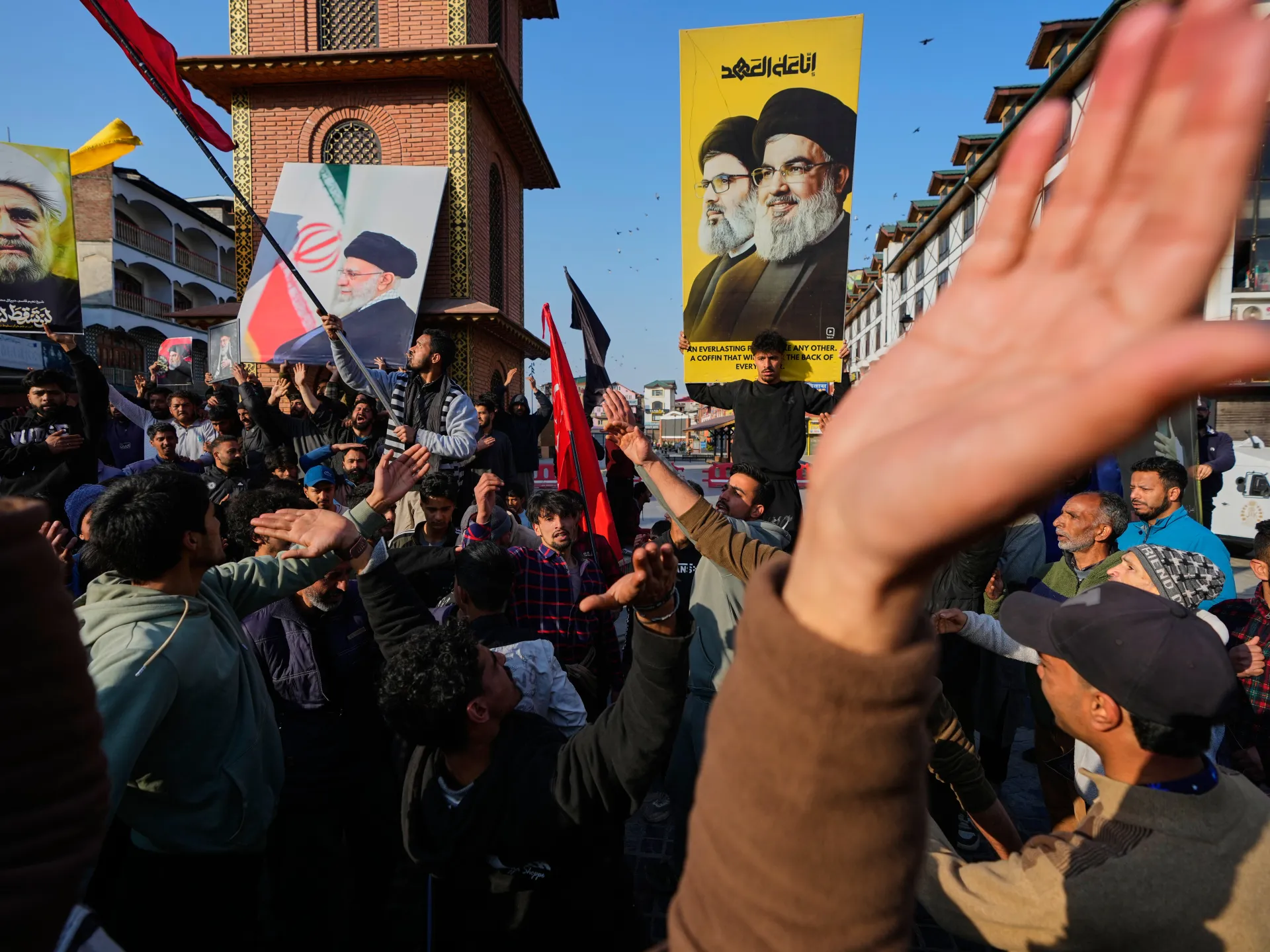
Analysis: Khamenei’s killing leaves Iran’s ‘axis’ in disarray | Hezbollah
The killing of Iranian Supreme Leader Ali Khamenei in a United States-Israeli air campaign has sent shockwaves through the Middle East, decapitating the leadership of the “axis of resistance” at its most critical moment.
For decades, this network of groups allied with Iran was Tehran’s forward line of defence. But today, with its commander-in-chief dead and its logistical arteries cut, the alliance looks less like a unified war machine and more like a series of isolated islands.
Recommended Stories
list of 4 itemsend of list
Hassan Ahmadian, a professor at the University of Tehran, warned that the era of strategic patience is over and the Iranian government is now prepared to “burn everything” in response to the attacks.
While Tehran promised to retaliate against the US and Israel “with a force they have never experienced before”, the reaction from its key proxies in Lebanon, Yemen and Iraq revealed a deep hesitation driven by local existential threats that may outweigh their ideological loyalty to a fallen leader.
Hezbollah: Walking between raindrops
In Beirut, the response from Hezbollah, long considered the crown jewel among Iran’s regional allies, has been cautiously calibrated.
After Sunday’s announcement of Khamenei’s death, the group issued a statement condemning the attack as the “height of criminality”. However, Al Jazeera correspondent in Beirut Mazen Ibrahim noted that the language used was defensive, not offensive.
“If one dismantles the linguistic structure of the statement, the complexity of Hezbollah’s position becomes clear,” Ibrahim said. “The secretary-general spoke of ‘confronting aggression’, which refers to a defensive posture. … He did not explicitly threaten to attack Israel or launch revenge operations.”
This caution is rooted in a new strategic reality. Since the collapse of Bashar al-Assad’s government in Syria in late 2024, the “land bridge” that supplied Hezbollah has been severed. Ali Akbar Dareini, a Tehran-based researcher, noted that this loss “cut the ground link with Lebanon”, leaving the group physically isolated.
Now with top leaders of Iran’s Islamic Revolutionary Guard Corps (IRGC) killed alongside Khamenei, Hezbollah appears paralysed – caught between a battered domestic front in Lebanon and a vacuum of orders from Tehran.
The Houthis: Solidarity meets survival
In Yemen, the Houthis face an even more volatile calculus.
In his first televised address after the strikes on Iran began on Saturday, the group’s leader, Abdel-Malik al-Houthi, declared his forces “fully prepared for any developments”. Yet his rhetoric notably emphasised that “Iran is strong” and “its response will be decisive,” a phrasing that analysts interpreted as an attempt to deflect the immediate burden of war away from the Houthis.
The Houthis are under immense pressure. While they have successfully disrupted Red Sea shipping and fired missiles at Tel Aviv, they now face a renewed threat at home.
The internationally recognised Yemeni government, having won a power struggle against southern separatists, has sensed a shift in momentum. Defence Minister Taher al-Aqili recently declared: “The index of operations is heading towards the capital, Sanaa,” which the Houthis control. The statement signalled a potential ground offensive to retake Houthi territory.
This places the Houthis in a bind. While Houthi negotiator Mohammed Abdulsalam recently met with Iranian official Ali Larijani in Muscat, Oman, to discuss “unity of the arenas”, the reality on the ground is different. Engaging in a war for Iran could leave the Houthis’ home front exposed to government forces backed by regional rivals.
“Expanding the circle of targeting will only result in expanding the circle of confrontation,” the Houthi-affiliated Supreme Political Council warned in a statement that threatened escalation but also implicitly acknowledged the high cost of a wider war.
Iraq: The internal time bomb
Perhaps nowhere is the dilemma more acute than in Iraq, where the lines between the state and the “resistance” are dangerously blurred.
Iran-aligned militias, many of which operate under the state-sanctioned Popular Mobilisation Forces, are now caught in a direct standoff with the US. Tensions have simmered since late 2024 when Ibrahim Al-Sumaidaie, an adviser to Iraq’s prime minister, revealed that Washington had threatened to dismantle these groups by force, a warning that led to his resignation under pressure from militia leaders.
Today, that threat looms larger than ever. Unlike Hezbollah or the Houthis, these groups are technically part of the Iraqi security apparatus. A retaliation from Iraqi soil would not just risk a militia war but also a direct conflict between the US and the Iraqi state.
With the IRGC commanders who once mediated these tensions now dead, the “restraining hand” is gone. Isolated militia leaders may now decide to strike US bases of their own accord, dragging Baghdad into a war the government has desperately tried to avoid.
Resistance without a head
Khamenei’s assassination has essentially shattered the command-and-control structure of the “axis of resistance”.
The network was built on three pillars: the ideological authority of the supreme leader, the logistical coordination of the IRGC and the geographic connection through Syria. Today, all three are broken.
“The most important damage to Iran’s security interests is the severing of the ground link,” Dareini said. With Khamenei gone, the “spiritual link” is also severed.
What remains is a fragmented landscape. In Lebanon, Hezbollah is too exhausted to open a northern front. In Yemen, the Houthis face a potential domestic offensive. In Iraq, militias risk collapsing the state they live in.
When the dust settles in Tehran, the region will face a dangerous unpredictability. The “axis of resistance” is no longer a coordinated army. It is a collection of angry, heavily armed militias, each calculating its own survival in a world where the orders from Tehran have suddenly stopped coming.
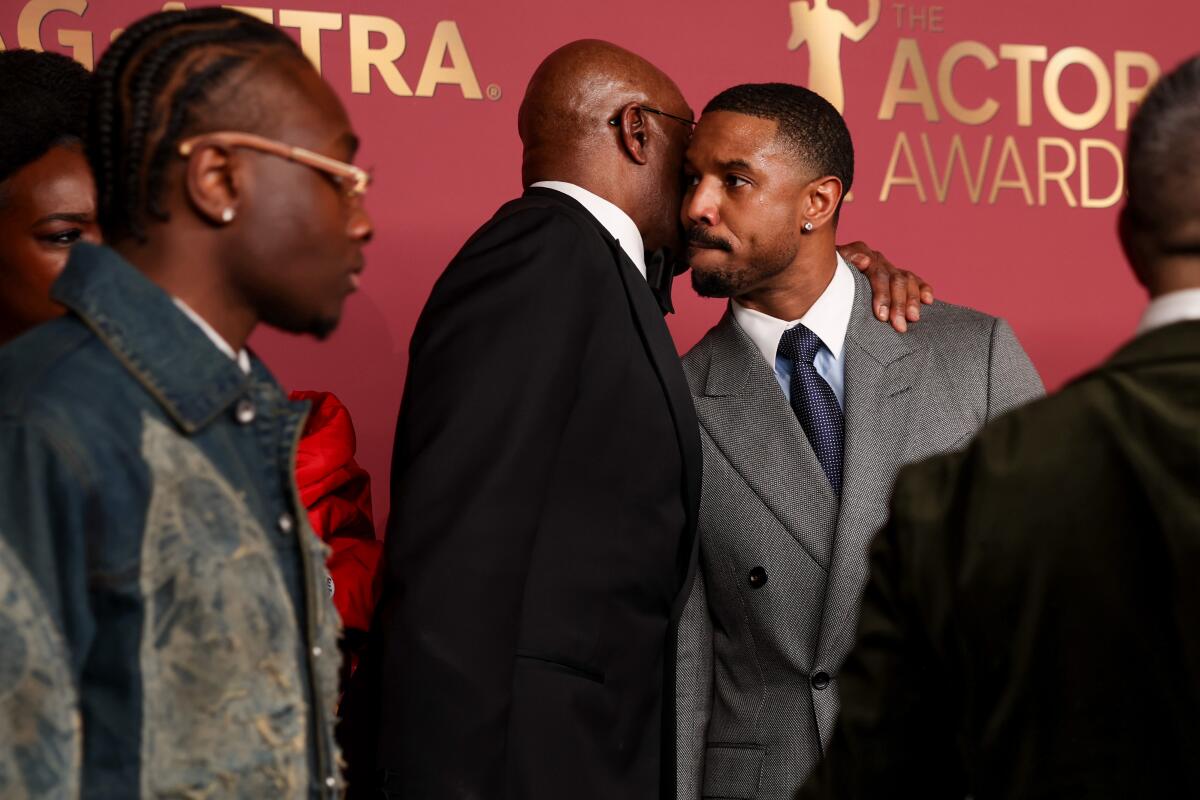
What 2026 Actor Awards mean for the Oscar race
There were tears (and cheers) for Catherine O’Hara. Rhea Seehorn explained “Pluribus,” or at least tried to. Harrison Ford was celebrated at the “half-point of his career.” And, because the show’s on Netflix, there were a few well-placed F-bombs, not including the swears muttered by the actors who didn’t win.
The 32nd Actor Awards — or the very first Actor Awards, since for the previous 31 years this ceremony has been known as the Screen Actors Guild Awards — went off without a hitch Sunday, and ended with a bang, scrambling a best picture race that felt settled after “One Battle After Another” won the top prize at the Producers Guild Awards on Saturday.
There were TV awards presented too. But we pay attention to the Actor Awards because the show takes place while Oscar ballots are out and are, for the most part, a reliable precursor to the Academy Awards. How trustworthy will they be for the acting winners this year? Let’s take a look.
Cast in a motion picture

(Kayla Bartkowski / Los Angeles Times)
Winner: “Sinners”
The past: The winner of this award has gone on to take the best picture Oscar in 15 of 30 years, making it basically a coin flip and easily the Actor Awards’ least trustworthy Oscar precursor. (The ensemble prize wasn’t awarded in 1994, the ceremony’s first year.) Oscar also-ran “Conclave” won last year, ending a three-year streak — “CODA,” “Everything Everywhere All at Once” and “Oppenheimer” — where the winner of the cast prize went on to take best picture.
Will history repeat itself? If “Sinners” had simply taken this award and nothing else, I would say “One Battle After Another” would still be the overwhelming favorite to win the best picture Oscar. But snagging this prize and Michael B. Jordan winning lead actor gives one pause, doesn’t it? Again, the cast award is not a reliable best picture precursor. A Ryan Coogler movie (“Black Panther”) won in 2019, but lost the Oscar to “Green Book.” And while “Sinners” did haul in a record-breaking 16 Oscar nominations, “One Battle” wasn’t far behind with 13, just one shy of the previous record. It’s easy to get carried away with the way the room exploded when Samuel L. Jackson announced the winner, but “One Battle’s” Producers Guild win carries more weight. I’ll need a couple of days to sit with this.
Female actor in a leading role

(Kayla Bartkowski / Los Angeles Times)
Winner: Jessie Buckley, “Hamnet”
The past: SAG and the academy have matched 21 of 31 years. The last two years have seen the groups split, with Emma Stone (“Poor Things”) winning her second Oscar over SAG winner Lily Gladstone (“Killers of the Flower Moon”) in 2024 and Mikey Madison prevailing for “Anora” over Demi Moore, who won over SAG-AFTRA voters and earned a huge standing ovation when she took the stage for her gonzo comeback turn in the body horror movie “The Substance.”
Will history repeat itself? Buckley has been a lock for the lead actress Oscar since “Hamnet” premiered in September at the Telluride Film Festival, her searching, searing turn as the film’s grieving mother producing the kind of visceral reaction that guts audiences and wins awards. And, boy, has she won awards these last few months, taking pretty much everything save for the major critics groups. The naysayers decried the acting as overripe, sniffing instead of sniffling. Monsters. There’s no denying Buckley goes big with her emotions here, but the magic in her work also can be seen in a much-used still photo from “Hamnet,” the one where she’s resting her elbows on the Old Globe stage, hands clasped, face transfixed, heart opened. You know the shot. And you’re probably getting a little verklempt just thinking about it.
Male actor in a leading role

(Kayla Bartkowski / Los Angeles Times)
Winner: Michael B. Jordan, “Sinners”
The past: This category has been the most reliable indicator of Oscar victory, with SAG and the academy matching 24 of 31 times. There are exceptions, though, such as just last year when Adrien Brody won the Oscar for “The Brutalist,” prevailing over SAG winner Chalamet (“A Complete Unknown”).
Will history repeat itself? Entering the month of February, it looked like Timothée Chalamet was a shoo-in for playing a talented, self-promoting ping-pong player in “Marty Supreme.” In fact, some know-it-all called this race more or less over just a week ago. (That was me.) Chalamet could still win. Maybe SAG-AFTRA voters didn’t want to give him the award again, just a year after they honored him for his lead turn in “A Complete Unknown.” Maybe SAG-AFTRA voters felt he was a bit, shall we say … “brash” in the way he marketed the movie and needed to be taken down a peg.
So now, entering March, it’s looking like “Marty Supreme” could be this year’s version of “The Irishman,” a film that earns a lot of nominations (in this case, nine) and comes away with nothing.
Meanwhile, Jordan’s big swing movie star turn in “Sinners,” playing twin brothers Smoke and Stack, was the best work of his career. That scream that Viola Davis let out when she opened the envelope spoke to the enthusiasm in the room both for the actor and the film. Momentum definitely seems to be on Jordan’s side right now.
Female actor in a supporting role

(Kayla Bartkowski / Los Angeles Times)
Winner: Amy Madigan, “Weapons”
The past: The Actor Award winner has gone on to take an Oscar 23 of 31 times, including last year, when Zoe Saldaña won for “Emilia Pérez,” one of countless prizes she won that season. (Note: One of those 23 winners, “The Reader’s” Kate Winslet, was nominated for — and won — the 2009 Oscar for lead actress for that performance.)
Will history repeat itself? Who knows? This category has been all over the place, but as Madigan said in her speech, she’s been doing this a “long ass time” and there’s a lot of love for this 75-year-old acting great. Teyana Taylor (“One Battle After Another”) took the Golden Globe, and Wunmi Mosaku (“Sinners”) won at the British Academy Film Awards. And the “they’re due” narrative doesn’t always play at the Oscars. (Just ask Demi Moore or Glenn Close.) Will a “One Battle” sweep carry both Taylor and Sean Penn? Or is there room for an outlier? It’s tempting to lean toward Madigan.
Male actor in a supporting role

Winner: Sean Penn, “One Battle After Another”
The past: The SAG winner has gone on to win the Oscar 22 times in 31 years, including the last dozen, the longest streak of any category.
Will history repeat itself? Penn did not attend the Actor Awards, the only thing less surprising than this win. Coming on the heels of taking the supporting actor prize from BAFTA last weekend (Penn didn’t go to that ceremony either), it’s looking likely now that Penn will win his third Oscar. He’s barely campaigned and remains a divisive figure. But his menacing turn as the outrageous Col. Steven J. Lockjaw, a man given to zealotry and tight T-shirts, is the best work he has done in years. Will he go to the Oscars, if only to collect the trophy so he can give another statue to Ukranian President Volodymyr Zelensky? We’ll soon see.

Oil prices rise as escalating Iran conflict spurs energy supply concerns
Published on
Oil prices climbed on Monday morning as investors assessed the economic impact of US and Israeli attacks on Iran, which triggered swift retaliation from Tehran targeting assets in multiple Middle Eastern countries.

ADVERTISEMENT
ADVERTISEMENT
In early trade, the price of a barrel of US benchmark crude initially surged by about 8%. It later traded 5.9% higher at $71.00 per barrel. Brent crude rose 6.2% to $77.38 per barrel.
Traders were betting that oil supplies from Iran and elsewhere in the Middle East could slow or grind to a halt. Attacks across the region, including on two vessels travelling through the Strait of Hormuz — the narrow mouth of the Persian Gulf — have restricted countries’ ability to export oil to the rest of the world.
“Roughly one-fifth of global oil and LNG (liquefied natural gas) flows squeeze through the Strait of Hormuz. This is not an obscure canal. It is the aorta of the global energy system,” Stephen Innes of SPI Asset Management said in a commentary note.
A prolonged war would likely result in higher prices for other fuels and petrol, and could ripple through the global economy, adding to overall production costs.
Likewise, prolonged interruptions to oil flows through the Middle East would have “huge implications for oil and LNG and every market everywhere if it occurs. Energy is an input to all production,” RaboResearch Global Economics & Markets said in a report.
Iran exports roughly 1.6 million barrels of oil a day, mostly to China. Beijing may need to look elsewhere for supply if Iran’s exports are disrupted — another factor that could push energy prices higher.
However, China has ample oil reserves of up to 1.5 billion barrels and could offset a decline in Iranian oil by increasing imports from Russia, said Michael Langham of Aberdeen Investments.
The attacks had been anticipated, following a significant build-up of US forces in the Middle East, so traders had already adjusted their positions to account for that risk.
In other early trading on Monday, the price of gold — usually viewed as a safe haven in times of uncertainty — rose 2.4% to about $5,371 per ounce.
Elsewhere, futures for the S&P 500 and the Dow Jones Industrial Average were down about 0.8% by mid-morning in Bangkok.
Asian shares also opened lower. Japan’s Nikkei 225 initially fell more than 2%. In Hong Kong, the Hang Seng lost 1.6% to 26,215.91, while the Shanghai Composite was flat at 4,163.01.
Taiwan’s benchmark index fell 0.6% and Singapore’s dropped 1.9%. In Bangkok, the SET declined 2.1%, while Australia’s S&P/ASX 200 shed 0.3% to 9,173.50.
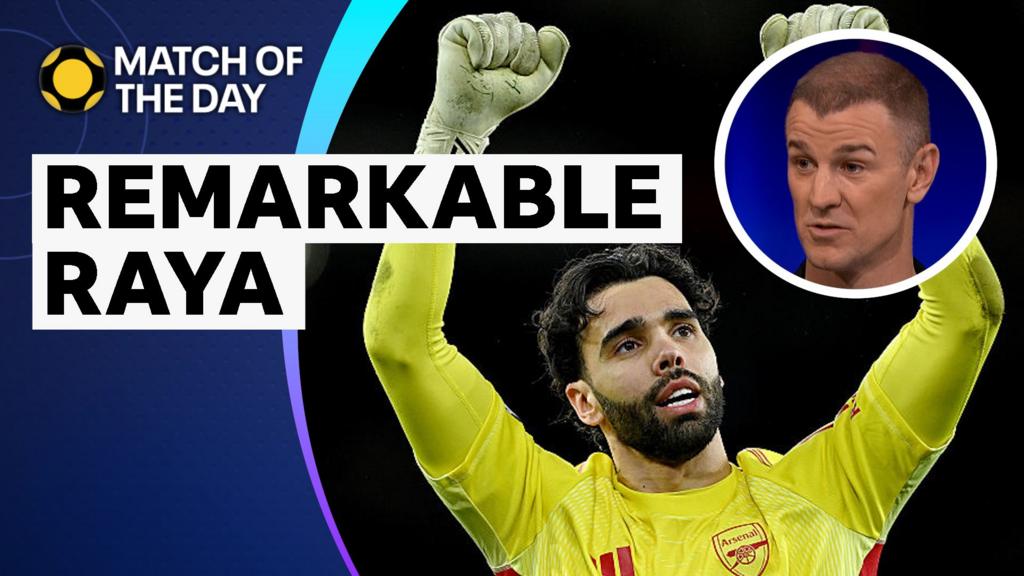
Hart breaks down why 'disciplined' Raya is so good
Match of the Day pundit Joe Hart breaks down how David Raya has cemented himself as one of the best goalkeepers in the Premier League.
Source link
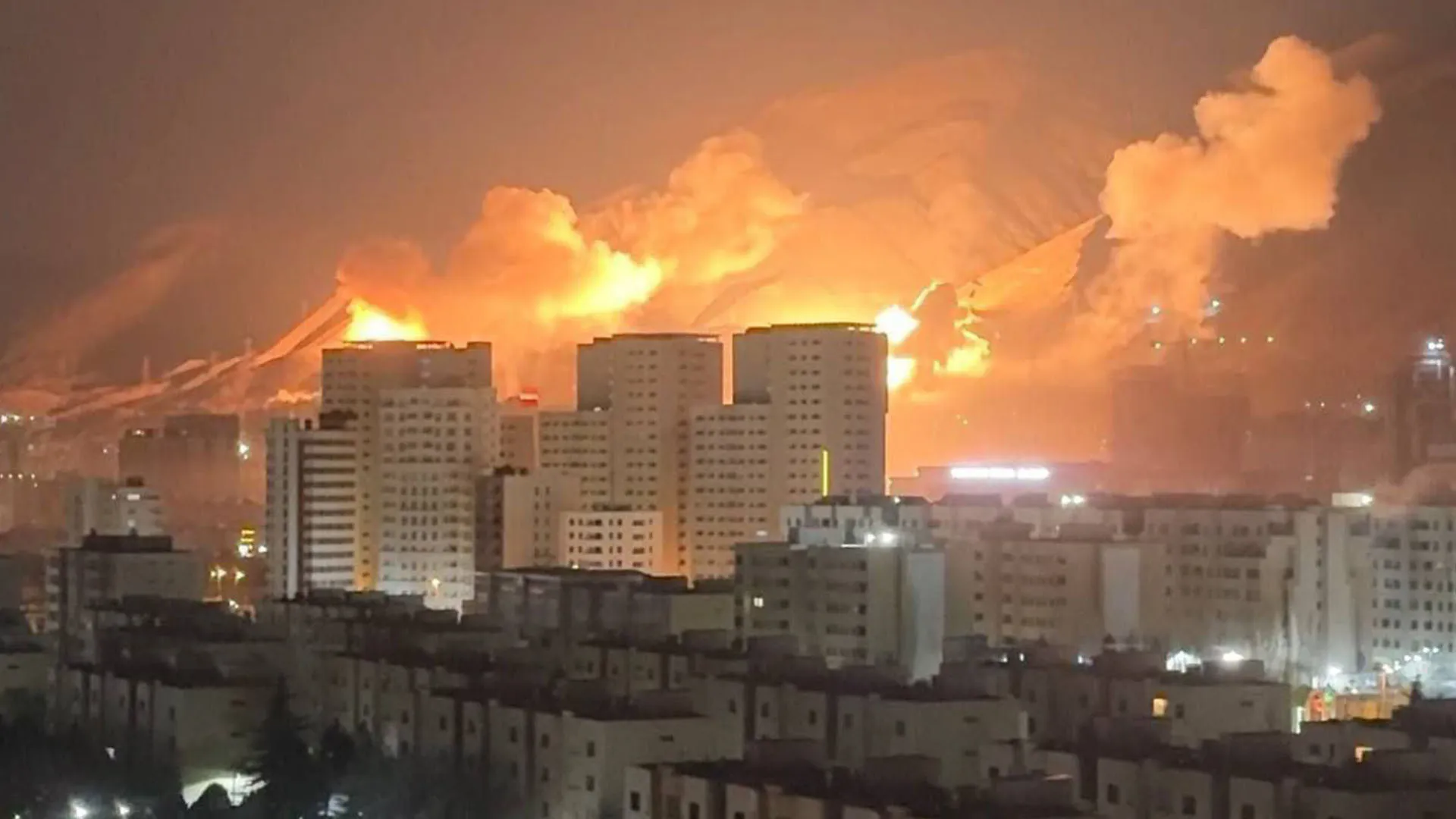
Tehran comes under attack from new round of Israeli strikes | Israel-Iran conflict
Videos show heavy bombardment of Tehran after Israel’s military said it had launched another wave of attacks on Iran.
Published On 2 Mar 2026
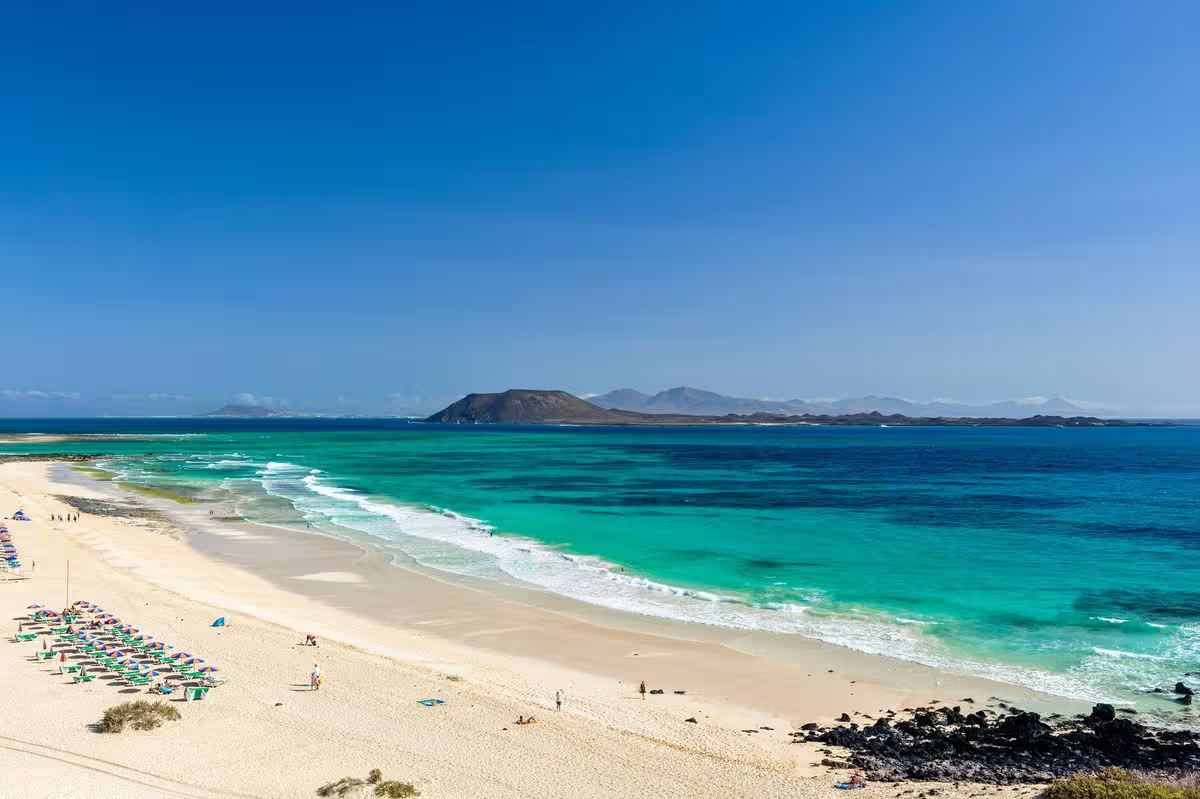
Sunshine resort with £1.70 pints and £27 flights has 21C weather in March
This stunning resort town offers the perfect combination of beautiful beaches, vibrant nightlife and exceptional value for money with cheap flights and affordable pints – what’s not to love?

This resort town is a traveller’s dream destination(Image: wallix via Getty Images)
Anyone seeking a quick getaway from Britain’s grey and gloomy weather this month need look no further than this sun-drenched resort nestled within this certified island paradise.
Boasting crystal-clear turquoise seas, endless stretches of pristine white sand, and delectable food at every turn, this resort town represents a traveller’s ultimate destination – particularly for those craving vibrant, energetic nightlife.
This former modest fishing hamlet has transformed into a bona fide tourist magnet, offering some of the planet’s finest beaches and water-based activities.
Despite the tourism explosion witnessed over recent decades, this dynamic resort has succeeded in preserving its authentic appeal and distinctive personality, positioning it as the perfect spot for those wanting to effortlessly jet away without breaking the bank.
Perched on Fuerteventura’s northern extremity in the Canary Islands, Corralejo delivers a bright and cheerful holiday experience packed with countless entertaining pursuits, reports the Express.
Amazon cabin bag meets Ryanair requirements for less than £15
This article contains affiliate links, we will receive a commission on any sales we generate from it. Learn more
Travellers keen to beat the bag charges without breaking the budget have made an Amazon travel bag a bestseller. Rated 4.7 stars out of 5 from almost 3,000 reviews, the Xkdoai bag comes in six colours with prices from £14.99, saving 29% on the usual price.
Within La Oliva’s municipality, Corralejo’s surrounding landscape proves both extraordinary and spectacular – golden-white sand dunes, rugged volcanic terrain and seaside ambience blended with historic town character.
Corralejo merges its classic maritime heritage with a youthful and dynamic spirit, offering holidaymakers the perfect combination. Getting to this resort on Fuerteventura’s northern coastline is a doddle – and won’t break the bank.
Direct one-way flights from London Stansted Airport and London Luton Airport to Fuerteventura Airport in early March cost as little as £27, with a free allowance for one cabin bag included.
And it’s not just the airfare that’s easy on the wallet – a refreshing pint will set you back a mere £1.70 in this stunning tropical haven. Combine that with Fuerteventura’s glorious 21C March temperatures, and you’ve got all the ingredients for the perfect early spring escape.
Nestled just across the water from the breathtaking – and tiny – island of Los Lobos, the resort town of Corralejo is as postcard-perfect as it gets. Brimming with outstanding restaurants, delightful boutiques, and buzzing bars, it truly is the complete package.
A resort town with humble beginnings
Corralejo was once nothing more than a traditional fishing village, home to a handful of residents and little else. In fact, right up until the 1950s, the entire town boasted only around 11 surnames and a modest population of just over 100 people.
From those quiet beginnings, the resort has grown beyond all recognition to become what it is today: Fuerteventura’s most beloved tourist destination.
The area encompassing Corralejo and its iconic surrounding dunes was also where conqueror and crusader Gadifer de la Salle and his expedition first set foot on Fuerteventura back in 1402.
According to folklore handed down through the ages, Corralejo’s origins trace back to approximately 1810, though some historians argue that genuine settlement didn’t occur until at least the 1850s.
The earliest residents are known to have built their homes using stone and readily available materials sourced from the surrounding area.
Corralejo remained a modest fishing hamlet until the mid-20th century, with its economy and inhabitants heavily reliant upon the neighbouring municipality of La Oliva and goods shipped in from overseas.
Throughout much of its unassuming past, Corralejo existed as an unremarkable fishing settlement where a small number of impoverished fishermen toiled long hours to support their households.
The early 1970s marked the beginning of Corralejo’s tourism explosion, as its magnificent beaches and breathtaking dunes (at last) began drawing holidaymakers to its spectacular coastline.
Things to do in Corralejo
This Fuerteventura destination proves ideal for watersports, especially windsurfing and kitesurfing, thanks to the region’s reliable winds and perfect wave conditions.
Scuba diving, water skiing, jet skiing and snorkelling also rank amongst favourite pursuits for tourists, courtesy of Corralejo’s superb translucent waters.
Adjacent to the harbour, Town Beach (Playa del Viejo) suits those based in or around the town centre, whilst the Galera Beach vicinity and Waikiki Beach located at the town’s core are renowned for their tranquil waters, vibrant beach bars, and convivial ambience.
Playa Vista Lobos is another essential destination, renowned for its distinctive ‘popcorn’ shoreline and spectacular vistas of Lobos Island visible from the coast.
Flag Beach and Glass Beach are perfect spots for enthusiasts keen to enjoy windsurfing or kitesurfing.
The Corralejo Dunes, or Grandes Playas, nestled within the sprawling 11-kilometre Corralejo Natural Park, stand out as arguably the resort’s most celebrated attraction – and justifiably so.
The unspoilt white sand dunes form an untouched coastal haven unlike anywhere else, cementing its status as an essential destination for anyone exploring Corralejo.
Stunning panoramas of Los Lobos and neighbouring Lanzarote further enhance the location’s allure. Native plant and animal species thriving within the Natural Park provide an extra treat for nature lovers.
The old town in Corralejo serves as the resort’s beating heart, featuring delightful narrow lanes packed with seafood restaurants and outstanding dining establishments – a haven for culinary enthusiasts.
Corralejo Old Town teems with characteristic whitewashed buildings, intimate bars and independent retailers, alongside a working harbour where fishing boats still operate.
Avenida General Franco, commonly referred to as Main Street, extends from the old town and hosts some of the resort’s most celebrated international restaurants, shopping complexes, and the bustling Music Square.
Visitors can also depart from Corralejo’s harbour to discover the neighbouring volcanic islands of Lobos and Lanzarote, either through glass-bottom boat excursions or by hopping aboard the regularly scheduled ferry services that connect the Canary Islands.
Ensure our latest headlines always appear at the top of your Google Search by making us a Preferred Source. Click here to activate or add us as your Preferred Source in your Google search settings.

‘I own the smallest house in Britain and the last tenant was too tall to live there’
Owning the smallest house in Britain comes with its fair share of history and responsibility, but the owner’s ancestor only bought it for a mere £20

It once housed a family of six(Image: PA)
Year in, year out, tourists flock to this seaside village to see what is known as Britain’s tiniest home, and day in, day out, its owner is still in shock at just how much attraction it continues to gain.
Jan Tyley inherited the little red house in Conwyn, Wales, from her mother’s cousin back in 2015, and over 10 years later, she is heading up a small business that continues to boom, all thanks to its unusually small size.
Measuring just 72 inches wide and 122 inches high, it holds the official World Record of being the smallest house within the British Isles – a phenomenon that draws in roughly 50-60,000 visitors each year.
The origins of the place sit way back in her family, when her great-great-grandfather bought it in 1891 as a letting property with a sitting tenant. Jan shared: “He was called Robert Jones, and the sitting tenant was called Robert Jones, which has created a lot of confusion over the years.”
Tenants of the past
Robert, the tenant, was a six-foot-three fisherman who was living there up until 1899, when the local council decided that it was not, in fact, a house fit for human habitation.
“I’m 5’7″, and I have to duck to go in, and I frequently forget to come out again,” Jan joked. “So you can imagine what a sore back he must have had.”
Best holiday cottage deals in Wales
This article contains affiliate links, we will receive a commission on any sales we generate from it. Learn more

Wales is renowned for its stunning mountains, picturesque coastline and rich Celtic history. Sykes has a wide and varied collection of holiday cottages, houses and apartments across the country. Prices start from £35 per night with current deals.
There was no toilet, but instead a shared toilet with the cottages beside it, and so, they threatened to tear it down.
Disheartened and unsure what to do, the landlord was chatting to his friends at the pub, one of whom was the editor of the North Wales Weekly News, Roger Dawson, who suggested it may be the smallest in the country. This led them on a wild pursuit in which they travelled across the UK measuring numerous houses, after advertising the quest in newspapers.
In turn, the council agreed for it to stay put, but that nobody could actually live in it. “So being the enterprising chap, um, my great-great-grandfather said, ‘Well, I’ll turn it into a tourist attraction,'” Jan explained. In May 1900, it became a tourist attraction, and the family never looked back.
The building remains dressed as it was when it was last lived in in 1900, Jan confirmed. Unfortunately, being open to the public has meant they have seen a few items go missing over the years.
While it’s bursting with humorous stories and tales of those who once lived in this tiny abode, the reasoning for them inhabiting such an uncomfortably small space is a lot darker.
“It’s a real testament to the shortage of property in Conwy and how people wanted to live in a house of their own, because sadly the alternative was a poorhouse,” Jan explained.
“When Robert Jones, the last tenant, had to move out, that’s where he ended up. He was in the poorhouse, and sadly that’s where he died. So that’s why, although it’s tiny, people didn’t have a problem living there.”
During the 18th and 19th centuries in Wales, poorhouses were institutions designed for the less fortunate, with conditions made to be ‘prison-like’ in a bid to deter those in financial need from seeking help. Inhabitants were forced into rigid, segregated and often unsanitary living conditions, and so while the cottage was small, it was somewhere people could call their own.
According to records, there was shockingly a family of six all living within the tiny home – a mum and dad and four children. The little one’s beds were believed to be hammocks, which hooked on to the walls and sat in between the beams.
The house today
While the property remains in Jan’s hands, and with no looming threats from the council anytime soon, it continues to be a tourist attraction.
However, the one shift she has noticed in recent years is a rather unusual request, not from landlords or the council, but from YouTubers hoping to immerse themselves in the 1800s experience and share it online.
“I’ve had lots of YouTubers who say, ‘Oh, can we stay the night?’ and they think they’re the first one to think about it. Except, I probably get three or four of them a year.”
Although the house is closed during the winter, from March it is open seven days a week, from 10am right up until 4pm, and Jan has a team of people helping to keep the whole thing running.
“I have a team of eight lovely ladies who do the shift. So, we have two shifts a day. I take my turn on the door as well, but I live about half an hour’s drive away.”
Originally, Jan was living in Oxford, but after inheriting the property, she moved closer to the North Wales spot to take on its wealth of responsibilities.
But for her, it seems a worthwhile decision. She said: “It never ceases to surprise me how many people come to see it each year and from all over the world, which is amazing.
“I’m still amazed at how many people do come through our doors. We probably could get more if we were bigger, but then that wouldn’t be the point.”
Ensure our latest headlines always appear at the top of your Google Search by making us a Preferred Source. Click here to activate or add us as your Preferred Source in your Google search settings.
Balen Shah: Rapper, mayor, Nepal’s next prime minister? | Elections
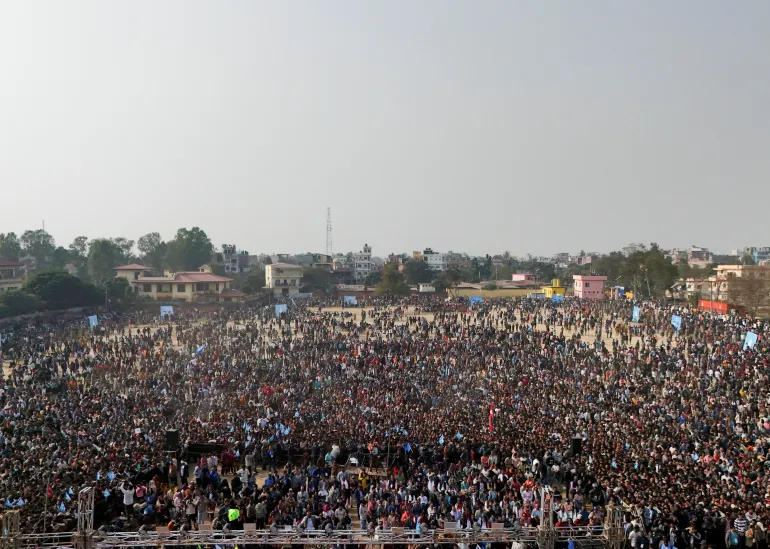
Kathmandu, Nepal – Facing thousands of raucous supporters, 35-year-old Balendra Shah lifted his signature black rectangular sunglasses, asked his audience to look him in the eye, and said: “I love you.”
It is a sentiment that millions of young Nepalis appear to reciprocate.
Recommended Stories
list of 4 itemsend of list
Balen – as he is popularly known – was a nobody until 2013, when he almost overnight became a rap sensation. Nearly a decade later, in May 2022, he stunned Nepal’s deeply entrenched mainstream political parties by winning the post of mayor of Kathmandu, the country’s capital, while contesting as an independent.
When the Himalayan nation of 30 million people erupted in popular protests against the government of then-Prime Minister KP Sharma Oli in September 2025, Balen emerged as a high-profile backer of the protesters. He was the first choice of many Gen Z activists to take over as interim leader after Oli was forced to resign. But he instead supported former Supreme Court Chief Justice Sushila Karki for the post. It is now that this was a tactical move.
As Nepal heads to its first election since the protests last year, and Karki’s brief term ends, Balen is positioning himself as the future prime minister the country needs. And true to style, he is doing it with a bang: He is contesting the parliamentary elections from Jhapa-5, a seat about 300km (186 miles) southeast of Kathmandu, against Oli, the man protesters deposed just five months ago.
On the surface, the odds appear stacked against him. The region is a stronghold of Oli and the Communist Party of Nepal – Unified Marxist Leninist (CPN-UML), which the former prime minister heads. Balen is contesting as a candidate of the Rastriya Swatantra Party (RSP), a centrist party formed less than four years ago, which won 10 percent of the national vote in the last elections in 2022.
Balen’s volatile public communication – he has abused mainstream parties, India, China and the United States, and threatened to burn down symbols of power in Nepal – has sparked criticism and questions over whether he is ready for high office.
But Balen defied the pundits when he won the Kathmandu mayoralty. And observers and analysts say that for many Nepalis, he represents a breath of fresh air in a country where more than 40 percent of the population is under the age of 35, but where the leadership of all major parties is in its 70s.
“Young Nepalis see him as a decisive actor, who is not beholden to traditional political or business interests,” Pranaya Rana, a journalist who writes for the Kalam Weekly newsletter, told Al Jazeera. “Many admire his macho public persona and his willingness to take on entrenched political patronage networks.”

The craze
If young Nepal burned with anger in September, when protesters clashed with security forces and attacked senior politicians after a crackdown by authorities under Oli, Balen was still seething with rage two months later.
In a midnight post on Facebook in November, he lashed out: “F*** America, F*** India, F*** China, F*** UML, F*** Congress, F*** RSP, F*** RPP, F*** Maobaadi. You Guys all Combined can do nothing”, venting against the popular political parties and even nations that have close ties to Nepal. Being the Kathmandu mayor at the time, he deleted the post less than half an hour later.
Then in January, he quit as mayor and joined the RSP, one of the parties he cursed in the Facebook post. More recently, after Oli called on Facebook for a public debate among prime ministerial candidates of major parties, Balen rejected the suggestion and asked the ex-prime minister to take responsibility for the dozens of civilians killed during the Gen Z protests in September. He asked Oli to acknowledge that he was a “terrorist”.
Over the top? Not to many Nepalis.
The rapper-turned-politician’s confrontational style and rhetoric appear to have only endeared him to large sections of the youth. His beard and dandy, all-black clothing style – he occasionally wears the traditional Newari dress of the ethnic inhabitants of the Kathmandu valley – coupled with his trademark dark glasses, have become fashion symbols.
Kathmandu shops once ran out of the kind of black rectangular glasses he wears. Many online stores, including Daraz, the most popular seller in Nepal, still carry multiple choices of these shades, calling them “Balen Shah glasses”.
Unlike traditional politicians, Balen mainly stays away from mainstream media. Instead, he communicates with the wider public through podcasts, television shows where he is a judge, or through his favourite platform: social media. His 3.5 million followers on Facebook, 1 million on Instagram, 400,000 on X and nearly 1 million on YouTube give him an online audience unmatched in Nepal.
This is valuable capital with a generation constantly on their phones.
Yet Balen first made waves not as a politician, but as an upstart musician who shook Nepal.

Big cars, bigger songs
The youngest of four siblings, Balen was born in 1990 in Kathmandu. Balen’s father, Ram Narayan Shah – who passed away in December – was a government practitioner of ayurveda, the ancient Hindu healing system.
In an interview with Al Jazeera in September – three months before his death – Shah recalled Balen as a “bright and simple” child. The father’s work took him away from home frequently, but one clear memory from Balen’s childhood stuck out for Shah: “He wrote poems. I remember that, because I also wrote poems.”
Balen graduated with a civil engineering degree from Himalayan Whitehouse International College in Kathmandu and received a postgraduate degree in structural engineering from Visvesvaraya Technological University (VTU) in Karnataka, India.
Then, in 2013, he engineered his first major career transition. The setting was a popular rap battle in Nepal, called Raw Barz, in which two contestants face-off live against each other. One of the organisers of the competition, who requested anonymity, told Al Jazeera that Yama Buddha, a popular rapper who has since passed away, recommended Balen to him.
Balen won the rap battle, gaining instant popularity. “More than a rapper, he was a poet. He was very good lyrically, and talked about suppressed [people],” the contest organiser recalled.
In 2021, Shah announced his candidature for the mayoral election and revealed that he had been plotting the run for at least two years. He swept the election, winning 61,767 votes, defeating candidates from the major political parties, the Nepali Congress and Communist Party of Nepal (UML), who received 38,341 and 38,117 votes, respectively.
As mayor, according to his aide and press coordinator, Surendra Bajgain, Shah would arrive at his office at the Kathmandu Metropolitan City (KMC) at about 10am. He would first meet all the department heads, go through files, “seek clarity” on questions he had, and then sign files, Bajgain told Al Jazeera.
He would wear his trademark black jacket and pants, and black shades, every day to the office. He would remove his glasses inside the office, Bajgain said. “But you’ll see him in those glasses when taking pictures or in public,” he added.
As a mayor, he lived in government-provided accommodation in the heart of Kathmandu with his wife and an infant daughter. A gym regular, he preferred lunch at home, but would sip on endless cups of tea and coffee in the office.
To get away from the public gaze, Balen “loves to go on long rides outside the valley, because here, people surround him very often in public,” Bajgain said.
His passion for cars also landed him in controversy, widely circulated online, when he was seen driving an expensive Land Rover Defender worth 40 million Nepali rupees ($275,0000) in January, while campaigning in Jhapa 5, his electoral constituency, for the March 5 election.
Given his strong anticorruption image, the sight of him in a high-end luxury vehicle drew heightened scrutiny. Critics accused him of a lack of transparency over the vehicle’s ownership and use, while some pointed out that, despite promoting modesty in public office, he rarely used public transport as the mayor. The car, it turned out, had been given to him by a wealthy businessman for use during his campaign.
Balen is now also pursuing a PhD in traditional infrastructure at Kathmandu University. But he is far from a reluctant public figure, nor is he an ivory-tower researcher.
Balen’s songs, which mock political parties, criticise corruption and talk of the sacrifices of everyday Nepalis, have been the soundtrack to the efforts by Nepal’s Gen Z to reshape the country’s politics in recent months.
One song, Nepal Haseko (Nepal Smiling), became an anthem during last year’s protests, and already has more than 10 million views on YouTube. In the song, children sing in the chorus: “I want to see Nepal smiling; I want to see Nepalis living happily.”
Another song, Balidan (Sacrifice) has 14 million views on YouTube. It talks about impunity and corruption. On the Discord server “Youth Against Corruption”, where Gen Z protesters picked the country’s interim leader after Oli’s resignation in September, the name “Balen” was mentioned 16,328 times — far more than anyone else’s.
But Balen also has his critics.

‘Set on fire’
In 2023, when Balen was mayor, his wife was in his official vehicle when a traffic policeman stopped it. Balen was not in the car. The government-plated vehicle was being used on a public holiday, which gives traffic personnel the right to ask the purpose of the vehicle use and whether the driver has a permit for it.
On social media, Balen blew up about the incident: “If any of our KMC vehicles are stopped by the government from tomorrow, I will set the Singha Durbar on fire. Remember, you thief government”. Singha Durbar houses many administrative offices along with the Prime Minister’s Office.
The Oli government initially wanted to charge him for the incendiary statement, but backed off – Balen’s comment on social media had drawn support. It was a sign of things to come. During the Gen Z uprising in September, Singha Durbar was severely damaged after being set on fire.
In another instance, in 2023, after India installed a mural of “Akhand Bharat” (a Greater India) – encompassing many of its neighbours – Shah hung a “Greater Nepal” map in his office, including territories that once belonged to Nepal but now lie within India’s borders.
The move instantly escalated into a diplomatic hurdle. Shah was accused of going beyond his mandate as a municipal leader and stoking nationalist sentiment for political gains. His supporters, however, hailed his move as an assertive counter to foreign dominance.
In 2023, Balen also banned the screening of Indian films in Kathmandu, alleging that an Indian movie had suggested that Sita, one of Hinduism’s most revered goddesses, was born in India. In fact, she was born in present-day Nepal according to Hindu scriptures.
As Kathmandu mayor, Balen bulldozed illegal structures and ordered rubbish to be dumped outside government offices. He temporarily halted waste collection from Singha Durbar. The move was a riposte to what he argued was the central government’s failure to coordinate with the city to address Kathmandu’s chronic waste management crisis.
Yet to many belonging to the generation most hungry for change in Nepal, Balen has an allure no one else appears to have.

‘Shake up the status quo’
Aayal Sah, a 20-year-old first-time voter, is a resident of Janakpur – where Sita, the Hindu Goddess, is believed to have been born. He took three of his friends to see Balen’s first public appearance after joining the RSP. “I cannot directly vote for Balen as he is not contesting from our area, but I’ll surely vote for his party,” he told Al Jazeera.
Rana, the journalist at Kalam Weekly, said that for many, Balen “embodies the outsider spirit that many young Nepalis are looking for to shake up the status quo”.
Yet, Rana acknowledged, questions over Balen’s ability to lead Nepal linger as the country heads to elections. “A primary concern for most critics is Balen’s immaturity and his refusal to engage with the public. During his time as mayor, he gave no interviews to local media and did not answer any questions,” Rana told Al Jazeera.
After Oli quit office, when Gen Z protesters voted most for Balen to take over as interim leader on Discord, the then-mayor was not available on the phone when the youth movement’s leaders tried to reach him to see if he would take charge of the nation.
That, say analysts, was yet another example of Balen’s communication style: It is always one way, at his time and place of choosing.
But for many young Nepalis like Sah, the Janakpur resident, none of these chinks in Balen’s public life matter. “It’s the trust he has gained among the young people,” Sah said.
“He is the only one who can take the country forward.”

MAFS UK reunion’s biggest revelations including unexpected new feud
A one-off reunion episode brought back a number of stars from the tenth series months after the E4 show ended

The Series 10 cast got back together again for one last reunion(Image: E4)
The stars of Married At First Sight UK’s tenth season reunited for one final time in an explosive reunion episode that aired this evening (March 1).
The dramatic season concluded back in November last year, and while a number of couples made it to their final vows on the show, nearly all of them separated after filming ended. Just one couple from the series are still together, Abigail Lindsay and John Shepherd.
There was no shortage of tears and clashes as the cast got back together, and there was even an unexpected new feud. So what were the biggest revelations that came during the episode?
Bailey had a fling with April’s best friend
April and Rebecca were frosty with each other from the start following the revelation that Rebecca’s ex, Bailey, slept with April’s best friend at a music festival.
Rebecca claimed April had broken ‘girl code’ by not informing her about what had happened straight away. After April pulled Rebecca for a chat to attempt to smooth things over, the conversation took a sour turn.
April was left in tears after Rebecca told her: “I don’t dislike you, I would just never associate with someone like you,” elaborating: “I’m treating you like the opposite of a girls’ girl, which is what you are.”
Bailey ended things with Rebecca
Fans had long questioned who had ended things with who when news of Bailey and Rebecca’s split was made public. The pair had been loved-up on the show and were even planning a huge move to be together permanently, with Rebecca planning to uproot her life in Liverpool to join Bailey and his daughter down south.
Rebecca revealed that she was on the verge of moving when Bailey ended things with her following a tense holiday to Dublin. She admitted she had been actively in conversation with an aesthetics clinic as she prepared to move her business.
Bailey recalled he had tried to split up with her twice before they finally parted. He said: “I couldn’t breathe without her telling me off for doing something.” He claimed it felt like “she was sabotaging the relationship.”
Rebecca was texting her ex
Bailey reluctantly revealed at the dinner table a private conversation that he had with Rebecca in the car ride home following their final vows on the show which he felt caused him to change afterwards.
He told the group: “Why did I change? I changed because after final vows I feel like you lied to me because of what you told me in the car on the way home.”
He continued: “You said ‘I’m so sorry I’ve got to tell you something. During the show, I was messaging my ex’ – and you didn’t tell me until after final vows.” Rebecca insisted the messages were never flirty, and that her ex simply didn’t know she was on the show.
Maeve and Julia-Ruth are civil
Maeve and Julia-Ruth had one of the fiercest feuds on their season, especially after Julia-Ruth got a matching tattoo with Maeve’s ex. Despite their past, the pair were smiling and laughing together as they met at the reunion.
Both decided to bury the hatchet and found common ground in navigating life in the public eye.
Dean is dating again
Viewers were delighted to see Dean giving up on his unrequited love for Sarah and moving forward with his dating life. He shared that he had been on a couple of dates since the series wrapped, and he still shares a solid friendship with his former flame.
He even had the support of Sarah who danced as he delivered a signature rap at the dinner table, despite her previously considering his rapping an ‘ick’ when they first met.
All episodes of Married At First Sight UK are streaming now on Channel 4’s catch-up service. For the latest showbiz, TV, movie and streaming news, go to the new ** Everything Gossip ** website.
Ensure our latest headlines always appear at the top of your Google Search by making us a Preferred Source. Click here to activate or add us as your Preferred Source in your Google search settings.

Women’s World Cup qualifying: Wales boss Rhian Wilkinson to continue rotating keepers
Rhian Wilkinson intends to continue rotating her goalkeepers during Wales’ Women’s World Cup qualifying campaign.
Wales kick off their bid to reach the 2027 World Cup in Brazil when they face the Czech Republic at the City Stadium in Uherske Hradiste on Tuesday.
Wilkinson has regularly switched between her two frontline keepers, Olivia Clark and Safia Middleton-Patel, during her time as Wales head coach and says that approach will continue.
“Both of them have performed for Wales but I don’t feel either of them really grabbed the jersey yet and so I try not to make it [so] that it’s a combative environment,” Wilkinson said.
“They know before they come in which games they’re going to be playing, so I try to tell them that you have just got to perform in your game.
“If they can do that consistently, they’ll grab the number one, but I do not feel one of them has taken that number one role yet.”
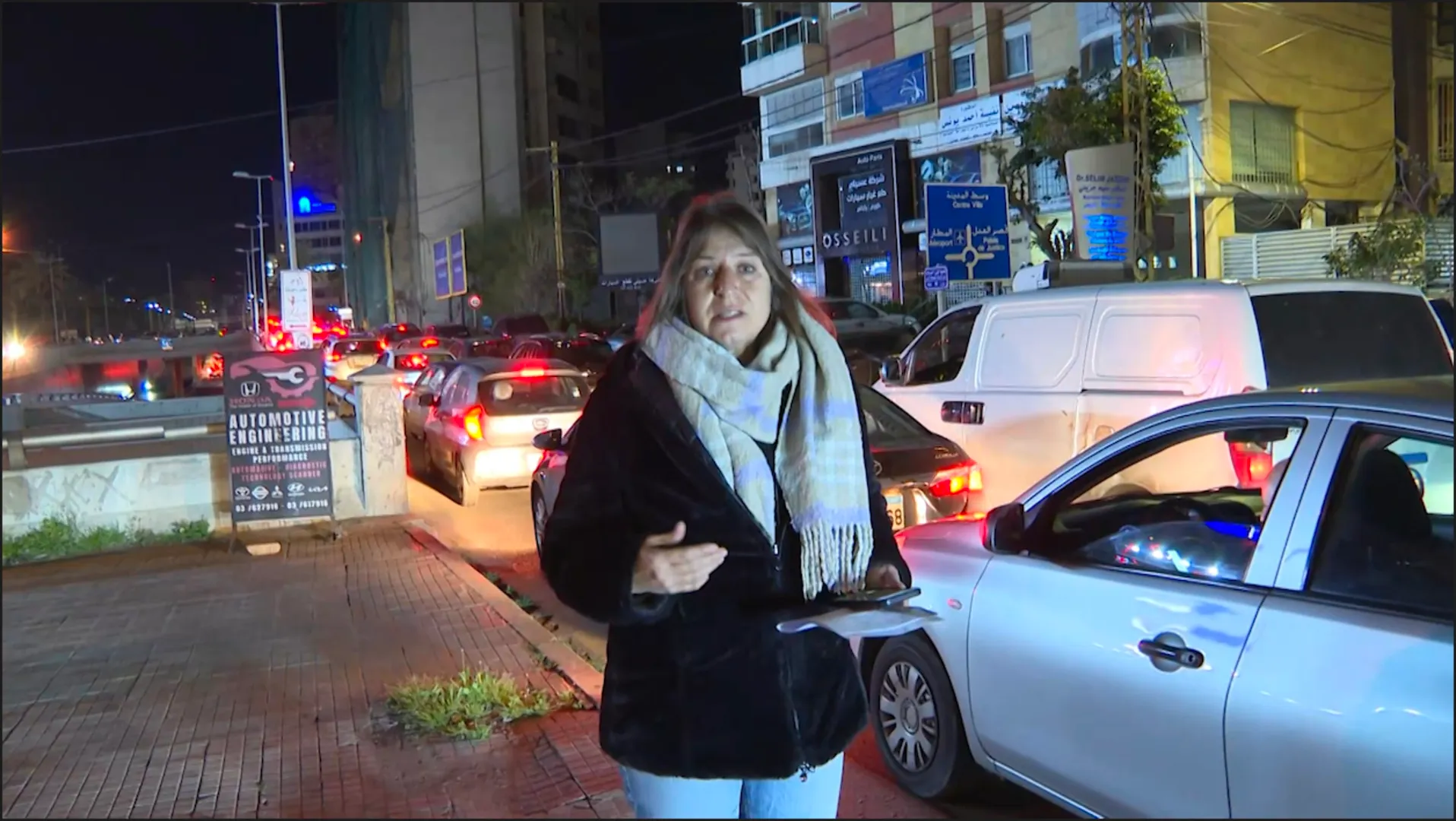
Al Jazeera reports from Beirut as residents flee following Israeli strikes | Israel-Iran conflict
Tens of thousands of Lebanese civilians are leaving areas in Beirut following Israeli strikes and forced displacement orders. Earlier Hezbollah launched a retaliatory attack on Israel. Al Jazeera’s Zeina Khodr is amid the heavy traffic.
Published On 2 Mar 2026
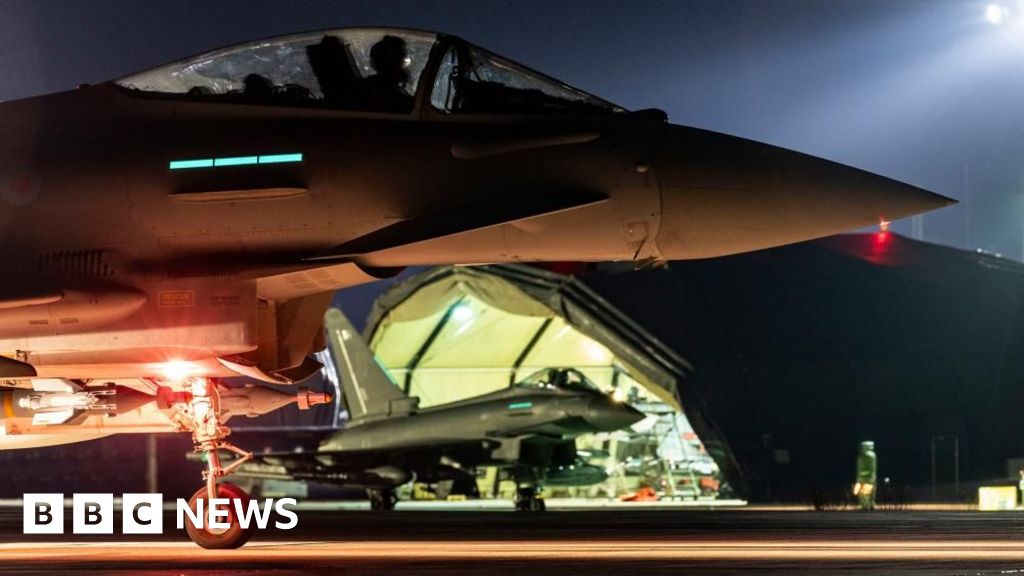
RAF responding to suspected drone strike at UK base in Cyprus, MoD says
The BBC understands there were no casualties in the suspected strike on RAF Akrotiri.
Source link

Maya Jama poses nude except for fur stole after stunning on Brit Awards red carpet in figure hugging white dress
MAYA Jama has posed with nothing but a fur stole after wowing at the Brit Awards.
The Love Island host, 34, presented the award for Artist of the Year at Saturday’s ceremony in a figure-hugging white, custom-made David Koma dress.
Maya completed the look with a white faux-fur stole and later stripped down to nothing except that wrap.
She took to Instagram to recap her Brit Awards night and shared the photo of her completely nude, with just the stole covering her modesty.
“Brit awards was so much fun! Presented Artist of the year to the absolute angel Olivia Dean & got to see all my pals wearing the dreamiest custom David Koma gown. Such a good year for British music,” she captioned the post.
People were quick to compliment her on the chic outfit and sexy poses.


“Hot 🔥,” wrote one person, while another added: “Lushhhh.”
And Big Brother host AJ Odudu commented: “STUNNING.”
This year’s Brits were held Manchester for the first time in the show’s 50 year history, so Maya did not have travel far from her new home with Man City footballer Ruben Dias.
Maya and Ruben have been dating for around 18 months and she confirmed during the Brits broadcast that she’d made the move to Manchester to live with him.
Maya took to the stage alongside music legend James Blunt and said to the crowd: “Hello Manchester, I’ve just moved here so this is my new home. Love it. And James?”
The You’re Beautiful singer replied: “This is the most important award of the evening this is for best artist and I have to say that when I was relevant it was far easier.
“There were only 4 other people in the category but tonight we have 10 people.”
After sharing the nominated artists, the pair then revealed the winner as Olivia Dean who was nominated for five awards, and took home four.
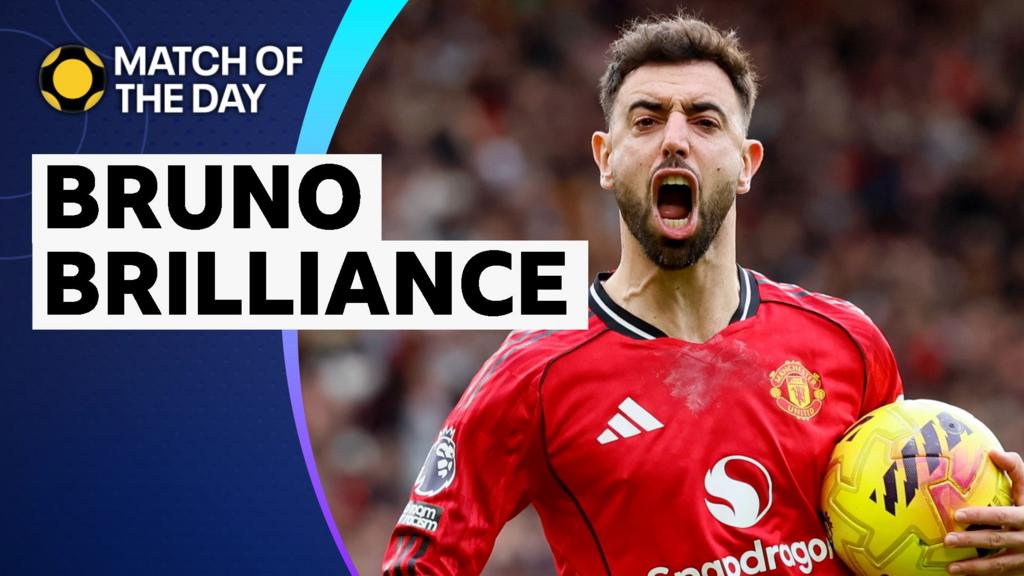
MOTD analysis: How Bruno Fernandes helped Benjamin Sesko in Man Utd win against Crystal Palace
Match of the Day pundit Joe Hart analyses how Bruno Fernandes was a “coach on the pitch” to “get the best” out of his Manchester United team-mates in their 2-1 victory against Crystal Palace.
MATCH REPORT: Manchester United 2-1 Crystal Palace
Available to UK users only.

Thousands rally against two-state future for Korea on Independence Movement Day

1 of 2 | Religious leaders, civic activists, overseas Koreans, South Korean youth and North Korean defectors gather in Seoul on March 1, 2026. and hold signs reading “Two Korea No! One Korea Yes!” during the Citizens’ Solidarity for ONE KOREA rally in Seoul. Photo courtesy of Citizens’ Solidarity for ONE KOREA
March 1 (UPI) — Thousands of South Koreans gathered in central Seoul on Sunday to call for peaceful unification of the Korean Peninsula and oppose what they described as a two-state framework between the two Koreas.
The rally, organized by Citizens’ Solidarity for ONE KOREA, was held at Gwanghwamun Square near the Dongwha Duty Free shop to mark the 107th anniversary of the March 1 Independence Movement.
Organizers estimated attendance at more than 4,000. Police did not immediately provide an independent estimate.
Organizers said pre-event cultural performances began at 1 p.m., including traditional percussion and a performance by a North Korean defector-turned-singer. The main program opened at 2 p.m., with speakers emphasizing the legacy of the 1919 independence movement and calling for renewed efforts toward unification.
Participants included civic activists, religious leaders, North Korean defectors, separated family members, overseas Koreans and young people. Many held signs reading “Two Koreas: No, One Korea: Yes.”
North Korea in recent months has characterized inter-Korean relations as those between “two hostile states,” effectively redefining its official stance on unification. In South Korea, the unification minister has said the ministry is proceeding with steps to formalize what he described as a “peaceful two-state” approach as a ministry position.
Kim Hyung-seok, a 105-year-old emeritus professor at Yonsei University, delivered a special message urging citizens to take the lead in pursuing national unity. He said unification should be achieved by the Korean people rather than driven solely by political leaders.
Religious figures from different faiths also addressed the crowd. Buddhist monks Hyein and Eung cheon spoke at the rally, alongside Protestant pastors Kim Jin-hong and Jang Hak-il, who criticized what they described as efforts to institutionalize division on the peninsula. Participants later sang “Our Wish Is Unification,” a song long associated with reunification hopes.
North Korean defector Kang Chol-hwan, head of the North Korea Strategy Center, spoke about human rights conditions in the North and stressed the importance of expanding outside information access to North Korean residents.
Jang Man-soon, head of a civic group representing families separated by the Korean War, announced plans to raise funds for broadcasting initiatives aimed at North Korea and to promote the establishment of a platform tentatively named “Korea Link.”
During a joint declaration, youth representatives from the South and from the defector community pledged to uphold the spirit of the March 1 movement and work toward unification based on freedom, human rights and shared prosperity.
After the rally, participants marched around the Gwanghwamun area, concluding the event at about 5 p.m.
Organizers said they plan to continue nationwide activities promoting what they described as a citizen-led movement for peaceful unification.
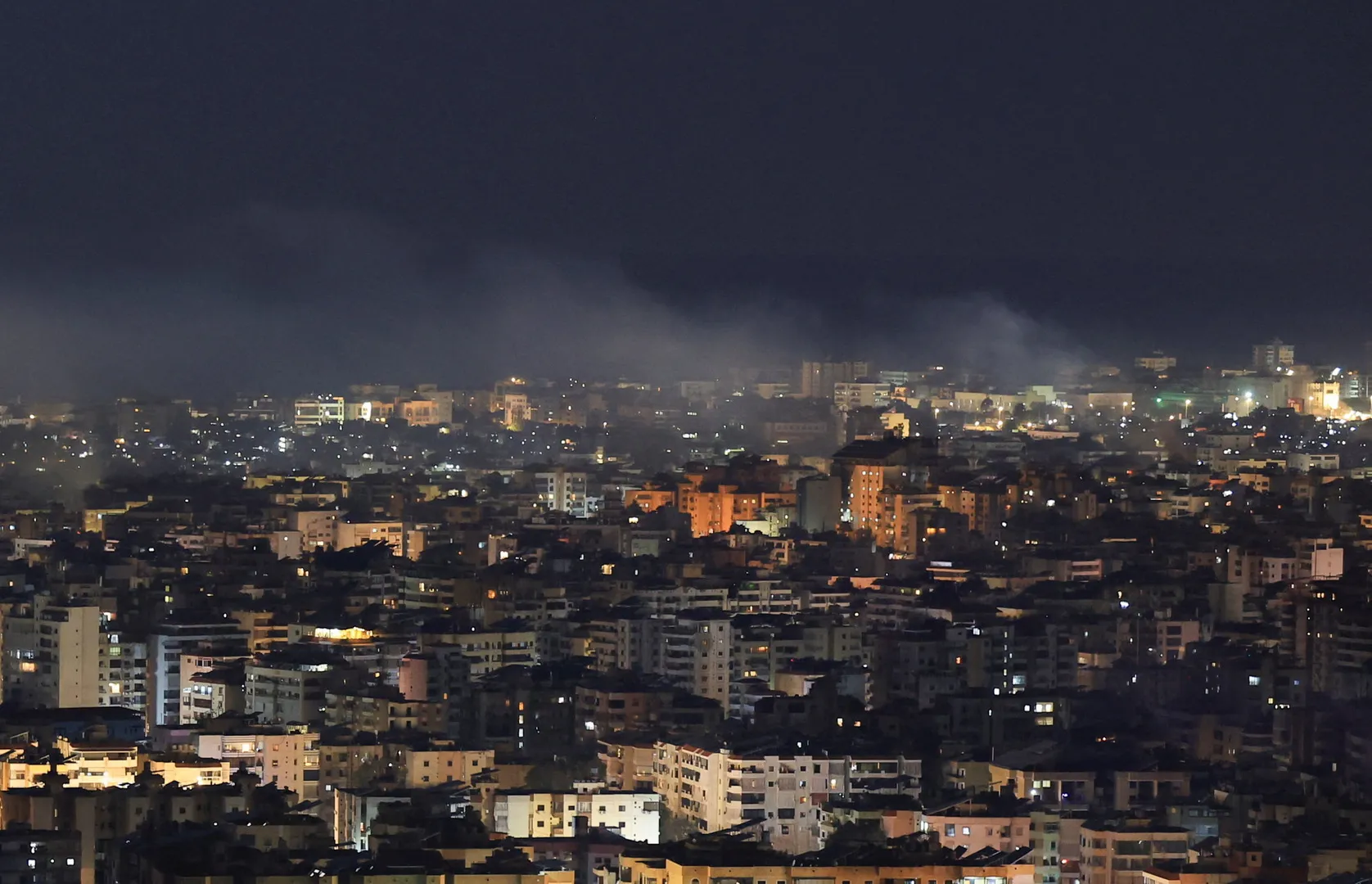
Israel bombs Beirut after Hezbollah fires rockets in Iran war retaliation | Israel-Iran conflict
Israel has carried out heavy strikes in the southern suburbs of Lebanon’s capital Beirut after Hezbollah launched an attack on northern Israel in retaliation for the killing of Iran’s Supreme Leader Ali Khamenei.
Published On 2 Mar 2026
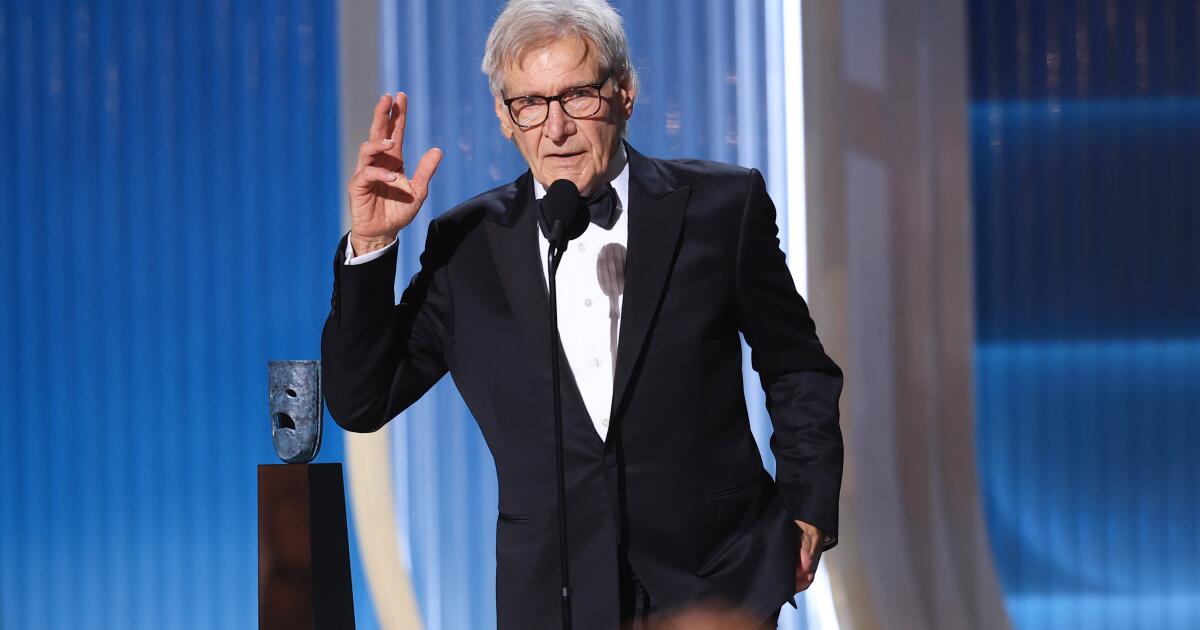
Harrison Ford gets tearful while accepting SAG Life Achievement Award
Harrison Ford received a standing ovation Sunday as he accepted the SAG-AFTRA Life Achievement Award.
“It’s a little early isn’t it?” Ford joked, noting that “it’s a little weird to be getting a lifetime achievement award at the half-point of my career.”
The 83-year-old is one of the industry’s highest-grossing actors after catapulting to global stardom with his role as Han Solo in the “Star Wars” franchise, a legacy further cemented by his lead role in “Indiana Jones” movies.
Ford fought back tears, thanking his fellow actors, writers, directors and cast members. He “found a calling. A life in storytelling. An identity in pretending to be other people,” he said.
“While we’re all at different stages of our lives and careers in this room, we all share something fundamental. We share the privilege of working in the world of ideas, of empathy, or imagination,” Ford said. “Because of that privilege, I’ve come to know myself.”
Ford said he was “not an overnight success,” spending the first 15 years of his career jumping between acting and carpentry before landing an acting role.
Ford thanked film producer and casting director Fred Roos and his longtime manager Pat McQueeney, all of whom he said were integral to his success.
“They’re no longer with us, but it feels important that I think of them now. I feel them here tonight. They would be happy for me,” Ford said.
SAG-AFTRA’s recognition on Sunday is one of several lifetime achievement awards bestowed upon the actor over his extensive six-decade career, which is defined by two of Hollywood’s biggest film franchises.
A highlight reel of Ford’s various acting performances played ahead of his accepting the award.
The award was presented by actor Woody Harrelson, who lauded Ford’s varied achievements and called him a “timeless American treasure.”
“There’s too much of me in this tribute to Harrison, but I’m an actor, what do you expect?” Harrelson quipped. The actor first met Ford after following him into a sushi restaurant and the pair “sealed their friendship” over lunch, during which “at one point, we laughed — and I’m not kidding — for three minutes straight,” Harrelson said.
“This is a life achievement award and he has lived a full one,” Harrelson said.
Ford hasn’t shown signs of slowing down in recent years. The actor plays therapist Paul Rhoades in the Apple TV show “Shrinking,” which earned him his first-ever Emmy nomination last year. He also recently starred in the “Yellowstone” prequel “1923” and appeared in his first Marvel movie, “Captain America: Brave New World.”
Ford “thinks working more is the antidote to aging,” Harrelson said. The actor recently reprised his iconic role as a swashbuckling archaeologist in the 2023 sequel “Indiana Jones and the Dial of Destiny.”
Despite Ford’s massive success in the industry, the actor has yet to win a major competitive acting award. The Life Achievement Award is the first that Ford snagged from the guild. He was nominated last year for actor in a comedy series for his role in “Shrinking” but lost to Martin Short for his performance in “Only Murders in the Building.”
Ford said he was “quite humbled” to be honored with the award in a room full of actors, “many of whom are here because they’ve been nominated to receive a prize for their amazing work, while I’m here to receive a prize for being alive.”
“Sometimes we make entertainment. Sometimes we make art. Sometimes we’re lucky and we make them both at the same time,” Ford said.
The awards show’s highest honor is given to performers who foster the “finest ideals of the acting profession.” Ford joins a list of seasoned actors who have received the award, including Jane Fonda, Barbra Streisand, Morgan Freeman and Robert De Niro.
SAG-AFTRA described Ford as “one of cinema’s most enduring leading men” whose performances “have become woven into the fabric of our culture,” in a December release announcing the honor.

California pro-Trump protests, rallies have surged since 2016
Despite its reputation as a leader of resistance, California saw more pro-Trump crowds than any other state during the president’s term in office.
That’s according to the Crowd Counting Consortium, a project from the University of Connecticut and Harvard University that documents political gatherings of all kinds. By combing news reports and social media, the group has cataloged some 4,500 pro-Trump gatherings nationwide since he took office in 2017. Of those, 417 events were in California. Florida was a distant second, with 253 events.
California is one of bluest states, but it’s also the most populous — 17.5 million people voted in the 2020 election. Though Joe Biden won the election here by a 2-1 margin, Trump claimed around 6 million votes, a higher raw total than in any other state.
After adjusting for size, California doesn’t look so exceptional in terms of Trump gatherings: It ranks 20th out of the 50 states and Washington, D.C., in protests per Trump voter. Washington was at the top, with 108 pro-Trump events in the past four years, despite having fewer than 19,000 people voting for the president.
The protests in California haven’t been limited to the red parts of the state. The top three counties are in Southern California: Los Angeles, San Diego and Orange counties combined had 174 events, about 40% of the pro-Trump protests in the state. Of the top 10 counties, the only one that went to Trump in the election was Kern, home of Bakersfield and a center of the oil and gas industry.
The researchers study the crowds and classify the political causes that motivate people to show up for each gathering. Many events provided only general support for the president, protesting officials who spoke against him or rallying in support of his campaign promises. Some protests were more specific, such as events opposing public health regulations related to the pandemic, supporting policing efforts or opposing the Black Lives Matter movement.
The data show a spike in pro-Trump protests after the 2020 election. After Biden was named the winner, there were a wave of protests supporting Trump’s disproved claims that the election had been stolen. On Jan. 6, the day the U.S. Capitol was raided, there were 15 protests of the election results in California, more than in any other state.
The number of gatherings in support of the president have been dwarfed by those opposing him. Over the last four years, there were nearly 38,000 anti-Trump events tracked by the consortium, eight times more than the number of pro-Trump gatherings. Again, California led the nation, hosting more anti-Trump rallies than any other state.
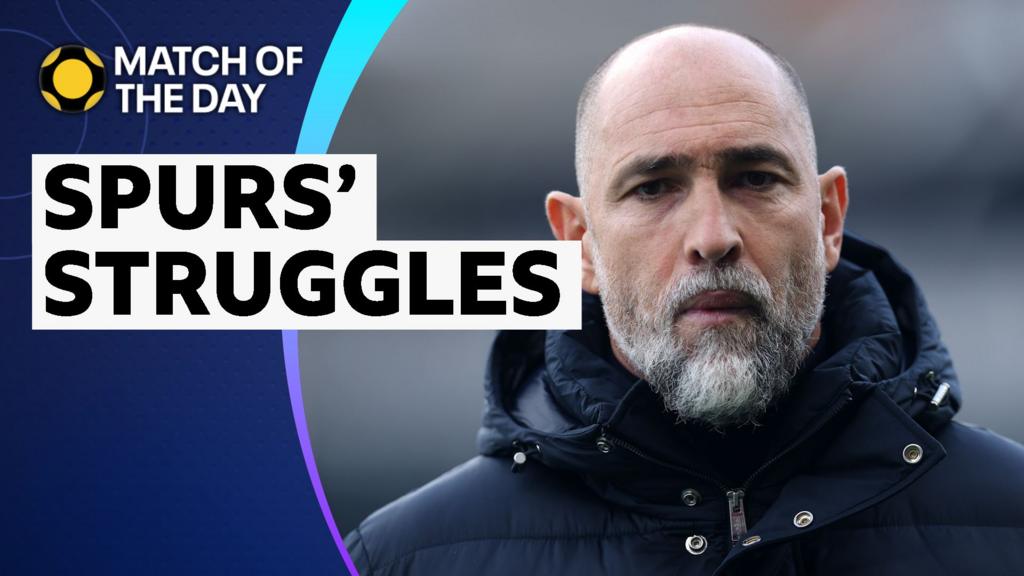
'They look all over the shop' – Hart
Match of the Day pundits Leon Osman and Joe Hart look at how Tottenham Hotspur’s disorganisation played a big part in their 2-1 defeat against Fulham.
Source link
Three U.S. troops killed in Kuwait in retaliatory Iranian strike
March 1 (UPI) — Three members of the U.S. military were killed and five were seriously wounded in the Iranian response to U.S. and Israeli strikes the day before.
President Donald Trump said in a video statement Sunday that the nation grieves “for the true American patriots who have made the ultimate sacrifice for our nation,” while repeating the warning he made Saturday in announcing the strikes that more U.S. troops may die.
“Sadly, there will likely be more before it ends,” he said. “Likely be more.”
The service members killed were part of an Army sustainment unit based in Kuwait, which is one of several American bases in the Middle East that Iran has targeted amid its response to Operation Epic Fury, which started early Saturday morning, NBC News and The New York Times reported.
“America will avenge their deaths and deliver the most punishing blow to the terrorists who have waged war against, basically, civilization,” Trump said.
U.S. Central Command announced in a post on X on Sunday morning that the troops had been killed in action and wounded as the military continued to hit targets, while also receiving counterattacks from Iran.
Several other troops also “sustained minor shrapnel injuries and concussions — and are in the process of being returned to duty,” CENTCOM said in the post. “Major combat operations continue and our response effort is ongoing.”
“The situation is fluid,” the post noted, adding that the names of the deceased troops would be withheld until 24 hours after their next of kin have been notified.
Iran has also targeted other countries nearby, including Cyprus, the United Arab Emirates and Qatar.
CENTCOM on Saturday refuted Iranian claims that at least 50 U.S. service members had been killed, as well as other claims that a U.S. Navy ship had been struck by missiles and that severe damage was seen at “multiple U.S. bases.”
Through the first day-and-a-half of Operation Epic Fury, the United States and Israel have said that they hit dozens of military and government sites throughout Iran.
CENTCOM has specifically announced the sinking of Iranian naval vessels, sending B-2 stealth bombers to hit Iran’s ballistic missile facilities and various communication, air defense and command and control centers.
Trump early Saturday announced that Iranian spiritual leader, Ayatollah Ali Khamenei, was dead — along with other high-ranking leaders of Iran — in U.S. and Israeli airstrikes.
U.S. intelligence and military assets had been tracking Khamenei for months and opted for a rare daylight strike on the meeting because of the opportunity to hit multiple targets, including Defense Minister Gen. Aziz Nasirzadeh, Revolutionary Guard Corps head Gen. Mohammad Pakpour and Khamenei’s defense adviser, Ali Shamkhani.

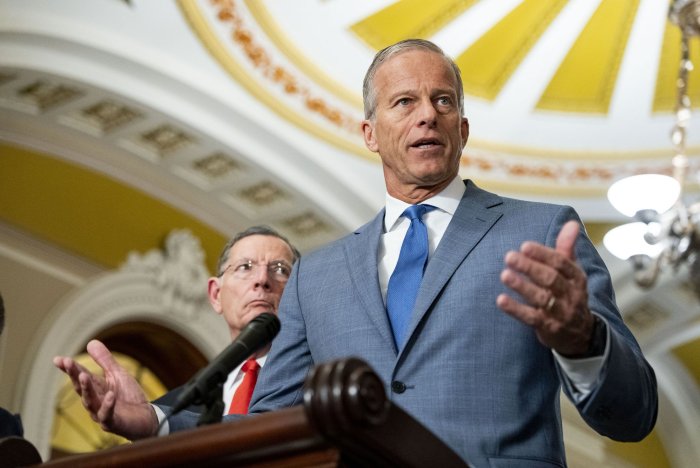
Senate Majority Leader John Thune, R-S.D., speaks during a press conference after the weekly Republican Senate caucus luncheon at the U.S. Capitol on Wednesday. Photo by Bonnie Cash/UPI | License Photo

Poll suggests only a quarter of Americans support attacks on Iran | Donald Trump News
A poll conducted in the hours after the United States and Israel launched a major military operation against Iran, sparking regional retaliation, shows dismal approval for the strikes from the US public.
The Reuters Ipsos poll was conducted beginning on Saturday and closing on Sunday, before the administration of President Donald Trump announced that the first US troops had been killed in the conflict. Only one in four respondents approved of the US-Israeli attacks.
Recommended Stories
list of 3 itemsend of list
The early findings could have a significant effect on how the Trump administration moves forward in the days ahead and on how lawmakers respond to the attacks, particularly as they look to a punishing midterm election season.
Trump on Sunday promised to continue what he described as a “righteous mission” until “all objectives are achieved”. Referencing the three US military members announced killed on Sunday, Trump said that “there will likely be more before it ends”.
After a US-Israeli strike killed Iranian Supreme Leader Ayatollah Ali Khamenei, Trump again framed Iran as an existential threat to the US, claiming that the country’s leaders “have waged war against civilization itself”.
The Reuters-Ipsos poll suggested that the US public does not share that view, with 43 percent of respondents saying they disapproved of the war and another 29 percent saying they were unsure.
Approval among Republicans was stronger, but not resounding, with 55 percent saying they approved of the strikes, 13 percent disapproving and 32 percent unsure.
Perhaps most significantly, about 42 percent of Republicans said they would be less likely to support the operation if it led to “US troops in the Middle East being killed or injured”.
About 74 percent of Democrats disapproved of the strike, with 7 percent approving and 19 percent unsure.
Midterms loom
The poll released on Sunday comes as Republican lawmakers have largely coalesced around Trump’s message on Iran, even as its contradiction to Trump’s campaign promises risks alienating his Make America Great Again (MAGA) base.
Trump had run on a pledge to cease “endless wars” and halt US interventionism abroad in an “America First” pivot.
While Trump has shown a unique ability to shape the views of his staunchest supporters in his likeness, some conservative commentators have warned that he is playing with fire.
“If this war is a swift, easy, and decisive victory, most of them will get over it,” Blake Neff, a former producer for late conservative activist Charlie Kirk, wrote on X on Saturday.
“But if the war is anything else, there will be a lot of anger.”
He added that “success can override bad explanations. So we must pray for success.”
Speaking to Al Jazeera, Doug Bandow, a senior fellow at the Cato Institute, a libertarian think tank, said the confirmation that US soldiers had been killed “brings home the cost of the war”.
“Americans, by a very large margin, don’t want to be tied up in an ongoing conflict in the Middle East,” he said during a television interview. “The fact that Americans have died suddenly shows this is not just a video game from the standpoint of America.”
Beyond the three US military personnel killed, at least 201 people have been killed in Iran, nine in Israel, two in Iraq, three in the United Arab Emirates and one in Kuwait.
Meanwhile, 45 percent of respondents to the Reuters-Ipsos poll, including 34 percent of Republicans and 44 percent of independents, said they would be less likely to support the campaign against Iran if gas or oil prices increased in the US.
The conflict has threatened arterial trade routes, with several companies suspending shipments in the area.
Democrats will also be keeping a close eye on public sentiment on the war, which will surely hang over the campaign season ahead of the midterm elections in November.
The party has made affordability a key issue, with incumbents and upstart challengers alike portraying Trump’s military adventurism, which has also included the US abduction of Venezuelan leader Nicolas Maduro, as out of touch with his messaging.
Elected Democrats, meanwhile, have given a range of responses to the US operation against Iran, with at least one Democratic senator praising Trump’s strikes. Others celebrated Khamenei’s killing, but remained more circumspect on Trump’s justification for the attacks, while several others were forthright in condemning the strikes.
Several Democrats on Sunday said the killing of US soldiers underscored the urgency of passing a war powers resolution, which would require approval from Congress before further military action is taken.
“I’m thinking of the brave American soldiers killed today,” Senator Chris Van Hollen, a proponent of the resolution, posted on X on Sunday. “They should still be with us.”
“Trump said he would keep us out of war. This is his war of choice.”
A vote on the resolution is expected early this week.
Luke Grimes’ return as Kayce in ‘Marshals’ involves a twist of fate
This story contains spoilers for the pilot of “Marshals.”
When the curtain came down on “Yellowstone” last year, Kayce Dutton had finally found his happily-ever-after.
The youngest son of wealthy rancher John Dutton (Kevin Costner) had secured a modest cabin in a mountainous region where he could reside in secluded peace with his beloved wife, Monica (Kelsey Asbille), and son, Tate (Brecken Merrill), far from the turbulent dysfunction of his family.
“Kayce found his little peace of heaven, getting everything he ever wanted and fought for,” said Luke Grimes, who plays the soft-spoken Dutton in “Yellowstone.”
Grimes reprises the role in CBS’ “Marshals,” which premiered Sunday. But in the new series, Kayce’s serenity has been brutally shattered, forcing him to find a new path forward after an unimaginable tragedy.
The drama is the first of several planned spinoffs of “Yellowstone,” which became TV’s hottest scripted series during its five-season run. And while some familiar faces return and events unfold against the magnificent backdrop of towering mountains and lush greenery, “Marshals” is definitely not “Yellowstone” 2.0.

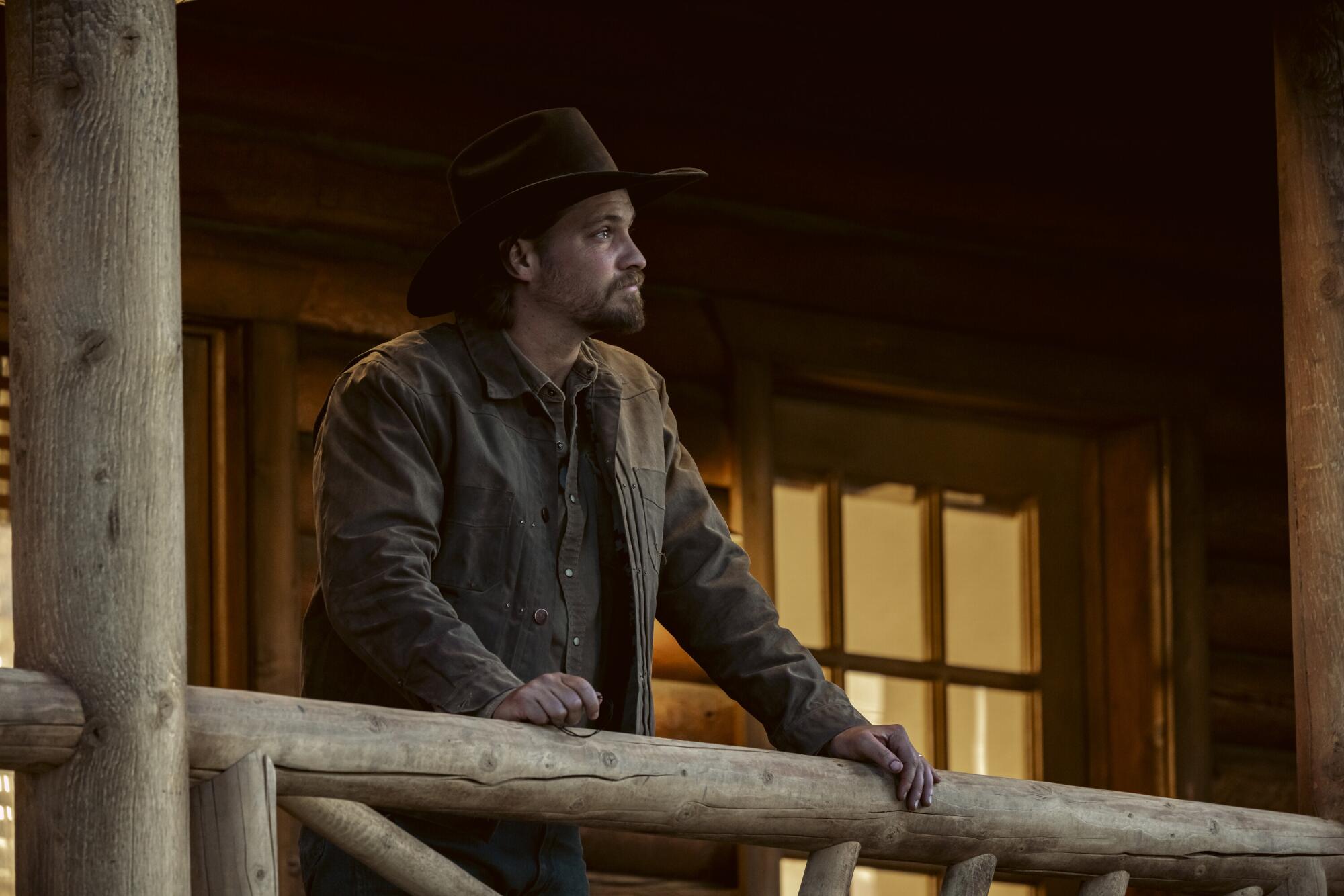
Luke Grimes as Kayce Dutton in “Marshals,” which combines the gritty Western flavor of “Yellowstone” with the procedural genre.
(Sonja Flemming / CBS )
In “Marshals,” Kayce joins an elite squad of U.S. Marshals headed by his Navy SEAL teammate Pete Calvin (Logan Marshall-Green). The drama combines two distinct brands — the gritty Western flavor of “Yellowstone” with the procedural genre, a flagship of CBS’ prime-time slate.
During an interview at an exclusive club in downtown Los Angeles, Grimes expressed excitement about dusting off his cowboy hat and boots, though he admitted to having initial concerns about whether the project was a fit.
“I had never watched a procedural before, so I had to do some homework on what that was,” Grimes said hours before the gala premiere of “Marshals” at the Autry Museum of the American West in Griffith Park. “And I just couldn’t wrap my head around it at first. In the finale, Kayce had ridden off into the sunset. So I thought, ‘Let him be, let him go.’ ”
Those doubts eventually ebbed away.
“To be honest, there was a part of me that didn’t want to let Kayce go just yet,” Grimes said. “Saying goodbye to him was really hard, so the opportunity to keep this going was something I couldn’t pass up. We get to show his backstory and also this other side of him that we didn’t see in ‘Yellowstone.’ ”
But this Kayce is a man in crisis. “Yellowstone” devotees will likely be shocked by the “elephant in the room” — the revelation in the pilot episode that Monica has died of cancer. The couple’s sexy and loving chemistry was a key element in the series while also establishing Grimes as a heartthrob.
“I think fans will be upset — and they should be,” Grimes said as he looked downward. “Kayce is very upset. It’s the worst thing that could have happened to him. But as much as I’m really upset not to work with Kelsey, it’s a good idea for the show.”
He added, “His dream life is no longer available to him. Now the only thing he has is his son, who is not so sure he wants the same life as Kayce. A big part of the season is Kayce learning how to manage all these new things — new job, being a single father.”

“His dream life is no longer available to him. Now the only thing he has is his son, who is not so sure he wants the same life as Kayce,” said Luke Grimes about his character Kayce.
(Jay L. Clendenin / For The Times)
Executive producer and showrunner Spencer Hudnut (CBS’ “SEAL Team”) acknowledged in a separate interview that viewers may be stunned by the tragedy. “Real life intervenes for Kayce. Unfortunately it happens to so many of us.”
But he stressed that although Monica is physically gone, her presence will be heavily felt this season.
“She is guiding Kayce, and their relationship is moving forward,” Hudnut said. “His dealing with his inability to confront his grief is a big part of the season. It became clear that something horrible had to happen to put Kayce on a different path.”
As the development evolved, Grimes embraced the procedural concept: “This is a very different show and structure. This is an action show, very fast paced. I meet a lot of fans who say they really want to see Kayce go full Navy SEAL.”
Alumni from “Yellowstone” returning in “Marshals” include Gil Birmingham as tribal Chairman Thomas Rainwater and Mo Brings Plenty as his confidante Mo.
“Yellowstone” co-creator Taylor Sheridan, who had already spearheaded the prequels “1883” and “1923,” will further expand the “Yellowstone” universe later this month with “The Madison,” starring Michelle Pfeiffer and Kurt Russell, about a New York City family living in Montana’s Madison River territory. Later this year, Kelly Reilly and Cole Hauser will star in “Dutton Ranch,” reprising their respective “Yellowstone” roles as John Dutton’s volcanic daughter Beth Dutton and her husband, boss ranch hand Rip Wheeler.
Hudnut said fans of “Yellowstone” will recognize themes that were central to that series: “The cost and consequences of violence, man versus nature, man versus man.”
“We’re trying to tap into what people loved about ‘Yellowstone’ but to tell the story in a different framework,” he said. “The procedural brand is obviously very successful for CBS. And nothing has been bigger than ‘Yellowstone.’ So the challenge is, how do you marry those things?”
Taking on the lead role prompted Grimes to reflect on how “Yellowstone” transformed his life after co-starring roles in films like “American Sniper” and “Fifty Shades of Grey” and playing a vampire in the TV series “True Blood.”
“‘Yellowstone’ changed my life in many, many ways,” he said. “The biggest change is that I now live where we shot the show in Montana. The first time I went there, I would have never thought I would ever live there.
“I would come back to the city after shooting. But a little bit more each year, I felt more out of place here, and more peace and at home there. I’m a big nature person — I never was a big city person, but I had to be here to do what I wanted. But after the third season, my wife and I decided to move there. We wanted to start a family.”
The topic of a Kayce spinoff kept coming up during the filming of the finale, but “meanwhile we were having a baby, so that was the biggest thing on my plate.”

“‘Yellowstone’ changed my life in many, many ways,” said Luke Grimes.
(Jay L. Clendenin/For The Times)
Grimes was also dealing with the off-screen drama that impacted production due to logistical and creative differences between Costner and Sheridan. Costner, who was the show’s biggest attraction, exited after filming the first part of the final season. His character was killed off.
Asked about the backstage tension, Grimes said, “I just tried to do my job to the best of my ability, and not get caught up in all that. It was sort of frustrating, but I felt lucky to have a job.”
He recalled getting a call from Sheridan about the plans for a spinoff: “He said, ‘I think you should talk to the guy who is going to be the showrunner. I’m not telling you to do it, and I’m not telling you not to do it. But Spencer is great and he has some good ideas.’ ”
Hudnut said Kayce “was always my favorite character. Also, Luke is not Kayce. Kayce is an amazing character, but Luke is really thoughtful and smart. He is a true artist and has an artist’s soul, while Kayce is kicking down doors and terrorizing people. And Luke has such a great presence. He can do so much with just a look to the camera. He is a true leading man.”
In addition to starring in “Marshals,” Grimes is also an executive producer. He pitched the opening sequence — a flashback showing Kayce in the battlefield. He also performs the song that plays over the final scene, in which he visits his wife’s grave. The ballad is from Grimes’ self-titled country album which was released last year.
“Luke’s creative fingerprints are all over the pilot,” Hudnut said.
Grimes said he does not feel pressure about being the first follow-up from “Yellowstone” to premiere.
“We’re not trying to make the same show, so no matter what happens, its a win-win,” he said. “I had a blast doing it.”