



‘Children see magic in the smallest adventures’: exploring Scotland with my four-year-old | Highlands holidays
‘There! There – I can see it!” The cries of my four-year-old echoed around the ruins of 13th-century Urquhart Castle, causing a group of US tourists to come running over to the corbelled bartizans (overhanging turrets) where we stood. “It’s Nessie, I saw her,” he insisted, pointing at the ripples spinning out from the back of a sightseeing vessel on Loch Ness.
This was day four of a budget, week-long Scotland adventure for the two of us, and we were spending the day in Drumnadrochit, on the shores of the country’s most famous body of water, looking for the fabled monster.
It wasn’t the first time that reality and wishful thinking had seemingly combined on this holiday. When I told people I was going to take my son on a week-long trip across Scotland and my budget was £500, they were sceptical – especially as we were travelling in the school holidays. But as a woman who likes a challenge, I was up for proving them all wrong.
We’d begun our adventure in Glasgow, having travelled by train (£30), then picked up a cheap hire car for the five-hour drive to the Isle of Skye. Accommodation on Skye is pricey, but I had a secret weapon – my tent.
The car journey was punctuated by stops at lochs so enchanting they could have been lifted from the pages of a children’s book. We finally reached the island and checked in at Camping Skye, a community-owned campsite by the sea in Broadford. For the £16 cost of a pitch, we spent the evening playing beneath the flanks of Beinn na Caillich, eating chips and mushy peas from the local shop, and roasting marshmallows on a firepit.
The next morning, primed for a mini-expedition and stocked up with supplies, we drove to the southern enclave of Elgol. The crowds who flock to the island for the Fairy Pools and spectacular Quiraing rock forms melted away as we went deeper into the countryside. We pulled over at a nondescript parking area and I explained the plan to my son. We were going to walk about 2.5 miles (4km) to our accommodation – and no, mummy couldn’t carry him as I would be carrying all our supplies. Excited by the carrot on a stick in the form of a bag of Percy Pigs, we set off, me with a full backpack, him clad in waterproofs, clutching a walking pole.
“I can do this. It’s going to be hard, but it’s going to be worth it,” I heard him muttering to himself as the ascent kicked in. Along the way I pointed out the purple petals of the devil’s-bit scabious flower – mythology claims the devil was so enraged by the plant’s healing properties that he chewed its roots, leaving them short and jagged. My son loved how stories such as this and the landscape combined, and it distracted him from the climb. When we reached the highest point, we could see down to Camasunary Bay, and the thought of playing on the beach made our descent fly by.
Our accommodation was a free (unbookable) bothy and, being first to arrive, we picked the top bunk of the sleeping platform, and I laid out our things. As more people came, my boy confidently greeted the guests as though welcoming them into his own home, proudly telling them this was his first bothy.
That evening was spent running around on the near-black sand beach just outside the door, making trenches, cooking pesto pasta on my camping stove and laughing at the “loo with a view” that sits above the bothy on the hillside.
Having stayed in many bothies over the past 15 years, I had wondered how taking a child would pan out. But his presence brought everyone together in an amazing way, and by 9pm all 12 residents were fast asleep, likely lulled by the white noise I was playing for him on my phone.
Next morning, my son’s determination to reach the car was only eclipsed by his desire to have ice-cream for breakfast, which I had promised as an incentive to climb up the hill. He was beaming with pride when he told the owner of The Creel pop-up cafe by Elgol harbour that he’d walked more than 5 miles “all by myself” and made friends in a bothy.
From there, it was back to the mainland and a two-hour drive on to Drumnadrochit for a stay in a private room at Loch Ness Backpackers Lodge (£60), with an afternoon spent in the nearby Loch Ness Centre, learning all about Nessie. After the novelty of sharing a bunk bed (me on top, him below), the next day was reserved for paddling in the shallows of the loch, running around the aforementioned Urquhart Castle and getting visitors’ hopes up with proclaimed sightings of the legendary plesiosaur.
That afternoon we journeyed to our final stop – the Cairngorms national park. At the reindeer centre in Glenmore Forest, we met the UK’s only free-ranging herd (which had been brought here to be checked over by a vet) and joined a scavenger hunt designed to teach children about these creatures. We ended the day at Loch Morlich, building sandcastles with children my son befriended in that easy way kids seem to do. I pointed up to the summit of Cairn Gorm – the sixth highest mountain in Britain. “That,” I told him, “is where we go tomorrow.”
After a night in a camping pod at the Speyside Trust’s Badaguish outdoor centre (£75), we braved the mountain during rain squalls on a guided hike (£35) which involved taking the mountain railway to Ptarmigan top station at 1,097m, then an hour’s walk to the summit. As we stood on the misty peak, our guide told us we were at 1,245m. I’ve never seen such a proud look on my son’s face.
The UK’s highest restaurant, the Ptarmigan, sits at the railway’s top station, and we indulged in hot chocolate before exploring the learning zone’s exhibition, with its panoramic film showcasing the landscapes around us in much better weather than we experienced. There are also interactive sandboxes where children can create their own natural environments. We rounded off the day by taking the train back down and going tubing (£15pp), laughing gleefully as we slid down the purpose-built dry slope in giant rubber rings.
Determined to make the journey home part of the adventure, I had booked the sleeper train back to London – our biggest indulgence at £170 for a cabin with a private loo and shower. Dusk hit as we boarded in Inverness, and the sky began to turn black outside the picture windows while we ate macaroni cheese in the dining car and my son told incredulous strangers about our adventures.
The truth is that kids love holidays – but they love spending time with their parents most of all. And by taking my son on my kind of adventure, I had bonded with him in a way I never thought possible. Children see magic in even the smallest of adventures – and their enthusiasm is utterly infectious. Our total spend after six days away was just under £500 which, when I think of the memories we have made, and the stories my son continues to tell, seems to me the best buy ever – even more fantastical than a magic monster that lives in Scotland’s largest loch.
Phoebe Smith is the author of Wayfarer: Love, Loss and Life on Britain’s Pilgrim Paths (Harper North). To buy a copy for £9.89, go to guardianbookshop.com. Delivery charges may apply

Australian Grand Prix result: George Russell wins from Kimi Antonelli as new era F1 era begins
Russell’s pole position – 0.8 seconds clear of the fastest non-Mercedes car – had sent shockwaves through the paddock on Saturday but the race was initially much closer than qualifying.
Both Ferrari drivers made their expected electric starts, and Leclerc vaulted from fourth on the grid to take the lead at the first corner.
Russell powered past the Ferrari on lap two between Turns 10 and 11 by using extra electrical energy.
But Leclerc was not to go down without a fight and drove past the Mercedes in a similar fashion on the run to Turn Nine on lap three.
Russell tracked Leclerc closely. He challenged for the lead into Turn One on lap nine only for the Ferrari driver to fend him off and leave Russell to fight to retain his position from Hamilton, who by now had joined the leading train of cars.
Antonelli, who had dropped to seventh at the start before fighting back past Norris, Lindblad and Isack Hadjar’s Red Bull, then joined them to make it four cars in the leading group after 10 laps, and they circulated together until Hadjar retired on lap 12.
The Frenchman, who had been running fifth, pulled off on the back straight, bringing out the virtual safety car, usually the trigger for teams to pit and benefit from the reduced time loss compared with pitting under racing conditions.
But while Russell and Antonelli pitted, Leclerc and Hamilton did not. Hamilton immediately questioned the call, saying over the radio: “At least one of us should have pitted.”
Instead, they ran long, sticking to their pre-race plan of a one-stop strategy.
By the time Leclerc pitted on lap 25, Russell was only five seconds behind him, and the Ferrari emerged 14 seconds adrift of the lead.
On fresher tyres, Leclerc might have been expected to narrow the gap to Russell, but he did not, and the fight at the front was over.

LG HelloVision’s budget mobile business remains stuck in slowdown

Exterior view of the headquarters of LG Uplus in Seoul, South Korea. LG HelloVision, LG Uplus’s subsidiary is still struggling to revive its mobile virtual network operator business, with subscriber growth and revenue showing little momentum despite broader expansion in South Korea’s budget mobile market. File. Photo by YONHAP / EPA
March 6 (Asia Today) — LG HelloVision is still struggling to revive its mobile virtual network operator business, with subscriber growth and revenue showing little momentum despite broader expansion in South Korea’s budget mobile market.
The company said its budget mobile revenue rose to 156.7 billion won ($118 million) last year from 156.1 billion won ($117 million) a year earlier, an increase of just 0.4%.
The business remains one of LG HelloVision’s key revenue sources, accounting for about 10% of total sales. But its performance has remained largely flat as subscriber growth has slowed.
LG HelloVision said its budget mobile subscriber base, including internet-of-things lines, stood at about 770,000 in the first half of last year, up only about 20,000 from a year earlier.
Industry analysts said the company received limited benefit from increased number-transfer demand that followed last year’s telecommunications hacking incident.
South Korea’s three major wireless carriers responded with aggressive marketing campaigns to attract subscribers, reducing the spillover effect that smaller operators such as LG HelloVision had hoped to capture.
Its parent company, LG Uplus, reported about 21.7 million mobile subscribers last year, up 6.6% from about 20.4 million a year earlier. Mobile service revenue rose to 6.67 trillion won ($5.01 billion) from 6.43 trillion won ($4.83 billion).
One industry official said LG Uplus, which was seen as less affected by the hacking fallout, appeared to absorb a large share of switching demand through aggressive marketing.
Analysts also pointed to LG HelloVision’s cautious approach to new pricing plans and promotions as another reason for the prolonged slump.
The company has faced profitability pressure while growth in its core pay television business has stalled. After posting operating profit in the 40 billion won range in 2023, it has remained in the 10 billion won range over the past two years.
Aside from a new plan introduced late last year that included compensation for financial fraud such as voice phishing, the company has made few notable changes to its budget mobile offerings.
LG HelloVision said it plans to try to revive subscriber growth this year with a new promotion tied to next week’s launch of Samsung Electronics’ Galaxy S26 smartphone series.
Customers who buy a Galaxy S26 device and sign up for one of the company’s plans will receive a 30,000 won ($23) gift certificate. Subscribers to its Coupon Pack plan will also receive additional coupons worth 120,000 won ($90).
The company has also added artificial intelligence features to improve the sign-up process. On its website, users can enter their preferences and receive tailored plan recommendations along with summaries of customer reviews.
Still, analysts say competition with the three major wireless carriers is likely to remain a challenge.
Industry observers expect another round of large smartphone subsidies this year, led in part by KT, which reportedly lost a substantial number of subscribers earlier this year after penalty fees were waived for some customers.
Given the structure of the budget mobile market, analysts said LG HelloVision may need to focus more heavily on low-cost promotional plans and more specialized offerings aimed at specific customer groups.
— Reported by Asia Today; translated by UPI
© Asia Today. Unauthorized reproduction or redistribution prohibited.
Original Korean report: https://www.asiatoday.co.kr/kn/view.php?key=20260306010001749

Rapper-turned-politician Balen Shah’s RSP heads for poll landslide in Nepal | Elections News
Shah’s party represents a reformist wave reshaping the Himalayan nation’s politics since last year’s youth-led uprising.
Published On 8 Mar 2026
Nepal’s centrist Rastriya Swatantra Party (RSP) of rapper-turned-politician Balendra Shah has secured a majority in the direct parliamentary elections and is heading for a landslide, according to official results and election commission trends.
The 35-year-old’s RSP party was also leading in proportional representation vote, according to results declared until early Sunday, in the country’s first election since last year’s youth-led uprising which toppled the government.
Recommended Stories
list of 4 itemsend of list
Elections on Thursday chose a new 275-member House of Representatives, the lower house of parliament, with 165 seats chosen directly, and 110 by a proportional representation vote.
Shah’s RSP has already won nearly 100 of 165 directly elected seats and is leading in over a dozen other constituencies in the results published by Nepal’s Election Commission early on Sunday.
Shah, widely known simply as “Balen”, himself on Saturday defeated the veteran four-time Prime Minister Khadga Prasad Sharma Oli – whose Marxist-led government was ousted in the protests last year – in his own seat in a southeastern district, securing almost four times as many votes as Oli.
His victory over the 74-year-old Oli, and his rise from the capital Kathmandu’s mayor to potential prime minister, marks one of the most dramatic results in recent Nepali politics.
He highlighted health and education for poor Nepalis as a key focus of his campaign, which rode a wave of public anger towards traditional political parties. He said the vote reflected his refusal to take “the easy way out” and signalled a reckoning with the “problems and betrayals that have affected the country”.
Oil congratulated Shah in a post on X, wishing him a “smooth and successful” term.
[Translation: Balenu Babu, Congratulations to you for the victory! May your five-year tenure be smooth and successful—heartfelt best wishes!]
Neighbouring India’s Prime Minister Narendra Modi on Saturday said the successful and peaceful conduct of elections in Nepal was a “proud moment” in the country’s “democratic journey”.
“It is heartening to see my Nepali sisters and brothers exercise their democratic rights so vibrantly,” Modi wrote on X. “This historic milestone is a proud moment in Nepal’s democratic journey.”
Modi assured of working together with the new government. “As a close friend and neighbour, India remains steadfast in its commitment to working closely with the people of Nepal and their new Government to scale new heights of shared peace, progress and prosperity.”
‘Shake up the status quo’
Shah trained as a civil engineer before breaking through as one of Nepal’s most prominent rappers, releasing conscious music targeting corruption and inequality that later became anthems of the September protests.
His 2022 election as Kathmandu’s first independent mayor was also a major upset for the political establishment at the time. The RSP, his party, founded the same year, was built on a similar anti-establishment platform.
Its campaign before Thursday’s vote was highly organised, with a more-than-660-person social media operation and significant funding from the Nepali diaspora, particularly in the United States.
“The nation was fed up with the old corrupt leaders,” said Birendra Kumar Mehta, a member of RSP’s central committee.
The September protests, initially triggered by a government ban on social media platforms, rapidly escalated into a mass movement against corruption and economic stagnation. At least 77 people were killed.
Shah emerged as a figurehead of the protests, and his song Nepal Haseko, Nepal Smiling, accumulated more than 10 million YouTube views during the unrest. His victory reflects a growing generational divide in the country.
More than 40 percent of Nepal’s nearly 30 million people are under 35, yet the leadership of its established parties has remained in its 70s.
Nepalese journalist Pranaya Rana described Shah to Al Jazeera as embodying “the outsider spirit that many young Nepalis are looking for to shake up the status quo”.

A 1986 documentary meets today’s moment, plus the best movies in L.A.
Hello! I’m Mark Olsen. Welcome to another edition of your regular field guide to a world of Only Good Movies.
If you are anything like me, you felt pretty out of sorts this week, not sure how to process the news that we are suddenly, apparently, a nation again at war. It can make the movies seem frivolous — a glorious, privileged sandbox to stick your head in — but it is also times like these that make them seem most vital and necessary: a place to focus energy and anxiety and maybe figure things out.
I was particularly struck by something New York Times critic Wesley Morris said in an appearance on the podcast “The Big Picture.” He was ostensibly talking about the downside of the Paramount-Warner Bros. merger news (“These people are f— with our dreams here” is how he began) but he landed on why movies matter in their moment, crucial to “how we develop as a culture, how we come to understand ourselves as a people, what this country ought to or should look like 40 years from now.”
The week’s big new release is Maggie Gyllenhaal’s “The Bride!” a sort-of adaptation of 1935’s “Bride of Frankenstein” starring Jessie Buckley and Christian Bale that is also very much its own thing, purpose-built to drive some people up a tree and already sharply dividing critics.

Christian Bale and Jessie Buckley in the movie “The Bride!”
(Niko Tavernise / Warner Bros. Pictures)
In her largely positive review, Amy Nicholson calls the movie “an unhinged scream,” adding, “‘Every wacky second, you’re well aware how perilously close it is to falling apart at the seams. This spiritual sequel to ‘Frankenstein’ is a romantic tale of obsession, possession and fantasy — adjectives that also apply to its filmmaker, Maggie Gyllenhaal, who expends massive quantities of energy jolting it to life. She succeeds by the skin of her teeth.”
I interviewed Gyllenhaal about “The Bride!” — including the significance of that exclamation point in the title. There have been numerous reports about a back-and-forth between the filmmaker and execs at Warner Bros. and Gyllenhaal didn’t shy away from talking about it. She had specific praise for Pam Abdy, co-chair and co-chief executive of Warner Bros. Motion Picture Group.
“Something really alive was born, and I think the movie is better for the work that she and I did together,” Gyllenhaal told me. “I know that’s an unusual thing to say. I know that you have lots of people saying like, ‘Ah, the studio f— my movie up.’ That is not my experience. It’s really not.”
Louis Malle’s ‘…and the Pursuit of Happiness’

A scene from Louis Malle’s documentary “…and the Pursuit of Happiness.”
(Janus Films)
On Saturday, in a co-presentation of 7th House at the Philosophical Research Society and El Cine, the will be a 16mm screening of director Louis Malle’s 1986 “…and the Pursuit of Happiness,” a documentary made for television that explores the immigrant experience in America. The French-born filmmaker traveled across the U.S. interviewing recent arrivals from all walks of life.
Writing about the film in 1988, The Times’ Kevin Thomas called it “an often amusing and always insightful survey of the contemporary emigre experience. … an irresistible array of vignettes depicting cultural accommodation and assimilation in all its variety.”
I got on a video call this week with 7th House programmer Alex McDonald and El Cine founder Mariana Da Silva to talk about why this movie matters now.
The movie is streaming on the Criterion Channel right now. Why was it important to also put this movie in front of audiences right now?
Alex McDonald: I think Mariana and I are on the same page with this. I never let streaming or home video availability deter programming. Growing up, the theater was a holy place, a cathedral of congregation. I feel like these films are meant to be seen with an audience. And thankfully, I feel like our audience recognizes that as well, even if the film is out there. Particularly in our current moment, it’s a very prescient film and it’s one that will be all the more powerful within community.
Mariana Da Silva: I agree fully. One of the biggest things within our program is the communal aspects — just seeing the same people come back, that trust that develops with the audience. The best part I love about going to movie theaters is standing outside with people I maybe would never speak to and having a conversation about a film.

A scene from Louis Malle’s documentary “…and the Pursuit of Happiness.”
(Janus Films)
Do you respond to a movie like this as a sort of time capsule of how things were, or is it important to you that it is saying something about what’s happening right now?
McDonald: That’s something I’m very conscious of when I program repertory titles. When I program social, politically minded films, a lot of what I’m trying to do is to show that the issues within these things have not really changed — the ways in which things have progressed, the way in which we have regressed. Malle has such a humane view on all of these people in the film. He narrates but he doesn’t really editorialize. He just sort of observes, and in doing so, he’s making the most compelling argument for the richness of diversity and everything that these people contribute to this country, what they lose in assimilation, what they have to give up and what they bring. There’s a complexity to it. There are certainly dissenting voices in it and those resonate differently now.
It wasn’t perfect then. Obviously, there’s always been conflict, but I think there was an open-heartedness that has really shifted. And this is kind of a poignant reminder of what we need to try to get back to and recognize.
Da Silva: If we were able to have these conversations more openly, it would put us all on an even playing field. Humans are flawed. There’s been a lot of miseducation. In this moment, especially for me as somebody who is an immigrant, I feel like there’s so many people who I know who are so liberal and so aware, but then they don’t really understand the experience of the immigrant. And it’s not their fault in any capacity. They just haven’t been exposed to somebody like me before.
I think we can all come together on the things we celebrate, but we also need to be very open and come together on the things that we differ on too.
Points of interest
‘Good Night, and Good Luck’ in 35mm

George Clooney, left, and David Strathairn in the 2005 movie “Good Night, and Good Luck.”
(Melinda Sue Gordon / Warner Independent Pictures)
On Sunday afternoon at the Los Feliz Theater, as part of the American Cinematheque’s ongoing “Sunday Print Edition” series, there will be a 35mm screening of George Clooney’s “Good Night, and Good Luck,” introduced by The Times’ own Rosanna Xia.
Starring David Strathairn as pioneering television journalist Edward R. Murrow at the height of the McCarthy era, the film was nominated for six Oscars, including picture, director, actor and original screenplay.
As Kenneth Turan wrote in his original review, “‘Good Night, and Good Luck’ couldn’t be more unlikely, more unfashionable — or more compelling. Everything about it — its look, its style, even its sound — stands in stark opposition to the trends of the moment. Yet by sticking to events that are half a century old, it tells a story whose implications for today are inescapable. … The son of a TV anchorman, Clooney had the nerve to believe that a drama of ideas could be as entertaining as ‘Desperate Housewives.’ He insisted that a fight for America’s soul, a clash of values over critical intellectual issues like freedom of the press and the excesses of government, had an inherent intensity that would carry everything before it. And it does.”
‘Days and Nights in the Forest’ 4K restoration

An image from Satyajit Ray’s 1970 drama “Days and Nights in the Forest.”
(Janus Films)
Now playing at the Laemmle Royal in a new 4K restoration undertaken by the Film Foundation is Satyajit Ray’s 1970 “Days and Nights in the Forest.” In this examination of masculinity and class, four male friends drive from the bustling city of Kolkata to a rural village, mixing with the locals with volatile results.
In a special video introduction, Wes Anderson, a longtime admirer of Ray, admits he lifted a scene from “Days and Nights” for one of his own films — 2023’s “Asteroid City” — and says, “Anything by Satyajit Ray must be cherished and preserved, but ‘Days and Nights in the Forest,’ I think you will agree, is one of the special gems among his many treasures.”
‘Grease 2’ returns

Michelle Pfeiffer on the set of “Grease 2” in 1981.
(Vinnie Zuffante / Getty Images)
The Cinematic Void series at the American Cinematheque will show 1982’s pastiche musical “Grease 2” on Monday. Directed by choreographer-turned-filmmaker Patricia Birch, the film is, of course, a sequel to 1978’s megahit “Grease” but it is also very much its own thing. Largely dismissed on initial release, it has found a growing following over the years thanks in large part to its extremely engaging young cast, including an on-the-rise Michelle Pfeiffer.
In his initial review (more complementary than one might expect), Kevin Thomas wrote, “There’s so much youthful talent and vitality in ‘Grease 2’ that it’s depressing to discover it is so unblushing and relentless and paean to ignorance. … This is a pity, because Birch displays an organic sense of how to make dance evolve out of the kids’ everyday activities — converging en mass at Rydell High on the first day of school or having fun at the bowling alley. But Birch has scant opportunity beyond letting us know she cares for these ignoramuses, most of who seem likable enough beneath aggressively crude exteriors.”
Anti-fascist films at UCLA

Ingrid Bergman and Charles Boyer in the 1948 drama “Arch of Triumph.”
(Enterprise-UA / Photofest)
The ongoing series at the UCLA Film and Television Archive titled “From John Doe to Lonesome Rhodes: Anti-fascism from the Archive” hits a real stride this weekend for two nights of restored rarities. On Friday comes a restored 35mm print of 1948’s “Arch of Triumph,” directed by Lewis Milestone and starring Ingrid Bergman, Charles Boyer and Charles Laughton in a romantic drama of refugees in 1938 Paris. Also playing is Arthur Ripley’s rare 1944 emigree drama “Voice in the Wind.”
Much of the press around the film at the time of its release had to do with the challenge of bringing the racier aspects of the novel by Erich Maria Remarque (“All Quiet on the Western Front”) to the screen. As producer David Lewis told The Times’ Philip K. Scheuer, “I promise you that as Joan, Ingrid Bergman will set the town on its ear. They’ll never think of her as anything but sexy again.”
Saturday brings the world premiere of the 35mm restoration of Walter Comes’ 1947 “The Burning Cross,” in which a returning veteran is recruited into the KKK. John Reinhardt’s 1948 “Open Secret,” about antisemitism, will also play in a 35mm restoration.
The series concludes next week with a 35mm screening of Elia Kazan’s 1957 “A Face in the Crowd,” starring Andy Griffith in an examination of the dark side of populist politics and media manipulation.
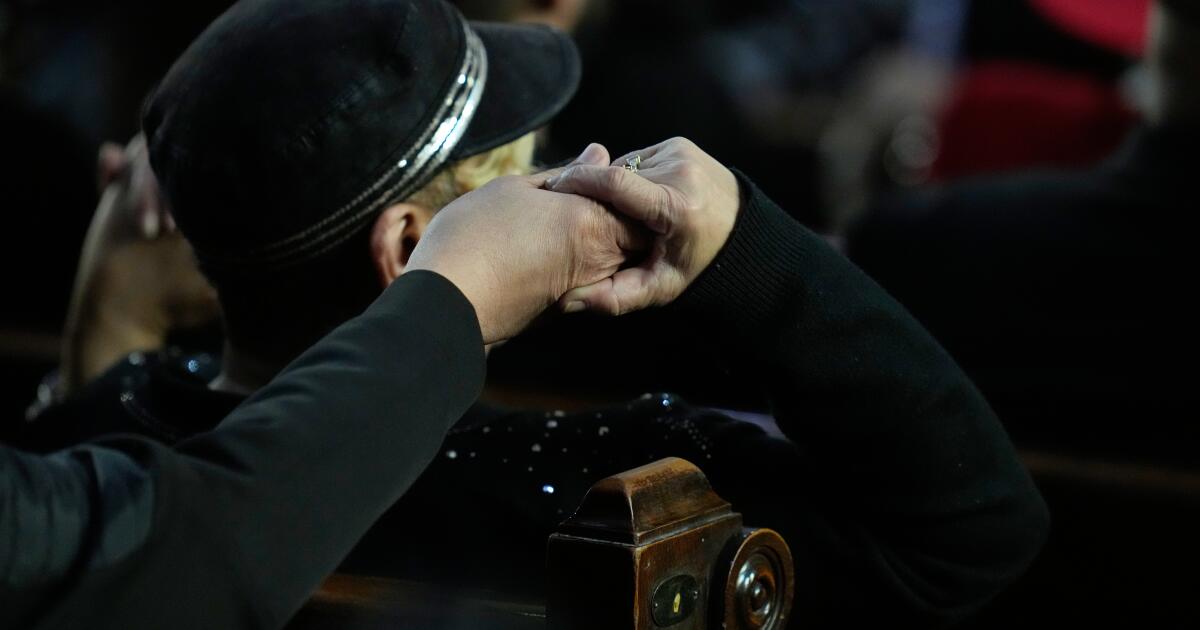
After high-profile celebration, the Rev. Jesse Jackson’s family gathers for intimate final goodbye
CHICAGO — A day after former presidents, sitting governors and local Chicago residents alike attended a vibrant, televised celebration for the late Rev. Jesse Jackson Sr., the family and friends who knew him best hosted a more intimate gathering Saturday to grieve the civil rights leader at his organization’s headquarters.
The final memorial service at the Rainbow PUSH Coalition’s headquarters on the South Side of Chicago included a few hundred attendees, most of whom were family members, allies and confidants. The event served as a capstone to a week of services and a call to action.
In a series of speeches, the late reverend’s children, civil rights leaders and two presidents of African nations said the best way to honor Jackson’s legacy is to continue his advocacy for universal human rights and economic justice.
“It is appropriate that we respect this season of grief,” said Yusef Jackson, one of Jackson’s sons and president of the Rainbow PUSH Coalition. “However, it is also appropriate to honor him by stepping up, to step out, and continue his work by answering his call to serve.”
The younger Jackson said that the Rainbow PUSH Coalition recently honored Jackson by deepening partnerships with activists in Minnesota, which saw mass protests after the Trump administration launched a massive immigration crackdown in the state.
U.S. Rep. Jonathan Jackson, an Illinois Democrat and a son of the late reverend, said his father taught him “that any society that will not support the many who are poor will never be able to save the few who are rich.” He said that his father’s relentless activism and charisma were rooted in a Christian call to service.
“For the children on the reservations, in the barrios, in the ghettos, he was speaking to you,” said the congressman. “My father was attacked for speaking about diversity. He was vilified for his stand on equality, and had the people who wanted to kill him had their way, we would have never seen a rainbow coalition.”
Marc Morial, president of the National Urban League, said that ambitious politicians should emulate the political strategy Jackson championed during his two presidential bids.
“Let the word go out that anyone who would like to be president of the United States in 2028, you’d better study this concept of the rainbow coalition,” Morial said.
Public visitors greet family, world leaders
In a move meant to reflect Jackson’s ethos, some members of the public who gathered outside the PUSH headquarters were allowed to enter the private service.
“Dad’s theology was rooted in the belief that every human being carries inherent worth,” said Ashley Jackson, the late reverend’s youngest daughter. “He fought for that truth in places that most people never saw, people whose names never made the news across decades and continents and causes.”
The service included musical performances by Stevie Wonder, Opal Staples, Terisa Griffin, Kim Burrell and others. Comedian Chris Tucker added some levity to the solemn services with a stand-up set.
South African President Cyril Ramaphosa thanked the late reverend for his work to end South Africa’s apartheid system. Jackson was a close friend of Nelson Mandela, South Africa’s iconic anti-apartheid leader and its first Black president.
“He told the world that the struggle for dignity in the United States was inseparable from the fight against apartheid and injustice in South Africa,” said Ramaphosa, who said his nation claimed the late civil rights leader as one of their own.
“When Jesse Jackson reminded the United States that its strength as a nation lies not in exclusion, but in the beautiful diversity of its people — Black and white, rich and poor, urban and rural, workers and farmers, immigrants and the forgotten — we were hugely inspired by his message,” said Ramaphosa, who was a key negotiator in the process to the end the apartheid system.
Felix Tshisekedi, president of the Democratic Republic of the Congo, praised Jackson as a peacemaker and humanitarian.
“Your mourning is also ours. You have lost a father, a husband, a brother. The world has lost a pastor, a champion, a mender of bridges. Africa has lost a faithful, loving son,” Tshisekedi said.
Since his death last month, Jackson’s family and allies have honored the late reverend with commemorations, community service and demonstrations in an effort to continue his work.
Mourners first honored Jackson as he lay in repose in Chicago last month. The late reverend then lay in state at the South Carolina Capitol. Jackson grew up in segregated Greenville, S.C. As a high schooler, he led fellow students into a protest that desegregated a local library, starting a lifetime of civil rights leadership.
Services honoring Jackson in Washington were postponed after a request for him to lie in honor at the U.S. Capitol was denied. House Republican leadership cited the precedent that only former presidents and senior generals typically receive the privilege.
Jackson’s allies have emphasized the forcefulness of his message and convictions.
“He maintained an intense relationship with the political order, not because presidents were white or Black, but the demands of our message — the demands of speaking to the least of these, those who were disinherited, the dispossessed, the disrespected — demanded not Democratic or Republican solutions, but demanded a consistent, prophetic voice,” said Jesse Jackson Jr., the reverend’s eldest son and a former congressman seeking to win back his seat in this year’s elections.
Fraternity brothers
Jackson’s mentees also organized efforts to continue his civil rights activism.
“We’re in a global moment where peace in the world is in jeopardy, where we just have bombs being dropped carelessly, killing children, innocent victims of political actions,” said the Rev. Janette Wilson, a longtime senior advisor to Jackson and executive director at the Rainbow PUSH Coalition. “When the government cuts SNAP benefits and you have millions of children and families who will be food insecure, I think you have to tell them that we’re fighting for you.”
On Thursday, the headquarters hosted a series of events that celebrated Jackson’s life, including a memorial service for several hundred members of Omega Psi Phi Fraternity Inc., of which Jackson was a member. That same night, the chamber hosted a reunion for Rainbow PUSH alumni to commemorate Jackson and his years of activism.
They celebrated Jackson’s life and reminisced about his 1984 and 1988 presidential bids, his globe-trotting activism as an anti-apartheid activist and hostage negotiator, and his evangelism for a Christianity that emphasized justice for all and support for the downtrodden.
Jackson family expected at voting rights march
On Sunday, members of the Jackson family and many of Jackson’s mentees will travel to Selma, Ala., to commemorate the “Bloody Sunday” protest marches when civil rights activists were beaten by police on the Edmund Pettus Bridge in 1965.
The Rev. Jackson often attended the same anniversary march.
“Selma has always stood for the basics of what civil rights is, what we are debating in policy,” said Jimmy Coleman, a longtime aide to Jackson and native of Selma. “He was always focused on what we needed in terms of policy in any given political moment, and that’s what the march represents.”
Brown writes for the Associated Press.

UK village with Mediterranean architecture and sub-tropical gardens ‘feels like Italy’
A travel content creator believes this enchanting village is worthy of your holiday bucket list, with pastel buildings, sub-tropical gardens and stunning architecture that will transport you to the Mediterranean

A UK town’s aesthetics has been compared to Italy (stock)(Image: Oscarhill via Getty Images)
Next time you’re planning a UK break, you might want to take note of a travel content creator who insists she’s discovered a picture-perfect spot that will make you “feel like you’re in Italy”.
After visiting the location, Amy Hulley described the captivating British village as thoroughly deserving of a place on your holiday “bucket list” as she posted an update to Instagram for her followers. “For a moment I genuinely forgot I was in the UK,” she confessed in a video. Visitors can purchase an entrance ticket to explore the village for the day, or book accommodation in one of its charming hotels and cottages.
The destination? Portmeirion in Gwynedd, North Wales on the border of Snowdonia National Park.
Amy added: “Pastel buildings. Arches and domes. Palm trees overlooking the water. It felt Mediterranean, almost cinematic.”
She also disclosed her visit happened to coincide with a steampunk festival, with period dress and live entertainment only contributing further to the “fun atmosphere”.
Discussing the village’s exotic gardens and remarkable architecture, Amy continued: “Sir Clough Williams-Ellis began creating it in 1925 to prove that colourful, theatrical design could sit beautifully within nature rather than damage it. Every building was carefully positioned to frame the estuary and protect the woodland around it.”
Writing in response, one past tourist praised: “A wonderful place to visit, a little expensive but worth it!”
A second person admitted: “Wow I can’t believe this is in the UK, Amy. Stunning Italian vibes.” A third enthused: “Can’t wait to visit here! So picturesque.”
While a fourth Instagram user gushed: “This is beautiful, it’s definitely on my bucket list now.”
Meanwhile, Portmeirion’s official tourism website proudly states: “Experience the magic of staying in Portmeirion. See the dawn break over the mountains of Meirionnydd; watch the tide fill the Dwyryd estuary from shore to shore.
“Stay in one of two luxury 4-star hotels or in a suite in the middle of the village. Portmeirion also offers self-catering accommodation on the picturesque North Wales coast. Situated on the southern flank of its own private peninsula, Portmeirion is a place apart.”
The village also features multiple cafes alongside an Italian-style gelateria serving genuine home-made gelato. “There are three shops in the village The Prisoner Shop with souvenirs of the famous series filmed here in 1966-67, the Rob Piercy Gallery and The Ship Shop with gifts, toys, housewares and Portmeirion Pottery best-ware, Portmeirion Pottery seconds as well as preserves, wines, and confectioneries,” the website continues.
It also served as the filming location for the 1960s cult classic series, The Prisoner, starring Patrick McGoohan. “It was probably one of the most influential pieces of television of the 1960’s not only in the UK and USA, but also in France, Australia, and many other countries,” according to the site.
The website elaborates: “The series is rich in imagery and visual impact. The surreal architecture of the village with its Mediterranean atmosphere coupled with the high-tech interiors, tannoys, surveillance cameras and piped music create a bizarre combination.”
Ensure our latest headlines always appear at the top of your Google Search by making us a Preferred Source. Click here to activate or add us as your Preferred Source in your Google search settings.

Women’s World Cup qualifying: Mared Griffiths shines as Wales get a glimpse of future
Safia Middleton-Patel, Mia Ross, Mared Griffiths and Carrie Jones – who is still only 22 – were the four players drafted into the side in Llanelli this weekend, with Olivia Clark, Gemma Evans, Angharad James and Ffion Morgan making way.
While goalkeeper Middleton-Patel and Ross – who was deployed as one of three centre-backs – were part of a defensive unit who did not have that much work to do, Jones impressed in a central midfield role.
But it was Griffiths, the Manchester United youngster who is currently on loan at Sunderland, who took most of the plaudits.
“She’s got it all,” Wilkinson said after Montenegro were hammered 6-1 in Llanelli.
“And she’s far from the finished product, which is very exciting for all Welsh people I’d imagine.”
Griffiths, sporting the number 10 shirt which was worn so often by Fishlock, scored Wales’ third goal, which was handed to her on a plate following an error by Montenegro keeper Ajsa Kala.
But there was nothing gift-wrapped about Griffiths’ second of the afternoon, which was Wales’ only goal during a second half in which Montenegro sat deep and defended with much more conviction than they had in the first period.
Fed by Jones, Griffiths had the composure to round the onrushing Kala before stroking the ball home with her left foot.

Israel strikes busy Beirut hotel in assassination attempt | Conflict
Israel has claimed responsibility for an assassination attempt, which killed at least four people, at a busy Beirut hotel. The Israeli military claims it targeted members of the Iranian Revolutionary Guard Corps (IRGC) at the Ramada Plaza. Al Jazeera’s Heidi Pett spoke to hotel guests who experienced the blast.
Published On 8 Mar 2026

Flames engulf Kuwaiti high-rise amid Iranian drone strikes | Conflict
Flames engulfed Kuwait’s Public Institution for Social Security high-rise headquarters after it was hit by a suspected drone amid a wave of Iranian aerial strikes on the country.
Published On 8 Mar 2026

Harry Styles fights back tears during Manchester gig as star makes emotional statement on our troubled world
CAUGHT LIVE
Harry Styles @ Co-op Live, Manchester
★★★★☆
HARRY STYLES fought back tears during his One Night Only in Manchester gig – as he broke off to make an emotional statement about our troubled world.
He shared his feelings with fans, from the stage, in between belting out songs from his brand-new album — Kiss All The Time. Disco, Occasionally.
As war in Iran rages, to add to other troubles, Harry said: “In a world like we have today that feels so chaotic it’s easy to feel so hopeless.
“But seeing this room, where there is so much hope, I encourage you to keep being the change in the world that you want to see.
“There are so many dangerous things that feel so powerful but love and kindness are powerful — go out and spread it.


“The world could use a little extra peace right now.”
I was among the 20,000 fans who were lucky enough to get £20 ballot tickets to Manchester’s Co-op Live Arena for Harry’s first concert in three years.
The former One Direction star said: “It’s a privilege to be able to perform and connect through music.
“The only reason I get to put an album out is because of all of you. I hope that one day my album might mean something to you and get you through something hard, too.”
The stripped-back set for Harry’s show, on a circular stage amid the sea of revellers, gave a nightclub vibe.
The relaxed feel was then added to by Harry’s dressed-down style on the night, in contrast to his usual flamboyant outfits including the pinstripe suit he wore for his Brits show last weekend.
His rider for the night was also anything but fancy as fitness enthusiast and marathon runner Harry requested, er, yoghurt, nuts, coffee and water.
The gig then began with Harry on keyboard before he was joined by his live band and later the House Gospel Choir — who performed with him at the Brits.
There were nods to LCD Soundsystem, Genesis and Seventies disco in the music, as standout tracks included American Girls and Ready, Steady, Go!
Harry revealed that among the audience were his family — and friends including James Coden and Apple Music’s Zane Lowe.
The gig, streaming on Netflix from tonight at 7pm, is a warm-up for his Together, Together tour later this year — when fans will be in for a treat.
HIS SET LIST
. Aperture
- American Girls
- Ready, Steady, Go!
- Are You Listening Yet?
- Taste Back
- The Waiting Game
- Season 2 Weight Loss
- Coming Up Roses
- Pop
- Dance No More
- Paint By Numbers
- Carla’s Song Encore
- From The Dining Table
- Golden
- Watermelon Sugar
- As It Was
- Sign Of The Times
- Aperture
Meanwhile, in Paris…
HARRY teased fans by revealing the “very special person” behind his track Clara’s Song was in the audience.
Fans have speculated that person is really his girlfriend Zoe Kravitz.
But, er, she has been busy in Paris.
Oh, we do love a riddle.
FOOTIE WILL GET ANGRY
ANGRY GINGE has revealed he is on the football pitch every weekend – as he practises for Soccer Aid.
The I’m A Celebrity winner – real name Morgan Burtwistle – will play in the charity football match at the London Stadium in May alongside England legend Wayne Rooney.
YouTuber Ginge told me at the Brit Awards last weekend: “When I have not got anything on in terms of work, I always play on Saturdays.”
Meanwhile, he revealed that he is a big fan of his Soccer Aid teammate Tom Hiddleston’s ex-love Taylor Swift.
Bit awks, that.
BURGLARS BEST NOT TRY TO JAMA A LOCK
LOVE ISLAND host Maya Jama and her Manchester City star boyfriend Ruben Dias have beefed up security at their home, after it was burgled, by paying for live-in security.
The guards will be camped out in the garden of the couple’s £4million property in leafy Alderley Edge, Cheshire, round the clock so they can keep watch on all comings and goings at whatever time of day or night.
They will even get their own mobile toilet, so they are never off duty.
Maya, and Portuguese Ruben, were left devastated in January when raiders targeted their house just weeks after they moved into it.
The raid took place while Maya was in South Africa filming Love Island and Ruben was in Turkey watching his teammates defeat Galatasaray in the Champions League, while he nursed an injury.
Cops investigating the break-in at the couple’s superpad confirmed a number of high-value items had been taken, but they are yet to make any arrests.
Now there will be no expense spared by Maya and Ruben after they called in the 24/7 watchmen.
A source said: “They were both really shocked when the burglary took place because the house already had state-of-the-art security systems.
“But they are not the first celebrities to be targeted by so-called ‘away-day’ robbers, while not at home, and they are unlikely to be the last.
“The couple asked a security firm to come in and assess the property and the suggestion was that having live-in, round- the-clock guards would act as a great deterrent. Lots of footballers have private fitness coaches, chefs and drivers – and now are adding security guards to the list.”
But following the burglary we revealed how Premier League players fear their security arrangements are being leaked by insiders who are trusted members of their inner circle.
The source added: “It’s driving some of the players mad.
“Some think they are just being targeted by criminals but others believe they are being betrayed by someone they have let into their circle of trust.”
As Cheshire Police continue to investigate the hit on Maya and Ruben’s house on January 28, a spokesperson urged anyone with information to contact them.
The Sun has previously told how valuables burgled from footballer homes often make their way to the Dublin-based Gucci gang, which has links to the infamous Kinahan drugs cartel.
Footballers whose properties have been targeted in recent times include Everton playmaker Jack Grealish and former Arsenal ace Raheem Sterling, now at Dutch side Feyenoord.
Reality TV stars Olivia Attwood and Molly Mae Hague have also had their homes broken into.
FANS’ JIG PROBLEM WITH BRITS’ A.I. USE
THE Brits has been slammed for using AI for a sketch at the ceremony last weekend.
Organisers recreated a TikTok dancefloor meme for a fun part of the event in Manchester – but they used AI performers instead of real talent.
In the sketch, Jack Whitehall was seen dancing at a Harry Styles tribute night, surrounded by computer-generated partygoers in a copy of a viral scene from Jon Hamm’s hit Apple+ show Your Friends & Neighbors.
But many fans were quick to ask why Brit awards bosses did not hire actual dancers. One said: “Seriously Brits. Why are we using AI for such a simple task for an event with your budget?!”
Another added: “The Brit School is literally in Croydon and more than capable of filming this there using students as extras.”
A source added: “The scene was based on the Jon Hamm viral meme. It is a shame the organisers didn’t use real people for this scene. The rest of the sketch featured real actors.”
This comes after last year’s ceremony saw artists including Lola Young and Myles Smith back the Make It Fair campaign to protect musicians from having their work exploited by AI.
RITA’S A BELTER
RITA ORA looked buckled up for the action at the Australian Grand Prix in this ridiculously big belt.
It almost distracted from her very low-cut black dress as she stepped out at the Formula 1 showcase in Melbourne alongside her filmmaker husband Taila Waititi.
But maybe not quite.

3 arrested after device is thrown at anti-Islam protesters in New York City
NEW YORK — A counterprotester demonstrating against a “Stop the Islamic Takeover of New York City” event Saturday lighted and threw a device containing nuts, bolts and screws at the protesting crowd after someone from that group used pepper spray on the counterprotesters, police said.
Police are investigating the incident that started late Saturday morning when someone from the anti-Islam protest associated with far-right activist and pardoned Jan. 6 rioter Jake Lang shot pepper spray into a counterprotesting group near the mayoral residence Gracie Mansion, Police Commissioner Jessica Tisch said.
Tensions continued to heighten, she said, when one of the counterprotesters lighted and threw a device she described as smaller than a football into the protesting crowd of about 20 people.
The device struck a barrier and extinguished itself “a few feet from police officers,” she said. The same person then ran, and another person gave a him a second device, which they then dropped. The devices were wrapped in black tape with nuts, bolts and screws, as well as a fuse. She said it was unclear whether the devices were functioning explosives or hoaxes.
Three people were arrested, and an investigation is underway, Tisch said.
Tisch at a news conference didn’t report any injuries and said she believed Mayor Zohran Mamdani was not at Gracie Mansion at the time.
She said about 20 people showed up to Saturday’s protest connected to Lang, and the counterprotest had about 125 people at its peak.
Lang was charged with assaulting a police officer with a baseball bat, civil disorder and other crimes before receiving a pardon as part of President Trump’s sweeping act of clemency for Jan. 6 defendants last year. Lang recently announced that he is running for U.S. Senate in Florida.
Last month, Lang staged an anti-Islam protest in Minneapolis during the Trump administration’s immigration crackdown there.

Flight attendant’s 4 personal rules she follows on planes – and why you must do the same
She warned she’s seen ‘diabolical things’ on planes

An experienced flight attendant has revealed some of her own dos and don’ts of air travel(Image: Getty)
An experienced flight attendant with 11 years under her belt has divulged her personal tips for ensuring the best possible experience when travelling by plane. She cautioned that she’s witnessed some truly “diabolical things” during her time in the air.
Not everyone enjoys flying. It can be expensive, exhausting, and even anxiety-inducing.
With this in mind, one expert has shared her own set of guidelines that she adheres to whenever she takes to the skies. In a video posted on TikTok, flight attendant and US reality TV star Charity Nelms stated: “These are things that you’re not doing on an aircraft that you should do.
“I’m an 11-year flight attendant and I do all of these things when I travel on my own personal time because I’m an expert. This ain’t my first Rodeo.”
Wiping seatbelts
If you’re the type to bring antiseptic wipes on board, you might be focusing your efforts in the wrong place, according to Charity. She explained: “Number one, you guys all come on board with your little Clorox wipes and your little disinfectants, and you start wiping everything down: that little tray table in front of you, the back of the seat.
“I don’t really get why you’re wiping the back of the seat, because if you’re wearing clothes, nothing really touches that.”
Instead, she advised: “What you should be wiping, that nobody wipes is that seatbelt. The metal part, because everybody touches it.
“And also you should be wiping the fabric part of the seatbelt because everybody pulls on that. The amount of throw up, baby vomit, bodily fluids, liquids that have spilled, random stuff that end up on those seatbelts.
“Wipe them down. I do.”
Wearing full-length trousers
This is the most effective way to avoid direct contact with your seat. She went on: “Second thing you’re not doing is you’re not wearing full pants [trousers].
“I am letting you know from a flight attendant, the amount of things I have seen on the seat.Wear pants. Shorts, skirts, dresses – absolutely not. Wear full pants.
“None of your skin should be touching that seat. I don’t care if you come on board and you disinfect it. Nope, nope, nope.
“Wear full pants. Trust me, I have seen some diabolical things.”
Hand hygiene
According to Charity, cabin crew can tell if you haven’t washed your hands after using the in-flight loo. “Third thing that none of you are doing, you are not washing your hands after you use the lav,” she stated.
“You’re also not flushing the toilet. Did you know that your flight attendants know if you flush the toilet and wash your hands?”.
“We literally know from outside. You’re also not closing the door when it comes to using the lavatory.
“This is what you do. Flush the toilet, you wash your hands, you come out and you close the door with your elbow. Please start doing that.”
Footwear
She encouraged travellers to keep their footwear on when using the lavatory. “Fourth, and also having to do with the lav, you’re not wearing shoes,” Charity stated.
“It is never, ever water on the floor in the lav. And your socks are like two big sponges.”

Kawhi Leonard and Darius Garland lift Clippers over Grizzlies
MEMPHIS, Tenn. — Kawhi Leonard had 28 points, Darius Garland scored 11 of his 21 points in the fourth quarter and the Clippers held on for a 123-120 victory over the Memphis Grizzlies on Saturday night.
Bennedict Mathurin finished 21 points and 10 rebounds, and Derrick Jones Jr. added 16 points as the Clippers won for the fourth time in five games despite hitting only four three-pointers, a season low.
Ty Jerome led Memphis with 23 points and seven assists. Taylor Hendricks scored 18 and Cedric Coward 15 as Memphis lost its third straight.
The game was close throughout, and the Grizzlies held a 118-117 lead with about two minutes left. Leonard and Jordan Miller each made a pair of free throws to give the Clippers a 121-118 edge. Mathurin’s two free throws with 4.4 seconds left sealed the win as Jerome’s closing three-point try for Memphis was off the mark.
The Clippers, who were 15 games under .500 earlier this season, now sit at 31-32. The are in ninth place in the Western Conference, and in the running for a postseason bid.
Meanwhile, the Grizzlies’ season has been marred by injuries. Six rotation players were on the injured list for Saturday’s game, including guard Ja Morant, who missed his 20th game with a left elbow ulnar collateral ligament sprain.
Before the game, Morant said he wanted to remain with the franchise, even referring to a Grizzlies logo tattooed on his back as a sign of his loyalty.

Memphis got off to a fast start building a 19-point lead against the Clippers, playing on the second night of a back-to-back.
The advantage was short-lived. The shooting touch left Memphis, which committed 10 turnovers in the second. Leonard scored 15 points and the Clippers trailed by a point at 59-58 at the break.

Huge fire rages at Tehran oil depot after Israeli attack | Israel-Iran conflict
Footage captured a massive fire raging at the Shehran oil depot on the outskirts of northern Tehran following an Israeli attack late Saturday night. The Israeli military claimed responsibility for striking fuel storage and related sites it alleges are affiliated with the Iranian armed forces.
Published On 7 Mar 2026

Iranian Attacks On Prized Missile Defense Radars Are A Wake-Up Call
As expected, Iran has repeatedly targeted prized missile defense radars across the Middle East in retaliation for the joint U.S.-Israeli air campaign that is ongoing. Iran’s attacks on high-value radars that enable the region’s missile defense capabilities appear to have succeeded on multiple occasions. The irony that lower-end long-range kamikaze drones are perhaps the biggest threat to extremely advanced radars capable of providing telemetry for intercepting targets traveling at hypersonic speeds, sometimes in space, is glaring. The losses of the radars and/or damage to their facilities should finally serve as a stark wake-up call regarding the vulnerability of these critical but largely static assets.
Based on the information at hand, it appears that Iran has been able to destroy one U.S. AN/TPY-2 radar in Jordan and damage the massive American-made AN/FPS-132 phased array radar in Qatar, prompting immediate concerns about available radar coverage to help respond to further barrages. There are strong indications that a number of other similar systems have been destroyed or damaged, as well.

For over a decade, TWZ has drawn attention to the threat of drones to America’s critical military capabilities and infrastructure. And more recently, we specifically discussed the glaring vulnerability of strategic radar systems after a Ukrainian drone attack nearly two years ago on a Russian early warning radar site, as well as after being first to report drone incursions over a U.S. missile defense site on Guam back in 2019.
For some general context to start, Iran and/or its regional proxies have hit targets in a total of 12 countries since the start of the current conflict. Iranian retaliatory attacks utilizing ballistic and cruise missiles, as well as long-range kamikaze drones, have significantly declined in recent days, but are still being carried out. Countries in the region are so far claiming very high interception rates of incoming threats, but some missiles and drones are clearly making it to their targets.
Iran has attacked a wide array of different targets, military and non-military, but there has been a clear concerted effort to go after air and missile defense radars in the region as part of the retaliatory campaign. This is to be expected given that the loss of key radars, even temporarily, risks degrading further efforts to intercept Iranian missiles and drones, hence these weapons can succeed at a higher rate. Taking out missile defense radars at very high-value sites can leave those areas far more vulnerable to follow-on attacks, as well. Striking these radars also reduces their user’s general situational awareness in the region, and can even have strategic implications beyond the region, too.
It’s also worth noting that these radars are extremely expensive and take years to replace.
Iran’s attacks on radars so far
This past week, CNN obtained imagery from Planet Labs showing an AN/TPY-2 radar damaged, or even possibly destroyed, following an Iranian attack on Muwaffaq Salti Air Base in Jordan. Muwaffaq Salti has long been a major regional hub for U.S. operations, and is being very actively utilized in the current conflict. It has the greatest concentration of U.S. tactical aircraft in the region, and thus is an extremely important target, where even one ballistic missile landing on an apron could destroy multiple prized fighter aircraft and take the lives of U.S. service members.
The Wall Street Journal reported yesterday that the U.S. military was rushing to replace the AN/TPY-2 at Muwaffaq Salti, lending credence to the assessment that damage from the Iranian attack was at least substantial. There is a picture, seen below, circulating on social media that is said to show the AN/TPY-2 at Muwaffaq Salti having been clearly knocked out, but it remains unverified and, in an age of increasingly impressive AI fakes, should be treated as such.
The active electronically-scanned array AN/TPY-2 is primarily associated with the U.S. Terminal High Altitude Area Defense (THAAD) anti-ballistic missile system, but it also has a demonstrated ability to feed data to Patriot surface-to-air missile systems. THAAD is a key upper-tier defensive system deployed to the Middle East that is capable of swatting down Iran’s most capable missiles from the end of their midcourse stage of flight and through their terminal stage. AN/TPY-2 radars can also be deployed as standalone sensors in a larger integrated air defense network. The radar is trailer-mounted and technically road mobile, but is not designed to be used on the move or very rapidly relocated from one place to another.

CNN has reported that additional Planet Labs imagery indicates that AN/TPY-2 and their infrastructure were also at least targeted and possibly damaged in Iranian attacks on THAAD batteries belonging to the United Arab Emirates (UAE), one at Al Ruwais and another at Al Sader, and another one in Saudi Arabia near Prince Sultan Air Base. The New York Times also obtained satellite imagery showing that the site at Al Ruwais had at least come under attack. The full extent of the damage at any of these sites remains unclear.
Satellite imagery from Planet Labs, obtained by the Middlebury Institute of International Studies at Monterey, has also confirmed that the very large, fully static AN/FPS-132 radar in Qatar was damaged in an Iranian attack on the first day of the conflict. At least one of the radar’s three arrays was hit, and there are also signs of a possible fire.
There are multiple versions of the giant AN/FPS-132, all of which are fixed-site solid-state phased array radar systems primarily to provide early warning of incoming ballistic missile strikes. As noted, the one in Qatar has three faces, offering 360-degree coverage, but there are also variants with only two faces. The AN/FPS-132 is part of a larger group of broadly related strategic early warning types that are also in U.S. military service at multiple sites in the United States, as well as in Greenland. The Royal Air Force (RAF) in the United Kingdom operates another one of these radars at its RAF Fylingdales base.

Since the first day of the current conflict, claims have been circulating that Iran was able to at least damage a U.S. AN/TPS-59 active electronically-scanned array ballistic missile defense radar in Manama, Bahrain. This appears to be based on the video below, showing a kamikaze drone hitting a large spherical radome at Naval Support Activity (NSA) Bahrain, a U.S. Navy facility in the country that is home to the headquarters of the U.S. Fifth Fleet.
However, Planet Labs imagery that The New York Times subsequently obtained has been assessed to instead show damage to what are understood to be large satellite communications terminals at NSA Bahrain. Like larger radars, these terminals also often sit inside spherical radomes. There are clear signs that communications arrays like this have been a major target of Iranian retaliation strikes on bases across the Middle East, as well.
Yesterday, Iran’s PressTV claimed that the Iranian Navy had launched a kamikaze drone attack targeting “strategic carbon-based radar installations at the Sdot Micha facility.” While TWZ cannot independently confirm whether such an attack was launched, let alone was successful, it does highlight continued Iranian targeting of key missile defense radars. Sdot Micha Air Base in Israel hosts Arrow-series anti-ballistic missile defense systems. Elta’s Green Pine, which is analogous in some very broad respects to AN/TPY-2, is the main radar associated with these anti-missile systems.
Costly losses of key capabilities
Concerns have been raised about the immediate impacts from the loss of the AN/TPY-2 and damage to the AN/FPS-132, given that Iranian retaliatory attacks have significantly slowed, but not stopped. There are claims now, said to have originated from a report from Channel 14 in Israel, that malfunctioning and/or damaged U.S. radars have caused delays in early warning alerts about incoming Iranian missiles. TWZ has been unable to find an original source for these assertions, and they remain very much unconfirmed at this time. Regardless, it is hard not to see how losses of these systems could cause at least some degradation in total coverage, even if other land based and sea-based systems (Aegis BMD) can help with filling in some coverage.
The United States, Israel, and Gulf Arab states do have other air and missile defense radars positioned in the Middle East, or that could otherwise help fill any resulting gaps. At the same time, there are only a small number of systems that are at all equivalent to the AN/TPY-2, let alone the AN/FPS-132. Only 16 AN/TPY-2s are understood to have been produced to date, in total, for all customers. The current cost of one of those radars is generally pegged at around $250 to $300 million. When the U.S. government approved the sale of the AN/FPS-132 radar, as well as various ancillary items and services, to Qatar in 2013, that entire package had an estimated value of $1.1 billion, or just over $2.1 billion today when adjusted for inflation. Any of these systems takes years to procure.
Furthermore, the U.S. military and its allies have spent years (and billions of dollars) building a regional missile defense shield, with AN/TPY-2s and the AN/FPS-132 in Qatar being core components thereof. Though Iran and its expanding ballistic missile arsenal have been the driving factors behind those efforts, the U.S. government also sees these assets as being a key element of its global missile defense architecture. As noted, the Qatari AN/FPS-132 provides 360-degree coverage that is not limited to scanning for threats emanating from Iran. Houthi militants in Yemen to the south, long backed by Iran, have amassed a substantial arsenal of ballistic missiles, as well as cruise missiles and long-range kamikaze drones, and have used it to attack Gulf Arab states in the past. As an aside, the UAE was the first to employ THAAD in combat back in 2022, using the system to knock down an incoming Houthi ballistic missile.

More serious ramifications
Strategic air and missile architectures, in general, exist in a world now where the threats they face are not limited to very-long-range standoff capabilities possessed only by peer or near-peer adversaries.
It used to be, generally, that you had to fire a ballistic missile or high-end cruise missile in an attempt to strike one of these systems. Now, long-range one-way-attack drones, as well as increasingly capable cruise and ballistic missiles, continue to proliferate steadily, including to smaller nation-state armed forces and even non-state actors. An attack could even come from a small drone with a C4 charge launched from a fishing trawler 10 miles away from one of these critical radar installations. The threat of these kinds of near-field attacks has largely been overlooked for years, even as the low-end drone threat has exploded and ‘democratized’ precision-guided weaponry, as they did not fit the established aerial threat matrix and the countermeasures used to repel those threats.
Though we have not seen it yet in the course of the current conflict with Iran, the threat of more localized attacks by smaller weaponized drones, in particular, is very real and only set to grow. This was definitely shown by Ukraine’s Operation Spiderweb’s unprecedented covert attacks on multiple airbases across Russia last year. Israel also employed near-field drone and missile attacks to destroy Iranian air defenses in the opening phases of the 12 Day War last June. These operations were massively successful and knocked out Iran’s most critical air defenses, allowing for long-range munitions to strike their targets unimpeded. TWZ had been calling attention to this issue for years beforehand, including back in 2019 after drones were reportedly spotted over the U.S. Army THAAD site, with its AN/TPY-2 radar, on Guam.
CBS News also reported this past week that quadcopter-type drones may have been surveilling the Shuaiba port in Kuwait before all-out hostilities erupted. Six U.S. service members were killed, and more were wounded, in an Iranian retaliatory attack on a U.S. logistics operations center at Shuaiba on March 1.
Large, high-value, static and semi-static radars are fragile, to begin with. Domes and other structures can be built around them to help protect them from the elements, but they still need to allow for signals to be sent out and received. This inherently limits options for more physical hardening. Since these radars are typically fixed in place permanently or semi-permanently, their locations are also easier to determine and then target using a set of basic map coordinates. This is highlighted by how quickly news outlets have been able to locate these sites and then assess damage to them from commercially available satellite imagery.
The fragility of large radars also means that what might seem to be minor damage to the casual observer could actually be enough for a mission kill that takes the system offline, or at least degrades its functionality greatly, for a protracted period of time. Depending on the radar, it might not take a very large munition at all to cause a sufficient degree of damage. Just a small drone packing a grenade-sized explosive can punch a hole in one of these fragile arrays, putting it out of action for a very long period of time.
As TWZ wrote back in 2019 in the context of reported drone incursions over Guam:
“With that said, America’s preeminent adversaries in the entire region would make taking out the THAAD battery on Guam a top priority during a conflict or even as part of a limited demonstration of force. Why barrage it with ballistic missiles or attempt a cruise missile launch from a forward-deployed submarine or even a clandestine commando raid when you can just fly a drone loaded with explosives into it? And no, you don’t need some high-end drone system to do this as real-world events have highlighted many times over. Drug cartels are now whacking their enemies with off-the-shelf drone-borne improvised explosive devices and even U.S. allies are actually manufacturing hobby-like drones just for this purpose. Somewhat more sophisticated types can be launched from longer distances and can even home in on radar or other RF emissions sources, like THAAD’s powerful AN/TPY-2 Radar and data-links, autonomously, beyond just striking a certain point on a map.”
“Simply put, ‘shooting the archer,’ in this case an advanced anti-ballistic missile system that protects America’s most strategic base in the entire region, via a relatively cheap drone is both an absurdly obvious and terrifyingly ironic tactic—the U.S. can shoot down ballistic missiles, but the critical systems used to do so remain extremely vulnerable to the lowliest of airborne threats—cheap drones.”

The scale and scope of Iran’s retaliatory attacks so far, while clearly threatening, pale in comparison to what one would expect to see in a major high-end fight between the United States and China in the Pacific. The overall ramifications would also be more severe.
Beyond the more immediate impacts of losing this kind of strategic radar coverage, there are far larger implications. In some cases, these radars are designed to provide critical early warning and verification of incoming nuclear strikes, or other large-scale attacks by a major adversary, targeting a nation’s home soil. They are critical parts of the nuclear deterrent. As such, losing these sensors can have major downstream impacts on strategic decision-making cycles based on concerns about what suddenly is not being seen. Fewer radars also means fewer ways to double-check that a track is not a false positive in a scenario where the total available decision-making time could be seriously truncated, to begin with. These are concerns TWZ explicitly highlighted after Ukraine’s attack on the Armavir Radar Station in Russia in 2024.

A need for deeply layered defenses
It should be clear at this point that threats to strategic radar systems that Iran’s attacks in the past week have thrust into the public eye are not new. Similarly, this highlights how the United States, and others globally, remain behind the curve when it comes to establishing deeper, layered defenses to better protect these prized assets. This was already evidenced by Ukraine’s attack on the Armavir Radar Station in Russia in 2024.

A notable exception is Taiwan’s Leshan radar station, which houses an AN/FPS-115 Pave Paws phased array early warning radar that would be a top target for Chinese forces during any cross-strait conflict. It is protected by an array of defensive capabilities, including a ground-based Phalanx Close-in Weapon System (CIWS), which is more typically found on warships. Even so, Iran’s attacks on radars this past week have still notably resonated in Taiwan.

Even a layered defense posture might not be enough, especially in the face of a large volume and/or complex attack involving multiple types of missiles and/or drones. Those threats could also be coming from very different vectors at once, and fired from very disparate launch points on land, at sea, or in the air. Achieving overmatch against fixed defenses is also a glaring vulnerability. An enemy can calculate how many munitions, and what mix of munitions, are required to overwhelm known defenses at a key location. This is especially true for largely static defensive arrangements. Once critical terrestrial sensors are taken out, attacking other targets that were under the defensive umbrella they helped enable can become far easier.
New eyes in space
Perhaps the biggest takeaway here is that the combat actions by Iran this week provide heft to the arguments for migrating missile tracking capabilities outside of the atmosphere. While advanced and resilient missile tracking layers in space may not replace all their terrestrial counterparts, they would provide much-needed redundancy and augmentation of their capabilities.
The U.S. military does have space-based early warning sensors that are integrated into its existing ballistic missile defense architecture, and have been for decades. But these warn of launches, they don’t track a weapon throughout its flight cycle. For some years now, work has been underway to substantially expand on those capabilities, to include the start of the fielding of a new satellite constellation to help track ballistic missiles, as well as hypersonic boost-glide vehicles and other threats, during the mid-course portion of their flights.

The U.S. Air Force and U.S. Space Force are also very eager to move most, if not all, of the airborne target warning sensor layer into orbit, and to do the same when it comes to persistent tracking of targets on the ground and at sea. Relevant space-based capabilities are still years away from becoming a reality, at least at the required scale.
Shifting the focus to sensors in orbit is not without its own risks, either. U.S. officials regularly highlight ever-growing threats to assets in space, and are now openly talking about the need for satellites to be able to fight back, as you can read more about here. As part of its work on new space-based sensor infrastructure, the U.S. military has been investing heavily in new distributed constellations with large numbers of smaller satellites to increase resiliency to attacks.
Regardless, the Pentagon is very bullish in moving missile tracking into orbit, and doing so with more resilient constellations than with a handful of traditional satellites. Work is deeply underway in proving out this technology, which would enable the entire missile defense architecture globally. President Trump’s Golden Dome initiative will need this capability in order to accomplish its lofty goals. But accelerating the development and deployment of this kind of capability is very costly and we may see a major boost in funding for it after this war ends.
Overall, more details about the scope and scale of damage to radars and other assets from Iranian retaliatory attacks are likely to continue to emerge. What we’ve already seen points to a need for a further reassessment of the vulnerabilities of critical strategic air and missile defense radars and what is needed to adequately defend them, including moving them outside of the Earth’s atmosphere.
Contact the author: joe@twz.com

Madonna turns heads in white corset and suspenders for Dolce & Gabbana shoot in nod to hit Like A Virgin music video
QUEEN of pop Madonna is Like a Virgin all over again — in a throwback to her 1984 hit video.
The megastar, 67, wore a white bridal corset and suspenders for the shoot.
Her outfit was similar to the look she had for her Eighties song clip — as she modelled and sang for Dolce & Gabbana.
Images posted online were captioned La Bambola — The Doll in Italian — a nod to the Patty Pravo 1968 hit Madonna recently covered.
Last week we told how Madonna was preparing to push boundaries yet again.
The 67-year-old singer will be filming her most X-rated music video to date, as she gears up to release her new album, dubbed Confessions Part 2.


A 200-strong team descended on a top-secret location in the UK to start work on the adventurous video, which will accompany her lead single later this summer.
This video is the first of a new campaign, which comes off the back of her signing a massive deal with Warner Records — the label she launched her career with — last year.
And as well as ramping up the sex, Madonna is preparing to push herself to the extreme physically.
A source said: “Madonna is reclaiming her throne.”
Judge rules actions to dismantle Voice of America are illegal
A federal judge ruled Saturday that Kari Lake, President Trump’s choice to lead the U.S. Agency for Global Media, did not have legal authority to take the actions she’s done to largely dismantle the Voice of America. The decision’s effect on VOA operations was not immediately clear.
Lake called the decision by U.S. District Judge Royce C. Lamberth “bogus” and said it would be appealed.
Voice of America, which has transmitted news coverage to countries around the world since its formation during World War II, is operating with a skeleton staff in only a few languages after Lake terminated contracts and laid off most of its employees.
Lake had been chosen by Trump to effectively lead the agency that oversees Voice of America and other services such as Radio Free Europe/Radio Liberty. But she has not received Senate confirmation for her role, and Lamberth said she did not have authority to act in that capacity due to laws that guard against unqualified government appointments.
“Only the Appointments Clause or the Vacancies Act’s exclusive structure may authorize service as a principal officer, and Lake satisfies the requirements of neither the statute nor the Constitution,” Lamberth wrote.
Lamberth was ruling on a lawsuit filed by Patsy Widakuswara, Voice of America’s White House bureau chief, and colleagues Kate Neeper and Jessica Jerreat. They were among the employees laid off by Lake and have been fighting the actions.
“We feel vindicated and deeply grateful,” the journalists said in a statement. They said the ruling against Lake “is a powerful step toward undoing the damage she has inflicted on this American institution that we love.” They said they are trying to determine what the action means for colleagues whose careers have been in limbo.
Proponents of Voice of America call it an example of the nation’s “soft power” that offers independent news coverage to countries where governments control the flow of information. Lake has contended that the government-run news outlets are wasteful and their outputs should promote the administration’s views.
Reporters Without Borders said Lamberth’s decision affirmed what it believed — that the administration acted unlawfully to gut the VOA. But there’s still more to be done to ensure VOA’s journalists can get back to work, said Clayton Weimers, executive director of the organization’s North American branch.
“This case is proof that fighting for press freedom matters,” Weimers said.
Lake, in a statement posted on X, said, “The American people gave President Trump a mandate to cut bloated bureaucracy, eliminate waste, and restore accountability to government.
“An activist judge is trying to stand in the way of those efforts at USAGM. Judge Lamberth has a pattern of activist rulings — and this case is no different.”
Bauder writes for the Associated Press.

I visited UK’s cheapest town with £50k houses – it was nothing like I expected
The market town is one that has had a run of bad luck, but has plenty to be excited about, including cheap houses, an excellent art gallery and a local fish and chip delicacy
There’s a market town in England lined with grand terraced houses that regularly sell for £100,000. In fact, many go for just £50,000.
Head to Rightmove or a local estate agent and you’ll find two and even three-bedroom homes selling for half or even a third of the nation’s average. But it’s a place that’s got a lot more than just cheap houses.
It’s home to one of the UK’s most recognisably-named football clubs, one of the country’s greatest living authors, and one of the world’s finest collections of Tiffany glass.
The dazzling glassware, worth tens of millions, was sent from the US in 1933 by local lad-done-good Joseph Briggs. They then sat gathering dust for four decades before their brilliance was finally recognised.
Accrington — where the collection now shines in the Haworth Art Gallery atop the town’s hill — is much the same: a hidden gem, long overlooked beyond Lancashire, but, I’d argue, ready to dazzle.
It’s about time, because Accrington has had its share of misfortune.
READ MORE: 20 iconic UK film sets you can enter for free for one week only
The town is probably best recognised (at least by those Fifa fans who have needed a willing team to drub) for its amusingly named football club, Accrington Stanley. Back in 1888, the club was one of an elite 12 that helped found the Football League, only to tumble out mid-season 88 years later, bankrupt and in chaos. As miserable fans drifted off to Blackburn and Burnley, the 15,000-seat stadium was binned and replaced with one a third of the size.
Far more tragic is the story of the Accrington Pals. In 1914, 5,000 striking mill workers were locked out by machinists Howard & Bullough amid a big industry downturn. Desperate for wages, many enlisted, making Accrington the smallest town in England to raise a battalion. On the first day of the Somme, 580 of the 720 Accrington Pals were mown down within half an hour.
There’s a cruel irony, too, in the town’s legacy as a brickmaking powerhouse — its super-strong ‘Noris’ bricks underpinning the Empire State Building and Blackpool Tower — and the relative cheapness of its homes. With an average house price of £148,714, and terraces £110,381, Accrington is officially the cheapest place in England or Wales to buy property.
But as advertising whizz and Amazing Accrington chair Murray Dawson tells me on a tour of the town: “Accrington needs to focus on the future, not the past.”
Certainly, the people I met are determined to do just that. Happily, there’s a lot to focus on.
Take Accrington Stanley. A decade ago, the Owd Reds were £1.2 million in debt, playing in a cowshed stadium with a pitch so waterlogged that six consecutive matches were postponed. Then along came Jack Holt, a Burnley lad who grew up on “the Shameless estate”. Since taking over in 2015, he has invested around £9 million of his plastics fortune into the club.
When I turned up, chief executive Warren Eastham paused his work on the club’s merchandise website to show me the gleaming corporate lounge running alongside the new artificial, puddle-free pitch — a set-up befitting a mid-table League Two side now punching above its weight, after years in the doldrums of football’s seventh tier.
After admiring the near-complete Stanley mural made by the paint-splattered Paul Curtis, Murray and I headed to the Haworth Art Gallery to meet curator Gillian Berry, who looks after the town’s Tiffany treasures.
The buzzing gallery looks out across the valley to Pendle Hill, recently climbed by a group of wig-wearing Jeanette Winterson superfans retracing the steps of the Oranges Are Not the Only Fruit author.
In 1960, Winterson was brought to the town by her adoptive, evangelical Christian parents, who only allowed her to read six books and burned her secret literature stash when they discovered it. The town’s cathedral-like public library, funded by Andrew Carneiege and bathed in sunlight filtered through great stained glass windows, provided a refuge and supply of illicit literature for Winterston.
The Whitbread Prize winner is not the town’s only notable daughter. There is also Lydia Becker, the pioneering suffragist who led the movement in the North West. Having spent years overshadowed by the likes of her protege Emmeline Pankhurst, she is now being celebrated at the new Accrington Dome, part of an ambitious town-centre regeneration stretching across several floors and shopfronts.
Soon, traders such as Steve Hatt will move his 150-year-old family fishmongers into the renovated Victorian Market Hall, and temporary market stalls that block off the grand town centre will be cleared away, as part of a £20 town centre revamp.
In an Amazon-dominated world, this seems as good a way as any to breathe life into a dying high street, hollowed out by online shopping and two huge supermarkets on the edge of town.
Another project that has successfully done just that is the Oswaldtwistle Mills. Having clung on as a working mill until the early 1990s, the two-century-old weaving centre was then transformed into a vast and hugely successful shopping complex, packed with everything from plants and dresses to children’s toys and butter pies. It is independently owned by Peter Hargreaves, whose relative, James (somewhat ironically) invented the Spinning Jenny, which mechanised milling and became a symbol of industrialisation for the homespinners it rendered obsolete.
Competing with Ozzie Mills in the size and shiny newsness stakes is the Raza Jamia Masjid Mosque. It is a vast building that regularly attracts 4,500 worshippers from across Lancashire.
It is the £9.5million passion project of Jawid Hussain, another local lad, who made his £110million fortune as the founder of toilet paper giant Accrol Papers. Today, he lives across from the mosque in a sprawling house with a Lamborghini-studded driveway.
I had discovered by that point in the day that the warmth of the welcome I received there, and the enthusiasm of the mosque’s caretaker-turned-impromptu-tour guide Manzoor Hussain, is typical of Accrington. It’s the kind of place where chippy owner Dianne wanders around the square after dealing with the lunch rush, armed with salt and vinegar, to make sure her regulars don’t need an extra shake.
The kind of place where so many random people kept chatting to Murray and me, our half-day tour ran over by hours. It’s also the kind of place that made national headlines back in 2024 when anti-racism protesters marched into the town centre in response to the Southport Riots.
As the woman behind the Heritage Dome, Hannah Saxton, tells it: “People were coming out of the pubs to shake their hands and hug them.”
Accrington’s challenges are undoubtedly real. It’s a town where its main industry has been hollowed out and has suffered years of underinvestment. But what is also real is its resolve. In its bricks, its glass, its football club and its faith, the town feels less like a relic of industrial Britain and more like a place quietly rewriting its future.

Kings can’t hold on to third-period lead in loss to Canadiens
Juraj Slafkovsky scored his second goal 49 seconds before he set up captain Nick Suzuki for the tiebreaker with 4:33 to play, leading the Montreal Canadiens’ rally for a 4-3 victory over the Kings on Saturday night.
Jake Evans also scored and Jakub Dobes made 35 saves for the Canadiens, who salvaged the final stop of their three-game California trip with a late surge led by their offensive stars.
Shortly after Slafkovsky tied it on Montreal’s only power play, Cole Caufield forced a turnover that went from Slafkovsky to Suzuki for a one-timer that slipped underneath Darcy Kuemper’s arm.
Montreal had its NHL-leading 20th comeback victory one night after making a late rally — and then blowing a lead — in a wild 6-5 shootout loss to the Ducks.
Alex Laferriere scored the tiebreaking goal early in the third period for the Kings, who have lost seven of nine — including two of three under interim head coach D.J. Smith.
Scott Laughton scored in his debut for the Kings, who acquired the center in a trade with Toronto on Friday. Kuemper stopped 19 shots.
Captain Anze Kopitar opened the scoring with his seventh goal late in the first period. The Kings’ 38-year-old captain, who is retiring this spring after 20 seasons with the Kings, ended his 21-game goal drought since Dec. 8.

Slafkovsky put Montreal ahead late in the second when he skated in off the boards. The 21-year-old Slovak’s first goal since January was also his 50th point, making him the first Canadiens player to record three 50-point seasons before turning 22.
The Kings didn’t take a penalty until Trevor Moore went off for slashing with 5:53 to play, but Slafkovsky tied it moments later.
Phillip Danault got a lukewarm reception during his first game in Los Angeles since the Kings traded him back to Montreal in December. Danault had four solid seasons for the Kings, but then played 30 goalless games this fall and reportedly requested an exit.
Up next for the Kings: at Columbus on Monday to open a five-game trip.

GOP Rep. Darrell Issa announces retirement from California seat

March 7 (UPI) — Rep. Darrell Issa, R-Calif., announced he is retiring at the end of his term and put his support behind San Diego Supervisor Jim Desmond.
Issa issued a statement Friday on social media saying he will not be seeking re-election in this year’s midterm elections.
“This decision has been on my mind for a while and I didn’t make it lightly,” Issa wrote. “First, we built the right campaign infrastructure, support has been overwhelming — including from President Trump — and our polling was unmistakable: We would win this race. But after a quarter-century in Congress — and before that, a quarter-century in business — it”s the right time for a new chapter and new challenges.”
Issa offered his “enthusiastic endorsement” to San Diego Supervisor Jim Desmond, who filed to run for Issa’s seat on Friday.
The announcement comes after Gov. Gavin Newsom‘s ballot measure to redraw state congressional districts, which passed in November, transformed Issa’s district from safely Republican to an area more friendly to Democrats.
Issa had previously been rumored to be considering a run for Congress in Texas, but he told Fox News in December that the plan would not be going forward.
“I’m thrilled to set the record straight and here’s the truth: Texas House members and residents of that state did ask if I would consider running there following Gavin Newsom’s historically corrupt gerrymander,” he said at the time. “I appreciate the opportunity, but California is my home. I told them I’m going to stay in Congress, and I don’t need to go to Texas for that.”
Anna Elsasser, spokesperson for the Democratic Congressional Campaign Committee, celebrated the news of Issa’s retirement in a statement.
“After over two decades of disastrous representation, Darrell Issa is once again running for the exits — and good riddance. Issa abandoning his voters now is the clearest sign yet that Republicans know he can’t win on his record of skyrocketing prices, gutting health care, and looking out for himself and wealthy special interests above all else,” Elsasser said. “Any Republican who tries to parachute into this race with the same extreme agenda will face the same fate.”
Christian Martinez, a spokesman for the National Republican Campaign Committee, praising Issa for his “decades of dedicated service” in a statement provided to Politico.
“We are optimistic that this district will continue to be represented by a Republican who will stand for common sense and reject the radical agenda and chaos that progressive Marni von Wilpert and socialist Ammar Campa-Najjar would bring,” Martinez said.
Iran war live: Trump again demands surrender; Israel bombs oil depots | Israel-Iran conflict News
Live updatesLive updates,
Qatar, Saudi Arabia and UAE report more attacks despite assurance from Iran’s president that the strikes will stop.

Published On 8 Mar 2026