





UK Grows Its Defensive Posture Abroad In Response To Iran Conflict
British Armed Forces assets continue to flow into Cyprus, as the United Kingdom bolsters its military presence in the eastern Mediterranean in response to the war in the Middle East. While the British government has not taken part in direct military action against targets within Iran, the expanding conflict has also put Cyprus under direct threat. Meanwhile, the rush to bolster the U.K.’s military capabilities in the region has highlighted some glaring deficits in the British Armed Forces.
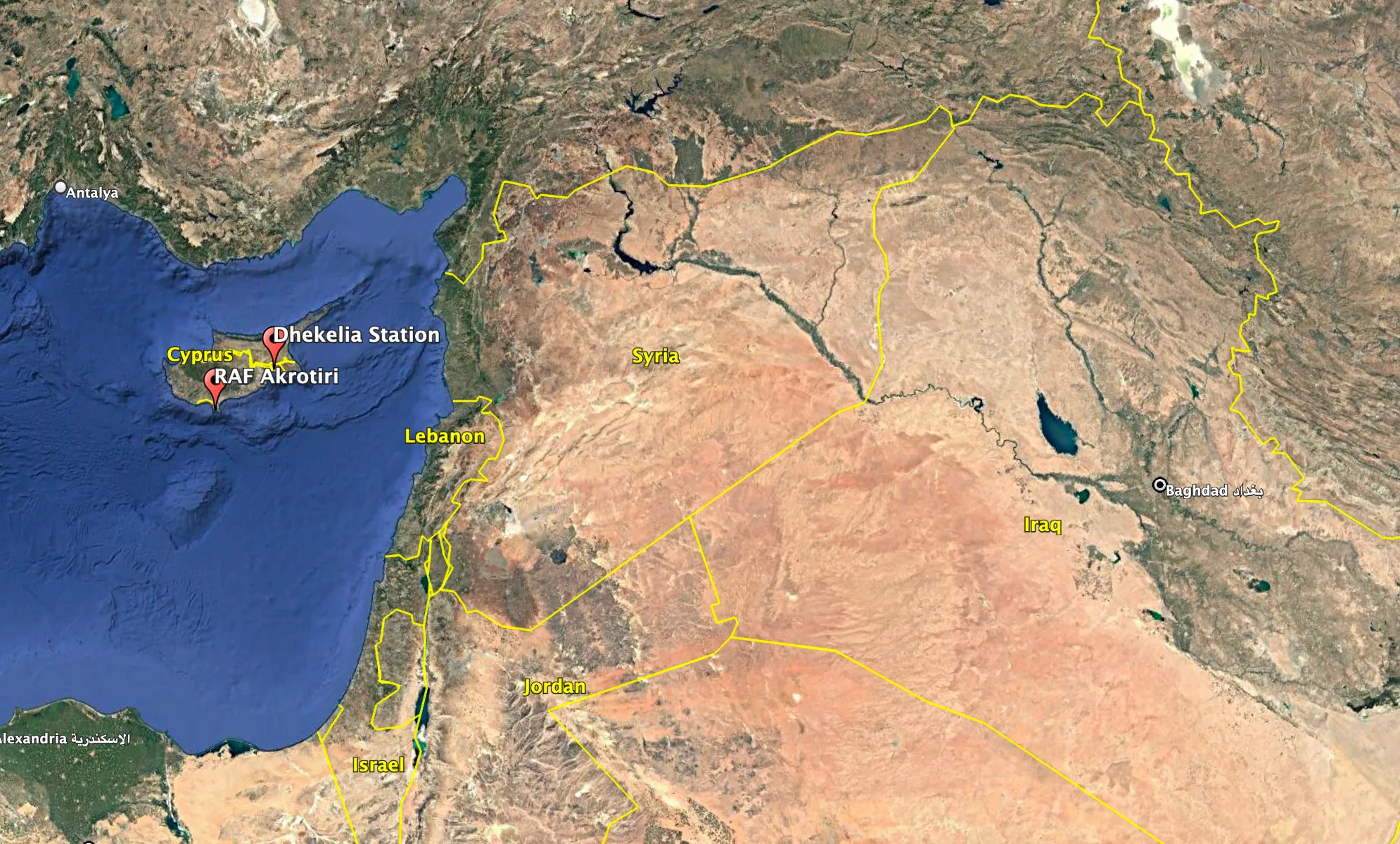
The British military response to the conflict in the Middle East has centered on the island of Cyprus in the eastern Mediterranean, which has long been home to a U.K. Armed Forces presence. As well as providing a ‘landing pad’ for British forces operating in the region, for example, during the counter-ISIS mission, Cyprus has long been used by the British for training and exercises. The so-called Sovereign Base Areas on Cyprus comprise the airbase of RAF Akrotiri and Dhekelia Station (a former airfield), which have been in British hands since the Republic of Cyprus was established in 1960.


Fighter assets
Before the Iran war began, eight Royal Air Force Typhoon multirole fighters were already deployed to Akrotiri, where they were still operating on the U.K. counter-ISIS mission, Operation Shader. Other U.K. Armed Forces personnel were also in Iraq under Shader.
In the wider region, there was also an existing RAF Typhoon footprint in Qatar, where a squadron of the jets is operated jointly with the Qatar Emir Air Force. This unit was strengthened in January, when another four Typhoons deployed there from the United Kingdom, specifically for air defense.

In February, six RAF F-35B Lightnings were sent to Akrotiri in Cyprus, joining the Typhoons already deployed there.
As Iran and its proxies have launched drones and missiles at countries across the region, the U.K. Armed Forces have been active in intercepting drones (and potentially also cruise missiles).
The real wakeup call came overnight on March 1, when a drone launched by Hezbollah in Lebanon hit Akrotiri. There were no reported casualties and only “minimal damage,” although this was, significantly, an impact that tore a hole in the hangar used by the U.S. Air Force U-2 Dragon Lady spy planes that are also regularly detached to Cyprus. Two more drones heading toward Cyprus were reportedly intercepted the same day.
Another two drones heading for Cyprus were intercepted on March 4, according to a Cypriot government spokesperson.
The U.K. Ministry of Defense has confirmed that the four Typhoons in Qatar, as well as the Cyprus-based F-35Bs, have since been active in bringing down hostile drones. The F-35B achieved its first air-to-air victories in British hands when one of the fighters shot down a pair of Iranian drones, announced on March 3.
The pilot involved in that historic engagement was a Royal Navy aviator embedded within the RAF’s joint-force No. 617 Squadron, the “Dambusters.”
The pilot fired two infrared-guided Advanced Short-Range Air-to-Air Missiles (ASRAAM) in the space of 20 minutes, each from a range of less than a mile, to destroy the Shahed-type drones over Jordan. They subsequently told The Telegraph:
“Your adrenaline is pumping pretty hard, you’re working down low at night above the desert in unfamiliar terrain. Emotionally, those things get pushed aside in the moment. It’s not until after landing that it begins to settle in.”
![Pictured: 9th February 2026 – 617 Sqn F-35B Lightning jets conduct QRA (Quick Reaction Alert) training, operating from RAF Akrotiri. F-35B Lightning, a 5th Generation, multi-role, stealth fighter, is usually based at RAF Marham. The Station is also home to a range of engineering support functions, from maintenance to frontline support. [Names have been blurred from jets and surcoats to protect PERSEC]](https://i0.wp.com/www.twz.com/wp-content/uploads/2026/03/LTNG-20260209-0110-0003-0050.jpg?resize=640%2C960&ssl=1)
Lt. Col. Mike Carty, commanding officer of No. 617 Squadron, added: “The tempo of flying here is greater than anything the Lightning Force has embarked upon before. The sheer amount of sorties and flying hours is quite high. People are being stretched and working incredibly hard, but nobody is under any particular strain. We are set up here to be able to sustain this.”
The continued threat posed by Iranian drones and cruise missiles has also seen the decision made to send another four Typhoons to Qatar. RAF Typhoons have also successfully shot down drones targeting Bahrain, Jordan, and Qatar.
Destroyer deployment
The United Kingdom has also elected to beef up its defensive capabilities in the eastern Mediterranean with the deployment of a Type 45 destroyer. This was the subject of considerable debate before it was finally announced that HMS Dragon would sail for the region. The warship departed yesterday for a voyage that will take around 10 days.

However, the Type 45 is the United Kingdom’s most balanced and capable air defense platform, at least against drones and cruise missiles.
The basic Type 45’s weapons fit includes Aster 30 missiles fired from the Sea Viper system, which represents the Royal Navy’s outer air defense layer. According to the Royal Navy, the Sea Viper is able to track “hundreds” of potential threats to an individual ship or task group at ranges up to 250 miles, using Aster 30 missiles to eliminate them when they close to “around 70 miles.” Other sources suggest the Mach-3 missile has a range of more than 75 miles.

There is also the Aster 15 with a range of around 18 miles, optimizing it for close-in and local-area and point defense. For aerial threats even closer to the warship, the Type 45 can call upon a pair of Phalanx close-in weapon systems (CIWS) armed with 20mm ‘Gatling’ cannons, 30mm guns, and various machine guns.
When it comes to ballistic missile defense, the Type 45 is much more limited, however.
While HMS Diamond did shoot down one of the Houthis’ anti-ship ballistic missiles (ASBMs) in 2024, this is an easier threat to deal with than the medium-range ballistic missiles (MRBMs) that Iran is currently launching toward Israel.
Also in 2024, the U.K. Ministry of Defense announced that it would invest around $515 million to upgrade Sea Viper, making it “even more lethal against new and growing threats from hostile drones and missiles.”
Under the upgrade, the Aster 30 missile will be modernized to improve its capabilities against ASBMs, with an enhanced warhead plus new guidance and seeker software. The upgrade will also address the Sampson multi-function radar as well as the command-and-control system and combat management system.
A second phase will see the evaluation of a new missile, the Aster 30 Block 1NT, currently under development by France, Italy, and the United Kingdom. This missile features a new seeker, which would further improve the ballistic missile defense capabilities of the Type 45. In particular, Block 1NT will be better equipped to intercept MRBMs carrying maneuverable reentry vehicles (MaRVs), which you can read more about here.
However, these upgrades are yet to be fielded.
More generally, there have long been questions about the availability of the Type 45s, despite their undoubted capabilities. These six vessels are still very modern, but they have spent a notably long time in maintenance. Typically, only two are actually available to deploy at any given time. With one of the warships normally earmarked for the North Atlantic and Russia, and another needed to escort one of the U.K. aircraft carriers when that is at sea, there is very little capacity left to play with.
This also brings us to the question of the two British aircraft carriers of the Queen Elizabeth class. With the war entering its second week, HMS Prince of Wales appeared poised to deploy, with the crew at five days’ notice to sail. Earlier this week, however, the Prime Minister’s official spokesman gave the following statement: “HMS Prince of Wales has always been on very high readiness. The MoD is increasing the preparedness of the carrier — reducing the time it would take to set sail for any deployment — but there is no decision taken to deploy her.”

Critics of the hugely costly aircraft carrier program might ask why these warships, which are designed to respond to just this kind of crisis, are being held back.
U.S. President Donald Trump also used the lack of carrier deployment as a stick with which to beat the U.K. government. On his Truth Social platform, Trump said that the United States did not need Britain’s carriers in the conflict and suggested they would have been useful had they deployed before the war began.
Short-range air defense
To help cover short-range air defense over Cyprus, the United Kingdom has deployed two Royal Navy Wildcat helicopters armed with Martlet missiles. On the plus side, each helicopter can carry up to 20 of these missiles, which are ideal for bringing down drones. On the other hand, the missiles have a range of only around five miles, and with just two ‘cabs’ available, the Wildcat deployment is really only capable of providing limited point defense.

With that in mind, it’s somewhat surprising that the British Army hasn’t deployed any of its Sky Sabre short-range air defense systems to Cyprus, or anywhere else in the region. The Sky Sabre is intended to bring down aircraft, as well as drones and cruise missiles. However, it’s unclear how many batteries are currently deployable. One is stationed in the Falkland Islands, and another has been deployed on NATO’s eastern flank, in Poland, and the 12 batteries on order are still being delivered.
The Sky Sabre fires the Common Anti-Air Modular Missile, or CAMM, also known as the Land Ceptor. The same CAMM missile is also used in naval applications — including aboard Royal Navy warships — as the Sea Ceptor. Fitted with an active-radar seeker, the CAMM is derived from the aforementioned ASRAAM. The CAAM has a reported range of more than 15 miles and is said to be able to tackle a wide range of threats, including low-observable targets, high-speed missiles, drones, and precision-guided air-to-ground weapons.

Meanwhile, the ability to surveil the airspace around Cyprus received an upgrade yesterday with the arrival of a Royal Navy Merlin HM2 Crowsnest helicopter, with airborne surveillance and control (ASaC) capabilities.
The Merlin brings a look-down sensor capability, making it something of a ‘pocket’ version of the E-7 Wedgetail. From altitude, the radar has an excellent field of view to spot low and slow-flying targets, even if they are relatively small. This makes it especially useful for tracking drones and cruise missiles.

Other British counter-drone units have also been active in the wider region.
Few details have been provided, but these are likely to consist of non-kinetic systems (like the ORCUS) and man-portable air defense systems (like the Starstreak missile) used by troops who have a limited presence in Jordan and Iraq, where they have been since before the Iran war began.

Overall, though, the conflict has highlighted the somewhat limited nature of U.K. ground-based air defense capabilities.
More generally, the deployments so far, in a purely defensive capacity, have raised concerns about the breadth, depth, and readiness of U.K. military power and its relevance in international affairs.
The question of “going kinetic”
The United Kingdom initially denied permission for the U.S. military to use its airbases — including Diego Garcia in the Indian Ocean — for strikes against Iran, as we discussed at the time. This was soon revised, with Prime Minister Keir Starmer saying his government had agreed to a U.S. request to use British military bases for “defensive” strikes.

Were the British stance to change, it is questionable whether RAF jets, as currently deployed, would be able to make a significant contribution, based on their small numbers, their other taskings, and the long distance to targets in Iran.
According to an assessment by the U.K.-based Royal United Services Institute (RUSI) think-tank, realistically, the fighter force at Akrotiri would only have been able to fly 28 strike sorties against Iran, had they been committed to Operation Epic Fury. This is very much a best-case scenario, and would also have required significant tanker support.
A British offensive campaign against Iran would otherwise rely primarily upon the Royal Navy, which operates nuclear-powered attack submarines that can launch Tomahawk Land Attack Missiles (TLAM). However, this is a capability that has suffered from poor availability in recent years. Currently, only one of five in-service Astute class submarines, HMS Anson, is at sea, and it was in the Indo-Pacific region as of January.

So far, however, the U.K. government has held back from committing to any kind of direct offensive action against Iran, although there have been voices raised across the political spectrum urging that the United Kingdom should back the United States more actively, including taking part in strikes. Kemi Badenoch, leader of the opposition Conservative Party, berated Starmer this week for not doing more to “stop the people who are attacking us” and said the U.K. Armed Forces should “do more than catch the arrows” and should “catch the archer” — a reference to striking missile and drone facilities directly.
For the time being, the U.K. Armed Forces, ravaged by decades of post-Cold War cuts, are bringing some useful but fairly limited in capacity air defense capabilities to the region. Should the U.K. government’s policy regarding Iran become aligned with that of the United States, then much more serious questions will be answered about the relevance and resilience of British military power in an operation of this kind.
Contact the author: thomas@thewarzone.com

Call the Midwife star opens up on ‘witty’ new role in ‘not your typical period drama’
Ella Bruccoleri looks unrecognisable from her days at Nonnatus House as she takes on the leading role in new BBC period drama

Ella played Sister Frances in BBC period drama Call the Midwife(Image: BBC/Nealstreet Productions/Matt Towers)
Call the Midwife star Ella Bruccoleri has landed the leading role in new BBC period drama The Other Bennet Sister.
The 10-episode series, which is based on Janice Hadlow’s novel of the same name, follows the “overlooked” character of Mary Bennet, played by Ella, who looks unrecognisable from her days at Nonnatus House, where she featured as Sister Frances until 2022.
The series begins at Longbourn, where the Bennet family’s five unmarried daughters navigate the rigid expectations of Regency society.
“Her journey sees her leave her family home for the soirées of Regency London and the peaks and vales of the Lake District, all in search of independence, self-love, and reinvention,” the synopsis says.
“The series follows Mary as she steps out of her sisters’ shadows in search of her own identity and purpose, finding herself in the middle of an epic love story along the way,” it goes on.
Fans don’t have long to wait for the show to drop as it had since been confirmed that it will premiere on BBC One at 8pm on Sunday ( March 15) and all episodes will be available to stream on iPlayer.
Speaking to the BBC about her new role, Ella explained: “Mary’s not your typical period drama heroine.
“She lives in a world where, particularly for women, appearance is everything, and she doesn’t understand that value system at all.
“Instead, she turns to literature that offers a different viewpoint. Her favourite book is Fordyce’s Sermons to Young Women, because it argues that women shouldn’t have to be beautiful — they should be intelligent and pious.”
Giving fans further insight on her character, she added: “Mary Bennet has been written off by many members of her family, and as a result she’s written herself off too. When we meet her at the beginning of the series, she’s living with her family in a small village and has never really left that world.
“These are the only people she knows, and she understands herself through the values they impose on her. We know these characters from Pride and Prejudice, but it’s fascinating to see the impact they have on someone like Mary.”
Giving her thoughts on the new adaptation, the star said: “When I read Jane Austen, I’m always struck by how witty it is so witty, with humour in every line.
“Sarah Quintrell really brings that into the scripts, and Janice Hadlow’s book does the same. The novel is very different in style from Austen, but it feels like a genuine extension of Pride and Prejudice.
“Sarah’s scripts tread the line between comedy and drama better than anything I’ve ever read. It feels like a tragicomedy – it doesn’t take itself too seriously, but it’s also not afraid to delve into emotionally weighty material. That feels very true to Jane Austen.”
The Other Bennet Sister debuts on BBC One and iPlayer on Sunday (March 15) at 8pm
For the latest showbiz, TV, movie and streaming news, go to the new ** Everything Gossip ** website.
HM Passport Office warning for Brits – 3 key checks to do now ahead of summer
The HM Passport Office has issued a warning to Brits about passport checks they must carry out well in advance of any impending holidays over spring and summer

HM Passport Office has issued a warning to holidaymakers (Image: Getty Images)
HM Passport Office has issued a warning to Brits ahead of the peak travel season.
With the Easter half-term just weeks away and plans already made for a summer getaway, thousands of holidaymakers will be jetting off abroad during one of the busiest travel periods. To ensure their journey gets off to a flying start, Brits are being urged to check their passports; otherwise, they risk being turned away at the airport.
In a stark reminder, the HM Passport Office advised Brits to “check your passport now” in a post shared on X, ahead of any spring or summer trips. A link in the post directed travellers to the government website, where they can apply online to renew, replace, or update their passports.
READ MORE: UK Foreign Office updates Egypt travel advice amid Middle East tensionsREAD MORE: Easter passport warning for Brits as common mistake could see you turned away at the airport
There are two key dates you should check on your document; the expiry date, and the issue date, especially if you’re planning to head to a European hotspot such as France, Spain or Greece. This is because of a post-Brexit regulation on travel to the European Union or Schengen countries, which stipulates that UK passports must have been issued less than 10 years before your departure and must be valid for at least 3 months after your return.
Meanwhile countries such as Australia, China, Thailand, the United Arab Emirates, Indonesia, and India require at least 6 months of passport validity from the date of arrival. It’s vital to check any entry requirements and passport validity before making any travel plans.
You must also ensure your passport has not been physically damaged, as this may render it invalid. This could include ripped pages, water damage, separated covers, or anything else that might make the personal information difficult to read.
Travel expert Jamie Fraser at Wild Packs warned that the general wear and tear of a passport can also be problematic when passing through automated scanners or at airport border control points. So it’s vital to check that your passport is in good condition, or if you need to apply for a replacement.
There must also be a blank page at the back of the passport for any necessary stamps or visas. If the passport is crammed with stamps from past trips, it could create problems at the border if there aren’t enough blank pages, leaving you unable to travel.
If your passport has expired or needs to be replaced, you can apply for a new one through the government website. However, it’s crucial to do it well in advance, as it can take around three weeks and sometimes longer.
There are fast-track passport services available, but Jamie cautioned that these are not “always guaranteed and appointments can be limited during peak travel periods”. HM Passport Office also advised: “Do not book travel until you have a valid passport – your new passport will not have the same number as your old one.”
To renew or replace your standard passport online, it will cost £94.50, or £107 if you opt for a paper application. Meanwhile, a child’s passport will cost £61.50 online or £74 by post.
Do you have a travel story to share? Email webtravel@reachplc.com

We drove through Scotland on an epic family road trip – it’s easier than you think with kids
Hannah Britt and her family fell in love with Scotland while on a road trip through the highlands in a Skoda Superb Estate SportLine 2.0 – here’s how you can do the same

Hannah, John, Molly and Poppy loved their road trip through Scotland
When you think of a Scottish road trip, what comes to mind? The NC500 probably. Two children aged six and one… probably not so much. And yet I’m here to tell you that it can be done, all it takes is the right car – and lots of snacks. A frequent yet fearful flyer last summer I became a convert to the good old family road trip when we borrowed a Skoda Kodiaq vRS and drove from our home in Manchester to France. Being able to get there under our own steam and haul 35 tonnes of equipment for the children was a gamechanger. I was chomping at the bit to do it again. So you can imagine my delight when my pals at Skoda got in touch again, offering to lend us a Superb Estate SportLine 2.0 this time – if we drove it to Scotland. My partner John’s bags were packed before I’d finished asking if he wanted to go.
The Superb is a long and spacious family car. You won’t get into a small parking space, but boy can you cram it full of stuff. It’s quite low to the ground, meaning those of us over 30 will make an oof noise getting in and out, but it feels how I imagine Lewis Hamilton must in his F1 car. I loved it right away.
As we set off from our home in Manchester, the four of us settled in – me, John, six year old Molly and one year old Poppy. Our route would take us to Langbank near Glasgow, where we would stay the night at Gleddoch Golf and Spa Resort, before continuing on the next day to Cameron House on Loch Lomond. From there we would loop up through Glencoe to Oban, before driving back home via Loch Lomond once more.
As was now customary, John did most of the driving with me the passenger princess and queen on snacks, handing out Pringles and Haribo on demand and restarting Golden from the K Pop Demon Hunters soundtrack each time it dared to stop. The Skoda’s big sat nav screen made it easy to work out where to go, and its built in black out screens allowed Molly and Poppy to doze off.
Four hours later, with just one stop to walk off a tantrum (not mine, promise), we arrived at Gleddoch, on the banks of the Clyde. I was impressed with this golf hotel, which welcomed children with open arms. Our room, a Residence Four Poster, was newly renovated, with a sleek bathroom, view out over the water, sofa bed for Molly and – as the name suggests – a gargantuan four poster for her parents. Arriving with fussy kids, we ate in the room, and the food was lovely, with a good kids menu and an excellent wine list.
But the jewel in Gleddoch’s crown is the Imperia spa, a newly opened, multimillion pound delight. It recently won the accolade of “best new spa” and, once I tore myself away from my family, I had a sublime old time checking it out. The space boasts the UK’s largest outdoor sauna with panoramic views over the estuary and rolling Renfrewshire hills to Ben Lomond.
Children are not allowed in the pool at all, which was a shame for me – but a bonus for the other guests who didn’t have to endure their spa time with a side of my little ones’ splashing. In the morning, I sat down in Gleddoch’s cosy Dram whisky and gin bar to do some work, before packing our rabble back into the Skoda to head to our second stop, 30 minutes away – Cameron House on Loch Lomond.
Now, Cameron House is a Scottish institution. Barack Obama has stayed here. Guests don’t really get cooler than that. And the moment you arrive it’s easy to see why it’s so beloved. Sweeping the Skoda up to the hotel, which sits right on the water, we were immediately greeted by a valet, who whisked the car off to park it and brought in our bags. Good lord, the crumbs, I thought to myself as the chic valet sat himself down on two days worth of digestive biscuits.
Inside, Cameron House is stylish, cosy and unmistakably Scottish, with nods to its rich heritage in everything from the pictures on the walls to the tartan prints of the cushions. Staff remember names, coffee orders and chatted to the children as if they were long lost friends. It’s a home from home – albeit an incredibly luxurious one.
The food is delicious, whether you choose to eat in the Michelin-starred Loma by Greme Cheevers, the Tavern, the Great Scots Bar, or anywhere in between. The room service is good too, and the chefs are happy to rustle up anything your little one desires off menu. Our room, a family suite, was spacious, sparklingly clean and modern, with an undisturbed view of the Loch.
Cameron House has a brilliant adults-only spa, which I’ve heard is exceedingly relaxing. However during my time at the hotel, I was to be found in the large family pool. With floor to ceiling windows out onto the grounds, areas shallow enough for Poppy to paddle in and areas deep enough for Molly to swim, and with a large and genuinely fun water slide, there was enough to keep everyone entertained for hours. When we finally tempted the children outside, a falconry lesson was equally enthralling. The next day, our be-crumbed valet returned the Skoda to us and waved us on our way to Oban – via Glencoe.
Glencoe is a stunning, historic glen in the Scottish Highlands, renowned for its dramatic, volcanic, and glacial landscape. It is a premier spot for hiking, mountaineering, and – luckily for us – scenic drives, often featured in films like Harry Potter and James Bond. From Loch Lomond to Glencoe takes around 90 minutes, and there’s an excellent visitor centre to greet you once you arrive, with nappy changing facilities, a shop selling various miniature models of highland cow, and a cafe that makes a good flat white.
The Glencoe drive is best done slowly, to ensure one takes in the insanely gorgeous scenery, and to make sure you don’t miss the turning down Glen Etive Road. The “Skyfall” road is the single-track B8074, famous for the scene where Bond (Daniel Craig) and M (Judi Dench) stop with the Aston Martin DB5 against the backdrop of Buachaille Etive Mòr. The spot is roughly halfway along the 12-14 mile road. I didn’t have an Aston Martin, but one better – my Skoda.
Another 50 odd minutes later and we arrived at the furthest point of our road trip – Oban. Or to be precise, Rhunacairn, a little Sykes Cottages house on the banks of Loch Etive, a couple of miles out of the town. Down a tiny road, with just one other house nearby, it was a white washed child’s drawing of a house, set in the most stunning scenery imaginable.
Sat next to a mussel farm, the house had all we needed for the next few days – a swing, a log burner and sea otters in the water outside. It was absolutely idyllic – a real find. And while we did go into Oban to sample the delights of the seafood capital of Scotland – and to buy a bottle of local whisky – I must admit the house had a magic to it that I was loath to leave. Before we left we began plotting our return, wondering which Skoda might fit paddleboards and fishing rods for a summer staycation.
10 steps to road trip success
Parenting expert Kirsty Ketley says:
1. Plan Ahead – Time journeys around naps, mealtimes, or toilet breaks to reduce stress and disruption to routines.
2. Leave at Nap Time – If you can, start longer journeys when little ones are most likely to sleep.
3. Entertainment is Key – Mix up old-school games like I Spy with sticker books, reusable window stickers, or magnetic boards.
4. Car-eoke – A family singalong is a fun way to pass the miles (and yes, Disney soundtracks count!).
5. Tech Can Help – Tablets on headrests with headphones make for a peaceful drive when everyone needs downtime – don’t feel bad or guilty for using them, but be clear about the boundaries on using them and use them more as a last resort, rather than the default.
6. The Quiet Game – When things get noisy, challenge the kids to see who can stay quiet the longest.
7. Snacks & Drinks – Pack snack boxes for older children and keep drinks in the front with you to avoid unnecessary stops for the loo when they have necked a whole bottle of water! Be very mindful of giving younger children snacks if an adult is not sitting in the back with them, as it is a choking hazard!
8. Safety First – Use child locks, remind kids about seatbelt safety, and follow The Lullaby Trust advice on babies sleeping in car seats.
9. Be Prepared – Keep wipes, tissues, and the nappy bag within easy reach. Blankets and comfy clothing are also essential.
10. Break It Up – If traffic hits or the car gets tense, don’t be afraid to stop somewhere safe, stretch legs, and reset before heading off again.
*The Skoda Superb Estate SportLine 2.0 costs from £44,715. Visit skoda.co.uk for more information
*Gleddoch Golf & Spa Hotel costs from £129 in low season and £189 in high season, based on entry level rooms. Visit gleddoch.com to book
*Rooms at Cameron House start from around £275 per night. Visit cameronhouse.co.uk to book
*Sykes Cottages Rhunacairn House costs from £1135 for 7 nights, see sykescottages.co.uk
Celebrate St. Patrick’s Day at L.A.’s best Irish pubs
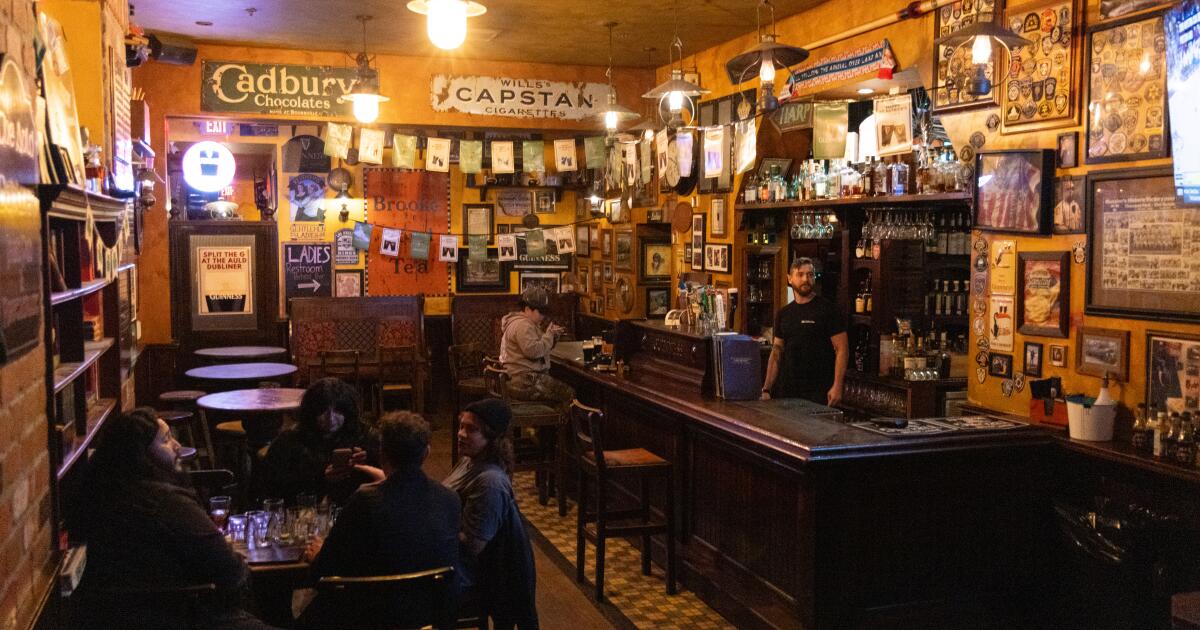
In 1936, Irish Bostonian entertainment lawyer Tom Bergin founded L.A.’s first Irish pub, the Old Horseshoe Tavern, on Wilshire Boulevard. The bar was later renamed in his honor and relocated to its current Tudor Revival-style building off Fairfax Avenue in 1949.
The tavern claims to have introduced Irish coffee to the U.S. — though some argue that San Francisco’s Buena Vista Cafe holds that title. Either way, Tom Bergin’s is one of the oldest bars in continuous operation in L.A. and boasts the second-oldest liquor license in the city. And its Irish coffee is still one of the best you’ll find.
Today, L.A.’s Irish pub tradition extends to Santa Monica, Long Beach and Woodland Hills, with many founded by Irish immigrants seeking to bring a bit of their homeland to the West Coast in the form of Guinness pints, corned beef and cabbage and traditional Irish folk music.
Whether you’re celebrating St. Patrick’s Day or just looking for somewhere to split the G, here are 13 Irish pubs to check out in L.A. — Danielle Dorsey
Iran war triggers ‘significant’ drop in UK holiday bookings to top hotspots
One the UK’s biggest tour operators has suspended its profit guidance after revealing impact of Middle East war on bookings

On the Beach says Egypt is among the normally popular destinations where demand has been hit(Image: Getty Images)
Spooked Brits are putting their holiday plans on hold because of the Middle East crisis.
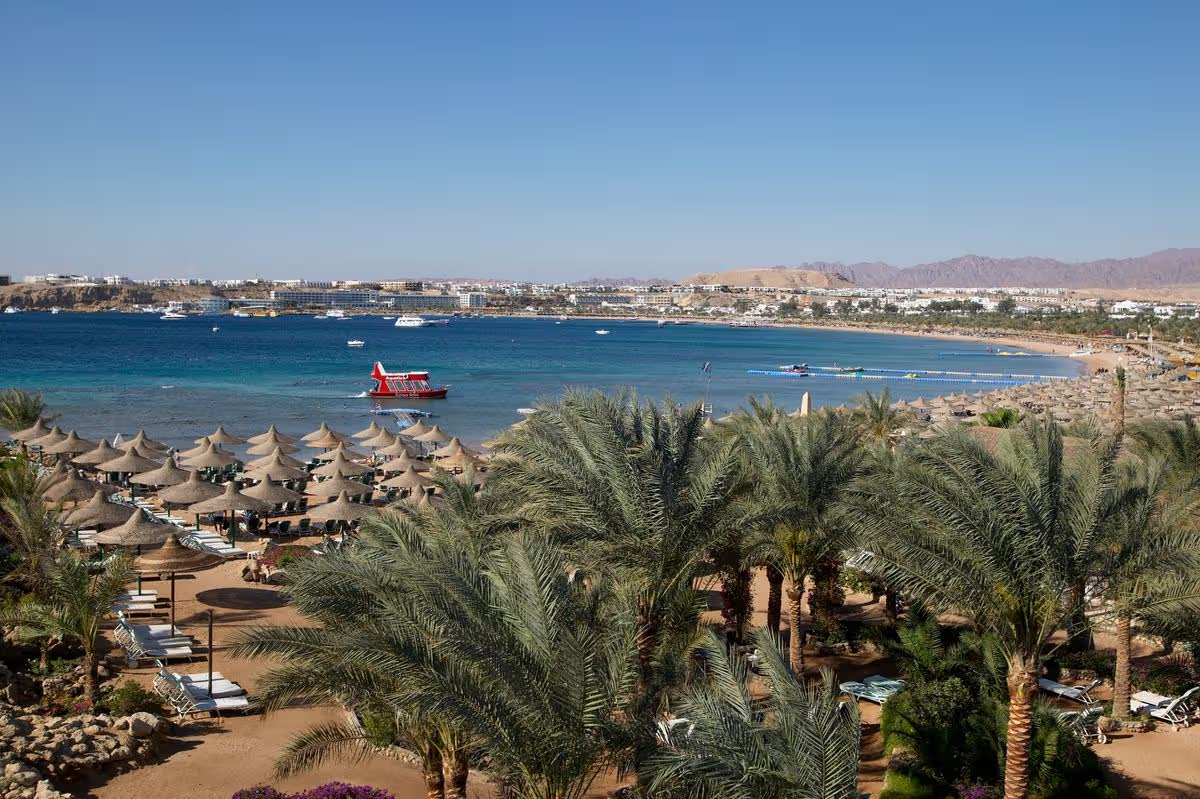
Leading holiday firm On the Beach revealed a “significant” drop in demand from British families to Turkey, Greece, Cyprus, and Egypt. “The timing of when the conflict will end and the shape of recovery in demand to these destinations are unknown,” it said.
At the same time, there are are warnings that the cost of a summer getaways could jump after a spike in jet fuel prices. It comes as many UK families would be booking sunshine trips for the Easter holidays.
The scale of the hit to bookings was enough for On the Beach to suspend its full year profit guidance. Boss Shaun Morton said: “Following the onset of the conflict in the Middle East, our operational teams have been working round the clock to support directly impacted customers in resort and to enable a return home as soon as possible.”
READ MORE: Saudi oil giant warns of ‘catastrophic consequences’ to global fuel suppliesREAD MORE: Mortgage rates hit 5% and deals slump after latest Iran war fall-out
The fall-out from the Iran war has already seen fuel prices jump and the cost of fixed rate mortgages rise. Industry experts Moneyfacts said the average two-year fixed rate mortgage had risen again, from 5.01% 5.04%. The average five-year fixed deal went up from 5.09% to 5.13%.
It came as oil prices remained at around $100 on Thursday – as two tankers were ablaze in Iraqi waters after what appeared to be Iranian strikes.
The latest wave of attacks on oil and transport facilities across the Middle East came as Iran warned the world should be ready for oil to hit $200 a barrel.
The conflict has spread across the region and prompted the International Energy Agency to recommended releasing 400 million barrels from reserves to dampen one of the worst oil shocks since the 1970s, the biggest such intervention in history.
Iran has made clear it intends to impose a prolonged economic shock.
Oil prices, which shot up earlier in the week to nearly $120 a barrel before retreating, jumped almost 10% back above $100 amid renewed fears about supply disruption.
Iranian explosive-laden boats appear to have attacked two fuel tankers in Iraqi waters setting them ablaze and killing one crew member.
Chris Beauchamp, chief market analyst at IG, said: “Overnight attacks on shipping off Iran are the stuff of nightmares for investors, confirming that one of the world’s key waterways is closed to shipping and resulting in a fresh surge in oil prices.”
US President Donald Trump claimed the IEA decision “will substantially reduce oil prices as we end this threat to America and the world.”
So far there has been no sign that ships can safely sail through the Strait of Hormuz, the now-blockaded channel along the Iranian coast that serves as a conduit for around a fifth of the world’s oil.
An Iranian military spokesperson said the Strait was “undoubtedly” under Iran’s control.

UK Foreign Office updates Egypt travel advice amid Middle East tensions
The Foreign Office has advised against travel to certain countries.

There’s advice for anyone going to Egypt(Image: murat4art via Getty Images)
At the start of this month, the UK Government issued guidance advising British citizens in Bahrain, Israel, Kuwait, Lebanon, Palestine, Qatar and United Arab Emirates to register their whereabouts. The Foreign, Commonwealth and Development Office (FCDO) is then able to send them direct updates.
There are roughly 300,000 British nationals in the region, of which over 170,000 have registered their presence with the FCDO. The Foreign Office has been revising its travel guidance for Middle Eastern countries and those in the vicinity, as the ongoing conflict continues to cause significant disruption.
The Government stated it is in discussions with commercial operators and regional countries regarding the arrangement of additional flights, as regional airspace has now partially reopened.
One of the most recent updates from the UK Foreign Office relates to entry into Egypt from Jordan.
Guidance stated: “Ferry services operate between Aqaba, Jordan and Taba Heights and Nuweiba in Egypt. Contact ferry operators directly for schedules and availability. Please check travel advice for Jordan for the latest on exit requirements.
“If your stay in Sinai will exceed 15 days, or you are planning to travel in Egypt beyond the Sinai Peninsula, including to fly from mainland airports, for example Cairo or Hurghada, you will need an entry visa”, reports the Liverpool Echo.
The statement continued: “If entering at Taba Heights, this costs 35 US dollars. If entering at Nuweiba, this costs 30 US dollars. Visas can be purchased at the port terminals. Travellers should obtain USD in cash before travelling given payments are often required in cash.”
Currently, the Foreign Office advises against all but essential travel to certain regions of Egypt. Ignoring advice from the Foreign, Commonwealth and Development Office could invalidate your travel insurance.
There is an increased risk of regional tension which could result in travel disruption and other unforeseen consequences. The Foreign Office stated: “British nationals should take sensible precautions, considering their own individual circumstances.”
These precautions include:
- Subscribing to FCDO Travel Advice email alerts.
- Keeping an eye on local and international media for the latest updates.
- Signing up to local information alerts/resources and following the instructions of the local authorities.
- Avoiding areas surrounding security or military facilities.
The Foreign Office strongly advises against all travel within a 20km radius of the Egypt-Libya border, with the exception of the town of El Salloum, where it recommends only essential travel.
Active military operations targeting criminal activity are ongoing in this area.
It recommends against all travel to North Sinai Governate owing to ongoing criminal activity and terrorist attacks targeting police and security forces that have led to fatalities.
The complete list of areas the FCDO advises against travelling to can be found here.

Major airline to cancel 600 flights across Europe this week
HUNDREDS of flights across Europe are being cancelled due to a two-day airline strike and thousands of Brits will be affected.
Lufthansa pilots are walking out today for a 48-hour period, over a dispute in regard to pay and pensions.
The airline has since been forced to cancel a huge part of the flight schedule until the strike ends on Saturday.
Around 50 per cent of all Lufthansa flight will be cancelled, which includes 40 per cent of long-haul flights..
This works out to around 300 flights a day, so 600 flights in total, according to Andreas Pinheiro, the head of the union.
Munich and Frankfurt have been hit with the most cancellations.
A number of UK flights are included in this today, such as:
- 10:05am from London Heathrow to Frankfurt
- 11:05am from London Heathrow to Frankfurt
- 12:05pm from London Heathrow to Frankfurt
- 12:10pm from Manchester to Frankfurt
- 1:05pm from London Heathrow to Frankfurt
- 3:40pm from Edinburgh to Frankfurt
- 3:45pm from Manchester to Frankfurt
- 4pm from Birmingham to Frankfurt
- 4:05pm from London Heathrow to Frankfurt
- 6:05pm from London Heathrow to Frankfurt
- 8:05pm from London Heathrow to Frankfurt
A similar number are cancelled tomorrow as well, meaning thousands are affected travelling from the UK.
A statement from Lufthansa reads: “Lufthansa is working intensively to keep the impact on our passengers as low as possible and has published a special flight schedule for both strike days.
“According to this schedule, more than 50 percent of the originally planned flight program can be operated on Thursday and Friday.
“For long-haul connections, the share is as high as 60 percent.”
Passengers affected can request a refund or move their flight date for free up until March 23.
The cancellations are far fewer than the previous strike which saw up to 800 flights cancelled.
Back in February, the airline was forced to cancel 90 per cent of it’s planned flights, affecting 200,000 passengers.
Flights to the Middle East have have been excluded from the current strike action, due to the Iran conflict.
But the continued attacks across the Middle East are continuing to cause huge travel disruption.
More than 32,000 flights have been cancelled across the Middle East in the past three weeks due to the ongoing crisis, according to experts.
Our Travel Expert has answered all of your questions about any upcoming holiday.

BBC Sport weekly quiz: Which keeper was subbed off after 17 minutes?
So much has happened over the past seven days, including Champions League thrashings, Six Nations firsts and Winter Paralympics drama.
About 21% of quizzers got full marks in last week’s edition. Will you make the grade this week?
Want more quizzes? Go to our dedicated Football Quizzes and Sports Quizzes pages and sign up for notifications to get the latest quizzes sent straight to your device.

Kim Jong Un, daughter Ju Ae test pistols at munitions factory

In this image released Thursday by state media, North Korean leader Kim Jong Un’s daughter Kim Ju Ae fires a pistol during an inspection of a munitions factory with her father. Photo by KCNA/EPA
SEOUL, March 12 (UPI) — North Korean leader Kim Jong Un inspected a munitions factory that produces light arms, state-run media reported Thursday, where he test-fired newly developed pistols alongside his daughter Ju Ae.
Kim visited the factory on Wednesday accompanied by officials from the ruling Workers’ Party, according to the official Korean Central News Agency. The report did not specify the location of the facility.
During the visit, Kim stopped at the factory’s shooting range to test-fire a pistol that he said was “superior in its structural performance, rate of hits, concentration fire and combat utility,” KCNA reported.
Kim “expressed satisfaction over the development of a really excellent pistol,” the report said.
The handgun was approved for production at a meeting of the party’s Central Military Commission last month, according to KCNA. The factory operates under North Korea’s Second Economy Commission, which oversees the country’s weapons production and defense industry.
While Ju Ae was not mentioned in the KCNA report, photographs released by state media showed her accompanying her father during the inspection. The pair wore matching leather jackets and fired pistols at the factory’s indoor range alongside senior officials.
Ju Ae, believed to have been born around 2013, has appeared alongside her father at public events with increasing frequency, including missile launches, military demonstrations and major political gatherings.
On Wednesday, she was also seen beside Kim as he oversaw the test-firing of strategic cruise missiles from a naval destroyer via a video feed.
South Korea’s National Intelligence Service said last month that Ju Ae appears close to being designated as Kim’s successor.
The factory visit comes in the wake of last month’s Workers’ Party congress, where Kim outlined defense priorities for the next five years. While Pyongyang continues to prioritize the expansion of its nuclear arsenal, the North Korean leader has also emphasized strengthening conventional weapons production.
During the congress, Kim presented newly developed sniper rifles to senior officials and military commanders, with state media releasing images of Ju Ae inspecting and firing one of the weapons.
During Wednesday’s visit, Kim stressed the importance of factories producing pistols and other light arms to strengthen “the combat efficiency of the army, public security forces and militia forces,” KCNA said.
He also announced plans to convene a meeting of the party’s Central Military Commission next month to review plans for modernizing munitions factories and allocating funds to upgrade three key defense production facilities.
The inspection comes as the United States and South Korea conduct their annual Freedom Shield joint military exercise, which Pyongyang routinely condemns as a rehearsal for invasion. Earlier this week, Kim Yo Jong, the powerful sister of the North Korean leader, warned the drills could bring “unimaginably terrible consequences.”
Iran Turns Up The Heat Around The Strait Of Hormuz (Updated)
As the Operation Epic Fury joint U.S.-Israeli attack on Iran moves into its 12th day, Tehran is intensifying its campaign against shipping in and around the Strait of Hormuz. At least three commercial ships were struck today, according to a British monitoring organization.
Each were hit in separate incidents by an “unknown projectile,” according to the United Kingdom Maritime Trade Operations (UKMTO), a monitoring agency that is part of the U.K. Royal Navy. One was a cargo ship traveling north of Oman. Another was a bulk carrier hit north of Dubai. The third was a container vessel struck near Ras al-Khaimah in the United Arab Emirates, The Washington Post noted.
Since Epic Fury was launched on Feb. 28, UKMTO “has received 17 reports of incidents affecting vessels operating in and around the Arabian Gulf, Strait of Hormuz (SOH) and Gulf of Oman,” the organization stated. That figure includes 13 attacks and four suspicious incident reports.
Iran said it is increasing these attacks to serve as an economic weapon against the U.S., Israel and allies.
The U.S. “will not be able to control oil prices,” the spokesperson for Tehran’s Khatam al-Anbiya military command headquarters vowed on Wednesday.
“We won’t allow even one liter of oil to reach the U.S., Zionists and their partners,” Ebrahim Zolfaqari proclaimed. “Any vessel or tanker bound to them will be a legitimate target.”
“Get ready for the oil barrel to be at $200 because the oil price depends on the regional security which you have destabilized,” Zolfaqari added.
As one example of market volatility, Brent Crude was trading at just over $90 a barrel as of Wednesday morning Eastern Day Light time, according to OilPrice.com. The prices have fluctuated wildly, surging to a recent high of more than $116 a barrel on March 8 and dropping to a little more than $84 a barrel yesterday.
Even as it cuts off the Strait for others, Iran is “exporting more oil through the Strait of Hormuz than before the war, showing it is in control of a strategic waterway that it has closed off to the rest of the region’s oil producers,” The Wall Street Journal reported.
The world’s biggest liquefied natural gas (LNG) export plant in Qatar hasn’t exported a shipment for five days, Bloomberg News reported. It marks the longest streak in data going back to 2008.
“A loaded tanker hasn’t left the Ras Laffan facility in five days,” according to a Bloomberg analysis of Kpler ship-tracking data. “No LNG ship traversed the Strait of Hormuz after Feb. 28, when the US and Israel began strikes on Iran.”
The unprecedented closure of the liquefaction plant, which supplies nearly 20% of the world’s LNG, came after an Iranian drone attack early last week — resulting in a jump in gas prices in Europe and Asia, the news organization noted. Ras Laffan did load a handful of shipments after stopping output, likely using fuel from storage tanks, the last of which was on Friday.
Two pipelines were built – one in Saudi Arabia, the other in UAE – just to bypass the Strait of Hormuz. This conflict, The Wall Street Journal posited, has highlighted their importance since they are the only ways to get a significant amount of oil out of the Persian Gulf and into world markets.
Iran’s closure of the Strait to most foreign shipping has thrown the world energy market into chaos, causing oil and gas prices to fluctuate dramatically.
“Japan, Germany and Austria will release oil from their strategic reserves in response to disruptions in the supply from the Middle East, officials in those countries said on Wednesday,” according to the Post. “They made the announcements hours before a meeting of leaders of the Group of 7 industrialized nations, including the United States, to discuss jointly releasing oil in consultation with the International Energy Agency.”
The International Energy Agency (IEA) on Wednesday agreed to release 400 million barrels of oil to address the supply disruption triggered by the Iran war, the largest such action in the organization’s history, CNBC reported.
“The IEA did not set out a timeline for when the stocks would hit the market,” the news outlet noted. “It said that the reserves would be released over a timeframe that is appropriate to the circumstances of each of its 32 member countries.”
The U.S., meanwhile, has yet to tap into its Strategic Petroleum Reserve, a network of salt caverns in Texas and Louisiana that can hold up to 714 million barrels of crude.
Iran is not preventing all ships from passing through the Strait. Tehran has agreed to provide Bangladeshi oil vessels with safe passage. The move comes as the Bangladesh government has intensified efforts to maintain a stable fuel supply through multiple strategic measures amid escalating conflict in the Middle East.
Bangladesh has sought assurances from Iran for the safe passage of its oil and liquefied natural gas (LNG)-carrying vessels through the Strait of Hormuz as escalating conflict in the Middle East threatens one of the world’s most critical energy shipping routes.
Some vessels are also using their AIS system to identify as Chinese owned, shipping expert Sal Mercogliano noted. Iran’s closure of the Strait does not pertain to Chinese-owned ships.
The New York Times claimed that Iran’s ongoing attacks on shipping, as well as its continuing missile and drone barrages are an example of how the Trump administration miscalculated Iran’s response to Epic Fury.
The Trump administration has said it will send U.S. Navy warships to escort commercial vessels through the Strait, but that plan has yet to be implemented. Such a deployment would put American warships at far greater risk than they are facing now at standoff distances from Iran. It remains unclear how much longer Epic Fury will continue. The longer it does, however, the more Iran can bring economic pain around the globe with even just threats against Strait shipping. The Iranian attacks have led to Trump proposing that the U.S. provide political risk insurance for seaborne trade in the Gulf. “However, Lloyd’s of London, the heart of maritime insurance globally, emphasizes it has not stopped providing contracts to those who ask – although at the right tariff,” The Guardian reported.
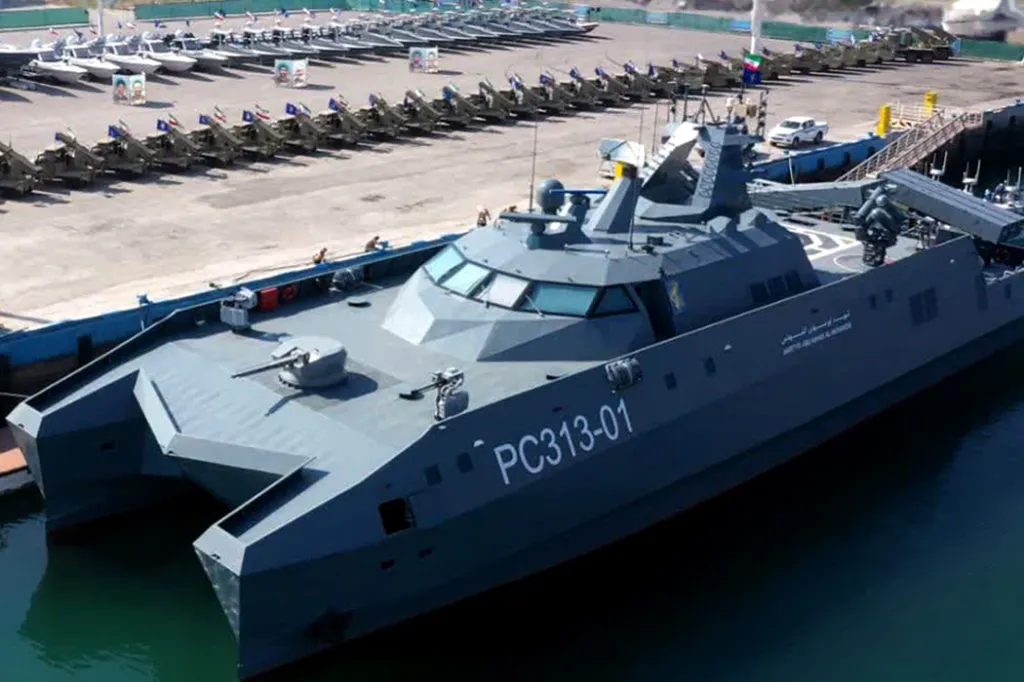
Though no escorts have been set up, the U.S. is continuing to strike Iran’s Navy, including the sinking of the last of Iran’s Soleimani class catamaran warships, the head of U.S. Central Command said in a video statement on Wednesday morning.
“To date, we have struck more than 5,500 targets inside Iran, including more than 60 ships using a variety of precision weapon systems,” Adm. Brad Cooper said in a video. “Just yesterday, we had strike waves nearly every hour from different locations and directions going into Iran. We also took out the last of four Soleimani class warships. That’s an entire class of Iranian ships now out of the fight.”
Cooper did not name which of the catamarans was hit, but the video shows one from the Soleimani class and one from a smaller class. The hull number on the smaller ship – PC313-01 – indicates it was the IRIS Abu Mahdi al-Muhandis. The ship was unveiled in a ceremony at Bandar Abbas in January 2024, the Iranian Press TV news outlet reported at the time.

U.S. Army Sgt. First Class Cory Hicks told ABC News about the Iranian drone attack on a command center in Kuwait that killed six soldiers on March 1.
The deadly attack was more severe than previously known, with dozens of troops suffering injuries that included brain trauma, burns and severe injuries from shrapnel, according to CBS News.
Iran’s new supreme leader, Mojtaba Khamenei, is “safe and sound” despite war injuries, Yousef Pezeshkian, a government adviser and the son of Iran’s president, claimed on Wednesday.
“I heard news that Mr Mojtaba Khamenei had been injured. I have asked some friends who had connections,” Pezeshkian stated on Telegram. “They told me that, thank God, he is safe and sound.”
State television had called Khamenei, 56, a “wounded veteran of the Ramadan war” but never specified his injury.
Iran’s Islamic Revolutionary Guard Corps (IRGC) has threatened to attack “economic centers and banks” related to United States and Israeli entities in the region after what it called an attack on an Iranian bank, Al Jazeera reported.
A spokesperson for the Khatam al-Anbiya Headquarters, a group described as IRGC-owned by the United Nations, said on Wednesday that “the enemy left our hands open to targeting economic centres and banks belonging to the United States and the Zionist regime in the region.”
The warning came after a reported attack on a Bank Sepah branch north of Iran, which is said to have killed many putting in extra hours ahead of the Persian New Year.
Iranian officials claimed to have hit several other U.S. targets in the region on Wednesday.
IDF Chief of the General Staff, Lt. Gen. Eyal Zamir claimed that “many thousands” of Iranian soldiers and commanders have been killed so far in this war.
The IDF released new video showing airstrikes on what it claims were Iranian troops preparing to launch drones.
The IDF completed another wave of strikes in Dahiyeh in Beirut against what it claims were Hezbollah command centers and weapons storage sites. IDF said it issued a warning to residents before the attacks and also struck a Hezbollah command post in the coastal area of Tyre.
The IDF justified the strike by claiming the Lebanon-based Iranian proxy is hiding missiles, drones and other weapons in the heart of the Dahieh neighborhood in Beirut.
The owner of this white pickup may be the luckiest person in the Middle East. Video emerged on social media showing Lebanese Army troops removing an unexploded bomb from the vehicle’s cargo bed.
Faced with growing threats from Hezbollah, Zamir ordered the Golani Brigade to be transferred from the Southern Command to operations in the Northern Command sector.
Zamir added that a decision will be made regarding additional reinforcements.
In a post on X, the UAE Defense Ministry (MoD) said its air defenses “are currently dealing with missile attacks and incoming drones originating from Iran, and the Ministry of Defense confirms that the sounds heard in scattered areas of the country are the result of the air defense systems intercepting ballistic missiles, as well as fighter jets intercepting drones and loitering munitions.”
Reuters posted a photograph on X of a building in Manama, Bahrain, reportedly damaged by an Iranian drone strike.
With Bahrain also being battered by Iranian attacks, Gulf Air has relocated its fleet of aircraft from there to Saudi Arabia, according to Al Jazeera.
Iranian Armed Forces spokesperson Brig.-Gen. Abolfazl Shekarchi “called on regional Muslims and countries to reveal the locations of U.S. and Israeli military assets to enable Tehran to conduct more accurate attacks,” the Jerusalem Post reported, citing official Iranian media.
Shekarchi also framed the request as a way to ensure the safety of the people in the region.
“I call on the Muslim people of the region and the countries of the region to show us the hideouts of US and Zionist forces so that they themselves will not be harmed, and so that we can strike them more precisely,” Shekarchi proclaimed.
In the wake of the joint U.S.-Israeli attack, The New York Times “has identified at least 17 damaged U.S. sites and other installations, several of which have been struck more than once since the war began,” the publication reported. “Our analysis is based on high-resolution, commercial satellite imagery, verified social media videos and statements by U.S. officials and Iranian state media.”
U.S. Air Force maintainers can be seen in the X post below loading weapons onto B-1B Lancer bombers, which have arrived at Fairford Air Base in the U.K.
Romanian President Nicusor Dan said that U.S. refueling planes, monitoring equipment and satellite communications systems can use his country’s military bases.
Turkey has reportedly deployed an ASELSAN’s ŞAHİN 40mm anti-drone system to Northern Cyprus, where it is now operational to defend against low-flying mini and micro UAVs using airburst smart grenades.
Ukrainian President Volodymyr Zelensky claims that Russia may send troops to Iran. That would be in addition to the support Moscow is already providing in the form of drones and air defenses, Zelensky said. He added that Russia will likely send missiles in the not-far-off future.
Ukraine, which has long sought interceptors to help fend off waves of Russian missile and drone attacks, took to social media to note the discrepancy in how much it has been supplied over the course of four years versus how much the U.S. and allies have used during 11 days of Epic Fury.
Add Italian Prime Minister Giorgia Meloni to the list of world leaders proclaiming that an Ayatollah-led regime in Iran should never obtain nuclear weapons.
UPDATES:
We have concluded our rolling coverage in this piece.
UPDATE: 5:11 PM EST –
Video has emerged showing a reported attack on an oil tanker near Iraq. Information at this point is scarce. The Ambrey martime security firm said it is investigating the matter.
The U.S. used as much as $4 billion worth of munitions in the first 72 hours of its attacks against Iran, including about 400 cruise missiles and 800 air defense interceptors, Bloomberg News reported, citing estimates from German defense giant Rheinmetall AG.
“The numbers, released in the company’s earnings presentation on Wednesday, were drawn from ‘publicly available sources and in-house assumptions,’ the slides said,” according to the news outlet. “Other reports have put the munitions cost for the first two days of the conflict higher, at as much as $5.6 billion.”
Trump said that he picked the name Epic Fury from a list of about 20 and that the U.S. has already won.
“You know, you can only do it if you win — and we’ve won,” the American leader proclaimed. “Let me say: we’ve won. You never like to say it too early, but we won the bet in the first hour. It was over.”
Israel’s Iron Dome air defense system “could not stop about half the 100 rockets Hezbollah launched at Israel just a few hours ago,” New York Post reporter Caitlin Doornbos posted on X.
The leaders of the G7 group of nations – the United States, Canada, Japan, Italy, Britain, Germany and France – “agreed to examine the option of providing escort for ships so they can navigate freely in the Gulf,” according to a statement from the G7 Presidency on Wednesday.
Despite threats from the regime to stay home, anti-government protestors are reportedly continuing to take to the streets in Iran demanding change.
The U.K. Defense Ministry (MoD) provided its latest update on Middle East operations.
The UAE MoD said its air defenses “dealt with 6 ballistic missiles, 7 cruise missiles, and 39 drones coming from Iran” today. “Since the start of the brazen Iranian aggression, UAE air defenses have dealt with 268 ballistic missiles, 15 cruise missiles, and 1,514 drones.”
UPDATE: 4:48 PM EST –
The IRGC posted video it claims shows missile launches toward U.S., Israeli and allied military bases housing American forces in the region.
Kuwaiti air defenses are currently confronting hostile missile and drone attacks, the nation’s army announced on X.
“The General Staff of the Army notes that if explosion sounds are heard, they are the result of air defense systems intercepting the hostile attacks,” the announcement added.
UPDATE: 4:18 PM EST –
Three Ukrainian teams of military personnel and engineers have gone to the Middle East to help the U.S. and allies in the fight against Iran, Ukrainian President Volodymyr Zelensky stated on X.
After four years of fending off daily bombardment by Russian missiles and drones, Ukraine has a lot of hardearned expertise to share.
Al Jazeera said a senior Iranian military official claimed that if “Washington commits a strategic mistake, another strait will be in a situation similar to the Strait of Hormuz,” the publication posted on X. “The region may enter a regional war soon, and we still have many cards to play. Any American mistake will complicate the situation in the region, and Iran has phased and graduated military plans.”
Video is emerging on social media claiming to show Tehran under a large drone attack.
Despite what appears to be a coordinated Israel attack on Basij checkpoints in Tehran, the regime is reportedly keeping a tight lid on any potential anti-government protests, journalist Nilo Tabrizy said a source told her.
“The government constantly sends threatening [text] messages to everyone. It says that if you come to the streets to protest, you will be considered an Israeli soldier and will be killed.”
Meanwhile, the Speaker of the Iranian Parliament is urging pro-government crowds to remain on the streets.
“Dear Iranian nation, to whom I would sacrifice my life a thousand times!” MB Ghalibaf stated on X. “Your presence in the streets has bewildered and enraged the enemy. This humble soldier of yours has three requests from you: the streets, the streets, the streets. Your children in the armed forces have taken their lives in hand to defend #Iran; strengthen their backs by holding the streets firm.”
Alarms have again sounded in Bahrain, as the nation braces for another wave of Iranian attacks, officials there claim.
Kuwait National Guard bomb squad engineers have destroyed a drone warhead that fell inside a fuel tank, spokesman Jadaan Al-Fadhel said in a statement on Wednesday, adding that no injuries were reported during the operation.
UPDATE: 3:45 EST –
During a visit to Thermo Fisher Scientific in Cincinnati on Wednesday, Trump said that for Iran, it’s a “war.” But for America, it’s “easier than we thought.”
The U.S. president also claimed that more than two dozen Iranian mine boats have been destroyed during Epic Fury.
“They started talking about mines. So we hit 28 mine ships as of this moment,” Trump proclaimed. “Twenty-eight. Like, using the same weapon — the exact same weapon that we use against the drug dealers in the water. We have — as an example, we had tremendous drugs pouring in through the water — through the sea. And now we have almost none. It’s down 97%.”
Iran deployed about a dozen mines in the Strait of Hormuz, Reuters reported, citing two sources familiar with the matter. The move is likely to complicate reopening the waterway — an important route for shipping oil and liquefied natural gas.
Trump is preparing to invoke Cold War-era powers to pave the way for renewed oil production off the southern California coast, Bloomberg News is reporting. The move is seen as “a long-shot bid to help ease the global crude supply crunch spurred by his war with Iran,” according to the outlet.
“Trump is set to soon summon authorities under the Defense Production Act to preempt state laws and ease permitting for Sable Offshore Corp., a Houston-based company looking to restart significant production from a cluster of offshore platforms in California,” Bloomberg added. “The plan was described by a person familiar with the matter who asked not to be named because it’s not yet public.”
The fire at Oman’s Salahah Port seems to be intensifying. The port was attacked by Iran earlier on Wednesday.
Several security forces and members of Iran’s paramilitary Basij force were killed by Israeli drones in Tehran today, according to the IRGC-affiliated Fars News Agency.
UPDATE: 2:53 PM EST –
Hezbollah fired dozens of rockets from Lebanon and Iran fired several ballistic missiles at the area, according to Israeli media.
The Israeli military later confirmed that it didn’t intercept some of the projectiles, adding that rescue services and emergency teams are “currently operating at the impact sites.”
Video has emerged showing an Iranian Shahed-type long-range strike drone approaching, then hitting the fuel tanks in the Omani port of Salalah earlier on Wednesday. The attack caused a powerful explosion and fireball.
In a post on X, Iranian President Masoud Pezeshkian said he told leaders from Russia and Pakistan that his nation reaffirms its “commitment to peace in the region.”
“The only way to end this war—ignited by the Zionist regime & US—is recognizing Iran’s legitimate rights, payment of reparations, and firm int’l guarantees against future aggression,” he exclaimed.
The Coordination Committee of the Iraqi Resistance issued a warning to Syrian leader, Ahmed Sharaa, threatening that any hostile move toward Lebanon, particularly if coordinated with the U.S. or Israel, would be treated as a declaration of war against the entire Axis of Resistance.
The threat in Iraq remains real as you can see by the following video, which reportedly shows an interceptor hitting an Iranian drone over Erbil.
There is pushback to claims that the U.S. is sending Terminal High Altitude Area Defense (THAAD) systems from Korea for deployment to the Middle East.
UAE reportedly sees an opportunity to reclaim the Abu Musa, Greater and Lesser Tunb islands that Iran seized in 1971.
The Bellingcat investigative team geolocated eight videos showing U.S. Tomahawk launches.
UPDATE: 2:40 PM EST –
Saying most of Iran’s Navy has been destroyed, Trump urged oil companies to start using the Strait of Hormuz again.
Meanwhile, India condemned the Iranian attack on the Thai ship bound for Kandla.
“Iran and the terrorist militias allied with it may be planning to target U.S.-owned oil and energy infrastructure in Iraq,” the U.S. Embassy in Baghdad warned. “Additionally, Iran-aligned terrorist militias have targeted hotels frequented by Americans in various parts of Iraq, including the Kurdistan Region of Iraq. “
The IDF released a video containing what it says was audio of a radio exchange between an Israeli and U.S. pilot.
UPDATE: 2:06 EST –
An ongoing military investigation has determined that the United States is responsible for a deadly Feb. 28 Tomahawk missile strike on an Iranian elementary school, The New York Times reported, citing U.S. officials and others familiar with the preliminary findings.
Iran’s Armed Forces spokesman General Shekarchi warned the U.S. and allies against striking Iranian ports.
“If any threat is made against our ports, all docks and economic ports in the entire region will be our legitimate targets, and we will carry out operations heavier than those we have done so far,” he vowed.
Iran may be using a Chinese satellite navigation system to target Israel and United States military assets in the Middle East, intelligence experts say, according to Al Jazeera.
“Former French foreign intelligence director Alain Juillet told France’s independent Tocsin podcast this week that it is likely that Iran has been provided access to China’s BeiDou satellite navigation system because its targeting has become much more accurate since the 12-Day War with Israel in June,” the outlet reported.
1:55PM EST—
The NYT reports that Pentagon officials told U.S. lawmakers that Iran has as much as 50% of its missiles and launchers remaining.
A Merlin early warning and control helicopter has arrived in Cyprus to provide a critical ‘look down’ capability for spotting incoming drones. You can read about how critical this capability is and how new assets are being sent to the Middle East to help provide it in our story from yesterday linked here.
Contact the author: howard@thewarzone.com
BBC boss defends new £15-a-month licence fee more expensive than Netflix and Amazon Prime
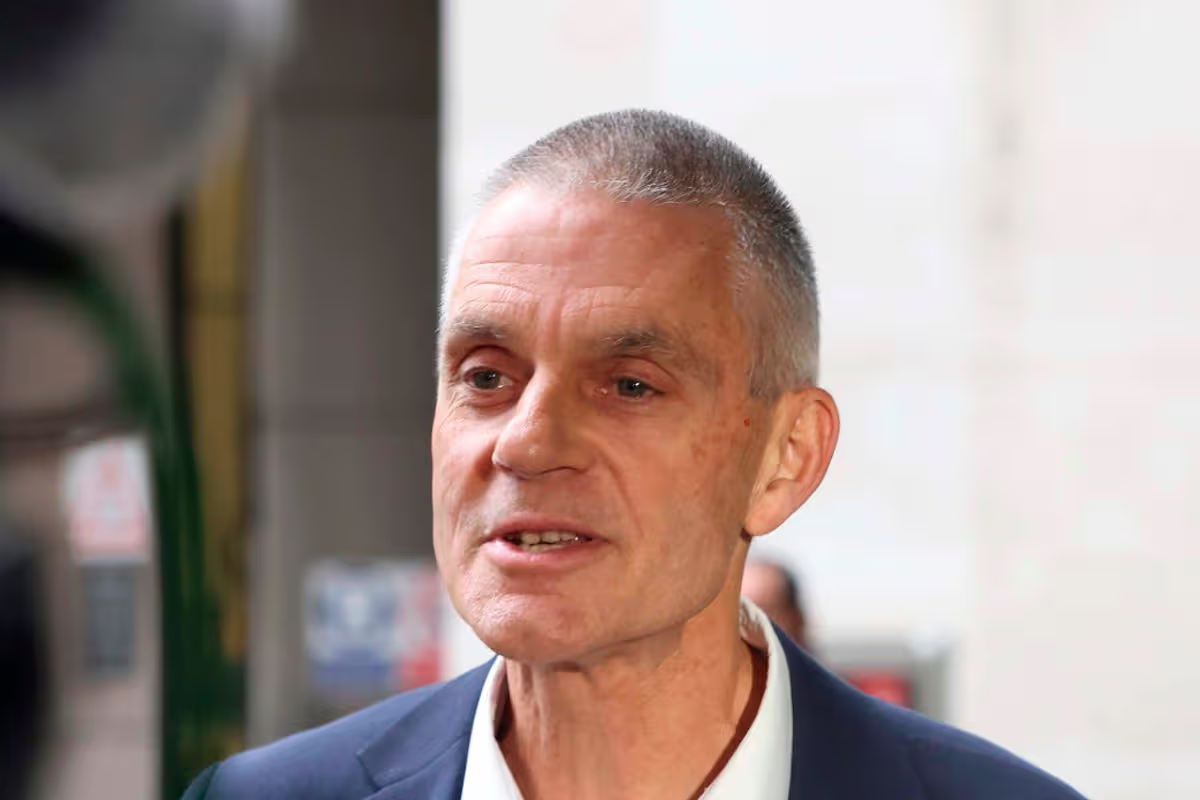
The outgoing Director General for the BBC, Tim Davie, has spoken out in the defence of the licence fee, which has risen to a huge £15 a month, making it more expensive than multiple streaming services

Davie agreed that the BBC and other institutions were in ‘crisis’(Image: Ian Vogler / Daily Mirror)
The BBC is in “crisis,” departing Director General Tim Davie has said. The broadcaster has been criticised for its planned increase to the licence fee, which will rise to £180, from April 1.The increase, required by the 2022 Licence Fee Settlement, will rise by £5.50 for the year. This means a standard colour TV licence will now cost each home £15 a month, more than a subscription to various streaming platforms.
Speaking on The Rest Is Entertainment podcast, Davie insisted that the BBC – and other institutions – are certainly in “crisis”. He says: “Trust is built and I’m semi-obsessed by this – trust is built by people absolutely believing that someone is acting in their interest and that they listen to them. And if you think about an old-school broadcaster, it broadcasts….
“I think there have been too many instances where institutions and the BBC is definitely not exempt from this – where, call it what you will, metropolitan, a certain lens on life.”
According to Davie, as long as the BBC is providing value, then there should be no problems about an increase in the licence fee.
“We’re at a consultation phase, but we have set out a very clear preference which is and I would do this to the point about restarting where we’re at – I think there is a model which says: look, if we can deliver value for every household and really work at that, then everyone contributes fairly, and I think that is a model that’s worth fighting for,” he says.
“I don’t see it as something potentially trapped in the past. I actually think it could be something exciting for the future – quite enlightened. You don’t have to go exactly where the market is going currently. You have to make markets, and I think we can do that.”
The BBC have been hit by serious allegations that one of their Panorama documentaries misled viewers by editing a speech by Donald Trump. The BBC’s director general Tim Davie and head of news Deborah Turness both resigned in November.
It had been alleged in a leaked internal BBC memo that those working on the Panorama programme edited two parts of the speech together so that Trump appeared to explicitly encourage the Capitol Hill riot back in 2021. Trump has since launched a multi-billion dollar lawsuit against the BBC, which is scheduled to go to trial in February 2027.
He did not explicitly reference any specific errors the BBC had made under his tenure but he said the world was in an age of “weaponisation”, where the broadcaster was under strict scrutiny over one thing – but not referencing all the good work they’ve done.
“We’ve made mistakes, sometimes serious mistakes, which we regret. But weaponisation is selectively taking one fact – it may be a fact, so you’re standing on a fact – but what you’re not standing on is any effort to be proportionate,” he says.
“You’re not saying, look, a thousand stories run, we’re running, and one didn’t get it right, or overall this is where there’s no balance of data. It’s literally just selecting a fact to make a case.”
*Watch or listen to The Rest Is Entertainment however you get your podcasts.
Like this story? For more of the latest showbiz news and gossip, follow Mirror Celebs on TikTok, Snapchat, Instagram, Twitter, Facebook, YouTube and Threads.

Lakers’ Luka Doncic in a custody battle for his two daughters
Luka Doncic is attempting to bring his daughters to the United States from his native Slovenia after separating from his fiancée, according to reports.
His former fiancée, Anamaria Goltes, 28, has filed a petition in California seeking child support and attorney fees from Doncic. One of Doncic’s daughters was with him for three months in 2025, and his other daughter has never been to California. Doncic, 27, told ESPN that he had “no idea” Goltes filed the petition.
“I love my daughters more than anything, and I’ve been doing everything I can for them to be with me in the U.S. during the season, but that hasn’t been possible, so I recently made the tough decision to end my engagement,” Doncic said in a statement. “Everything I do is for my daughters’ happiness, and I will always fight to be with them and give them the best life I can.”
Doncic and Goltes were engaged for nearly three years. Their oldest daughter, Gabriela, was born in November 2023, and Olivia was born in December. Doncic traveled to Slovenia for Olivia’s birth, missing games against the Toronto Raptors on Dec. 4 and Boston Celtics on Dec. 5.
During his visit, Doncic told Goltes he wanted to bring Gabriela to the United States when he returned to rejoin the Lakers, according to reports. Goltes objected, and Doncic departed without his daughter.
“I don’t even know how to describe it,” he told reporters of being present for Olivia’s birth. “It was a lot. I was there for the birth of my daughter, so that means everything to me. But it was definitely a roller coaster.
“I got to see my daughter again, my newborn. Coming back, it was kind of hard to leave them behind. But it’s a job, so I got to do it. So hopefully I’ll see them soon.”
Doncic posted a photo on social media of Olivia wearing a pink sweater with a heart emoji covering her face. In his first game back, he inscribed a G and O with a heart on his shoes.
“Two girls, they’re going to make my life hell for sure, I know that,” Doncic said, half-joking. “I’m going to be their security after I retire. All jokes aside, it’s the best thing in the world. I’m just blessed.”
Goltes deleted photos of her and Doncic from her Instagram account last week, and Doncic acknowledged that they had separated. Two weeks ago, he filed an injunction with a Slovenian court seeking immediate contact with his daughters, ESPN reported.
Doncic, who was traded to the Lakers from the Dallas Mavericks for Anthony Davis in February 2025, leads the NBA with a 32.5 points-per-game average. The guard also averages 8.4 assists and 7.8 rebounds.
Trump admin estimates US war on Iran cost $11.3bn in first 6 days: Report | US-Israel war on Iran News
Lawmakers express concerns as Trump officials project $50bn more may be needed for Iran war funding.
Published On 12 Mar 2026
Officials from President Donald Trump’s administration have estimated during a congressional briefing this week that the first six days of the war on Iran had cost the United States at least $11.3bn, a source familiar with the matter told the Reuters news agency.
That figure, from a closed-door briefing for senators on Tuesday, did not include the entire cost of the war, but was provided to lawmakers as they have clamoured for more information about the cost.
Recommended Stories
list of 3 itemsend of list
Several congressional aides have said they expect the White House to soon submit a request to Congress for additional funding for the war. Some officials have said the request could be for $50bn, while others have said that estimate seems low.
The administration has not provided a public assessment of the cost of the conflict or a clear idea of its expected duration. Trump said during a trip to Kentucky on Wednesday that “we won” the war but that the US would stay in the fight to finish the job.
The $11.3bn figure was first reported on Wednesday by The New York Times.
The human cost
The US-Israeli war on Iran has so far killed about 2,000 people, mostly Iranians and Lebanese, as the conflict has spread across the Middle East, with Iranian retaliatory strikes on neighbouring countries hosting US assets, sending energy prices soaring.
The United Nations children’s agency (UNICEF) says the “intensifying conflict” has killed or wounded 1,100 children, creating a “catastrophic” situation for millions of children across the Middle East.
About 800,000 people have already been displaced in Lebanon by relentless Israeli bombardment.
Administration officials also have told lawmakers that $5.6bn of munitions were used during the first two days of strikes.
Members of Congress, who may soon have to approve additional funding for the war, have expressed concern that the conflict will deplete US military stocks at a time when the defence industry was already struggling to keep up with demand.
Democratic lawmakers have demanded public testimony under oath from administration officials about the Republican president’s plans for the war, including how long it might last and what his plans are for Iran once the fighting has stopped.
Trump on Wednesday said the war with Iran may end “soon” because there is “practically nothing left” for the US military to bomb. He did not provide any evidence for that claim.
Oil price jumps despite deal to release record amount of reserves
It comes as Iranian attacks on ships intensify in the crucial Strait of Hormuz waterway.
Source link
Kanye West ordered to pay former contractor $140,000 for mansion work
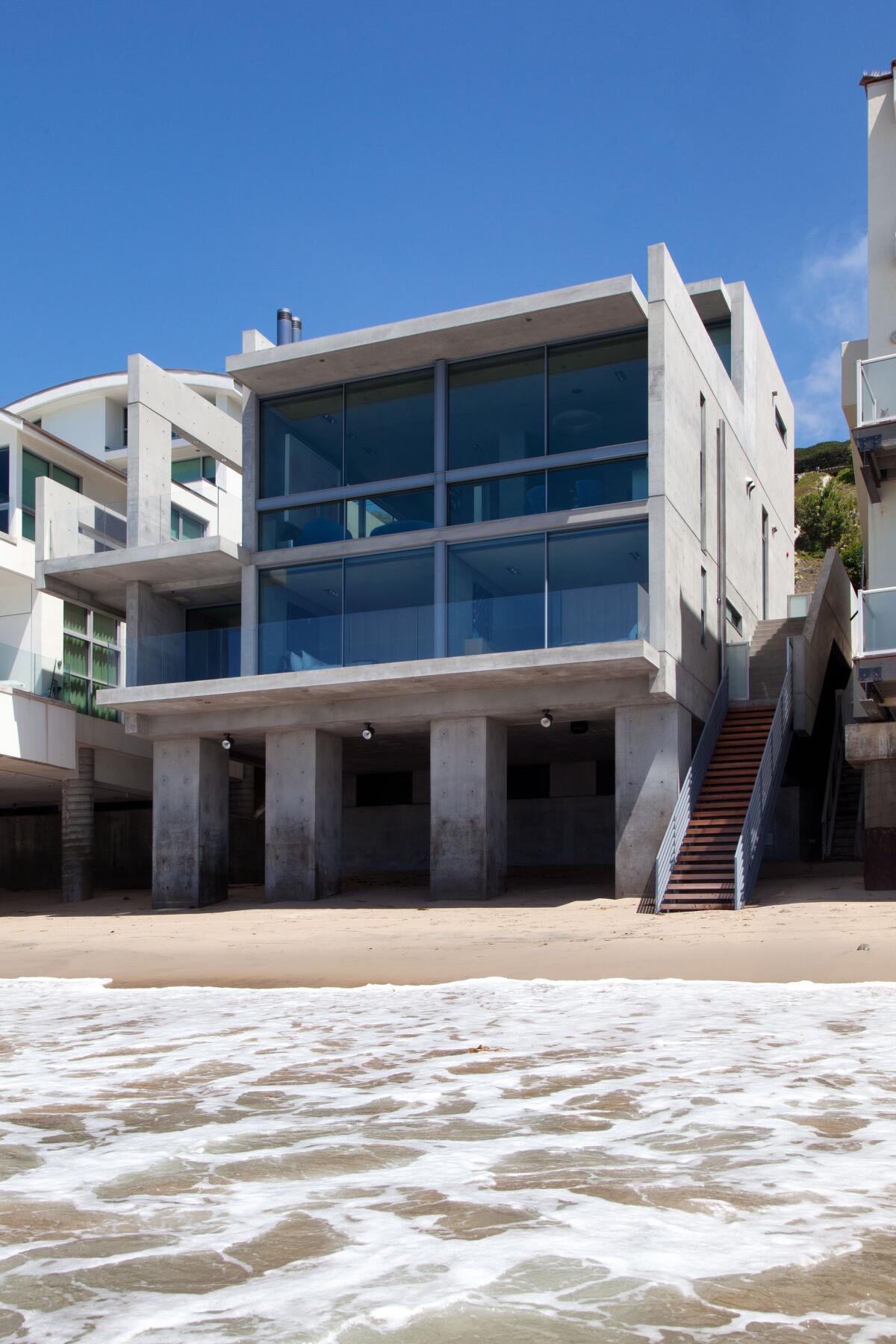
A jury found Ye, the controversial music impresario formerly known as Kanye West, liable in the legal dispute brought by his former contractor and ordered him to pay $140,000.
Tony Saxon, who also worked as Ye’s security guard and caretaker at the Malibu property, sued the rapper in Los Angeles Superior Court in September 2023, claiming a slate of labor violations, nonpayment of services and disability discrimination.
The $140,000 judgment announced Wednesday is far less than the $1.7 million in damages that Saxon’s lawyers had originally requested. Ye will also have to pay for Saxon’s legal fees, which is expected to put the total sum that West will have to pay at more than $1 million.
Although Saxon’s attorneys at the Los Angeles-based firm West Coast Trial Lawyers called the verdict a “mixed” one, they characterized it as as a “vindication for our client.”
“Ye’s lawyers called him a liar, a fraud, and a malingerer in court. His medical records, bank records, and personal family history were dissected, mocked, and vilified,” said attorney Ronald Zambrano in a statement.
“In true David-vs.-Goliath fashion, Mr. Saxon stood firm against one of the biggest celebrities in the world, with the truth on his side,” Zambrano said.
Saxon alleged that while working as a security guard on the property, he was forced to sleep on the floor and was fired in November 2021 for failing to comply with Ye’s “dangerous requests.” He also said that he frequently complained to West about these and other issues, but that the rapper failed to address them.
In a statement, Ye’s spokesperson noted the jury had “rejected almost all of his [Saxon’s ] claims,” and that Saxon only recovered “a small fraction of what his lawyers demanded.”
“The jury also found that Saxon acted in the capacity of a contractor and did not qualify for the employee exception under California’s contractor licensing statutes,” according to the statement. “We believe the damages award is legally barred and we’ll be seeking post-trial relief from the court.”
Ye purchased the beachfront concrete mansion in 2021— designed by Pritzker Prize-winning Japanese architect Tadao Ando — for $57.3 million. He then gutted the property on Malibu Road, reportedly saying, “This is going to be my bomb shelter. This is going to be my Batcave.”
Three years later, the hip-hop star sold the unfinished mansion (he had removed the windows, doors, electricity and plumbing and broke down walls), at a significant loss to developer Steven Belmont’s Belwood Investments for $21 million.
In court filings Ye denied Saxon’s allegations. In a November 2023 response to the complaint, he disputed that Saxon “has sustained any injury, damage, or loss by reason of any act, omission or breach by Defendant.”
In January, Ye sued Saxon and his law firm over a $1.8 million lien placed on the Malibu mansion, alleging they “wrongfully” placed an “invalid” lien on the property “while simultaneously launching an aggressive publicity campaign designed to pressure Ye, chill prospective transactions, and extract payment on disputed claims already being litigated in court.”

The Malibu mansion that Ye purchased and gutted was later purchased and restored to its original design.
(The Oppenheim Group / Roger Davies)
That case is pending.
Ye’s spokesperson said the lien “clouded the home’s title and interfered with its sale, destroying substantial value at the time of sale.”
In recent years, the mercurial superstar has faced a number of public and legal dramas.
In 2022, Ye lost numerous lucrative partnerships with companies like Adidas and the Gap, following a raft of antisemitic statements, including declaring himself a Nazi on X (which he later recanted).
Two years later, Ye abruptly shut down Donda Academy, the troubled private school he founded in 2020.
Ye, the school and some of his affiliated businesses faced multiple lawsuits from former employees and educators, alleging they were victims of wrongful termination, a hostile work environment and other claims.
In court filings, Ye has denied each of the claims made against him by former employees and educators at Donda.
Several of those suits have been settled.

It takes a village – the pioneering tourism project breathing new life into India’s mountain communities | India holidays
Kathdhara village is a riot of colour as the early evening light turns the clouds the rosy hue of Himalayan salt. Bright red chillies lie drying in front of cornflower blue doorways. The pink of a sari and the orange of marigolds pop against a backdrop of verdant terraced fields, where cabbages grow in perfect rows like a picture from a Peter Rabbit book.
Just 22 families live in this remote hamlet in Binsar Wildlife Sanctuary, in the Kumaon region of Uttarakhand, north-east India. As we stroll with our guide, Deepak, taking in views of the layered hills and soaring, snow-capped Panchachuli peaks beyond, we are welcomed by villagers tending homes and gardens, strings of Diwali fairy lights adding extra sparkle to the scene.
I’m here to explore the foothills of the Himalayas and sample village life on a walking holiday with Village Ways, a pioneer of responsible, community-based tourism in India, which is celebrating its 21st anniversary this year. Dreamed up by Manisha and Himanshu Pande, the couple who run the Khali Estate, a small hotel in the reserve, the goal is to help address urban migration and support traditional rural life through low-impact tourism. Village Ways launched in 2005 with just five villages in the reserve, which guests hike between, and now more than 30 villages are involved in different parts of the country, from Madhya Pradesh to Kerala.
“The idea was to bring the community together to run something collectively, training people in all aspects of business. Everyone has a role to play,” says Manisha. “The Village Ways model has captured the attention of the government, too, and we’re collaborating on various projects in other states now, which is exciting.”
Most accommodation is in small, village-built guesthouses sleeping up to eight, rather than homestays, and money is evenly distributed to everyone from cleaners to porters, with committees making joint decisions. Back at the Kathdhara guesthouse, we join Diwali celebrations, sharing sweets, lighting lamps and praying to the goddess Lakshmi by a makeshift shrine. We feast on a delicious thali – spicy yams, dal, hemp chutney and warm roti – and sleep soundly, cocooned by the silence of the mountains.
The next day brings blue skies, and after breakfast we set out on a gentle walk to the neighbouring Gonap village. Binsar Wildlife Sanctuary was created in 1988, a 47 sq km (18 sq mile) area to help protect the broadleaf oak forest and wildlife. For the people living here, it altered their relationship with the forest, ending tree felling and hunting – tempting many to abandon village life for the cities. Village Ways offered an alternative – former hunters turned guides, sharing knowledge of the land and wildlife with guests, and seeing outsiders’ interest in local customs and traditions renewed their sense of pride.
We hike through pristine pine, oak and rhododendron forests (come in March or April to see the land painted red, pink and white when they bloom). I’m fascinated by the Himalayan oaks, which play a key role in storing and releasing water and stabilising the land with their vast root networks. We see the bright red flowers of wild turmeric and countless medicinal plants, from goat weed (some believe the juice stops bleeding) to Indian tobacco (used for toothache).
Leopards roam here too and, though they remain elusive, we spy footprints and scat, as well as porcupine quills. But the sanctuary is best known for its amazing birdlife – more than 200 species are found here – and we stop frequently as Deepak points out the crested serpent eagle, leaf warbler, black-headed jay and noisy parakeets.
Gonap itself is tiny – home to just seven families today. We’re welcomed to the guesthouse with chai and plates of warm pakora – enjoyed with staggering mountain views as Eurasian griffon vultures float on the thermals. Deepak leads us to a tiny temple, past houses with gardens heaving with jumbo lemons and air potatoes on giant stalks, the sounds of cicadas in the air.
No roads connect the five villages in the Binsar circuit, but the paths between them offer easy walking and there’s plenty of time to rest. A higher-altitude route in the nearby Saryu and Pindar valleys, close to the border with Tibet, offers more challenging hikes. But limited time means we head back to the Khali Estate from Gonap, stopping at Zero Point lookout – the highest vantage spot in the reserve, at 2,500 metres – to gawp at the 360-degree Himalayan panorama, dominated by Nanda Devi, the second highest mountain in India.
Built 150 years ago by a British commissioner, Gen Sir Henry Ramsay, the Khali Estate makes a picturesque base, with accommodation in stone rondavel cabins and a sitting room with roaring fire. During his time in Kumaon, Ramsay is credited with developing local infrastructure, founding a leper colony in the historical capital of the region, Almora, and regulating tree felling. We delve into the estate’s history on a tour with Himanshu, poring over photos and library texts, and learn how it was also a retreat for the Nehru family and an ashram for Mahatma Gandhi. Surrounded by forest, it’s utterly peaceful. Later, I fall asleep to the distant sound of barking deer.
For visitors wanting to learn more about the region’s history and the characters who shaped it, Village Ways has launched a new itinerary, Khali in Kumaon. As well as the Binsar walks, it takes in the lakeside hill station of Nainital, where we had stopped on the 270-mile journey from Delhi. Guests will also explore Almora, with its local primary school supported by Village Ways, the museum of the Anglo-Indian hunter turned conservationist Jim Corbett, and the Gandhi trail, heading into the hills to see some of the first looms he established for homespun cotton – a symbol of economic independence and resistance to British rule – at Anasakti ashram.
But our last day is very much focused on the present, as a stream of villagers arrive at Khali from far and wide to join the anniversary celebrations. Other Village Ways founders – Brits who worked in development and tourism – are here too, and there are talks, feasting and dancing. I learn about the Village Ways charitable trust, which supports healthcare in these remote villages, training local women to run mobile clinics. Since Village Ways’ inception, it has hosted 7,000 guests, benefiting about 5,000 people, from artists to taxi drivers, according to Manisha, and 470 villagers are directly involved in decision-making as members of the village tourism committees in six states.
I buy locally made scarves and handicrafts, and many of the young villagers – now guides, cooks or porters – tell me about the positive impact tourism has had on their lives. “Since I joined as a guide three years ago I’ve learned lots about Binsar and our birds – and my English has really improved,” said 23-year-old Ashirwad Joshi from Dalar village. “I’m very happy to be part of it and share my knowledge with visitors – it makes me proud.”
When we leave the next morning for the long drive to Kathgodam and onward train journey to Delhi, it’s the feeling of mutual respect and warmth that stays with me. The challenges are many, from ageing village populations to a decline in international visitor numbers to the area since Covid, but the Village Ways mission is very much full steam ahead – taking its ethos to other parts of the country. This type of tourism – one that involves communities as partners and is collaborative rather than exploitative – benefits locals and travellers alike. In these times of division, it is to be celebrated more than ever.
The trip was provided by Village Ways, which creates bespoke itineraries, tailored to travellers’ interests. The suggested 10-day Khali in Kumaon itinerary (available until 30 May, and from 15 September to 30 November 2026) costs from £1,315pp, based on a party of four, including transfers, rail travel, accommodation and most meals

Kawhi Leonard scores 45 points, Clippers score 153 and win to move above .500
Kawhi Leonard scored 45 points and the Clippers routed the Minnesota Timberwolves 153-128 on Wednesday night, moving above .500 with their third straight victory and sixth in seven games.
Eighth in the Western Conference at 33-32 after opening 6-21, the Clippers had their highest point total of the season. They blew out Minnesota after beating New York on Monday night to open a five-game homestand.
Leonard was 15 of 20 from the the field, six of nine on threes and made nine of 10 free throws. Los Angeles made 19 of 37 threes.
Bennedict Mathurin scored 22 points for the Clippers and Darius Garland had 21, hitting five three-pointers.
Anthony Edwards led Minnesota with 36 points and Naz Reid had 18.

Kawhi Leonard goes to the basket against Julius Randle in the first half.
(Eric Thayer / Los Angeles Times)
Minnesota dropped to sixth in the tight Western Conference, but only a half-game behind the third-place Lakers. The Timberwolves have lost three in a row after winning five straight. They lost to the Lakers on Tuesday night to open four-game trip.
Leonard scored 18 points in the first quarter to help the Clippers take a 38-27 lead. He had 28 at the half, with the Clippers up 74-65, and went to the fourth with 39 and his team ahead 109-98. The Clippers had a 44-30 edge in the fourth.
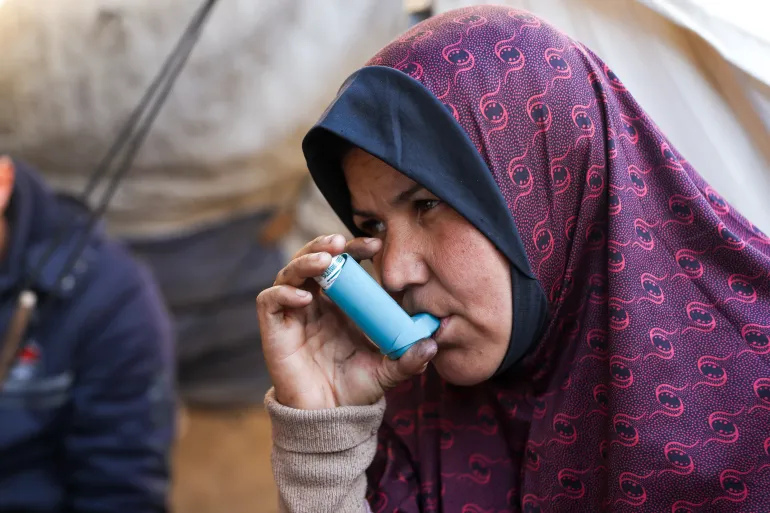
‘Life covered in soot’: Gas shortage forces Gaza families to cook over wood | Israel-Palestine conflict News
Gaza City, the Gaza Strip – Shortly before the call to sunset prayer, Islam Dardouna stretches her hand towards a pot hanging over a makeshift stove fashioned from a battered metal can, with scraps of paper and pieces of wood feeding the fire beneath it.
Then she pauses. She turns her face away from the rising tongues of smoke. Her face stained with a thin layer of soot and her clothes steeped in the lingering smell of fumes, she takes a deep breath but does not immediately lift the lid.
Recommended Stories
list of 3 itemsend of list
In her right hand, Dardouna holds an asthma inhaler as though it were a ladle or tongs. With her other hand, she tries to prepare food for her three children.
“I can no longer tolerate the fire at all,” the 34-year-old says in a strained voice as she raises the inhaler to her mouth.
“We heat water on it, cook on it … everything. It completely destroyed my health,” she said, pointing to her chest.

Dardouna has been displaced from Jabalia in northern Gaza since the start of Israel’s genocidal war against Palestinians in the territory in October 2023.
She now lives with her husband – 37-year-old Muath Dardouna – and their children in Sheikh Ajleen, west of Gaza City.
A year and a half ago, their home was destroyed. Since then, the family has moved from place to place until they eventually settled in this camp alongside other displaced families.
Everything changed after the war began. But for Dardouna, having to cook daily over an open fire in the face of cooking gas and fuel ranks among the worst.
“Our entire life now is a struggle, searching for wood and things we never imagined we would need one day,” she says. “There is no cooking gas and no gas cylinders. We lost all of that during displacement.”
What makes the situation even harder is that she suffers from asthma and chronic chest allergies, conditions she says began during Israel’s 2008 war on Gaza when she inhaled the smoke of a phosphorus bomb that dropped on her house. Her situation improved over the years, but has dramatically worsened during the current war.
“I developed airway obstruction, and recently there were masses found in my lungs,” said Dardouna, who in January was hospitalised for six days after suffering from oxygen shortage.
“The doctors prescribed an oxygen cylinder for me,” she says, quietly. “But unfortunately, I cannot afford it.”
A prolonged shortage
Like so many others across Gaza, Dardouna is struggling amid a prolonged shortage of cooking gas and fuel that has persisted since the start of the war.
Supplies have remained severely limited even after a “ceasefire” came into effect in October that included provisions allowing the entry of fuel and essential goods into the territory.
However, the quantities that have entered since then remain far below the population’s actual needs, according to official sources in Gaza and United Nations agencies.
The UN Office for the Coordination of Humanitarian Affairs says the availability of cooking gas in Gaza remains “critically constrained”, with the limited quantities entering the territory covering less than three percent of what is required.
As a result, many families have been forced to rely on alternative and often hazardous cooking methods.
UN data indicates that about 54.5 percent of households rely on firewood for cooking, roughly 43 percent burn waste or plastic, and only around 1.5 percent are able to cook with gas.
Humanitarian groups warn that such unsafe alternatives endanger people’s health and the environment due to prolonged exposure to smoke and toxic fumes produced by burning plastic and other waste.
Amid these conditions, cooking over open fires made from wood, scrap materials or plastic has become a daily reality across displacement camps and neighbourhoods throughout Gaza.
The crisis has intensified during the Muslim holy month Ramadan, when families must prepare both suhoor meals before their daily fast and iftar meals afterwards.
Firewood has become expensive, requiring a daily budget. Lighting the fire before dawn is also often difficult due to the lack of lighting and unfavourable weather conditions, so the family often skips the pre-dawn meal entirely.
“Today, for example, it’s raining and windy. I couldn’t light the fire,” said Darduna’s husband, Muath, who is also helping out with the daily cooking.
“Even when we break our fast, we wish we could drink a cup of tea or coffee afterwards, but we can’t, because lighting the fire again is another struggle.”
A former psychosocial support worker for children, Muath says it pains him to see his children fasting without suhoor.
“Every detail of our lives is literally suffering,” he says. “Fetching water is suffering. Cooking is suffering. Even going to the bathroom is suffering. We are truly exhausted,” he added.
“Our lives are covered in soot,” Muath says, pointing to the black smoke stains left by the fire.

He describes gas as “one of our dreams”, recalling how “it felt like Eid day” when the family got a gas cylinder a few months ago. “But we don’t even have the stove to use it, and many families are like us,” he said.
“We are living on the edge of nothing. Displacement and war stripped us of everything,” he adds. “We are willing to live with the simplest rights in tents. But there is no heating, no gas, no lighting. It feels like we are living in open graves on Earth.”
Serious implications
In a statement on Wednesday, the General Petroleum Authority in Gaza warned of the “catastrophic and dangerous consequences of the continued halt in cooking gas supplies” to the territory, stressing that the crisis “directly affects the lives of more than two million residents” amid already dire humanitarian conditions.
The authority said Gaza had already been facing a shortfall of about 70 percent of its actual gas needs compared with the quantities that entered after the “ceasefire” announcement.
It added that the “complete suspension of gas supplies places the Gaza Strip before a looming disaster that threatens food and health security”, particularly during Ramadan.
The authority also said that preventing gas from entering the enclave constitutes a “clear violation of the ceasefire understandings”, calling on mediators and international actors to intervene urgently to ensure the regular flow of cooking gas into Gaza.
Across Gaza, many families now rely on ready-made meals from aid distributions and charity kitchens because of economic collapse and the difficulty of cooking.
“Even when food arrives ready hours before iftar,” Muath says, “heating it becomes another problem.”
The frustration of daily survival pushes Muath to the brink.
“As a father now, I cannot even provide the most basic things,” he says. “Imagine my son simply wants a cup of tea … even a little wind can stop me from making it.”
‘The fire suffocates you’
In a nearby tent, Amani Aed al-Bashleqi, 26, sits watching food being cooked over an open fire for iftar while her husband stirs the pot.
She said cooking on fire makes food taste “flavourless” – not because the taste changes, but because “exhaustion and suffering have become part of every bite”.
“We start cooking early so we can finish by iftar, and after breaking the fast, my husband and I are completely exhausted and covered in soot.”

Like Dardouna, al-Bashleqi says the smoke causes severe headaches and health problems.
“The fire suffocates you. All the women in the camp suffer health problems from cooking on fire,” she says. “But we have no choice.”
She has a seven-month-old baby, and her biggest worry is boiling water for his milk.
“Sometimes I boil water and keep it in a borrowed thermos, but I don’t always have one,” she says. “And sometimes when he wakes up at night, I mix the milk with water without boiling it, even though I know that’s not healthy. But what can I do?”
Nearby, Iman Junaid, 34, displaced from Jabalia to western Gaza City, sits with her husband Jihad, 36, in front of the fire preparing food.
Junaid blows on the flames while she pushes an empty plastic oil bottle under the fire.
Behind them, bags full of plastic bottles are piled up. The family collected them to fuel the fire because cooking gas has been unavailable for months.
A mother of six, Junaid says she knows the health dangers of burning plastic, but has “no other choice”.

“My little daughter is one year old, and her chest always hurts because she inhales the smoke,” she says. “Our life is collecting and burning plastic and nylon.”
“With the price of wood rising, we now wish we could even find wood. Gas has become almost impossible … we’ve forgotten it.”
She said there were many promises that gas would enter Gaza after the “ceasefire”, but “nothing happened”.
For Dardounah, the solution is not simply bringing cooking gas into Gaza. “What we need is for life to become possible again,” she says.
“Let gas enter. Let goods enter at reasonable prices. Let there be basic necessities for a normal life.”
There is only one person’ who can decide to end the war on Iran | US-Israel war on Iran
Israeli journalist and writer, Gideon Levy, says that regime change in Iran is unlikely and the decision to end the war ultimately rests with US President Trump, not Israel.
Published On 12 Mar 2026

Nicole Kidman, 58, turns heads in a white shirt and black tights as she poses in a bath amid divorce from Keith Urban
NICOLE Kidman is feeling bubbly about her future — despite her January divorce from singer Keith Urban.
The actress wore a white shirt and black tights in a bath for Variety magazine ahead of Sunday’s Oscars.
The 2003 Best Actress winner, 58, said she was doing well despite the end of her 19-year marriage.
She said: “I am, because I’m always going to be moving toward what’s good.
“What I’m grateful for is my family and keeping them as is and moving forward. That’s that. “Everything else I don’t discuss out of respect. I’m staying in a place of, ‘We are a family,’ and that’s what we’ll continue to be.
“My beautiful girls, my darlings, who are suddenly women.”
READ MORE ON NICOLE KIDMAN
Nicole and Keith were together for two decades before splitting last year.
Meanwhile, Nicole and Keith face the tough task of dividing their staggering £210million property portfolio as part of their divorce settlement.
According to documents, both Nicole and Keith will retain ownership of the properties already in their possession and the rest will be split to their mutual satisfaction.
It is believed the majority of the exes’ properties were all jointly purchased following their wedding in 2006.
The most recent purchase came in 2023 in the form of a £5.7m three-bed apartment in Sydney‘s exclusive Landmark Latitude complex – their sixth property in the same high rise.
They have another £13.3m wrapped up in the complex.
Nicole and Keith first bought into the apartment block in 2009, picking up a sizeable 420-square-metre pad overlooking Sydney’s famous harbour for a cool £4.45m.
A further £5.2m was splashed on a larger neighbouring apartment when that became available in 2012.
The couple bought into the 19th floor in 2011, paying £2m on a smaller space that Nicole used as a home office.

Overlooked castle crowned ‘stunning’ with ‘super detailed’ interior and Italian-style gardens
The 13th-century National Trust castle features the UK’s largest private collection of South and East Asian artefacts and Britain’s best baroque terraced gardens

It looks Italian, and inside is a vast Indian collection and yet it’s here in the UK(Image: Tornadoflight via Getty Images)
Nestled close to the English-Welsh border, in the town of Welshpool, stands a genuine fairy-tale fortress which appears straight out of a storybook and provides a vibrant splash of colour against its sprawling green backdrop.
Built in the 13th century, this mediaeval stronghold is brimming with stories and continues to evolve, much to the delight of those who visit.
For the perfect day spent appreciating historic architecture, discovering a different heritage and exploring the most spectacular of gardens, Powis Castle is the destination to seek out.
Its most recent ownership belonged to the same family, who resided in the castle from as early as the 1570s – the Herbert family. This continued until the castle and its grounds were handed over to the National Trust in 1952 by the 4th Earl of Powis.
Best holiday cottage deals in Wales
This article contains affiliate links, we will receive a commission on any sales we generate from it. Learn more
Wales is renowned for its stunning mountains, picturesque coastline and rich Celtic history. Sykes has a wide and varied collection of holiday cottages, houses and apartments across the country. Prices start from £35 per night with current deals.
One TripAdvisor reviewer said: “This site is stunning. I was blown away by how picturesque the place is.”
Another wrote: “This place really exceeded my expectations. The interior is super detailed and interesting, with some spectacular pieces of furniture.
“The gardens are truly beautiful on a lovely warm hillside and some stupendous giant yew trees. Has to be seen.”
History
The heritage of this fortress stretches back hundreds of years, encompassing numerous owners, as the property expanded and transformed, whilst preserving its original character throughout.
However, it all started in the 13th century when a Welsh prince, Gruffudd ap Gwenwynwyn, established some independence. When he and the remainder of his direct lineage died in 1309, leaving no male heir, the castle passed to an heiress called Hawise. She then married Sir John Charlton from Shropshire.
The fortress came under attack during this period from Hawise’s uncle, who was trying to claim the lordship he believed he was entitled to instead of her, but was unsuccessful.
In response, they chose to repair the damage and constructed two imposing drum towers on either side of the castle’s west entrance. Charlton’s descendants remarkably remained lords of Powis for more than 100 years, until no male heir could be found.
Consequently, in 1421, the castle was split between two daughters, after which the fortress entered a sharp decline, desperately needing restoration following years of abandonment. Before long, it was taken over and lovingly rebuilt before being leased to the Herbert family.
Most significantly since that time, one of the most substantial changes occurred when the Clive family introduced what is now recognised as the Clive collection. A collection teeming with South and East Asian artefacts exhibited in the castle, and the largest private collection of its kind in Britain.
Clive Collection
What makes this fortress particularly unique is its fascinating array of artefacts housed within it. Originally assembled by two generations of the Clive family, comprising Robert and his son Edward, who had wed Henrietta Herbert, the daughter of the 1st Earl of Powis.
The collection was assembled during Britain’s colonial rule of India, when these artefacts were removed from their country of origin and brought to the castle, starting in the 1800s. Today it houses more than 1,000 pieces originating from South and East Asia.
According to its website, visitors can expect to discover an extensive array of ivories, textiles, statues of Hindu deities, decorative silver and gold, weapons and ceremonial armour.
Naturally, this remarkable collection carries with it a troubling past, one which connects the castle to a proprietor who played a role in the invasion of India. Robert Clive was directly employed by the East India Company, which sent armies to both invade and subjugate India.
In doing so, they exploited the nation financially and profited from the natural resources it possessed. This contributed to establishing the British Empire’s presence within India and, consequently, secured a lifetime of riches and prosperity for Clive, which is evident in the castle’s magnificence.
Gardens
Beyond the striking castle itself, the true highlight of the estate lies in its grounds and immaculately-maintained gardens. Part of its impressive display of flowers, plants and trees is attributed to the captivating hedging that encircles the castle.
It covers up to 8,500 square metres of the estate, with the yett, tumps and top terrace contributing an extra 7,000 square metres to that figure. And with this comes some extreme-gardening methods adopted by the National Trust to guarantee it stays in impeccable condition.
To put that into perspective, it states that one skilled gardener can spend up to 10 weeks annually working at height, using a hydraulic cherry picker to trim and sculpt the towering hedges. That represents just one element of these magnificent gardens.
What makes them particularly remarkable is their Italian-influenced design dating back to 1680. The gardens at Powis Castle are regarded as the finest surviving example of a baroque terraced garden in the entire country – blending both Italian and French influences.
Without a National Trust membership, it costs £18 for entry to the castle and gardens for an adult, excluding gift aid. Meanwhile, children will be charged £9, while families can choose a family ticket for a reduced price.
It’s worth noting that ticket prices are reduced during off-peak periods of the year.