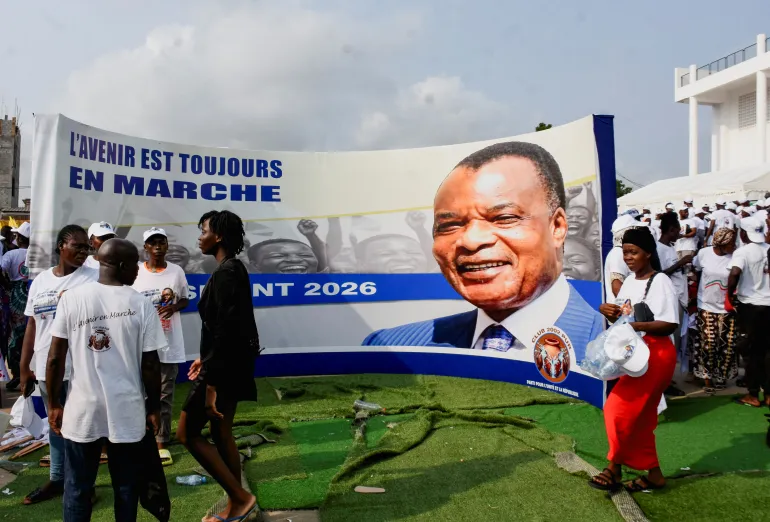
Brazzaville, Republic of Congo – On main roads and public squares across the Congolese capital, posters are up featuring the seven main candidates vying for president.
But at the Moukondo Market in Brazzaville’s fourth district – between lively discussions, people jostling for space and saleswomen trying to attract customers – many voters are less than enthusiastic about this weekend’s election.
Recommended Stories
list of 3 itemsend of list
Fortune, a 27-year-old unemployed university graduate who did not want to give his last name, said he does not expect much to come from the polls.
“When you see how money is spent during the campaign, you wonder if those in power really care about the living conditions of the population,” he said.
While Congo is the third largest oil producer in sub-Saharan Africa, about half the country’s population of about six million people live below the poverty line.
A few metres away, Gilbert, 44, shared similar sentiments. The civil servant explained that his salary is not enough to cover all his household expenses.
“I do odd jobs to supplement my income. At my age, believing that these elections will change our daily lives would be almost suicidal,” he said.
“I’ve known practically the same leader all my life,” Gilbert added. “Some call it stability. Others say that nothing changes.”
It’s a sentiment shared by many in the country: That after 40 years under a single leader, political continuity has become the norm.
President Denis Sassou Nguesso, 82, who is once again standing in the election, first came to power in Congo in 1979. After a period of political transition in the early 1990s, he returned to the presidency in 1997 after a civil war and has ruled the country without interruption ever since.
Two major constitutional revisions have marked his political trajectory. The 2002 constitution and the one adopted in 2015 notably changed certain eligibility requirements, allowing the head of state to continue to run for office.
For Nguesso’s supporters, this political longevity is primarily attributed to the stability the country has managed to maintain in a region often marked by conflict.
Congo’s neighbours include the conflict-racked Central African Republic; Gabon, which witnessed a coup in 2023; and the Democratic Republic of the Congo, where the government is facing armed groups, most notably M23.
In official discourse, peace and institutional continuity are regularly presented as the main achievements of the Nguesso government.
However, several foreign observers painted a more nuanced picture of the political situation. The pro-democracy organisation Freedom House classified Congo as a “not free” country while the Ibrahim Index of African Governance highlighted limited progress in democratic participation and political accountability.

‘Asymmetrical political competition’
In the last presidential election in 2021, the official results gave Nguesso more than 88 percent of the votes cast with a reported voter turnout of 67 percent.
Nguesso is widely expected to win again when the country goes to the polls on Sunday.
Some analysts said the president’s political longevity can be partly explained by the country’s political structure.
Charles Abel Kombo, a Congolese economist and public policy observer, described the political system as a hybrid model.
“The Congolese political system combines formally pluralistic institutions – elections, political parties, parliament – with a high degree of centralisation of executive power,” he explained. “Nguesso’s political longevity can be explained in part by the structure of the institutional apparatus and the predominant role of the executive branch in the management of the state.”
According to him, the continuity of power is also linked to perceptions of stability in a country marked by the conflicts of the 1990s.
“In this historical context, this continuity can be seen as a factor of stability. But it is also accompanied by asymmetrical political competition.” In other words, political change remains theoretically possible but politically difficult.
For the economist, however, the issue goes beyond political change alone.
“The central challenge remains the ability of political actors to propose a credible plan for economic transformation. Countries dependent on natural resources need a strategic state capable of diversifying the economy and guiding productive transformation.”
Other observers took a more critical view of this political longevity.
For economic and political analyst Alphonse Ndongo, the stability often touted by the authorities must be examined with caution.
“There is indeed a stabilising regime because it has succeeded in maintaining peace. This is what is being sold today as the main recipe for success: There is no war, so the country is at peace. But this peace also allows those in power to remain there. We are in a kind of democratic illusion where elections often resemble a deal,” he said.
According to him, the current political architecture makes a change in leadership unlikely in the short term.
“It is difficult for the institutions responsible for managing elections to produce a result that differs from what everyone already expects. Everything is structured, from voter registration to the organisation of the ballot. Under these conditions, a surprising result seems unlikely,” he said.

‘Political alternatives exist’
As the debate continues in Congolese society over whether the country’s political continuity is a mark of stability or a system that is hard to change, the opposition appears fragmented and weakened.
Some established parties are boycotting the vote while some prominent potential candidates are in prison or exile.
In June, the party of opposition leader Clement Mierassa was removed from the official list of recognised political parties.
For him, the conditions for a truly democratic election are not in place.
“We have always called for essential reforms: a truly independent national electoral commission, reliable voter rolls and a law regulating campaign spending,” he said. “Without these guarantees, it is difficult to talk about free and transparent elections.”
Other political actors, however, have chosen to run in the election.
Christ Antoine Wallembaud, spokesperson for candidate Destin Melaine Gavet, said participation remains a way of defending the political space.
“The electoral system has flaws, but that does not mean that those who participate in it condone fraud. Participating also serves as a reminder of the need for reform and shows that a political alternative exists.”
For many observers, access to the media is also a key issue during election campaigns.
“Access to public media remains a recurring problem for opposition candidates. The ruling party candidate always gets the lion’s share even though the High Council for Freedom of Communication has established a list of appearances on state media so that all candidates can present their programmes,” said a Congolese journalist who requested anonymity.
Faced with these difficulties, opposition candidates often turn to private media outlets to spread their messages.
Congolese authorities, for their part, insisted that civil liberties are fully guaranteed for all.
The prime minister and spokesperson for Nguesso, Anatole Collinet Makosso, recently said freedom of opinion and expression “is doing very well”.
“Freedom of expression is alive and well in Congo. The proof is the multitude of foreign journalists here to cover this election. No journalist has been arrested because of their work or prosecuted,” he said.
For the government, this international media presence is evidence of the transparency of the electoral process and the ability of the media to work freely in the country.
However, some press freedom organisations paint a different picture. In its World Press Freedom Index, Reporters Without Borders regularly highlights the difficulties faced by local journalists, particularly in terms of access to public information, political pressure and economic constraints.

Adapting to circumstances
In the working-class neighbourhoods of Brazzaville, reactions to Sunday’s election range from resignation to pragmatism.
In Bacongo, a young man on the street explained that he has learned to adapt to circumstances.
“When the country goes left, we go left. When it goes right, we go right. Doing the opposite can be dangerous,” he said while refusing to give his name.
Beyond the political debate, economic concerns remain central.
The Congolese economy is heavily dependent on oil, which accounts for about 70 percent of its exports and nearly 40 percent of its gross domestic product (GDP), according to the World Bank. This dependence exposes the country to fluctuations in international energy prices.
Public debt has also reached high levels in recent years, exceeding 90 percent of the GDP before being partially restructured under agreements with international creditors.
In this context, several economists said the electoral stakes go beyond the single issue of political change.
Diversifying the economy, creating jobs for a predominantly young population and improving public services are major challenges in the years ahead.
But many Congolese aren’t hopeful that Sunday’s election will make a difference to their material reality because political and economic power will likely remain in the same hands.
“We all understand the system in this country,” Fortune said. “The [economic] crisis doesn’t affect everyone, nor does poverty.”