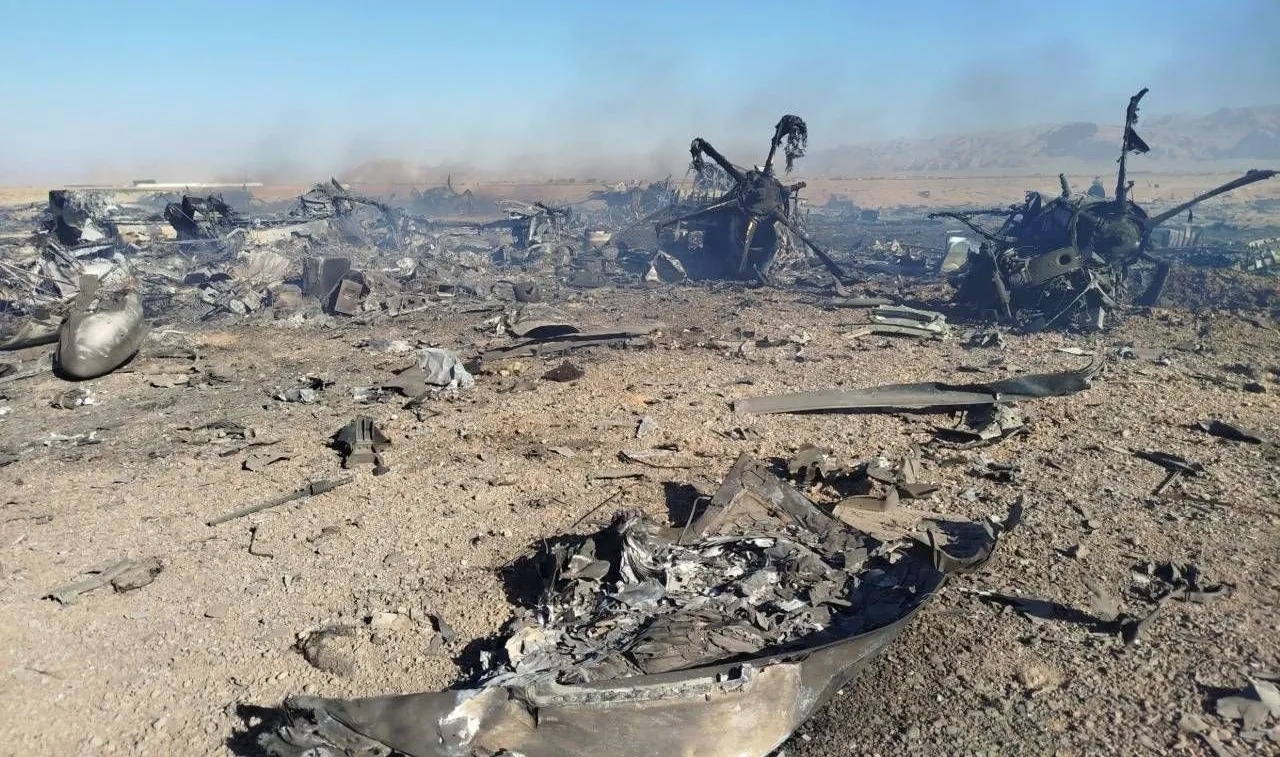
New images have emerged that appear to show the destroyed special operations C-130s (MC-130Js Commando IIs) at the forward improvised airfield in Iran. The austere operating location acted as a hub (and forward arming and refueling point or FARP) for the rescue mission of the downed F-15E Weapon System Officer. You can read our latest coverage on the rescue here. It has been reported that the two C-130s were demolished in place as they were incapable of departing, with three more aircraft coming in and extracting the special operations force. Amongst this wreckage appears to be two burned-out wrecks of MH-6/AH-6 Little Birds of the 160th Special Operations Aviation Regiment, better known as the Night Stalkers.

As is typically the case, the images of the crash site look authentic after a cursory examination, but that could change in the future.

Here we see a destroyed Little Bird on the right, with the hulk of a C-130 to the left.
A closer look at the destroyed H-6.
The burned-out C-130 is seen in the background with a rotor mast of an H-6 in the foreground.
The debris field appears quite large.

These helicopters, if in AH-6 configuration, were likely delivered to the landing site to provide close air support and force protection for the larger force deployed there. Reports now state that there may not have been a major firefight on the ground as originally reported, but Iranians were fired upon from the air when trying to approach the base. Video supposedly showing one of these engagements does look like the firing aircraft could be an AH-6.

A U.S. Army AH-6 Little Bird in support of Marine Aviation Weapons and Tactics Squadron One (MAWTS-1) fires rockets at designated targets during an offensive air support exercise at Mt. Barrow, Chocolate Mountain Aerial Gunnery Range, Calif., April 5, 2016. The exercise is part of Weapons and Tactics Instructor (WTI) 2-16, a seven-week training event hosted by Marine Aviation Weapons and Tactics Squadron One (MAWTS-1) cadre. MAWTS-1 provides standardized tactical training and certification of unit instructor qualifications to support Marine Aviation Training and Readiness and assists in developing and employing aviation weapons and tactics. (U.S. Marine Corps photograph by SSgt. Artur Shvartsberg, MAWTS-1 COMCAM/Released)
A U.S. Army AH-6 Little Bird in support of Marine Aviation Weapons and Tactics Squadron One (MAWTS-1) fires rockets at designated targets during an offensive air support exercise at Mt. Barrow, Chocolate Mountain Aerial Gunnery Range, Calif., April 5, 2016. (U.S. Marine Corps photograph by SSgt. Artur Shvartsberg, MAWTS-1 COMCAM/Released) Gunnery Sgt. Artur Shvartsberg

Heavy clashes have been reported in Dehdasht, a city in the Central District of Kohgiluyeh County, where the second American pilot was reportedly spotted. pic.twitter.com/DDleOptrfD

— Afshin Ismaeli (@Afshin_Ismaeli) April 5, 2026

The Little Birds could have also been used to help find and support the extraction of the pilot if in MH-6 configuration. Little Birds can be configured in the AH-6 attack and MH-6 assault configurations.

123rd Special Tactics Squadron operators load onto an MH-6 Little Bird during Exercise Agile Chariot, May 2, 2023, honing capabilities linked to Agile Combat Employment. Instead of relying on large, fixed bases and infrastructure, ACE uses smaller, more dispersed locations and teams to rapidly move and support aircraft, pilots, and other personnel to wherever they are needed. There are millions of miles of public roads in the United States, including federal, state, and local roads – with Agile Combat Employment, including Forward Arming and Refueling Point (FARP) and Integrated Combat Turnarounds (ICT), it becomes millions of miles of public landing zones, when necessary. (U.S. Air Force photo by Tech. Sgt. Carly Kavish)
123rd Special Tactics Squadron operators load onto an MH-6 Little Bird during Exercise Agile Chariot, May 2, 2023, honing capabilities linked to Agile Combat Employment. (U.S. Air Force photo by Tech. Sgt. Carly Kavish) Tech. Sgt. Carly Feliciano

The force protection role for exactly this kind of mission is a key one for the AH-6. Night Stalker AH-6 crews train heavily for it. The Little Birds can be rapidly delivered to forward locations aboard aircraft as small as a C-130, but it’s their ability to be rolled out and flying in mere minutes that suits them so well for this mission set. The MC-130 can act as transport, weapons hauler and a gas station on the ground for the Little Birds.

You can read all about the Little Bird’s ability to be rapidly deployed virtually anywhere in our past feature linked here.

An AH-6 is rolled off an MC-130. These aircraft can be in the air in minutes, not hours, after leaving the cargo hold of transport aircraft. (DoW) Airman 1st Class Joseph Pick

The Little Birds could possibly have flown directly to the site, and then refueled from MC-130J on the ground and operated out of the makeshift base, although the range on these aircraft is limited, even with auxiliary fuel tanks. Even flying from Kuwait or a commercial ship in the northern Persian Gulf, a direct flight over Iranian airspace would have been very risky and required much of the Little Bird’s range. Overall, this option seems very likely.

Airmen from the Kentucky Air National Guard’s 123rd Special Tactics Squadron prepare to conduct combat search-and-rescue from an MH-6M Little Bird that was offloaded from a MC-130J Commando II during Exercise Agile Chariot near Riverton, Wyoming, May 2, 2023. Agile Chariot tested Agile Combat Employment capabilities, including using smaller, more dispersed locations and teams to rapidly move and support aircraft, pilots and other personnel wherever they’re needed. (U.S. Air National Guard photo by Master Sgt. Phil Speck)
Airmen from the Kentucky Air National Guard’s 123rd Special Tactics Squadron prepare to conduct combat search-and-rescue from an MH-6M Little Bird that was offloaded from a MC-130J Commando II during Exercise Agile Chariot near Riverton, Wyoming, May 2, 2023. (U.S. Air National Guard photo by Master Sgt. Phil Speck) Philip Speck

As to why the Little Birds were destroyed in place, that isn’t clear. Extracting the force was likely done in a big hurry, especially due to the immobilization of two C-130s. If the Little Birds flew in aboard them, there may have been no time (or room) to load them onto the replacement aircraft. They could have also been damaged by enemy fire. If they flew in directly themselves, the mission may not have gone as planned and they could not be fueled while on the ground by the stricken MC-130s. There are many possibilities.

Destroying stranded special operations aircraft is absolutely critical as they are packed with sensitive sensors, communications, defensive systems and more.

Regardless, the inclusion of the Little Birds is another indication of just how complex this mission, which was thrown together in just a matter of hours, was. It’s also a reminder of just how versatile and forward deployable the MH/AH-6s truly are.

UPDATE: 6:02 AM PDT—

The landing zone has been geolocated to just south of Isfahan. This puts it about 200 miles from the Iranian coastline and roughly 230 miles from a land border. It is very unlikely the Little Birds made this trip on their own (can rule it out almost entirely) beyond the tactical issues with doing so.

Location of the USAF forward base set up deep within Iran for the F-15 crew rescue mission.

The base was set up just outside of Isfahan, a critical Iranian strategic hub with missile and army bases, nuclear facilities, and the airbase home to Iran’s F-14 fleet. pic.twitter.com/ax0NIIlbKs

— OSINTtechnical (@Osinttechnical) April 5, 2026

Contact the author: Tyler@twz.com

Tyler’s passion is the study of military technology, strategy, and foreign policy and he has fostered a dominant voice on those topics in the defense media space. He was the creator of the hugely popular defense site Foxtrot Alpha before developing The War Zone.


Source link

Leave a Reply

Discover more from Occasional Digest

Subscribe now to keep reading and get access to the full archive.

Continue reading