Weekly insights and analysis on the latest developments in military technology, strategy, and foreign policy.
The U.S. Air Force has stood up a new squadron at Andrews Air Force Base to manage the arrival of HH-60W Jolly Green II helicopters to replace aging UH-1N Twin Hueys. Originally designed for combat search and rescue (CSAR) missions, the HH-60Ws assigned to the 5th Helicopter Squadron will be in a specialized configuration to take on the tasks of ferrying VIPs around the nation’s capital and supporting continuity of government plans. Questions have been raised about using Jolly Green IIs in these roles, and how this may impact the ability of the overall fleet of these helicopters to meet CSAR demands.
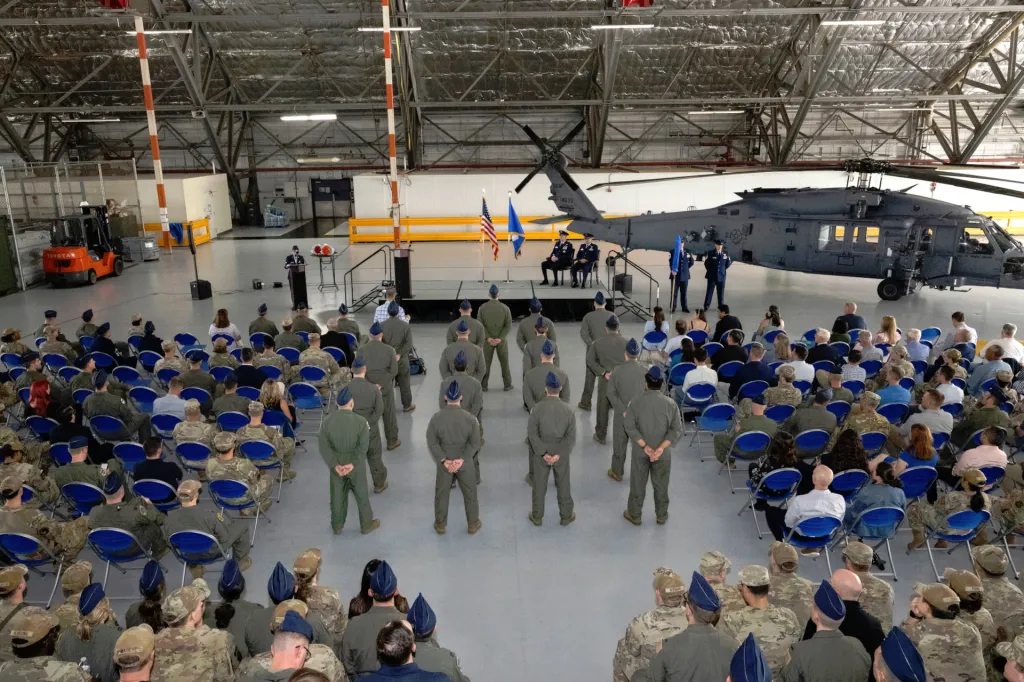
The Air Force held a ceremony at Andrews yesterday to mark the formal activation of the 5th Helicopter Squadron, also sometimes abbreviated as 5 HS. The 1st Helicopter Squadron (1 HS), with its UH-1Ns, will continue to operate throughout the transition to the HH-60W, which is expected to be completed in 2030, to avoid any gaps in capacity to meet critical operational requirements. A total of 26 Jolly Green IIs are set to be based at the facility, which is situated just outside Washington, D.C., a one-for-one replacement for the Twin Hueys that are there now. The arrival of the new helicopters will also lead to a small increase in total personnel, 60 in total, at Andrews.
A view from yesterday’s ceremony marking the activation of the 5th Helicopter Squadron at Andrews. An HH-60W Jolly Green II is seen at top right. USAF
The Air Force originally planned to supplant all of its UH-1Ns worldwide with new MH-139 Grey Wolf helicopters, which is a more direct replacement in terms of size and capability. The service is still acquiring MH-139s to supplant UH-1Ns elsewhere, including ones assigned to Air Force Global Strike Command (AFGSC) units that help provide security around Minuteman III intercontinental ballistic missile (ICBM) silos. We will come back to this later on.
The first Air Force Global Strike Command (AFGSC) MH-139A at Malmstrom Air Force Base in Montana, with a UH-1N seen flying in the background. USAF The first AFGSC MH-139A at Malmstrom Air Force Base in Montana, with a UH-1N seen flying in the background. USAF
“The HH-60W’s increased speed, range and carrying capacity will better deliver safe operations for U.S. senior leaders, service members, and the communities around the region,” the Air Force said in a press release regarding the 5th Helicopter Squadron’s activation.
The Jolly Green II also has in-flight refueling capability, something that is not found on the UH-1N or MH-139, and could be very valuable for missions around Washington, D.C. The HH-60Ws heading to Andrews are set to receive additional modifications, including to the main cabin seating arrangement, communications suite, and defensive capabilities, as you can read more about here.
Combat Rescue Helicopter Successfully Executes Major Test Milestone: Aerial Refueling
Graphics depicting how the HH-60W’s cabin can be configured now for CSAR missions. Lockheed Martin
“In the next few years, the 5 HS will train aircrew and maintainers, establish operational and maintenance processes, and receive new aircraft as it prepares to execute the national security mission within the National Capital Region,” the release yesterday added.
National Capital Region (NCR) refers to a larger area that surrounds Washington, D.C., proper. Air Force operations in and around the NCR are primarily managed through a unit called the Air Force District of Washington (AFDW).
The HH-60Ws will be taking over an AFDW mission set from the UH-1Ns that currently includes daily airlift sorties transporting U.S. and foreign VIPs around the nation’s capital. The helicopters will also be in position to swing into action as part of continuity of government plans. In such a scenario, the Jolly Green IIs would be tasked to help rush senior officials and lawmakers to safety to ensure the continued functioning of federal authorities following an attack or a similarly serious contingency. 1st Helicopter Squadron’s role in responding to the terrorist attack on the Pentagon on 9/11 was highlighted during the activation ceremony at Andrews yesterday.
A stock picture of 1st Helicopter Squadron UH-1Ns. USAF
The NCR presents particular challenges for crisis response missions and routine day-to-day flight operations. The airspace around Washington, D.C., is most densely defended and heavily monitored anywhere in the United States, and packed full of military and civilian air traffic every day. Where and when military helicopters can operate over the nation’s capital has been a hot topic of debate since a fatal mid-air collision involving an Army UH-60 Black Hawk and a PSA Airlines Bombardier CRJ700 regional jet in January 2025. The Black Hawk was conducting a continuity of government training flight at the time. This has been more recently highlighted by an incident involving a Marine One helicopter carrying President Donald Trump earlier this month. A subsequent Federal Aviation Administration (FAA) investigation has highlighted communication issues and factors tied to the construction of a new helipad at the White House.
It is also worth noting here that Marine Helicopter Squadron One (HMX-1), the primary unit responsible for the Marine One presidential helicopter mission, would play a role in any continuity of government scenario in the NCR. Helicopters from the U.S. Park Police, as well as ones belonging to other law enforcement and civilian agencies, would be utilized, too.
Military and police helicopters land at the US Capitol this evening.
As mentioned, there are significant questions about the impacts of basing HH-60Ws at Andrews will have on the rest of the Air Force’s Jolly Green II fleet. This is something TWZ highlighted when the Air Force confirmed it was moving ahead with the AFDW HH-60W plan with the release of its 2027 Fiscal Year budget request earlier this year.
A particular issue is the Air Force’s decision years ago to scale back total purchases of HH-60Ws, from 113 helicopters down to 91. If the service does not order more Jolly Green IIs in the coming years, this will mean that roughly a third of the entire fleet will be assigned to the AFDW mission.
Up close with the HH-60W Combat Rescue Helicopter at Nellis AFB for The War Zone.
The Air Force previously confirmed the plan will involve taking HH-60Ws out of “back up inventory.” In the past, the service has defended this decision as being “more cost effective” than a move to “procure additional MH-139A aircraft” to meet AFDW requirements. Whether or not there were other specific operational considerations that factored into the decision to use Jolly Green IIs to meet these needs instead is unknown. The acquisition plan for the Grey Wolf has also been significantly truncated, with the Air Force now planning to buy just 56 of these helicopters instead of 80.
“The MH-139A Grey Wolf was competitively selected to replace the UH-1N for intercontinental ballistic missile security and National Capital Region missions, including continuity of government and transport of United States government officials and security forces,” members of the House Armed Services Committee wrote in a report accompanying a draft of the annual policy bill, or National Defense Authorization Act (NDAA), for the 2027 Fiscal Year, back in May. “The committee remains concerned regarding the justification for transitioning these missions to an alternate rotary-wing platform and seeks additional details on cost and operational implications.”
At that time, the House Armed Services Committee explicitly directed “the Secretary of the Air Force to submit a report to the congressional defense committees not later than December 1, 2026, assessing operational, cost, infrastructure, and readiness impacts of assigning any non-MH-139A rotary-wing aircraft to continuity of government and transport of United States government officials and security forces in the National Capital Region.” The lawmakers stressed that the report had to include “a comparison of procurement cost, cost per flight hour, infrastructure and aircraft modification requirements, and training and manpower impacts” and an assessment of the cost, schedule, and operational disruption associated with required upgrades to Joint Base Andrews facilities for each aircraft type.”
Separate questions have been raised in recent years about the utility of traditional CSAR helicopters in future operations, especially in the context of a high-end fight, such as one between the United States and China in the Pacific. Air Force officials openly talked about exploring alternatives for rescuing aircrew downed deep inside contested environments, but details about those plans remained limited.
At the same time, demand for traditional CSAR capabilities has certainly not gone away entirely. This was underscored by the operation to retrieve the crew of an F-15E Strike Eagle that went down inside Iran in April. HH-60Ws were part of the larger force package sent into Iranian airspace to help recover those aviators.
Wild footage from a USAF C-130 fueling two helicopters over Iran shared by telegram channels. The cars & the dialect are Iranian and from southwest. pic.twitter.com/K9cufOOY26
In the meantime, the Air Force’s UH-1Ns, a type the service first began operating in the early 1970s. are only getting older and harder to sustain, too. Three of the UH-1Ns currently assigned to 1st Helicopter Squadron saw combat during the Vietnam War. Just last week, one of the unit’s Twin Hueys made a precautionary landing in an open field in Maryland “after experiencing unusual mechanical noise” while on a training flight. This is hardly the first time such an incident has occurred.
There is a possibility that Congress could more directly intervene in the Air Force’s move to start flying HH-60Ws around Washington, D.C. With the expectation that UH-1Ns will remain in service at Andrews for another four years, there is time for the service’s own plans to evolve further.
With the activation of 5th Helicopter Squadron, the Air Force has now taken an important step toward an all-new helicopter force in the nation’s capital.
The helicopter sleeps two guests with prices starting from £50 a night, which is just £25 per person per night.
Inside the helicopter you’ll find a double sofa bed, TV, mini fridge and a kettle.
Station Masters House, Scottish Borders
Or stay in an old train station in the Scottish BordersCredit: Sykes Holiday Cottages
Switching from one mode of transport to another, you could stay inside a train station house in the Scottish Borders.
Known as Station Masters House, Saughtree Station used to once be a working train station and to get to the house, you have to head along the original platform and once inside you’ll find a spacious kitchen as well as a lounge with a Smart TV.
There’s then three bedrooms in total – one on the ground floor, and then another double and twin room – while outside there is also a patio area ideal for soaking up the sunshine.
Stays cost from £531 per night, which would work out at £88.50 per person per night.
The Old Chapel, Herefordshire
In Hertfordshire, you could stay in an old chapelCredit: Sykes Holiday Cottages
The Old Chapel is a two bedroom converted chapel, surrounded by countryside.
Inside, you’ll find an open-plan living space with a Smart TV, as well as two bedrooms.
Both rooms have an ensuite as well and there is an outside area with a lawn, patio and furniture.
Stays cost from £146 per night, though there is a minimum stay of four nights.
Tree House near Aberaeron, Ceredigion
If you dreamt of having a tree house as a kid, then you can stay in one near AberaeronCredit: Sykes Holiday Cottages
If you always dreamed of having a tree house when you were a little kid, now is your chance to (sort of) live out that dream.
Tree House near Aberaeron in Ceredigion, Wales, is what it says on the tin – a tree house in the woods, with an open-plan airy living area.
There is one double bed and a sofa bed, ideal if also with kids.
Outside the tree house there is even a small veranda and also a hot tub.
Nant y Garnedd, North Wales & Snowdonia
Lords of the Rings fans should head to Nant y Garnedd in WalesCredit: Sykes Holiday Cottages
If you are a fan of Lord of the Rings, make sure to head to Nant y Garnedd in Wales.
Somewhat resembling a hobbit hut, you can stay in a single storey hut built into the hillside.
The accommodation sleeps up to four people, has its own little kitchen and lounge as well as an outdoor area.
Bookings must be a minimum of three nights, which costs from £689 – working out at £229.67 per night.
Sprat & Winkle, Horsebridge
If a train station wasn’t enough, you can stay in an old train carriage as wellCredit: Booking
Sprat and Winkle is a converted 1922 railway carriage that sleeps up to four guests.
Inside, there are two bedrooms with ensuite shower rooms, a living area and a small kitchen.
Just a short walk away is a pub too, in case you fancy a tipple – if not, you can soak up the sunshine in the garden.
There’s a minimum stay of three nights, which costs from £538, working out at £179.34 per night.
Fingal Hotel, Edinburgh
In Edinburgh, you can stay in a permanently docked shipCredit: Booking
Fingal Hotel in the Scottish capital isn’t your regular hotel – instead you will be sleeping on a boat.
Complete with a sun terrace, restaurant and bar onboard, you’d be staying on a former Northern Lighthouse Board ship that is permanently docked in the Port of Leith.
There are 23 custom designed cabins onboard as well as Art Deco styling throughout.
A one-night stay for two adults costs from £279.
Cley Windmill, Holt
You could even stay in a windmill in HoltCredit: Booking
If none of the above tickle your fancy, you could stay inside a windmill.
Cley Windmill in Holt is both historic and pretty, with its own terrace and garden.
Inside, you will find rooms with their own bathrooms, as well as a restaurant and bar.
Rooms cost from £150 per night for two adults (£75pp), with breakfast included.
Hocus Pocus Tiny Hotel, York
Hocus Pocus Tiny Hotel in York is great for fans of all things magicCredit: Booking
Love all things witchy? Check in to the Hocus Pocus Tiny Hotel in York.
Found inside a historic building in the city centre, the hotel has a range of rooms including family options.
You can expect quirky details, stone walls, historic paintings and four poster beds.
The ultra-luxury cruise ship recently docked in London for the first time so I went to see what passengers can expect from a holiday that includes two helicopters and a submarine
The Scenic Eclipse II isn’t your average cruise ship(Image: Natalie King)
As a travel journalist, I often have to convince people that my life isn’t all glitz and glamour, but it was difficult to argue my case as I sat drinking champagne on a six-star cruise ship.
The Scenic Eclipse II docked for the first time in London last month, and I got the chance to have a nosey around and see what life is like onboard this luxury vessel. Coming out of the very unglamorous tube, I immediately spotted the boat moored just off of Greenwich Pier, looking more like the kind of superyacht you’d see in the waters of Monaco than in the murky Thames.
While many cruise lines compete to build bigger and bigger ships, Scenic Eclipse II has focused on quiet luxury and an exclusive experience for those onboard. Only 228 guests can board each of its voyages, (200 if it’s visiting polar waters) and with a staff ratio of nearly 1:1, service is incredibly personal. Each of its 114 suites comes with butler service, and the layout means everyone gets a veranda where they can enjoy the views. Which is handy, because the ship visits plenty of places where you’ll need a good camera.
Our group took a quick, if choppy, Thames Clipper service across to the Scenic, and were relieved to step onto its much more stable floors. As soon as you step onboard, you definitely feel the luxury vibes, and it felt more like the lobby of a five-star hotel than a cruise ship. Sipping a glass of champagne in the plush lounge, and taking a sneaky peek at the top shelf drink selection for all-inclusive guests, I started to make a plot to stowaway on the ship.
But I settled for a sneaky peek around its deluxe rooms instead. Firstly, to one of the top decks to see the vast Owner’s Penthouse Suites, set at the front of the ship so you get to make the most of the views, presumably while soaking in your private spa tub while the butler tops up your drink. It had a plush bedroom area, huge living room with its own bar, and walk in-closets where you can store all your best cruising outfits for black tie galas.
You certainly won’t be slumming it if you opt for one of the lead-in Verandah Suites. These have a king-size bed, a curtained off living area, and marble en-suite bathrooms, and even the ‘basic’ level rooms on this ship get butler service, in-room dining, and much more included.
Of course, nobody goes on a cruise just to sit in their room, and Scenic Eclipse II is clearly for cruisers who have a more adventurous side. Passengers can book trips on one of the ship’s two helicopters, or even get onboard its submersible to explore the deepest waters with 360-degree views. The relatively small size of the ship compared to many mega cruise ships mean it can also visit a wider variety of places, and its itineraries range from Antarctic adventures to relatively tame Mediterranean voyages.
One feature that I found really fun was that the navigation deck would be kept open for the duration of the cruise, so you can pop along and chat to crew members, see the equipment up close, and live out your fantasies of being captain. But sadly, they won’t let you press the buttons.
A team of 38 chefs onboard means you have a huge range of culinary options for a relatively small ship, about 10 all-inclusive choices overall from lounges with snacks and coffee to impressive Italian, fine French dining, a sushi counter, and a Teppanyaki grill experience.
Add to this a couple of pools, an incredible spa with a gym and yoga room, and a plush lecture theatre offering a program of talks as well as workshops and entertainment, and I can’t imagine you’d ever get bored during your cruise.
After leaving Greenwich, the Scenic Eclipse II is made its way to Hamburg, continuing through Ostend, Belgium, before cruising the Elbe River. This five-night itinerary starts at £4,4951 per person.
The specifications of the ship mean it has plans to visit some of the world’s most extreme environments in the future, including Antarctica and the Arctic, as well as classic Mediterranean destinations, Oceania, and the remote archipelagos of South East Asia and Indonesia. Find out more about Scenic Cruises here.
Have a story you want to share? Email us at webtravel@reachplc.com
Weekly insights and analysis on the latest developments in military technology, strategy, and foreign policy.
Helicopters played a major role in this year’s Rim of the Pacific (RIMPAC) sinking exercise (SINKEX), with at least three allied rotorcraft types employing weapons against retired U.S. Navy vessels. U.S. Army AH-64 Apache attack helicopters fired Spike NLOS (Spike Non-Line of Sight) missiles at the guided missile cruiser ex-USS Mobile Bay, a Royal New Zealand Navy SH-2G(I) Seasprite struck the amphibious assault ship ex-USS Peleliu with an AGM-119 Penguin missile, a Royal Australian Navy MH-60R Seahawk launched an AGM-114N Hellfire missile against a target ship, and an Italian Navy SH-101 helicopter launched a Marte anti-ship missile.
WATCH: Ships and aircraft participating in the Exercise RIMPAC 2026 conducted a sinking exercise and sank decommissioned USS Mobile Bay (CG 53) on July 12 and decommissioned USS Peleliu (LHA 5) on July 17, more than 50 nautical miles off Kauai.https://t.co/dNmo55FsUJpic.twitter.com/C6mlma8YiJ
Collectively, the engagements underscored how helicopters are emerging as key contributors to distributed maritime strike, complementing fighters, warships, submarines, and land-based missile batteries with precision-guided anti-ship weapons.
The Apache strike, conducted July 11, saw AH-64s assigned to the 16th Combat Aviation Brigade, 7th Infantry Division, Multi-Domain Command–Pacific engage the former Ticonderoga-class cruiser ex-USS Mobile Bay during the live-fire SINKEX. The Army’s previous demonstration of an Apache destroying a much smaller boat with a Spike NLOS was something TWZ was first to report, but employing the weapon against a full-sized cruiser during the world’s premier maritime exercise marks another significant milestone in the service’s expanding maritime mission.
A major impact on the side of the ex-USS Mobile Bay during a sinking exercise (SINKEX) at RIMPAC 2026. U.S. Navy screencapThe ex-USS Mobile Bay sinks below the waves, as seen from an attack submarine’s periscope. U.S. Navy screencap
The Apache’s participation in RIMPAC reflects the Army’s steadily growing role in maritime operations across the Indo-Pacific. Long associated with close air support and anti-armor missions, the AH-64 is increasingly being tasked with engaging naval targets. This is something that has also played out in recent combat operations against Iran.
Spike NLOS has emerged as one of the key tools enabling that mission. The Israeli-developed missile provides an operator-in-the-loop datalink that allows course corrections and aimpoint refinement throughout much of the missile’s flight. That capability makes it particularly useful against moving or time-sensitive maritime targets, where target discrimination and battle damage assessment can be especially challenging.
AH-64 fires Spike NLOS during integration tests at the U.S. Army Yuma Proving Ground in 2023:
Spike missile integrated into AH-64 at Yuma Proving Ground
Compared with the AGM-114 Hellfire and AGM-179 Joint Air-to-Ground Missile (JAGM), Spike NLOS dramatically extends the Apache’s reach while retaining the flexibility to engage both land and maritime targets.
According to manufacturer Rafael, the latest version of Spike NLOS has a maximum range of roughly 20 miles, giving it a substantial stand-off advantage over the Hellfire and JAGM. The variants of those weapons currently fielded on U.S. Army Apaches have maximum ranges of less than 10 miles, though they are typically employed at considerably shorter distances in operational use. At the same time, extended-range versions of both missiles have been demonstrated, with Hellfire tested at approximately three times its standard range and JAGM at roughly double its baseline reach.
A U.S. Army graphic gives an idea of how much more reach the Spike NLOS gives Apaches compared to other weapons options, including the extended-range JAGM. U.S. Army
The Royal Australian Navy’s contribution highlighted another facet of the growing helicopter anti-ship mission. An MH-60R Seahawk embarked in the Arleigh Burke class destroyer USS Wayne E. Meyer conducted a live AGM-114N Hellfire engagement against a target ship. While Hellfire lacks the standoff reach of Spike NLOS and is primarily associated with engaging smaller surface vessels, it remains a highly capable maritime strike weapon and is a standard part of the MH-60R’s surface warfare arsenal.
Imagery released by the New Zealand Defense Force showed a Royal New Zealand Navy SH-2G(I) Seasprite embarked aboard the Anzac class frigate HMNZS Te Mana launching an AGM-119 Penguin anti-ship missile against the decommissioned amphibious assault ship ex-USS Peleliu. According to the NZDF, the missile penetrated the hull before detonating inside the vessel, inflicting significant internal damage and compromising its integrity.
Launch of an AGM-119 Penguin anti-ship missile from a Royal New Zealand Navy SH-2G(I) Seasprite helicopter. New Zealand Defense ForceNew Zealand Defense ForceThe ex-USS Peleliu after being hit by an AGM-119 Penguin anti-ship missile and other weapons. New Zealand Defense Force Sargentina, Scott
The Italian Navy also revealed that an SH-101 helicopter embarked aboard the multirole combat ship Giovanni delle Bande Nere launched a Marte anti-ship missile during RIMPAC 2026, although it did not specify which target the missile was fired against.
Together, the Apache, Seahawk, Seasprite, and SH-101 illustrated just how diverse helicopter-based maritime strike has become. Although each of the weapons described above is optimized for different targets and mission profiles, all three point toward helicopters assuming an increasingly prominent role in coalition anti-surface warfare operations.
The U.S. Army’s maritime application for Spike NLOS aligns closely with the Army’s Multi-Domain Operations concept, which increasingly envisions aviation units contributing to sea-denial missions alongside their more traditional roles. Apache crews have repeatedly demonstrated maritime strike capabilities during exercises across the Pacific, and RIMPAC provides one of the largest and most complex venues yet to refine those tactics alongside allies and partners.
A U.S. Army AH-64 helicopter assigned to 25th Combat Aviation Brigade, 25th Infantry Division, prepares to land aboard the Wasp class amphibious assault ship USS Essex as part of RIMPAC 2026 in the Pacific Ocean, July 19, 2026. U.S. Army photo by Sgt. Olivia Cowart
Beyond the Army’s work with Spike NLOS, the U.S. Marine Corps has been experimenting with arming its AH-1Z Viper attack helicopters with small cruise missiles, dramatically expanding their reach and giving them the ability to strike ships from well beyond the range of traditional helicopter-launched weapons. Above all else, it’s yet another example of the attack helicopter’s changing role in the maritime environment.
Although helicopters featured prominently, they represented just one layer of the larger SINKEX strike package.
Video released this week also showed a U.S. Navy F/A-18F Super Hornet carrying AGM-158C Long Range Anti-Ship Missiles (LRASM), along with live launches from U.S. Army M142 High Mobility Artillery Rocket System (HIMARS) and Japan Ground Self-Defense Force Type 12 coastal defense missile batteries. U.S. Navy P-8 Poseidon maritime patrol aircraft were also seen supporting the event. Based on the imagery that has been published, submarines were also involved in the SINKEX strikes. Full details of which weapons and platforms ultimately sent which retired ships to the bottom remain unclear, and TWZ has asked officials for additional information.
An AGM-158C Long Range Anti-Ship Missile (LRASM) under the wing of a U.S. Navy F/A-18F Super Hornet. U.S. Navy screencapLaunch of a rocket from a U.S. Army M142 High Mobility Artillery Rocket System (HIMARS). U.S. Navy screencap
As well as the decommissioned Ticonderoga class guided missile cruiser, the Tarawa class amphibious assault ship ex-USS Peleliu also served as a SINKEX target. As we have discussed previously, the pair represented two very different classes of major warship, providing participants with valuable opportunities to employ and evaluate a wide range of anti-ship capabilities.
An impact on the Tarawa class ex-USS Peleliu amphibious assault ship. U.S. Navy screencap
Live-fire events like RIMPAC’s SINKEX remain among the most valuable aspects of the exercise, providing opportunities that are difficult to replicate in synthetic training environments. They allow participating forces to observe weapon performance against full-sized ships, refine targeting procedures, and integrate air, sea, and land-based fires while operating within a coalition framework.
RIMPAC 2026 brings together 30 nations, more than 30 surface ships, five submarines, 15 national land forces, over 206 aircraft, and approximately 30,000 personnel operating in and around the Hawaiian Islands from June 24 through July 31. Now in its 30th iteration since beginning in 1971, RIMPAC remains the world’s largest international maritime exercise, designed to improve interoperability while strengthening the partnerships that underpin maritime security and freedom of navigation across the Indo-Pacific.
While long-range anti-ship missiles launched by fighters, warships, submarines, and coastal batteries remain central to modern naval warfare, this year’s RIMPAC SINKEX also demonstrated that helicopters are increasingly indispensable members of the maritime strike team. Whether armed with Spike NLOS, Hellfire, Penguin, or Marte missiles, allied rotorcraft showed they are increasingly expected to contribute directly to the joint force’s anti-ship kill chain. For a region where distributed operations and coalition interoperability are becoming ever more important, that evolution is likely only to accelerate.
Weekly insights and analysis on the latest developments in military technology, strategy, and foreign policy.
The Senate Armed Services Committee believes that the U.S. Air Force is currently unable to support combat search and rescue (CSAR) operations “in a major contingency.” Legislators say they are concerned about the CSAR force structure after the Air Force trimmed its buy of HH-60W Jolly Green II helicopters and also elected to transfer some of these aircraft to the so-called Air Force District of Washington (AFDW) mission set, as you can read about here. This comes on top of concerns that the HH-60W fleet isn’t well suited for the realities of a war in the Pacific while no better solution is being sought.
The Senate Armed Services Committee released a full copy of the proposed legislation earlier this week. In this, it states that it is “concerned about CSAR force structure” in the Air Force.
Up close with the HH-60W Combat Rescue Helicopter at Nellis AFB for The War Zone.
Now, the committee points to the Air Force’s decision to truncate its buy of heavily modified HH-60Ws, followed by the transfer of 26 of these from CSAR units to the AFDW to replace UH-1N Twin Huey helicopters. AFDW uses these helicopters to support continuity of government plans, contingency response, homeland operations, and ceremonial honors in the National Capital Region. Under normal circumstances, the vast majority of AFDW missions involve VIP movements.
A UH-1N Huey assigned to the 1st Helicopter Squadron at Joint Base Andrews, Maryland, flies over Washington, D.C., during training, March 31, 2026. U.S. Air Force photo by Staff Sgt. Aubree Owens
“The committee believes that these actions have left CSAR forces unnecessarily short of the forces needed to support CSAR operations in a major contingency,” the legislators say. The committee has now called upon the Secretary of the Air Force to conduct a study of CSAR requirements and capabilities, including HH-60Ws and HC-130J Combat King IIs, and provide a report briefing to Congress before the end of March 2027.
Until that study is completed, the committee has called upon the Secretary of the Air Force to avoid making any more changes in CSAR force structure.
The Air Force had once planned to replace its AFDW UH-1Ns with new MH-139A Grey Wolf helicopters, but revealed last year it was considering using HH-60Ws for this role instead. The Air Force’s proposed budget for the 2027 Fiscal Year confirmed that it was moving ahead with these plans.
A U.S. Air Force MH-139A Grey Wolf assigned to the 40th Helicopter Squadron conducts its first operational mission at Malmstrom Air Force Base, Montana, January 8, 2026. U.S. Air Force photo by Airman 1st Class Teniya Caldwell
As we have discussed in the past, the HH-60W will bring a substantial increase in speed, range, and payload capacity compared with the aging UH-1Ns now flying AFDW missions, while also outperforming the smaller, lighter MH-139 in each of those key metrics.
The Air Force’s current plan calls for development of the HH-60W AFDW variant to begin in Fiscal Year 2027, starting October 1, with the first aircraft entering modification the following fiscal year. Those reconfigured Jolly Green IIs would then begin replacing the increasingly outdated UH-1Ns assigned to the AFDW mission at Andrews Air Force Base (now part of Joint Base Andrews).
TWZ had previously raised the question of how the transfer of 26 HH-60Ws for the AFDW role might affect the operational capacity of the rest of the CSAR-focused fleet.
In particular, the Air Force has no plans to procure additional Jolly Green IIs despite the upcoming transfer.
As the Senate Armed Services Committee points out, the Air Force already decided to scale back HH-60W purchases, from an original program of record for 113 of the helicopters. The total planned fleet now stands at 91. This amounts to the CSAR fleet losing roughly 30 percent of its entire Jolly Green II fleet, the first of which began entering Air Force service in 2022.
A U.S. Air Force HC-130J Combat King II prepares to refuel an HH-60W Jolly Green II during a training mission near Nellis Air Force Base, Nevada, April 24, 2026. U.S. Air Force photo by Airman 1st Class Jennifer Nesbitt
The legislators point to the ongoing demand for CSAR capabilities, not just in lower-end conflicts such as the war with Iran, but especially in potential future high-end fights, such as one between the United States and China in the Pacific, where aircrew losses would be greater by an order of magnitude.
For years, TWZ has warned that the growing reach and sophistication of modern air defenses are calling into question the viability of traditional fixed-wing and helicopter CSAR missions. In a high-end conflict, especially against China in the Pacific, even stealth aircraft are expected to face significant risks inside contested airspace. The idea that a Black Hawk helicopter, no matter what is bolted onto it, is going to survive in that same environment is highly questionable, and that’s if it can even reach the rescue point at all. The distances involved in the Pacific are far greater than those in Europe or the Middle East, which the legacy CSAR fleet was largely optimized around.
Back in 2023, one of the Air Force’s senior procurement officers asserted that the HH-60W fleet would not be “particularly helpful in the Chinese area of operations” due to these reasons. The Air Force’s cuts to planned purchases of HH-60Ws reflected this reality, while other senior officials have acknowledged that the service will need to rethink how it carries out this critical mission in future wars. The issue is that the cuts didn’t result in other capabilities taking the HH-60W’s place, like uncrewed systems and tiltrotors. So now there is an emerging gap in CSAR capabilities, both in terms of new ones more aligned with the challenges of the Pacific and just any kind of CSAR capability at all. Turning a large portion of the HH-60W fleet into VIP transports certainly doesn’t help with problem.
For the time being, at least, the Air Force is heavily reliant upon its HH-60Ws, regardless of potential vulnerabilities. With orders for the Jolly Green II slashed, and more than two dozen examples slated to switch to another mission, it is perhaps not surprising that legislators want to know how the Air Force will be able to conduct CSAR in the future.