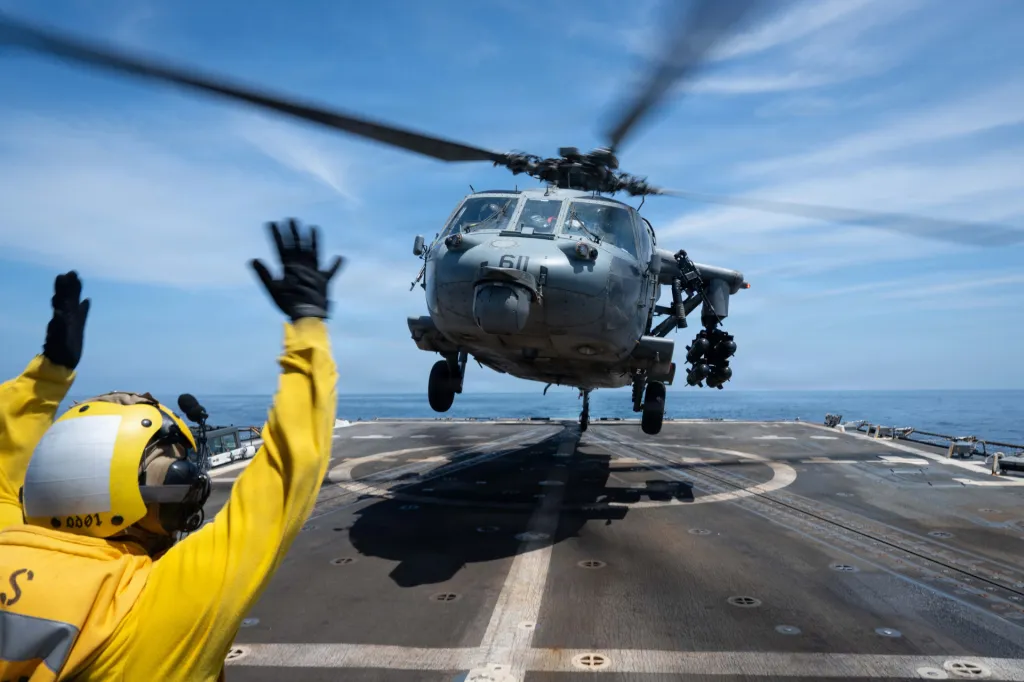
Earlier today, U.S. Army AH-64 Apache and U.S. Navy MH-60 Seahawk helicopters destroyed six small Iranian boats that were threatening commercial ships in and around the Strait of Hormuz, according to the U.S. military’s top officer in the region. He also confirmed that Iran has launched new attacks aimed at American warships, as well as merchant vessels. All of this comes after the U.S. kicked off a new operation to safeguard commercial shipping through the Strait of Hormuz, dubbed Project Freedom, which you can read more about in our initial reporting here.

“We have an enormous amount of capability and firepower concentrated in and around the strait, including AH-64 Apache and MH-60 Seahawk helicopters used just this morning to eliminate six Iranian small boats threatening commercial shipping. So we’re backing up commitment with action,” Navy Adm. Brad Cooper, head of U.S. Central Command (CENTCOM), told TWZ and other outlets during a press conference today. “We also have A-10s, F-15, F-16, F/A-18, F-35, EA-18 Growlers, RC-135s, KC-46s, and KC-135 fixed-wing aircraft, and numerous U.S. warships, including destroyers, two carrier strike groups, [an] amphibious readiness [sic] group, and [a] Marine Expeditionary Unit.”
“The cruise missiles were going after both U.S. Navy ships, but mostly after commercial shipping,” Cooper added when asked about attacks so far. “We defended both ourselves and, consistent with our commitment, we defended all those commercial ships.”
“We had drone launches against commercial ships, all of which were defended against, consistent with our commitment, and then the small boats were all going against commercial ships, and all were sunk by Apaches and Seahawk helicopters,” he continued.
UPDATE: More Details From Adm. Cooper’s Briefing
- On the scope of Project Freedom:
“We are employing U.S. ballistic missile defense-capable destroyers, over 100 land and sea-based aircraft, multi-domain unmanned platforms – meaning under the sea, on the sea, and from the air – and then 15,000 service members to extend this defensive umbrella across the Strait of Hormuz to protect our forces and also, as committed, to defend commercial shipping.”
- On international reaction
“Vessels currently in the Arabian Gulf represent 87 countries from around the world. As the president mentioned, they’re merely neutral and innocent bystanders. Over the last 12 hours, we’ve reached out to dozens of ships and shipping companies to encourage traffic flow through the Strait, consistent with the president’s intent, to help guide ships safely through the narrow trade corridor. This news has been quite enthusiastically received, and we’re already beginning to see movement.”
“The President has also said that if the process [Project Freedom] is interfered with, we will react forcefully. And over the last 12 hours, Iran has interfered. The IRGC [Islamic Revolutionary Guard Corps] has launched multiple cruise missiles, drones, [and] small boats at ships we are protecting. We have defeated each and every one of those threats through the clinical application of defensive munitions.”
- On whether U.S. warships were hit:
“I can confirm there’s been no U.S. military ship hit, and there’s been no U.S. flagged-ship [sic] that have been hit.”
- On whether these attacks mean the ceasefire is over:
“I wouldn’t go into detail of whether the ceasefire is over or not. I think the key thing for us is we’re merely there as a defensive force and a force to give a very thick layer of defense to commercial shipping to allow them to proceed out of the Arabian Gulf. That’s what we’re focused on. What we saw this morning was Iran initiating aggressive behavior. We are simply going to respond to that consistent with the president’s direction.”
- On whether Project Freedom is protecting ships in port in the United Arab Emirates (UAE), which have also come under attack today:
“I don’t want to give the details of what we’re protecting and what we’re not. I wouldn’t want to tip our hand on that. But in the case of the Fujairah attack, I’d really refer to the UAE on that. That’s really a matter under their national jurisdiction and not part of our project operation.”
- On how close the Iranian missiles and drones got to ships:
“I don’t want to get into the specific details of differences. All of the missiles and drones that were fired at both us and the commercial ships were effectively engaged. So that’s the good news. No personnel injuries in that regard, and also in terms of where specifically, the area in the strait was transited, probably not worth getting into details. What I will say is, over the past several weeks, we’ve used low-observable capability to clear that path, and we validated that in multiple ways. And then we took the risk by using U.S. flagships [sic] to go first, setting the example. Since then, we’ve had great communication with industry, as I mentioned, and ships, multiple ships, are already heading that way. So the summation of that is, we used our own military technology in a unique way to clear a free lane that’s not obstructed in any way, shape or form, through the Strait, executed by setting the example of U.S. ships. And over top of all that, we have a US military defensive umbrella.”
- On whether U.S. destroyers transited the Strait today:
“Yes, we have gone through the Strait today. As we sit here right now, we have multiple U.S. Navy guided missile destroyers operating in the Arabian Gulf.”
- On whether U.S. warships are providing escort through the Strait:
“There’s no specific escort. If I just describe this overall, if you’re escorting a ship, you’re playing kind of one-on-one, I think we have a much better defensive arrangement in this process, where we have multiple layers that include ships, helicopters, aircraft, airborne early warning, electronic warfare – we have a much broader defensive package than you would have ever had if you were just escorting. I feel good about that, and it was proven just in the last couple of hours.”
“In terms of mines, I’m not going to talk about specific capabilities. You know, they all have varying degrees of influence. I think the key thing about mines is that we have cleared an effective pathway for ships to lead. At this point, for the first time, there seems to be great enthusiasm to do that, but we’re going to stay in contact with the commercial shipping and support them along the way.”
- On our question about whether Project Freedom is just for getting ships out of the Strait, or whether it is also for getting them into it.
“It will ultimately be a two-way path. The most important thing is in the near-term getting ships out. And then over time, we’ll also, for sure, see ships go in.”
- On our question about what munitions the Apaches and MH-60s used:
“We don’t want to get into the munitions or how we’re doing things tactically. I will just kind of put that off to the side. But the munitions that were used were very effective, and the tactics worked just as described.”
UPDATE: More on AH-64s and MH-60s in the counter-small boat role
Today’s use of AH-64s and MH-60s to engage Iranian small boats as part of a larger effort to ensure access to the Strait of Hormuz highlights a larger contingency plan that the U.S. military has been working to refine for decades now.
The IRGC’s naval arm, in particular, has been a chief example of the threats that small boats pose since the Tanker War sideshow to the Iran-Iraq War in the 1980s. Armed helicopters, including ones belonging to the U.S. Army’s elite 160th Special Operations Aviation Regiment, the famed Night Stalkers, were an important part of the American response to threats to commercial shipping at that time.
Small boat threats, and in the context of a Strait of Hormuz crisis, especially, became even more of a focus of U.S. military planning in the early 2000s. Al Qaeda’s attack on the Arleigh Burke class destroyer USS Cole while it was in port in Aden, Yemen, was one key driver. The fallout from the still-controversial Millennium Challenge war game in 2002 was another very important factor.

All of this impacted the addition of new close-in defense capabilities to existing and forthcoming warships. It also put additional emphasis on the role of armed helicopters, as well as fixed-wing aircraft, in responding to swarms of small boats. The Air Force’s A-10 Warthog ground attack planes have trained extensively to fly counter-small boat missions for the past two decades, for instance.
Army AH-64s and Air Force A-10s had already been conducting missions targeting Iranian naval assets in and around the Strait of Hormuz before the announcement of the ceasefire in April. Navy MH-60s are known to have been flying armed force protection missions as part of Operation Epic Fury against Iran, as well. As an aside, Seahawks also destroyed small boats belonging to Iranian-backed Houthi militants in Yemen as part of previous operations to safeguard commercial shipping in and around the Red Sea.

Armed helicopters remain key assets for defending against swarms of small boats. This is in part because of the added flexibility they offer in terms of their ability to launch from forward bases on land and ships at sea, either of which can also be situated closer to the threat area. This, in turn, can help reduce the time it takes to react and increase time on station. Helicopters’ ability to fly slow and low also allows them to spot, identify, and make rapid attacks on small moving targets. For naval vessels that carry helicopters, arming them with more advanced weaponry to go after small boats means they can provide an on-call outer highly flexible layer of force protection that would not exist otherwise. New munitions, including laser-guided Advanced Precision Kill Weapon System II (APKWS II) rockets, will only increase their capabilities to engage larger swarms of small boats

Small boats are, of course, not the only threat Iran is already bringing to bear in the Strait of Hormuz. As Adm. Cooper noted in his briefing, Iranian forces have been launching cruise missile and drone attacks on ships in and around this critical waterway. There is also the continued threat of Iranian naval mines, as well as explosive-laden uncrewed surface vessels. Iran has also launched a new round of missile and drone attacks on the United Arab Emirates.
For weeks, TWZ has been pointing out that Iran’s shore-based anti-ship cruise missiles had been largely absent from conflict in the region, and these weapons could play a major part in responding to any American push to reopen the Strait. This now seems to be happening and also underscores a broader point we have been making about the real danger of the regime in Tehran turning the waterway into a super weapons engagement zone. The threat ecosystem also includes air defenses, such as shoulder-fired surface-to-air missiles, also known as man-portable air defense systems, which present hazards to armed helicopters, as well as fixed-wing aircraft.
All of this only reinforces the general risks that U.S. forces will face as Project Freedom gets further underway, especially if it grows to include more direct escort and/or convoy missions.
UPDATE: Reaction to the Iranian missile and drone barrage
In a phone conversation with ABC News Chief Washington Correspondent Jonathan Karl, Trump “”stopped short of saying Iran has violated the ceasefire,” Karl stated on X. “Regarding the Iranian drone and missile attacks on UAE today: ‘They were shot down for the most part,’” Trump told Karl. “‘One got through. Not huge damage.’ Regarding the Iranian attack on a South Korean ship: ‘We’re going to look into it. Shots were fired at a South Korean ship, and I think South Korea should take some action. … This was a South Korean ship riding by itself. It was not an escorted ship.’”
Trump said Iran will be “blown off the face of the Earth” if they attack U.S. vessels carrying out Project Freedom.
Trump made the comments during an interview with Fox News‘ Trey Yingst on Monday, adding that he believes Iran has become “much more malleable” in peace negotiations.
The president also emphasized that U.S. military buildup in the region is continuing.
“We have more weapons and ammunition at a much higher grade than we had before,” Trump said. “We have the best equipment. We have stuff all over the world. We have these bases all over the world. They’re all stocked up with equipment. We can use all of that stuff, and we will, if we need it.”
Trump again said that Iran has “no navy, they have no air force, they have no anti-aircraft equipment, they have no readar, they have no nothing, they have no leaders actually…the leaders happen to be gone also.”
UAE air defense systems “engaged 12 ballistic missiles, 3 cruise missiles, and 4 UAV’s launched from Iran, resulting in 3 moderate injuries,” the UAE MoD stated on X. “Since the beginning of the blatant Iranian attacks on the United Arab Emirates, the air defences have engaged a total of 549 ballistic missiles, 29 cruise missiles, and 2,260 UAV’s.”
Qatar “strongly condemns the renewed Iranian attacks targeting civilian sites and facilities in the sisterly United Arab Emirates using missiles and drones, which resulted in injuries to three Indian nationals,” the country’s Foreign Ministry stated on X. “Qatar considers these attacks a blatant violation of the UAE’s sovereignty and a serious threat to the security and stability of the region.”
The U.S. and Israel are “holding feverish consultations on how to respond and assist their loyal ally.” Israel’s Israel Hayom news outlet claimed, citing three sources familiar with the matter.
“The likely options include targeted attacks against launchers and military targets threatening the strait, or a parallel attack on an Iranian energy facility in response to the attack on Fujairah,” the outlet posited.
We cannot independently verify that claim.
Tehran had no prior plan to attack Emirati facilities in Fujairah port, an Iranian official told Iranian media.
“What happened is the result of the American army’s adventure to illegally open a passage for ships to cross from the prohibited passages in the Strait of Hormuz,” the official said.
UPDATE: 5:32 PM EDT –
In the wake of today’s attacks from Iran, UAE has partially closed its airspace for one week, effective today through May 11. Commercial traffic is restricted to narrow corridors through specific waypoints only.
Meanwhile, Israel’s Ben Gurion Airport management has raised the alert level for an attack scenario, which includes a rapid “departure procedure” for international companies, according to Israel’s Channel 14 news outlet.
“Against the backdrop of increasing security tensions and reports of the closure of the airport in the United Arab Emirates today (Monday), Israel is on high alert for the possibility of a widespread escalation,” the outlet added. “As of this time, Ben Gurion Airport continues to operate as usual, but behind the scenes the alert level has been raised to the highest level with the understanding that the schedule could change within minutes.”
Contact the author: joe@twz.com