Apache

U.S. AH-64 Apache, MH-60 Seahawk Helicopters Sink Six Iranian Boats (Updated)

Earlier today, U.S. Army AH-64 Apache and U.S. Navy MH-60 Seahawk helicopters destroyed six small Iranian boats that were threatening commercial ships in and around the Strait of Hormuz, according to the U.S. military’s top officer in the region. He also confirmed that Iran has launched new attacks aimed at American warships, as well as merchant vessels. All of this comes after the U.S. kicked off a new operation to safeguard commercial shipping through the Strait of Hormuz, dubbed Project Freedom, which you can read more about in our initial reporting here.

A US Navy MH-60S Seahawk armed with Hellfire missiles takes off from the Arleigh Burke class destroyer USS Pinckney somewhere in the Middle East on March 27, 2026. CENTCOM

“We have an enormous amount of capability and firepower concentrated in and around the strait, including AH-64 Apache and MH-60 Seahawk helicopters used just this morning to eliminate six Iranian small boats threatening commercial shipping. So we’re backing up commitment with action,” Navy Adm. Brad Cooper, head of U.S. Central Command (CENTCOM), told TWZ and other outlets during a press conference today. “We also have A-10s, F-15, F-16, F/A-18, F-35, EA-18 Growlers, RC-135s, KC-46s, and KC-135 fixed-wing aircraft, and numerous U.S. warships, including destroyers, two carrier strike groups, [an] amphibious readiness [sic] group, and [a] Marine Expeditionary Unit.”

“The cruise missiles were going after both U.S. Navy ships, but mostly after commercial shipping,” Cooper added when asked about attacks so far. “We defended both ourselves and, consistent with our commitment, we defended all those commercial ships.”

“We had drone launches against commercial ships, all of which were defended against, consistent with our commitment, and then the small boats were all going against commercial ships, and all were sunk by Apaches and Seahawk helicopters,” he continued.

UPDATE: More Details From Adm. Cooper’s Briefing

  • On the scope of Project Freedom:

“We are employing U.S. ballistic missile defense-capable destroyers, over 100 land and sea-based aircraft, multi-domain unmanned platforms – meaning under the sea, on the sea, and from the air – and then 15,000 service members to extend this defensive umbrella across the Strait of Hormuz to protect our forces and also, as committed, to defend commercial shipping.”

  • On international reaction

“Vessels currently in the Arabian Gulf represent 87 countries from around the world. As the president mentioned, they’re merely neutral and innocent bystanders. Over the last 12 hours, we’ve reached out to dozens of ships and shipping companies to encourage traffic flow through the Strait, consistent with the president’s intent, to help guide ships safely through the narrow trade corridor. This news has been quite enthusiastically received, and we’re already beginning to see movement.”

“The President has also said that if the process [Project Freedom] is interfered with, we will react forcefully. And over the last 12 hours, Iran has interfered. The IRGC [Islamic Revolutionary Guard Corps] has launched multiple cruise missiles, drones, [and] small boats at ships we are protecting. We have defeated each and every one of those threats through the clinical application of defensive munitions.”

  • On whether U.S. warships were hit:

“I can confirm there’s been no U.S. military ship hit, and there’s been no U.S. flagged-ship [sic] that have been hit.”

🚫 CLAIM: Iranian state media claims that Iran’s Islamic Revolutionary Guard Corps hit a U.S. warship with two missiles.

✅ TRUTH: No U.S. Navy ships have been struck. U.S. forces are supporting Project Freedom and enforcing the naval blockade on Iranian ports. pic.twitter.com/VFxovxLU6G

— U.S. Central Command (@CENTCOM) May 4, 2026

  • On whether these attacks mean the ceasefire is over:

“I wouldn’t go into detail of whether the ceasefire is over or not. I think the key thing for us is we’re merely there as a defensive force and a force to give a very thick layer of defense to commercial shipping to allow them to proceed out of the Arabian Gulf. That’s what we’re focused on. What we saw this morning was Iran initiating aggressive behavior. We are simply going to respond to that consistent with the president’s direction.”

  • On whether Project Freedom is protecting ships in port in the United Arab Emirates (UAE), which have also come under attack today:

“I don’t want to give the details of what we’re protecting and what we’re not. I wouldn’t want to tip our hand on that. But in the case of the Fujairah attack, I’d really refer to the UAE on that. That’s really a matter under their national jurisdiction and not part of our project operation.”

  • On how close the Iranian missiles and drones got to ships:

“I don’t want to get into the specific details of differences. All of the missiles and drones that were fired at both us and the commercial ships were effectively engaged. So that’s the good news. No personnel injuries in that regard, and also in terms of where specifically, the area in the strait was transited, probably not worth getting into details. What I will say is, over the past several weeks, we’ve used low-observable capability to clear that path, and we validated that in multiple ways. And then we took the risk by using U.S. flagships [sic] to go first, setting the example. Since then, we’ve had great communication with industry, as I mentioned, and ships, multiple ships, are already heading that way. So the summation of that is, we used our own military technology in a unique way to clear a free lane that’s not obstructed in any way, shape or form, through the Strait, executed by setting the example of U.S. ships. And over top of all that, we have a US military defensive umbrella.”

  • On whether U.S. destroyers transited the Strait today:

“Yes, we have gone through the Strait today. As we sit here right now, we have multiple U.S. Navy guided missile destroyers operating in the Arabian Gulf.”

U.S. Navy guided-missile destroyers are currently operating in the Arabian Gulf after transiting the Strait of Hormuz in support of Project Freedom. American forces are actively assisting efforts to restore transit for commercial shipping. As a first step, 2 U.S.-flagged merchant… pic.twitter.com/SVDxDhK72I

— U.S. Central Command (@CENTCOM) May 4, 2026

  • On whether U.S. warships are providing escort through the Strait:

“There’s no specific escort. If I just describe this overall, if you’re escorting a ship, you’re playing kind of one-on-one, I think we have a much better defensive arrangement in this process, where we have multiple layers that include ships, helicopters, aircraft, airborne early warning, electronic warfare – we have a much broader defensive package than you would have ever had if you were just escorting. I feel good about that, and it was proven just in the last couple of hours.”

“In terms of mines, I’m not going to talk about specific capabilities. You know, they all have varying degrees of influence. I think the key thing about mines is that we have cleared an effective pathway for ships to lead. At this point, for the first time, there seems to be great enthusiasm to do that, but we’re going to stay in contact with the commercial shipping and support them along the way.”

  • On our question about whether Project Freedom is just for getting ships out of the Strait, or whether it is also for getting them into it.

“It will ultimately be a two-way path. The most important thing is in the near-term getting ships out. And then over time, we’ll also, for sure, see ships go in.” 

  • On our question about what munitions the Apaches and MH-60s used:

“We don’t want to get into the munitions or how we’re doing things tactically. I will just kind of put that off to the side. But the munitions that were used were very effective, and the tactics worked just as described.”

UPDATE: More on AH-64s and MH-60s in the counter-small boat role

Today’s use of AH-64s and MH-60s to engage Iranian small boats as part of a larger effort to ensure access to the Strait of Hormuz highlights a larger contingency plan that the U.S. military has been working to refine for decades now.

The IRGC’s naval arm, in particular, has been a chief example of the threats that small boats pose since the Tanker War sideshow to the Iran-Iraq War in the 1980s. Armed helicopters, including ones belonging to the U.S. Army’s elite 160th Special Operations Aviation Regiment, the famed Night Stalkers, were an important part of the American response to threats to commercial shipping at that time.

Small boat threats, and in the context of a Strait of Hormuz crisis, especially, became even more of a focus of U.S. military planning in the early 2000s. Al Qaeda’s attack on the Arleigh Burke class destroyer USS Cole while it was in port in Aden, Yemen, was one key driver. The fallout from the still-controversial Millennium Challenge war game in 2002 was another very important factor.

The USS Cole seen being transported aboard the heavy lift ship M/V Blue Marlin after suffering severe damage as a result of the Al Qaeda attack in 2000. USN

All of this impacted the addition of new close-in defense capabilities to existing and forthcoming warships. It also put additional emphasis on the role of armed helicopters, as well as fixed-wing aircraft, in responding to swarms of small boats. The Air Force’s A-10 Warthog ground attack planes have trained extensively to fly counter-small boat missions for the past two decades, for instance.

Army AH-64s and Air Force A-10s had already been conducting missions targeting Iranian naval assets in and around the Strait of Hormuz before the announcement of the ceasefire in April. Navy MH-60s are known to have been flying armed force protection missions as part of Operation Epic Fury against Iran, as well. As an aside, Seahawks also destroyed small boats belonging to Iranian-backed Houthi militants in Yemen as part of previous operations to safeguard commercial shipping in and around the Red Sea.

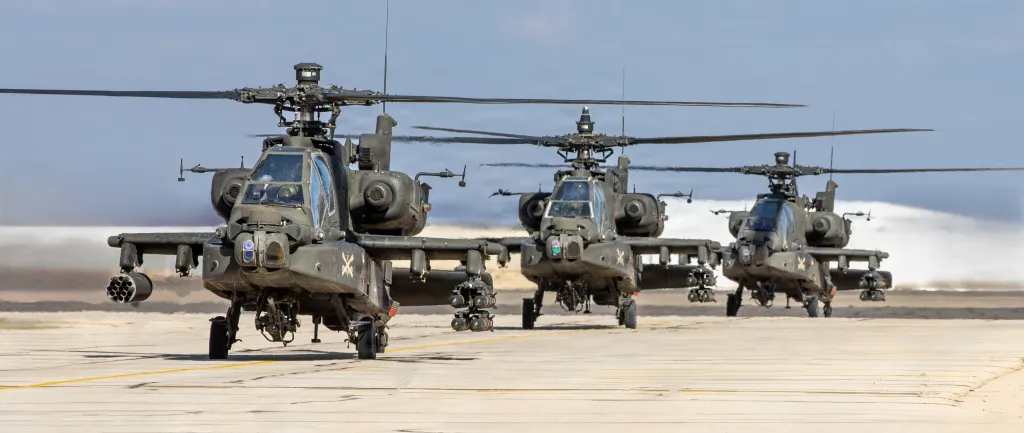
A flight of US Army AH-64 Apache attack helicopters, armed with rockets and Hellfire missiles, seen taxing out to conduct a recent scheduled flight in the CENTCOM area of responsibility. US Army

Armed helicopters remain key assets for defending against swarms of small boats. This is in part because of the added flexibility they offer in terms of their ability to launch from forward bases on land and ships at sea, either of which can also be situated closer to the threat area. This, in turn, can help reduce the time it takes to react and increase time on station. Helicopters’ ability to fly slow and low also allows them to spot, identify, and make rapid attacks on small moving targets. For naval vessels that carry helicopters, arming them with more advanced weaponry to go after small boats means they can provide an on-call outer highly flexible layer of force protection that would not exist otherwise. New munitions, including laser-guided Advanced Precision Kill Weapon System II (APKWS II) rockets, will only increase their capabilities to engage larger swarms of small boats

US Army Apaches operate from the US Navy Expeditionary Sea Base ship USS Lewis B. Puller during an exercise in the Middle East in 2020. USN

Small boats are, of course, not the only threat Iran is already bringing to bear in the Strait of Hormuz. As Adm. Cooper noted in his briefing, Iranian forces have been launching cruise missile and drone attacks on ships in and around this critical waterway. There is also the continued threat of Iranian naval mines, as well as explosive-laden uncrewed surface vessels. Iran has also launched a new round of missile and drone attacks on the United Arab Emirates.

For weeks, TWZ has been pointing out that Iran’s shore-based anti-ship cruise missiles had been largely absent from conflict in the region, and these weapons could play a major part in responding to any American push to reopen the Strait. This now seems to be happening and also underscores a broader point we have been making about the real danger of the regime in Tehran turning the waterway into a super weapons engagement zone. The threat ecosystem also includes air defenses, such as shoulder-fired surface-to-air missiles, also known as man-portable air defense systems, which present hazards to armed helicopters, as well as fixed-wing aircraft.

All of this only reinforces the general risks that U.S. forces will face as Project Freedom gets further underway, especially if it grows to include more direct escort and/or convoy missions.

UPDATE: Reaction to the Iranian missile and drone barrage

In a phone conversation with ABC News Chief Washington Correspondent Jonathan Karl, Trump “”stopped short of saying Iran has violated the ceasefire,” Karl stated on X. “Regarding the Iranian drone and missile attacks on UAE today: ‘They were shot down for the most part,’” Trump told Karl. “‘One got through. Not huge damage.’ Regarding the Iranian attack on a South Korean ship: ‘We’re going to look into it. Shots were fired at a South Korean ship, and I think South Korea should take some action. … This was a South Korean ship riding by itself. It was not an escorted ship.’”

In a phone conversation a short while ago, President Trump stopped short of saying Iran has violated the ceasefire.

Regarding the Iranian drone and missile attacks on UAE today: “They were shot down for the most part,” Trump told me. “One got through. Not huge damage.”…

— Jonathan Karl (@jonkarl) May 4, 2026

Trump said Iran will be “blown off the face of the Earth” if they attack U.S. vessels carrying out Project Freedom.

Trump made the comments during an interview with Fox News‘ Trey Yingst on Monday, adding that he believes Iran has become “much more malleable” in peace negotiations.

The president also emphasized that U.S. military buildup in the region is continuing.

“We have more weapons and ammunition at a much higher grade than we had before,” Trump said. “We have the best equipment. We have stuff all over the world. We have these bases all over the world. They’re all stocked up with equipment. We can use all of that stuff, and we will, if we need it.”

Trump again said that Iran has “no navy, they have no air force, they have no anti-aircraft equipment, they have no readar, they have no nothing, they have no leaders actually…the leaders happen to be gone also.”

President Trump on Iran: “They have no navy, they have no air force, they have no anti-aircraft equipment, they have no radar, they have no nothing, they have no leaders actually…the leaders happen to be gone also.” pic.twitter.com/JBkAV7OKwi

— CSPAN (@cspan) May 4, 2026

UAE air defense systems “engaged 12 ballistic missiles, 3 cruise missiles, and 4 UAV’s launched from Iran, resulting in 3 moderate injuries,” the UAE MoD stated on X. “Since the beginning of the blatant Iranian attacks on the United Arab Emirates, the air defences have engaged a total of 549 ballistic missiles, 29 cruise missiles, and 2,260 UAV’s.”

تتعامل حالياً الدفاعات الجوية الإماراتية مع اعتداءات صاروخية وطائرات مسيرة قادمة من ايران وتؤكد وزارة الدفاع أن الاصوات المسموعة في مناطق متفرقة من الدولة هي نتيجة تعامل منظومات الدفاعات الجوية الإماراتية للصواريخ الباليستية، والجوالة والطائرات المسيرة.

UAE Air Defences system… pic.twitter.com/j9mW4JucfW

— وزارة الدفاع |MOD UAE (@modgovae) May 4, 2026

Qatar “strongly condemns the renewed Iranian attacks targeting civilian sites and facilities in the sisterly United Arab Emirates using missiles and drones, which resulted in injuries to three Indian nationals,” the country’s Foreign Ministry stated on X. “Qatar considers these attacks a blatant violation of the UAE’s sovereignty and a serious threat to the security and stability of the region.”

Qatar Strongly Condemns Renewed Iranian Missile, Drone Attacks on UAE

Doha | May 4, 2026

The State of Qatar strongly condemns the renewed Iranian attacks targeting civilian sites and facilities in the sisterly United Arab Emirates using missiles and drones, which resulted in… pic.twitter.com/UU0tV5w111

— Ministry of Foreign Affairs – Qatar (@MofaQatar_EN) May 4, 2026

The U.S. and Israel are “holding feverish consultations on how to respond and assist their loyal ally.” Israel’s Israel Hayom news outlet claimed, citing three sources familiar with the matter. 

“The likely options include targeted attacks against launchers and military targets threatening the strait, or a parallel attack on an Iranian energy facility in response to the attack on Fujairah,” the outlet posited. 

We cannot independently verify that claim.

Tehran had no prior plan to attack Emirati facilities in Fujairah port, an Iranian official told Iranian media. 

“What happened is the result of the American army’s adventure to illegally open a passage for ships to cross from the prohibited passages in the Strait of Hormuz,” the official said.

BREAKING: Iranian Military source to Iranian TV:

Tehran had no prior plan to attack Emirati facilities in Fujairah port

What happened is the result of the American army’s adventure to illegally open a passage for ships to cross from the prohibited passages in the Strait of… pic.twitter.com/Pt3GKSUIDb

— Sulaiman Ahmed (@ShaykhSulaiman) May 4, 2026

UPDATE: 5:32 PM EDT –

In the wake of today’s attacks from Iran, UAE has partially closed its airspace for one week, effective today through May 11. Commercial traffic is restricted to narrow corridors through specific waypoints only.

UAE has partially closed its airspace for one week, effective May 4 through May 11.

Vide NOTAM A1722/26, Emirates FIR partially closed. Commercial traffic restricted to narrow corridors through specific waypoints only.#airspace pic.twitter.com/dfmJFuOAlA

— FL360aero (@fl360aero) May 4, 2026

Meanwhile, Israel’s Ben Gurion Airport management has raised the alert level for an attack scenario, which includes a rapid “departure procedure” for international companies, according to Israel’s Channel 14 news outlet. 

“Against the backdrop of increasing security tensions and reports of the closure of the airport in the United Arab Emirates today (Monday), Israel is on high alert for the possibility of a widespread escalation,” the outlet added. “As of this time, Ben Gurion Airport continues to operate as usual, but behind the scenes the alert level has been raised to the highest level with the understanding that the schedule could change within minutes.”

Ben Gurion Airport is on high alert in preparation for a possible closure of Israeli airspace and evacuation of aircraft -CH14

The Airport Authority and the Ministry of Transportation have conducted situational assessments in recent hourshttps://t.co/VufBp2viqj pic.twitter.com/inDP3RNVKm

— Faytuks News (@Faytuks) May 4, 2026

Contact the author: joe@twz.com

Joseph has been a member of The War Zone team since early 2017. Prior to that, he was an Associate Editor at War Is Boring, and his byline has appeared in other publications, including Small Arms Review, Small Arms Defense Journal, Reuters, We Are the Mighty, and Task & Purpose.


Howard is a Senior Staff Writer for The War Zone, and a former Senior Managing Editor for Military Times. Prior to this, he covered military affairs for the Tampa Bay Times as a Senior Writer. Howard’s work has appeared in various publications including Yahoo News, RealClearDefense, and Air Force Times.


Source link

Wolf Pack Modular Mini Cruise Missiles Pitched For Apache, Black Hawk

L3Harris is pushing its modular Wolf Pack family of “launched effects vehicles” for the U.S. Army, including to equip its H-60 Black Hawk series and AH-64 Apache helicopters, with an eye on the specific demands of a future conflict in the Pacific. The family of vehicles includes the Red Wolf, configured for long-range precision strikes against targets on land or at sea, and the Green Wolf fitted with an electronic warfare payload. Overall, these are part of a wider drive toward fielding modular, relatively cheap, and small systems that increasingly blur the line between uncrewed aerial systems, especially longer-range kamikaze drones, and cruise missiles, as well as decoys.

Readers can refer to our previous coverage of the Wolf Pack family, and it is also worth noting that the company is under contract with the U.S. Marine Corps to deliver the related PASM, the Precision Attack Strike Munition.

At the Army Aviation Association of America’s Army Aviation Warfighting Summit in Nashville, Tennessee, this week, TWZ caught up with Brad Reeves, the director of strategy and requirements for the Agile Development Group at L3Harris, to talk about the company’s vision for the Wolf family with the Army.

L3Harris has formally rolled out its modular Wolf family of "launched effects vehicles," which includes the Red Wolf, configured for long-range precision strikes against targets on land or at sea, and the Green Wolf fitted with an electronic warfare payload.
A rendering of the Red Wolf launched effects vehicle. L3Harris L3Harris

TWZ: What is the primary driver behind the Wolf family, and how is it relevant to the Army’s rotary-wing fleets?

Brad Reeves: The Department of War has a heavy emphasis on the Pacific and a conflict over there. Mass is an issue. We have a lot of exquisite weapons today, but the numbers are not maybe as high as we might hope for a conflict over there. So, they’re trying to solve that problem. Affordable mass has kind of become the buzzword, which basically means, “hey, how do we get capability that we can buy in quantity without breaking the bank?” And so, with that, the Department of War, actually Secretary Hegseth, issued a memo on April 30 of last year. And one of the things he called out specifically was launched effects, the urgency to get that fielded beginning this year. So, that’s a high-emphasis item for those guys.

A U.S. Army UH-60M Black Hawk. U.S. Air Force photo

Launched effects are really meant to be an affordable mass solution for the Army. But the real story behind this is what we call our Wolf Pack family of systems, and our offering and the capability it brings. And the story here is it’s very capable, but it’s what it does for the Army and for Army aviation. So it’s transforming Army aviation, and it’s addressing platforms that lack some relevancy today in the fight. Black Hawks, Apaches, etc, have a very short-range capability, relatively speaking, when you’re talking about the Pacific, and you have the tyranny of distance and anti-access/area-denial threats. It’s a much harder challenge than what we’ve dealt with in the decades since those aircraft were first invented.

Now we’re basically bringing relevancy to those platforms. We’re transforming from a weapons-effectiveness range and lethality range of single-digit kilometers, maybe up to a dozen kilometers, and we’re now extending that to hundreds of kilometers. We’re taking what before was a single-mission aircraft that’s supporting the Army; it’s doing close combat attack missions for Army soldiers on the ground, and is basically specific to that single service. And we’re now expanding that, and we’re giving that platform a joint or coalition viability in a Pacific flight. And so, the relevance now has increased. We’re taking what was before, a single-domain, fully land-based capability. We’re turning it into multi-domain, so now surface, meaning maritime, and land. And then we’re taking the target sets, which were traditionally tanks, maybe threats that we get from ground forces, etc. Again, we’re expanding that so it can be maritime threats and ground threats. It’s kind of a revolution in the way that the Army is going to fight and what they’re going to contribute to the joint coalition force. The Army desperately needs this capability.

A U.S. Army AH-64D Apache fires a Hellfire missile during training. The basic Hellfire has an operational range of anywhere between four and just under seven miles (seven to 11 kilometers). U.S. Army photo by Spc. Dean John Kd De Dios

TWZ: And what are the differences between the Wolf Pack family members?

Brad Reeves: Our launched effects offering, we call it the Wolf Pack family of systems. Today, we have two high-level mission capability variants. We have the Red Wolf, which is the kinetic variant, so a cruise missile. We have the Green Wolf, which has a purely (non-kinetic) electronic warfare payload. So now you’re also doing suppression of enemy air defenses. These types of missions, the DILR mission — detect, ID, locate, report — and/or electronic attack to suppress this threat.

Wolf Pack is designed to have multiple variants, so one aircraft, let’s say an Apache in this instance, you could launch multiple variants, Green and Red. You have a Green Wolf that goes out ahead and is searching and building the EMBM, the electromagnetic battle management. Through some software we call DISCO, which is AI-driven software, it’s building the landscape where the threats are, whether on the surface or on the land.

The wait is over.

Introducing Red Wolf ᵀᴹ and Green Wolf ᵀᴹ, the first vehicles in our expanding pack of launched effects systems. pic.twitter.com/d4oG7fgeE4

— L3Harris (@L3HarrisTech) July 17, 2025

TWZ: How does PASM, the Precision Attack Strike Munition, differ from these?

Brad Reeves: It comes out of our Wolf Pack family. It’s a unique variant designed for the U.S. Marine Corps AH-1Z Viper, and we’re delivering early operational capability. They did a long-range precision fire, LRPF, last September, and that was somewhat of a graduation event. Now we’re basically starting to work with production at our plant in Virginia.

In February 2025, NAVAIR released this image of a Red Wolf-toting AH-1Z, at which time the munitions were identified only as “a new Long Range Precision Fire (LRPF) capability.” U.S. Navy

TWZ: So these are basically loitering munitions?

Brad Reeves: We don’t consider it a loitering munition, but technically, by definition, yes, what it’s doing is it’s flying a pattern. It’s very smart: it goes out, starts detecting threats, then it will set up a pattern to make sure that a) it’s survivable itself, so it doesn’t fly over a threat and get shot down. But b), it will maximize the search pattern, and then it will deconflict with the others in the pack, so that you can, if you have a large area, you can have one, one will say, “hey, I’m going to go do maybe a zigzag pattern over here looking for threats. You go do a zigzag pattern and then report those back.” Once they find the threats, they’ve got options. Either the aircraft can just avoid the threats because they know where they are, or if they need to go through them, then you can either use electronic attack to jam them, or you can send a signal to one of the kinetic variants. Then the kinetic variant does the destruction of enemy air defenses mission.

That’s kind of why we call it the Wolf Pack: working together collaboratively in a pack to perform a mission that’s assigned by the pilot, and they do that autonomously. They have been ground-launched. They have been air-launched from both manned and unmanned platforms, and they can be launched from rotary-wing or fixed-wing. Since we’re here with the Army, the target is Black Hawks and Apaches very specifically.

In the past, L3Harris has also highlighted the potential benefits of pairing its Red Wolf miniature cruise missile with the U.S. Air Force’s OA-1K Skyraider II. L3Harris

TWZ: Would you say that the Wolf Pack is oriented generally towards the SEAD/DEAD mission?

Brad Reeves: It is much broader. But certainly one of the main applications is SEAD/DEAD. With the EW variant, that’s really applicable when you’re doing SEAD/DEAD, or you’re just looking for platform survivability, meaning you’re going towards a mission, but you want to maybe send something out ahead. These fly at high subsonic speeds. They’re going out ahead when launched from a helicopter. They’re scouting out the area, giving them the picture, and allowing them to either avoid, suppress, or defeat threats that may be in their way.

A graphic depicting a notional ground mission scenario involving the employment of Red Wolf and Green Wolf launched effects vehicles. L3Harris

TWZ: Presumably, the cost point of these means the numbers can be fairly scalable, depending on the requirement?

Brad Reeves: Absolutely, it depends on the mission set. One of the advantages is that, while it is an affordable mass munition, it also comes with significant capability. There are some, what I would call differentiators, that put this capability at the high end of the affordable mass, meaning it’s very inexpensive compared to traditional legacy weapons that the forces are using today. We usually say it’s about five times cheaper than what these aircraft would be using today. There are BAAs, broad area announcements, something the U.S. government will release to industry, asking for different capabilities. Right now, when they’re asking for this type of capability, they’re usually targeting somewhere between $300,000 to $500,000 for that market, per round, and we’re certainly in that sweet spot.

TWZ: Aside from the small turbine engine that they share, how modular are the Wolf Pack vehicles themselves?

Brad Reeves: Some people call it a truck, but for some reason, that offends me. But you’ve got the platform, and we’ve designed it modularly with what’s called WOSA, weapon open systems architecture. And so you can interchange the payload. You can take the platform, you can put a warhead in it, and it becomes kinetic. You can take the warhead out, you can put an EW payload in it. I’m oversimplifying a little bit because with the kinetic variant, there are sensors and other stuff. So you probably wouldn’t physically take a kinetic one and swap out the warhead for an EW payload.

Side-by-side renderings of the Red Wolf and Green Wolf, showing them to be functionally identical, at least externally. L3Harris

TWZ: When it comes to Green Wolf, which has no warhead, is this designed to be expendable or recoverable?

Brad Reeves: We have both. We have a recoverable variant. It depends on what the customer wants. In some instances, they want recoverability. And with recoverability, you lose a little bit of range. So in some instances, it’s going to be on a one-way mission; they just want maximum range. Basically, the parachute equipment we use to recover it takes up a little bit of space that otherwise would be fuel tank space.

The Deceptor small-form-factor software-defined radio frequency (RF) electronic warfare (EW) payload from L3Harris. In its promotional material, the company has indicated that this is a potential payload for the Green Wolf. L3Harris

TWZ: How do these vehicles navigate?

Brad Reeves: It has the standard inertial navigation and GPS. It has those capabilities inside of it, and then the seeker effectively is used purely for in-game targeting.

TWZ: To what degree would you be able to surge production to meet urgent demands?

Brad Reeves: We gave our manufacturing team the problem and said, “Hey, multiple customers are asking for as many as a thousand per year. We expect this to really blow up. How do we know how big a plant to build? How do we know what we can do?” And so they actually designed a modular, scalable production plan. In theory, you can scale up to as many as you want. But right now, what we’re doing is we’re scaling towards a thousand a year, which is the current path, and then if the demand signal spikes, we have the ability to scale above that.

The beauty of this vehicle is that there’s a lot as a significant amount of commonality, which does allow us to scale, and also gives us economies of scale, price, etc.

Meet the “Wolf Pack” thumbnail

Meet the “Wolf Pack”


TWZ: Where are you now with testing?

Brad Reeves: We’ve flown over 50 times in test events with the military. So we’ve done multiple services. We’ve done formal testing with those services. It’s been launched twice off the AH-1Z. We’ve launched off fixed-wing UAS, but this gets a little sensitive with the customers, as to what those platforms are. And we’ve done ground launch.

TWZ: Do you have a pathway toward testing on the Black Hawk and Apache?

Brad Reeves: I am very passionate about making sure this gets fielded to U.S. Army soldiers, specifically the Apache and the Black Hawk. Right now, we’ve obviously got Epic Fury. But if something lights off in the Pacific, this just pales in comparison. If I were young enough to be flying in that fight, I would want more capability. And so I am a little bit of a zealot. The U.S. Army, I know, has to have this capability, and I believe they want it. It’s going to be a game-changer for them, and it’s going to be important to the joint force and coalition forces. It is a significant transformational capability.

Jamie Hunter contributed to this story.

Contact the author: thomas@thewarzone.com

Thomas is a defense writer and editor with over 20 years of experience covering military aerospace topics and conflicts. He’s written a number of books, edited many more, and has contributed to many of the world’s leading aviation publications. Before joining The War Zone in 2020, he was the editor of AirForces Monthly.


Source link