Shia LaBeouf’s alleged stalker has been arrested after posting a video of the actor asking to be left alone.
According to Orleans Parish Sheriff’s Office booking records, Alyssa Lee Couture, 40, was arrested Monday night and booked on a misdemeanor charge of stalking. Hours earlier, Couture had posted a video of a confrontation with LaBeouf in what appeared to be a grocery store parking lot. The “Honey Boy” actor is shown speaking to Couture through the window of a car.
“Leave me alone. God bless you. Leave me alone,” LaBeouf says calmly in the video. “You’re scaring my dad. You’re scaring my people. Leave me alone.”
Couture has posted more than 5,000 videos on her Instagram, most of which feature the woman addressing the embattled actor, whom she appears to believe is her husband. In a GoFundMe launched in May, Couture wrote that she was hoping to raise $70,000 to find permanent housing and that she had been living in her car and staying with family members. She also wrote that she had schizophrenia, among other disabilities.
Although the New Orleans Police Department does not identify Couture’s stalking victim as LaBeouf due to privacy policies, the timeline of her booking appears to line up with the confrontation with LaBeouf.
According to People, LaBeouf left Los Angeles after his split from actor Mia Goth last year and relocated to Louisiana to be closer to family.
In June, he pleaded guilty to three counts of simple battery, months after he went viral for his involvement in a Mardi Gras altercation in New Orleans. The actor, 39, was arrested in New Orleans on Feb. 17. At the time, New Orleans police confirmed LaBeouf was charged with two counts of simple battery for allegedly assaulting two men near a bar in the French Quarter. TMZ published bystander video of the incident and footage of LaBeouf walking through the French Quarter hours before the brawl.
The actor was released from jail shortly after his arrest and posted $100,000 in bond. More than a week after LaBeouf’s initial arrest, the New Orleans Police Department issued a second warrant for the actor’s arrest in connection with the same incident, and he racked up an additional simple battery charge. Prior to the second arrest, a New Orleans judge ordered LaBeouf to begin substance abuse treatment and undergo weekly drug testing.
Times staff reporter Alexandra Del Rosario contributed to this report.
Weekly insights and analysis on the latest developments in military technology, strategy, and foreign policy.
Plans for a new tranche of upgrades for U.S. Army special operations MH-60M Black Hawk helicopters are heavily tied to continued progress, or lack thereof, on an improved engine. Work on the Army’s Improved Turbine Engine Program (ITEP) is ongoing now, but there have also been threats to cancel it entirely in recent years, and its future remains murky.
Officials from U.S. Special Operations Command (SOCOM) talked about the intersection of future plans for the MH-60M fleet and ITEP during a roundtable at the annual SOF Week conference yesterday. TWZ was in attendance, along with other outlets. The Army’s elite 160th Special Operations Aviation Regiment, also known as the Night Stalkers, operates the MH-60Ms.
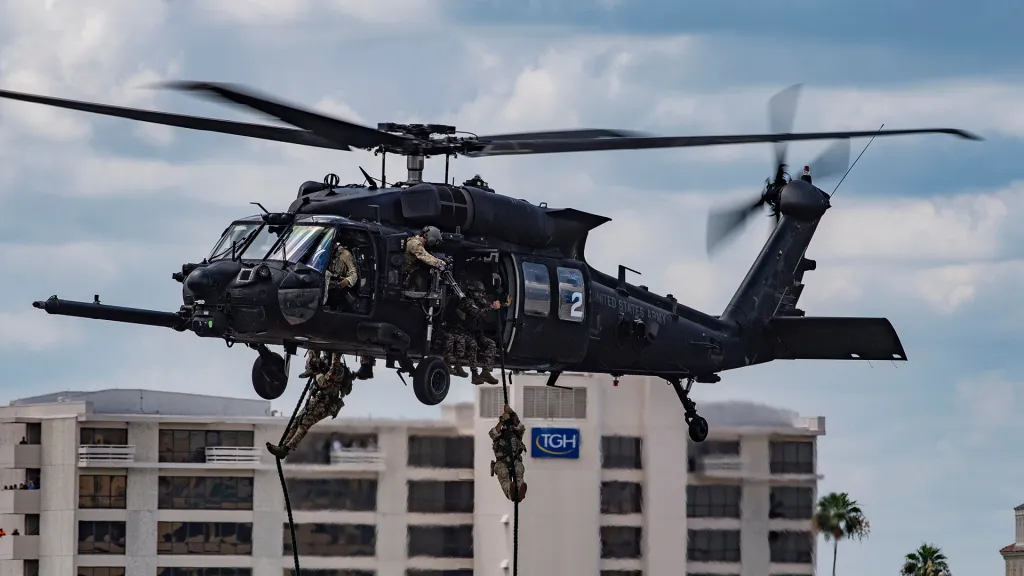
Special operators rappel from a Night Stalker MH-60M during a capability demonstration outside the 2026 SOF Week conference. Jamie Hunter
The Army selected General Electric’s (GE) T901 as the winner of the ITEP competition in 2019. The engine remains in development, with flight testing involving a modified Black Hawk beginning in May 2025.
“We are following very closely what the Army is doing with ITEP. We are hoping that we will get it,” Lt. Col. Aron Hauquitz, head of the Technology Applications Program Office (TAPO), said at the roundtable yesterday. “We’ll be able to put it in our aircraft, and we’ll create the Block 2 variant of the MH-60M.”
A T901 turbine engine. GE
In “FY30 [Fiscal Year 2030], we’re going to start either the Block 1.2 or the Block 2” upgrade program for the MH-60M fleet, Lt. Col. Cameron Keogh, the Program Manager for the MH-60 within SOCOM’s Program Executive Office for Rotary Wing (PEO-RW), also said at the roundtable. “It’s going to hinge on what’s going on with the Improved Turbine Engine, the T901 program that the Army’s running. We’re closely following that. If it continues to be successful, we will integrate that engine.”
To take a step back quickly, Night Stalker Black Hawks today already have an array of unique features compared to other H-60 variants in service elsewhere across the U.S. military and globally. This includes a terrain-following/terrain avoidance radar and other sensors, a variety of defensive systems, and an extensive communications suite, which you can read about in more detail here. A subset of the MH-60Ms are also configured as Direct Action Penetrators (DAP), which can be armed with a mix of guns, missiles, launched effects, and rockets to provide organic close air support during missions.
A pair of Night Stalker MH-60M configured as Direct Action Penetrators (DAP). USMC/Cpl. Matthew Williams
Cramming all of these capabilities on the MH-60Ms also requires significant changes to their core structure, and they are notably heavier than other typical H-60 variants. To account for this, the 160th’s Black Hawks already have YT706 turbine engines that are more powerful than the T701s found on standard Army models. GE makes both of these engines.
The YT706 has “higher fuel consumption, but it also has a higher output to help us keep that extra weight in the air,” Lt. Col. Keogh noted yesterday.
Integrating the T901 onto a typical Black Hawk will provide “50 percent more shaft‑power while delivering significantly higher fuel efficiency,” according to Lockheed Martin. Sikorsky, the prime contractor behind the H-60 family of helicopters, became a subsidiary of Lockheed Martin in 2015.
“The 50% power increase means a Black Hawk can transport additional fuel or payloads, such as launched effects, medical evacuation litters, forward area resupply loads or advanced sensor packages, without compromising aircraft performance,” Lockheed Martin highlighted in a press release earlier this month. “The engine’s performance at high altitude, high temperature conditions expands the Black Hawk’s envelope, giving commanders more options for insertion, extraction and reconnaissance missions in austere environments.”
Sikorsky Begins Black Hawk® Ground Runs with U.S. Army T901 Improved Turbine Engines
“Higher fuel efficiency and lower maintenance demands lessen the supply chain burden in contested environments, a core tenet of the Army’s continuous transformation strategy,” the press release noted. “Improved specific fuel consumption reduces the number of refuel stops, extending mission endurance and shrinking the fuel footprint in forward operating bases.”
The boost in capability that the T901 is set to bring is especially relevant for Night Stalker MH-60Ms, given their unique attributes and mission requirements. The maintenance and logistics benefits would also be particularly attractive for the 160th. The Regiment routinely flies extremely demanding missions, often conducted across long distances and under adverse conditions, and staged from far-flung locations with limited access to established support chains.
Plans otherwise for the Block 1.2/Block 2.0 MH-60M upgrades are still evolving.
Right now, the core “focus on that is payload restoration. We’re trying to take weight out of the airplane [sic], [and] we’re trying to move the CG, the center of gravity, forward,” Lt. Col. Keogh explained. “How we’re doing that without reducing capabilities is we’re just kind of moving the capabilities around.”
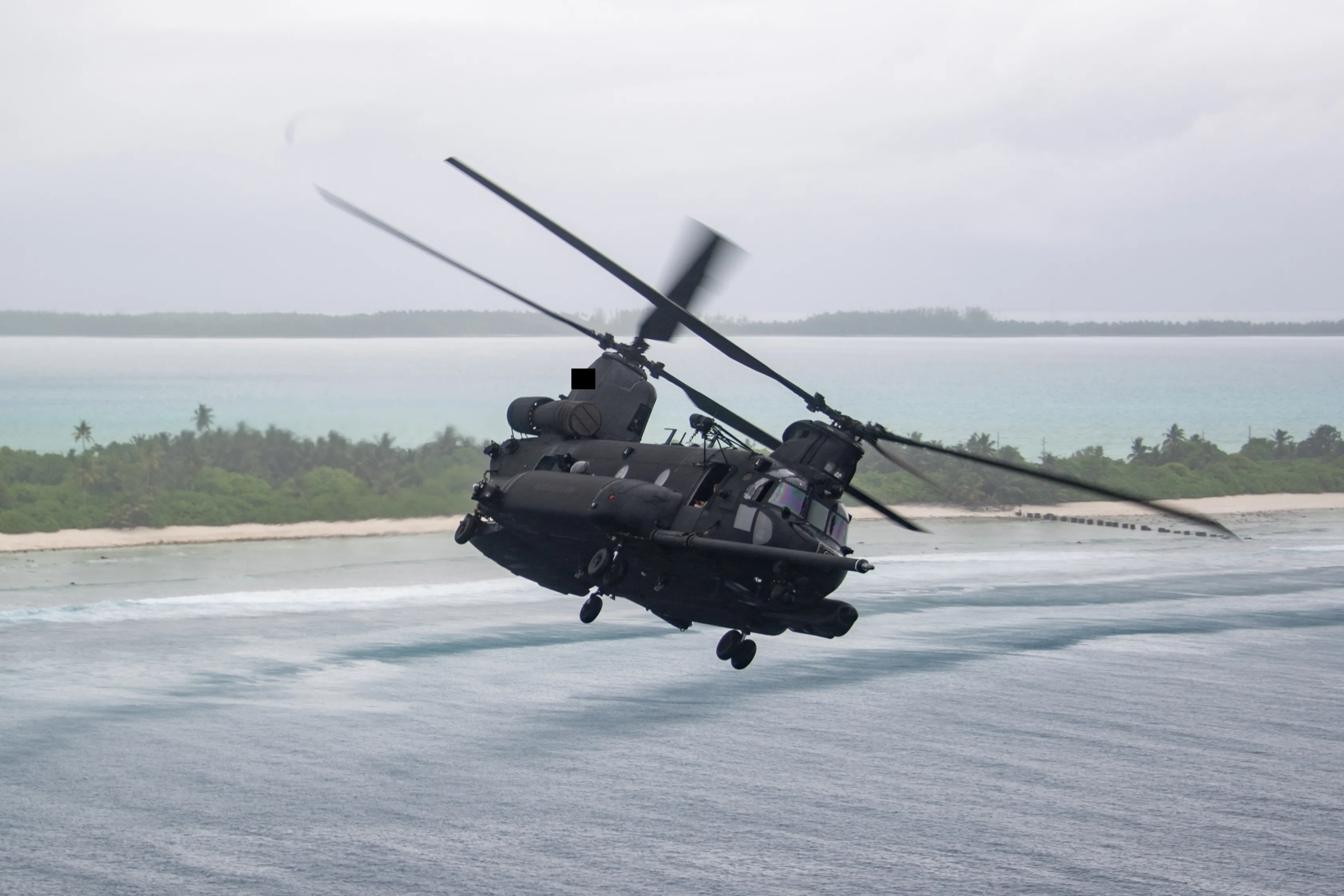
An MH-60M flies low over the water during the capabilities demonstration outside this year’s SOF Week conference. Jamie Hunter
“Somebody asked me earlier if we’re going to take the anti-ice system off the airplane to lose some weight. We’re not. We need the anti-ice, especially up in Washington State,” he continued. “We’re taking some of our heavier boxes, a lot of our avionics, we’re putting them up forward into the crew department, we’re putting them behind the pilots. That’s going to shorten cable runs – copper weighs a lot, you’d be surprised – and then it also helped with our CG shift, as well.”
“That’ll give the operators more butts in seats as they head out to the objective, and also give the air crews better fuel flexibility for mission planning,” he added.
To go back to ITEP, the new engine has long been expected to offer a major leap in performance to regular Army Black Hawks, as well as the service’s AH-64 Apache attack helicopters. However, as noted, the program has faced major uncertainty in recent years. The effort has suffered significant delays tied to manufacturing and supply chain issues. The T901 was also a central component of the Army’sFuture Attack Recon Aircraft (FARA) program, which the service axed in 2024.
Last year, there were indications the Army was moving to cancel ITEP, too, with the service requesting no additional funding for the program in its 2026 Fiscal Year budget proposal. Congress subsequently interceded, appropriating another $238 million for continued work on the engine in the current fiscal cycle.
In its 2027 Fiscal Year budget request, the Army is again not asking for any new money for ITEP, which has raised new questions about the program’s future.
T901 First Engine to Test Mission Accomplished
At the Army Aviation Association of America’s (AAAA) 2026 Warfighting Summit last month, Army Maj. Gen. Clair Gill said he was “very excited about where they’re going there” with ITEP and that the engine was “almost nearing completion of certification.” Gill is the service’s Program Acquisition Executive for Maneuver Air.
ITEP is “performing as intended,” and “the resourcing that Congress added in 2025 and the resourcing that Congress added in 2026 is being used to deliberately continue that testing,” Army Brig. Gen. David Phillips also told TWZ and other outlets at a roundtable at the AAAA conference, but did not elaborate on future plans for the engine. Phillips is the Deputy Portfolio Acquisition Executive for Maneuver Air.
“We will need a little bit more money to get through the EMD [engineering, manufacturing and development] program, but it’s certainly not anywhere close to the money that we’ve already received for the program,” Mike Sousa, GE’s Executive Program Manager for the T901, had also told members of the media ahead of the AAAA conference, according to Breaking Defense. “So there is a little bit of money that is still required.”
Another factor now in all of this for the Army, as well as the Night Stalkers, is the expected arrival of the new MV-75 Cheyenne II tiltrotor in the next few years. The MV-75 offers massive boosts in range and speed compared to any Black Hawk variant. At the same time, that is also expected to come at a cost. As it stands now, the MV-75 is not expected to replace all of the Army’s H-60s, which will continue to play important roles for years to come. SOCOM and the 160th have a similar vision when it comes to the fielding of a special operations-specific version of the MV-75 and the future of the MH-60M.
A rendering of a special operations-specific version of the MV-75. Jamie Hunter
“There will not be a one-for-one swap for MH-60M and MV-75. Don’t ask me what that exact number will be,” Dr. Steven Smith, head of SOCOM’s PEO-RW, also said at the roundtable yesterday. “We’re still going to need analysis to determine what that will be, but it will not be a one-for-one swap. We recognize that the M-60s will be required for the crisis response mission.”
Altogether, the MH-60M is still on track to be a central component of the Night Stalker’s fleets for years to come, whether the helicopters are re-engined in the end or not.
Weekly insights and analysis on the latest developments in military technology, strategy, and foreign policy.
Special operations MH-47 Chinooks offloading fuel to other aircraft in the air is one possible future scenario that U.S. Army Special Operations Command (SOCOM) is eyeing as it begins to work out what the future Block III iteration of the twin-rotor helicopter might look like. While hypothetical at this stage, a Chinook capable of operating as an aerial refueling tanker could help address the command’s lack of organic tanker capacity and support its future air assault strategies.
A MH-47G Chinook, attached to the “Night Stalkers” of U.S. Army 160th Special Operations Aviation Regiment, flies over Diego Garcia, October 14, 2025. U.S. Navy photo illustration by Mass Communication Specialist 1st Class Samantha Jetzer
At this stage, however, SOCOM is beginning to draft possible requirements for the next iteration of special operations MH-47G — the Block III — expected to come online starting around 2032.
“Currently, we’re in Block II,” explained Sean Godfrey, product manager for the MH-47 at Army Special Operations Aviation Command. “We do not currently have what the Block III looks like, but that aircraft’s not going anywhere. It’s going to have to get upgraded over time.”
A slide from a SOCOM event at the annual SOF Week conference shows a pathway to the Block III MH-47G. Jamie Hunter
“Those next big things that we have to figure out would be how to get more out of the system,” Godfrey continued. “That would have to be enabling the aircraft to go further into more environments.” Another area of interest is increasing options for putting modular equipment on and off the aircraft, he added.
“That increased modularity to be able to rapidly take things on and off the aircraft to reconfigure it very quickly, to meet our mission requirements, is something that we’re always looking at,” added Dr. Steve Smith, SOCOM’s program executive officer for Rotary Wing.
“Anything that we do going forward, we’re going to try to make it as modular as possible. We want to go plug things in when we need them, unplug them, and take them off the aircraft when we don’t need them.”
Even with an aircraft offering the performance and capacity of the MH-47, preserving the allowable combat load is always at a premium. Increased modularity might include removing certain protection systems for operations in more-permissive environments, to give operators additional load. The same could be said for navigational systems, as well.
Two U.S. Army MH-47G Chinooks conduct helicopter air-to-air refueling operations with a U.S. Air Force HC-130J Combat King II, assigned to the 26th Expeditionary Rescue Squadron, over an undisclosed location in the U.S. Central Command area of responsibility, December 27, 2022. U.S. Air Force photo by Staff Sgt. Gerald R. Willis
Smith continued: “There might be cases where I want to fill that aircraft with as much fuel as possible, and maybe that MH-47 becomes a flying FARP, and I put it somewhere, and we refuel other aircraft off of them.”
A FARP, or Forward Arming and Refueling Point, is essential for operating from austere forward bases along (or beyond) the battle lines.
This is already a key mission for the MH-47, with the 160th using these aircraft in “Fat Cow” configuration. Filled with extra tanks, the Chinook then serves as a gas station on the ground for other rotary-wing aircraft. This was a tactic famously used in the Bin Laden raid.
A U.S. Army Soldier assigned to the 160th Special Operations Aviation Regiment loads rockets into a MH-60 Black Hawk during a forward arming and refueling point exercise at Marine Corps Outlying Field Atlantic, May 6, 2025. U.S. Army Soldiers and aircraft from the 160th SOAR utilized MCAS Cherry Point’s training area to conduct a FARP. This training is essential for enhancing the unit’s operational readiness and ensuring efficient support for rapid deployment, as Cherry Point provides the facilities and resources to simulate real world scenarios (U.S. Marine Corps photo by Cpl. Matthew Williams) Cpl. Matthew Williams
At a FARP, aircraft can quickly receive fuel and weapons, even without shutting down their engines. As a result, they can accelerate the fight by dramatically increasing sortie rates, or FARPs can extend the combat range of an aircraft. When it comes to just adding fuel, refueling in mid-air is an even more efficient way of doing this.
“Maybe, maybe we can do in-air refueling off of an MH-47,” Smith mused.
U.S. soldiers assigned to Echo Company, 5-159th General Support Aviation Battalion (GSAB), refuel a CH-47 Chinook helicopter during a Forward Arming and Refueling Point (FARP) training at Felker Army Airfield on Joint Base Langley-Eustis, Virginia, April 25, 2024. U.S. Air Force photo by Zulema Sotelo
While he admitted that he was “just throwing stuff up against a wall,” at this point, Smith also acknowledged that having more modular systems could make that possible.
“Aerial refueling is an amazing capability,” Smith continued. “It allows us to do a lot of things, but that affects your allowable combat load, right? So, is there a way to do something modular for aerial refueling, so that the system could come on and off quickly, so that would allow us to get maybe something in country, rapidly reconfigured, and then do something else.”
An MH-47G Chinook, attached to the 3rd Battalion, 160th Special Operations Aviation Regiment (3/160th SOAR), flies near the flight deck of the aircraft carrier USS Harry S. Truman (CVN 75). U.S. Navy Photo by Mass Communication Specialist Seaman T’ara Tripp
According to Smith, SOCOM is already looking at the possibility of porting mission equipment from its forthcoming MV-75A Cheyenne II tiltrotors onto the MH-47 Block III, and potentially even the Block II or Block III MH-60 fleets. However, he admitted that, at this stage, there is no funding appropriated for this, or even a formal requirement.
When it comes to making Block III a reality for the MH-47, this would likely follow the same procedure that is currently used to produce special operations Chinooks.
For the MH-47G Block II, specifically, Godfrey explained that the procedure starts with selecting a legacy aircraft, some of which are now more than 60 years old. SOCOM then removes all the mission equipment and software equipment, Godfrey continued, and flies the aircraft to Delaware. Here, the aircraft is essentially torn apart, and the parts to be used are recapitalized and returned to the Boeing production line. After a multi-year process, the Chinook re-emerges as a black-painted MH-47 and then goes to have all its mission equipment fitted. Then it is delivered to the unit.
U.S. Army soldiers enter an MH-47G Chinook helicopter assigned to the 3rd Battalion, 160th Special Operations Aviation Regiment at Hunter Army Airfield, Georgia, before it takes off during Weapons School Integration (WSINT) at Nellis Air Force Base, Nevada, December 2, 2020. U.S. Air Force photo by Airman 1st Class Dwane R. Young
Once in SOCOM service, Smith explains that “We’re constantly trying to figure out the best ways to increase range, increase payload, increase speed, reduce weight, all while somehow holding flight-hour costs low. And all these things aren’t rolling in the same direction.”
The MH-47’s need for range is an enduring one and is reflected in its regular use of in-flight refueling itself, using the probe-and-drogue method, as also employed by SOCOM MH-60s. Already, the MH-47 features massive sponson fuel tanks compared to the standard Chinook, making them the longest-range assets of the 160th.
But whether or not some kind of palletized or modular aerial refueling capacity comes to the Chinook remains to be seen.
Expanding the “Fat Cow” role and taking the MH-47 tanker to the air would be very enticing for SOCOM. It would give them their own air-to-air refueling assets, rather than relying totally on the Air Force MC-130/HC-130 fleets. As it is, providing fuel at FARPs can be a very high-risk mission for SOCOM, considering they are often working in contested territory. If the same aircraft could be adapted to refuel MH-60s and MH-47s in the air, they would not have to land in some scenarios, and the Army wouldn’t need to call upon external refueling assets, which might not be available or cannot be risked.
It is also worth noting that questions have also emerged about how the Army will ensure there is adequate tanker capacity to support its aerial-refueling-capable MV-75s. As delivered, all Cheyenne IIs will have the capacity to have a probe fitted, the Army has confirmed, even those in non-SOCOM units, although the exact mix of how many ‘big Army’ MV-75s will get the probe and how many won’t is yet to be determined. Bell, the MV-75’s prime contractor, and the Army have both suggested that tanker drones like the U.S. Navy’s forthcoming MQ-25 Stingray could help extend the Cheyenne II’s reach. An adapted MH-47 could provide another answer, although one with drastically different performance.
A rendering of a special operations configured MV-75 with an in-flight refueling probe. Jamie Hunter
Recent operations in South America and in the Middle East have underscored the need for long-range missions by Special Operations Aviation Command. The prospect of a potential conflict with China across the vast expanses of the Pacific means that longer-range platforms, of all kinds, are an increasing area of interest, and the 160th’s heavy-lifting, far-flying Chinooks are no exception.