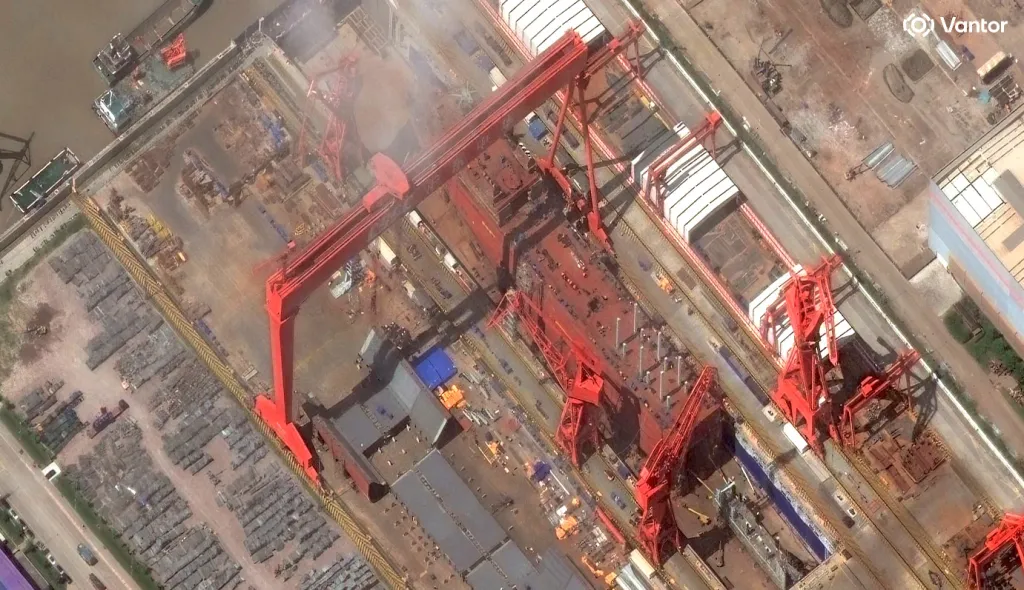
For the past six months or so, a curious-looking vessel with a very boxy superstructure has been taking shape at a shipyard in the Chinese city of Shanghai. A new satellite image lends credence to an earlier assessment that this is a mothership to support China’s growing fleets of ever-larger submersible drones, though it could also have other roles.
TWZ obtained the image of the ship in question, which was taken on September 10, from Vantor. Since then, it has also received an overall coat of gray paint, pointing to future service with the People’s Liberation Army Navy (PLAN). It is some 669 feet (204 meters) long and around 98 feet (30 meters) at its widest. In terms of basic length and width, the vessel being built now is very roughly comparable to China’s Type 071 amphibious warfare ship. However, it appears to be much taller overall than the Type 071.


The new ship has been under construction at the Hudong-Zhonghua Shipyard on Changxing Island in Shanghai since at least April. This yard produces a variety of naval vessels, including surface combatants and amphibious assault ships, as well as commercial designs.
The September 10 image, which shows the ship from the stern, is interesting for a number of reasons. It notably confirms that the design not only has a well deck, but that it is sized around what looks to be a large cradle-like platform visible in the shot. The very roughly 164-feet (50-meter) long rectangular platform has an arch-shaped structure at one end and two teardrop-shaped ones at the other, as well as six pillars, three on each side, in between. The teardrop-shaped structures, in particular, point to the platform being at least a semi-submersible, as they would help with stability and otherwise guide the flow of water while being pulled along.


The satellite image also clearly shows six large struts extending from the top of the stern end of the superstructure, each one which is paired with a shorter strut, for a total of 12. Earlier this month, independent naval analyst H.I. Sutton, who tracks undersea warfare developments in particular, posited that these struts could be used to lower a platform or some other similar structure below the hull of the ship. He also assessed that they could be used as part of a larger system capable of moving payloads between decks internally. This would help account for the configuration of the core superstructure, especially how high it is all the way from the front to the back. Overall, signs point to the inside of the superstructure being largely hangars and other open work spaces, allowing for multiple large UUVs to be carried and supported. Individual UUVs would be launched and recovered, one at a time, via the cradle.

In making his assessment, Sutton drew specific attention to a previously shown rendering of a proposed Chinese scientific research vessel with a roughly similar strut-based system at the stern for deploying submersibles and other large payloads. However, on that design, the system was entirely exposed rather than contained with an extended superstructure.

The platform seen immediately behind the ship being built at the Hudong-Zhonghua Shipyard aligns with Sutton’s assessment about the purpose of the struts. At the same time, launches and recoveries could also be conducted in a more traditional manner via the well deck. The design of the cradle-like platform would seem to suggest the latter option is at least part of the plan.
The general idea of launching and recovering payloads through the bottom of the hull of a ship, including through moon pools, is hardly new. As another point here, Russia is known to have highly specialized mothership submarines that can carry crewed midget submarines and large uncrewed submersibles attached underneath their hulls, and that are also capable of launching ultra-long-range nuclear-powered and nuclear-armed torpedoes. The idea of deploying and retrieving large UUVs via well decks using cradle-like systems is something being explored by other navies globally, including in the United States. All that being said, a large specialized ship built for the purpose of launching and recovering very large underwater vehicles in an operational capacity is unique.
The image from September 10, as well as other recent views of the ship, highlight other features that are now taking shape. This includes a large opening on the starboard side, which could be for launching and/or recovering lifeboats or other watercraft, or moving payloads to and from the pier while docked, as well as a multi-pronged mast on top of the bridge. An additional part of the ship’s superstructure extends behind the bridge area, and there is what looks to be a hangar inside. There is no attached helipad present now, but one could well be added later on somewhere on top of the superstructure. Many naval auxiliaries, as well as commercial ships designed for offshore support and other specialized tasks, have open helipads on raised frames attached to different parts of the superstructures.

Though there is growing clarity about the ship’s design, many questions do remain about the full breadth of its intended purpose. In Sutton’s view, the PLAN has a need, just in general, for a dedicated mothership to support its growing uncrewed underwater vehicle (UUV) fleets. The PLAN is pursuing various tiers of UUVs to perform a host of different missions, including intelligence, surveillance, and reconnaissance (ISR), as well as mine-laying, special operations support, and even launching direct attacks on enemy vessels. Larger and larger UUV designs have been steadily emerging in China, which could require more specialized launch and recovery options to be feasibly employed operationally, especially from other vessels at sea. Deployment and retrieval at sea could, in turn, support very long duration missions far from China’s own shores.
“With smaller UUVs, even up to 20 meters like the AJX-002 and HSU-100 paraded in Beijing last year, they are road mobile. Truck mounted cranes should be sufficient for getting them in and out of the water making operations much simpler. With these latest, much larger XXLUUVs [extra-extra large uncrewed underwater vehicles] however, China will start to need dedicated port facilities,” Sutton wrote previously on his website. “Until now China has been using floating docks to house the two XXLUUV prototypes being tested on Hainan. One of these docks was purpose built while the other may have been taken up from general use.”

“This arrangement also has a significant drawback: each floating dock can only carry a single XXLUUV,” Sutton added. “Or if more than one, then they both need to be placed in the water at the same time. Because the whole dock floods, there cannot be one undergoing maintenance while another is being launched or recovered.”
A mothership vessel able to discreetly deploy and recover large uncrewed and crewed submersibles and other large payloads underwater could be tasked with more specialized missions, including cutting cables, retrieving objects from the seabed, and other kinds of undersea espionage. There is overlap here with more benign roles, such as submarine rescue, salvage, and even deep-sea scientific research. There is also the matter of servicing an expanding array of Chinese underwater infrastructure, including sensor and communications networks. As something of a corollary, Russia’s spy ship Yantar is officially described as an oceanic research vessel. In China, the line between military and non-military assets and capabilities, including ships, is often very blurry, to begin with, as TWZ regularly highlights. This dichotomy was observed right at the Hudong-Zhonghua Shipyard around the end of last year after pictures of a commercial cargo ship being used to showcase a new family of containerized weapons, sensors, and other systems went viral online.
It is also worth pointing out that the boxy and largely enclosed design of the ship now being built at Hudong-Zhonghua Shipyard will inherently make it difficult to observe any activities onboard. This will have the additional knock-on effect of helping keep any payloads, as well as the crew, shielded from the elements. This could be valuable for operations in harsher locales, including waters in and around the Arctic, an ever-more strategic part of the world where China is working to be more engaged.
We also do not know if the apparent mothership vessel is intended to be a one-off or part of a larger class. It could be a stepping stone to broader plans or be part of an already extensive fleet of bespoke naval auxiliaries, as well as unique ostensibly commercial vessels, in service in China today. The PLAN’s aforementioned UUV ambitions will bring along significant test and evaluation requirements, as well as the need to support actual future operations.
If nothing else, evidence is only growing that the new ship under construction at the Hudong-Zhonghua Shipyard is intended to serve, at least in part, as a mothership for large submersible drones.
Contact the author: joe@twz.com