Weekly insights and analysis on the latest developments in military technology, strategy, and foreign policy.
From recent satellite imagery, the Russian Navy now looks to be using nets to protect submarines from drone attacks at a highly strategic base on the country’s far eastern Kamchatka Peninsula. There are also signs that Russian forces have been taking new steps at a separate base along the Black Sea to shield submarines against uncrewed aerial threats. The appearance of the nets over the submarines at the base in Kamchatka point to how Russia’s concerns about drone threats have extended to critical facilities far removed from the battlefields of Ukraine.
Russian forces at Rybachiy look to have started using these nets back in May based on additional imagery from Vantor. The imagery from May and August show crane barges being used to help erect the nets around submarines at their moorings.
As an aside, floating booms are also seen strung around the piers at Rybachiy. This is something else that is now commonplace at naval bases across Russia, and can help provide an additional barrier to certain threats on or near the surface, particularly explosive-laden kamikaze drone boats.
On Tuesday, the Ministry of Defense in the United Kingdom also published additional imagery from Vantor of the Russian Navy’s base in Novorossiysk along the Black Sea taken back on June 13. The images show several Kilo class attack submarines partially submerged in port. Three of the boats also appear to have anti-drone armor screens installed over their conning towers. A cursory review of additional satellite imagery in Planet Labs’ archive suggests screens were a relatively new additional at that time.
An annotated satellite image of Kilo class attack submarines in port at Novorossiysk on June 13, 2026. Vantor via UK Ministry of Defense
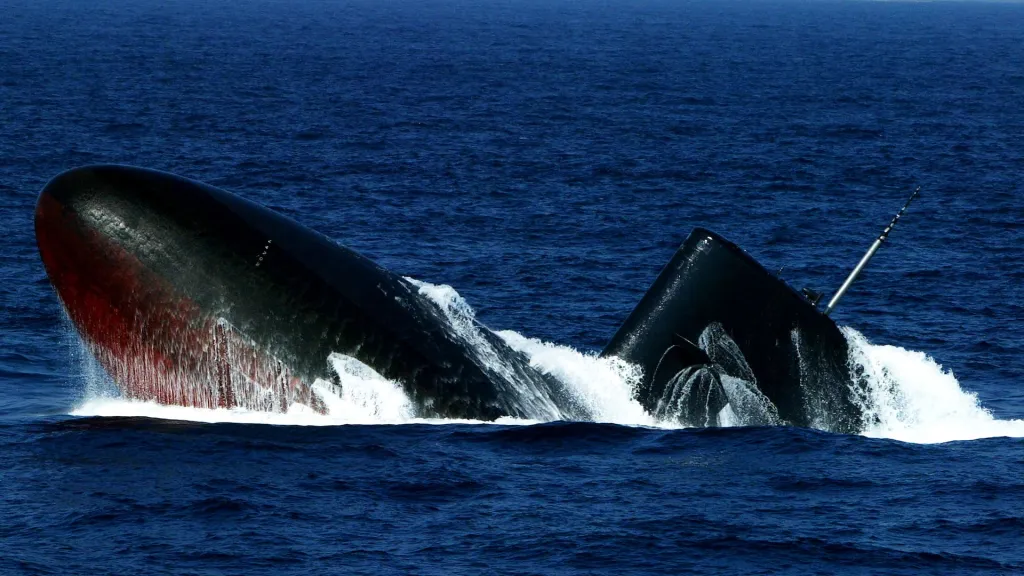
“The Russian Black Sea Fleet has equipped three of its four Kilo class submarines with counter-UAS [uncrewed aerial systems] cages covering the vessels’ conning towers. This was applied as a preventive measure in response to Ukraine’s increased ability to strike targets further from the front line,” according to an accompanying assessment from British authorities earlier this week. “Analysis of commercial satellite imagery dated 13 June 2026 identified that three of the submarines had loosened their moorings and had submerged within the basin. Whilst the majority of the hull was below the surface, their conning towers remained above the waterline, explaining the need for the counter-UAS cage.”
“The fourth submarine, which had not been fitted with a counter-UAS cage, had slipped its mooring lines, manoeuvred away from nearby surface vessels and submerged within the harbour, its conning tower visible above the waterline,” the British government’s assessment continued. “The lack of a counter-UAS cage likely signifies this vessel has been de-prioritised compared to the other three.”
TWZ has also now obtained the June 13 image of Novorossiysk directly from Vantor, as well as another one taken on June 17, which shows the submarines surfaced and at their moorings as usual. This, in turn raises questions about whether or not the boats were submerged in response an attack or indications that one might be imminent. There could be another explanation for why the submarines were temporarily submerged in port, including a force protection readiness exercise in preparation for such an incident.
Also in 2024, what looked to be additional overhead protection against drone attacks appeared on the Delta-IV class nuclear ballistic missile submarine Tula at the Russian Navy’s base in Gadzhiyevo in the country’s far northern Murmansk region. What was seen fitted to Tula at that time very rudimentary compared to what has now been seen erected over submarines at Novorossiysk and Rybachiy, which offers far greater and more elaborate coverage . More extensive counter-drone screens have also now appeared on other types of Russian naval vessels.
A view of Tula in 2024 with the apparent counter-drone armor screen installed on top of its conning tower. Russia-24
As noted, the appearance of the nets at Rybachiy, which sits thousands of miles from Ukraine, speaks to how much further the threat of drone attacks has expanded. This goes beyond long-range strikes, as well. Ukraine’s unprecedented Operation Spiderweb attacks on Russian airbases last year highlighted the dangers posed by near-field attacks launched from deep inside hostile territory closer to their actual targets. Bases in Russia’s far eastern regions were among those targeted in the clandestine operation. Ukrainian forces have also launched attacks on Russian-linked ships in the Mediterranean Sea.
СБУ показала унікальні кадри спецоперації «Павутина», у результаті якої уражено 41 військовий літак стратегічної авіації рф
The russian terrorist state no longer has the ability to produce Tu-95s or any kind of strategic bomber. This is a tremendous victory for Ukraine. pic.twitter.com/SVeQE78v0h
It also worth mentioning here that just this week, a small quadcopter drone equipped with explosive payload was discovered at next to Ukrainian An-124 cargo plane at an airport in Germany. CNN reported today that U.S. authorities have now assessed that uncrewed aerial system to have belonged to a Russian intelligence service. This follows year now of concerning drone incursions over military bases and other critical infrastructure across Western Europe.
Just this week, the US assessed that an explosive-laden drone discovered at an airport in Germany overnight on Wednesday belonged to a Russian intelligence service, a US defense official in Europe told CNN — https://t.co/axn5uQRTiG
Altogether, the expansion of counter-drone defenses around submarines at the Russian Navy’s bases at Rybachiy and Novorossiysk reflect very immediate threats emanating from Ukraine, but are also a sign of larger trends globally. Similar force protection measures could well continue to emerge elsewhere, and not just in Russia.
The Navy currently plans to acquire 19 VPM-equipped Virginia class SSGNs, according to a press release the service put out today. The first boat in this class to feature the VPM will be the future USS Arizona, which is actually the second Block V subvariant being built. The first Block V version, the future USS Oklahoma, will lack a VPM, but the other 10 boats in this batch are expected to have this feature.
【P1】 The submarine currently under construction appears to be USS Arizona (SSN-803), the second Block V Virginia-class attack submarine. 【P2】 is likely the Virginia Payload Module (VPM), a key feature of the Block V variant.
Block VI Virginia class submarines are also expected to have VPMs, as well as other upgraded capabilities. However, last week, the Navy announced a new monster $76.6 billion contract award for nine Block VI boats, as well as five additional Columbia class nuclear ballistic missile submarines, or SSBNs. This creates a discrepancy of one submarine (11 Block Vs together with nine Block VIs, for a total of 20, not 19) when it comes to the stated SSGN plans. One possible explanation might be that the outlier is a planned one-of-a-kind seabed espionage subvariant. TWZ has reached out to the Navy for clarification.
A graphic from a General Dynamics Electric Boat presentation in 2022 showing the planned evolution of the Virginia class beyond the Block V subvariant, including the planned one-of-a-kind seabed espionage boat. General Dynamics Electric Boat
Regardless, the decision to formally recategorize Virginia class submarines with VPMs as SSGNs is significant.
“This reclassification is a clear acknowledgment of the increased lethality VPM brings to the undersea fight,” Navy Vice Adm. Rob Gaucher, Director of Submarine Programs, said in a statement. “These VPM-equipped SSGNs will ensure the Navy continues to dominate the undersea domain for decades to come. By integrating this additional payload capacity, we will have the ability to surge strike power to assure our allies, deter aggression, outmatch any adversary, and give our Fleet commanders an incredibly versatile, hard-hitting instrument of national power.”
A briefing slide offering a general look at the Virginia Payload Module (VPM) that will be incorporated in Block V Virginia class submarines. USN
“Reclassifying Virginia Payload Module-equipped submarines as SSGNs accurately reflects the extraordinary strike capacity, operational flexibility, and global reach these platforms bring to the Fleet,” Navy Adm. Daryl Caudle, Chief of Naval Operations (CNO), the service’s top office, also said in his own statement. “These submarines will provide our Nation with a powerful and persistent deterrent, expand options for our combatant commanders, and ensure the Navy remains ready to fight and win whenever and wherever called upon.”
Virginia class submarines with VPMs do have significantly greater magazine depth than their predecessor. Block I and II boats had vertical launch system (VLS) arrays capable of firing a dozen Tomahawks. Block III and IV versions have a pair of Virginia Payload Tubes (VPT) in place of the earlier VLS configuration, but with the same number of tubes (12) for Tomahawks.
The Block III Virginia class submarine USS John Warner seen at its commissioning ceremony with one of its two Virginia Payload Tubes open. USN
VPM-equipped types will be able to carry 28 more Tomahawks for a total load of 40. Using different inserts, future Virginia class SSGNs will be able to carry other munitions in those tubes. This includes the aforementioned IRCPS hypersonic missiles. The Navy is also now looking to acquire a surface-to-air missile designed to be fired vertically from these submarines, which you can read more about here.
A slide from a 2021 Navy briefing providing a visual overview of the IRCPS program, including the Advanced Payload Module (APM) insert that will allow those missiles to be fired from the VPM’s tubes. The Navy is also working to arm its Zumwalt class destroyers with IRCPS missiles. The Navy’s program also shares a common missile and other elements with the U.S. Army’s ground-based Dark Eagle weapon system. USN
It should be noted here that all Virginia class submarines have four 21-inch torpedo tubes, which also offer another option for launching Tomahawks. They can also be used to fire Harpoon anti-ship cruise missiles, as well as launch and recover uncrewed underwater vehicles (UUV). It’s also possible, if not highly probable, that the VPMs will be capable of launching (and potentially recovering) other payloads, including additional uncrewed platforms.
Some existing Virginia class submarines can be fitted with Dry Deck Shelters (DDS) on top of their hulls for deploying special operations forces, swimmer delivery vehicles (SDVs), and other assets, as well. That is a capability that could be carried over to the enlarged SSGNs.
All of this brings us to the matter of the Ohio SSGNs. These boats are best known for being able to carry up to 154 Tomahawks at once, though they more typically deploy with loads of around 100 of those missiles. However, these submarines, which were converted from Ohio class SSBNs, are really multi-mission platforms. Beyond their ability to launch barrages of dozens of Tomahawks, they can act as motherships for special operations forces and uncrewed platforms, as well as serve as underwater intelligence fusion nodes and command centers. You can read more about their capabilities in this past War Zone feature.
A graphic offering a very general overview of the full breadth of features found on Ohio class SSGNs. USN
“This transition [in categorization from SSN to SSGN] comes at an important moment as USS Georgia, one of the Navy’s four Ohio class guided-missile submarines, begins the inactivation process after more than four decades of exceptional service,” CNO Caudle also said in his statement today. “Georgia and her sister ships proved the enduring value of combining undersea stealth with unmatched clandestine strike capability. The next generation of Virginia class SSGNs builds on that legacy with greater survivability, adaptability, and sustained combat power.”
USS Georgia returned home from its final scheduled operational patrol last month. It is now scheduled to be formally inactivated next year.
At the same time, as TWZ has noted for years, the VPM-equipped Virginia class boats will not be a one-for-one replacement for the Ohio class SSGNs, at least based on what is publicly known about the former’s expected capabilities. Just in terms of missile launch capacity, each one of the converted Ohios is equal to roughly four Block V/VI Virginias. This means the Navy will need to field 16 new Virginia SSGNs before it fills the gap left by the retirement of USS Georgia and its three sisters, and can then start adding capacity with three additional boats. The Navy is facing a broader deficit in VLS capacity across its surface and subsurface fleets in the coming years, due also in part to the impending retirement of the last of its Ticonderoga class cruisers.
USS Georgia seen after its final return to Naval Submarine Base Kings Bay in Georgia in July 2026. USN/Petty Officer 1st Class Travis Alston
It is unclear what other capabilities the Block V and VI Virginia class submarines might have that will help make up for the loss of the specialized intelligence gathering and command and control tasks currently performed by the Ohio class SSGNs. As noted, some existing Virginia class submarines also perform the special operations support mission, but on a more limited level.
“By putting high-volume, long-range precision strike capabilities directly into the hands of the Fleet, these SSGNs will serve as a vital cornerstone for Distributed Maritime Operations and high-end warfighting,” the Navy’s press release today says. “Once operational, these highly survivable platforms will be dynamically employed across crucial global theaters – providing persistent forward presence, reinforcing robust alliance deterrence, and standing ready to project decisive combat power at a moment’s notice.”
On top of all this, the Navy does not expect the full fleet of 19 Virginia SSGNs to be in service until Fiscal Year 2038, at the earliest. This will be nearly a decade after the last Ohio SSGNs sail into mothballs. Concerns are regularly voiced now about the ability of General Dynamics Electric Boat and Newport News Shipbuilding (a division of Huntington Ingalls Industries) to keep up with demand for submarines in this class. There is even more pressure on the program with the addition of plans to sell some of those boats to Australia as part of the trilateral Australia-United Kingdom-United States (AUKUS) defense pact. The Navy is hoping to see the Virginia class production rate eventually rise to two per year, but is not expecting that to come until sometime in the 2030s.
If nothing else, the Navy has at least outlined more of a formal plan to supplant the Ohio class SSGNs with what it has now dubbed Virginia class SSGNs.
Prime Minister Carney said Monday that Canada selected Germany’s ThyssenKrupp Marine Systems (TYEKF) (TKAMY) to build as many as 12 submarines, as the country boosts defense spending to meet NATO targets.
The planned purchase will be groundbreaking for Canada’s naval
Weekly insights and analysis on the latest developments in military technology, strategy, and foreign policy.
South Korea has confirmed plans to develop a new class of nuclear-powered submarines under the Jang Bogo N Project. These will put South Korea in an exclusive class of nations operating nuclear-powered subs, with currently only China, France, India, Russia, the United Kingdom, and the United States having them in active service. The move has larger implications than providing the Republic of Korea Navy (ROKN) with just more capable submarines.
A Ministry of National Defense rendering shows how the Jang Bogo N Project boats may look. MND
South Korea’s Ministry of National Defense (MND) today published a document, the Basic Plan for the Development of Nuclear-Powered Submarines in the Republic of Korea, that sets out its ambition for a major advance in the country’s naval capabilities. The name of the program alludes to South Korea’s first submarine, the Jang Bogo class.
📌「대한민국 핵추진잠수함 개발 기본계획」 발표
국방부는 5월 26일(화)에 「대한민국 핵추진잠수함 개발 기본계획」을 발표했습니다.
「대한민국 핵추진잠수함 개발 기본계획」은 대한민국이 핵추진잠수함을 체계적으로 개발하기 위한 추진 방향을 국내·외에 최초로 제시하는 문서로서 주요 내용은… pic.twitter.com/jkVjS3soQt
The MND has presented the thinking behind its nuclear-powered sub plans, noting that the vessels will offer “dramatically enhanced operational capabilities” compared to the ROKN’s existing diesel submarines. As well as their functionally unlimited range, the MND says the new nuclear-powered submarines will offer “higher mobility” than their predecessors, which pairs with nuclear submarines’ abilities to travel farther, and do so faster, as well as their underwater agility, at least in certain performance envelope areas.
The ministry also outlines that the new submarines “will play a core role in responding to threats such as North Korea’s submarine-launched nuclear and missile threats.”
“The Republic of Korea will transparently and firmly fulfill its nuclear non-proliferation obligations based on the trust of the international community,” the MND adds.
Clearly, this is a long-term program, with it being Seoul’s first venture into nuclear propulsion for a military application, although it does develop reactors for civilian purposes, which could be leveraged for such work.
An official rendering showing one of the Jang Bogo N Project boats under construction. MND
The defense ministry expects that the construction process will take up to 10 years, after which the boats will be operated for more than 30 years.
A precise timeline has not been released, and it is also unclear how many hulls are expected to be built.
Back in October last year, TWZreported on a key milestone toward the program launch, when U.S. President Donald Trump announced that he’d signed off on the plan.
“Our Military Alliance is stronger than ever before and, based on that, I have given them approval to build a Nuclear Powered Submarine, rather than the old fashioned, and far less nimble diesel powered submarines that they have now,” Trump wrote in a post on Truth Social.
The U.S. leader also claimed that at least some of the boats would be built in the United States. The MND hasn’t mentioned this possibility, and the wording of its announcement stresses the sovereign nature of the program and local industrial participation. However, with South Korean firms already building ships in Philadelphia and the United States needing more nuclear shipbuilding capacity, this dynamic could also come into play as a result of the Jang Bogo N Project.
Collapse of U.S. shipbuilding poses national and economic security risks | 60 Minutes
However, the plans long faced pushback, including from the United States, especially over nuclear proliferation concerns.
The ROKN already operates a sizable diesel-electric submarine force made up of 12 Jang Bogo class boats, nine Sohn Won-yil class submarines, and three Dosan Ahn Changho class vessels — these are also referred to under the Korean Submarine (KSS) nomenclature, being the KSS-I, KSS-II, and KSS-III, respectively.
The Republic of Korea Navy’s submarine Jang Bogo, one of the KSS-I boats. U.S. Navy
The Jang Bogo and Sohn Won-yil classes are based on the German Type 209 and Type 214 designs, respectively, while the Dosan Ahn Changho class is a fully South Korean design.
The KSS-III submarine ROKS Dosan Ahn Changho during trials. Defense Acquisition Program Administration
Last year, South Korea also launched the first of three planned Jang Yeongsil class (KSS-III Batch II) submarines, the nation’s largest and most technologically advanced submarine class so far. You can read more about them here.
The launch ceremony for the ROKS Jang Yeongsil, the first of the KSS-III Batch II boats. ROKN
Whatever Seoul’s plan is for the production of the new boats, it is still possible, indeed likely, that the United States will provide assistance at least in relation to their propulsion systems.
Last year, South Korea’s defense minister said that South Korea would build its own submarines and modular reactors, but would receive a supply of enriched uranium fuel from the United States. Seoul’s Defense Acquisition Program Administration (DAPA), meanwhile, said that the country was already working on developing small nuclear reactors.
This fuel issue is interesting, bearing in mind that one of the hurdles for the program is a bilateral agreement that prevents it from enriching uranium and reprocessing spent fuel without Washington’s approval. Today’s announcement would suggest that the U.S. government has given the program the green light.
The Ohio class guided-missile submarine USS Michigan in Busan, South Korea, in 2017. U.S. Navy
When it comes to the nuclear issue, it’s worth noting that, as it now stands, all nations operating nuclear-powered submarines also field nuclear weapons. Already, however, Australia is moving to acquire nuclear-powered submarines through the trilateral Australia-United Kingdom-United States (AUKUS) defense cooperation agreement. Canberra has no plans for fielding nuclear weapons.
A rendering of what the AUKUS nuclear-powered submarine design for Australia may look like. U.K. Ministry of Defense
North Korean Premier Kim Jong-un on board one of the country’s Soviet-era Romeo class submarines. KCNA
As a signatory of the Non-Proliferation Treaty (NPT), this would also stand in the way of South Korea acquiring nuclear weapons. Indeed, separate from weapons, the process of building enrichment or other nuclear facilities, or otherwise acquiring the highly enriched fissile material to power the submarines, would be an issue for the NPT.
The Jang Bogo N Project is certainly ambitious, and not just in terms of constructing the boats and securing the fuel required for them.
Beyond that, there is the question about the degree to which Seoul even needs nuclear-powered submarines. South Korea is already developing conventionally-armed submarine-launched ballistic missiles (SLBM) that can be fired from some of its more modern diesel submarines. These would already offer a conventional second-strike capability to help deter North Korea. The ranges involved in striking North Korean targets hardly need a launch platform with nuclear propulsion.
At the same time, South Korean diesel-electric submarine technology already outstrips North Korea’s limited anti-submarine warfare capabilities.
South Korea Test Launches Ballistic Missile From Submarine
On the other hand, while South Korea’s new diesel-electric subs offer a conventional quasi-second strike capability, it is not anywhere comparable to a true strategic nuclear second-strike deterrent of the kind that highly survivable nuclear-powered boats could provide, if South Korea one day chooses to go nuclear. Even with just conventional ballistic missiles aboard, the ability of a nuclear submarine to disappear out to sea for long periods is unmatched, which would enhance the survivability of the boats and their missiles, and help the credibility of a far more limited conventional second strike deterrent.
Beyond the North Korean threat, the nuclear-powered submarine program promises boats with extreme endurance and a higher level of underwater performance that can range much farther afield, reflecting Seoul’s growing focus on a broader regional security picture. With this in mind, it’s clear that the Jang Bogo N Project is also directed against the threat posed by China. Beijing’s military capabilities are a growing concern for South Korea, a fact reflected in Seoul looking increasingly toward security challenges beyond the peninsula.
A stock picture of a Chinese Type 039A or Yuan class nuclear attack submarine. via U.S. Navy
The Chinese government has also previously spoken out against South Korea’s nuclear-powered submarine plans, calling for Seoul and the U.S. “to fulfill their nuclear non-proliferation obligations and do things to promote regional peace and stability, and not the other way around,” according to Reuters.
South Korea’s burgeoning submarine plans underscore how quickly its naval ambitions in general are evolving from coastal defense to a far more capable regional deterrent force, and one that will increasingly be able to undertake long-duration bluewater operations.
With the Jang Bogo N Project now underway, the ROKN can look forward to fielding its most advanced vessels yet. Depending on final plans for the production of these boats, it may well also cement its position as one of the few countries capable of designing and building nuclear-powered vessels. At the very least, it should put yet another piece in place should South Korea decide it needs a true second-strike strategic nuclear deterrent.
South Korean President Lee Jae Myung (2-R) presides over a defense strategy committee meeting in Changwon, South Gyeongsang Province, South Korea, 26 May 2026. Photo by YONHAP / EPA
May 26 (Asia Today) — The South Korean government said Tuesday it aims to launch its first nuclear-powered submarine by the mid-2030s and deploy the vessel to the Navy in the late 2030s.
The plan was presented during the first meeting of the Future Defense Strategy Committee in Jinhae, South Gyeongsang Province, attended by President Lee Jae-myung.
According to the government, South Korea plans to domestically develop and build the submarines to strengthen the independence and stability of its military procurement, maintenance and operational systems.
The submarines are expected to use low-enriched uranium fuel enriched below 20%, allowing for long operational cycles without frequent refueling.
Defense Minister Ahn Gyu-back briefed Lee on the government’s basic plan for developing nuclear-powered submarines.
The announcement came seven months after Lee said he received support from President Donald Trump during a bilateral summit in October for South Korea’s submarine program.
“Based on the strong South Korea-U.S. alliance, the nuclear-powered submarines we will build symbolize our determination to take responsibility for peace and security on the Korean Peninsula ourselves,” Lee said.
He added that the project would also contribute significantly to strengthening South Korea’s defense industry capabilities.
Lee also emphasized the importance of regaining wartime operational control, known as OPCON, from the United States.
“The recovery of wartime operational control is a core element of self-reliant national defense,” Lee said. “It will serve as an opportunity for South Korea to more clearly establish itself as the main actor in defending the Korean Peninsula.”
He said Seoul and Washington would continue close consultations to finalize a roadmap for the transfer, including the timing of the transition.
Lee also called for integrating advanced science and technology into national defense to build what he described as a “smart military” capable of dominating future warfare.