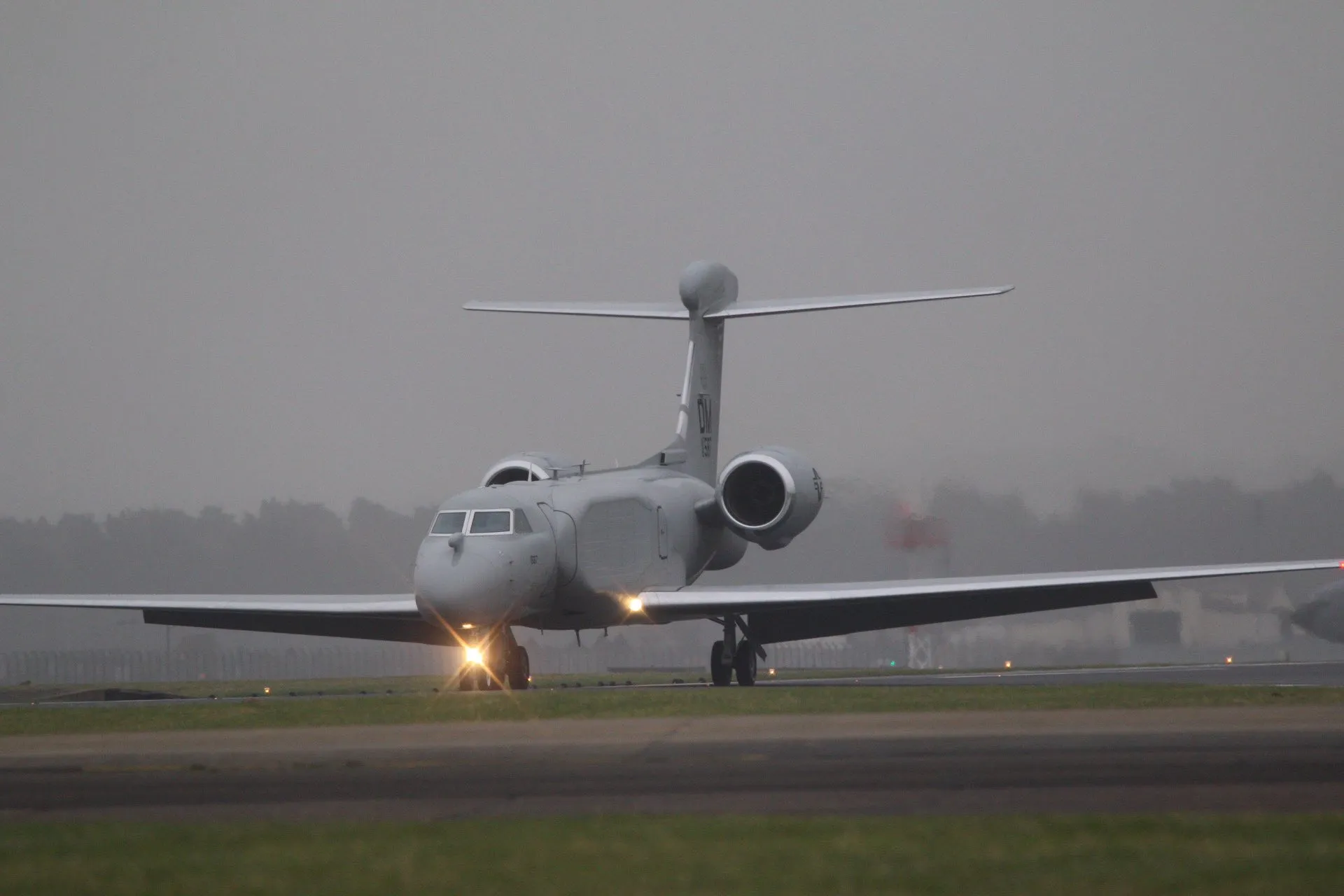
A pair of the U.S. Air Force’s new EA-37B Compass Call electronic warfare jets have touched down at RAF Mildenhall in England, from where they could move forward and join America’s growing aerial armada in the Middle East.
Last night, open-source flight trackers began to track the progress of the two jets — tail numbers 19-1587 and 17-5579 — that were flying with the callsigns AXIS41 and AXIS43. Photos of the aircraft arriving at Mildenhall were provided to TWZ by g.lockaviation.

This could become the EA-37B’s first operational deployment, but we cannot say that for certain at this time. One of the EA-37Bs was in Europe earlier this year to introduce airmen to the platform, but it was not yet operational. You can read more about that here.
It is worth bearing in mind that, during Operation Desert Storm in 1991, a pair of E-8 Joint STARS surveillance aircraft were also deployed, but were operated by civilian crews. The same could be the case here, or at least mixed crews.
The 55th Wing at Offutt Air Force Base, which operates the Compass Calls, declined to provide TWZ with a comment, deferring us to CENTCOM, which could not immediately comment.

The Air Force plans to acquire 10 EA-37Bs to replace its aging and steadily shrinking fleet of turboprop-powered EC-130H Compass Call planes, of which only four are still in service. Two are deployed to the Middle East for Operation Epic Fury. There have been some unconfirmed reports that these aircraft may have been damaged in the attack on Prince Sultan Air Base that saw an E-3 destroyed. Losing EC-130H capability in the region could have very well prompted an emergency deployment of EA-37Bs, even ahead of their planned entry into full operational availability. But we cannot confirm that is the case at this time.

Electromagnetic warfare, evolved
The new aircraft are designed to provide critical standoff jamming support against enemy communications systems, including hostile air defense systems.
As we have pointed out, even improvised systems cobbled together by Iranian-backed Houthi militants in Yemen, as well as their hodgepodge of other air defenses, have shown their ability to challenge even the most advanced fighters in the U.S. inventory. Iran’s capabilities, while now in a deeply degraded state, are more advanced and already seem to have had some success in targeting U.S. military aircraft, while others have faced close calls.
At the same time, while air defenses are certainly part of the equation, simply keeping the Iranian military from communicating and (further) disrupting their already fractured command-and-control infrastructure is a highly significant capability to bring to bear.
The EA-37B also has an important intelligence, surveillance, and reconnaissance (ISR) function, given its ability to spot, track, and geolocate various types of emitters.
This aircraft, which represents the cutting edge in U.S. electronic warfare capabilities, would be highly important for any ground operation, helping to protect troops put in harms way, should this come to pass.
We will have to wait and see if the EA-37Bs make the leap to the CENTCOM area of responsibility. If they do, it will be something of a baptism by fire for America’s new Compass Call.
A full deep-dive into the various capabilities of the EA-37B can be found in this interview with top executives from the two co-primes that are working on the electronic attack aircraft program.
UPDATES:
Our coverage for the day has concluded.
UPDATE: 5:38 PM EST –
CENTCOM spokesman Capt. Tim Hawkins provided us with the latest casualty figures for Epic Fury.
There have been 348 troops wounded, six seriously and 315 have returned to duty. There have been 13 troops killed.
Trump told reporters at the White House that the U.S. military will soon depart from the Strait of Hormuz.
“We’ll be leaving very soon,” he proclaimed. “What happens [there] we’ll have nothing to do with.
CNN said top administration officials acknowledge that the U.S. cannot swiftly end the war within the Trump-imposed four to six week timeline and keep the Strait of Hormuz.
Secretary of State Marco Rubio reiterated the Trump administration’s rationale for going to war with Iran, stating “we were on the verge of having an Iran that had so many missiles and so many drones that nobody could do anything about their nuclear weapons program…”
It appears that USS Tulsa and USS Santa Barbara, a pair of U.S. Navy Independence class Littoral Combat Ships (LCS) configured for minesweeping, remain in the Pacific.
According to open-source researcher MT Anderson, satellite imagery shows vessels moored alongside each other at Sembawang Shipyard in Singapore. As we have previously noted, ships remain thousands of miles away from their primary assigned operating area in the Middle East, where the conflict with Iran grinds on. That despite concerns that the Strait of Hormuz could be mined.
Iran released new video of its Eagle 44 underground airbase showing it still has some aircraft. As TWZ editor-in-chief Tyler Rogoway notes in a post on X, low-resolution satellite imagery from March 16 shows relatively little damage at the site. However, things may have changed since then and the site may have been it. Regardless, it doesn’t matter if Eagle 44 only has jets, which wouldn’t last very long even if they got off the ground. However, if the facility were stuffed with missiles, that would be a concern. You can read more about Eagle 44 here.
UPDATE: 4:06 PM EST –
In a brief exchange during an interview with NBC News Tuesday afternoon, Trump hinted that Epic Fury might be drawing to a close.
“We’re doing great,” Trump told the network. “And it’s coming to an end.”
He offered no further details.
The U.K. is sending more troops and Sky Sabre air defense systems to the Middle East to defend against Iranian attacks. This will bring the total number of UK personnel in the Gulf and Cyprus to around 1,000, the BBC noted.
“On a trip to the Gulf nations, Defense Secretary John Healey said extra air defence teams and systems would be deployed to Saudi Arabia, Bahrain and Kuwait while the use of Typhoon jets in Qatar will be extended,” the outlet added. “My message to Gulf partners is: Britain’s best will help you defend your skies.”
Iran’s foreign minister Abbas Araghchi told Al Jazeera that his country is exchanging messages with the U.S. either directly or through friends in the region.
But that doesn’t mean there are peace talks with Washington, Araghchi posited.
“I receive messages from [U.S. envoy Steve] Witkoff directly, as before, and this does not mean that we are in negotiations,” he told the news outlet.
Araghchi added that Iran has no “faith that negotiations with the U.S. will yield any results. The Trust level is zero.”
Netanyahu said that as a result of constant Israeli attacks on Iran, “sooner or later, it will end up falling.”
The Israeli leader also said “we are working on transforming Israel into a super nation in the region and globally.”
The IRGC confirmed the killing of another Iranian leader, this time Jamshid Eshaghi, head of budget and financial affairs for the Iranian Armed Forces General Staff. He was killed in a missile strike in Tehran on an unspecified date, according to the IRGC.
Eshaghi played a key role in evading oil sanctions and financing the group’s missile projects, according to Ariel Oseran, senior Middle East correspondent for Israel’sI24 News in a post on X.
The State Department said it is “tracking reports of threats against locations where American citizens gather” in Saudi Arabia. ”We advise U.S. citizens that hotels and other gathering points including U.S. businesses and U.S. educational institutions may be potential targets.”
UPDATE 12:46 PM EST –
The Navy released video today of the aircraft carrier USS George H.W. Bush departing for deployment. As we previously noted, the carrier is reportedly heading to the Middle East region. The Bush will likely replace the aircraft carrier USS Gerald R. Ford, which left the region and is undergoing repairs in Croatia after a fire.
Israeli Prime Minister Benjamin Netanyahu hinted at something on Tuesday that at one time was unthinkable – a military alliance with Saudi Arabia and other Arab nations.
According to Israeli media, “Netanyahu told ministers at a cabinet meeting that new alliances are being formed with leaders of Arab countries who ‘are talking about fighting together on our side,’” The Times of Israel reported.
“In the past, I had secret conversations with Arab leaders,” Netanyahu reportedly said. “I told them, ‘As soon as Iran can, it will conquer you and overthrow your kingdoms.’ Back then, they didn’t really internalize things. Today they understand.”
Lebanon has informed the United Nations in a letter that it has outlawed Hezbollah’s military wing. Beirut’s letter, dated a few weeks ago but made public today, also mentioned the Lebanese government’s March 2 decision to ban all military activity by the group.
Hegseth not only validated Trump’s idea to move forward with plans to attack Iran, he also downplayed the inherent risks of the conflict spiraling out of control, according to CNN.
Poland has no intention of shipping any Patriot batteries to the Middle East despite a request from the U.S. to do so, says Polish Defense Minister Władysław Kosiniak-Kamysz.
“Our Patriot batteries and their armament are used to protect Polish skies and NATO’s eastern flank,” he stated on X. “Nothing is changing in this regard, and we are not planning to relocate them anywhere! Our allies know full well and understand how important the tasks we have here are. Poland’s security is an absolute priority.”
The Islamic Revolutionary Guard Corps (IRGC) has threatened to strike 18 U.S. technology and defense-related companies operating in the Middle East, Israel’s I24 News reported. The IRGC warned the action could begin as early as tomorrow night if Iran’s senior commanders are targeted.
“In a statement, the IRGC urged employees of the listed firms to evacuate immediately, and advised nearby residents to leave surrounding areas, describing the companies as ‘terrorist’ entities allegedly supporting US and Israeli operations against Iran,” the publication added.
U.S. President Donald Trump said today that countries should be prepared to go to the Strait of Hormuz and “take” fuel themselves, urging them to show greater resolve. Writing on Truth Social, he argued that nations would need to “learn how to fight for yourselves,” adding that the United States would no longer step in to assist, particularly after what he described as their refusal to support efforts to topple Iran’s leadership.
Trump suggested that countries facing shortages could instead purchase jet fuel from the United States, where supplies are abundant. He added that Iran had effectively been “decimated” and concluded by telling nations to secure their own oil.
In a press conference today, U.S. Secretary of War Pete Hegseth stressed that Operation Epic Fury would conclude “on our terms” and that the United States remains committed to shaping the outcome of the conflict according to its own objectives.
The next days of the Iran war will be “decisive,” Pentagon chief Hegseth said at his first news conference in nearly two weeks. He adds: “We have more and more options, and they have less… in only one month, we set the terms, the upcoming days will be decisive. Iran knows that, and there’s almost nothing they can militarily do about it.”
The war secretary reaffirmed that the option of some kind of ground campaign has not been ruled out. Hegseth said that “maybe negotiations will work,” but he was unwilling to commit one way or the other when asked about the potential for American boots on the ground.
Hegseth continued:
“You can’t fight and win a war if you tell your adversary what you are willing to do or what you are not willing to do, to include boots on the ground. Our adversary right now thinks there are 15 different ways we could come at them with boots on the ground, and guess what? There are. And so if we needed to, we could execute those options on behalf of the president of the United States and this department.”
“Or maybe we don’t have to use them at all. Maybe negotiations work, or maybe there’s a different approach. But the point is to be unpredictable in that you certainly do not let anybody know what you’re willing to do or not do.”
Hegseth went on to argue that recent events have exposed the level of support the United States can expect from its allies, suggesting that their responses have fallen short. According to Hegseth, while the missiles in question do not threaten the United States directly but rather its allies, requests for assistance — or even basic overflight access — have often been met with hesitation or obstacles.
Hegseth also confirmed that he had briefly visited the U.S. Central Command region recently.
He concluded by warning that an alliance loses its meaning if member countries are unwilling to stand together when it matters most.
When it comes to overflight access, France has apparently joined Spain in denying U.S. military access to their airspace for taking part in attacks on Iran. In a statement, Trump slammed France for refusing to let U.S. military aircraft carrying military supplies operate in its airspace.
In other France-related news, Israel has apparently stopped defense exports to the European country, citing “hostile attitude,” sources told The Jerusalem Post.
Meanwhile, Italy confirmed that it denied permission for U.S. military aircraft to land at Sigonella Air Base in Sicily last week, before heading to the Middle East; this was due to Washington having not sought prior authorization from the government in Rome, Reuters reports. A source at the Italian defense ministry told The Guardian that “some US bombers” had been due to land at Sigonella en route to the Middle East. Otherwise, U.S. military aircraft continue to operate from Italian airbases as a matter of course, the defense ministry confirmed.
Gen. Dan Caine, the Chairman of the Joint Chiefs of Staff, has said the U.S. military is delivering precision strikes against manufacturing nodes “deep within Iran.”
He says around 11,000 targets have been hit in the past 30 days. The U.S. military “continues to assert dominance over the Iranian Navy,” he added.
Caine added that more than 150 ships have been “taken out.”
An underground missile storage facility in Sofeh, in Isfahan province, appears to be among the hardened facilities targeted in recent strikes. Earlier accounts suggested that the target was an Iranian underground missile base, but that seems to be refuted by the geolocation of the imagery available.
Videos purporting to show the aftermath of the strikes include multiple secondary explosions, suggesting that bunker-busting munitions managed to penetrate the vaults and then detonate the missiles stored there. As we have described in the past, a key vulnerability of Iranian subterranean installations is the risk that even a single weapon penetrating their hardened exterior by any means could have absolutely catastrophic results.
Officials familiar with U.S. and Western intelligence assessments say the U.S.-Israeli war on Iran has fractured the Iranian government, making it harder for the country to make decisions or coordinate large-scale retaliatory attacks, The New York Times reports.
Since the conflict began four weeks ago, several dozen Iranian leaders and their deputies have been killed. Survivors face significant communication challenges and are unable to meet in person, fearing that their calls could be intercepted by the United States or Israel and lead to airstrikes.
Although Iran’s security and military agencies remain operational, the government’s capacity to develop new strategies or policies has been significantly weakened.
Iranian state media reported yesterday that a parliamentary committee has approved a plan to impose tolls on ships passing through the Strait of Hormuz.
According to a Telegram post by the Fars News Agency, the strait would remain closed to vessels from the United States, Israel, and countries involved in sanctions against Iran. The report added that Iran would play a “sovereign” role in enforcing the new system.
The proposal, which has been backed by Iran’s parliament security committee, would still require agreement from other countries bordering the strait. Details on the level of the proposed tolls have not been disclosed.
Meanwhile, as you can read about in our previous coverage, President Trump warned that if no agreement is reached with Iran — including reopening the Strait of Hormuz shipping route — the U.S. military forces would destroy “all of their Electric Generating Plants, Oil Wells and Kharg Island (and possibly all desalinization plants!).”
More information on the proposed toll arrangement emerged today, including the surprising suggestion that Oman is slated to help shape the legal framework. This was reported by Fars and later picked up by Bloomberg, but has yet to be independently verified. Oman has strong relations with the United States, including extensive security cooperation. Oman also plays a key role as a regional mediator, particularly between the United States and Iran.
A pair of container ships operated by the Chinese shipping giant Cosco have successfully transited the Strait of Hormuz and exited the Gulf, according to ship-tracking data.
The vessels, CSCL Indian Ocean and CSCL Arctic Ocean, sailed near the Iranian-controlled island of Larak and are now heading toward Port Klang in Malaysia.
While Iran has largely restricted traffic through the key waterway, it appears to be permitting limited passage for ships from countries it considers “non-hostile,” including Thailand, China, Pakistan, and India.
Iran struck a fully laden crude oil tanker anchored in the port of Dubai, setting it on fire and damaging its hull in what marks the latest attack on commercial shipping in the Gulf and the Strait of Hormuz during the conflict.
Authorities in Dubai said the drone strike on the Al Salmi tanker sparked a blaze that was brought under control early Tuesday, several hours after the incident was first reported. They later confirmed that no oil spill had occurred.
Iran is reportedly pushing the Houthis to prepare for a renewed campaign against Red Sea shipping, contingent upon any further escalation by the United States in the conflict with Iran. This was reported by Bloomberg, citing European officials familiar with the matter.
An Israeli military spokesperson has said the country is ready to continue its offensive against Iran for an extended period. According to Reuters, Lt. Col. Nadav Shoshani told reporters that Israel is prepared for “weeks” more of fighting in the conflict, which began on February 28 when joint U.S.-Israeli airstrikes killed Iran’s supreme leader, Ali Khamenei. He emphasized that while the final decision rests with political leaders, “we are prepared to keep operating for weeks to come. We have the targets for that, the munitions for that, the manpower for that, and it’s up to the leadership to decide”.
His remarks follow comments from Israeli Prime Minister Benjamin Netanyahu, who said the campaign was “definitely beyond the halfway point,” later clarifying that he was referring to progress in terms of “missions” rather than “not necessarily in terms of time.”

In a televised interview, Netanyahu has claimed that Iran has tried to kill President Trump twice, although he did not provide a timeline for when these attempts were made or how. “They’re still trying to kill him,” the Israeli leader added.
The Israeli military claimed today that all of its critical and essential pre-war targets in Iran will have been destroyed by Wednesday.
This represents the complete elimination of the top two priority categories of pre-war targets and is part of the broader campaign in which the IDF has destroyed roughly 60 to 70 percent of all designated targets within the Islamic Republic.
“Critical” targets include those posing an immediate threat to Israel, such as ballistic missile facilities, as well as key sites central to the objectives of the campaign, including the few remaining nuclear-related installations.
On the topic of nuclear-related targets, President Trump disclosed today that he considers that Iran’s nuclear facilities are buried so deeply that it would be difficult to raid them to secure their enriched uranium stockpiles.
“I don’t even think about it. I just know that, you know, that’s so deeply buried it’s gonna be very hard for anybody,” Trump told CBS News.
TWZ has previously explored the possibility of U.S. and/or Israeli authorities launching a special operations ground raid to extract or otherwise neutralize Iran’s stockpile of enriched uranium. While noting that it is far from easy to achieve this objective from the air alone, it is also true that Israel has demonstrated its ability and willingness to carry out complex raids on subterranean facilities in the past. Nevertheless, any such operation would still face immense risks and uncertainties.
Four Israeli soldiers have been killed during fighting in southern Lebanon, the Israeli military said on Tuesday, as its forces continue to clash with the Iran-backed Hezbollah.
In a statement, the military identified three soldiers from the same battalion who “fell during combat,” while a separate statement said a fourth soldier, whose name has not yet been released, was also killed in the same incident, according to Agence France-Presse.
The military added that another soldier was seriously injured, while a reservist sustained moderate wounds.
Saudi Arabia’s defence ministry has said it intercepted and destroyed 10 drones in recent hours, along with eight missiles targeting the Riyadh area and the country’s eastern region.
The United Arab Emirates says its air defenses engaged eight ballistic missiles, four cruise missiles, and 36 drones launched from Iran earlier today.
Furthermore, Kuwait reported that its air defences were responding to hostile missile and drone attacks. Neither country specified the origin of the projectiles.
Gulf partners of the United States, especially Saudi Arabia and the United Arab Emirates, are pressing President Trump to keep up military operations against Iran, asserting that Tehran has not been sufficiently weakened by the month‑long U.S.‑led bombing campaign, according to U.S., Gulf, and Israeli officials, AP reports.
A recent video released by U.S. Central Command includes footage of attacks on pickup trucks configured to launch drones, including Shahed-136 one-way attack drones.
NPR has reported that the Iranian strike on Saudi Arabia’s Prince Sultan Air Base last week damaged two U.S. Air Force E-3G Sentry AWACS aircraft. Previously, we had gotten confirmation that one aircraft was entirely destroyed. The extent of the damage to the other is unclear.
Ukraine’s president, Volodymyr Zelensky, has claimed that Ukrainian intelligence had information that a Russian spy satellite had photographed the base three times before the attack, with targeting data provided to Iran. While that may be true, commercially available satellite imagery over the same period also revealed the likely position of the E-3s at the base.
A video circulating on social media appears to show an Iranian ballistic missile maneuvering to evade an Israeli interceptor. If verified, this would not be the first occasion that we have seen evidence of more advanced types of Iranian missiles still being fired at Israel and eluding air defenses. We have seen multiple occasions where Iranian maneuverable reentry vehicles (MaRVs) have been able to pierce interceptor barrages during the terminal stage.
At least some of the aircrews of the three U.S. Air Force F-15E Strike Eagles that were shot down in a friendly-fire incident by Kuwaiti air defenses are still flying missions in Epic Fury, Secretary of War Pete Hegseth has confirmed. “Admiral Cooper noted this morning that the three Air Force captains who were shot down by Kuwaiti friendly fire early in the fight never left the theater. All dropped bombs over Tehran last night.”
Contact the author: thomas@thewarzone.com