In the past three years, following the October 7 attacks and the start of Israel’s genocidal war on Gaza, the wider region has been marked by conflict, economic turmoil, and a shattering of the balance of power.
The network of alliances maintained by Iran, long central to its regional power, has been hit hard and severely weakened. Yemen’s Houthi rebels remain one notable exception.
Recommended Stories
list of 4 itemsend of list
Israel has made gains. Many of the leaders of the Lebanese group Hezbollah and the Palestinian group Hamas have been killed, while Iranian Supreme Leader Ayatollah Ali Khamenei was also assassinated in February. Israel occupies most of Gaza, where it has also killed more than 74,000 Palestinians and reduced much of the enclave to rubble.
Its military aggression has come at a cost, isolating it from its traditional allies and making it globally unpopular, including in the United States. The potential for more normalisation deals with Arab countries seems unlikely, at least in the short term.
Instead, Israel continues to launch attacks across the region, crossing previously held red lines – such as the 2025 attack on Doha, Qatar – and making many governments around the world view it as the primary source of unrest in the Middle East.
US not a protector
“Before October 7, the US’s entire policy in the Middle East rested on normalising Israel’s presence in the region through its so-called Abraham Accords,” HA Hellyer of the Royal United Services Institute said, referring to the normalisation deals with several Arab states, including the United Arab Emirates. “Israel’s response to the October 7 attack ended that.”
Instead, rather than a stable Middle East with Israel at its centre, the US entered into a war with Iran this year, and has since looked on as Tehran targeted US allies across the Gulf, shattering the perceived security of the US security umbrella.
Drones and missiles hit Qatar’s Ras Laffan gas hub and started fires near Dubai airport and at Fujairah’s oil zone. In September, the Houthis surged down Yemen’s Red Sea coast, taking the port of Mocha and nearby islands. Their gains tightened their grip on the Bab al-Mandeb strait, threatening a key route for global trade and energy supplies that had become even more important amid disruption in the Strait of Hormuz.
“There’s been a loss of faith in the US as a singularly sufficient security guarantor,” Hellyer continued.
“This is why you’re seeing many in the region talk to other external actors, in addition to continuing, and in some cases deepening their US ties, as well as initiatives such as the Mecca security pact as states in the region look elsewhere for ways to safeguard their security,” he said, referring to the defence agreement between Saudi Arabia, Turkiye and Pakistan, signed in August, agreeing that an attack on one was to be regarded as an attack on all.
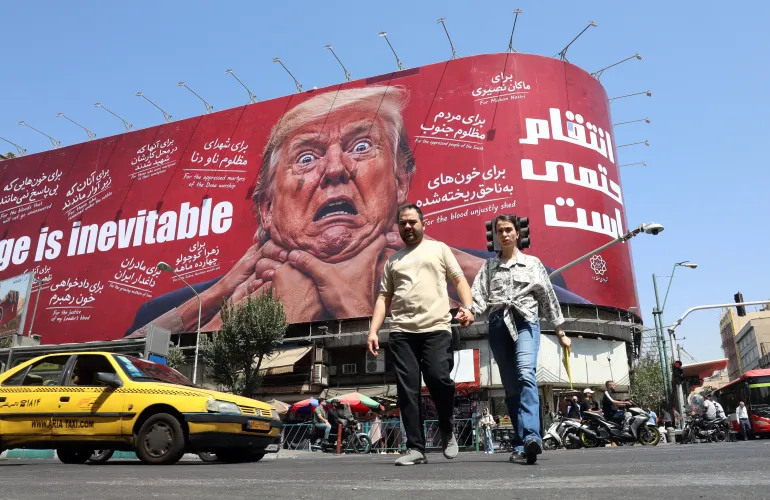
Iranians walk near an anti-Trump billboard in Tehran, Iran, August 19, 2026 [Abedin Taherkenareh/EPA]
Alliances
Alongside the loss of confidence in the US as a security guarantor has come a dramatic reordering of alliances and rivalries. Much of Iran’s network – most notably Hezbollah, whose reputation had long served as a deterrent against Israeli attack – appeared to buckle under Israeli pressure.
“The Middle East has always been multi-aligned. However, now it’s even more so,” Sanam Vakil, the director of the Middle East and North Africa Programme at Chatham House, said of the increased leverage given to external actors, such as Turkiye in Syria and China’s involvement in negotiations over the end to war on Iran, as Beijing finds its own energy supplies under threat.
“It’s ironic, since October 7, it’s Israel that has emerged as the revisionist power and Iran almost as the status quo power,” she said of the apparent reversal in status of the two belligerents, with Tehran seemingly more focused on regaining the ground it has lost in the last three years rather than advancing beyond them.
However, none of this was to overstate Israeli influence, or liken it to a regional superpower, Vakil cautioned. “Israel may currently be the preponderant military power in the Middle East, but real power is typically classed as being able to project stability, which Israel hasn’t shown itself able or willing to do,” she said.
Clogged arteries
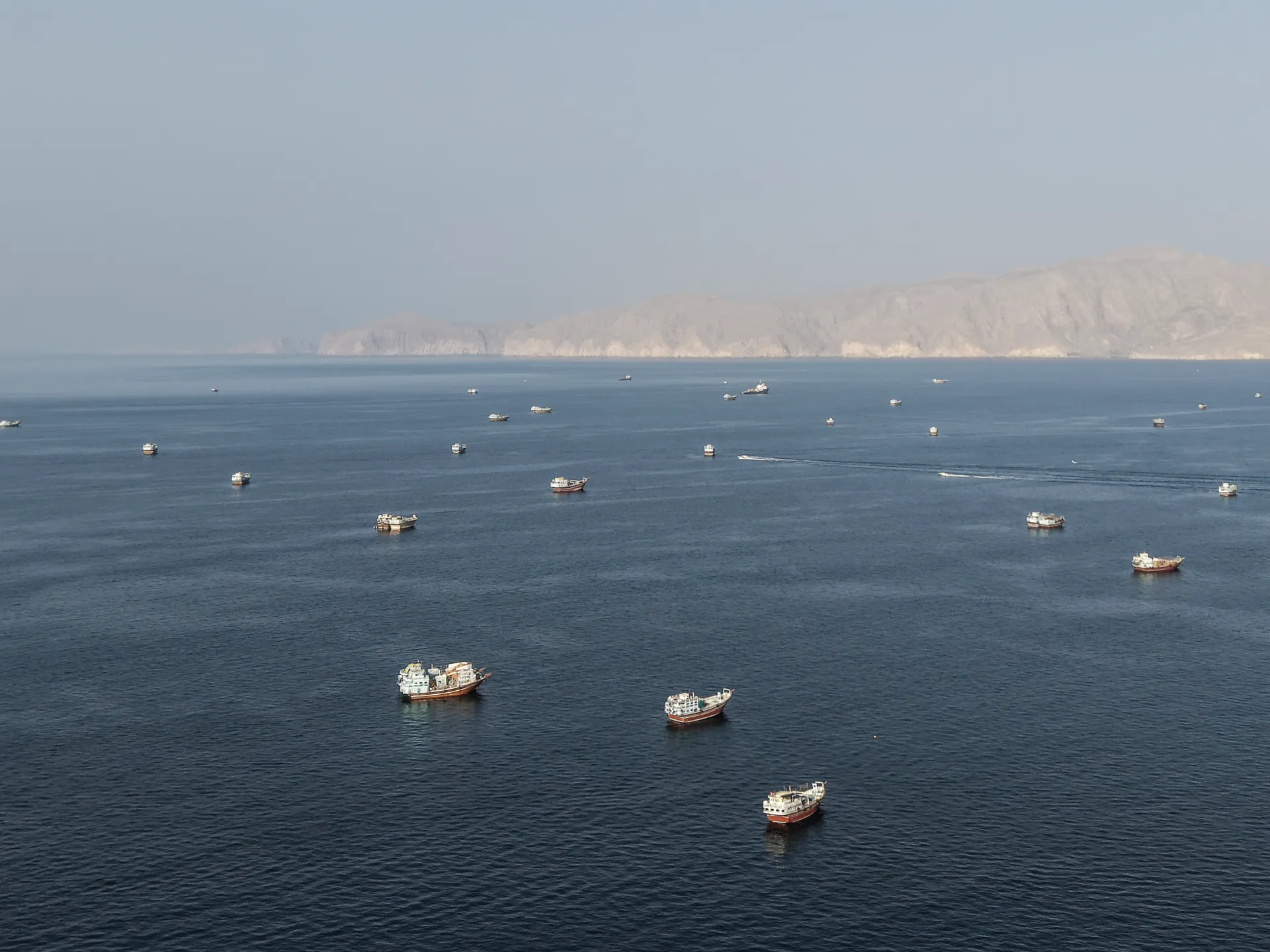
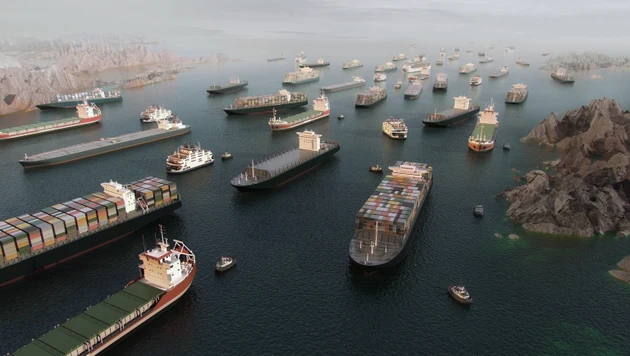
While Israel and the US hoped February’s attacks would swiftly topple Iran’s government, they have instead opened a new front. Tehran now wields economic leverage over Israel, the US and their partners through the Strait of Hormuz, which borders Iran and typically carries about a fifth of the world’s oil and gas, and through Bab al-Mandeb, which is now threatened by its Houthi allies.
Whatever Tehran’s intentions, the economic pain has been uneven. The West, cushioned by emergency reserves, record US oil production and supplies from countries such as Norway, has so far avoided the turmoil of the 1970s oil shocks, when US drivers queued for petrol, even though the current disruption is on a greater scale. In April, the International Monetary Fund trimmed its 2026 global growth forecast only slightly, to 3.1 percent from 3.3 percent.
Gulf exporters, in contrast, have fared far worse. The same assessment cut its forecast for Saudi Arabia from 4.5 to 3.1 percent, and turned Qatar’s from growth of 6.1 percent into a contraction of 8.6 percent.
“It’s curious, in many ways the West’s reduced need for Gulf oil has increased the degree to which Israel has become a liability for the US,” Israeli political economist Shir Hever told Al Jazeera, referring to a diplomatic alliance between the two states long underpinned by Israel’s strategic position in an oil-rich region central to US interests.
“There’s a train of thought in Israel that the current crises may push the Gulf states into allying with it,” he said, while noting the irony that Israel had been the main aggressor in the conflicts that followed October 7. “Though that seems fairly unlikely.”
Thursday marks 30 days since Israel’s foreign minister ordered the closure of the UK consulate in occupied East Jerusalem.
Published On 8 Oct 20268 Oct 2026
Workers at the UK consulate in occupied East Jerusalem have removed its signage as the Israeli shutdown deadline arrives, further damaging strained ties between allies.
Journalists from the Reuters news agency saw workers remove a plaque reading “British Consulate General” from the building on Thursday, as well as another sign for its consular section. The UK flag was still flying over the building.
Recommended Stories
list of 3 itemsend of list
Thursday marks 30 days since Israeli Foreign Minister Gideon Saar ordered the closure of the consulate in occupied East Jerusalem. The move was in response to the UK’s wave of sanctions on illegal Israeli settlements, including a ban on importing goods made there.
The United Nations and most countries consider the settlements illegal under international law. Israel disputes this.
The United Kingdom threatened to expel 27 Israeli diplomats if Israel proceeded to close the consulate in occupied East Jerusalem, according to unverified Israeli media reports.
The consulate has not responded to an immediate request for comment.
Israel has been adamant the consulate will close even as the UK has sought to keep it open, including sending the country’s top national security adviser to Israel last week for talks.
The UK’s presence in the city dates back almost 200 years, long before the state of Israel was established in 1948. The closure order does not affect the UK’s embassy in Tel Aviv, which handles diplomatic relations with Israel’s government.
The consulate, in the Sheikh Jarrah neighbourhood of occupied East Jerusalem, handles the UK’s relations with Palestinians in Jerusalem, as well as in the occupied West Bank and Gaza. It also provides consular services to Palestinians.
The UK Foreign Office on Wednesday declined to comment when asked whether the consulate was still operating or if diplomats working there had returned to the UK.
Despite the current strains, the UK and Israel are close economic, security and intelligence partners.
Oil flows from the Middle East have rebounded to ~80% of pre-war volumes, a testament to the resilience of countries in the region to maintain their supply commitments to global markets, Shell (SHEL) CEO Wael Sawan said Tuesday, according
The acclaimed actor stars as the sweet-natured Adam Trask in Netflix’s East of Eden
East of Eden is now streaming on Netflix(Image: Netflix)
East of Eden viewers are wondering where they’ve seen one of the show’s stars before.
The Netflix series is an adaptation of John Steinbeck’s novel of the same name and stars a glittering cast including Florence Pugh as literary legend Cathy Ames, while Mike Faist and Christopher Abbott portray the brothers who fall for her, Charles and Adam Trask.
Netflix’s synopsis reads: “This fresh interpretation of Steinbeck’s masterpiece will explore the multigenerational saga of the Trask family, focusing new attention on its indelible antihero, Cathy Ames.”
The seven-part series arrived on the streaming platform just last week and it is currently at the top of Netflix’s most-watched TV series in the UK list. As fans dive in to the episodes, many have wondered about one particular cast member.
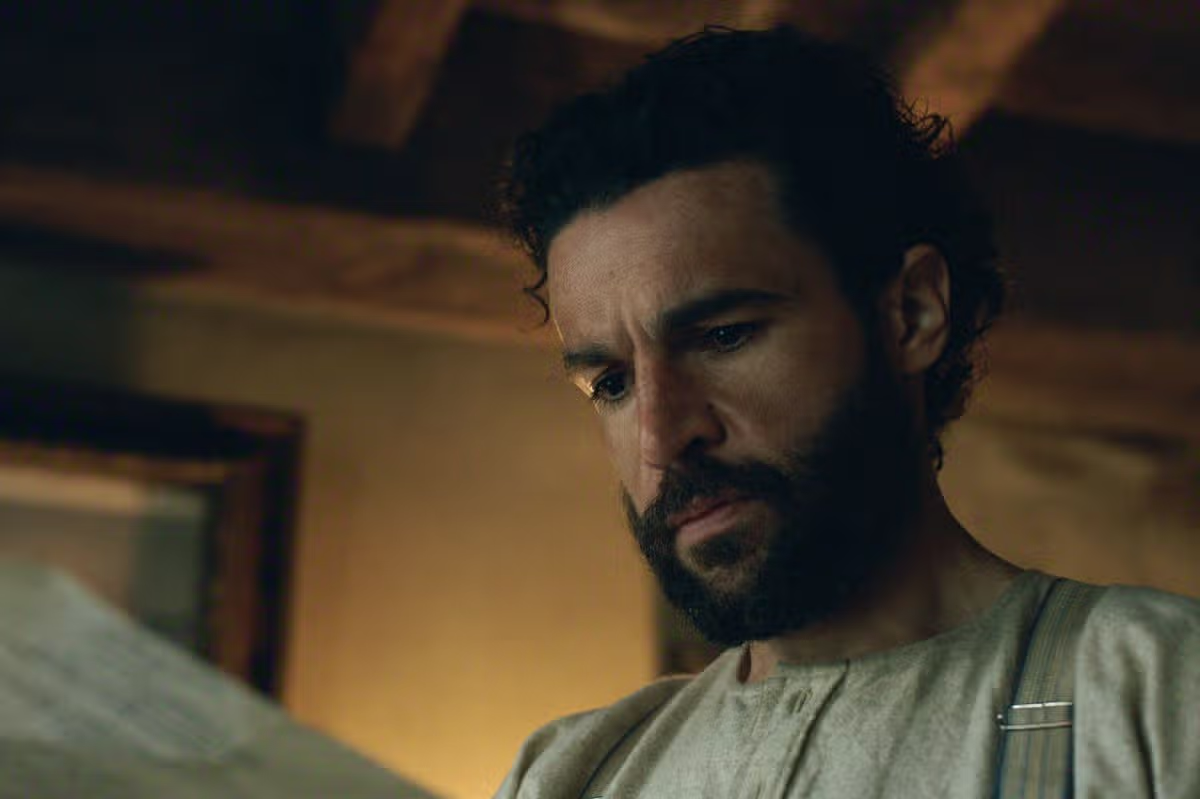
Christopher Abbott plays the sweet-natured Adam Trask who shows kindness to Cathy Ames when she appears bloodied and beaten at the door of his home, shared with his brother, who at first is much more sceptical of their new arrival. Adam nurses her back to health and they go on to marry.
Even before he whisks her away to California however, cracks have started to show. While it is a place he has always dreamed of, Cathy does not share that dream and she makes no secret of it.
Google searches for Christopher Abbott’s past movies and TV shows have soared since East of Eden’s debut, so where might viewers know the star from?
What films and TV shows has Christopher Abbott been in?
His breakout role was as Charlie Dattolo in the HBO series Girls. He was a recurring cast member, portraying the kind boyfriend of Marnie Michaels (Allison Williams). More recently he has had leading roles in Poor Things alongside Emma Stone, 2025 horror film Wolf Man and 2022 comedy-thriller, Sanctuary.
He is no stranger to literary adaptations and previously took the lead role of Yossarian in Catch-22, a TV series based on the Joseph Heller novel of the same name.
Discussing his role as Adam, Christopher told Netflix’s Tudum: “He’s a character that has lived a lot of different lives, and he’s sort of changed his personality throughout it.
“He starts off, like, hopping trains and living like a vagabond and stealing stuff and then becomes a different human when he has son. It’s a big epic arc to track.”
When Zoe Kazan learned she was going to adapt “East of Eden,” she knew it meant she’d be destroying a copy of John Steinbeck’s 1952 novel with scribbled notes in different colors, highlights and earmarked edges. So she ordered a used one from Powell’s Books — it has somebody else’s last name written on it, she points out.
“It’s a treasure to me,” she said during a recent video call from London.
Steinbeck’s Cain and Abel-inspired novel follows two families across decades as a way to explore good and evil, legacy, free will and what makes a person. Driving many of the biblical parallels are two sets of siblings — half-brothers, Charles and Adam Trask, and later, Adam’s fraternal twin sons Cal and Aron — each competing for their father’s attention and love. Disrupting their lives is an enigmatic woman named Cathy Ames, who Adam marries and who gives birth to Cal and Aron.
The book-to-screen adaptation has been Kazan’s passion project. And for a tale of familial legacy, she had her own to confront — in 1955, her grandfather Elia Kazan directed a film version that starred James Dean and covered the last third of the book, which focused on Cal and Aron. Zoe Kazan’s interest in the story took shape decades later when, as a teenager, she discovered the book.
She found herself drawn to Cathy, its famous antagonist.
“I felt repelled by her, attracted by her, curious about her. I felt empathy. I felt hared. I felt love. I felt all these things,” Kazan said. “I had never read anybody like her. I just remember, every few pages, wanting to stop and read aloud to someone the things that she was doing or [the things] that someone was saying about her.”
She also felt the pull of the story’s examination of intergenerational cycles and familial legacy.
“It feels a little bit like a chicken-and-egg situation. Which came first: Was I drawn to this book because of its intergenerational aspects or did this book teach me to think about intergenerational aspects?”
Now streaming on Netflix, the seven-part adaptation Kazan shepherded — alongside co-showrunner Jeb Stuart — covers more ground of the multigenerational saga than her grandfather’s film. This new version also centers Cathy.
Ready for a luxury East London break? Enter our exclusive competition to win a stylish two-night stay at the award-winning Town Hall Hotel, complete with daily breakfast and an exquisite dinner for two at Elis.
Win a luxurious 2 night stay in the stunning Town Hall Hotel
Looking for the ultimate East London escape? We’ve teamed up with the award-winning Town Hall Hotelin Bethnal Green to give one lucky reader and a guest the chance to win a stylish two-night stay, complete with daily breakfast and dinner at the acclaimed Elis .
Housed inside the former Edwardian Bethnal Green Town Hall, this Grade-II listed landmark seamlessly blends grand historic architecture with cutting-edge modern design. Step inside to discover sweeping marble staircases, intricate Art Deco detailing, and a striking glass-and-steel extension—creating a boutique retreat like no other.
Experience the best of East London
Positioned right in the energetic heart of Bethnal Green, Town Hall Hotel is perfectly placed for exploring East London’s vibrant culture from the independent boutiques of Shoreditch, to the iconic Columbia Road Flower Market and historic Brick Lane.
When you’re not out exploring, unwind in the hotel’s breath taking 14-metre indoor heated swimming pool, squeeze in a session at the gym, or relax with a cocktail at the bar.
What you can win:
A two-night stay for two guests in one of the hotel’s spacious, gallery-like luxury suites (featuring fully equipped kitchens and bespoke interiors).
Daily breakfast (B&B) to start each morning in style.
Dinner for two at Elis, where two-Michelin-starred chef Rafael Cagali and his team serve up a relaxed menu inspired by his Brazilian-Italian roots.
For your chance to win simply fill in the form below. if you can’t see the form, click here.
IRGC commander says oil flows through US-supervised route in Hormuz are ‘negligible’.
Published On 5 Oct 20265 Oct 2026
Crude oil exports from the Middle East have risen above pre-war levels on four of the seven days in the last week of September, provisional data from ship-tracking firm Kpler showed.
However, senior Islamic Revolutionary Guard Corps (IRGC) commander Ali Fadavi said in a televised interview on Sunday night that only three to four million barrels of oil per day (bpd) are now moving through the route, dismissing the amount as “negligible” when compared with pre-war traffic.
Recommended Stories
list of 3 itemsend of list
Fadavi said, for the first time, no US vessels were present in the Gulf, the Strait of Hormuz, the Sea of Oman or even the northern Indian Ocean and US warships are “100 percent vulnerable” to IRGC attacks.
Kpler data showed crude exports from the region exceeded pre-war levels on September 24 and between September 27 and 29, rising to 19.5-22.5 million bpd.
Around that time, Iran claimed success in attacking ships – including US Navy vessels – near the Strait of Hormuz, saying the strikes had forced Washington to move its warships further from the Iranian coast.
Before the US-Israel war on Iran began, exports averaged 18 million bpd between March 2025 and February 2026.
According to Kpler data, the overall tally for crude, oil products, chemicals and non-gas liquids averaged 22.4 million bpd in the seven days to September 30.
On October 1, the seven-day moving average for crude exports was at 18.5 million bpd. This includes transits via the Strait of Hormuz, the Red Sea, exports from terminals and ship-to-ship transfers in the Gulf of Oman.
The number of liquefied natural gas cargoes exiting the Strait of Hormuz also rose in September to its highest monthly level since February.
The figures exclude any vessels that might have crossed the strait with their automatic identification system transponders turned off to avoid detection.
The United Kingdom Maritime Trade Operations agency reported at least one attack a day in the Strait of Hormuz or in the Gulf of Aden since October 2.
On Sunday, Iran’s top negotiator and parliament speaker, Mohammad Bagher Ghalibaf, said the Strait of Hormuz would remain closed until the United States accepts Tehran’s seven-day plan to reopen the waterway.
Middle East crude oil exports have rebounded to 17.5M bbl/day on a 10-day average, or 98% of pre-war levels, despite continued risks to shipping, J.P. Morgan analysts said this week, supported by restored flows through Saudi Arabia’s East-West pipeline and
As Olivia Rodrigo kicked off the Unraveled Tour in support of her third album, “You Seem Pretty Sad for a Girl So in Love,” the internet had plenty to talk about—from her dissolving dress and flower-covered stage design to her custom-made, pink heart-shaped guitar.
The guitar was built by Luis Muñoz, a Mexican American guitar technician and luthier who operates out of a tiny repair shop in East L.A.
Originally from El Paso, Muñoz moved to Los Angeles in 2009 and took guitar repair classes in Hollywood, hoping to find his way into the music industry.
Music was always around Muñoz. He remembers discovering Slash after his family got cable television. Mesmerized by the Guns N’ Roses guitarist, who stole the spotlight with his top hat and searing guitar solos in videos for “Welcome to the Jungle” and “Sweet Child O’ Mine” on MTV’s Hot 100 music video countdown, Muñoz knew that was what he wanted to do.
He picked up his father’s old guitar and began learning to play, experimenting with the strings and teaching himself along the way.
His first opportunity came with singer-songwriter LP as a guitar technician. Muñoz admits he exaggerated his skill set to get his foot in the door, but he was determined to make the opportunity count.
“Once you’re in, you’re in,” he said.
Share via
Over the years, Muñoz has toured with artists including Smashing Pumpkins, Deftones, Bush, Anthrax, Fall Out Boy and his most recent touring job was with Rodrigo, after his wife, the pop star’s former bassist, told him she was looking for a new guitar tech.
Rodrigo’s heart-shaped guitar was another opportunity to put his craftsmanship on display.
“I’m sure Olivia has every guitar company in the world in her DMs, and she still trusted a small shop in East L.A.,” Muñoz wrote on Instagram, alongside photos of Rodrigo with the guitar.
“Five prototypes before I got the body right. It had to look cool, play easy, feel comfortable, and most of all, sound good. Built completely by hand, late nights after shop hours.”
Muñoz recalled the moment Rodrigo’s team reached out to request a custom-made guitar. He knew he had one shot to get it right: “In the back of my mind, I’m like, I only got one shot and it has to be made with love.”
The guitar took several months to complete and was built entirely by hand. He later hinted that it is currently one-of-one for now. After Rodrigo shared the guitar with her fans, Muñoz’s one-of-a-kind creation quickly became part of the visual identity of the tour — but for him, the significance went beyond the instrument itself.
Now retired from touring to spend more time with his family, including his 18-month-old daughter, Rosie, Muñoz says moments like seeing young fans in the crowd are what stay with him.
“One of my favorite things being on tour was seeing all the little girls lose their minds. The power of seeing that. Immediately in their head it’s like, ‘I can do that too.’ Imagine if I’m playing a tiny little role in that, yeah … all day.”
The American Israel Public Affairs Committee (AIPAC) is set to spend $233 million to defeat candidates in this fall’s congressional midterm elections who speak out against the government of Israeli Prime Minister Benjamin Netanyahu, warned US Senator Bernie Sanders, Anadolu reports.
The top pro-Israel lobbying firm in the US “plans to spend $233 million to defeat candidates who dare to speak out against Netanyahu’s extremist government,” Sanders said on US social media platform X on Friday.
“They spent $33 million to defeat Abdul El-Sayed in the Michigan primary. They lost. They are going to keep losing,” he said.
El-Sayed, the Democratic candidate in this year’s senatorial race in the state of Michigan, strongly opposes unconditional US military aid for Israel and has criticized the Netanyahu government’s policies in both Gaza and the occupied West Bank.
Sanders added: “NO MORE U.S. MILITARY AID FOR ISRAEL.”
In the Nov. 3 US congressional midterms, polls show Democrats broadly favored to win the House of Representatives and possibly the Senate.
As the US electorate’s view of Israel has soured, especially in light of the genocide in Gaza, many Democrats running for office this year have taken a harder line against the policies of the Netanyahu government and what many see as its efforts to displace Palestinians and frustrate any hope for peace in the Middle East.
East of Eden on Netflix’s creator Zoe Kazan follows in her grandfather’s footsteps who directed the 1955 film adaptation.
Hayley Anderson Screen Time TV Reporter
21:22, 01 Oct 2026
East of Eden: Florence Pugh stars in Netflix trailer
East of Eden is being hailed as a faithful and “captivating” watch with fans especially impressed by its leading lady.
John Steinbeck’s 1950s classic novel East of Eden has been resurrected once again but this time for Netflix fans, following the story of fierce Cathy Ames (played by Florence Pugh).
Set in the early 1900s, anti-heroine Cathy stops at nothing to get rich and in the process, drives a rift between two brothers that “ignites a saga that unfolds across two generations”.
The seven-part period drama was released in full today, Thursday, October 1, with fans quickly flocking to social media to share their thoughts. And it didn’t take long for users to make a major prediction about Florence Pugh’s future.
Watch Jose Mourinho Netflix doc with free Netflix subscription
This article contains affiliate links, we will receive a commission on any sales we generate from it. Learn more
Jose Mourinho’s three-part Netflix documentary is available to watch at no extra cost for Sky customers as the provider gives away free subscriptions with each of its Sky Stream TV bundles.
With so many viewers impressed by the 30-year-old’s performance, fans believe she is in the running for an Emmy Award.
“Florence Pugh will definitely get an Emmy for East of Eden, she has out done herself by miles”, someone praised on X. A second agreed: “Just finished watching east of eden and the Emmy campaign for Florence Pugh starts right now.”
“Florence Pugh getting rave reviews for East Of Eden, oh we are sweeping the awards season all the way to that Emmy!”, a third exclaimed.
As another viewer remarked: “People were claiming that Florence Pugh is ruining her career with a Netflix show but the critics are raving about her and she’s most definitely getting an Emmy for this performance.”
Ahead of its release, Pugh opened up to Tudum about the challenges of creating an “epic adventure” for just seven episodes.
“As a performer, it was a really big step up into how I was going to approach this role and shooting this schedule because I had no time in between.
“I’m not only talking about heavy subject matter in the scenes, but the language is from a different era, which has a different rhythm.
“It meant that I had to approach this role in a way that I’d never done before.”
Hollywood is filled with book-to-screen adaptations that have ignited grumbling and spirited debates. Even before its release, Zoe Kazan’s interpretation of John Steinbeck’s sprawling 1952 masterwork, “East of Eden,” roused passionate opinions from loyalists of the text on social media.
Much of the discourse surrounds Kazan’s creative choice in how to portray the book’s infamous antagonist, Cathy Ames, in Netflix’s seven-episode limited series out Thursday.
Steinbeck’s multigenerational saga ruminates on family, the power of choice and the nature of good and evil — deeply exploring the biblical stories of Cain and Abel and the fall of Adam and Eve — through the intertwined destinies of two families, the Trasks and the Hamiltons. Cathy (later known as Kate) functions as a chilling, destructive force in the saga.
Kazan pared down much of the Hamilton family’s story for the show and centered Cathy (Florence Pugh), whose arrival alters the lives of the Trask brothers, Adam (Christopher Abbott) and Charles (Mike Faist). In doing so, Kazan dared to humanize the character who has been considered one of literature’s most definitive symbols of pure evil, described by Steinbeck to be a “psychic monster” born without a conscience or kindness.
“I’m trying to protect my mental health by not being too much online,” Kazan said in a video call from London on a recent weekday. “I do think it is not surprising to me that this character brings up a lot of strong feelings for people … I’m excited to see what people think once they actually see what we have made and aren’t just anticipating something.”
Mike Faist as Charles Trask, Christopher Abbott as Adam Trask and Florence Pugh as Cathy Ames in Netflix’s “East of Eden.”
(Netflix)
When Kazan, an actor who has expanded her creative footprint behind the camera, first pitched the series in 2019 and was asked about which actor she envisioned as Cathy, she replied: “I have one.” She had seen Pugh in “Midsommar,” “Lady Macbeth” and “Little Women,” marveling at how the actor’s ultra femininity lived alongside her masculine energy.
“The range on that girl … I was like, if anybody can do that, they can play Cathy,” Kazan says. “It allowed me to write Cathy as complicated and mysterious [as I wanted] and with so much shadow and light.”
When it came to Adam and Charles, Kazan knew Abbott and Faist could depict the psychological nuance beyond the binaries of the nature versus nurture debate: “I wanted an Adam where you felt what his true nature was and the nature that his father had pushed him into … and I knew we needed that in Charles as well.”
Adapting a classic is hardly a simple endeavor, particularly one that has been done before. That Kazan would choose “East of Eden,” which unpacks legacy and generational shadows is apt: Her grandfather, Elia Kazan, famously directed the 1955 film version starring James Dean. The actors of the Netflix series are eager for viewers to see her vision come to life.
“When you do an adaptation of a book, especially a seminal American novel, no matter what, you’re always going to be up against it because … whenever somebody reads a book, the budget in their heads is unlimited,” Abbott says. “I think this is such a great adaption in its own right.”
Pugh adds: “I’m excited for people to do the stuff that I’m doing now, which is [to say], ‘Oh my God, let’s read this and see how it fits against what I’ve got in my head.’”
Over a video call together, Pugh, Abbott and Faist reflected on their journey to adapting Steinbeck’s epic story, including their first experiences with it and filling in the shades of these characters who remain timeless allegories of the human condition. This conversation, which contains spoilers, has been edited for clarity and length.
Florence Pugh, left, Christopher Abbott and Mike Faist take on some of literature’s most indelible characters — Cathy Ames, Adam Trask and Charles Trask — made famous in John Steinbeck’s classic “East of Eden.” (Photographs by Sophia Spring / For The Times)
When did you first encounter the book?
Faist: My first encounter with the story was the James Dean, Elia Kazan film. That was a movie that I watched, especially when I first moved to New York and wanted to be an actor. It wasn’t until Zoe and Florence asked if I’d be interested in doing this, that I picked up the book.
Pugh: I want to say maybe my early 20s, I read the book. I only watched the movie recently to prepare myself for these kind of conversations. I’m rereading the book now while we’re heading into press, just so I can like fine-tune what I thought I knew … there’s so much love that’s being breathed into every single sentence of every chapter [in this adaptation], and that is solely down to Zoe’s fantastic brain and her ability to want to dig deeper.
Abbott: A lot of my favorite books I’ve picked up and put down numerous times before actually plowing through it — that was the case here until Zoe approached me about doing it. I was like, “Well, this is a perfect excuse to finally [finish].”
This adaptation lit up social media early on for centering Cathy. She is such a polarizing figure. Some see her solely as an evil monster. Some argue there is more nuance to what’s driving her actions. Florence, how do you see her?
Pugh: It’s tricky because I know I’m gonna get asked this again and again, and I guess I’m still trying to figure out how to word it without totally pissing people off. I love finding characters that people automatically think are villains and trying to find a way for you to love them — it’s my favorite thing to do.
I read these episodes, and I was listening to Zoe and how she was wanting this to come from Cathy’s perspective, how Cathy was her hero and how she’s just been championing Cathy ever since she first read the book — that was so f— exciting to know that we’re not gonna just point the finger and say that she’s evil. It is my job to do my skills as good as possible so that I can argue in defense of them. I believe that I can argue for her, which is terrifying but also really cool. I care for her deeply. I understand where she went and why. Does she do some terrible things? Absolutely. Is she a product of the situation that she grew up in? Totally. You can’t get raped as a child and and you be totally fine for the rest of your life.
Florence Pugh as Cathy Ames. She hopes the adaptation prompts curiosity: “I’m excited for people to do the stuff that I’m doing now, which is [to say], ‘Oh my God, let’s read this and see how it fits against what I’ve got in my head.’”
(Netflix)
That detail was not explicitly stated in the book. What were your conversations with Zoe about it?
Pugh: That’s why we ended up choosing the way that we explained it and the way that we showed it — that little girl is so tiny you can’t even imagine anything bad happening to her, and the fact that she’s holding “Alice in Wonderland,” [in her mind], there’s so many through lines through Cathy and Kate’s life that all come back to that moment. You don’t need to do much. Everybody has the sinking feeling of what might happen to a vulnerable child in that situation. In the book, I think it’s constantly playing with the themes of can we trust her? Is she already a monster as a child?
What Zoe has done is made her a real human, and has given her cause and has given her time to understand. That moment that is alluded [to in the book ] — if Cathy asked the boys to tie her down, and whatever it is that they were doing to her — it’s no longer alluded [in the series]. That [assault] happened, but maybe people didn’t believe her.
Mike, what were you interested in excavating with Charles, this Cain archetype who’s tormented by rejection and jealousy?
Faist: What is amazing about this story is — and it’s the entire through line of the entire novel — is this idea of timshel. What happens in a person’s life, and the burdens that they carry, then the choices they make, and every single moment as they continue to live it. Charles jumped out at me. There was just something about him that I was very drawn to — and along with that pull, there’s this feeling of dread, where you say, “Oh God, I can’t believe that I’m about to jump in and do this thing.” You end up surrendering yourself to it. It is scary and deeply exciting.
Abbott: I don’t have a brother. You forget too that they’re half brothers and what that dynamic is like, what kind of Freudian s— pops up. I think the through line for Mike and I, because there’s a lot of conflict there, that it always comes from a place from love. The letters, as they [Charles and Adam] get older, that are written or the letters that he starts to write and doesn’t send, when there is hate between them, it’s because they love each other so much. Otherwise, it would just be indifference. A lot of that happens in the things that are unsaid.
1
2
1.Mike Faist as Charles Trask. (Netflix)2.Christopher Abbott as Adam Trask. He found the sibling relationship intriguing: “I don’t have a brother. You forget too that they’re half brothers and what that dynamic is like, what kind of Freudian s— pops up.”(Kirsty Griffin / Netflix)
When Zoe approached you, Chris, to play Adam, you questioned whether she actually meant for you to be Charles?
Abbott: I’m just used to being typecast, so I thought she made a mistake. Zoe’s mentioned this idea of masculine and feminine energy — what one presents and what one actually holds, and the old switcheroos of that. The very first email, I was like, “Oh, are you sure?” But I was excited to play with all the nuance of and the layers of what this is. I had seen the movie before, and it [covers] only the last 100 or so pages. It’s really gratifying to play a part where you get to see someone’s whole life and how this guy goes from being this wanderer, drifter to this to stoic, depressed, rigid older man.
What moment between these characters were you most eager or nervous to depict?
Faist: The scene that I reflect back on the most, that actively had the biggest impact on me, is the scene between Cathy and Charles, where she comes into his room and the two of them share this intimacy together. We had talked about what we were wanting to do, then on the day, none of it was really working. I remember Florence had this really specific thing she wanted to bring to the scene. And it was really powerful — there’s these very rare moments when you genuinely feel someone’s objective actively working against your own. [Pugh makes a quizzical face.] No, it’s good! It creates this friction and this tension that does exist and does live.
Abbott: That was your favorite, huh?
Faist: I’m sorry, Chris! That one was just such a visceral feeling of, I know what my character wants in this thing, and her character is very much wanting the exact opposite and the literal clash of that that moment and the feeling of that — I’ll never forget that.
Pugh: It’s such an important scene to get right because it literally is the ending moment of those two; it added so much pressure on the day of shooting. It’s actually really hard when you’re trying to do a sex scene that’s consensual, but it’s definitely not at the right time. The coolest thing about it is it wasn’t working and we had to push everyone out. Everyone was whispering and everyone was trying to figure out what they were comfortable with us doing and, eventually, Mike and I were just like: Right. Done.
Florence Pugh, with Christopher Abbott, left, and Mike Faist, says “East of Eden” endures because “every single one of these characters is struggling to survive realistically.”
(Sophia Spring / For The Times)
Chris, you have the daunting task of, in the closing moments of the series, delivering the word that’s the thrust of the whole story —timshel.
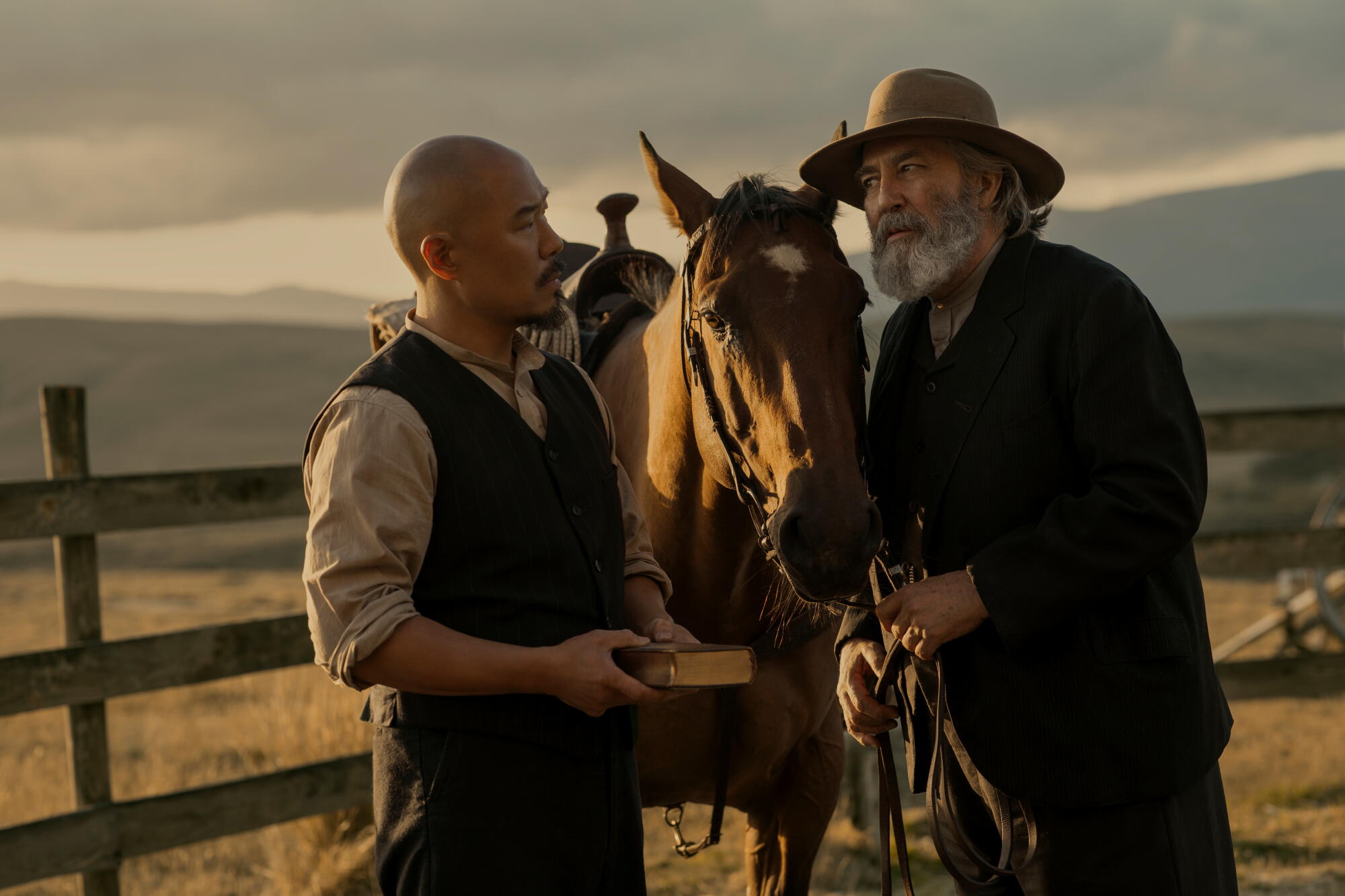
Abbott: I think that was the last scene I shot. I can’t say I was being lazy, but the character had a stroke so he was laying there. You just gotta listen [in a moment like that]. Hoon [Lee, who plays Lee] is reading from the Bible. You take in the room. I nailed it in one. [Pugh and Faist laugh.]
People have deep feelings about “East of Eden.” And it seems to have had a real resurgence recently, even outside of curiosity about this adaptation. Why do you think that is?
Abbott: That’s a big, existential [thing to think about]. There’s a ton of themes in the book that are relevant: displacement, family, love. The themes in the book aren’t specific to the time period. All great works are that.
Pugh: It’s also about generational trauma and change in healing. One of the things I recognized immediately when I started rereading the book months ago, the first few pages about the Salinas Valley describe very quickly that this place is about growth, change and moving on. What I’ve taken from our adaption of Cathy and her generational trauma and what she’s doing to her kids is that not everybody is going to get it right. The reason I think why people keep picking it back up is every single one of these characters is struggling to survive realistically, and they are all making decisions that affect and domino-effect other people around them. Us learning about how we could have done better will always be relevant. And especially with America, and what we’re watching in terms of its constant battle against racism and immigration. It’s relevant to life and to our lives.
Fighting in Sudan’s Kordofan region has intensified since late 2025, turning it into one of the main battlegrounds in the war between the Sudanese Armed Forces (SAF) and the paramilitary Rapid Support Forces (RSF), now in its fourth year.
The vast region, which comprises North, West and South Kordofan states, lies where the two sides’ areas of control meet, between the army-held central region and the RSF-controlled Darfur in the West. In recent months, the SAF has pushed the RSF out of much of North Kordofan.
The battle is increasingly being fought from the air. Drone strikes on towns in North Kordofan are growing more frequent and deadly, and civilian infrastructure has been hit across the region.
Since the war began in April 2023, one in five recorded attacks in Sudan has taken place in Kordofan.
Al Jazeera maps where the fighting is concentrated in Kordofan and across Sudan, and the displacement that has followed.
Who controls what on the ground?
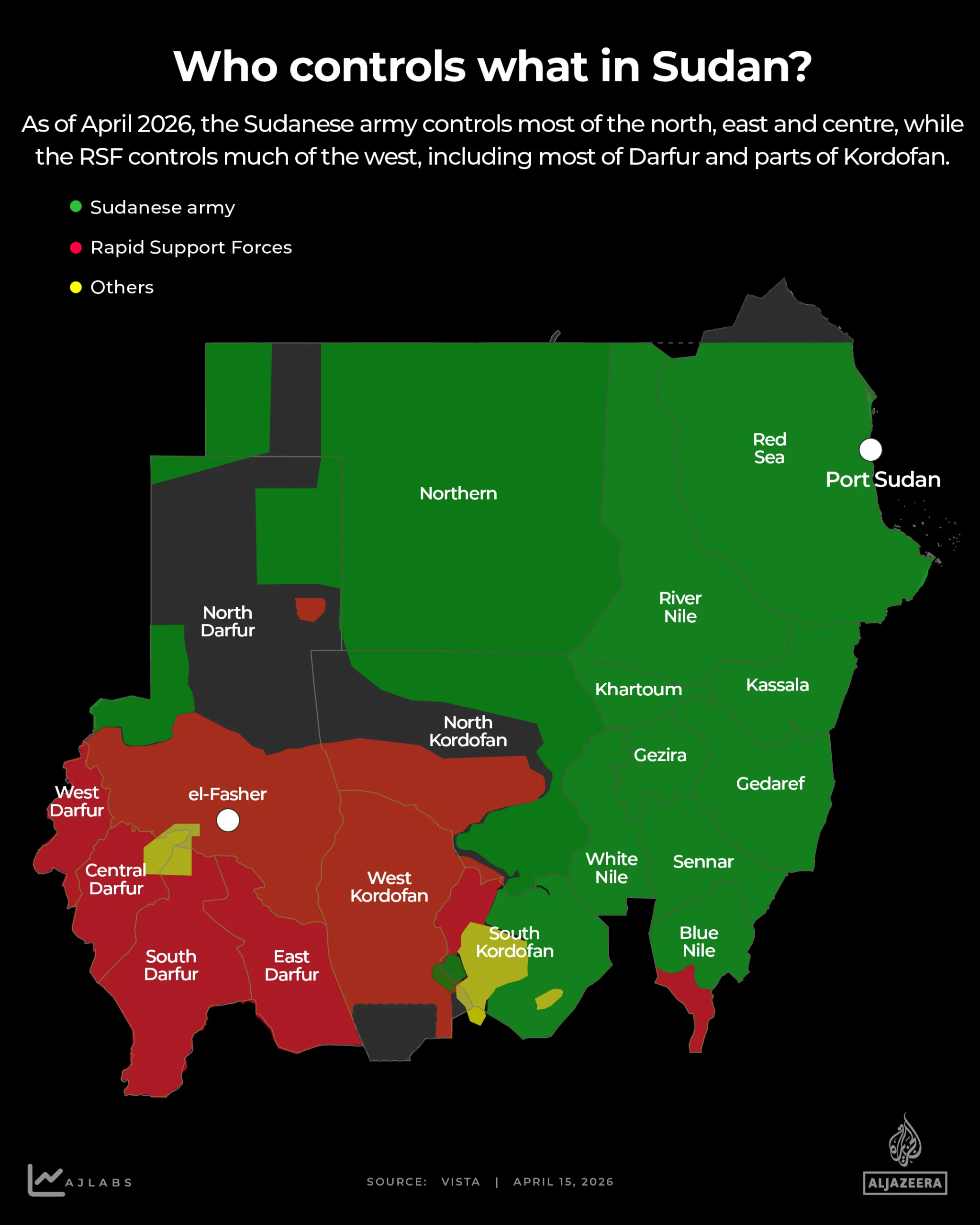
Sudan is broadly divided between the two sides. The SAF controls the capital, Khartoum, and most of the north, east and centre, while the RSF controls the west, including almost all of Darfur and parts of Kordofan. Smaller armed groups, including the RSF-allied Sudan People’s Liberation Movement-North (SPLM-N), hold pockets of territory in the south.
The army has the upper hand in the north, the RSF in the west, and South Kordofan remains contested.
Where have most attacks occurred?
According to an Al Jazeera analysis of data from the Armed Conflict Location and Event Data (ACLED), an independent conflict monitor, there were 14,648 recorded attacks between the start of the war on April 15, 2023, and September 19, 2026.
The four most affected states include:
Khartoum: The capital region has seen the most, with 5,719 attacks, or 39 percent of the total, almost three times as many as North Darfur, the second-highest
North Darfur has witnessed 1,999 attacks (13.7 percent)
Gezira state has seen 1,435 attacks (9.8 percent)
Kordofan emerged as a major centre for fighting. North, South and West Kordofan together recorded 2,876 attacks, or about 19.7 percent of all recorded attacks, putting the region behind only Khartoum when considered collectively.
Who has carried out the most attacks?
The SAF is associated with the largest share of recorded attacks between April 15, 2023 and September 19, 2026, accounting for just over half (52 percent), compared with just over a third (34.7 percent) for the RSF and 13.3 percent for other actors.
Smoke billows after drone strikes by the paramilitary Rapid Support Forces (RSF) targeted the northern port in the Red Sea city of Port Sudan, Sudan, on May 6, 2025 [AP Photo]
The balance of attacks has shifted over time. The SAF was associated with more recorded attacks than the RSF in the first year and a half of the war, before the RSF overtook it in number of attacks from late 2024 to mid-2025.
Since August 2025, the two sides’ monthly attack counts have been closer, with the SAF generally recording slightly more, even as the overall number of attacks has fallen sharply.
Where have attacks in Kordofan occurred?
After the fall of el-Fasher, the last major Darfur city held by the army and its allies, in October 2025, attention shifted to Kordofan. The region sits between RSF-held Darfur and the army-held centre, north and east, forming a corridor between the two sides’ heartlands.
Kordofan’s three states recorded 2,717 attacks: North Kordofan had 1,205 (44 percent), South Kordofan 789 and West Kordofan 723. Adding Abyei, a disputed oil-rich area on the Sudan-South Sudan border that was historically part of Kordofan, brings the total to 2,878.
Soldiers arrive at the Allafah market, in an area recently recaptured by Sudan’s army from the Rapid Support Forces paramilitary group, in the al-Kalalah district, south of Khartoum, Sudan, on March 27, 2025 [AP Photo]
The concentration of attacks differs from state to state. In North Kordofan, Sheikan locality alone accounted for 497 attacks, or 41 percent of the state’s total. Sheikan is home to the state capital, el-Obeid, a commercial and administrative hub linking central Sudan with the west. Taking the city would open a route east towards Khartoum for the RSF.
On September 9, a drone strike on a college in el-Obeid tore the roof off the building and killed a security guard, the college’s dean, Abdel Aziz al-Sheikh, told Reuters.
“As you can see, the entire faculty is destroyed and we feel that our dreams are destroyed, our future is destroyed,” Omnia Aboul Gassim, a student who had sat her exams at the el-Obeid college just one day before the attack, told Reuters.
In South Kordofan, Dilling locality was the main hotspot, with 242 attacks (31 percent), followed by Kadugli with 107 (14 percent) and Al Quoz with 94 (12 percent).
Attacks in West Kordofan were spread more evenly across localities. Babnusa recorded the most, with 142, followed by En Nuhud (119), Al Khiwai (112) and Abu Zabad (111).
ACLED has recorded at least 12,314 reported fatalities in Kordofan since April 2023.
The SAF was associated with 1,323 attacks (46 percent) across all three states in Kordofan, compared with 920 (32 percent) for the RSF and 633 (22 percent) for other actors.
How many people are displaced?
About 8.6 million people remain internally displaced across Sudan, according to the latest United Nations figures, down from a peak of 11.6 million in January 2025 as millions returned home to areas retaken by the army. New displacement continues in Kordofan, Darfur and Blue Nile.
Darfur hosts the largest concentrations of internally displaced people (IDPs), particularly South and North Darfur.
Returns have steadily increased since 2025, reaching about 5.1 million by August 2026. Khartoum has seen a major return of displaced people, with about 2.7 million returnees.
A displaced woman from Dalanj braids her grandmother’s hair at a displacement registration centre in El Obeid, North Kordofan State, Sudan, on January 15, 2026 [El Tayeb Siddig/Reuters]
Despite the decline, millions remain displaced more than three years into the war. The International Organization for Migration (IOM) says the number of people newly displaced in Kordofan since fighting escalated in October 2025 has risen 65 percent in four months, from more than 132,000 in February to at least 219,000 by late June.
The agency has warned that el-Obeid, which shelters about 500,000 people, including more than 83,000 displaced, faces a looming threat of a full-scale invasion.
“The warning signs are impossible to ignore,” said IOM Director General Amy Pope earlier this month. “Across Sudan, families are fleeing violence, losing access to water, electricity and healthcare, and now facing the added burden of destructive floods.”
John Steinbeck’s 1952 novel “East of Eden,” an Oprah’s Book Club Selection in 2003, is a retelling, or actually two retellings, of the Cain and Abel story, first in Connecticut with half-brothers Charles and Adam Trask, and then in the author’s native Salinas Valley with Adam’s fraternal twin sons, Cal and Aron, in each case competing with one another for their father’s love. Not wanting you to miss his meaning, if you haven’t already guessed by the title, Steinbeck has a character read the entire passage from Genesis.
The stories, which together run from the late 19th century through World War I, are connected by a woman named Cathy Ames, whom Adam marries and who gives birth to Cal and Aron — which I suppose makes her the Eve in this household, though that’s not a theological road Steinbeck chose to really explore.
In 1955, Elia Kazan directed a film version, a color-mad Cinemascope melodrama that told only the Cal and Aron part of the story; significantly, it was the film debut of James Dean and so will live forever. Writing in The Times in 2005, Kenneth Turan called it “not only one of Kazan’s richest films and Dean’s first significant role” but “arguably the actor’s best performance.”
Kazan’s granddaughter Zoe Kazan has written the screenplay and worked with Jeb Stuart as co-showrunners for a new “East of Eden” adaptation, a seven-episode miniseries debuting Thursday on Netflix. Though it omits a sizable chunk of what is after all a very long book, it takes its chronology whole, putting Cathy front and center in the publicity and in the show, owing largely to Florence Pugh‘s performance as its most dynamic character.
Kazan begins her telling with a badly beaten woman dragging herself through the night as a female voice delivers an edited, elaborated version of the author’s thoughts on difference. (It is a book brimming with thoughts.) “I believe there are monsters born in this world to human parents … A child may be born perfect of body but without kindness or the potential of conscience. Still, you must not forget, everyone is normal to himself. And to a monster, the norm must seem monstrous.” Given that the novel’s narrator is Steinbeck, it’s hard to say just who the “I” is here, but I assume the gender swap has something to do with wanting to literally give this version a female voice.
The monster is Cathy, crawling to the porch of the farmhouse occupied by Charles (Mike Faist), who thinks they should call the sheriff, and Adam (Christopher Abbott), who is compelled to care for her. Close your eyes if you don’t want to know anything more about this 73-year-old bestseller, but Cathy has already possibly driven a man to suicide and definitely burned down her house with her parents locked inside. She was beaten up by her former pimp, whose mistress she’d become and from whom she was stealing. You may be thinking “sociopath.”
The series backs up 25 years to a Connecticut farm where father Cyrus Trask (Tracy Letts), a peg-legged Civil War veteran, rejects Charles’ gift of a new knife in favor of Adam’s present of a stray puppy, creating a long trail of jealousy. He’ll later pack pacifistic Adam off to the army (because, he says, he loves him better), with Charles unhappily constrained to stay and work the farm (though he proves good at it). After years in service and living in hobo jungles, Adam returns home.
Standout performers include Hoon Lee as Lee, left, and Ciarán Hinds as Samuel Hamilton.
(Kirsty Griffin / Netflix)
Cathy crawls to their doorstep; Charles sees through her, which will earn him her respect, but Adam falls for her, marries her and drags her west to California, where she doesn’t want to go and doesn’t plan to stay. (She’s quite upfront about this, but Adam is a poor listener.) She gives birth to Cal (younger, Bodhi Aisher; older, Joseph Zada), who will grow up to wonder if he’s bad, and Aron (younger, Jonah Wren Phillips; older, Joe Anders), whom everyone thinks is good, and returns to the life of a prostitute, which suits her fine. And that is probably enough plot for me to relate.
Pugh impressively represents Cathy’s outward self through successive stages; she’s not a character born to develop, though she will have various crises to navigate, and the actor imbues her with as much nuance as the part allows. She’s the main reason to watch, though there are standout performances from Hoon Lee as Lee, a philosophical, intellectual, American-born Chinese man who works for Adam and becomes a kind of surrogate mother to Cal and Aron; and from Ciarán Hinds as Samuel Hamilton, a jovial Irishman, virtually the only remnant of the novel’s Hamiltons, who stand in for Steinbeck’s own family. Faist does a lot with the taciturn, perceptive Charles. Martha Plimpton, never not great, plays Faye, a madam for whom Cathy works; and Zoe Phillips makes an impression in her scattered scenes as Abra Bacon, who’ll date Aron but feels connected to Cal.
Kazan and Stuart do cover all the main plot points and themes — good and evil, love and jealousy, inherited character and (the big one) the possibility of change. Unavoidably the text has been chopped and channeled, with some swapping of parts, bits of narration screwed into dialogue and events described in a paragraph blown out into scenes. Certain thoughts inside Cathy’s head have been made concrete.
The adapters don’t add too much material of their own, Steinbeck having provided a wealth of character descriptions, backstory, philosophical rumination and social criticism for every occasion, but here and there they’ll stress a point or provide something new in order to make sense of Cathy. But they don’t overdo it. (Steinbeck, declaring her unknowable, cuts her a lot of slack, walking back his earlier “monster” comments: “Who knows but that she tried to tell someone or everyone what she was like and could not, for lack of a common language. It is easy to say she was bad, but there is little meaning unless we know why.”) Oddly, the Cain and Abel elements in the Cal and Aron story, which launched Dean’s career, don’t really register.
If nothing else, the miniseries reminds us that adaptation is a difficult job that grows harder the more complex and celebrated the original text, and the more necessary it is to honor it. (This is why pulp fiction has produced so many memorable movies.) Things will always be lost in translation, not least from the pictures in your head to the pictures on the screen. If you’re going to film a literary monument, and a period piece to boot, you’re going to have to spend some money.
But the production here betrays its economy, and the direction, by Garth Davis and Laure de Clermont-Tonnerre, remains earthbound, held down by mournful strings and devoid of color. The New Zealand landscape does echo the rolling hills of Central California, in a dry season, but it’s a dreary vision, hardly the paradise of Steinbeck’s memory, book or metaphor.
Nairobi, Kenya – With less than nine months until the 2027 Africa Cup of Nations kicks off, Kenya, Uganda and Tanzania are entering the most demanding phase of preparations: completing and testing the stadiums, training grounds and supporting infrastructure needed to host the tournament.
The tournament, scheduled for June 19 to July 17, 2027, will be the first Africa Cup of Nations jointly hosted by three countries and the competition’s return to East Africa since Ethiopia staged the finals in 1976.
A Confederation of African Football (CAF) delegation spent eight days inspecting facilities across the three host countries earlier this month, assessing stadiums, training grounds, hotels, airports and other infrastructure. The delegation included officials responsible for competitions, safety and security, transport, media, television and logistics.
Kenya: Talanta takes centre stage
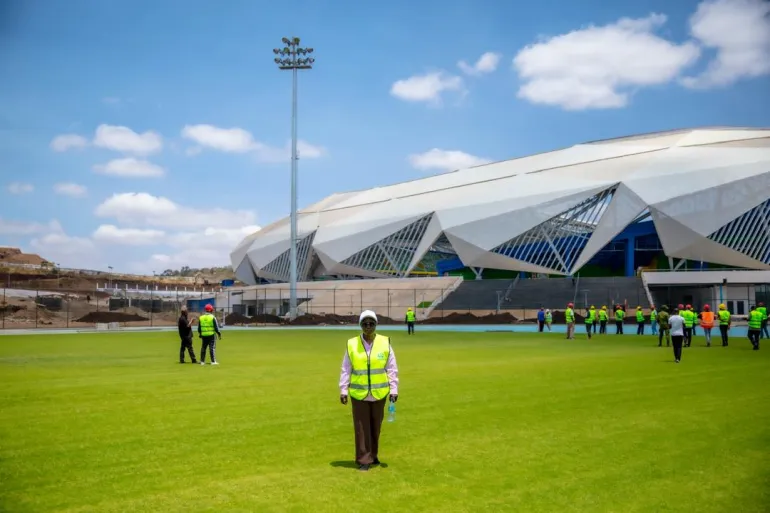
In Kenya, the biggest project is the newly built Talanta Sports International Stadium in Nairobi.
The 60,000-capacity stadium is intended to be the country’s flagship AFCON venue and was inspected by CAF earlier this month. During a subsequent visit, CAF President Patrice Motsepe said he was impressed by the progress at Talanta. He also visited Kasarani Stadium, where work remains to be completed.
But Kenya’s preparations extend well beyond its new flagship stadium.
CAF’s inspection also covered training venues, hotels, airport infrastructure and other sites supporting the Nairobi tournament operation.
Nicholus Musonye, chairman of Kenya’s AFCON 2027 Local Organising Committee, told Al Jazeera that the country was addressing the outstanding requirements.
“I want to assure Africa, and I want to assure the world, that Kenya, Uganda, Tanzania, we are ready to host AFCON,” Musonye said.
He said work on Kasarani’s pitch should be completed by the end of October, with the venue planned to be ready for handover in December.
But concerns remain about some of the facilities that will support the tournament.
Kelvin Kimaru, a Kenyan football fan, told Al Jazeera that training grounds remained a concern.
“We are not yet ready because the training grounds for the coming teams are not yet ready,” Kimaru said.
Moses Kamalik, an executive member of the Boxing Federation of Kenya, said other venues also needed work, including Nyayo Stadium and Kipchoge Keino Stadium in Eldoret.
The challenge for Kenya is broader than completing Talanta; it needs a network of match venues, training grounds and supporting facilities capable of operating together when teams and supporters arrive.
Tanzania: the race extends beyond stadiums
Tanzania is also entering the final stretch, with preparations covering stadiums, training grounds and the infrastructure connecting them.
Neema Msitha, chief executive of the country’s AFCON 2027 Local Organising Committee, told Al Jazeera that the country’s stadiums were more than 80 percent complete on average and expected to be ready for handover to CAF in January.
“All these stadiums are almost ready. If you grade them on average, all of them are almost above 80 percent,” Msitha said.
Training facilities are being developed alongside the main venues, with five facilities being prepared in each host location. Msitha said they were about 75 percent complete.
The three East African hosts are moving from construction to testing and operational preparations as the 2027 tournament approaches [Hafsa Abdiwahab Sheikh/Al Jazeera]
The Tanzanian government has also applied pressure to accelerate the work.
In August, Prime Minister Mwigulu Nchemba ordered work on AFCON training grounds to speed up, saying the facilities needed to be completed on time and meet CAF standards. He issued the directive after inspecting the Farasi and Leaders Club training grounds in Dar-es-Salaam.
Road infrastructure is also part of the preparations. In June, Works Minister Abdallah Ulega ordered contractors working on roads linked to the tournament in Arusha to operate around the clock to meet deadlines and international standards.
Msitha pointed to regional airlines, Air Tanzania and ferry services between Dar-es-Salaam and Zanzibar as part of the transport arrangements being developed for teams, officials and supporters.
CAF’s September inspection included Benjamin Mkapa Stadium in Dar-es-Salaam and other key facilities in Tanzania as the governing body continued to assess preparations across the three hosts.
Uganda faces its own deadlines
Uganda is working towards the same year-end push.
Patrick Ogwel, a CAF infrastructure monitoring officer, told Al Jazeera that infrastructure development was expected to be ready by December 31.
Hoima City Stadium has been completed and commissioned, he said, while Akii-Bua Olympic Stadium in Lira is due to be completed and commissioned by December.
Uganda’s Local Organising Committee has identified Akii-Bua, Hoima City Stadium and Mandela National Stadium as its three main stadiums. It expects 10 of the country’s 12 training facilities to be ready by the end of the year.
The organising committee said after CAF’s latest inspection that all three stadiums remained on course for completion by the end of December, while some training facilities were planned to be completed in January 2027.
But the deadlines are not without pressure.
On September 24, Uganda’s State Minister for Sports Peter Ogwang directed the Uganda People’s Defence Forces to accelerate work on several AFCON training facilities, citing concerns about the pace of construction at sites including Pece Stadium in Gulu, Lira and Gulu University.
After its September inspection, the CAF delegation also briefed President Yoweri Museveni, with challenges outside Kampala among the issues raised during the assessment.
From construction to tournament readiness
The coming months will test whether the three hosts can turn construction progress into a functioning tournament operation.
AFCON requires stadiums and training grounds that can handle teams and spectators while meeting requirements for broadcasting, media, security, transport, hospitality and match operations.
A completed stadium is only one part of the equation.
CAF inspections are now focusing on whether venues and supporting facilities can meet the operational demands of the continental tournament [Hafsa Abdiwahab Sheikh/Al Jazeera]
Kenya, Tanzania and Uganda have already gained experience from jointly hosting the 2024 African Nations Championship, which allowed the three countries to work together on a major continental tournament. CAF has also involved representatives from the three local organising committees in an observer mission at the recent AFCON in Morocco.
But AFCON will be a larger undertaking, with 24 national teams competing across the three countries for almost a month.
The coming months will determine whether the work under way across the three countries can be completed, verified and brought into operation before teams and supporters begin arriving.
For supporters in East Africa, the tournament represents more than a test of stadiums and infrastructure. It is also a chance to experience Africa’s biggest national-team competition on home soil.
Gilbert Okeya, a Kenyan football fan and Football Kenya Federation referee, told Al Jazeera:
“We are happy because we are going to host, and we are going to have an opportunity to have live matches for AFCON in our country.”
There is a “strong indication” that Iran played a role in Sunday’s suspected terror plot near Royal Air Force (RAF) Fairford base in South West England, the prime minister confirmed Wednesday, Anadolu reports.
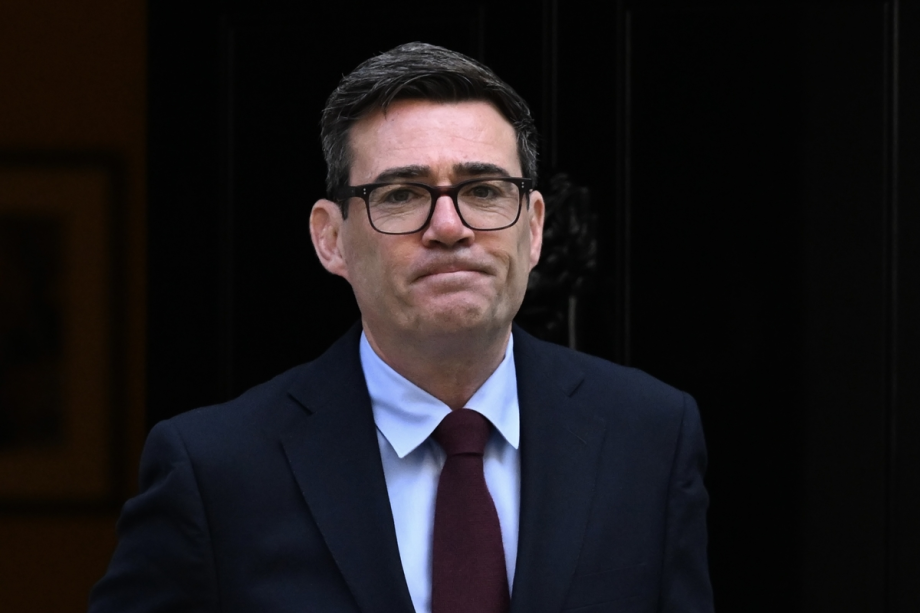
“There is indeed a strong indication that Iran played a part,” Andy Burnham confirmed in an interview with Sky News.
However, he added: “This remains, though, a complex and very serious police investigation. So I can’t say any more at this stage.”
Five men from London, age between 23 and 25, were arrested on suspicion of explosives offences and terrorism.
The incident came after a farmer discovered three vans blocking a road near the RAF base in Gloucestershire at 1.30 am local time (0030GMT).
Later, it was understood that one of the suspects had contacted authorities around an hour before, a development first reported by The Times newspaper.
Israeli Prime Minister Benjamin Netanyahu “is doing everything” to prevent the establishment of an official commission of inquiry into the events of Oct. 7, 2023, former military intelligence officer Barak Seri said, Anadolu reports.
In a Saturday post on the US social media company X, Seri said Netanyahu was “warned and alerted” ahead of the attacks, but that “he ignored it all.”
“This is why Netanyahu is personally blocking the establishment of an inquiry commission,” he said.
Earlier Saturday, Israeli newspaper Yedioth Ahronoth reported that Netanyahu received warnings about a possible Hamas attack ahead of Oct. 7, 2023, but did not convene a meeting to discuss them.
Citing unnamed security officials, the outlet said Netanyahu did not share the warnings with the Shin Bet, Mossad or the Military Intelligence Directorate, known as Aman.
Meanwhile, US magazine The Atlantic reported that former Egyptian intelligence chief Abbas Kamel secretly visited Israel 11 days before the Oct. 7 events to alert Tel Aviv about a possible Hamas attack.
There has been no official Egyptian comment on the claim.
Following the Oct. 7 events, Israel launched a brutal offensive on the Gaza Strip, killing nearly 74,000 people, injured around 175,000 others and turned the entire enclave into ruins.
Despite a ceasefire that took effect in October 2025, Israel has continued its daily attacks on Gaza, killing more than 1,400 Palestinians and injuring nearly 5,000 others, according to Gaza’s Health Ministry.
Israeli daily Haaretz said on Friday that Prime Minister Benjamin Netanyahu has driven Israel’s standing in the US to an “unprecedented low.”
“Anyone following the conduct of Israel and its relations with other countries, especially the United States, has for years warned of an unprecedented crisis in Israel’s strategic relations with its most important ally,” Haaretz said in an editorial. “It was clear that the damage caused by Benjamin Netanyahu and his government would bring relations with the United States to a new low.”
“He has ignored the many warnings regarding the damage he is causing to Israel-US relations,” the newspaper said.
The damage continued with his “blatant interference in American politics in favor of (President Donald) Trump and the Republican Party,” and that “Israel’s standing among Democrats collapsed.”
The newspaper said, however, that the decline is no longer limited to Democrats. “In the past two years, the government of Netanyahu, Itamar Ben-Gvir and Bezalel Smotrich has brought Israel’s standing in the GOP to a new nadir,” Haaretz wrote. “The war in Iran and the sharp rise in gas prices that followed, the violence against Palestinians by extremist settlers and the harm to Christian communities in Gaza, the West Bank and East Jerusalem have led even Israel’s most loyal supporters to express unprecedented criticism.”
US polls from recent months, the newspaper said, show a “sharp and unprecedented decline” in favorable attitudes toward Israel, especially among younger respondents, arguing that “No bombastic speech” by Netanyahu at the UN General Assembly can “paper over this bleak reality.”
It warned about the implications for ties between the two countries, saying: “Every Israeli needs to understand the extent to which Israel’s image has deteriorated in the eyes of the American public and the implications for the future of relations between the two countries.”
WITH its enormous Olympic Park, graffiti-clad buildings, old mills, new bars and neighbourhood pubs, it’s no wonder East London is one of the world’s trendiest neighbourhoods.
And actually, that’s why Alberto Cambus who was born and raised in Italy’s Sardinia, decided he was going to stick around when he moved to the London district over 10 years ago.
Alberto Cambus moved from Sardinia to East London over a decade agoCredit: Alberto CambusThe Stratford hotel in London, where Alberto works, has 145 rooms across seven floorsCredit: Marriot
Alberto Cambus, Director of Sales & Marketing, for The Stratford, explained why he has never left the quirky area of East London.
He explained: “I moved here 11 years ago to study, and I loved it – I embraced the pace, the lifestyle, the coffee – I’m even having cappuccinos after 11am now.”
Sign up for the Travel newsletter
Thank you!
“I’ve always lived in East London, so I’m definitely an advocate for it and Stratford is one of the areas I love the most.”
Here are some of his top tips on exploring the area.
As he works The Stratford, Alberto of course highly recommends the hotel as a great base for those visiting East London.
He said: “Our hotel is itself a triumph of architecture – our architects are the same that designed the Burj Khalifa, the tallest building in the world.
“It perfectly blends with the local area and community, making it well worthwhile popping in to take a look at our art – if you check out the lobby, we have many pieces that reference the London 2012 Olympics.
“On top of that, we have tours of the area, such as the Olympic venues.
“We do tend help our guests with the ease of access to these London institutions whether it’s to Sadler’s Wells for contemporary dance or the V&A.
“We can try to facilitate the sourcing of West Ham tickets, London Lions or London Aquatics too.”
The hotel is a stone throw away from the West Ham stadiumCredit: Alamy
Restaurants
Despite coming from the Italian island, he did say there was an Italian restaurant in the UK that was just as good.
He said: “I have to mention Santi, an Italian restaurant in front of a hotel – the menu is similar to the classic Italian food that you’ll find in Italy.
“The pizza is amazing, it’s so underrated, I’d say it’s one of the best pizza places in London.
“Another of my favourite restaurants is Hera, a beautiful Greek restaurant – it’s in front of West Ham stadium, it has a great atmosphere, very cosy, sophisticated, but not over the top.”
Bars and pubs
Alberto admitted that the hotel’s Stratford Lounge cocktails were amazing, with “mixing of the classics” as well as a recently launched autumn menu.
But he did shout out another local bar too.
He said: “Another one is Number 90 Bar in Hackney Wick, along the canal.
“It is always lively with amazing music playing, very good cocktails and reasonably priced.”
Mother Kelly’s pub is a staple of StratfordCredit: FacebookSanti has the best pizza in Stratford according to AlbertoCredit: Santi Ristorante
Being in the UK for more than a decade, Alberto is a pub convert – and he raved about one called Mother Kelly’s in the Olympic Village.
He explained: “It’s tiny, very cosy pub in Victory Parade, a neighbourhood pub that excels in craft beers, sour beers , IPAs and it’s a stone’s throw away from the hotel.
“I’ve been working in Stratford for three years now so I go in a fair bit.
“I still haven’t managed to try the whole selection of beer they have – there’s so much you’re spoiled for choice.”
Lesser-known spots
Despite East London being a popular tourist destination, there are still some spots only locals know about: “Three Mills Island isn’t very well-known; essentially, they are old flour mills between the river and navigation channel – it’s completely off the beaten track.
“It’s nothing short of an East London experience because it has a huge amount of history.
“I’d say it’s quite an unusual place for London, but beautiful – and you can take a long walk around it.
“If you’re in the area, visit now because I think that the landscape of East London in 10 years will be completely different – it’s transforming in front of my eyes.”
One must-do local experience
“You absolutely have to see a West Ham match – I’m so passionate about it, there is nothing like watching them play at the London Stadium.
“I’ve been a West Ham fan since I was about 10-ears-od thanks to a very strong Italian player called Paolo Di Canio.
“One of the first activities I did here was see a West Ham game at Upton Park, then they moved to the London Stadium right next door, I always say it was fate.”
Most people won’t be aware of Three Mills IslandCredit: AlamyThe Queen Elizabeth Olympic Park has an ‘oasis of green space’Credit: Alamy
Green spaces
“This area of London used to be a bit of an urban jungle, but then obviously they built the Queen Elizabeth Olympic Park, which is an oasis of green space.
“Stratford is so much more enjoyable now, and if you combine it with the canals in Hackney Wick, the Hackney Marshes, I’d say there’s lots of nature in East London.
“It’s well connected to Victoria Park too so you can actually walk between the two parks in 10-minutes then head along Regent’s Canal.
Family attractions
“The Olympic Park has so many options and activities for families – there’s the Tumbling Bay Playground and The Aquatics Centre.
“There’s Zip World at the ArcelorMittal, and a huge slide which goes down from the Orbit too – you name it, we have it.
“There’s the Olympic Pool, which is available for guests and for kids to swim, and all sorts of activities at the Velodrome.
“The V&A East opened earlier this year – I can’t say I enjoyed going around museums when I was a kid – but they do have activities for children.”
Shopping
“I’d recommend Hackney Wick for shopping, there are lots of small markets, particularly on the weekend that populate the area.
“They sell any type of quirky item – it’s very nice.
“And I know that most people won’t be going to a butchers but I love Appetite Steakhouse, they have a huge selection of Italian meats.
“I’m mentioning it’s also a restaurant – it has the best meat I’ve found in London.”
Sweet treats and coffee
“My favourite place is called Signorelli, which is an Italo-English” bakery.
“While I’m not a massive sweet tooth, I am a huge coffee lover and Signorelli is perfect for both.
“From time to time you can be lucky enough to find a Cornetto, which is the Italian version of a croissant, but it’s a bit different in terms of the dough, and in terms of coffee, definitely, I mean, they are the best in Stratford.
“Whenever I feel homesick, I have one of their coffees, and it takes me back to Italy.”
Signorelli is Alberto’s top spot for sweet treats and coffeeCredit: SignorelliOne free activities is doing a tour of the graffiti around Hackney WickCredit: Alamy
Free things to do
“Hackney Wick is full of street art so I’d suggest taking yourself on an unofficial graffiti tour.
“One artist, Helch, has always been known by his tag – like Banksy, he passed away recently, and Hackney Wick was a place he worked the most.
“Lots of the buildings in Hackney Wick are decorated by graffiti and you can probably see it all in around 20 minutes.
“Otherwise, take a stroll around the Queen Elizabeth Olympic Park – they also have lots going on there, so it’s worth checking out their site ahead of time to not miss out like live music to kids activities.”
Best views in East London
“Our rooftop at the hotel has the best view of Stratford.
“The view from the rooftop at Kokin is unbeatable – it’s our signature restaurant on the seventh floor and you can see the very best of East London from there.
“You can enjoy the dramatic views across to St Paul’s Cathedral and enjoy some of the best sushi in London – it’s not just sushi there’s all sorts of Japanese cuisine and the chef is incredible.
“They do special events up there too like tuna carving which takes place every Wednesday.”
The rooftop at The Stratford has incredible views across East LondonCredit: Marriot For daytrips out of Stratford, Alberto recommends WhitstableCredit: MEDITERRANEAN
Daytrips from Stratford
“The thing about Stratford is that it has so many transport links so really, you’re spoilt for choice, but I would definitely say head to Kent.
“You can get there so easily and the Kent coast is amazing, there’s Whitstable, Margate, Deal, Ramsgate – I was born by the sea in Sardinia so for me to be able to get away to the beach, it’s fantastic.”
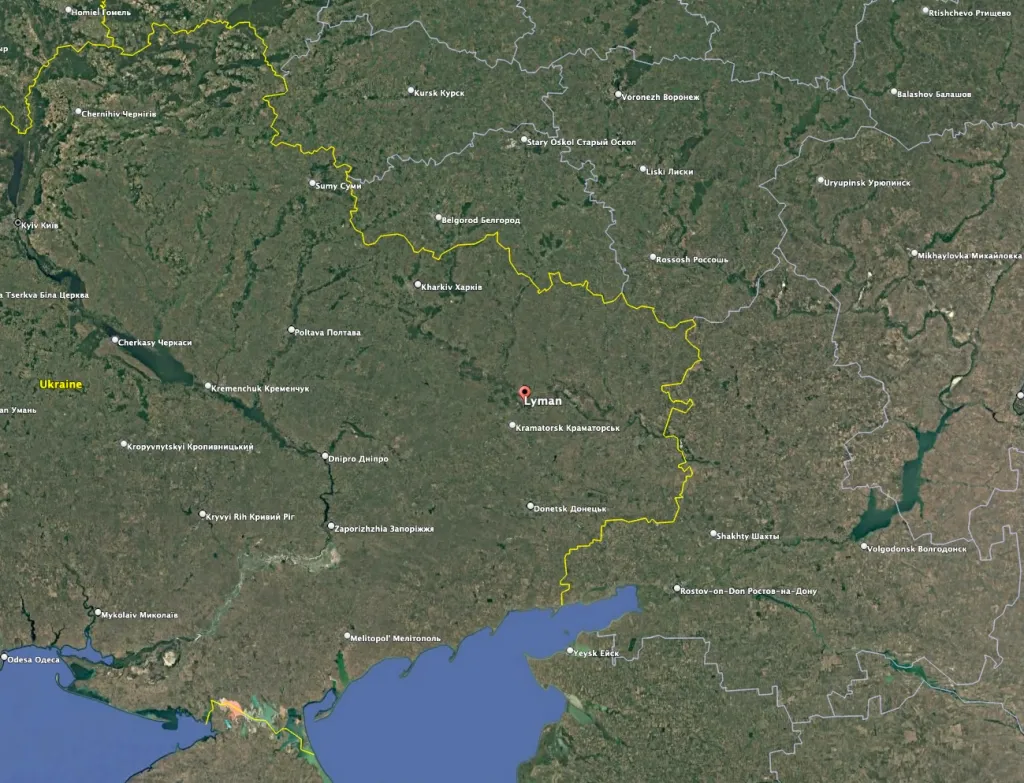
Ukraine claims it has recently regained about 125 sq. km. of territory near the town of Lyman in the eastern Donetsk region during what has been dubbed Operation Vivaldi. Rodion Kudryashov, a Ukrainian colonel and deputy commander of the Third Army Corps, offered some insights into this offensive and what made it different.
Though the operation is still ongoing, the success of Vivaldi began long before any troop movements, Kudryashov explained in an editorial he published in Ukrainian Pravda.
Ukraine is making advances near the town of Lyman, located in the Donetsk region. (Google Earth)
“After the Third Army Corps was formed, we changed the command system of its subordinate units,” he noted. “Some brigades came to the corps after very heavy fighting, with losses, manning problems and, most importantly, eroded trust in their leadership.”
Third Army Corps Commander Brig. Gen. Andriy Biletsky “then set out one of our key principles: a commander must be responsible for the entire cycle, from training a soldier to the result on the battlefield,” Kudryashov pointed out. “In some places that meant replacing a commander. In others it meant restructuring a staff or strengthening the NCO chain. In some cases we had to build, almost from scratch, processes that on paper should have been working long ago.”
At issue was changing the culture from a more rigid Soviet-era model, with a cumbersome chain of command, to a modern, more flexible one better suited for the current conflict.
“A modern commander has to handle an enormous flow of information and make decisions quickly,” the deputy commander proffered. “He has to understand what unmanned systems, logistics, reconnaissance and adjacent units can do, while not smothering initiative at lower levels with endless approvals. An army where every decision takes hours to travel up and down the chain loses to an army that makes the same trip in minutes.”
Once those changes were put in place, the Third Army Corps had to first stop Russian advances in the sector before it could move forward.
VIVALDI 🎼🎶
GoPro footage from Ukrainian assault troops who took part in the Vivaldi counteroffensive, which resulted in the liberation of five settlements in the Lyman direction. pic.twitter.com/2SVXSKlEX0
“When the corps took over its area of responsibility, our first task was not an offensive,” the officer said. “We had to stop the situation from deteriorating and stabilize the forward edge.”
“The enemy was pressing. In some sectors our combat formations were losing cohesion,” he underscored. “The Russians were actively using infiltration tactics: small groups seeped between positions, massed in our rear, threatened logistics and gradually eroded the defensive line.”
“We had to stabilize the forward edge and stop the infiltration,” Kudryashov said. “We had to rebuild command, put in commanders capable of making decisions, form new teams and reconstitute units. We had to set up the surveillance-and-strike system and sustain the front line. We had to stockpile ammunition, drones and other resources, understand the enemy, and plan the next step before the previous one was finished. Only after that could we move forward.”
By June, the corps was able to secure the front “in the sector from Borova to Lyman and eliminate the enemy’s infiltration zones,” Kudryashov continued. “That sounds less impressive than the word ‘offensive,’ but no offensive ever happens without it.”
“You cannot plan a complex operation if you don’t know where your forward edge will be tomorrow,” the deputy commander extrapolated. “You cannot build up forces if your logistics are constantly under threat. And you cannot form a strike group if your units are always forced to patch new breaches. So the first phase of ‘Vivaldi’ was not an advance at all. It was creating the conditions that made an advance possible in the first place.”
Once the front was stabilized, the next step was shaping the battlefield for the offensive. The corps’ unmanned systems units went to work against Russian logistics, striking a pipeline and depots. That forced the enemy to change its fuel and lubricant supply routes.
Ukraine’s 3rd Army Corps released new footage of search-and-strike operations on the Lyman front. FPV drone operators from the 60th Mechanized Brigade’s FATUM unit targeted Russian armored vehicles, a Grad multiple rocket launcher and personnel. #Ukrainepic.twitter.com/1iNG7z2N1c
“The operation also involved the corps’ brigades, its reconnaissance and unmanned units, and attached forces from the SSO (Special Operations Forces), GUR (Defense Intelligence) and DPSU (State Border Guard Service),” the deputy commander said. “To counter infiltration, a joint headquarters was set up to coordinate special and reconnaissance units at the tactical level under a single concept.”
“In my view, this is one of the main characteristics of modern war,” he further stated. “It is not 10 strong units that each fight well on their own. It is 10 different elements that start working as one system at the right moment.”
An interesting new detail from Ukraine’s 3rd Army Corps about Operation Vivaldi on the Lyman axis.
The Corps says Ukrainian forces carried out a flanking maneuver and, for the first time, airlifted unmanned ground vehicles behind Russian lines, while also suppressing Russian… https://t.co/ZEq8C75bN4pic.twitter.com/KgKcZ0Zs2P
The influential, Kremlin-connected Rybar Telegram channel has acknowledged Ukrainian gains in this sector.
“In the first half of summer, Russian units gradually advanced in Lyman,” Rybar wrote this morning. “However, in August, the enemy launched counterattacks and, by the first week of September, regained some positions, and also began attempts to recapture Shandryholovo and Zarechnoye.”
“The enemy did not inflict significant losses on Russian troops, as the concentration of units of the West group of forces in the salient remained relatively low,” Rybar added. “However, later, the UAF deployed reserves to launch an offensive towards Zherebets in order to align the front along the water barrier and return it to the configuration of the end of 2025.”
rybar now saying the 144th division is still falling back. the 3rd corps is still advancing and destroying an entire army group as they move. this is historic. pic.twitter.com/2jOa8KR9oA
Though the battle is still in flux, Kudryashov said there are lessons the rest of the Ukrainian military should heed.
“Winning one battle is not yet winning the war,” he said. “The enemy is learning too. He changes tactics, looks for weak spots and tries to scale what works for him.”
“So our task is to be faster, not only in physically moving forward but also in our ability to see, think, decide and put into practice what delivers results,” the deputy commander avowed. “And to do everything possible so that our soldiers pay the lowest possible price for every next kilometer of Ukrainian land.”
The Latest
On the battlefield, in addition to the gains Ukraine has made near Lyman, it has also largely been able to hold off Russian advances across the front lines. Here are some key takeaways from the latest Institute for the Study of War assessment of frontline operations:
Sumy: Russian forces recently conducted an infiltration mission east of Sumy City, and they continue to conduct glide bomb strikes against frontline settlements in northern Sumy Oblast to set conditions for future offensives.
Kharkiv: Russian forces continued offensive operations in northern Kharkiv Oblast and in the Borova, Kupyansk and Velykyi Burluk directions on Sept. 21 and 22 but did not advance.
Donetsk: Ukrainian forces reportedly continue counterattacks in the Lyman direction, including southeast of Lyman, as Russian forces are attempting to use redeployments to stabilize the area. Russian forces continued offensive operations east and southeast of Slovyansk near Rai-Oleksandrivka and toward Mykolaivka and Fedorivka Druha on Sept. 21 and 22 but did not advance. During this period, they also tried to advance in the Novopavlivka and Oleksandrivka directions but made no gains, as Ukrainian forces counterattacked in both areas.
Zaporizhia: Ukrainian forces recently advanced or maintained positions in western Zaporizhia Oblast.
Kherson: Neither Russian nor Ukrainian forces reported ground activity in the Kherson direction on September 22.
Russian Offensive Campaign Assessment, September 22, 2026: The Russian Ministry of Defense (MoD) falsely claimed that Russian forces have encircled Dobropillya — an intensification of the Kremlin’s cognitive warfare campaign alleging encirclements across various sectors of the… pic.twitter.com/yMoAcyVIme
In his speech to the U.N. General Assembly this afternoon, Ukrainian President Volodymyr Zelensky called for Russia to end its war and said it was paying a heavy price — and exacting a terrible toll — for little territorial gain.
“This ridiculous and never-ending war with Ukraine must be ended,” the Ukrainian leader urged. “I do not know a single world leader who would say otherwise. I do not know anyone who is openly for this war, except one man.”
He was referring to Russian President Vladimir Putin.
“Ladies and gentlemen, for almost five years now, Russian generals have been trying to carry out Putin’s crazy order to seize our eastern land, the Donetsk region,” Zelensky continued. “And just this year, from January through August, the Russian army lost 248,964 people on the battlefield in Ukraine in eight months. Twenty-one countries in the world have smaller populations… than the number of Russian troops lost in just eight months.”
‘Patient Zero’ Putin, Russia-Ukraine war & Trump: Zelensky addresses UN
“It’s madness, but they still keep going there to die because that is what Putin wants,” Zelensky suggested. “After losing so many people, Russia managed to capture just over 1,000 square kilometers of our land this year, and we have already liberated a significant part of it. Russia is a country that already has 17 million square kilometers of its own land without any Ukrainian territory, by the way. So to add another 1,000 square kilometers, Putin is paying with 248 people for every kilometer. Does anyone still think that he is reasonable? And moderate?”
“Russia’s leader, Patient Zero, the man from whom this war began and spread into the world, becoming the largest war in Europe since World War II, will inevitably leave this war,” Zelensky proffered. “But the longer Putin is able to wage war, the more evil he will leave behind in this world. Today, nothing in war works the same way it did, by the way, in 2022, except the courage of people.”
Russian missile and drone barrages have “caused damage, but they didn’t break us,” the president proclaimed. “We build our defense. What is really difficult for us now is Russian ballistic missiles and their new jet-powered Shaheds — Iranian technologies.”
Residential buildings stand against the backdrop of smoke from a Russian attack on Kyiv. (Photo by Bohdan Diev/Global Images Ukraine via Getty Images) Tatyana Kudel’s’ka
“Just imagine this: since the beginning of this year, Russia has already used more than 2,100 missiles of different types again against us, against Ukraine, our people and our children,” Zelensky stated. “More than 950 of them were ballistic missiles. In eight months of this year, Russia used 63,000 attack drones of different types against Ukraine, our people, and more than 7,700 of them were jet-powered Shaheds, truly destructive and very dangerous weapons. Just think about it. The Russians launch jet-powered Shaheds every hour, every hour, against our cities, our economy, our infrastructure. Our combat aircraft are fighting them 24/7, and this is part of Russia’s strategy to create a new threat every hour, to make life harder for the economy and to disrupt people’s lives, and to stop children from being able to study, to study at school.”
Speaking at the Sixth Summit of the International Crimea Platform in New York on Wednesday, Zelensky said the return of Crimea is a condition for any return to normal relations with Russia.
“Disrespect for international law began in 2014, when Russia entered Crimea,” the Ukrainian leader stated. “There can be no full return to normality without Crimea, the restoration of security, the protection of people and lives, the release of prisoners held by Russia, and a return to the fundamental principles of international law. Territorial integrity matters, state sovereignty matters, and human lives matter. And Russia must learn this.”
Участь Володимира Зеленського в шостому саміті міжнародної Кримської платформи
Tuesday, Zelensky met with U.S. President Donald Trump.
Among the topics of their three-hour meeting were a path to end the war and a renewed discussion about the licensing of Patriot air defense interceptors so they can be built in Ukraine. The country is struggling to defend against Russian ballistic missiles because of the dearth of these munitions.
“Just had a positive and productive meeting with President Trump on the sidelines of the UN General Assembly,” the Ukrainian leader stated on X. “Both the United States and Ukraine want this senseless Russian war to end before winter. We discussed possible de-escalation steps that could pave the way to diplomacy.”
“I am grateful that, in parallel with this, our teams continue to work on launching the production of Patriot interceptor missiles in Ukraine,” Zelensky noted. “This is exactly what will help protect lives if Russia rejects negotiations and continues to rely on ballistic terror against our people this winter and beyond. We also discussed other bilateral and multilateral issues, including the winter air defense package for Ukraine. Thank you to President Trump, his team, and all the American people for their support.”
I just had a positive and productive meeting with President Trump @POTUS at UNGA. Both the U.S. and Ukraine want to see this senseless Russian war ended before winter. We discussed potential de-escalatory steps that can open up the way to diplomacy. I am grateful that in the… pic.twitter.com/Ayvsj9It3m
— Volodymyr Zelenskyy / Володимир Зеленський (@ZelenskyyUa) September 22, 2026
For his part, Trump said negotiations about Patriots are ongoing but offered no commitments.
“We’re talking about that,” Trump stated. “We’ll be talking about that now. If you would have come in at the end, we would have had an answer. But we’ll be talking about that. I mean, we talk about it all the time. Very capable people, really amazingly capable people.”
This isn’t the first time the two leaders have talked about a Patriot licensing deal. The issue came up back in July. As we noted at the time, such a deal faces big challenges.
First of all, it could face bureaucratic and regulatory hurdles, like getting congressional approval. Major security concerns exist, not just by having license production of a very sensitive weapon in Ukraine but also having to do with whatever facility will perform the work, which would become a top target for Russia. Even if they got the clearance to move forward, delivery of new weapons will still take years due to the time it takes to build the facility and to source long-lead components.
Even Lockheed Martin, one of the world’s biggest arms makers, currently produces only about 650 PAC-3 MSE interceptors a year, or just shy of two per day. However, under a contract with the Pentagon inked in January, Lockheed is committed to boosting Patriot PAC-3 MSE annual production to 2,000 in the years to come.
You can read more about the headwinds a Patriot licensing deal would face, even if it were to come to fruition, in our initial story here.
A Patriot interceptor. (DOW) Department of Defense
Ukraine’s president also confirmed that “Kyiv is ready to agree to an energy truce on the condition that Russia does not attack its energy, electricity and heating infrastructure as well as its water supplies,” CNBC reported. “Trump has previously called on Ukraine to stop targeting Russian oil refineries with drone strikes, which he says are ‘hurting the world’ as fuel supply disruptions from the Ukraine and Iran wars propel U.S. diesel prices to a record high.”
Ukraine’s repeated attacks on Russian oil infrastructure is having a major impact.
“Russian refinery throughput fell to 3.8 mb/d, its lowest level in more than 20 years and roughly 30% below a year earlier,” according to a recent report by the International Energy Agency (IEA). “Reported gasoline output is down by 20% compared with 2025 levels, while diesel production is estimated to have fallen by nearly 30%, prompting the government to restrict fuel exports to protect domestic supplies.”
Amid the U.N. General Assembly meeting, strikes by both sides continued.
“At least 16 people were killed and 59 others injured in Russian attacks across Ukraine over the past day, as Russia launched several waves of ballistic missiles at Kyiv overnight,” the Kyiv Independent reported, citing local authorities.
“Two people were killed and eight others injured in Kyiv, where Russian ballistic missiles struck the capital in three waves overnight,” the publication added. “Residential buildings, a maternity hospital, energy, and logistics infrastructure were among the sites damaged, according to President Volodymyr Zelensky.”
“Russia launched 282 attack drones of various types overnight, including jet-powered drones, as well as Zircon anti-ship missiles and Iskander-M, S-400, and KN-23 ballistic missiles,” the news outlet stated, citing the Ukrainian Air Force. “Ukrainian air defenses shot down 227 aerial targets, including 219 drones, four Zircon missiles, three ballistic missiles, and one Banderol munition. Strikes were recorded at 13 locations, while debris from downed targets fell at 10 locations.”
A difficult night for Ukraine as Russia continued attacking our civilians, launching a ballistic missile attack on Kyiv, and attacking Kyiv and other Ukrainian regions with drones. The air raid alert in Kyiv was turned on at 3:28 a.m. and hasn’t turned off since.
Ukraine’s strikes on Russian energy infrastructure continued.
“Over the past 24 hours, two oil refineries were hit – one in Bashkortostan and one in the Samara region. There were also strikes in the Black Sea,” the Ukrainian Defense Ministry stated on X. “We are taking the war back to where it came from. We are bringing peace closer for Ukraine. I thank the units involved for their precision.”
I thank our warriors for the results they achieve every day in carrying out Ukraine’s long-range sanctions. Over the past 24 hours, two oil refineries were hit – one in Bashkortostan and one in the Samara region. There were also strikes in the Black Sea.
In an effort to defend against Ukrainian attacks, Russia continues to use netting to protect its energy facilities. You can see a recent example in the video below.
After more frequent Ukrainian strikes on Russian oil refineries and fuel depots, Moscow and the Moscow region decided to cover potential targets with anti-drone nets.
Finland’s President Alexander Stubband Zelensky this morning “signed an Agreement on Enhanced Defense and Security Cooperation under the Drone Deal format,” the Finnish Defense Ministry said in a statement. “It will enable defense materiel cooperation between the two countries.”
“The agreement will enable Finland and Ukraine to transfer technology and knowledge, pursue research, development and innovation cooperation and promote joint manufacturing and drone technology development between their industries,” the MoD stated. “Another objective is to simplify administrative processes, for example regarding the granting of export authorizations, to make the transfer of defense materiel and technologies between the two countries as efficient as possible.”
Finland and Ukraine take their defence cooperation to the next level
Today, we signed a drone deal with @ZelenskyyUa. The agreement enables, among other things, the joint production of defence materiel. Defence sector companies in Finland are ready, and the joint effort can now… pic.twitter.com/UUh2kZPPpk
With electronic warfare interfering with how drones controlled by radio frequencies operate, Ukraine is testing a new system of small radio beacons placed on the ground that allow drones to navigate without GNSS — including missions deep inside Russia. While many systems might not need this fix, some of the lower-end drones might.
Ukraine is testing and scaling this technology as part of a layered navigation system designed to keep drones autonomous in heavily jammed environments.
“The concept is quite simple,” the BBC wrote. “If the enemy jams the signal coming from above—specifically from GNSS (Global Navigation Satellite System) satellites, which determine the precise coordinates, speed, and time of any object on Earth—then specific points must be created to provide that same signal from below.”
The idea is to guide the drones by triangulating their location.
“To achieve this, special small devices—radio beacons—are either installed on the ground or air-dropped across a specific area. Their coordinates are known; thus, when a drone flies through the area, it receives coordinate data and signal transmission timing from several beacons. From there, it is a matter of basic geometry: the UAV calculates its own spatial position using data on the distance to the beacon and its altitude above the ground.”
GPS can be jammed. Ukrainian drones still need to fly.
A new beacon network is helping solve that problem.
Small radio beacons placed on the ground allow drones to navigate without GNSS or a constant communications link — including missions deep inside russia.
In the age of robots, uncrewed ground vehicles (UGVs) are playing a larger role in combat. The following video shows one UGV rescuing another one by pushing it back on its wheels.
A Ukrainian logistics UGV comes to the rescue of its overturned teammate, helping get the stranded ground robot back on its wheels. pic.twitter.com/q7d5I2tyOe