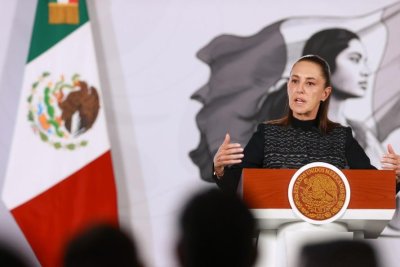

Mexican President Claudia Sheinbaum said at her morning press conference Wednesday that a national debate on regulating artificial intelligence and social media would begin after the World Cup ends July 19. Photo by Mario Gizman/EPA
July 1 (UPI) — Mexico will launch a national debate on artificial intelligence and social media after the 2026 FIFA World Cup concludes in a move aimed at laying the groundwork for future regulatory framework.
President Claudia Sheinbaum said the process will begin after July 19 and will bring together lawmakers, technology experts, academics, media representatives and parents to discuss the impact of digital platforms and artificial intelligence on different areas of society.
Sheinbaum emphasized that the process will be conducted under the government’s stated premise of not infringing on freedom of expression.
Among the issues to be discussed are mental health, protection of children and adolescents, concentration of power among major technology platforms, development of artificial intelligence and the possibility of establishing limits on cellphone use in schools.
“The discussion should be opened on the control of platforms: Who controls them? How many people own these platforms? How is that power concentrated?” the president said during her Tuesday morning news conference.
Sheinbaum also raised the need to examine who controls the development of artificial intelligence, what regulatory frameworks exist in other countries, what benefits they offer and what risks they pose for Mexico.
“It is very important for Mexico to enter this regulatory process without resorting to censorship,” she said.
The announcement prompted immediate reactions on social media, where experts, civil society organizations, academics and users began debating the scope of possible regulation.
While some argued that Mexico’s legal framework needs to be updated to address the challenges posed by digital platforms and artificial intelligence, others expressed concern that poorly drafted legislation could become a tool to limit criticism or restrict freedom of expression.
News outlet Sinaloa Hoy reported that the proposal comes at a time when social media has become the primary source of information and political criticism for young people.
According to opinion polls, including one conducted by consulting firm Enkoll, the president has a 44% disapproval rating among people ages 18 to 24.
Mexican political analyst Juan Ortiz wrote on X that regulation may be necessary, “but a poorly written rule could end up punishing political criticism under the pretext of protecting minors or combating disinformation.”
“In San Luis Potosí, its ‘regulation’ of AI ended with women journalists being detained,” he said.
Mexican attorney Gildo Garza also questioned the announcement, arguing that regulation could become a mechanism to control public discourse.
In a post on X, he warned that previous experiences in Venezuela and Nicaragua show how initial narratives about protection or regulation ultimately resulted in restrictive laws, judicial persecution and punishment of critical voices.
According to a report by the Anáhuac Universities Network, the path toward digital legislation in Mexico has been marked by intense activity in Congress. Since April 2023, lawmakers have introduced 85 legislative initiatives to create laws or amend existing ones to regulate artificial intelligence and the digital environment.
The vast majority of those proposals, 67, have remained stalled or are pending approval. That has been attributed to a lack of consensus, technical complexity and concerns among various sectors that such measures could affect freedom of expression.