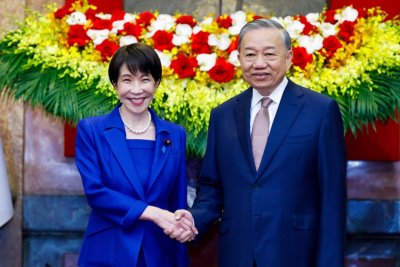

Vietnamese President and General Secretary of the Communist Party To Lam (R) shakes hands with Japanese Prime Minister Sanae Takaichi (L) during their meeting at the Presidential Palace in Hanoi, Vietnam 02 May 2026. Photo by LUONG THAI LINH / EPA
May 3 (Asia Today) — Japan and Vietnam agreed to deepen cooperation across key economic security sectors, including energy, critical minerals, semiconductors, artificial intelligence and space, as Tokyo seeks to strengthen supply chains and reduce reliance on China.
Prime Minister Sanae Takaichi met with Vietnam’s top leadership, including Communist Party General Secretary and President To Lam and Prime Minister Le Minh Hung, during her visit to Hanoi. After the meetings, she said both countries had designated economic security as a top priority in bilateral cooperation.
According to Vietnamese media and Reuters, the two countries agreed Saturday to elevate their comprehensive strategic partnership and signed six memorandums of understanding covering technology, climate response and information and communications.
Energy cooperation at the forefront
A key outcome was in energy. Vietnam said Japan will support crude oil supplies to the Nghi Son refinery through a $10 billion “Power Asia” initiative aimed at strengthening energy resilience in the region.
The program, introduced by Takaichi last month, is designed to help Southeast Asian countries affected by disruptions in the Strait of Hormuz by supporting oil procurement, storage and supply chain resilience.
Japan’s Idemitsu Kosan has already decided to send about 4 million barrels of crude oil to Vietnam via routes that bypass the Strait of Hormuz. The shipment, equivalent to about 10 days of refinery operations, followed a request from Vietnam earlier this year.
Strategic message on China
In a speech at Vietnam National University, Takaichi emphasized the risks of overdependence on a single country for critical supplies, a remark widely interpreted as targeting China.
“Overreliance on one country often stems from abnormally low prices,” she said, calling for a “level playing field” in global trade.
She also stressed that regional supply chains depend on secure and open sea lanes, referencing both the Strait of Hormuz and the South China Sea.
The speech reaffirmed Japan’s vision of a “free and open Indo-Pacific,” a framework originally proposed by former Prime Minister Shinzo Abe and now updated for what Takaichi described as a more challenging global environment.
Expanding cooperation in critical minerals
The two countries also agreed to expand cooperation on critical minerals, as Japan seeks to diversify supply chains heavily dependent on China.
Vietnam holds significant reserves of rare earth elements and gallium but lacks refining capacity, leaving it reliant on Chinese processing. Strengthened cooperation could help Japan secure alternative supply sources.
Japan remains one of Vietnam’s largest economic partners, with bilateral trade exceeding $50 billion last year. It is also Vietnam’s largest provider of official development assistance.
Takaichi highlighted Vietnam’s growing role in global manufacturing, citing production of Apple AirPods and Nintendo Switch devices, as part of efforts to encourage renewed Japanese investment.
She is scheduled to travel to Australia next, where she will meet Prime Minister Anthony Albanese to mark the 50th anniversary of bilateral relations and upgrade ties to a “special strategic partnership.”
— Reported by Asia Today; translated by UPI
© Asia Today. Unauthorized reproduction or redistribution prohibited.
Original Korean report: https://www.asiatoday.co.kr/kn/view.php?key=20260503010000231