A BELOVED UK hotel chain has closed two of its sites ahead of a Premier Inn takeover.
One of the hotels has been in operation since 2009 and was highly praised by guests for its great service, low prices and comfy beds.
A popular hotel chain has closed two of its sites ahead of a major takeoverCredit: Future InnThe two sites will be turned into Premier Inn hotelsCredit: AFP via Getty Images
Now, Future Inn in Bristol‘s iconic Cabot Circus has shut down for good, having been bought by hotel giant, Premier Inn.
Future Inn’s Plymouth branch has also closed its doors, after operating for 20 years.
Sign up for the Travel newsletter
Thank you!
The four-star sites were acquired by hospitality operators, Whitbread, and will re-open under the Premier Inn name.
While it’s unknown when the transformations will be completed, the purchases come after Whitbread announced a new business strategy to invest in the Premier Inn brand.
The company has shut down hundreds of Brewers Fayre, Beefeater, Table Table and Bar + Block locations in recent months in order to invest in Premier Inn hotels.
The closure of Bristol’s Future Inn was confirmed after guests who had reservations for after September 28 had their bookings cancelled.
Sharing a statement after the official closure, a Future Inn spokesperson said: “After 17 wonderful years, we’re saying goodbye to Future Inn Bristol.
“To every guest who stayed with us, celebrated with us, shared special moments with us and made memories here – thank you.
“And to the incredible team members, past and present, who brought the hotel to life every day – thank you for your hard work, loyalty and dedication.”
The statement also confirmed the fate of the Plymouth branch, while it said that the Cardiff site will remain open.
The Bristol Future Inn hotel boasted 149 bedrooms as well as its Chophouse restaurant and bar.
The branch also had multiple conference and event spaces plus a jazz music venue.
Having hosted guests for almost two decades, Future Inn became a popular tourist go-to with countless positive reviews.
Reviewing the hotel earlier this year, one guest said: “Excellent stay from start to finish.
“The hotel is modern, clean and very comfortable, with spacious rooms that had everything needed for a relaxing family stay.
“Beds were comfortable, the room was well maintained, and it felt fresh and welcoming throughout,” the customer added.
Another described their stay as a “lovely experience”, while one more wrote: “I had a wonderful stay at this hotel. The room was very spacious, and the bed was large and extremely comfortable.”
WHEN it comes to the best foodie spots in the UK, it’s safe to say Michelin-star chef Tom Kerridge knows his stuff.
Talking to Sun Travel, Tom revealed that he doesn’t always go for fine food – with a popular high street chain being one of his favourites.
Tom Kerridge spoke to Sun Travel about his top foodie destinations in the UKCredit: We Are SocialOne of Tom’s favourite spots for seafood is Whitstable in KentCredit: Alamy
“As far as chain restaurants go, it’s good value for money, and you can make it healthy – then cover it in hot sauce, as I like to.
“If I’m with my son, we’ll do a whole chicken and share one of those, then for sides, we love the Peri-Peri salt chips, and the Macho peas.”
You can even get meals for under £10 in Nando’s – the grilled chicken burger served in a soft roll with tomato relish, mayo, lettuce and tomato comes in at £8.75.
A variety of the salads come in at £9.50, or if you fancy some sides, get a quarter of a chicken and add two sides for just £12.45.
Another British staple is of course fish and chips, and Tom reveals exactly where he likes to go for the seaside favourite.
He said: “The north coast of Kent is just brilliant, and there are a couple of great chippies in Whitstable.
“The town actually ahs an incredible fish scene in general – it’s still a fishing port and you can see the boats coming in and out everyday.
“One of my favourites spots is actually Whitstable Oyster Company, and there’s Wheelers which is fantastic for shellfish – especially if you like a crab sandwich.”
British and his son love a pre-cinema trip to Nando’sCredit: Tom Kerridge
He added: “And the best part is that it’s all along the seafront – I’m a believer in flavour being wrapped up in a setting.
“You’ve got to go and eat on the sea wall with seagulls flying overhead. It’s magic, and that’s what makes things taste great – especially along the north Kent coast.”
When it comes to the Great British pub, there’s one spot that sticks out in Tom’s mind, and you’ll find it in Yorkshire.
He explained : “One of the best in the UK is in a sweet little village called Harome.
“The Star Inn is run by Andrew Pern and it’s an amazing, brilliant pub with Michelin-star food.
“It’s homely, hearty and everything you’d expect from a Yorkshire pub like an open fireplace, Wellington boots. It’s a lovely, lovely place.”
A few years ago, The Star Inn was named one of the best pubs in the country – it’s inside a 14th century thatched cottage with exposed wooden beams.
Lots of visitors have praised it for being “charming” and having “incredible food for a fair price”.
Whitstable has an incredible fish scene – like at WheelersCredit: AlamyThe Star Inn is one of Tom’s most-recommended country pubsCredit: Alamy
They cook up a storm too from plum-glazed duck to roast lamb, pan-roasted halibut and for dessert baked-apricot soufflé to savoury frangipane.
And while Tom raves about the major cities as a place to eat fantastic food – praising Manchester for its street food and bars, along with Bristol for its vegetarian restaurant – there is a much smaller island he said is amazing as well.
He said: “When I was a child, I used to go on holiday to the Isle of Wight all the time.
“It was to a Butlin’s-style caravan park, and now I’m at the point where my son is 10 and he loves the idea of camping and doing adventure stuff – so I’m looking forward to getting back into it.
Marlow is considered one of Buckinghamshire’s prettiest townsCredit: AlamyOne of Tom’s three pubs in Marlow is The Butcher’s TapCredit: Tom Kerridge
“I actually went back to the Isle of Wight earlier this year to film something, and I love going back.
“It’s so small that you can go all over – the coast is very special.
“The Isle of Wight has quite an old-school feel, it’s like going back to the 50s or childlike England. It would be cool to take my son there and go camping.”
Tom is based in Marlow, where he has lived for 21 years, and it’s where he’s set up his three pubs; The Coach, The Hand & Flowers and The Butcher’s Tap.
In October 2017, Tom’s pub, The Coach was awarded its first Michelin starCredit: AlamyRock village in Cornwall is where Tom and his family love going on holidayCredit: Alamy Stock Photo
Chase bank has partnered with Tom Kerridge to celebrate the UK’s world class dining scene.
This comes as new research from Chase reveals that Brits are willing to travel far and wide for a good meal, to the tune of 57 miles on average – the same distance as from London to Oxford.
With Chase, customers can earn 2 per cent cashback – up to £20 a month – when you use your debit or credit card in the UK and Channel Islands across:
Groceries – e.g. at grocery stores, supermarkets, miscellaneous food stores, convenience stores and specialty markets
Everyday transport – e.g. local and suburban commuter passenger transportation (including ferries), bus lines (including charter/tour buses), railroads and passenger rail (trains)
Fuel – e.g. service stations (with or without ancillary services), automated fuel dispensers and public electric vehicle charging points
Within hours of a Feb. 28 missile attack that hit an Iranian school, some Pentagon personnel knew the U.S. was responsible, according to officials involved in an internal investigation of the incident. That probe found what the officials now describe as a cascade of preventable failures.
Two Tomahawk missiles struck the building and its grounds that Saturday, killing more than 150 people, including at least 123 children. The strikes devastated the two-story school, which was built on land that was part of a military compound in the southern Iranian town of Minab. In terms of child casualties, it’s the deadliest American military targeting error of the 21st century.
United Nations investigators said Thursday that there were reasonable grounds to conclude that the strike on Minab and another U.S. attack that took place on the same day amounted to war crimes. The U.S. has yet to publicly accept responsibility for the school strike, and President Trump has previously suggested it was Tehran’s fault. As recently as July 14, he told Fox News, “I don’t think anybody’s going to ever be able to say what happened there.”
But in interviews, officials with direct involvement in the Pentagon’s internal investigation have offered some of the first accounts of the probe. The strike didn’t result from a single catastrophic decision but an accumulation of smaller ones, they said, and their review has identified a series of missed opportunities to prevent the disaster. The officials, like more than two dozen others who provided descriptions of targeting procedures or background information for this story, asked not to be named to discuss sensitive matters.
In the final days of February, the Trump administration demanded an overwhelming aerial assault. More than 1,000 Iranian targets were hit within the first 24 hours alone. That order compressed the time frame for finalizing targets, the officials said, instilling an urgency that — combined with gaps in underlying information about the site, cuts in civilian protection personnel and an overreliance on artificial intelligence technology — set the stage for the deadly error.
Full details from the investigation remain tightly held. Officials who described it said they faced constraints on the amount of information they could share. Previous news reports have indicated that by early March, a preliminary internal review determined the U.S. was likely responsible for the Minab strike.
A report on the full Pentagon investigation, which commenced in March, hasn’t been released — though the officials said it has been all but complete for several months.
Adm. Brad Cooper, who heads U.S. Central Command and ordered the investigation, told members of Congress in May that he’s committed to providing transparency. Yet it’s not clear how much detail will be included, nor how much of the report ultimately will be released to the general public.
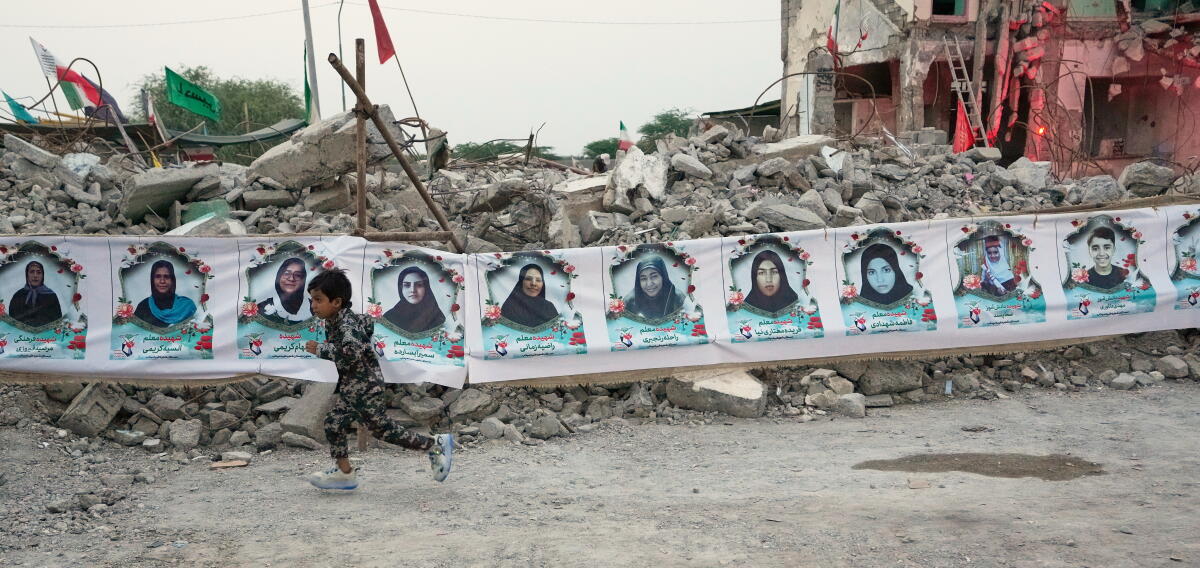
A child runs past a banner strung across the rubble of Shajarah Tayyebeh Elementary School showing portraits of the children and teachers killed there by a U.S. missile strike.
(Vahid Salemi / Associated Press)
A Pentagon spokesperson said the incident remains under investigation and declined to comment further.
In response to questions, including about when the White House was informed that the strike was a mistake, a senior administration official also cited the ongoing probe and added: “The United States does not target civilians.”
Last week, a report from the United Nations’ Independent International Fact-Finding Mission on Iran said that the U.S. had “failed in its obligation to do everything feasible to verify” that the school was a military target and that the failure “went beyond negligence.” The U.S. Department of Defense has declined to comment on the report.
U.S. officials have said that outdated intelligence was a problem. Although the site in Minab had been identified years earlier as a military compound, there was clear evidence that it had been modified and undergone a change of purpose, the officials said. Physical changes reflecting new construction — visible on satellite imagery — dated back almost a decade, they said, and the site operated openly as a school.
Analysis of commercially available satellite images shows construction of walls and entrances that separate the school site from the military base, work that appears to have been completed by 2017. An image from 2018 shows brightly painted walls alongside a soccer pitch, assembly rows and play markings on the ground.
Some U.S. intelligence analysts took notice, the officials said. Bloomberg reported in June that one analyst detected changes to the site as early as 2019, and logged remarks about the modifications in a system that wasn’t connected to the primary military intelligence database, which informs targeting.
Inside Centcom, which conducted the U.S. attack, some personnel relied too much on the artificial intelligence embedded in Maven Smart System, the officials said. Maven, which is made by Palantir Technologies Inc., allows users to view and coordinate complex military operations — from targeting to command and control — using AI-enabled software that fuses more than 150 different data inputs into a coherent set of information to inform commanders’ decisions.
In the past year, the Defense Department has rapidly made Maven a cornerstone of the U.S. military apparatus. Several former senior U.S. military officials now work for Palantir, including some with high-level security clearances in Centcom’s Tampa headquarters. Their role is to keep the software functioning inside secure military environments.
Some Centcom personnel expected Maven to flag stale information or inconsistencies in the underlying intelligence assembled for potential targets, the officials said. It’s not clear why they had such expectations.
A Palantir spokesperson said that the company “is not responsible for the underlying data nor identifying intelligence deficiencies” and that there’s no evidence that its software was at fault in the Minab strike.
Two people familiar with the firm’s Pentagon contracts said the government retains primary responsibility for the quality of the information that’s fed into Maven. But they said it’s not uncommon for personnel who use tools such as Maven to develop operational understandings that differ from contractual terms.
After the Minab strike, Palantir built new capabilities into Maven that “re-review underlying intelligence to identify factors that would disqualify a target and flag inconsistencies and inaccuracies that human review may have missed,” according to a person familiar with the matter. That work has already caught some anomalies, the person said.
The ‘kill chain’
As Feb. 28 approached, Pentagon officials were tasked with identifying strikes they thought would paralyze Iran’s military before Tehran had a chance to respond, the officials said.
High on Centcom’s list: the naval division of the Islamic Revolutionary Guard Corps, the most powerful force across the country’s military, economy and politics. It’s tasked with defending — and at times, disrupting — the Persian Gulf and the Strait of Hormuz. The Minab school site — with its uncorrected classification as a Revolutionary Guard facility — was fed into Maven along with other potential targets. It ultimately emerged as one of the recommended Day 1 targets, people involved in the investigation said.
As all targets do, the Minab site moved through a multi-stage assessment process known by the military as the “kill chain.” Steps in that process have traditionally involved intelligence analysts, imagery specialists, targeteers, lawyers, operational commanders and launch crews, according to U.S. military doctrine and interviews with current and former Defense officials. Today, Maven sits at the heart of those operations — between the initial intelligence inputs and the latter review stages, officials said.
In past conflicts, preparing lists of proposed targets — work that includes assessing how they align with an operation’s objectives — had taken hours for staffers to complete. Ahead of the U.S. attack on Iran, much of that work was condensed into several minutes via Maven, people involved in the Pentagon’s internal review said.
Officials involved in the investigation pointed to gaps that they said were left after Defense Secretary Pete Hegseth dismantled most of the Pentagon’s civilian harm mitigation, or CHM, units — cutting headcount across a number of teams by roughly 90% to fewer than 20 staff members, people with direct knowledge of the matter said. Centcom’s team was reduced from 10 to 1.
No CHM team member reviewed the Minab site before the strike, according to officials involved in the internal investigation. That was a consequence of the cuts in staffing but also a decision not to involve the group in planning and operations, the officials said. While not mandatory, that sort of review had become routine in recent years, they added. It’s unclear whether such checks, which include mapping the civilian environment, assessing noncombatant presence and developing lower-risk strike options, would have been enough to raise questions about the Minab site.
The Biden administration had built up civilian-harm-prevention capabilities within the Pentagon after an August 2021 drone strike in Kabul killed 10 civilians — based on the misidentification of an aid worker as a threat. Hegseth has characterized his subsequent cuts to those efforts as a shift away from “Biden-era, non-lethal programs.”
“America, regardless of what so-called international institutions say, is unleashing the most lethal and precise air power campaign in history,” Hegseth said at a news conference March 2, days after the Minab attack. “All on our terms with maximum authorities. No stupid rules of engagement, no nation-building quagmire, no democracy-building exercise, no politically correct wars.”
Under Hegseth’s leadership, the U.S. military has prioritized speed of delivery. People involved in the Pentagon probe said a rush to finalize targets shortly ahead of Feb. 28 contributed to the tragedy.
“Haste can lead to errors,” said Laurie Blank, who was appointed a special counsel at the Pentagon’s general counsel during the Biden administration from 2022 to 2024. She drew a distinction between planned targets and those that arise in the heat of battle. “A rush to hit pre-planned targets just isn’t the same thing,” she said, “especially when the operations are launched by choice and not in response to an attack where you are responding without time to plan.”
Why Minab?
A little more than 800 miles south of Tehran, the city of Minab sits on the critical Strait of Hormuz, at the crossroads of centuries-old trade routes and the nation’s modern military might. As the U.S. attack on Iran began, it was deemed a high-value target, according to people involved in the investigation.
As the strait’s significance grew in the 1980s, so did the number of military assets devoted to protecting it and projecting power into the Persian Gulf. The Revolutionary Guard’s missile units, naval facilities and logistics compounds operate alongside neighborhoods where fishermen, teachers and civil servants have lived for generations in the city of 76,000.
Shajarah Tayyebeh Elementary School was built almost a decade ago on land originally occupied by a Revolutionary Guard naval unit. The Pentagon had cataloged the site as a military base several years earlier — a determination that wasn’t updated before the February attack. The New York Times reported in June that targeting officials used satellite imagery that hadn’t been updated in seven years and that did not show a school at the site. Investigators have focused on the Defense Intelligence Agency’s failure to reclassify the location, officials involved in the inquiry said.
On Feb. 28, Minab awoke to clear skies. Shopkeepers unlocked their storefronts. Fishing crews unloaded ice chests along the docks. Children in green-plaid uniforms walked through the gates of the 260-student school, before heading into classrooms.
Firsthand descriptions of the events that took place in and around the school that day have been gathered by a group of human rights advocates, lawyers and digital forensics experts who’ve spent months reconstructing the attack. Members of the informal consortium — including some based in the U.S. and Europe — asked not to be named given the sensitivity of their outreach efforts with victims’ families. Their work and an assessment by the U.K.-based watchdog group Airwars — viewed as a highly reliable source by some Pentagon officials — provides the following account:
After the first reports of attacks on Iran emerged that Saturday morning, teachers called parents and asked them to collect their children, saying the school planned to close early. Shortly after 11 a.m., a first missile hit part of the school, triggering an explosion that reverberated across the neighborhood. Panicked shrieks filled the air. Teachers ushered children from the playground back inside to take cover in a prayer room.
Within minutes, a second missile struck, sending metal fragments across the school. Part of the roof collapsed. Only a few children inside the prayer room survived, buried beneath the rubble.
Rescue vehicles rushed to the scene while passersby helped the wounded. Some injured children were pulled from the rubble while dozens more, deceased, were slowly identified. One rescue crew member stumbled upon a child’s hand, detached and laying on the ground. He wept as colleagues continued to hunt through the debris alongside him.
Some parents were left to identify their dead children by fragments of clothing or belongings — a pencil case, bracelet or shoe — as many faces were no longer distinguishable. The father of Arash Gol-Azin didn’t learn the fate of his 7-year-old son until reaching the morgue. Only then did he spot him by identifying his sock.
Payam Akhavan, a Toronto-based lawyer who has practiced before the International Criminal Court and is an expert on civilian protection, said it’s important for investigators to determine what efforts U.S. officials made to try to ensure they were targeting a military installation.
“The Geneva Convention says you must take all feasible measures to determine that this is, in fact, a military objective,” said Akhavan, who spoke before Thursday’s U.N. report was published. “This does not mean that every mistake is a war crime, because mistakes will be made, even if you take all feasible measures.
“But if all feasible measures were not taken,” he added, “then that raises a question of criminal responsibility.”
At least 1,701 civilians were killed in the opening 39 days of the war, according to data compiled by the U.S.-based group Human Rights Activists in Iran. That’s an average of 43 people a day, and the group — viewed by some in the Pentagon as an authoritative source for Iranian casualty figures — said it’s a low estimate.
“We should be asking how so many civilians were killed amid an unprecedented tempo of strikes over just a matter of weeks,” said Skylar Thompson, the group’s deputy director.
More recently, Iranian officials and a United Nations body said the U.S. was responsible for a Sept. 1 strike on Kuhestak — some 20 miles south of Minab — that hit a residential area where a wedding party was underway and killed at least five people with dozens more injured. The U.S. is investigating the incident, Vice President JD Vance said earlier this month.
Target libraries
For decades, American military planners had maintained extensive target libraries in anticipation of potential conflict with Iran, encompassing everything from limited strikes to maritime war and major air campaigns. The list stretched into the thousands and included air bases, missile factories, nuclear facilities and ports, according to current and former U.S. officials familiar with the plans.
Some potential targets had remained on the books for years, accumulating layers of satellite imagery, intelligence reports and legal reviews.
But these catalogs can age quickly, according to people who’ve dealt with them. Buildings appear and disappear. Headquarters switch locations. Where a military barracks once stood, schools, hospitals and mosques may now exist. So the libraries’ contents require close and continual review well before any particular building or site winds up on a target list.
Maintaining the lists is critical but labor-intensive. Officials involved in the internal investigation of the Minab incident described gaps in vetting — or checking whether the underlying information is accurate, reliable and timely — that came well before the school site was selected.
Some of the most sensitive sites, such as Iran’s nuclear facilities — attacked by Israel in its 12-day war with Tehran in June 2025 — faced relentless attention from U.S. intelligence analysts ahead of the 2026 war, according to officials with direct knowledge of the matter. Less prominent locations, such as Minab, went months without receiving another close look, the officials added.
War planners start to think they’ll have time to revisit the less urgent sites, current and former Pentagon officials said.
That assumption evaporated during the final days of February as diplomatic talks between U.S. and Iranian officials in Geneva faltered and then collapsed on Feb. 26.
Work that had unfolded in previous conflicts over weeks or months — matching sites from the library, such as buildings, airfields or bases — was completed in a matter of days, according to officials involved in the inquiry. More than a thousand potential targets had to be reassessed and approved.
By the time the first Tomahawk missile bound for the Minab site left its launcher on a ship operating in the Arabian Sea, roughly three dozen people were involved along the kill chain, the officials said.
Most sat in secure facilities more than 7,000 miles away in Tampa, Fla., studying maps, imagery and databases in preparation for a war that, until 48 hours before the Minab attack, many officials had believed for decades wouldn’t occur.
Typically, part of their work entails refining a list based on satellite imagery and on-the-ground intelligence that’s used to create a pattern-of-life analysis reflecting human movements on the site and changes over time. In Iran, a bitter U.S. adversary for almost half a century, such intelligence was limited, especially in the south of the country, people involved in the probe said.
Additional steps in the kill chain address other types of issues. Lawyers assess whether each proposed target is a lawful military objective. Specialists estimate potential collateral damage. Weapons experts debate not only which missiles to fire but when.
Every stage leaves a record. Analysts sign off on each piece of the chain. They’re told to report any inconsistencies to superiors.
Then a series of questions is asked by the senior commander: Is the target lawful? Is there sufficient intelligence? And have reasonable precautions been taken to minimize civilian harm? In the early hours of Feb. 28, the answer to each question about the Minab site was yes, according to the officials involved in the probe.
The Pentagon’s internal investigators, who examined the satellite imagery, intelligence databases, targeting materials, operational chat logs and computer records that analysts used, concluded that there was high confidence throughout the kill chain that the Minab site was a Revolutionary Guard facility, according to people involved in the probe.
“Insufficient intel wasn’t really viewed as a concern before the war,” said one Pentagon official involved in the internal probe. “We were confident in our intel. Minab proved you should never be too confident.”
Political pawns
Government researchers and auditors have noted deficiencies in the primary intelligence database that’s used to develop strike targets, and the Pentagon is working to replace it with one that will introduce more automation. And Minab isn’t the first time that flawed intelligence has directed U.S. precision weapons toward the wrong target.
The accidental bombing of the Chinese Embassy in the Serbian capital Belgrade in 1999 killed three people and injured 27 others. A mistaken 2015 airstrike on a Doctors Without Borders hospital in Kunduz in Afghanistan killed 42 people. More recently, soon after the Pentagon’s civilian-harm-mitigation teams were disbanded, a strike on the Ras Ina port in Yemen in April 2025 resulted in at least 80 civilian deaths.
In the months since the attack, the children of Shajarah Tayyebeh Elementary have become symbols. Their faces were plastered on the backs of the seats of Iranian planes ferrying diplomats to Islamabad for talks with the U.S. in April. They adorn memorials on the streets of Minab. Some families have complained that their injured children haven’t received the treatment they need. Critics accuse Iranian officials of leveraging the school attack to their political advantage.
In the U.S., the disaster has become a different sort of political touchstone. Democratic lawmakers, who are seeking to take control of the Congress in the November election, are asking how the attack could have happened.
Sen. Jack Reed of Rhode Island, the ranking member on the Senate Armed Services Committee, accused the Pentagon of deliberately withholding the results of the investigation, and his Republican counterpart, Thom Tillis of North Carolina, called for congressional briefings on what went wrong.
That call is echoed by Sen. Richard Blumenthal, who also sits on the committee, which helps set spending caps for the Pentagon’s roughly $1-trillion annual budget.
“The administration should have been forthcoming within hours or days, and here we are months later and nothing has been provided,” Blumenthal said.
The “Hands Around the Kennedy Center” rally drew thousands after Trump-backed board votes to close the iconic arts venue.
Published On 19 Sep 202619 Sep 2026
Thousands of protesters formed a human chain around the Kennedy Center for the Performing Arts in Washington DC to contest its closure, amid fears that United States President Donald Trump could make good on his threat to demolish the venerated landmark.
The crowd filled streets in the Foggy Bottom neighbourhood of the capital on Friday evening, bringing traffic to a standstill as demonstrators made their way to the “Hands Around the Kennedy Center” protest. Many carried signs and some wore costumes, while boos rang out when Trump was mentioned during the programme.
At one point, some protesters linked hands around the building, whose marble facade remained partly concealed by scaffolding and tarpaulins.
Among the most iconic buildings on Washington’s Potomac waterfront, the Kennedy Center has become a battleground over Trump’s bid to assert control over the institution since he returned to office last year, replacing its board with his own appointees and installing himself as chairman.
Protesters in Washington, DC denounce the Kennedy Center board’s vote to close one of the nation’s premier performing arts venues, September 18, 2026 [Leah Millis/Reuters]
Chris Raleigh, co-founder of Hands Off the Arts, which organised the rally, said in an interview with The Associated Press news agency that he hoped the turnout would show that people were prepared to push back against Trump’s plans for the building.
The demonstration comes just days after the Trump-installed board voted to close the centre for repairs that are expected to last up to two years. That came hours after District Judge Christopher Cooper quashed the board’s latest attempt to restore Trump’s name to the building.
Last December, the new board added Trump’s name to the building’s facade after the Kennedy Center said its Board of Trustees had unanimously voted to rename the institution in his honour.
A federal judge blocked those efforts in May, ruling that the board had exceeded its statutory authority by unilaterally renaming the Kennedy Center and adding Trump’s name to its facade without congressional approval. Congress had designated the centre as a memorial to the late 35th US President John F Kennedy.
In August, the board tried again to inscribe Trump’s name on the building, this time with wording along the lines of “The John F. Kennedy Center for the Performing Arts Restored and Renovated By President Donald J. Trump”.
The federal judge scotched the move in September, ruling that it violated his May injunction.
Protesters outside the John F. Kennedy Memorial Center for the Performing Arts in Washington after its board voted to close the venue. September 18, 2026 [Leah Millis/Reuters]
Trump has since declined to rule out demolishing the building, while a federal judge on Thursday ordered the Kennedy Center to give 30 days’ notice before undertaking any major structural changes, including demolition.
Speaking to reporters in North Carolina on Wednesday, Trump argued that his administration deserved recognition for rescuing the Kennedy Center and that without the repairs, the building risked falling into disrepair and ultimately being forced to shut down.
Raleigh said he, like others, is concerned that Trump could move ahead without first notifying the court.
“Look at the East Wing,” he said. “We got up one morning and there was a giant hole there.”
The expansion will create nearly 700 additional rooms, with the hotels expected to begin welcoming guests between late 2026 and 2028
A popular hotel chain has announced plans to open 10 new locations across the UK. The expansion will create nearly 700 additional rooms, with the hotels expected to begin welcoming guests between late 2026 and 2028.
The properties will be positioned near major railway stations, motorways, stadiums, business centres and visitor attractions. Hilton confirmed the hotels will operate under Spark by Hilton, its value-focused “premium economy” brand.
The company says Spark offers reliable and comfortable accommodation at an accessible price, although room rates and individual opening dates have not yet been announced. A total of 672 rooms will be added across nine locations in England and one in Wales.
The new hotels will open in Cardiff, Coventry, Derby, Doncaster, Hull, Peterborough, Runcorn, Sunderland, Wakefield and Washington. The 10 properties have been signed through an agreement between Hilton and UK hotel owner and operator AG Hotels Group.
Paul Blackmore, vice-president of development for the UK and Ireland at Hilton, said: “With nearly 700 rooms in the pipeline, including the brand’s first hotel in Wales, Spark continues to gain momentum.”
The full list of new hotels is:
Spark by Hilton Cardiff North – 51 rooms
Spark by Hilton Coventry Walsgrave – 48 rooms
Spark by Hilton Derby Station – 100 rooms
Spark by Hilton Doncaster East – 51 rooms
Spark by Hilton Hull Central – 51 rooms
Spark by Hilton Peterborough Norman Cross – 99 rooms
Spark by Hilton Runcorn – 53 rooms
Spark by Hilton Sunderland Northern Spire Bridge – 63 rooms
Spark by Hilton Wakefield South – 77 rooms
Spark by Hilton Washington Newcastle South – 79 room
Spark by Hilton Dunfermline – 53 rooms
The Dunfermline property is separate from the 10 hotels included in the latest agreement. Spark by Hilton launched in 2023 and now has more than 275 hotels operating worldwide, with over 200 additional properties in development.