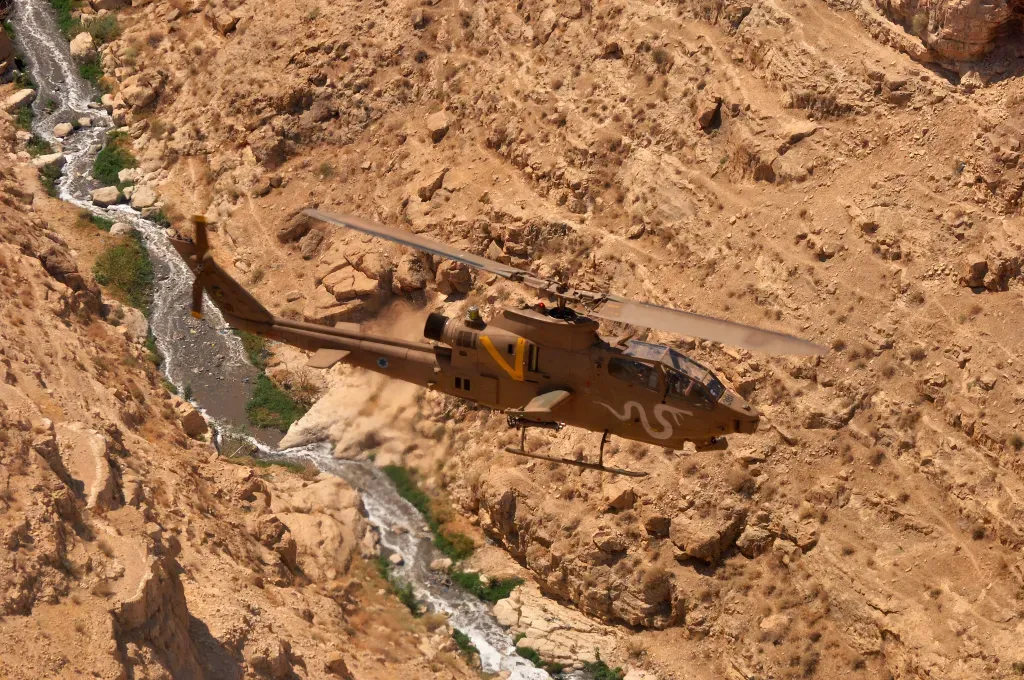
The Israeli Air Force (IAF) is repositioning one of its AH-64 Apache squadrons from Ramon Air Base in the Negev to Ramat David Air Base in northern Israel, bringing a portion of the service’s attack helicopter force significantly closer to the Lebanese and Syrian fronts. The AH-64 has been of central importance in recent IAF operations, and the shift makes the relatively small Apache fleet better positioned for rapid-response missions, including greater persistence over the northern battlefield.
The IAF announced today that 190 “Magic Touch” Squadron would be transferring its aircraft from Ramon to Ramat David, the northernmost IAF base. This would involve increased aircraft activity in the country’s skies, but that there was no security concern. The unit currently operates the older AH-64A, known locally as Peten (python), which the IAF began to receive in 1990.
The IAF began to establish an attack helicopter force in response to the lessons of the October 1973 Yom Kippur War, particularly the need to counter large-scale enemy armored formations. Over the following decades, its role evolved from that of a dedicated tank-hunting force into a precision-strike capability able to engage a much broader range of threats, including irregular and guerrilla forces operating among civilian populations.
In the past, the IAF attack helicopter force comprised three frontline squadrons: 160 “First Attack Helicopter” Squadron, operating the AH-1, was at Palmachim, near Tel Aviv, while Ramon hosted the “Magic Touch” Squadron and 113 “Hornet” Squadron operating the newer AH-64D Saraf (serpent), which arrived in 2005.

When it arrived in Israel, the AH-64D (sometimes designated AH-64D-I) was one of the most advanced attack helicopters in the world. It combined the mission system of the U.S. Army AH-64D Apache Longbow, including its mast-mounted AN/APG-78 Longbow radar, with Israeli avionics. Among these are a Rafael voice communications and data suite (RAVNET 300) and Elta 1891 satellite communications (with prominent bulbous antennas carried on the outer parts of the stub wings). The locally developed mission management system is the Elbit HELICOM suite which provides a real-time overview of the battlefield. Finally, the Elisra Seraph self-protection suite includes an SPS-65 missile warning receiver and an SPJ-40 radar jammer as well as Elbit Rokar countermeasures dispensers.

After the Saraf entered IAF service, the fleet was subsequently expanded through the conversion of older AH-64A airframes to a similar standard.
The AH-64A upgrade also added an optional under-fuselage avionics pod, something that you can read about in more detail here.

Located near Haifa, Ramat David Air Base is one of the most historic in Israel. It was formerly operated by the U.K. Royal Air Force and was involved in combat from the very beginning of Israeli independence. Flying a succession of different fighters and fighter-bombers, units operating from the base were active in every major conflict that followed, including the Sinai campaign, the June 1967 Six-Day War, and the October 1973 War, when its squadrons fought over the Syrian and Lebanese fronts. Due to its proximity to Lebanon, Ramat David has played a major role in different campaigns fought in that country, starting in 1982.
Before the arrival of the “Magic Touch” Squadron, Ramat David was primarily an F-16 hub, with three squadrons flying the F-16C/D. These units have played a central role in Israeli air operations on the northern front, including operations against Hezbollah in Lebanon and Hamas in Gaza.

As for Ramon Air Base in the south, its history dates back to the early 1980s, when it was established in the Negev as part of the reorganization of IAF infrastructure following the withdrawal from Sinai under the peace treaty with Egypt. Ramon has been home to fighters and attack jets, including F-16s and A-4s.
Since the 2000s, Ramon has been a principal base for some of the most advanced IAF combat aircraft. As well as the AH-64D, it is home to three of the four F-16I Sufa squadrons. It is also understood to be the home of the secretive Israeli drone, referred to as RA-01 and used for covert missions. You can read more about that here.
Moving an AH-64 squadron from Ramon to Ramat David reflects a shift in the IAF’s priorities toward the northern front. Ramat David places the helicopters significantly closer to Lebanon and Syria, reducing transit times and allowing more of their limited endurance to be spent over the battlefield. This is particularly valuable for rapid-response missions and close air support, where the Apache’s sensors and precision weapons can provide immediate support to ground forces.

As detailed in our deep dive on the IDF’s air defenses, Israeli AH-64s have also been extensively used in counter-drone operations. Their flexibility and ability to operate at low speeds make them well suited to engaging certain types of unmanned aircraft, while their Hellfire missiles can be employed in an unconventional air-to-air role for this mission. Bearing in mind the threat posed by drones launched from Lebanon and Syria, this factor may also have played into the relocation.
An IDF video purportedly showing an Israeli AH-64 intercepting an Iranian UAV that crossed into Israeli territory:

Iranian UAV Intercepted by an Israeli Helicopter
In fact, there is a historical precedent for the move. Ahead of the June 1982 Lebanon War, the “Magic Touch” Squadron was transferred from Ramon to Ramat David to reduce the distance to its principal operational theater along the Lebanese border. Once again, between 1990 and 1995, the same squadron again flew its MD500 Defenders from Ramat David.
The new relocation also disperses the IAF’s relatively small Apache fleet between its northern and southern fronts, improving readiness at the cost of concentrating fewer helicopters at Ramon. It is worth noting that, at the time of the October 7, 2023 Hamas attack, only four Israeli AH-64s were actually on standby across the entire country. Two of these were on so-called short standby for potential deployment to the northern border within minutes, with the other two on long standby for the same area, meaning they would take longer to get into action. In total, the IAF has a fleet of around 48 AH-64s of both versions.

As of now, Israeli forces are no longer involved in a full-scale ground offensive on the northern front. However, they maintain a very active forward-defense posture, still hold positions in southern Lebanon, and limited ground operations continue. So, too, do airtrikes against Hezbollah infrastructure.
Separately, Israel maintains positions in Syria, in the former UN buffer zone and parts of Quneitra and western Daraa, while continuing raids and airstrikes in southern Syria. Only today, Israel reportedly struck Syria’s Abu al-Duhur airbase in the northwest, reportedly damaging the runway and storage facilities.
Time will tell how the long-term IAF Apache force looks. In January of this year, the U.S. State Department approved a possible Foreign Military Sale to Israel of 30 of the latest AH-64E Apaches and related equipment for an estimated cost of $3.8 billion. Israel might not take up all of those aircraft, but the Apache is currently central to its future plans.
Even before October 7, the IAF had been pushing to acquire another 40 of the AH-64E versions, after apparently concluding that an earlier plan to bolster its attack fleet by replacing the older AH-64As with armed drones was not feasible. This is a notably interesting development at a time in which other AH-64 customers are rethinking the value of the attack helicopter in general, due to questions about their survivability on the modern battlefield.
The transfer of an AH-64 squadron to Ramat David underscores the IAF’s growing emphasis on the northern front and the Apache’s expanding role beyond traditional anti-armor missions. By positioning the helicopters closer to Lebanon and Syria, the move should improve their responsiveness and endurance over the battlefield while giving the IAF greater flexibility in addressing a wider range of emerging threats.
Contact the author: thomas@thewarzone.com