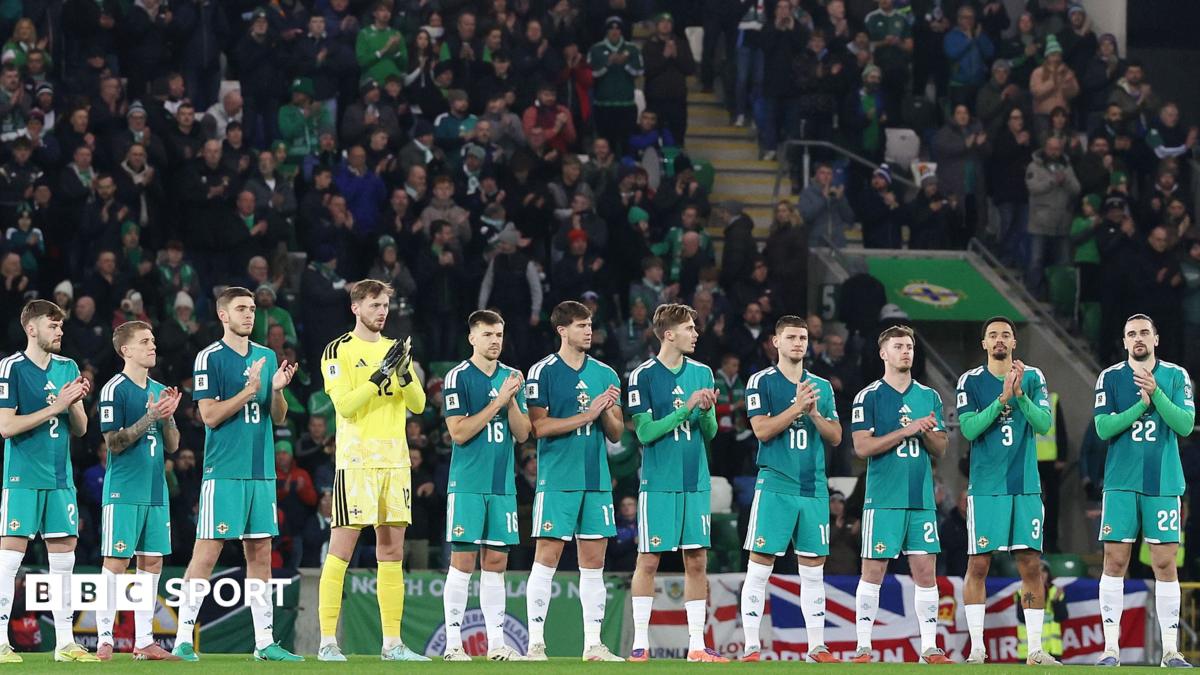
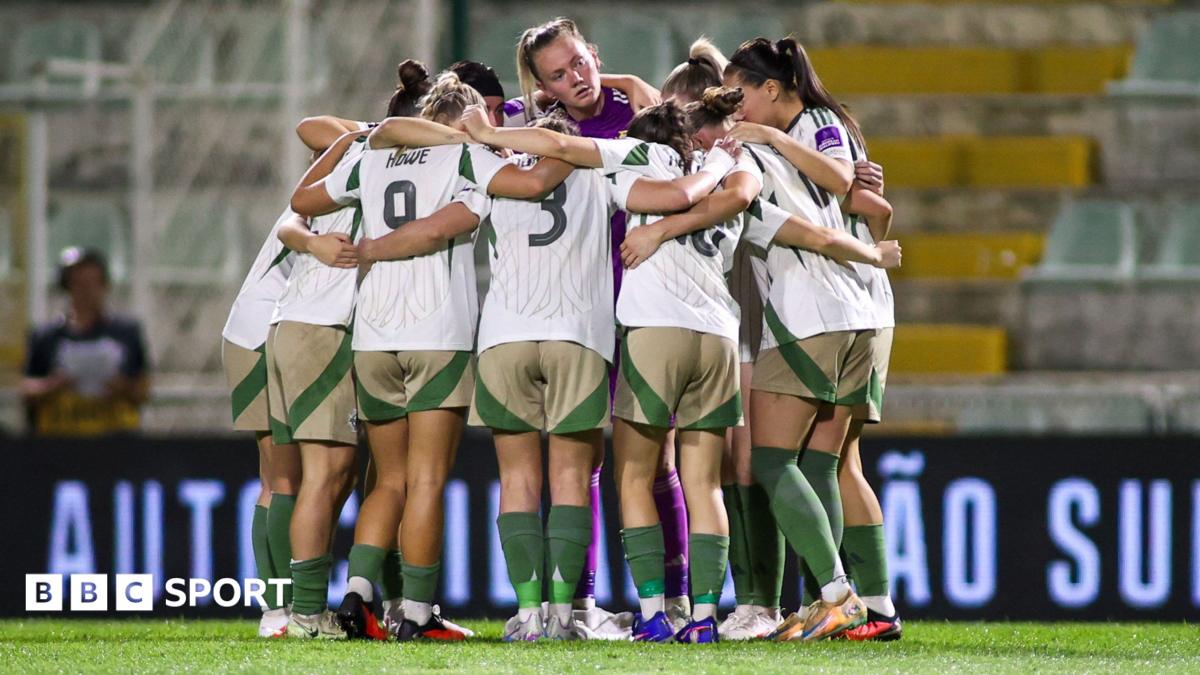
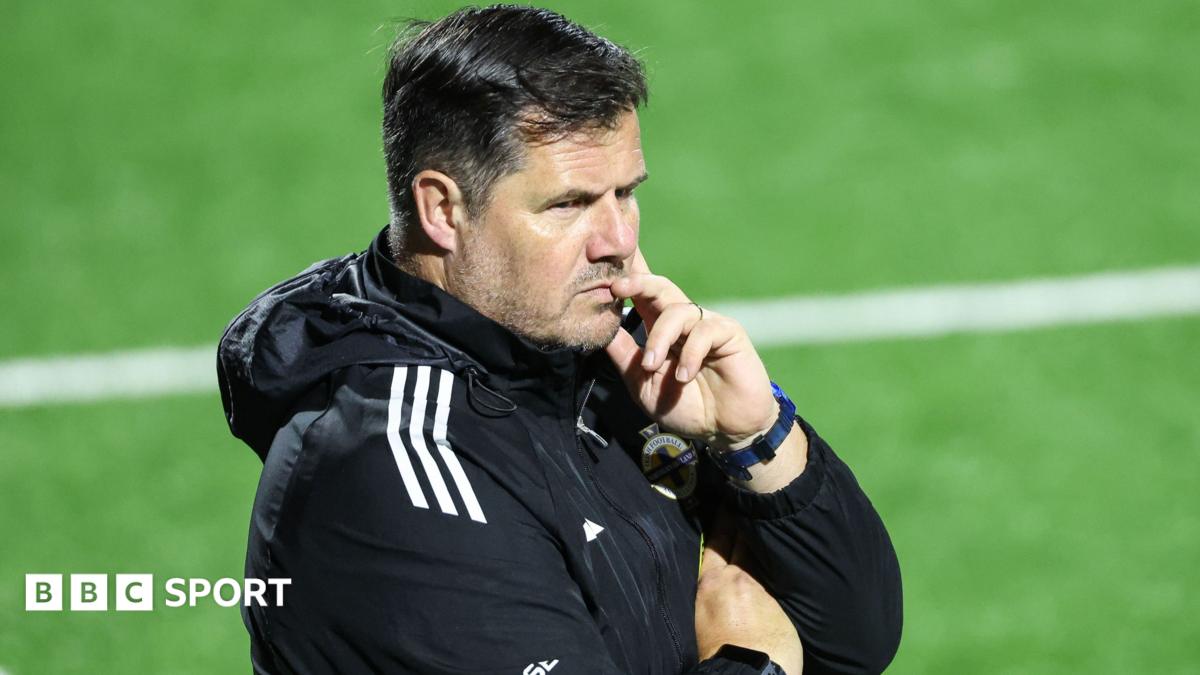
McArdle has shown throughout his tenure so far that he is keen to expand Northern Ireland’s squad depth and gave four players their debuts during the Portugal double header.
One of those debutants, Elmore, scored Northern Ireland’s only goal of the tie and became the second player to score on her debut under McArdle after Emily Cassap netted during the 2-1 defeat by Switzerland in June.
“I’m delighted for Kess,” McArdle continued.
“I knew she could bring that, and it’s just great that she has had that impact in Larne and also got the reward with a goal tonight.
“She’s going to add so much to the group moving forward, but so will a lot of the debutants this week, which was exciting.”
It has been a challenging window for McArdle’s side with key players such as captain Simone Magill and the experienced Laura Rafferty, Nadene Caldwell and Caragh Hamilton missing.
However, the Scot still thinks the side have set “a real enthusiastic marker” down during the tough Portugal tie.
“There have been those moments that have went against us, moments of misfortune. We’re playing a risky style of football,” he continued.
“We were on the front foot from the first whistle, and I couldn’t be prouder of the girls. This is a real enthusiastic marker for moving forward. This is getting closer to the identity that I would like for us moving forward.
“We want more energy, we want more mobility, and we want to be a lot more versatile as well. I’m really proud but also really frustrated with the scoreline.”
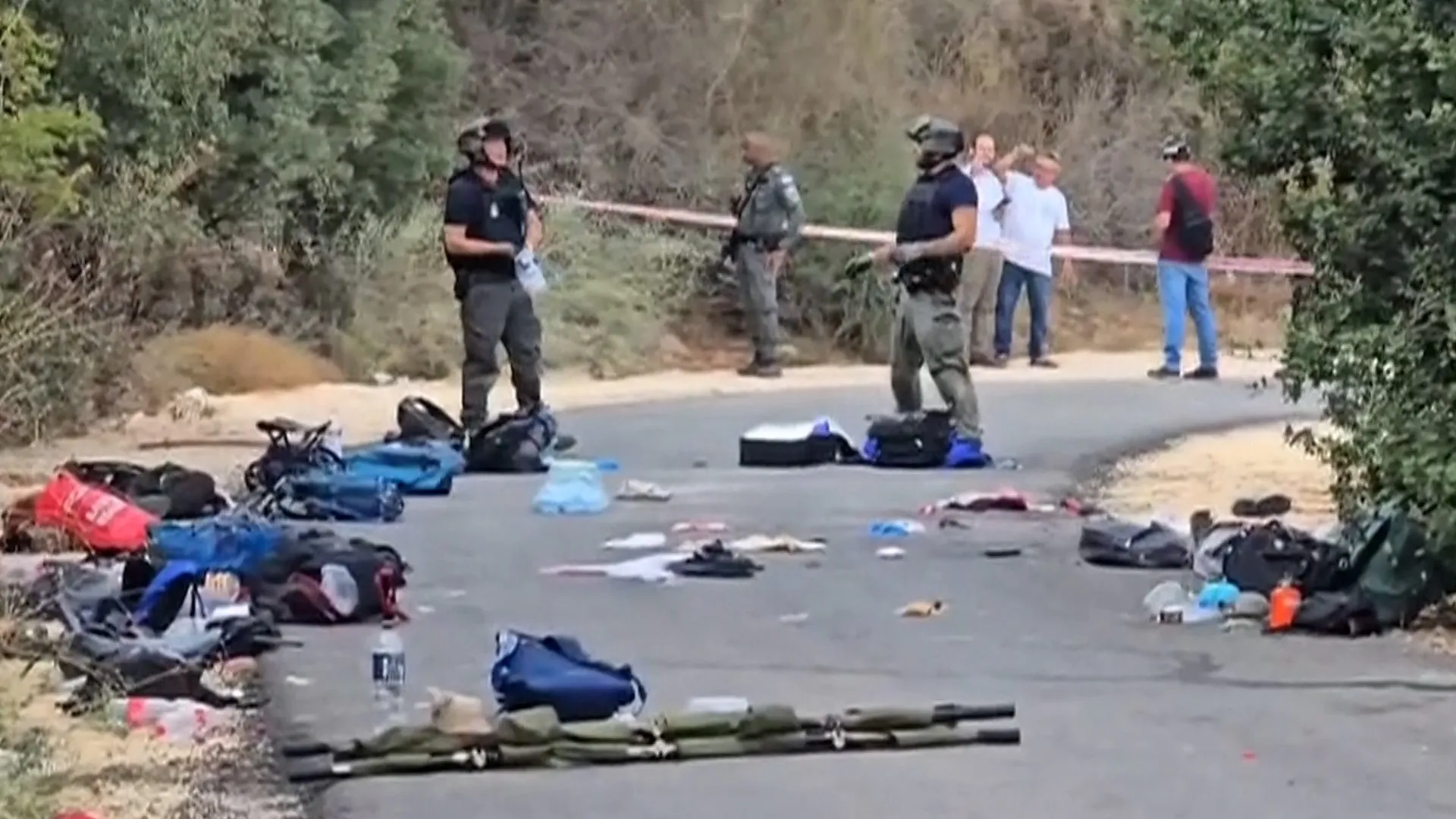
A 15-year-old was killed and around 20 people injured when unexploded ordnance detonated during a school trip in northern Israel. The army is investigating whether the munition came from Hezbollah or Israeli forces, amid recent fighting near the Lebanon border.
Missing a number of experienced players, including captain Simone Magill, Laura Rafferty and Nadene Caldwell, McArdle handed a debut to defender Jane McMaster and first caps to Kess Elmore and Charlotte Havern off the bench.
McMaster responded well after giving away the early penalty for Encarnacao’s opener, while Kelmore was lively in the second half and, at 16, it was a big moment for Cliftonville’s Havern to be introduced with 10 minutes remaining.
“It’s fundamental, especially for our younger players, to get this exposure,” McArdle added.
“It’s a risk and it’s brave, but it’s one that will definitely 100% stand strong with us in the long term.
“It will give us that sustainable opportunity to qualify for tournaments in the longer run because we need our younger players to get this exposure, but also for a lot of our senior players as well.”
After impressing in the second half before Pinto’s goal took the wind out of their sails, McArdle said his players will “hurt for the next 24 hours or so” but regroup for the second leg.
Northern Ireland will be without Chambers, who was sent off in the closing stages for grabbing the hair of Carolina Correia.
“There’s the travel over to Portugal thrown in to allow us to relax a wee bit afterwards.
“But once we get there, we’ll look forward to Tuesday again.
“We’re trying to qualify, but there is a longer process as well that we’ll use Tuesday night for.”
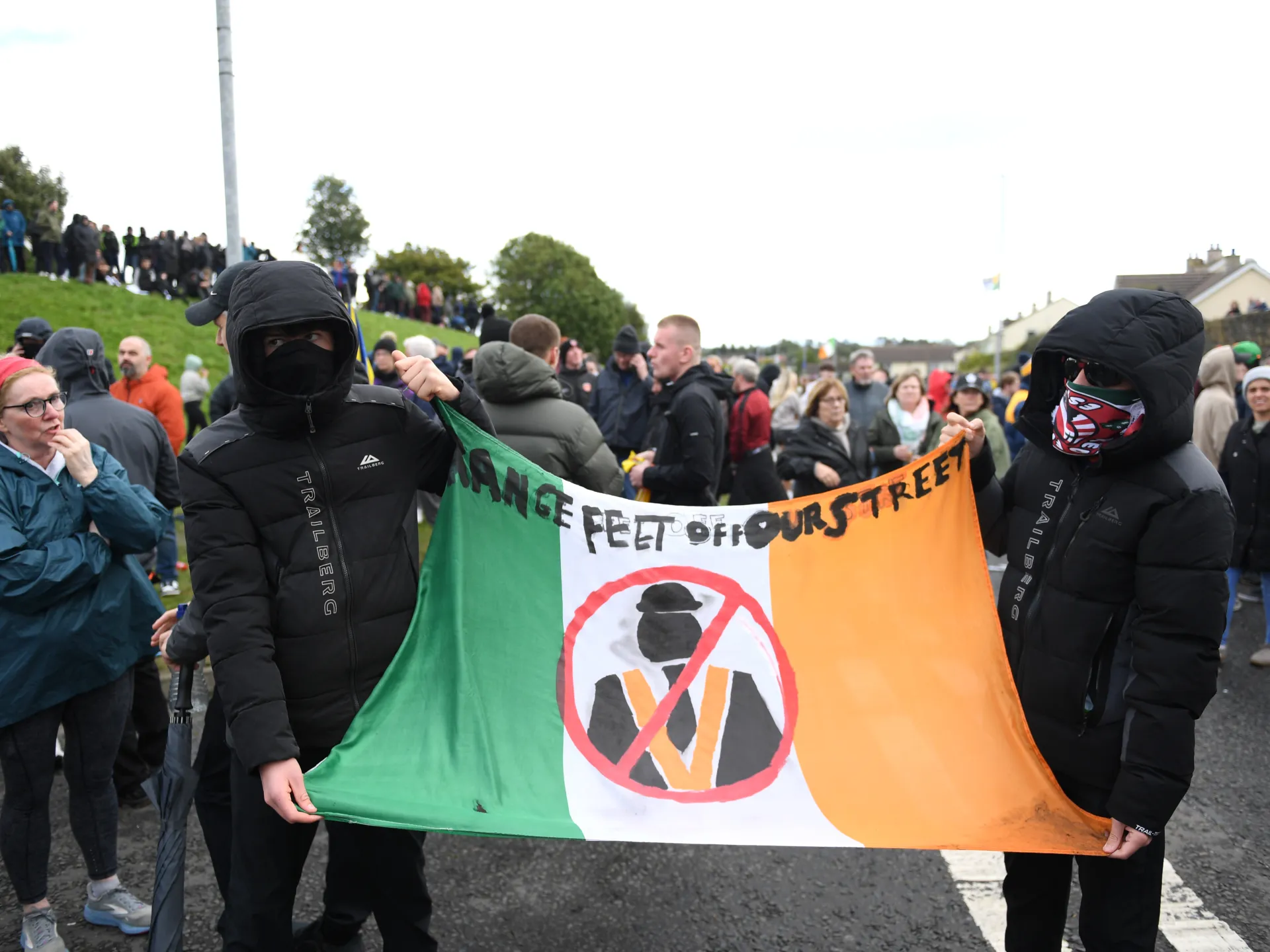
Opposition unionists call for the prosecution of Sinn Fein lawmakers who participated in the protest.
Published On 9 Oct 20269 Oct 2026
Northern Irish police have contacted representatives of Sinn Fein in an investigation into a protest that blocked a Protestant parade from marching through a Catholic area, the party said.
The Sinn Fein party leads Northern Ireland’s power-sharing government alongside its main pro-British rival, the Democratic Unionist Party (DUP), which has called for Sinn Fein lawmakers to be prosecuted.
Recommended Stories
list of 3 itemsend of list
In a statement posted to Facebook on Thursday, Sinn Fein confirmed “that a number of its representatives and party members received correspondence” from police.
“Sinn Fein will continue to stand with the Garvaghy Road residents who should be allowed to live in peace and free from sectarian intimidation,” the party said in the statement.
It added they have “stood with residents of the Garvaghy Road for the last two weeks in the face of provocation and the threat of an unwanted Orange march through their community”.
March permitted
Northern Ireland’s High Court permitted the Protestant Orange Order to march on the Catholic Garvaghy Road for the first time in 28 years.
Police opened an investigation into what they called the unlawful protest of the march, and said people reasonably suspected of committing offences will receive letters for interviews.
Sinn Fein First Minister Michelle O’Neill and Sinn Fein President Mary Lou McDonald participated in the protests.
The DUP called for O’Neill and other lawmakers to be prosecuted.
“A political title is not a shield, and no one is above the law,” the party said in a statement on Thursday.
Before the Good Friday Agreement was signed, annual attempts by the Orange Order to march through the area triggered unrest across the British-run region until the route was banned in 1998.
The standoff has become a political crisis in Northern Ireland, affecting the region’s power-sharing government.
Eritrea dismisses allegation as Ethiopia’s pretext for more war.
Published On 7 Oct 20267 Oct 2026
Eritrean soldiers have been seen driving through a northern town inside Ethiopia, witnesses tell the Reuters news agency, days after the neighbouring countries severed ties.
At least two witnesses told Reuters they saw “dozens” of Eritrean soldiers drive through Adigrat in two trucks on Wednesday. The town is located 25km (15 miles) south of the border with Eritrea.
The witnesses said they could identify the soldiers as Eritrean by their off-white camouflage uniforms.
Another Adigrat resident who was not in town at the time said family members had told him they had also seen Eritrean troops, according to Reuters, which could not independently verify their accounts.
“The Eritrean army has entered Tigray in uniform, equipped with heavy weaponry,” said Gebreigziabher Beyene, commander of the Tigray Peace Force, a pro-government militia that has fought alongside the federal army.
“This force is being struck by drones,” he said, adding Eritrea was “deliberately deploying its forces so that the fighting takes place inside Tigray rather than spilling into Eritrea”.
Last week, the chief administrator in Ethiopia’s northeastern Afar region said Eritrean troops were fighting in the area, but Reuters was unable to confirm the claim.
In a statement on X, Eritrea’s Information Minister Yemane Meskel did not deny that troops had crossed the border, but said Ethiopia’s government was creating “a fallacious narrative of ‘self-defense’ to rationalise and camouflage its war of aggression”.
If confirmed, it would mark the first time Eritrean forces have been seen inside Ethiopia since the renewal of fighting between Ethiopian forces and a seven-group armed alliance, including the Tigray People’s Liberation Front (TPLF), on September 23.
Ethiopia has accused Eritrea, as well as Egypt and Sudan of backing the armed alliance which is fighting to remove the government. All three countries have denied involvement.
Eritrea announced it was severing ties with Ethiopia on Thursday after Addis Ababa announced it would close its embassy in Asmara and expel 10 Eritrean diplomats.
In a statement, Eritrea’s Ministry of Foreign Affairs said Ethiopia’s actions had left it with “no option but to reciprocate in kind and sever all diplomatic ties with Ethiopia”.
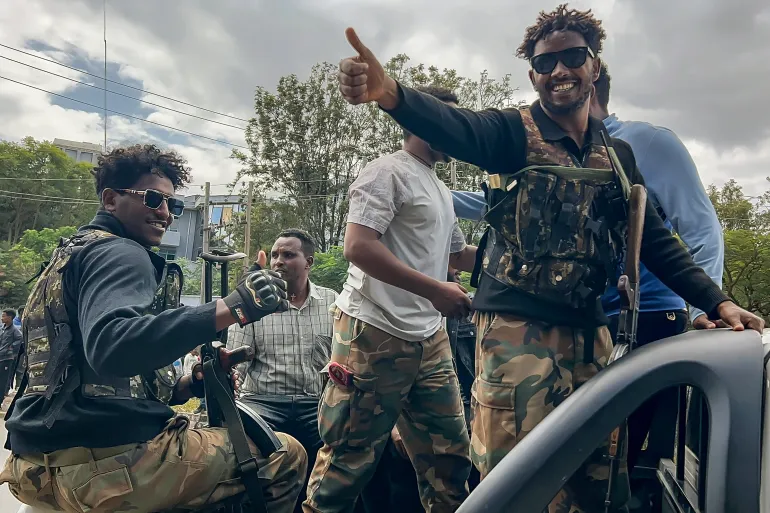
Members of the Ethiopian pro-government Tigray Peace Force (TPF) give a thumbs up to residents after Ethiopian federal and allied forces entered the Tigray capital of Mekelle on October 4, 2026 [AFP]
On Monday, Ethiopian forces captured Tigray’s regional capital Mekelle, days after the TPLF confirmed that it had withdrawn from the city and moved its regional administration “temporarily” to another location.
It happened as Ethiopia’s Prime Minister Abiy Ahmed was sworn in for another five-year term, during which he insisted that his landlocked country must have access to the Red Sea.
On the same day, Eritrea joined Somalia, Sudan and Egypt in issuing a joint declaration calling for a political and peaceful solution to the war in Ethiopia.
The declaration appeared to push back against several policies pursued by Ethiopia in recent years, highlighting widening rifts between Addis Ababa and its neighbours.
With this new four-game window presenting something different for managers across Europe to tackle, a myriad of approaches emerged.
Germany boss Jurgen Klopp named virtually two separate squads for his side’s two pairs of games, while Ukraine made 10 changes between their first two games and then nine for their defeat by Northern Ireland.
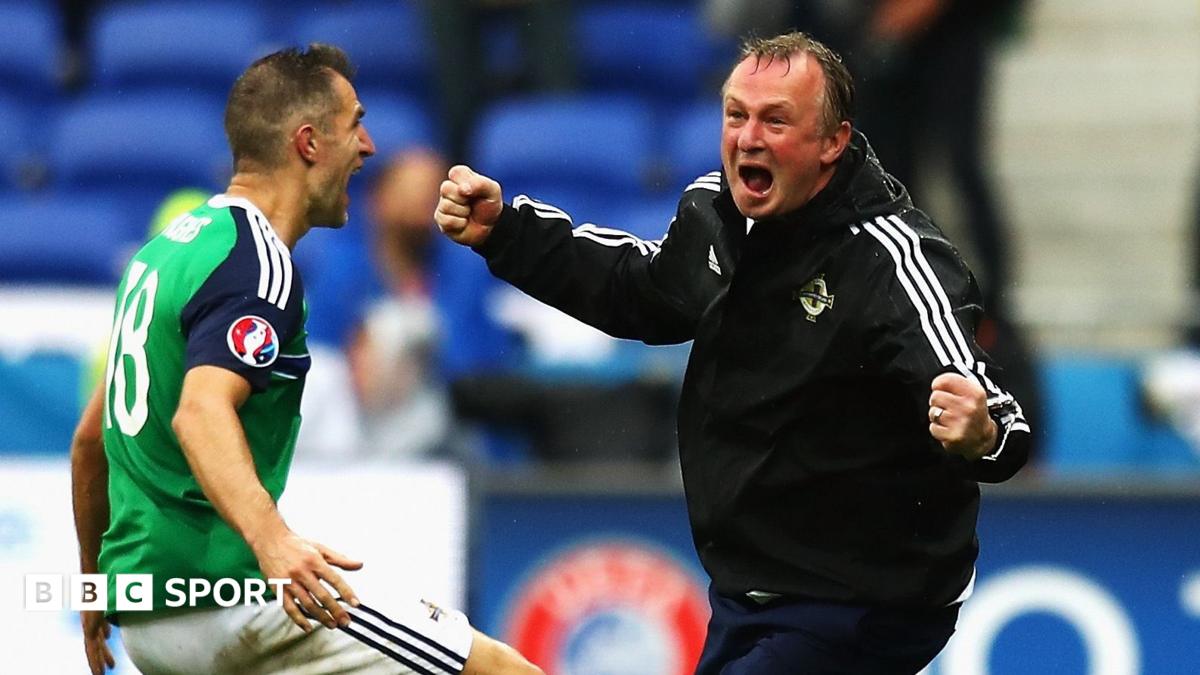
Having spoken before the start of the campaign about how the condensed schedule would be more difficult for smaller nations, O’Neill kept changes to a minimum.
He started only 15 different players across the four games with two of his changes enforced by Ballard’s injury and Ethan Galbraith’s absence against Ukraine to attend the birth of his child.
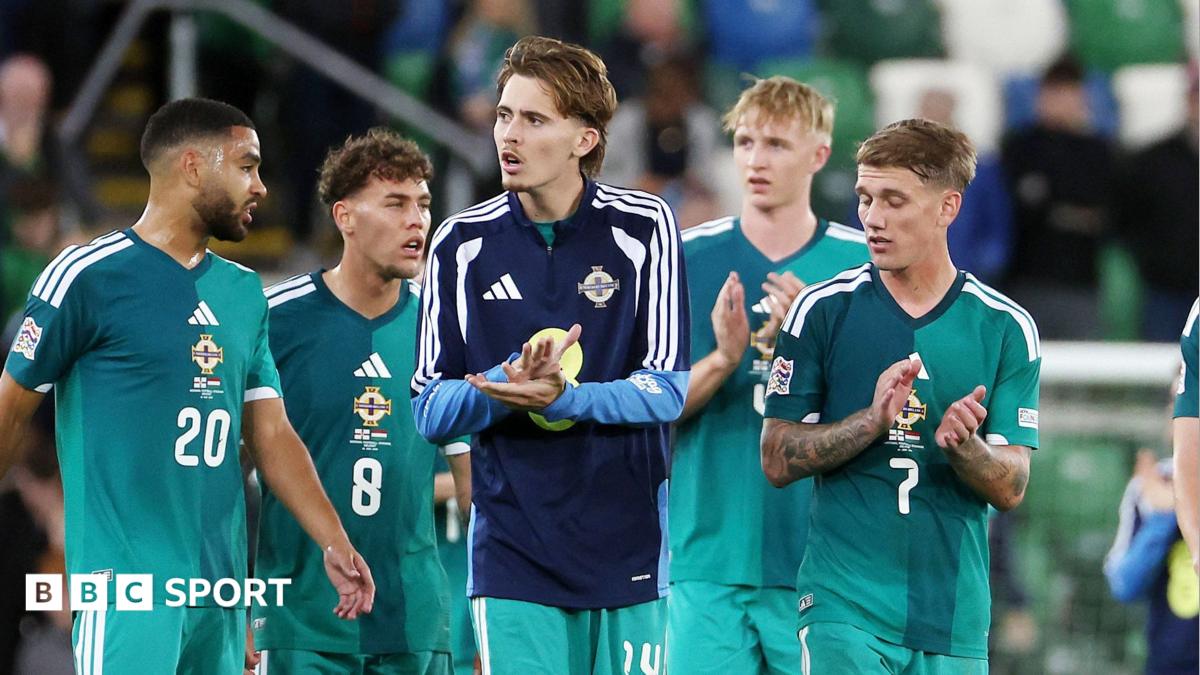
Despite the relatively small pool of starters, this still feels like a window when Northern Ireland’s depth was tested and passed with flying colours.
O’Neill was without talisman Bradley and the reliable Ali McCann coming into the window, and then lost Ballard to a hamstring injury after the first game in Tbilisi.
Young centre-backs McConville, 21, and Tom Atcheson, 20, looked ready to play at this level, while Ciaron Brown started all four games and drew plaudits having often had to bide his time in past squads.
Kieran Morrison, Terry Devlin and Brodie Spencer all impressed when given a chance against Ukraine.
O’Neill’s praise for his squad is across the board.
“For me it’s been one of the most enjoyable windows I’ve had as an international manager, and that’s been because of the players,” said O’Neill.
“How they’ve applied themselves, how desperate they are to do well, that’s a real positive.
“We’ve a brilliant group of players and a lot of them I think will play international football for a long time.”
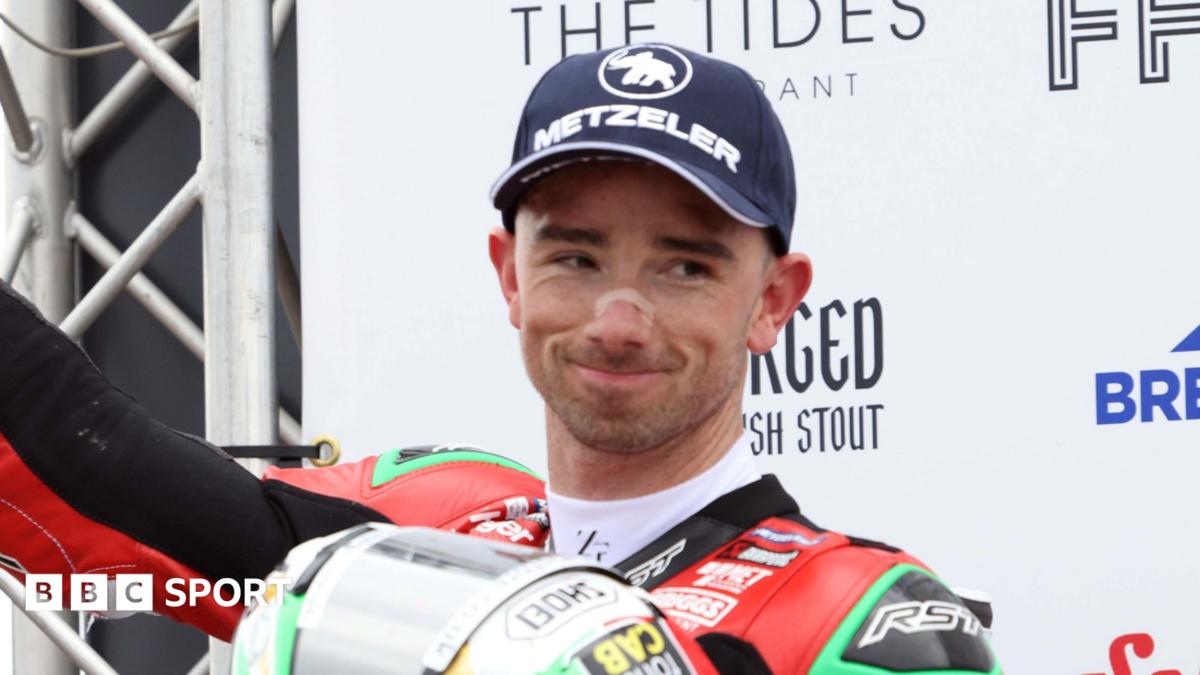
BSB leader Kyle Ryde won the opening two races of the weekend at Donington but Scott Redding clinched the third and final outing to take the championship to the final weekend at Brands Hatch from 17-18 October.
Portadown, Northern Ireland – When the summer holidays arrived, Chris Nelson worried about his mother.
At night, he lay awake waiting for her to return. During the day, he rang family members to ask if she was safe. There were threats and letters through the door.
Recommended Stories
list of 4 itemsend of list
“I was afraid to leave the house,” he told Al Jazeera.
His mother, Rosemary Nelson, was a lawyer representing the Catholic residents opposing the Protestant Orange Order parade along Portadown’s Garvaghy Road in Northern Ireland in the late 1990s.
Every July, as marching season approached, there was a standoff.
Orangemen sought to return from Drumcree church along what they regarded as their traditional route. Residents opposed the passage of the anti-Catholic organisation through a majority Catholic street. In some years, police forced the parade through. In later years, it was blocked.
Rosemary would spend summer evenings alongside the residents on Garvaghy Road. Before leaving home each evening, she told her son that she was going to look after families and make sure their children were okay. She compared them to his friends at primary school.
“She was a big believer in helping the underdog,” said Chris, now 39. “She did a lot of work for free.”
His mother helped people from both sides of the community. When work allowed, the family went to Bundoran, across the border, and for a day the fear would pass.
But one night, during a standoff in 1997 when the state police force, the Royal Ulster Constabulary (RUC), used batons to clear Catholic locals from the road, “she was beaten by the police”, said Chris. “She was spat on”, bruised and bloodied.
“That was very traumatic. I was always thinking something was going to happen to my mum.”
On a Monday in March 1999, nearly a year after the Good Friday Agreement brought an end to the conflict, Rosemary drove away from her home in Lurgan.
As she braked at a nearby junction, a bomb beneath her car exploded. Her eight-year-old daughter, Sarah, was at primary school nearby and heard the blast. The family had spent the previous weekend in Bundoran together.
Chris, 11 at the time, and his older brother were away on a school ski trip when they received a phone call with the news of her death.
“That was hard”, he said, his voice tailing off.
A legacy of loss
Nearly three decades later, another standoff has recast these childhood memories into fears for the next generation, with a renewed attempt by the Protestant Orange Order to march through the Catholic neighbourhood, threatening to unravel a fragile peace.
The Troubles began in the late 1960s as protests by Catholics against discrimination were met by repression and violence. Republican paramilitaries fought for a united Ireland as loyalists and the army battled to preserve British rule, in a conflict that killed more than 3,500 people.
The 1998 Good Friday Agreement established a framework for peace and power-sharing.
Under the agreement, the people of Portadown have lived in relative peace for the past 28 years.
But this was suddenly unsettled by a last-minute decision by the High Court to allow the march. In response, Catholic residents blocked the road. Many camped out as Orange men gathered at the top of the road, awaiting police permission to pass – an image of division that never truly left.
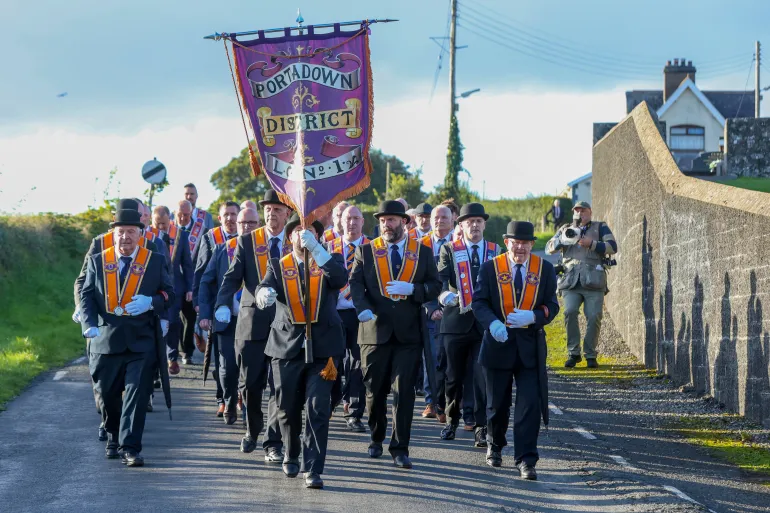
Portadown Orangemen march from Drumcree Church to start their march towards Garvaghy Road, which was stopped a short distance later by police, in Portadown, Northern Ireland on September 27, 2026 [AFP]
Many of the Garvaghy Road residents are now parents, and fear what their children might inherit from a dispute they hoped had been left behind.
Paul O’Connor, of the Pat Finucane Centre human rights group in Northern Ireland, said Rosemary Nelson is among 21 people whose deaths were linked to the Drumcree dispute.
Many are still being investigated, with families continuing to seek justice and pressing for public inquiries amid concerns about collusion between the British state and loyalist paramilitaries, many of which were members of the Orange Order.
“These murders encompass LVF (Loyal Volunteer Force) killings at that time, and are all linked to the Drumcree disputes. They were responsible for many of the killings around the Mid Ulster area at that time. They were trying to destabilise the peace process, with many riots spreading around, including into Derry,” O’Connor told Al Jazeera.
He worked with Rosemary Nelson and is now seeking a public inquiry into the murder of Sean Brown, another Drumcree-linked case, he believes. The 61-year-old father of six from Bellaghy, County Derry, was abducted and murdered in May 1997.
The following year, the three Quinn brothers – Richard, 10, Mark, nine, and Jason, eight – died after loyalists petrol-bombed their home in Ballymoney, County Antrim, as they slept. Their deaths, during the unrest surrounding Drumcree, brought widespread calls for the Orange Order to end its standoff.
Protesters block the Garvaghy Road in Portadown, Northern Ireland on September 27, 2026, preventing a parade of marchers from the Orange Order using the route through the mainly nationalist area of the town [AFP]
Fear and loathing in Mid Ulster
In Portadown town centre, a Union flag flies among plinths dedicated to the Ulster Defence Regiment, a locally recruited unit of the British army and the Ulster Covenant – a document signed when nearly 500,000 people opposed a form of self-government for Ireland in 1912.
Around the corner, in the Edgarstown housing estate, Ulster Volunteer Force (UVF) flags hang from lampposts, and the kerbs are painted red, white and blue, alongside a mural of a Rangers FC badge.
The area is one of the heartlands of unionism. The Orange Order was founded in 1795 in the village of Loughgall, a few miles from Drumcree.
The Orangemen say they have marched the route through Garvaghy Road since 1807. The parade has been blocked from Garvaghy Road since 1998, but the Orangemen have continued submitting requests to march.
The latest Parades Commission decision permitted 35 men to walk without music. Since then, Orangemen have repeatedly approached the police line before returning to the church.
UVF flags fly alongside UK flags in the Edgarstown estate, Portadown, Northern Ireland, on October 1, 2026 [Caolán Magee]
Irish nationalists have criticised the police assessment underpinning the decision to allow the march, while unionists have denounced police for failing to forcibly remove protesters blocking the route.
Al Jazeera contacted the three main unionist parties – the Democratic Unionist Party (DUP), the Traditional Unionist Voice (TUV) and the Ulster Unionist Party (UUP) – for comment but received no response.
Addressing around 200 supporters in Portadown, loyalist activist Jamie Bryson described protesters as “an unlawful snarling mob”.
He has called for the First Minister, Sinn Fein’s Michelle O’Neill, and police Chief Constable Jon Boutcher to resign, and demands that the Orange men must be allowed to walk the Garvaghy Road.
O’Neill has faced criticism for standing beside the protesters.
At Drumcree Church, the Orangemen were not marching, but sitting down drinking tea and eating crisps. Around six men, one wearing his sash, huddled under a gazebo in the cold.
“We are waiting patiently for the chief constable to apply the law of the land,” Nigel Dawson, the Portadown Orange Order district master, told Al Jazeera.
“Portadown District has never in its history stopped a parade down the road to have a confrontation with its neighbours, ever. So I don’t know where the fear and trepidation comes from.”
Another Orangeman, who requested anonymity, added: “We are determined to get home after Sunday service … We just want to go home.”
Orange Order members sit outside Drumcree church as they await passage along Garvaghy Road in Portadown, Northern Ireland, on October 1, 2026 [Caolán Magee]
Around a mile further down the Garvaghy Road, Irish folk band the Mary Wallopers performed to hundreds of residents and supporters.
Children danced and slid down the embankment, as parents watched from above. Palestine and Ireland flags flew in the wind.
Linda O’Neill, 51, a Garvaghy Road resident, told Al Jazeera the scene would have been unimaginable 30 years ago.
“It was horrendous growing up as a teenager. We stayed in our own community. We didn’t access the town centre … This community was a ghetto. And that was deliberate.”
Another resident, Ciaran O Ferghail, remembered summers spent surrounded by British forces.
“This community was turned into a war zone. There were tanks and British Army everywhere, thousands of RUC. This community was completely under siege every summer, by the Orange Order, the British military, the RUC and loyalist paramilitaries. We were surrounded on every road and in every direction.”
O’Neill said the confrontation changed as residents began asserting their rights.
In 1995, hundreds sat down on Garvaghy Road to block the parade. The ensuing violent standoff between security forces and Orangemen and their loyalist supporters ended in a compromise allowing the march through. Residents say they understood it would be the last.
But the following summer, the parade returned. Police initially blocked it, then reversed course after five days of widespread loyalist attacks. Officers forced residents off the road and beat them, sparking riots in Catholic communities.
In 1997, security forces sealed off the Catholic neighbourhood before dawn and allowed the parade through at midday amid loyalist threats to kill Catholics if it was stopped. Nationalist protests and violence followed. From 1998, the march was banned from Garvaghy Road. But for residents, summers remained marked by the army’s steel barricades until 2000.
Children play on the embankment as music rings out along Garvaghy Road in Portadown, Northern Ireland, on October 1, 2026 [Caolán Magee]
Lessons from the past
Chris Nelson, almost 40, is around the same age his mother was when she was killed.
The Garvaghy Road protests mark the first time he has chosen to speak publicly about his mother.
He went on to study law at university, but says his life would have followed a different trajectory if she were still here.
The public inquiry into his mother’s death found no evidence that state security agencies had “directly facilitated” her murder, but it “could not exclude the possibility” that individual members of those agencies had helped the perpetrators.
The inquiry brought the past back repeatedly as he tried to get on with his life. But seeing photographs of families linking arms on Garvaghy Road brought back unavoidable memories of his mother.
“If she were here, that’s where she would be,” he said, “standing with the people of the Garvaghy Road”.
While there has been no violence in Portadown, in Derry’s Waterside, two recent nights of disorder saw petrol bombs and masonry thrown at police. Officers described the crowd on the second night as mostly young people.
The renewed attempt to bring the Orange Order parade through Garvaghy Road risks leaving its mark on children on both sides. With some schools closed, Chris Nelson worries about parents having to explain to their kids what is happening.
“Children don’t forget things“, he said. “They absorb everything.”
He remembers how it felt waiting for his mother each night, and how that worry followed him through the summer holidays. He wants something different for the children growing up now.
“Children shouldn’t grow up knowing the difference between Catholic and Protestant.
“It isn’t something that should be brought into the mind of a child.”
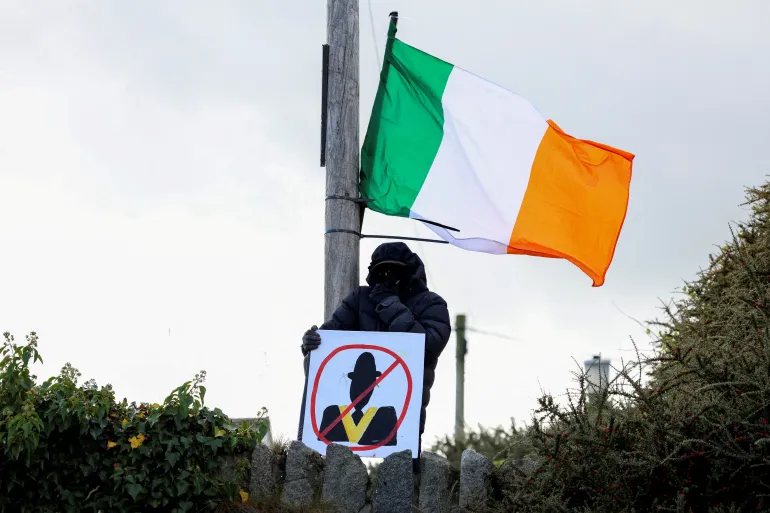
A ‘Garvaghy Road says no’ sign with an Irish tricolour in the background in Portadown, Northern Ireland, on October 1, 2026 [Caolán Magee]
Brown’s two goals were just reward for a player who has been quietly impressive for far longer than this campaign, and he was part of a back-five which stood out in what was a third consecutive clean sheet.
Brodie Spencer and Terry Devlin were drafted in at the full-back positions and both impressed, but Brown’s centre-back partners McConville and Tom Atcheson really shone.
Norwich City defender McConville, 21, commanded his area well and, as well as an assist for Brown, he also allowed the ball to trickle over the line when he could have touched home for the third goal instead of his team-mate.
Atcheson, himself only 20 and playing for Blackburn Rovers in the Championship, made his Northern Ireland debut in Wales in March, but showed composure beyond his years.
O’Neill said both players were “terrific” as he told BBC Sport: “They have no ceiling, to be honest.
“They are both playing in the Championship at the minute but they are ready to go to the next level.
“They will make mistakes at times and we’ve put a lot on them in terms of the physicality. The two of them were brilliant.”
O’Neill was also delighted for Brown, who said he had “really grown” into a senior role in the absence of injured Sunderland defender Dan Ballard.
“Three 90 minutes at this level is tough,” said O’Neill of the 28-year-old.
“He plays his club football in League One and he’s a better player than that.
“He brings a lot to the team. He was our most senior player tonight and he has really grown into that.”
The ultimate aim for O’Neill is to lead his young squad to a first major tournament since 2016 when the next Euros roll around in 2028.
Their return to the second tier in the Nations League has been successful so far, with Charles scoring a 99th-minute winner in Georgia before the team showed their character with a goalless draw at home to Hungary.
The players definitely looked tired in the closing stages of the draw, which can be put down to the 5000-mile return trip to Tbilisi, but they held their own against Dominik Szoboszlai’s side.
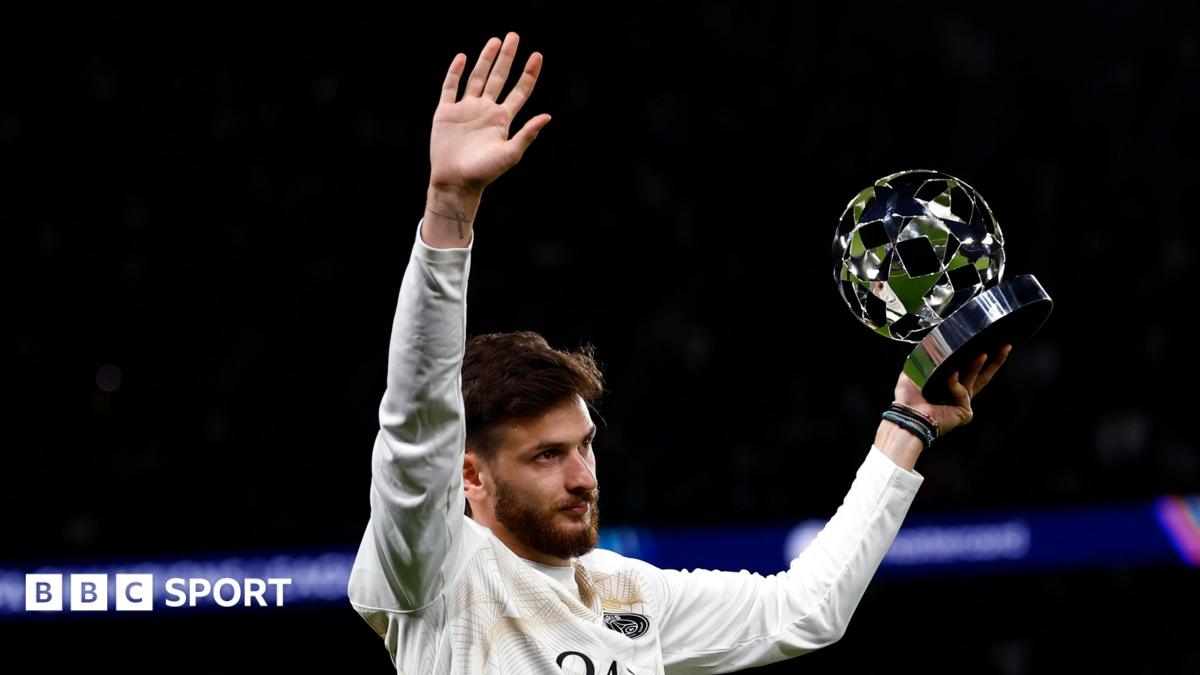
Before that, Northern Ireland had kept Paris Saint-Germain winger Khvicha Kvaratskhelia quiet in the opener.
While Ukraine do not have the individual star power of the other teams in League B2, O’Neill knows they are still a dangerous side.
He described them as favourites on Friday night, and pointed to the fact that manager Andrea Maldera had made 10 changes between their opening 1-0 win in Hungary and the goalless draw with Georgia in their second game.
“Ukraine’s strength is in their collective as a team, rather than what we faced against Georgia with Kvaratskhelia and Hungary with Szoboszlai, who are top European players.
“I think that Ukraine have many players that have potential to be on that level and go to the big, big clubs in Europe.
“We haven’t highlighted any one individual, but we’ve looked very closely at how they play, with the ball and without the ball, and I believe their strength is in the collective of the team.”
Portadown, Northern Ireland – On the Garvaghy Road in Northern Ireland, residents have spent days gathering to stand guard in their community.
They have linked arms and blocked their road, preparing to stop a Protestant Orange Order parade from attempting to march through this predominantly Catholic area for the first time in 28 years.
Recommended Stories
list of 3 itemsend of list
Some pitched tents. Others brought food and stayed through the night, keeping watch.
“We’ll be here as long as we have to be,” said one local woman, who asked not to be identified for fear of violent reprisals. “I’ve seen the fighting when those Orangemen come along here, and I’m not having it back here – none of us are.”
A demonstrator holds a placard, as people protest on the Garvaghy Road, a Catholic enclave in the largely Protestant town of Portadown, against the Protestant Orange Order’s annual Drumcree parade, in Northern Ireland, September 27, 2026 [Cathal McNaughton/Reuters]
The Orange Order, a Protestant organisation with a historically anti-Catholic tradition, has been banned from marching on Garvaghy Road for the last 28 years.
The High Court order has overturned that ban. Now, a small group of Orangemen gathers at Drumcree Church each day in their traditional regalia, ready to march.
But they have not been able to get beyond the end of the road. Police stand in their way, refusing them permission to pass and citing the risk of violence with so many protesters waiting a few hundred metres away.
This has infuriated the Orange Order, which has called for the Police Service of Northern Ireland chief constable, Jon Boutcher, to be removed. The group believe they have a legal right to march and accuse police of yielding to the protesters.
“We hold a positive determination issued by the Parades Commission and reinforced by the High Court judge,” Nigel Dawson, district master of the Portadown Orange Lodge, told Al Jazeera. “The chief constable must comply with the law.”
In the 1990s, there were protests and violence when the Orange Order tried to return from Drumcree Parish Church along the road.
When asked how much longer the Orangemen are prepared to wait, Dawson said, “I’ve been at Drumcree for 28 years.”
Dawson warned of a dangerous precedent in which “might makes right”.
If a protest is big enough, the police can refuse to uphold a court ruling, he said, adding, “We have the law on our side here.”
Ultan Larkin, a protester who travelled to Portadown from the neighbouring town of Armagh to show support for the Garvaghy Road residents, said, “The law is on their side, but justice is not on their side.
“There’s hurt here. There’s pain here. Just because you can doesn’t mean you should.”
The standoff has so far been peaceful. But history tells the story of why this confrontation has a real risk of escalation.
‘Justice is not on their side’
Garvaghy Road was one of the most potent flashpoints of The Troubles – a 30-year conflict between mostly Protestant unionists who fought for Northern Ireland to remain part of the UK, and predominantly Catholic republicans who want a united Ireland.
Orange marches through the Catholic area were usually accompanied by some of the worst sectarian violence Northern Ireland has seen.
The peace deal known as the Good Friday Agreement was signed in 1998, and it transformed Northern Ireland.
Large-scale violence largely ended, former enemies shared power in a devolved assembly at Stormont, and a generation grew up in an era of peace without soldiers manning checkpoints on their streets.
Following this peace process, the Orange Order was prevented from parading along Garvaghy Road – an effective ban that has lasted almost three decades, until now.
In an unexpected decision, the Northern Ireland Parades Commission allowed for a scaled-down Orange march to go ahead under strict conditions. Only 35 Orangemen could take part in the march, and they would have to do so in silence without their usual flutes and drums.
Residents of Garvaghy Road were appalled and legally challenged this ruling.
A High Court judge initially granted an injunction preventing the parade, but the Court of Appeal overturned that ruling late on Saturday, clearing the legal way for the march to proceed on Sunday morning.
A further High Court challenge was subsequently dismissed.
Ultan grew up during the Troubles. He was convicted for having a senior role in the Real IRA and was sentenced to four years in prison – a conviction quashed years later on appeal.
“We have to live together, and to do that we have to respect each other,” he said. “But where is the respect if you’re marching through a community that doesn’t want you and where the people of that community are asking you to march somewhere else?”
“On the Irish tricolour we have green, white, and orange. The green is for the Irish Catholics here, and the orange is for the Protestant community, with white symbolising peace. We all have our place.”
He said there are old wounds on Garvaghy Road.
“People here suffered a lot when the Orange marches came. They remember how bad things were here – the intimidation and that sort of thing – and some people just aren’t able to forgive that.”
Political fallout
The standoff has become a political crisis in Northern Ireland, affecting the power-sharing government that runs the country.
Sinn Fein First Minister Michelle O’Neill visited Garvaghy Road to stand beside the protesters, alongside Sinn Fein President Mary Lou McDonald.
The Democratic Unionist Party (DUP) accuses nationalist politicians of breaking the law by supporting a protest that blocked Garvaghy Road, and observers have questioned how the first minister can continue in her role when she has openly rejected a High Court ruling.
The confrontation is particularly awkward as the DUP and Sinn Fein are supposed to govern together, representing the two principal political traditions that emerged from the conflict as part of the peace process.
The language between them has become increasingly bitter, and in less than nine months, Northern Ireland faces an Assembly election.
For now, the DUP and Sinn Fein remain in government together, while accusing the other of threatening the political settlement that followed the Good Friday Agreement.
Meanwhile, attempts to find a resolution continue.
Northern Ireland Secretary Chris Bryant has met representatives of the two communities, but talks have so far failed to produce a breakthrough.
His future is also now on the line over this.
Bryant could revoke the Orange Order’s right to march, but he has not exercised this power. Unionists have threatened to call for his resignation if he tries. Irish nationalists say they will do likewise if this parade goes ahead.
Chances were at a premium at Windsor Park as both defences came out on top.
Patrick Kelly hit the crossbar in the first half for Northern Ireland, and Isaac Price had an effort beaten away by Balazs Toth.
After Dan Ballard controversially conceded a penalty in Georgia, Shea Charles also had a penalty appeal waved away in the lead-up to the Kelly chance for a similar incident.
While O’Neill said he had yet to see it back, he did quip that “the referee never seems to make the walk for us to the side of the pitch. It never seems to happen for us.”
The threat of Liverpool midfielder Dominik Szoboszlai was largely nullified throughout the game as Hungary, like Northern Ireland, struggled to create any clear-cut chances.
The only save that Pierce Charles had to make in goal was when a lethargic clearance led to Alex Toth shooting towards goal in the closing stages, but the QPR stopper was otherwise untroubled.
After a 5,000-mile trip from Georgia in their opening game, Northern Ireland had to quickly reset and O’Neill admitted he saw “two tired teams” at the end of the game.
“I think our preparation, our first game in terms of being away from home and everything, was more difficult.
“I felt like Hungary got a little bit stronger towards the end.”
For the first time in 315 days, Northern Ireland are back in Belfast.
Michael O’Neill’s side welcome Hungary to Windsor Park for a Nations League Group B2 contest on Monday night, just 51 days shy of a year since a Jamie Donley penalty saw the side to a 1-0 win over Luxembourg in their previous home fixture.
In the interim, they have played five times on their travels, a run that began with World Cup play-off defeat by Italy in Bergamo in March and concluded with victory over Georgia on Friday night.
If that win in Tbilisi represented a something of a breakthrough in terms of away performances – they had won just two of their previous 12 competitive away games – form back at Windsor has been strong despite the sporadic fixtures.
Since losing to Slovenia in October 2023, only Germany have left Belfast with a win and that a 1-0 triumph on a night the hosts missed numerous good chances.
A run of seven wins in nine home games is in stark contrast to what went before when, in the preceding nine at Windsor Park, Northern Ireland had beaten only San Marino and Kosovo, the latter courtesy of a 94th-minute winner.
O’Neill said he does not put much stock in such runs of form given the changing squads in international football, but acknowledged his team are in “a really good phase” at Windsor Park.
“This is a new team, so they’re not saddled by the performance of previous teams,” he said.
“They love playing here at the stadium. You know there was a period where the team of 2016 [who qualified for the European Championships of that year] didn’t enjoy playing at home.
“Then suddenly they started to win games and they loved playing at home. Teams go through phases and at this moment in time this team is in a really good phase in terms of the home form.”
Shares in Australia’s Northern Star Resources (NESRF) rose more than 9% on Monday after the gold miner rejected a $27B takeover proposal from South Africa’s Gold Fields (GFI).
Gold Fields proposed acquiring 100% of Northern Star through a combination of
Northern Star Resources (NESRF) said Sunday it rejected a cash-and-shares takeover approach from Gold Fields (GFI) valuing the Australian gold miner at A$38.7B (~US$27.1B).
Gold Fields (GFI) proposed acquiring 100% of Northern Star (NESRF) through a combination
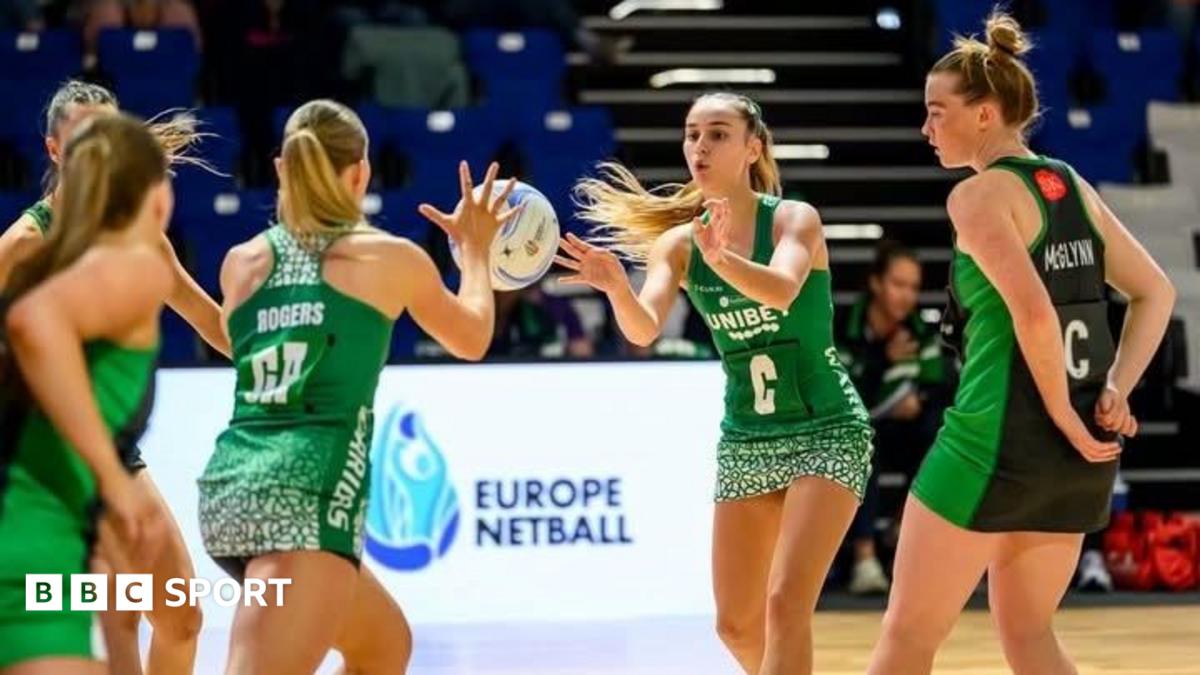
World-ranked number 15 Northern Ireland’s emphatic 73-50 victory over Republic of Ireland in their final qualifier was not enough to secure one of the two qualification spots automatically.
However, Scotland’s narrow win over Wales in Sunday’s later game booked both teams spots with Wales, who are ranked ninth in the world, missing out.
“It was a real rollercoaster of a day,” O’Hanlon continued.
“Obviously we started out with a hard-fought win against the Republic of Ireland, but we knew that we were still relying on Scotland.
“That match was just up and down the whole way through, so we were nerve-wrecked watching that. Just sitting in the stands, not being able to control anything, was nerve-wracking.”
O’Hanlon was captain of the side when they finished 10th in the World Cup seven years ago.
But, now, the 42-year-old said the squad will head to Sydney with ambitions of competing for results rather than simply gaining experience.
“The last one we were at was in Liverpool and there was a lot of home support, but Sydney is the home of netball at the minute,” O’Hanlon added.
“Sydney is the centre of the best league in the world. It’ll be a brilliant spectacle and it’s just class to be a part of it.
“The group will be going into the games not just to experience, not just to learn, but to actually go on and compete and try to win games and get results. That’s the next step for us really.”
Scotland and Northern Ireland secured qualification for the Netball World Cup after a three-day event in East Kilbride.
The top two sides from the four-team tournament won their spots in the finals, which take place in Sydney, Australia, with Wales and Republic of Ireland failing to qualify.
Northern Ireland’s emphatic 73-50 win in the early match on Sunday meant they would qualify should Scotland win or draw, while Wales’ only path to qualification was through a victory over Scotland.
Heading into the final match of the tournament between the Scots and Welsh, the event hosts had their spot in the finals secured unless Wales won with an overwhelming points haul and Scotland ran out 55-48 victors.
The World Cup runs from 25 August-5 September 2027.
Crowd gathers on Garvaghy Road early on Sunday morning to protest against the ruling allowing the march.
Published On 27 Sep 202627 Sep 2026
Northern Ireland’s High Court has permitted the Orange Order, a Protestant organisation, to march through a mainly Catholic area in the town of Portadown for the first time in 28 years, reviving one of the region’s most contentious marching disputes.
The court rejected a final attempt by residents to stop the parade passing through the Garvaghy Road early on Sunday, after Northern Ireland’s Court of Appeal overturned a temporary injunction granted on Saturday.
Recommended Stories
list of 2 itemsend of list
Large crowds gathered on the road before the procession, with the Belfast Telegraph reporting that protesters planned to block the route peacefully by linking arms.
First Minister Michelle O’Neill, vice president of Sinn Fein, an Irish nationalist party that supports a united Ireland, joined residents opposing the march.
In a statement posted on X on Sunday, she backed their right to protest and urged restraint, saying, “I am calling for calm on all sides.”
Sinn Fein leader Mary Lou McDonald also condemned the court decision in a post on X early on Sunday, calling it “disgraceful” and saying her party stood with the Garvaghy Road community.
Deputy First Minister Emma Little-Pengelly, from the Democratic Unionist Party (DUP), which supports Northern Ireland remaining part of the United Kingdom, urged people to stay away from the area.
She said on Sunday that threats of violence were unacceptable and added: “No one in Northern Ireland wants violence or disorder.”
The Orange Order is a Protestant organisation closely associated with unionism, the political tradition that favours Northern Ireland remaining in the UK.
The Parades Commission, the independent body that rules on disputed marches in Northern Ireland, approved Sunday’s procession with a 35-person limit, barred bands and accompanying supporters, and required the march to finish by 9:30am (08:30 GMT).
The dispute over the Drumcree parade and Garvaghy Road became one of the most bitter marching confrontations of the “Troubles”, the decades-long conflict over Northern Ireland’s political status that largely ended with the 1998 Good Friday Agreement.
Repeated attempts by the Orange Order to return from Drumcree church along Garvaghy Road triggered protests, violence and major security operations during the 1990s.
Tigray was cutoff from the world during the 2020-2022 civil war, which killed around 600,000 people.
Published On 25 Sep 202625 Sep 2026
Fears of a communications blackout in northern Ethiopia have increased as fighting flares between the federal military and forces from the Tigray region and their allies.
Telecom and internet networks were reported to have stopped working on Friday as the conflict threatened to develop across the country into a full-scale war.
Recommended Stories
list of 4 itemsend of list
The interruptions have provoked fears of a repeat of the communications blackout and supplies blockade during the 2020-2022 civil war in northern Ethiopia, when Tigray was largely cut off from the outside world.
Web monitor NetBlocks said it had detected an “internet disruption in northern Ethiopia corresponding to reports of a telecoms blackout in Tigray”.
The Reuters news agency reported that Tigray’s ruling party, the Tigray People’s Liberation Front, had ordered private operator Safaricom and state-owned Ethio telecom to cut off access to phone and internet networks in the region.
Full-scale war
A source said the restrictions may be part of a tactic to neutralise the advantage of government forces using battlefield drones.
Lower-level clashes between federal and Tigrayan forces have been ongoing for some time. However, fighting intensified this week across Tigray and later spread to the neighbouring Afar and Amhara regions, after seven armed groups announced they have formed an alliance.
The Ethiopian Peoples’ Forces Alliance for Survival has committed itself to removing the government of Prime Minister Abiy Ahmed.
The Tigray Army said the federal government had launched a “full-scale offensive” involving infantry, mechanised units and drones, and said its forces had begun what they called a defensive war to counter aggression by Abiy’s government.
The alliance forces have seized three airports and launched attacks against federal troops in Afar and Amhara.
The federal government has accused Eritrea of financially backing the TPLF and its allies, which leaders in the capital Asmara deny.
Abdisalam Balema, a member of the Tigray People’s Liberation Front’s (TPLF) central committee, told Al Jazeera that the situation has become a “full war”.
The outbreak of violence is the most serious escalation since the civil war in 2020-2022. During that conflict, which killed an estimated 600,000 people, the telecoms blackout and supplies blockade imposed on Tigray caused famine-like conditions for hundreds of thousands of people.
People in Tigray are reported to have rushed to stock up on basic supplies and withdraw cash.
The renewed fighting comes at an awkward moment for the United States, which only this month lifted sanctions on Ethiopia and Eritrea related to atrocities committed during the last civil war, saying the “national emergency… has expired”.
The conflict could also draw in neighbouring Eritrea, which fears landlocked Ethiopia is planning to invade it to gain access to the Red Sea.
A Northern California community college wrestling star slipped and fell to his death Sunday at Yosemite National Park, officials confirmed.
Santa Rosa Junior College sophomore Ryan George died in an apparent accident, his college coach, Fred Duerr, posted in a statement Tuesday.
The Santa Rosa Press Democrat broke the news Tuesday, saying the 19-year-old “was hiking with friends near Illilouette Falls in Yosemite when he reportedly slipped and fell to his death.”
“Details are limited right now, and it’s been a really hard time for us all trying to process everything,” Duerr said in the statement. “If you knew Ryan, you know he was one of the most genuine, positive people you could ever meet. He had this way of lighting up a room, making you feel welcome, and bringing out the best in everyone around him.”
Yosemite National Park officials did not immediately respond to an email seeking comment.
George is listed as a Santa Rosa native in the school’s media guide and graduated from Montgomery High School in that city.
Last season, he enjoyed a strong run through the state championship in the 197-pound division. He entered sixth-ranked and finished with five victories, including two falls, en route to third place.
His finish was impressive considering he lost in the second round of the double-elimination tournament.
George rallied with perhaps his best effort of championships, defeating No. 5-ranked Dominic Sanders Jr. with a pin in 2 minutes, 38 seconds, in elimination bracket action.
He picked up the bronze in that tournament by defeating teammate Joe Ellis via a 6-2 decision.
“He was an amazing leader and wrestler, but more than that, he was an amazing human — kind, loyal, funny, and the kind of friend everyone wishes they had in their life,” Duerr said. “We love you and we will miss you so much, Ryan. Thank you for everything you gave us all.”
While current Northern Ireland boss Michael O’Neill was not yet born when Best won the Ballon d’Or off the back of a European Cup with Manchester United, he can appreciate what a global superstar means to a small footballing nation.
“George Best, an iconic figure in in world football and obviously we’re very privileged that he came from Northern Ireland. In many ways, he puts our country on the map.” he said.
“I think in Georgia, you have that situation now with Kvaratskhelia who I think is a world-class player.
“For me he was probably the best player in the Champions League last season over the whole competition. We obviously have to give him special attention.
“It’s the same when you play against any world-class player in any country that you have to be aware that he can win the game in a moment, that he can create so much and he can lift his team as well.”
Despite being in the running for such prestigious individual accolades, Kvaratskhelia’s national coach Willy Sagnol praised the player’s focus on the collective.
The former France international was a Les Bleus team-mate of Zinedine Zidane, winner of the Ballon d’Or in 1998.
“You were talking about Ballon d’Or, times maybe change but I think sometimes the past was better where players were playing and waiting to the end to see who would be Ballon d’Or and then be happy to be or disappointed not to be,” said the 49-year-old.
“Too many times in the last weeks, I see players saying ‘I’m the best, I’m the best, I’m the best.’
“Khvicha never said that and that’s why I’m very proud to be his head coach because he’s not just about a fantastic football player, but he’s also a fantastic personality who thinks always about the team and not about himself and I’m sure [on Friday] he will show it again.”


![Portadown Orangemen march from Drumcree Church to start their march towards Garvaghy Road, which was stopped a short distance later by police, in Portadown, Northern Ireland on September 27, 2026 [AFP]](https://i0.wp.com/www.aljazeera.com/wp-content/uploads/2026/10/afp_6abfeb6d30a8-1790962541.jpg?w=640&ssl=1)

![UVF flags fly alongside UK flags in the Edgarstown estate, Portadown, Northern Ireland, on October 1, 2026 [Caolán Magee]](https://i0.wp.com/www.aljazeera.com/wp-content/uploads/2026/10/DSC00033-1790961495.jpg?w=640&ssl=1)
![Orange Order members sit outside Drumcree church as they await passage along Garvaghy Road in Portadown, Northern Ireland, on October 1, 2026 [Caolán Magee]](https://i0.wp.com/www.aljazeera.com/wp-content/uploads/2026/10/DSC00113-1790961532.jpg?w=640&ssl=1)
![Children play on the embankment as music rings out along Garvaghy Road in Portadown, Northern Ireland, on October 1, 2026 [Caolán Magee]](https://i0.wp.com/www.aljazeera.com/wp-content/uploads/2026/10/DSC00134-1790961539.jpg?w=640&ssl=1)
![A ‘Garvaghy Road says no’ sign with an Irish tricolour in the background in Portadown, Northern Ireland, on October 1, 2026 [Caolán Magee]](https://i0.wp.com/www.aljazeera.com/wp-content/uploads/2026/10/DSC00064-1790961515.jpg?w=640&ssl=1)