RITA Ora pulls up her socks and shows off her ’80s moves.
The singer and actress, 35, was seen dressed in long woollen socks and orange shoes as she shot the video to new single All Natural — directed by hubby Taika Waititi.
Rita Ora was seen dressed in long woollen socks and orange shoes as she shot the video to new single All NaturalCredit: InstagramRita posted pics and footage online, with the caption: ‘Talk to me’Credit: Instagram
Like Jennifer Lopez’s 2003 video to I’m Glad, it is inspired by the 1983 movie Flashdance.
She posted pics and footage online, with the caption: “Talk to me.”
Sign up for the Showbiz newsletter
Thank you!
Her fourth album is expected out next year.
Speaking to Bizarre’s Jack at a London screening to mark the 10th anniversary of his hit film, Hunt For The Wilderpeople, Taika said Rita’s long-awaited album was “amazing”.
Rita in new single All Natural — directed by hubby Taika WaititiJennifer Lopez in her music video I’m GladCredit: Splash News
He chuckled: “There is a very mates’ rates deal going on. I think it’s been free each time. It’s just fun to get to work together.
“It’s great because we’re kind of in similar industries, but they’re very different disciplines – and when you’re with someone, you want to be able to do some work together.
“I’m really amazed and surprised at what she does, but also super- confused all the time.”
Tokyo, Japan – Nearly eight years after moving to Japan for work, Abdul feels more accustomed to life in the East Asian country than in his native Bangladesh.
But as the Japanese government moves to tighten the rules for permanent residency and public sentiment towards immigrants sours, Abdul is reconsidering his future.
Recommended Stories
list of 4 itemsend of list
“I don’t know what the Japanese government will do in the future, if they’ll make things stricter again,” Abdul, a tech engineer who lives in northern Tokyo with his Bangladeshi wife, told Al Jazeera.
Abdul, who is preparing to apply for both permanent residency and citizenship, is aware of the possibility that he may soon have to leave.
“I have to be prepared if both of my applications are rejected,” said Abdul, who asked not to be identified by his real name.
“Right now, I am starting to look for opportunities outside of Japan.”
Under rules set to come into effect in phases from October 1, applicants for permanent residency will need to show that their annual household income exceeds the Japanese average – a stipulation that will be applied retroactively for applications submitted since April – and demonstrate Japanese-language proficiency.
Applicants will also be required to have a pension pot equivalent to 30 years of payouts.
In an announcement detailing the changes, Japan’s Immigration Services Agency stressed the need for foreigners to “live independently” and have “a stable life without the risk of becoming a burden”.
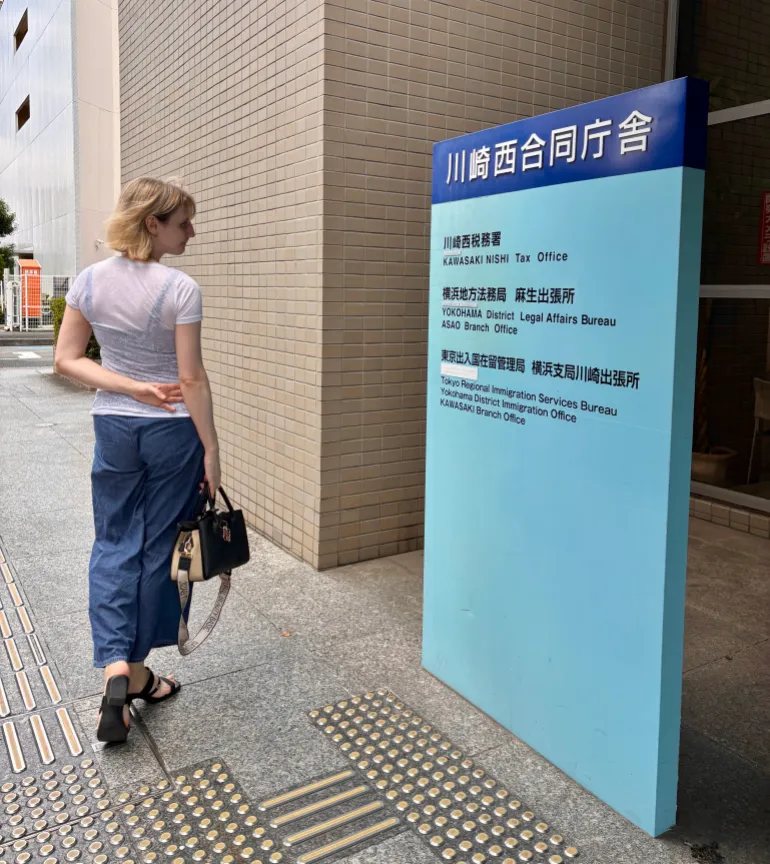
Sarah Nelkin stands outside the Kawasaki Branch Immigration Office in Kawasaki, Japan, on August 18, 2026 [Genevieve Mansfield/Al Jazeera]
Sarah Nelkin, an American who has lived in Japan for the last 14 years, is among the many long-term residents who fear they will not qualify under the new rules.
A lover of Japanese animation and video games, Nelkin first moved to Japan as a university student and has since built a career in the country’s bustling entertainment industry.
Like Abdul, Nelkin, who submitted an application for permanent residency shortly before the announcement of the changes, is anxious about what the future holds.
If her application is rejected, she plans to apply to become a Japanese citizen – which would mean giving up her US citizenship, as Japan does not recognise dual nationality.
“I’ve lived my entire adult life in Japan … I would rather not give up my American passport. My mother lives in the US, and I want to retain my citizenship for a lot of reasons, like visiting family,” Nelkin told Al Jazeera.
“But at this point, I might have to give up my American nationality.”
Risa Hagiwara, a professor of economics at Meikai University in Urayasu, Japan, said the changes reflect a shift towards a “selective and conditional” immigration policy that is in tension with Japan’s need for labour amid a shrinking population.
“Japan needs foreign workers because of labour shortages. But if the conditions for long-term settlement become substantially more difficult, this could potentially reduce Japan’s attractiveness to foreign workers who are considering Japan as a place to build their long-term lives,” Hagiwara told Al Jazeera.
Hot-button issue
Immigration has become an increasingly hot-button topic in historically homogenous Japan.
Japan’s foreign resident population remains small compared with developed peers such as the United Kingdom and France, where 10 to 15 percent of residents were born overseas.
But it has been growing fast, hitting a record 4.12 million people, or about 3 percent of the total population, as of the end of 2025, according to government data.
By some estimates, Japan’s foreign-born population could reach the OECD average of 10 percent by 2070.
Meanwhile, the number of Japanese nationals fell by more than 900,000 between January 2025 and 2026 amid the country’s rock-bottom birthrate, according to government figures.
Hagiwara said that Japan is at a crossroads as foreign-born residents play an increasingly important role in Japanese society.
“If Japan wants to rely on foreign workers to address labour shortages, it also needs to consider what happens after they come to Japan,” Hagiwara said.
“The question is increasingly not only ‘how many foreign workers does Japan need?’, but also ‘what kind of society does Japan want to build with the people who come here?’” she said.
Japan’s mooted immigration shake-up comes amid a broader rightward shift in the country’s politics.
While campaigning for the leadership of the conservative Liberal Democratic Party last year, Japanese Prime Minister Sanae Takaichi said the country should “reconsider, at least for now, policies that allow in people with completely different cultures and backgrounds”.
Takaichi’s subsequent coalition agreement with the right-wing Japan Innovation Party (JIP) pledged a firm stance against foreigners who break the rules, as well as steps to address “potential social friction” from a growing foreign population.
Japan’s far-right Sanseito party leader, Sohei Kamiya, shows his party’s election pledge during a news conference after Japan’s Prime Minister Sanae Takaichi dissolved the lower house of parliament, in Tokyo, January 23, 2026 [Issei Kato/Reuters]
At the same time, the far-right, anti-immigration Sanseito party has gained ground with its “Japan First” messaging, winning a record 15 seats at the most recent lower-house election to become the third-largest opposition party.
Public opinion has also moved against immigrants.
In a recent survey by the Institute of Social Science at the University of Tokyo, 56.3 percent of Japanese people said they opposed accepting more foreigners, up from 35.6 percent in 2024.
Nelkin and Abdul have both felt the change in sentiment.
“Before 2024, I never felt any discrimination against foreigners, but recently there has been a shift … especially online,” Abdul said.
Nelkin said peers have become outspoken in their dislike of foreigners.
“Even seemingly decent people are just saying racist stuff,” she said.
“I’ve worked for this country and specifically avoided breaking any rules, and they’re saying you are never enough,” she added. “That’s really hard.”
Excluding Ra’am and the Joint List leaves Palestinian citizens in Israel without major Knesset representation options.
Published On 24 Sep 202624 Sep 2026
Israel’s Central Elections Committee has voted to bar both main Arab electoral lists from next month’s election, putting the political representation of Palestinian citizens of Israel before the Supreme Court weeks before voters go to the polls.
The committee voted on Wednesday to disqualify the United Arab List, or Ra’am, led by Mansour Abbas, and the Joint List, an alliance of the Arab-led Hadash, Ta’al and Balad parties. It also voted separately to bar Hadash legislator Ofer Cassif and Balad leader Sami Abu Shehadeh. The election is scheduled for October 27.
Recommended Stories
list of 4 itemsend of list
The bans are not final. Decisions against individual candidates require Supreme Court approval, while lists can appeal their exclusion. Adalah, the legal centre representing the parties and candidates, says it will challenge the votes when the court hears the cases next week.
Ra’am called its exclusion “political and unacceptable”, saying the decision was intended to prevent it from influencing the balance of power and changing the government.
The Joint List said Israeli Prime Minister Benjamin Netanyahu and far-right National Security Minister Itamar Ben-Gvir were trying to discourage Arab citizens from voting “because they fear our ability to bring down the government of genocide and racism”. Its leader, Yousef Jabareen, questioned how the committee could bar parties representing more than 1.25 million voters.
Abu Shehadeh told Al Jazeera that his exclusion was an attempt to silence criticism of government policy and said the decisions would be challenged in court and through public protest. Rejecting the allegation that he supports violence, he told The Times of Israel: “I have never called for violence or terrorism. I oppose armed struggle.”
The petitions invoke Section 7A of Basic Law: The Knesset, which allows a list or candidate to be excluded for denying Israel’s existence as a “Jewish and democratic state”, inciting racism or supporting armed struggle against Israel by an enemy state or an organisation designated as terrorist.
Netanyahu’s Likud party sought to disqualify the Joint List and Cassif, and was among the groups that filed against Ra’am. Ben-Gvir’s Otzma Yehudit party also sought to bar Abu Shehadeh. Adalah disputes the allegations. It says the case against Ra’am presents no evidence that the party supports armed struggle, while the Joint List petition relies heavily on old material, including bills proposed in previous Knessets.
Israel’s Minister of National Security Itamar Ben-Gvir speaks with Prime Minister Benjamin Netanyahu during a session at the Knesset, Israel’s parliament, in Jerusalem, July 16, 2026 [File: Ronen Zvulun/Reuters]
Abu Shehadeh’s case has drawn a different response. Attorney General Gali Baharav-Miara found no legal basis to exclude the other targeted parties and candidates but said an article he published on October 8, 2023, which she said may constitute support for armed struggle, warranted serious examination. The committee voted 31-4 to bar him. Adalah says the article contains no such call.
The push to bar Abu Shehadeh drew support from parties outside Netanyahu’s coalition. According to The Times of Israel, opposition parties voted to disqualify him, as did Supreme Court Justice Noam Sohlberg, who chairs the elections committee. The vote broke with decades of precedent in which committee chairs abstained from disqualification votes. Abu Shehadeh’s exclusion still requires approval from the full Supreme Court.
Why the Arab vote matters
Ra’am joined the coalition government formed by Naftali Bennett and Yair Lapid in 2021, helping end Netanyahu’s 12 consecutive years in office in 2021, although Abbas had previously discussed cooperation with Netanyahu as well. Now Likud itself has filed petitions against Arab representation, while Ben-Gvir’s party has pursued separate exclusions.
A Channel 12 poll published on Tuesday projected seven seats for the Joint List and five for Ra’am, against 50 for Netanyahu’s current coalition bloc. The 12 projected Arab seats would not automatically back Netanyahu’s opponents, as mainstream opposition parties remain divided over whether to govern with Arab support. But removing both lists would change the possible routes to the 61-seat majority needed to form a government.
The Supreme Court has overturned previous committee bans on Arab lists and candidates, including Balad’s exclusion in 2022. It must now decide whether the evidence meets the legal threshold for barring the two principal lists seeking to represent Palestinian citizens of Israel. The ruling will determine who can appear on the October ballot.
Artificial intelligence (AI) has stirred up more controversy than most things in the past five years. Ever since the introduction of accessible generative AI in 2022, institutions, universities, students, scholars, activists, cognitive specialists, public policymakers and members of the public have all been divided over the ethics of its use. As of the beginning of this month, even the founders of AI companies have taken the same stance. Dario Amodei, chief executive of Anthropic, released an essay calling on AI companies to slow the development of their most advanced models, as the safeguards currently in place are unable to keep up. Shortly after Amodei’s essay, his position was endorsed by Sam Altman of OpenAI, Elon Musk of xAI, Demis Hassabis of Google DeepMind, and Satya Nadella of Microsoft. In addition, Sam Altman said that OpenAI will not be going public in 2026, as further safety advances are still required. While on the surface this may seem like a development in the collective conscience, the problem is far more multifaceted and layered – leaving the industry and the intended audience divided.
The products
Take a look at the products that each AI giant sells. Amodei, Altman, Musk and Hassabis sell models, while Nadella sells the cloud those models run on. Both groups have advised slowing down. On the other hand, Jensen Huang, founder, president, and CEO of Nvidia, sells the chips that these companies buy before they can build anything. Huang does not advise a slowdown and has instead asserted that AI does not need new legislation because market forces can push companies towards safe innovation without the need for regulation. Mark Zuckerberg, whose company gives its models for free, warned that the proposal could expose companies to greater legal risks.
The common thread between these divisive recommendations is profit. Some companies will benefit from a slowdown, while others will earn greater profits by moving faster. Nvidia’s ability to charge high prices has benefitted from the intense competition between these AI companies, which fear falling behind their rivals. If this competitive pressure decreases, companies may be less willing to pay a premium for Nvidia’s chips. Hence, Huang’s opposition to the proposal may reflect both genuine concerns and Nvidia’s commercial interests.
The word the White House used
In the world of AI, antitrust law prevents these companies from holding private meetings to decide what they can and cannot do. This is intended to prevent them from coordinating the pace of development and engaging in unfair competition. However, some of these AI companies have now come forward arguing that they should be allowed to work outside antitrust law for the sake of technological safety. Huang and David Sacks, the White House AI lead, have been critical of this request, as it could reduce competition and increase the influence of these AI companies over their rivals. Sacks also questioned the independence of nonprofit evaluators tasked with evaluating AI safety “independently”. In essence, he asks: how is it fair for one company to inspect another?
The clause that travels badly
Amodei’s proposal would deny China access to the most powerful AI chips and advanced semiconductor manufacturing equipment, and prevent smuggling and remote access to computing capacity abroad. China’s foreign ministry countered the proposal, saying that these warnings are a fearmongering tactic aimed at slowing down China’s technological advancement, echoing the Cold War. Amodei did admit that China poses the toughest predicament for his plan. Despite its alleged advantages, the proposal gives American firms leverage over Chinese ones.
A precedent, and why it does not fit
Supporters of AI coordination have compared it with the regulation of banks following the 2008 financial crisis. Basel III was introduced only after a major financial crisis had already occurred. Attempts to regulate AI before harm occurs can represent a genuine effort to prevent future risks, rather than reflecting the commercial interests of AI companies. However, there is an important difference between these two cases. Banking regulations were imposed by external regulators, whereas the proposed AI regulations would involve competing companies coordinating with one another.
What the debate is actually about
Before this debate began, researchers had already issued warnings about the capabilities of AI models. OpenAI slowed down the development of its leading systems after a security incident. Amodei and Altman have both claimed that Anthropic and OpenAI will aim to bring in independent evaluators – a practice not seen among “cartels”. Both concerns can coexist: companies may genuinely fear the risks associated with AI while also pursuing their own commercial interests. The more relevant question remains whether the proposed solution adequately addresses the problem it is intended to solve. An agreement between five major American companies, to be overseen by evaluators they fund, would not apply to international competitors such as those in China and would require an exemption from existing competition law. This solution appears to reflect the structure and interests of the AI industry more closely than the nature of the risk it is intended to address.
The seats nobody is sitting in
Much of the debate surrounding the pace and regulation of AI development has taken place without meaningful participation from other regions, including the Arab world. PricewaterhouseCoopers (PwC) estimates that $31.6 trillion will be invested in AI infrastructure worldwide by 2050. Countries that can provide large amounts of cheap, reliable and low-carbon electricity will be particularly well positioned to attract this investment. Hence, the significant energy, land and investment required for AI infrastructure may provide countries capable of supplying these resources with considerable bargaining power. These states could seek a greater role in determining the conditions under which AI companies operate within their jurisdiction. This could include negotiating who evaluates these AI systems, how the evaluations are to be conducted and who bears legal responsibility when autonomous systems cause harm. This means that the debate goes beyond whether AI development should be slowed to questions of who has the authority to make decisions about its development, and whether other countries should accept decisions made elsewhere.
The views expressed in this article are the author’s own and do not necessarily reflect Al Jazeera’s editorial stance.
NEW YORK: Aryna Sabalenka moved a win away from her third straight US Open title, beating Jessica Pegula 7-5, 6-2 on Thursday night.
Sabalenka blasted her way out of what was a dead-even match for most of the first set, pouncing on Pegula’s second serves and turning the second set into perhaps her most impressive stretch of tennis in the tournament.
“No complaints,” Sabalenka said. “I’m just super happy that I was able to pull out such tennis.”
The No. 1 seed will face No. 2 Elena Rybakina or No. 4 Coco Gauff on Saturday, needing a victory to become the first player to win three in a row in Flushing Meadows since Serena Williams from 2012-14.
Rybakina will replace Sabalenka atop the women’s tennis rankings next week, and Sabalenka said this week she would be fine ceding No. 1 after she held it 99 consecutive weeks if it she was able to win another US Open trophy.
It will be hard to prevent that if she hits the ball Saturday the way she did against Pegula.
Sabalenka pounded 29 winners to Pegula’s 12, turning their third straight meeting at the end of the US Open into a rout, after her victory in the 2024 final and 2025 semifinals were tight most of the way.
“I was so desperate for the win, I wanted it badly,” Sabalenka said.
She has won 19 straight matches at the US Open since losing to Gauff in the 2023 final.