closer

‘I don’t think we’ve ever felt closer’: five writers on their most memorable family holidays | Family holidays

‘Exploring Finland with our baby was a delight’

Finland has been named the world’s happiest country for nine years running, but arriving in Helsinki, dishevelled from one of my first flights with my nine-month-old baby, I was less interested in national rankings and more in having a nice nap. My husband, Jake, and I had emerged from the fog of newborn life and the idea of a holiday felt possible again. My ambitions were small: a sunset beer, a walk in the woods, reading a few pages of my book uninterrupted.

But Finland, with its famously family-friendly culture, made exploring with my tiny new travel companion a delight. Finnish parents are supported with generous, gender-equal parental leave, affordable childcare, and free healthcare and education. No one bats an eyelid at a pram parked beside a restaurant table or a baby snoozing outdoors in the cool air, and the terrifyingly efficient public transport system is a dream with children.

In Helsinki, we found ourselves in the cool neighbourhood of Kallio, where locals spilled out on to terraces in the late evening sunshine. We stayed at Hobo Hotel, which, despite attracting a hip crowd, was kitted out with travel cots and highchairs. At a bar aptly named Holiday, my daughter, Sylvie, sat happily chewing a spoon while we drank paloma cocktails in the long golden evening light of July, when the sun barely seems to set at all.

Part of Finland’s appeal for me lies in jokaisenoikeudet, or “Everyman’s Right” – the law that gives everyone freedom to roam the country’s forests and lakes. On the southern coast, we hiked through pine forest and over moss-clad rocks towards Lake Kukuljärvi, with Sylvie snoozing, strapped to my front. At a traditional laavu – a simple wooden shelter with a communal fire pit – Jake and I cooked sausages and boiled coffee over open flames. Sylvie eventually deigned to wake from her nap and gnawed on flakes of pink salmon like a tiny woodland creature. Then I handed her to Jake and jumped from the rickety jetty into the lake for a swim.

The off-grid cabin at Majamaja. Photograph: Sian Lewis

In summer, Finns are all about escaping to remote cabins. At Santalahti in Kotka, simple self-catering wooden cottages were just steps from the sea, but my favourite tiny houses were Majamaja, four minute off-grid cabins perched on rocks on the Baltic Sea. A stay here felt truly wild, yet we were a 10-minute drive from Helsinki if we ran out of nappies.

On our last day, we boarded a little ferry which chugged the 15 minutes from Helsinki to Lonna island, a tiny military outpost turned summer escape. Now uninhabited and carpeted in wildflowers, it has a wood-fired sauna overlooking the sea. Inside, women of all ages sat side by side as steam curled from the stove. Finnish children grow up going to saunas from infancy, and two locals showed me how to plonk Sylvie into a bucket of cool water, where she spent the entire time grinning with her four newly minted teeth at the sauna-goers smiling back at her. “She’s Finnish now!” one woman laughed.
Sian Lewis

‘I struck gold with the Vespa tour’: Naples with my teenage son

Jill Mead’s son, Ned, on a Vespa with guide Michele in Naples. Photograph: Jill Mead

On a wing and a prayer, I took my 13-year-old son, Ned, to Naples. Just the two of us. He was old enough to carry his bags, young enough to bunk in the same bed and keep the cost down. I’d booked a small apartment in the centro storico with decent wifi in case single parenting got the better of me and we simply needed to play Fifa.

My worry didn’t last long. I struck gold by booking a Vespa tour with Michele and Luigi at NeaTour, who took our brief – “Show us where you wouldn’t normally go” – as a personal challenge. We wove through the city under balconies dripping with washing, past giant graffiti and smelly fish stalls, and shared fruit with elderly women sitting outside on old chairs. We stopped at Bar Nilo to pay homage to Maradona and check out a lock of his hair, then scootered on to a towering mural of the icon himself.

Michele handed Ned a cornicello, a small red charm to ward off bad luck. Legend has it they only work when given as gifts, and we bought into it immediately, wandering off into the Quartieri Spagnoli (Spanish quarter) despite all the warnings of theft and danger. Doors were open everywhere. It was tempting to peep in. One family were inside finishing lunch. Without ceremony, they invited us in. Wine appeared. A Pepsi for Ned. Three generations shifting to make space for strangers who weren’t strangers any more.

Naples worked like that. You needed to give in quickly. We took the smallest alleyways, watched football with the locals, stayed out until the early hours. Not because of the place itself, but because of the interruptions: conversations, offers, eye contact that turned into something wonderful.

Of course, it wasn’t all a success story, despite the cornicello. It was a terrible idea to climb Vesuvius in the midday heat. Blisters, lack of water, wishing we wore hats. Then, on the same day, Pompeii. Crowds, dust, exhaustion and the surreal shock of carved penises everywhere.

Jill and Ned above Naples. Photograph: Jill Mead

Capri proved the antithesis. Beautiful and polished. Botox clashing with bougainvillea. We neither wanted nor could afford the restaurants or designer shops, but lovely assistants indulged us as we tried on sunglasses and handbags costing more than my monthly salary.

Sixteen years earlier, I’d photographed boats arranged like petals outside the Blue Grotto, and wanted to see if we could make it happen again. What I never expected was the same boatmen agreeing to recreate it, carefully positioning themselves into a floating flower.

Trusting local knowledge, we left everything on the old iron stairs leading into the water and swam through the tiny cave entrance. The azure blue was so dense, like liquid moonlight lit from within. After diving and GoPro posing, we swam to the back and sat watching the regulars in their cave cathedral.

As we climbed back up the cliff, salt-dried and tired, Ned turned to me and said, “That’s the best thing I’ve ever done.”

“Me too,” I replied.
Jill Mead

‘One for the family album’: glamping with granny in Norfolk

The beach at Hunstanton, Norfolk. Photograph: Nigel Harris/Getty Images

Sitting on the veranda with a glass of rosé, my mum and I watched rabbits hop through ferns while birds of prey soared overhead. We decided the view from our “safari” tent was pleasingly wholesome – the only howls were coming from the teenagers inside …

Last summer, I took my twin daughters, my mum and my dog, Miss Babs, on holiday to north Norfolk. Aged 19, the girls are fully embroiled in their own lives – Lola has the travelling bug, Nancy’s away at university – so it was a rare opportunity for us all to get together.

We stayed on the edge of the Sandringham estate, the royal family’s Norfolk retreat, where Experience Freedom, the glamping arm of the Caravan and Motorhome Club, has smart safari tents for us commoners to enjoy (from £69 a night).

While a week in Norfolk is not quite “Ibiza with the girls”, the twins adore their granny and jumped at the chance to come along. A child of the 70s, I grew up holidaying with multiple generations. Every year, my very extended family would head en masse for a week at St Margaret’s Bay holiday camp near Dover. We went the full hokey cokey, joining glamorous granny contests, donkey derbies and a highly competitive fancy dress competition. I adored those holidays with my beloved grandparents, aunts, uncles and numerous cousins, plus aunty Joan and uncle Dick, my nana’s neighbours, who always came, too.

This trip didn’t involve such a large crew, but we had a lovely time in Norfolk. I enjoyed early morning dog walks through the Sandringham estate while the twins slept in. My mum cooked us a full English breakfast every morning, drawing the girls out of their beds with the smell of sizzling bacon. Afternoons were spent on the beach at Old Hunstanton or bobbing around the twee villages that dot the north Norfolk coast. We’d head back to camp in the late afternoon for a glass of rosé on the veranda, when the girls would entertain their grandmother with some inappropriate TikTok reels. One night after dinner, Nancy and Lola challenged us to a game of Cards Against Humanity, only to be utterly horrified when their grandmother won.

The twins and their granny. Photograph: Tracey Davies

Sating the different wants and needs of teenagers and a septuagenarian was not always easy. Tensions did rise, particularly when the sisters snipped at each other or bickered over doing the washing up. More than once, I had to throw the girls a stern look when they dropped the F-bomb in front of their grandmother. And as the unelected leader of the pack, by day three I had decision-making fatigue over what to do, where to go and what to eat.

On our last afternoon, we popped to the main house to see our royal neighbours. Sandringham House is not dog-friendly (unless you’re a corgi or an assistance dog), so Lola stayed back with Miss Babs. Wandering through the hallways of the royal family home, I watched Nancy and her nana, arm in arm and nattering happily, and thought: “This holiday is definitely one for the family album.”
Tracey Davies

‘We would have happily carried on going to who knows where’: Interrailing to Turkey with our boys

Sam Wollaston and family with one of the many trains they took. Photograph: Sam Wollaston

I was due a sabbatical, my wife, Vicky, is a teacher and so gets long school holidays, and our boys Tom and Jack were nine and 11, which created an opportunity for an adventure beyond the usual Cornwall. So, in the summer of 2023, we took the train – to Asia.

I never did the Interrail thing in my youth, so why not in middle age? And kids up to 11 go free. (You still have to pay for reservations, and sleepers; it’s really not a cheap holiday). We got passes that give you 10 days travel within two months, and on an August morning we set off with backpacks to the tube, the boys mortified at the prospect of being spotted by their school friends.

Our route in brief: Eurostar from St Pancras; a couple of nights in Paris; Stuttgart; the first sleeper to Budapest (paprika chicken and a thermal bath); another overnight to Brasov, where we got off the train and spent a week travelling round Romania (Carpathian hiking, Ceaușescu opulence-ogling, birding in the Danube delta). Then on through Bulgaria to Istanbul, Ankara, İzmir, Selçuk. Ancient ruins (boo!), waterparks (yay!), the best breakfasts and bazaars, then cooling off in the Aegean. Back via Vienna and Amsterdam.

The trains were more than just a way of getting from A(ustria) to B(ulgaria), they were a big part of the whole thing. They started off lightning-quick, smooth, pointed at the front, with western Europe flashing past on fast-forward out of the window. As we got farther east, they got older, slower and clankier, but more romantic. We liked the ones with steps up to the carriages, and a window at the back to watch the track disappearing behind, literally a window to the past.

Ephesus, Turkey, one of the stops on the Wollaston family trip. Photograph: Ron Watts/Getty Images

And we liked the overnighters – apart from a rude and rather retro awakening on the border between Romania and Turkey. There was a sharp knock on the door, then uniformed men were shining torches in our blinking eyes. “Your papers, please!” Is this a summer holiday, or a thwarted escape from cold war repression? Still, holidays are about memories, right? And now it’s one of them, and a story to tell.

That aside, there is something special about boarding a train at dusk, finding the right compartment, unpacking dinner – simit bread perhaps, interesting stringy cheese, tomatoes, a glass (plastic cup) or two of rough red, with the sun going down outside the window. Then a game of cards before pulling down our bunks and drifting off to the clickety-clack of steel wheels passing over the joints in the rails. That was the heartbeat soundtrack of our month away – that, and Kraftwerk’s Trans-Europe Express, which I definitely overplayed.

Yes, of course there were strops and disagreements, times we longed for a washing machine, a pool, wifi. But had there not been tedious things like jobs and school to get back for, we would have happily carried on – clickety-clack, clickety clack – to who knows where. And, possibly because we were often literally on top of each other, I don’t think we’ve ever felt closer as a family.
Sam Wollaston

‘Reclaiming the spirit of adventure for all of us’: a healing family trip to Norway

Ailsa Sheldon’s sons at Sognsvann lake. Photograph: Sheldon Family

“Miss Butler says there’s a real live Viking ship in Norway and you can go and see it!” Challenge accepted. I’d been looking for inspiration and found it in my eight-year-old, buzzing with enthusiasm at the school gate. There was more to it: I’d been widowed three months previously and felt as though I had something to prove. When someone you love is ill, your world gets very small: it was our flat, the hospital, and then the hospice. My husband, Jay, and I loved to travel, living in China when our two boys were toddlers; they were now six and eight. I wanted to reclaim that adventurous spirit for all of us.

Walking across Oslo in the early hours of the morning, I wondered what on earth I was doing. Bus tickets could only be bought in convenience stores, which were all closed, so we walked for miles over dark bridges between islands of white light. Our Airbnb host left directions to find a key, hidden behind a rock in a park near his flat: funny looking back, but stressful that night in the dark after too many Scandi noir dramas.

Norway is expensive, so I packed plenty of snacks and tried to keep costs as low as I could. In Oslo, a 24-hour travel pass could last two days: an afternoon hopping on boats and buses, then ensuring we were within walking distance of the flat when it ran out the following morning. We explored brilliant galleries and played games on the roof of the opera house. We took a ferry to Hovedøya island and found 12th-century ruins in the woods, before sprinting to catch the last boat back. We walked round Sognsvann lake picking wild blueberries. The Viking Ship Museum did not disappoint, the dark carved wood so beautifully intricate, gleaming in the pale light (the museum is now being refurbished, due to reopen in 2027). With time left on our bus tickets, we visited Huk on a whim, which, it turns out, is one of Oslo’s nudist beaches. All part of a European education.

Ailsa Sheldon and her sons in Norway. Photograph: Sheldon Family

From Oslo, we took a train to Myrdal, then the steep Flåmsbana line to Flåm for a night in the youth hostel, before continuing by boat along the Nærøyfjord, then two trains to Bergen. It was thrilling. The boat trip was our favourite, passing remote villages and watching thundering waterfalls tumble down the sides of the fjord.

In Bergen, the cheapest place to stay was a berthed yacht in the harbour. When our host had to change mooring, we went along for the ride. A planned quick transfer became a longer trip when he saw how excited the boys were to be out on the water. He produced fishing rods and gave them their first fishing lesson.

The kindness of this young man felt like a gentle squeeze of encouragement from the universe. It was a trip that reminded me of my capabilities as a parent, my boys’ resilience, the inherent goodness of people, and the power of big skies and new horizons to help start to heal a broken heart.
Ailsa Sheldon

Source link

Becerra advances to November, moves closer to becoming California’s first elected Latino governor

Veteran Democratic politician Xavier Becerra won one of the top two spots in California’s primary election for governor, according to the Associated Press, a finish that puts him in a prime position to win in November and make history as California’s first elected Latino governor.

“The people of the great state of California, in the greatest nation on earth, have spoken — loudly and proudly,” Xavier Becerra said in a statement Friday. “We will not be bought. We will not be bullied. And we are never backing down. November, here we come.”

Former Fox News host Steve Hilton, a Republican, remains in a close second and appears on the cusp of securing the right to face off with Becerra in the November general election.

Tom Steyer, a hedge fund manager turned climate change activist, may be destined to finish in third place — which would be a disappointing end to a campaign that saturated California’s television screens, social media scrolls and mailboxes thanks to the progressive Democrat spending $216 million of his own wealth.

Becerra’s victory was declared by the Associated Press on Friday evening, three days after the June 2 election — an indication of the competitive race to replace termed-out Gov. Gavin Newsom and California’s lengthy process of counting ballots. Still, Becerra and Hilton were within a percentage point of each other, though that could change as the vote tally continues. While his fate is not sealed, Steyer faces long odds to finish in the top two.

Under California’s primary system, only the two candidates who receive the most votes in the primary advance to the November general election, regardless of their party affiliation.

Becerra would enter the general election campaign with a significant edge over Hilton since Democratic voters in California outnumber Republicans by almost a 2-to-1 margin, a telltale reason why no GOP candidate has won a statewide race since 2006.

President Trump’s endorsement of Hilton helped consolidate support from Republican voters, which was pivotal to his success in the primary, but would likely hurt him in a face-off against Becerra. Nearly two-thirds of voters in the state want a governor who will fight Trump’s policies, according to the survey by UC Berkeley’s Institute of Governmental Studies that was co-sponsored by the Los Angeles Times.

Becerra could make history by becoming the first Latino to be elected governor — and the first to lead the state in more than 150 years. The last time a Latino held the office was in 1875, when then-Lt. Gov. Romualdo Pacheco was elevated to fill a vacancy and served for 10 months.

“California has made history. Xavier Becerra’s advancement to the general election is a defining moment both for the state, and for the millions of Latino families who have been instrumental in shaping the state’s future. … As home to the nation’s largest Latino population, California will once again demonstrate the decisive power of Latino voters,” said Voto Latino Executive Director Beatriz Lopez.

Though Latinos make up about 40% of the state’s population and are California’s largest ethnic group, they historically have lower turnout in elections and are underrepresented in government. Though Becerra often cites his upbringing as a child of working-class Mexican immigrants, he will still need to demonstrate he can deliver for those communities, said Christian Arana, vice president of civic power and policy at the California-based Latino Community Foundation.

“There’s a lot of excitement about the representation side,” Arana said. “You can have Latino representation, but whether or not that will actually lead to tangible outcomes for Latino communities, that’s what people want to know.”

Once stuck in the single-digits in public opinion polls with a handful of other Democratic candidates, Becerra rose quickly and unexpectedly following the political demise of former Rep. Eric Swalwell.

Becerra’s rise began days after Swalwell dropped out in April following allegations of sexual assault and misconduct, which he denies. Becerra quickly consolidated support from elected officials including Assembly Speaker Robert Rivas and influential groups like Planned Parenthood Affiliates of California and the California Medical Assn.

But both supporters and critics of Becerra struggle to explain exactly how or why he became the main beneficiary of Swalwell’s downfall.

Becerra’s campaign credits the timing of a major television and digital advertising push. The political ads began running just before the allegations against Swalwell came out and depicted Becerra as a calm, experienced leader with a record pushing back against Trump and support from Young Democrat groups.

Steyer’s campaign hired an intelligence firm to look into the online surge favoring Becerra and found thousands of bot accounts had amplified Becerra on various social media platforms. Becerra’s campaign denied any involvement and dismissed the influence of the fake accounts.

Political experts describe it as the stars aligning for the longtime Democratic politician. In the aftermath of the scandal, voters were apparently drawn to Becerra’s long resume and calm, thoughtful demeanor.

“He just never overreacted. Even when attacked [during debates], he was calm,” said Fernando Guerra, professor of Chicano Studies at Loyola Marymount University. That “gave the sense of being a moderate, while he’s really a liberal, so he was able to appeal not only to Latinos, but to liberals and to moderates.”

After Swalwell’s campaign crumbled, members of the political brain trust — many with ties to Newsom — that had been advising the former congressman began working for Becerra, including digital strategist Alf LaMont and veteran consultants Courtni Pugh and Lindsey Cobia.

“There was nothing going for him for a long, long time,” said Jason McDaniel, associate professor of political science at San Francisco State University. “I do think it was just people looking for someone who had a lot of experience who could win.”

Becerra’s first election victory was to the state Assembly in 1990. He served one term before successfully running for a Los Angeles congressional seat, which he held for 24 years.

Then-Gov. Jerry Brown appointed Becerra as state attorney general in 2017, a post he used to challenge Trump administration policies in the courts more than a 100 times — with great success. Becerra helped craft the Affordable Care Act in Congress and defended it as attorney general, and Joe Biden nominated him to serve as Health and Human Services secretary.

The 68-year-old veteran elected official has faced criticism on the campaign trail for his record leading the massive federal agency, particularly over a New York Times investigation that found thousands of unaccompanied migrant children ended up working in dangerous jobs after they were released to sponsors.

Some former Biden administration officials, many of them anonymous, have also criticized Becerra’s leadership of the agency.

Still, Becerra’s supporters said the candidate’s experience, particularly when it comes to fighting the Trump administration, qualifies him for California’s top job.

“He’s had some very important positions in government,” labor leader Dolores Huerta said at Becerra’s election night party in downtown Los Angeles. “He is qualified. He doesn’t have to go into a learning mode.”

“He’s a legal scholar,” said David Dixon, a political science professor at Cal State Dominguez Hills and brother to a longtime Becerra aide. “When our Constitution is threatened, we need people like him to be in positions of power to reclaim things we are losing now.”

Times staff writers Seema Mehta, Dakota Smith and Andrew Khouri contributed to this report.

Source link

Trump says U.S., Iran are ‘getting a lot closer,’ but questions remain about concessions

President Trump said Saturday that the United States and Iran have agreed on the basic terms of an agreement to end the two countries’ nearly three-month-long war and reopen the Strait of Hormuz.

“An Agreement has been largely negotiated,” Trump wrote in a social media post. “Final aspects and details of the Deal are currently being discussed, and will be announced shortly. In addition to many other elements of the Agreement, the Strait of Hormuz will be opened.”

Iran’s state television network quoted Foreign Ministry spokesman Esmail Baghaei as saying the draft pact will be a “framework agreement” that defers talks toward limiting Iran’s nuclear program until later. Trump did not mention the nuclear issue in his statement.

If that is the form the deal takes, it would represent at least a short-term concession from the president, who initially demanded a definitive end to Iran’s nuclear program as the price of peace.

Trump has also relaxed an earlier U.S. demand that Iran give up its right to enrich uranium and says he would be satisfied with a deal to “suspend” enrichment for 20 years.

Those signs of U.S. flexibility have raised alarm from Iran hawks, reportedly including Israeli Prime Minister Benjamin Netanyahu. They say they fear Trump is so intent on restoring the flow of oil from the gulf that he might agree to a deal that falls far short of U.S. goals.

Mark Dubowitz, a leading critic of past agreements with Iran, said he worries that Trump might settle for “a foolish agreement” to reopen the Strait of Hormuz.

“I’m concerned that the administration is looking to cut some ‘Phase One’ deal” in which Iran is given “significant sanctions relief in exchange for agreement to reopen the strait,” he said in an interview Friday. “I think that would be a foolish agreement. Iran would get real money, but they could continue to close the strait any time they wanted simply by making threats.”

Robert Kagan, a conservative foreign policy scholar at the Brookings Institution, wrote that a deal to reopen the strait while deferring the nuclear issue would amount to a U.S. “surrender.”

“On the present trajectory, Iran will emerge from the conflict many times stronger and more influential than it was before the war,” Kagan wrote in the Atlantic.

When the war began in February, Trump said he wanted not only to end Iran’s nuclear activities and destroy its ballistic missile program, but bring about regime change as well.

Instead, the nuclear talks have focused on narrower, more achievable goals: a “suspension” of nuclear enrichment for 20 years or less and removal or destruction of Iran’s highly enriched uranium, the essential ingredient for a nuclear weapon.

“A basic agreement shouldn’t be impossible to achieve,” said John W. Limbert, who worked on Iran policy at the State Department for three decades, and was one of the American hostages seized by Iranian militants in 1979. “The deal would be some kind of verifiable limits on the nuclear program in return for economic relief.”

“The fact that we’re talking about a suspension of all enrichment, and the question is whether it will be five years, 20 years or halfway in between — that’s important,” said Nate Swanson, an Iran expert who worked at the National Security Council under President Biden and Trump. “That sounds like you really have the basis for an agreement. … But don’t fool yourself to think that completely addresses the situation.”

Swanson said other issues, including Iran’s nuclear research and its advanced ballistic missiles, haven’t been addressed.

Despite signs of progress toward an agreement, the gaps between the two countries remain large.

Part of the problem is that both sides appear to believe they have won the war, said Danny Citrinowicz, a former Iran analyst at Israel’s defense intelligence agency.

Trump and other U.S. officials frequently assert that the United States has gained the upper hand by destroying Iran’s navy, air force and many of its missiles.

But the Iranians use a different scoring system, Citrinowicz said.

“Iran does not measure success the same way Washington often does,” he wrote in an email. “From Tehran’s perspective, simply holding firm in the face of American pressure can be framed as a win.”

“Tehran believes time is working against Trump politically and strategically,” he added. “Iran is prepared for prolonged confrontation; the United States, far less so.”

And even if a negotiated agreement is reached, the deals under discussion now won’t resolve all the conflicts between the two countries.

“An interim deal to buy time [is] probably where we end up,” Swanson said. “Buying time is not a bad thing. Ending a war is not a bad thing. But it’s not a comprehensive solution.”

Source link

Trossard scores late as Arsenal beats West Ham, moves closer to title | Football News

Winger Leandro Trossard scores the only goal of the match as Arsenal survives VAR controversy to win at West Ham.

Arsenal cleared arguably the most dangerous ‌remaining obstacle in their path to the Premier League title by the skin of their teeth as Leandro Trossard’s late goal secured a ⁠dramatic 1-0 win at West Ham ⁠United to restore their five-point lead on Sunday.

The visitors were living dangerously at the London Stadium, but Trossard guided home a low shot from Martin Odegaard’s pass in the 83rd minute to spark delirium amongst the Arsenal fans and despair in the home ranks.

Recommended Stories

list of 4 itemsend of list

Arsenal ⁠rode their luck and survived a huge scare deep in stoppage time as West Ham substitute Callum Wilson had an equaliser ruled out for a foul after a long video assistant referee (VAR) review.

Victory put Arsenal a step closer to a first Premier League title since 2004, and they will be crowned football champions if they win their ⁠last two games at home to Burnley and away to Crystal Palace on the final day.

Arsenal have 79 points from 36 games with Manchester City, who have a game in hand, on 74.

For West Ham, it was a bitter pill to swallow as defeat left them staring at relegation, and they could find themselves four points from the safety zone with two games left if Tottenham Hotspur beat Leeds United on Monday.

If Arsenal do go on to lift the title, the incident in stoppage ‌time described by Sky Sports pundit Gary Neville as the “biggest VAR call in the history of the Premier League” will be just a detail in a season-long slog with Manchester City.

But it could have serious implications for West Ham, who would have deserved a point for a gritty display.

With time almost up and even West Ham keeper Mads Hermansen up for a corner, the ball broke for Wilson, who slammed a shot through a forest of legs and over the line.

West Ham fans went wild, and Manchester City’s probably did, too. Arsenal manager Mikel Arteta looked aghast, but when the VAR instructed referee Chris Kavanagh to look at a possible foul by West Ham substitute Pablo on Arsenal keeper David Raya in the build-up, the stadium fell silent.

He ⁠returned to announce that the goal was disallowed and Arsenal could breathe a huge sigh of relief.

Leandro Trossard in action.
Leandro Trossard scores his goal for Arsenal seven minutes from full time [Adrian Dennis/AFP]

Source link

Kevin Warsh is one step closer to top job at the Fed after Trump’s pick approved by Senate committee

The Senate Banking Committee voted on party lines Wednesday to approve Kevin Warsh as the next chair of the Federal Reserve to replace Jerome Powell, a longtime target of President Trump’s insults for not cutting borrowing costs as far as the president wanted.

The vote was 13-11, with all Republican senators voting in favor and Democrats opposed.

Warsh is a former top Fed official but has also been a sharp critic of the institution and Powell’s leadership. He has called the inflation spike to 9.1% in 2022 the central bank’s biggest policy mistake in four decades. A vote on his nomination probably won’t take place until next month, but he could be confirmed by the time Powell’s term as chair ends May 15.

The Senate Banking vote is the first of two key events surrounding the future of the Fed’s leadership. Also Wednesday, Powell is presiding over what will probably be his last meeting of the Fed’s interest rate-setting committee. At a news conference Wednesday afternoon, Powell may indicate whether he will remain as a member of the central bank’s board of governors after his term as chair ends.

It would be unusual for Powell to stay, but doing so would deprive the Trump administration of an opportunity to appoint a new member to the board. Powell may choose to stay if he sees it as necessary to protect the Fed’s independence, which has become part of his legacy as its leader.

Sen. Tim Scott, a South Carolina Republican and chair of the committee, said Warsh is “battle tested” and added that, “It is incredibly important that we break the bind of Bidenomics on households across this nation.”

Sen. Elizabeth Warren, a Democrat from Massachusetts, criticized the banking panel for voting on Warsh’s nomination. Doing so “will bring the president one step closer to completing his illegal attempt to seize control of the Fed and artificially juice the economy,” she said, citing Trump’s effort to fire Fed governor Lisa Cook and investigate Powell.

The Fed on Wednesday is widely expected to leave its key rate unchanged at about 3.6% for its third straight meeting, defying Trump’s calls for lower rates.

Warsh has called for “regime change” at the Fed and could alter many of its practices, including the economics models it focuses on, how it communicates with the public, and how large its bondholdings will be in the long run.

Those changes could affect financial markets, but otherwise won’t necessarily be visible to the general public. But Warsh has also advocated for additional interest rate cuts, which could potentially lower borrowing costs for mortgages, auto loans, and business loans. He will face barriers to implementing those cuts anytime soon, however, largely because the Iran war has caused a spike in gas prices, pushing inflation to a two-year high of 3.3%.

The Fed typically keeps rates elevated, or even raises them, to combat worsening inflation.

Most of the other 11 members of the Fed’s rate-setting committee have indicated they would prefer to wait and evaluate where inflation and the economy are headed before making any changes to rates. It could take time for Warsh to build up enough influence to push for rapid rate cuts. He will also replace Stephen Miran, a member of the Fed’s rate-setting committee who was appointed by Trump last September and is the most consistent advocate for rate reductions at the central bank.

Warsh also faces questions about his independence from the White House, a key issue that dogged him during a Senate Banking hearing last week. On Wednesday, Warren said, “Mr. Warsh is a Trump sock puppet who is so cowed by the president that he could not even say that Trump lost the 2020 election.”

Last December, Trump called for much lower interest rates in a social media post, and added that “anyone who does not agree with me will never be Fed chair!” And just last week he told Fox Business that he expects rates to head lower, “when Kevin gets in.”

Warsh denied at his hearing, however, that Trump had ever pressured him directly to cut rates.

Rugaber writes for the Associated Press.

Source link

Dodgers closer Edwin Díaz likely out until after All-Star break

The Dodgers announced Monday that Edwin Díaz will undergo surgery to remove “loose bodies” in his right elbow and the closer isn’t expected to return until some point in the second half of the season.

Díaz, 32, has a 10.50 ERA in seven appearances this season for the Dodgers, who made a splash signing the high-profile free agent to a three-year $69-million deal, a record for a reliever.

The Dodgers recalled 27-year-old left-handed long reliever Jake Eder to replace Díaz on the roster.

Díaz gave up three runs and failed to get an out in the Dodgers’ 9-6 loss to the Colorado Rockies in a non-save situation Sunday, in what was his first appearance in nine days.

He entered the game and gave up a walk and three base hits, including a two-RBI single to Edouard Julien. Afterward, Dodgers manager Dave Roberts expressed concern about Díaz’s performance: “I know what it’s supposed to look like, and when it doesn’t look like that, it gets a little concerning, really.”

Before the Dodgers played their final game of the four-game series against the Colorado Rockies on Monday, Roberts said that the diagnosis provides some clarity, and that Díaz only began feeling discomfort in his elbow Sunday.

Before that Roberts said the plan was to “tread lightly” with the pitcher’s workload, unsure why the velocity of his pitches was down.

“Obviously, we all saw the stuff [Sunday], and it sent up red flags,” Roberts said. “And so, after the game, he had a conversation with our training staff, and felt that he had some elbow discomfort. So we just wanted to be proactive, and felt that it was smart to get an MRI, get imaging, which we did do, and it showed loose bodies.”

Having experienced the same thing as a player, Roberts explained, “you have loose bodies and they’re asymptomatic until they’re not.”

Dodgers closer Edwin Díaz jogs to the mound during the ninth inning against the Cleveland Guardians.

Dodgers closer Edwin Díaz jogs to the mound during the ninth inning against the Cleveland Guardians at Dodger Stadium on March 31.

(Ronaldo Bolanos / Los Angeles Times)

A 10-year veteran, Díaz is a three-time All-Star. For his career, he has 257 saves in 300 opportunities with 849 strikeouts.

General manager Brandon Gomes said the Dodgers are “as confident as we can be” that Díaz will return to top form.

“Our understanding is that it’s a pretty straightforward procedure,” Gomes said. “We’re going to take our time with getting him back and being mindful of the buildup, and make sure he’s in a really good position to come out and compete at the highest level of what we expect.

“It’s the benefit of having a deeper staff and a talented team that it’s never easy to lose somebody like Edwin, but we’ll get through it and it’ll be a collective effort to keep winning baseball games.”

Roberts said he doesn’t plan to name a substitute closer in Díaz’s place, and the manager acknowledged that the news will significantly alter how he’ll use the bullpen.

“It does change it. In a big way,” Roberts said. “I do think being able to deploy guys in their right lanes or pockets has been helpful. But with that, I do think that Alex [Vesia] has been throwing the baseball really well. Tanner [Scott has] been throwing the baseball really well, and outside of last night, Blake [Treinen] was throwing the baseball really well.

“But it does kind of not allow us to work from the back end, which is certainly a luxury.”

The Dodgers have had unfortunate luck signing big-name relievers. In 2025 they signed left-hander Scott to a four-year $72-million deal. He then led the league with 10 blown saves last season and the Dodgers removed him from their postseason roster, replacing him with left-hander Justin Wrobleski, who was set to start Monday as the team played for a series split at Coors Field.

Source link

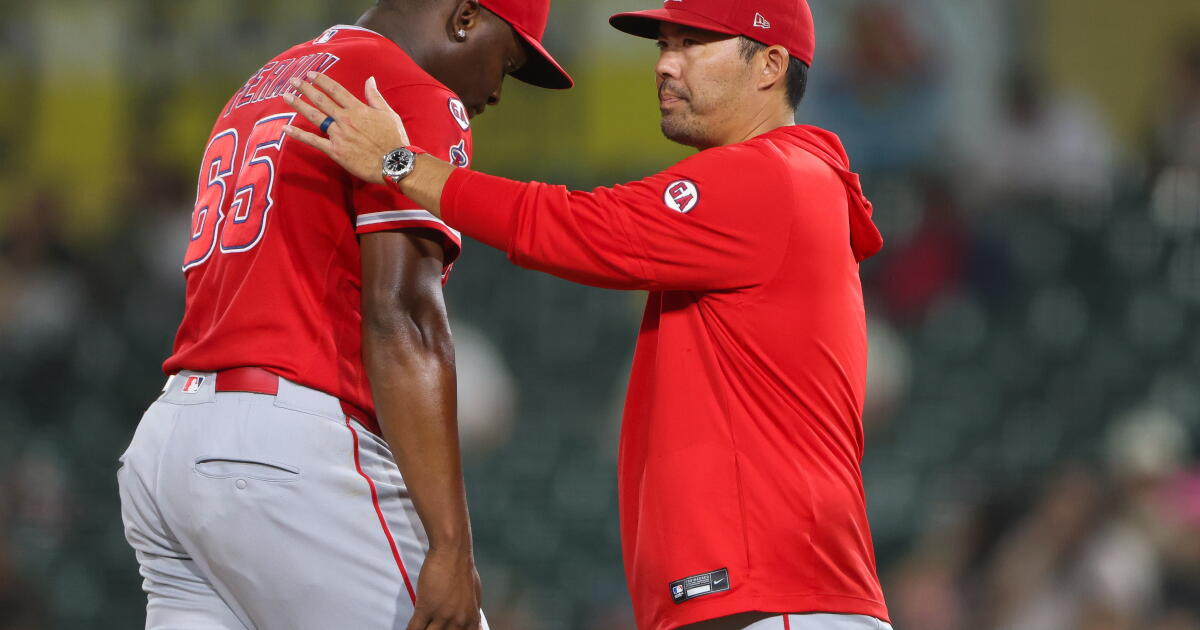
If Padres can sell for $3.9 billion, are we closer to an Angels sale?

I’d heard Arte Moreno had told people recently that he thought the Angels could command $4 billion. He might sell the team. He might not. But the figure seemed ambitious, since no major league team ever had sold for even $3 billion.

Until Friday, that is, when the Wall Street Journal first reported the San Diego Padres were about to be sold for $3.9 billion.

The new owners: a group led by Jose Feliciano of Santa Monica-based Clearlake Capital, which manages more than $90 billion in assets, and his wife, Kwanza Jones. In 2022, Feliciano and Dodgers co-owner Todd Boehly led the investment group that bought Chelsea of the Premier League for $5.2 billion.

The new money should enable the Padres to build upon the legacy of late owner Peter Seidler, who simply disregarded the fact that San Diego ranks as one of the smallest media markets in the major leagues. He spent to win, and the Padres have made the playoffs four times in the past six years — after making the playoffs five times in their first 51 years.

The fans rewarded him, packing Petco Park. As of Friday, the Padres had the second-best record and second-highest attendance in the major leagues. The Dodgers, of course, had the best record and the highest attendance.

The party most immediately interested in the Padres’ sale price? The players’ union, since Commissioner Rob Manfred has cited sluggish appreciation in sale prices as one reason to pursue cost controls on player salaries, whether through a salary cap or some other restriction. In recent years, the owners of the Angels, Minnesota Twins and Washington Nationals all have put their teams on the market without completing a sale.

But Moreno should be interested, too. He turns 80 this summer.

The comparison with the Padres only goes so far. In San Diego, in a city without a team in the NFL, NBA or NHL, the Padres are virtually unchallenged for dollars from fans and corporate sponsors.

And, in San Diego, the Padres play in Southern California’s best ballpark, one the team has turned into a year-round events center, with major concerts in the stadium itself and smaller ones within a delightful park beyond center field.

Could Moreno get $4 billion without a resolution to the long-running ballpark stalemate in Anaheim? It sounds borderline insane to consider that the only available team in America’s second-largest market might not be worth as much as the team that just sold in America’s 30th-largest market.

In Anaheim, however, two deals that would have anchored the Angels there for decades collapsed, and the 60-year-old stadium is in serious need of renovation or replacement. A buyer likely would have to account for the billion-dollar cost of a new ballpark and might ask for a credit against the purchase price, effectively lowering how much profit Moreno could make on the sale.

Any potential buyer should be keeping a close eye on a bill slowly winding its way through the state legislature this year. That bill, if enacted into law, would give the city the ability to loosen development restrictions on the stadium property for a team owner willing to call the team the Anaheim Angels.

Still, even without that legal assist, there should be no shortage of parties interested in acquiring two rarely available assets in one transaction: an MLB team in the Los Angeles market, and a 150-acre site perfect for the mixed-use development coveted by owners in every sport these days.

Golden State Warriors owner Joe Lacob, who once worked as a peanut vendor at Angel Stadium, lost out in the Padres’ bidding and could take another run at the Angels.

Rams owner Stan Kroenke, who lost out in the Dodgers’ bidding in 2012, surrounded the Rams’ Inglewood stadium and Woodland Hills training site with major development and could consider replicating those successes in Anaheim.

Ducks owner Henry Samueli has denied interest in the Angels, but he could consider extending and complementing his OC Vibe development across the 57 Freeway — and his hockey team already wears the Anaheim name.

That assumes, of course, that Moreno opts to sell. He enjoys owning a team and, in a season in which the Angels are one-half game out of first place entering Friday in what appears to be a weak American League West, there is no hurry.

It is considered more likely that Moreno waits until after a new collective bargaining agreement is reached next year to determine whether to sell. All I can tell you for sure Friday is what one baseball official texted me when I asked for reaction to the Padres’ sale: “Great news for the Angels.”

Source link