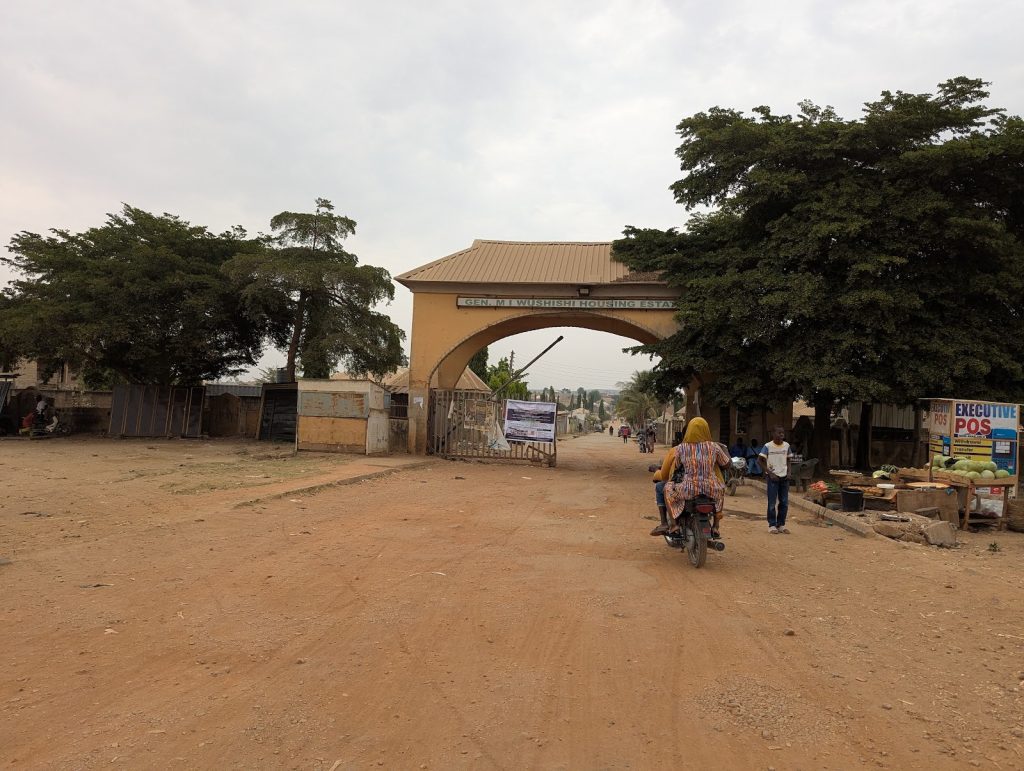
For Ike Uche and many others looking to flee the turmoil of gang violence in Niger State, North Central Nigeria, the eastern bypass area of the Minna metropolis was supposed to be a sanctuary. After years of hard work, Ike finally finished building his house, which is located behind the M. I. Wushishi Housing Estate along the bypass.
For him, the move symbolised a fresh start, a promise of safety, and a chance to raise his family in a peaceful environment. The quiet streets, the open plots waiting for development, and the hum of a growing community gave him hope that life there would be different from New Market, an area notorious for gang violence in Minna. Within a year of moving there, that dream began to die when gold was said to have been discovered in the community.

For about five years now, the silence of his neighbourhood has been broken not by the laughter of children or the bustle of new shops, but by the metallic clang of shovels and the chaos of hundreds of illegal miners, mostly youths.
Illegal miners had occupied lands within the community. Armed with weapons, cutlasses, and knives, and emboldened by impunity, they dig through residential lands in search of gold, carving scars into the earth and into the lives of those who lived there.
At first, Ike thought it was a case of young people constituting a nuisance, but when he confronted the miners who closed onto his property, his worst fears materialised. The same day he confronted them in late 2024, his home was attacked. During the attack, miners rained insults, calling him an enemy of progress and telling him to mind his own business while they focused on theirs.

“They vandalised my house,” he said, his voice heavy with frustration. “People from the ministry came to my house and told me that the government will take action. It’s been over a year now; the situation has only worsened.”
His vehicle was damaged too; his windows were shattered, doors broken, and even his ceiling ripped apart.
“I had to shoulder all the responsibilities to fix everything myself,” he said, pointing to the patched walls and replaced fittings. For him, the cost was not just financial but also emotional: a constant reminder that the safety he sought had been stolen.

Even after the attack, the miners threatened to attack again. What was meant to be a safe haven had gradually changed into a battleground, where the pursuit of illicit wealth outweighed the sanctity of family and home.
“If you come here during the rainy season, you will see more than one thousand people digging through people’s land,” he said. “It’s because we are in the dry season that their presence has reduced, but we still feel threatened by them.”
This climate of fear has silenced many residents. “That is why a lot of people are scared to speak about it publicly because they can be attacked by these boys,” he added.
For many people living in the area, safety has become a significant concern.
“How can one be safe in this kind of environment?” Ike wondered. “If I have another means to leave here, I would because we no longer feel safe here. This is not something somebody will start asking questions about; everybody knows that on the issue of gold mining, the government is not doing anything. The three-arm zone is not far from here; they are seeing it. It’s on the expressway, and they’re not taking any serious action. That is why they are doing it without any fear.”

The damage caused by illegal mining in Minna’s eastern bypass is not limited to land alone; it has seeped into the lives of residents, eroding their sense of safety and community. During field reporting, HumAngle observed how roads once passable have been torn apart by miners digging for gold, leaving behind networks of gullies and broken pathways.


Illegal mining in Niger State’s metropolitan area remains unchecked, characterised by blatant impunity and the failure of security agencies to take decisive action. Massive pits were seen scattered across vast lands. One of the pits was so deep that it held over 15 people in sequence as they disposed of debris. This massive pit sat close to a carcass that was now covered in debris.
Locals, including Muhammad Ndagi, claim that most miners are not originally from Minna, with many arriving from Sokoto and Zamfara in northwestern Nigeria. Armed with machetes, some illegal miners in Minna are emboldened by weak enforcement, vandalising properties, including one belonging to an army general. Beyond the damages, illegal mining sites in Minna have become arenas of violence, where weapons are now part of daily survival.

An illegal miner who simply identifies as Rugged explained that the practice began as a response to constant power struggles among young people in the state capital.
“Miners who are stronger or have the numbers tend to attack the weak ones to collect their gold or money. So, we decided to also come with our weapons in order to protect ourselves and avoid intimidation,” the illicit miner told HumAngle.
Over time, the weapons were not only used against rival miners but also against residents and security personnel. Confirming what residents told HumAngle, Rugged admitted that when community members tried to stop them, they were chased away with threats.

“With the weapons, they were scared, and we would chase them away. We also use them to protect ourselves from security personnel who come to disrupt our activities,” he added.
The presence of men, women, and children at these sites underscores how deeply entrenched their activity has become. Ndagi stated that attempts by Nigeria Civil Defence Corps (NCDC) officers to intervene are often met with hostility, as the miners retaliate as a gang.
“Whenever their vehicles approach, the miners start shouting ‘ƙarya ne!’ and throwing stones,” Ndagi said. “If anyone is arrested by the civil defence officers, the miners converge as a gang to fight them, and at the end they get released before returning to continue their operations.”

“They have left mining activity in the hands of hoodlums who you can’t dare challenge even on your property, and as a taxpayer,” Ndagi lamented.
Residents expressed concerns over the possible consequences of these illegal activities, which include devastating effects on waterways as they expand towards homes, buildings at risk of collapse, and daily clashes involving machetes.
Girls in the pits of gold

Mining activities in the metropolis have also attracted many girls, including school-aged children, who abandon classrooms for the lure of quick earnings. Hannatu Audu, a 16-year-old student of Hilltop Model School, is one of them. She told HumAngle that on some days she earns between ₦10,000 and ₦15,000, and once made as much as ₦300,000 from selling gold. But the money comes at a high cost. In her pursuit of survival, she has nearly lost her life multiple times inside collapsing pits.
On one occasion, after returning to retrieve her pan, the soil caved in and buried her completely.
“I went into the pit to gather materials, and when I came out to look for water to wash and separate the gold, I realised I had forgotten my pan inside. So, I went back in to get it. That was when the soil collapsed and buried me for the third time,” she recalled.
“My friend noticed I hadn’t come out. She saw fresh soil in the pit and shouted for help. People kept digging until they reached my waist; that was when I finally got to breathe. But as they continued, the pit collapsed again. I only woke up the next day to find myself lying on a hospital bed.”
Since the incident, Hannatu has been scared to go back. “I want to, because that’s where we feed from. But anytime I think of going there, I feel something bad will happen to me,” she said. Beyond the physical dangers, Hannatu told HumAngle that she and other girls face constant harassment.

At the sites, men often demand sexual favours, threatening to deny access to pits or refuse assistance with heavy tasks if these are declined.
“There are instances where you need a stronger person to help you, especially in digging or pulling out the debris you intend to wash because it is heavy. So, if you decline their proposal, they will hate you and hinder you from even accessing the pits they have dug,” she noted.

Women and girls in northern Nigeria’s mining sites face severe risks, including sexual harassment, exploitation, and life-threatening accidents, forcing many girls into vulnerable positions, where survival is negotiated not only through labour but also through resisting exploitation.
Hannatu revealed that sympathetic miners intervene to protect them, but the environment remains hostile. “To cope, we form girls-only groups, working together to reduce dependence on men so that we can protect ourselves from predators.
The dangers remain constant. Hannatu acknowledged that she has lost track of how many people have perished in the pits.
“For young girls like myself, mining is both a lifeline and a trap: because it is a place where we can earn enough to feed our families, yet where every day carries the possibility of violence, exploitation, or death,” she noted.
A broader crisis
Illegal mining in Nigeria is not only an economic drain but is also a direct driver of insecurity. According to a 2025 report by the National Assembly Library Trust Fund, unregulated mining sites in the north-central and northwestern states have become fertile ground for armed groups.
Terror groups impose “protection fees” on miners, smuggle minerals to finance weapons, and use mining fields as safe havens. In states like Zamfara, Kaduna, and Niger, the overlap between mining zones and terrorist camps is striking, with many illegal mining sites linked to violent networks, according to the report.

The report also emphasised that mining areas often function as ungoverned spaces, where state authority is absent and criminal groups thrive. Competition over access to gold pits sparks violent clashes, while communities are displaced and stripped of livelihoods.
Illegal mining in Niger State has found its way spreading to parts of Minna metropolis, carving deep scars into several communities and fueling gang violence. A report by the Nigeria Extractive Industries Transparency Initiative (NEITI) ranks the state as having the highest number of illegal mining sites in Nigeria. Areas such as Shiroro, Munya, Rafi, and Paikoro Local Government Areas (LGAs) are the most severely affected. These areas, rich in gold and lithium deposits, have become magnets for unlicensed miners and armed groups.
In Shiroro and Munya, illegal mining fuels insecurity. Armed groups impose “taxes” on miners, using the proceeds to purchase weapons and sustain violent operations. Communities there face displacement, with residents abandoning farmland and homes due to constant attacks.
In areas like Rafi, illegal mining activities have led to environmental devastation, with road networks and farmlands destroyed by uncontrolled digging. In Paikoro and Minna’s outskirts, such as the Pmapi community, residents recount tragic accidents from collapsed pits and violent reprisals when they challenge miners.
In February this year, the Niger State Government ordered the immediate closure of illegal and non-compliant mining sites. The directive followed a joint inspection carried out by the State Ministry of Mineral Resources in collaboration with the Federal Ministry of Solid Minerals Development.
Leading the delegation, the state’s Commissioner for Mineral Resources, Qasim Danjuma, revealed that operators without valid federal licences and proper state documentation would not be allowed to continue operations.
While the move signals the government’s renewed effort to curb illegal mining and enforce compliance in the state’s mineral sector, residents in affected communities in the metropolis believe the government is not walking the talk, as the menace persists.
“Until the government has the political will to stop it, the situation can only get worse, especially as the rainy season is fast approaching,” Ike warned.
Abbas Idris, President of the Risk Managers Society of Nigeria (RIMSON), emphasised that unchecked illegal mining in Minna metropolis could lead to severe environmental damage and security challenges.
Idris warned that illegal mining leads to the destruction of land, ecological balance, and loss of arable land that could have long term consequences.
“Land degradation increases the risk of flooding during the rainy season, leaving communities exposed to disaster. Also, mining activities undermine infrastructure, weakening roads and buildings, which creates hazardous living conditions and communities in the affected areas are bound to face heightened risks due to poor access to safe housing.”
“Most concerning is that illegal mining operations, especially in a state like Niger where terrorists are turning it into a sanctuary, can fuel crime, violence, and conflicts over resources where armed groups exploit the situation, worsening insecurity and displacing populations,” he added.
While criticising weak governance and ineffective law enforcement, Idris warned that unchecked illegal mining devastates society and traps communities in cycles of insecurity and deprivation.
HumAngle has shared the findings of this report with the Niger State government through the Chief Press Secretary, Ibrahim Bologi, who has failed to respond to the questions aimed at providing clarity on illegal mining in Minna metropolis.