violence

Southern Poverty Law Center says it faces a Justice Department criminal probe over paid informants

The Southern Poverty Law Center says it’s the subject of a criminal investigation by the Justice Department and faces possible charges over its past use of paid informants to infiltrate extremist groups.

The civil rights group made the announcement on Tuesday, saying President Trump’s administration appears to be preparing legal action against it or some of its employees.

“Although we don’t know all the details, the focus appears to be on the SPLC’s prior use of paid confidential informants to gather credible intelligence on extremely violent groups,” CEO Bryan Fair said in a statement.

The Justice Department had no immediate comment.

The SPLC previously paid informants to infiltrate extremist groups and gather information on their activities, often sharing it with local and federal law enforcement, Fair said. It was used to monitor threats of violence, he said, adding that the program was kept quiet to protect the safety of informants.

“When we began working with informants, we were living in the shadow of the height of the Civil Rights Movement, which had seen bombings at churches, state-sponsored violence against demonstrators, and the murders of activists that went unanswered by the justice system,” Fair said. “There is no question that what we learned from informants saved lives.”

He said the organization “will vigorously defend ourselves, our staff, and our work.”

The SPLC, which is based in Montgomery, Alabama, was founded in 1971 and used civil litigation to fight white supremacist groups. The nonprofit has become a popular target among Republicans who see it as overly leftist and partisan.

The investigation could add to concerns that Trump’s Republican administration is using the Justice Department to go after conservative opponents and his critics. It follows a number of other investigations into Trump foes that have raised questions about whether the law enforcement agency has been turned into a political weapon.

The Southern Poverty Law Center has faced intense criticism from conservatives, who have accused it of unfairly maligning right-wing organizations as extremist groups because of their viewpoints. The SPLC regularly condemns Trump’s rhetoric and policies around voting rights, immigration and other issues.

The SPLC came under fresh scrutiny after the assassination last year of conservative activist Charlie Kirk brought renewed attention to its characterization of the group that Kirk founded and led. The SPLC included a section on that group, Turning Point USA, in a report titled “The Year in Hate and Extremism 2024” that described the group as “A Case Study of the Hard Right in 2024.”

FBI Director Kash Patel said last year that the agency was severing its relationship with the SPLC, which had long provided law enforcement with research on hate crime and domestic extremism. Patel said the SPLC had been turned into a “partisan smear machine,” and he accused it of defaming “mainstream Americans” with its “hate map” that documents alleged anti-government and hate groups inside the United States.

House Republicans hosted a hearing centered on the SPLC in December, saying it coordinated efforts with President Joe Biden’s Democratic administration “to target Christian and conservative Americans and deprive them of their constitutional rights to free speech and free association.”

Binkley and Richer write for the Associated Press.

Source link

Eight children killed in Louisiana shooting, gunman fatally shot by police | Gun Violence News

DEVELOPING STORY,

Louisiana community in shock as domestic violence incident leaves eight children dead and two others injured.

Eight children have been killed in a shooting spree in the southern US state of Louisiana, in what police said appears to have been an incident of domestic violence.

The gunman, who was not immediately identified, was fatally shot by police after a car chase early Sunday, officials said.

The incident occurred in Shreveport, northwestern Louisiana.

“This is a rather extensive crime scene spanning between two residences,” Shreveport Police Corporal Chris Bordelon told a press conference, adding that a third residence was also part of the scene being combed by investigators.

The victims ranged in age from one to 14, Bordelon said.

“Some of the children inside were his descendants,” he added.

Two other people were struck by gunfire, but their conditions were not immediately known.

Officials said they were still gathering details about the crime scene, which extended across three locations. Police Chief Wayne Smith said the suspected shooter was fatally shot by police during a vehicle chase.

“This is an extensive scene, unlike anything most of us have ever seen,” Smith added.

Louisiana State Police say their detectives have been asked by Shreveport police to investigate. In a statement, state police say no officers were harmed in the shooting that involved an officer after a police pursuit into Bossier City on Sunday morning.

State police are asking anyone with pictures, video or information to share it with state police detectives.

Source link

Ukraine police shoot dead gunman who killed six in Kyiv, took hostages | Gun Violence News

The attacker has been identified as a “58-year-old Moscow man”, but no motive has been established.

A gunman who killed at least six people in Kyiv and took hostages has been shot dead by Ukrainian police, officials said.

The attack occurred on Saturday in the capital’s Holosiivskyi district, where the assailant opened fire on civilians in the street before barricading himself inside a nearby supermarket, Kyiv Mayor Vitali Klitschko said on Telegram.

Recommended Stories

list of 4 itemsend of list

Special tactical police units stormed the supermarket after roughly 40 minutes of failed negotiations, Interior Minister Ihor Klymenko said on Telegram. The gunman shot at police officers during the standoff.

“We tried to persuade him, knowing that there was likely a wounded person inside,” Klymenko told The Associated Press news agency. “We even offered to bring in tourniquets to stop the bleeding, but he did not respond.”

Ultimately, authorities were given the order to “neutralise” the attacker, he said.

At least 10 others were hospitalised, including one child, and four hostages were rescued, President Volodymyr Zelenskyy said in a post on X.

Special Forces Police Unit evacuate the hostage at the site of a shooting incident, in Kyiv, Ukraine, April 18, 2026. Picture taken with a mobile phone. REUTERS/Stringer TPX IMAGES OF THE DAY
Special Forces Police Unit evacuate a hostage at the site of a shooting incident, in Kyiv, Ukraine, April 18, 2026 [Reuters]

Prosecutor General Ruslan Kravchenko said the attacker was a 58-year-old born in Moscow.

Klymenko said the man was carrying a legally registered gun and had approached licensing authorities as recently as December 2025 to renew his weapons permit, submitting a valid medical certificate at the time. He added that investigators would determine which medical institution issued the document.

Zelenskyy offered his condolences to the families of the victims, saying he had instructed officials to make all verified information publicly available. “We expect a swift investigation,” he wrote.

Source link

Hegseth recites ‘Pulp Fiction’ speech at Pentagon prayer service

Defense Secretary Pete Hegseth, leading a Pentagon prayer meeting, quoted a fictional bible verse taken from a violent monologue in Quentin Tarantino’s 1994 film “Pulp Fiction,” originally delivered by actor Samuel L. Jackson just before his character shoots a helpless man to death.

The secretary used the prayer to frame the war in Iran as an act of divine justice, the same justification Jackson’s character cites in the film before pulling the trigger.

Hegseth told the audience at a monthly Pentagon worship service held Wednesday that he learned the prayer from the lead mission planner of a team called “Sandy 1,” which recently rescued downed Air Force crew members in Iran.

Hegseth said the verse is frequently spoken by combat search-and-rescue crews, who call the prayer “CSAR 25:17, which I think is meant to reflect Ezekiel 25:17” from the Bible.

“And I will strike down upon thee with great vengeance and furious anger those who attempt to capture and destroy my brother,” Hegseth recited. “And you will know my call sign is Sandy 1, when I lay my vengeance upon thee.”

The infamous Ezekiel 25:17 speech from “Pulp Fiction” is almost entirely a screenwriter’s creation; only the final refrain is loosely inspired by the actual biblical verse. The majority of the monologue in Tarantino’s film is adapted from the opening of the 1976 Japanese martial arts film “The Bodyguard,” with action star Sonny Chiba.

Hegseth’s minute-long prayer closely followed those scripts, with only the last two lines resembling language from the Bible. In Hegseth’s version, he replaced “and they shall know that I am the Lord,” from the book of Ezekiel with the call sign for a U.S. A-10 Warthog aircraft.

Chief Pentagon Spokesman Sean Parnell said some outlets accused Hegseth of mistaking Jackson’s Golden Globe-winning performance with actual scripture, and called that narrative “fake news.”

“Secretary Hegseth on Wednesday shared a custom prayer, referenced as the CSAR prayer, used by the brave warfighters of Sandy-1 who led the daylight rescue mission of Dude 44 Alpha out of Iran, which was obviously inspired by dialogue in Pulp Fiction,” Parnell wrote on X. “However, both the CSAR prayer and the dialogue in Pulp Fiction were reflections of the verse Ezekiel 25:17, as Secretary Hegseth clearly said in his remarks at the prayer service. Anyone saying the Secretary misquoted Ezekiel 25:17 is peddling fake news and ignorant of reality.”

Hegseth has frequently used his prayer sessions to call for violence in the ongoing Iran war. In last month’s sermon, he asked God to “grant this task force clear and righteous targets for violence.”

The services are not mandatory, a senior defense analyst with knowledge of Pentagon operations told The Times, but some who work closely with Hegseth’s office feel an “implied pressure” to attend and “fill seats.”

The effect — some feel — is less attention on the Pentagon’s wartime efforts, and more on supporting political stunts, according to the source, who is not authorized to speak to the media and requested anonymity.

“We have managers and leaders that are missing mission critical work to go listen to ‘Pulp Fiction’ quotes,” the source said. “It delays our ability to make operational, mission related war-fighting decisions.”

The prayer came amid an ongoing clash between the Trump administration and Pope Leo XIV, who has spoken out in recent weeks against the U.S.-Israeli war in Iran. Statements from the Vatican were met with a series of reprisals from President Trump, who said he doesn’t “want a pope” who criticizes the president of the United States.

On Thursday, the pope released a statement against military leaders who conflate war with divinity.

“Woe to those who manipulate religion and the very name of God for their own military, economic, and political gain, dragging that which is sacred into darkness and filth,” he said.

Source link

‘Endless grief’: Turkiye mourns victims of second school shooting in a week | Gun Violence News

Death toll rises to 10 after shooting by 14-year-old student at the Ayser Calik School in Kahramanmaras.

Mourners have gathered in Turkiye’s southern province of Kahramanmaras for the funerals of victims killed in the second of two school shootings that rocked the nation this week.

Funerals were held on Thursday for eight students and maths teacher Ayla Kara, 55, who were killed in Wednesday’s shooting, The Associated Press news agency reported.

Recommended Stories

list of 3 itemsend of list

A 10th victim died while being treated in hospital on Thursday, authorities said. Six of those wounded in the attack were in critical condition, officials said.

Isa Aras Mersinli, 14, opened fire on two classrooms in the Ayser Calik School in Kahramanmaras city on Wednesday. The attacker was later found dead.

Interior Minister Mustafa Ciftci said the attacker is believed to have used guns that belonged to his father, a former police officer.

Coffin of a victim of a school shooting in Turkiye
People carry the coffin of a victim of a school shooting during the funeral prayers at a mosque in Kahramanmaras, Turkiye, on April 16, 2026 [Ensar Ozdemir/Reuters]

At a funeral for four of the victims held near Kahramanmaras city’s main mosque on Thursday, one father sat motionless beside the coffin of his daughter, 10‑year‑old Zeynep, the AFP news agency reported.

“Our grief is endless. These children were like our own. They were all innocent,” said Vezir Yucel, father of a student named Yusuf, who lost his close friend, 10-year-old Bayram, in the shooting.

Nilgun Ruci, a 55‑year‑old homemaker, told AFP that she rushed to Ayser Calik School after hearing gunshots. When she arrived, she saw the daughter of a neighbour lying gravely wounded.

“She had been shot in the leg and the shoulder,” Ruci said. “At first, I thought she had fainted. Today I learned that she died.”

Second attack in two days

The attack was the country’s second school shooting in two days, coming after Tuesday’s attack at a high school in Sanliurfa province in the southeast, which was carried out by a former student who wounded 16 people.

As of Thursday, 20 people had been detained in connection with Tuesday’s shooting in Sanliurfa.

The interior and education ministries held a joint school security meeting in the capital, Ankara, on Thursday, which was attended by both ministers and all 81 of Turkiye’s provincial governors, as well as police chiefs and provincial education directors.

Until this week, school shootings were rare in Turkiye. But dozens of students were arrested Thursday over alleged social media posts implying they might stage similar attacks.

Justice Minister Akin Gurlek announced that 67 social media users were detained over posts targeting 54 different schools.

Source link

Taylor Frankie Paul won’t face domestic violence charges

Taylor Frankie Paul won’t face criminal charges in connection with alleged domestic violence incidents between her and her ex-boyfriend, the Salt Lake County district attorney’s office said Tuesday.

The embattled “Secret Lives of Mormon Wives” star’s cases were reviewed by multiple attorneys due to their high-profile nature, according to the district attorney’s office.

“After reviewing reports and evidence submitted to the Draper Police Department and West Jordan Police Department, the Salt Lake County District Attorney’s Office has declined to file charges against Taylor Frankie Paul,” the statement reads.

According to the news release, Dakota Mortensen, Paul’s ex and the father of her youngest child, reported several domestic violence incidents, “some of which occurred more than three years ago.”

“Any incidents of misdemeanor offenses which are alleged to have occurred more than two years ago are barred by the statute of limitations,” the district attorney’s office wrote, adding that “several incidents that were submitted do not rise to the level of criminal offenses.” The remaining incidents lack sufficient evidence to support filing criminal charges, according to the district attorney’s office.

Mortensen filed a report with the West Jordan Police Department in Utah in February alleging an incident of domestic violence that he said occurred in early to mid-2024. Utah’s Draper Police Department was also looking into a separate incident involving the former couple.

Days before the premiere of Season 22 of “The Bachelorette,” in which Paul was set to star, a leaked video of a 2023 domestic dispute between Paul and Mortensen circulated online.

That 2023 incident resulted in Paul being arrested. She eventually pleaded guilty in abeyance to aggravated assault, and Paul’s arrest was featured in the first season of “Secret Lives.”

Although the incident had already been addressed publicly and dealt with in court, the leaked video featured previously unseen footage of the dispute. As a result, Paul was hit with a restraining order, she temporarily lost custody of Ever, the 2-year-old son she shares with Mortensen, and ABC pulled “The Bachelorette.” Production on the hit reality series had already wrapped and the premiere was slated for March 22.

Last week, a Utah judge ruled that Paul can have supervised visits with Ever, until another hearing for a protective order later this month.

The exes are also ordered to appear remotely at a court hearing April 30 to review the merits of Mortensen’s protective order against Paul. Paul has also filed her own protective order against Mortensen, which a Utah judge signed off on last week.

Mortensen sought a protective order after two incidents in February that involved “grabbing, scratching, shoving, and striking” that allegedly left Mortensen with marks on his neck, according to police documents. A judge granted the order last month.

Source link

Justice Department fires four prosecutors accused of bias against anti-abortion activists

The Trump administration fired four Justice Department prosecutors involved in cases against anti-abortion activists, accusing the Biden administration on Tuesday of abusing a law designed to protect abortion clinics from obstruction and threats.

The firings are the latest wave of terminations of employees involved in cases criticized by conservatives or because they were perceived as insufficiently loyal to President Trump’s agenda. The terminations came before the release of a report accusing the Biden administration of biased prosecutions under the Freedom of Access to Clinic Entrances Act or FACE Act.

“This Department will not tolerate a two-tiered system of justice,” Todd Blanche, the acting attorney general, said in a statement. “No Department should conduct selective prosecution based on beliefs. The weaponization that happened under the Biden Administration will not happen again, as we restore integrity to our prosecutorial system.”

The report is the first released from the Justice Department’s “Weaponization Working Group,” created by former Atty. Gen. Pam Bondi to scrutinize the federal prosecutions of Trump and other cases criticized by conservatives.

Biden’s attorney general, Merrick Garland, and Jack Smith, the special counsel who prosecuted Trump, have said they followed only the facts, the evidence and the law in their decisions. Critics of the Trump administration say Bondi — who was fired by Trump this month — and Blanche are the ones who politicized the agency, with the norm-breaking actions that have stirred concern that the institution is being used as a tool to advance Trump’s personal and political agenda.

The Biden administration brought cases against dozens of defendants under the FACE Act, which makes it illegal to physically obstruct or use the threat of force to intimidate or interfere with a person seeking reproductive health services, and prohibits damaging property at abortion clinics and other centers. It was signed into law in 1994, when clinic protests and blockades were on the rise along with violence against abortion providers such as Dr. David Gunn, who was murdered.

The Trump administration alleges in the report that prosecutors under Biden often “ignored and downplayed” attacks against pregnancy resource centers or houses of worship, which are also protected under the law. It also claims that the Biden administration pushed for harsher sentences against anti-abortion activists than it did in cases against abortion-rights defendants. Trump last year pardoned anti-abortion activists convicted of blockading abortion clinic entrances, calling them “peaceful pro-life protesters.”

Kristen Clarke, who led the Justice Department’s Civil Rights Division under Biden, defended the prosecutions, saying the attorneys “enforced the law even-handedly and put public safety at the center of this work.”

“The Civil Rights Division brought law enforcement leaders, crisis pregnancy center representatives, faith leaders, and reproductive health care staff together to address the real violence, threats of violence, and obstruction that too many people face in our country when it comes to reproductive health care,” Clarke said in an emailed statement on Tuesday.

The firings are part of a broader personnel purge that has shaken career Justice Department lawyers generally insulated from changes in administrations thanks to long-recognized civil service protections.

Justice Connection, a network of former department employees, said the agency leadership’s “cruelty and hypocrisy are on full display in this report.”

“They insist on zealous advocacy by career staff in advancing the President’s priorities, while shaming and firing those who did just that in the prior administration,” Stacey Young, a former department lawyer who founded Justice Connection, said in a statement. “They’ve put career employees on notice: if they do their jobs, they face potential termination if future political leadership disagrees with the policy goals of prior leadership.”

Richer writes for the Associated Press.

Source link

Illicit Gold Mining Is Fueling Gang Violence in Niger State’s Capital City

For Ike Uche and many others looking to flee the turmoil of gang violence in Niger State, North Central Nigeria, the eastern bypass area of the Minna metropolis was supposed to be a sanctuary. After years of hard work, Ike finally finished building his house, which is located behind the M. I. Wushishi Housing Estate along the bypass.

For him, the move symbolised a fresh start, a promise of safety, and a chance to raise his family in a peaceful environment. The quiet streets, the open plots waiting for development, and the hum of a growing community gave him hope that life there would be different from New Market, an area notorious for gang violence in Minna. Within a year of moving there, that dream began to die when gold was said to have been discovered in the community. 

A motorbike and pedestrians pass through a dusty archway entrance with surrounding trees and small shops.
Gen. M. I. Wushishi housing estate along the eastern bypass of Minna. Photo: Isah Ismaila/HumAngle.

For about five years now, the silence of his neighbourhood has been broken not by the laughter of children or the bustle of new shops, but by the metallic clang of shovels and the chaos of hundreds of illegal miners, mostly youths. 

Illegal miners had occupied lands within the community. Armed with weapons, cutlasses, and knives, and emboldened by impunity, they dig through residential lands in search of gold, carving scars into the earth and into the lives of those who lived there.  

At first, Ike thought it was a case of young people constituting a nuisance, but when he confronted the miners who closed onto his property, his worst fears materialised. The same day he confronted them in late 2024, his home was attacked. During the attack, miners rained insults, calling him an enemy of progress and telling him to mind his own business while they focused on theirs.

Close-up of a textured surface with an irregular dark spot surrounded by lighter, cloudy patterns.
One of the illegal miners in the area washed small pieces of gold. This act continues through the day until they have gathered enough to sell. Photo: Isah Ismaila/HumAngle.

“They vandalised my house,” he said, his voice heavy with frustration. “People from the ministry came to my house and told me that the government will take action. It’s been over a year now; the situation has only worsened.”

His vehicle was damaged too; his windows were shattered, doors broken, and even his ceiling ripped apart.

“I had to shoulder all the responsibilities to fix everything myself,” he said, pointing to the patched walls and replaced fittings. For him, the cost was not just financial but also emotional: a constant reminder that the safety he sought had been stolen.  

People working at a construction or excavation site, with tools and muddy water around, near a brick wall and shrubs.
Illegal miners washing materials behind Mr Uche’s house in the Kafin Tela area of the bypass. Photo: Isah Ismaila/HumAngle.

Even after the attack, the miners threatened to attack again. What was meant to be a safe haven had gradually changed into a battleground, where the pursuit of illicit wealth outweighed the sanctity of family and home.

“If you come here during the rainy season, you will see more than one thousand people digging through people’s land,” he said. “It’s because we are in the dry season that their presence has reduced, but we still feel threatened by them.”

This climate of fear has silenced many residents. “That is why a lot of people are scared to speak about it publicly because they can be attacked by these boys,” he added.

For many people living in the area, safety has become a significant concern.

“How can one be safe in this kind of environment?” Ike wondered. “If I have another means to leave here, I would because we no longer feel safe here. This is not something somebody will start asking questions about; everybody knows that on the issue of gold mining, the government is not doing anything. The three-arm zone is not far from here; they are seeing it. It’s on the expressway, and they’re not taking any serious action. That is why they are doing it without any fear.”

A person in a helmet and work gear is digging at the bottom of a deep earthen hole, surrounded by bags and dirt.
An illegal miner is digging in a pit to gather sand, which will be washed to separate the gold from the dirt. Photo: Isah Ismaila/HumAngle.

The damage caused by illegal mining in Minna’s eastern bypass is not limited to land alone; it has seeped into the lives of residents, eroding their sense of safety and community. During field reporting, HumAngle observed how roads once passable have been torn apart by miners digging for gold, leaving behind networks of gullies and broken pathways.

Houses with tin roofs behind a stone wall, surrounded by an empty, rocky, reddish-brown plot.
As miners dug through the foundation of this fence in search of gold, it collapsed, leaving the owner to bear the loss. Photo: Isah Ismaila/HumAngle.
People working in a large, stepped sandy excavation site, scattered across different levels, with tools and equipment visible.
Fifteen illegal miners line up in sequence to bring out sand materials from the deep pit they dug, which looks like an excavated site. Photo: Isah Ismaila/HumAngle.

Illegal mining in Niger State’s metropolitan area remains unchecked, characterised by blatant impunity and the failure of security agencies to take decisive action. Massive pits were seen scattered across vast lands. One of the pits was so deep that it held over 15 people in sequence as they disposed of debris. This massive pit sat close to a carcass that was now covered in debris.

Locals, including Muhammad Ndagi, claim that most miners are not originally from Minna, with many arriving from Sokoto and Zamfara in northwestern Nigeria. Armed with machetes, some illegal miners in  Minna are emboldened by weak enforcement, vandalising properties, including one belonging to an army general. Beyond the damages, illegal mining sites in Minna have become arenas of violence, where weapons are now part of daily survival. 

People working near a pit, with bags and a bowl of water on the ground, surrounded by dry vegetation.
Rugged hangs his machete, which he uses for protection and intimidating residents who dare interfere in their business. Photo: Isah Ismaila/HumAngle.

An illegal miner who simply identifies as Rugged explained that the practice began as a response to constant power struggles among young people in the state capital.

“Miners who are stronger or have the numbers tend to attack the weak ones to collect their gold or money. So, we decided to also come with our weapons in order to protect ourselves and avoid intimidation,” the illicit miner told HumAngle.  

Over time, the weapons were not only used against rival miners but also against residents and security personnel. Confirming what residents told HumAngle, Rugged admitted that when community members tried to stop them, they were chased away with threats.

A person with a tool in hand walks down a stepped, rocky terrain, surrounded by earthy walls.
An armed vigilante was sighted within the illegal mining site. Miners say they sometimes show up to settle any scuffle between the miners. Photo: Isah Ismaila/HumAngle.

“With the weapons, they were scared, and we would chase them away. We also use them to protect ourselves from security personnel who come to disrupt our activities,” he added.  

The presence of men, women, and children at these sites underscores how deeply entrenched their activity has become. Ndagi stated that attempts by Nigeria Civil Defence Corps (NCDC) officers to intervene are often met with hostility, as the miners retaliate as a gang.

“Whenever their vehicles approach, the miners start shouting ‘ƙarya ne!’ and throwing stones,” Ndagi said. “If anyone is arrested by the civil defence officers, the miners converge as a gang to fight them, and at the end they get released before returning to continue their operations.”  

Dry, rocky landscape with several deep holes scattered across the surface under a cloudy sky. Sparse vegetation in the background.
Several pits are scattered across one of the lands within the area. Miners have abandoned the place due to its lack of gold, leaving the owner devastated. Photo: Isah Ismaila/HumAngle.

“They have left mining activity in the hands of hoodlums who you can’t dare challenge even on your property, and as a taxpayer,” Ndagi lamented.

Residents expressed concerns over the possible consequences of these illegal activities, which include devastating effects on waterways as they expand towards homes, buildings at risk of collapse, and daily clashes involving machetes.

Girls in the pits of gold

Young person in an orange hijab sits on the ground outdoors, with a wall and a gate in the background.
Hannatu Audu escaped death three times at the mining site along the eastern bypass. She abandons school for mining, where she and other young girls are confronted with constant harassment. Photo: Isah Ismaila/HumAngle.

Mining activities in the metropolis have also attracted many girls, including school-aged children, who abandon classrooms for the lure of quick earnings. Hannatu Audu, a 16-year-old student of Hilltop Model School, is one of them. She told HumAngle that on some days she earns between ₦10,000 and ₦15,000, and once made as much as ₦300,000 from selling gold. But the money comes at a high cost. In her pursuit of survival, she has nearly lost her life multiple times inside collapsing pits. 

On one occasion, after returning to retrieve her pan, the soil caved in and buried her completely. 

“I went into the pit to gather materials, and when I came out to look for water to wash and separate the gold, I realised I had forgotten my pan inside. So, I went back in to get it. That was when the soil collapsed and buried me for the third time,”  she recalled.

“My friend noticed I hadn’t come out. She saw fresh soil in the pit and shouted for help. People kept digging until they reached my waist; that was when I finally got to breathe. But as they continued, the pit collapsed again. I only woke up the next day to find myself lying on a hospital bed.” 

Since the incident, Hannatu has been scared to go back.  “I want to, because that’s where we feed from. But anytime I think of going there, I feel something bad will happen to me,” she said. Beyond the physical dangers, Hannatu told HumAngle that she and other girls face constant harassment. 

People digging in a dry, barren landscape with small pools of water.
Young girls at the mining site sand washing materials in search of gold. Photo: Isah Ismaila/HumAngle.

At the sites, men often demand sexual favours, threatening to deny access to pits or refuse assistance with heavy tasks if these are declined.

“There are instances where you need a stronger person to help you, especially in digging or pulling out the debris you intend to wash because it is heavy. So, if you decline their proposal, they will hate you and hinder you from even accessing the pits they have dug,” she noted. 

A group of four people sitting in a large hole dug in the ground, surrounded by loose dirt.
Young boys inside one of the pits in search of gold. Photo: Isah Ismaila/HumAngle.

Women and girls in northern Nigeria’s mining sites face severe risks, including sexual harassment, exploitation, and life-threatening accidents, forcing many girls into vulnerable positions, where survival is negotiated not only through labour but also through resisting exploitation. 

Hannatu revealed that sympathetic miners intervene to protect them, but the environment remains hostile. “To cope, we form girls-only groups, working together to reduce dependence on men so that we can protect ourselves from predators. 

The dangers remain constant. Hannatu acknowledged that she has lost track of how many people have perished in the pits.

“For young girls like myself, mining is both a lifeline and a trap: because it is a place where we can earn enough to feed our families, yet where every day carries the possibility of violence, exploitation, or death,” she noted.

A broader crisis 

Illegal mining in Nigeria is not only an economic drain but is also a direct driver of insecurity. According to a 2025 report by the National Assembly Library Trust Fund, unregulated mining sites in the north-central and northwestern states have become fertile ground for armed groups. 

Terror groups impose “protection fees” on miners, smuggle minerals to finance weapons, and use mining fields as safe havens. In states like Zamfara, Kaduna, and Niger, the overlap between mining zones and terrorist camps is striking, with many illegal mining sites linked to violent networks, according to the report.

Excavated site with deep trenches and unfinished brick structures in a developing area, with houses visible in the background.
One of the mining pits at the edge of a partially covered carcass, with the foundation visible. Photo: Isah Ismaila/HumAngle.

The report also emphasised that mining areas often function as ungoverned spaces, where state authority is absent and criminal groups thrive. Competition over access to gold pits sparks violent clashes, while communities are displaced and stripped of livelihoods.

Illegal mining in Niger State has found its way spreading to parts of Minna metropolis, carving deep scars into several communities and fueling gang violence. A report by the Nigeria Extractive Industries Transparency Initiative (NEITI) ranks the state as having the highest number of illegal mining sites in Nigeria. Areas such as Shiroro, Munya, Rafi, and Paikoro Local Government Areas (LGAs) are the most severely affected. These areas, rich in gold and lithium deposits, have become magnets for unlicensed miners and armed groups.  

In Shiroro and Munya, illegal mining fuels insecurity. Armed groups impose “taxes” on miners, using the proceeds to purchase weapons and sustain violent operations. Communities there face displacement, with residents abandoning farmland and homes due to constant attacks. 

In areas like Rafi, illegal mining activities have led to environmental devastation, with road networks and farmlands destroyed by uncontrolled digging. In Paikoro and Minna’s outskirts, such as the Pmapi community, residents recount tragic accidents from collapsed pits and violent reprisals when they challenge miners.

In February this year, the Niger State Government ordered the immediate closure of illegal and non-compliant mining sites. The directive followed a joint inspection carried out by the State Ministry of Mineral Resources in collaboration with the Federal Ministry of Solid Minerals Development.  

Leading the delegation, the state’s Commissioner for Mineral Resources, Qasim Danjuma, revealed that operators without valid federal licences and proper state documentation would not be allowed to continue operations. 

While the move signals the government’s renewed effort to curb illegal mining and enforce compliance in the state’s mineral sector, residents in affected communities in the metropolis believe the government is not walking the talk, as the menace persists. 

“Until the government has the political will to stop it, the situation can only get worse, especially as the rainy season is fast approaching,” Ike warned.

Abbas Idris, President of the Risk Managers Society of Nigeria (RIMSON), emphasised that unchecked illegal mining in Minna metropolis could lead to severe environmental damage and security challenges. 

Idris warned that illegal mining leads to the destruction of land, ecological balance, and loss of arable land that could have long term consequences.

“Land degradation increases the risk of flooding during the rainy season, leaving communities exposed to disaster. Also, mining activities undermine infrastructure, weakening roads and buildings, which creates hazardous living conditions and communities in the affected areas are bound to face heightened risks due to poor access to safe housing.”

“Most concerning is that illegal mining operations, especially in a state like Niger where terrorists are turning it into a sanctuary, can fuel crime, violence, and conflicts over resources where armed groups exploit the situation, worsening insecurity and displacing populations,” he added.

While criticising weak governance and ineffective law enforcement, Idris warned that unchecked illegal mining devastates society and traps communities in cycles of insecurity and deprivation.

HumAngle has shared the findings of this report with the Niger State government through the Chief Press Secretary, Ibrahim Bologi, who has failed to respond to the questions aimed at providing clarity on illegal mining in Minna metropolis.

Source link

Under L.A. mayor’s $300-million homeless program, 40% have returned to the street

It was a risky move and Jonathan Torres knew it, but he did it anyway. He let an out-of-town guest stay with him in his room.

Torres, 40, had been living at the Highland Park Motel as part of Inside Safe, Mayor Karen Bass’ flagship program to combat homelessness. He and his neighbors, many of them from a downtown encampment, were told that visitors were not allowed.

Still, Torres kept having people over. After the third violation, he said, the facility kicked him out.

Jonathan Torres spent about two years living in a city-leased motel in Highland Park.

Jonathan Torres spent about two years in a city-leased motel in Highland Park. He told The Times he was kicked out of the facility in December.

(Myung J. Chun / Los Angeles Times)

“It’s nobody’s fault but my own, but I just feel it’s unfair,” said Torres, who now lives in a tent in Chinatown. “In the real world, you’re allowed to have people come over. You have visitors. That’s part of keeping your sanity, you know?”

Los Angeles has spent more than $300 million on Inside Safe since Bass launched the program in December 2022, clearing scores of homeless encampments and moving about 5,800 people into interim housing — mostly hotels and motels. The goal was to get each of those people into permanent housing, typically taxpayer-funded apartments.

But even as the mayor’s initiative brings more people indoors, a growing number are winding up back on the street.

About This Story

The Times’ reporting on Mayor Karen Bass’ Inside Safe program was undertaken as part of the USC Annenberg Center for Health Journalism’s 2025 Data Fellowship.

The longer the program exists, the greater the share of participants who have returned to “unsheltered” homelessness, according to monthly dashboards which were posted by the Los Angeles Homeless Services Authority, or LAHSA, and analyzed by The Times.

Jeremiah Flores packs up his belongings for interim housing through the Inside Safe Program in North Hollywood.

Jeremiah Flores, center, packs up his belongings during an Inside Safe operation in North Hollywood last month.

In 2023, at the program’s one-year mark, nearly 20% had returned to the street, according to numbers posted by LAHSA at the time.

Halfway into Bass’ four-year term, the figure had climbed above 30%.

In December, as the program finished its third year, about 40% of the people who had gone indoors — 2,300 of the 5,800 — were back on the street, according to LAHSA’s dashboard. That includes people who were kicked out of their housing or disappeared from the system altogether.

The growing exodus reflects the challenges Bass faces while trying to help some of the city’s neediest residents, many of whom struggle with mental health conditions, substance use issues or major physical ailments.

Los Angeles sanitation workers clean a homeless encampment along Hollywood Boulevard in 2024.

Workers with Mayor Karen Bass’ Inside Safe program clean up a homeless encampment along Hollywood Boulevard in 2024.

(Brian van der Brug / Los Angeles Times)

Bass, asked about the worrisome trend, said she believes that Inside Safe participants need more services to address those issues. She also said she suspects that the longer people stay, the more likely they are to violate the rules and face expulsion.

The goal of Inside Safe is to find permanent homes within 90 days, with a maximum stay of six months, according to the written agreement issued by the city to each participant.

At this point, the average stay is 362 days — just shy of a year, according to recent LAHSA figures.

Bass did not offer any definitive conclusions, saying the city now has outside researchers assessing the problem.

“It’s critically important that we look at the people who left, why they left [and] what do we need to do strengthen the interim housing that we have,” she said. “I have my opinions about it, but the opinions have to be based in science.”

Bass has staked much of her reelection campaign on her handling of the homelessness crisis, which she made a top priority as soon as she took office. She credits Inside Safe with producing a 17.5% drop in “unsheltered homelessness” — people living outdoors or in their vehicles — over a two-year span. That number fell from about 33,000 to nearly 27,000, according to the most recent homeless count.

Los Angeles Mayor Karen Bass prepares to leave a large homeless encampment in Van Nuys.

Los Angeles Mayor Karen Bass prepares to leave a homeless encampment along the San Diego (405) Freeway in Van Nuys targeted by Inside Safe in July. “The homeless should never be living in these conditions,” she said.

By clearing encampments, Inside Safe also benefits the surrounding community, making sidewalks more accessible and reducing the number of encampment fires, Bass said.

UCLA Law School professor emeritus Gary Blasi, an expert on homelessness, said the program has become too expensive to justify the results — and is in need of “a thorough re-engineering.”

Blasi said there were never enough vouchers and low-cost apartments to provide permanent housing to Inside Safe participants in a timely way. As a result, the city has been paying for them to live in expensive motel rooms for long stretches, he said.

“Once they started having people in interim housing for nine months or a year, that should have rang some alarm bells, because that’s just not sustainable,” he said.

July 2025 image of an officer walking through a large homeless encampment in Van Nuys.

Last summer, the Inside Safe program cleared away a large homeless encampment next to the San Diego Freeway in Van Nuys. Some residents went to the Budget Inn in North Hills.

Inside Safe participants also face a wide array of rules. They are barred from leaving the premises for three consecutive days without prior approval. Alcohol and illegal drugs are prohibited in their rooms, which are inspected multiple times a day.

Participants also are frequently barred from bringing in outside food, to keep from attracting roaches, mice and other pests.

“The rules are dumb. They treat houseless people like children. They don’t give people agency,” said Paisley Mares, who lives in an RV in the San Fernando Valley and has several friends who took part in the program.

Executives with the nonprofit groups that run the Inside Safe facilities said the restrictions are needed to protect residents, keeping them on track to find permanent housing.

Violence, threats of violence and property damage are prohibited, and can result in immediate removal from the program. The ban on guests is designed to prevent people from being physically attacked, sexually assaulted or engaging in high-risk behavior, such as drug use, behind closed doors, those nonprofit leaders said.

“We are bringing people indoors, mostly from encampments, where drugs are often the trade of the street. There is also often physical violence. That’s the way people survive on the streets,” said John Maceri, chief executive officer of the nonprofit the People Concern, which runs two Inside Safe motels in Hollywood. “All of those behaviors don’t stop when people come into an Inside Safe setting.”

Executives at the People Concern estimate that 50% to 65% of the shelter clients they work with — not just for Inside Safe, but other homeless housing programs — have serious issues with drugs or alcohol. The number with serious mental health issues, particularly trauma, is also “very high,” they said.

Inside Safe providers acknowledged that motel rooms can be a huge adjustment, leaving people feeling lonely and isolated. They said they work closely with participants to improve their behavior — and turn to expulsion only as a last resort.

“My goal is never to exit anyone to the streets,” said Joseph Bradford III, chief executive officer of BARE Truth, which runs two Inside Safe motels on the Eastside. “I want to keep people inside until they find permanent housing.”

By now, Inside Safe operations are a well-oiled machine. Sanitation trucks roll up to encampments. Traffic officers cordon off the sidewalk with yellow tape. Encampment residents lug their bags onto a bus and head to their destinations.

Robert Martinez, 40, moved to a Budget Inn in North Hills last summer from an encampment near the 405 Freeway. He had been homeless for about five years and jobless even longer, he said.

Martinez, who used to work at a water filtration company, said the Inside Safe motel was better than the street. Still, he chafed at the rules. He wanted his children to visit, which was not permitted.

In November, after learning that a beloved uncle had died, Martinez left the motel for several days — and didn’t “want to be around anybody.”

When he returned, he said, program staffers informed him he’d been away more than 72 hours and would have to leave.

“I had 30 minutes to get my stuff,” said Martinez, who has been living on a sidewalk in Van Nuys.

Erica Y. Pena, left and Jose Monteon are pictured at a homeless encampment in Van Nuys.

Erica Y. Pena, left, and Jose Monteon at a homeless encampment in Van Nuys. Monteon told The Times he spent about two months in an Inside Safe motel last year.

(David Butow / For The Times)

Jose Monteon, 29, moved into the same motel as part of the same Inside Safe operation. He said he was kicked out two months later, after program managers accused him of fighting and making threats.

Monteon, who has spent some nights sleeping his car, denied getting physical. But he admitted expressing frustration over the theft of his bicycle and other possessions.

“Yes, I said some s—. But I never said it to a specific person,” he said. “I said ‘Whoever I find out is taking my s—, I’m going to stab their b— ass.’”

Monteon corrected himself. “My bad — poke. I didn’t say stab, I said poke.”

Ken Craft, whose nonprofit supervises the Budget Inn, declined to discuss specific cases. But he said his staff gives Inside Safe participants three chances — unless they have engaged in threats or violence — and tries to find another place for them to go.

“We’re trying to end homelessness, not have people recycle back to homelessness,” he said.

Even with its challenges, Inside Safe has been gradually moving a greater percentage of its residents into permanent housing, where they are no longer governed by such a wide array of rules.

In December, about one out of every four people who participated in Inside Safe since its inception was in permanent housing, according to that month’s LAHSA dashboard. Two years earlier, that figure was about 15%.

Once the program’s hotels, motels and other temporary lodging are factored in, about 55% were in some form of housing.

Bass said those facilities are a vast improvement over the street, providing bathrooms, heating, air conditioning, hot showers, three meals a day and doors that lock. The program is one of several reasons why Los Angeles County officials reported a double-digit reduction in the homeless mortality rate in 2024, she said.

“The value of the interim housing, number one, is to save lives,” Bass said.

Torres, the Inside Safe participant now in a tent in Chinatown, experienced the difference. He entered the program with a history of gastrointestinal issues and abdominal surgeries.

Jonathan Torres walks his dog in Highland Park in November. At the time, he was living in an Inside Safe motel.

Jonathan Torres walks his dog in November. At the time, he was living in an Inside Safe motel in Highland Park.

(Myung J. Chun / Los Angeles Times)

“The whole time I had my housing, not once did I get sick or have to be hospitalized,” said Torres, who grew up in Redlands and Baldwin Park.

Torres said he was in the program for nearly two years. The longer he stayed, the more frustrated he grew over the wait for permanent housing.

In November, Torres told The Times he had received a notice stating that he had violated the motel’s prohibition on guests and was in danger of being expelled.

By then, he was worried about his health and his dog Waku, a Belgian Malinois/Akita mix. (The program allows “emotional support” animals.)

First To Serve, the nonprofit that supervises the hotel, did not respond to inquiries from The Times.

Even after the written notice, Torres struggled to comply with the rules. He said he allowed a woman from out of state to stay in his room for more than a week during last year’s rains.

The day after Christmas, he was back on the street.

In February, his dog was struck and killed by a car. Days later, sanitation workers cleared the encampment where he’d been living. Soon afterward, he was in the hospital, receiving treatment for a blockage in his bowels.

He eventually returned to Chinatown, setting up another tent. He’s been using meth, saying it helps with his medical issues.

For now, Torres has found some of the companionship he craved. In recent days, he’s been sharing his tent with his new girlfriend.

Source link

Violence Erodes Adamawa’s Farmer-Herder Social Tradition

The year was 1975. 

On a quiet afternoon in Bare, a farming community in Numan Local Government Area of Adamawa State, northeastern Nigeria, Clement Coleman sat beneath a neem tree with an old friend. Alhaji Sadiki, a herder from the nearby village of Sabewa, had come to visit.

Clement had recently bought two calves, and he believed that Sadiki was best positioned to raise them. There were no contracts to sign, no witnesses to summon. By the end of their conversation, he handed them over to Sadiki. At the time, this was not unusual in Bare. It was the system.

Farmers routinely bought a handful of calves and entrusted them to herders they knew. In return, the herders were given access to farmland within the community, land they could not cultivate themselves because of their nomadic life and the demands of managing large herds. Farmers, in turn, worked those fields on their behalf. 

It was an arrangement built on mutual dependence. At harvest, farmers handed over the yields to the herders. When they needed money or access to their cattle, they turned to the herders to whom they had entrusted their animals. Over time, the cattle multiplied. Farmers who never grazed a single animal came to own sizeable herds. Herders, meanwhile, secured steady food supplies through farms they did not till themselves. Risks were shared, and so were rewards.

That afternoon, Clement and Sadiki sealed their agreement with a handshake.

The pact that fed generations 

For years, the system worked with remarkable ease.

Clement recalls how Sadiki managed the cattle as though they were his own, alerting him whenever one fell ill. “One time, the cows entered someone’s farm and destroyed their crops. Sadiki told me, and I went to the farmer and covered the loss in cash,” Clement told HumAngle. 

A decade on, by 1985, his herd had grown to four cattle. By 1990, it had increased to six. The herd continue to multiply. 

“They were healthy and big. I considered myself a rich man back then,” he recounted. 

Man in a gray shirt sits relaxed against a thatched background, looking at the camera with a calm expression.
Clement Coleman in his compound in Bare, Adamawa State. Photo: Saduwo Banyawa/HumAngle. 

The cattle became a financial lifeline. One time when Clement was short of funds and needed to pay for his children’s education, he went to Sadiki and one of the big cows was sold. He paid his children’s fees and used the balance to support his household. He continued to use the system for years to support his family. 

Others relied on the same system.

Buba Sarno, a lifelong herder in Mararaban Bare, never had time to farm. Yet, for four decades, each harvest season, he received about 25 bags of rice and 30 bags of maize. It was simple. All he did was seek land for free and reached an agreement with a local who tended to the farm on his behalf. If the farm required manual labour or fertiliser, Buba sorted it through the farm attendant. “With time, I also cultivated soya beans and other crops, and my family never had to buy food,” Buba told HumAngle. 

Magaji Yakubu, another herder in Mararaban Bare, told HumAngle that he combined grazing with both rainy season and irrigation farming, relying on locals to manage his fields. “I cultivated rice, guineacorn and soya beans,” Magaji noted. Like Sadiki, he tended farmers’ cattle.

The same arrangement played out in Bwashi community in Adamawa’s Demsa Local Government Area, where Theophilus Tapu built his livelihood around it. The 80-year-old farmer is a father of 10 and grandfather of over 40 children. He is considered an accomplished cattle rearer in his community, but Theophilus never led a herd to graze. Instead, he bought young male calves, handed them to trusted herders, and sold them at maturity. 

“I sold them to sort my needs and purchase more young ones, then hand them back to the herders,” he told HumAngle, adding that when some of the herders were migrating, they would hand over his herd to him, and he would entrust it to a new batch of herders. 

The cycle sustained him for over 60 years. 

By 2000, he had lost count of his herd. He explained that his relationship with the herders thrived to the extent that he didn’t have to follow them to the market; the herders sold the cattle and brought him the proceeds. 

A person in a blue robe and red cap walks along a path between straw fences, with trees and huts visible in the background.
80-year-old farmer Theophilus Tapu has lived in Bwashi for most of his life. Photo: Saduwo Banyawa/HumAngle.  

It was, in every sense, a shared economy rooted in trust.

From trust to tension 

The trust began to fracture in 2017. 

That year, violence broke out between farmers and herders in several communities in Adamawa State, with Numan and Demsa among the hardest hit local government areas. What had once been isolated disputes escalated into deadly clashes, displacing communities and destroying livelihoods. 

Despite government intervention and multiple peacebuilding efforts, the violence has persisted for almost a decade. 

At its core, the conflict is about land and water. Farmers have accused herders of encroaching on farmlands. Herders, in turn, said grazing routes had been taken over.

In Bare, the turning point came in 2017, when a confrontation between a farmer and a herder spiralled out of control. “The herder took his cattle to the farm, and when the owner of the farm confronted him, things got out of hand, and they started fighting,” Jackson Amna, the District Head of Bare, told HumAngle. 

What began as a verbal confrontation that day turned into full-blown violence, leading to deaths and displacement. The clashes now follow a pattern, according to locals; they subside during the dry season and resurface when farming resumes with the rains. 

HumAngle has extensively covered the conflict in Bare and Mararaban Bare.

Sign reading "Welcome to Bare (Bwazza), Home of Hospitality" near a dirt road and greenery under a clear blue sky.
Bare is nicknamed “Home of Hospitality”. Photo: Saduwo Banyawa/HumAngle.

With each recurrence, trust erodes further. 

The long-standing system, in which farmers entrusted cattle to herders and herders relied on farmers for farm produce, is steadily collapsing across Numan and Demsa. Even though a few farmers still hand over farmland to herders, the District Head of Bare explained that it is rare. 

“During the 2017 conflict, some herders ran with people’s cattle and have not been seen to date,” Jackson said. “My herd was also taken away by the herder I entrusted them with, so I won’t give my cattle to somebody who can run away with them.”

Strained lives

The consequences have been profound.

When clashes between farmers and herders continued in Bwashi, Theophilus’ relatives urged him to retrieve his cattle from the herder he had entrusted to them. He noted that most herders had already started leaving the area at that time. 

“They [herders] were considered our enemies, and we could no longer trust them, but I knew some of them were good, but my people wanted me to do nothing with them,” he said. 

Theophilus succumbed and took over his cattle from the herder.

Not long after, thieves stole the animals he had struggled to manage himself. The old farmer doesn’t have a single cow to call his own. “I lost everything,” he said. “I’m very poor now, and survival is hard.” 

Theophilus had a well-planned retirement. He was to stop farming in 2024 and live off his herd, but now he says his entire life has been altered, and with many mouths to feed, he had to go back to the farm that yields little. 

Things didn’t change only for the farmers. In 2019, two years after the conflict began, the man who had given the farmland to Buba Sarno in Mararaban Bare told him never to set foot on the land again, so Buba migrated with his herd and family to Lamurde, a nearby local government area. In Lamurde, he tried to rent land for farming but couldn’t get any. 

“I went to a hill and established a farm there, but unfortunately, the soil is not good, and the land is not fertile, so my crops didn’t yield,” he said. 

Like Buba, several other herders who once lived in Bare have been displaced to settlements such as Sabewa, Ubandoma, and Mararaban Bare. However, since they are not indigenous to those communities, they told HumAngle that farming has become restricted as locals have taken over their lands and broken the pact that existed between them for generations. 

Magaji Yakubu, who lost his farmland at Mararaban Bare after locals took charge of it, has also retired all the cattle he had been tending for locals. “Feeding has become very hard for my family and me since the conflict began,” he stated. As someone who had access to large harvests in past years, Magaji said navigating a new life without owning farmland or grain is difficult. 

A man stands in a field with grazing cattle under a clear sky.
A herder stands behind his herd in a grazing field at Mararaban Bare. Photo: Saduwo Banyawa/HumAngle. 

For Clement, the loss is both economic and deeply personal. Sadiki, the man he trusted for decades, disappeared with his cattle during the 2017 crisis. Although his phone rings occasionally when he dials it, no one has ever responded. Clement says he is not sure whether the man is dead or alive.

“Some say the herders around here migrated to Cameroon for safety due to the recurring clashes. We also heard that some have moved to other states. I’ve looked for Sadiki everywhere I can in the past nine years and haven’t seen him,” he said. 

He had planned to fund his children’s education by selling cattle. Without them, those plans collapsed. Even if Sadiki returns, Clement believes the relationship might not be as usual. 

“Right now, I believe he intentionally ran away with my herd,” he said. 

Searching for solutions

Efforts to restore peace continue, but progress remains slow.

The Justice, Development, and Peace Commission (JDPC), a faith-based organisation affiliated with the Catholic Diocese of Yola, has worked for decades to address the crisis. According to Jareth Simon, JDPC’s Project Manager in Adamawa State, land and water were the initial triggers, but new pressures have emerged.

“The one that is glaring to us now is the climate-related issues,” he said. “We’ve also seen where there is an increase in population, leading to more people wanting to cultivate more land.” Additionally, Jareth noted that displacement caused by the Boko Haram insurgency in the region has further intensified competition for resources. 

While most of Adamawa’s 12 LGAs have been affected by the farmers-herders crisis, Jareth said that JDPC’s engagements have identified Demsa, Numan, and Yola South as the hardest hit areas. “This is as a result of the number of cases that have been reported,” he said. 

To mitigate the crisis, JDPC’s approach focuses on community-led solutions, bringing together local government representatives, religious leaders, women, and persons with disabilities. Currently, about 415 stakeholders in conflict-prone areas are engaged in this initiative. 

“These are people who cut across the local structures at the local government level. That includes the local government representative and religious leaders from the Muslim and Christian associations. We have women’s representation and persons with disabilities,” he said. 

Jareth explained that people meet at least once a month to discuss issues related to peaceful coexistence, social cohesion, and community protection, and to identify local actions to mitigate them. “We don’t dictate to them. We only strengthen their capacity, and they themselves identify the leadership structure,” Jared said. 

Illustration of a group of herders walking with a herd of cattle, carrying sticks and wearing traditional hats.
Illustration: Akila Jibrin/HumAngle

In some communities, such as Namtari in Yola South, the approach has helped reduce clashes. “We have programmes for children like Peace Clubs, and we also have the one that targets adults using informal education and informal approaches,” he added. 

But challenges remain, particularly around funding and sustainability. “So we’ve seen where we’ve intervened, and then the projects have to end, but you also see that there is an increased need for you to also go out and support, and the funds are limited,” he said.

Jareth said that government authorities should set up and maintain multiple community-based interventions. “Because one of the gaps we’ve noticed is that from the community to the local government, from the local government to the state, there seems to be some gaps sometimes even in terms of information sharing,” he said. 

Government interventions to resolve the farmers-herders conflict across Nigeria have struggled over the years. For instance, the Rural Grazing Area (RUGA) scheme, introduced in 2019, was derailed by mistrust and controversy and later suspended by the former President Muhammad Buhari’s administration. 

Another intervention, the National Livestock Transformation Plan (NLTP), remains largely unimplemented. It was initially introduced to “create a peaceful environment for the transformation of the livestock sector that will lead to peaceful coexistence, economic development, and food security…” 

The Plan, whose first phase execution was budgeted at ₦120 billion, has not been actualised. 

While Jareth acknowledged the efforts of the Adamawa State government in establishing a peace commission comprising committees across the LGAs, he said there’s a need to strengthen security across the locations. “We also want to see the government come out with policies […] that help resolve some of these tensions that arise as a result of scarce resources within these communities,” Jareth stressed. 

Government interventions and community-led peace initiatives continue, but the deep scars of mistrust, competition for land, and recurring violence make reconciliation slow and fragile.

What is being lost in Adamawa is not just a livelihood, but a way of life. 

Source link

Taylor Frankie Paul’s domestic violence investigations explained

Amid allegations of three domestic violence incidents involving reality TV star Taylor Frankie Paul, fans are worried about whether MomTok can survive this.

Paul, who gained an online following after founding MomTok — a loosely connected group of TikTokers who made content about their lives as members of the Church of Jesus Christ of Latter-day Saints — previously pleaded guilty in abeyance to a third-degree felony count of aggravated assault following a fight with former boyfriend Dakota Mortensen in 2023.

MomTok inspired the Hulu reality show “The Secret Lives of Mormon Wives,” which follows eight women in Salt Lake City who grapple with their relationship with the church. The first season explored the fallout of the group’s “soft swinging” scandal, which Paul exposed on TikTok prior to filming.

Throughout its four seasons, “Mormon Wives” has featured lighthearted content like the moms’ love of the soda shop Swig and more weighty topics, including gender roles within the Mormon church. “Mormon Wives” has also crossed over with various Disney reality shows, including “Dancing With the Stars,” “The Bachelorette” and “Vanderpump Villa.”

However, filming on Season 5 of “Mormon Wives” was paused and Paul’s season of “The Bachelorette” was shelved in the wake of domestic abuse allegations. A second investigation, which began in late February, gained even more attention when a video from Paul’s 2023 domestic dispute with Mortensen was made public. The footage showed Paul putting Mortensen in a headlock and throwing metal barstools while the couple fought. Paul’s daughter can be heard crying and was injured during the incident, according to the police report.

2020: The birth of MomTok

Paul, Whitney Leavitt, Mayci Neeley and Mikayla Matthews begin making videos together on TikTok. Their content focuses on motherhood and their relationship with the church mixed with dancing and skits.

May 2022: The Pauls split

Paul posts a video on TikTok announcing her divorce from her husband, Tate Paul. Fans begin speculating what led to their divorce.

May 25, 2022: ’Soft swinging’ scandal emerges

On TikTok Live, Paul explains that she and her husband had been in an open relationship and were part of a “soft swinging” group with other members of MomTok. Paul says she had violated the group’s rules by meeting with a partner without her husband’s knowledge, which contributed to their divorce.

Feb. 17, 2023: Paul is arrested

Hulu begins filming the first season of “Mormon Wives.” After a fight with Mortensen, Paul is arrested and charged with assault, criminal mischief and commission of domestic violence in the presence of a child, according to the Herriman Police Department. Filming of the show is put on hold during the investigation.

August 2023: Paul enters a plea deal

Paul enters a plea in abeyance to a third-degree felony count of aggravated assault. The agreement allows charges to be reduced after three years, if Paul meets the requirements of her plea deal.

Dakota Mortensen, in a plaid shirt, and Taylor Frankie Paul, in a brown jumpsuit, sit leaning their heads together.

Dakota Mortensen and Taylor Frankie Paul share 2-year-old son Ever.

(Fred Hayes / Disney)

March 19, 2024: Paul and Mortensen welcome a son

Paul has a son, Ever, with Mortensen. While the pair had been dating throughout Paul’s pregnancy, they choose to end their relationship and co-parent their son.

Sept. 6, 2024: ‘Mormon Wives’ debuts

The first season of “Mormon Wives” is released on Hulu. The series follows cast members Jen Affleck, Jessi Draper, Demi Engemann and Layla Taylor, as well as Leavitt, Neeley, Matthews and Paul from the original group of MomTokers. The pilot episode, “The First Book of Taylor,” explores the fallout of the swinging scandal and ends with Paul’s 2023 arrest. The second episode picks up nearly a year after the incident.

The show is Hulu’s most-watched unscripted season premiere of 2024 and is renewed just a month after its premiere.

October 2024: On again

Mortensen and Paul seemingly reconcile their relationship.

December 2025: Off again

Paul and Mortensen break up. On Christmas, Paul posts on TikTok that she “wouldn’t wish this pain upon anyone.”

Demi Engemann, Mikayla Matthews, Mayci Neeley, Layla Taylor, Whitney Leavitt, Miranda Hope and Taylor Frankie Paul.

Demi Engemann, Mikayla Matthews, Mayci Neeley, Layla Taylor, Whitney Leavitt, Miranda Hope and Taylor Frankie Paul in Season 2 of “The Secret Lives of Mormon Wives.”

(Fred Hayes / Disney)

May 15, 2025: Season 2 premieres

Season 2 of “Mormon Wives” is released. Miranda Hope joins the cast.

Sept. 10, 2025: Paul gets her roses

During an episode of Alex Cooper’s hit podcast “Call Her Daddy,” Paul announces she will star as “The Bachelorette.” Paul is the first-ever Bachelorette to have not competed on “The Bachelor.”

Fall 2025: Mortensen‘s mea culpa

While FaceTiming Paul before she begins filming “The Bachelorette,” Mortensen apologizes for his behavior and tells Paul “save a rose for me.” This conversation is shown in the fourth season of the show in March 2026.

Nov. 13, 2025: Season 3 debuts

”Mormon Wives” Season 3 premieres.

Feb. 24-25, 2026: A second investigation opens

The Draper City Police Department makes contact with Paul and Mortensen regarding an open “domestic assault investigation” between the two, with allegations being made in both directions.

March 12, 2026: Season 4 drops

Season 4 of “Mormon Wives” is released.

March 16, 2026: ‘Mormon Wives’ filming halts

Filming for Season 5 of “Mormon Wives” is paused as the new investigation involving Paul and Mortensen becomes public.

Taylor Frankie Paul, in a brown off-the-shoulder dress, smiles and holds a rose to her chest.

Taylor Frankie Paul’s season of “The Bachelorette” was canceled three days before it was set to premiere.

(Michael Kirchoff / Disney)

TMZ publishes a previously unreleased video taken by Mortensen during his February 2023 altercation with Paul. It shows Paul throwing barstools at Mortensen as her then-5-year-old daughter cries. After the video’s release, ABC cancels Paul’s season of “The Bachelorette.”

March 20, 2026: The court intervenes

Mortensen is granted temporary custody of Ever, his 2-year-old son with Paul, according to documents obtained by People.

March 24, 2026: A third investigation opens

The West Jordan Police Department in Utah begins investigating a third incident of domestic abuse between Paul and Mortensen, which occurred in “early-mid 2024.” No charges have been filed as the investigation is ongoing.

Paul has been denied visitation until their protective order hearing on April 7, which may determine whether a final protective order is granted by the court.


Source link

US diplomat Marco Rubio denounces settler violence, tolls in Hormuz strait | Donald Trump News

United States Secretary of State Marco Rubio has offered wide-ranging remarks upon his departure from the latest Group of Seven (G7) ministers’ meeting in France, denouncing Iran’s continued chokehold on the Strait of Hormuz as well as settler violence in the occupied West Bank.

Standing on an airport tarmac on Friday, Rubio fielded questions from journalists about reports that Iran plans to implement a tolling system in the strait, a vital waterway for the world’s oil supply.

Recommended Stories

list of 3 itemsend of list

Rubio used the topic to double down on pressure for countries to participate in securing the Strait of Hormuz, a demand US President Donald Trump has repeatedly made.

“One of the immediate challenges we’re going to face is in Iran, when they decide that they want to set up a tolling system in the Strait of Hormuz,” Rubio said.

“Not only is this illegal, it’s unacceptable. It’s dangerous for the world, and it’s important that the world have a plan to confront it. The United States is prepared to be a part of that plan. We don’t have to lead that plan, but we are happy to be a part of it.”

He called on the G7 members — among them, Japan, Canada, France, the United Kingdom, Italy, Germany and the European Union — as well as countries in Asia to “contribute greatly to that effort”.

Rubio calls toll plan ‘unacceptable’

The Strait of Hormuz is a key artery for the global transport of oil and natural gas, and prior to the start of the US and Israel’s war against Iran on February 28, an average of 20 million barrels of oil per day passed through the waterway.

That amounted to roughly 20 percent of the world’s liquid petroleum supply.

But since the outbreak of war, Iran has pledged to close the Strait of Hormuz, which borders its shores. The threat of attacks has ground most of the local tanker traffic to a standstill, though a few vessels, some linked to Iran or China, have been allowed to pass through.

Media reports suggest that Iran is setting up a “tollbooth system” that would require passing ships to put in a request through Iran’s armed forces, the Islamic Revolutionary Guard Corps (IRGC). There would also be a fee to secure passage.

“ They want to make it permanent. That’s unacceptable. The whole world should be outraged by it,” Rubio said on Friday.

He added that he conveyed a warning about the polling scheme to his colleagues at the G7.

“All we’ve said is, ‘You guys need to do something about it. We’ll help you, but you guys are going to need to be ready to do something about it,’” Rubio said.

“Because when this conflict and when this operation ends, if the Iranians decide, ‘Well, now we control the Strait of Hormuz and you can only go through here if you pay us and if we allow you to, that’s not only is it illegal under international law and maritime law. It’s unacceptable, and that can’t be allowed to exist.”

The Trump administration, however, has struggled to rally allies and world powers to join the US in its offensive against Iran.

Legal experts have criticised the initial strikes against Iran as an unprovoked act of aggression, though the Trump administration has cited a range of rationales for launching the attack, including the prospect that Iran may develop a nuclear weapon.

Many of the US allies in Europe have maintained that they would limit their involvement to defensive actions. Trump, meanwhile, has accused members of the NATO alliance of being “cowards”, adding in a social media post, “We will REMEMBER.”

In a statement following the G7 meeting, member countries reiterated their stance that there should be an “immediate cessation of attacks against civilians and civilian infrastructure”.

They also underscored the “absolute necessity to permanently restore safe and toll-free freedom of navigation in the Strait of Hormuz”. But the statement fell short of pledging any resources or aid to the US and Israeli war effort.

Achieving goals ‘without any ground troops’?

It is unclear when the war might end. On Saturday, it reaches its one-month anniversary, having stretched for four weeks.

Rubio on Friday echoed Trump’s assessment that the war was going as planned and that the US was achieving its objectives, including to destroy Iran’s navy, missile stockpiles and uranium enrichment programme.

“ We are ahead of schedule on most of them, and we can achieve them without any ground troops, without any,” he said, addressing an oft-raised concern about the prospect of US troops being deployed to Iran.

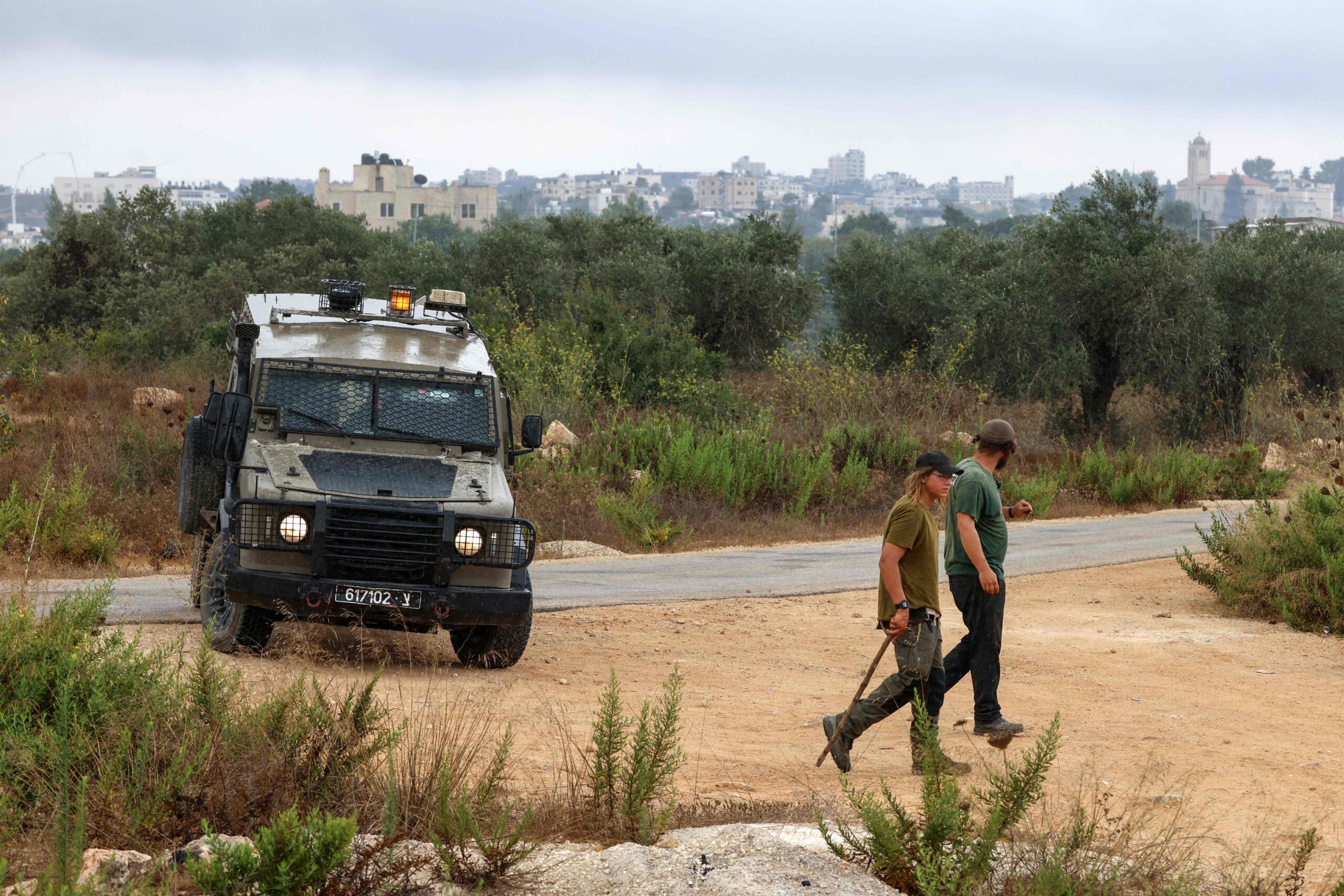
Rubio also briefly addressed the increasing levels of Israeli settler violence against Palestinians in the occupied West Bank.

Footage has shown settlers this month torching Palestinian homes and vehicles, as well as assaulting residents.

On March 19, the United Nations estimated that more than 1,000 Palestinians have been killed in the West Bank since Israel began its genocidal war in Gaza in October 2023. The international body underscored that a quarter of the victims were youths.

“ Well, we’re concerned about that, and we’ve expressed it. And I think there’s concern in the Israeli government about it, as well,” Rubio responded, adding that it was a “topic we follow very closely”.

He suggested that the Israeli government may take action to stop the violence, though critics argue that Israel has largely turned a blind eye to settler violence.

“Maybe they’re settlers, maybe they’re just street thugs, but they’ve attacked security forces, Israelis, as well. So, I think you’ll see the government going to do something about it,” Rubio said.

Upon taking office for a second term in January 2025, President Trump also moved to cancel sanctions against Israeli settlers accused of grave abuses in the West Bank.

Source link

Dolores Huerta, sexual violence survivors speak out against Cesar Chavez | Sexual Assault News

Content note: This story contains details of sexual violence. 

Civil rights icon Dolores Huerta is one of several women in the United States speaking out against the sexual violence they say they endured at the hands of labour leader Cesar Chavez.

Recommended Stories

list of 3 itemsend of list

In a statement on Wednesday, Huerta said she was motivated to speak out after being contacted for an investigation by The New York Times, which revealed that children as young as age 12 were abused by Chavez.

“I am nearly 96 years old, and for the last 60 years have kept a secret because I believed that exposing the truth would hurt the farmworker movement I have spent my entire life fighting for,” Huerta wrote.

“Following the New York Times’ multi-year investigation into sexual misconduct by Cesar Chavez, I can no longer stay silent and must share my own experiences.”

Chavez, who died in 1993, co-founded the National Farm Workers Association alongside Huerta and other advocates. They rose to fame during the US civil rights movement of the 1960s, practising nonviolent protest techniques similar to those of Mahatma Gandhi and Martin Luther King Jr.

Together, Chavez, Huerta and other advocates drew attention to the abuses facing vulnerable immigrant farmworkers, particularly in the Hispanic and Filipino American communities.

Some of the slogans from the movement continue to have resonance in the US political sphere.

The Spanish phrase “si, se puede” — or, in English, “yes, we can” — was adopted as the campaign slogan for President Barack Obama, while the Tagalog phrase “isang bagsak” continues to be a rallying cry for collective organising.

The fight for equality and fair labour practices that Huerta and Chavez led would be remembered as one of the defining moments of the 1960s.

But it was out of fear of denting the burgeoning civil rights movement that Huerta and other women say they stayed silent about Chavez’s abuse.

“I carried this secret for as long as I did because building the movement and securing farmworker rights was my life’s work,” Huerta said in her statement.

“I wasn’t going to let Cesar or anyone else get in the way. I channeled everything I had into advocating on behalf of millions of farmworkers and others who were suffering and deserved equal rights.”

Huerta explained that the first time she had sex with Chavez, she was “manipulated and pressured” into submitting to his advances while on a trip to San Juan Capistrano.

“I didn’t feel I could say no because he was someone that I admired, my boss and the leader of the movement I had already devoted years of my life to,” she said.

The second time, she said she was “forced, against my will”. The New York Times investigation includes a summary of what Huerta says happened: She was in a car that Chavez was driving when he parked in an isolated grape field and raped her.

Both instances resulted in pregnancies, which Huerta says she kept secret. The children were ultimately given to other families to raise.

“I had experienced abuse and sexual violence before, and I convinced myself these were incidents that I had to endure alone and in secret,” she said.

Her story was echoed by the accounts of other women featured in The New York Times investigation.

One of the interviewees, Ana Murguia, said she was 13 when a 45-year-old Chavez kissed her, took off her clothes and tried to have sex with her in his locked office.

He had known her since she was eight years old, and the abuse at his hands prompted her to attempt suicide.

Debra Rojas, meanwhile, was 12 years old when Chavez began groping her. She described being 15 when she was raped by him at a motel near Stockton, California.

A third woman, Esmeralda Lopez, said she was 19 when Chavez tried to pressure her to have sex with him while they were alone on a tour, offering to use his influence to get something named in her honour.

Lopez said she refused his advances, and her mother, a fellow activist, corroborated her account, based on conversations they had at the time.

The women explained that they grappled with whether to come forward and whether they would be believed, given Chavez’s rise to fame as a civil rights hero.

In response to the widening scandal on Wednesday, United Farm Workers — the group that emerged from the National Farm Workers Association — announced it would not participate in any events on Cesar Chavez Day, a federal commemoration that falls on the late leader’s birthday.

The group denied receiving any direct reports of abuse, but it pledged to create a pathway for reports to be submitted.

“Over the coming weeks, in partnership with experts in these kinds of processes, we are working to establish an external, confidential, independent channel for those who may have experienced harm caused by Cesar Chavez,” United Farm Workers wrote in a statement.

“These allegations have been profoundly shocking. We need some time to get this right, including to ensure robust, trauma-informed services are available to those who may need it.”

Lawmakers across the political spectrum, from Texas Governor Greg Abbott to New Mexico Representative Ben Ray Lujan, also called for Chavez’s name to be stripped from public buildings, roads and other places of honour.

Lujan called the revelations in Wednesday’s New York Times report “horrific” and a “betrayal of the values that Latino leaders have championed for generations”.

“His name should be removed from landmarks, institutions, and honors,” Lujan said of Chavez. “We cannot celebrate someone who carried out such disturbing harm.”

Huerta, meanwhile, said that, in the wake of the investigation, community advocacy was more important than ever.

“I have kept this secret long enough,” she wrote. “My silence ends here.”

Source link

Contributor: War abroad, injustices at home and a theme running through it all

As the U.S. wades even deeper into the conflict with Iran, some Democratic and progressive political figures are trying to figure out how to connect the public’s wariness about war with concerns about affordability and the widespread reaction against President Trump’s xenophobic immigration policies.

If you’re looking for a template to do it well, one can be found in the words and actions of a political figure who recently passed away: the Rev. Jesse Jackson.

For while attention after his death has rightfully focused on Jackson’s long involvement with the civil rights movement, the more telling lesson for this moment is how his presidential campaigns connected a concern for addressing domestic disenfranchisement with a resolute stance against U.S. military adventures — a message that built on and echoed the Rev. Martin Luther King Jr.’s landmark 1967 speech against the Vietnam War, economic exploitation and racial injustice.

Jackson’s candidacies in 1984 and 1988 emerged at a moment when the social compacts forged by the labor, civil rights and women’s movements of the 20th century were being systematically undone. Deindustrialization was hollowing out working-class communities. Reaganism was consolidating power around tax cuts for the wealthy, deregulation and attacks on unions. A new corporate consensus was hardening — one that increasingly shaped both major parties — prioritizing financial elites while disciplining labor and shrinking the public sphere.

Sound familiar?

Jackson refused to accept that such a right-wing and corporate realignment was inevitable. His Rainbow Coalition was far more ambitious than a candidate-centered campaign. It was an attempt to build an organized, multiracial, cross-class political front capable of contesting the direction of the country itself.

The Rainbow brought together constituencies that conventional political wisdom said could not unite — Black voters in the South, industrial workers in the Midwest, family farmers in crisis, Latino and Native organizers, Arab American activists, peace advocates, labor insurgents and progressive whites.

Jackson’s platform did not treat these groups as symbolic additions to a coalition; it linked their material interests. Farmers facing foreclosure were not an afterthought — the farm crisis was up front. Deindustrialized workers were not rhetorical props — trade, jobs and industrial policy were central. Civil rights were braided together with economic justice.

And crucially, Jackson insisted, as King had, that economic populism could not be separated from anti-militarism.

At the height of the Cold War, amid Reagan’s military buildup and interventionist doctrine, Jackson argued that bloated Pentagon budgets were not abstract line items. They were resources diverted from schools, healthcare, housing and jobs. He connected the violence of abandonment at home to the violence of intervention abroad — and his campaign called for redirecting military spending toward human needs and for diplomacy over escalation.

When Jackson thundered that we should “choose the human race over the nuclear race,” this was not a simple turn of phrase. It was integral to the Rainbow’s moral and economic logic. A government that prioritizes war over welfare, weapons over workers, cannot sustain democratic life.

That clarity feels especially salient today, as the United States continues to pursue military interventions and proxy conflicts whose legality and human cost are deeply contested. Once again, defense budgets swell while public goods strain. Once again, dissent against war is treated as disloyalty. Jackson rejected that false choice decades ago. He understood that militarism abroad reinforces inequality and immorality at home.

Jackson’s 1988 campaign captured millions of votes, won primaries and caucuses across the country and forced issues into the Democratic Party that party elites preferred to sideline. He demonstrated that a progressive program grounded in the lived experiences of ordinary people — rural collapse, urban disinvestment, plant closures, racial injustice and war — could assemble a national constituency.

Unfortunately, after Jackson’s last campaign, the Rainbow’s experiment in independent organizational life was folded too tightly into the mainstream Democratic Party. While that seemed a strategy to achieve a broader front, it meant that the progressive anchor was unmoored — and the effort dissolved before it could truly mature.

But the lessons of that era may be more relevant than ever.

Today, we again confront an ever-ascendant rightward turn buttressed by concentrated corporate power and normalized militarism. As in Jackson’s day, some leaders seek to deflect our attention, blaming economic challenges on the proximate “other” — in his era, Black women taking welfare, in our era, immigrants taking jobs — rather than those with power.

Jackson understood that defeating reactionary politics required isolating it — not only morally, but structurally — by assembling a coalition larger than the right’s base and rooted in shared material demands. He understood that hope had to be organized and that peace had to be part of prosperity. His campaigns showed that racial justice, labor rights, rural survival, gender equality and anti-war politics were not competing claims but interlocking ones.

Protest has surged in the United States, particularly after the excesses in Minnesota. But protest alone does not prevent consolidation. Nor do narrow electoral bargains that leave the underlying corporate and military consensus intact.

At a time when both parties remain deeply entangled with corporate and defense interests, remembering the promise of the Rainbow is not nostalgia. It is instruction.

Rishi Awatramani is a postdoctoral scholar in sociology at USC, where Manuel Pastor is a professor of sociology and the director of the Equity Research Institute.

Source link

8 convicted on terror charges in shooting at Texas ICE site

A federal jury Friday convicted nine people — eight on terrorism charges — over a shooting at a Texas immigration facility that federal prosecutors tied to antifa, the decentralized far-left movement that has become a target of the Trump administration.

One person was also found guilty of attempted murder after prosecutors say he opened fire last summer outside the Prairieland Detention Center outside Fort Worth, wounding a police officer. The Justice Department called the violence an attack plotted by antifa operatives, but attorneys for the accused denied that characterization, saying there were no antifa associations and that there was merely a demonstration with fireworks before gunshots broke out.

U.S. District Judge Mark Pittman, an appointee of President Trump, presided over the nearly three-week trial in Fort Worth. It was closely followed by legal experts and critics who called the proceedings a test of the lengths the government can go to punish protesters.

FBI Director Kash Patel had said the case was the first time charges of providing material support to terrorists had targeted people accused of being antifa members.

“Today’s verdict on terrorism charges will not be the last as the Trump administration systematically dismantles Antifa and finally halts their violence on America’s streets,” U.S. Atty. Gen. Pam Bondi said in a statement.

Short for “anti-fascists,” antifa is not an organization but rather an umbrella term for far-left militant groups that confront or resist neo-Nazis and white supremacists at demonstrations.

Protesters denied having antifa ties

Defense attorneys told jurors that there was no plan for violence on July 4 outside the facility in Alvarado.

Of the nine defendants on trial, eight faced the charge of providing material support to terrorists, among other charges. The ninth defendant, Daniel Sanchez Estrada, was charged with corruptly concealing a document and conspiracy to conceal documents. He was found guilty of both.

Sanchez Estrada’s attorney, Christopher Weinbel, said he can’t believe jurors “came to this conclusion.” Weinbel said his client had deployed as a member of the U.S. Army several times and he’d hoped what he sacrificed for the country “meant something.”

“But I feel like it turned its back on justice with this. … The U.S. lost today with this verdict,” Weinbel said.

Prosecutor Shawn Smith told jurors during closing arguments that the group’s actions — including bringing firearms and first aid kits and wearing body armor — were all signs of nefarious intent. He said they practiced “antifa tactics” and were “obsessed with operational security.”

Attorneys for the defendants have said that there was no planned ambush and that protesters who brought firearms did so for their own protection — in a state with very lenient gun laws.

A test of 1st Amendment rights

The terrorism charges followed Trump’s order last fall to designate antifa as a domestic terrorist organization. Those charges did not require a tie to any organization, and there is no domestic equivalent to the State Department’s list of foreign terrorist organizations. That’s in part because organizations operating within the United States are protected by broad 1st Amendment rights.

Critics of the Justice Department’s case have said the outcome could have wide-reaching effects on protests.

“That opposition is something that the government wants to squash, so a case like this helps the government kind of see how far they can go in criminalizing constitutionally protected protests and also helps them kind of intimidate, increase the fear, hoping that folks in other cities then will think twice over protesting,” said Suzanne Adely, interim president of the National Lawyers Guild, a progressive legal group.

Trial focused on shots fired

Attorneys for the defendants have said most protesters began leaving when two guards from the center came outside. That was before any shots were fired.

Prosecutors said Benjamin Song, a former Marine Corps reservist, yelled, “Get to the rifles,” and opened fire, striking one police officer who had just pulled up to the center.

Though it was Song who opened fire, prosecutors charged several other protesters with attempted murder of an officer and discharging a firearm, but they were found not guilty. The prosecution had argued that from the group’s planning, it was foreseeable to those others that a shooting could happen.

The officer who was shot, Alvarado Police Lt. Thomas Gross, testified that when responding to the scene he saw a person clad in all-black with their face covered and carrying a rifle. He told jurors he was shot with a round that went into his shoulder and out of his neck.

Song’s attorney, Phillip Hayes, told jurors during closing arguments that there wasn’t a call to arms before Gross arrived on the scene and “aggressively” pulled out his firearm. Hayes suggested that Song’s shots were “suppressive fire” and that a ricochet bullet hit the officer.

Leading up to the trial, several people pleaded guilty to providing material support to terrorists after being accused of supporting antifa. They face up to 15 years in prison at sentencing.

Some of them testified for the prosecution, including Seth Sikes, who said he went to the detention center because he wanted to bring some joy to those held inside.

“I felt like I was doing the right thing,” he said.

Stengle writes for the Associated Press. AP writer Jim Vertuno in Austin, Texas, contributed to this report.

Source link