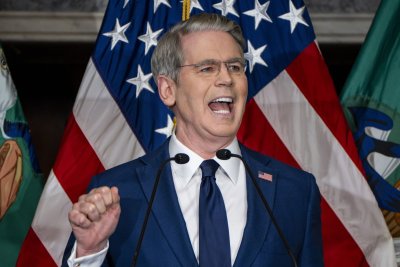

Aug. 31 (UPI) — Finance ministers and other officials from the Group of 20 nations, as well as many CEOs, met Monday in Asheville, N.C., at a summit in which U.S. leaders intended to focus on growth and Iran — but also drew protests from other leaders for the inclusion of the Russian minister.
U.S. Treasury Secretary Scott Bessent told officials that the United States wants to focus on the mission of accelerating growth and said the countries need to work together
“The world is awash in debt, and the only way for us to get out of this is to grow our way out of this,” Bessent said, CNBC reported.
He also said a “durable” global economy” cannot rest on “beggar-thy-neighbor acts that stifle fair, market-based competition,” The New York Times said.
In introductory comments, U.S. Federal Reserve Chairman Kevin Warsh also focused on growth, saying the time is one of “secular growth.”
“If I were to try to characterize this moment, it would be one of a global investment surge,” he said.
Bessent said earlier Monday in a CNBC interview that the U.S. plan to pressure and isolate Iran through its economy can work without China, which opposes the sanctions. He is expected to ask the other finance ministers to join in those sanctions.
Russian Finance Minister Anton Siluanov was at the meeting — at the invitation of the Trump administration — for the first time since Russia’s invasion of Ukraine in 2022.
This drew protests from other European ministers, who have issued their own sanctions against Russia for that war. Finance Minister Lars Klingbeil told The Times that he scolded Siluanov over the war and said the European ministers demanded the Russian minister be left out of a traditional group photo. It was eventually taken without Siluanov.
“Receiving the Russian finance minister here sends a signal I find troubling,” he told reporters. “I would have preferred clear positioning from the U.S. side that he not be received like a regular guest.”
Ukraine’s finance minister was not present in person at the meeting.
In addition, European ministers protested that the United States did not invite representatives from South Africa, a G20 country, to the meeting. Trump administration officials also invited many U.S. business executives but denied requests to include business leaders from other G20 countries.