Federal Reserve

Sen. Thom Tillis will vote to confirm Trump nominee for Fed chair

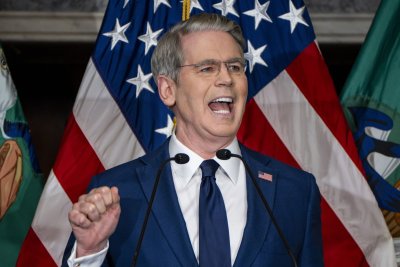
Sen. Thom Tillis, R-N.C., said on Sunday that he will vote to confirm President Donald Trump’s nominee for Federal Reserve chairman after the Department of Justice assured him it has ended its investigation into current chair Jerome Powell. Photo by Bonnie Cash/UPI | License Photo

April 26 (UPI) — U.S. Sen. Thom Tillis, R-N.C., said on Sunday that he will end his blockade of Kevin Warsh’s confirmation as Federal Reserve chair after the Department of Justice ended its investigation into current chair Jerome Powell.

U.S. Attorney Jeanine Pirro on Friday said the Justice Department was ending its investigation into Powell over the Fed’s budget for renovations to its headquarters and has threatened him with criminal charges over testimony he gave about the costs.

Tillis made the announcement during an interview on NBC News’ “Meet The Press,” because the department assured him that it has “completely and fully ended” the investigation.

He had previously said he would block all Trump nominees until the probe was dropped.

“We worked a lot over the weekend to make sure that we were very clear that we have assurances from the Department of Justice that I needed to feel like they were not using the department as a weapon to threaten the independence of the Fed,” Tillis told NBC News.

The Justice Department launched a criminal investigation into Powell in January after President Donald Trump questioned the Fed being over budget on renovations to its headquarters in Washington, D.C.

The investigation was condemned by several members of Congress as improper, including Tillis, because it was seen as politically motivated punishment from Trump for not setting interest rates at levels he preferred.

Pirro said Friday that she has asked the Federal Reserve’s inspector general to investigate the renovation costs, which she said is “billions of dollars” over budget, and that she expects a “comprehensive report” on the matter.

She noted, however, that she “will not hesitate to restart a criminal investigation should the facts warrant doing so.”

President Donald Trump and first lady Melania Trump participate in the 2026 White House Correspondents’ Association Dinner in Washington on April 25, 2026. Photo by Yuri Gripas/UPI | License Photo

Source link

Trump vs. Powell: Interest rates, investigation and a replacement

April 22 (UPI) — Federal Reserve Chairman Jerome Powell‘s term is nearing its end and President Donald Trump is pushing for his replacement but an investigation into Powell may hold up the appointment of a new chair.

The Justice Department opened an investigation into Powell over the renovation of the Marriner S. Eccles Federal Reserve Board Building in Washington, D.C., which Trump claims has exceeded $3 billion. The renovation was not the beginning of Trump’s feud with Powell but it has added to his effort to oust the chairman before the end of his term.

Powell’s term as chairman of the Federal Reserve will end in May but he will remain on the Board of Governors until January 2028.

Typically when a Fed chair’s term ends, they resign. However, Powell said he plans to stay put until a replacement is appointed.

At least one lawmaker, Sen. Thom Tillis, R-N.C., said he would not vote on a new chairman until the investigation into Powell is over.

The Justice Department alleges that Powell made false or misleading statements to Congress about the cost of the renovation project at the Federal Reserve headquarters during his testimony to the House Committee on Financial Services in June.

Powell’s testimony was part of his semiannual report to Congress on monetary policy.

Following the hearing, Rep. Anna Paulina Luna, R-Fla., submitted a request to then-Attorney General Pam Bondi for Powell to be investigated for perjury and making false statements. Luna said that Powell denied there would be “luxury features” included in the renovations, including a “VIP dining room, premium marble, water features and a roof terrace garden.”

Luna added that Powell “falsely claimed that the Eccles building ‘never had’ a serious renovation.” She notes that the building underwent renovations in 1999 and 2003.

“These are not minor misstatements,” Luna said. “Chairman Powell knowingly misled both Congress and executive branch officials about the true nature of a taxpayer-funded project. Lying under oath is a serious offense — especially from someone tasked with overseeing our monetary system and public trust.”

No charges have been formally filed against Powell. The challenge the Justice Department faces in convicting Powell of perjury or false statements is in proving that he willfully, knowingly made statements he knew to be false at the time.

Powell, who was Trump’s nominee for chairman in 2017, has said that the investigation into him and the Federal Reserve renovation is “pretext” to punish him for not following Trump’s direction to lower interest rates.

“No one, certainly not the chair of the Federal Reserve, is above the law, but this unprecedented action should be seen in the broader context of the administration’s threats and ongoing pressure,” Powell said in a video message in January. “This is about whether the Feed will be able to continue to set interest rates based on evidence and economic conditions — or whether instead monetary policy will be directed by political pressure or intimidation.”

Last month, federal prosecutor George A. Massucco-LaTaif told Chief U.S. District Judge James E. Boasberg that the Justice Department does not know of any evidence that a crime has been committed in the Federal Reserve renovation project.

“We do not know at this time,” Massucco-LaTaif said. “However, there are 1.2 billion reasons for us to look into it.”

The fissure between Powell and Trump began and has continued over the Federal Reserve’s decision to maintain elevated interest rates in response to inflation. Trump has repeatedly called on the Federal Reserve to lower interest rates, saying the United States should “have the lowest interest rate in the world.”

All along the Federal Reserve continues to hold an elevated interest rate, currently between 3.5% and 3.75%, in an effort to tame inflation. Its target rate of inflation is 2% on an annual basis.

Economic markers from the U.S. Bureau of Labor statistics show the rate of inflation remains at about 3%.

Trump has nominated Kevin Warsh to succeed Powell. Warsh served on the Fed’s board for five years after being appointed by President George W. Bush in 2006.

“I have known Kevin for a long period of time, and have no doubt that he will go down as one of the great Fed chairmen, maybe the best,” Trump posted on social media in January. “On top of everything else, he is ‘central casting,’ and he will never let you down.”

Warsh faced his first hearing on the path toward confirmation on Tuesday when he testified before the Senate Banking Committee. Questions by senators centered on the Federal Reserve’s independence, something Trump’s influence has called into question.

If appointed, Warsh would be the wealthiest person to lead the Federal Reserve.

Presidents have butted heads with the Federal Reserve throughout its history, as monetary policy can reflect on how the U.S. population views the president’s performance. A president has never tried to fire the chairman of the Federal Reserve.

The Federal Reserve is a non-partisan, independent agency made up of a board of governors posted in Washington, D.C., and 12 regional banks located across the United States.

Independence is key to the Federal Reserve’s function, keeping it from choosing policy based on the political goals of those occupying the White House and other branches of government.

Trump has not attempted to fire Powell yet but he did attempt to fire Fed board Gov. Lisa Cook. The attempt was unsuccessful as the U.S. Supreme Court intervened in October and ruled that she can remain at her post on an interim basis, at least for 2026.

The president does have some authority over choosing or designating a new Federal Reserve chair, Peter Shane, a constitutional law scholar in residence at NYU Law School, told UPI. However, a president must demonstrate a good reason for doing so.

There are two mechanisms in place that are meant to protect the independence of the Federal Reserve and its chair from political influence.

First, there is Supreme Court precedent. In 1935, the high court made a ruling in the landmark case Humphrey’s Executor vs. the United States. In this case, the court ruled that President Franklin D. Roosevelt could not fire the commissioner of the Federal Trade Commission, another independent agency, without cause.

The ruling affirmed that the authority to remove the head of any independent agency falls to Congress.

Second, there is the Federal Reserve Act. President Woodrow Wilson signed the Federal Reserve Act of 1913 to decentralize the control over monetary policy in the United States. This established the Federal Reserve and set its independence as a foundational feature of its existence.

The Federal Reserve Act makes the Federal Reserve independent in setting monetary policy without the influence of the president or Congress.

Congress has the ability to change the Federal Reserve Act. It did so in 1977 with the Federal Reserve Reform Act.

This amendment, signed into law by President Jimmy Carter, codified the objectives of the agency and established a requirement for the board of governors to report to Congress in hearings twice a year. It also added the requirement of Senate confirmation hearings for the chairman and vice chairman of the board of governors.

Last year, Rep. Thomas Massie, R-Ky., introduced the Federal Reserve Board Abolition Act, calling for the board of governors of the Federal Reserve and all Federal Reserve banks to be abolished.

“Americans have suffered under crippling inflation and the Federal Reserve is to blame,” Massie said in a statement.

Since being introduced in March 2025 the bill has not progressed beyond being referred to the House Committee on Financial Services.

FBI Director Kash Patel speaks during a press conference at Department of Justice Headquarters on Tuesday. The Trump Administration announced charges against the Southern Poverty Law Center, which the government alleges funneled over $3 million toward white supremacist and extremists groups. Photo by Bonnie Cash/UPI | License Photo

Source link

Fed chair nominee Warsh rejects ‘Trump sock puppet’ label at Senate hearing

Kevin Warsh, the man nominated to lead the Federal Reserve, the world’s most important financial institution, told the US Senate Banking Committee on Tuesday that he had made no secret agreements with the White House over interest rate policy, defending his professional integrity.


ADVERTISEMENT


ADVERTISEMENT

He said he would act independently if confirmed to succeed Jerome Powell, despite continued public pressure from US President Donald Trump for lower borrowing costs.

The question of that independence was put sharply to him during the hearing, when Republican Senator John Kennedy asked whether he would be Trump’s “human sock puppet”. Warsh replied: “Absolutely not.”

His comments came amid broader concerns on Capitol Hill about the future direction of the central bank, with lawmakers divided over his past record and approach to monetary policy.

Warsh insisted that the President had never asked him to commit to any specific interest rate path and said he would not have agreed to such a request.

The hearing highlighted the significant pressure facing the Federal Reserve as it maintains its independence while addressing inflation, which remains at 3.3%.

Just hours before the session began, US President Donald Trump stated in a CNBC interview that he would be disappointed if Warsh did not immediately implement rate cuts.

This current friction suggests that the White House may struggle to secure the necessary votes to confirm Warsh before Powell’s term as Fed Chair expires on 15 May.

Democratic opposition and Republican dissent

Democratic senators were particularly vocal in their scepticism, accusing Warsh of shifting his economic stance to suit the political climate.

US Senator Elizabeth Warren labelled the nominee a “sock puppet”, suggesting his installation would facilitate an “illegal takeover” of the institution.

Critics also pointed to his historical record, alleging that he favoured higher rates during Democratic administrations but has become more dovish under Republican leadership.

US Senator Ruben Gallego cited reporting from the Wall Street Journal (WSJ), which claimed the President had previously urged Warsh to reduce borrowing costs. Warsh responded by stating that such reports were based on inaccurate sources and reiterated that the independence of the Fed is “essential” for economic stability.

Despite Trump’s backing, the nomination also faces a critical roadblock within the Republican Party.

US Senator Thom Tillis, a Republican from North Carolina, reiterated his refusal to support Warsh as long as a Department of Justice investigation into Jerome Powell continues.

The probe, led by Assistant US Attorney Jeannine Pirro, is examining whether Powell committed perjury during testimony last year regarding the budget of a Federal Reserve building renovation project.

Tillis and other Republican colleagues have expressed their support for Powell, arguing that the investigation is meritless. According to Tillis, he will not vote for a successor until the “investigation is dropped,” a stance that effectively freezes the nomination in a closely divided committee.

Federal prosecutors have reportedly continued their efforts to access Fed records as recently as last week, even after a judge previously found no evidence to support the charges.

Legal and ethical hurdles

The proceedings also delved into Warsh’s personal financial interests and the logistical challenges of a potential leadership transition.

US Senator Elizabeth Warren raised questions about the nominee’s investments in private entities, including SpaceX and Polymarket, noting that the specific size of these holdings had not been fully disclosed to the public.

Warsh defended his position by stating that the Office of Government Ethics has already approved his plan to divest all assets within 90 days of his confirmation.

Compounding the uncertainty is the unique situation involving Jerome Powell.

Unlike most departing Chairs, Powell has indicated he intends to remain on the Federal Reserve’s governing board until his separate term ends in 2028, or until the perjury investigation is concluded.

This could create an awkward power dynamic where the former Chair sits alongside his successor, a scenario not seen in Washington since the late 1940s.

While US President Donald Trump has threatened to remove Powell from the board entirely, legal experts suggest such a move would be difficult, particularly given recent US Supreme Court precedents relating to the protection of Fed governors from political dismissal.

Source link

Trump again threatens to fire Powell if he doesn’t step down

April 15 (UPI) — President Donald Trump again threatened to fire Federal Reserve Chair Jerome Powell if he doesn’t step down from his position in May.

“Then I’ll have to fire him,” the president said on Fox Business. “If he’s not leaving on time — I’ve held back firing him. I’ve wanted to fire him, but I hate to be controversial. I want to be uncontroversial.”

Powell’s term as chair ends on May 15 and Trump does not have the authority to fire him without cause. But his nominated replacement, Kevin Warsh, hasn’t been confirmed by the Senate. If he doesn’t get confirmed, Powell could stay on as chair pro tempore.

“That’s what the law calls for. That’s what we’ve done on several occasions,” Powell said.

He said he plans to stay on the board.

“I have no intention of leaving the board until the investigation is well and truly over with transparency and finality,” Powell said.

The Senate Banking Committee is scheduled to have hearings on Warsh’s nomination on April 21.

Powell’s term as a Fed governor goes until 2028, but he said he hasn’t decided if he’ll serve out that term.

Complicating matters, the Trump administration has been trying to prosecute Powell for his role in the $2.5 billion renovation of the Fed headquarters. The building went far over budget, and Trump has implied that something illegal is happening.

U.S. attorney for the District of Columbia Jeanine Pirro tried to subpoena Powell over the renovation, but a judge denied it. Pirro admitted she had no evidence.

Sen. Thom Tillis, R-S.C., who is on the Senate Banking Committee, said he will continue to block Warsh’s confirmation until the investigation into Powell ends.

But Trump said he isn’t worried about Tillis.

Tillis “is an American; he knows what to do,” he said.

Trump said the investigation must happen.

“What they’ve done to that, so it is probably corrupt, but what it really is is incompetent, and we have to show the incompetence of that,” he said.

Trump has wanted Powell out of the Fed since he was elected to office for the second term. He has said he wants interest rates dropped, but Powell has taken a more conservative approach. Powell has lowered the rates, but not fast enough for the president.

“Does that mean we stop a probe of a building that I would have done for $25 million that’s going to cost maybe $4 billion? Don’t you think we have to find out what happened there?” Trump said in the interview at the White House. “I have to find out.”

He called Powell “a disaster.”

“Here’s a man who took this little, tiny building and a couple of other little, tiny complex, and he’s spending more than $3 billion. I want to know who the contractor is, because that contractor is making billions of dollars, perhaps.”

The Fed said the building’s cost overruns are due to “unforeseen conditions” requiring more spending, including “more asbestos than anticipated, toxic contamination in soil, and a higher-than-expected water table.”

Trump has also tried to oust Fed governor Lisa Cook on the allegation that she committed mortgage fraud.

Speaker of the House Mike Johnson, R-La., presents the family of Benjamin Ferencz with his Congressional Gold Medal during the Holocaust Memorial Museum’s Days of Remembrance ceremony at the U.S. Capitol on Tuesday. The gold medal was presented posthumously to Ferencz, who served in the Army during World War II and prosecuted Nazi war criminals during the Nuremberg Trials. Photo by Bonnie Cash/UPI | License Photo

Source link

Federal Reserve chairman nominee Kevin Warsh has millions in assets, filings show

1 of 3 | Kevin Warsh speaks during a press conference in 2014. Warsh, a nominee for chairman of the Federal Reserve, has more than $100 million in assets, recent filings show. File Photo by Will Oliver/EPA

April 14 (UPI) — Kevin Warsh, the presidential pick for the next Federal Reserve chairman, has wealth greater than any other recent chairman, his financial disclosures released Tuesday show.

The filings were part of the usual consideration process for the role. Warsh, if confirmed, would succeed current Chairman Jerome Powell, whose second term ends May 15. A Senate hearing on the matter is expected to take place April 21.

CNBC reported that Warsh’s disclosure forms show that the nominee has about $192 million in assets in combination with his wife, Jane Lauder, who is an heir to the Estee Lauder fortune. Warsh’s solo assets equal about $135 million to $226 million. These numbers show a large range because they can include variable items such as bonds, stocks and other assets.

By comparison, Powell’s financial filings for 2025 showed assets of between $19 million and $75 million, while former Chairman Ben Bernanke, who left office in 2014, submitted filings that year of about $2.3 million in assets, CNBC reported.

If the Senate confirms Warsh, he has said that he will divest a large amount of assets, of which about 1,800 were listed in the forms. Some of these were undisclosed because of cited “preexisting confidentiality agreements,” The New York Times and CNBC reported.

Warsh, who served as a governor at the Federal Reserve from 2006 to 2011, also said that he would resign posts such as his role as financial adviser to investor Stanley Druckenmiller, as well as several other positions including a board seat at UPS.

Warsh will face the Senate Banking Committee in the planned hearing before a full Senate vote. However, an ongoing Department of Justice investigation into Powell has further complicated matters. Sen. Thom Tillis, R-N.C., a member of the Senate Banking Committee, has said he will not vote on Warsh or any other nominee for the role until the investigation is completed.

Speaker of the House Mike Johnson, R-La., presents the family of Benjamin Ferencz with his Congressional Gold Medal during the Holocaust Memorial Museum’s Days of Remembrance ceremony at the U.S. Capitol on Tuesday. The gold medal was presented posthumously to Ferencz, who served in the Army during World War II and prosecuted Nazi war criminals during the Nuremberg Trials. Photo by Bonnie Cash/UPI | License Photo

Source link

Federal judge refuses to reconsider quashing Fed subpoenas

A federal district court judge denied a Department of Justice motion asking the court to reconsider its quashing of subpoenas aimed at U.S. Federal Reserve Chair Jerome Powell, pictured in January at a press conference, and the Fed Board. File Photo by Annabelle Gordon/UPI | License Photo

April 3 (UPI) — A federal judge on Friday refused a Department of Justice request for him to reconsider his earlier ruling to block grand jury subpoenas it issued to Fed Chairman Jerome Powell.

U.S. District Judge James Boasberg on Friday said he would not lift his block on subpoenas that the Justice Department issued to board of the Federal Reserve regarding the $2.5 billion renovation of the Fed’s complex in Washington, D.C.

The judge had previously blocked the subpoenas because, he said, they had nothing to do with a Justice Department probe about the renovations, but rather were intended to pressure Powell into adjusting interest rates, as President Donald Trump had been chiding him to do for months.

“On March 11, 2026, this Court issued a Memorandum Opinion and Order that quashed the Government’s subpoenas directed to the Board of Governors of the Federal Research System,” Boasberg wrote in a response to the Justice Department request that was filed on Friday.

“The Government promptly moved for reconsideration of that decision,” he wrote. “As its cursory brief neither offers new evidence nor points to any material error, the Court will deny the Motion.”

The DOJ launched its criminal investigation into the Fed’s renovation budget, which Powell at the time called “pretexts” to punish him for not setting interest rates based on Trump demands.

Boasberg, in his response to the Justice when he blocked the subpoenas said that the government “has produced essentially zero evidence to suspect Chair Powell of a crime.”

The Justice Department later acknowledged when appealing Boasberg’s quashing of the subpoenas that it did not have evidence that a crime had been committed, instead saying that there were “1.2 billion reasons for us to look into it.”

President Donald Trump delivers a prime-time address to the nation from the Cross Hall in the White House on Wednesday. President Trump used the address to update the public on the month-long war in Iran. Pool photo by Alex Brandon/UPI | License Photo

Source link

Fed holds interest rates steady amid Iran war, poor inflation report

March 18 (UPI) — The Federal Reserve announced that it is leaving its benchmark interest rate untouched Wednesday in its first Federal Open Market Committee statement since the start of the war with Iran.

The Fed’s benchmark interest rate remains at a 3.5% and 3.75% range as the committee held on to its projection of at least one rate cut coming this year.

“Available indicators suggest that economic activity has been expanding at a solid pace,” the FOMC statement said. “Job gains have remained low and the unemployment rate has been little changed in recent months. Inflation remains somewhat elevated.”

As for the war in Iran, the statement said its impact on the U.S. economy is “uncertain.”

The Fed continues to pursue monetary policies it believes will bring the rate of inflation down to 2%. In its statement it said it is “committed to supporting maximum employment,” in pursuit of its target.

Economic reports that inform the Fed’s decision have indicated pressures from inflation remain and economic growth has slowed.

Wednesday’s announcement comes on the heels of a producer price index report earlier in the day that showed the largest increase to the index for final demand goods since August 2023.

Last week, the U.S. Bureau of Labor Statistics reported that nonfarm payrolls fell by 92,000 in February. The unemployment rate increased to 4.4%.

These reports have economists and traders cooling on the potential for interest rate cuts. Eugenio Aleman, chief economist at Raymond James, said in a statement that the wholesale inflation report on Wednesday, “likely reinforces a hold decision.”

Data from the producer price index report predates the beginning of the war with Iran.

President Donald Trump receives a bowl of shamrocks from Irish Taoiseach Micheal Martin to celebrate St. Patrick’s Day at the White House on Tuesday. Photo by Yuri Gripas/UPI | License Photo

Source link

Judge quashes subpoenas for Fed Chair Jerome Powell

March 13 (UPI) — A federal judge this week quashed subpoenas the Department of Justice had issued to Federal Reserve Chair Jerome Powell because they were issued to pressure him into adjusting interest rates.

Judge James Boasberg redressed the DOJ for the subpoenas, saying that their purpose had nothing to do with a probe about renovations at the Federal Reserve in Washington, D.C.

The DOJ in January launched a criminal investigation into Powell’s testimony last year about the renovations, which Powell at the time said were “pretexts” to punish him and the Fed after they did not set interest rates at levels demanded by President Donald Trump.

“The Government has produced essentially zero evidence to suspect Chair Powell of a crime; indeed, its justifications are so thin and unsubstantiated that the Court can only conclude that they are pretextual,” Boasberg wrote in the opinion.

The department in January issued grand jury subpoenas in reference to Powell’s comments about the multi-year project to renovate the Fed’s office buildings during his June 2025 testimony before the Senate Banking Committee.

During a tour of the renovations, Powell disputed Trump’s over-estimates of the renovation’s cost, and threatened to sue him for the “horrible and grossly incompetent job” Powell had done on the project.

Overall, however, Trump has repeatedly ripped into and mused about firing Powell, which he cannot do, because the Fed chair has repeatedly said that interest rate changes would be dictated by only the market, rather than the preferences of any one person.

In the opinion, which was unsealed Friday, Boasberg said he blocked the subpoenas because “a mountain of evidence suggests that the Government served these subpoenas on the Board to pressure its Chair into voting for lower interest rates or resigning.”

President Donald Trump speaks during an event celebrating Women’s History Month in the East Room of the White House on Thursday. Photo by Bonnie Cash/UPI | License Photo

Source link

Judge quashes Justice Department subpoena of Federal Reserve in blow to investigation

A federal judge on Friday quashed Justice Department subpoenas issued to the Federal Reserve in January, a severe blow to an investigation that has already attracted strong criticism on Capitol Hill.

Judge James Boasberg said that a “mountain of evidence suggests” that the purpose of the subpoenas was simply to pressure the Fed to cut its key interest rate, as President Trump has repeatedly demanded.

Fed Chair Jerome Powell revealed the investigation Jan. 11, prompting Senator Thom Tillis, a North Carolina Republican to block consideration of Trump’s pick to replace Powell as Fed chair when his term expires May. 15.

Rugaber writes for the Associated Press.

Source link