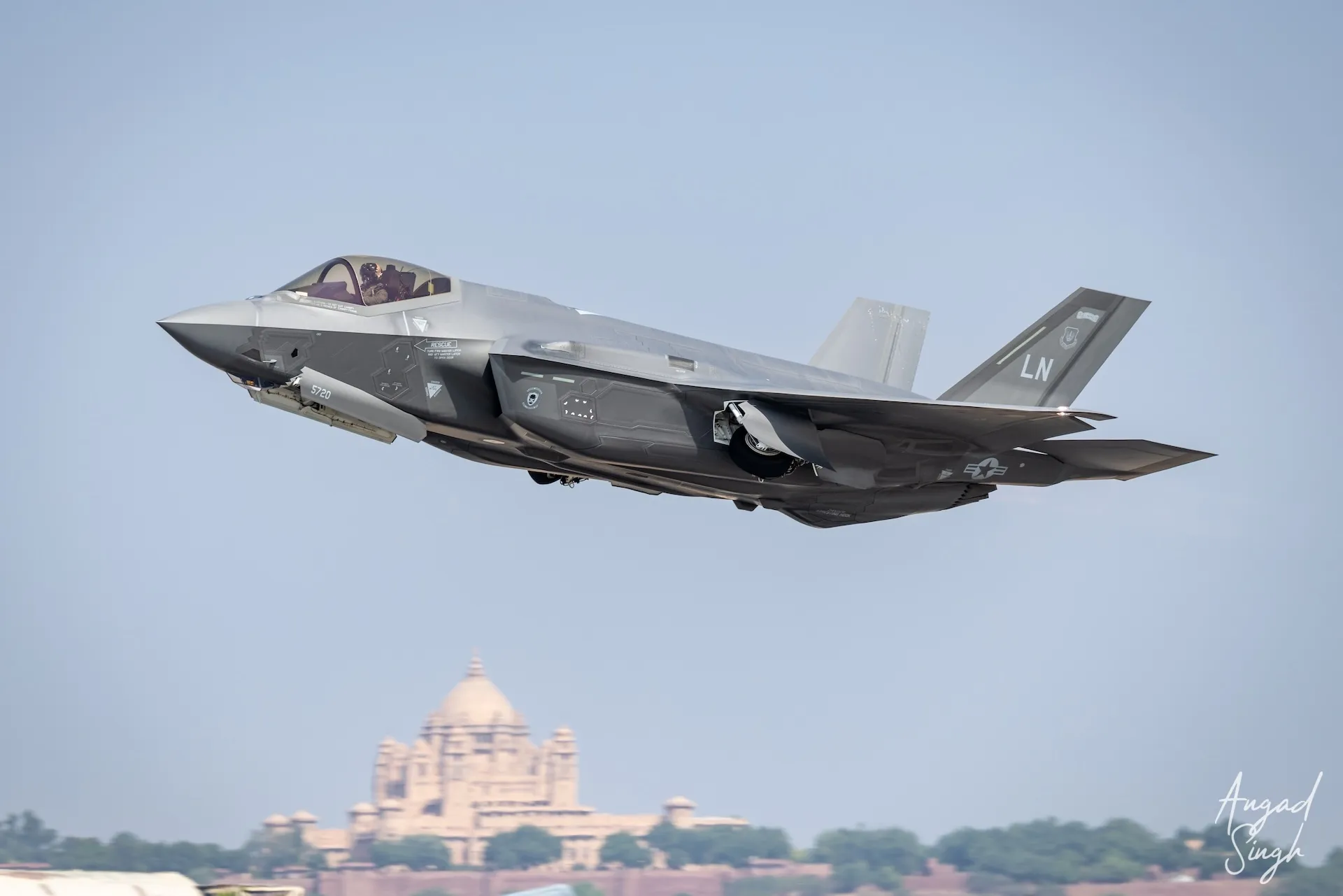
For the first time, F-35 stealth fighters have operated from Indian soil in an exercise with the Indian Air Force (IAF). Six of the U.S. Air Force jets joined Tarang Shakti 2026 at Jodhpur, in the northwest Indian state of Rajasthan, bringing a fifth-generation combat aircraft to an Indian airbase for the IAF’s biggest multinational air exercise.

Two years ago, the Indian Air Force hosted its first major multinational air exercise in over six decades. The plan to make Tarang Shakti a biennial fixture has held, and from September 26 to October 12, the exercise returned to the international airpower calendar — this time as a single, continuous event centered on Jodhpur and adjoining bases in Rajasthan. Seven foreign air forces sent flying detachments. Of these, France, the United Arab Emirates, and the United States sent fighters. Australia, Bangladesh, Germany, and Sri Lanka provided transport or special mission types.

The headline act, though, was undoubtedly American.
This edition marked the first time F-35s from any nation operated from an Indian airbase in an exercise with the IAF. Past outings for the stealth jet in India have been limited to Aero India displays in 2023 and 2025, and an India-U.K. exercise which saw British F-35Bs operating from their aircraft carrier (and a widely publicized RAF F-35 diversion to the southern city of Kochi).

The F-35 factor
Six F-35As of the 13th Fighter Squadron from Misawa, Japan, along with over 200 airmen and KC-135R support from Kadena, touched down at Jodhpur on September 26. “American airpower has arrived in Jodhpur!” posted U.S. Ambassador Sergio Gor, who later described the deployment as another example of trust between the two countries, noting that the F-35 “does not go just anywhere.”
One 13th FS pilot said that operating with forces from around the world exposed the squadron to new tactics, perspectives, and ways of operating. For the IAF, the payoff was arguably more pointed. Indian crews spent two weeks flying with, and against, a genuine stealth fighter — the closest available proxy for the J-20s and J-35s now fielded by China.

The IAF was understandably tight-lipped about what the F-35s actually did.
The IAF vice-chief, Air Marshal Ashutosh Dixit, acknowledged the interest at the curtain-raiser in New Delhi on September 22, but declined to discuss specifics. While media commentary quickly cast the jet as a stand-in for the J-20 in mock engagements, Dixit offered a more measured view, arguing that an aircraft’s generation is not the sole arbiter of combat performance — training, networks, and weapons matter as much. He also noted that the IAF is developing its own means of detecting fifth-generation aircraft, alongside its backing for its domestically developed next-generation fighter, the Advanced Medium Combat Aircraft (AMCA).
The IAF and the U.S. Air Force are hardly strangers to one another. Their bilateral Cope India exercises, which began in 2002 and expanded into fighter combat training in 2004, have proved valuable to both sides. Early encounters saw Indian pilots flying Russian-built fighters against American F-15s, with the IAF’s performance prompting the U.S. Air Force to reassess some of its own assumptions about air combat tactics. Subsequent iterations broadened the relationship beyond fighter maneuvers to include large-force employment, airlift, airdrop, and disaster response. The result has been a deeper understanding of each other’s capabilities, procedures, and operating cultures. All this groundwork has helped make larger multinational engagements such as Tarang Shakti possible.

The F-35’s appearance in India comes against the backdrop of a potential, if complicated, future procurement relationship. For years now, some U.S. officials have suggested that the stealth jet could be offered to New Delhi. Most notably, back in 2018, the then-head of U.S. Pacific Command supposedly stated that he supported the sale of the stealth fighter to India. In February 2025, President Donald Trump announced that Washington was paving the way to offer the stealth fighter to India, as part of a broader push to deepen defense ties with New Delhi. The proposal was significant, given India’s longstanding reliance on Russian military equipment, including the S-400 air defense system. No formal sale negotiations have begun, and questions over technology security, Russian equipment, and India’s preference for domestic production remain major hurdles. For now, the deployment at Tarang Shakti represents something more immediate, namely an opportunity for the IAF to work alongside the aircraft, without any commitment to acquiring it.

Power in Partnership
‘Tarang Shakti’ translates to ‘wave of power,’ evoking both the electromagnetic spectrum and the combined force of cooperation. The 2026 edition leaned on the latter, running under the theme ‘Power in Partnership.’
With fighters from France, the UAE, and the United States sharing the skies with their Indian counterparts, the exercise was as much about testing interoperability as it was about signaling the growing depth of India’s defense partnerships.

The context, however, is very different from 2024. Since Operation Sindoor in May 2025, when the IAF briefly went to war with the Pakistan Air Force, Dixit has listed intelligence-led operations, precision, integrated air and missile defense, and jointness as the lessons that mattered most. The exercise, he said, would let Indian combat experience and that of partners test each other’s assumptions.
The two-phase structure of 2024 was born of convenience, catching European contingents on their way home from Exercise Pitch Black in Australia. No such happy coincidence presented itself this time, and the IAF consolidated everything at Jodhpur, which had hosted the bilateral Veer Guardian 2026 with Japan just four days earlier.

The roster shifted in the run-up. Greece was among eight flying participants named at the curtain-raiser, but had dropped off the list by the time flying began. Bangladesh, which withdrew days before TS24-2 amid the upheaval in Dhaka, made it this time with a C-130J.

The Exercise
Group Captain Manoj Yadav, Chief Operations Officer at Jodhpur, said TS26 “demonstrates the importance of bringing air forces together.” Flying began on September 27 with familiarization and visual-range basic fighter maneuvers, first one-versus-one, then two-versus-one.
From September 30, the large-force employment (LFE) phase took over, with up to 80 aircraft airborne in the most intense missions, set in contested airspace with beyond-visual-range and long-range air defense threats. The IAF fielded examples of its entire fighter inventory — Rafale, Mirage 2000, Jaguar, Tejas, MiG-29 Fulcrum, and Su-30MKI Flanker — and by its count, the exercise logged over 800 sorties and some 600 flying hours.

The IAF also put its recent combat experience on the table. Exercise Director Air Vice Marshal A. Raj Thakur said visitors were keenly interested in Operation Sindoor, and the IAF briefed them on its side of the story. The PACAF Commander, Gen. Kevin Schneider, said Sindoor had also been featured in his own discussions with Air Chief Marshal A.P. Singh during a week spent as his guest.
Voices from the Flight Line
France again brought the largest visiting contingent, around 300 personnel under Mission Pégase 26: seven Rafales — four from France and three from a detachment in the UAE — plus three A330 MRTT Phénix tankers and two A400Ms.
“This exercise is quite important for us,” said Julien Sabéné, Deputy Commander of the French Air Defense and Air Operations Command, on arrival. A few days in, he was calling Tarang Shakti the highlight of Pégase 26, and was particularly keen on swapping combat lessons now that both air forces have flown the Rafale in anger. He noted that French and Indian tankers had successfully refueled each other’s fighters, and as a former Mirage 2000 pilot, had a soft spot for the Indian-made Tejas: “It reminds me of the Mirage 2000, which was my aircraft.”


Germany swapped 2024’s Eurofighters for an A400M, but the Luftwaffe made the most of it. Capt. Maurice Berns, an A400M first officer, said his crew was being folded into the large-force engagements — “we, as a transport aircraft, are being involved in big fighter jet exercises.” Lt. Gen. Günter Katz, commander of the German Air Force Forces Command, said his crews had found nothing to separate flying in India from flying at home: “It’s the same setup, the same flow, the same procedures.” France’s Gen. Stéphane Groen made a similar point, crediting years of bilateral exercises with the IAF for how smoothly the multinational drills ran.

For the two South Asian participants, the exercise was a significant step up. The Bangladesh Air Force sent 19 pilots and technicians in what the Indian High Commission in Dhaka described as the BAF’s first multinational air exercise on this scale. Sri Lanka’s King Air 360ER came with a six-member crew, and the SLAF highlighted the value of exposure to unfamiliar tactics and procedures.

Symbolic Finale
An open-house day coinciding with Air Force Day on October 8 drew over 20,000 visitors. Two days later, Defense Minister Rajnath Singh was joined by the Chief of Defense Staff and all three service chiefs for the Distinguished Visitors’ Day. Its set-piece was the ‘Tarang’ formation, an arrowhead led by an IAF Su-30MKI, with an American F-35 flying alongside a Tejas on its left, and a French Rafale paired with an Emirati F-16 on its right.
In his address, Rajnath Singh argued that future military power would depend less on the number of platforms a country fields, and more on the “speed of sensing, understanding, deciding, and acting.”

The final day brought a fitting bookend. On October 12, Air Chief Marshal A.P. Singh flew his last fighter sortie in a Tejas, alongside aircraft of the visiting forces and the Suryakiran aerobatic team. He retired on October 31, handing over to Air Marshal Dixit — a neat echo of 2024, when the vice-chief running Tarang Shakti went on to become chief within weeks.
The Future
With its second edition, Tarang Shakti has made the leap from promising debut to established fixture. Dixit summed up the journey well, recalling that for years the IAF had operated with foreign forces bilaterally: “We learned to operate with one partner at a time.” Tarang Shakti, he said, changed that. Gen. Schneider made the case for why it matters: when partners are called on to act together, in a crisis or a disaster, “we don’t do it cold.”

There is room to grow, however. The visiting fighter contingent was thinner than in 2024, even if the debut of the F-35 more than made up for it in interest. The second edition of Tarang Shakti has firmly established the IAF as a host rather than a guest of the world’s air forces, and the force is keen to keep up the momentum toward establishing the exercise as something of a ‘Red Flag of the East.’
Contact the editor: thomas@thewarzone.com