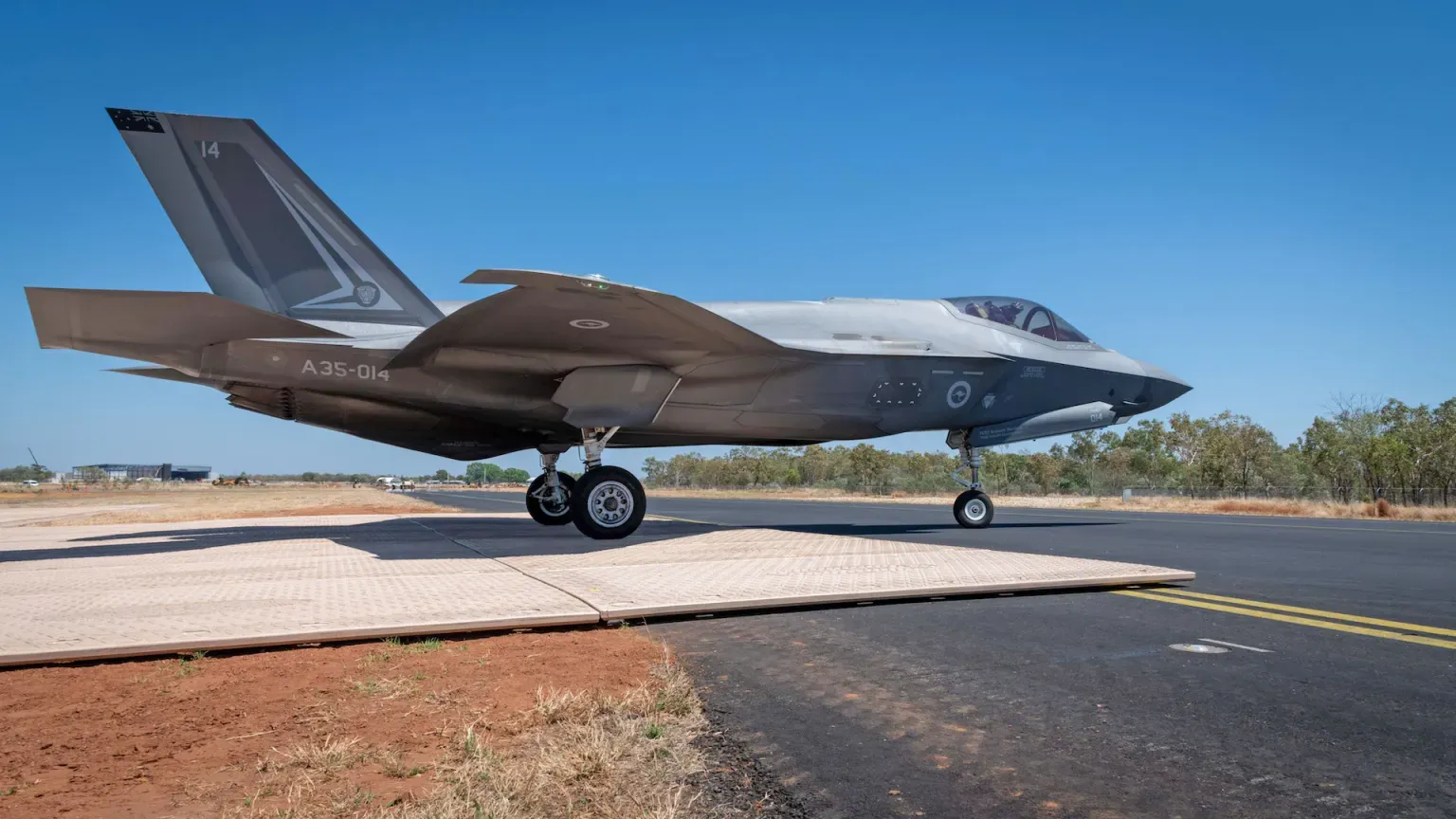
Chinese authorities have reportedly taken possession of an F-35 cockpit canopy and weapons-bay door that were inexplicably diverted to Hong Kong while being shipped from Australia to the United States. The incident appears to have left physical components that incorporate aspects of the fighter’s low-observable design in the hands of a country that has spent years doing whatever it could to gain information on the aircraft and America’s stealth technology secrets in general.
So, what does all this mean? Let’s put it in perspective.
The parts in question were being shipped by UPS from Australia to the United States in late May, according to people familiar with the matter cited by Bloomberg. The components from a Royal Australian Air Force F-35A were being sent to the United States for inspection and possible repair or disposal.

F-35 sustainment procedures explicitly cover the movement of F-35 parts, including unserviceable components, through the program’s logistics network. The U.S. Air Force’s transportation guidance directs F-35 shipments outside the Defense Transportation System to follow approved Joint Program Office procedures. In other words, moving an unserviceable Australian F-35 component to the United States for inspection, repair, or disposition is consistent with the normal sustainment process.
What is highly unusual is where this particular shipment ended up. F-35 components moving through an established international logistics system apparently stopped in South Korea, were then routed to Hong Kong. Chinese authorities subsequently took possession of the parts and have not returned them, according to the sources cited by Bloomberg.


“For security reasons, we can’t discuss the status of specific shipments or our shipping procedures,” Lockheed Martin told us in response to a request for clarification about the incident. The company added that it “follows all U.S. regulations established by the Department of War and regulated by the Defense Logistics Agency (DLA) regarding the shipment of aircraft components. Our teams handle every shipment with the utmost diligence and safeguards to ensure the integrity of the F-35 program and the security of our allied partners.”
The Pentagon’s F-35 Joint Program Office has acknowledged a “shipment issue” involving F-35 components and said U.S. authorities and industry partners are working to recover them and investigate what happened.
Lockheed Martin, UPS, and the Pentagon have not publicly provided a detailed account of how the shipment was diverted or what happened to the parts after they reached Hong Kong.
Australian Defense Minister Richard Marles also confirmed that Canberra was aware of the incident and was working with the United States and Lockheed Martin.

Marles has sought to play down the potential security implications of the components, saying his understanding was that the shipment did not contain sensitive equipment or sensitive parts. That does not by itself answer the more specific question of what could potentially be learned from these particular pieces of an F-35. After all, not every physical component of an F-35 is necessarily highly classified or capable of revealing meaningful information about the aircraft’s design. At the same time, a cockpit canopy and weapons-bay door involve structures, materials, interfaces, tolerances, and treatments that all have to work within the aircraft’s low-observable design. If radar-absorbing material or other specialized treatments remain on the components, that could potentially make them far more sensitive from a technological exploitation standpoint.
The condition of the parts is also unknown. We do not know how much of their coatings or other treatments remain intact, whether Chinese authorities have examined them, or what information could actually be extracted from them in their current state.
Above all else, there is little specific information in the public domain about what F-35-related technical information Chinese intelligence already has acquired over the years, what physical components or materials it may already possess, or what additional information could be gained through espionage, cyber operations, industrial access, observation of deployed aircraft, or other means.
Without these facts, it is impossible to gauge what damage could have been done by this loss. Still, viewed in a vacuum of those unknowns, simply having an F-35 canopy and weapons-bay door in Chinese possession represents a significant loss of control over sensitive physical hardware — there is no way around that reality — and the severity of that loss could be substantial depending on the physical state of the parts.
The circumstances are particularly sensitive because, as we mentioned in the opening of this article, China has pursued multiple avenues for acquiring information on the F-35 for many years, with publicly documented cases involving cyber operations, technical information, supply chains, and human expertise. Some aspects of China’s subsequent stealth aircraft designs have also prompted comparisons with U.S. aircraft, although claims that China simply ‘cloned’ entire aircraft are not supported by the available evidence.
China And The F-35: A History Of Espionage
In 2014, U.S. authorities charged Chinese businessman Su Bin with conspiring with two other Chinese hackers to break into the computer systems of U.S. defense contractors. Prosecutors alleged that the group targeted information on aircraft including the F-35 and F-22. The alleged hacking campaign ran from 2009 to 2013.
Su Bin later pleaded guilty and was sentenced to nearly four years in prison. The Justice Department’s 2026 case against former Air Force fighter pilot Gerald “Runner” Brown connects the two cases. Prosecutors allege that Brown used a co-conspirator to negotiate his work training Chinese military pilots with Su Bin.
Brown, a retired U.S. Air Force major who spent more than 24 years in the service, subsequently worked as a contract simulator instructor training U.S. military pilots on the A-10 and F-35. In February 2026, the Justice Department charged him with providing and conspiring to provide unauthorized defense services to Chinese military pilots.
According to the criminal complaint, Brown traveled to China in December 2023, where he allegedly began training People’s Liberation Army Air Force (PLAAF) personnel. Prosecutors say he also answered questions about the U.S. Air Force for three hours on his first day in China. Brown has been charged, and the allegations have not been adjudicated. He is one of multiple former Western aviators alleged to have provided training services and/or intelligence to Beijing.
The Honeywell case provides yet another example, this time involving the defense industry’s supply of technical information.
In 2021, the State Department reached a $13-million administrative settlement with Honeywell over alleged violations of the Arms Export Control Act and International Traffic in Arms Regulations (ITAR). Honeywell had voluntarily disclosed alleged unauthorized exports and retransfers of ITAR-controlled technical data.
The case involved 71 engineering drawings containing dimensions, geometries and layouts for manufacturing castings and finished parts used across multiple aircraft, engines and military systems. The State Department said the unauthorized exports and retransfers involved Canada, Ireland, Mexico, China, and Taiwan.
Among the systems covered by the drawings were components associated with the F-35 and F-22. The case did not allege that Honeywell deliberately sought to provide China with sensitive military technology; rather, it concerned alleged violations of export-control requirements.

There has also been a physical supply-chain precedent.
In 2022, F-35 deliveries were temporarily halted after the Pentagon discovered that a magnet in the aircraft’s Honeywell-built turbomachine pumps —which provide critical power functions to the jet — contained a cobalt and samarium alloy produced in China. The material itself was not considered a security or flight-safety threat, but the discovery demonstrated how difficult it can be to maintain complete visibility over a global supply chain involving thousands of companies and multiple tiers of subcontractors.
Taken together, these cases demonstrate several different pathways through which China has appeared in the F-35 security story: cyber theft, unauthorized technical-data transfers, supply-chain exposure, and alleged exploitation of former Western military expertise.
The Hong Kong incident would add another major category: physical access to actual F-35 components.
These are only some of the publicly documented examples. There is no public way to know the full extent of information or physical material Chinese intelligence may have acquired over the years, but is very likely far larger in scope than what is available in the open source.
Chinese Access Concerns Have Shaped F-35 Export Policy
The security issues surrounding the F-35 are significant enough that concerns about China have affected not only how the United States protects F-35 technology, but where Washington is willing to export the aircraft in the first place.
The proposed sale of F-35s to the United Arab Emirates became deeply entangled in U.S. concerns about Abu Dhabi’s growing military and technology relationship with China.

Washington had approved a potential package involving 50 F-35As, but U.S. officials and lawmakers expressed concerns about Chinese intelligence activity and technology in the UAE. Among the broader concerns were Chinese telecommunications infrastructure and the possibility of Chinese military or intelligence access to facilities associated with advanced U.S. weapons. A Congressional U.S.-China Economic and Security Review Commission report later cited the potential presence of Chinese intelligence collection capabilities and military facilities in the UAE as risks to the proposed F-35 sale.
The issue has now resurfaced with Saudi Arabia.
The State Department recently approved a potential $24.3-billion sale to the Kingdom involving 48 F-35s and associated equipment. But U.S. intelligence agencies have reportedly warned that China’s military and technology relationship with Saudi Arabia could create opportunities for Beijing to obtain sensitive F-35 information.
According to reporting based on U.S. officials familiar with intelligence assessments, a Defense Intelligence Agency report raised concerns about Chinese military access to Saudi bases, Chinese technology in Saudi telecommunications infrastructure, and whether secure facilities could be maintained for F-35 operations. The assessments also questioned whether Saudi Arabia would limit contact between Chinese military and intelligence personnel and F-35-related sites.
What Could The Components Reveal?
As we noted earlier, there is no way to gauge the intelligence impact of the loss at this stage. The central unknown of what China already knows about the F-35, and what it may already have in its possession — especially related to these components — is the key variable here.
Regardless, an F-35 canopy and weapons-bay door can provide information that cannot otherwise be easily obtained and gives a different level of fidelity in terms of material exploitation than what construction data and blueprints alone could.
The F-35’s low observability is the product of an extremely complex combination of airframe shaping, construction materials, external coatings, manufacturing tolerances, speciality apertures, and more.

A canopy is a particularly demanding part of any stealth aircraft. It has to satisfy optical and structural requirements while also controlling radar reflections. The cockpit is historically a major source of radar reflectivity, including the pilot’s helmet. Therefore the canopy’s materials, construction, interfaces, and specialized treatments can be critical to the aircraft’s overall low-observable performance, and especially from the critical frontal aspect.
The F-35’s canopy has been an ongoing work in progress for many years. It has had chronic material issues, especially when it comes to delamination. Multiple iterations spread over two decades have recently resulted in a major improvement of the issue. The tight balancing act of keeping the canopy transparent enough, while controlling the F-35’s stealthy signature and having that mix of materials be robust enough to last for a reasonable amount of time has been a major investment for the program. If the canopy is of a later variation, that loss alone could be substantial and could help China with their own low-observable canopy development programs even if they already had original information on the F-35’s canopy original design dating back years.

The F-35’s weapons-bay door has its of sensitivity issues. It is effectively a major section of the aircraft’s outer shell, with its structure, edges, interfaces, tolerances and treatments all having to function without creating unacceptable radar signatures. Its construction and material attributes can be reasonably extrapolated for the rest of much of the F-35’s outer mold-line. Above all else, if the radar absorbent material remained intact on the door, that would signify a major loss when viewed without any understanding of what China already knows about the F-35’s radar absorbing surface treatments. Historically speaking, RAM technology is among America’s closest guarded material sciences secrets.

For the time being, Australian officials have said they do not understand the parts to be sensitive. The investigation will ultimately have to establish what the components actually contain and what could be learned from them.
The incident comes at a moment when China’s own stealth fighter efforts are undergoing an extraordinary expansion.
The PLAAF is now operating the J-20, China’s first operational fifth-generation stealth fighter, in increasingly large numbers. The smaller J-35 is also moving toward broader service, including a carrier role for the People’s Liberation Army Navy.

China has also moved into what Western observers generally describe as sixth-generation fighter development.
Two new tailless combat-aircraft designs emerged publicly in December 2024. One is the large Chengdu aircraft commonly referred to as the J-36, while the other is associated with Shenyang and is variously called the J-XDS or J-50. Both have continued flight testing and yielded several prototypes with individual refinements.
The exact capabilities and eventual operational roles of these aircraft remain uncertain. They are developmental designs, not established operational equivalents of the F-35 or other sixth-generation systems. However, China is clearly building an increasingly broad ecosystem of fifth- and next-generation low-observable combat aircraft, both crewed and uncrewed. In the latter category is a growing number of stealthy drones, including long-endurance types.

China didn’t likely need physical access to an F-35 canopy or weapons-bay door to develop the J-20, J-35, or its next-generation aircraft. But additional information about how a mature Western stealth aircraft handles materials, coatings, interfaces, manufacturing, and the integration of those elements can still have great potential value to an industry developing its own systems. This includes technologies intended to counter the U.S. combat aircraft and their low-observable characteristics.
The F-35 has been produced in large numbers, is operated by a growing coalition of countries, and has been subjected to years of testing and operational experience. Its low-observable design represents decades of accumulated U.S. research and industrial know-how. At the same time, the global scale of the program inevitably makes control over sensitive information more complicated. More aircraft, more maintainers, more industrial partners, and more international logistics mean more points at which information and physical hardware have to be controlled. Over time, a program of this size will see an erosion in its secrets, but a major loss can drastically accelerate what should be a more gradual and control decline in security.

The potential intelligence value of the components also has to be considered in the context of foreign material exploitation, or FME. Major military powers maintain dedicated capabilities to recover, examine and characterize foreign weapons, aircraft, sensors, materials and other equipment. The objective is not necessarily to reproduce an entire system. More important is determining how something is built, what materials and manufacturing techniques are used, how individual components perform, and where industrial strengths or limitations may lie.
That is why countries have historically gone to extraordinary lengths to recover even crashed or damaged pieces of sensitive military hardware. The bigger the prize, the more risk an intelligence service would be willing to take in order to realize a recovery.
The sensitivity surrounding the physical remnants of an F-35 is not new. When a Japan Air Self-Defense Force F-35A disappeared over the Pacific in 2019, the search quickly became more than a rescue operation. U.S. and Japanese forces mounted an extensive effort to locate the wreckage, with U.S. Navy P-8A aircraft and a destroyer joining the search. TWZ noted at the time that even scattered F-35 wreckage could expose valuable technological secrets, while the aircraft’s location on the seabed raised the prospect of an underwater espionage and recovery operation.
That concern has also been evident in subsequent F-35 recovery operations. That concern has been reflected in subsequent F-35 recoveries. In 2022, the U.S. Navy recovered an F-35C from roughly 12,400 feet in the South China Sea after a carrier landing accident, removing the possibility that the aircraft could be accessed by another country.
Unanswered Security Questions
At this point, there is no public evidence that the Hong Kong diversion was a deliberate Chinese intelligence operation, although it is certainly possible. It is also unclear whether Chinese authorities have examined the F-35 parts or what level of new and useful information has been recovered from them.
If, as reported, Chinese authorities have taken possession of the parts and have not returned them, that would be an extraordinary development. If the diversion was genuinely the result of a shipping or logistics error, the outcome would itself be extraordinary. It would raise serious questions about the security controls surrounding the movement of F-35 hardware even without evidence of deliberate interference.
The timing is also notable. Chinese President Xi Jinping arrived in Washington this week for a state visit with President Donald Trump, with the two leaders meeting amid broader disputes involving technology, security, and the future of U.S.-China relations. Whether the F-35 shipment comes up directly in those discussions is not known, but it would be an obvious subject for U.S. and Chinese officials to address through diplomatic channels.
For now, however, the central question remains how the parts got there. Until that is answered, we won’t know if this was a simple logistics failure or a deliberate intelligence operation. And beyond that, what China already knew about the components it now may have in its possession — a question we may never truly get an answer to.
Contact the author: thomas@thewarzone.com