SELMA Blair has been arrested after allegedly attacking multiple flight attendants while trying to open a plane’s door mid-flight.
The actress reportedly started mass chaos on a Delta Airlines flight traveling to John F. Kennedy International Airport on Sunday.
Selma Blair has been arrested after allegedly attacking flight attendants while trying to open the plane’s door mid-flights
Selma attempted to open the aircraft door while it was in the air and assaulted several crew members who tried to stop her, according to TMZ who first reported the news.
“Two flight attendants from the airline were injured to the point where they needed further medical care due to an attack from a passenger,” the New York Port Authority confirmed in a statement to The U.S. Sun, though they didn’t mention the Legally Blonde star by name.
Sign up for the Showbiz newsletter
Thank you!
“The person who caused these injuries also repeatedly tried to open the plane door. She was arrested immediately upon landing, and the incident is currently being investigated by federal law enforcement,” they added.
A rep for Selma further told TMZ, “Selma experienced a medical emergency that led to the alleged conduct. Upon landing, she received immediate medical attention and is currently in stable condition.”
It’s unknown what caused Selma’s behavior, but it’s sadly not the first time this happened.
In 2016, the Cruel Intentions star was removed from a flight on a stretcher after having a meltdown in the sky.
More to follow… For the latest news on this story, keep checking back at The U.S. Sun, your go-to destination for the best celebrity news, sports news, real-life stories, jaw-dropping pictures, and must-see videos.
Chinese authorities have reportedly taken possession of an F-35 cockpit canopy and weapons-bay door that were inexplicably diverted to Hong Kong while being shipped from Australia to the United States. The incident appears to have left physical components that incorporate aspects of the fighter’s low-observable design in the hands of a country that has spent years doing whatever it could to gain information on the aircraft and America’s stealth technology secrets in general.
So, what does all this mean? Let’s put it in perspective.
The parts in question were being shipped by UPS from Australia to the United States in late May, according to people familiar with the matter cited by Bloomberg. The components from a Royal Australian Air Force F-35A were being sent to the United States for inspection and possible repair or disposal.
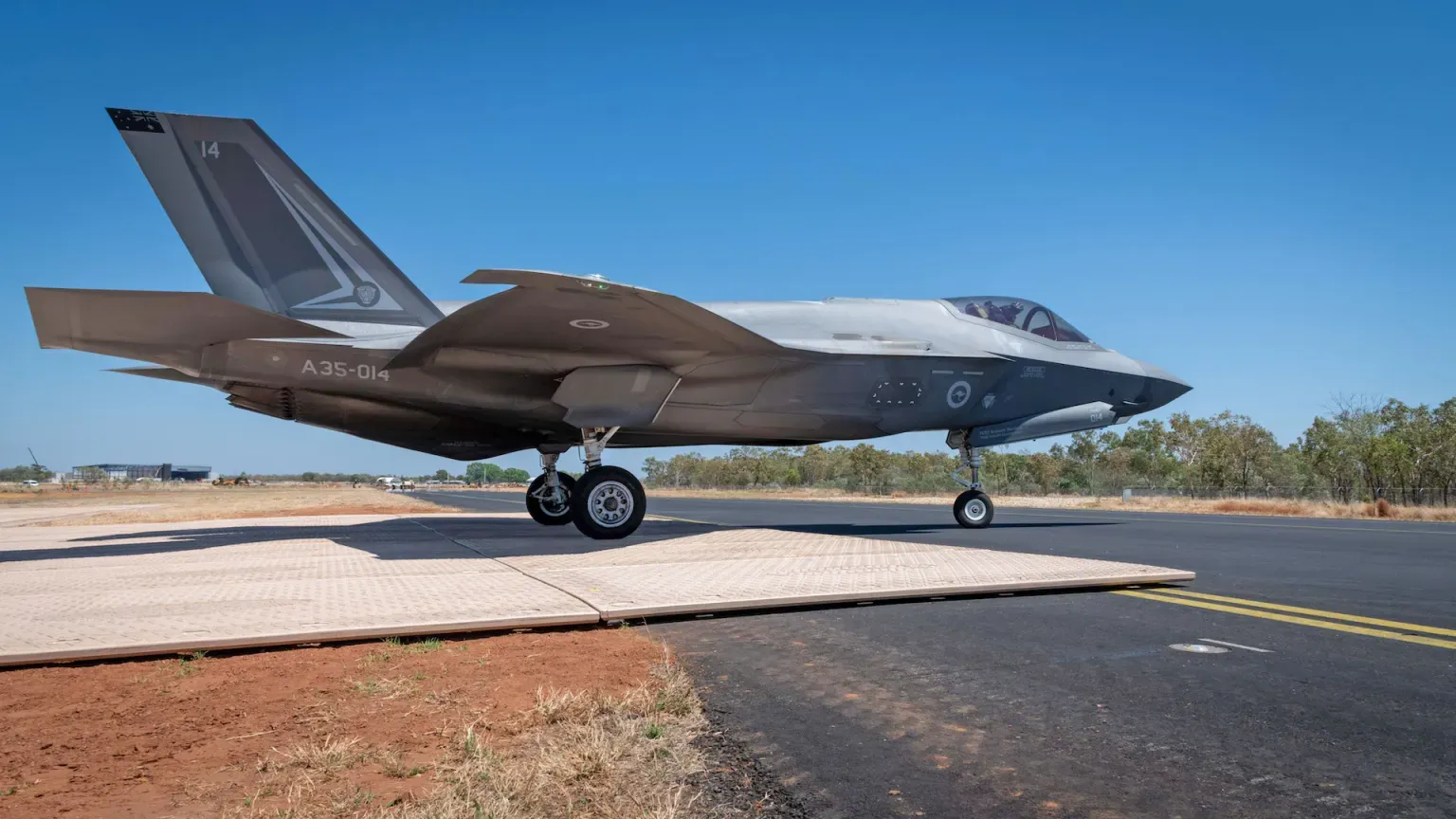
A Royal Australian Air Force F-35A from 75 Squadron taxiing at RAAF Base Tindal, Northern Territory. Australian Defense Force
F-35 sustainment procedures explicitly cover the movement of F-35 parts, including unserviceable components, through the program’s logistics network. The U.S. Air Force’s transportation guidance directs F-35 shipments outside the Defense Transportation System to follow approved Joint Program Office procedures. In other words, moving an unserviceable Australian F-35 component to the United States for inspection, repair, or disposition is consistent with the normal sustainment process.
What is highly unusual is where this particular shipment ended up. F-35 components moving through an established international logistics system apparently stopped in South Korea, were then routed to Hong Kong. Chinese authorities subsequently took possession of the parts and have not returned them, according to the sources cited by Bloomberg.
F-35 canopy component replacement at Luke Air Force Base, Arizona. U.S. Air Force photo by Senior Airman Ridge ShanSecretary of War Pete Hegseth autographs the weapons bay door of an F-35 at Lockheed Martin Air Force Plant 4, in Fort Worth, Texas. DoW photo by U.S. Navy Petty Officer 1st Class Alexander Kubitza
“For security reasons, we can’t discuss the status of specific shipments or our shipping procedures,” Lockheed Martin told us in response to a request for clarification about the incident. The company added that it “follows all U.S. regulations established by the Department of War and regulated by the Defense Logistics Agency (DLA) regarding the shipment of aircraft components. Our teams handle every shipment with the utmost diligence and safeguards to ensure the integrity of the F-35 program and the security of our allied partners.”
The Pentagon’s F-35 Joint Program Office has acknowledged a “shipment issue” involving F-35 components and said U.S. authorities and industry partners are working to recover them and investigate what happened.
Lockheed Martin, UPS, and the Pentagon have not publicly provided a detailed account of how the shipment was diverted or what happened to the parts after they reached Hong Kong.
Australian Defense Minister Richard Marles also confirmed that Canberra was aware of the incident and was working with the United States and Lockheed Martin.
Acting Prime Minister and Minister for Defense, Richard Marles, accompanied by Chief of Air Force Air Marshal Stephen Chappell at RAAF Base Edinburgh, South Australia. Australian Defense Force
Marles has sought to play down the potential security implications of the components, saying his understanding was that the shipment did not contain sensitive equipment or sensitive parts. That does not by itself answer the more specific question of what could potentially be learned from these particular pieces of an F-35. After all, not every physical component of an F-35 is necessarily highly classified or capable of revealing meaningful information about the aircraft’s design. At the same time, a cockpit canopy and weapons-bay door involve structures, materials, interfaces, tolerances, and treatments that all have to work within the aircraft’s low-observable design. If radar-absorbing material or other specialized treatments remain on the components, that could potentially make them far more sensitive from a technological exploitation standpoint.
The condition of the parts is also unknown. We do not know how much of their coatings or other treatments remain intact, whether Chinese authorities have examined them, or what information could actually be extracted from them in their current state.
Above all else, there is little specific information in the public domain about what F-35-related technical information Chinese intelligence already has acquired over the years, what physical components or materials it may already possess, or what additional information could be gained through espionage, cyber operations, industrial access, observation of deployed aircraft, or other means.
Without these facts, it is impossible to gauge what damage could have been done by this loss. Still, viewed in a vacuum of those unknowns, simply having an F-35 canopy and weapons-bay door in Chinese possession represents a significant loss of control over sensitive physical hardware — there is no way around that reality — and the severity of that loss could be substantial depending on the physical state of the parts.
The circumstances are particularly sensitive because, as we mentioned in the opening of this article, China has pursued multiple avenues for acquiring information on the F-35 for many years, with publicly documented cases involving cyber operations, technical information, supply chains, and human expertise. Some aspects of China’s subsequent stealth aircraft designs have also prompted comparisons with U.S. aircraft, although claims that China simply ‘cloned’ entire aircraft are not supported by the available evidence.
China And The F-35: A History Of Espionage
In 2014, U.S. authorities charged Chinese businessman Su Bin with conspiring with two other Chinese hackers to break into the computer systems of U.S. defense contractors. Prosecutors alleged that the group targeted information on aircraft including the F-35 and F-22. The alleged hacking campaign ran from 2009 to 2013.
Su Bin later pleaded guilty and was sentenced to nearly four years in prison. The Justice Department’s 2026 case against former Air Force fighter pilot Gerald “Runner” Brown connects the two cases. Prosecutors allege that Brown used a co-conspirator to negotiate his work training Chinese military pilots with Su Bin.
Brown, a retired U.S. Air Force major who spent more than 24 years in the service, subsequently worked as a contract simulator instructor training U.S. military pilots on the A-10 and F-35. In February 2026, the Justice Department charged him with providing and conspiring to provide unauthorized defense services to Chinese military pilots.
According to the criminal complaint, Brown traveled to China in December 2023, where he allegedly began training People’s Liberation Army Air Force (PLAAF) personnel. Prosecutors say he also answered questions about the U.S. Air Force for three hours on his first day in China. Brown has been charged, and the allegations have not been adjudicated. He is one of multiple former Western aviators alleged to have provided training services and/or intelligence to Beijing.
The Honeywell case provides yet another example, this time involving the defense industry’s supply of technical information.
In 2021, the State Department reached a $13-million administrative settlement with Honeywell over alleged violations of the Arms Export Control Act and International Traffic in Arms Regulations (ITAR). Honeywell had voluntarily disclosed alleged unauthorized exports and retransfers of ITAR-controlled technical data.
The case involved 71 engineering drawings containing dimensions, geometries and layouts for manufacturing castings and finished parts used across multiple aircraft, engines and military systems. The State Department said the unauthorized exports and retransfers involved Canada, Ireland, Mexico, China, and Taiwan.
Among the systems covered by the drawings were components associated with the F-35 and F-22. The case did not allege that Honeywell deliberately sought to provide China with sensitive military technology; rather, it concerned alleged violations of export-control requirements.
A U.S. Air Force F-22 (nearest camera) flies alongside an F-35A. U.S. Air Force photo by Lt. Sam Eckholm
There has also been a physical supply-chain precedent.
In 2022, F-35 deliveries were temporarily halted after the Pentagon discovered that a magnet in the aircraft’s Honeywell-built turbomachine pumps —which provide critical power functions to the jet — contained a cobalt and samarium alloy produced in China. The material itself was not considered a security or flight-safety threat, but the discovery demonstrated how difficult it can be to maintain complete visibility over a global supply chain involving thousands of companies and multiple tiers of subcontractors.
Taken together, these cases demonstrate several different pathways through which China has appeared in the F-35 security story: cyber theft, unauthorized technical-data transfers, supply-chain exposure, and alleged exploitation of former Western military expertise.
The Hong Kong incident would add another major category: physical access to actual F-35 components.
These are only some of the publicly documented examples. There is no public way to know the full extent of information or physical material Chinese intelligence may have acquired over the years, but is very likely far larger in scope than what is available in the open source.
Chinese Access Concerns Have Shaped F-35 Export Policy
The proposed sale of F-35s to the United Arab Emirates became deeply entangled in U.S. concerns about Abu Dhabi’s growing military and technology relationship with China.
A 34th Expeditionary Fighter Squadron F-35A conducts inflight refueling above the United Arab Emirates. U.S. Air Force photo by Tech. Sgt. Kat Justen
Washington had approved a potential package involving 50 F-35As, but U.S. officials and lawmakers expressed concerns about Chinese intelligence activity and technology in the UAE. Among the broader concerns were Chinese telecommunications infrastructure and the possibility of Chinese military or intelligence access to facilities associated with advanced U.S. weapons. A Congressional U.S.-China Economic and Security Review Commission report later cited the potential presence of Chinese intelligence collection capabilities and military facilities in the UAE as risks to the proposed F-35 sale.
The State Department recently approved a potential $24.3-billion sale to the Kingdom involving 48 F-35s and associated equipment. But U.S. intelligence agencies have reportedly warned that China’s military and technology relationship with Saudi Arabia could create opportunities for Beijing to obtain sensitive F-35 information.
According to reporting based on U.S. officials familiar with intelligence assessments, a Defense Intelligence Agency report raised concerns about Chinese military access to Saudi bases, Chinese technology in Saudi telecommunications infrastructure, and whether secure facilities could be maintained for F-35 operations. The assessments also questioned whether Saudi Arabia would limit contact between Chinese military and intelligence personnel and F-35-related sites.
What Could The Components Reveal?
As we noted earlier, there is no way to gauge the intelligence impact of the loss at this stage. The central unknown of what China already knows about the F-35, and what it may already have in its possession — especially related to these components — is the key variable here.
Regardless, an F-35 canopy and weapons-bay door can provide information that cannot otherwise be easily obtained and gives a different level of fidelity in terms of material exploitation than what construction data and blueprints alone could.
The F-35’s low observability is the product of an extremely complex combination of airframe shaping, construction materials, external coatings, manufacturing tolerances, speciality apertures, and more.
U.S. Air Force 325th Maintenance Squadron low-observable maintainers work on an F-35A at Tyndall Air Force Base, Florida, in August 2024. U.S. Air Force photo by Airman 1st Class Victoria Moehlman
A canopy is a particularly demanding part of any stealth aircraft. It has to satisfy optical and structural requirements while also controlling radar reflections. The cockpit is historically a major source of radar reflectivity, including the pilot’s helmet. Therefore the canopy’s materials, construction, interfaces, and specialized treatments can be critical to the aircraft’s overall low-observable performance, and especially from the critical frontal aspect.
The F-35’s canopy has been an ongoing work in progress for many years. It has had chronic material issues, especially when it comes to delamination. Multiple iterations spread over two decades have recently resulted in a major improvement of the issue. The tight balancing act of keeping the canopy transparent enough, while controlling the F-35’s stealthy signature and having that mix of materials be robust enough to last for a reasonable amount of time has been a major investment for the program. If the canopy is of a later variation, that loss alone could be substantial and could help China with their own low-observable canopy development programs even if they already had original information on the F-35’s canopy original design dating back years.
Evidence of the F-35’s canopy delamination issue on an early example of the F-35B. Crown Copyright
The F-35’s canopy has been a notorious work in progress, specifically the low observable coating/delamination issue which has improved a lot in recent years with new materials and processes. So no, you do NOT want to lose that in to China! https://t.co/9V0jdRAiwA
The F-35’s weapons-bay door has its of sensitivity issues. It is effectively a major section of the aircraft’s outer shell, with its structure, edges, interfaces, tolerances and treatments all having to function without creating unacceptable radar signatures. Its construction and material attributes can be reasonably extrapolated for the rest of much of the F-35’s outer mold-line. Above all else, if the radar absorbent material remained intact on the door, that would signify a major loss when viewed without any understanding of what China already knows about the F-35’s radar absorbing surface treatments. Historically speaking, RAM technology is among America’s closest guarded material sciences secrets.
A Belgian Air Force service member inspects the open weapons bay of an F-35A at Luke AFB, Arizona. U.S. Air Force photo by Airman 1st Class Tekorey Watkins
For the time being, Australian officials have said they do not understand the parts to be sensitive. The investigation will ultimately have to establish what the components actually contain and what could be learned from them.
The incident comes at a moment when China’s own stealth fighter efforts are undergoing an extraordinary expansion.
The PLAAF is now operating the J-20, China’s first operational fifth-generation stealth fighter, in increasingly large numbers. The smaller J-35 is also moving toward broader service, including a carrier role for the People’s Liberation Army Navy.
Aircraft maintainers clean the fuselage of a J-20 fighter during the Changchun Air Show in the Jilin Province of China, in September 2025. Photo by Zhang Xiangyi/China News Service/VCG via Getty Images
China has also moved into what Western observers generally describe as sixth-generation fighter development.
Two new tailless combat-aircraft designs emerged publicly in December 2024. One is the large Chengdu aircraft commonly referred to as the J-36, while the other is associated with Shenyang and is variously called the J-XDS or J-50. Both have continued flight testing and yielded several prototypes with individual refinements.
The exact capabilities and eventual operational roles of these aircraft remain uncertain. They are developmental designs, not established operational equivalents of the F-35 or other sixth-generation systems. However, China is clearly building an increasingly broad ecosystem of fifth- and next-generation low-observable combat aircraft, both crewed and uncrewed. In the latter category is a growing number of stealthy drones, including long-endurance types.
China didn’t likely need physical access to an F-35 canopy or weapons-bay door to develop the J-20, J-35, or its next-generation aircraft. But additional information about how a mature Western stealth aircraft handles materials, coatings, interfaces, manufacturing, and the integration of those elements can still have great potential value to an industry developing its own systems. This includes technologies intended to counter the U.S. combat aircraft and their low-observable characteristics.
The F-35 has been produced in large numbers, is operated by a growing coalition of countries, and has been subjected to years of testing and operational experience. Its low-observable design represents decades of accumulated U.S. research and industrial know-how. At the same time, the global scale of the program inevitably makes control over sensitive information more complicated. More aircraft, more maintainers, more industrial partners, and more international logistics mean more points at which information and physical hardware have to be controlled. Over time, a program of this size will see an erosion in its secrets, but a major loss can drastically accelerate what should be a more gradual and control decline in security.
The Lockheed Martin F-35 production line at Fort Worth, Texas. Lockheed Martin photo by Alexander H Groves
The potential intelligence value of the components also has to be considered in the context of foreign material exploitation, or FME. Major military powers maintain dedicated capabilities to recover, examine and characterize foreign weapons, aircraft, sensors, materials and other equipment. The objective is not necessarily to reproduce an entire system. More important is determining how something is built, what materials and manufacturing techniques are used, how individual components perform, and where industrial strengths or limitations may lie.
That is why countries have historically gone to extraordinary lengths to recover even crashed or damaged pieces of sensitive military hardware. The bigger the prize, the more risk an intelligence service would be willing to take in order to realize a recovery.
The sensitivity surrounding the physical remnants of an F-35 is not new. When a Japan Air Self-Defense Force F-35A disappeared over the Pacific in 2019, the search quickly became more than a rescue operation. U.S. and Japanese forces mounted an extensive effort to locate the wreckage, with U.S. Navy P-8A aircraft and a destroyer joining the search. TWZnoted at the time that even scattered F-35 wreckage could expose valuable technological secrets, while the aircraft’s location on the seabed raised the prospect of an underwater espionage and recovery operation.
That concern has also been evident in subsequent F-35 recovery operations. That concern has been reflected in subsequent F-35 recoveries. In 2022, the U.S. Navy recovered an F-35C from roughly 12,400 feet in the South China Sea after a carrier landing accident, removing the possibility that the aircraft could be accessed by another country.
Unanswered Security Questions
At this point, there is no public evidence that the Hong Kong diversion was a deliberate Chinese intelligence operation, although it is certainly possible. It is also unclear whether Chinese authorities have examined the F-35 parts or what level of new and useful information has been recovered from them.
If, as reported, Chinese authorities have taken possession of the parts and have not returned them, that would be an extraordinary development. If the diversion was genuinely the result of a shipping or logistics error, the outcome would itself be extraordinary. It would raise serious questions about the security controls surrounding the movement of F-35 hardware even without evidence of deliberate interference.
The timing is also notable. Chinese President Xi Jinping arrived in Washington this week for a state visit with President Donald Trump, with the two leaders meeting amid broader disputes involving technology, security, and the future of U.S.-China relations. Whether the F-35 shipment comes up directly in those discussions is not known, but it would be an obvious subject for U.S. and Chinese officials to address through diplomatic channels.
“Ladies and gentlemen, the President of the United States Donald J. Trump and First Lady Melania Trump, accompanied by the President of the People’s Republic of China Xi Jinping and Madame Peng Liyuan.” pic.twitter.com/hyPHOBC99Q
For now, however, the central question remains how the parts got there. Until that is answered, we won’t know if this was a simple logistics failure or a deliberate intelligence operation. And beyond that, what China already knew about the components it now may have in its possession — a question we may never truly get an answer to.
Chester County public health officials did not wait long to launch a response to the growing measles outbreak in their community, which shares a border with Lancaster County, the epicentre of the outbreak.
Jeanne Franklin, the director of the health department, said officials have been using some of the strategies they employed during the Covid pandemic – knocking on doors in the community to let them know about the outbreak and offering private settings, like people’s homes, for immunisations.
Since the outbreak started, the county has given 538 MMR vaccines, 340 of which they administered in private settings.
“People have called up and said, ‘I can’t get to your clinic, or, I don’t want people to know I’ve changed my mind,” Franklin said. “‘If you can come to us, that’s a lot easier.'”
The boots-on-the-ground approach has helped the health department dispel misinformation and build trust with the community, local health officials said.
In recent years, childhood vaccination rates have fallen across the country as false theories about the safety of the measles vaccine have proliferated on social media.
Those theories have found roots even in an insulated community with limited access to computers, Weiser said. She has heard people ask if there are heavy metals in the vaccine that could make them magnetic, or if the shot has a computer chip in it.
“You’re clearly getting information from that hard-core group that is promoting that misinformation and disinformation,” she said.
People in this “hard-core group”, who are staunchly against vaccines, are unlikely tobe swayed, experts and officials themselves said.
But now, local health officials said, many affected by the Pennsylvania outbreak are seeing their neighbours fall seriously ill and asking thoughtful questions. Weiser said many are parents who are unfamiliar with the shots and are scared to make the wrong choice for their children.
“There is the classically-defined anti-vaxer, versus people who are unaware or their culture feels differently,” Franklin said. “The thinking and the willingness to discuss and possibly change your mind is different between those two bookends.”
WASHINGTON — President Trump’s AI-fueled vision for a drone port he intends to install atop the new White House ballroom includes missile-bearing unmanned aerial vehicles and gun-toting troops, ostensibly to protect the 18-acre complex and the nation’s capital.
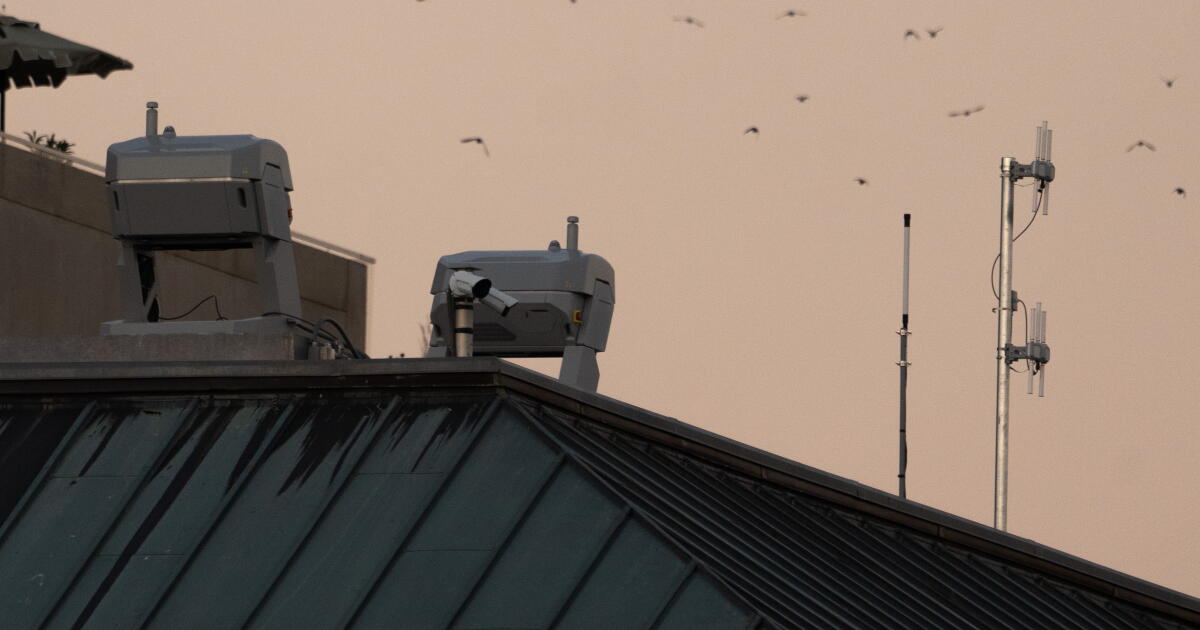
A few hundred feet away, a drone port, run by the U.S. Secret Service and not the military, is already quietly operational. Equipped with cameras and sensors to scope out potential threats from a bird’s-eye view, the small UAVs stand on alert in four gray weatherproof boxes until deployed at officers’ commands.
The agency is using a model known as “drone as first responder,” deploying speedy unarmed drones from outdoor stations to serve as flying cameras. That model has been adopted by hundreds of police agencies across the U.S., often powered by AI software to help dodge obstacles or track targets.
The existence of the surveillance drones on a Treasury Department building adjacent to the White House complex has not been previously reported, and could undercut Trump’s legal claims that the ballroom construction is necessary “to protect the White House and surrounding region from aerial attacks.” The need for the drone port underpinned Trump’s national security defense for the construction project — a justification he is now citing for the construction of a massive arch outside the gates of Arlington National Cemetery.
The installation is thus far markedly less imposing than the vision outlined by Trump, with its rows of futuristic attack drones, apparently modeled after those used in U.S. military strikes, that drone experts describe as outlandish.
“To be honest, if a drone was so close to the White House that it needed interdiction, it’s already gotten too far,” said Matt Sloane, co-founder of SkyfireAI, which makes software for drones used by public safety agencies.
It would be more realistic for the White House to build something akin to what the Secret Service is using next door, Sloane said: “The drone takes off and does some type of perimeter sweep or whatever, and then puts itself back in the box.”
The White House did not comment for the story. The Secret Service declined to comment on the specifics of its drone operations but said the new docks are separate from Trump’s ballroom drone port.
The details of Trump’s ballroom drone port remain murky
Security of the president and the White House complex is generally the domain of the Secret Service, which works in close concert with the White House Military Office and other military elements when needed.
Trump has said the drone port came at the request of U.S. military officials. Speaking to reporters in May, he said the building’s plans were expanded to meet the request: “They wanted more drone capacity,” he said. On social media, he boasted that the drone port might end up being the “most sophisticated” in the world.
What Trump is ultimately aiming to build, and how far it goes beyond what has already been installed, remains unclear. Beyond Trump’s AI images, some of which he filed in his appeal to the U.S. Supreme Court to lift lower courts’ blocks on the construction, the White House has not disclosed what kinds of drones will be used or for what tactical purpose.
The Secret Service is using smaller surveillance drones that are a fraction of the size of the attack drones depicted in Trump’s AI images. The U.S. Air Force bought similar drones from Skydio in April to protect bases across the Middle East. The company also supplied drones to help protect World Cup matches this year.
The Secret Service has been building out its drone- and counter-drone programs for years. But work has accelerated since the 2024 attempted assassination of Trump at a campaign rally in Butler, Pa., when the agency failed both to take action against a drone used by the shooter to scout out the attack and to fly one of its own to provide overwatch of the event.
In the weeks that followed, tethered and untethered surveillance drones became commonplace at campaign rallies and large events at the White House complex.
In an online video released by the agency highlighting their deployment, the Secret Service said the Skydio drones are used to provide “real-time situational awareness” and “aerial overwatch.”
“It allows you to see the threat before it becomes an issue, and to task assets accordingly,” Dustin Talbott, of the Secret Service’s Aviation and Airspace Security Division, said in the video. “We no longer wait for the threat to reveal itself. We find it first.”
Skydio did not provide comment for this story.
Trump’s drone port vision would face logistical hurdles
Trump has made it a priority to build a stronger drone presence around the White House, responding to an increase in political violence and the evolution of drone warfare.
Paul Eckloff, a former supervisor of the Secret Service’s presidential protection division, said the Russia-Ukraine war has highlighted the risks posed by drones, even off-the-shelf models that can cause massive damage. Drones now represent one of the largest emerging threats the White House must defend against, he said.
During Trump’s first term, conversations about drones often centered on their use in places like Iraq and Syria, said Javed Ali, who served on the National Security Council during at that time and now teaches national security at the University of Michigan. Since then, it has become a matter of domestic security, he said.
Yet there would be major logistical hurdles involved in putting a busy drone port on top of the White House, he said. “There’s a whole host of questions, like who is responsible for overseeing it, and how would there be any de-confliction with commercial airspace?” he said.
Complexities around federal oversight were laid bare this year when the U.S. military used a laser to shoot down a drone near El Paso, Texas, only to find it belonged to Customs and Border Protection. The mishap briefly led the FAA to close nearby airspace.
A drone hub at the White House would navigate crowded and complex airspace around Washington, not far from Reagan Washington National Airport and flight paths shared by other military aircraft.
Opponents say the White House is becoming a fortress
Trump started talking about the drone port in May, weeks after a federal judge halted ballroom construction but allowed work on security components to continue. Trump later went on to refer to the ballroom as a “military complex,” leaning on that security role as a legal justification.
The Supreme Court in August cleared Trump to continue construction as the legal challenge moves ahead.
Opponents say the president is going too far in his hardening of the White House, turning it into something closer to a fortress. Edward Lengel, a former chief historian for the White House Historical Assn., said Trump has militarized the White House at a scale that’s at odds with its legacy as “the people’s house.”
“It turns it into a big giant porcupine that has its spines pointing out against the people and against the world,” Lengel said.
Trump has argued that the White House was in “very bad condition” when he returned to office, saying it had become vulnerable to modern threats.
At times, he has expressed concerns about his own safety and the risks posed by drones and other air threats. Speaking at a Rose Garden dinner for law enforcement officials in May, Trump quickly glanced up from the lectern as a low bird flew overhead.
“I thought that was a drone,” Trump said, bringing laughs from the crowd. “They make them in all different sizes nowadays — they can be very destructive, as you’ve probably heard.”
Japan has said it is keeping the door open to acquiring nuclear-powered submarines, a potentially major shift for a country whose submarine force has historically relied exclusively on conventional propulsion. Defense Minister Shinjiro Koizumi confirmed recently that Tokyo is not ruling out nuclear-powered submarines as it considers the future requirements of the Japan Maritime Self-Defense Force (JMSDF).
Should Japan ultimately pursue the capability, it would join an exclusive group of nations operating nuclear-powered submarines. China, France, India, Russia, the United Kingdom, and the United States are currently the only countries with nuclear-powered submarines in active service. Brazil is already working to join the club, while Australian and South Korean nuclear-powered submarine plans are somewhat longer-term.
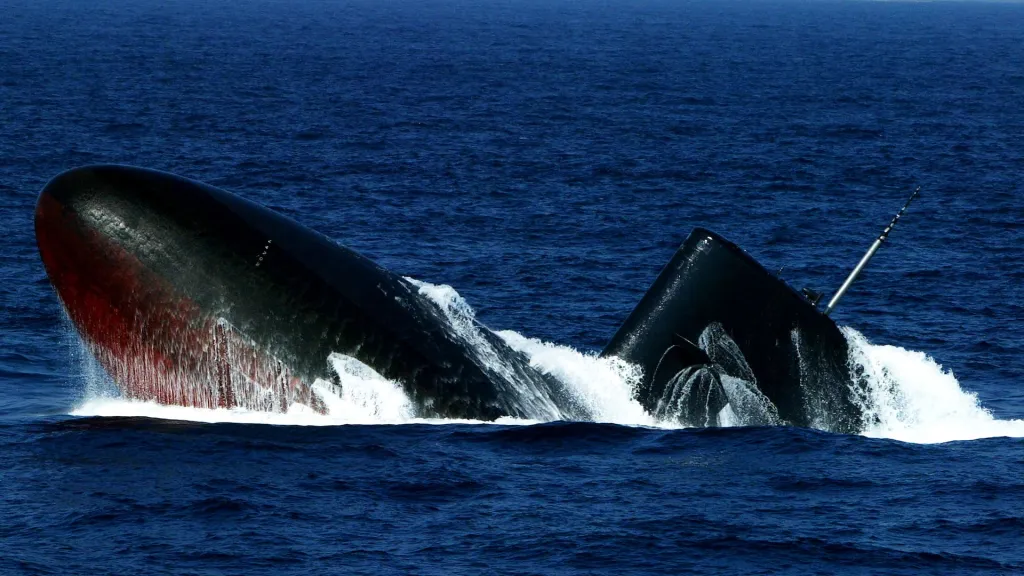
A submarine of the Japan Maritime Self-Defense Force surfaces during a naval review off Sagami Bay, Japan. Photo by Koichi Kamoshida/Getty Images
Japan’s submarine fleet is already regarded as among the most capable conventionally powered forces, and is very much at the forefront of advanced naval propulsion technologies. Even with that considerable expertise, however, developing and sustaining a nuclear propulsion capability would represent a huge challenge, requiring expertise and infrastructure far beyond those needed to build Japan’s existing conventionally powered submarines.
Koizumi’s comments do not represent a decision to acquire nuclear-powered submarines, nor do they indicate that Japan has begun a procurement program. They do, however, mark a significant evolution in the country’s public debate over submarine propulsion and point to a growing willingness within the Japanese defense establishment to consider capabilities that were previously largely outside the mainstream of defense planning.
Secretary of War Pete Hegseth hosts a bilateral meeting with Japanese Minister of Defense Shinjirō Koizumi at the Pentagon, Washington, D.C., Jan. 15, 2026. (DoW photo by U.S. Navy Petty Officer 1st Class Alexander Kubitza)
Currently, Japan operates one of the world’s most capable conventional submarine fleets, centered on increasingly sophisticated diesel-electric boats equipped with air-independent propulsion and advanced lithium-ion batteries. These submarines are well suited to operations around Japan and the country’s surrounding waters.
The JMSDF currently operates 22 conventionally powered submarines, maintaining the force structure established in the 2010s while progressively replacing older boats with the more capable Taigei class. Five Taigei class submarines are now in JMSDF service, with additional boats in the pipeline.
The first-of-class Taigei was launched on October 14, 2020, at the Mitsubishi Heavy Industries (MHI) shipyard in the city of Kobe, in the western prefecture of Hyogo. Japan Maritime Self-Defense Force
Nuclear propulsion, however, would offer substantially greater endurance and sustained underwater speed, allowing Japanese submarines to conduct longer-range operations across the broader Western Pacific with minimal support. This is a requirement that is becoming increasingly relevant as Tokyo’s strategic focus expands beyond its immediate maritime approaches.
China’s rapidly expanding naval force, including its growing submarine fleet and increasingly distant maritime operations, is forcing Tokyo to consider how it would monitor and potentially counter Chinese forces farther from the Japanese archipelago. A nuclear-powered attack submarine could remain submerged for extended periods without the endurance limitations imposed by conventional propulsion, making it particularly useful for long-range surveillance, tracking, and sea-denial missions.
Japan’s debate is also unfolding alongside a significant development in neighboring South Korea. Seoul has confirmed plans to develop a new class of nuclear-powered submarines, a move that could add further momentum to an emerging undersea competition in Northeast Asia. South Korea’s decision is particularly relevant to Tokyo because it demonstrates that nuclear propulsion is no longer merely a theoretical capability for U.S. allies in the region. While the missions and strategic priorities of the Japanese and South Korean navies are different, both countries face the challenge of operating in waters increasingly contested by China and North Korea.
A South Korean Ministry of Defense rendering shows how the nuclear-powered Jang Bogo N Project boats may look. MND
A Japanese decision to pursue SSNs could eventually create a much deeper basis for cooperation with Australia, including submarine interoperability, undersea warfare, workforce and technical expertise, infrastructure, sustainment, and potentially aspects of the industrial base. Analysts have already examined how Japan could fit into the wider AUKUS submarine ecosystem as Australia’s nuclear-submarine program develops.
Concept art of the submerged SSN-AUKUS nuclear-powered attack submarine. U.K. Ministry of Defense illustration
A Japanese nuclear-powered submarine with a robust capacity to launch land attack cruise missiles would also be a powerful component in the country’s emerging “counterstrike” posture, which is increasingly centered on acquiring the ability to strike targets at longer ranges.
Launch of the first Tomahawk missile from the Kongōclass Aegis destroyerChōkaiat an undisclosed location in the Pacific. Japan Ministry of Defense
An SSN would potentially add a highly survivable, mobile platform to this emerging strike architecture, allowing Japan to position long-range weapons farther from its home territory and complicating an adversary’s efforts to locate and neutralize them. That could be particularly valuable in a conflict in which Japanese air bases, missile batteries, and other fixed infrastructure were under attack.
The potential SSN requirement also fits with Japan’s expanding expeditionary ambitions. As the JMSDF converts its Izumo class helicopter destroyers to operate F-35B fighters, giving Japan a more credible carrier aviation capability, nuclear-powered attack submarines could provide a valuable escort for these increasingly important surface groups. Their speed, endurance, and ability to remain submerged for extended periods makes SSNs particularly well suited to accompanying carrier forces on longer-range deployments and supporting contingencies farther from Japanese waters.
U.S. F-35B Flies From Japanese Carrier; First Fighter Launched From Japanese Warship Since WWII
Looking at the bigger picture, it is highly significant that nuclear propulsion was effectively excluded from Japan’s conventional defense debate for decades. More recently, however, Japanese defense officials and policymakers have begun examining whether future submarines will require a different propulsion system. The issue is now one that can now be discussed openly at the ministerial level.
Nevertheless, pursuing a nuclear-powered submarine program would come with huge challenges.
The Japan Maritime Self-Defense Force Sōryū class submarine Hakuryū arrives at the submarine piers of Joint Base Pearl Harbor-Hickam. U.S. Navy photo by Mass Communication Specialist 1st Class Steven Khor/Released
Building and operating nuclear-powered submarines would require Japan to establish an entirely different industrial, regulatory, and training infrastructure. The vessels would also be considerably more expensive and complex to build and operate than Japan’s existing conventionally powered submarines. Tokyo would have to resolve questions involving nuclear regulation, reactor technology, maintenance facilities, crew training, and the handling of nuclear material.
There would also be a significant political dimension. Although naval nuclear propulsion is fundamentally different from possessing nuclear weapons, any move in that direction would inevitably receive scrutiny in a country whose postwar security policy has been shaped by its experience with nuclear weapons and its longstanding non-nuclear principles.
For those reasons, Koizumi’s statement should be viewed less as an announcement of a Japanese nuclear-submarine program than as evidence that the political barrier to discussing such a program is falling.
The Japanese Oyashio class submarine Yaeshio transits the Philippine Sea during Exercise Pacific Vanguard 23. U.S. Navy photo by Mass Communication Specialist 3rd Class Santiago Navarro
The next question is whether the Japanese government will move from keeping the option open to actually studying a nuclear-powered submarine design, propulsion technology and acquisition pathway in detail.
If it does, the consequences could extend well beyond Japan’s submarine fleet. A Japanese nuclear-powered submarine capability would represent a major enhancement of Tokyo’s ability to operate across the Western Pacific and could alter the undersea balance between Japan, China, and the United States’ other regional allies. At the very least, the idea is one that is now part of wider discussions at the highest levels.