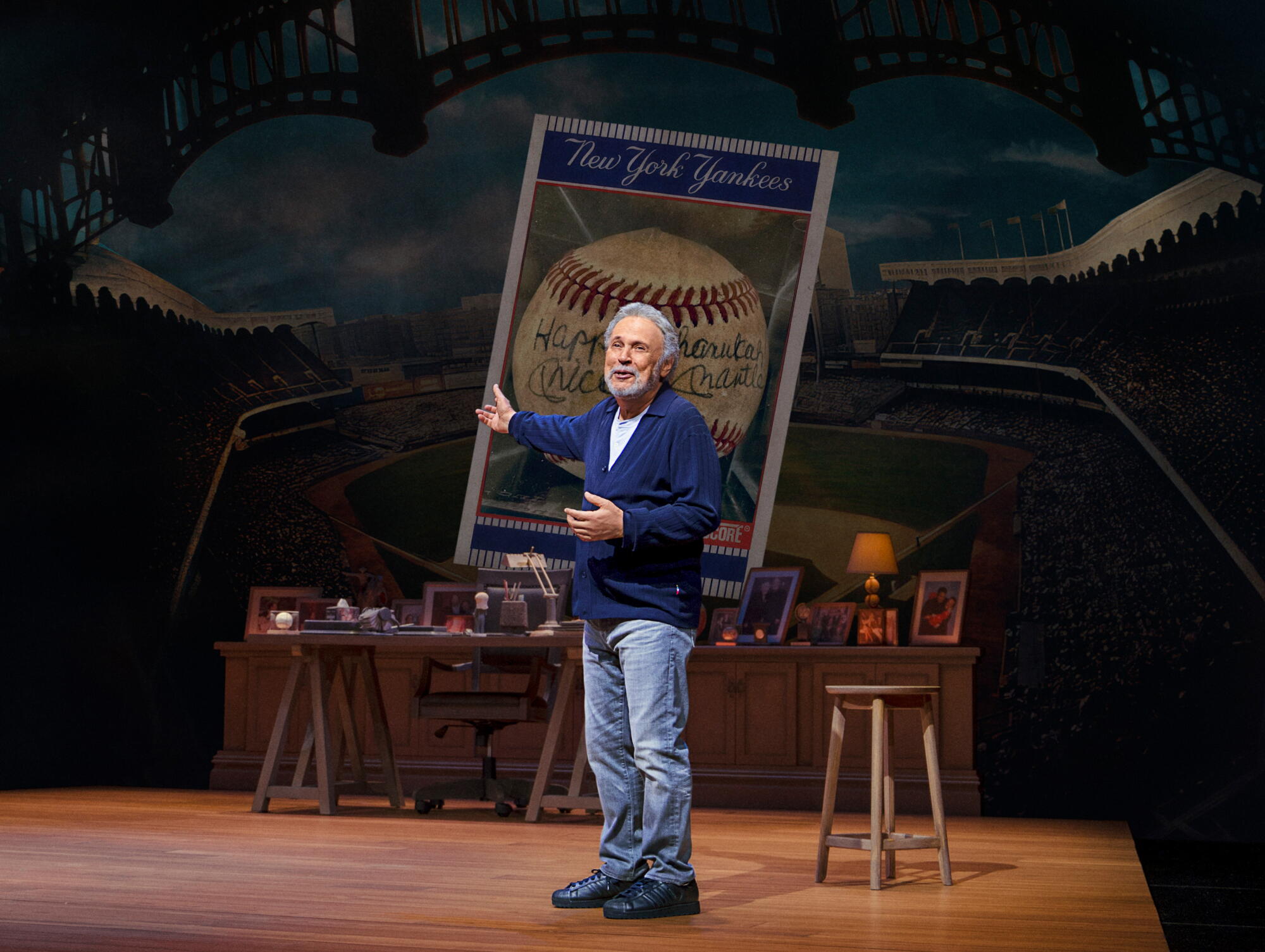
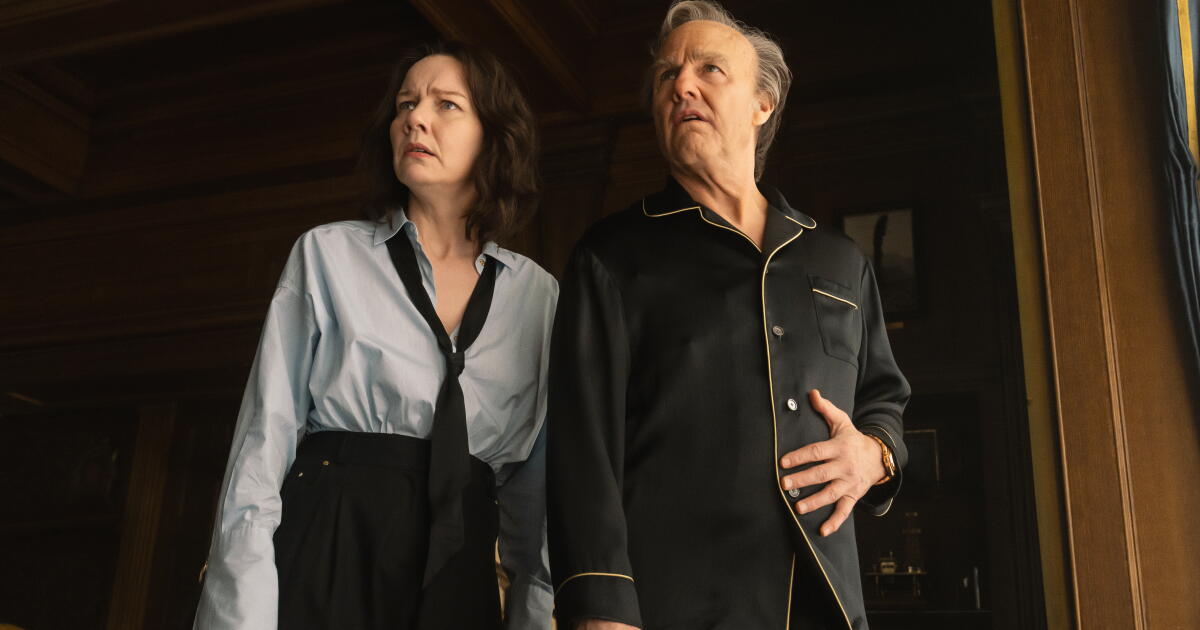
NEW YORK — “860,” the title of Billy Crystal’s tremendously moving new Broadway show at the Imperial Theatre, refers to the address of his house in the Pacific Palisades that was destroyed in last year’s fire.
Crystal re-creates the events of Jan. 7, 2025, as the wildfire that began in the Santa Monica Mountains started making its way down toward his home at 860 Chautauqua Blvd. Video clips of the escalating emergency are shown as a cardigan-clad Crystal, standing in a facsimile of his home office (the conjuring work of scenic designer Scott Pask), re-creates the horror of having to decide what to take with him as the evacuation orders come in.
The photos, awards and other memorabilia aren’t just souvenirs of his storied career. They are pieces of the life he built with his wife, Janice, and their two daughters as well as a record of the friendships that made Hollywood feel like a welcoming community for a wide-eyed Long Island kid.
“860,” impeccably directed by Scott Ellis, occurs in a series of flashbacks. Crystal brings us back to what it was like as he and his wife made their way across a jam-packed Sunset Boulevard in separate cars to the safety of their daughter’s house as smoke and flying embers turned their small-town paradise overlooking the Pacific Ocean into an apocalyptic war zone.
A baseball superfan, Crystal gives us the play-by-play as though he were calling a World Series game that had taken an unimaginable turn. Hana S. Kim and Kylee Loera’s video design turns us into eyewitnesses of that terrible day.
I was in Los Angeles when the Palisades and Eaton fires broke out, but I was far enough away not to feel the immediacy of the threat. Crystal had me in full fight-or-flight mode, as if I were in the car behind him going 5 mph along the only route out of danger.
Billy Crystal in “860” at the Imperial Theatre on Broadway.
(Avery Brunkus)
Making a show about a recent public trauma isn’t easy to pull off, but Crystal has managed it as perhaps only he could. “860” is a meditation on loss, but it’s also a theatrical memoir of his multifarious career as a comic, actor, filmmaker and celebrated Oscar host. He returns to his days on “Soap,” the controversial nighttime parody of a daytime soap opera created by Susan Harris that featured Crystal in the role of Jodie Dallas, one of TV’s first openly gay characters.
Crystal was living in an apartment in then-smog-filled Hancock Park with his wife and daughters when he was filming the show’s third season. The couple wanted to move to an area that had better air quality for their children, and someone asked if he knew about the Pacific Palisades.
“It was a small town, good schools, beautiful afternoon breezes from the nearby ocean, one main street with some shops, a deli named Mort’s that had lean corned beef and a lot of people who didn’t put mayonnaise on pastrami,” Crystal recounts.
The house they came to see wasn’t for them, but a for-sale sign at 860 Chautauqua caught their eye. The real estate agent told them that the owners “were very motivated to sell because they were very motivated not to be together anymore.”
It was December 1979 when, with a 30-year mortgage in hand, they moved into the house. Two women who grew up at 860 (“Imagine the twins from ‘The Shining’ — but they’re 55”) paid a welcome call to say how pleased they were that their former home was back in the hands of show people.
The original owners were vaudevillians who had a mind-reading act and were passionately into the occult. They socialized with the comic luminaries of their day, including humorist Will Rogers, who would regularly stop by on his horse. Behind a secret wall, Crystal found a hidden room with a cork board that had clippings that suggested maybe it wasn’t such an accident that the house became his.
Crystal, the emcee of all emcees (as his performance at this year’s Hollywood Bowl Opening Night once again proved), tells the story of his home with buoyant humor and charm, turning loss into living memory. To set up the meaning of what was destroyed, he takes us back to his roots, starting with his graduation in 1970 from NYU, where he took a film production class with a young Martin Scorsese, who would critique his work in a manner that Crystal, the Al Hirschfeld of celebrity impersonators, hilariously captures.
Crystal’s comic timing was honed in the clubs doing stand-up. Jack Rollins, the producing titan who managed Mike Nichols, Elaine May and Woody Allen, imparted some wisdom after watching Crystal’s act. Crystal thought he killed it that night, but Rollins told him that he failed to “leave a tip,” meaning reveal something about himself in his jokes.
Opening for Blood, Sweat & Tears in Scranton, Pa., a huge opportunity, Crystal faced a hostile audience. But he won the crowd over and thought maybe he could really make this stand-up comedy thing work. But then he was sent back out onstage after lead singer David Clayton-Thomas decided he didn’t want to perform and had to win the jeering music fans over again — and then a third time. While driving home on the New Jersey Turnpike to his wife and baby that night, he felt his future in front of him, having found not only his calling but also his voice.
Crystal’s luckiest break may have been in not being drafted during the Vietnam War, but a close second was being invited to do his Howard Cosell-Muhammad Ali routine at a televised gala for the boxing legend. Crystal not only crushed it but he made a lifelong friend in Ali, who was already his personal hero.
Bonds forged in comedy, like the one he had with Robin Williams, deepened into a lasting brotherhood. Norman Lear cast Crystal as Rob Reiner’s best friend on “All in the Family,” and life imitated art. Their successful collaborations — crystallized in the fake orgasm scene at Katz’s Delicatessen in “When Harry Met Sally” — were an outgrowth of their telepathic comic rapport.
In reviewing his famous life, Crystal reanimates parts of our own. And it’s this shared history that helps us understand what he lost when his house went up in flames. The magnitude of the devastation is made personal for all of us.
But just when you think things can’t get any worse, something completely unthinkable happens. For Crystal, this occurred at the end of 2025, his annus horribilis, when Reiner and wife Michelle were found stabbed to death at their Brentwood home.
Some things are too painful for words, and Crystal knows that sense cannot be made from senselessness. But he’s already told us so much about this unique friendship that nothing more needs to be said.
Crystal doesn’t wallow in grief or self-pity. He bears the weight of his losses with his wit and generous spirit to help us carry the weight of our own. (When he walked into a store to buy a new wardrobe after the fire, he reports, the salesclerk looked at him and said, “Let me guess … Ozempic?”)
No one gets out of this world without becoming a master of the art of losing, to invoke the poet Elizabeth Bishop. But laughter can sustain us through our losses, and Crystal thinks it’s no accident that one of the few things that was salvaged from the ashes of his home was a stone from his garden with the word “laughter” engraved on it.
I found Crystal’s previous solo show “700 Sundays” to be a touch mawkish, so I wasn’t expecting to be so powerfully moved by “860.” But this is just a brilliantly conceived and executed piece, and I hope it yields Crystal another Tony Award.
But even more, I hope the production finds its way home to where it belongs, Los Angeles. We could really use the fortifying laughter.
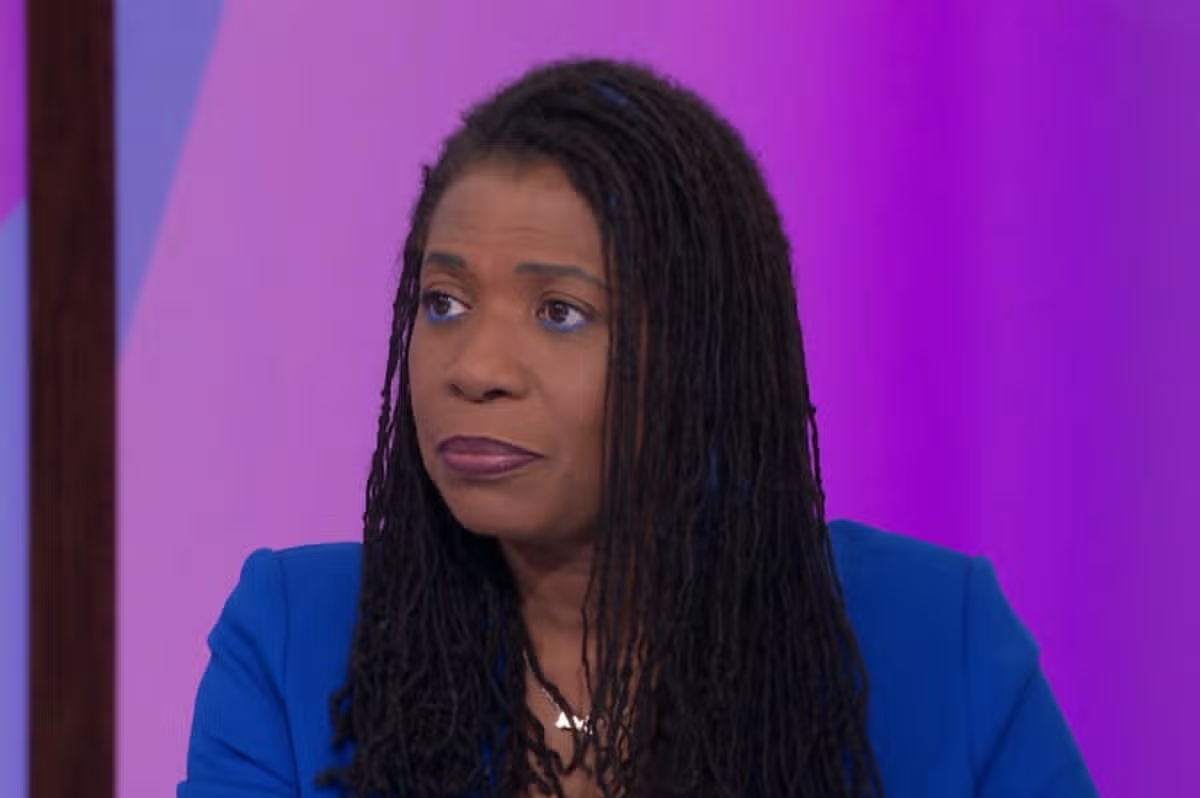
The singer and presenter returned to our screens on Tuesday afternoon (October 20), alongside fellow panellists Coleen Rooney, Kaye Adams, Janet Street-Porter and Ruth Langsford.
As the ITV stars discussed their individual journeys to motherhood, 57-year-old Brenda revealed she suffered a miscarriage before the birth of Jamal., who died aged 31 in 2022.
Brenda started by explaining that she always dreamed of having two children. “I did grow up saying ‘by the time that I’m 27, I want to have a job, I want to have a husband. I want to have two children.’ It was always two children. I wasn’t going for a football [team] or anything,” she said.
She went on to admit that her excitement to become a mother was partially due to losing her own parents at just four years old. Brenda explained: “There was a little bit of me that wanted to have children [and] to raise them because I wasn’t raised by my mum and dad. I was four when my parents died but I was kind of thinking ‘I’d like to go past that age that we were.'”
The Luton-born actress went on to give birth to her late son Jamal at 21 years old, then her daughter Tanisha. However, she unfortunately miscarried before Jamal was born.
She shared: “I was 21 when I had Jamal and then Tanisha and then I did finally get married at 27,” before adding: “I did unfortunately have a miscarriage before Jamal came.
“And when that happened, it really made me think ‘Oh my god, that would have been so lovely. What would that have been like if I hadn’t [miscarried]?’ So I see children as a blessing.”
Ensure our latest Loose Women stories always appear at the top of your Google Search by making us a Preferred Source. Click here to activate or add us as Preferred Source in your Google search settings.
It comes four years after Brenda’s son Jamal sadly died after suffering a cardiac arrhythmia. The Loose Women presenter recently paid tribute to him on what would have been his 36th birthday.
Posting a series of childhood photos on Instagram, she wrote: “Jamms 36 years ago today you were born, the sun was shining bright just like your beautiful smile. These photographs capture so many beautiful memories that will never be forgotten. I miss you each and every second of every day!! I love you always and forever.”
If you have been affected by this story, advice and support can be found at Sands. You can call them on 0808 164 3332 or emailhelpline@sands.org.uk.
Loose Women airs 12:30pm on ITV1 from Monday to Friday
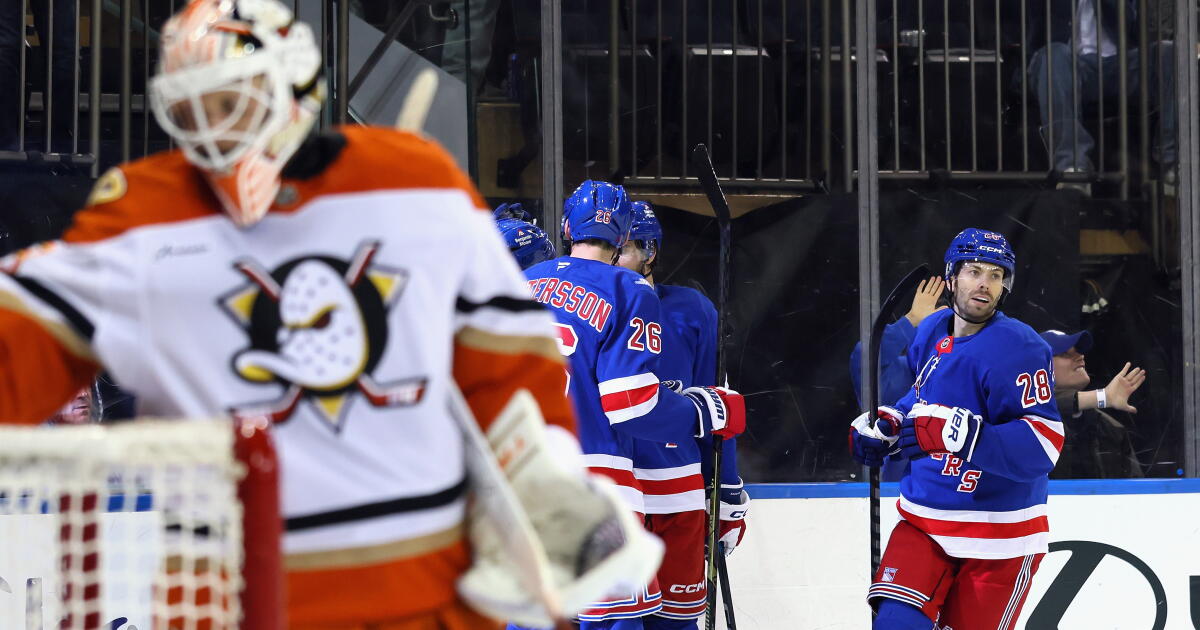
NEW YORK — Sean Durzi scored 78 seconds in, Dylan Garand made 29 saves and the New York Rangers defeated the travel-weary Ducks 5-2 on Monday night to improve to 6-0-0 at home this fall.
The Rangers (7-3-1) did not pick up their sixth victory at Madison Square Garden last season until Jan. 26, their 23rd game there. They lost 27 of 41 at home on the way to missing the playoffs and finishing last in the Eastern Conference.
There is hope of a turnaround given this start, even missing franchise goaltender Igor Shesterkin for the rest of the season. Garand was making a fifth consecutive start since Shesterkin went down, and he has allowed two or fewer goals in nine of 10 NHL appearances dating to his debut last spring.
He got support early and often, with Durzi’s goal making it three home games in a row where the Rangers have scored in the first two minutes. That has only happened once before for New York, in March 1989.
The Ducks scored twice in the final 69 seconds, on goals by Nick Jensen and A.J. Greer, their first goals with Anaheim, to ruin the shutout bid.
Oliver Bjorkstrand scored twice, captain J.T. Miller and Gabe Perreault each had a goal and Alexis Lafreniere recorded two assists. Pavel Dorofeyev, the team’s most notable trade acquisition over the summer, came close on several occasions but remained stuck on two goals for the season.
Putting goalie Ville Husso in a tough spot with sloppy play, the Ducks (4-4-0) looked every bit like a group that endured a 15-hour, delay-filled travel ordeal to the East Coast from Southern California. They did not arrive at their hotel until 2:30 a.m., were on the ice for their morning skate less than nine hours later and were getting shut out until scoring twice in the final 70 seconds.
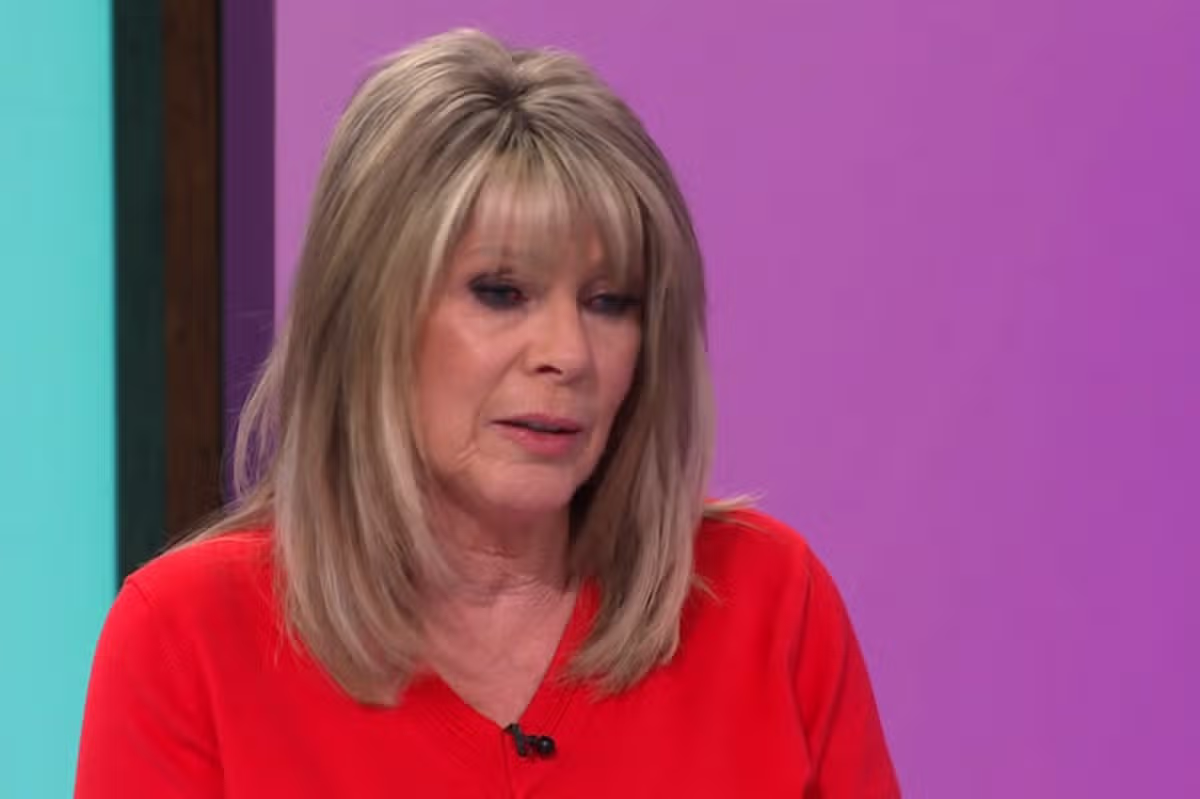
Loose Women host Ruth Langsford has bene flooded with support after her recent devastating news
13:35, 19 Oct 2026Updated 13:35, 19 Oct 2026
Ruth Langsford took a moment to talk about her recent sad family news(Image: ITV)
Ruth Langsford thanked fans watching at home for their “thousands” of well wishing messages as she was supported by her co-stars following her recent heartbreaking loss.
The Loose Women host struggled to hold back tears as she opened up on her ‘heartbreaking’ loss on Monday’s (October 19) show. It comes just days after she shared sad news on social media and was flooded with support.
Part way through the show she took some time out to thank viewers who had sent messages following the loss of her family dog. Last week, Ruth announced that her dog called Maggie had “gone to sleep forever” at the age of 16.
As soon as she began to talk about her, Ruth immediately became teary eyed and was handed some tissues. Joined by Janet Street Porter, Kelly Brook and Jane Moore, they noted she had only just talked about Maggie on the show the other day.
Ruth revealed that very same day, was when they lost her. She spoke directly to the camera and thanked everyone for all their messages that she was ‘working my way through to say thank you.’
She went on to share that when she got home a relative told her that Maggie was not right and was not getting out of her bed. Ruth said it was then she knew that it was her time and added: “It was sad but it was peaceful”
Ensure our latest TV stories always appear at the top of your Google Search by making us a Preferred Source. Click here to activateor add us as Preferred Source in your Google search settings
Sharing more, she said she believed that Maggie waited for one of her children to be there before it happened. She confessed that years ago, before she owned the dog, she would have ‘internally rolled her eyes’ at someone who responded in the teary manner she had over he death of a pet but now understood just how ‘heartbreaking’ it really was now.
However, Ruth also commented that she had not told her mum about Maggie’s death. This is because she is suffering with Alzheimer’s.Viewers watching along were quick to show their support.
One posted on social media: “Oh Ruth. You gave your beautiful Maggie a very happy life.” Another replied: “We can so understand Ruth. Much love xxx”
At the time, Ruth posted on Instagram : “It is with a heavy heart that I tell you our beautiful Maggie has gone to sleep forever. She was 16 years old and sadly this was her time.
“Her passing was painless and peaceful and we were with her until the very end. We are so thankful to have had her in our lives for 15 years…..she gave us so much joy & unconditional love. We will treasure our memories forever. Rest in peace our beautiful girl.”
The Dodgers’ offseason began at 8:07 Thursday night. Heavily favored to win a third straight World Series, they were swept into winter by the Milwaukee Brewers.
The final score doesn’t really matter, but for the record it was 6-4 Brewers. It wasn’t really that close.
The Dodgers led in every game of the National League Championship Series. They didn’t win any of them. No team has ever done that while getting swept in a best-of-seven series. So while the Dodgers didn’t three-peat, they made history just the same.
“They were relentless with everything that they did,” Dodgers infielder Max Muncy said of the Brewers. “They just strung together good at-bat after good at-bat. That’s usually what we do.
“We didn’t do it this series and they did.”
The Dodgers’ starting rotation, the most expensive in history, gave up 16 hits and 13 runs in 18 innings for a 6.50 earned-run average. The bullpen was nearly as bad, posting a 4.50 ERA in 16 innings.
The Brewers’ relievers, on the other hand, were spectacular. Milwaukee manager Pat Murphy went to his bullpen 14 times and just twice did a reliever give up a run. All four victories against the Dodgers and all seven Brewers wins this postseason have gone to a reliever, with the bullpen posting a 1.33 ERA in 40⅔ innings.
“Pitcher after pitcher came in and executed,” Muncy said. “When one of their pitchers faltered, the next guy came in and picked up the slack.”
And each time the Dodgers took a lead, the Brewers waited no more than two innings to cut into the deficit. Milwaukee trailed 4-0 after two innings Thursday. By the top of the fifth, the score was tied. An inning later, the Brewers went ahead to stay, becoming the first team with six comeback wins in their first eight postseason games.
“They respond,” Murphy said of his players. “We’ve talked about it all year long. You have a bad week, you have a bad game, you have a bad at-bat, you bounce back.”
“I love the Dodgers. I love their players. They’ve got legendary players,” he continued. “But we came in with a group that would not be denied. They were hungry, very hungry.”
The two-time defending champion Dodgers, meanwhile, appeared to be full. They hit with runners in scoring position as often as they hit into double plays, going four for 27 and stranding 24.
“We had our opportunities. We just didn’t get the job done,” first baseman Freddie Freeman said. “We won two [titles]. We came up short on the third.
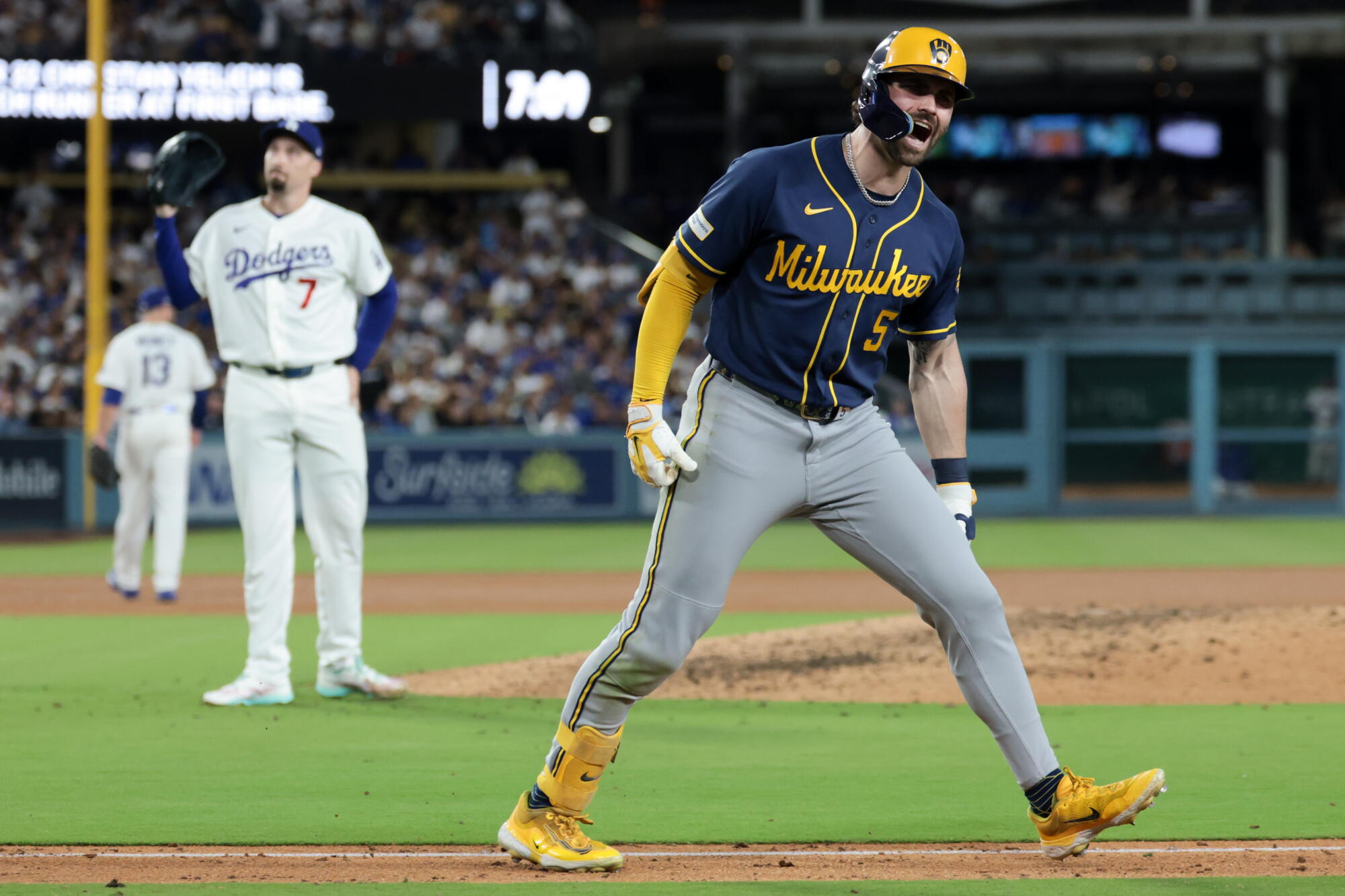
Milwaukee’s Garrett Mitchell, right, celebrates with Cooper Pratt after hitting the go-ahead home run in the sixth inning of a 6-4 win over the Dodgers in Game 4 of the NLCS on Thursday night.
(Robert Gauthier / Los Angeles Times)
“There’s a lot of hurt at the end of the season. Sometimes you just get beat. That’s just kind of how it goes. You have to give credit to the Brewers. They played really good baseball.”
A year ago the Dodgers swept the Brewers in the NLCS. This fall the results were reversed.
“The sadness is we just didn’t accomplish our goal,” Muncy said. “The goal every year is to be the last team standing. This year we had a chance to do something historic, and we didn’t accomplish it. And every single time you’re not the last team standing, it’s heartbreak and it’s failure and it’s not what you’re looking for.”
The Dodgers’ clubhouse was closed for more than 35 minutes after the game, partly to process that heartbreak but also to give manager Dave Roberts and veteran infielder Miguel Rojas, who announced his retirement, a chance to address the team. When the doors finally opened, nearly every player was sitting in front of his locker, most still in uniform, waiting to explain what seemed to be inexplicable.
How did the greatest team money can buy wind up so flat when the stakes were so high?
“We’ve been grinding all season long,” said right-hander Tyler Glasnow, who retired the first 10 Brewers in order, but lasted just one more inning. “No one slacked off at all. Everyone just came in and worked hard. They just played a lot better than us. They were hitting on everything. It wasn’t our year.”
“Not every time it’s gonna be us,” left fielder Teoscar Hernández added through a forced smile. “It’s not fair for us to be doing the same thing over and over every year. Teams are going to learn from their losses the same way we’re gonna learn from this one.
“So hopefully we come back next year stronger.”
Speaking of next year, no one would.
Half the players on the Dodgers 26-man NLCS roster are on expiring contracts. The core of the team — Mookie Betts, Freeman, Muncy, Kiké Hernández and Teoscar Hernández along with pitchers Blake Snell and Glasnow — are 33 or older. The Dodgers could look very different when spring training starts — if spring training starts — in February.
“There’ll come a time when we think about next year,” Muncy said. “But that’s not right at this moment.”
The Dodgers have an extra-long winter to get through first.
KANSAS CITY, Mo. — The Chargers hit the road to face the undefeated, AFC West-leading Kansas City Chiefs, still looking for their first victory of the season.
They were unsuccessful, falling 22-6 on Sunday evening at Arrowhead Stadium. The Chargers are 0-6 to start the season for the first time since 2000, when they finished 1-16. They’ve also lost nine straight games since last season, tying a franchise mark for most consecutive losses.
“I truly believe and was confident that we would win this game,” coach Jim Harbaugh told reporters. “We have to address everything, guys, and especially offensively.”
The Chargers’ offense, already weakened by a series of injuries to its offensive line and receiving corps, struggled mightily, recording their second-lowest output of the season at 259 total yards. They also lost wide receiver Ladd McConkey, who was ruled out midway through the second quarter with a concussion. He had just one catch in his return from a foot injury that kept him out last week against Denver.
Additionally, it marked the first time the Chargers failed to score a touchdown this season, likely putting first-year offensive coordinator Mike McDaniel’s job in further jeopardy. They have just five touchdowns through six games.
Harbaugh did not give a conclusive answer when asked directly if McDaniel would continue calling plays, saying the team would review “everything.”
“I see the effort, I see the work being put in in the meetings, on the practice field, to get that to transfer to the field is what’s necessary,” Harbaugh said.
Chiefs quarterback and two-time MVP Patrick Mahomes was in exceptional form, completing 23 of his 30 passes for 272 yards. He did not score a touchdown, either, opting to hand off to running back Kenneth Walker for two scores. Walker finished with 128 yards in 19 carries.
Justin Herbert led the Chargers in rushing with 26 yards and threw for 204 yards on 22-for-37 passing. Quentin Johnston had a team-high 57 receiving yards — all from one catch.
The Chiefs had a chaotic first drive that included two offensive penalties, but took a 3-0 lead with a 44-yard field goal by Harrison Butker. After a Chargers punt, the Chiefs struck again with a 33-yard scoring run up the middle by Walker. The Chargers caught a small break with Butker missing the extra point, but they never got back to within a possession of the Chiefs.
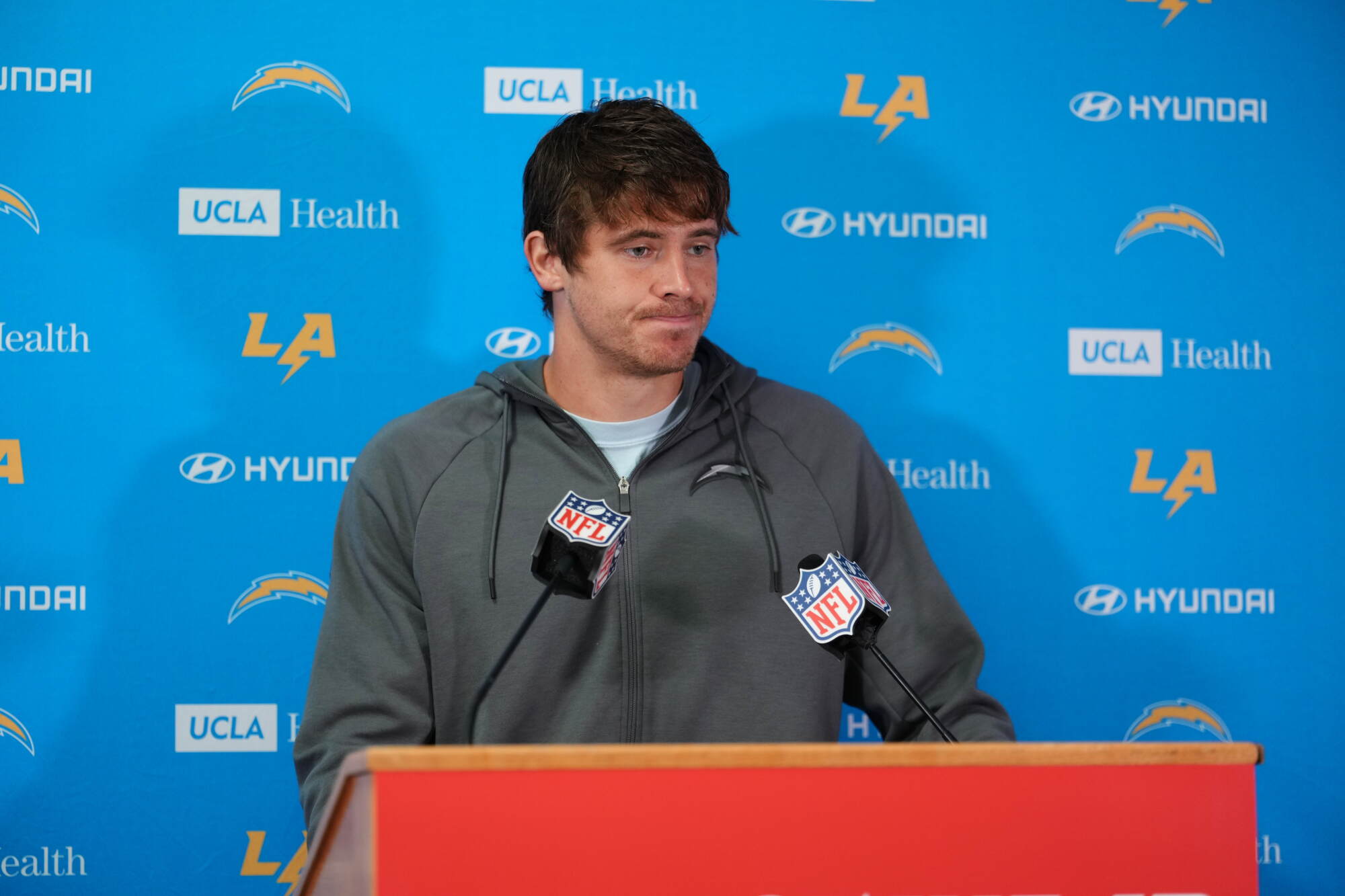
Chargers quarterback Justin Herbert listens to a question during a news conference after a 22-6 loss to the Chiefs on Sunday.
(Ed Zurga / Associated Press)
The Chargers did get on the board later in the first quarter with a 23-yard field goal by Cameron Dicker off an 11-play, 60-yard drive. The Chargers forced a punt on the Chiefs’ next possession and traded interceptions in the second quarter before giving up an 80-yard drive that ended with a two-yard run by Walker.
After another punt, the Chargers left the Chiefs with the ball and 25 seconds left in the half. Mahomes completed two more passes and Butker nailed a 50-yard field goal to push the lead to 19-3.
Starting from their own 45-yard line, the Chargers began the second half with their most promising drive of the game. Herbert completed passes to KeAndre Lambert-Smith, Johnston and Kimani Vidal to take them down to Kansas City one-yard line, but an offensive hold and two incomplete passes meant they had to settle for another field goal.
Chiefs linebacker Drue Tranquill, center, tackles Chargers running back Kimani Vidal during the fourth quarter Sunday.
(Jamie Squire / Getty Images)
The Chargers’ defense stopped Kansas City at the goal line in the third quarter, forcing a turnover on downs at the one-yard line before Caleb Murphy recovered a fumble on a Chiefs punt return. But the Chargers went nowhere on the ensuing possession.
Butker kicked a 30-yard field goal late in the fourth quarter. The Chargers then had one final chance to score, driving to the Kansas City eight-yard line, but Herbert could not find a receiver on back-to-back throws and was sacked twice, leading to a turnover on downs.
In addition to McConkey’s injury, cornerback Deane Leonard left in the third quarter with a concussion.
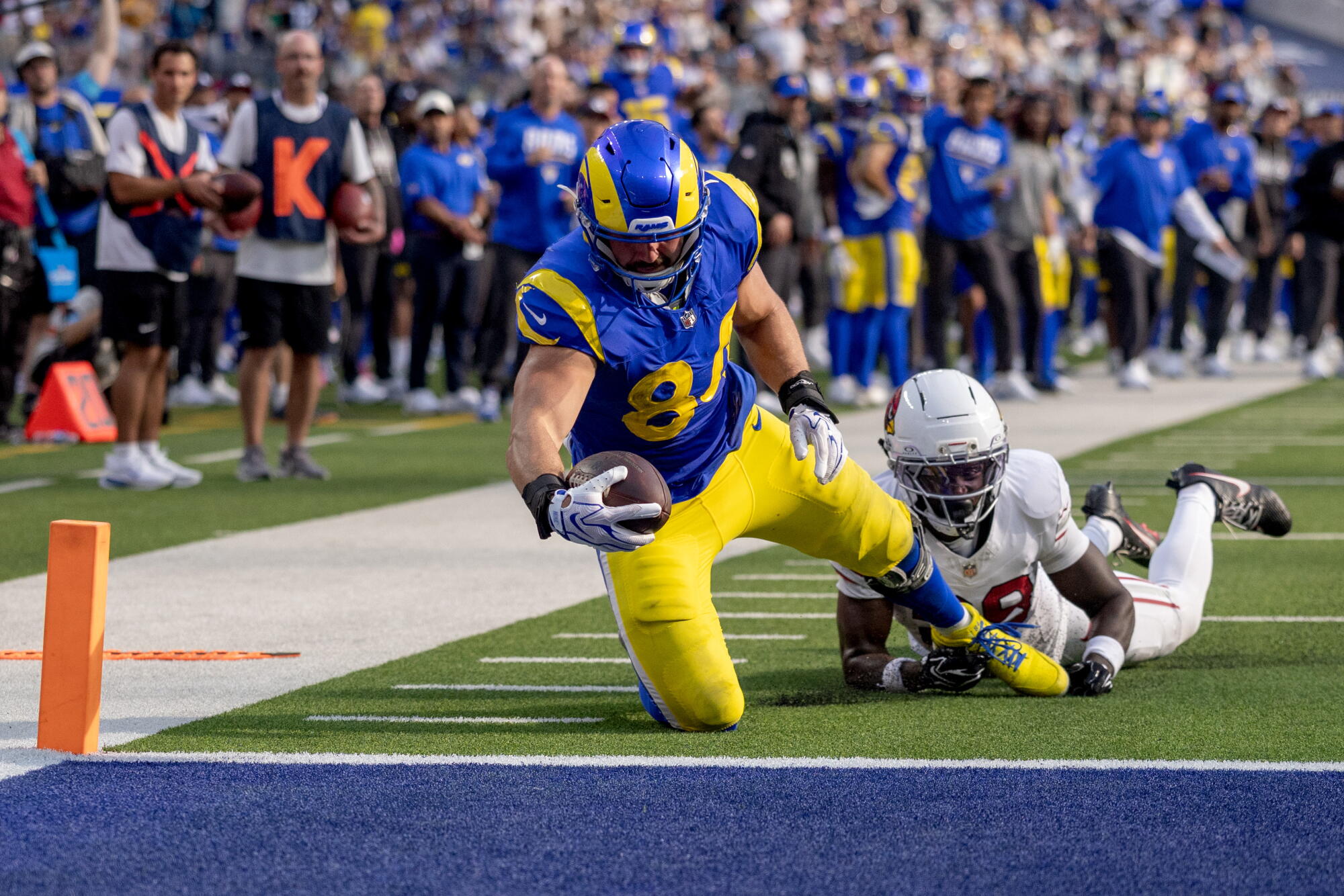
Rams tight end Colby Parkinson scores a touchdown in front of Cardinals safety Andrew Wingard at SoFi Stadium Sunday.
(Eric Thayer/Los Angeles Times)
First-year Cardinals coach Mike LaFleur, the Rams former offensive coordinator, outcoached and outmaneuvered friend and mentor Sean McVay.
With just more than a third of the season complete, the Rams are 2-4.
The Rams failed to bounce back from their overtime defeat by the powerful Buffalo Bills and lost to a Cardinals team that entered the game having given up at least 31 points in each of its last four.
Only six players from the team that won Super Bowl LVI are still on the roster: Quarterback Matthew Stafford, defensive lineman Aaron Donald, tight end Tyler Higbee, center Coleman Shelton, left tackle Alaric Jackson and receiver Tutu Atwell.
During the offseason they added two players with two Super Bowl rings each: cornerbacks Trent McDuffie and Jaylen Watson.
Rams quarterback Matthew Stafford looks to pass the ball against the Cardinals at Sofi Stadium on Sunday.
(Eric Thayer/Los Angeles Times)
But they have not looked anything like a Super Bowl contender.
An offense that went into the game as the league’s most productive from a yardage standpoint managed only a field goal and two touchdowns.
Stafford completed 25 of 33 passes for 222 yards.
With left tackle Alaric Jackson suspended for the game for punching Bill linebacker Bradley Chubb on the field after the Rams loss, veteran David Quessenberry started for the first time since 2023.
The Cardinals predictably brought pressure and blitzed, sacking Stafford three times and hitting him seven times.
Safety Quentin Lake intercepted a pass for a defense that was without All-Pro cornerback Trent McDuffie because of a groin injury. The defense gave up only field goals and gave the offense multiple opportunities.
And special teams continued to be a disaster.
New kicker Blake Grupe, signed this week after the Rams released struggling Harrison Mevis, kicked a 44-yard field goal in the first quarter. But on the ensuing kickoff, Devin Duvernay returned Grupe’s kick 40 yards before the 5-foot-7, 156-pound Grupe hurled his body to stop him. Grupe suffered a knee injury and did not return.
The Rams managed Grupe’s 44-yard field goal and Corum’s touchdown for a 9-9 tie at halftime.
The Cardinals consumed nearly nine minutes of the third quarter before kicking a field goal for a 12-9 lead.
The loss of Grupe then came into play again late in the third quarter. On a fourth-and-one at the Cardinals’ 27-yard, McVay opted to go for it. Davis Allen lined up in the backfield and took a handoff from Stafford, but the Cardinals stopped him for no gain.
The Cardinals added another field goal with 9:28 left for a 15-9 lead.
The Rams then put together a lively drive, but Higbee fumbled with just under eight minutes left.
They got the ball back with just less than seven minutes remaining. They drove into Cardinals’ territory with about three minutes left but a false-start penalty gave them a fourth-and-eight situation, and Stafford’s pass to running back Kyren Williams fell incomplete.
But the Rams got one more chance when they got the ball with 2:48 left.
Stafford escaped pressure and found Nacua, for a mid-range pass that he turned into a 32-yard gain. Stafford connected again with Nacua for 16 yards to the Cardinals’ 13-yard line.
Stafford’s six-yard touchdown pass to Colby Parkinson tied the score, and punter Ethan Evans came on to kick the extra point to give the Rams the lead.
But the Cardinals came back with the help of a personal-foul penalty after a completed pass. And Ryland’s sixth field goal finished the Rams.
Cory Morgan has spent more than 25 years fighting for Canada’s oil-rich province of Alberta to become an independent country. On Monday, Albertans will head to the polls to vote on the issue for the very first time. But even if the answer is no, Morgan said he’s in it for the long haul.
“I would respect the will of the voters,” he told Al Jazeera. “If they’ve decided it’s not time to go that route yet, then so be it. But that doesn’t mean I’ll stop.”
Recommended Stories
list of 4 itemsend of list
Morgan, the founder of the advocacy organisation Pathway to Independence, is among a group of longtime separatists who have managed to push what was once a fringe idea onto the ballot.
Monday’s provincial referendum asks Alberta residents to weigh whether they would like to pursue a binding resolution in the future on the question of independence.
Polls indicate the pro-independence side has little chance of succeeding, with four of five people in the province saying they want Alberta to remain a part of Canada. But Morgan’s focus is on the one in five who don’t.
“That’s not a movement that’s leaving,” he said.
What the referendum will mean for the separatist movement and for Canada as a whole, however, is a more complicated question.
What exactly are Albertans voting on?
Monday’s ballot gives Albertans two options: to remain part of Canada or begin the legal process for holding a future referendum on separation.
A vote in favour of the second option doesn’t mean Alberta immediately becomes an independent country.
Any province that tries to secede would first have to go through complex negotiations with the federal government in Ottawa, other provinces and Indigenous peoples who live in and around Alberta.
Some separatist organisers have been using that distinction to encourage people to vote for the referendum — even if they don’t necessarily want independence.
“Strategic separatists and their leaders have been using that ambiguity, that lower-bar threshold, to entice folks to vote not to leave, but rather to send Ottawa a message that Albertans need to be heard,” said Jared Wesley, a political science professor at the University of Alberta.
He told Al Jazeera that the message may be resonating with some voters.
Data collected by Viewpoint Alberta, a University of Alberta-based research initiative, suggests that two-thirds of voters who support the referendum say they’re doing so for strategic reasons, to send a message to Ottawa.
These are people Morgan calls “reluctant separatists”, people who are “at the end of their rope” and simply want Ottawa to pay attention.
But Prime Minister Mark Carney has warned Albertans against this strategy.
“Don’t be fooled by the idea you can ‘send a message’ with your vote,” he told a pro-Canada rally in Calgary on Thursday. “This is not poker. A vote against Canada is a dangerous bluff that will lead to years of deep division and great uncertainty.”
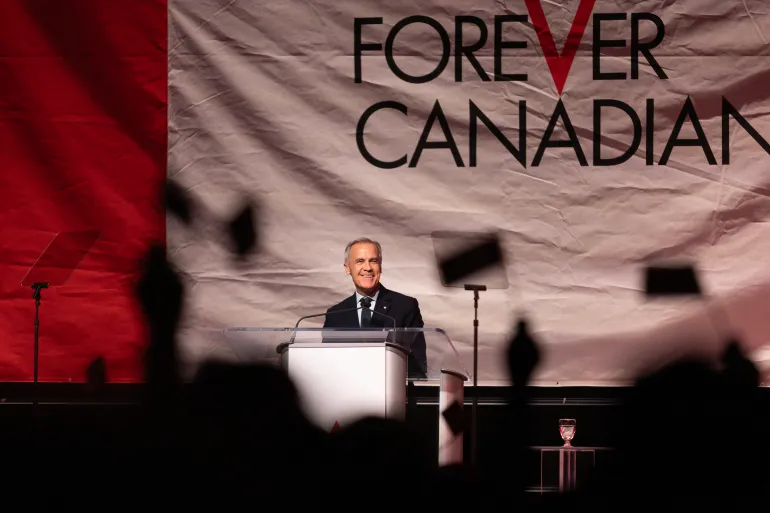
Canadian Prime Minister Mark Carney speaks at a rally hosted by the advocacy group Forever Canadian at the Edmonton Expo Center in Edmonton, Alberta, on Friday [AFP]
What’s driving Alberta’s separatist movement?
Monday’s referendum has been decades in the making. Separatists have long felt that Alberta, home to the world’s fourth-largest proven oil reserves, sends too much money to Ottawa, subsidising the rest of the country while receiving little in return.
They also take issue with federal energy policies that they feel limit the potential of the province’s oil industry.
For Morgan, the resentment stretches back to the 1980s when the National Energy Program was introduced by the government of Pierre Trudeau, former Prime Minister Justin Trudeau’s father.
The policy used price controls, taxes and ownership rules to keep Canadian energy affordable while directing more of Alberta’s revenues to Ottawa.
It has since become a central symbol of “Western alienation”, a term used to describe the sense of disenfranchisement felt among Canada’s westernmost provinces.
Those tensions resurfaced decades later under Justin Trudeau, whose term began in 2015. His climate policies, including a national carbon tax and a limit on emissions, angered Alberta’s oil sector.
“We’ve been fighting about the same things for 50 years,” said Morgan.
Then came the COVID-19 pandemic. Experts say demonstrations against health restrictions mobilised a new generation of conservative activists, breathing new life into Alberta’s separatist movement.
Trudeau ultimately resigned as Liberal Party leader and prime minister in 2025, amid sinking poll numbers. Carney was elected his replacement.
Last year, under growing pressure from separatist groups, Alberta Premier Danielle Smith’s government made it easier to start referendums, helping bring the question of Alberta’s independence onto the political agenda.
For Wesley, the moment is less about growing public support for independence and more about pressure from within Smith’s governing United Conservative Party, whose members show higher support for separation than Albertans generally.
“We’re having a referendum because Danielle Smith wants us to have a referendum,” Wesley said. “She is looking to solve internal party matters by throwing a question to the broader public.”
Though she called Monday’s referendum, Smith has said she opposes the independence effort, and on October 14, she announced she had voted against seceding.
“In my view, now is not the time to give up hope in our country, not when we have fought so long and come so far,” Smith said in a social media video, explaining her vote.
Alberta Premier Danielle Smith speaks at the Canada Strong and Free conference in Calgary, Alberta, on Friday [Ahmed Zakot/Reuters]
Could defeat make the movement stronger?
Smith’s political gamble has drawn comparisons with the 2016 Brexit referendum in the United Kingdom, including from Carney.
At the time, then-UK Prime Minister David Cameron called a vote over whether the country should leave the European Union, in hopes of settling a debate dividing his own Conservative Party.
Voters ultimately chose to leave the bloc, triggering years of political unrest.
But Ian Cooper, a political scientist who grew up in Alberta and now lives in Ireland, says a more useful comparison might be a different UK referendum in 1975, when British voters chose overwhelmingly to stay in what was then known as the European Economic Community.
That vote, he said, did little to deter those who wanted the country out.
“The activists who were in favour of Brexit — this is before anybody called it Brexit — they really played the long game,” he said. “It took them 25 years, but they finally achieved it.”
Cooper suspects that, even if Alberta separation is roundly defeated, separatists could take a similar approach, pursuing the issue over the long term to gain prominence and support.
“My impression is that they really are true believers, and it’s really ideologically driven,” he said.
If Monday’s separatist vote fails, Morgan said separatists would need to take a hard look at why they had fallen short and work towards making a stronger case for independence in the future.
He does not believe the underlying grievances can be resolved by working within the Canadian system or by electing a more sympathetic federal government.
Carney, who grew up in Alberta, acknowledged at Thursday’s rally that “the frustrations that many Albertans have felt are real”. He added that Ottawa had made people in the province feel “like our resources weren’t our own”.
The prime minister has tried, amid an ongoing trade war with the United States, to improve relations with Alberta, including through commitments to building a new pipeline to Canada’s west coast and major infrastructure projects.
Morgan admits that, for those whose goal is simply to get more leverage in Ottawa, “it’s pretty clear the movement has been effective”.
“We’ve seen more love from a federal prime minister in the last year than we’ve seen in the last 10,” Morgan said. “The problem though, when it comes to stubborn independence folks like me, is nothing has changed in the system.”
Prime ministers come and go, he added. “We’re just one election away from another hostile one.”
Separatist organiser Cory Morgan speaks to Alberta separatist supporters at a meeting by Let’s Talk Alberta in Calgary, Alberta, on October 13, 2026 [Todd Korol/Reuters]
Why the other referendum questions matter
But the referendum could also offer an opportunity to challenge the premise that Alberta’s grievances cannot be addressed within Canada.
The independence question is just one of 10 on Monday’s ballot. Other proposals include restricting temporary residents’ access to healthcare and education, as well as allowing Alberta to choose its own judges.
Smith has encouraged Albertans to vote in favour of the nine other proposals, arguing that they will give her more negotiating power in Ottawa.
“Many Albertans I speak with tell me they want to send Ottawa a message, and I would suggest the best way to do that is to give us a strong mandate on the other nine questions,” she said on social media.
If Albertans back those proposals but Ottawa refuses to make concessions, Cooper, the political scientist, said the movement would have fresh ammunition to argue that meaningful change within the current system is impossible.
“Buried in the nine other questions are the seeds for a future referendum,” Cooper added.
What could keep the movement alive?
Not everyone agrees, however, on whether the separatists can emerge from the vote as a united force.
Wesley explained that people have been drawn to the separatist cause for a variety of reasons.
If there’s a sense that independence is not a realistic prospect, there may be little to keep that group of activists together, he said. They could turn their attention to other conservative issues, such as immigration.
Other experts question whether Alberta’s separatist movement, which is united more by economic grievances than by a shared cultural identity, can endure the way Quebec’s has.
Just two weeks ago, the largely French-speaking province elected the separatist Party Quebecois, which has promised a third referendum on independence after Trump leaves office.
Morgan, however, argues that Alberta does have a distinct culture, shaped by generations of people who have moved to the province in search of prosperity.
“The type of person drawn to do that is often an individualistic type of person,” he said. “They want the opportunity to go out and succeed or fail on their own.”
“And that builds a kind of a distinct culture on its own, even if it’s not a long-built one, as you would see in a distinct area like Quebec with a linguistic difference or in another country.”
Even if Albertans reject separation, he believes the movement has succeeded in forcing Ottawa to take the province’s frustrations more seriously.
“Hopefully some people understand that eventually something has to give,” he said. “So whatever the results are … I do hope, at the very least, they’ve served as a wake-up call to a lot of people.”
The hope for a Dodgers comeback in the National League Championship Series ended with the smack of the ball hitting leather.
Milwaukee Brewers left fielder Jackson Chourio, sprinting toward the warning track, had to leap to reel in Kiké Hernández’s line drive in the gap. But he secured the catch. And ended the Dodgers’ season.
The Dodgers’ hopes of making National League history with a three-peat died with a 6-4 loss to the Brewers on Thursday, completing Milwaukee’s four-game sweep.
“It sucked,” veteran left fielder Teoscar Hernández said. “Especially after [what] we had done the last two years. This year at the beginning of the year, what we’ve been through, a lot of injuries throughout the year the last two years, a lot of ups and downs. It just sucked that we’re in this situation, but it’s part of the game.
“Somebody has to win, somebody has to lose. This time, we’re the ones that lost, and just reflect on everything that we didn’t do great this year and just try to do it next year.”
As the Dodgers’ postseason hype video declared before the game: “October doesn’t remember who came close. It remembers who triumphs.”
The Dodgers, after reinforcing to their back-to-back championship roster in the offseason and entering the year as the World Series favorites, fell short. And instead the Brewers will represent the National League, making their first trip to the Fall Classic in 44 years.
“They may have a bunch of Hall of Famers, but we have a bunch of gamers,” Brewers manager Pat Murphy said from the stage. “And the gamers won this week.”
When the Dodgers went down 3-0 in the series, they faced a steep climb that only one team in MLB history has overcome. But the Dodgers showed resolve to begin the game.
Three singles in the second inning gave the Dodgers a lead, with Andy Pages driving in the first run. It was his third hit of the postseason with runners in scoring position and the Dodgers’ fourth overall. Then with two outs, Ohtani not only prolonged the inning but also made it the Dodgers’ highest-scoring frame of the postseason, with their first home run of the series.
It had been a maddening couple of months as Ohtani battled injuries, slid down the batting order and failed to produce when the Dodgers needed him most — in the postseason.
Then on Thursday, with the Dodgers on the brink of elimination, one swing momentarily wiped all that away.
Ohtani got his bat head down to a cutter from former Dodgers pitcher Dustin May on the inside corner. He lifted it into the stands for a three-run home run.
Ohtani turned to the Dodgers’ dugout, spread his arms wide and tossed his bat to the side. He tilted his face to the sky and yelled. He punched the air.
This was the version of Ohtani the Dodgers had sorely been missing. He announced his return with authority. And he breathed life into a stadium that had a crowd of only 49,104 — short of a sellout.
It was his first home run since Aug. 18. And it had been even longer since he’d hit a homer quite like that. With an exit velocity of 113.1 mph, it was his hardest-hit home run since June 20 and his third-hardest hit of the year, according to Statcast.
Even more important, it was the big swing the Dodgers had been waiting for all series.
“It was something that you don’t see very often from Shohei,” manager Dave Roberts said. “I think it was a lot of pent-up anger, frustration. It was the best ball he hit in probably two, three months, and it was a big hit. So I think that for him to look at the dugout, show that emotion, it just shows how much he cares. He’s still human. He still cares and wants to help his team win a baseball game. That was a big hit.”
Dodgers starter Tyler Glasnow kept the good vibes going, retiring the first 10 batters he faced. But the Brewers, as they had all series, had a comeback in them.
“We got a nice lead, we got Glas on the mound, we’re confident behind him,” third baseman Max Muncy said. “And they just kept stringing together one good at-bat after another after another after another. They were just kind of relentless.”
It began with one out in the fourth inning, as Brice Turang drew a walk, the first baserunner against Glasnow. Then William Contreras and Jake Bauers each bounced ground-rule doubles into the stands, Bauers’ driving in two runs to cut the Dodgers’ lead in half.
Shohei Ohtani strikes out with a runner on third during the seventh inning.
(Gina Ferazzi / Los Angeles Times)
The next inning, the Brewers used a walk, stolen base and David Hamilton’s RBI single to trim the Dodgers’ lead to one and knock Glasnow out of the game.
Right hander Evan Phillips replaced him and loaded the bases the rest of the way, before left-hander Alex Vesia entered to face Bauers, who had been a nightmare for the Dodgers this series.
Vesia walked Bauers on four pitches, tying the score at 4-4.
The Dodgers had lost their momentum, but they still had time.
Then, in the sixth, Dodgers setup man Tanner Scott took the mound early, at an inflection point in the contest. He worked ahead 0-and-2 in the count to Garrett Mitchell. But Mitchell spat on three straight balls to get to a full count.
Scott missed down the middle with a fastball. Mitchell sent it over the fence to give the Brewers the lead for the first time.
Even down by a run, Roberts continued to manage like he had hope, bringing in Edwin Díaz in the seventh to keep the game close.
The Dodgers’ offense got runners to third in three straight innings. In the sixth, Kyle Tucker hit a one-out double, and Teoscar Hernández moved him over with a groundout. In the seventh, Pages led off with a double, and Kiké Hernández bunted him over. In the eighth, with one out, Will Smith cut out the middle man by doubling into the right-field corner and advancing to third when Milwaukee’s Sal Frelick misplayed the carom off the wall.
The Dodgers stranded all three at third, failing to score the tying run.
“They just outplayed us this series,” first baseman Freddie Freeman said. “That’s just kind of how it goes. We had our opportunities. We just didn’t get it done.”
Díaz did his part to keep the Dodgers in the game, retiring eight straight batters. But the ninth batter he faced, Hamilton, hit a solo homer to add cushion to the Brewers’ lead.
“I wouldn’t want to go through this with any other group of guys,” Muncy said. “We really tried to do something special in this clubhouse, and I know next year we’ll be ready to get right back to it. But right now, this sucks.”
The veteran infielder stood by his locker at Dodger Stadium, his eyes red and watery, his uniform covered in dirt, knowing that when he pulled them off, it would be for the last time.
“This is it, guys,” he said, announcing his retirement, after the Dodgers were swept by the Milwaukee Brewers in the National League Championship Series on Thursday. “It’s been a lot, the last four years of my life here. And obviously making my debut here in 2014 changed my life, not just for me but for my whole family. They took care of my son, my daughter, my wife, and everybody in my family. It’s really amazing what I can think about, what happened to me and to my family the last few years.”
Rojas addressed the team after the 6-4 loss to the Brewers. He said he was going to stay loyal to the Dodgers organization but in a different role.
Rojas, 37, has a player development role lined up, the first step in a post-playing career that he hopes eventually will land him in a manager’s seat.
“I just wanted to say thank you to all the veteran guys for allowing me to be myself when I got here, even though I didn’t play one game for the Los Angeles Dodgers for the last eight or nine years before I came here,” Rojas said. “They allowed me to be the leader that I wanted to be, the person that I wanted to change the culture and kind of give a little bit more of a culture, chemistry to the clubhouse. I feel like that is going to be a legacy that I wanted to leave here, other than my performance on the field. … I want them to remember me as a guy who always did everything possible to help my teammates win and to help the team get better every single day.”
Rojas put together a 13-year career split between the Dodgers and Miami Marlins. He had a career .260 batting average, won two World Series rings and three straight Roy Campanella Awards for his leadership in the Dodgers’ clubhouse.
Miguel Rojas hits a single during Game 3 of the NLCS against the Brewers on Wednesday.
(Gina Ferazzi / Los Angeles Times)
After Rojas made his major league debut with the Dodgers in 2014, the team traded him to the Marlins. He played eight seasons there. Then in 2023, the Marlins traded him back to the Dodgers.
Rojas, a key contributor in the Dodgers’ back-to-back championship seasons, saved the Dodgers’ 2025 World Series with his Game 7 home run. He re-signed in December for what was expected to be his last season.
Right before the playoffs, Rojas, who is from Venezuela, took his U.S. citizenship test. He said the person administering his interview didn’t realize he was a baseball player until she asked who his employer was.
“I actually wanted it to be that way because I didn’t want to have any kind of preference or anything because this process has nothing to do with baseball,” he said last week. “I felt like, as a citizen, as a human being, I always wanted to be a good person off the field and not let my performance influence anything, because we all know how hard this game can be and how high you can be and how low you can be one day. I don’t want to be judged by my performance on the field. I want to be judged by the person I am and my preparation.”
The quiet crowd had come alive. The quiet pitcher had become unhittable. The quiet catcher had loudly blasted a ball that sent Chavez Ravine into tremors.
In the sixth inning Wednesday night, with their pursuit of history on the line against those pesky Milwaukee Brewers, the somnolent Dodgers had finally come to life.
Moments later, they were dead again.
The Brewers’ Garrett Mitchell yells after hitting a solo home run in the seventh inning off Blake Snell in Game 3 of the NLCS at Dodger Stadium on Wednesday.
It’s not over, but it is. The Dodgers aren’t done, but they’re so done.
The chase for a third consecutive World Series championship is historically and essentially and practically kaput. Their pursuit of a three-peat has been smothered by the Brewers’ own version of a three-peat, and nearly all hope is lost.
The Dodgers now trail the Brewers three-games-to-none in this best-of-seven series, a virtually impossible mountain to scale, achieved only once in major-league history.
Yes, Dave Roberts stole the base that spurred the Boston Red Sox to work out of a similar hole against the New York Yankees in 2004, but he’s no longer on the field and any of that inspiration has long since vanished.
“I don’t know if some of those guys even know I played,” said Roberts before the game..
They could have used some of his fire Wednesday in a game played against a background of apathetic embarrassment.
Namely, it wasn’t a sellout. How can an NLCS game in the most perpetually crowded baseball stadium in America not sell out?
The huge swaths of empty seats were perhaps a sign that, after watching their team slog through two losses in Milwaukee, Dodger nation had already given up. The 50,708 fans who did show up made lots of noise, but it was too late to reverse the optics of a team abandoned.
Dodgers left fielder Teoscar Hernández reacts after taking a strike in the sixth inning of Game 3 of the NLCS at Dodger Stadium.
(Robert Gauthier/Los Angeles Times)
Not surprisingly, there were several standing ovations given to injured star Shohei Ohtani, who the Dodgers considered benching before allowing him to talk his way into staying in the lineup. Also not surprisingly, Ohtani did little to reward his devotees, He hit a soft flyout, he was hit by a pitch, he drew a walk to help fuel the Dodgers sixth-inning rally and he singled after the Brewers had taken a three-run lead. No heroics. No hard hits. No chance.
The injury-plagued season of Ohtani will end with the Dodgers surely realizing that they should have taken control of his situation instead of empowering him to dictate the terms of his participation. They shouldn’t have let him keep playing hurt, but they did because they didn’t want to upset him, and it was the team that ended up paying the price.
All this negativity swirling around Dodger Stadium Wednesday night and, to think, the Dodgers were just moments from saving themselves.
Snell was brilliant for six innings, allowing just a leadoff home run to Jackson Chourio.
The Dodgers then set him up for a victory by taking advantage of a terrible decision by Brewers manager Pat Murphy.
Entering the sixth inning Brewers starter Robert Gasser had allowed just three singles in five shutout innings and had thrown just 72 pitches. Yet he was stunningly pulled by Murphy in favor of heavily used Abner Uribe.
Sure enough, Uribe threw eight balls in his next nine pitches to walk Teoscar Hernández and Kyle Tucker. After Max Muncy struck out, Ohtani drew a five-pitch walk in one of his best plate appearances this month.
Up stepped Smith, who entered the game with one hit in his previous 25 postseason plate appearances. But this night was going to be different, as it was hours after Will Smith’s wife, Cara, announced the birth of their third child.
Oh baby! Dad powered a two-run double off the left-center field fence to give the Dodgers a 2-1 lead.
Snell took the mound in the seventh having retired the previous 14 Brewers and looking strong. But he had not pitched this deep all season. And the Chourio home run was the first he had allowed this season.
Should Roberts have pulled him? You decide. Snell opened the seventh by walking Andrew Vaughn and losing an 11-pitch duel to Bauers, who won the battle with a two-run homer. Two pitches later, Garrett Mitchell took Snell deep to almost exactly the same right-center field spot to give the Brewers a 4-2 lead they never lost.
Snell was gone, but it was too late and too much. The weary and distracted Dodgers never again showed much energy on a night when Dodger Stadium did its best.
There was Keith Williams Jr. hitting all the high notes — and even higher — during his usual incredible national anthem.
Brewers first baseman Jake Bauers hits a two-run home run during the seventh inning of Game 3 of the NLCS on Wednesday at Dodger Stadium.
(Gina Ferazzi/Los Angeles Times)
There was past Brewers playoff nemesis Chris Taylor chanting, “It’s time for Dodger baseball!.”
Late in the game, there was even unofficial Dodger emcee Ice Cube on the video board saying “We ain’t backing down to no one.”
The hardest part of all this is that Cube is wrong. The Milwaukee Brewers are a good team but make no mistake.
Blessed with an opportunity to step up and make history, the Dodgers backed down.
LAS VEGAS — The plan for the Lakers had been to turn their fourth preseason game into a dress rehearsal for the upcoming season.
But that was not the case.
The Lakers did get the preseason debut of center Walker Kessler on Tuesday night, a good sign for them to see their biggest acquisition of the summer play.
But on the flip side, Luka Doncic didn’t play in the Lakers’ 101-89 loss to the Golden State Warriors at T-Mobile Arena because he was resting.
“He’s not injured, just getting the night off,” Lakers coach JJ Redick said.
So, it was left up to Kessler, Austin Reaves and the rest of the available Lakers to sort things out. And Reaves and Kessler were on point.
In just his second preseason game, Reaves was doing what is expected of him, scoring 28 points on 10-for-18 shooting, including four for seven on three-pointers, with seven assists and four rebounds. But forced to handle the ball more with Doncic out, Reaves also had seven turnovers.
Kessler started and had 11 points, nine rebounds, one blocked shot and one steal in 16 minutes.
For the Lakers, it was good to see Kessler on the court. They gave up a lot to acquire him in a trade with the Utah Jazz — two unprotected first-round picks and two pick swaps and then signing him to a four-year, $130-million contract.
Kessler played in only five games last season while recovering from a torn labrum in his left shoulder.
He missed the first three Lakers’ preseason games because of a left pinky injury.
Kessler yearned to play again.
“Yeah, I mean it was a lot of fun being out there again,” he said. “It’s been so long. Before the game I was actually pretty nervous, to be honest. But, getting out there and just playing with the guys, it was a blast. I can’t really, you know speak to … I think I have a certain presence on the floor, but I think my teammates around me did a great job of playing defense on the perimeter. I think we shared the ball really well tonight. Just how it was, especially in the first half. It was a lot of fun.”
He began his night with a defensive rebound, which allowed the Lakers to set up their offense early in the first quarter.
Kessler then cut to the basket, took a pass from Reaves and scored on a layup, his first points of the preseason.
His second basket was a left-handed layup early in the second quarter. Shortly after, Kessler blocked a shot by Warriors center Charles Bassey from behind, a display of his defensive presence.
Another good sign, less than a minute later, was when Kessler got an offensive rebound and bounded back up for a dunk.
When the Warriors went to their small-ball lineup in the first quarter, it meant the 7-foot-2 Kessler would be tested on defense, because his man was 6-2 Gary Payton II. It meant Kessler was forced to play defense on the perimeter and not down low where the Lakers prefer him.
Still, Kessler held his own.
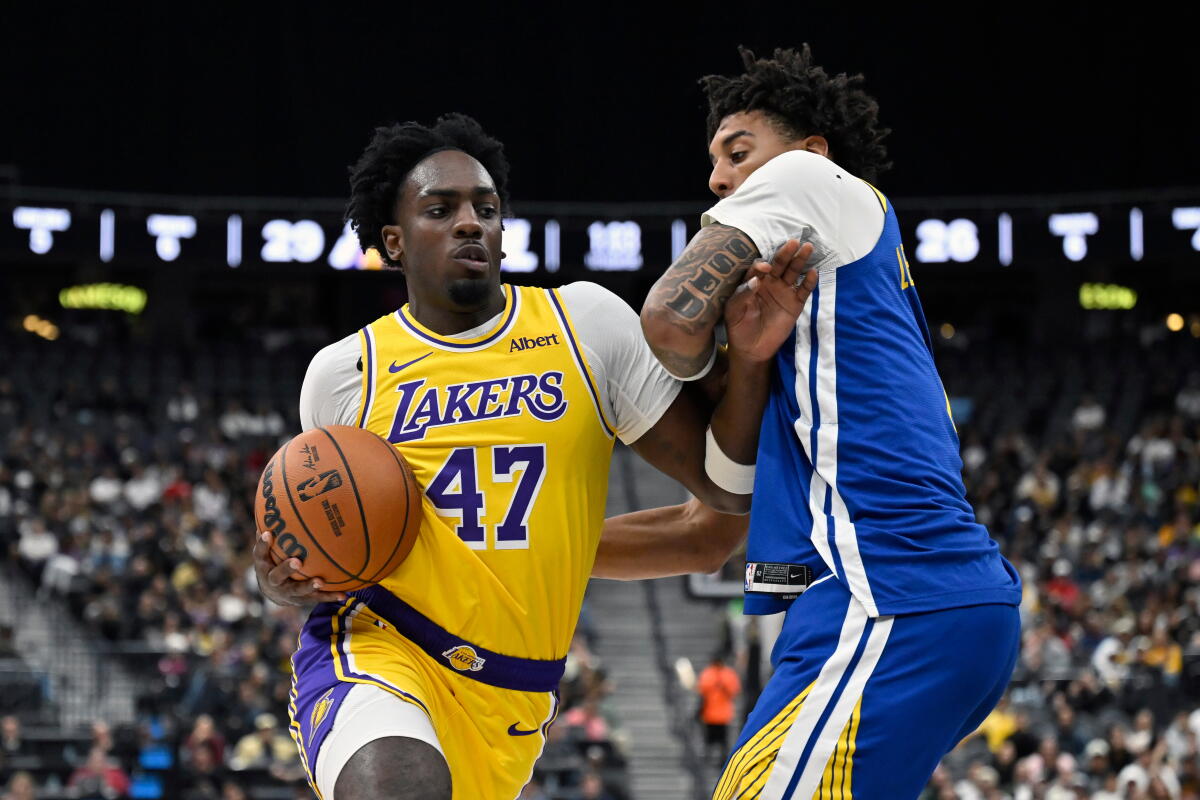
Lakers forward Arthur Kaluma drives the ball against Warriors forward Yaxel Lendeborg during the first half Tuesday.
(David Becker / AP)
While he was out and unable to play, Kessler learned a few things about himself.
“Yeah, I think what I missed most was competing,” Kessler said. “Quite frankly, competing to win, and I think as far as making me a better basketball player, I just think it has made me long to go try to win every game and win every night. So returning, I think it makes me a little better basketball player.”
The Lakers lost to the Warriors for the second time this preseason. Their other two games were victories over the Sacramento Kings. They play one more preseason game, Friday night against the Denver Nuggets at Crypto.com Arena, and then open the season against the Warriors at home on Oct. 21.
Before the game, Redick said the plan was for the Lakers to “continue to work on us.”
“We have kind of circled this game, not as a full dress rehearsal, just in terms of our scout presentation, but we gave the guys a sample of that this morning and at shoot-ariund,” Redick said. “Not as much game-planning necessarily, but just kind of the sequencing of how we present prior to a game. We’ll do the same thing pregame with a brief personnel tape. We just want to get better. I mean, that’s the biggest thing. We want to get healthy, we want to get better, we want to continue to build our fitness and cardio level and find a rhythm. And it’s been a little disjointed with having some guys out.”
Redick said rookie Cameron Carr, guard Collin Sexton (lower leg) and forwards Ziaire Williams (right foot contusion) and Adou Thiero (undisclosed) “are still day to day” with their injuries.
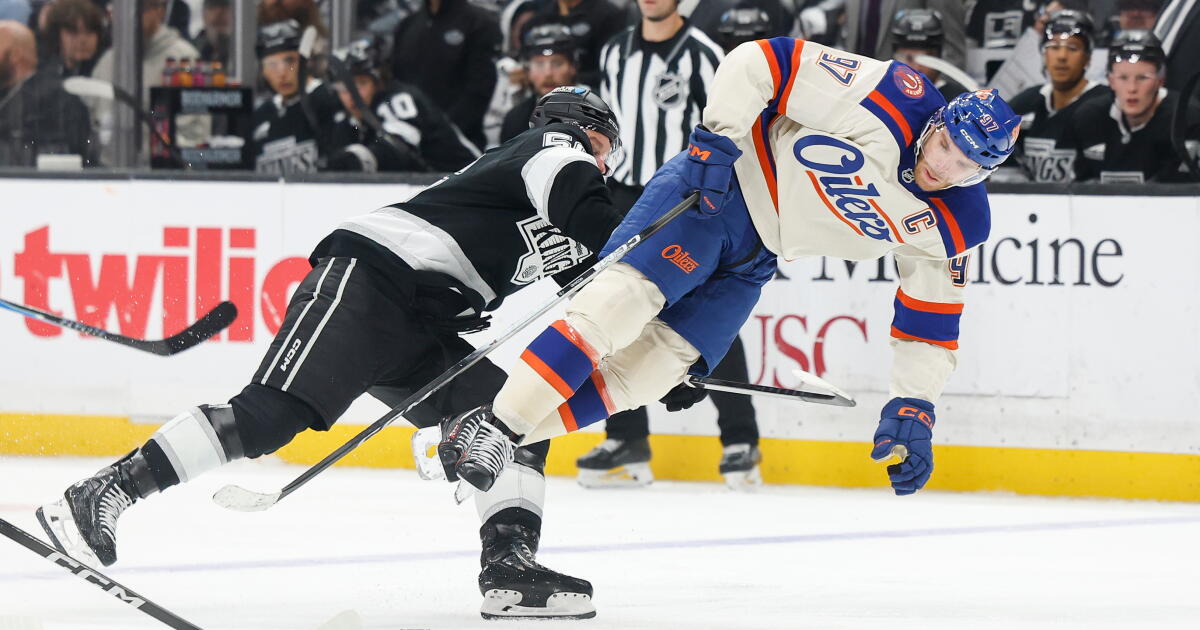
Connor McDavid had a goal and two assists in the dynamic first period of his four-point night, propelling the Edmonton Oilers to a 4-1 victory over the winless Kings on Tuesday.
Vasily Podkolzin got his sixth and seventh goals of the season, Leon Draisaitl also scored and Devon Levi made 39 saves for the Oilers, who have won five straight and scored at least three goals in every game of their 5-0-1 start.
McDavid recorded at least three points in a period for the 33rd time in his 11-year career, doing it in the first period for the 10th time. The six-time Art Ross Trophy winner as the NHL’s top scorer has a whopping 16 points already this season with five multi-point games.
Brandt Clarke scored for the Kings, who dropped to 0-3-2 to begin coach Peter Laviolette’s first season despite outshooting the Oilers 40-16. The Kings are still adjusting to their new direction under Laviolette, who wants offensive aggression from a team that has played deliberate, defense-first hockey for nearly two decades.
The Kings and Philadelphia are the NHL’s only winless teams.
Evan Bouchard had two assists for the Oilers, who are off to their strong start despite playing without injured Zach Hyman and Ryan Nugent-Hopkins.
Edmonton opened the scoring when McDavid froze Cody Ceci and fed the puck low to the quick-wristed Draisaitl. One minute later, Podkolzin converted the rebound after McDavid blew past Mikey Anderson and blistered a shot off Darcy Kuemper.
After the Kings had pinned Edmonton in its own end for nearly two full shifts late in the first period, McDavid came off the bench, accepted Ty Emberson’s pass at the blue line in stride and scored his fourth goal.
Kuemper was replaced by Anton Forsberg to start the second.
Clarke scored late in the second period on a long shot through traffic. The goal was Clarke’s first since the Kings’ young defensive cornerstone signed a five-year, $37-million deal last June.
McDavid and Draisaitl assisted on Podkolzin’s empty-net goal.
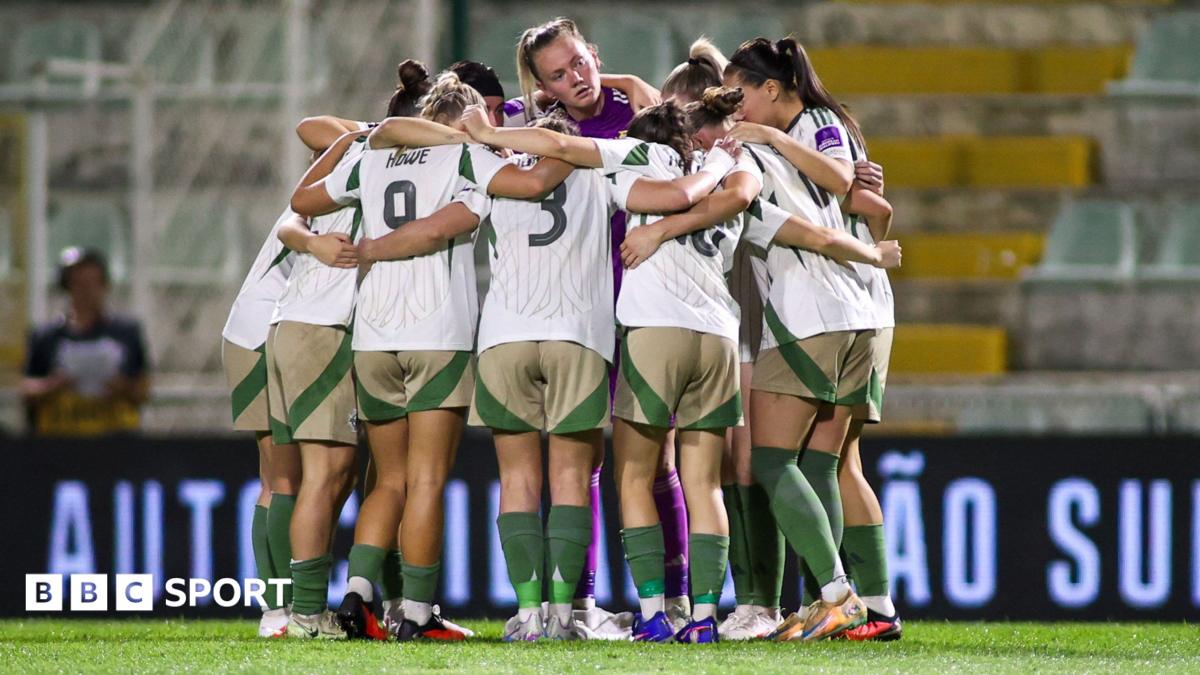
McArdle has shown throughout his tenure so far that he is keen to expand Northern Ireland’s squad depth and gave four players their debuts during the Portugal double header.
One of those debutants, Elmore, scored Northern Ireland’s only goal of the tie and became the second player to score on her debut under McArdle after Emily Cassap netted during the 2-1 defeat by Switzerland in June.
“I’m delighted for Kess,” McArdle continued.
“I knew she could bring that, and it’s just great that she has had that impact in Larne and also got the reward with a goal tonight.
“She’s going to add so much to the group moving forward, but so will a lot of the debutants this week, which was exciting.”
It has been a challenging window for McArdle’s side with key players such as captain Simone Magill and the experienced Laura Rafferty, Nadene Caldwell and Caragh Hamilton missing.
However, the Scot still thinks the side have set “a real enthusiastic marker” down during the tough Portugal tie.
“There have been those moments that have went against us, moments of misfortune. We’re playing a risky style of football,” he continued.
“We were on the front foot from the first whistle, and I couldn’t be prouder of the girls. This is a real enthusiastic marker for moving forward. This is getting closer to the identity that I would like for us moving forward.
“We want more energy, we want more mobility, and we want to be a lot more versatile as well. I’m really proud but also really frustrated with the scoreline.”
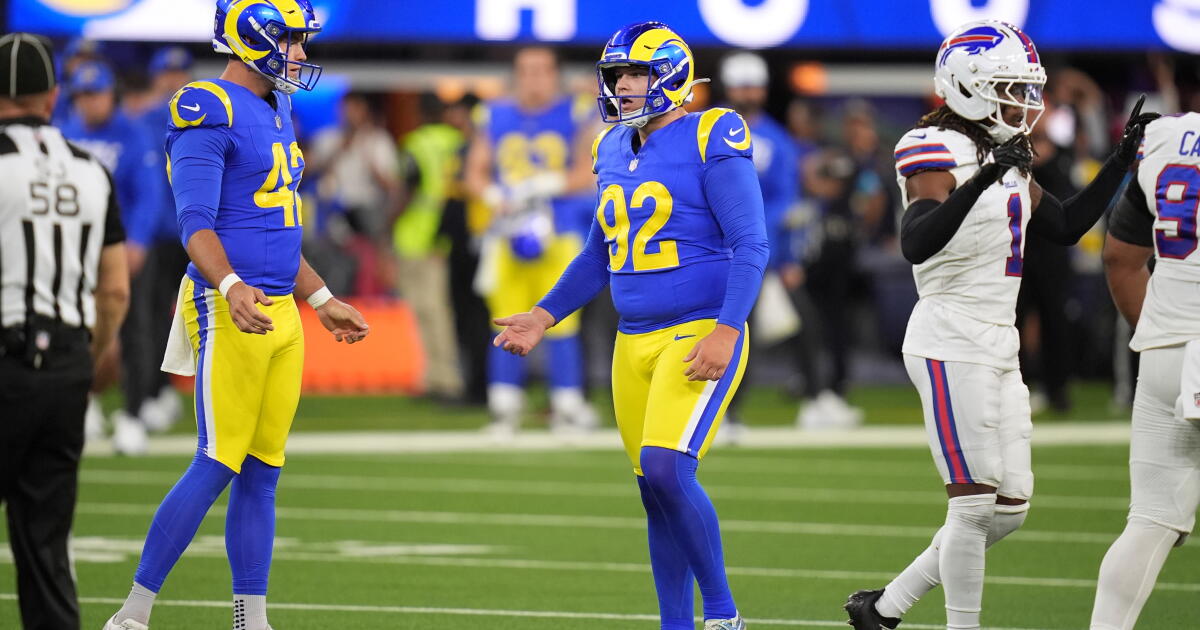
Less than 24 hours after kicking-game issues led to the Buffalo Bills defeating the Rams in overtime, the team released kicker Harrison Mevis, a team official said Tuesday.
Mevis missed a 50-yard field-goal attempt in the first half, and a had potential 48-yard game-winning field-goal attempt blocked in overtime. The Bills went on to win 37-34 in overtime, dropping the Rams’ record to 2-3.
“Not even close to good enough,” coach Sean McVay said of the field-goal and extra-point units after the defeat. “It cost us the game tonight.”
The Rams are signing kicker Blake Grupe from the New York Jets practice squad, according to ESPN.
Mevis’ release is the latest move in a Rams’ special teams saga that dates to last season.
In 2025, the Rams lost to the Philadelphia Eagles after two kicks by Joshua Karty were blocked, including one on the final play of the game that resulted in an Eagles touchdown. After Karty continued to struggle, the Rams released him and signed Mevis, who made 18 of 19 field-goal attempts in nine regular-season games and the playoffs.
McVay fired special teams coordinator Chase Blackburn with a few games left in the season, and hired Bubba Ventrone during the offseason.
But this season, Mevis made only five of nine attempts.
In 2025, Grupe made 18 of 26 field-goal attempts for the New Orleans Saints and all 11 of his attempts for the Indianapolis Colts.
MILWAUKEE — Mookie Betts slapped his bat with his free hand after tipping a slider from Brewers right-hander Abner Uribe back into catcher William Contreras’ mitt.
Betts had been setting the tone for the Dodgers from the leadoff spot all postseason, taking good at-bats against some of MLB’s best starting pitchers. But there wasn’t much he could do against a sinker-slider mix like Uribe’s.
Uribe shuffled off the mound, and the crowd at American Family Field roared.
Then, with left-handed-hitting Freddie Freeman coming to the plate, Milwaukee had an answer for him too. Manager Pat Murphy signaled to the bullpen, left-hander Aaron Ashby emerged and struck out Freeman on four pitches, only one of which touched the strike zone.
“They all throw 100 [mph] from different angles,” Freeman said after the Dodgers’ 7-4 loss in Game 2 of the National League Championship Series on Monday.
Those back-to-back strikeouts in the eighth inning were part of five perfect innings thrown by the Brewers’ bullpen — a postseason record. And the Dodgers’ inability to rally against the Brewers’ relievers, paired with the shortest start in Yoshinobu Yamamoto’s postseason career, sunk their chances of evening the series.
The NLCS heads to Los Angeles with the Brewers leading 2-0 in the best-of-seven series.
The Dodgers’ performance against the Brewers’ bullpen on Monday magnified how much the star-powered lineup hasn’t been clicking with Shohei Ohtani struggling at the plate. He went 0 for 4 in the cleanup spot in Game 2, bringing his postseason total to three hits, all singles, in 20 at-bats.
Manager Dave Roberts told the Athletic after the game that he would “have a conversation” with Ohtani on Tuesday to determine “what’s best for him, what’s best for [the team].”
Factoring into the decision of whether to bench Ohtani is an understanding that he likely is not completely healthy, according to a person with knowledge of the situation not authorized to speak publicly.
Ohtani has dealt with left knee and right biceps issues for much of the season. But it’s been difficult since he returned from the injured list to determine whether health, bad swing habits caused by earlier injuries, or some combination of the two has been to blame for his poor performance.
Ohtani hasn’t addressed the media since the day before Game 1 of the division series.
“It’s tough,” Teoscar Hernández said. “We obviously need his help. He’s a big, big part of this team, and it’s really important. And I feel bad for him. I know what he’s capable of. He’s been dealing with some stuff in the past. We don’t know if it’s still there. But it’s Shohei. Any moment he can come through.”
The game wasn’t doomed, per se, when Yamamoto exited after 2⅔ innings, but it was clear it would be an uphill battle for the Dodgers.
Yamamoto stood on the same mound where a year ago he’d thrown a complete game and was pummeled by Brewers fans’ chants:
“Yel-li! Yel-li!”
As the fans celebrated Brewers captain Christian Yelich’s two-run single for an early lead, Roberts emerged from the visiting dugout, ready to take the ball from the starter who’d made himself a household name with his postseason heroics.
“He just didn’t have it tonight, which is very rare,” Roberts said.
The two walks Yamamoto issued in the inning set up Yelich for a big at-bat. The first walk, to Brice Turang, included a borderline ball-four call. Yamamoto’s hand flew up to the back of his hat like he was contemplating an ABS challenge, but neither he nor catcher Will Smith pulled the trigger. And the second, to Jake Bauers, lasted 12 pitches.
The other run Yamamoto gave up, in the first inning, also included a missed opportunity for a challenge.
Yamamoto struck out Jackson Chourio — whose leadoff home run last year was the lone run in Yamamoto’s NLCS complete game — to open the frame.
Then Turang worked a full count — although the first ball caught most of the low and outside corner — before he hit an opposite-field double.
“It was kind of early in the game, we kind of had him on the ropes where we could just get him out there,” Smith said. “The walk one was a bummer but I guess it happens. It’s baseball.”
The next batter, William Contreras, fought off a low slider, poking it into shallow left field to tie the score.
Against Brewers starter Logan Henderson, the Dodgers capitalized on a couple of errant throws by the pitcher, on a pickoff attempt and a sacrifice bunt, to contribute to two unearned runs, on a day when he gave up four runs in all.
Hernández and Freeman hit sacrifice flies in the first and fifth innings, respectively. Freeman’s came off former Dodger Dustin May, driving in a runner inherited from Henderson. And that was the most the Dodgers accomplished against the same relief corps that held them off the day before. They finished with three hits, their fewest in a playoff game since 2020.
“If there is a positive, you can say that a lot of our guys are starting to get looks at their back-end guys,” third baseman Max Muncy said. “But when they’re as good as they are, I don’t know how much that helps. Unfortunately, that’s the issue with that.”
If the Dodgers are going to bounce back, they’ll either have to figure out how to score against the Brewers’ suffocating bullpen, or build early leads and maintain them.
The Dodgers were forced to throw seven relievers behind Yamamoto. In the fifth inning, with the Dodgers up 4-3, Roberts brought in left-hander Kris Bubic — replacing right-hander Roki Sasaki after a hitless inning — to face the left-handed-heavy heart of the order. But Bubic missed down the middle to the right-handed-hitting Contreras, who gave the fastball a ride over the center field wall, tying the score.
In the sixth, against Dodgers right-hander Brock Stewart, Contreras drove in the go-ahead run in a traffic-filled inning that included a Freeman error on a muffed pickoff attempt. Left-hander Tanner Scott came to the rescue and struck out Bauers and Yelich to end the inning and Garrett Mitchell to kick off the seventh.
The Brewers added insurance runs in the eighth inning with RBI singles by Turang off hard-throwing right-hander Edgardo Henriquez and Bauers against left-hander Justin Wrobleski.
“The guys in here are really good at staying together,” Betts said. “I don’t think there’s much doubt going on. I think we just need to regroup and figure out what we need to do individually. But there’s no doubt.”
The Tom Cruise-led “Digger” is poised for a massive loss after ticket sales for the political satire fell 60% in its second weekend in theaters in the U.S. and Canada.
The Warner Bros. film made just $3.2 million in those theaters over the weekend, according to a studio estimate. Its opening weekend brought in $8 million, Cruise’s lowest opening as a leading man since 2007’s “Lions for Lambs.” Global ticket sales for “Digger” were only $35.3 million.
The tepid box-office returns mean the studio is now expected to lose at least $150 million on the film, including ancillary revenue streams such as premium video-on-demand and streaming, industry sources said. Historically, a film has typically needed to make 2½ to three times its budget to recoup its costs.
A Warner Bros. spokesperson did not respond to a request for comment.
It’s a tough result for the film, which stars Cruise as an aging oil tycoon whose company sets off an environmental catastrophe. Analysts have said that the film was challenging to market, given a major twist in the plot, and that Cruise’s nearly unrecognizable appearance could have dissuaded his fan base from coming out to support the film.
The film suffered from polarizing critical reviews, notching a 53% on aggregator Rotten Tomatoes. Opening-night audiences gave it a C+ on CinemaScore, a grade that typically points to weak word of mouth and steep drops in the weeks that follow.
The budget for “Digger” raised the stakes. Warner Bros. has said the film cost $125 million to produce, though some industry experts and trade reports have estimated the cost was at least $160 million, citing production delays.
That figure also doesn’t include marketing costs, which sources said could have increased in the days after the film’s opening since Warner Bros. began using the divided reviews in social media and TV ads to encourage people to see the film for themselves.
The film will have value to Warner Bros. — and Skydance, the newly combined company that now owns it — beyond its theatrical reception. “Digger” probably will make money through downstream revenue sources such as streaming. If Cruise wins his first competitive Oscar, that also would be a plus for the film.
But a film’s domestic reception, and to some extent, its international box office revenue, does play a role in the value of those downstream revenue opportunities, experts said.
“Even with respectable ancillary income based on the film’s pedigree, the movie is going to lose a lot of money,” David A. Gross wrote in his FranchiseRe movie industry newsletter shortly after the film’s opening.
The reception for “Digger” comes during a tough time for Warner Bros.
The studio has had a string of disappointments this year, including Maggie Gyllenhaal’s “The Bride!” and DC Studios’ “Supergirl.” None of its 2026 releases has crossed $100 million at the domestic box office.
But the prospects for Warner Bros. should improve next year, according to the research and brokerage firm Bernstein. Skydance has said it will keep the Warner Bros. and Paramount studios distinct, though Paramount Pictures chiefs Dana Goldberg and Josh Greenstein are expected to oversee both. Bernstein expects the Warner Bros. film and TV studios to amass $11.7 billion in revenue, driven by strong titles that include the sequel to “Minecraft” and a new “Lord of the Rings” movie.
The Rams delivered some thrills — but not a victory.
Tyler Bass kicked a 45-yard field goal with 1:55 left in overtime, sending the Rams to a 37-34 loss before 73,882 at SoFi Stadium.
Special teams miscues and penalties once again hampered the Rams in a game that featured three touchdown passes by Matthew Stafford and a career-best 17 catches by Puka Nacua.
Just as they did two years ago, when the Rams outlasted the Bills for a 44-42 victory, the teams put on a show.
But the Rams’ record dropped to 2-3, the fourth time in the last five seasons the Rams are 2-3 or worse after five games.
In 2022, when the Bills blew out the Rams in the opener at SoFi Stadium, the Rams were 2-3 en route to a 5-12 finish, the worst Super Bowl hangover in NFL history.
In 2023, the Rams were 2-3 before rallying to finish 10-7. The Detroit Lions eliminated the Rams in the NFC wild-card round. The next season, the Rams started 1-4, finished 10-7 again and lost to the Philadelphia Eagles in the divisional round.
Monday’s game was a matchup between the two previous NFL most valuable players, Bills quarterback Josh Allen in 2024 and Stafford in 2025. It was the first game between consecutive MVPs who play in separate conferences since 2015 when Peyton Manning went against Aaron Rodgers.
Stafford completed 40 of 54 passes for 383 yards, including two touchdown passes to Davante Adams and another to Nacua, who had 138 receiving yards.
Allen, who accounted for six touchdowns in a 44-42 loss to the Rams two years ago, completed 12 of 19 passes for 210 yards and a touchdown, and he rushed for 121 yards and a touchdown as the Bills improved to 4-1.
This was supposed to be a special season for the Rams.
But it has turned into a special teams nightmare.
Harrison Mevis failed to convert two field-goal attempts, including a winning kick in overtime that was blocked by Buffalo linebacker Greg Rousseau. The Rams also gave up a 70-yard return on the opening kickoff.
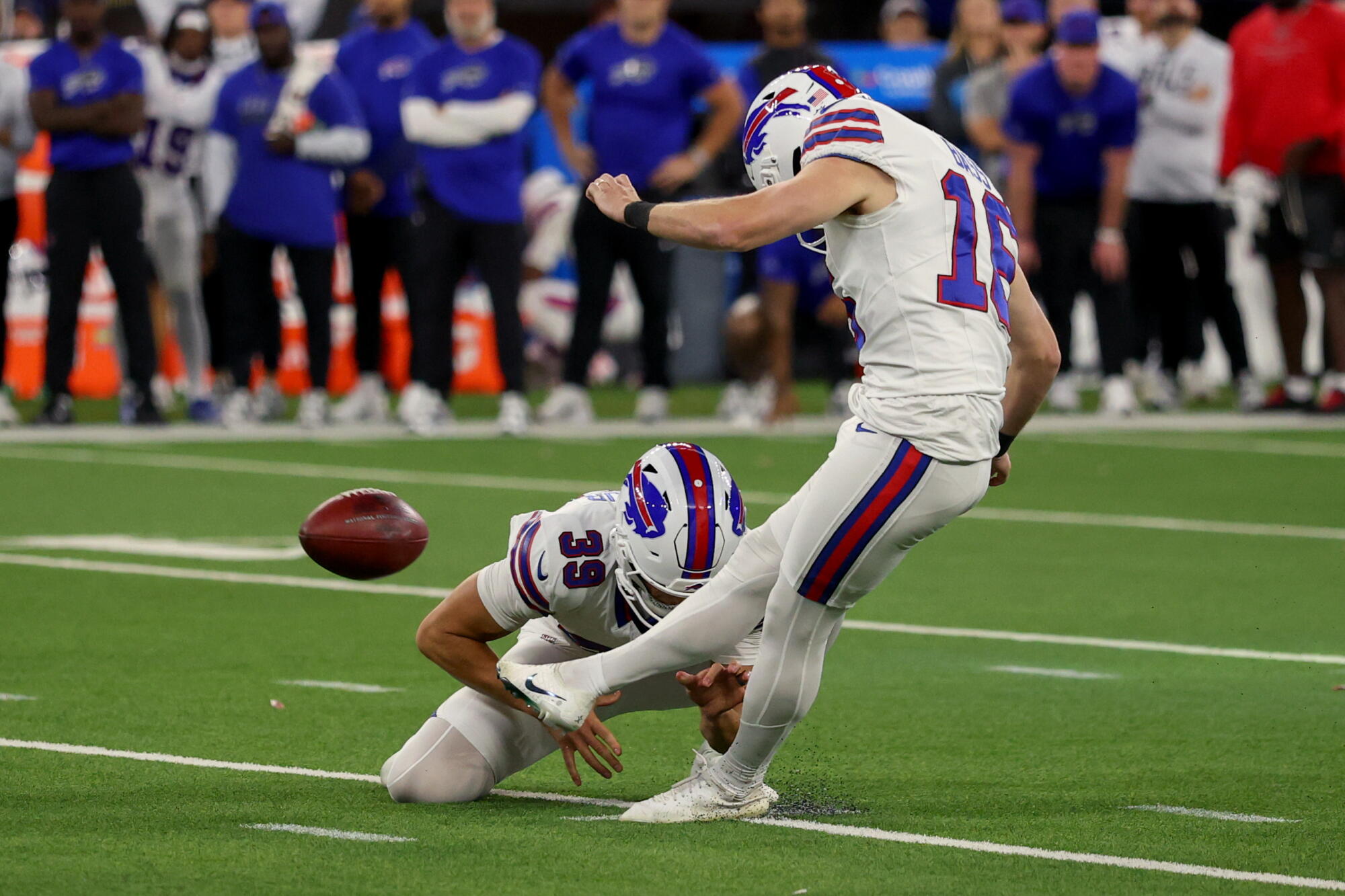
Tyler Bass kicks a 45-yard field goal in overtime to seal the Bills’ 37-34 win over the Rams at SoFi Stadium on Monday night.
(Eric Thayer / Los Angeles Times)
The Rams continued their penalty-filled foibles: They were flagged 11 times for 84 yards, many of the pre-snap variety that drives coach Sean McVay crazy.
Special teams miscues and penalties hampered the Rams in the first half, and they trailed 13-7 at halftime.
The Rams took the lead early in the second half when Stafford engineered a 60-yard drive that ended with Blake Corum’s one-yard touchdown run.
But late in the third quarter, the Bills took the lead on Allen’s touchdown pass to receiver Keon Coleman. The Bills missed the extra-point attempt, leaving them with a 19-14 lead.
The Rams immediately answered, Stafford connecting with tight end Tyler Higbee for 28 yards before Corum caught a pass and turned it into a 34-yard gain. That set up Stafford’s two-yard touchdown pass to Nacua early in the fourth quarter, but Stafford was sacked on a two-point conversion attempt, leaving the Rams with a 20-19 lead.
Rams linebacker Nate Landman punches the ball out of Bills running back James Cook III’s arms during the third quarter Monday.
(Eric Thayer / Los Angeles Times)
Allen then directed an 80-yard drive that he capped with a one-yard sneak, and his two-point conversion pass to tight end Dalton Kincaid gave the Bills a 27-20 lead with 11:28 left.
But the Rams tied the score on the next possession off a five-yard touchdown reception by Adams.
Allen, however, got the ball with just over seven minutes left, and had 15- and 21-yard scrambles during a drive that ended with James Cook III scoring on a five-yard run for a 34-27 lead with 1:39 left.
On the ensuing possession, Stafford completed a 14-yard pass to Adams and, one play later, found Nacua for 16 yards and then Adams for 15. A one-handed catch for nine yards by Kyren Williams moved the ball to the one-yard line, and Williams scored on the next play with five seconds left in regulation. Mevis’ extra-point tied the score.
Rams quarterback Matthew Stafford passes during the first half against the Bills on Monday.
(Eric Thayer / Los Angeles Times)
The Bills got the ball first in overtime, and appeared on their way to a field goal or touchdown when Khalil Shakir gained 57 yards on a catch-and-run to the Rams’ 22. Rams safety Kamren Kinchens prevented Shakir from scoring when he just barely managed to trip up the Buffalo receiver.
But on the next play, linebacker Nate Landman punched the ball from Cook’s grasp and Aaron Donald recovered the fumble with 7:54 left.
Stafford drove the Rams to the Bills’ 30, but the Bills blocked Mevis’ attempt, setting the stage for the Bills’ winning drive.
NEW YORK — UCLA jumped to No. 12 in the latest Associated Press top 25 poll following its upset of Oregon and USC retained its No. 19 ranking following its win at hostile Penn State.
The poll saw many changes following a Saturday filled with upsets.
Georgia moved up to No. 1 after its win at Alabama, Texas dropped six spots to No. 7 after its loss to rival Oklahoma and Oregon was unranked for the first time in four years after losing for the second time in the past month.
The Bulldogs, who had been No. 2 for five straight polls while rolling off five straight lopsided wins, went on the road and beat Alabama 20-17 with the help of what appeared to be a missed pass interference call in the end zone late in the game.
Georgia received 66 first-place votes from the panel of 70 media members after its first victory in Tuscaloosa since 2014 and ascended to the top of the poll for the first time since Sept. 8, 2024.
Notre Dame, which tuned up for this week’s top-10 matchup at BYU with a 58-7 rout of Stanford, moved up one spot to No. 2. The Fighting Irish got one first-place vote and have their highest ranking since they were No. 2 in the final poll of the 2024 season.
No. 3 Miami, which received two first-place votes, is followed by Ohio State and Indiana. The Hoosiers, who received the remaining first-place vote, got a two-spot promotion after their narrow win at Nebraska.
Alabama remained No. 6, and Texas, BYU, Mississippi and Texas Tech completed the top 10.
Oregon came into the season with its highest preseason ranking ever at No. 2. The Ducks’ turnover-fueled 17-15 home loss to UCLA dropped them to 3-2 and knocked them out of the poll for the first time since they went from No. 11 to unranked following a 49-3 loss to Georgia in the 2022 opener.
No. 12 UCLA and No. 15 Kentucky got the biggest promotions. The Bruins moved up nine spots with their win over Oregon, and the Wildcats went from unranked to No. 15 with their 35-34 overtime win over LSU, which dropped from No. 10 to No. 22.
In and out
In: Kentucky, which dropped out last week after beating South Carolina, is back in the poll with its highest ranking since early October 2022.
In: No. 21 Wake Forest is 5-1 and ranked for the first time since late October 2022.
In: No. 25 Northwestern, at 4-1, earned its first ranking under fourth-year coach David Braun.
Out: Oregon hasn’t lost two of its first five games since the 2016 team opened 2-5 and finished 4-8.
Out: Florida has gone from No. 8 to No. 16 to out of the rankings in two weeks following its 38-19 home loss to South Carolina.
Out: Pittsburgh managed just one touchdown on eight second-half possessions in a 21-17 home loss to North Carolina.
Poll points
— This is the second time in three years there have been three or more No. 1 teams in the first six polls. Georgia, Texas and Alabama took turns holding the top spot in the first six polls in 2024. The only other time in the Top 25 era that three teams had been No. 1 at this point of a season was 1990.
— Notre Dame and Miami, dubbed “Catholic vs. Convicts” rivals since their classic game in 1988, haven’t been together in the top three since Nov. 9, 1993.
— Texas’ six-spot fall from No. 1 to No. 7 matched its drop following a season-opening loss to Ohio State last year.
Dak Prescott and the Dallas Cowboys suffered an unexpected loss to the previously winless Tampa Bay Buccaneers and their undrafted rookie quarterback Jalon Daniels in front of a home crowd on “Thursday Night Football.”
Some might describe the loss as “embarrassing” — in fact, one guy actually said that exact word in the Cowboys tunnel within earshot of Prescott as he walked to the locker room after the game.
Online video footage shows Prescott looking back at the man — who was there as a transportation service driver and not an employee of the Cowboys or AT&T Stadium — while still walking, then turning away. The man then said something else, possibly “you heard me,” which prompted the veteran quarterback to look back and say, “You say it once I look off, huh?” while still walking.
Prescott can then be seen speaking to a Cowboys security employee and gesturing in the direction of the other man. Footage shows the security employee going back down the tunnel, presumably in search of the heckler, but it is unclear what happened after that. The Cowboys declined to comment for this article.
Prescott was asked about the incident during his postgame news conference. At first, he simply acknowledged that the person wasn’t necessarily wrong in his assessment of the game.
The four-time Pro Bowl selection was then asked if he thought the comment was disrespectful.
“You know, when he said it I just happened to look at him, and at that point he looked away, didn’t look. And when I turned my head back, he said something else,” said Prescott, who completed 24 of 42 passes for 316 yards with one touchdown and two interceptions.
“So that’s the part that — just as a man or as a person, feel free to speak your mind. Just speak it. Don’t coward away from the reaction that you’re going to get. If you’re saying it’s embarrassing, say it’s embarrassing. If you’re saying it to me, then say it to me. Don’t go back on it. So that’s all that was, and hate it that it’s even being talked about, to be honest with you.”
The Cowboys led 10-7 at halftime, but Tampa Bay scored 17 points in the third quarter to take control of the game. Dallas pulled to within 24-16 late in the fourth quarter, but Prescott threw his second interception of the night deep in Buccaneers territory with 1:16 remaining to seal the game.
Owner Jerry Jones called the game’s result “extraordinarily, extraordinarily disappointing.”
“Boy, I’ve been so disappointed before with losses, but this was disappointing,” Jones told reporters after the game. “And I’m disappointed because I see potential growth here. And we need to have good experiences on an individual basis as well as a team. And this was not a good experience out here.”
Prescott said he hesitates to use the word “embarrassing” to describe the loss because “I feel like I’m discrediting the NFL if I use that and particularly the Tampa Bay Bucs and a great Todd Bowles-coached and defensive-coached team.”
But, he added, “when a winless team comes into your home stadium on a Thursday night primetime game, yeah, we’re supposed to win that. So it sucks and it’s right up there close to ‘embarrassing,’ but I don’t know if I would say that.”