SACRAMENTO — It was unprecedented and stunning: California’s governor and top two legislative leaders negotiated a compromise on a big bill — and one house rebelled, refusing to bring it to a vote.
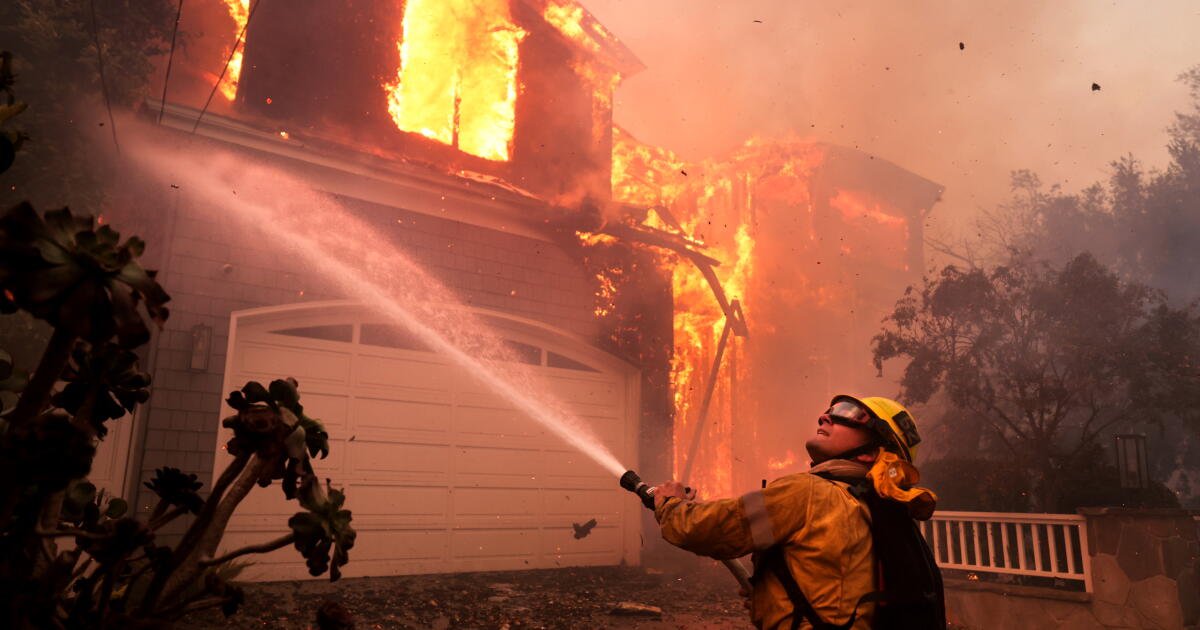
Not just any bill, but this year’s biggest in the state Legislature, dealing with catastrophic wildfires, arguably the state’s most perilous problem.
The issue: who gets hit the hardest financially when a for-profit utility’s electrical equipment ignites a blaze. The utility’s investors? Its ratepayers? The insurers? Their premium payers?
At stake, depending on who you talk to, is whether the electricity providers can afford to stay in business and keep our lights on. Will some utility — Southern California Edison, Pacific Gas & Electric or San Diego Gas & Election — be forced into bankruptcy when the next powerline-caused wildfire explodes?
Alternatively, there’s another unacceptable potential outcome: Property insurance companies completely stop issuing policies — not just in obvious fire-prone areas, but in tree-lined urban neighborhoods — and basically pull out of California. Or their premiums become flat-out unaffordable.
Politically, the wildfire legislation’s flameout called into question Gov. Gavin Newsom’s seeming weakness as a lame duck chief executive who will be termed-out of office in January.
Newsom stuck out his neck and took it on the chin from fellow Democrats — showing that even with lopsided one-party rule, unity and success aren’t always guaranteed.
But the episode also raised doubts about Assembly Speaker Robert Rivas’ leadership capability. The Hollister Democrat signed off on the deal with Newsom and Senate President Pro Tem Monique Limon (D-Santa Barbara), but reneged at the last minute under pressure from the Assembly Democratic Caucus. They killed the bill without a floor vote.
I’m in my seventh decade of covering California governors and legislatures and never have seen — or heard of — anything like this: a legislative leader backing out of a deal agreed to with the governor and the other house’s leader.
But in truth, Newsom didn’t really like the agreement much anyway. He was on the utilities’ side, and they were out-lobbied by the insurers and ratepayers.
“I know we all hate utilities, so no one wants to defend a utility. But you’ve got to deal with reality. This thing’s not going to get better on its own,” Newsom told reporters at the Capitol on the night before the deal collapsed, referring to the utilities’ worsening financial liability.
Personally, I think it’s an overreach to conclude that Newsom’s power has been severely weakened — or that Rivas necessarily showed lack of leadership. One can question their reasons for doing what they did, but that doesn’t mean it was because of political debility.
“Newsom’s still a powerful lame duck because he could be a presidential nominee,” Republican consultant Rob Stutzman says.
“One of the better things he has done all year is taking on this issue. It would have been very easy for him to just pass it on to the next governor.”
Leaving aside whether this governor could become a president, there are hundreds of bills piling up on his desk that he must sign or veto by Sept. 30. That gives him tremendous clout. It’s good politics — and human nature — for a governor to lean more favorably toward a measure if it’s authored by a legislator who has voted with him.
Plus, one of the Legislature’s last acts last week was to send Newsom a bloated supplemental budget bill containing more than $3 billion in spending, including countless stacks of pork sought by lawmakers for their districts. Newsom easily and gleefully could discard any or all of it.
So Newsom has awesome power, lame duck or not.
But he’s vulnerable to criticism for his style. He has had an annoying habit of waiting until the very end of a legislative session to spring a hefty proposal on the lawmakers. It’s called “jamming.”
In the past, this pressure tactic mostly worked, although it ticked off lawmakers. This time Assembly members rebelled.
It’s not clear whether his jamming is mainly strategy, or just lack of focus and a tendency to push too many projects at once. Or is he preoccupied with positioning himself to run for president in 2028? Probably all of the above.
“If we had more time, we could have had a different outcome,” Rivas told me.
With only a few days remaining in the legislative session, Newsom initially proposed an ambitious plan that would have shifted more cost for utility-sparked wildfires to property insurers, sharply raising premiums across California. Utilities would have gotten some relief.
It became a titanic fight between two powerful special interests. And insurers — teamed with consumer advocates — triumphed, forcing Newsom to back down.
After hard bargaining, the governor and legislative leaders finally agreed on a post-midnight deal to help wildfire victims receive compensation more quickly — a so-called fast-pay program — and to step up fire preventative efforts.
But utilities’ financial risks weren’t significantly reduced, and they quickly mounted an opposition campaign. That resulted in Assembly Democrats scuttling all of it on the session’s last day.
“It’s unfortunate that [bill] was not given a vote,” Limon said, adding that the Senate was prepared to pass it.
“I don’t want us to do the easy stuff and call it a day,” Rivas told me. “I wanted to see real utility accountability. This bill did not go nearly far enough.”
It went a fair distance, however, in helping future fire victims get their insurance payouts faster. And it probably should have been passed.
Half a loaf. Bird in hand. Incremental change. Next year more incrementalism. Ultimately it can add to massive reform.
Some problems are just too tough to resolve in one sitting.
What else you should be reading
The must-read: Reining in Big Tech: How California lawmakers plan to regulate AI and social media
California vs. Trump: Judge dismisses Justice Department lawsuit challenging California transgender sports policies
The L.A. Times Special: Texas is red, California blue — but for how much longer? A Lone Star toss-up will tell
Until next week,
George Skelton
—
Was this newsletter forwarded to you? Sign up here to get it in your inbox.