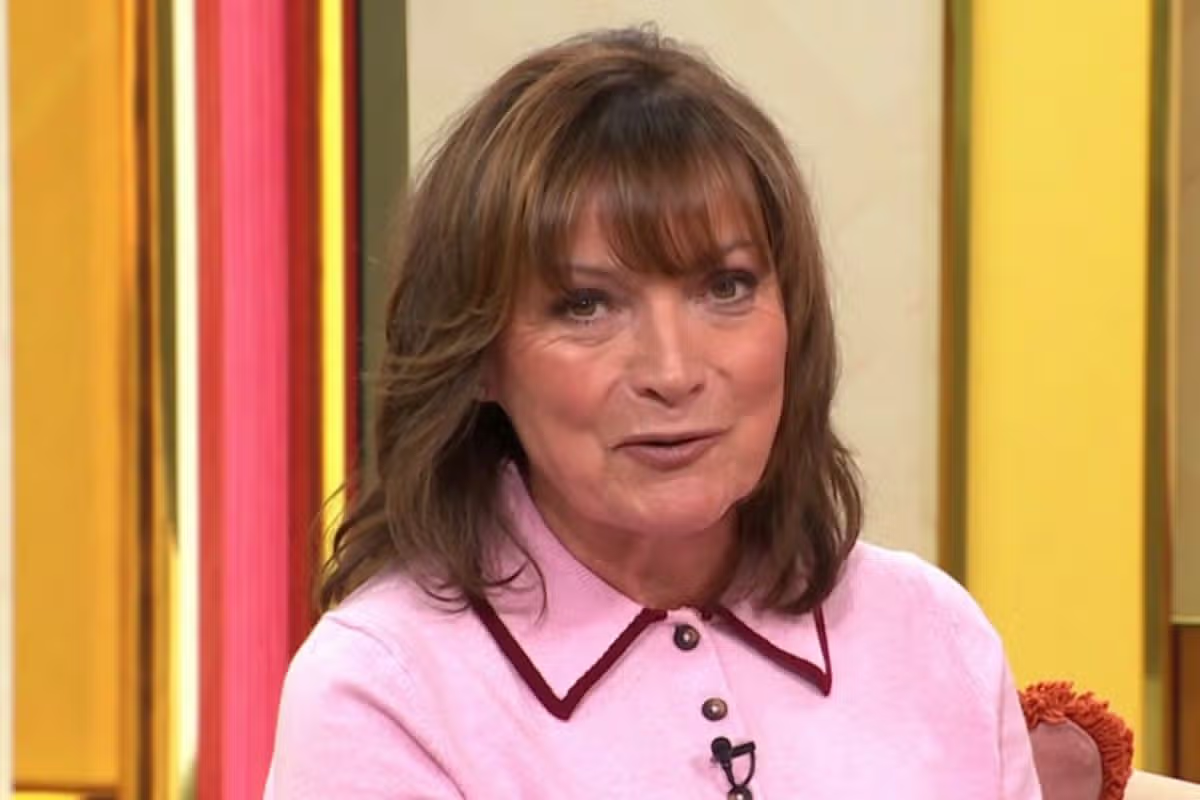
Emmerdale’s latest episode saw a character brutally dumped, paving the way for a sad exit on the ITV soap, while another character’s lies could finally be exposed by a character
20:07, 28 Sep 2026Updated 20:07, 28 Sep 2026
Emmerdale Sadie’s lies could finally be exposed by a character(Image: ITV)
Monday’s visit to Emmerdale could seal the end of TWO characters.
We’ve got someone’s secret possibly being exposed by someone known for taking action. Then we’ve got a brutal dumping that no doubt deals a departure for a character after their recent crime.
Sadie King may have just exposed her lies about her faked relationship with Jimmy King. Fans know that she’s made out to Jimmy’s grieving widow Nicola King that they were having a secret relationship for three years.
She’s actually after his money, and she’s in cahoots with Robert Sugden to find it. So when she drunkenly let slip to Ruby that the recent fling she had in Paris was in December last year… will Ruby realise she can’t have been with Jimmy, and has lied?
Ruby could use this information to expose Sadie’s lies and her real plan, no doubt triggering her downfall. Question is, will Ruby keep quiet?
Elsewhere, Lewis Barton ended his relationship with Vinny Dingle after finding out Vinny caused the fatal crash that killed Jimmy, and caused Dawn Taylor’s death too. With Vinny facing prison, Lewis tearfully ended things with him.
So with Vinny facing prison and now having lost his partner, with the villagers also turning on him, will he flee? Will he take his punishment and go to prison, either way confirming an exit for the character?
It comes as Lewis actor Bradley Riches told the Mirror what was ahead. Bradley teased: “It’s always going to be hectic. For Lewis, he doesn’t know where the relationship is gonna go. But also, his people will be there to support him.
“There’s a lot of things going on but at the end of the cycle, what we are filming now for later on, it’s joyful and fun. Lewis becomes friends with the women in the village.
“We did a scene the other day where it was Lewis, Sadie King, Vanessa Woodfield, Manpreet Sharma and Ruby Miligan. We were all together having drinks, as Lewis invites himself, as he often does.
“There is drama happening there but it’s so much fun, comedy and silliness. I think it’s needed from time to time in soap.” Asked to describe winter on the soap, he teased: “Christmassy, togetherness, community, and vulnerability.”
Bradley also teased the repercussions of Vinny’s crime coming to light. He shared: “There’s a lot of layers to it. Vinny was responsible for killing Jimmy and Dawn, and it’s one of those things where Lewis has to navigate being there for Nicola but also deciding what to do about his relationship.
“It is gonna be overwhelming for him. Normally everyone babies him, and people make decisions for him, but I think maybe this is the first time where Lewis is like, ‘I’m gonna do what I wanna do,’ and he deals with the situation on his terms.”
Repeated incidents of organisational failure at the Asian Games have left athletes frustrated, exhausted and disappointed as rain-delayed matches became the latest headache for host nation Japan.
A glitzy opening ceremony did little to overshadow the growing accommodation crisis, logistical gaffes and scheduling issues that have headlined the Games, which opened on September 19 in Aichi-Nagoya.
Recommended Stories
list of 4 itemsend of list
India’s multiple-Olympic medallist PV Sindhu lamented a badminton schedule that saw her play three matches within 18 hours.
“Three matches in 18 hours. Back at 3am, out again at 8:30am. It took a toll,” Sindhu wrote on social media after her quarterfinal exit on Sunday.
Pakistan’s volleyball team was mistakenly taken to the wrong gymnasium an hour before the start of its preliminary round match, forcing its members to change into their kits on the bus and leaving them without enough time for a warm-up.
“Japan has destroyed the dignity and discipline of the Asian Games,” men’s captain Murad Jehan wrote in a now-deleted video on his Instagram account as the team travelled to their match against Uzbekistan, which they won 3-0. “Really disappointing situation.”
He said athletes would often return from training to find their hotel restaurant closed, leaving them unable to eat. “This situation at Asian Games is not acceptable.”
The South Korean men’s basketball team faced a similar incident when they missed a light practice session hours before their final after their shuttle bus did not show up on time. Team officials said they received no explanation.
It was a repeat of what the men’s football team faced when the bus did not arrive at the team’s hotel. A day earlier, the bus took the athletes to a baseball ground instead of the Mizuho Rugby Stadium, causing a 30-minute delay.
‘Rain has ruined everything’
On Monday, persistent rain became the organisers’ latest headache when it disrupted several competitions, including tennis, surfing and cricket.
Both the men’s cricket quarterfinals between Pakistan-Hong Kong and India-Afghanistan were washed out after the playing field was drenched at Korogi Athletic Park on the outskirts of Nagoya.
With no contingency built into the schedule for rained-off matches, Pakistan and India advanced to the semifinals of the T20 tournament by virtue of their higher rankings.
It was a bitter pill for Afghanistan, who saw the gold medal go to India due to the rankings rule three years ago when their Hangzhou Games final was abandoned due to rain.
“The rain started yesterday, so hard luck for us,” Afghanistan opener Mohammed Akram said.
“We would have been happy to play here with India. Our players are in form.
“But unfortunately the rain has ruined everything.”
Typhoon Surigae lashed southern Japan’s Okinawa prefecture on Monday and was projected to track northeast towards central Japan and the Tokyo region by midweek, raising the prospect of strong winds and heavy rain further disrupting the Games.
Typhoon Dujuan hit the Games early in week one, causing equestrian events in Tokyo to be suspended although most competitions were unaffected.
The continental sporting showpiece is mainly based in the city of Nagoya and Aichi prefecture, but Tokyo is also hosting diving events while Osaka is hosting football matches.
The rain saw several tennis matches scrapped on Sunday and caused match delays on Monday.
Fans hoping to catch Filipino headliner Alex Eala’s opening match against Thai opponent Patcharin Cheapchandej were repeatedly frustrated at the Higashiyama Park Tennis Centre.
Eala, the women’s top seed, had her match shifted off centre court amid the scheduling logjam and wrapped it up in 55 minutes with a 6-1, 6-0 win over Patcharin.
Poor wave conditions saw the surfing called off early at the Long Beach venue southeast of Nagoya with medal finals having already been pushed to Tuesday.
India’s Kishore Kumar Anbarasu was able to complete his heat before it was abandoned, beating China’s Ma Wensong to make it into the quarterfinals on the sport’s Asian Games debut.
“It was not the easiest conditions. It was very hard to find the good waves,” Anbarasu said.
China’s Jinyi Liu puts his targets into plastic bags due to the rain during his compound men’s individual 1/16 elimination match against the United Arab Emirates’s Sultan Almenhali [Anushree Fadnavis/Reuters]
Organisers apologise for logistical chaos at ‘sad’ games
Organisers on Saturday apologised for logistical glitches at the Games that left thousands of athletes with cramped housing conditions and undersized beds that forced several countries to house their athletes elsewhere.
Satoshi Murate, secretary-general of the local organising committee, said a late influx of about 2,000 additional athletes and officials had stretched resources.
“There have been mistakes in accommodation and transport for various reasons,” Murate said.
“Whatever the cause, AINAGOC [the Aichi-Nagoya Asian Games and Asian Para Games Organising Committee] is responsible for providing the service, and I frankly apologise for the mistakes.
“Our staff work every day to identify the causes of each mistake and make sure they don’t happen again. I think you can see that accommodation and transport have improved greatly compared with the early days.”
Organisers chose not to build a traditional athletes village in a bid to save money. Competitors instead are staying in hotels, temporary wooden units and on a cruise ship.
India’s multiple badminton medallist HS Prannoy said that made for a disappointing experience.
“It was sad,” the 34-year-old, who won team bronze, said in a YouTube video published by the Badminton Association of India.
“It never felt like we were playing in an Asian Games, to be honest.”
EXCLUSIVE Some of the biggest stars of Coronation Street, EastEnders and Emmerdale have united for a new staging of a classic play and looked back on their time on the world’s longest-running TV soap
17:35, 27 Sep 2026Updated 18:05, 27 Sep 2026
Twelve Angry Men is on tour across the UK
Coronation Street, Emmerdale and EastEnders have been the UK’s biggest soaps for decades and now the stars truly have aligned as a group of actors from each of them have united to take on a stage production based on a film that is often one of the greatest films ever made
Soap legends Bill Ward, Tristan Gemmill, Ben Nealon and Gray O’Brien have teamed up together to appear as four of the jurors in Twelve Angry Men, which follows a jury as they deliberate the guilt of a boy on trial for murdering his father. All four of them have gone on to carve out successful careers on the boards since their time on screen, but Gray, 58,who played the villainous Tony Gordon on Coronation Street, has admitted he would be keen to return to TV if the opportunity was there.
“It’s not that I choose to do theatre, I’ll be brutally honest. It’s because nowhere in telly will employ me. That’s the thing about men coming out of soaps. Look at some of the best actresses we have in this country, Suranne Jones, Katherine Kelly, they’ve all used Coronation Street as a springboard into other things but it doesn’t work that way for men and I don’t know why that is,” he tells The Mirror.
Tony was the second husband of Underworld boss Carla Connor (Alison King). Introduced as a ruthless businessman, things quickly turned evil and he raped Carla before tying her up in the factory and setting it on fire during a major siege week in 2010. Carla made it out alive, but Tony did not. Gray admits he had no idea where the character was going when he first signed up to appear, but didn’t expect things to pan out as they did.
“It’s only supposed to be about seven houses,” he laughs when discussing the increasingly dramatic nature of the programme. Prior to joining Coronation Street, Gray had appeared in Casualty and River City, but joining the Manchester-based soap was a poignant moment for Gray because his father was such a fan.
“My father was a huge fan of Coronation Street, everyone says they are the biggest fan, but he was. Unfortunately, he died in 2000 and I joined in I think 2007 so he didn’t get to see it and he would’ve loved the part,” he adds.
But the star is happy with his latest role as touring fits in with his lifestyle and ultimately has happy memories of his time on set. It’s a similar case for Bill Ward, who played Charlie Stubbs and, after years of high-profile storylines, one of which saw Charlie abuse Shelley Unwin (Sally Lindsay), his character was murdered by girlfriend Tracy Barlow (Kate Ford) almost 20 years ago.
“I loved it, and people do still talk to me about it,” he smiles, adding “It was a really, really great piece of writing. The writers, I was very, very lucky. The writers really, really wrote for that character, for Charlie Stubbs, and I always used to look forward to getting the next week’s script to see what he would be up to because it was always it was very thoughtful, but it was also very innovative. A lot of the kind of the absolute delight, and I loved my time on it.”
Following his stint in Coronation Street, Bill, 59, went on to play James Barton in Emmerdale, but has also enjoyed a stellar career in theatre, starring in productions of Legally Blonde and Everybody’s Talking About Jamie amongst a host of others.
Things are never safe in soap land and a decade on from Charlie’s dramatic exit, former Casualty star Tristan Gemmill, 59, arrived to play Tracy’s ex-husband Robert Preston. Like Charlie, Robert did not exit in a black cab and his departure from the street was also explosive – being shot through the door of the Rovers Return Inn on Christmas Day.
At the time, Tristan’s children were young and he recalls having to calm them down when they saw the hard-hitting scenes. “Being shot through the door of the Rovers was harsh. It a hell of an exit. We all watched it on Christmas Day with my kids. I thought ‘Oh, look, we’ve had Christmas lunch. Let’s sit down and watch Daddy’s episode of Coronation Street because it’s where he leaves the show.’ It was a big mistake! They got so upset and I spent hours calming them down!”
For Ben Nealon, who played Alex Harkinson on EastEnders but is better known for starring as Capt Jeremy Forsythe on Soldier Solider, the theatre is definitely home, but he is always pleasantly surprised when members of the public recognise him for his signature role.
“With Solider Solider, it’s strange. In some ways, was really lucky, and all of us who were in it were really lucky to be last bastion of a show that was on television when there were still only five channels
“We had 17 million viewers, which is bigger than Game of Thrones now. I’m still amazed that that people come up and say ‘Hey, Jeremy!’ because it’s such a long time ago.” When asked if there is one genre he prefers, Ben, 59, admits he feels “really lucky” to have had a career spanning over three decades to begin with.
“I love doing theatre because of the rehearsal process, the immediacy of it. Of doing, it changes every night based on where you are, what the audience are like.
“I think in television these days, very rarely do you get a chance to rehearse much at all. You might do a couple of rehearsals for the camera and then off you go, so to have that in-depth analysis that you get in a in a rehearsal room for two or three weeks is is a real joy, and, and I think why most of do this job.”
After decades of starring on stage and screen, the four actors are keen to discuss taking on roles of various jurors in a new production of Reginald Rose’s legal drama. “It’s things like social justice, immigration, racism, one man standing against a mob, these are all ideas that he comes back to again and again and again.
“And so I’ve sort of gone backwards into his other work, if you see what I mean, and tried to find reasons, and I’ve researched the period,” Bill says.
Having already hit a few venues in the UK on its lengthy tour, Tristan is thrilled with the way audiences have responded. He explains, “We’re finding that the audiences are, are really engaged because the, Reginald Rose, the writer, has, has structured it in such a clever way where, where by, at the, at the beginning, you just see 12 blokes walk into a room.
“You know that it’s a jury deliberating on a murder case, but you don’t know any more than that. And then as, as time goes on, you almost fill in the gaps backwards, so that eventually you know what everybody in the room knows, because they’ve sat in the court for three days and listened to the proceedings. So, the way he drip-feeds the information is, is really clever.”
Lorraine Kelly sent a sweet message to her mum, Anne Kelly, on Tuesday’s episode of the show
Lorraine Kelly sent a sweet message to her mum, Anne Kelly, on Tuesday’s episode of the show (Image: ITV)
Lorraine Kelly revealed her mum had suffered a ‘bad fall’ on Tuesday’s episode of Lorraine.
During the latest installment, Lorraine, 66, marked her mum Anne Kelly’s 85th birthday with a sweet message live on air before sharing a sad update regarding her mother.
Lorraine said: “Happy birthday to my wee mum. Happy birthday. There we are” to which a photo of Lorraine and Anne appeared on screen before a picture of Lorraine, Anne and her brother Graham was also shown.
In a sad update, Lorraine added: “Sadly, she’s back in hospital. She had a bad fall. She’s in Hairmyres Hospital. So thanks to everybody that’s looking after her, saw her at the weekend, of course. But yeah, God bless her. I hope she has a good day.”
Lorraine continued: “Mum, have a great day. Have a great day as much as you can. Happy birthday!”
Taking to Instagram, Lorraine also shared a post for her mother, writing: “Happy 85th birthday to my mum. Sadly celebrating in hospital today after a bad fall resulted in broken arm.
“Saw her at weekend and she’s getting well looked after. Hopefully back home with us soon #birthday #mum.”
Responding in the comments, one person said: “Happy birthday to your mum, hope she gets well soon” with a heart emoji.
Another account wrote: “Happy birthday hope you’re better soon xx” while another follower added: “Happy Birthday wishes to your lovely mum. Hope she has a good recovery.”
A different show watcher put: “Happy birthday/speedy recovery” while another fan added: “Happy birthday to your gorgeous mum. It’s my birthday tomorrow xx.”
Earlier this year, Lorraine announced the death of her dad. The Scottish broadcaster took to Instagram at the time to share the devastating news with her online followers.
Lorraine’s father, John, worked as a TV service engineer and was known for his passion for science and astronomy, which the TV presenter had inherited from him.
Sharing a snap of herself and her late dad, the ITV star said: “Very sad news. My dad has died. I am mourning the man who bought me a telescope when I was five years old, who watched the moon landings with me and taught me to always be curious and interested in everything. He was in poor health but it has still been a shock.
“Any of you who have experienced a similar loss will know how my brother Graham and I are feeling. Our priority is taking care of my mum and the family would very much appreciate privacy at this distressing time. We will miss you dad.”
Lorraine continues on weekdays at 9:30am on ITV and ITVX