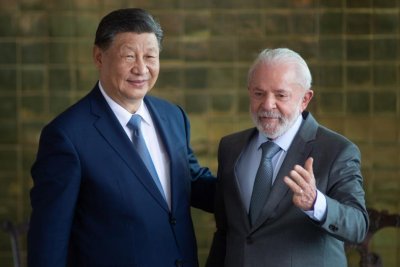

Chinese President Xi Jinping (L) and Brazilian President Luiz Inacio Lula da Silva react during a meeting in Brasilia, Brazil, in November 2024. The two leaders poke by telephone for more than an hour Monday to work on trade agreements. File Photo by Andressa Anholete/EPA
July 27 (UPI) — Brazil and China agreed Monday to speed up negotiations on a trade agreement between Mercosur and China as both countries seek to strengthen economic ties after new U.S. tariffs hit Brazilian exports.
Brazilian President Luiz Inácio Lula da Silva and Chinese President Xi Jinping spoke by telephone for more than an hour just days after the United States confirmed a 25% tariff on Brazilian exports.
Lula said on X that the two leaders reaffirmed their commitment to expanding cooperation in strategic and high-technology sectors, including artificial intelligence, satellites, critical minerals processing and fertilizer trade.
In the post, Lula highlighted the “positive results” of bilateral trade and the recent short-term visa waiver, saying the measures “will increase tourist flows and business opportunities.”
He also emphasized the need to expand cooperation in other sectors and advance negotiations on a trade agreement between Mercosur, the South American trade bloc, and China.
“I stressed that our government remains committed to diversifying markets,” Lula wrote.
The two leaders also discussed global conflicts and their impact on people’s lives, as well as global food and energy security, identifying them as key international challenges.
“While discussing the crisis in the Middle East, we agreed that restrictions on freedom of navigation through the Strait of Hormuz and the Bab el-Mandeb Strait have harmful effects on the global economy,” Lula said.
According to China’s state-run Xinhua News Agency, Xi rejected what he described as external interference in Brazil’s electoral process and expressed China’s willingness to support Lula’s government.
Xi said that under new global circumstances and challenges, China and Brazil, as leading members of the Global South, should uphold historical justice and the progress of civilization while playing a greater role in reforming and improving the global governance system and defending international fairness and justice.
According to Xi, China “highly values Brazil’s international standing and significant influence, supports the country in safeguarding its sovereignty and independence, opposes foreign interference and will contribute to maintaining regional and global peace and stability.”
Lula also said both leaders criticized the inability of the United Nations Security Council to respond effectively to current international crises and reaffirmed Brazil’s and China’s commitment to multilateralism. They agreed to maintain close coordination on international issues through forums, including the United Nations and the BRICS group.
The conversation comes as Lula has intensified his efforts to diversify Brazil’s trade relationships. In an article published Sunday in The Washington Post, he described the new U.S. tariffs on Brazilian goods as a “strategic mistake” and said Brazil would pursue alternative markets to expand investment and economic partnerships.