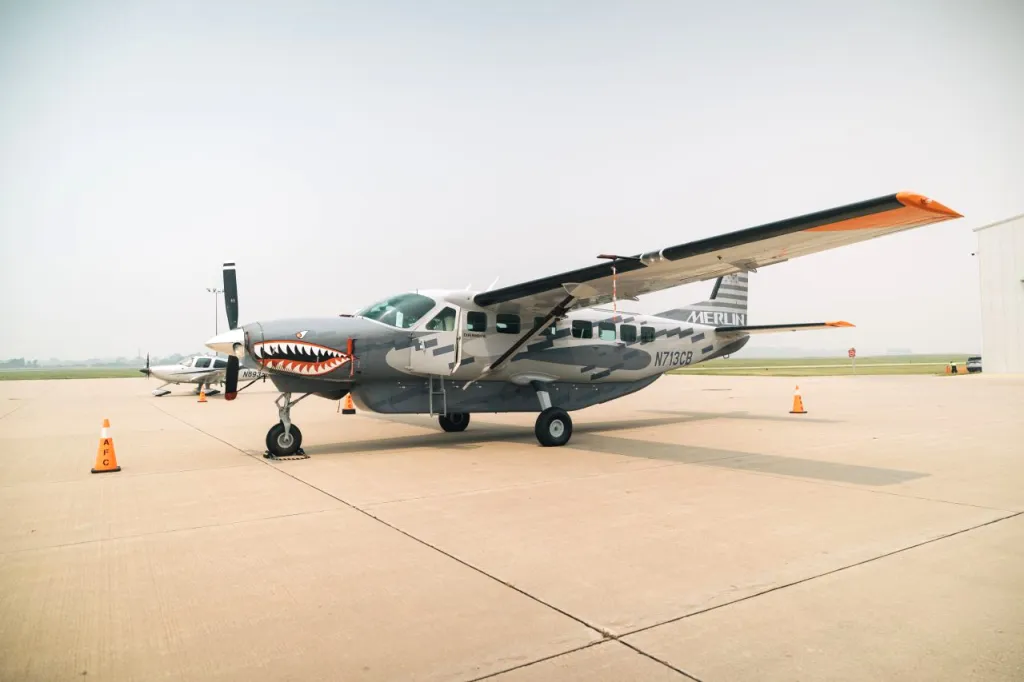
U.S. Africa Command (AFRICOM) is set to demonstrate a potential autonomous casualty evacuation (CASEVAC) capability in Morocco. The test will involve a Cessna Model 208B Grand Caravan with an artificial intelligence (AI) driven ‘copilot’ from Merlin Labs.
The ability to send out pilot-optional or even entirely uncrewed aircraft to rescue injured personnel could be extremely valuable for supporting U.S. operations in Africa. American forces on that continent are routinely deployed in remote areas where immediate access to medical care can be very limited. Autonomous CASEVAC capabilities could also be very relevant in other locales, like the Pacific, where future operations could be widely spread out across constellations of small islands.
Merlin Labs announced the planned capability demonstration today, which is being conducted under the initial phase of AFRICOM’s Autonomous Casualty Evacuation (CASEVAC) Industry Technology Challenge. The test is currently scheduled for some time in “early U.S. government fiscal year 2027.” That fiscal cycle began on October 1.

“The demonstration will encompass the full mission, from initial tasking and flight planning continuing through autonomous departure and enroute flight to an austere casualty collection site,” according to Merlin’s release. “Following simulated patient loading, the aircraft will conduct its return mission, autonomously completing the flight and landing back at the designated location.”
AFRICOM has awarded Merlin a very small $500,000 contract to support this demonstration. The company has already received millions of dollars in funding from the U.S. military for separate autonomy projects. This includes the development of autonomous capabilities for C-130-type aircraft for U.S. Special Operations Command (SOCOM) and similar efforts in support of the U.S. Air Force’s KC-135 tanker fleet. Just yesterday, Merlin announced a new deal with SOCOM, valued at $8.9 million, for continued C-130 autonomy work.
Merlin has said previously that its flagship autonomy package, called Merlin Pilot, has flown on at least four different types of aircraft already. Merlin Pilot is designed to be scalable in form and function, and can be configured to enable pilot-optional flight capability. The system can also increase safety margins during crewed flight operations by reducing task burdens (and resulting fatigue) for the humans onboard and helping alert them to potential technical faults.

Merlin Lands an Autonomous Cessna Caravan at Oshkosh AirVenture
“Merlin’s demonstration [for AFRICOM] is planned to show how Merlin Pilot can bring onboard autonomy to aircraft supporting CASEVAC missions, managing flight planning, navigation, contingency response and mission completion without relying on a remote ground station or flight crew,” the release adds. “The system is designed to plan the optimal route from an operator’s tasking, replan dynamically around hazards, communicate with air traffic control using natural language processing, and continue safely along its authorized plan if a communications link is lost.”
The Grand Caravan’s “large cargo door and flat-floor cabin will allow ground level litter loading without rotor wash, winching or special equipment, and its cabin will be configured with an air ambulance medical module providing oxygen, power, and mounting for patient monitoring equipment,” the release also notes. “Merlin believes there is a clear follow-on path to operational scale using a [Beechcraft] King Air variant, which would provide twin-engine redundancy, greater payload capacity, and additional cabin space for multiple litter patients, medical equipment, and an in-flight attendant. The same architecture could also support autonomous logistics and personnel movement across dispersed operating locations.”

As already mentioned, the use case for autonomous CASEVAC capabilities to support U.S. operations in Africa is clear-cut. The scale and scope of AFRICOM operations means that American forces are often dispersed in small groups at far-flung operating locations far from higher-level medical care. Options for getting individuals to a hospital, even after accidents in relatively low-risk areas, can be extremely limited. Medical professionals often talk about the so-called “golden hour,” which refers to the first 60 minutes after a serious injury occurs. The chances of saving that person’s life or otherwise preventing serious permanent damage are highest within that window.
“AFRICOM’s area of responsibility spans vast distances, and security threats can prevent access to nearby medical facilities, often forcing longer and more dangerous patient transport. In these conditions, transporting a wounded noncombatant or service member to medical care is both time-critical and logistically complex,” Merlin says in its release. “Conventional casualty evacuation relies on crewed aircraft, while remotely piloted systems require persistent command-and-control links that may be unavailable in austere or contested environments. The challenge set forth by AFRICOM seeks autonomous solutions that can accelerate access to a higher level of care while reducing the number of personnel exposed to risk.”
This was all rammed home in a very public fashion nearly a decade ago by the infamous ambush of American forces near Tongo Tongo in Niger, in which four U.S. Army soldiers died. The only immediate aerial CASEVAC support available in that instance was provided by contractors operating from the Nigerien capital Niamey more than 100 miles away.

Issues relating to ready access to higher-level medical care, as well as contested logistics chains, together with what is commonly referred to as the ‘‘tyranny of distance,’ are not limited to U.S. operations in Africa. Any high-end fight against China in the Pacific could easily see American forces spread across very broad areas, with established facilities of any kind being few and far between.
Furthermore, the U.S. Marine Corps and the U.S. Air Force, in particular, are envisioning future operations in that region being conducted in a highly distributed manner utilizing austere forward operating locations to create targeting complications for the enemy. The war with Iran has only underscored the kinds of threats and logistics challenges U.S. forces should expect to be faced with in an even larger-scale conflict in the Pacific.
With all this in mind, the U.S. Air Force has already been experimenting with Cessna Grand Caravans with semi-autonomous capabilities as a path to new distributed logistics capabilities, including in the Pacific.

demonstration of autonomous flight capabilities in AGILE FLAG 24-1
As noted earlier on, Merlin, specifically, has been working for years now to demonstrate new degrees of autonomy in other existing U.S. aircraft. In September, Merlin and Textron (which owns the Cessna brand) also announced a new partnership to develop a cargo-carrying drone derived from the Cessna 408 SkyCourier.

Introducing SkyCourier UX
All that being said, the planned AFRICOM autonomous CASEVAC demonstration, and the paltry amount of funding put toward it, highlights how the U.S. military has been lagging behind in this arena.
China, especially, has been surging forward in the development of fully uncrewed logistics aircraft, which could be adapted for aeromedical and other missions in the future. Several Chinese cargo drone designs are flying now, including types that are significantly larger and more capable than a Cessna Grand Caravan. China’s People’s Liberation Army (PLA) would be faced with its own logistical and other challenges in any future conflict in the Pacific region.

China’s New 7-Ton Cargo Drone Completes Maiden Flight

China’s unmanned transport aircraft completes maiden test flight
In recent months, Ukraine has also demonstrated uncrewed CASEVAC capabilities in support of real combat operations using large multi-rotor drones. The U.S. military has explored broadly similar platforms in the past. However, these uncrewed aerial systems are designed for much more localized operations compared to what AFRICOM is now looking to demonstrate in Morocco.

МИ ЕВАКУЮВАЛИ ДВОХ ПОРАНЕНИХ ДРОНОМ STARGATE
The outcome of the upcoming demonstration of the Merlin Pilot-equipped Cessna Caravan could help spur further interest within the U.S. military in new autonomous aerial CASEVAC and logistics platform. At the same time, it shows U.S. military efforts to pursue these capabilities remain limited despite the clear use cases already being made by America’s chief global competitor China.
Contact the author: joe@twz.com