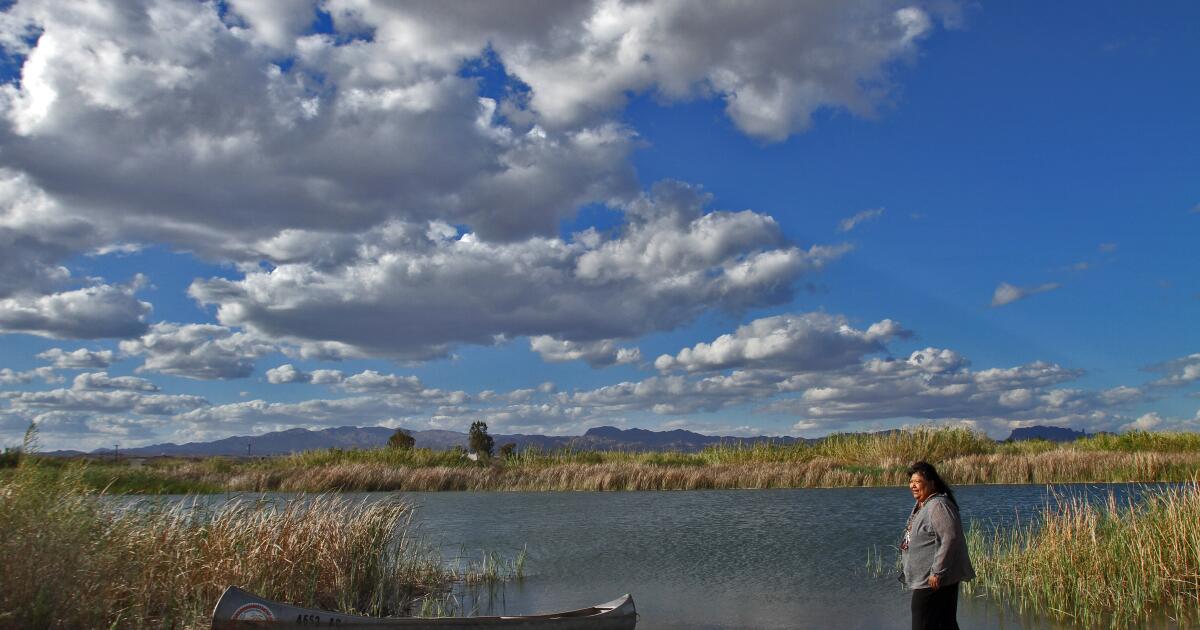
As I’ve followed the long-running negotiations over the Colorado River the last couple of years, very little progress has been made in transforming the century-old system of managing the river’s dwindling water. The Colorado’s giant reservoirs have dropped because of heavy water use and a quarter-century of drought, worsened by climate change, yet seven Western states have remained deadlocked on how to take less water and live within the river’s limits.
In the last month, though, leaders of a tribal nation on the California-Arizona border offered a concept that might help transform the discussions — or at least ensure that the health of the river itself isn’t completely ignored.
The Tribal Council of the Colorado River Indian Tribes decided to recognize the river as a legal person under tribal law. It’s the second time a Native tribe has declared legal personhood for a river in the United States. The Yurok Tribe in Northern California in 2019 declared the Klamath River a legal person.
I was interested to learn more about why the leaders of the Colorado River Indian Tribes, or CRIT, wanted to take this step, and Chairwoman Amelia Flores agreed to talk with me.
She said they reached the decision after discussing the idea for a year, holding community meetings to hear input from the more than 4,000 tribal members.
“It just reaffirms what our tribal members already know and what we believe,” Flores said. “This river is alive, and has taken care of us for many, many, many years.”
“This river is a part of us,” she added. “It’s who we are.”
When Flores was growing up in the 1950s and ‘60s, she and her family swam, fished and camped at the river on summer weekends.
The reservation, established in 1865, encompasses nearly 300,000 acres straddling the river in Arizona and California, a patchwork of lush farm fields across a wide plain bordered by desert mountains.
The Mojave people, one of the tribes that make up CRIT, have lived along the river for thousands of years. Their traditional name is Aha Makav, meaning the People of the River.
Flores noted it’s a central part of their creation story, and features prominently in traditional songs.
“We always say we’re stewards of the river from our Creator, who gave us our resources, our land and our water,” she said.
“It’s ingrained in us by our ancestors to protect the river,” she said. “And we carry that on from one generation to the next.”
In the Colorado River Basin, there are 30 tribal nations. They have rights to roughly one-fourth of the river water. Indigenous leaders have long been largely excluded from the states’ negotiations, but tribes have volunteered to take part in previous water conservation deals.
CRIT and other tribes have said they are willing to help reduce water use as the states try to hash out a plan to keep reservoirs from falling to critically low levels.
The personhood decision was to “acknowledge that the river itself has needs,” said John Bezdek, a water attorney for CRIT, and to affirm tribal leaders’ commitment to addressing those needs.
The river ecosystem has been largely an afterthought in talks about managing its water. For decades, so much water has been taken out for farms and cities that the river has seldom met the sea.
The decision means that future leaders will have to account for the river’s welfare when, for example, they agree to lease out some of the reservation’s water, Bezdek said.
Flores said she knows of at least two other tribes that are interested in taking the same step. The more that follow suit, she said, “the better it’s going to be in protecting the river.”
More recent water news
For more about the personhood decision, read this great article by Debra Utacia Krol of the Arizona Republic. Alex Hager of the public radio station KUNC also visited the reservation for a story earlier this year. Tribal Chairwoman Amelia Flores wrote in an op-ed in the Republic that she and others see a sacred obligation to protect the river ecosystem “at a time when, more than ever, it is needed.”
A year after the removal of four dams on the Klamath River, salmon can once again reach spawning habitats far upriver near the California-Oregon border. Michael Harris, an environmental program manager for the California Department of Fish and Wildlife, said “there are salmon everywhere” and their quick reappearance in their ancestral habitats is “both remarkable and thrilling.” Barry McCovey Jr., fisheries director for the Yurok Tribe, said he was also surprised by how quickly the salmon returned. “I don’t think anyone really expected how well the fish would respond to dam removal.”
The Trump administration recently notified California agencies that it plans to weaken environmental protections and pump more water out of the Sacramento-San Joaquin River Delta into the southbound aqueducts of the Central Valley Project. The proposal has drawn strong opposition from Gov. Gavin Newsom’s administration, as shown in letters to the federal government. I wrote about the debate over the plan, which state officials warn would threaten native fish and could reduce water to millions of Southern Californians.
More climate and environment news
President Trump announced a proposal this week to weaken vehicle mileage rules for the auto industry that limit air pollution. My L.A. Times colleagues Tony Briscoe and Hayley Smith report that the plan is expected to be finalized next year and would significantly reduce fuel efficiency standards for new vehicles in model year 2031. Trump said the government is terminating what he called “ridiculously burdensome, horrible” standards. Gov. Gavin Newsom said the president is helping his “Big Oil campaign donors” and it will “poison our air.”
A California environmental oversight board has taken another step toward improving how it deals with hazardous waste. But Briscoe reports for The Times that environmental groups fear the plan could weaken protections by potentially redefining what counts as hazardous.
Searching for economical strategies to prevent wildfires, power utilities are working with a handful of artificial intelligence startups to map fire risks along thousands of miles of power lines. Lauren Rosenthal and Joe Wertz report for Bloomberg that utilities including PG&E are contracting AI startups to analyze satellite images and identify where trees are most likely to topple onto power lines and spark fires, enabling them to select individual trees to cut and poles to replace.
This is the latest edition of Boiling Point, a newsletter about climate change and the environment in the American West. Sign up here to get it in your inbox. And listen to our Boiling Point podcast here.
For more water and climate news, follow Ian James @ianjames.bsky.social on Bluesky and @ByIanJames on X.