tribe

Trump is taking longer to approve disaster aid and denying Democratic states more frequently

When major disasters strike, Americans are routinely waiting weeks — or even months — to receive presidential approval for aid. And if they live in a state that didn’t support President Trump, chances are greater that aid will be denied.

Since taking office last year, Trump has approved about 65 requests for major disaster declarations and denied more than two dozen others from states, tribes or territories seeking federal financial assistance following hurricanes, tornadoes, storms, floods and fires.

Trump has taken longer on average to approve disaster requests than any other president, according to an Associated Press analysis of data dating back to 1989, when a federal law setting new parameters for disaster determinations was implemented. And no other president has such a disparity in denials between states that supported him politically and those that did not.

The delays and denials come as Trump’s administration contemplates a makeover of the Federal Emergency Management Agency, which administers disaster aid. Major disaster declarations are intended for events that are beyond the resources of state and local governments.

Trump is saying yes to Republicans more than Democrats

During his second term, Trump has denied a greater percentage of disaster requests than any president dating to 1989. Those denials have not been evenly distributed among states.

Trump has approved 80% of the disaster requests from Republican governors but only about 60% from Democratic governors, according to the AP’s analysis of FEMA data.

The discrepancy is even more apparent when analyzing major disaster declarations based on presidential elections. Trump has approved more than three-fourths of the requests from states that voted for him in the 2024 election but less than half the requests from states that did not. Although there are federal criteria for disaster aid, decisions ultimately are at the president’s discretion.

A batch of denials earlier this month included four Democratic states — Massachusetts, New Jersey, New York and Rhode Island — seeking federal aid for a February snowstorm.

“The President’s denial is part of a pattern of extreme partisanship as he tries to shift a heavier economic burden onto blue states. Disaster aid should be merit-based, not politicized,” Rhode Island’s Democratic U.S. Senate and House members said in a joint statement.

White House spokesperson Abigail Jackson said in a statement that “there is no politicization to the President’s decisions on disaster relief.”

During his first term, Trump actually approved a greater share of requests from states that had opposed him than those that supported him.

Yet no other president had such a wide partisan divide in disaster declarations as currently exists under Trump. Obama approved 87% of the disaster requests from Democratic governors during his second term and 79% from Republican governors, but Obama’s approval rate was identical for states that voted for and against him.

When requests are denied, individuals, insurers and local governments are left to shoulder the costs themselves.

Trump is waiting longer to declare disasters

Since Trump assumed office last year, it’s taken him an average of a month and a half to approve major disaster declarations after receiving a request from the governor or chief executive of a state, territory or tribe, the AP found. Because it can take several weeks after a disaster for officials to inspect the damage and submit a request, the total wait time often has exceeded two months.

By comparison, Trump approved major disaster requests in an average of about three weeks during his first term, a pace similar to President Joe Biden. Their predecessors — Presidents Barack Obama, George W. Bush, Clinton and George H.W. Bush — all had average disaster approval times of less than two weeks.

All presidents have taken longer to approve some requests. But that’s become the norm in Trump’s second term. Of Trump’s approvals, 70% have taken at least a month — up from about one-quarter of requests during Trump’s first term and Biden’s administration, and fewer than 10% under their predecessors.

Jackson said that Trump conducts a more thorough review than any administration before him, “ensuring American tax dollars are used appropriately and efficiently by the states to supplement — not substitute — their obligation to respond to and recover from disasters.”

The longer the approval process takes, the longer people must wait to receive federal aid for daily living expenses, temporary lodging and home repairs. Delays in major disaster declarations also can hamper recovery efforts by local officials uncertain whether they will receive federal reimbursement for cleaning up debris and rebuilding infrastructure.

FEMA nominee is pledging faster decisions

FEMA has had four different temporary leaders since Trump took office in January 2025. One of those, Cameron Hamilton, is awaiting Senate confirmation as the agency’s permanent director.

During a Senate committee hearing last month, Hamilton said he would try to speed up disaster declaration decisions and reimbursements. He also pledged to ensure that FEMA is objective, fair and reasonable in reviewing disaster declaration requests and making recommendations to the president.

Hamilton, a former Navy SEAL, had been fired as FEMA’s acting director in May 2025 after publicly disagreeing with Trump’s idea of dismantling the agency. His reemergence signals that Trump now may support changes to FEMA instead of an outright elimination of the agency.

Panel’s recommendations could lead to more denials

A council appointed by Trump has recommended a series of changes to FEMA that would shift greater responsibility to states, potentially reducing the number of major disaster declarations and the amount of federal money paid out.

The council suggested revised criteria to qualify for presidential declarations, including a prerequisite of annual minimum expenditures by states, territories and tribes.

Another recommendation, which would require congressional approval, would reduce the federal government’s share of the disaster aid from a minimum of 75% to 50% of the costs, leaving state and local governments more to cover. For governments approved for assistance, federal funding could get there quicker — within 30 days of a federal disaster declaration, instead of waiting months or years for reimbursements that are based on proof of expenditures.

For individuals, the council recommended consolidating several different types of aid into one payment targeted for those whose homes are uninhabitable.

Lieb and Wildeman write for the Associated Press.

Source link

Asa Tribe: Glamorgan batter staking England claim with Lions share

If Tribe does realise his ambition and become the first Glamorgan player since Simon Jones in 2005 to play for England, it will have come off the back of a willingness to pack his bags and head for wherever there were opportunities to play and improve.

He had never played a game outside of Jersey until he left the island to study in Cardiff when he was 18, but joined Glamorgan on a rookie contract in 2023 before signing an improved deal last year.

Since then, his travels have taken Tribe to the National Cricket League in Texas, a stint in Adelaide playing Grade cricket, then onto a Nepalese T20 competition, before he was picked up by Paarl Royals to play in the South African T20 tournament last winter – as well as getting a deal to play grade cricket in Australia.

His stint with Paarl Royals in particular is bearing fruit, with Tribe having been able to tweak his technique ahead of this tour in South Africa.

“I have made a couple of technical changes and they have served me well here,” he said.

“I am now more side on and added a little trigger in there and made sure I have added a few other shots.

“So if the lads are missing slightly short on the off-side I can still punch that, and I’m trying to narrow the margin for error on the bowler’s side.

“My movement is a bit more precise and accurate as well.

“It has given me the ability to know what their bowlers do with the ball.

“It has definitely helped me against their skilful bowlers and has given me a clue on what they do.

“The reason we have this type of cricket where we play against the second team of other countries is that it is going to be a better standard that what we potentially face in the County Championship.

“In the Championship you talk about slightly slower bowling whereas on this wicket it has had more pace and bounce. It is different challenges.

“I like the idea we get the opportunity to play in these because if you are then exposed to Test cricket then it will be faster.”

Whether Tribe is on the fast track to an England cap remains to be seen, but the already much-travelled young player continues to do all he can to make his dream a reality.

Source link

Border wall construction is desecrating sacred Indigenous sites

White sage burning, Norma Meza Calles gathers guests at a Mexican wellness resort into a semicircle facing Kuuchamaa Mountain and asks everyone to close their eyes and feel its presence.

“This is sacred to us like a church for you all. The mountain is our healer, our psychologist,” said Meza Calles, a Kumeyaay Nation tribal leader who explains that in its creation story a shaman transformed into the mountain. “Here is where we gather strength to live in this difficult world.”

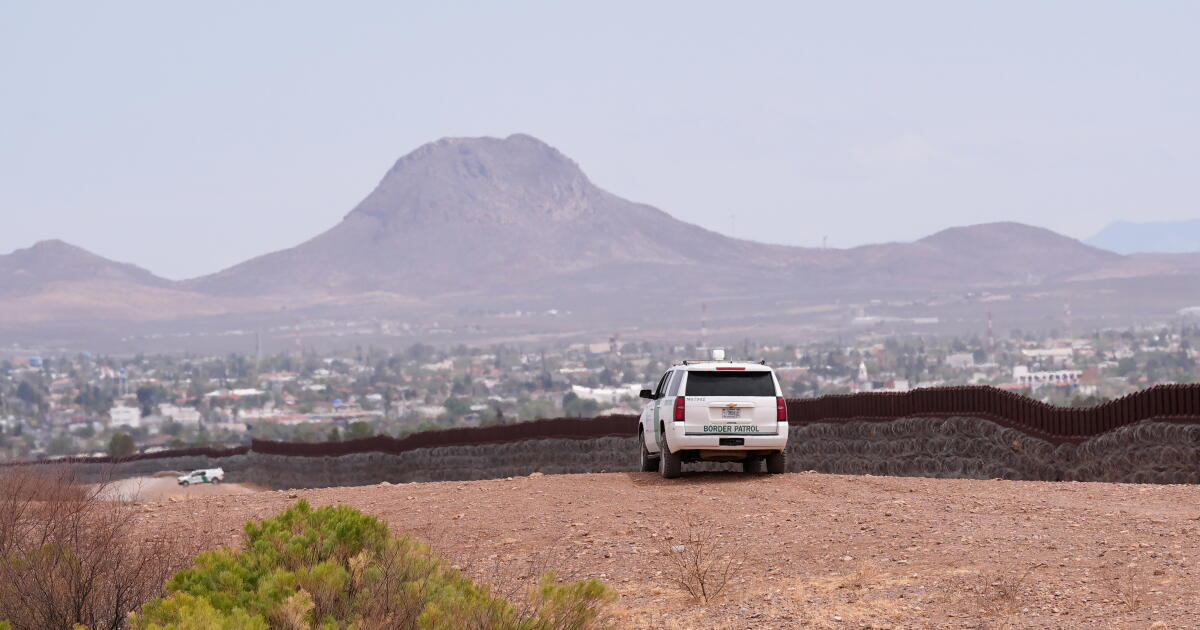
Then she calls for a moment of reflection. But the silence is pierced by the crushing of rock. U.S. federal contractors have been blasting and bulldozing Kuuchamaa, which straddles the U.S.-Mexico frontier, to make way for new sections of border wall.

Indigenous leaders say that in the Trump administration’s rush to build border wall segments, contractors are desecrating Native American sacred places and cultural sites at an unprecedented pace, more than 170 years after the international boundary split the territories of dozens of tribes.

Blasts on sacred mountain

Wall construction has ramped up along the 1,954-mile border even as illegal crossings have plummeted to historic lows. Much of it began this year after the U.S. Department of Homeland Security waived cultural and environmental laws.

In California, explosions on Kuuchamaa, also known as Tecate Peak, send rocks hurtling down its Mexico side.

“We feel that in our DNA,” said Emily Burgueno, a California member of the Kumeyaay Nation, noting that “body” and “land” are the same word in the Kumeyaay language. Some tribal leaders met with Homeland Security officials to urge them to protect Kuuchamaa and are looking into legal action.

“No one ever consented or supported the use of dynamite on the mountain,” Burgueno said.

The nation consists of more than a dozen tribes in California and Mexico’s Baja California. The Kumeyaay have been working to block construction of the border wall since Trump’s first term.

In Arizona, Homeland Security contractors last month carved through a massive, 1,000-year-old fish-shaped geoglyph called Las Playas Intaglio. The rare drawing, etched into the desert floor much like Peru’s Nazca Lines, was created on a lava field in what is now the Cabeza Prieta National Wildlife Refuge.

Construction crews work on a new border wall segment on a steep slope.

Construction crews work April 24 on a new border wall segment near the end of a previously built section on Kuuchamaa Mountain, seen from Tecate, Mexico.

(Gregory Bull / Associated Press)

The Tohono O’odham Nation said it had pointed out the site on its ancestral land for contractors to avoid.

“This was a devastating and entirely avoidable loss,” Tohono O’odham Chairman Verlon Jose said in an April 30 statement. “There is nothing more important than our history, which is what makes us who we are as O’odham. The site was also an irreplaceable piece of the United States’ history, one none of us can ever get back.”

U.S. Customs and Border Protection said in a statement that a contractor “inadvertently disturbed” the site west of Ajo, Ariz., on April 23, but it vowed to protect the remaining portion. CBP Commissioner Rodney Scott is talking to tribal leaders to determine next steps.

Members of the Inter-Tribal Assn. of Arizona, which represents 21 tribes, traveled to Washington last month to lobby against a 20-foot secondary wall being built along that section of the border, as well as a primary 30-foot bollard wall planned on Tohono O’odham tribal lands.

They met with Homeland Security Secretary Markwayne Mullin, a Cherokee Nation member, who listened but made clear his intent is to build more border wall as fast as possible, the Tohono O’odham Nation said in a statement.

Hundreds of miles under contract

The Trump administration says the barriers are necessary to keep people and drugs from entering the U.S. illegally. It wants walls to cover at least 1,400 miles of the border.

Trump’s One Big Beautiful Bill Act last year devoted more than $46 billion to the effort.

CBP has awarded contracts or begun construction on over 600 miles of new border wall, with companion surveillance technology. A double wall is planned or under construction along an additional 370 miles.

In Arizona, where the Patagonia Mountains descend to the border, heavy machinery crawls along freshly graded roads to extend a double wall that could block a wildlife corridor for endangered ocelots and jaguars. Jaguars have long coexisted with the Tohono O’odham, who consider the species “spiritual guardians,” Austin Nunez, a tribal leader, said in a 2025 lawsuit that unsuccessfully challenged the Homeland Security waivers.

In Sunland Park, on New Mexico’s border with Mexico, crews this year set off blasts on Mt. Cristo Rey, a pilgrimage site topped with a limestone crucifix.

CBP is seeking to seize a strip of the mountain owned by the Roman Catholic Church for wall construction. The Diocese of Las Cruces asked a judge this month to deny the land transfer as an affront to religious liberties and the “faithful who seek to commune with God on Mount Cristo Rey.”

In western Texas, the federal government in February notified ranchers on the Rio Grande east of Big Bend National Park of its interest in their land that contains canyonland pictographs and petroglyphs, said Raymond Skiles, a retired Big Bend National Park ranger.

“There are pictographs, paintings of shaman figures and various things that we don’t know how to interpret,” said Skiles, describing the drawings on his family’s ranchlands.

After community backlash, CBP’s online planning map showed the 30-foot-wall plans were scrapped for surveillance technology, patrols and some vehicle barriers. A segment in the national park and neighboring Big Bend Ranch State Park would rely on technology alone.

CBP says it recognizes the importance of natural and cultural resources and is working to minimize the construction’s impact, including leaving drainage gates open in wildlife corridors for animal passage. Illegal border crossings have littered, polluted and trampled sensitive habitat, the agency says.

CBP also says 535 miles of remote, rugged border terrain will solely rely on detection technology.

Many tribes would prefer that to walls.

Norma Meza Calles, a Kumeyaay Nation leader, touches a branch.

Norma Meza Calles, a Kumeyaay Nation leader, leads a guided tour of traditional Kumeyaay uses for local plants at a wellness center in Tecate, Mexico.

(Gregory Bull / Associated Press)

Desecrating Native American sites is a felony

Tribes along the border “are all experiencing the same tragic desecration of our cultural and sacred sites,” said Burgueno, chair of the Kumeyaay Diegueño Land Conservancy, a nonprofit organization in California that works to protect Kumeyaay lands. “This is a great example of the federal government not following federal laws.”

Desecrating a sacred Native American site on U.S. federal or tribal land is a felony, punishable by imprisonment and fines. In 1992, the National Park Service listed Kuuchamaa Mountain in the National Register of Historic Places, giving it limited protection. It noted that “discarding or disturbing the mountain’s natural state would be sacrilegious.”

Rising 3,885 feet above sea level, Kuuchamaa has also captivated non-Native people.

Sarah Livia Brightwood Szekely said her father, Edmond Szekely, felt the mountain’s healing energy when he arrived in Tecate, Mexico, as a Hungarian Jewish refugee during World War II, and started the renowned wellness resort, Rancho La Puerta, which she now runs.

“There are all of these people that have a deep relationship with the mountain,” she said.

Meza Calles leads walks at Rancho La Puerta to teach guests about Kuuchamaa.

Traditionally, young men would spend 40 days at its base in a coming-of-age ceremony before becoming warriors or shamans, she said. Today’s rituals are shorter. People suffering from a death, debt, divorce or other difficulty seek Kuuchamaa’s healing, she said.

“It’s sad they are ruining the mountain,” she said. “We’ll see how far they go. Destiny is destiny. But the fight is not over.”

Watson and Lee write for the Associated Press and reported from Tecate and Santa Fe, N.M., respectively.

Source link