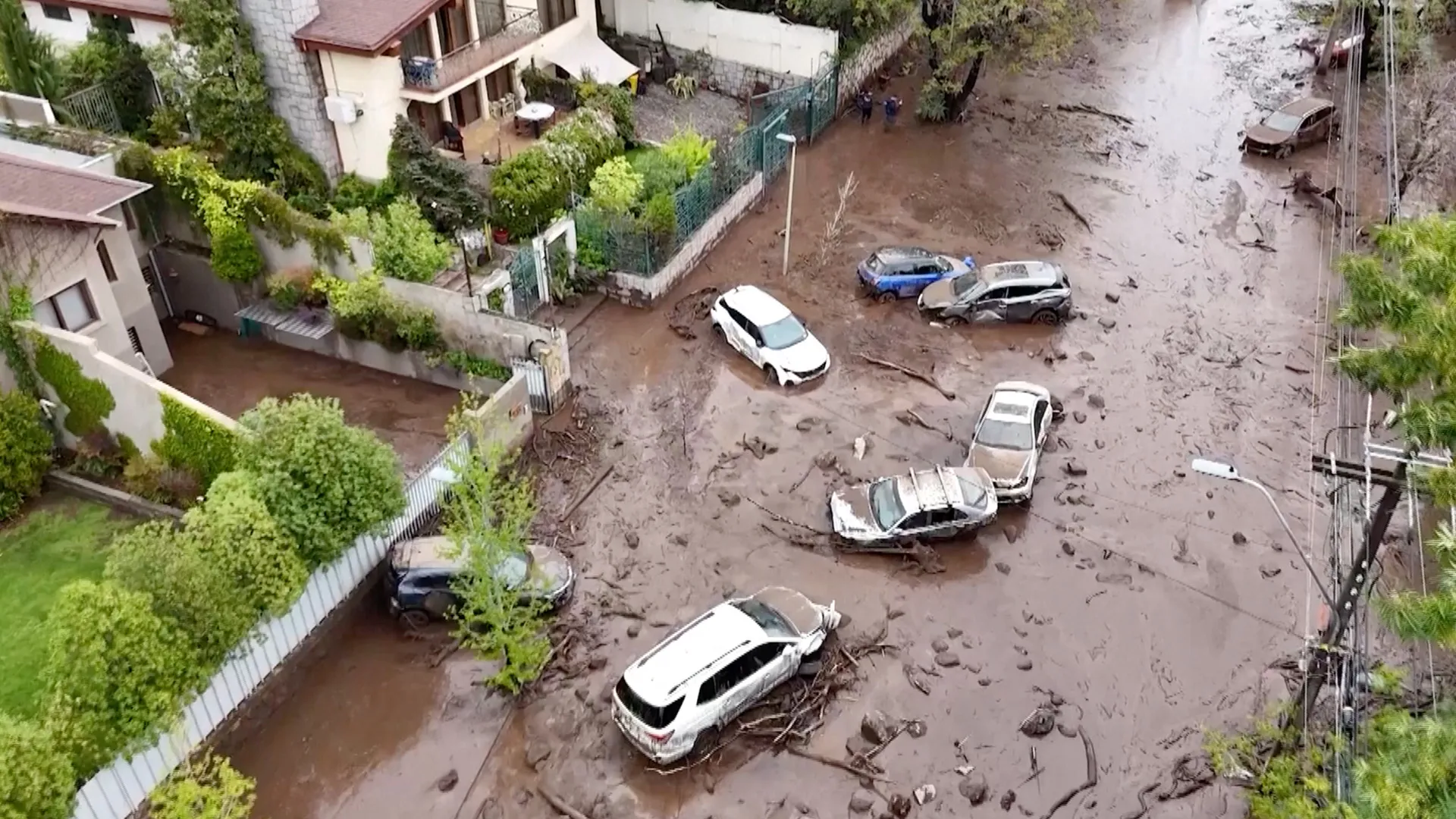
Bolivia’s president announces a state of emergency after weeks of nationwide protests and road blockades crippled the country’s economy. Protesters are demanding fuel subsidies be reinstated and increased funding for education.
June 3 (UPI) — Almost six months after NASA lost contact with the spacecraft, the agency has declared the Mars Atmosphere and Volatile Environment satellite unrecoverable and its mission concluded.
NASA’s Deep Space Network (radio antennas that connect Earth with spacecraft) last received a transmission from the MAVEN satellite on Dec. 6, just before its orbit passed behind Mars. When it emerged, communications did not resume, NASA said. The cause of this lapse was under investigation, but the agency said the satellite was rotating at an usually high rate, leading to drained batteries.
The MAVEN mission was the first successful one dedicated to observing Mars’ atmosphere and its evolution. It orbited the planet for more than 11 years, far longer than its planned one-year lifespan.
NASA hosted a media teleconference Wednesday about the end of the mission and issued a statement.
“The MAVEN mission has truly advanced our understanding of the Martian atmosphere and evolution,” said Shannon Curry, MAVEN principal investigator and a professor at the Laboratory for Atmospheric and Space Physics at the University of Colorado Boulder. “This dataset has had a tremendous impact onthe field. Our science team is exceptionally proud of all of these amazing discoveries.”
The mission launched in November 2013 on an Atlas V rocket from Cape Canaveral, Fla., and arrived in Mars orbit 10 months later, Space.com reported.
During its mission, MAVEN provided information about Mars’ atmosphere and how it became the planet it is today, changing from a planet with a more Earth-like atmosphere that could host liquid water on the surface. It discovered new types of auroras across the planet and studied Mars’ dust storms.
MAVEN also played a key role as a communications link to the Curiosity and Persistence rovers on Mars. The Mars Odyssey and Mars Reconnaissance Orbiter spacecraft remain in operation to play that role.
“The science MAVEN has given us is key to informing what kind of radiation protection and safety measures we must take before sending humans to Mars,” said Louise Prockter, director of the planetary science division at NASA. “The data collected from MAVEN will continue to provide valuable insight into Mars for decades to come.”
The Mars Atmosphere and Volatile Evolution Mission (MAVEN) spacecraft undergoes final preparations at the Kennedy Space Center, Florida on September 27, 2013. MAVEN will be launched by a Atlas 5 rocket currently scheduled for a November 18, 2013 lift off. The Lockheed Martin spacecraft will orbit the planet Mars for one year after completing a ten month journey through space. The mission is to explore how the sun has effected Mars upper atmosphere and ionosphere. UPI/Joe Marino-Bill Cantrell | License Photo
“Ships caught in the Strait due to our amazing and unprecedented Naval Blockade, which will now be lifted, may start the process of ‘heading home!’” Trump proclaimed on Truth Social, referring to the Strait of Hormuz. The strategic chokepoint has been largely closed to most traffic by Iran since not long after the launch of Epic Fury on Feb. 28.
Trump’s comments may reflect a still unsigned Memorandum of Agreement with Iran that paves the way for reopening the Strait and is designed to create negotiating space to deal with the larger issues of Iran’s nuclear ambitions.
“Iran must agree that they will never have a Nuclear Weapon or Bomb,” the U.S. leader added. “The Hormuz Strait must be immediately open, no tolls, for unrestricted shipping traffic, in both directions. All water mines (bombs), if any, will be terminated (we have removed, through detonation, numerous such mines with our great underwater mine sweepers. Iran will complete the immediate removal and/or detonation of any mines that are left, which will not be many!).”
Last month, the head of U.S. Central Command stated that he was deploying uncrewed underwater vehicles (UUVs) to the region for the counter-mine effort. UUVs are a critical part of modern minesweeping operations.
“The Strait of Hormuz is an international sea passage and an essential trade corridor that supports regional and global economic prosperity,” Admiral Brad Cooper said in an April 11 media release. “Additional U.S. forces, including underwater drones, will join the clearance effort in the coming days.”
The Navy has various types of uncrewed undersea vehicles, remotely operated vehicles and an airborne mine neutralization system to perform mine sweeping operations. You can read more about these systems and how they work in our story about minesweepers here.
Trump ordered the blockade on April 13 to create economic pressure on Iran by limiting its ability to export oil or import needed weapons or other materiel.
“As of May 29, 115 commercial vessels have been redirected to ensure no commerce enters or leaves Iranian ports,” CENTCOM said in a post Friday morning about an hour before Trump made his announcement about the blockade.
U.S. forces continue to enforce the blockade against Iran. As of May 29, 115 commercial vessels have been redirected to ensure no commerce enters or leaves Iranian ports. pic.twitter.com/ioKe4A6p7T
Trump did not spell out the mechanics for ending the blockade and CENTCOM declined to say what Trump’s announcement means for the assets arrayed around the region to enforce it. The command referred us to the White House, which did not immediately respond to a request for comment.
It is also unclear why Trump would lift the blockade at such a critical time, before any agreement is signed. According to various media reports, such a move would have been in conjunction with Iran easing its restrictions on Strait shipping. However, Iranian officials have insisted that has yet to happen. In essence, the U.S. lifting the blockade on Iran would do nothing for mariners trapped in the Persian Gulf unless Iran also lifts its threats to attack ships transiting the waterway without its permission.
According to Axios, the memorandum between Iran and the U.S. calls for the following:
The U.S. naval blockade will also be lifted, but that will happen in proportion to the restoration of commercial shipping, a U.S. official said. The U.S. would also issue some sanctions waivers to allow Iran to sell oil freely.
The MOU will include an Iranian commitment not to pursue a nuclear weapon, the officials said. It will also state that the first issues to be negotiated during the 60-day window will be how to dispose of Iran’s highly enriched uranium and how to address Iranian enrichment.
The U.S. will commit to discuss sanctions relief and the release of frozen Iranian funds as part of the negotiations, the publication added.
The MOU will also include a discussion of a mechanism to help Iran start receiving goods and humanitarian aid.
The MOU would also state that the war between Israel and Hezbollah in Lebanon would end — an issue on which Trump and Israeli Prime Minister Benjamin Netanyahu have had at least one tense discussion.
In addition to stating that he lifted the blockade, Trump also claimed in his Truth Social post that the U.S. and Iran reached an understanding on Tehran’s supply of highly enriched uranium.
“The enriched material, sometimes referred to as ‘Nuclear Dust,’ which is buried deep underground with virtually collapsed mountains, caused by our powerful B2 Bomber attack 11 months ago, sitting on top of it, will be unearthed by the United States (which, it is agreed, is the only Country, along with China, with the mechanical capability of doing so!), in close coordination and conjunction with the Islamic Republic of Iran, plus the International Atomic Energy Agency, and DESTROYED. No money will be exchanged, until further notice,” Trump asserted. “Other items, of far less importance, have been agreed to.”
Iranian officials have rejected Trump’s claims.
“No final understanding has been reached between Iran and the US so far,” according to the Islamic Revolutionary Guard Corps (IRGC)-connectedTasnim News Agency.
“Trump’s post follows his usual pattern of one-sided, self-aggrandizing statements,” the outlet added. “His claims about lifting the naval blockade should be viewed with skepticism—and even if implemented, it would merely mark the cessation of one ceasefire violation, as the blockade should never have been imposed in the first place.”
“Trump’s nuclear claims are baseless, as no details on that issue have been discussed,” Tasnim posited. “His insistence on not releasing Iran’s blocked funds only deepens Tehran’s doubts about Washington’s seriousness.”
No final understanding has been reached between Iran and the US so far, according to Tasnim News Agency.
According to the report, Trump’s post follows his usual pattern of one-sided, self-aggrandizing statements. pic.twitter.com/bRDZfjGT7K
In his post, Trump said that he “will be meeting now, in the Situation Room, to make a final determination,” on the agreement with Iran.
This is a developing story.
UPDATE: 2:36 PM EDT –
Trump “left a two-hour meeting on a possible deal with Iran without making a decision,” The New York Times reported, citing a senior administration official.
The administration “believes it is close to an agreement but there are still certain matters being debated including the unfreezing of funds for the Iranians,” the newspaper added.
NYT: “President Trump’s meeting in the Situation Room lasted about two hours, but the president did not reach a decision on any new deal with #Iran, according to a senior administration official who spoke on condition of anonymity to speak about internal deliberations.
In the wake of Trump’s claims and media reports about negotiations with Iran, some positive economic news is emerging
“Stocks rose in afternoon trading on Wall Street Friday, adding to the all-time highs they set a day earlier,” CBS News reported. “The S&P 500 rose 0.2% Friday. The index is coming off six gains in a row and is headed for a ninth straight winning week, which would be the longest such streak since 2023.”
The Dow Jones Industrial Average “rose 382 points, or 0.8%, as of 12:01 p.m. Eastern,” the outlet added. “The Nasdaq composite rose 0.2%. Every major index is on track for records and to close out May with solid gains.”
Of course, all that could change should talks break down and major hostilities resume.
“U.S. stock markets are surging toward new records as of May 29, 2026, driven by breakthrough reports of a potential $300 billion peace and reconstruction framework between the U.S. and Iran”
The United Arab Emirates “carried out dozens of airstrikes against Iran beginning in the early days of the war and continuing through the day after the April cease-fire was announced,” The Wall Street Journal reported, citing people familiar with the matter. This represents a “deeper involvement than was previously known in the air campaign led by the U.S. and Israel,” the publication added.
The attacks were conducted in coordination with the U.S. and Israel, both of which provided intelligence, the people said. “They included targets on Qeshm and Abu Musa islands in the Strait of Hormuz; Bandar Abbas; the oil refinery on Lavan island in the Persian Gulf; and the Asaluyeh petrochemical complex” the Journal continued.
During the Iran War, the United Arab Emirates (UAE) carried out dozens of airstrikes against Iran in coordination with Israel and the United States, beginning in the early days of the war and continuing through the day after the ongoing ceasefire was announced, targeting both… pic.twitter.com/FvyIYVw2qk
Iranian Parliament Speaker Mohammad Bagher Ghalibaf says “Tehran secures its diplomatic advantages through missiles rather than talks,” according to the official Iranian Press TV news outlet.
Medical workers check temperatures at the Mpondwe border point with DR Congo, near Bwera, Uganda, on May 9, 2019. File Photo courtesy the WHO
May 17 (UPI) — The World Health Organization has declared a public health emergency of international concern in reaction to an Ebola outbreak in Uganda and the Democratic Republican of the Congo.
Health officials believe the disease, also known Ebola hemorrahagic fever, has killed dozens of people in the two countries in recent days. In the DRC’s Ituri province, there have been 336 cases and 88 deaths possibly linked to the disease. Eight cases have been confirmed.
Cases have also been suspected in Kampala, Uganda.
The WHO declared the public health emergency Saturday, one day after confirming the existence of an outbreak. The international health organization, which is an arm of the United Nations, said the outbreak doesn’t meet the criteria of a pandemic, but the spread of the virus could be bigger than currently known.
“There are significant uncertainties to the true number of infected persons and geographic spread associated with this event at the present time,” the WHO said.
This Ebola outbreak has been linked to the Bundibugyo virus, making it particularly challenging to treat. Unlike the Ebola-zaire strains of the virus, there are no approved approved therapeutics or vaccines for the Bundibugyo strain, the WHO said.
An Ebola outbreak caused by the rare Bundibugyo strain has killed dozens in Democratic Republic of the Congo and is spreading into Uganda, raising fears of regional transmission. Health officials say instability and shared borders are complicating containment efforts as the World Health Organization declares a global health emergency.
A handout photo made available by the World Health Organization shows temperature screening at Mpondwe border point with the Democratic Republic of Congo, near Bwera, Uganda, in May 2019. The Democratic Republic of Congo declared an Ebola outbreak on Friday as 65 people have died from the disease in the country’s eastern region. File Photo by the World Health Organization/EPA-EFE
May 15 (UPI) — The Democratic Republic of Congo declared an Ebola outbreak on Friday as 65 people have died from the disease in the country’s eastern region.
There have been about 246 cases reported, many of them in the Ituri province’s small mining towns of Mongbwalu and Rwampara. The Africa Centres for Disease Control and Prevention said in a statement Friday that it is meeting with DRC, Ugandan and South Sudanese leaders to prepare a response to the outbreak.
Uganda and South Sudan border the Ituri province.
Africa CDC said that the DRC’s national research laboratory has detected Ebola in 13 of 20 samples it has tested.
There have been 16 prior Ebola outbreaks in the DRC since 1976 when it first identified the virus within its borders. Vaccines are available for the Zaire strain. Africa CDC said that early testing indicates the current strain is not the Zaire strain.
“Africa CDC stands in solidarity with the government and people of the Democratic Republic of the Congo as they respond to this outbreak,” Dr. Jean Kaseya, director general of Africa CDC, said in a statement. “Given the high population movement between affected areas and neighboring countries, rapid regional coordination is essential.”
The mining towns where the outbreak is centered experience a lot of inbound and outbound traffic, raising concerns about the disease spreading further.
Ebola is a severe illness with a high fatality rate in humans, reaching as high as 90% in some cases, the World Health Organization says.
Infection can be spread by direct contact with a person who is infected or object surfaces that are contaminated with bodily fluids from a person who is sick or has died from the disease.
The Ebola virus can incubate between two and 21 days. Symptoms include fever, fatigue, malaise, muscle pain, headache and sore throat, before progressing to vomiting, diarrhea, abdominal pain, rash and symptoms related to impaired kidney and liver functions.
There were 64 cases of Ebola reported in the DRC last year, with 45 deaths, a 70% rate of fatality, the U.S. Centers for Disease Control and Prevention said. That outbreak occurred from September to December in the remote Bulape health zone in the Kasai province, which has a relatively low population density.