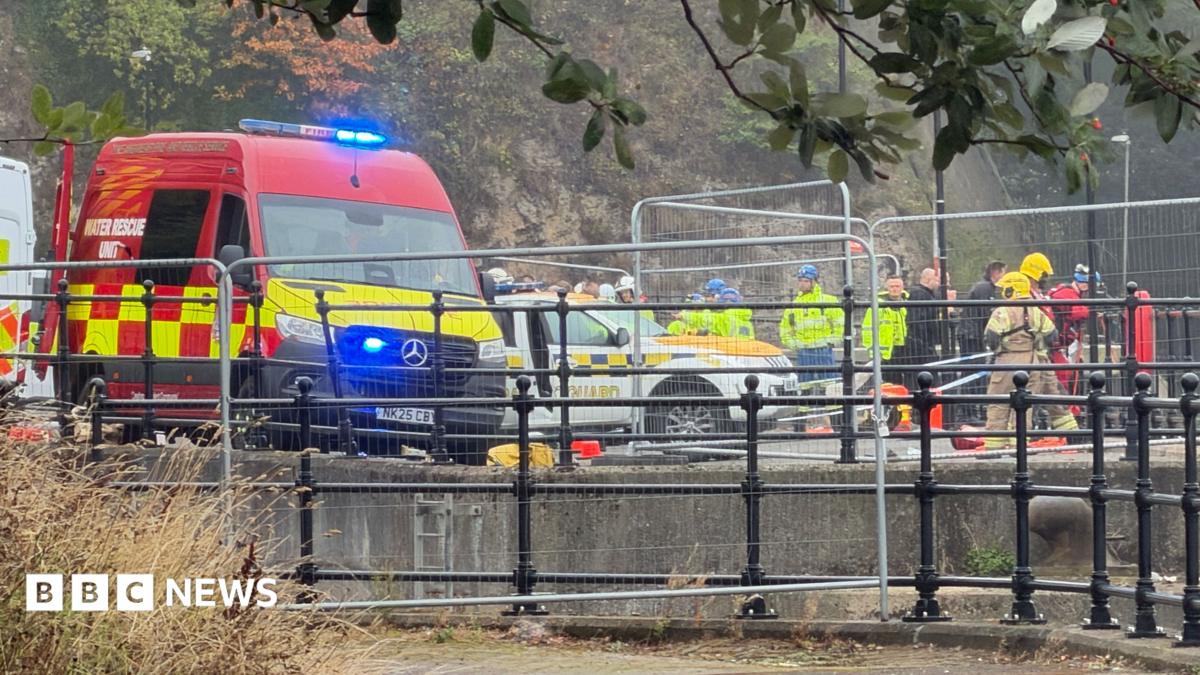
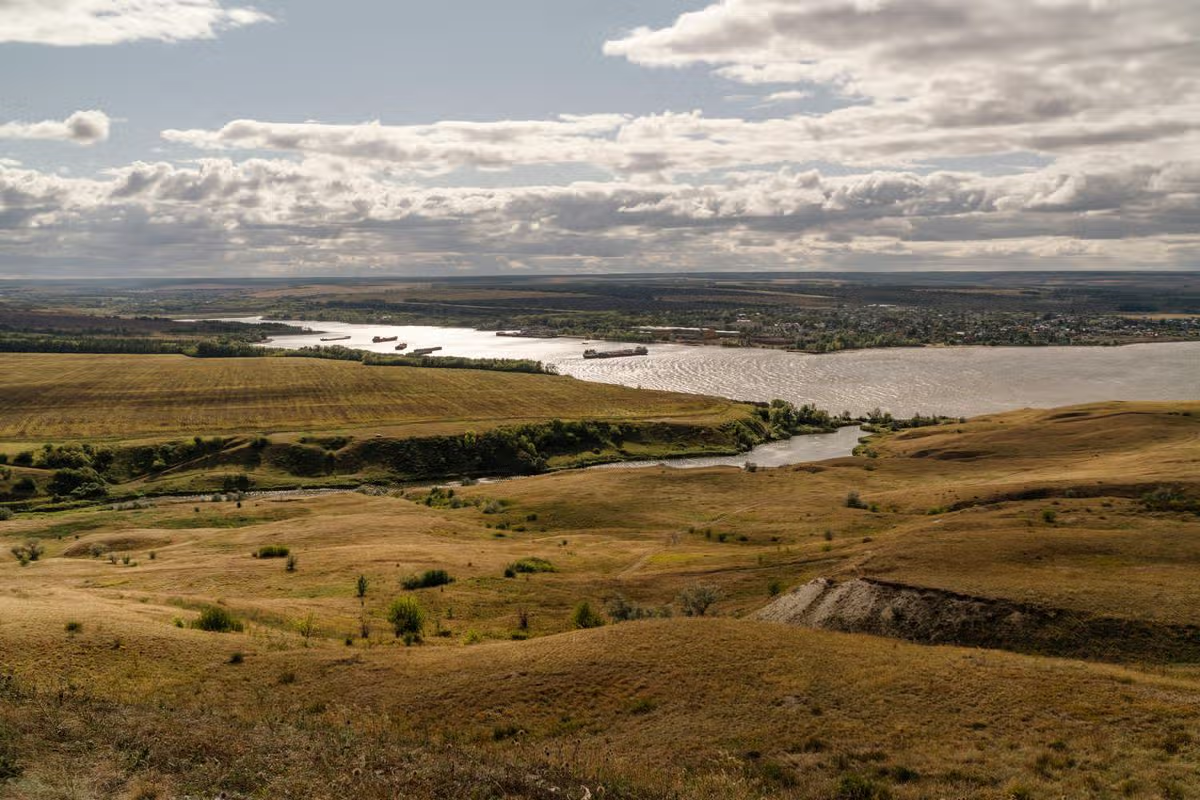
Workers in Hungary are sinking two 260-foot barges into the Danube River to raise waters levels. Photo courtesy of Prime Minister Peter Magyar’s Office/X
Aug. 15 (UPI) — Hungarian working crews are sinking two barges into the Danube River in an attempt to raise water levels and stave off an energy crisis, the prime minister said on Saturday.
Water levels of the 1,800-mile river have fallen to record lows amid a months-long drought across Europe.
To raise the waters, crews are sinking two 260-foot barges into the Danube River.
Hungary’s only nuclear power plant, Paks, depends on water from the river to cool down its reactors.
Prime Minister Peter Magyar said current water levels on Saturday were 48 inches lower than usual, and could fall a further 4 inches by Monday.
If it falls that low, he added, the power plant would have to shut down one of its last two functioning turbines.
“Water management experts are continuously monitoring the water level, water velocity, and riverbed condition using a measuring vessel and installed measuring devices,” Magyar said in a statement on X.
The plant is responsible for generating half the electricity needed by the country’s 10 million people.
Doc Rivers needed some time to write the speech that he’ll give when formally inducted into the Naismith Memorial Basketball Hall of Fame on Saturday.
The storytelling, that part was easy. He’s a natural at that.
But what Rivers wound up learning during the trial-and-error process of speechwriting was that the words he’ll say from a stage in Springfield, Mass., aren’t going to be about him. They’re going to be about everyone else who played a role in him getting to that moment.
“You go through this journey of writing it and you realize it has nothing to do with you in a very good way,” Rivers said. “People are happy for you, and I am happy for them because they got me there. You hear all your life, ‘You don’t do anything alone.’ When you get in the Hall of Fame, you really understand that you don’t do anything alone. It’s all the coaches in your life, your parents, the players. It’s a thankful journey and that’s what the Hall of Fame should be about.”
Numbers prove he’s among best
A winner of 1,194 regular-season games as an NBA coach — and that’ll be all, he insists, saying his retirement is a real one — Rivers ranks sixth in league history. The only others ahead of him: Gregg Popovich, Don Nelson, Lenny Wilkens, Jerry Sloan and Pat Riley, all of whom are Hall of Famers, so it was obviously a lock that Rivers would be joining them.
He won a championship with Boston in 2008, won 114 playoff games as a coach, played 13 seasons, was an All-Star once, has been a broadcaster and — if he goes back to work, and his family currently has a pool that he will — he’ll be a broadcaster again.
But there’s more to life now. The Illinois native and Marquette legend has seven grandchildren, a house on the water and can’t play enough golf. He’ll still be involved in the game, somehow. It just won’t be as a coach. It’ll be as a Hall of Famer.
“Doc is a proven, extraordinary leader and communicator during his renowned NBA coaching career,” Milwaukee general manager Jon Horst said when the Bucks hired Rivers in 2024. “As a championship coach, he’s widely respected as an established innovator, and the right coach to lead our experienced and talented team.”
He was, until he wasn’t.
Injuries derailed every chance the Bucks had at being a winner last season, and when the season came to its dismal close Rivers was fairly certain it was the end for him as well — after 27 seasons on the sideline, and whole lot of missed moments along the way.
“The one thing that people have no idea about is the toll it takes on you and the family component,” Rivers said. “It is rough. You’re never home. You make sacrifices and your family has to make them as well.”
That won’t be an issue now.
A hit from the beginning
Rivers won coach of the year in his first season, taking a team he called “the 301s” in Orlando and leading it to a 41-41 record. On the surface, there’s nothing special about going .500. But the Magic were supposed to be bottom dwellers that season and Rivers used a preseason ranking of the league’s top 300 players as inspiration — since none of those top 300 were playing for the Magic.
“That season gave me great confidence,” Rivers said.
He has some regrets, of course. Critics have long pointed to the 10 losses that Rivers-coached teams had in Game 7s, by far the most of any coach in NBA history. And his fans will retort by pointing to his 114 playoff wins, fourth-most in NBA history. But the biggest do-over, if Rivers had such an option, would be changing his mind about leaving the Celtics for the Clippers in 2013.
Rivers got to the Clippers not long before the end of Donald Sterling’s ownership of the team; Sterling made racist comments and was banned by NBA commissioner Adam Silver.
“I underestimated what a great situation I was in, and I took that for granted, like you can just go anywhere and create that,” Rivers said. “I messed that one up. But then when I go to the Clippers, the team is pretty damn good. The organization, it was the worst organization in sports with the ownership problem. Within a week there, I remember telling my assistant, ‘We’ve got a lot to do here.’ ”
The championship with the Celtics in 2008 — Ray Allen, Paul Pierce and Kevin Garnett, the stars of that team, will be together again to present their former coach for his Hall enshrinement — was an obvious high point for Rivers’ career. There were other moments he’s particularly proud of as well, such as delivering on a promise that he made to someone who barely played for him.
Tyronn Lue succeeded Rivers as coach of the Clippers. Lue played 11 games for Rivers in Orlando during the 2003-04 season; that was all the time it took for Rivers to be convinced that Lue would one day be a coach. He told Lue to call him if he ever wanted a job and Lue took him up on it. Rivers wound up going to the Hall of Fame, and few within the game would be surprised if Lue joins him there one day.
“It’s the stories like that that you think about,” Rivers said. “Rajon Rondo played for me in Boston. We had a very tumultuous relationship when I coached him and now, I probably talk to Rondo more than probably than any player that I coached.”
It’s what the game does, Rivers said. The lucky ones get guided along the way. He played that role with players like Rondo — who coached with Rivers — and Lue, and in Rivers’ own case, it was Riley who gave him the push he needed.
Riley and Rivers clashed at times during their player-coach relationship, and their biggest fights came when Riley was telling Rivers that he belonged in coaching.
Riley was right.
“When I was doing TV, he kept writing and sending me these freaking messages about getting into the fray,” Rivers said. “He knew it. And here I am, going into the Hall of Fame.”
The Russian River was running low and slowly. A few miles outside Guerneville at Steelhead Beach, several men stepped into the water, laden with flotation devices. A duck, a flamingo, a unicorn …
“Don’t you know?” asked Anna Deurloo, standing by me on the shore. “It’s Lazy Bear Week! That’s why the river is full of bears: big hairy men with beards. And Speedos.”
Deurloo, who lives in Guerneville, had made glittery bandannas for her crew of bears to wear at the annual celebration. Out on the water, Joe Souza of Long Beach adjusted his blinged-out headgear, hollering that he’d been coming to Guerneville every summer for more than 20 years.
“It’s a nice place to meet our friends from all over the country,” Souza said, “and get tricked into this river.”
1
2
3
1.Steelhead Beach is a popular starting place for warm-weather floats down the Russian River.2.Families play in the Russian River near Johnson’s Beach.3.The view from Korbel Winery includes vineyards and forest along the Russian River.(Photographs by Christopher Reynolds / Los Angeles Times)
When the weather is warm, the Russian River draws dawdlers of all kinds, including LGBTQ+ vacationers, longtime locals and Bay Area families. On summer weekends, thousands show up in Guerneville with kayaks, canoes, inner tubes — just about anything that will float, preferably with a cooler attached. Then they spend hours gliding downstream past scenery that might as well be a Northern California highlight reel: vineyards, redwood forests and eventually a beach scene full of driftwood and sea stacks.
They know that time is of the essence. Many places on the river in and around Guerneville shut down November through early May because it gets cold and rainy and the river can run high and fast.
But for now through early October, with little rain and seasonal dams controlling the water’s flow, this might be California’s laziest river.
Still, for plenty of Californians, including me, this corner of Sonoma County is little-known territory. I’ve just gotten my first good look at the area, which is about 85 miles north of San Francisco, and I’m glad I arrived when I did.
For years, as Sonoma County’s wine country has grown ever more pricey and elegant, the communities of the lower Russian River have clung to their rustic, quirky and more affordable ways, in part because of the area’s vulnerability to changing seasons.
But the riverside scene is evolving. Since the pandemic, several new or revamped lodgings have boosted glamping and other upscale elements in a territory once better known for old cabins. At privately owned Johnson’s Beach in Guerneville, where parking was free in the old days, the fee is up to $10 a day. In the Johnson’s Beach lodgings, long known for summer-camp vibes, some rooms now come equipped with luxury linens and a French press. On the menu at the River Electric, there’s a “high-low dog” — a hot dog with black caviar — for $40. In other words, the lower Russian River is edging up-market.
“There’s a lot more new blood up here. A lot of new people in the last five years,” said Robert Baba, who runs Ideal Hardware in Forestville.
“Prices are going up and hotels are getting more posh,” said Michael Rex, owner of Guerneville’s Russian River Bookstore. But still, he said, “there’s a lot to do here where you don’t have to spend a dime.”
Here’s what I found in four days as a Russian River rookie.
River guide Keith Chandler prepares to kayak at the Russian River estuary at Jenner on the Sonoma County coast.
(Christopher Reynolds / Los Angeles Times)
Forestville: Stepping into the river
If you want to imagine time standing still, start at Burke’s Canoe Trips, which has been renting canoes and kayaks for decades. At Burke’s, which sits at the edge of Forestville (population: about 3,300), most customers rent a watercraft ($95 per canoe, $60 per kayak) before noon, drift 10 miles down river to Guerneville, then catch a Burke’s bus back to where they began.
The river water is shallow, often 3 to 5 feet deep. The beaches are pebbly. The redwood groves begin within stone-skipping distance of the Burke’s property and follow the river downstream. Drinking water and sunblock are vital. Sightings of blue heron, egrets and river otters are common. (Burke’s also has camping with hot showers and fire rings, at $20 per person per night.)
Canoes await paddlers at Burke’s Canoe Trips in Forestville along the Russian River.
(Christopher Reynolds / Los Angeles Times)
A cat sleeps alongside a Jesus statue and beach gear at Burke’s Canoe Trips in Forestville along the Russian River.
(Christopher Reynolds / Los Angeles Times)
“People know that no matter how the world is doing, when they come to the river, it’s going to be like it used to be,” said Linda Burke, second-generation owner of the business.
“It could be 1946 when you’re paddling,” said Ted Schroeder, longtime manager at Burke’s.
But even at Burke’s, things change: Demand is up for kayaks, down for the metal canoes, which are heavier.
Along Front Street, Forestville’s tiny commercial core, you could get a corn dog for $3.30 at Carr’s Drive-Inn, which looks like a time capsule from 1979. Or you could get some wood-fired pizza on the big, bright patio of Sonoma Pizza Co., which opened in 2022; or maybe a cup of organic ice cream at Angela’s (since 2023).
If you want to go luxe, you can eat or sleep at the Farmhouse Inn, a 6-acre property on River Road that includes 18 rooms and cottages, a pool and some spa services amid lushly landscaped grounds. Its restaurant occupies an 1873 farmhouse. (Nightly rates start around $440.)
For a lot of people, however, Forestville is just a place to slip into the lazy river — often at Steelhead Beach, half a mile downriver from Burke’s.
Glamping tents are a central part of Dawn Ranch, near the Russian River in Guerneville, Calif.
(Christopher Reynolds / Los Angeles Times)
As glampers arrive, Guerneville gets fancier
Guerneville (population: about 4,500) is the hub of human activity on the Lower Russian River. River Road becomes Main Street there, and in summer its shops and restaurants buzz with people. Riverfront recreation at Johnson’s Beach is a block away. A network of redwood forest trails awaits 2 miles up the road in Armstrong Redwoods State Natural Preserve.
Be warned, however, that on weekends, Guerneville is often short on parking. Consider parking for the day ($10) in the big dirt lot at Johnson’s Beach, which has food, drinks, rental kayaks, canoes and inner tubes, campsites, historic bungalows, modern tiny cabins, canvas cabanas and a four-bedroom lodge. There are about 35 units in all, open mid-April through October. (The bare campsites start at $55, historic bungalows at $165.)
“It’s a lazy river and walkable to town, so we can camp and eat at restaurants,” said Kim Loda of Oakland as her son, Axel, 10, showed off his juggling skills near the Johnson’s Beach snack bar. “I don’t know why my family didn’t bring me here growing up.”
The River Electric, a resort along the Russian River in Guerneville, Calif., includes glamping tents.
(Christopher Reynolds / Los Angeles Times)
Guerneville grew up as a 19th century logging settlement, prospered as a weekend getaway for San Franciscans arriving by ferry and train in the 1920s, slumped in the ‘30s and suffered extensive flooding in the 1960s. It entered a new chapter in the late 1970s, when a handful of gay entrepreneurs began buying up and revamping rustic resorts and bars.
First, in 1978, was a riverside getaway called Fife’s. Another early gay-owned venture was the Rainbow Cattle Company bar, still in business on River Road, a.k.a. Main Street. (Every week on Give Back Tuesday, the bar stages raffles, offers $5 dinners and earmarks 10% of revenue for charities.)
When the 1980s and 1990s arrived, Guerneville suffered deeply — from the AIDS epidemic and from repeated floods.
Nimble & Finn’s sells ice cream inside the Guerneville Bank Club building in Guerneville, Calif.
(Christopher Reynolds / Los Angeles Times)
Yet a generation later, the community has gained ground.
Since 2008, entrepreneur Crista Luedtke has built a series of businesses, including Boon Eat+Drink and Boon Hotel+Spa. The Guerneville Social Club, “Russian River’s First Queer-Owned Social Club,” is due to open with a restaurant, bar and shop in 2027. Lazy Bear gatherings have been staged every July since 1996 by the nonprofit Lazy Bear Fund to raise money toward LGBTQ+ community health. There’s also a Russian River Pride parade Sept. 19.
Cars park along Main Street on July 30 in Guerneville.
(Christopher Reynolds / Los Angeles Times)
Timing my visit to avoid weekend crowds, I ate a dinner of chicken in tasty mole negro at Three Cultures Kitchen, which opened last year. I got ice cream at Nimble & Finn’s, lunch at Coffee Bazaar and a $15 sandwich to go at the Korbel Winery, which offers a deli, tasting room, wine shop and free tours at its scenic site about 3 miles west of Guerneville. I also browsed at Russian River Books & Letters.
“I ended up here because of the pandemic. It just went on and on, so I decided to open the bookstore,” said bookshop owner Michael Rex. Since that time, Rex said, he’s seen a growing number of remote workers.
Most notable among the new and renovated Guerneville resorts: Dawn Ranch and the River Electric, both with a glamping focus, both with docks on the river.
Dawn Ranch, dramatically upgraded in 2023, is a 22-acre, all-ages property that once held the Fife’s resort. The verdant grounds feature 86 cabins, cottages, chalets and glamping tents (open year-round) that share bathrooms and showers. There’s an upstairs restaurant, spa services, a pool and boathouse bar, along with a dock and private beach at the end of the short trail that feels like a secret path.
The tents, which start at about $300 nightly, have furniture, electricity and Wi-Fi, but if you show up on a 93-degree afternoon, as I did, your un-air-conditioned tent will be about the same temperature. That’s when it’s time to jump in the pool or river.
The Russian River runs past a dock at Dawn Ranch in Guerneville, Calif.
(Christopher Reynolds / Los Angeles Times)
The River Electric is sited on long-idle, flood-prone 12-acre expanse of riverside land that old-timers remember as the site of J’s Amusement Park in the ‘70s, ‘80s and ‘90s. In 2025, the current owners unveiled a newfangled resort with a restaurant, two pools (one of them round) and 46 furnished, electrified tent units, which start at about $260 nightly.
The resort stays open until Oct. 31. Then, by design, most of the resort will be carted away or submerged when the river rises.
“Everything except the concrete, we take off-site, Which is wild,” said River Electric’s Jessica Baker, who gave me a tour. The resort also sells day passes for $38 and hosts many weddings and special events.
Yet another glamping option is Guerneville’s Autocamp Sonoma, which opened in 2016. It doesn’t have river frontage, but it includes 25 Airstream trailers and 10 glamping tents in the shadow of a redwood grove.
Stand-up paddle-boarders are common at the Russian River estuary, next to Jenner on the Sonoma County coast.
(Christopher Reynolds / Los Angeles Times)
This is how the river ends: with roaring wind on an empty beach
Heading west from Guerneville, you roll through Monte Rio, seeing more redwoods, cabins and glimpses of river.
You might spot the 11-room Inn on the Russian River, a recently upgraded property whose riverside perch includes a private dock and summer rates of roughly $260 to $430 nightly.
Kayakers often come across harbor seals in the Russian River estuary at Jenner on the Sonoma County coast.
(Christopher Reynolds / Los Angeles Times)
What you’ll need to imagine is the Bohemian Grove, which hides in the nearby forest, serving as a haven for the rich, powerful, famous and all-male members of the Bohemian Club since the 19th century.
Gathering every July at that 2,700-acre compound, club members, who have included Ronald Reagan, Richard Nixon and Bob Weir, are said to stage a ritual “cremation of care,” burning an effigy of “care” in front of a 40-foot owl statue. (Suddenly, Burning Man seems a little less original.)
Anyway, a casual tuber or kayaker can’t float all the way to the Pacific from Forestville. (Obstacles include seasonal dams at Johnson’s Beach and Vacation Beach.) But if you drive the river road past Monte Rio and the historic but touristy shops at Duncans Mills, you reach the coastal hamlet of Jenner. That’s where the water flows into the Pacific, where the Russian River goes from mild (in summer) to wild.
To see the converging waters and feel the roaring wind, you can drive to Goat Rock Road and Goat Rock Beach. Or you could stop for a snack at Cafe Aquatica, whose patio fronts the water’s edge.
Or you could do both, followed by a night at River’s End, where a restaurant and five woodsy guest rooms enjoy sweeping views of the river, sea and sea stacks.
Kayakers paddle through sunset on the Russian River estuary, which looks out at the sea and sea stacks near Jenner.
(Christopher Reynolds / Los Angeles Times)
I did that. And on my last morning along the river, I got up early and met Keith Chandler of Jenner-based Watertreks Ecotours at water’s edge. Then we paddled around the estuary on a pre-breakfast kayak tour.
“I never get tired of this,” Chandler told me.
Some tours go out by night, focusing on bioluminescent plankton. We skirted Penny Island, where native Pomo people lived and farmed for generations before immigrants from Europe arrived. In fact, Chandler’s boss, Suki Waters, is part Pomo. Jenner might be small, but river, sea, natives and newcomers all converge there.
For a good chunk of this morning, however, there was just two of us in a kayak, sidling up to egrets, cormorants and harbor seals, watching pelicans glide in formation over the long, empty beach where the Russian River ends.
Someday, you might be able to ride a bike from the western San Fernando Valley to Long Beach along the Los Angeles River. But not yet.
The longest unfinished stretch is the eight miles from Elysian Park through downtown to Maywood. For decades, advocates of the path have tried to complete those eight miles along the concretized river.
Yet a decade later, the unrideable gap remains. The ambitious project remains mired in planning and bureaucratic complications, with groundbreaking still two years off and the cost nearly tripling to more than $1 billion — almost $24,000 per foot — documents reviewed by The Times show.
It looked like the prospects for the bike route to the sea were getting serious after Angelenos enthusiastically passed a half-cent tax for transit projects in 2016 that earmarked $365 million for the L.A. River Path.
At the time, the Metropolitan Transportation Authority, the lead on the project, priced out a simple path on one side of the river.
An aerial view of bicyclists where the Los Angeles River Path ends near Golden Shore and Shoreline Drive in Long Beach.
But by last year, the proposed designs were much wider and added seven pedestrian bridges. They also included sections where the path would be elevated above the ground, supported by beams. The changes responded to community input and comments from the U.S. Army Corps of Engineers and L.A. Department of Water and Power, among others. Estimated completion of the initial phase is not until 2031.
Navigating the web of nearby structures, like active rail lines and historic bridges, is part of what makes the construction so complex, Metro says. An original $75 million set aside for unforeseen expenses in 2016 swelled to $309 million last year, and the rising cost of construction also added to the high price tag.
Advocates for the path say this grander plan would be great, if there were a way to pay for it.
Yuval Bar-Zemer is a board member with Streets for All, a group that advocates for safer streets in L.A. He also is a downtown loft developer and commissioned studies that helped inform a far less expensive option that would run down near the flowing river, rather than up above. The path would be unusable during heavy rains, but Bar-Zemer and others say that would be less than 20 days each year.
This option was included in Metro’s initial scoping of the path in 2016 but has since been dropped, with the agency citing safety concerns. Bar-Zemer contends that safety features could be installed to make sure pedestrians have enough time to exit the pathway if water rises swiftly. He says he’s spent $350,000 of his own funds in engineering studies and advocacy to advance the path.
A pedestrian walks with an umbrella on the L.A. River Path near Lewis MacAdams Riverfront Park.
“The benefits are so obvious, it’s such a home run and such a low-hanging fruit that for me, it’s like criminal not to make it happen,” he said.
Currently, bikers headed southbound run out of path where Riverside Drive crosses the L.A. River at Egret Park. From there, they’re forced to weave through high-traffic streets in neighborhoods including Lincoln Heights, Chinatown, Downtown L.A. and Boyle Heights before they find the path again in Vernon.
“It’s a huge chasm,” said Michael Schneider, founder and chief executive of Streets for All. He called the gap in the L.A. River path “a shame because it’s an otherwise amazing resource.”
Some 76,000 residents live within walking distance of the proposed path, and a million within three miles of the L.A. River, according to Metro estimates from 2022. Around 17% of working-age people who live within a bikeable distance already walk, bike or take transit in their regular commute.
An aerial view of downtown Los Angeles and the Sixth Street Bridge amid an unfinished eight-mile gap in the L.A. River Path.
Metro had the eight-mile gap on its list of 28 projects it wanted ready for the 2028 Olympic and Paralympic Games. As costs soared, it quietly was taken off the list.
Yet there are recent signs of progress for the L.A. River Path.
In late May, the Metro board voted to create a committee that brings together all the players needed to push it to toward completion.
The Los Angeles River runs under the Sixth Street Bridge amid an unfinished eight-mile gap in the L.A. River Path in downtown Los Angeles.
Mayor Karen Bass chairs the Metro board. Despite the project’s stagnation, she continues to convey optimism.
“Angelenos voted in 2016 to make the L.A. River Path path a reality, and Mayor Bass is marshaling the resources necessary to eliminate further distraction that have threatened the project’s pace and cost,” her office said in statement.
Metro staffers are reviewing comments on the draft environmental impact statement, the agency said. They intend to recommend a path forward in the fall.
Even though it was late October, I couldn’t help but feel jealous as I watched my best friend Jenny swim into the calm, clear water of the American River near downtown Sacramento.
I was in town to cheer Jenny on as she competed in a long-distance triathlon. Although the race was such a fun experience, that moment on that tree-lined river bank stuck with me. In my home state of Oklahoma, I regularly swam in lakes and kayaked and rafted in rivers. But freshwater recreational opportunities were harder to come by once I moved to L.A.
This all led me to wonder: Will it ever be safe to swim in the Los Angeles River?
A large white bird stands along the L.A. River in the Glendale Narrows area of the waterway near Elysian Valley a.k.a. Frogtown.
(Jaclyn Cosgrove / Los Angeles Times)
This felt like an especially relevant time to discuss this question, as Friends of the L.A. River will host its annual (free!) RiverFest this Sunday from 2:30 to 7:30 p.m. at L.A. State Historic Park in Chinatown. This year also marks the organization’s 40th birthday.
After reading this edition of The Wild, our weekly outdoors newsletter, I hope you feel as fired up as I do about how we can work toward a day when the answer to my question is “Yes!” But we aren’t there yet. Let’s explore why.
You are reading The Wild newsletter
Sign up to get expert tips on the best of Southern California’s beaches, trails, parks, deserts, forests and mountains in your inbox every Thursday
By continuing, you agree to our Terms of Service, which include arbitration and a class action waiver. You agree that we and our third-party vendors may collect and use your information, including through cookies, pixels and similar technologies, for the purposes set forth in our Privacy Policy such as personalizing your experience and ads.
The L.A. River is a 51-mile waterway that flows from the confluence of Bell Creek and Arroyo Calabasas in Canoga Park, ending in Long Beach as it flows into San Pedro Bay near the Queen Mary.
Candice Dickens-Russell, chief executive at Friends of the L.A. River, told me that her organization’s founder spent decades trying to persuade Angelenos to understand that our local watercourse was not a manmade concrete flood channel but actually a river that has been surrounded by concrete.
“I’m feeling like we’re at a tipping point for people to understand that the L.A. River is really a river, which is wonderful because our founder spent his entire life trying to get people to understand that,” she said.
Channelization of the L.A. River started in the mid-1930s after a number of devastating floods and was completed in 1960.
In an early 1936 article, Times real estate editor Charles C. Cohan seemingly praised the channelizing of a nine-mile stretch of the river from Fletcher Drive westerly to Lankershim Boulevard, calling it “one of the greatest stream-channel transformations ever undertaken in the West.”
Ducks hang out in the Glendale Narrows area of the L.A. River.
(Jaclyn Cosgrove / Los Angeles Times)
Cohan went on to write: “Men and machinery directed by the United States Army engineers are changing that vitally important length of the river from an irresponsible water course into a far larger, thoroughly conditioned channel that will be a vitally important flood protection while at the time conforming to the well-ordered, picturesque region through which it passes.”
It didn’t have to be this way.
Before the devastating flooding of 1938, the Los Angeles Chamber of Commerce commissioned two major landscape architecture firms in 1927 to develop a report analyzing how the region could develop more parkland in an already park-poor city.
“The report imagined an ‘emerald necklace,’ an urban paradise of parks and rivers and open spaces and public beaches encircling L.A. County, and it also laid out the practical, political and financial mechanisms to make it happen,” Times columnist Patt Morrison wrote in May.
The Glendale Narrows area of the L.A. River.
(Jaclyn Cosgrove / Los Angeles Times)
The report’s authors wrote about how flood-prone land would make for better park space than business and residential developments, as anything built in these areas would inevitably be damaged during floods. The parks could also serve as their own kind of protection.
“Parkways along the river were intended to reduce the need for structural flood protection features,” according to a 2001 state report.
For political and financial reasons explored in the book “Eden by Design,” that plan was shelved and long forgotten after it was published in 1930. Around 1938, local officials worked with the U.S. Army Corps of Engineers to channelize the L.A. River, literally paving the way for what we experience today and what we’ve seen on film in everything from “Grease” to “Drive.”
In recent years, local groups have started advocating for a “rewilding” of the L.A. River, removing some level of concrete and instead using our natural environment and watershed as a means of flood control.
A large bird that appears to be a type of heron flies over the L.A. River.
(Jaclyn Cosgrove / Los Angeles Times)
“If we develop and retrofit land to capture water, we can reduce the intensity of flood waters and peel back concrete to enable all of the essential functions healthy rivers and soil provide,” according to the local nonprofit the River Project.
This would certainly also change the swimming experience to a much more natural opportunity, rather than feeling like you’re floating about in a large, flowing swimming pool.
The future of the river becoming swimmable, though, depends in large part on how much water is left for recreation, a complicated equation for officials to develop in a region constantly grappling with how to rely less on imported water.
A person rests in the shade of trees along the L.A. River.
(Jaclyn Cosgrove / Los Angeles Times)
Presently, the L.A. River is fed, in part, by rain and snowmelt in the wet months.
In the dry months, its main water source is three water reclamation plants that release tertiary treated water into the river. “These plants take all the wastewater from apartment buildings, houses and commercial operations and cleans it. Some of that water is used for irrigation at city parks and golf courses. Some feeds Lake Balboa,” my former Times colleague Deborah Netburn wrote in 2018. “But most of it — more than 30 million gallons each day — ends up in the river.”
Dickens-Russell of Friends of the L.A. River said for the last three years, she has sat alongside leaders from government agencies, local nonprofits and more to discern, among other things, just how much water our river needs. (For my fellow nerds who want to Google their hearts out, the full name of this effort is the Los Angeles River California Environmental Flows Framework Project, or CEFF.)
The Glendale Narrows is one of three soft-bottomed areas of the L.A. River.
(Jaclyn Cosgrove / Los Angeles Times)
For example, the L.A. River has three soft-bottomed areas where plant and animal life thrives. If the river were starved of reclaimed water in the dry months, what would happen to those ecosystems?
“No one is saying the river doesn’t need water — there is no debate about whether there should be water in the river — the debate is … how much water does the river need?” Dickens-Russell said. “We’re trying to establish that baseline.”
The CEFF group will meet for the last time in less than two weeks, and afterward, its members will send their findings to the state water board, which oversees any changes to river flow in California, she said.
The Glendale Narrows area of the L.A. River.
(Jaclyn Cosgrove / Los Angeles Times)
Even as officials discern the amount of the water the river needs for its multitude of uses, the L.A. River also has to be clean enough to swim in.
And humans and our behaviors are one of the biggest reasons our river water becomes polluted.
When it rains in cities, that water runs off buildings, driveways and roads, picking up fertilizer from our yards and farmlands, motor oil spilled on our streets and highways, pesticides sprayed on our plants, dirt and bacteria. This untreated runoff makes its way through storm drains and ditches into our local streams and rivers and eventually, the ocean.
Additionally, for years, runoff from industrial sites along the river have added to the problem, an effort that’s been highlighted as climate justice activists work to develop the former Taylor Yard, a railroad maintenance yard, into a park.
This is all part of a much larger problem beyond the banks of the L.A. River. “Polluted runoff is one of the greatest threats to clean water in the U.S.,” according to the federal Environmental Protection Agency.
The river is especially gnarly after its so-called “first flush,” when L.A. experiences its first big rain after a lengthy dry spell, and everything that’s built up on our roadways flows into the river.
A sunflower-like plant resembling California brittlebush grows among invasive plants in the L.A. River.
(Jaclyn Cosgrove / Los Angeles Times)
Addressing this pollution to the extent that would make the L.A. River swimmable is not an impossible task, but it’s one that would require significant investment in our local infrastructure — like implementing creative solutions to keep out or remove trash from the river. That’s where public opinion and advocacy come into play, Dickens-Russell said.
Cities across the world like Portland and Copenhagen have successfully transformed their urban rivers into green spaces that offer reprieve from intense and increasingly frequent heat waves in our climate-changed world. Unlike Paris, which made a $1.5-billion investment in cleaning the Seine, our river won’t be ready — unless something substantial changes — for the 2028 Olympics.
The possibility of swimming in the L.A. River, though, is far from a new idea.
“Towards a swimmable, fishable, boatable river,” read the first page of the Friends of the L.A. River’s first “State of the Los Angeles River” report, published in 2005.
Lino Jubilado using a tenkara-style fly fishing rod in the L.A. River in Long Beach.
(Jerry Hsu / For The Times)
Swimming in our river isn’t going to happen with just “one good project,” but instead a mix of people changing their behaviors and also pushing for change, Dickens-Russell said.
“Looking at your question, ‘When will we be able to swim in the L.A. River?’” Dickens-Russell said, “I don’t know that that’s the question. I think the question is what we’re willing to invest to make that possible. A swimmable river is an achievable goal, but it’s going to require sustained investment in water quality and things like habitat restoration and safe and equitable public access. Every project that reduces pollution and restores natural function brings us a little bit closer to that. And yeah, we should be planning for a future where Angelenos can safely swim in the L.A. River. Why not?”
While digging through The Times’ archives for this story, I found a new visual of a river to inspire me: Three boys swimming in the L.A. River in 1936.
“Viewing the dusty Los Angeles River bed last week no one would have thought of swimming in connection with it,” the caption read. “But yesterday Bob Henderson, Stanley Hayden and Archer Bolton frolicked in the flood waters near Bell, thanks to the week-end rain.”
Ninety years later, I’m dreaming of one day doing the same. How long will that take exactly? It’s up to all of us to find out.
3 things to do
Hikers learn about their local ecosystem on a previous hike with environmental educator Jason Wise and others.
(Jason Wise)
1. Celebrate the full spectrum of the animal kingdom in L.A. Environmental educator Jason Wise and biological anthropologist Natalia Reagan will host a sunset queer ecology walk from 6 to 8 p.m. Aug. 13 in Griffith Park. The co-hosts will dive deep into the world of animal homosexuality, bisexuality, asexuality, polyamory and more. Suggested donation of $30. Register at eventbrite.com.
2. Churn up hills in L.A. Labyrinth, a trail run club, will host Dirt & Dessert from 7:30 to 10 a.m. Saturday in Griffith Park. Participants will tackle a 5K trail run while churning their own ice cream. Runners should bring their own bag, vest or backpack to hold ice cream-making materials, which will be included in the $14 event fee. Register at eventbrite.com.
3. Nurture native habitat in Northeast L.A. We Explore Earth needs volunteers from 8 to 10:30 a.m. Saturday at Ascot Hills Park to beautify the park’s hillsides and trails. Participants will remove invasive species and support native habitat recovery. Register at eventbrite.com.
The must-read
Marc Papas cycles past graffiti next to the L.A. River.
(Kayla Bartkowski / Los Angeles Times)
Cyclist Marc Papas is on a mission to bike every public street in L.A., an estimated 7,516.07 miles. Papas moved to L.A. in late 2020 after completing his PhD at Georgia Tech, freelance journalist Oren Peleg wrote for The Times. Papas was initially scared to ride his bike around L.A., fearful of all he’d been told about our city’s car-filled and dangerous streets. Then he found himself asking: “With perfect weather year-round, and a mostly flat topography, why wasn’t everyone in L.A. riding bikes?” His passion evolved into “The Project,” of which he’s already ridden over 78% (about 5,840 miles) of our city’s streets.
Who else feels inspired to jump on their bike?
Happy adventuring,
P.S.
After my friend Maria told me she’d signed up for $10 kayaking classes after learning about them from my Instagram Stories, it made me realize that there were likely many others who’d like to know that information. L.A. County Parks and Recreation is hosting stand-up paddleboard and kayaking classes, and they’re only $10 per session. Instructors will teach participants about proper paddling technique, balance and coordination, and water safety. The classes will be offered at Santa Fe Dam, Bonelli Regional Park and Castaic Lake. August classes have sold out at Santa Fe Dam and Bonelli, but several spots remain at Castaic Lake, which sits north of L.A. and offers amazing views of the San Gabriel Mountains. Sign up by searching “kayak” or “stand” on the county’s activity registration website. A great way to have fun and stay cool this summer!
For more insider tips on Southern California’s beaches, trails and parks, check out past editions of The Wild. And to view this newsletter in your browser, click here.
FORGET packing like sardines into the London underground, or dodging the crowds (and the rain) on a walking tour.
I’ve found the best way to soak up the sights of London, where you can even sit down and enjoy a slap-up meal while you tick off all the big landmarks.
Save yourself the steps walking between London’s landmarks and spot them all from a swanky cruise instead!Credit: Jenna Stevens
City Cruises Lunch River Cruise – now only £38 (was £53)
City Cruises offer budget-friendly sightseeing tours on the River Thames, ranging from traditional Afternoon Tea cruises to live Jazz nights and New Year’s Eve celebrations.
You can click here to browse all the different types of cruises available and see which ones are currently on sale.
Sign up for the Travel newsletter
Thank you!
I recently tried out City Cruises’ most popular experience, the Lunch Cruise on the River Thames.
For just £38 – slashed from the usual £53 – this is now the cheapest lunch cruise on the River Thames, and it packs in a whole lot for the price.
As I stepped onboard from Tower Milennium Pier (right next to the Tower of London) I was shown through a gorgeous restaurant to a fancy dining table with a view.
After ordering my meal (chicken supreme for main, white chocolate cheesecake for dessert) I sank back to simply soak up the skyline.
The gentle river cruise drifted all the way along to Canary Wharf, the fancy finance district of London that is home to six of the UK’s ten tallest skyscrapers.
This is when my main course arrived – and I was absolutely blown away by the meal.
I tucked into tender chicken smothered in a creamy mushroom sauce, paired with a cheesy fondant potato and crunchy tender stem broccoli. Dreamy.
As for drinks, you can have anything from posh Teapigs tea blends, to glasses of wine or fizz, to full-on cocktails – just note that these drinks are an add-on!
I was thoroughly impressed by the food served onboard – it felt like I was in a posh restaurantCredit: Jenna Stevens
City Cruises Lunch River Cruise – now only £38 (was £53)
Then it was time for dessert – a gooey, white chocolate cheesecake with the perfect buttery base and a sharp raspberry coulis to cut through. Delicious.
The cruise then turned back around, and this was when my favourite part began. I recommend heading up to the top deck for this part – but you will still see it all from your table downstairs!
I watched as the history of London unfolded in real-time before my eyes.
We glided past futuristic skyscrapers all the way back to 1450 BC, as we floated by the oldest landmark in London, Cleopatra’s Needle.
I also enjoyed cruising underneath nine of London’s bridges, as a knowledgeable tour guide taught us all about their history.
I watched the world go by with a cosy cup of tea in-hand, which was also included.
We glided right underneath the famous Tower Bridge, as well as the Millennium Bridge – which locals call the “Wibbly Wobbly bridge”, as the bridge once swayed from side to side as people walked over it.
I learned that Waterloo Bridge is nicknamed the “Ladies’ Bridge” because women stepped up to build it during WWII, and we even drifted past the bright red pillars of the lost 18th-century Blackfriars Bridge.
We paused just outside of Big Ben and the Houses of Parliament with plenty of photo-taking timeCredit: Jenna StevensThe lower deck of the cruise is laid out like a fancy restaurant, with huge windows and plenty of roomCredit: Jenna Stevens
After cruising past the legendary Globe Theatre (and spotting the pub that Shakespeare used to frequent: The Anchor) we drifted right past the London Eye.
There was even time for a quick stop right in front of Big Ben and the Houses of Parliament for the ultimate selfie.
Then it’s time to turn around and head back to the pier, having ticked off all of the major London landmarks and enjoyed a fancy two-course meal all in one go.
Once you step back on land, you’re perfectly positioned to keep exploring the rest of the city.
Head into the historic Tower of London, or grab a wow-worthy lunch at Borough Market.
If you’re visiting London and want to go sightseeing in style, plus save a bit of money while doing so, this is the one trip you cannot afford to miss.
Is there a more relaxing way to soak up the sights of London?Credit: Jenna Stevens – The Sun
City Cruises Lunch River Cruise – now only £38 (was £53)
The dried banks of the Danube River are exposed due to the record low water level caused by extreme heat and drought in Budapest, Hungary. Photo by Zsolt Szigetvary/EPA
Aug. 5 (UPI) — Hungary is facing an energy crisis as the Danube River, which cools the nation’s largest power plant, dries to record lows.
Water levels of the 1,800-mile river, which flows through 10 countries in Europe, has fallen amid a three-month drought across the continent.
The Danube is an integral component in the running of Paks, Hungary’s only nuclear power plant, as it flows into the reactor and cools it down.
Three of the plant’s four reactors were not in operation on Wednesday, while the fourth is operating at 50% power, CBS News reported.
The plant is responsible for generating half the electricity needed by the country’s 10 million people.
“Several factors will determine whether Hungary’s most important power plant can avoid a complete shutdown in the coming days,” said Hungarian Prime Minister Peter Magyar, CBS News reported.
“There are a few critical days left — today and tomorrow are certainly that,” Magyar added, according to the outlet. “I ask everyone to continue the national unity that has developed in the country. Let’s do what our country demands.”
But the drying of the Danube has brought a silver lining for some. Residents and researchers have marveled at several discoveries that have emerged as water levels drop.
In Serbia, researchers have found some 200 boats that had been hidden deep in the Danube, including World War II-era Nazi warships, Smithsonian magazine reported.
A ship that likely sank in 1937 was exposed in Croatia.
And in Bulgaria, residents discovered the remains of a woolly mammoth.
AS the drought continues across Europe, low water levels in Europe are now threatening river cruise holidays.
The River Rhine and the Danube River have started to dry up with passengers being re-routed at the last minute after two ships ran aground.
River Cruise ships are being affected by the low water levels on the Rhine and DanubeCredit: AlamyBoth waterways have record low water levels due to droughtCredit: AFP
On the morning of June 29, the ship called Viking Einar ran aground on the Rhine River at Cologne in Germany.
Days later, the Viking Ullur ‘experienced a grounding incident on theDanube River‘ in Bulgaria with 186 passengers being evacuated.
Sign up for the Travel newsletter
Thank you!
It came ‘into contact with a sandbank during a period of exceptionally low water levels‘, Viking said in a statement.
With no rain on the horizon, river cruise companies are having to take action with some having to change sailings completely.
One woman who booked with Riviera Travel wrote on Facebook: “We have just received an email to tell us that our Rhine and Switzerland cruise is being re-routed and will not be travelling to Switzerland but instead north to Netherlands and Belgium.”
She added that she was given the option to change the itinerary or “cancel with full refund and have been offered compensation”.
Riviera Travel, issued a statement about potential alterations on its website.
It explained that “individual sailings may continue to develop right up until departure and, occasionally, during the cruise itself.”
“Currently, our cruises continue to operate, although itineraries are being adapted where necessary.
“This may include adjustments to sailing schedules, excursions or mooring locations, and in some cases carefully coordinated ship swaps to help you continue your holiday with as little disruption as possible.”
Passengers are being contacted about alterations to their sailingsCredit: handout
Passengers who have booked after August 5 are being contacted up to two weeks before departure with updates and between 48 hours and 24 hours before departure to “explain the latest position, any expected changes and the options available.”
Talking to The Independent, Riviera Travel said that cancelling a cruise is always a last resort.
In another case, one woman heading on a river cruise with TUI shared her new itinerary on a Facebook page.
Instead of sailing from Basel, through Germany to Amsterdam, the new suggested route starts in Zaandam through to Rotterdam, Antwerp, Middelburg, Dorecht and Amsterdam.
In the email, TUI also offered a 15 per cent refund of the holiday cost with £150 holiday vouchers per person on the new sailing.
Other options were to rebook another river cruise with a refund in cost if the new sailing is cheaper, or if it’s more expensive, an incentive of up to 10 per cent of the value of an existing holiday.
Or there was an option to cancel the booking with a full refund.
On TUI’s website, it says “Most sailings go ahead without any disruptions, but water levels on the rivers can go up or down depending on the weather.”
Low water levels means ships are unable to dock in some casesCredit: Anadolu via Getty ImagesThere are alternative itineraries being offered to passengers as well as refundsCredit: Alamy
It continued: “If your cruise is affected, we’ll make every effort to complete your itinerary. To do this there may be changes to berth locations, modifying shore experiences or completing some sections of the itinerary by coach.”
Emerald Cruises confirmed that reduced water levels are affecting sections of the upper Danube between both Vienna and Budapest, and Regensburg and Passau near Pfelling.
On its website it has said that it may make “operational adjustments” with passengers possibly being transferred to a “sister ship” as well as embarkation and disembarkation being amended.
AmaWaterways said: “Due to unusually low water levels on sections of the Rhine and Danube rivers, operational adjustments to select sailings have been deemed necessary.”
It continued to add that “modifications may include changes to ports, embarkation or disembarkation locations, motorcoach transfers, ship scheduling or other itinerary elements”.
From the underground parking lot to the 8,200-square-foot weight room, from the two gymnasiums to the 52-meter pool, from the eight tennis courts to the two all-weather turf playing fields, from the yoga room with a million-dollar view to the 11 locker rooms with projector screens, the $200-million project is certainly living up to expectations.
There’s also a cafeteria, a smoothie machine, 117 toilets, wrestling room, fencing room, training room, community rooms, more than 150 security cameras, an underground water basin and facial recognition technology from the parking lot to enter the coaches’ area. In the main gym foyer, there’s an area for people to watch live streams of games while purchasing food.
With two gyms and two sports fields, the school would be capable of holding basketball or soccer tournaments. The P.A. system in the main gym is state of the art.
Not only will students who attend the upper school on Coldwater Canyon enjoy the facility but so should fans and visiting teams with all the amenities such as large visiting locker rooms. The only question is when an official opening will take place.
Construction is nearing completion, but it’s unclear when teams will start practicing and playing there because the facility still needs to go through inspections and receive a Certificate of Occupancy from the city. The school is targeting early 2027 for activity to begin at the site.
The basketball teams are unlikely to use the main gym this coming season unless they are allowed to practice there.
Construction began in April of 2024. The project replaces the beloved Weddington Golf & Tennis Center and took several years of obtaining permits, having community meetings and receiving city approval to overcome a vocal group within the community objecting to losing the Weddington center.
There are still 14-foot-high covered fences hiding the progress off Whitsett Avenue, but those will be coming down soon to give community members a peak what’s been going on.
Head of athletics Terry Barnum and communications director Ari Engelberg have been providing updates to school administrators. The school added two new sports this year, flag football and girls lacrosse, in anticipation of the new field space.
The first year it opens is expected to be trial and error on how to best use the facilities, figuring out traffic patterns and welcoming the public to grounds that can be used during the school day, from the tennis courts to a privately run cafe to a walking path next to the L.A. River.
JUST like her 54-year-old mum, my daughter Lola likes the finer things in life.
So instead of backpacking around Europe like a Gen-Z, 20-year-old Lola and I ticked off four countries and six cities on a week’s river cruise down the Danube.
Lola in the ancient city of LinzCredit: SuppliedPassau is known as the ‘City of Three Rivers’Credit: Viking
Pottering around the Old Town, all cobblestone streets, Baroque architecture and cute German cafes, we stop by St Stephan’s Cathedral, a huge white and green onion-domed church — so my girl can inform Instagram.
Back on board, and dinner is a sociable affair — the conversation oiled by the included wine and beer.
We dine with a group of Americans — Vicky and Jay, a lovely couple from Montana, and Dillon and Robert from Georgia, who are celebrating Robert’s 40th birthday on the ship.
The food on board is so good, and plentiful, that I just wish I’d packed more elasticated clothes.
Each morning on the al-fresco Aquavit Terrace, we breakfast like queens — eggs Benedict, buttermilk pancakes with fresh berries, smoked salmon.
And there’s a view of a new port each day.
We always make it back to the ship in time for the excellent three-course lunch, too. With wine, of course.
Dinner is the most formal affair, served on the lower deck in the restaurant.
A Classics menu, featuring dishes like ribeye steak, poached salmon and roast chicken, is available every night but the chef also prepares a Regional Specialities menu that changes to reflect the country we’re in.
I particularly enjoy the Austrian evening.
To a backing track of oompah music, staff dressed in gingham shirts welcome us with shots of schnapps before serving platters of cured meats, cheeses and pickles, followed by roast pork, schnitzel and spaetzle.
I roll back to the cabin that night.
The Wachau Valley in Austria is beautifulCredit: Comofoto – stock.adobe.comA room with a view on the Viking VilhjalmCredit: Viking
While Lola is by far the youngest guest, it doesn’t stop her making friends.
Docking in Linz, I’m enjoying a glass of wine in the lounge, listening to Peter, the resident pianist, work through his Smooth FM setlist, when Lola appears with a glint in her eye.
“I’ve made friends at the bar and we’re hitting the town,” she announces.
Little encouragement is needed as I join her and new friends, Pam, Nick and Kate, also from the US, in the bars of Hauptplatz, the main square.
In the Pink Panther bar, Lola chats to local girls who introduce us to strawberry schnapps — a Linz favourite.
It’s a slow start the next morning, but we drag ourselves out to explore more of Austria’s third-largest city.
We take the vintage tram up to Postlingberg, the local mountain, to be greeted by panoramic views across the city.
We stumble across Linz Grottenbahn, a kitsch grotto inspired by Grimm’s fairytales, which opened in 1906.
Inside, a dragon train trundles through fairy-lit caves past dioramas of gnomes and taxidermy animals.
Despite our ages, it’s a real highlight of our cruise.
Back on board, and cruise life suits us. Over breakfast, we check out the Viking Daily — the newsletter detailing the day’s programme.
Our next stop is Krems, in the scenic Wachau Valley — Austria’s wine region.
We visit Gottweig Abbey, a Baroque wonder overlooking the river, where Lola (remembering her A level in History of Art) is mesmerised by the ceiling fresco of Emperor Charles VI as Apollo — by Paul Troger, Austria’s Michelangelo.
Tracey and Lola stop off in the Austrian capitalCredit: SuppliedTracey by the river in PassauCredit: Supplied
Vienna is another favourite port of call — and on the Viking walking tour of Ringstrasse, we learn about the naughty antics of Klimt and “Sisi” — Empress Elisabeth of Vienna, who bathed in milk and got a tattoo aged 51.
After dinner, we attend a classical music concert in a Viennese music hall, where Lola falls in love with the music of Mozart and Strauss.
I had feared my girl might get bored — but docking daily in a different port, she thrives on the variety.
Our next stop is Bratislava — the small and charming capital of Slovakia.
We dock moments from the Old Town, near the UFO Bridge, and tick off Bratislava Castle, Michael’s Gate and Hlavne Namestie Square.
Lola loves the Baroque architecture and cute shops which, under a blissful blue sky, feature heavily on her Instagram feed.
Our final stop is Budapest, Hungary’s buzzy capital.
Our coach tour captures the highlights — Buda Castle, the vast Hungarian Parliament and St Stephen’s Basilica — but we decide to ditch the walking tour to see the Shoes on the Danube Bank.
This haunting art installation of dozens of iron shoes is a memorial to Hungarian Jews lost in the Holocaust.
Before we return to the ship for our last dinner, I take Lola for a beer at Szimpla Kert — the first of Budapest’s ruin bars, created since the Noughties from abandoned or derelict buildings.
As we sit around an old Trabant car-turned-table in a graffiti-strewn courtyard, I look at my gorgeous girl — grinning and in her element — and decide that our mum-and-daughter river cruise has been a rip-roaring success.
GO: DANUBE CRUISE
SAILING THERE: Viking’s eight-day Danube Waltz river cruise is from £1,895pp including return flights, transfers, all meals with wine, beer and soft drinks at lunch and dinner plus included excursions and gratuitites.
There are few pastimes more relaxing than messing about on the river. Whether it’s paddling along an urban waterway, navigating a historic canal in a narrowboat, spotting the wildlife on an estuary walk, or a towpath bike ride, we’d love to hear how you like to spend time on your favourite river or canal in the UK or Ireland.
The best tip of the week, chosen by Tom Hall of Lonely Planetwins a £200 voucher to stay at a Coolstays property – the company has more than 3,000 worldwide. The best tips will appear in the Guardian Travel section and website.
Keep your tip to about 100 words
If you have a relevant photo, do send it in – but it’s your words we will be judgingfor the competition.
We’re sorry, but for legal reasons you must be a UK resident to enter this competition.
The competition closes on Monday 27 July at 10am BST
Your responses, which can be anonymous, are secure as the form is encrypted and only the Guardian has access to your contributions. We will only use the data you provide us for the purpose of the feature and we will delete any personal data when we no longer require it for this purpose. For alternative ways to get in touch securely please see our tips guide.
If you’re having trouble using the form click here. Read terms of service here and privacy policy here.
Yo-Yo Ma closed his eyes as he drew a bow slowly across his cello, playing the first notes of the Catalan lullaby “The Song of the Birds.” But this venue wasn’t like any vaulted concert hall he had toured globally.
At Maywood’s Riverfront Park, Ma was accompanied by the vroom of nearby traffic, cascade of a yucca rainstick and burbling hum of a water synth. An oblivious biker pushed past the world-renowned classical musician. The music flowed on.
Ma’s pop-up show in Southeast Los Angeles was part of his ongoing efforts to highlight people’s relationship to nature through music. He is among a new wave of artists who have been hosting shows along the L.A. River, a waterway with a complex history.
Yo-Yo Ma plays cello for a small group of artists and environmental advocates as part of the L.A. Phil Insight program, which aims to spark conversations around the arts.
(Halline Overby for InsightLA)
The river once terrorized Angelenos; its unconstrained flow was prone to flooding until most of its 51 miles were lined with concrete starting in the 1940s. While it’s been neglected, trashed and often forgotten over time, myriad governmental and nonprofit groups have been working for years to restore habitat, add park space and establish recreational elements (sometimes in conflict over the vision). And recently, creatives and activists, who dream of transforming it into a hospitable greenway, have been hosting arts events.
“Awareness around the river itself is changing,” said Maria Meija, executive director of L.A. River Arts, one of the organizations bringing attention to its history and cultural significance through public programming. She sees the serpentine stretch of the river as a natural highway that connects Angelenos from the San Fernando Valley to Long Beach. “We believe that if the river is properly activated as a green and cultural landscape, then Angelenos will fundamentally also get to experience Los Angeles in a different way.”
The River Solstice Festival was a family affair, with guests lounging on picnic blankets, watching puppet and opera performances and participating in birdwatching.
(Ariana Drehsler / For The Times)
Visions of those possibilities were realized on the summer solstice in mid-June at L.A. River Arts’ inaugural River Solstice Festival at an Elysian Valley park abutting a soft-bottomed area of the river known as the Glendale Narrows.
Children and parents applauded the performances by the Bob Baker Marionette Theater and opera singer San Cha at Lewis MacAdams Riverfront Park in what’s otherwise known as Frogtown. Attendees also gathered for guided bird-watching along the bike path by the water. Four-year-old Juni Wahab was entranced by the sight of the swallows and cormorants swooping low overhead and the rushing twists of water.
1
2
3
4
1.Bob Baker Marionette Theater performs at the River Solstice Festival, clockwise from top left. Meanwhile, attendees enjoy the park and river as skateboarders roll down the bike path. (Ariana Drehsler / For The Times)
“It’s going so fast,” Wahab said, wiggling and pointing as her aunt held on tightly for safety. “There are so many waves.”
A quick stroll upstream, a group of DJs unaffiliated with the family-friendly festival hosted a day party aimed at Gen Z and millennial attendees, perched on one of the channel’s outcrops. Roughly a dozen people at the if-you-know-you-know event grooved and shuffled to EDM music while kayak enthusiasts paddled by and locals fished for carp.
Dominic Tsoi drove from Orange County to spin at the open decks hosted by the DJ collective Helipad Society. “This event really resonated with me, because it mixes two things that I really love, music and being a part of nature,” said Tsoi, adding the commute was worth it. An indoors club setting can feel stifling, but outdoors is where Tsoi feels free.
DJs have been putting on pop-up events like this one at the L.A. River and sharing videos of their sets on TikTok.
(Ariana Drehsler / For The Times)
Just up the sloped bank, Antonio Solano and Erick Torres were sweeping outside their tent, where they live under the Glendale Freeway. Torres started noticing events at the river increase over the last three years.
“It gets people together,” said Torres, who’s been living above the river for over a decade. The music is a source of pleasure even as Torres and Solano stay vigilant to avoid city encampment sweeps. “It’s good, we enjoy it.”
Social media has driven interest in these DIY events as artists playing ambient music against a backdrop of verdant green have gone viral on TikTok.
“The attention has expanded to people who otherwise wouldn’t have given the L.A. River a second thought,” said Noah Klein, a lifelong Angeleno who has hosted popular river jams over the last two years through his Living Earth public art series.
Erika Apelgren wears a flower crown that she made at the River Solstice Festival.
(Ariana Drehsler/For The Times)
People don’t need approval to host these impromptu gatherings, said Dash Stolarz, director of public affairs at the Mountains Recreation and Conservation Authority. The park agency oversees commercial use of the L.A. River recreation zones in Elysian Valley and the Sepulveda Basin, another section of soft-bottomed riverbed.
In her 25 years on the job, this was the first time Stolarz had heard of people using the riverfront for mini concerts. She was excited by the ingenuity of artists; as long as people aren’t charging for events, they don’t need permission.
“It’s exactly how we envisioned people enjoying the river,” Stolarz said. “We want people to use the river like a park.”
Though unlike a regular park, the L.A. River is primarily treated as a flood control channel, so park rangers carefully monitor for rain when the recreation zones open for leisure, like kayaking, during the summer.
While appreciating the L.A. River can be a good thing, social media algorithms can flatten the context around the waterway, particularly when it comes to demographic changes in nearby neighborhoods.
“The City of L.A.’s greatest skill is the erasure of its own history, and the L.A. River kind of feels like the perfect encapsulation of this,” Klein said.
Once home to mostly working-class Latino families, neighborhoods along the river in northeast L.A. have seen home prices surge for years. To preserve the history of these neighborhoods, Clockshop, an arts organization, has been collecting interviews with locals as part of a multimedia oral history project since 2023. The project includes everything from videos of an Indigenous musician performing a song about water in the Tongva language to brothers worrying about the future of their family’s 60-year-old pickle business in the face of gentrification.
Jon Christensen, director of the Laboratory for Environmental Narrative Strategies at UCLA, said river revitalization can be part of a “green gentrification cycle” as new development pushes out old communities. Like the chicken-and-egg paradox, it’s hard to tell which comes first: the amenities surrounding the L.A. River or the more affluent people seeking them.
Yo-Yo Ma, who hosts a podcast called “Our Common Nature,” chats with attendees at his intimate river concert. Human connection to the natural world is among his passions.
(Halline Overby for InsightLA)
Christensen hopes artists engaging with the river spurs conversation for more equitable green investments that benefit communities and the environment. “When people are more connected to nature, they want to support nature more,” Christensen said of his studies on how people connect to the outdoors. “It’s really kind of a virtuous cycle there.”
Cindy Donis, a water organizer with East Yard Communities for Environmental Justice, said artwork can also raise awareness around inequities. While there are aspirations to turn the river into a greenbelt, nightmarish pollution incidents have still haunted Southeast L.A. communities.
Ma’s performance was nearly canceled in May due to 25,000 gallons of crude oil that spilled into the L.A. River after a pipeline rupture in Boyle Heights. Weeks later, the Lineage warehouse fire sent even more debris and pollution downstream. Donis said multiple people reached out with complaints of a foul smell emanating from the river. Miles away, some at the River Solstice Festival wore masks due to poor air quality caused by the fire.
Charles Kelley with his daughter Zirah Kelley pose along the L.A. River bike path near the River Solstice Festival.
(Ariana Drehsler/For The Times)
Earlier this year, East Yard Communities for Environmental Justice held an exhibition at Art Space Huntington Park called “We Are Water” to uplift local Indigenous artists. “Art really allows and embraces healing,” Donis said. “It’s another tool that allows us to process these feelings and get closer to the solutions as a community.”
The L.A. River inspired Arturo Gonzalez to found his arts education nonprofit that focuses on gang intervention among young people in East L.A. As Ma performed in the park, Gonzalez stood in the river basin, spray-painting in neon-pink blockbuster letters the name of his organization, East Side of the River, onto pillars under Slauson Avenue.
As a teenager in the early 2000s, Gonzalez was involved in gangs that would tag the gray walls of the L.A. River, but his passion for graffiti and Chicano art eventually led him out of those circles.
“The river was a safe place to paint, where you could sit and spend the day learning colors, composition,” he said of illicit tagging as a teenager, which eventually led to his public art work. “There’s a thin line between vandalism and art.”
Arturo Gonzalez spray-paints the name of his organization, East Side of the River, which focuses on gang intervention.
(Halline Overby for InsightLA)
This time, Gonzalez arrived with permission from the county and painted on a detachable fabric in case the mural needs to be removed.
“The opportunity to get into the river and paint again was like a dream,” he said. He seeks the input of local residents in his planned projects so they can participate in beautifying their neighborhoods. “We call it wall medicine for the community.”
JUMP into river swimming, bear-watching and space simulators on a family road trip to Belgium, says Acting Senior Designer Sasha Cunningham.
Sunlight bursts through the tree canopy as enormous furry paws pad silently across the forest floor.
Credit: Getty ImagesThere’s lots to lake in NeufchâteauCredit: Greg Van Oz
Elevated safely on a viewing platform, my family and I quietly watch as two Eurasian brown bears climb trees, paddle in the stream and stalk through the lush landscape.
We’re at Forestia in Theux, Belgium, which has 44 hectares dedicated to the conservation of animals originally found wild in the area.
Sign up for the Travel newsletter
Thank you!
Later the kids get to hand-feed deer, too.
Tickets cost from £22 for adults, and £16 for children (Forestia.be).
The grass is greener at these luxe lodgesCredit: Supplied by PRScandi cool at Landal Hillview Resort GrandvoirCredit: Supplied by PR
This is just one of the highlights we find in our week spent in the wilds of Belgium’s Ardennes region.
We’re staying about four hours from Calais – a drive that takes us along winding roads and through luscious pine forests – kipping in a stylish six-person self-catering lodge at Landal Hillview Resort Grandvoir, near the town of Neufchâteau.
Nestled among wildflower meadows teaming with butterflies, our lodge feels super-private, with just the sound of the birds and the occasional cricket for company.
It’s decked out with hygge decor in earthy shades, plus has its own cosy infrared sauna.
My sons Oscar, eight, and Ben, five, splash around in the ankle-deep stream running alongside our pad, and there’s plenty of wildlife to spot.
Wild boar, deer, raccoons and beavers all frequent the site, and I’m excited to spy a badger scampering across the field as husband Grant and I settle down on our large deck for a sundowner.
Later, we try a game of boules by the resort’s Bois Des Bois restaurant, which serves up regional dishes for dinner and a buffet of delicious pastries, yoghurts, eggs, meats and cheeses if you’re feeling lazy one morning.
Breakfast costs £19 for adults, £16.50 for children.
There’s also a playground, on-site shop and bike hire, plus a boutique hotel if you want to splash out.
Water Find
Elevated safely on a viewing platform, my family and I quietly watch as two Eurasian brown bears climb trees, paddle in the stream and stalk through the lush landscapeCredit: Getty Images/iStockphotoYou’ll have a pawsome time spying deer and bears at ForestiaCredit: Biosphoto/roberthardingDo go chasing waterfalls at Cascades de CooCredit: Getty Images
Just 25 minutes’ drive away is L’Antrogne, a wild swimming spot popular with locals.
The river La Semois glistens in the sun, and after a pebble-skimming contest we paddle in the crystal-clear shallows, baby trout weaving around our legs.
The boys also delight in floating down the gentle rapids as dragonflies hover around them.
Another day, we hire top-of-the-range Bosch ebikes, £32 each per day, plus £13 for a kids’ trailer, to tackle the hilly terrain to Lake Neufchâteau.
Whizzing through the quaint village of Grandvoir and beautiful tree-lined tunnels is great fun, and we make it to the man-made reservoir in 40 minutes to find both a lido and sandy beach.
We jump into the water to cool off, as the boys eye up kayaks and pedal boats, from £7 for 30 minutes’ hire, before we picnic on cheese-filled croissants by the water’s edge.
Meanwhile, a worthy detour on our way back from bear-watching at Forestia proves to be Cascades de Coo, the highest natural waterfall in Belgium.
With a 15-metre drop down to the Amblève River, the thundering rapids are a must-see – but without doubt the kids’ favourite bit is Brasserie Au Vieux Moulin’s chocolate crêpes served with Nutella and fresh cream, £8.25, which we devour with a glorious view of the falls from the terrace (@Brasserieauvieuxmoulin).
Blast off
Buckle up for adventure at the Euro Space CenterCredit: Supplied by PRCompiled by: Catherine Bennion-Pedley Photography: Greg Van Oz, Christian Cabron/Biosphoto/Robertharding, Getty ImagesCredit: Getty Images
On our last day, a 25-minute drive transports us from our tranquil forest camp to the surface of Mars and the fascinating astronaut training camp at Euro Space Center.
We don orange spacesuits and test our minds and agility to see if we have what it takes to be astronauts.
As we are taken through computer logic tests, physical balance trials and even try on space pants to check whether we’d be able to correctly use a spaceship toilet, our family competitiveness is properly revealed.
Tickets cost from £30 for adults, £26 for children (Eurospacecenter.be).
We also get to wander through the Mars village to operate our very own rover, but the best bit is finding out what it feels like to walk on the moon and experiencing take-off in the space shuttle simulator.
The G force of the space rotor leaves our legs feeling pretty wobbly and, if I’m honest, I’m not sure any of us would cut it as real astronauts.
Still, the kids certainly think our trip across the channel was an out-of-this-world adventure.
FYI
Family stays in a forest lodge at Landal Hillview Resort Grandvoir cost from £399 for three nights (Landal.co.uk).
Tickets from Folkestone to Calais on LeShuttle cost from £98 each way for a vehicle with up to nine passengers (Leshuttle.com).
Veurne rules
The medieval town of Veurne makes for an excellent pit stop when driving back to the UK, with its Flemish language and Dutch-style architecture reminiscent of Amsterdam.
Nestled between St Walburga and St Nicholas churches is De Soetasse Brasserie, where you can tuck into rich croque monsieurs, £8, and croûte aux champignons with a curry twist, £10.50 (@Desoetasse).
CLINTON, Iowa — When the history of the 2000 presidential campaign is written, Al Gore’s visit to this little Mississippi River town may be just a footnote–or, just perhaps, a turning point. As midnight neared, it was here, with confetti flying, a fast blues number blaring, their hands high overhead, that the vice president and his wife, Tipper, danced on an outdoor stage as though they were at a well-fueled fraternity party.
He looked like he could not have been happier.
“Any smooches, we go up points,” a senior advisor joked about the closely watched polls.
Four days after securing the Democratic presidential nomination and three days after beginning a boat and bus trip down the Mississippi, Al Gore, the man so often derided as a campaign robot, has come to life.
To be sure, happier poll reports since the convention have contributed to the sunny demeanor. The latest surveys show either a dead heat or a single-digit lead for either Gore or GOP nominee George W. Bush.
But senior aides also point to Gore’s choice of a vice presidential running mate, Sen. Joseph I. Lieberman of Connecticut, as a factor, because it helped him emerge from the shadow that is typical for a vice president.
“It was a confidence builder,” said a senior aide. “Now he has a No. 2, which makes him No. 1.”
Equally important is that the Democrats have long been planning for the post-convention stretch to election day, so they are now armed with a plan of attack and a message that they believe will lead to victory.
On Sunday, Gore displayed the strategy by melding a brief criticism of Republican health-care policies with his stump speech in a way that allowed his staff to argue that he is focusing on issues and specific solutions.
Taken together, the events Saturday night and Sunday reinforced the twin images the Gore campaign is seeking to project–a likable human being and a competent leader. He is the man who would dance onstage to celebrate his wife’s 52nd birthday and 12 hours later delve into policy differences with his rival, Bush.
The strategy is a showcase for Gore’s strength as a policy wonk while seeking to take advantage of Bush’s perceived weaknesses.
Within the Gore camp, aides say this turn is a reflection of the political calendar.
“In the spring, people are getting a general impression of the candidates,” said a senior political aide. “In the fall campaign, people start thinking about what’s at stake in the election.”
So Gore plans to talk about issues–namely, the economy, health care, education and the environment–that appeal to both the Democratic core and the swing voters peeled away from the Democrats by Ronald Reagan in 1980, the aide said.
“The more we get specific, the less the other guy looks specific,” he said.
As Gore headed downriver by boat Friday and Saturday, on a bus tour Sunday, and back on the boat today, he has focused on a core message: Keep the economy strong and use it to help all the people, not just the powerful.
On Sunday, in Muscatine, Iowa, Gore attacked Bush’s proposals to allow some private investment of Social Security funds. “What exactly is your plan on privatizing Social Security?” Gore rhetorically asked his rival. “Do you want to know the facts?” he asked the crowd. “Yes,” came the reply.
“Am I giving you too many specifics?” he added. “No!” his audience, on a sun-drenched courthouse lawn, called back.
Today and the rest of the week, his topic is likely to be tax cuts. Next week he plans to highlight success stories of the past eight years, to make the point that during the Clinton administration, the life of the country has taken great strides.
On Saturday night, before the spirited dance, Gore offered that theme and painted it in a frame of hope, even as he said of the nation, “We got problems, we’ve got problems aplenty,” and pleaded for the citizenry to abandon its distaste for politics and join him:
“You use the word politician out there and you see what goes across people’s minds. What do they say? Well, I won’t go into it,” he said, gaining a knowing laugh from an audience that waited as long as five hours to see the vice president, who was running nearly two hours late.
Gore continued:
“After everything that we’ve been through since the assassinations of President Kennedy and Dr. King and Bobby Kennedy and Watergate, the Vietnam War, and all the stuff between then and now, it’s hard . . . to allow yourself to really believe that somebody who’s standing up here in front of you, pledging to work his heart out for you and make this country a better place to the best of his ability, really means it.
“Well, that’s what I’m asking you to do. To push past the fear of disappointment, being let down, disillusioned,” he said.
At times, and largely out of public view, Gore has presented a relaxed, even playful picture of himself since he left Los Angeles and the Democratic National Convention around midnight Thursday.
Encountering an NBC correspondent taping a stand-up, the vice president donned the sound engineer’s headphones and took hold of the boom microphone, while the taping continued uninterrupted.
As the party motored past an open railroad bridge, he seized a megaphone and shouted at the tender’s quarters at mid-span: “You got cable?”
The Mississippi offered Gore easy access to four crucial swing states: Wisconsin, Iowa, Illinois and Missouri, his destination today. But more, the campaign is using it as a way to connect with the heartland.
“The river is such a major part of the American psyche and fabric,” one senior aide said.
What could be more evocative of good times than a sunny summer day on a riverboat? the vice president said in one encounter.
This weekend, there was no pretense of vacation, save for a few private moments for Al and Tipper Gore, who were accompanied part of the way by their eldest daughter, Karenna Gore Schiff and her husband, Drew, and part of the way by Lieberman and his wife, Hadassah.
To be sure, there was a staged aura to the trip–the boat, decorated with a banner shouting the slogan “Setting Course for America’s Future,” formed a picturesque backdrop for Gore’s shore-side visits. The voyage yielded inviting vistas of Wisconsin’s hills, the bluffs of Minnesota and campsites along the Iowa shore.
Crowds in La Crosse, Wis., a city of 60,000 where Gore and Lieberman began the trip, and those farther down the route were enthusiastic, spent hours awaiting the candidates, and repeatedly interrupted them with rowdy cheers.
But for all the chants of “Go Al, Go!” each day, for all the red, white and blue fervor pumped up by a high-volume recording of Bruce Springsteen’s “Glory Days,” there were those as yet unconvinced.
Bob Hare came to see Gore in La Crosse, along with his wife, Sue, and their grandchildren.
“I told my wife he’s got a lot of good things, but how will it all get funded?” said Hare, an independent who voted Republican in 1996. As for Bush, he said: “I haven’t heard much of what he really plans on doing. I don’t know what his program is.”
In Dubuque, Iowa, John Seller, who owns a trucking company and voted twice for Reagan and then voted Democratic in the next three presidential elections, said he was moved by Gore’s speech last week at the Democratic convention.
“For the first time [Gore] came out and presented himself as the No. 1,” Seller said. At the same time, he said he saw Bush as “a bit hollow–I feel he has skated a bit on his father’s coattails.”
Throughout his trip, Gore plunged into his campaigning with fresh abandon, reaching over two and three people to shake hands deep in the crowd.
“I’m just getting warmed up,” the candidate said after his midnight dance with Tipper.
The lido is a beloved outdoor swimming pool for families, and with its Mediterranean-inspired design and 300-metre lazy river, it’s reminiscent of a luxury hotel pool abroad
This vast lido is the perfect place to cool off(Image: Dan Kitwood, Getty Images)
A lido that is often likened to pools found in Greece and across the Mediterranean has opened its doors for the summer season, just in time for the third expected heatwave to hit the UK.
The pool has been loved by local families ever since it first welcomed visitors in 1896, and nowadays draws tourists from far and wide too. It’s not difficult to understand why.
One glance at the lido, with its strikingly blue waters, splashpad and 300 metre-long lazy river, and you’d be forgiven for thinking you were lounging at an overseas hotel pool.
Yet this dazzling blue pool is actually tucked away in Kent, just over an hour from London. The Strand Lido in Gillingham also holds the unique distinction of being the only riverside saltwater pool in the entire UK.
Fed directly from the River Medway, the water is filtered and chlorinated to ensure it’s perfectly safe for swimmers of all ages. The Lido Guide wrote about the Strand: “Nothing about the exterior gives away what lies within. What lies within is a riot of Mediterranean-resort-style colour and fun. Any children in the party will be completely unable to contain their excitement.
“The whole thing is a freeform riot of bright white painted concrete, edged in royal blue, that gives the treated river water that fills the pool a hue that is more reminiscent of Greece than Kent.”
There are six 25-metre long lanes for swimming, alongside a paddling pool for toddlers and enjoyable extras such as water fountains. As the pool is unheated, it operates on a seasonal basis only, and it reopened for 2026 on May 23.
The pool then opens at weekends until the school summer holidays, when it operates daily before closing at some point in September. Tickets must be booked online through the Medway Council website to secure your spot at this much-loved pool.
During opening days, the pool offers two sessions: the first from 10.30am to 1.30pm and the second from 2.30pm to 5.30pm. There’s also a free to use Splash Pad in the park that has the same opening hours as the lido.
Alongside the pool itself, the complex boasts sunbathing and relaxation areas, a café serving food — though you’re more than welcome to bring a picnic and enjoy it in one of the park’s shaded spots — as well as play areas. There are changing rooms, poolside showers and a shop stocking inflatables, though you can also bring your own rubber ring.
The Strand Leisure Park is also home to a miniature railway that operates seasonally, trundling around the park on sunny days, along with plenty of riverside walks to explore.
One glowing review read: “We travelled from Suffolk and booked the afternoon session. Stopped for some lunch on the way. Lovely day out. Pool has a lazy river, kids pool and adult pool, changing rooms, toilets, café. Lots of space to set up camp for the afternoon but not a lot of shade.”
Another visitor commented: “Very good few hours. Looks like we are on holiday. Lazy river all around the outside (take a rubber ring). “
Have a story you want to share? Email us at webtravel@reachplc.com
Nancy Pelosi’s husband likely to face charge after California crash
July 4 (UPI) — Paul Pelosi, former House Speaker Nancy Pelosi’s husband, is expected to face charges after he hit a parked car in Napa County, Calif., on Saturday.
While Fuchs’ first senior managerial role saw him win just nine of 31 matches in charge of the Exiles, he got off to a victorious start in cricket whites.
Bowling first, Fuchs returned figures of 2-20 from his 3.2 overs and also contributed to a run out as Grindleford dismissed Riverside Notts for 150.
“His bowling, he was throwing it but it was alright,” Mahmood laughed.
“It was his first game, so it is what it is. We gave him the benefit of the doubt and didn’t say anything to him.”
During the run chase, Fuchs batted at number six, scoring 12 runs off 18 deliveries, including a four and that six as Grindleford triumphed by one wicket.
“When he got out, he was chatting to all of us. He was a very, very nice guy,” added Mahmood.
“It was a surprise to actually see him there because it was so random. It’s a random game on a Sunday and we just see a Premier League winner there.”
Fuchs is not the only former footballer who has swapped between the two sports later on in life.
Former England goalkeeper Nigel Martyn plays for Cornwall’s over-50s side. Ex-Liverpool and Manchester City midfielder Dietmar Hamann once represented Cheshire side Alderley Edge’s second team while still contracted at City.
Current Newcastle United midfielder Sean Longstaff is also spending his summer break playing for Tynemouth in Division 1 of the North East Premier League.
During his football career, Fuchs made more than 650 appearances for club and country that included six seasons at the King Power Stadium.
As well as winning both the Premier League and the FA Cup, Fuchs won 78 caps for Austria and was captain at Euro 2016.
It’s just past midday and I appear to be inside a rain cloud. Soaked to the skin, my walking boots squelching through tufts of grass and black bog mud, I can hear hundreds of streams rolling off this wide mid-Wales peak, each vying to be the fastest. I’ve hiked around more than 8 miles (13km) of Hafren Forest trails to the top of Mount Pumlumon Fawr (Plynlimon), to reach a wooden post carved with the words Source of the Severn. And I’m here, alone, because I’m hoping to meet a river goddess.
It’s perhaps not as strange as it first sounds. Starting about 150 years ago, the folklorist John Rhys travelled across Wales to archive as many local myths as possible, and among them was the very tale that brought me to this peak: the story of the birth of the River Severn, in which three sisters – Hafren (Severn), Rheidolyn (Rheidol) and Gwy (Wye) – each choose their own route to the sea. My trip to the river’s source was itself a moment of mythically inspired travel, something that has been common practice in the British Isles for as long as we’ve told stories, not least as a means of passing them on.
The writer channels her inner goddess at the Gower peninsula, south Wales. Photograph: Ben Holbrook
Folklore is experiencing a revival in Britain, whether it’s in wild tales told around festival campfires or in the rise of Mabinogion-inspired romantasy fiction. I was here on my own adventure, travelling around the islands to rediscover our lost goddess myths and what they mean for modern womanhood, for my new book, No Fair Maidens. My journey took me from Somerset to Skye, from Gower to Eryri, and was less about archaeological sightseeing and more a journey into the landscape and waterways themselves: the river sources, lakesides, spring wells and seashores that feature so vividly in old lore.
Water, it seems, is often the site of powerful women and magical happenings. In Roman and perhaps pre-Roman times, Britannia was a network of waterways represented by goddesses, from Sulis’ hot spring in Bath to Coventina’s well near Carrawburgh on Hadrian’s Wall. For centuries, wells and river sources have been places of pilgrimage for people to bring their wishes, throwing in stones and coins and asking for help from forces unseen. They are also places where magic can sometimes cross over. In local Welsh myth, the Ffynone waterfall is regarded as a portal to the mystical Otherworld, where the goddess Rhiannon lived before riding her white horse into the real world to choose a husband. Up the road at Llyn y Fan Fach in the Bannau Brycheiniog (Brecon Beacons), the mountain lake is known as the home of a beautiful nymph who agrees to marry a mere mortal, only to return to the waters, taking her large dowry with her, when he breaks their covenant.
Legend has it that Ffynone waterfall is a portal to the mystical Otherworld. Photograph: Birds Online/Getty Images
The shores are also home to some of our most renowned female fighters. On the Isle of Skye, in the dark ruins of Dunscaith Castle on the edge of Loch Eishort, we meet Scáthach: a fearsome Scottish warrioress from eighth-century Irish mythology, who was tasked with training Celtic princes to become warriors. She was said to be invincible, wielding supreme combat skills and a giant spiked spear, leading many a man to seek out her tutelage. Today, it is easy to picture her on the battlements, battered by wind and rain, wearily awaiting the next wannabe hero.
Indeed, as I travel across the island, powerful women weave through our folklore so readily that they feel like a source code, even though their stories are mostly unmarked in the landscapes from which they come. In England on the River Stour, I hear the 12th-century legend of Gwendoline, who was said to have raised an army in Cornwall and seized the crown from her cheating husband’s dead hands, making her the mythic first queen of a peaceful, united England. Further down the road as I climb Glastonbury Tor, it’s the matriarchal myth of Avalon that’s calling me, the tale of a magical island of sisters bound by the powers of shapeshifting, healing and prophecy. It’s wild to imagine that Britain might once have been home to that benevolent circle of women.
Llyn y Fan Fach in Bannau Brycheiniog (the Brecon Beacons) has its own lady of the lake legend. Photograph: James Osmond/Getty Images
It seems as if, across Britain, the landscape is brought to life through story. As I discuss in my book, exploring the island through the lens of myth and folklore invites us to see Britain in a different light; as a place full of wonder, where wild and strange things are possible. And with more of us investigating how to build a stronger, healthier connection with the natural world, folklore and myth can create a kind of bridge, inviting us to see waterways less as “resources” and more as living beings with their own stories and a curious will of their own. This is Britain, but not as you know it; and perhaps by travelling through the landscape with myths as our guides, we might find new inspiration too.
Back on Mount Plynlimon, I was never quite sure how to go about meeting a river goddess, lacking the rituals and training our ancestors might once have known. But perhaps it was enough simply to know her story, so I could appreciate the land a little better. Whenever I see a river now, I can’t help saying hello, still in awe of how vast she has become, and how quickly she grew from nothing.
Kim Willis is the author of No Fair Maidens: A Wild Journey with the Lost Goddesses of Britain (Doubleday, £20). To support the Guardian, order your copy at guardianbookshop.com. Delivery charges may apply.
TORONTO — A new Canadian-built bridge across the Detroit River that U.S. President Donald Trump threatened to block will open soon, Canadian Prime Minister Mark Carney said Tuesday.
A ribbon-cutting ceremony for the Gordie Howe International Bridge, jointly owned by Canada and the U.S. state of Michigan, is set to take place on Friday, while the bridge itself is expected to open to traffic later this month.
In February, Trump demanded that Canada turn over at least half the ownership of the bridge to the U.S. federal government and agree to other unspecified demands in one of his many salvos over cross-border trade issues.
The bridge, which would connect Windsor, Ontario, and Detroit, and would be a vital economic artery between Canada and the United States, had been expected to open early this year, according to information on the project’s website.
The bridge is named after Howe, the late Canadian hockey great who spent 25 seasons with the Detroit Red Wings.
The project was negotiated by former Michigan Gov. Rick Snyder — a Republican — and paid for by the Canadian government to help ease congestion over the existing Ambassador Bridge and Detroit-Windsor tunnel. Work has been underway since 2018.
“Obviously the bridge will be open at the end of the week. A symbol of, but also a fact of cooperation between our countries,” Carney told reporters as he walked into Parliament.
“Great for Canadians going across the border, Americans coming across the border, and for commerce,” he said, calling it “positive news.”
Trump threatened the bridge as the United States-Mexico-Canada trade agreement is up for review this year, and Trump has been taking a hard-line position before those talks, including by issuing new tariff threats.
Carney, meanwhile, has spoken out on the world stage against economic coercion by the United States.
Sen. Elissa Slotkin, a Michigan Democrat, has said that the Canadian-funded project is a “huge boon” to her state and its economic future.
Michigan is a swing state that Trump carried in both 2016 and 2024.
Snyder wrote in an op-ed in The Detroit News earlier this year that Trump was wrong in asserting that Canada owns both the U.S. and Canadian sides of the Gordie Howe bridge.
“Canada and the state of Michigan are 50/50 owners of the new bridge,” Snyder wrote. “Canada was wonderful and financed the entire bridge. They will get repaid with interest from the tolls. Michigan and the United States got their half-ownership with no investment.”
The Gordie Howe bridge will join the privately owned Ambassador Bridge as the second span connecting Detroit and Windsor, Ontario.
The rival Ambassador Bridge is considered the busiest U.S.-Canadian border crossing, carrying 25% of all trade between the two countries. It plays an especially important role in auto manufacturing.
Companies controlled by the Moroun family, owners of the rival Ambassador Bridge, previously sued to prevent the Howe bridge from being built.
Rescue workers have pulled stranded farmers from flood waters in eastern Syria after the Euphrates burst its banks. Among the worst-affected areas was Deir Az Zor, where the flooding caused a bridge collapse and cut-off communities.
Israeli Prime Minister Benjamin Netanyahu said Israeli forces had crossed the Litani River in southern Lebanon and were operating in Beirut and the Bekaa Valley, in what he described as a “tactical victory”. This comes after Netanyahu said he ordered the Israeli military to take control of 70% of the Gaza Strip.