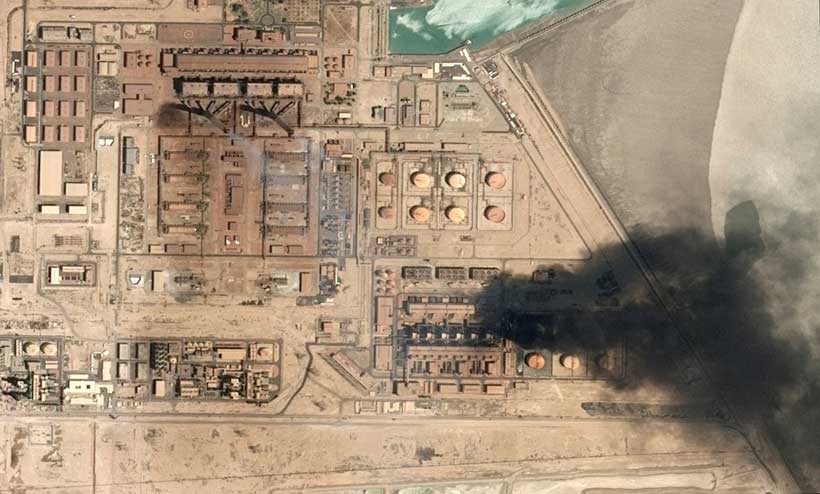
Kuwait has since the beginning of the Iran War in February been targeted by Iranian drones and missiles 1,400 times. Why has this state—smaller than the US state of New Jersey—been targeted more than any of its larger neighbors including Bahrain, Qatar, and the United Arab Emirates?
A military node
This question takes us all the way back to 1991 when the US intervenes when Iraq under Saddam Hussein invades Kuwait. In return, Kuwait has since hosted one of the the largest US armies in the Middle East of 13,000 troops, and has the fourth biggest deployment of the US military globally. Furthermore, Kuwait is one of five U.S. Army Prepositioned Stocks (APS) sites across the world— a cornerstone of the US’ global military strategy as it allows for rapid deployment and display of influence. And not only does Kuwait not charge the US for its land use, or restrict US troop movements on its territory—unlike most other host countries—but indeed pays the US for its troop presence, and subsidies energy and water costs for the military bases.
A geostrategic asset
Stay ahead of the geopolitical week.
MD Briefing delivers expert analysis across five global fronts — the Indo-Pacific, energy, geoeconomics, European security, and the Middle East — every Monday morning. Free.
In exchange, Kuwait’s geostrategic location on the Arabian peninsula and along the air corridor between Asia and Europe makes the country an important location for the US to secure its interests and exert influence in the region and beyond. Indeed, the US has designated Kuwait as a Major Non-Nato Ally since 2004, and has located its biggest air logistics facility in the Middle East in conjunction with Kuwait international airport. Thus, Kuwait has proven a key logistical hub for US military operations in the region including against the Islamic State and during the withdrawal from Afghanistan in 2021.
Furthermore, Kuwait holds 7% of the world’s oil reserves, reinforcing its importance for the US and other oil consuming countries, while also making it strategically vulnerable to Iranian attacks on energy plants in late July, as this adds to the ongoing energy insecurity created by the closure of the key oil trade route through the Strait of Hormuz.
The end of diplomatic balancing?
Despite these far-reaching strategic links with the US, Kuwait has long maintained a diplomatic balancing act, refusing to normalise relations with Israel while simultaneously refraining from condemning the Iranian regime. Moreover, Kuwait has often assumed the role of neutral mediator in the Middle East. For example, Kuwait mediated the 2021 rapprochement between Qatar, Saudi Arabia, Bahrain, the United Arab Emirates and Egypt, and has contributed to peace efforts in Yemen. In addition, Kuwait has been much more cautious in its statements concerning the Iranian regime, unlike its vocally critical, yet less targeted neighbors such as the United Arab Emirates, and has even refused to allow the US to use military bases in Kuwait for launching attacks on Iran.
Geographic liabilities
Even so, Kuwait has fallen prey to its geography. For one, its geographical proximity to Iran makes Kuwait a comparatively cheap and easy target for Iranian missiles, while its lack of naturally occurring fresh water and consequent reliance on desalination provides Teheran an additional pressure point, as illustrated by Iranian attacks on desalination plants in late July. Furthermore, its proximity to Iraq has exposed it to attacks by Iraqi Shia militias, allied with Teheran.
And the risk of further attacks in the future is high. On 1 August, Iranian Foreign Minister Abbas Araghchi declared that it would react ”decisively” against any US strikes, and warned Gulf states against permitting the US and Israel to use bases on their territories to launch attacks against Iran. Similarly, Iraq announced that its military forces stood ready to ‘thwart any attempts at targeting neighbouring countries within our regional sphere.’ Thus, recent developments suggest that Kuwait might no longer be able to remain an independent diplomatically oriented actor that can stay out of the conflicts in the Middle East.
Ideology
While Iran’s official rationale for the attacks has been to target US military targets and assets, the attacks on energy and desalination plants are neither; these are civilian infrastructures. Hence it is Kuwaiti civilians—not the US military capacity—that bear the brunt of the attacks. This suggests that Iranian attacks have not only immediate military objectives in context of the current war, but also underlying psychological and ideological motives, as these attacks can be seen as a way of scaring countries that go against Iran’s exhortations—reiterated since 1979–to its Gulf neighbors to cut ties with the US. In addition, the attacks expose the limitations of US security guarantee, and undermine the credibility of the US promises of stability and protection to its allies.
A change of strategy
Consequently, Kuwait may pivot toward building up more national military defence capabilities, as the deterrence guarantee that the well-accommodated US presence was supposed to provide has ostensibly failed, while Kuwait’s lack of domestic military resources to retaliate further enticed Iranian attacks.
Hence, it appears that the security order in the Middle East is set to become even more fragile, with the US increasingly proving incapable or unwilling to ensure what has long been considered a stabilising presence, and with regional actors increasingly divided and polarized, making neutral mediation harder.