Kuwait has since the beginning of the Iran War in February been targeted by Iranian drones and missiles1,400 times. Why has this state—smaller than the US state of New Jersey—beentargeted more than any of its larger neighbors including Bahrain, Qatar, and the United Arab Emirates?
A military node
This question takes us all the way back to1991 when the US intervenes when Iraq under Saddam Hussein invades Kuwait. In return, Kuwait has since hosted one of the the largest US armies in the Middle East of13,000 troops, and has thefourth biggest deployment of the US military globally. Furthermore, Kuwait is one of five U.S. Army Prepositioned Stocks (APS) sites across the world— a cornerstone of the US’ global military strategy as it allows for rapid deployment and display of influence. And not only does Kuwaitnot charge the US for its land use, or restrict US troop movements on its territory—unlike most other host countries—but indeed pays the US for its troop presence, and subsidies energy and water costs for the military bases.
A geostrategic asset
Stay ahead of the geopolitical week.
MD Briefing delivers expert analysis across five global fronts — the Indo-Pacific, energy, geoeconomics, European security, and the Middle East — every Monday morning. Free.
In exchange, Kuwait’sgeostrategic location on the Arabian peninsula and along the air corridor between Asia and Europe makes the country an important location for the US to secure its interests and exert influence in the region and beyond. Indeed, the US has designated Kuwait as aMajor Non-Nato Ally since 2004, and has located its biggest air logistics facility in the Middle East in conjunction with Kuwait international airport. Thus, Kuwait has proven a key logistical hub for US military operations in the region including against the Islamic State and during the withdrawal from Afghanistan in 2021.
Furthermore, Kuwait holds7% of the world’s oil reserves, reinforcing its importance for the US and other oil consuming countries, while also making it strategically vulnerable to Iranian attacks onenergy plants in late July, as this adds to the ongoing energy insecurity created by the closure of the key oil trade route through the Strait of Hormuz.
The end of diplomatic balancing?
Despite these far-reaching strategic links with the US, Kuwait has long maintained a diplomatic balancing act, refusing to normalise relations with Israel while simultaneously refraining from condemning the Iranian regime. Moreover, Kuwait has often assumed the role ofneutral mediator in the Middle East. For example, Kuwait mediated the 2021rapprochement between Qatar, Saudi Arabia, Bahrain, the United Arab Emirates and Egypt, and has contributed to peace efforts inYemen. In addition, Kuwait has been muchmore cautious in its statements concerning the Iranian regime, unlike its vocally critical, yet less targeted neighbors such as the United Arab Emirates, and has even refused to allow the US to use military bases in Kuwait forlaunching attacks on Iran.
Geographic liabilities
Even so, Kuwait has fallen prey to its geography. For one, its geographical proximity to Iran makes Kuwait a comparativelycheap and easy target for Iranian missiles, while its lack of naturally occurring fresh water and consequentreliance on desalination provides Teheran an additional pressure point, as illustrated by Iranian attacks ondesalination plants in late July. Furthermore, its proximity to Iraq has exposed it to attacks byIraqi Shia militias, allied with Teheran.
And the risk of further attacks in the future is high. On1 August, Iranian Foreign Minister Abbas Araghchi declared that it would react ”decisively” against any US strikes, and warned Gulf states against permitting the US and Israel to use bases on their territories to launch attacks against Iran. Similarly,Iraq announced that its military forces stood ready to ‘thwart any attempts at targeting neighbouring countries within our regional sphere.’ Thus, recent developments suggest that Kuwait might no longer be able to remain an independent diplomatically oriented actor that can stay out of the conflicts in the Middle East.
Ideology
While Iran’s official rationale for the attacks has been to target US military targets and assets, the attacks on energy and desalination plants are neither; these are civilian infrastructures. Hence it is Kuwaiti civilians—not the US military capacity—that bear the brunt of the attacks. This suggests that Iranian attacks have not only immediate military objectives in context of the current war, but also underlying psychological and ideological motives, as these attacks can be seen as a way of scaring countries that go against Iran’s exhortations—reiterated since 1979–to its Gulf neighbors to cut ties with the US. In addition, the attacks expose the limitations of US security guarantee, and undermine the credibility of the US promises of stability and protection to its allies.
A change of strategy
Consequently, Kuwait may pivot toward building up more national military defence capabilities, as thedeterrence guarantee that the well-accommodated US presence was supposed to provide has ostensibly failed, while Kuwait’slack of domestic military resources to retaliate further enticed Iranian attacks.
Hence, it appears that the security order in the Middle East is set to become even more fragile, with the US increasingly proving incapable or unwilling to ensure what has long been considered a stabilising presence, and with regional actors increasingly divided and polarized, making neutral mediation harder.
A magnitude 5.4 earthquake struck Egypt, north of Suez early on Monday, startling a content creator during a livestream. Tremors were felt as far as Gaza, prompting residents to evacuate homes and hotels. No casualties were reported.
A HUGE US influencer has revealed her husband’s face “caught on fire” during a BBQ, and has left him with “second-degree burns”.
Rebecca Zamolo, 41, left her followers concerned after she shared the horror accident that left Matthew Yoakum, 46, badly injured.
US influencer Rebecca Zamolo has revealed her husband’s face ‘caught on fire’ during a BBQCredit: Instagram/rebeccazamoloThe social media star revealed her husband had ‘second degree burns’Credit: Instagram/rebeccazamolo
The social media star shared a slew of photos which included how her husband’s face looked after it had been burned.
Posting the pics on Instagram, the mum-of-two penned: “For those who don’t know, Matt’s face caught on fire at our BBQ and it gave him ‘2nd degree superficial burns’.
Sign up for the Showbiz newsletter
Thank you!
“It was hours before our flight to Hawaii to celebrate his birthday so he has been healing here. (He still wanted to go).
“It was a scary incident for all of us, and a reminder how precious life is.
Rebecca revealed that Matt needed ‘time to heal’Credit: Instagram/rebeccazamoloThe Influencer is looking after her husband on holiday in HawaiiCredit: Instagram/rebeccazamolo
“Thank you to everyone that has reached out and friends that are in the medical field and put him on a good path to heal.
“He’s extremely lucky as it could have been a lot worse, but we are taking it day by day. We love you Matt.”
Rebecca’s followers immediately rushed to share their concern, with one writing: “Omg. That is horrible. So happy he’s okay.”
While another added: “Sending love & prayers.”
A third worried fan wrote: “This is awful! Get well soon Matt!”
Rebecca is a huge influencer, with 3.3million followers on Instagram and over 30million on YouTube.
The star is known for her family orientated content, which often includes Matt and their two kids, Zadie and Xander.
Brits who hold two passports can no longer use their foreign document to enter the countryCredit: AlamyThe change was predicted to affect around 1.2million BritsCredit: Alamy
These passport rules came into play in February and mean that British nationals have to carry a valid British passport to return to the UK.
They can no longer use their foreign passport to enter the country.
Sign up for the Travel newsletter
Thank you!
An alternative is to have a “certificate of entitlement” costing £589.
Despite being in place for five months, the new rules have been catching people out.
Colette Bjorn-Alderson, who has lived in the UK for 28 years, had been in the Danish country since April, but was returning to the UK with her six-week- old and 23-month-old for a wedding.
However, her two children only had Danish passports which meant they didn’t have valid travel documents for returning to the UK.
She told The Times that she felt “unwelcome in my own country” after being turned away from the flight.
Colette sent photocopies of her documents to the Home Office – but ultimately the decision was made that the family could not fly.
This important question can easily cost holidaymakers extra cash
Tourists need to pick this option when paying for items abroad to avoid ‘hidden fees’(Image: Getty)
People going on holiday this summer should know this simple money mistake to avoid as it could needlessly cost you more without realising. The ‘rule’ to remember is very simple, according to money and travel experts.
Travel specialist Kate Donnelly (@Thedonelleyedit) claims that all British people heading abroad this summer should remember one important thing that could result in hidden fees when on holiday. She said that we all have the option to avoid these, even if the choice seems clear and convenient.
She said: “When you are abroad, you should always pay in the local currency. Whether that’s euros or dollars, depending on where you are, and you should never select the option of paying in Great British Pound (GBP).”
Why does it matter what you choose?
Whether you’re buying a meal or using a cash machine, you should always have the option to pay in local currency instead of DCC. Nobody should choose on your behalf.
Content cannot be displayed without consent
Kate confirmed: “When you’re abroad, and you choose to pay in pounds, you are allowing the ATM or the shop to do the exchange. Within this, there will also be a conversion charge, which is notoriously a really poor rate, meaning you will end up paying significantly more if you pay in the local currency.
“It’s your bank or the card provider that does the exchange. Even if they add on a transaction fee, you are still going to be getting a better rate if you choose to pay in pounds.”
Choosing dynamic currency conversion (DCC) means the amount is converted from the local currency to pounds at the point of sale. But, “DCC usually costs you more”, according to HSBC.
The bank said: “You might choose DCC and pay in pounds because it’s a currency you’re more familiar with. It could give you a better understanding of how much you’re spending. But there are extra fees, and the exchange rate is usually higher.”
Kate added: “The best thing to do when going on holiday is to invest in a fee-free card, such as a Monzo or a Starling. They add no transaction fees, and they also offer the best exchange rate.”
Martin Lewis previously appeared on ITV’s This Morning to talk about this exact issue. He said that the best thing to do, wherever you are in the world, is to pay in local currency to avoid inflated fees.
Anyone who’s jetting off this summer will want to know about a fairly new safety rule that you must follow when you’re on board.
01:48, 25 Jul 2026Updated 08:22, 25 Jul 2026
Several airlines enforce the little-known rule(Image: Getty Images)
Going on holiday is always an exciting time, but there’s a lot of reasons that they can be stressful too. For many people, the flight itself is a source of anxiety, while others aren’t keen on the packing, the security process or the bag regulations.
I love a trip abroad, and although I can sometimes get nervous during takeoff and landing – as I’m sure many people do – I try to push it aside because I know there’s a holiday waiting for me at the other end.
If I can afford it, I’ll go on two or three holidays a year, so I like to think I’m pretty savvy when it comes to knowing what to pack, how big your bag can be, and just having a general know-how about the process. But on my most recent holiday, I was shocked to hear a safety announcement onboard that I’d literally never heard before, and it really threw a spanner in the works.
Picture the scene – it’s 5.30am, I’ve had three hours of sleep, two coffees down in Manchester Airport and I’m about to board my flight to Bilbao. Because I’ve desperately been trying to keep myself awake, I’ve been scrolling endlessly, so by the time I’m sat in my seat, my phone battery is looking a little unhealthy.
Luckily I’ve got a portable charger in my bag, ready to give my phone a much-needed boost. It’s been a rule for a while now that you can’t pack these in your checked luggage due to the potential danger from lithium ion batteries, but it’s always handier to have them in your hand luggage anyway.
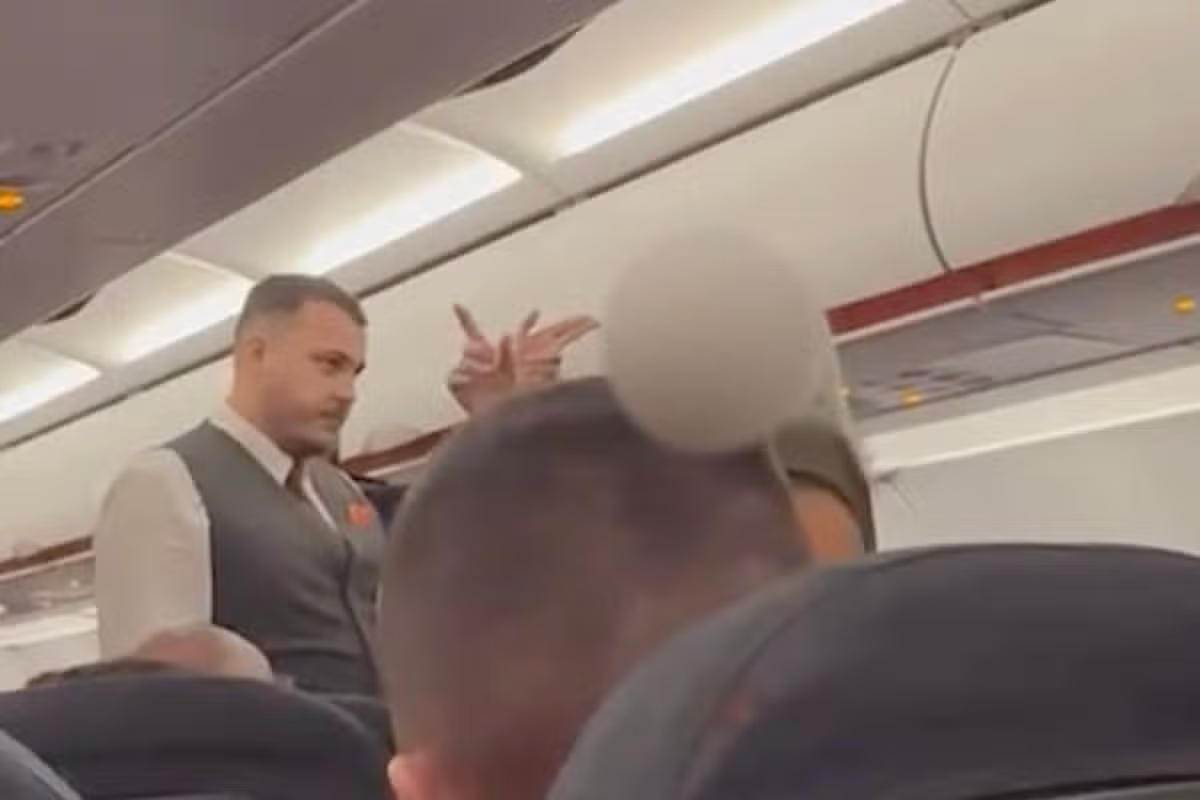
But as the safety announcements kicked off, I was very surprised to hear that on this easyJet flight, you couldn’t use portable chargers at all.
Why can’t you use portable chargers on flights?
This was the first I’d heard of power banks being completely banned from use onboard flights. However, it’s clear to see in the ‘dangerous goods’ section of the easyJet website, which says they can’t be used to charge other devices.
They also must be ‘individually protected’ like placed in original retail packaging or a plastic bag, and customers are only allowed a maximum of two each.
Explaining why the rules are so strict, Jonathan Nicholson from the Civil Aviation Authority told BBC News that compared to the likes of digital cameras and laptops, “power banks have a much bigger battery, much stronger and get a lot hotter”.
“These things, when they catch fire, they go – they really go – they are big, big issues and big fires,” he added.
This makes total sense, and it obviously explains why most airlines have banned portable chargers in hold luggage – it was only a matter of time before they were banned from being used on planes too.
It’s worth noting that they are not outright prohibited – you just can’t use them, on easyJet flights anyway. So it’s definitely worth making sure you’re fully charged before you board, and don’t make the same mistake I did.
Which airlines have banned power banks?
As well as easyJet, several other airlines have started to enforce strict rules surrounding power banks. British Airways recently tightened its regulations – they must display the capacity rating information, they can’t exceed exceed 100Wh and they must be stored either in the seat pocket or in a bag placed under the seat in front.
Emirates has outright banned the use of power banks on all flights, nor can you plug the power bank into the seat’s power supply to charge it.
Most other airlines, such as Ryanair, Jet2 and TUI, do allow you to use them on board – just not during taxi, takeoff and landing, and restrictions can apply on the wattage. And you’re definitely not allowed to pack them in your hold luggage under any circumstances.
It’s recommended to check with the airline you’re flying with if you’re not sure, but always better safe than sorry.
Built in 1875 and modelled on the Chapelle Saint-Marc in Lyon, the church was originally intended to be the chapel for St Joseph University, which was opened by French Jesuits as part of France’s colonial-era “civilising mission”.
Its pale stone facade rises above a busy Beirut street. Today, it remains under Jesuit stewardship, with Father Michael Petro leading the parish.
“It’s an interesting space, because it is on the edge of Ashrafieh, a predominantly Christian, francophone area, which has plenty of wealthy Lebanese people living in it. But it also has their domestic workers. From the start of the first waves of migrants in the 70s, this place became known as a place for them,” he tells Al Jazeera.
Every Sunday, during peacetime, the gravel car park is transformed into a cricket ground. Indian and Pakistani migrant workers play softball cricket while families sit on the sidelines sharing home-cooked food, catching up with friends and enjoying one of their few days away from work.
Today, the atmosphere is very different.
Instead of the crack of a plastic bat and Bollywood music spilling across the church grounds, rows of mattresses line the floors, and laundry hangs from railings. Men slouch on plastic chairs littered around the church, scrolling through their phones. Women carry blankets and washed clothes in plastic tubs. Only the children seem able to break the subdued mood, darting between adults and filling the space with bursts of laughter.
“When the war escalated, we immediately had large groups of Sudanese and South Sudanese come here,” Father Michael says. “They showed up because they would ask community leaders what to do, and were told to come here, as it is the first place they trusted.
“On one hand, that’s very beautiful, because people thought they would be welcome here, and they were.”
However, the strain of being a first port of call for so many displaced migrants is beginning to show.
Supplies are low, and tensions occasionally flare among those sheltering at the church. Father Michael says the church reached its capacity of 250 people on just the second day of the war.
“We’ve turned away more than 100 people in the last few days,” he says. “It’s a disaster.”
Mohammad says daily life has become increasingly difficult, particularly since the arrival of their son.
“We do not have enough clothes, especially now that the baby is growing. Also, my wife’s nutrition is not great. Sometimes she gets constipated, and then the baby becomes ill. We need more protein and vegetables. The diet is a huge concern.”
Living in crowded conditions, surrounded by uncertainty, has taken a toll on people’s mental wellbeing, Rufaida says.
“Because of the atmosphere and mental health problems, small problems become big ones. I said good morning to someone, and they didn’t like it. There are no big fights, but there is an underlying tension.”
Both say they understand why tempers sometimes fray. Many of those sheltering at the church have fled war, lost homes and spent months or years living with uncertainty.
Small problems become big ones.
by RUFAIDA, DISPLACED SUDANESE MOTHER
Their gratitude is rooted partly in what happened when Rufaida sought maternity care.
At Karatina Hospital, they say they were repeatedly overlooked by doctors in favour of Lebanese patients. “We were there to get papers so she could give birth in that hospital, but we were ignored, and Lebanese people were allowed into consultations first,” Mohammad says.
After waiting for three hours, a worker from the Jesuit Refugee Service (JRS), who had accompanied them to the hospital, intervened and helped ensure they were seen.
Through support coordinated by JRS and partner organisations, the entire cost of Rufaida’s pregnancy was covered, including prenatal care, the cesarean delivery and Ahmad’s vaccinations.
“It gave me comfort and peace that I was able to deliver in a safe environment,” Rufaida says.
Their experience is increasingly common among Sudanese migrants in Lebanon, many of whom have found themselves uprooted more than once — first by war in Sudan and then by conflict in Lebanon.
Rufaida’s story is far from unique. According to figures published by the International Organization for Migration (IOM) in August 2025, there are 164,097 migrants living in Lebanon, of which 14,854 are Sudanese nationals.
That number represents only a small fraction of the 4.4 million Sudanese who have fled their country since the outbreak of civil war in April 2023.
Some, like Rufaida, arrived on tourist visas. Others found jobs as concierges or domestic workers, under Lebanon’s kafala sponsorship system, which ties a migrant worker’s legal residency to their employer.
About 3,800 Sudanese have also found asylum in Lebanon as registered refugees with the UN Refugee Agency.
For refugees in Lebanon, a UNHCR registration card can mean far more than a piece of paper. It offers a measure of protection from detention or deportation, can unlock access to aid and education where services exist, and, for many, represents their best hope of one day being resettled in another country.
A leopard storms into a store in Rajasthan, India, attacking an employee and causing panic. The leopard was trapped, tranquilised and returned to the wild.
Chris, 34, was holidaying in Salou when he filmed the video. He said that some people had been in the queue for an hour
Manic tourists race for sunbeds at Spanish hotel
Holidaymakers were filmed in a “manic race” for the prime sunbeds surrounding the pool at a Spanish hotel — after queuing for an hour. Chris, 34, was on holiday in Salou, Spain, last week when he witnessed the spectacle unfold on June 24, as over 40 tourists rushed out.
The holidaymakers had been standing by the doors for an hour before the pool opened at 9am. Chris, from Glasgow, Scotland, said he observed the sun-seekers lining up at the doors on each day of his week-long break.
He said tourists would dash out, reserve a sunbed with their towel and belongings before heading back inside for breakfast. Chris found the spectacle amusing but thought it was somewhat unfair that nobody else would manage to get a sunbed for the entire day.
Chris, from Glasgow, Scotland, said: “It was a manic race and scramble for the sunbeds surrounding the pool at the hotel. I don’t judge but found it funny so had to film it.
“Some people just rolled out their bed, queued up, mad-dashed to secure the bed then they were seen going back to their hotel rooms or off for breakfast.”
“It doesn’t leave room for those who don’t queue for an hour.”
It was midnight on April 12 when Modu Baluye woke to the sound of gunfire.
He was asleep with his family inside a classroom at Government Girls’ Secondary School (GGSS), in Monguno, Borno’s north, in northeastern Nigeria, which now serves as a temporary displacement camp, when the first shots rang out. Then came another burst, and another, cutting through the night in rapid succession.
“These people are attacking again,” he remembered saying.
He whispered a prayer and stayed awake. Around him, other displaced families were stirring as well. In the darkness, people listened without speaking, measuring the distance of the violence by the sound of the guns. The attack went on for hours.
By Modu’s account, the gunshots lasted about four hours. He later learned it was a gun battle between terrorists and military officers at the nearby Sector 3 base. As the troops pursued the terrorists along the exit route between Gana Ali, another displacement shelter, and the GGSS, they drove over buried explosives, which detonated and killed the commanding officer and six other soldiers.
By morning, fear had settled over the communities.
The military, residents said, became suspicious of the settlements around the base. The attackers had entered on foot under the cover of darkness, and the communities were not far from the military formation.
“They suspected we were hiding some of them,” Modu said. In the days that followed, soldiers raided Gana Ali and the GGSS camp. Residents told HumAngle that five suspected informants in the communities were arrested, and weapons were recovered. Then came an order for the communities to leave.
“They told us: leave or we will kill you all and burn down your houses,” Modu recounted. Within two days, families began dismantling their makeshift shelters. They packed what they could carry and left. Some were moved to a government settlement on the outskirts of Monguno, along the Monguno-Gajiram road, which is about a 30-minute walk from town.
“It is two weeks today,” Modu said when he spoke to HumAngle on May 10. “The place was torched after we left. I am not sure who torched the buildings.”
For Modu, displacement is not new. He fled Ala, his village in the Marte Local Government Area (LGA) of the state, in 2016 as insurgent violence spread across northern Borno. At the time, he was unmarried and found refuge with his parents at the ‘Water Board’ displacement camp in Monguno, where they lived for about six months. He later moved to the GGSS settlement after securing his own shelter and spent nearly a decade there. In 2024, he got married. By the time soldiers ordered residents to leave the community in April, he had begun building a mud house on a piece of land he purchased the previous year. It was there, in the unfinished house, that he and his family began rebuilding their lives after years of displacement.
A war returning to the bases
The Monguno attack came during a renewed wave of terror assaults on military formations and rural settlements across Borno.
File: A military patrol vehicle with personnel parked outside a Civilian Joint Task Force office in Maiduguri. Photo: Kunle Adebajo/HumAngle.
In recent months, terrorists from Jama’atu Ahlis Sunna Lidda’awati wal-Jihad (JAS), commonly known as Boko Haram, and the Islamic State West Africa (ISWAP) have repeatedly targeted troops, bases, weapons, and supply routes. The attacks have killed soldiers, including senior military officers, and Civilian Joint Task Force (CJTF) members.
In Nov. 2025, terrorists ambushed a military convoy along the Damboa-Biu road. Two soldiers and two CJTF members were killed. Brigadier-General M. Uba, commander of the 25 Task Force Brigade, was abducted and later killed.
On Jan. 26, terrorists attacked a military base in Damasak, killing seven soldiers and capturing 13 others, including the commanding officer. Eleven later escaped. Five days later, on Jan. 31, another terror attack on an army base in Sabon Gari killed nine soldiers and two CJTF members; about 16 injured security personnel were evacuated for treatment.
On March 10, a military base in Kukawa came under attack; the commanding officer, Lt. Col. Umar Farouq, and several of his soldiers were killed.
On April 9, three days before the Monguno attack, terrorists launched a joint assault on the headquarters of the 29 Task Force Brigade in Benisheikh, killing its brigade commander, Brigadier-General Oseni Braimah.
The attacks have already weakened the military formations in rural areas. In some places, troops have withdrawn or consolidated around larger garrison towns, leaving smaller settlements more exposed. But when soldiers are killed, residents say the anger does not end on the battlefield. It returns with the troops.
The Nigerian Police officers at the scene of an explosion at the Maiduguri Monday Market in March. Photo: Al’amin Umar/HumAngle.
The trails of suspicion
In rural Borno, civilians are often trapped between two armed powers. Terrorists demand information about troop movements, military positions, and security operations. Soldiers, in turn, demand information about insurgent hideouts, movements, and informants. Refusing either side can be deadly.
Those suspected of helping the military may be abducted or killed by the terrorists. Those suspected of helping terrorists may be arrested, detained, displaced, or punished by security forces. As a result, civilians often face impossible choices, with serious consequences regardless of whom they cooperate with.
Get our in-depth, creative coverage of conflict and development delivered to you every weekend.
Subscribe now to our newsletter!
Despite these risks, communities have at times provided intelligence to the military. In March, for example, residents of Doro, a rural community in Kukawa LGA on the shores of Lake Chad, reportedly alerted troops after observing suspicious insurgent movements, helping security forces prepare for an attack.
The consequences of such actions can be severe. In March 2022, ISWAP executed four civilians in communities within the same local government area after accusing them of spying for government troops. Residents said the killings were intended to deter others from sharing information with security forces. For many civilians, the message was clear: speaking to the military could carry a death sentence.
The Chief of Defence Staff (CDS), Gen. Olufemi Oluyede, recently argued that residents in Borno and Yobe knew some of those behind the attacks during an operational visit to Maiduguri in March, reflecting a long-held security assumption that residents in affected communities often know more than they admit. The CDS said communities must take ownership of the crisis, citing Kukawa, where he claimed two of the attackers were from within the village.
But for many civilians, knowing does not mean consenting. They say in places where terrorists move freely, buy food, collect supplies, and threaten residents, silence is often a currency for survival.
Professor Abubakar Mu’azu, former director of the Centre for Peace, Development, and Diplomatic Studies at the University of Maiduguri, said this suspicion has existed since the early years of the insurgency.
“Right from the start, there was suspicion by the security agencies that the people who are living in areas where these terrorist activities were happening are also supporting the terrorists,” he said. “They never considered the fact that there is a majority of people who disagree with these terrorists’ activities.”
Mu’azu said the reactionary nature of security operations has prevented the military from building a reliable system of trust with local communities.
“They assume that the locals are giving information to the terrorists willingly,” he said. “But they keep saying they want the people to give them information about the terrorists.”
For him, this contradiction is at the heart of the crisis.
The military needs civilian intelligence to fight terrorism, but if civilians fear that any contact with terrorists, even under duress, will be treated as collaboration, they may stop speaking altogether.
File: Men seated, playing a game on a smartphone in an IDP camp in Maiduguri. Photo: Usman Abba Zanna/HumAngle.
Life under duress
In Monguno, residents say terrorists still move in and out of town despite the presence of security forces.
Koso Abubakar, a displaced farmer, said the terrorists often enter on motorcycles, buy food items, and leave.
“They come and leave at will,” he said. “Sometimes, they come to kidnap people. They don’t attack the military, and the military does not confront them. But on other days, they attack the military. That is when the military retaliates.”
According to Koso, most residents live with the knowledge that they can be accused by either side at any time.
“People are living in fear because everyone is a potential target,” he said.
In many rural communities, even work has become dangerous. A farmer going to his field, a fisher heading towards the water, or a trader moving goods through bush paths may first have to pay those who control the routes. The payments are called taxes, levies, or sometimes simply “settlement”, but residents understand what they are: money paid under fear. To refuse is to risk punishment, in lighter cases, or killing and abduction, in extreme cases, from terrorists. To pay is to risk being seen by soldiers as someone sustaining the insurgency. In this way, even the small acts people perform to feed their families can become evidence against them.
Farmers handing over money to armed and masked terrorists in a rural setting. Illustration: Akila Jibrin/HumAngle.
Professor Mu’azu said this fear terrorists use violence to discipline communities.
“They are very good at setting a very deadly example by killing or eliminating people, with or without evidence,” he said. “If they are attacked by security agencies and they did not hear anything from people living in these settlements, they would assume the people gave information about their positions.”
This was what many residents believe happened in Ngoshe in March, when terrorists attacked the community, killed many residents, and abducted others, including women and children. The attack was suspected to be retaliation for a previous military operation in the Mandara Mountains that killed some terrorist commanders. The terrorists reportedly believed residents had given up their location.
For civilians, the lesson is brutal: giving information can kill you. Not giving information can also kill you.
When protection becomes punishment
The military has long accused some civilians of aiding terrorists. In the early years of the war, many young men were arbitrarily detained. Some disappeared. Some were killed. In April 2014, soldiers arrested 42 adult men from Gallari, a village in the Konduga LGA of Borno, on suspicion of links to the insurgency. They were taken to the Giwa Barracks detention facility in Maiduguri. Twelve years later, only three have regained their freedom after years in detention and alleged torture. Through months of on-the-ground investigation and analysis of satellite imagery, HumAngle has also previously reported on disappearances and mass graves linked to military operations, while the wives of detained and disappeared men later formed the Knifar Women movement to demand justice.
Terrorists and suspected civilian collaborators arrested by the military. Illustration: Akila Jibrin/HumAngle.
For communities already carrying the memory of those years, new raids and forced evacuations reopen old wounds.
Mu’azu said security forces should approach communities with more care, especially when allegations of collaboration arise.
“One would assume that when security forces are dealing with situations like this, they would not come with the mindset that the people are sympathetic to the terrorists, or that all the people are giving information to the terrorists,” he said.
He added that soldiers have a difficult job and deserve sympathy for the burden they carry. But he argued that this does not justify indiscriminate punishment.
“They are the ones who are supposed to protect the civilians,” he said. “If there are people they suspect, they should arrest them and hand them over to the police for proper investigation, without compromising the little support they have in the community.”
When communities are burned or displaced after attacks, the consequences go beyond the immediate loss of shelter. Food stocks disappear. Children are pulled out of school. Families scatter. People who had already fled violence once are forced to flee again.
In resettled or displaced communities, where people have spent years coping, another displacement can mean the collapse of everything they had slowly rebuilt.
A dangerous silence
After the Monguno raid, Koso said some residents became so afraid of the military that they fled into the bush.
“Many people, about 30, also left for the bush,” he said. “Most of them fear the military. The military does not trust them.”
Mu’azu warned that this kind of fear can damage counterterrorism efforts.
“They will lose trust, respect, and block chances of receiving information,” he said. “This could also push them to be recruited by the terrorists.”
For Mu’azu, the solution is not to abandon intelligence work, but to make it safer and more systematic. He said the military should cultivate trusted informants within communities, create secure channels of communication, and protect residents when terrorists retaliate.
“This is the gap,” he said. “Oftentimes, communities are attacked after successful military operations. The patterns should be studied. They should do a statistical analysis. They should be mindful of the time and be prepared against such actions.”
He also called for stronger collaboration among the military, DSS, police, civil defence, and intelligence agencies in neighbouring countries such as Cameroon, Chad, and Niger, because terrorists move across borders.
But for Modu and others displaced from Gana Ali and the GGSS, these policy questions remain distant. What they know is simpler: they fled one danger and met another. They were told to leave the place they had made into a home. Then they watched, or heard, that what remained had been burned.
In Borno’s war, civilians are often asked to prove their loyalty to the state while surviving under the shadow of terrorists, and in that narrow space between fear and suspicion, many are losing everything.
The last time Abdullahi Alabi heard from his friend, Oluwafemi Adeyemo, it was a voice note. “I dey Terminus… I sey make I update you,” his friend said in Nigerian Pidgin. He was restocking his foodstuffs at the market, but he never came back.
Abdullahi and Oluwafemi had been friends and coursemates since they came on campus. “We became brothers, I knew his family, he knew mine,” Abdullahi said.
Two days before that, on March 29, terrorists had opened fire on residents and passersby at Angwan Rukuba, a busy roadside community in Jos, Plateau State, North Central Nigeria, killing at least 30 people. The Plateau State government immediately clamped a 48-hour curfew on Jos North, the kind of precaution the city has learned, through painful experience, to take, given how quickly such attacks can tip into ethno-religious reprisal violence.
When the curfew lifted on April 1, Oluwafemi, a final-year Quantity Survey student at the University of Jos (UNIJOS), had just received his upkeep allowance from the Nigerian Education Loan Fund (NELFUND). He headed to Terminus Market that morning, a 15-minute tricycle ride from where he and Abdullahi lived, to buy foodstuffs.
What made Abdullahi check his phone that morning was hearing that something was happening around Terminus. He wanted to know if his friends were alright. That was when he saw the voice note.
“I actually did not take it that seriously,” he said. But as the updates on social media got worse, he started calling. Oluwafemi’s number was not going through. He and other friends kept trying.
By evening, Oluwafemi had not returned and was still unreachable. Abdullahi called the family, who said he had not been in touch with them either. “I took permission from the family to file a missing person report, and we also made a post on social media,” he said.
Then another of Oluwafemi’s friends reached out. She sent Abdullahi a screenshot of her last chat with him. He had told her there was a fight at Terminus, that he had escaped, and that he had made it to Bauchi Road, near the university’s Main Campus. After that, nothing.
The university’s Bauchi Road Campus (also known as the Main Campus) is located along Bauchi Road and is surrounded by volatile communities in the Angwan Rogo area. Map: UNIJOS Navigation Aid.
The next day, Abdullahi and other friends went from one police station to another. On the third day, they started checking mortuaries. That afternoon, a call came asking them to come to the Jos University Teaching Hospital to identify a body.
“When we got there, it was his body,” Abdullahi said, with a sigh. “He was attacked at Bauchi Junction. According to the autopsy, he sustained a gunshot wound to his back and was macheted as well.” He added that they were told that the police officers who brought his corpse to the hospital had intervened. The identities of the perpetrators remain unknown.
Oluwafemi was one of at least eight people killed in reprisal attacks that swept through Jos on 1 April, after the night of terror at Angwan Rukuba took on an ethno-religious colouration.
“Femi was ready to make a change in the world,” Abdullahi said. “A few days before his death, he sent a voice note in a group lamenting about how Nigeria is bad and what he thinks needs to be done to fix the challenges.” He never got the chance.
A portrait of Oluwafemi Adeyemo.
In that same voice note, obtained by HumAngle, Oluwafemi turned his frustration toward the government’s response to the recurring violence. Precautions like curfews, he said, were not enough. “What has curfew done?” he asked. “Make we speak up, abi na until dem kill everybody finish.”
Oluwafemi is not the first UNIJOS student the city has claimed. With over 40,000 students – according to its website – living and studying in Jos’s most volatile neighbourhoods, the university community has, for more than two decades, been one of the most consistent casualties of the city’s recurring violence. And with no meaningful change in how students are protected, many fear it is only a matter of time before the next name is added to the list.
Map of Jos North showing the areas usually affected by the crisis. Map by Mansir Muhammed/HumAngle
Caught in harm’s way
To understand why Oluwafemi’s death is not an isolated tragedy, it helps to know the city he was living in. To outsiders, the speed with which violence can spread across Jos often appears bewildering. Yet the city has endured recurring cycles of conflict for more than two decades, fuelled by a complex mix of ethno-religious tensions, disputes over indigene-settler identities, political representation, land ownership, and access to resources. While many incidents are framed as clashes between Christians and Muslims, residents and researchers have long argued that the roots of the conflict run deeper than religion alone.
“…as is often the case with identity conflicts in Africa, these are socially constructed stereotypes that are manipulated to trigger and drive violence in Jos,” said Prof. Chris Kwaja, a Researcher at the Centre for Conflict Management and Peace Studies at the University of Jos, Nigeria, who also serves as the Plateau State’s Special Envoy on Peace and Security.
“The ethnic or religious dimensions of the conflict have subsequently been misconstrued as the primary driver of violence when, in fact, disenfranchisement, inequality, and other practical fears are the real root causes. Capitalising on such conditions, many political rivals have instrumentalised the ethnic and religious diversity of Jos to manipulate and mobilise support. Each outbreak of violence worsens suspicions and renders communal reconciliation more difficult, deepening the cycle and further incentivising polarisation,” he noted.
Over the years, many neighbourhoods have become identified with particular ethnic and religious communities, creating a city that is deeply polarised along social and geographic lines. Areas such as Angwan Rukuba, Terminus, Bauchi Road, and other mixed communities often function as fault lines where residents from different backgrounds live, trade, commute, and study side by side. When violence breaks out, fear, rumours, and reprisals can quickly travel beyond the immediate scene of an attack, drawing in people who had no connection to the original incident.
For students of the UNIJOS whose campuses, hostels, and daily routines are woven into these communities, that vulnerability is particularly acute. A journey to class, the market, or a friend’s place can suddenly become dangerous when the city descends into unrest.
Map of Plateau State showing Jos North. Illustrated by Mansir Muhammed/HumAngle.
Until his death, Oluwafemi was studying quantity surveying at UNIJOS. Photo: Johnstone Kpilaakaa/HumAngle.
Jos North is where most of the university’s campuses sit, including the Township Campus, Bauchi Road Campus, Naraguta Campus, the Jos University Teaching Hospital, staff quarters, and other facilities. Student hostels, both university-owned and private, are scattered all across the area. Angwan Rukuba, where the March 29 attack happened, is one of the neighbourhoods with the highest concentration of students. Meanwhile, Terminus Market, which borders it, has long been an epicentre of violence in the city.
Get our in-depth, creative coverage of conflict and development delivered to you every weekend.
Subscribe now to our newsletter!
Several residents and students who spoke to HumAngle said the university community is always caught in the middle when violence breaks out, which is hardly surprising, given how deeply the campuses and student hostels are woven into those areas.
Although no comprehensive data exists on the total number of students killed across incidents, HumAngle’s research — drawing on interviews with students and staff, as well as archival news reports — indicates that at least five students have died in every major episode of violence, and often significantly more.
In 2018, Shedrach ‘Kums’ Fenan, a 300-level Law student, was shot and killed by a stray military bullet near the Students’ Village Hostel during a similar crisis. That same year, the bodies of several students were found floating in nearby rivers.
Plangna’an Daor, who studied law at UNIJOS and now works as team lead of the post-conflict rehabilitation and recovery desk at the Plateau Peacebuilding Agency, knew Kums personally.
“I still remember how we were all glued to social media, checking on friends in different parts of Jos, asking questions and trying to understand what was happening,” she told HumAngle. “Imagine finding out that the student was someone you knew personally, someone with immense potential.” As an executive leader of the National Association of Plateau State Students at the time, she travelled with other students for the burial. “It was a stark reminder that students are not merely observers of conflict; they can become direct victims of it,” she said.
Aondona Kwaghaondo, a medical student at the university, almost lost his life when a mob attacked him in August 2021, along the Bauchi Road near the Naraguta Hostels, which sits between major university communities. “It was a very traumatising experience; till this day I am a bit triggered by similar sights and sounds,” he said. Aondona survived, but he sustained several injuries from the attack.
The Bauchi Road route, where Aondona was attacked in 2021, is just beside the highway. Photo: Johnstone Kpilaakaa/HumAngle.
During one of the crises, while she was a student, Plangna’an lived off campus near Dariye Park, barely 100 metres away from the main gate of the Naraguta Campus. “I remember the tension of that period vividly,” she said. “We could hear gunshots at night and constantly monitored developments around us.”
The fear was not abstract. During that same period, Plangna’an narrated that a young man attempting to reach Bauchi Road Junction was stabbed after ignoring a neighbour’s warning and was brought to her compound, where a medical student provided first aid before he could be taken to the hospital. “The atmosphere was one of constant fear and uncertainty,” Plangna’an recalled. Her roommates told her, “This is not the time to sleep in a nightie. Wear trousers. Wear something that, if we have to wake up and run, you can simply get up and leave.”
She also highlights a dimension of the crisis that is easy to overlook: the particular vulnerability of students like Adeyemo, who are from outside Plateau State. “Those of us from Plateau State at least had some understanding of the context,” she said. “But imagine students who came from other states and had no understanding of the local dynamics. They arrived expecting a safe learning environment and suddenly found themselves navigating fear, insecurity, displacement, and uncertainty.” Many students, she notes, are simply unfamiliar with which areas are considered high-risk during periods of tension, and which routes should be avoided.
Prof. Lazarus Maigoro, former chairperson of the Academic Staff Union of Universities (ASUU) UNIJOS chapter, said the pattern has left the university community exasperated. “We have suffered untold damages in relation to loss of lives and property… each time there is a security breach in Jos, and as a union, we have tried to understand how the university community is always at the receiving end of each crisis in Jos,” he said.
“In spite of all the provocations, we have continued to offer community service to all, irrespective of religion, culture and tribe; the university administration has, over the years, made overtures to host communities in terms of undergraduate admissions and staff employment, yet our students and staff are killed at the slightest provocation, however far the epicentre of the crisis from the institution.”
Plangna’an, who now works on post-conflict recovery, points to structural factors that compound the danger. The communities surrounding the university include areas with high concentrations of informal settlements, illegal structures, motor parks, and markets. “Some of these spaces have become hideouts for criminals, street gangs, drug users, and other vulnerable groups susceptible to recruitment into violence and extremism,” she said. Students living off-campus must pass through these environments daily.
As Prof. Maigoro noted, the attacks not only threaten the security of life and property within the university community but also disrupt the academic calendar, causing students to spend more than the stipulated number of years to complete their programmes. “Some who were meant to spend four years will end up doing six, that is, if there are no labour union strikes,” said Liamhuan Akpenmo, a student of the university’s Faculty of Education.
For instance, Adeyemo got admission in 2019, but by the time of his death, he had spent seven years on a five-year programme, his progress interrupted by the COVID-19 lockdown and the 2021 crisis that forced the university to close.
The evacuation
When the situation following the March 29 incident worsened, the university management rescheduled the semester examinations and placed academic and related activities on hold. Prof. Ishaya Tanko, the vice-chancellor, also announced the evacuation of students from hostels, in collaboration with the Plateau State government.
In the days that followed, specifically from April 2, other state governments and private individuals began sending dozens of buses to evacuate students who were indigenes or residents of those states. More than 1600 students were reportedly evacuated by about seven state governments, including Benue, Delta, and Kaduna. Such arrangements are often collaborations with state student union groups and relevant state government ministries.
UNIJOS students living in Benue State awaiting evacuation by the state government on April 2. Photo: Johnstone Kpilaakaa/HumAngle
“It was all familiar,” said Liamhuan, a student who first experienced a similar evacuation in 2021. She and her younger sister, who is also a student, left for Benue; other students travelled as far as Lagos.
Then, even as the crisis was still unfolding, the university management announced that examinations would go ahead. “It was abrupt,” said Liamhuan. The city was not yet safe. A 6 p.m. curfew was still in effect. In one press statement issued around that time, the Student Union Government advised students to either split their journey into two legs or arrive early enough to beat the curfew. Social media was still full of missing-person posters.
“Let me state clearly that since the beginning of the crisis, no single breach of the peace was recorded on any of our campuses,” the Vice Chancellor said at a press briefing. But students like Oluwafemi, who died during the incident, were attacked in areas immediately surrounding the university, a distinction that offered little comfort to those who had lost someone.
For instance, in August 2021, at the peak of a similar crisis, a 100-level microbiology student of the university was murdered by a mob at a filling station, near Dariye Park – where Plangna’an lived – which is located adjacent to the university.
HumAngle reached out to Emmanuel Madugu, the university’s Deputy Registrar for Information and Public Relations, for comment on how the university intends to prevent casualties among students and staff. Madugu acknowledged the request and indicated that he would respond after consulting the relevant units, but had not done so at the time of publication.
An alumnus of the university with knowledge of security matters, who spoke on condition of anonymity, said there is only so much the institution can do. When students and staff are attacked outside the university environment, he noted, the university’s hands are largely tied. The responsibility, he argued, falls primarily on the state and federal governments to secure the city.
For Liamhuan, the management’s decision to continue with the session reflected a pattern she had seen before. “I prefer to leave because the school environment does not feel safe, and everywhere feels threatened. So, home is where I feel safe, and if anything happens to you, it is you and your family that will bear the burden.” She added that the situation is even more difficult for students like herself who live off campus, largely due to a lack of sufficient student hostels.
“Even those on campus are not protected,” Liamhuan added. She once lived in one of the student hostels at the Naraguta Campus before moving off campus. “Students are still attacked by mobs when they are close to the school facilities.” Aondona’s testimony confirms this. Additionally, a viral video during the recent incident showed a man who was attacked right at the entrance of the university’s Naraguta Campus, which houses the administrative building and most of the faculties and student residences.
Although armed security posts existed near university campuses around 2017 and 2018, HumAngle observed that most of those posts no longer exist, and security is now mostly provided by unarmed officers of the university’s Security Division. More recently, through the Tertiary Education Trust Fund, a police station was constructed at the Naraguta Hostels Gate, along the Jos-Bauchi Road, but students say it is insufficient.
Entrance of the student hostels at Naraguta Campus, where Adeyemo lived. Photo: Johnstone Kpilaakaa/HumAngle.
When HumAngle visited the campus in June, no police officers were seen on the grounds, but an unarmed Security Division security guard was at the gate.
For Abdullahi, authorities do not need to wait for violence to break out before they start mapping how to protect the students and the rest of the university community. “If there are checkpoints at flashpoints like Bauchi Road, when a crisis starts, there will be an immediate response, ensuring that killings are avoided,” he said, adding that surveillance cameras can also be installed.
During a condolence visit to Plateau State after the March 29 attack, Nigeria’s President, Bola Tinubu, disclosed that the Federal Government would deploy an artificial intelligence-enabled network of over 5,000 digital cameras to help law enforcement agencies combat insecurity in the state. At the time of this report, the project had yet to commence.
The General Officer Commanding of the 3rd Division, Maxwell Khobe Cantonment, Major Gen. Eyitayo Oyinlola, visited the university during the recent incident “to assure the Vice Chancellor of the Division’s high priority of securing the University in the face of threats to the lives of its community”. But students who were on campus during the incident said little to no security was actually provided.
Younglan Taylong, the university’s Student Union Government president, did not respond to requests for comment. However, students who spoke to HumAngle, including Abdullahi, say the union was supportive during the crisis, providing information, aid, and evacuation support to students.
A police station was recently constructed at the entrance to the hostels on the Naraguta campus, but students and staff say it is insufficient to meet the needs of the university’s vast community. Photo: Johnstone Kpilaakaa/HumAngle.
In the absence of protection, students have had to fend for themselves. Another student, a recent graduate who declined to give his name for fear, recalled that during tense periods, particularly in 2021, students would mobilise to act as a vigilante force around the hostels at night.
“Sometimes, we will just carry kitchen knives, I do not even know what we were thinking,” he said.
What can be done?
For those who have spent years studying or working on the crisis, the frustrating reality is that the recommendations are not new. The Greater Jos Master Plan already includes provisions to relocate illegal motor parks, markets, and informal settlements away from critical public institutions, such as the university. Similar proposals have appeared repeatedly across various commissions of inquiry. “Many remain unimplemented,” Plangna’an said. “There is a need for greater political will to translate these recommendations into reality.”
Among the measures she and others who spoke to HumAngle advocated for are: the establishment of a Mobile Police barracks or dedicated security formation near the university; the construction of additional student hostels to reduce the number of students living off-campus; the strengthening and securing of perimeter fencing at the Permanent Site to control access and deter encroachment; and the provision of secure shuttle bus services for students living off-campus. “While no transport system is completely immune to attack, organised transportation would significantly reduce students’ exposure to risk,” she added.
The post-conflict rehabilitation and recovery expert also calls for dualising major roads around the university and constructing an interchange at the Bauchi Road junction — a congested gateway into the state that regularly creates both mobility and security problems. Beyond infrastructure, she argues for sustained investment in peacebuilding programmes that directly involve students, university staff, and surrounding communities, including support for those living with the psychological aftermath of violence. “There are many students who continue to live with trauma from experiences they have had as victims or witnesses of violence,” she said. “These experiences can affect academic performance, mental health, and overall well-being.”
Plangna’an insists the approach must shift from reactive to preventive. “Every time violence occurs, similar recommendations are made, yet implementation remains weak,” she said. “Early warning without early response has limited value.”
Until that changes, students and experts who spoke to HumAngle say that the university community will remain, as it has been for more than two decades, caught in the crossfire.
George Russell’s admission after qualifying that he has been struggling to maximise the Mercedes car all season felt like a seminal moment in the championship fight.
Until then, Russell had looked for external reasons to explain his difficult start to the season.
There have, indeed, been many.
He suffered a gearbox problem and then a front-wing issue in qualifying in China, which may well have denied him pole.
The safety-car timing in Japan handed the victory to Antonelli, and vaulted him ahead of Russell.
It’s a bit of a stretch, however, to claim Russell would have won in Japan without that, because McLaren’s Oscar Piastri led the first stint, and stopped in the same window as Russell before the safety car, and Russell didn’t pass the Australian all race.
And in Canada, Russell was leading when his MGU-K failed to cause his retirement.
At the same time, the reason Russell’s admission felt important is the impression for some time is that he has been struggling to keep up.
In China, Antonelli had the same front-wing issue as Russell on his final run – albeit his session was not disrupted in other ways, as Russell’s was – and still claimed pole.
And after both dropped behind the Ferraris at the start, Antonelli’s race-craft was much more decisive in passing them.
In Japan, Antonelli was on pole, and dropped back only because of a poor start. And such was his pace on medium tyres in the first stint of the race that Mercedes felt he was on target to run longer and claim the lead anyway, even without the safety car.
In Miami, there was no argument, Antonelli was simply faster. And although Russell took pole for the sprint and grand prix in Canada, won the sprint and was leading the grand prix when he broke down, Antonelli was all over him in both races and looked faster. The destiny of the win in Montreal was far from certain when Russell retired.
In a way, Russell’s decision to finally admit he is struggling might be a good thing.
Last year, Lando Norris was in a similar position at McLaren. Having beaten Piastri convincingly in 2024, and so entered 2025 as favourite, Norris struggled with the characteristics of the car in the early part of the season.
Sounds familiar, doesn’t it?
With assiduous work from Norris himself, and also from the team – both technically in terms of making changes to the car, but also psychologically in helping Norris get on top of his situation mentally – he bounced back and won the title.
Russell is in a difficult place, 68 points behind Antonelli, but it is far from unrecoverable.
As he put it on Sunday: “I want to get racing now. The season has been disjointed. I still very much believe in myself and know what I can do. I think we’re not even 30% of the way through, but there’s a lot of points down the drain.
“When I look at things objectively, if things were balanced out a little bit more, I still think it would have been very, very close. He’s doing an amazing job, but I think I’d have at least two more victories to my name.
“I still very much believe in myself. I still believe we’re going to be fighting for race wins for the end of this year.”
The Sidemen have taken a swipe at KSI after his shock exitCredit: Alamy Stock PhotoKSI revealed earlier this week he was splitting from the YouTube groupCredit: YouTube
Today The Sidemen put up a long post on their social media which seemed to criticise the way in which KSI did it.
They wrote: “Ideally, we would have loved the opportunity to give JJ the send off he deserved, a proper farewell video, time for everyone to process it, and a chance to celebrate everything we’ve built together.
“Unfortunately JJ released the news before we had agreed on a mutual way of letting our audience know.”
KSI posted a long video on Sunday afternoon which not only caught fans unaware but seemed to do the same for The Sidemen too.
He told fans the decision to walk away after 13 years was not one he took lightlyCredit: ITVBut The Sidemen say his statement announcing the move caught them ‘unaware’Credit: YouTube
They said: “His exit did not happen in the way any of us wanted it to. That has understandably left lots of you confused and we feel like we owe you some clarity.
“It’s difficult for us to address the situation and has taken some time, because we’re a group and not an individual.
“We don’t have a spokesperson as such and each of our opinions and feelings differ, which is why we’re using this shared statement.”
Though they did sound a note of positivity, starting off the statement by saying: “We as the Sidemen wish JJ the best and respect his decision to leave.
“We will be forever grateful for the amazing moments and memories we’ve shared together.”
They also signed off reassuring their fans: “This is the end of an era, but not the end of the Sidemen. The rest of us will continue to bring you Sidemen content with the same commitment and optimism we’ve always had.
“We look forward to continuing the journey with you all, and thank you for always supporting us through everything. Ethan – Harry – Josh – Simon – Tobi – Vik.”
In the video KSI posted he said: “This is honestly the hardest video I’ve ever had to make in my life.
“But after a lot of thought, I’ve decided that I’m no longer be doing sidemen videos. Today, 31st of May, will be my final Sidemen video.
“Even saying those words out loud doesn’t feel real.”
KSI went on to say: “The Sidemen have been such a huge part of my life for over 12-13 years.
“For almost half my life, this Sidemen has been my second family. We’ve grown up together. We’ve travelled the world together.”
He later added: “The truth is, nothing bad has happened. This decision is completely my own.
“Over the last few years, I’ve felt myself being pulled in a lot of directions than ever before.
“Between everything else in my life, I feel like I’ve been running at full speed at 100mph.
“I’ve spent so long trying to be everything for everyone. Trying to be everywhere. Trying to do it all. Trying not to let anyone down. But somewhere along the way, I started losing the balance in my own life.”
KSI went on: “I’ve found it hard to make enough time for myself. I’ve definitely found it hard to find time for my family. I’ve found it hard to make time for the people I love. And I’ve realised that something has to change.
“The Sidemen deserve somebody who can give 100%. And right now, I know I can’t do that. It just wouldn’t be fair to the boys.
“It wouldn’t be fair to you. And it wouldn’t be fair to myself. Walking away from something you love is painful. Trust me, it’s not been easy. But deep down, I know it’s the right thing to do.
“Those boys helped shape who I am today. And I hope in some small way I helped shape who they became too.”
KSI then went on to thank each of the men behind the successful YouTube channel, before thanking the crew and the fans who supported them on their journey.
Concluding his statement, KSI signed off by saying: “But for now, I need to focus on myself, and I need to focus on fixing my work life balance, just so I can finally focus on my health, and finally make time to see my family and make time to see my partner.”
Alton Towers has opened the world’s first Bluey ride and I went along with my kids to test out the new addition to CBeebies Land – but one thing saw disappointed parents turned away
The new Bluey ride opened in March(Image: Supplied)
Alton Towers opened its brand new Bluey ride earlier this year, and I was lucky enough to be one of the first into CBeebies Land to ride the exciting new rollercoaster.
Bluey the Ride: Here Comes the Grannies, which is based on Bluey and Bingo’s granny alter-egos Janet and Rita, is arguably one of the biggest attractions to open this year, and we even met fans from overseas who had travelled just to have a go.
The Bluey family is no stranger to the park, with a daily show also featuring mum, dad and bingo, and is performed multiple times a day. This allows young fans to dance along to some of the show’s hits, including Dance Mode and the infectiously catchy theme.
But now CBeebies has its very own ride, but does it live up to all the hype?
The queue
Before we get to the ride, please remember to check the height requirement for the rollercoaster. There were so many people literally panicking as it came to height measurement on the entrance (and yes, the queue was backed up to before the ride’s entrance). You must be 0.9m to ride, and those who are between 0.9m and 1.1m must be accompanied by an adult.
I saw people looking at 60 to 90-minute wait times for the ride, which is expected on opening day. But to the credit of the Alton Towers design team, they have this usual dreaded wait with kids sorted.
Two play areas and some Bluey and Bingo photo opportunities have been placed within the queue to help pass the time while waiting for the ride. Which, honestly, is a fantastic idea after being sat with a little one multiple times, bored of waiting and wanting to go off and do something.
I can tell you now that if your child loves Bluey or even rollercoasters in general, even if you are waiting over 100 minutes, Bluey The Ride is still worth it for their priceless reaction.
The ride itself
I had seen clips of it going round a test run on social media, and from those I thought it was going to be the same old slow coaster for kids. Where you are forced to have a fake scream of excitement for the kids.
But the clips did not do this ride justice. For starters, some parts are much higher than they looked, and the turns on corners really bring some momentum. At one point, I clung to my child even though they were secure and laughing and smiling all the way through. It just really caught me by surprise especially on the second way round. I was worried it was a one time around but the fact you experience the track twice really does make that wait time much better.
It sort of hit me after the ride that this may be the best kids’ rollercoaster, and I think even adults would appreciate this as a ride with some thrill about it.
My son has special needs and learning disabilities, and he can’t walk for long. Staff even helped my wife push the buggy as close as possible and helped escort him round so he was not left out of being one of the first people to ride Here Come the Grannies. So thank you to all those staff who helped make his day. He liked the ride so much that he tried getting straight back on.
The extras
As with most rides around CBeebies Land, you get the theme tune of the show the ride is dedicated to, plus some other classics such as Telebubbies. But Bluey being here with its iconic theme feels like it has given the area a huge boost.
Visitors were smiling even in huge lines, and trust me, they battled the elements that day. We were hit with a frosty morning, then sunny, to hail, to rain and pretty much the repeat of that over the course of the day. But all with smiles on their faces, young and old.
The arrival of Bluey the Ride feels really significant in bringing a new era to CBeebies Land, and with how fast the ride is, it feels like it’s trying to cater for a growing audience as well as keep younger fans happy.
The Bluey family is no stranger to the park with a daily show, which is performed multiple times a day, allowing young fans to dance along to some of the show’s hits, including Dance Mode and the infectiously catchy theme.
Bluey is a worldwide phenomenon, and the fact that the UK is now home to the world’s first coaster dedicated to everyone’s favourite Australian dog is a huge coup for Alton Towers and CBeebies Land.
Alton Towers offers short breaks from £42pp. Find out more and book at altontowers.com.
Weekly insights and analysis on the latest developments in military technology, strategy, and foreign policy.
A new type of submarine that appears to lack a traditional sail has emerged in China. The same shipyard launched a smaller ‘sailless’ submarine — a technology demonstrator — eight years ago. More recently, a top Chinese shipbuilding conglomerate put forward a concept for an uncrewed underwater vehicle (UUV) with a broadly comparable hullform. Designs of this kind can offer benefits in terms of speed, maneuverability, and reduced acoustic signature, but also have major drawbacks.
TWZ has obtained imagery of the submarine in question at JN (Jiangnan) Shipyard in Shanghai on June 1, as seen at the top of this story and below, from Vantor (previously Maxar Technologies). The boat, the name and/or designation of which are currently unknown, first appeared there sometime at the end of May, according to Naval News. That outlet was first to report on this development.
From the imagery, the submarine does not have a traditional sail. However, the exact shaping of what is present is also not entirely clear from the view that is currently available. As noted, JN Shipyard is known to have built at least one other ‘sailless’ submarine in the past, which we will come back to later on.
Writing for Naval News, undersea warfare analyst H.I. Sutton has assessed the design to be roughly 394 feet (120 meters) long and to be between 33 and 36 feet (10 and 11 meters) wide. What its intended missions might be are unknown, but this is certainly larger than common diesel-electric submarines (SSK) and even longer than most nuclear fast attack submarines. For comparison, variants of China’s Type 093 nuclear-powered attack submarine (SSN), some of the most modern submarines in People’s Liberation Army Navy (PLAN) service today, are approximately 356 to 360 feet (108 to 110 meters long) and 36 feet wide. The official stated length and width of the U.S. Navy’s Virginia class SSNs, across all existing subvariants, are 377 feet (114.8 meters) and 34 feet (10.36 meters), respectively.
An X-shaped stern is a feature now further associated with a next-generation Chinese attack submarine design commonly, but still unofficially, referred to as the Type 095. Naval News also reported today on the recent launch of what may be another Type 095, which has a traditional sail, at the Bohai Shipyard in Huludao, hundreds of miles to the north of Shanghai. This appears to have caused some confusion online, with some mistaking the boat at Bohai for the ‘sailless’ type.
Just translated via @type36512: CSSC Bohai Shipbuilding: Launch of a New Submarine
Satellite imagery captured on May 29. I believe this image depicts the new 120m-class, sail-less submarine discussed in the accompanying article. However – due to limitations in image resolution – https://t.co/sHF9Y8gkGe
Even if we scale 09V’s hull diameter with this mystery submarine (for illustration purposes), it is a fair bit shorter, meaning it probably isn’t a 09V, but it also doesn’t correspond to what a 10m diameter, 120m length submarine would look like…
The newly emerged submarine at JN Shipyard may also have a shrouded propulsor, which could be a pumpjet type. Pumpjets offer further benefits for quieter operation, especially at higher submerged speeds.
The absence of a traditional sail is still the most notable aspect of the new submarine at JN Shipyard. Omitting a large structure sticking out of the top of the hull helps significantly with streamlining the overall design. Eliminating that drag can allow greater optimization for speed and maneuverability while submerged. It can also help make the submarine quieter and, by extension, harder to detect, even while transiting through an area at higher speeds. This can be especially useful when racing out to threats, even those far away.
Not having a traditional sail could impose certain design constraints. Traditionally, naval submarines have used their sails to mount periscopes and other sensor masts, as well as extendable communication antennas and snorkels to help cycle air without fully resurfacing. That is space that can be used for other purposes, including launchers for countermeasures and general storage.
A generic example of the array of masts that extend up from the sails of modern naval submarines. Hensoldt
Above all else, while running on the surface, the sail is key for general navigation and situational awareness. It can also provide an elevated position for local force protection or supporting vertical replenishment (VERTREP) operations. If sufficiently hardened, it can even break through feet of ice during operations in and around the polar regions.
The sail of the US Navy’s Los Angeles class attack submarine USS Santa Fe seen broken through the ice during an exercise in the Arctic Circle in March 2026. USN/Petty Officer 1st Class Jacob Bergh
The lack of a sail might reflect a focus on seabed operations far from the surface where mast deployment and other considerations might be less pressing. At the same time, the design’s features could just as easily be centered on improving performance, including the ability to make transits as quickly as possible during blue water operations. It could also offer benefits for shallow-water operations, though we have noted that, overall, it is very large compared to SSKs.
As mentioned, a smaller ‘sailless’ submarine had already emerged at JN Shipyard in 2018. H.I. Sutton previously estimated that design to be around 150 feet (45 meters) long and 15 feet (four to four-and-a-half meters) wide. That submarine also had a non-X-shaped rudder arrangement and what appeared to be an unshrouded propeller. The exact reasons for building that boat and how it has been utilized over the years remain unknown, but it would have at least provided a testbed and technology demonstration platform to explore this design concept, and potentially other capabilities. Whether it was designed for crewed or uncrewed operation, or to be optionally crewed, is not clear, either. The same is true of this new submarine, though it seems unlikely it is uncrewed.
A top-down look at the first low-profile submarine to emerge from JN Shipyard. Chinese Internet
At the Zhuhai Airshow in 2024, the state-run China State Shipbuilding Corporation (CSSC) did show a model of an unprecedentedly large, diesel-electric UUV. Its overall design was highly reminiscent, at least in broad strokes, of JN Shipyard’s original ‘sailless’ submarine, as TWZ noted at the time. JN Shipyard is one of many subsidiaries of CSSC.
CSSC said at the time that the drone submarine could be configured to perform a wide array of missions, including launching attacks on enemy vessels, laying mines, supporting special operations forces, and serving as a mothership for smaller uncrewed underwater vehicles (UUV). You can read more about all of this here.
The model of the low-profile UUV design CSSC showed at the Zhuhai Airshow in 2024. Chinese internet
Other shipyards and navies around the world have explored low-profile submarine designs in the past, but designs have generally been consigned to the world of paper concepts and limited experimentation. The U.S. Navy, for instance, previously tested a Large Scale Vehicle Range (LSVR) subscale demonstrator submarine with a novel sail structure. The Navy’s Acoustic Research Detachment (ARD) conducted that work in a lake in Bayview, Idaho.
Large Scale Vehicle Range (LSVR) subscale demonstrator submarine seen sailing in Lake Pend Oreille in Idaho. Public DomainA model of a low-profile ballistic missile submarine concept called Arktur shown in Russia in 2022. @MuxelAero
In 2021, the Navy also notably put out a contracting notice calling for concepts for inflatable sail structures, which could combine the benefits of traditional sails and low-profile designs. What degree of work the service may have conducted since then on this Inflatable Deployable Sail System (IDSS) is unclear, but it underscores how important a sail is for general operations on the surface.
The PLAN’s submarine force otherwise continues to grow in terms of capability and capacity, with an increasing number of more modern types. U.S. officials have openly said in the past that the quality of newer Chinese submarines has been getting closer in parity to American designs. All of this is further underscored by the recent appearance of the other new submarine at Bohai. In addition to new nuclear-power designs, China is also understood to be developing at least one design with a hybrid nuclear/conventional propulsion system, referred to as the Type 041 or Zhou class. The first known example of the Type 041 came to light after it looked to have sunk in a shipyard in 2024.
Greater use of nuclear propulsion promises to extend the reach of Chinese submarines in the Pacific and beyond, and is clearly part of the PLAN’s larger vision for naval power projection going forward.
“The PLA Navy is executing a significant strategic shift from diesel-electric to all-nuclear construction, representing a fundamental departure from historical construction patterns,” U.S. Navy Rear Adm. Mike Brookes, head of the Office of Naval Intelligence, wrote in prepared remarks ahead of a hearing before members of the U.S.-China Economic and Security Review Commission in March.
Brookes also highlighted how the hybrid Type 041, specifically, could offer “greater endurance, potentially filling regional patrol and presence missions more economically than full-size SSNs [attack submarines] and SSGN [guided missile submarines.”
More remains to be learned about the newly emerged submarine at JN Shipyard, but it could point to new low-profile designs without traditional sails, possibly to act as the PLAN’s underwater high-speed interceptor, being part of China’s larger future submarine future.
Travellers have shared frustration online after being left stuck in overcrowded terminals while trying to enter or leave countries within the Schengen zone
The delays come following the rollout of the EU’s Entry/Exit System (EES)(Image: Bloomberg via Getty Images)
Brits heading to Europe have been caught in hours-long airport queues, with some passengers reportedly missing flights as new border checks continue to cause disruption across the EU.
Travellers have shared frustration online after being left stuck in overcrowded terminals while trying to enter or leave countries within the Schengen zone. Turning what was meant to be a relaxing getaway quickly turned stressful due to lengthy waits at passport control.
A Facebook user, Clarissa Ward, took to Facebook today after waiting in the “longest line” she’s seen in her life saying: “I saw lots of elderly people and families with small children. People who missed connections. Others who missed flights. Me included.”
“Airport staff only let TAP (Portugal’s main airline) passengers cut the line if they were seconds away from missing their flight. Everyone else? Good luck. Since the much delayed rollout began in October there have been similar scenes in many European cities.”
Another Facebook user, Craig Hackett, explained he arrived three hours ahead of departure and checked their bag at the earliest opportunity, however was met with a “enormous” queue just to reach the boarding gate.
“As a result, we and at least 15 other passengers missed our flight through no fault of our own. There was no prioritisation for passengers at risk of missing flights, no fast tracking, and no meaningful help from airport staff or easyJet representatives”
“What makes this even worse is watching flights take off without passengers who were already inside the airport and trying to reach the gate. How is this acceptable operationally, economically, or environmentally? Where is the customer care for passengers doing everything right and still being left stranded?”
Content cannot be displayed without consent
The delays come following the rollout of the EU’s Entry/Exit System (EES), which officially launched on October 12, 2025. Under the new system, non-EU travellers including Brits are required to register fingerprints and have their photograph taken when entering or leaving the Schengen area.
The Schengen zone, which includes 29 European countries, is the world’s largest free-travel area. EU officials say the new checks are designed to strengthen border security, and reduce illegal migration.
Since the heavy delays, Airlines have taken to social media to urge governments to suspend the new Entry/Exit system (ESS). Ryanair posted on Facebook sharing: “Portuguese Government needs to suspend new Entry/Exit System (EES) until after the peak summer season. Average Ryanair flight time is 1 hour 15 minutes. Lisbon border control wait time is up to 2.5 hours. Portuguese Government must suspend EES to avoid excessive border control queue times at Portuguese airports during peak summer season”
WASHINGTON — Last June 16, armed immigration agents broke the locks to forcibly enter an Oxnard auto body shop. Juan Carlos Ramirez, a U.S. citizen, filmed as they arrested his father.
Then the agents pepper-sprayed Ramirez, slammed him onto the hoods of two vehicles, punched his face and kneed him in the side, according to a legal claim he later filed against the federal government.
Local attorney Vanessa Valdez denounced Ramirez’s arrest at an Oxnard City Council meeting the next day. The following month, Valdez found herself in a similar situation when agents raided the cannabis company Glass House Farms.
Despite identifying herself as a legal observer, she said, agents — or possibly National Guard — deployed tear gas and shot her six times with rubber bullets. She ran and then, unable to see, crawled on all fours to escape.
Vanessa Valdez, a Ventura-based attorney, has filed a claim against the federal government, alleging she was hit with tear gas and six rubber bullets during the Glass House Farms raid last July.
(Christina House / Los Angeles Times)
“They were just shooting aimlessly, it seemed like,” she said. “I thought maybe they had fractured a rib because that’s how painful it was. I couldn’t sleep face down for three weeks.”
Ramirez and Valdez are among the dozens of U.S. citizens and immigrants who are seeking financial compensation for damages they say they suffered during President Trump’s immigration dragnet. For Valdez, that includes the cost of hospital visits, lost wages as she recovered, anxiety medication and seeing a therapist.
After reviewing public accounts and legal documents and interviews with more than a dozen lawyers and immigrants, The Times found that claimants from across the country are seeking at least $260 million.
In a statement, Homeland Security spokesperson Lauren Bis wrote that ICE officers are held to the highest professional standard and receive regular training. Bis said that when agents are faced with danger, they use their training to protect themselves and the public.
“The pattern is NOT of law enforcement using force. It’s a pattern of violent agitators attacking our law enforcement,” she wrote.
Asked about Valdez, Bis said law enforcement deployed chemical irritants including pepper balls, but not rubber bullets, after agitators attempted to breach the perimeter at Glass House Farms. She said Ramirez refused officer’s commands and physically attacked them, so they pepper-sprayed him in self-defense.
Lawyers who are experts in tort claims said the bureaucratic process is lengthy and complex, and any damage award would likely be lower than what a claimant is seeking.
Still, seeking redress through the Federal Tort Claims Act is one of the few legal remedies available for those seeking financial compensation for deaths, physical injuries, emotional trauma, unlawful detention or property damage caused by federal employees.
The number of claims is expected to rise.
Federal agents, some wearing street clothes and some wearing uniforms and protective gear, form a defensive line against hundreds of protesters outside the Metropolitan Detention Center in Los Angeles on Jan. 30.
(Allen J. Schaben / Los Angeles Times)
In recent months, advocacy organizations have prepared practice advisories for attorneys interested in filing tort claims, and law groups across the country have begun holding training sessions on the process.
“There is no question in my mind that a lot of people — hundreds, thousands — have been harmed significantly and will be legally entitled to large damages payouts, which are going to come from the federal government,” said Jonathan Feinberg, a Philadelphia-based attorney.
Feinberg, who specializes in cases involving excessive use of force by police and abuses of detained immigrants, is president of the board of directors for the National Police Accountability Project, which focuses on law enforcement misconduct.
“We’re going to be talking about Minneapolis in 2030,” he added.
Before they can sue in federal court, individuals must first request a review by the agency that they say is responsible, such as Immigration and Customs Enforcement or Customs and Border Protection. The agency has six months to respond and deny the claim or offer a settlement.
If the agency doesn’t respond or denies a claim, the claimant can then file suit.
Unlike civil rights lawsuits, in which juries decide the verdict, in tort cases, judges make that call. Only the agencies are named as defendants, not individuals.
The Times reviewed the claims of nearly 80 people filed since the start of 2025. The vast majority remain in the review stage. Lawyers anticipate most will not be settled, unleashing a flood of lawsuits starting this summer.
Federal law since 1871 has established that people can sue state and local officials for violating their constitutional rights. But the law left out federal actors.
One hundred years later, the Supreme Court allowed for damages lawsuits against federal officials who violate a person’s civil rights, though decisions in recent years have substantially narrowed that ability.
Democrats in California are pursuing legislation that would make it easier for residents to seek financial damages for constitutional violations committed by federal agents. Similar laws were already enacted in Maryland, Illinois and Connecticut, though the Trump administration has sued to block the latter two.
But there is a different route — tort claims.
Tort cases can be difficult to win, in part because the government can claim a “discretionary function exception,” which shields the agency from liability when the situation involves a policy-driven judgment call.
“So that’s what a lot of plaintiff’s lawyers are really anxious about, that the Trump administration is going to say, ‘Well, we’ve got our own immigration policies. Of course a lot of people disagree with them, but the statute is designed to give us the right to make those policy judgments,’” said Benjamin Zipursky, a Fordham University law professor who studies torts.
“Now, if I were the plaintiff’s lawyer, I would say, ‘Yeah, but shooting somebody in cold blood because you’re just mad about their political views, and they’re not really threatening your life at all — that’s not a policy judgment,’” he said.
The law office of John Burris, an Oakland-based attorney who represented Rodney King after he was severely beaten by Los Angeles police officers in 1991, has taken on damages clients in Minnesota. He said he anticipates filing around 80 tort claims stemming from the immigration enforcement actions there.
A memorial for Renee Good at the location where she was fatally shot in Minneapolis.
(Eric Thayer / Los Angeles Times)
Burris said the experience has given him flashbacks to the period before King’s beating and the subsequent protests over police brutality, when officers felt they could act with impunity.
“There’s 1779798656 a more fundamental understanding that bad stuff does happen,” he said. “Everyday people are not as willing as they once were to just accept a police officer’s perspective.”
Public disapproval over immigration enforcement rose after federal immigration agents in Minneapolis shot and killed two 37-year-old U.S. citizens, Renee Good, a mother of three, and Alex Pretti, an ICU nurse, in separate incidents.
Other deaths took place before the Minnesota operation: 23-year-old Ruben Ray Martinez, who was killed by an ICE agent in Texas who fired repeatedly through the open window of his car; Keith Porter, 43, who was killed in Los Angeles by an off-duty ICE agent after shooting his gun into the air on New Year’s Eve; and Jaime Alanis Garcia, 57, who fell 30 feet from atop a greenhouse while fleeing agents at the Glass House Farms site in Camarillo.
Lawyers for the families of Good, Martinez and Garcia confirmed they are pursuing tort claims. Lawyers for the other families did not respond to requests for comment.
Additional highly publicized cases have also resulted in tort claims: Marimar Martinez, who was shot five times by a Border Patrol agent in Chicago; Mahmoud Khalil, the Columbia University student and Palestinian rights activist who spent 104 days detained after the administration labeled him a national security threat; Aliya Rahman, a disabled woman on her way to a doctor’s appointment in Minneapolis who blacked out at a detention facility after ICE agents detained her.
New claims appear to be filed weekly. Seventeen men, women and children who were detained in a military-style raid at a Chicago apartment complex filed claims this month seeking about $5 million each.
In many of the cases, Bis said, the claimants impeded or assaulted agents. Pretti’s death remains under investigation, she said.
Willy Wender Aceituno stands in the parking lot where he was arrested last November by ICE agents in Charlotte, N.C.
(Jesse Barber / For The Times)
Willy Wender Aceituno was already a plaintiff in a class-action lawsuit filed by the ACLU of North Carolina challenging the policy allowing warrantless immigration arrests after he was stopped twice in a span of minutes by immigration agents last November. In March, he also submitted a tort claim.
Aceituno is a Honduran-born U.S. citizen who voted for Trump. On the day he was arrested, a group of masked agents checked his identification and left. Aceituno then filmed as a second group surrounded his red truck.
“If you break it, you will pay for it,” he tells them in Spanish seconds before one agent smashes the window with a baton. “Why did you do that, sir?”
Aceituno suffered cuts when agents threw him to the ground, which was covered in shattered glass. They placed him in an SUV with other detainees and drove him around Charlotte, N.C., before releasing him, still bleeding, more than 2 miles from his vehicle.
The moment brought back Aceituno’s childhood memory of watching his father be arrested by the Honduran military and disappeared.
“I remember they broke down the door, entered, put him in handcuffs and threw him to the ground,” he said. “I thought, ‘It’s happening again.’ To see the other Hispanics in the car made it feel like this is racial persecution. This is about skin, not criminality.”
Bis, the Homeland Security spokesperson, said Aceituno acted erratically, escalated the situation and refused to comply with officers’ commands.
Lawyers said many people, especially immigrants, who have viable claims have chosen not to pursue them out of fear of being targeted for deportation. Some were deported before they could sue.
“Even now, our clients wake up some days thinking, ‘What am I doing suing the federal government?’” said Iván Espinoza-Madrigal, executive director of the Massachusetts-based Lawyers for Civil Rights. “You have to have a lot of courage to be able to stand up against an administration that has put a bull’s-eye on you and that has targeted you based on your identity.”
Others have turned to mutual aid or online fundraisers to pay for medical bills or to repair property damage. On the website GoFundMe, donation campaigns describe shattered car windows, broken limbs, head trauma and mounting bills.
Some damage can’t be fully recompensated, Espinoza-Madrigal added.
Members of the Haitian community hold signs in support for the extension of Temporary Protected Status during a rally last month in Miami.
(Carl Juste / Miami Herald / Getty Images)
One of the organization’s clients is Jose Pineda, a Salvadoran man with Temporary Protected Status. A year ago, Pineda was stopped by ICE officers on his way to work in East Boston as a landscaper. They wouldn’t accept his Social Security and work authorization cards as proof enough that he was not deportable, and detained him without explanation, according to his tort claim.
So Pineda spent nearly two days in a holding cell at the ICE Boston Field Office with around 50 other people. He couldn’t sit or sleep and received minimal water and food.
Bis said agents “briefly questioned” Pineda because he matched the description of the subject of an operation, and that he was released after being identified.
When he was released, the claim alleges, his documents were returned but $600 in cash that he was saving to pay rent was not. The incident left him with frequent headaches, anxiety and memory loss, and exacerbated his gastritis. His absence from work resulted in a demotion from lead foreman to an assistant role.
“Whenever I drive, if someone stays behind me for three, four or five minutes, I start to imagine that it’s them again,” he said in an interview.
Pineda’s arrest also caused recurring nightmares that leave him shouting and thrashing around in bed. Out of fear that he could inadvertently harm his wife, they now sleep in separate beds.
Maya Jama and Ruben Dias shockingly split after a smitten romanceCredit: InstagramAs Maya prepares for another summer hosting Love Island, her ex has been reaching out to stunning singles onlineCredit: instagram/mayajama
But The Sun can reveal he’s already been casting his net and reached out to women online – including just days after the split.
Aussie Love Islander Amelia Marni caught his eye, as has a sexy blonde called Georgia.
But this is nothing new for the Manchester City ace, because Ruben has been accused by fans of “toe dipping” for years.
Toe dipping is a practice where one user follows another on social media to invite a response, then if the targeted user doesn’t return the favour, the follow is retracted.
Aussie Love Island star Amelia Marni is one of the women Ruben has reached out toCredit: ameliamarni / InstagramAmelia often shares stunning snaps on InstagramCredit: ameliamarni / InstagramGeorgia is a stunning social media influencerCredit: TikTokGeorgia is another of the slew of women Ruben has reached out toCredit: @xgeorgia.b.x/ / TikTok
Fans have been tracking Ruben’s toe-dipping for years and noted that he tends to follow a woman in the evening, then unfollow them the next day.
The footballer’s antics are so well-known among his supporters that they track the instances.
One joked on a gossip site in March 2024 – when Ruben was single – writing: “Our favourite alpha sex god keeping us entertained with following, unfollowing, re-following and liking the pics of a random assortment of women on IG.”
And now he’s back on the market, Ruben has been hitting that follow button.
On May 6 he allegedly “toe-dipped” Aussie Amelia, who lives in London and has a boyfriend.
On May 20 he is accused of follow and unfollowing a blonde called Georgia, who has now mysteriously deleted her profile.
There is no suggestion that Ruben has met up with the women or interacted further than just following, nor that they responded.
Ruben followed Amelia online…Then Ruben unfollowed herRuben followed Georgia onlineThen Ruben unfollowed her
Maya and Ruben met in November 2024 at the MTV European Music Awards and went public with a loved-up appearance in May 2025.
Yesterday The Sun revealed that the couple had split after “reaching a crossroads” ahead of a hectic summer for both of them.
They both cleared their Instagram profiles of any loved-up snaps.
A source close to the pair said: “Maya and Ruben had a wonderful time together and there’s still a lot of love and respect between them.
“But with both of their careers going into overdrive this summer, they realised that the relationship had run its course and it was better to separate.
“Maya is heading into an intense filming schedule and Ruben’s focus is fully on the World Cup, so they’ve decided to part ways.”
A representative for Ruben Dias did not respond to request for comment.